Famous Londoners – The Tower Ravens…

Ravens

OK, so they’re not people as such, but the ravens at the Tower of London are renowned the world over.

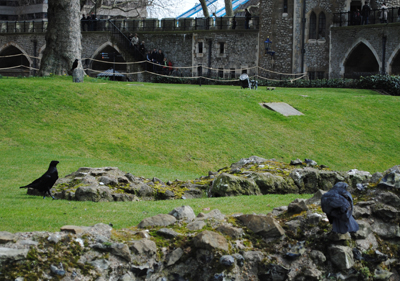
Known as the “Guardians of the Tower”, there are currently as many as eight ravens living at the tower, lodged in a space on the grass next to the Wakefield Tower.

Raven-pensLegend has it that there must be at least six ravens living at the Tower – should they leave, not only will the Tower fall but the kingdom as well (although we hasten to add that it’s been argued this tradition only started in the Victorian age and that there have been times when the numbers of ravens dropped below the required six, such as at the end of World War II when only one raven remained).

It was King Charles II who first ordered the ravens be protected – an order which must have upset Astronomer Royal John Flamsteed who complained after he found that the birds were interfering with the observation work he was carrying out from the Tower’s north-east turret. He later moved out to Greenwich.

The eight ravens who now live at the tower include Rocky, Merlin, Hugine and the latest additions Jubilee – given to the Tower last year to celebrate the Queen’s Diamond Jubilee – and Grip, named after Charles Dickens’ pet raven.

The birds are looked after by a team of four headed by the raven master, Chris Skaife, who each day feed them 170 grams (six ounces) of raw meat and special biscuits soaked in animal blood.

Not all ravens can cut the mustard to work at the Tower – one recent addition Pearl was apparently bullied by other ravens and had to be withdrawn. And while the birds have the feathers on one wing trimmed to stop them escaping to a new life on the wing, that hasn’t stopped some from doing so including Grog who took off in 1981 and was last seen outside an East End pub.

The oldest raven to ever live at the Tower was Jim Crow, who died at age of 44 in 1928.

WHERE: Tower of London (nearest Tube station Tower Hill); WHEN: 9am to 5.30pm, Tuesday to Saturday, 10am to 5.30pm Sunday to Monday; COST: £21.45 adults; £10.75 children under 15; £18.15 concessions; £57.20 for a family; WEBSITE: www.hrp.org.uk/toweroflondon/.  

Lost London – Monfichet’s Tower…

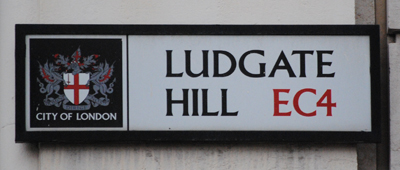
A relatively short-lived Norman fortification located on Ludgate Hill, this tower or ‘castle’ was probably built in the late 11th century and was one of several new fortress located in the city post 1066.

Ludgate-HillBelieved to have been built by Gilbert de Monfichet – a relative of King William the Conqueror who hailed from Rouen (and is believed to have been connected with Monfichet family of Stansted Monfichet in Essex), the tower apparently comprised a stone keep on a motte surrounded by ditches. It was located on Ludgate Hill near the city wall, to the north of Carter Lane, on what was then the western edge of the walled city.

First appearing in documents in the 1130s, it was apparently strengthened during a revolt against King Henry II in 1173-1174 but was eventually demolished in the 13th century (some accounts suggest it was King John who ordered its demolition in 1213, after Gilbert’s successor Richard was banished).

The site was given to the Dominican priory of Blackfriars in 1275 (there’s a suggestion that the tower was already in ruins by 1278 meaning it must have been at least partially demolished some time prior). Apparently some of the masonry from the tower was used in the priory’s construction.

Excavations in the 1980s revealed the remains of a ‘V’ shaped defensive ditch – interpreted as one of three defensive ditches which protected the tower – and rubbish and cess pits – interpreted as standing within what was the tower’s bailey.

LondonLife – Celebrating the 60th anniversary of Queen Elizabeth II’s coronation…

Regent-Street-turns-purple-to-celebrate-The-Queen’s-Coronation-

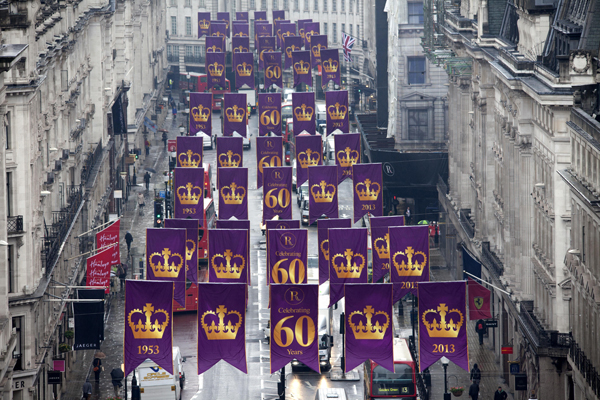
Regent Street is adorned with flags in celebration of the 60th anniversary of Queen Elizabeth II’s coronation, among the many ways in which London has been celebrating the occasion. The official anniversary was on Sunday – it was 2nd June, 1953, some 16 months after the 25-year-old Queen took the throne following the death of her father King George VI, that Queen Elizabeth II was crowned in Westminster Abbey. In celebrations yesterday, the King’s Troop Royal Horse Artillery fired a 41-gun salute in Green Park at midday followed an hour later by a 62-gun salute fired by the Honourable Artillery Company across the River Thames from the Tower of London. The Queen and other members of the royal family (along with some 2,000 guests) is attending a special service at Westminster Abbey today (for more on how the abbey is celebrating the event, see our earlier post here). More than 8,000 people attended the coronation which was watched by an estimated 27 million people across the country. PICTURE: RegentStreetOnline


Treasures of London – Coins at the Tower…

Coin2

In this special edition of Treasures of London, we’re taking a quick look at a new permanent exhibition which has opened at the Tower of London focusing on the 500 years it served as the Royal Mint.

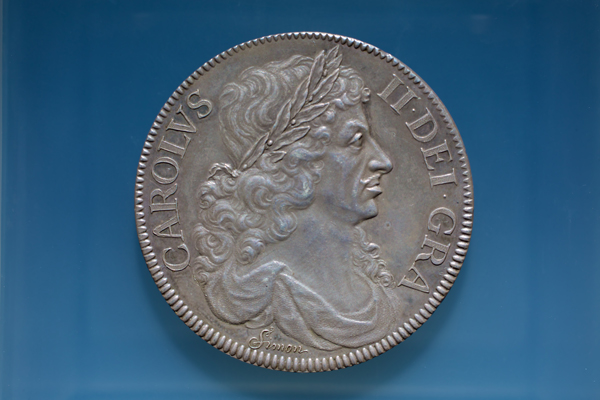
Opened in partnership with the Royal Mint Museum, the new exhibition, Coins and Kings: The Royal Mint at the Tower, features a series of rare coins and other coin-related paraphernalia, including a rare silver groat from the time of King Edward I (1279-1307), a gold “trial plate” dating from 1542 in the reign of King Henry VIII, and a Charles II petition crown dating from 1663 – pictured above, it was sent to King Charles II by engraver Thomas Simon as an example of his work (Simon never got the job and died of plague three years later).

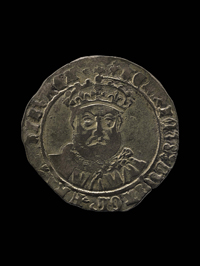
Coin1There’s also a silver ‘testoon’ from the reign of King Henry VIII (it bears a Holbein-style portrait of him) which has been debased – indeed, such was the state of coinage during his reign that the “silver” coins often contained more cheap metal, like copper, than silver so that as they wore down, the copper shone through earning the king the delightful nickname, ‘Old Coppernose’ (pictured right).

The tower was used as the country’s mint from about 1279 – when King Edward I moved the Royal Mint inside the Tower as part of his efforts to clean up England’s coinage – to 1812 – when the Royal Mint was relocated out of the Tower to a purpose-built premises on Tower Hill – and the exhibition focuses on five moments from its history.

They include a look at the efforts of Sir Isaac Newton, Warden (and later Master) of the Royal Mint, in tracking down forgers in the late 1600s (his rather zealous prosecutions of those creating forgeries, in particular one William Chaloner, is retold with aplomb in Thomas Levenson’s book Newton and the Counterfeiter), King Edward I’s harsh punishments for people who dared to tamper with his coinage, Queen Elizabeth I’s restoration of the coinage after her father, King Henry VIII’s meddling with the currency, and King Charles II’s rejection of Commonwealth money.

There’s a series of events to go with the exhibition’s opening including the change to see some of the coins up close and family activities (check out the Tower of London website – link below – for more details).

WHERE: Tower of London (nearest tube station Tower Hill); WHEN: 9am to 5.30pm, Tuesday to Saturday, 10am to 5.30pm Sunday to Monday; COST: £21.45 adults; £10.75 children under 15; £18.15 concessions; £57.20 for a family; WEBSITE: www.hrp.org.uk/toweroflondon/.  

PICTURES: Historic Royal Palaces/newsteam

Lost London – The King’s Wardrobe…

In the medieval period, the royal wardrobe – that is, the splendid robes and other clothes worn on state occasions – were kept at a range of different locations including the Tower of London and Westminster Abbey. In the 1360s, however, it moved to a more permanent location in what had been a house near Blackfriars priory.

King's-WardrobeSold to King Edward III by the executors of the will of Sir John Beauchamp, the house served as the key storage site for  royal clothes including not only those of the monarch but various people attached to the court such as the royal family, king’s ministers and Knights of the Garter.

The building, which was considerably extended over the years to include everything from a great hall and chapel to stables, was destroyed in the Great Fire of 1666 and the wardrobe was moved to another building in Buckingham Street although by this stage its importance had declined considerably (the last Master of the Wardrobe held office in the late 18th century).

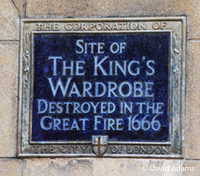
Its name lived on in that of the church St Andrew-by-the Wardrobe and that of the well-hidden and intimate Wardrobe Place (it’s located between St Andrew’s Hill and Addle Hill). There is a blue plaque which marks the site of the former building (pictured above).

Around London – Christmas at the Tower and Kew Gardens; Old Flo on display; African Diaspora on show at MoL Docklands; and, Mariko Mori at the Royal Academy…

Victorian-Christmas The Tower of London is going Victorian this Christmas with visitors able to experience some of what the Yuletide celebrations in the foreboding, much storied buildings were like in the mid-to-late 1800s. Visitors will be shown how many of the Christmas customs we now participate in each year – like writing cards, pulling crackers and the setting up of family Christmas trees – owe their origins to the Victorian era. The Yeoman Warders will be receiving a Victorian makeover and writer of the age – Charles Dickens – will be reciting some of his works before joining in a “raucous” lunch party with some of his fellow writers, artists and benefactors. It’s even rumoured that Queen Victoria and Prince Albert themselves may make an appearance (take that as a given). Bah! Humbug! A Very Merry Victorian Christmas runs from 27th until 31st December. The festivities will all be included in the usual admission price. For more, see www.hrp.org.uk. PICTURE: Nick Wilkinson/NewsTeam.

Kew Gardens are celebrating Christmas with a host of events including a “Twelve trees of Christmas” family trail. The trail, a map of which can be picked up as you enter, includes facts about trees along the route. Volunteer guides are also leading free tours of seasonal highlights and the Kew Christmas tree can be seen at Victoria Gate. Other festive treats at Kew include the chance to see Father Christmas in his grotto (until Sunday only) and a vintage carousel on the Kew Palace Lawn. Many of the Christmas-related events end on 6th January. See www.kew.org for more.

A display focusing on the history of Henry Moore’s sculpture, Draped Seated Woman (better known as Old Flo), has opened at the Museum of London Docklands. Henry Moore and the East End provides a glimpse into 1950s East London and looks at why public art was considered important at the time. It features some of the maquettes (scale models) Moore used in creating the piece. The exhibition was opened following a decision by the Mayor of Tower Hamlets, Lutfur Rahman, to sell Old Flo (now at the Yorkshire Sculpture Park) rather than display the artwork in a public space. The move is being contested by the Museum of London Docklands who have offered to put the work on public display. An online exhibition can be seen at www.museumoflondon.org.uk/oldflo and a ‘pop-up exhibition’ on Old Flo will be launched in January. The museum is also encouraging people to tweet their views about the selling of the sculpture under the hashtag #saveoldflo.

On Now: Take Another Look. Still at the Museum of London Docklands, this exhibition focuses on the visual representation of people from the African Diaspora who were living and working in Britain in the late 18th and early 19th century. The display of 17 exhibits in the London, Sugar and Slavery gallery features prints by artists including Thomas Rowlandson and George Cruikshank as well as newspaper cuttings, mostly dating from 1780-1833, which show black Britons in perhaps what were unexpected roles – soldiers, musicians and sportsmen – during what was the period in which the abolition of slavery occurred. There are a series of events planned around the exhibition which runs until 4th August. Entry is free. For more see www.museumoflondon.org.uk/Docklands/.

On Now: Mariko Mori: Rebirth. The first major museum exhibition of the New York-based Japanese artist Mariko Mori in London since 1998 has opened at the Royal Academy of Arts in Piccadilly. The exhibition features some of the artist’s most acclaimed works from the last 11 years, many of which have never before been seen in the UK, as well as works created just for the exhibition. Highlights include Tom Na H-iu, a five metre high glass monolith lit by hundreds of LED lights and connected back to the Institute for Cosmic Ray Research at the University of Tokyo; Transcircle, described as a “modern day Stonehenge”; and, Flatstone, an installation of “22 ceramic stones assembled to recreate an ancient shrine”. Runs until 17th February. Admission charge applies. For more, see www.royalacademy.org.uk.

LondonLife – A new crown for King Henry VIII…

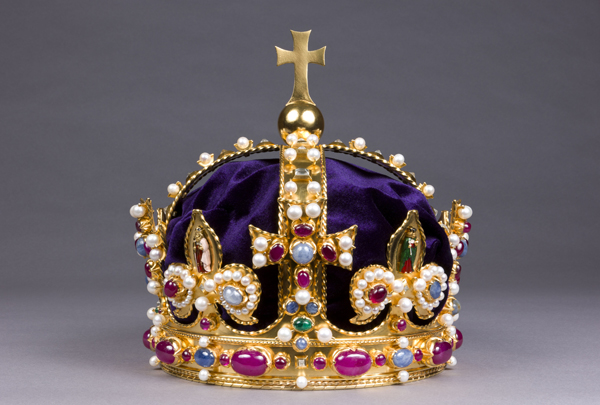
A recreation of King Henry VIII’s imperial crown, destroyed after the English Civil War, has gone on show in the Chapel Royal at Hampton Court Palace. Originally created for either King Henry VIII or his father, King Henry VII, the crown was worn at the coronations of Henry VIII’s children and possibly the king’s own as well as at Hampton Court Palace during major liturgical and court ceremonies. It was subsequently used by his successors down to King Charles I before being melted down by the Commonwealth Government in 1649 at the Tower of London. The replica crown, which is being displayed in the Royal Pew – allowing visitors access to the balcony in the chapel for the first time in seven years, is the result of detailed historical research by Dr Kent Rawlinson, curator at Hampton Court Palace, and was made by Crown Jeweller Harry Collins and his master craftsmen. Hand-crafted in silver gilt, it features 344 jewels including pearls and precious and semi-precious stones. Five enameled figures are set within five fleur-de-lis – the figures represent the Virgin and Child, St George and English kings believed to be St Edmund, St Edward the Confessor and King Henry VI (King Henry VIII had the latter three figures added to the crown to underline the political and religious authority of the Crown). For more on Hampton Court Palace, see www.hrp.org.uk/HamptonCourtPalace/PICTURE: HRP/Newsteam

LondonLife – The Olympic Torch Relay (so far)…

The Olympic Torch Relay arrived in London last Friday night and has been moving around the capital ever since. Here are some of the highlights so far (all images are courtesy of LOCOG)…

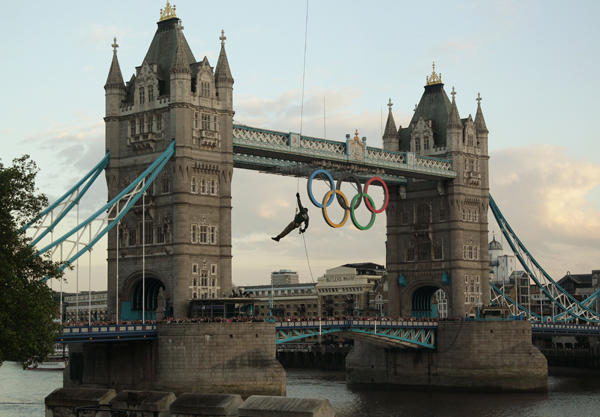
Day 63 (20th July): A Royal Marine, believed to be Martin Williams, is carrying the Olympic Flame as he abseils from a helicopter into the grounds of the Tower of London.

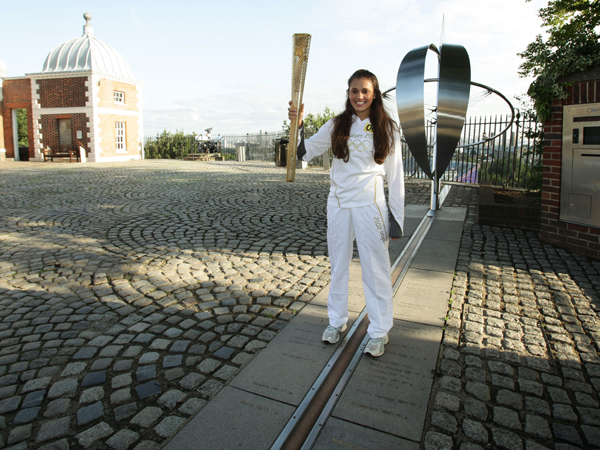
Day 64 (21st July): Swimmer Natasha Sinha holds the Olympic Flame on the Meridian Time Line outside the Royal Observatory in Greenwich.

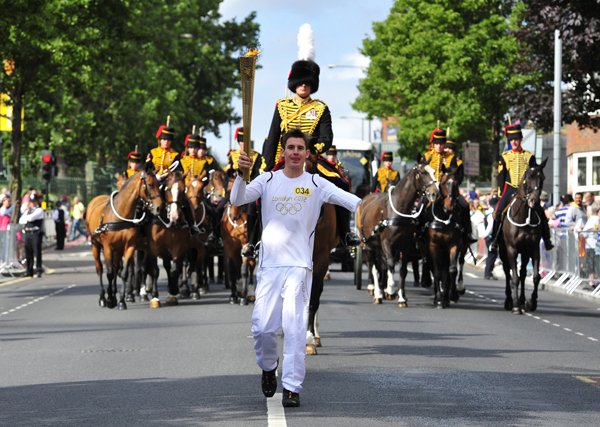
Jaco-Albert Van Gass carries the Olympic Flame through Greenwich.

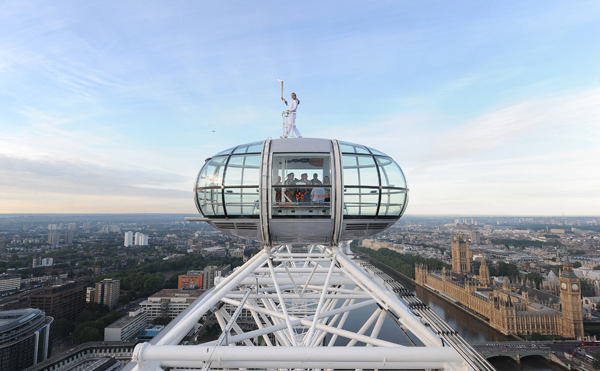
Day 65 (22nd July): Student explorer Amelia Hempleman-Adams poses with the Olympic Flame on top of a London Eye pod.

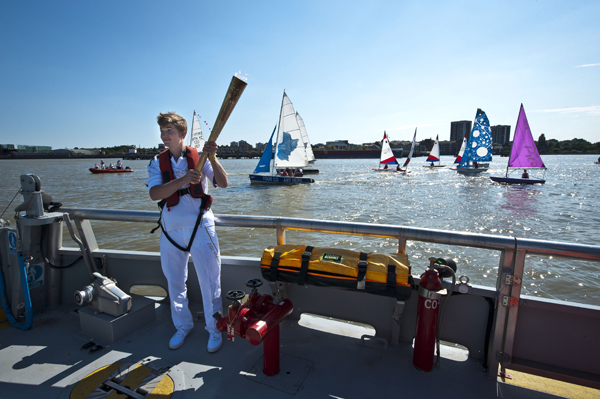
Sailor Aaron Reynolds carries the Olympic Flame on a London Fire Brigade Boat.

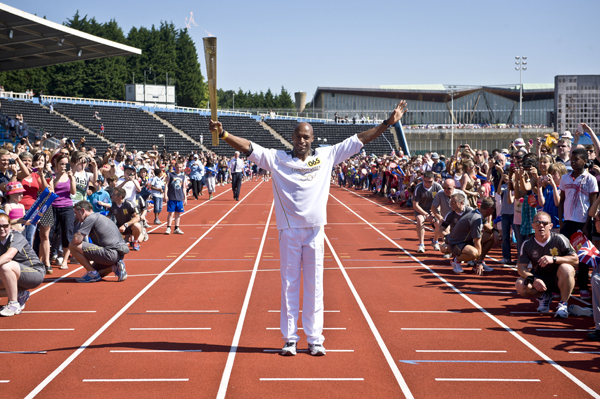
Day 66 (23rd July): Sprinter Marlon Devonish carries the Olympic Flame at Crystal Palace stadium in south London.

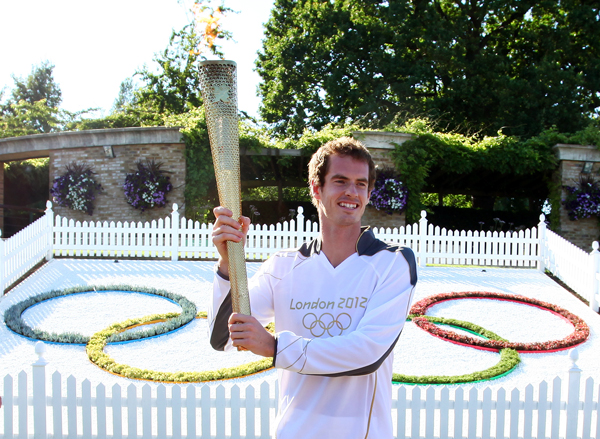
Tennis player Andy Murray carries the Olympic Flame at Wimbledon.

For more on the Torch Relay, see www.london2012.com/torch-relay/

ALL PICTURES: LOCOG.

Around London: Olympic Torch Relay hits London; mascots pop-up all over the city; and Shakespeare at the British Museum…

• The Olympic Torch Relay arrives in London tomorrow night before working its way around all of the city’s 33 boroughs and reaching the Olympic Stadium for the Opening Ceremony next Friday.  The torch will arrive in the city by helicopter from Guildford tomorrow night and then be abseiled into the Tower of London where it will spend the night ensconced with the Olympic medals. The relay will travel 200 miles over the next week, carried by more than 980 torchbearers. The route is as follows:

  • Saturday, 21st July – Greenwich via Newham, Tower Hamlets and Hackney to Waltham Forest (highlights include a visit to the Cutty Sark);
  • Sunday, 22nd July – Redbridge via Barking & Dagenham and Havering to Bexley (highlights include a ride on the London Eye and a crossing of the Thames);
  • Monday, 23rd July – Lewisham via Bromley, Croydon, Sutton and Merton to Wandsworth (highlights include a visit to a live filming of Eastenders);
  • Tuesday, 24th July – Kingston via Richmond, Hounslow, Hillingdon and Denham to Ealing (highlights include a visit to Kew Gardens);
  • Wednesday, 25th July – Harrow via Brent, Barnet and Enfield to Haringey (highlights include a visit to Wembley Arena);
  • Thursday, 26th July – Camden via Islington, the City of London, Southwark, Lambeth, Wandsworth, Kensington & Chelsea and Hammersmith & Fulham  to Westminster (the many landmarks to be visited include St Paul’s Cathedral, Shakespeare’s Globe, Trafalgar Square, Buckingham Palace and Hyde Park);
  • Friday, 27th July – From Hampton Court Palace (where it will be taken into the maze) on board Gloriana via the Thames to Olympic Park for the Opening Ceremony.

The 70 day torch relay, which kicked off on 19th May, will have travelled a total distance of about 8,000 miles and have involved 8,000 torchbearers by the time it reaches its end. LOCOG and Transport for London have advised people to see the relay at a location closest to their home given the expected crowds. For more detailed route information, see www.london2012.com/torch-relay/route/. PICTURE: LOCOG

Still talking all things Olympics and London’s largest ever ‘pop up’ shop – where you can buy Olympic merchandise – was officially opened by multiple gold medalist Sir Steve Redgrave in Hyde Park last week. The shop, located on Rotten Row, will be the site of special athlete visits during the Games and visitors can have their photo taken with the Olympic Torch.

• Meanwhile, life-sized versions of the Olympic mascot Wenlock and Paralympic mascot Mandeville are popping up at some of London’s key tourist locations. The 83 two metre tall sculptures capture various elements of life in London with incarnations including a Beefeater, a giant red phone box and a replica of Big Ben. The figures can be found on the routes of Stroll, six new discovery trails designed to help both tourists and Londoners get more out of the city. A QR code on the bottom of each of the sculptures directs smartphone users to further information about the discovery trails. The discovery trails are part of the Mayor of London Presents, a city-wide programme featuring free events, shows and activities. For more on what’s happening in your area, see www.molpresents.com. Some of these events are also being run as part of the Festival of London 2012. For more on this, see http://festival.london2012.com.

• On Now: Shakespeare: staging the world. Part of the World Shakespeare Festival taking place in London, this exhibition at the British Museum looks at the then emerging role of London as a “world city” as interpreted through Shakespeare’s plays and examines the role the playhouse performed in this. The museum has collaborated with the Royal Shakespeare Company to produce the exhibition which features more than 190 objects including paintings, jewels and rare manuscripts. These include the Ides of March coin, a Roman gold aureus commemorating the assassination of Julius Caesar (Julius Caesar), the Lyte Jewel, presented to Thomas Lyte in 1610 in thanks for his work in tracing King James I’s lineage back through Banquo (Macbeth), and a 1610 bird’s-eye view of Venice (Othello and The Merchant of Venice). Runs until 25th November. Admission charge applies. For more, see www.britishmuseum.org.

Celebrating the Diamond Jubilee with 10 royal London locations – 9. Royal chapels…

Palaces aside, the Queen also owns a series of chapels – the Chapels Royal – in London which, although not as grand as Westminster Abbey, have each played an important role in the history of the monarchy. 

The term Chapel Royal originally referred to a group of priests and singers dedicated to serving the Sovereign’s personal spiritual needs and as such would follow the monarch around the country. It was in Stuart times that they became more settled establishments with the two main Chapels Royal – the Chapel Royal and the Queen’s Chapel – located in St James’s Palace.

• The Chapel Royal, St James’s Palace. Constructed by King Henry VIII, the chapel was decorated by Hans Holbein the Younger in honor of the king’s (short) marriage to Anne of Cleves. Queen Mary I’s heart is said to be buried beneath the choir stalls and it was here that Queen Elizabeth I apparently prayed waiting for news of the progress of the Spanish Armada. King Charles I took the Sacrament of Holy Communion here before his execution in 1649 and the chapel was where Queen Victoria married Prince Albert (her marriage certificate still hangs on the wall). In more recent times, the coffin of Diana, Princess of Wales, was placed before the altar so family and friends could pay their respects before her 1997 funeral. Among the composers and organists associated with the chapel are Thomas Tallis, William Byrd, Henry Purcell and George Frideric Handel. The chapel is not open to the public except for services.

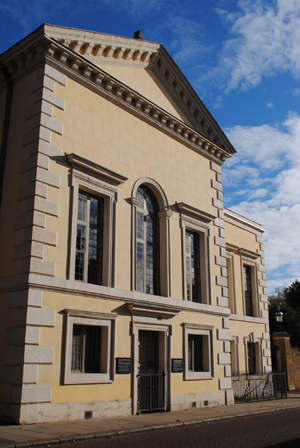
• The Queen’s Chapel, St James’ Palace (pictured right). Now located outside the palace walls, this chapel was built by King James I for the Catholic Henrietta Maria, the bride of his son, then Prince Charles (later King Charles I). Designed by Inigo Jones, Grinling Gibbons and Sir Christopher Wren were also involved in its creation. The chapel was used by Henrietta Maria until the Civil War and later became the home of the Danish Church in London. The chapel is not open to the public except for services.For more on this chapel or the Chapel Royal at St James’s Palace, follow this link.

• The Queen’s Chapel of the Savoy. Built in the Middle Ages to serve the now long gone Savoy Palace, London home of Count Peter of Savoy (uncle to King Henry III’s wife, Eleanor of Provence, the original building was destroyed in the Peasant’s Revolt of 1381. The current building, located in Savoy Hill, off the Strand, was built on the orders of King Henry VII in the late 15th and early 16th century to serve the hospital he founded on the site of the palace. The chapel since served many other congregations – including a German Lutheran congregation – but remains royal property via the Duchy of Lancaster, which is held in trust for the Sovereign and used to provide an income for the British monarch. It is officially the Chapel of the Royal Victorian Order. For more, see www.duchyoflancaster.co.uk/duties-of-the-duchy/the-queens-chapel-of-the-savoy/.

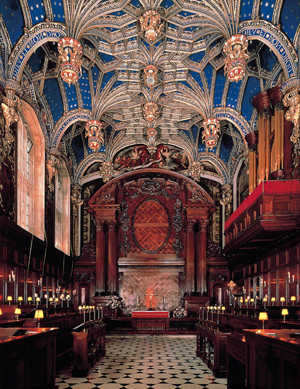
• Chapel Royal, Hampton Court Palace (pictured right). There has been a chapel here since the Knights Hospitallers occupied the site in the 13th century but it was Cardinal Wolsey who built the chapel to its present dimensions after acquiring the property in 1518. The current building, however, dates from the later ownership of King Henry VIII – Wolsey surrendered the property to him when he fell from favour – and further works in the eighteenth and nineteenth centuries. Many subsequent monarchs have worshipped here. The chapel, with its stunning ceiling, is open to the public when visiting Hampton Court Palace. For more, see www.chapelroyal.org. PICTURE: Historic Royal Palaces/newsteam.co.uk

• The Chapel Royal of St Peter ad Vincula, Tower of London. Originally a parish church, this was incorporated into the walls of the Tower in the reign of King Henry III. It was subsequently rebuilt at least twice – in the reign of King Edward I and King Henry VIII – and is home to the graves of important personages executed at the Tower including Henry VIII’s one-time wives, Anne Boleyn and Catherine Howard as well as Jane Grey, the nine day queen, and Sir Thomas More and Bishop John Fisher. The chapel can be accessed during a Yeoman Warder’s tour of the Tower of London. For more, including details of an appeal for its restoration, see www.hrp.org.uk/TowerOfLondon/stories/thechapelproject.

• Chapel Royal of St John the Evangelist, Tower of London. Located within the White Tower, this beautiful chapel – arguably the oldest church in London – dates back to the construction of the tower by King William the Conqueror the late 11th century and remains one of the best preserved examples of Anglo-Norman architecture in England. King Henry III added stained glass windows but for much of its later history the chapel was used for records storage. Tradition records that King Henry VII’s wife, Elizabeth of York, was laid in state here following her death in childbirth and that it was here Queen Mary was betrothed by proxy to Philip of Spain. This can be visited as part of a visit to the Tower of London. For more, see www.hrp.org.uk/TowerOfLondon/Sightsandstories/Prisoners/Towers/ChapelofStJohns

For more on churches in London, check out Stephen Millar’s London’s City Churches
and Stephen Humphrey’s London’s Churches and Cathedrals: A Guide to London’s Most Historic Churches and Cathedrals, Leigh Hatt’s London’s 100 Best Churches: An Illustrated Guide or the Pevsner Architectural Guide London: City Churches.

Lost London – The Lion Tower, Tower of London

Built as a barbican by King Edward I around 1275, the Lion Tower took its name from the fact that it was later used to house the Royal Menagerie.

Visitors to the Tower in the late 13th century would have crossed a causeway and drawbridge over the moat to reach the semi-circular Lion Tower before then heading on, via another causeway to the Middle Tower (the place where you now enter).

It would seem that the Royal Menagerie – which included lions, leopards, mastiffs and other assorted animals – was housed here by 1335 (there is a document dated three years later which refers to the ‘Lion Turret’) and it is known for certain that it was housed here from the 16th century until the menagerie was disbanded in the 1830s and the animals removed, some of which were presented to the Zoological Society of London.

The animals were kept in two stories of wooden ‘houses’ set around the inside face of the tower – these were refurbished during the reign of King James I, an exercise yard was added on land reclaimed from the moat and an improved viewing platform from which to watch the lions was added (people were charged a small fee to come and view the animals). Modifications were again carried out in the 1770s.

The Lion Tower and the surrounding complex of buildings were finally demolished in 1852 to make way for a new ticket office. The foundations of the tower can now be seen as you enter the tower.

For more on the Royal Menagerie, see our previous entry here.

PICTURE: A Yeoman Warder with lifesize wire lion sculptures commissioned for the ‘Royal Beasts’ exhibition at the Tower of London. They are located on the site of the Lion Tower. Courtesy  Historic Royal Palaces/newsteam 

Celebrating the Diamond Jubilee with 10 royal London locations – 8. Golden Jubilee memorials…

UPDATED: Last week we looked at some of the monuments marking Queen Elizabeth II’s Silver Jubilee in London, so this week we’re taking a look at some of the monuments marking the Queen’s Golden Jubilee celebrating what were then 50 years on the throne in 2002.

The year  was marked with celebrations, including a Golden Jubilee Weekend, not unlike that experienced in London over last weekend, which featured public concerts in Buckingham Palace gardens including the ‘Party at the Palace’ pop concert, flyovers including one by a Concorde with the Red Arrows, a National Thanksgiving Service at St Paul’s Cathedral and a Jubilee Procession down The Mall.

In addition, the celebrations included the first ever parade of all the Queen’s bodyguards – this 300 strong group featured detachments from the Gentlemen at Arms (created by King Henry VIII in 1509), the Yeoman of the Guard (created by King Henry VII in 1485) and Yeoman Warders (based at the Tower of London).

As with the Silver Jubilee, the Queen more than 70 towns in the UK and visited countries overseas including Jamaica, New Zealand, Australia and Canada.

Among the monuments in London marking the Golden Jubilee are:

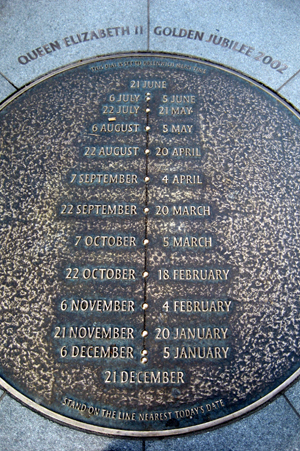
• Golden Jubilee Sundial, Old Palace Yard (pictured). Designed by Quentin Newark, this was Parliament’s gift to the Queen and was installed in 2002 as part of the yard’s revamp. The dial, which is ‘set’ to Greenwich Mean Time and can be found just outside the eastern end of Westminster Abbey, features a quote in its outer circle from William Shakespeare’s play, Henry VI, part III: “To carve out dials quaintly, point by point, thereby to see the minutes how they run: how many makes the hour full complete, how many hours brings about the day, how many days will finish up the year, how many years a mortal man may live.”

• King’s Stairs Memorial Stone, Bermondsey. This memorial stone located on the edge of King’s Stairs Gardens by the Thames in Bermondsey was first installed to mark the Queen’s Silver Jubilee. In 2002, the other side of the stone was inscribed to mark the Golden Jubilee and unveiled in the presence of the Earl and Countess of Wessex.

• Dovehouse Green, Royal Borough of Kensington and Chelsea. We omitted to mention this last week – located on an old burial ground granted by Sir Hans Sloane in 1733,  Dovehouse Green was laid out in 1977 to commemorate the Silver Jubilee and the Golden Jubilee of the Chelsea Society and was refurbished in 2002 to mark the Queen’s Golden Jubilee (it reopened in 2003).

• Great Ormond Street Hospital. Not strictly a Golden Jubilee memorial, there is a plaque close to the hospital’s main entrance which commemorates the Queen’s visit to the hospital to mark its 150th anniversary in 2002, “Her Majesty’s Golden Jubilee Year”.

• Golden Jubilee Footbridges. One memorial accidentally left off the list initially was the Golden Jubilee Bridges which run along either side of the Hungerford Bridge, between Westminster and Waterloo Bridges. The new four metre wide footbridges, which feature a particularly complex design, were named the Golden Jubilee Footbridges in honor of the Queen’s Golden Jubilee. They replaced an earlier – and somewhat notorious – footbridge which cantilevered off the side of the railway bridge.

PICTURE: Wallyg

Around London – Crown Jewels polished for Diamond Jubilee; Diana’s dresses at Kensington Palace; a plaque for Ziggy Stardust; and At Home with the World…

• A revamped Crown Jewels display opens today at the Tower of London to mark the Diamond Jubilee of Queen Elizabeth II. The new display features graphics, music and newly restored film footage and will focus on the coronation ceremony as its central theme, exploring how the regalia are used in the ceremony. The regalia – which includes some of the most extraordinary diamonds in the world such as the Star of Africa and Koh-i-Nur – is being displayed in the order in which it is used at the coronation ceremony. The Crown Jewels have been on show to the public at the Tower of London since at least 1661 after they were remade for King Charles II’s coronation. The previous collection had been largely destroyed in the Civil War although some pieces survived including a gilt silver spoon probably made for King Henry II or King Richard I (the “Lionheart”). For more information, see www.hrp.org.uk/TowerOfLondon/.

Five dresses worn by Diana, Princess of Wales, have gone on display at Kensington Palace  which re-opened to the public this week following a £12 million overhaul. The five dresses include a black silk taffeta gown (designed by Emanuel) which Diana wore to a fundraising event at the Goldsmith’s Hall in 1981 – her first official engagement with Prince Charles as well as a formal dinner dress of ivory silk (Catherine Walker) created for a State Banquet for the King and Queen of Malaysia in 1993 and a black ribbed silk shift evening dress (Gianni Versace) worn to the London premiere of Apollo 13 in Hammersmith in 1995. For more on the revamp of the palace see our earlier post. Or visit www.hrp.org.uk/KensingtonPalace/.

• A plaque commemorating the site where the iconic image for the cover of David Bowie’s 1972 album The Rise and Fall of Ziggy Stardust and the Spiders of Mars was photographed has been unveiled in the West End. The plaque at the somewhat innocuous site at 23 Heddon Street, just off Regent Street, was installed by the Crown Estate and unveiled this week by Gary Kemp of Spandau Ballet. The image for the album cover was shot by the late photographer Brian Ward who managed to persuade Bowie to step outside the ‘studio’ space he had rented upstairs despite the fact it was a cold, wet January night.

• On Now: At Home with the World. This exhibition at the Geoffrye Museum explores the cosmopolitan nature of London’s homes over the past 400 years and looks at how diverse cultures have helped shaped the homes – covering everything from Chinese porcelain and the tea craze of the 1700s to the use of Islamic and Indian patterns in the 1800s, the popularity of Scandinavian and American design in the 1900s and the globalism of today. The period rooms on show at the museum have been reinterpreted to highlight the international influences. This is one of a series of Stories of the World: London exhibitions taking place across the city which are exploring four aspects of life – home, identity, journeys and place – as part of the London 2012 Cultural Olympiad program. Runs until 9th September. Entry is free. For more, see www.geffrye-museum.org.uk.

LondonLife – The Ceremony of the Dues…

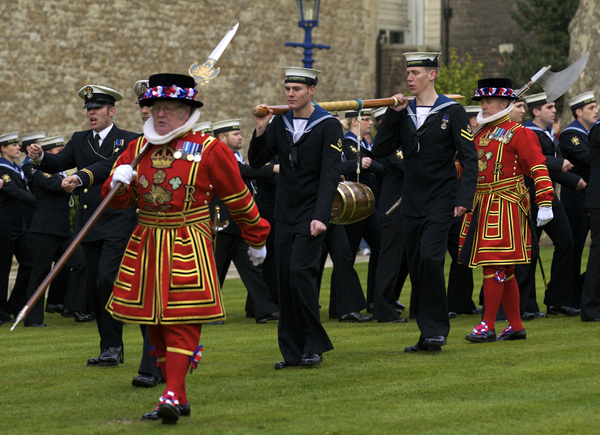
The Constable of the Tower of London, General Lord Richard Dannatt, was presented with a barrel of wine in the Ceremony of the Constable’s Dues by the commander and crew of the Royal Navy destroyer, the HMS Liverpool,  last Saturday. The annual ceremony dates back to the 14th century and relates to the right of the tower’s constable to demand tolls from vessels on the Thames on behalf of the king. Previous offerings have included  barrels of rum, oysters, mussels and cockles. The HMS Liverpool, commanded by Colin N O Williams, was berthed at West India Docks before the ceremony and the wine escorted to the Tower where, after being challenged by Yeoman Warders it was delivered to the constable at the Queen’s House. The ship is to be decommissioned in spring after 30 years of service in which it saw service in Iraq, the Caribbean and during the recent Libyan conflict. For more on the Tower of London, see www.hrp.org.uk/TowerOfLondon/

PICTURE: Courtesy of Historic Royal Palaces

Exploring London’s 10 most popular posts for 2011 – Numbers 10 and 9…

As we approach the end of the year, we’re taking a look back at our 10 most popular posts for 2011. We start the countdown with numbers 10 and 9…

10. LondonLife – The Royal Menageriein which, inspired by what was a new exhibition at the Tower of London, we take at the Royal Menagerie kept there by England’s monarchs for more than 600 years;

9. Treasures of London – Admiral Lord Nelson’s coat: part of a series looking at some of the many, many ‘treasures’ of London, this piece focused on the coat which Admiral Lord Nelson when he was fatally shot aboard the HMS Victory during the Battle of Trafalgar and which can now be seen at the National Maritime Museum in Greenwich (complete with bullet hole).

Stay tuned by numbers 8 and 7 tomorrow. We love to hear from you if there was a particular post that was your favorite. Leave your comment below…

10 curiously named churches of London – 1. St Andrew-by-the-Wardrobe

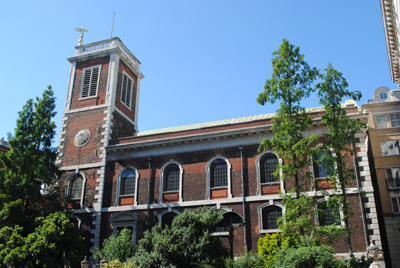
Look a little deeper and you’ll find there’s often a fascinating story behind many of London’s seemingly odd place names. Churches are no exception and in this new series we’re looking at some of the stories behind the name. First up, it’s the church of St Andrew-by-the-Wardrobe, a rather austere-looking church which looms up over Queen Victoria Street.

While the present church largely dates from after World War II – it was bombed during the Blitz and only the outer walls remain of what was there before (the previous church was itself a rebuild to the designs of Sir Christopher Wren after an earlier version was burnt down in the Great Fire of 1666) – there has apparently been a church on the site since at least the 12th century. Indeed, in the 13th century it was associated with the then royal residence known as Baynard’s Castle.

The church’s rather unusual name owes its origins to King Edward III’s decision in 1361 to move the Royal Wardrobe – which included his state robes and other valuables – from the Tower of London to a new building which lay near to the church (there’s a plaque in nearby Wardrobe Place marking the former location of the King’s Wardrobe which also burnt down in the Great Fire and was subsequently relocated). Hence St Andrew-by-the Wardrobe.

While the interior of the church is a complete reconstruction of Wren’s original, it does still boast some early treasures including  an original pulpit as well as a font and cover of Wren’s period (these come from the now long gone church of St Matthew Friday Street), a figure of St Andrew dating from about 1600 and another of St Ann (mother of Mary), who is holding her daughter who is in turn holding Jesus, dating from about a century earlier. There’s also a royal coat of arms – dating from the Stuart period – which originally came from St Olave’s Old Jewry.

Among the most prominent residents in the church’s parish was the playwright William Shakespeare (there’s a rather odd oak and limewood memorial to him and a contemporary composer, singer and musician, John Dowland – who was  buried in the churchyard, inside). Another Shakespearian contemporary, Ben Jonson, also apparently lived in the parish. The church also has links with with the Mercers, Apothecaries and Blacksmiths livery companies.

Earlier this year St Andrew-by-the-Wardrobe, which is a sister church to St James Garlickhythe (another unusually named church), celebrated 50 years since its post war reopening in 1961.

WHERE: Access is via St Andrew’s Hill or Queen Victoria Street (nearest Tube stations are St Paul’s and Mansion House). WHEN: The church building and the Chapel of St Ann are normally open for visitors between 10am and 4pm weekdays while the nave is open on Fridays from 11am to 3pm (check with the church before going); COST: Free; WEBSITE: www.standrewbythewardrobe.net.

The Royal Parks – 7. Richmond Park

Covering almost 1,000 hectares, Richmond Park, located by the Thames in the city’s south-west, is the largest of the Royal Parks. We have talked about some of Richmond Park’s history in an earlier post, but here we’ll give a little more detail.

The park’s association with royalty goes back at least to the time of Edward I, who ruled in the late 13th and early 14th century, when it was part of the Manor of Sheen.

It was King Henry VIII who renamed the manor Richmond (after one he possessed in Yorkshire) but it was King Charles I to whom the park owes its existence as we know it.

Charles, who had brought the court to Richmond in 1625 to escape the plague, enclosed the park – then farmland and pastures – in 1637 with eight miles of walls (these still remain, albeit having been repaired) and kept 2,000 red and fallow deer inside. The move didn’t met with universal approval from his subjects but he did pay compensation and eventually give people a right of way and allow them to collect firewood after complaints.

Features within the park – which still contains 650 Red and fallow deer (don’t get too close!) – include King Henry’s mound which features a protected, although tiny, view of St Paul’s Cathedral in the city 12 miles distant – it’s said by some that it was here where King Henry VIII watched for fireworks to be set off at the Tower of London indicating Anne Boleyn had been beheaded although the truth of that remains lost to history (others say it was here he watched hunting parties in the park – perhaps more likely).

The park is also home to White Lodge – it was a hunting lodge built for King George I and is now The Royal Ballet Lower School (complete with ballet museum) – and Pembroke Lodge – this house with stunning views overlooking the Thames Valley, now a restaurant, was once home to Prime Minister Lord John Russell and later the childhood home of his grandson, Nobel Prize-winning philosopher and mathematician Bertrand Russell.

More recently created is the Isabella Plantation – a woodland garden created largely in the 1950s by George Thomson , then park superintendent, his head gardener, Wally Milleron, an area once known as The Sleyt or Isabella Slade. The garden is well worth a visit at any time of year, having been specifically designed to be interesting all year round.

Richmond Park also features a lake divided in two by a causeway – as so known as Pen Ponds – which was dug in 1746 and remains a good place to see waterbirds.

WHERE: The park is located south of the Thames-side village of Richmond (nearest tube is Richmond). WHEN: 7am in summer (7.30am in winter) to dusk; COST: Free to enter; WEBSITE:www.royalparks.org.uk/parks/richmond_park/

Famous Londoners – Simon of Sudbury

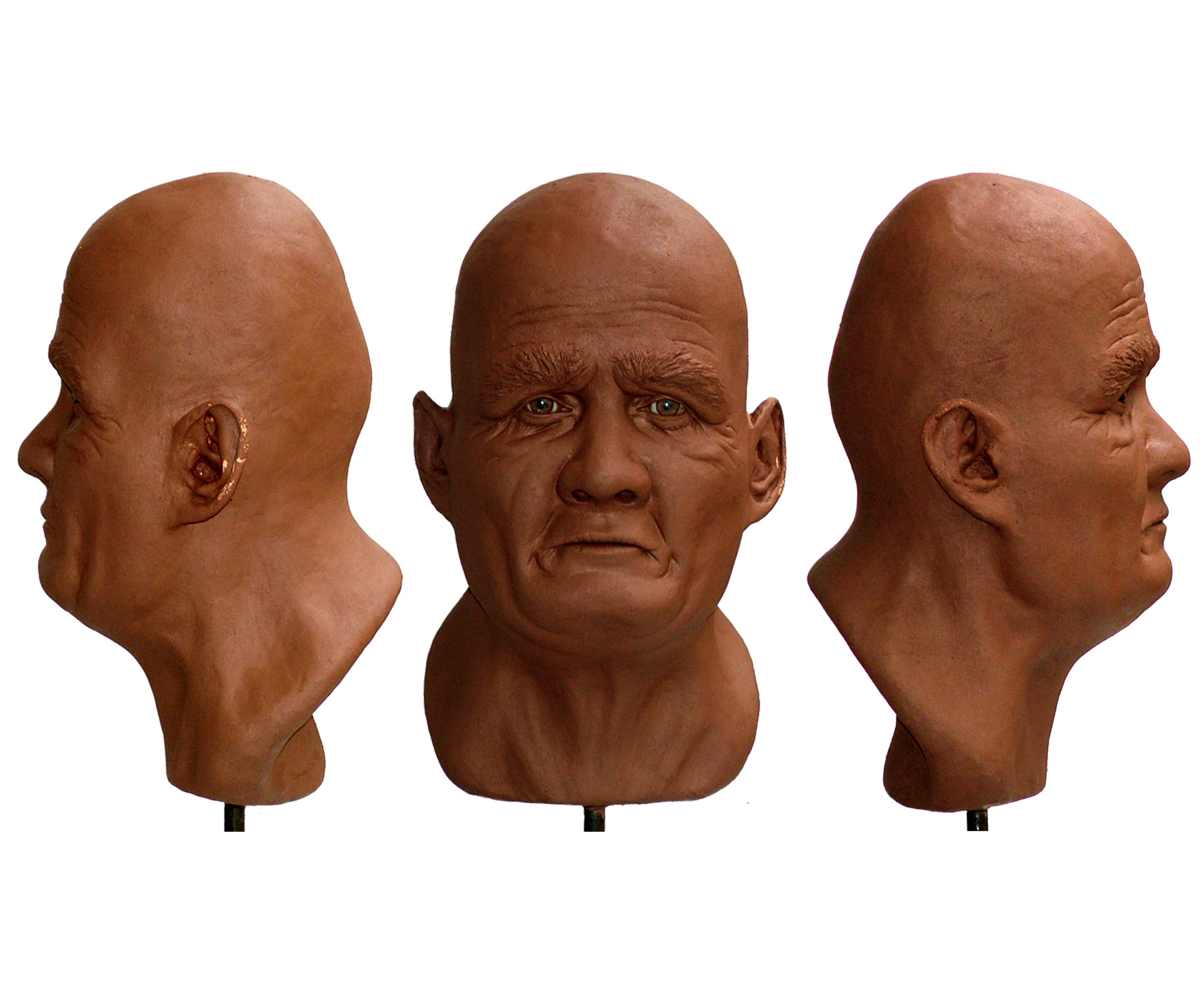
Recently making news headlines thanks to the work of Adrienne Barker of the University of Dundee in reconstructing his face, Simon of Sudbury wasn’t born in London and, in fact, spent much of his early life elsewhere. But, as Bishop of London and Archbishop of Canterbury, he was a key figure in the 14th century city and it was in London that he eventually met his grisly death during the Peasant’s Revolt.

Simon Theobold was born around 1316 – the son of a wealthy Norfolk merchant – and, while details of his early life are scant, it has been suggested he studied at Cambridge before eventually entering the service of William Bateman, the Bishop of Norwich. He apparently became caught in the middle of a dispute between the bishop and the Abbot of Bury St Edmunds (the details of which we don’t have time to get into here) and it was this which is said to have led to the issuing of a royal order for his arrest, a move which forced him to flee England for the papal court at Avignon.

He quickly came to the attention of the popes and took on an official role, the reward for which was the income from various positions in the English church including Chancellor of Salisbury. In 1356, Pope Innocent VI sent him on a peace mission to King Edward III and it was during this mission that he came to the attention of the king. Having never been formally outlawed, he was apparently forgiven his earlier crimes and was soon acting on behalf of the king including at the Papal court.

In 1361, Simon was made Bishop of London and spent the next 10 years in the role, as well as continuing to act for the king, notably as a diplomat.

In 1375 following the death of incumbent William Whittelsey, he was elevated to the position of Archbishop of Canterbury. His time as archbishop was somewhat troubled – as well as facing accusations of being too close to the king, he also faced criticism over his treatment of Bible translator John Wycliffe – but it was his role in secular politics which led to his demise.

Following the accession of King Richard II in 1377, in 1380 Simon was appointed chancellor, a position which meant he bore the ultimate responsibility for the imposition of an extremely unpopular new poll tax. In 1381, there were calls for his death at the outbreak of rebellion in Kent, notably when the rebels entered Canterbury Cathedral. But as the crisis now known as the Peasant’s Revolt gained momentum, Sudbury remained with the king in the Tower of London where he apparently counselled a hard line.

King Richard II when to parley with the traitors at Mile End on 14th June and there apparently indicated that action would be taken against traitors around him (Wat Tyler was killed when the king again met the rebels, this time at Smithfield, the following day). A group of rebels subsequently stormed the tower and dragged out Sudbury and the treasurer, Sir Robert Hales. Taken to Tower Hill, they were there beheaded. Sudbury’s head, which apparently had a skullcap nailed to his skull, was impaled on a lance and put on display over London Bridge. His body was buried in Canterbury Cathedral.

The skull, meanwhile, was apparently taken down by a Sudbury man and taken back to his home town where it was kept at St Gregory’s Church. Some 630 years later, following an approach by Sudbury locals, forensic artist Adrienne Barker from the University of Dundee was asked to recontruct Simon’s head.

Following some CT scans of the skull, Barker – who carried out the work as part of her MSc Forensic Art studies under the tutelage of renowned facial reconstruction expert Professor Caroline Wilkinson – used state-of-the-art reconstruction techniques to recreate Sudbury’s facial features and complete a series of 3-D bronze-resin casts of his head. The models, one of which will be on permanent display at St Gregory’s Church in Sudbury alongside Simon’s skull, were unveiled in September.

PICTURE: University of Dundee

Treasures of London – The White Tower

It’s one of London’s most famous landmarks and, having just undergone a three year, £2 million restoration, we thought it was time to take a look at the origins of the White Tower.
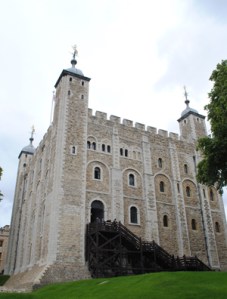
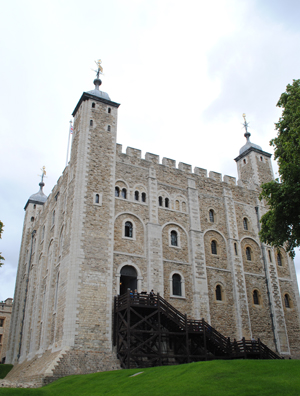
Now the keep of the Tower of London, the White Tower was first built by the Norman King William the Conqueror following his defeat of Saxon King Harold Godwinson and the cream of the Saxon army at the Battle of Hastings in 1066.

Following his coronation at Westminster Abbey on Christmas Day, King William then withdrew to Barking Abbey while his men built several temporary strongholds in the city to ensure it wouldn’t cause any trouble – this included an earth and timber keep standing on an artificial mound in the south-east corner of the city’s Roman-era walls.

The White Tower, a permanent structure, replaced this and although the exact date its construction started is unknown, building – under the watchful eye of Gundulf, the Bishop of Rochester, was well underway by the mid-1070s. While the labourers were English, the masons in charge of the building were Norman and then even used some Caen stone imported from William’s homeland (along with Kentish ragstone). By 1097 the tower was complete.

Primarily built as a fortress rather than for comfort, the size of the Tower was intimidating and, at 27.5 metres tall, it would have dominated the skyline for miles. Initial defences surrounding the White Tower included the Roman walls and two ditches although in later years outer walls were added to create the massive fortifications and series of towers one encounters at the site today.

The tower earned its moniker, the White Tower, from the whitewash used on its walls during the reign of King Henry II. The caps on the four turrets which stand at each corner of the tower were originally conical but were replaced with the current onion-shaped domes in the 1500s (the round tower was once home to the Royal Observatory before it moved out to Greenwich). The White Tower’s large external windows are also more modern innovations, these were added in the 1600s by Sir Christopher Wren.

The original entrance to the White Tower was on the first floor, reached by a wooden staircase (that could be removed if necessary), much as it is today while, for security reasons, the internal stone spiral staircase was placed as far from this entry as possible in the north-east turret. A stone forebuilding was later added during the reign of King Henry II but was later demolished.

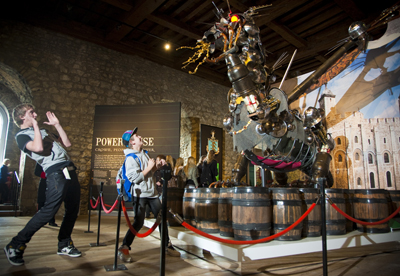
Inside, accommodation for the king was provided on the second floor – it originally had a gallery above but an extra floor – still there today – was later added. Accommodation for the Tower’s constable was probably on the first floor. Both floors were divided in two – with a large hall on one side and smaller apartments on the other. These rooms now house displays on the Tower’s history – at the present these include the Royal Armouries’ exhibition ‘Power House’.

The White Tower is also home to the Chapel of St John the Evangelist which, made from Caen stone, still looks much the same as it did in Norman times. It was used by the royal family when in residence at the tower but by the reign of King Charles II had become a store for state records. These were removed in 1857. Among some of the events which took place here was the lying in state of Queen Elizabeth of York, wife to King Henry VII, after her death in 1503, and the betrothal of Queen Mary I to Philip of Spain in 1554 (by proxy, Philip was not present). Prince Charles received communion here on his 21st birthday.

Other historic events associated with the White Tower include the apparent murder in 1483 of the ‘Princes in the Tower’ – King Edward V and his younger brother, Richard, Duke of York – while legend says they were killed in the Bloody Tower, the discovery of two skeletons under stairs leading to the chapel during building works in 1674 has led some to believe that they may have been buried here.

It was also in the White Tower that King Richard II was forced to sign away his throne to King Henry IV in 1399 and it was from the White Tower that Gruffydd ap Llywelyn Fawr, the illegitimate son of  Welsh Prince Llywelyn the Great, apparently fell to his death while attempting to escape captivity in 1244.

There are tours of the White Tower daily at 10.45am, 12.45pm, and 2.15pm.

WHERE: Tower of London (nearest tube station Tower Hill); WHEN: 9am to 5.30pm, Tuesday to Saturday, 10am to 5.30pm Sunday to Monday (until 31st October); COST: Included in Tower of London admission – £19.80 adults; £10.45 children under 15; £17.05 concessions; £55 for a family (prices include a voluntary donation); WEBSITE: www.hrp.org.uk/toweroflondon/.
LondonLife – The Royal Menagerie

A new exhibition has opened at the Tower of London celebrating the Royal Menagerie which was located there for more than 600 years.

Over the years featuring everything from lions and leopards to elephants, camels, kangaroos and crocodiles, the menagerie was founded at the Tower of London during the reign of King John (1199-1216), although as far back as the reign of King Henry I (1100-1135) animals were being presented to the king as gifts. Some notable early animals included a ‘white bear’ believed to be a polar bear from Norway and an African elephant, a gift of King Louis IX of France, both of which were presented to King Henry III.

While the early location of the menagerie – which had a long history of attracting curious sightseers – remains unknown, during the rein of King Edward III (1327-1377) there is reference to it being in a position near the Middle Tower (now the main entrance to the Tower) which suggests it was then already located in what became known as the Lion Tower – a now ruined barbican built by King Edward I in 1276-77.

Animal accommodations in the Lion Tower were substantially upgraded during the reign of King James I (1603-1625) – James was noted to have enjoyed watching the lions fight other animals in the tower’s exercise yard). Further upgrades were made under the watchful eye of Sir Christopher Wren, then Surveyor of the King’s Works, between 1672 and 1675.

The office of the menagerie’s ‘keeper’, meanwhile, had been  formalised in the 1400s with the title awarded for life – it was subsequently held by some important officials.

While in 1687 some of the beasts and birds were transferred to new accommodations at St James’s Park, the menagerie remained at the Tower until 1830 when, following the death of King George IV, the decision to move the animals – then said to number 150 – to the recently founded Zoological Society of London’s zoo at Regent’s Park. Initially only some animals were sold to the zoo but by the end of 1835 the menagerie had been completely emptied with many of the remaining animals apparently sold to an American ‘showman’ Benjamin Franklin Brown who exported them to the US.

The new exhibition, Royal Beasts, is housed in the newly opened Brick Tower (entry via the Martin Tower, itself entered via the wall walk), and gives visitors views from a hitherto closed-off part of the north wall. There are also a series of life-size sculptures of various animals (see the three lions pictured), created by artist Kendra Haste, located around the tower. And, to gain a feel for how the menagerie was viewed during different eras, you can watch the short live action show featuring some of the “rarees” and “curiosities” which were housed within the tower (check with staff for times).

For more on the menagerie’s history, see Geoffrey Parnell’s guide, ‘The Royal Menagerie at the Tower of London’, available for sale at the Tower (£3.99).

WHERE: ‘Royal Beasts’, Tower of London (nearest tube station Tower Hill); WHEN: 9am to 5.30pm, Tuesday to Saturday, 10am to 5.30pm Sunday to Monday (until 31st October); COST: Included in Tower of London admission – £19.80 adults; £10.45 children under 15; £17.05 concessions; £55 for a family (prices include a voluntary donation); WEBSITE: www.hrp.org.uk/toweroflondon/.