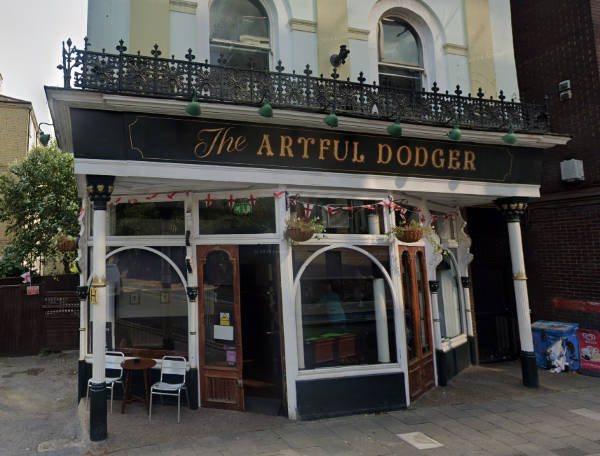
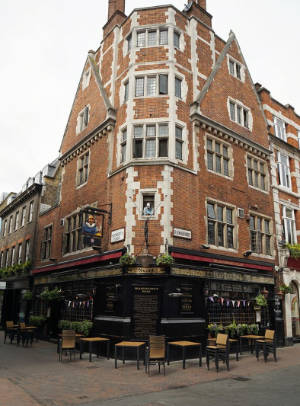
It won’t come as a surprise, but this pub, located a short distance east of Tower Hill, is named for the character from Charles Dickens’ Oliver Twist.
PICTURE: Google Maps
Located in Royal Mint Street, the pub was formerly known as the Crown and Seven Stars. It closed in 1981 and reopened under its current name in 1985.
While the history of the Crown and Stars apparently goes back some years earlier, the current four storey building, which is Grade II-listed, dates from a rebuild in the 1820s. But the facade, which features a crown and seven stars on the uppermost level, was partially rebuilt in the 1880s.
It’s not quite clear why the pub is so re-named – there doesn’t appear to be any particular connection of the character – known as the Artful Dodger but whose ‘real’ name in the novel is Jack Dawkins – with the location except that it’s in the East End where large sections of the book are set.
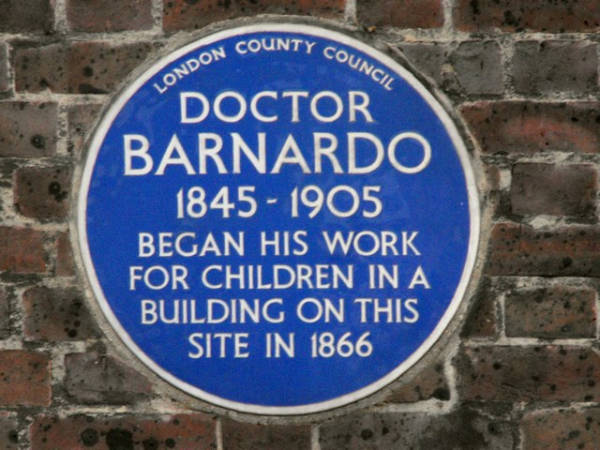
An orphan who lived on London’s streets in the 1860s, Jim Jarvis is famous for having inspired Dr Thomas Barnardo to establish his first home for boys.
Barnardo had moved to London from Dublin in Ireland to train as a doctor and, after a cholera epidemic swept through the East End, leaving many children orphans, in 1867 he established the Hope Place Ragged School in Stepney where children could get a basic education for free.
Jim Jarvis, who was 10-years-old at the time (although Barnardo later said he looked older but had the body of a boy of seven or eight), was one of the children who attended the school.
Barnardo’s account is that one night, after he was about to close the school, the boy had begged to be allowed to stay and, when pressed, had told his story.
Jarvis explained that had been living in a workhouse with his mother (he apparently never knew his father) but after she died, he ran away. Living on the streets of Stepney, he was initially helped by a woman who sold whelks and shrimp. He subsequently did some odd jobs for coal lighter but was treated very cruelly – this included the lighterman, ‘Swearin’ Dick’ setting his dog on him when he was drunk.
Jarvis was able to escape and lived on the streets for a time, including being briefly detained in a workhouse. Eventually he attended Barnardo’s newly opened ragged school and asked for help.
Jarvis explained that there were many other boys in a similar position to his own. Barnardo asked him to show him where some of these boys were staying, so Jim took him to a rooftop near a hayloft where 11 boys were sleeping in a huddle.
That encounter helped open Barnardo’s eyes to the hardships faced by the children in the East End – in his words, “I had seen enough, and I needed no fresh proof of the truth of his story or any new incentive to a life of active effort on behalf of destitute street lads”.
After the fateful night on which Jarvis told his story, Barnardo paid for Jarvis’ lodgings. It’s been suggested that, thanks to the aid of a charity, he later went to live on a Canadian farm.
Barnardo meanwhile, established his first home for boys in Stepney in 1870 – a place where they could live and learn skills such as carpentry, metalwork, and shoemaking to help them secure apprenticeships.
Containing a residence for the Bishop of London (although, it has to be said, certainly not traditionally a bishop’s palace), the Old Deanery is located in Dean’s Court, to the south-east of St Paul’s Cathedral.
Subscribe for just £3 a month to access all of Exploring London’s content – and support our work!
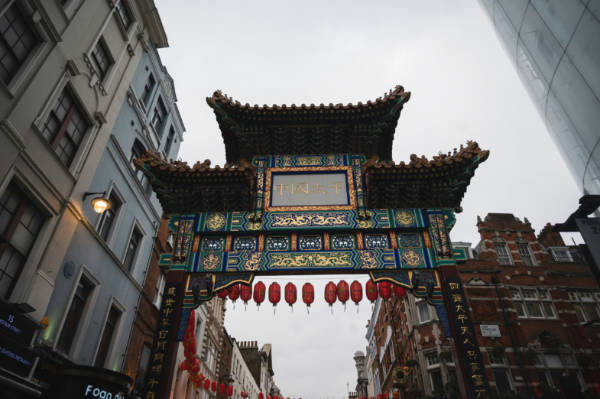
• Lunar New Year festivities will be held in Chinatown in central London this weekend including lion dances and the Chinese New Year Parade. Lion dances will be held throughout Chinatown on Saturday and Sunday while the parade kicks off at 10am on Sunday just east of Trafalgar Square reaching the square at 12 where an afternoon of festivities will be held. For more, see www.london.gov.uk/events/lunar-new-year-festival-spring-2026. Meanwhile, Lunar New Year celebrations will also be held in Greenwich on Saturday. The celebrations include lion dances, musical and dance performances, a martial arts demonstration, workshops including one on Tibetan dance and another on lantern making and the chance to sample Asian food. For more, see www.rmg.co.uk/lunarnewyear.
• A new exhibition at the Young V&A in Bethnal Green takes a look behind the scenes of stop-motion classics such as Wallace & Gromit, Chicken Run and Shaun the Sheep. Inside Aardman: Wallace & Gromit and Friends, created primarily for children and families and marking Aardman’s 50th annversary, features some 150 objects including never-seen-before models, sets and storyboards from Aardman’s archives as well as interactive activities ranging from designing characters and experimenting with lighting through to creating live action videos. Among the items on show are early sketches of Wallace & Gromit, a hand-drawn storyboard from The Wrong Trousers (1993) train chase, Wallace & Gromit’s motorbike and sidecar from Vengeance Most Fowl (2024), and the airship model from The Pirates! (2012). Admission charge applies. Runs until 15th November. For more, see vam.ac.uk/young.
• The women who influenced Charles Dickens are at the centre of a new exhibition at the Charles Dickens Museum.Extra/Ordinary Women features a portrait of Dickens’ daughters, Katey and Mamie, on display for the first time, Catherine Dickens’s cookbook, and a draft preface to an 1857 manual for educating working class children written by penned by Angela Burdett Coutts and including edits by Dickens in blue ink as well as items owned by Ellen Ternan, best known for her 12-year extra-marital relationship with Dickens. Admission charge applies. Runs until 6th September. For more, see https://dickensmuseum.com/blogs/all-events/extra-ordinary-women.
Send all items for inclusion to exploringlondon@gmail.com
Before we get back to our current Wednesday series on bishop’s palaces, we pause to remember the death of celebrated crime writer Agatha Christie, 50 years ago this week (she died on 12th January, 1976).
• First up, we head to 58 Sheffield Terrace in Holland Park where Christie lived with her second husband, archaeologist Max Mallowan, between 1934 and 1941 (one of several homes she lived in in the area), and where she wrote books including Murder on the Orient Express (1934) and Death on the Nile (1937). The house is marked with an English Heritage Blue Plaque.
• Then it’s over to University College Hospital in Bloomsbury where Christie worked during World War II as a volunteer dispenser (and where she added to her expertise on poisons). Christie had in 1917 sat three exams to become a qualified pharmaceutical assistant at the Apothecaries Hall in London.
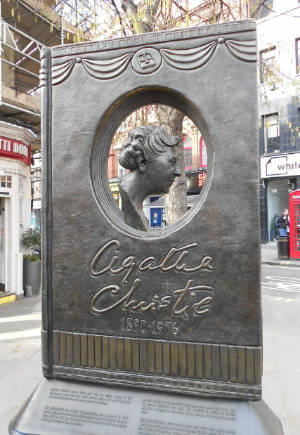
• Finally, we head to the West End and St Martin’s Theatre where Christie’s play, The Mousetrap, continues to be performed nightly, notching up more than 30,000 performances. Outside is the Agatha Christie Memorial (pictured) depicting a book with a bust of Christie set into the centre.
We’ll be taking a more detailed look at Agatha Christie’s London in a series soon…
Dame Sarah Mullally, Bishop of London since 2018, was named as the 106th Archbishop of Canterbury in October so we thought it a good time to explore some of the grand palaces which served as bishop’s palaces, some of them still standing and others not.
And what more appropriate place to start than Lambeth Palace, the official Thames-side residence of the Archbishop of Canterbury.
Subscribe for just £3 a month to access all of Exploring London’s content…
The real person behind writer Charles Dickens’ ‘Inspector Bucket’, Charles Frederick Field was a police officer with the Metropolitan Police who rose to the rank of inspector before, following retirement, becoming a private detective.
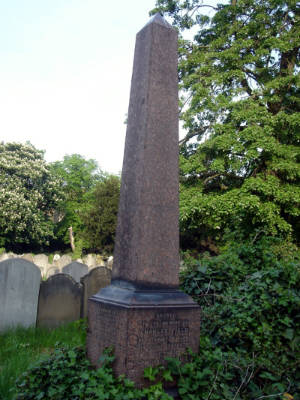
Field’s funerary monument in Brompton Cemetery. PICTURE: Edwardx (licensed under CC BY-SA 1.0)
Field, the son of a Chelsea pub proprietor, had apparently wanted to be an actor but due to his straitened economic situation had instead joined the Metropolitan Police at its founding in 1829.
Field served in several divisions across London, eventually rising to the rank of inspector. He joined the Detective Branch, which had only been formed in 1842, in 1846.
It was while with the Detective Branch that he encountered Dickens and they formed what’s described as a lasting friendship. From 1850 onwards Dickens wrote as series of articles about the world of the Detective Branch and the work of Field (sometimes using a pseudonym) including his essay ‘On Duty With Inspector Field’.
Dickens is also believed to have used Field as the model for Inspector Bucket in Bleak House, first published as a serial in 1852 and 1853.
Field, who was noted as a bit of a raconteur and for his love of disguises even when not really required (perhaps explained by theatrical bent), retired from the Met in 1852 and set up his own enquiry office. He apparently caused controversy after his retirement by using his rank in his private work which somewhat soured his relationship with the force.
Field, who died in 1874 and is buried in Brompton Cemetery, has since been the subject of several works of fiction.
It’s 5th November and that means Bonfire Night, the annual event featuring bonfires, effigies of Guy Fawkes (and others), and fireworks displays in commemoration of the November, 1605, foiling of a conspiracy to kill King James I (and many others) by blowing up the House of Lords(you can read more about it in earlier posts here and here).
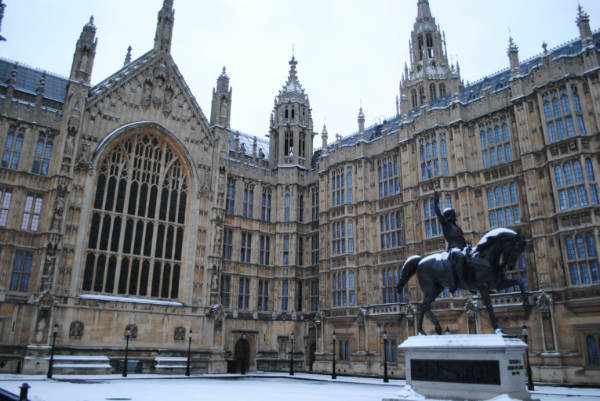
Looking across Old Palace Yard outside the Houses of Parliament to the southern end of Westminster Hall. PICTURE: David Adams
Here’s five places of significance to the story of the plot:
1. The Houses of Parliament: It was in the undercroft beneath the House of Lords that Guy Fawkes was found with 36 barrels of gunpowder. The cellar is now gone – having been destroyed when the Houses of Parliament burned down in 1834.
Subscribe for just £3 a month to support our work and access all of our stories…
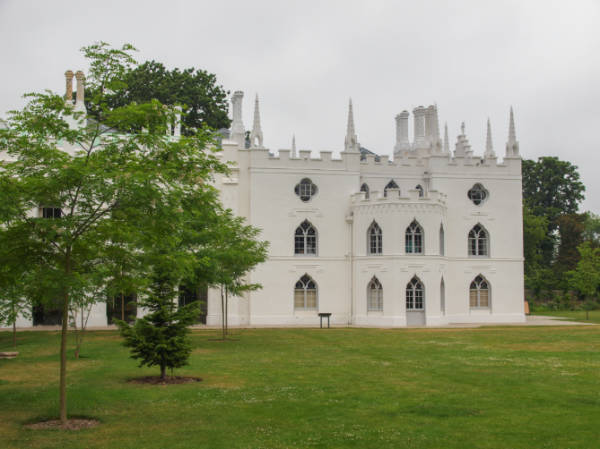
Strawberry Hill House. PICTURE: claudiodivizia/iStockphoto
• The disappearance of a jewelled Ottoman dagger which is believed to have once belonged to King Henry VIII has inspired a new exhibition at Strawberry Hill House, Horace Walpole’s former home in Twickenham in London’s west.Henry VIII’s Lost Dagger: From the Tudor Court to the Victorian Stage looks at the history of the 16th century dagger which, said to have been richly decorated with “a profusion of rubies and diamonds”, was once part of Horace Walpole’s collection. When the collection was sold in 1842, the dagger passed into ownership of the Shakespearean actor Charles John Kean who directed private theatricals for Queen Victoria at Windsor Castle. Kean (1811-1868) pioneered what critics dubbed “living museums” on the Victorian stage by using real artifacts, including the dagger, during performances. But after Kean’s death the dagger vanished without a trace. Dr Silvia Davoli, the principal curator at Strawberry Hill House, launched an investigation to find the dagger and instead found six almost identical daggers scattered around the globe. Two of these daggers – known as the Vienna and Welbeck Abbey examples – are featured in the exhibition alongside reproductions of 18th century materials which related to Walpole’s lost dagger from Yale University’s Lewis Walpole Library. The exhibition can be seen from Saturday until 16th February. Admission charge applies. For more, see www.strawberryhillhouse.org.uk.
• The role maps have played in preserving secrets for the benefit of their creators from the 14th century to the present day is the subject of a new exhibition at the British Library. Secret Maps features more than 100 items ranging from hand-drawn naval charts given to Henry VIII to maps of cable networks used to intercept messages between the world wars; and the satellite tracking technology used by apps today. Among highlights are a map from 1596 attributed to Sir Walter Raleigh on an expedition in search of the mythical city of El Dorado in what is now Guyana in South America; a map produced in 1946 of British India (modern-day India, Pakistan and Bangladesh) with a ‘top secret’ report investigating the potential economic and military impact of partition for the proposed state of Pakistan; one of only two known existing copies of a secret map produced by Ordnance Survey during the General Strike of 1926 amid fears of a public uprising; and a 1927 Cable Map of the world which reveals a global network of censorship stations and was used by the British government to intercept messages sent via submarine and overland cables. Runs until 18th January (and accompanied by a programme of events). Admission charge applies. For more, see https://events.bl.uk/exhibitions/secretmaps.
• Staffordshire-based artistPeter Walker’s large scale interactive artworks, Connection and Identity, can be seen in the Painted Hall at the Old Royal Naval College in Greenwich from Friday. Identity features eight columns suspended within the hall which shift in colour and light while Connection showcases “a dramatic and modern reinterpretation of Michelangelo’s Creation of Adam“. The installation, which is located in the hall sometimes described as “Britain’s Sistine Chapel”, is accompanied by music specially composed by David Harper. Runs until 25th January. Admission charge applies. For more, see https://ornc.org/whats-on/connection-and-identity/.
Send all items for inclusion to exploringlondon@gmail.com.
• The UK’s largest retrospective of trail-blazing 20th century surrealist photographer Lee Miller opens at Tate Britain today. Lee Miller features around 230 vintage and modern prints, some of which are on display for the first time, which reveal how her approach pushed boundaries and led to the creation of some of the most iconic images of last century. Highlights include the newly discovered solarisation exemplar, Sirène (Nimet Eloui Bey) (c1930-32), her celebrated surrealist image of Egypt’s Siwa Oasis, Portraitof Space (1937), London-based works such as You will not lunch in Charlotte Street today (1940) and Fire Masks(1941) which convey the “pathos and absurdity” of the city in wartime, and war-related images including portraits of Miller and David E Scherman in Hitler’s private bath in April, 1945, as well as a rare 1950 self-portrait showing Miller posed in Oskar Kokoschka’s London studio flanked by artworks. Runs until 15th February. Admission charge applies. For more, see www.tate.org.uk/whats-on/tate-britain/lee-miller
• The initial and enduring impact of the Hallelujah Chorus is the subject of a new display at the Foundling Museum in Bloomsbury. A Grand Chorus explores the profound impact music can have on listeners and performers and brings together musical scores, librettos, and musical instruments as well as paintings, photographs, audio, video, personal testimonies, and other archival material spanning three centuries. Originallycomposed as part of his famous Messiah oratorio, George Frideric Handel later incorporated the Hallelujah Chorus into an anthem he created speciallyfor the Foundling Hospital that premiered in 1749 as a fund-raising exercise. The exhibition also showcases a major sound and video installation byMikhail Karikis – We are Together Because (2025), described as a modern counterpart to the Hallelujah Chorus. Runs until 29th March. Admission charge applies. For more, see https://foundlingmuseum.org.uk/event/a-grand-chorus-the-power-of-music/.
• Swing a conker at the Hampstead Heath Conker Championships this Sunday. People are all ages are invited to join in, whether a conker veteran or a newcomer, with competitions held in a range of age categories. The competition is being held near the Parliament Hill Bandstand from 1pm to 4pm. Entry is free. For more, see www.cityoflondon.gov.uk/events/go-conkers-on-hampstead-heath-5-october.
Send all items for inclusion to exploringlondon@gmail.com
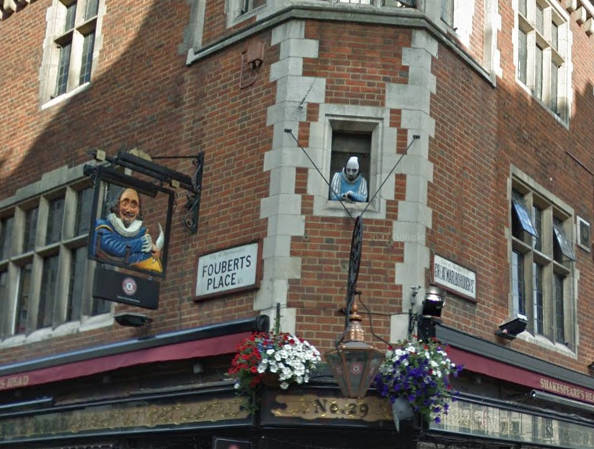
Located at the northern end of Carnaby Street, this Soho pub features a life-sized bust of the Bard looking out of a first floor window at the people passing by in the street below.
The pub in 2015. PICTURE: David (licensed under CC BY 2.0)
According to the pub’s signage, it was first constructed in 1735 and owned by Thomas and John Shakespeare, who were said to be distant relatives of William (and, if indeed they were the owners, no doubt keen to capitalise on his fame).
The current, rather ornate, building, designed in a faux-Tudor style, reportedly dates from the late 19th century.
As well as the bust, which features a missing hand due to damage from a bomb in World War II, the pub sign features an image of Shakespeare with his quill poised.
The pub, now part of the Greene King chain, is located on the corner of Fouberts Place and Carnaby Street (although its address is 29 Great Marlborough Street – it has a street sign for this on its facade – we’ll try and find out some more about why this is so). For more, see www.greeneking.co.uk/pubs/greater-london/shakespeares-head.
The only woman prisoner recorded as having escaped from the Tower of London, Alice Tankerville was accused, along with her common-law husband John Wolfe, of committing piracy in 1533.
It was alleged that Tankerville had lured two wealthy Italian merchants into a wherry out in the Thames where her accomplices – including Wolfe and two men disguised as watermen – had robbed and murdered them. They were also accused of burgling a home near St Benet Gracechurch where the two men had been staying.
Despite apparently having attempted to seek sanctuary in a special precinct near Westminster Abbey, the couple were arrested, charged with piracy and murder among other things, and, following a trial neither apparently attended, found guilty.
Taken to the Tower of London in 1534 (Wolfe had done a previous stint there for the theft of 366 gold crowns from a ship berthed at the Hanseatic League’s Steelyard but had eventually been released due to a lack of evidence), Alice is said to have been imprisoned in Coldharbour Gate.
Alice wasn’t done yet, however. On 23rd March that year, she managed to escape, apparently with the aid of gaoler John Bawde who provided her with ropes and a key.
It was a short-lived liberation – believed to have been wearing man’s clothes, she and Bawde were arrested trying to reach waiting horses on a road just outside the Tower (it’s worth noting that not only was Alice the only women prisoner to ever escape the Tower of London, she was also the only escapee during the reign of King Henry VIII).
Both she and Wolfe were subsequently executed and due to the nature of their crime, their execution took place on the Thames.
They were hanged in chains in the Thames near the site of their crime and, before a small flotilla of boats filled with sight-seers come to witness the event, were slowly drowned as the tide rose. Their bodies were then left hanging on the spot as a warning to others.
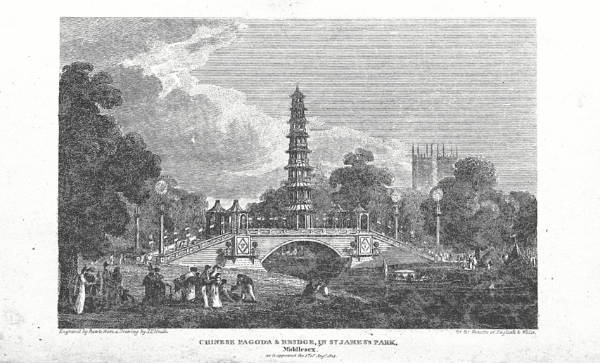
Briefly a sizeable landmark on London’s skyline, this seven-storey high structure and bridge were built over the canal in St James’s Park in 1814 as part of celebrations over the 100th anniversary of the accession of the House of Hanover, the 16th anniversary of Nelson’s victory at the Battle of the Nile and the signing of Treaty of Paris with France on 30th May following Napoleon’s abdictation in April.
British Library digitised image from “A Topographical and Historical Description of London and Middlesex” By Brayley, Brewer, and Nightingale
The pagoda and bridge, designed by none other than John Nash and Auguste Pugin, were among a number of structures built for the celebrations held in Royal Parks on 1st August – others included a ‘Temple of Concord’ and a naval arch. There was also a naval re-enactment on The Serpentine in Hyde Park.
As well as bands, food stalls and marquees for guests, the event, which was billed (among other names) as the Grand Jubilee, also included balloon ascents and fireworks.
The latter wasn’t good news for the pagoda – it was hit by a stray firework and destroyed (and tragically at least one person lost their life). The bridge lasted a few years longer – it apparently survived until 1825.
• The enduring appeal of Charles Dickens’ works and how they have been adapted for the stage, screen and radio is the focus of a new exhibition at the Charles Dickens Museum in Bloomsbury. Showtime! looks at productions starting from as far back as 1837 and including such classics as The Muppets Christmas Carol and Oliver! the musical with objects on show including original playbills, posters, programmes, photographs and props. There’s also the opportunity to hear from actors and writers about what makes Dickens so adaptable and see Dickens’ own works which he annotated with stage directions. The display can be seen until 26th January. Admission charge applies. For more, see www.dickensmuseum.com.
• A major new exhibition on the future of food – how science is creating more sustainable ways of producing and consuming food – opens at the Science Museum today.Future of Food reveals how the way we grow food and eat impacts the climate, nature, and society. Among the more than 100 objects on show are cricket burgers and cell-grown salmon as well as 3,500-year-old fermented sourdough bread, the first Quorn burger dating from 1981 and the first beef steak grown outside a cow. There is also the chance to join a multiplayer interactive game and create your own “future for food”. Runs until 4th January. Admission is free. For more, see https://www.sciencemuseum.org.uk/see-and-do/future-of-food.
The Peter Rabbit Adventure at Hampton Court Palace. PICTURE: Courtesy of Historic Royal Palaces.
• Peter Rabbit is hopping over to Hampton Court Palace to take part in a new family trail that brings Beatrix Potter’s beloved characters to life in the palace gardens from tomorrow. The Peter Rabbit Adventure, included as part of the palace admission, is spread over the Kitchen Garden, Tiltyard, and Wilderness and the activities on the trail will introduce little ones to the plants, vegetables and wildlife that inhabit the gardens. These include the chance to use Mrs Tiggy-winkle’s washing equipment to make music among the trees, to join in a search for Peter Rabbit under wheelbarrows and flowerpots in the Tiltyard, and to try to hop, skip and jump as high as Peter and his friends. A larger-than-life Peter Rabbit will be greeting families in the Kitchen Gardens. Runs until 7th September. For more, see https://www.hrp.org.uk/hampton-court-palace/whats-on/the-peter-rabbit-adventure/.
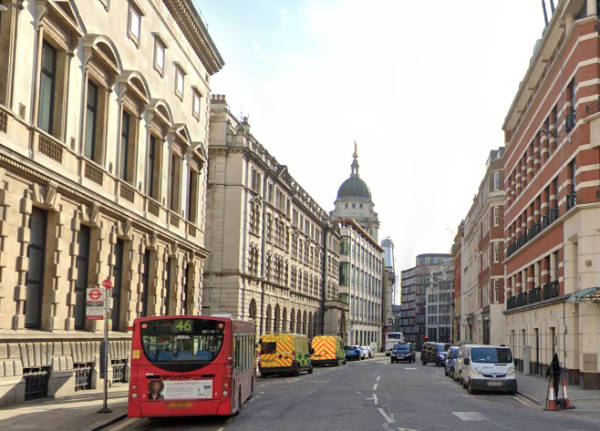
This City of London street runs north-south from the junction of Newgate Street, Holborn Viaduct and Old Bailey to West Smithfield. Its name comes from those who once travelled along it.
Looking south down Giltspur Street, with the dome of the Old Bailey visible, in 2018. PICTURE: Courtesy of Google Maps
An alternative name for the street during earlier ages was Knightrider Street which kind of gives the game away – yes, the name comes from the armoured knights who would ride along the street in their way to compete in tournaments held at Smithfield. It’s suggested that gilt spurs may have later been made here to capitalise on the passing trade.
The street is said to have been the location where King Richard II met with the leaders of the Peasant’s Revolt who had camped at Smithfield. And where, when the meeting deteriorated, the then-Lord Mayor of London William Walworth, ending up stabbing the peasant leader Wat Tyler who he later captured and had beheaded.
St Bartholomew’s Hospital can be found on the east side of the street. On the west side, at the junction with Cock Lane is located Pye Corner with its famous statue of a golden boy (said to be the place where the Great Fire of London was finally stopped).
There’s also a former watch house on the west side which features a monument to the essayist late 18th century and 19th century Charles Lamb – the monument says he attended a Bluecoat school here for seven years. The church of St Sepulchre-without-Newgate stands at the southern end with the Viaduct Tavern on the opposite side of the road.
The street did formerly give its name to the small prison known as the Giltspur Street Compter which stood here from 1791 to 1853. A prison for debtors, it stood at the street’s south end (the location is now marked with a City of London blue plaque).
Usually Treasures of London focuses on an object held in a museum or gallery or an outdoor feature such as sculpture or memorial but in honour of its 200th birthday this year, today we’re taking a look at the Royal Mews at Buckingham Palace.
Here are some facts about the Mews which you may not know…
Subscribe for just £3 a month to access all of Exploring London’s content…
A titan of American broadcast journalism, Edward R Murrow’s name is synonymous with London during World War II from where, as a correspondent for CBS, he famously provided live radio broadcasts at the height of the Blitz.
Edward R Murrow, seen in a screenshot in 1961. PICTURE: Via Wikipedia
Murrow, who joined CBS in the US in 1935, went to London in 1937, initially to serve as director of the network’s European operations. Said to have been deeply committed to exposing the threat Nazism posed to Americans, he was soon deeply involved in reporting events leading up to and during World War II with his first on the scene news report taking place in March, 1938, when he reported live from Vienna, Austria, during Hitler’s annexation.
Following the breakout of the war in 1939, Murrow remained based in London and went on to provide his famous live broadcasts during the Blitz, opening them with the iconic words, “This is London” and, later, ending them with “Good night and good luck”.
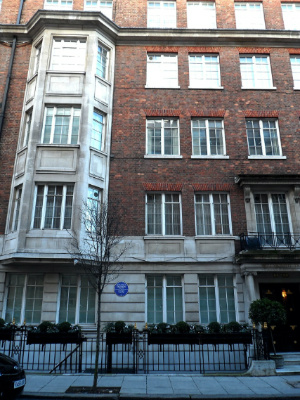
Weymouth House in Westminster where Edward R Murrow stayed during his time in London. PICTURE: Spudgun67 (licensed under CC BY-SA 4.0)
His wartime dispatches – which were broadcast from a studio in the sub-basement of the BBC’s Broadcasting House (which was bombed more than once) as well as from locations including Traflagar Square and a rooftop during the bombing raids – were to win him considerable acclaim and also saw him undertake such feats as joining combat missions in the skies over Europe and being one of the first two reporters to enter Buchenwald concentration camp in Germany in April, 1945.
Such was his standing that then British Prime Minister Winston Churchill even offered to make him joint-director of the BBC (a job offer he declined).
Murrow made his last report from London in March, 1946, before returning to the US to head CBS News. he continued to work with CBS until resigning in 1961 to take up a position as head of the United States Information Agency, a job he held until 1964.
He died at the age of 57 after being diagnosed with lung cancer at his home in Pawling, New York, on 27th April, 1965.
During his time in London, Murrow lived in a flat at Weymouth House, 84-94 Hallam Street in Westminster. An English Heritage Blue Plaque now commemorates his stay there.
Murrow is, of course, also the subject of the 2005 film – and subsequent Broadway production – Good Night, and Good Luck (although that focuses on his later stand against US Senator Joe McCarthy and his hunt for communists).



 Exploring London
.jpg)