Top posts of 2015 – The ‘lost’ chapel of St Thomas; and, inside King Henry V’s chantry chapel…

2016 is fast approaching and to celebrate, we’re looking back at the 10 most popular posts we published in 2015. Today, we present our most popular and second most popular articles posted this year…

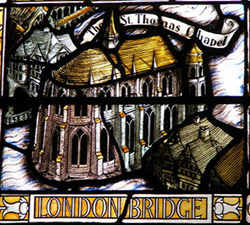
London-Bridge-chapel2. Our second most popular article, posted in August, was another in our Lost London series and this time looked at a long-lost feature of Old London Bridge – Lost London – Chapel of St Thomas á Becket.

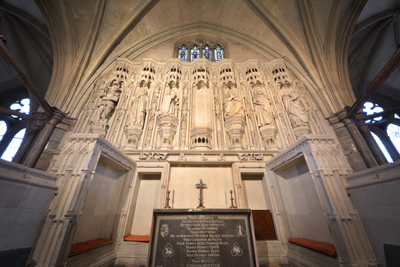
1. And we are finally there – the most popular of our posts published this year was run in conjunction with the 600th anniversary of the Battle of Agincourt. Part of our LondonLife series, it took a look inside King Henry V’s rarely opened chantry chapel in Westminster Abbey – LondonLife – A rare glimpse inside King Henry V’s chantry chapel.

Top posts of 2015 – A garden gem; London and the Peasant’s Revolt; and, the Duke of Wellington’s cloak…

Goldsmiths12016 is fast approaching and to celebrate, we’re looking back at the 10 most popular posts we published in 2015. 

10. Our 10th most popular post was published in July came from our special series on “10 small, ‘secret’ and historic gardens in central London” and looks at the origins of The Goldsmith’s Garden – 10 small, ‘secret’ and historic gardens in central London…1. Goldsmiths’ Garden…

9. Published in November, our ninth most popular post was from our current special series on London ‘battlefields’ and looks at the role the city played in the 14th century Peasant’s Revolt – 10 London ‘battlefields’ – 3. London sacked in the Peasant’s Revolt…

8. At number eight is a post from our long-running Treasures of London series, which, in the year of the 200th anniversary of the Battle of Waterloo, looks at a recent acquisition by the National Army Museum – Wellington’s cloak – Treasures of London – Duke of Wellington’s cloak…

We’ll look at numbers seven through five tomorrow…


A Moment in London’s History – Publication of Charles Dickens’ ‘A Christmas Carol’…

St-Michael's-CornhillCredited as “the man who invented Christmas”, Victorian author Charles Dickens’ featured Christmas celebrations in many of his works – but none more so than in his famous story, A Christmas Carol.

Published 172 years ago this December, the five part morality tale centres on the miserly Londoner Ebenezer Scrooge who, following several ghostly visitations by the likes of the Ghosts of Christmas Past, Present and Yet to Come, becomes a changed man and recaptures the essence of what Christmas is all about.

The book – whose characters (said to have been partly based on people he knew in real life) also include the abused clerk Bob Cratchit and his ever positive youngest son, Tiny Tim – is based in London.

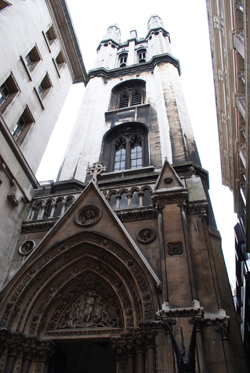
Among key locations mentioned in the book is Scrooge’s counting house, said to have been located in a courtyard off Cornhill (it’s been suggested this is Newman’s Court, thanks to a reference to a church tower, believed to be St Michael’s Cornhill – pictured), the home of Scrooge (it has been speculated this was located in Lime Street), and the home in Camden Town where the Cratchits celebrate their Christmas (perhaps based on one of Dickens’ childhood homes in Bayham Street). City of London institutions like the home of the Lord Mayor, Mansion House, and the Royal Exchange are also mentioned.

The book, which apparently only took Dickens six weeks to write while he was living at 1 Devonshire Terrace in Marylebone, was first published on 19th December, 1843, by London-based firm Chapman & Hall. Based at 186 Strand, they published many of Dickens’ works – everything from The Old Curiosity Shop to Martin Chuzzlewit – along with those of authors such as William Makepeace Thackeray and Elizabeth Barrett Browning.

A Christmas Carol‘s first print run of 6,000 sold out any Christmas Eve that same year and sales continued to be strong into the following year. Despite its warm reception by critics and popularity among the public, the book’s profits were somewhat disappointing for Dickens who had hoped to pay off his debts (he also lost out when he took on some pirates who printed their own version two months after its publication; having hauled them to court Dickens was apparently left to pay costs when they declared bankruptcy).

Dickens would later give some public readings of the book, most notably as a benefit for the Great Ormond Street Hospital for Sick Children (his last public reading of the book took place at St James’s Hall in London on 15th March, 1870, just three months before his death).

The book, which has apparently never been out of print, went on to become something of a Christmas classic and has been adapted into various films, theatre productions, radio plays and TV shows (one of our favourites is The Muppet Christmas Carol, dating from 1992).

This Week in London – Christmas at Kensington and the Geffrye; and Ebola and ISIS at the IWM…

Christmas is looming and that means Christmas themed events happening all over London. Here’s a couple worth considering:

Kensington Palace: Head back into the Victorian era where so many of the Christmas traditions we know and love find their origins. The palace and gardens have been decorated with period-inspired decorations while inside decorations include the beautifully decorated tables where Queen Victoria and Prince Albert showcased their Christmas gifts. There’s talks on the origins of Christmas foods such as plum pudding, music and carolling, and the cafe is serving up seasonal food and drink while on Saturday, a special brunch time lecture will look behind the curtains into the world of Victorian pantomime and performance. Admission charges apply – check the website for dates. For more, see www.hrp.org.uk/kensington-palace/.

The Geffrye Museum: This Shoreditch institution is once again celebrating Christmas traditions of the past in its annual display showcasing the past 400 years of Christmas traditions. Christmas Past has taken place at the museum for the past 25 years and is based on ongoing, original research. It provides insights into everything from traditional Christmas feasts to kissing under the mistletoe, playing parlour games, hanging up stockings, sending cards, decorating the tree and throwing cocktail parties. A series of related events, including a concert by candlelight, are being held over the Christmas season. The display, which has free entry, closes on 3rd January. For more, see www.geffrye-museum.org.uk.


Ebola and the fight against ISIS are the subject of a new exhibition which opened at the Imperial War Museum in Lambeth last month. Fighting Extremes: From Ebola to ISIS looks at the experiences of British personnel serving on recent operations including the response to the Ebola outbreak in Sierra Leone and the fight against ISIS in the Middle East. The display features behind the scenes interviews such as an in-depth talk with Corporal Anna Cross, a British Army nurse who contracted Ebola, photographs, and recently acquired objects such as the Wellington boots worn by healthcare worker Will Pooley, the first Briton to contract Ebola who was evacuated from Sierra Leone by the RAF, a headset used by an RAF drone pilot, and a shooting target depicting a silhouette of an ISIS suicide bomber used by the British Army to train Peshmerga troops. For more, see www.iwm.org.uk.

Send all items to exploringlondon@gmail.com.

Famous Londoners – William Hewer…

The National Maritime Museum is hosting a new exhibition on the life of Samuel Pepys and, while we’ve looked at the life of the famous diarist before (see our earlier post here), we thought we’d take a look at his not-so-famous manservant and clerk William Hewer.

“Will” Hewer, who is mentioned several times in Pepys’ diary and, as well as being a business partner also became a fast friend of Pepys, is thought to have been born in about 1642.

He was first introduced to Pepys when still a young man – about 17 – by his uncle Robert Blackborne in 1660. They obviously hit it off because Hewer, who was the son of a stationer, was soon working as a manservant and clerk for Pepys in his role as Clerk of the Acts to the Navy Board.

Hewer, who was subjected to some bullying by Pepys who apparently could reduce him to tears (but at the same time Pepys also defended him at work from attacks from others), at first lived with Pepys at his Seething Lane home. However, by late 1663 – apparently thanks to his misbehaviour which included staying out late, drunkenness and corrupting maids – he was told to leave Pepys’ house and moved into his own lodgings.

Pepys moved to the Admiralty in 1673 and Hewer went with him, appointed Chief Clerk the following year. In 1677, he was appointed as Judge Advocate-General.

Hewer’s star continued to climb and in 1685, he was appointed MP for Yarmouth, on the Isle of Wight. The following year he was appointed to the Special Commission which replaced the Navy Board and had a special responsibility for accounts.

After King James II fled the country in 1688, Hewer, along with Pepys, lost their patronage from the Crown; both were briefly imprisoned, but were released without trial.

Thanks largely to his involvement in trading with his uncle Blackborne – who served as both Secretary to the Admiralty and Secretary to the British East India Company and to an inheritance he received from his father, Hewer became a wealthy man (as was the case with Pepys, there have been suggestions he may have made considerable illicit sums from people doing trade with the Navy thanks to his position, but these claims have not been substantiated).

Hewer, who never married (but he did apparently have a special attachment to Pepys wife Elizabeth who was of a similar age), owned a house near The Strand which became the Admiralty Office when he followed Pepys from the Navy Board. Pepys lived with him in the house when he was at the Admiralty.

He also owned other properties, including a country retreat on Clapham Common which he bought in 1688. It was here that Pepys lived in during his latter years (and where he died in 1703).

Hewer was the executor of Pepys’ will and kept his library – including, of course, his famous diary until his own death on 3rd December, 1715. He was buried in St Paul’s Church, Clapham. In an odd twist, his estate was left to his godson Hewer Edgeley but only on the condition that he change his surname to Hewer, becoming Hewer Edgeley-Hewer.

Hewer is depicted in a painting by Godfrey Kneller (1689) now in the National Maritime Museum’s collection. It was a pair with another painting by Kneller of Pepys.

WHERE: Samuel Pepys: Plague, Fire, Revolution is at the National Maritime Museum, Greenwich (nearest DLR station is Cutty Sark; nearest railway stations are Greenwich and Maze Hill; and nearest river pier is Greenwich); WHEN: 10am to 5pm daily; COST: £12 adults/£6 children WEBSITE: www.rmg.co.uk/see-do/exhibitions-events/samuel-pepys-plague-fire-revolution-exhibition.

For more on Pepys, see Margarette Lincoln’s book Samuel Pepys: Plague, Fire, Revolution.

This Week in London – Samuel Pepys and his world revealed; the world of contemporary cycling; and, Indian jewellery traditions…

Samuel-PepysThe largest exhibition ever mounted about the life of 17th century diarist Samuel Pepys opens at the National Maritime Museum in Greenwich tomorrow. Samuel Pepys: Plague, Fire, Revolution features more than 200 paintings and objects brought together from museums, galleries and private collections which explore the life of the famous diarist (depicted here in a bust outside the Guildhall Art Gallery) against the backdrop of the tumultuous events of Stuart London, from the execution London of King Charles I in 1649 through the Great Fire of London and the Glorious Revolution on 1688. Objects on show include the famous painting, Portrait of Charles II in Coronation Robes, objects connected to Pepys’ mistresses including one of his love letters to Louise de Kéroualle (aka ‘Fubbs’ or ‘chubby’) and other personal items such as a lute owned by Pepys. The exhibition is accompanied by a series of events including Pepys Show Late: Party like it’s 1669 (26th November) and a series of walks and talks. Admission charge applies. The exhibition runs until 28th March. For more, see www.rmg.co.uk/national-maritime-museum.
Cycles are in the spotlight at the Design Museum in Shad Thames with a new exhibition, Cycle Revolution, opening yesterday. The display, which focuses on the world of contemporary cycling, features dozens of bicycles from key manufacturers as well as high end accessories, items belonging to celebrated cyclists Sir Chris Hoy and Sir Paul Smith and specially commissioned films and photography. It looks at cycling subcultures – everyone from the “high performers” to the “cargo bikers”, examines manufacturing techniques and innovations in the use of materials and design with exhibits including a large scale recreation of a bespoke bicycle making workshop, and tackles questions about the future of cycling particularly in relation to the urban environment. The exhibition is being accompanied by a ‘cycle cafe’, large scale installations and a series of public events. Runs until 30th June. Admission charge applies. For more, see www.designmuseum.com.

The jewellery traditions of the Indian sub-continent are set to sparkle at a new exhibition opening at the V&A in South Kensington this Saturday. Part of the V&A India Festival, Bejewelled Treasures: The Al Thani Collection features 100 items, drawn from a single private collection, including a Golconda diamond given to Queen Charlotte by the Nawab of Arcot in South India in 1767, a jade-hilted dagger that belonged to the 17th century emperor Shah Jahan (builder of the Taj Mahal), and a jewelled gold tiger’s head from the throne of the Tipu Sultan of Mysore. As well as showcasing the types of jewels collected by the Mughal emperors, the exhibition reveals the influence of India on European jewellery houses in the early 20th century and the ongoing impact of Indian influences on more modern pieces. The exhibition runs until 28th March. Admission charge applies. For more, see www.vam.ac.uk/BejewelledTreasures.

Send all items for inclusion to exploringlondon@gmail.com

10 London ‘battlefields’ – 4. Jack Cade’s rebellion…

London-StoneLittle is known of Jack Cade until the former soldier from Kent led an uprising against the rule of King Henry VI during the Hundred Years War with France. And London was a key site of fighting during the uprising.
Cade, who adopted the name John Mortimer and who some claimed to have been a relative of Richard, Duke of York, was said to have been a veteran of the war who led rebels protesting against the king’s rule amid the general state of disorder affecting England at the time which saw such abuses as lands being illegally seized and a lack of confidence in courts to rule fairly. There was also some discontent over the loss of lands of Normandy.

While many of the rebels were peasants, the rebellion – which rose in late May or early June, 1450 – was also supported by nobles and churchmen who were protesting what they saw as poor governance.

Led by Cade, who also attracted the title ‘Captain of Kent’, were camped on Blackheath in what is now the city’s south-east by mid-June and there apparently presented an embassy from the king with a list of grievances.

Thomas, Lord Scales – authorised by the king to raise troops, subsequently marched out to Blackheath but Cade and his rebels retreated into the forests of Kent and managed to lure the royal troops into an ambush.

Cade and the rebels returned to Blackheath while back in London the Royal soldiers turned mutinous, angered over the defeat. They were disbanded to protect the City and the king retired to Kenilworth Castle, effectively abandoning London to the rebels (despite the offer of the Lord Mayor and aldermen to resist the rebels).

Cade then marched on London itself, reaching Southwark on 2nd July (apparently using the now vanished White Hart Inn as his HQ). He forced his way over London Bridge the next day, cutting the drawbridge ropes personally with his sword to ensure it couldn’t be raised again

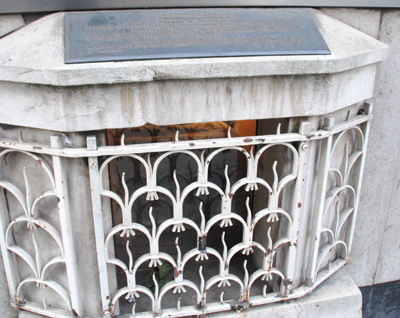
Such was the support the rebels had in London, that resistance was initially minimal. Following his entry to London, Cade struck the famous London Stone (pictured above – for more on it, see our earlier post here) with his sword, declaring “Mortimer” was now lord of the city.

While initially under tight control, Cade gradually lost control of many of his followers who turned to looting. Meanwhile, to head off an attack on the Tower of London – where Lord Scales had retreated – he handed over the hated Lord Treasurer, James Fiennes, Lord Saye, and his son-in-law William Crowmer, Under Sheriff of Kent (they had apparently been imprisoned in the Tower by the King for their own protection such as their unpopularity). Both were beheaded – Fiennes at Cheapside, Crowmer at Mile End – and their heads placed on poles on London Bridge.

The king’s supporters in the Tower had regrouped by early July and, with the rebels, while initially welcomed by many, now clearly having outstayed their welcome, they and city militias drove the rebels from the streets and had taken back the northern half of London Bridge (another bloody battle over the bridge) when William of Waynflete, Bishop of Winchester, arrived with promises of pardon for the rebels on behalf of the Lord Chancellor and Archbishop of Canterbury, John Kemp.

His forced much reduced, Cade – a pardon in his pocket under Mortimer’s name only – moved back into Kent and continued to cause trouble. He was, however, captured by the new Sheriff of Kent, Alexander Iden, on 12th July, – one version says this took place near Heathfield in Sussex at a hamlet now known as Cade Street. In any event, Cade was mortally wounded during the struggle and died en route to London.

His corpse, however, completed the journey and Cade was hanged, drawn and quartered and his head placed atop a pole on London Bridge.

While the rebel ringleaders were later captured and killed, in the most part King Henry VI honoured the pardons he had granted.

The story of Cade’s rebellion features in William Shakespeare’s play, King Henry the Sixth.

What’s in a name?…Bleeding Heart Yard

Bleeding

There’s a couple of different suggestions as to how Bleeding Heart Yard – a small courtyard located in the Farringdon area of the City of London, just north of Ely Place – obtained its rather descriptive – and gory – name.

The more prosaic answer is that it was named after an inn which, from the 16th century, stood on the yard and had a sign showing the heart of the Virgin Mary pierced by five swords.

The more interesting answer, on the other hand, is that the name commemorates the horrible murder of Lady Elizabeth Hatton (of the famed Cecil family), second wife of Sir William Hatton (formerly known as Newport), and, after his death, wife of Sir Edward Coke.

The story goes that her corpse was found here on 27th January, 1626, with the beating heart torn from the body.

A version of the legend – albeit with a slightly different protagonist – appears in a story published in Bentley’s Miscellany in 1837 which told of how the wife of Sir Christopher Hatton (he was actually the uncle of Sir William Hatton), made a somewhat ill-conceived pact with the Devil to secure wealth, position and a mansion in Holborn. The Devil dances with her during the housewarming party at the new home and then tears out her heart, found beating in the yard the next morning.

The yard also features in Charles Dickens’ Little Dorrit where it is the location of the home of the Plornish family.

London Pub Signs – The Prince of Wales…

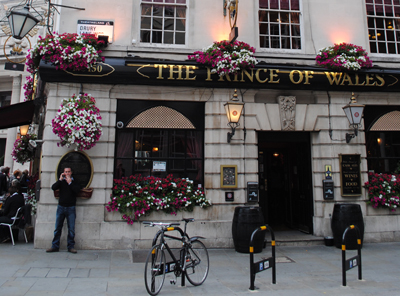
Prince-of-WalesAnother Drury Lane pub, the origins of this one go back to 1852 when it was established by Henry Wells on the site of what was once a potato warehouse. 
The name, in this case, comes from Queen Victoria and Prince Albert’s eldest son, Albert Edward.

Only about 11-years-old when this West End pub was first built, he remained Prince of Wales until succeeding his mother as King Edward VII (nonetheless, the location proved somewhat prescient – Albert Edward was to become known for his bon vivant lifestyle including his love of the theatre (along with, of course, his love of philandering.))

Located close to theatres and the Royal Opera House, the pub at 150-151 Drury Lane (on the corner of Long Acre) was rebuilt in Portland stone in the early 20th century when the street was widened.

Now part of the Taylor Walker group, it remains a popular pub for theatre goers (and even hosts its own events). For more, see www.taylor-walker.co.uk/pub/prince-of-wales-covent-garden/c0659/.

10 London ‘battlefields’ – 3. London sacked in the Peasant’s Revolt…

Tower-of-London1OK, so not really a battle although it must have felt something like that to those involved (and the ‘battlefield’ turned out to be much of the City itself), the uprising known as Peasant’s Revolt of 1381 saw two great armies march upon London – one from Kent led by Wat Tyler and another from Essex which is said to have been under the command of Jack Straw.

The armies had risen in response to a series of events which they saw as unjust and which trace their origins back to the Black Death. Killing about a third of the population when it struck some 30 years earlier, this had resulted in a growing demand for labourers to work the fields raising, as one might expect, hopes of increased wages and greater freedom of movement among the peasant class.

But to ensure the social order was maintained, authorities had not only put limits on how much farm workers could be paid but ensured long-standing but increasingly unpopular practices – such as serfs being forced to work some time for free for their landlords – were maintained. On top of this came the imposition and enforcement of a series of poll taxes to fund England’s wars with France.

The poll taxes – and the harsh way in which they were enforced – were a step too far and when a tax collector visited the village of Fobbing in Essex in May, 1381, he was shown short shrift and thrown out. The unrest soon spread and by June, the rebels, having rampaged through the countryside were marching on London.

By 12th June, the men from Essex were camped at Mile End while Tyler and his army from Kent were at Blackheath. The next day, after being denied a meeting with the king, the rebels headed into the City where sympathetic Londoners opened the gates. Once inside, they targeted the property of those they deemed responsible for their misfortune, opening prisons and destroying any legal records they could find.

Foremost among the sites attacked and looted was the Palace of Savoy (see our earlier post here), home of the King’s uncle John of Gaunt, Duke of Lancaster, and, as the power behind the throne, the man many deemed as the ultimate source of the ills besetting them (John himself had a lucky escape – he was away from the city when the palace was attacked.).

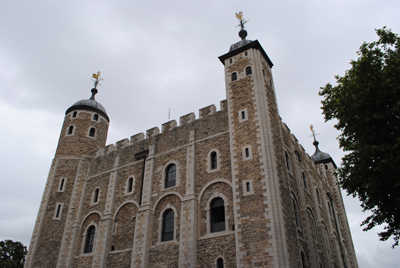
King Richard met with the leaders of the men from Essex on 14th June at their camp at Mile End and, after they pledged their allegiance, agreed to their petitions to abolish serfdom and allow them to sell their labour. But the attacks, meanwhile, were continuing in the City with a group of rebels led by Tyler storming the Tower of London (pictured above) the same day and seizing and beheading the Simon of Sudbury, the Archbishop of Canterbury and Chancellor, along with the Robert Hales, Lord High Treasurer and Prior of St John’s in Clerkenwell – both key figures in the government of the king (you can read more about Simon of Sudbury here).

The following day – 15th June – King Richard again met with the rebel leaders – this time with Wat Tyler, leader of the Kentish band, at Smithfield. It was then that things went awry for the rebels. Apparently enraged by Tyler’s insolence (already stories differ as to exactly why he did so), the Lord Mayor of London, Sir William Walworth (see our earlier post here), stabbed Tyler in the neck. King Richard managed to keep the situation under control until armed troops arrived and after the king declared a general pardon, the rebels dispersed.

Tyler, meanwhile, was taken to St Bartholomew’s Hospital but on the orders of the Lord Mayor was dragged from his bed and beheaded (his head was displayed atop a pole positioned in a field). He was among dozens of the rebels who were subsequently executed for their role in the uprising (leaders Jack Straw and another, John Ball, were among them).

LondonLife – 600 years on, Westminster Abbey commemorates the Battle of Agincourt…

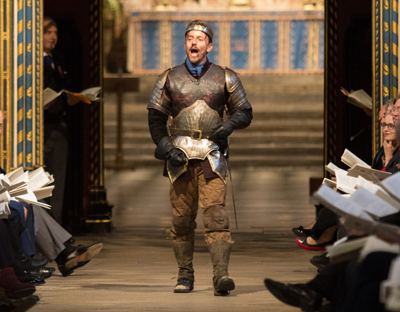
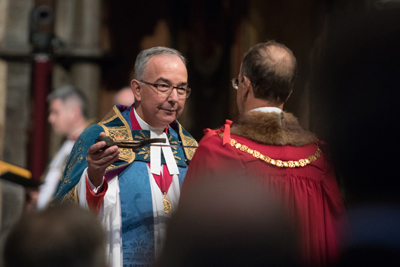
Sam-MarksHundreds gathered at Westminster Abbey last Thursday for a service to commemorate the 600th anniversary of the Battle of Agincourt – 600 years to the day when word of the battle’s victory arrived in London. During the service, the sword of King Henry V – who was buried in the abbey and whose chantry chapel is located above his tomb (see our earlier post here) – was carried through the abbey and presented to the Dean of Westminster, the Very Reverend Dr John Hall, at the High Altar (pictured below). “A hundred years ago, as our countrymen fought alongside the French, the old enmities had been put away,” Rev Dr Hall told those at the service who included the Duke of Kent and Princess Michael of Kent. “In the dark days before the Second World War, the story of Agincourt encouraged men and women alike to strive their utmost for freedom from tyranny. Today we give hearty thanks for our freedoms, and we pray for an end to tyranny wherever it is found, and for enduring peace and prosperity.” Royal Shakespeare Company actor Sam Marks read the St Crispin’s Day speech from the Bard’s Henry the Fifth (pictured above) while veteran of the stage and screen, Robert Hardy, read the prologue from Act IV of the same play. For more on abbey, visit www.westminster-abbey.org.  PICTURES: Ian Stratton/Westminster Abbey.

The-Dean-of-Westminster,-the-Very-Reverend-Dr-John-Hall-receives-the-sword-of-Henry-V

LondonLife – A rare glimpse inside King Henry V’s chantry chapel…

Henry-V-chantry-chapelA fortunate few last weekend had the chance to have a look inside King Henry V’s elaborately carved chantry chapel in Westminster Abbey as part of commemorations marking the 600th anniversary of the Battle of Agincourt. 

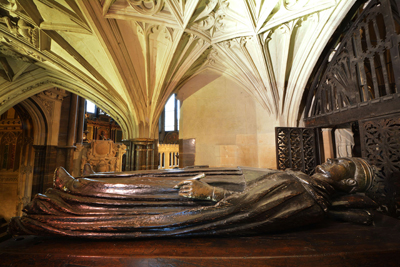
The chapel, which is located on a sort of mezzanine level above the king’s tomb at the east end of the Shrine of Edward the Confessor, is one of the smallest of the abbey’s chapels. It was constructed on the orders of the king – who died Vincennes in August, 1422, and was buried in the abbey on 7th November that year – so prayers could be said in perpetuity for his soul.

The tomb was completed in 1431 and the chantry chapel was built above between 1437 and 1450. The latter is entered via narrow stairways of worn steps hidden inside a pair of stone turrets which flank the tomb.

For centuries the Henry V’s funeral ‘achievements’ – the king’s saddle, helm and shield – were displayed on a wooden beam above the chantry chapel but these were restored and moved to the abbey museum in 1972.

Henry V’s wife, Catherine de Valois, who survived her husband by 15 years was eventually – in the Victorian age – buried under the chantry chapel altar (originally buried in the old Lady Chapel, King Henry VII had her removed and placed in an open coffin in the open air next to the tomb of King Henry V, when building his new chapel – among visitors to her mummified body was diarist Samuel Pepys who even kissed her. In 1778 she was buried in a vault before being relocated to her current position in 1878).

An inscription on the altar in the chantry chapel reads: “Under this slab (once the altar of this chapel) for long cast down and broken up by fire, rest at last, after various vicissitudes, finally deposited here by command of Queen Victoria, the bones of Catherine de Valois, daughter of Charles VI, King of France, wife of Henry V, mother of Henry VI, grandmother of Henry VII, born 1400, crowned 1421, died 1438”.

The chantry chapel is still occasionally used for services but, measuring just seven by three metres, is not usually open to the public because of size and access issues.

Westminster Abbey will hold a special service of commemoration on 29th October in partnership with charity Agincourt600. The day before, 28th October, it will host a one day conference for Henry V enthusiasts entitled ‘Beyond Agincourt: The Funerary Achievements of Henry V’. For more, see www.westminster-abbey.org/events/agincourt.

Above – King Henry V’s chantry chapel; Below – King Henry V’s tomb which sits below the chantry chapel. PICTURE: Jim Dyson/Dean & Chapter of Westminster

Henry-V-tomb

Treasures of London Special – Remembering Agincourt at the Tower…

This weekend marks the 600th anniversary of the Battle of Agincourt (25th October, 1415) when King Henry V and his army of English archers overcame the larger French host in what is now northern France during the Hundred Years War.

To mark the occasion, the Royal Armouries have launched a new exhibition at the Tower of London, The Battle of Agincourt: 600th Anniversary Exhibition which tells the story of the battle and its aftermath as well as some of the myths which sprang up in its wake.

Below are some of the “treasures” presented in the exhibition in the White Tower which runs until 31st January. There will also be a programme of associated events running at the Tower from tomorrow until 1st November. For more, see www.royalarmouries.org/agincourt.

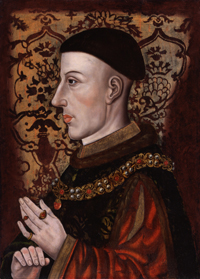
King Henry V played a key role in the battle, which came more than two-and-a-half months after he launched an invasion of Normandy. Until Agincourt, the campaign had not gone well – dysentery had taken a considerable toll on his men and his army had only taken one target – the port of Harfleur – when, after crossing the River Somme, the French heralds summoned him to the fight. It was on the morning of the battle – St Crispin’s Day, 25th October – that he gave a short speech to stiffen the resolve of his army which William Shakespeare subsequently embellished in his play Henry V: “We few, we happy few, we band of brothers…”. This painting of the king is by unknown artist, oil on panel, late 16th or early 17th century. PICTURE: © National Portrait Gallery.

Agincourt2b


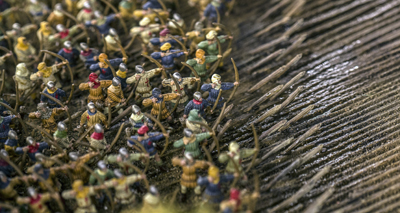
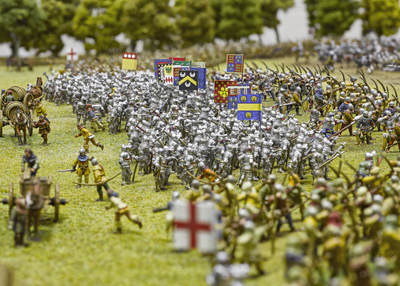
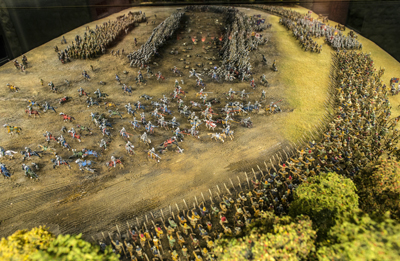
Three scenes from a four metre by two metre model of the battlefield of Agincourt, supported by the Arms and Armour Heritage Trust and constructed by MM Dioramas and Perry Miniatures. The model features 4,000 detailed scale model figures – 2,600 French and 1,750 English, representative of the larger forces each brought the fight (the exhibition puts the number of English 8,500-9,000 and the French at 12,000 although we should note others have claimed the English were outnumbered by as much as three or four to one). In the model, which draws on recent research to accurately bring to life the arms, armour and heraldry of those involved, English archers – who played a critical role in the battle (in fact, the battle is seen as an exemplar of the use of archers in battle) – are shown positioned behind wooden stakes that King Henry V asked them each to carry for protection against the French cavalry, seen charging towards them. The battle, which started in late morning when the English archers provoked the French into attacking, was all over by early afternoon and while it’s not certain how many died, sources are agreed that the French losses were considerably higher than the English. Following the exhibition the model will be going on permanent display at the Royal Armouries Museum in Leeds. PICTURE © Royal Armouries.

Agincourt3

Agincourt1

Agincourt6


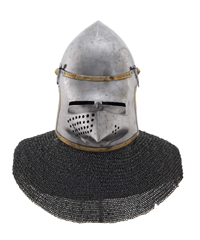
Lyle Bacinet, north Italian, late 14th century. Rare in terms of its quality, it would have been used mostly by mounted knights. By the late 14th century, men-at-arms would have worn complete plate armour. PICTURE © Royal Armouries.

Agincourt5b


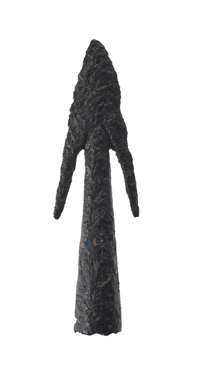
An arrowhead typical of the period. These would have been made in ‘sheaves’, bundles of 24 arrows which would have been worn on the archer’s waist. PICTURE © Royal Armouries.

Agincourt5a

 An English ‘ballock dagger’, dating from the late 14th – early 15th centuries. A common weapon and characteristic shape of the period. Such weapons may have been carried by archers to finish off the wounded. PICTURE © Royal Armouries.


Agincourt9

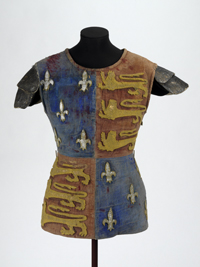
Shakespeare’s retelling of events in Henry V has kept the story of the famous battle alive down the centuries. In a nod to the important role the Bard has played, the exhibition features a rare First Folio of Shakepeare’s plays as well as tabard (below) worn by Richard Burton in the title role of King Henry V at Stratford-upon-Avon in 1951. It was made of hessian and felt with simulated armour at the shoulders so it would appear to have been worn on the battlefield. PICTURE © Victoria and Albert Museum.

Agincourt2a


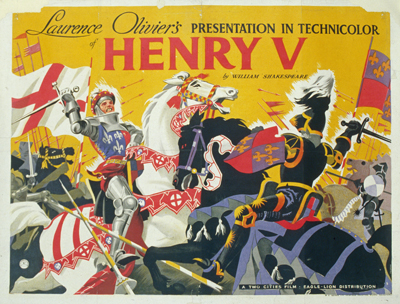
Other 20th century artefacts related to Agincourt include a film poster for Henry V (1944), a film adaptation of Shakespeare’s play which starred and was directed by Laurence Olivier. PICTURE: © ITV / REX.

Agincourt7

For more information on events surrounding the 600th anniversary of the Battle of Agincourt, see www.agincourt600.com.

10 London ‘battlefields’ – 1. Queen Boudicca takes on the Romans…

boudicca

This month marks the 600th anniversary of the Battle of Agincourt and to mark the occasion, we’re looking at 10 of London’s “battlefields” (well, maybe not officially recognised battlefield sites but 10 places where fighting took place – or, as in this instance, legend says took place – at various times throughout London’s history).

First up it’s to King’s Cross, once said to have been site of a village known as ‘Battle Bridge’, so named because, according to tradition, it here in about 60AD that the rebellious hoards of Queen Boudicca (also known as Boadicea or Boudica) ran into the well-disciplined army of the Roman Governor of Britain, Gaius Suetonius Paulinus.

Paulinus had been campaigning in northern Wales when the Iceni rebellion broke out in East Anglia, apparently sparked by the Romans’ refusal to honour the will of the deceased King Prasutagus. He had left his land to the Emperor Nero and his two daughters but instead, the story goes that the Romans seized the land, flogged his wife Boudicca and raped his two daughters.

Understandably incensed at this treatment, the Iceni and members of other tribes rose in rebellion under Boudicca and laid waste to the Roman city of Camulodunum (what is now Colchester in Essex).

Boudicca then turned toward Roman Londinium, the provincial capital, and while Paulinus beat her there with a small number of troops, he quickly concluded he couldn’t defend it and ordered it evacuated. Boudicca, who is claimed to have fought from a chariot, and her army of tribesman apparently spared no-one when they arrived and burnt it to the ground. They then moved on to attack another Roman city – Verulamium (St Albans).

Paulinus, meanwhile, marshalled his forces – still apparently vastly outnumbered – and chose his battleground carefully. One legend suggests King’s Cross – then site of an ancient bridge across the River Fleet – as the battle’s location (although we should mention there are also numerous other sites which have been suggested as the location for the battle including locations in the Midlands along the Roman road of Watling Street, now the A5).

Where-ever it was, Paulinus had apparently chosen his position so that Boudicca couldn’t bring her greater numbers to bear on his flanks. Her army collapsed and, according to the Roman historian Tacitus, there was a rumour that 80,000 Britons were killed and just 400 Romans in the ensuing battle (although fair to say such numbers may be a stretch!).

The outcome was obviously devastating for Boudicca – there’s various accounts of what happened to her next with one being that she fell during the battle and another that, having survived, she committed suicide by poisoning herself. There is a legend that Boudicca was subsequently buried at a site now covered by platform nine or 10 at King’s Cross railway station. It’s also been suggested she was buried at Parliament Hill.

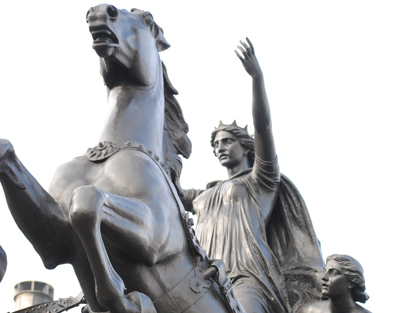
There’s a statue commemorating Boudicca and her daughters (pictured above) at the western end of Westminster Bridge. Designed by Thomas Thornycroft, it was made in 1850 but not erected on the site until 1902.

Lost London – Church of St Alban, Wood Street…

This church, which survived until it was largely destroyed by bombing in World War II, isn’t completely lost – its tower still survives in the middle of Wood Street in the City.

St-Alban's-Wood-StreetThe church, one of a number dedicated to St Alban (Britain’s first Christian martyr) in London throughout its history, was medieval in origin although it has been argued its foundation dates back to the 8th century Saxon King Offa of Mercia who is believed to have had a palace here with the chapel on this site (Offa is also credited as the founder of St Alban’s Abbey).

The church had fallen into disrepair by the early 17th century and was demolished and rebuilt in 1630s. It proved unfortunate timing for only 32 years later it was completely destroyed again, this time in the Great Fire of London.

Following the Great Fire, the church, now combined with the parish of St Olave, Silver Street, was among those rebuilt to the designs of Sir Christopher Wren and completed in the mid-1680s.

It was restored in the late 1850s under the eye of Victorian architect Sir George Gilbert Scott and the four pinnacles on the tower, which stood on the north side of the church, were replaced later that century.

It survived until World War II when the building was burnt out and partly destroyed on a single night during the Blitz in December, 1940. The remains, with the exception of Wren’s Perpendicular-style tower, were later demolished in the 1950s (by which time the church had been united with the parish of  St Vedast, Foster Lane).

The Grade II*-listed tower was converted into a rather unusual private dwelling in the 1980s.

Famous Londoners – Hans Holbein the Younger…

Famed as the court painter of King Henry VIII, Hans Holbein the Younger was one of the greatest portrait painters of the sixteenth century.

Born in Augsburg, in southern Germany, in 1497-98, Holbein was the son of painter and draughtsman Hans Holbein the Elder. Hans, like his brother Ambrosius, followed the family trade which he apparently learnt under the tutelage of his father and uncle until breaking away to make his own mark.

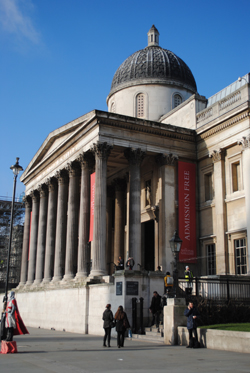
National-GalleryJourneying with Ambrosius to Basel in what is now Switzerland, the two brothers became apprenticed to the city’s leading painter Hans Herbster. In 1517, Holbein went with father to Lucerne where they worked painting murals for a leading merchant. It is thought while there, that he visited northern Italy where he studied Italian frescos.

Returning to Basel in 1519, he quickly re-established his business there, becoming a member of the artists’ guild, and married Elsbeth Schmid, their first son arriving in the first year of their marriage (the couple apparently had four children, two of whom are depicted in a portrait with his wife he painted in the late 1520s).

He was soon completing numerous major projects for the city – including painting internal murals for the Town Hall’s council chamber – and was also involved in creating illustrations for books – the most famous being the series of images known as the Dance of Death – and painting portraits, including his first portraits of the Renaissance scholar, Erasmus. It was these and other portraits that ensured his fame across Europe.

The decline in the production of religious art, thanks to the Reformation which was then sweeping over the continent, apparently led Holbein to look further afield for work and, having first gone to France, in 1526 he went to England.

There he was welcomed by Sir Thomas More, then a key figure in the regime of King Henry VIII, who soon found him some commissions. His works during this period included portraits of More, William Warham, Archbishop of Canterbury, astronomer Nicholas Kratzer and courtiers like Sir Henry Guildford.

He returned to Basel a wealthy and successful man in 1528 and remained there for four years before once again leaving his family and heading to England, this time finding favour with the Boleyn family and Thomas Cromwell.

It was early during this period – he remained in England until his death in 1543 – that he painted portraits of Hanseatic League merchants of the Steelyard (see our earlier post here) as well as The Ambassadors (see our earlier post here).

In 1536, he was employed as painter to King Henry VIII and the following year he painted what is arguably his most famous image – that of King Henry VIII in all his glory in the image known as the Whitehall Mural which pictured the king with his the wife, Queen Jane Seymour, his father, King Henry VII and his mother, Queen Elizabeth of York (the image was lost in the fire which destroyed Whitehall Palace in 1698 but copies were made and a copy is now at Hampton Court Palace).

King Henry VIII was to be his subject on numerous occasions as were other members of the Royal Family, courtiers and prospective wives including, famously, a portrait of Anne of Cleves which may have oversold her beauty to the king who was unimpressed with her in person (there is apparently no evidence the king blamed Holbein himself for this).

While he had successfully navigated his way past the downfall of Sir Thomas More and then the Boleyn family, the fall of Sir Thomas Cromwell did cause significant damage to his standing. Nonetheless he retained his official position at court and it was during this time that he painted some of his finest miniatures including those of the sons of Henry VIII’s friend, Charles Brandon, 1st Duke of Suffolk.

It is believed Holbein may have returned to visit his family in late 1540 before returning to London where he died sometime in October or November, 1543, having made his will on 7th October at his home in Aldgate (plague has been suggested as the cause of his death). The site of his grave is unknown.

Holbein’s legacy is such that the portraits he created in his two stints in London have become a key component in how we view Tudor England – and in particular, the Tudor court – today.

His works can be seen in key locations across London including the National Gallery (pictured above), the National Portrait Gallery (where his bust is one of a series of artists on the exterior) and Hampton Court Palace.

LondonLife – The Quadriga at Hyde Park Corner…

The-QuadrigaKnown as ‘The Quadriga’, this bronze monument atop Wellington Arch at Hyde Park Corner depicts Nike, goddess of victory, in a four horse chariot. The work of English sculptor Adrian Jones, the quadriga was part of Decimus Burton’s original early 19th century design but it wasn’t until 1911-1912 that this colossal piece – once the largest bronze monument in Europe – was installed, replacing an equestrian statue of the Duke of Wellington which was moved to Aldershot (a smaller equestrian statue of the Duke now stands nearby). For more on the arch, see www.english-heritage.org.uk/visit/places/wellington-arch/.

Treasures of London – Duke of Wellington’s cloak…

Duke-of-Wellingtons-CloakRecently acquired by the National Army Museum (fittingly given this is the 200th anniversary of the Battle of Waterloo), this cloak was worn by the Duke of Wellington during the Waterloo Campaign.

Spattered with mud, the cloak is made from blue wool and trimmed with a navy collar and facings. Purchased by the museum at auction for £38,000, it will now form part of a collection of other Waterloo and Napoleonic items in the museum’s permanent collection.

The cloak can apparently be traced back to Lady Caroline Lamb, who had an affair with Wellington in the summer of 1815 and is believed to have been given the cloak as a memento. The first documented owner was Grosvenor Charles Bedford who was given the cloak in 1823 by the surgeon and anatomist Anthony Carlisle.

On presenting Bedford with the cloak, Carlisle had commented that it had been given to him by Lady Caroline who had received it from the duke. The cloak has been passed down within Bedford’s family ever since.

The National Army Museum in Chelsea already possesses a portrait of Wellington by Edward Stroehling (1768-1826) which depicts him wearing a similar cloak.

The cloak will go on display when the museum reopens next year. For more on the museum in the meantime, see www.nam.ac.uk.

PICTURE: Courtesy National Army Museum.

10 Questions – Sheila Dunsmore, a State Apartment warder at Hampton Court Palace…

HamptonCourtPalace500thBirthday-3

This year marks the 500th anniversary of the building of Hampton Court Palace in Greater London’s south-west. We speak to Sheila Dunsmore, a State Apartment warder at Hampton Court Palace (pictured above in centre on the left)…

1. It’s Hampton Court Palace’s 500th anniversary – who first built the palace and why? “In 1514, Thomas Wolsey came to survey the land at Hampton Court. He wanted to find a suitable place to build a sumptuous country retreat away from the dirt of London, but close enough to the capital to travel back for meetings. It was also to be a place to entertain the important company his position as Archbishop of York provided, of which none were more important than young King Henry VIII.”

2. Where are the oldest parts of the palace today? “The oldest part of the palace is the Tudor kitchens, more specifically the area were the great fire is. This was once part of Sir Giles Daubeney’s original kitchen, and dates back to the manor already on the site when it was acquired by Wolsey. Sir Giles Daubeney was Lord Chamberlain to Henry VII, and acquired an 80 year lease on the property from the Knights Hospitallers of St John of Jerusalem, the then owners. The bell in the tower above the astronomical clock is also said to have come from the Knights Hospitallers’ original manor house.”

3. Hampton Court’s 500 years of history spans a number of definable eras – from Tudor to the 21st century. Which is your favourite and why? “My favourite era is the 1660s when Charles II came back to England to take up his rightful place as king. Although visitors do not really associate Charles with the palace, he did spend time here, most famously his honeymoon!”

4. With this in mind what is your favourite part of the palace? “I love the west front façade – it just looks so imposing and mysterious. Whether you are driving or walking past it it’s guaranteed to draw you in under its spell!”

5. Do you have a favourite anecdote from the palace’s history? “I love the story of Horace Beauchamp Seymour, a dashing military hero who had fought at the Battle of Waterloo. He came to live at the palace in 1827 and, as a handsome eligible widower, he caused quite a sensation amongst the ladies, especially when he joined the Sunday services at the Chapel Royal. It was not long before a series of fainting episodes began, with the strategically placed young lady fainting into the arms of the dashing Horace, who then proceeded to carry the lady out and stay with her until she regained her composure. After a third successive Sunday of fainting’s, the epidemic was brought to a swift halt by the aunt of Mr Seymour, herself also a palace resident. The feisty old lady pinned a sign to the chapel door warning any lady feeling faint that forthcoming Sunday that Bransome the dustbin man would be carrying her out. Needless to say the fainting ceased!”

6. A complex of buildings dating back as far as 500 years obviously requires considerable upkeep. What are the greatest challenges with regard to maintaining the palace? “I think the biggest challenge would have to be generating the money to keep restoring and conserving this historic palace. To do this we have to keep making sure that people want to visit, from international tour groups to local families who might visit again and again. To do this teams right across the palace work to create exciting exhibitions, immersive events and guided tours to ensure we’re offering people a memorable experience.”

7. Are there any areas of the palace which remain unseen by the public? And any plans to open further areas up? “The palace contains over 1,000 rooms, and visitors get to discover about a quarter of these during their visit. Some years ago we held a Servants, Soldiers and Suffragettes exhibition in a suite of rooms on the top floor of Fountain Court (previously unseen). It was incredibly popular so I’d imagine that in the future we’d look for other such opportunities to share other areas of the palace with our visitors. For anyone that can’t wait that long, on one night of the year (Halloween no less), our adults-only ghost tour offers the chance to peek behind the scenes and explore some areas of the palace off the beaten track!”

8. Are there any ‘secrets’ about the palace you can reveal to us? “A palace as old and as large as Hampton Court holds its fair share of secrets…When the fire took hold in 1986 it was devastating, but in a strange twist of fate some good came from it as well. As restoration of the damaged interiors took place little secrets were revealed to us; behind wood panelling in King William’s damaged rooms hand prints were found in the plaster from the palace’s builders, and sketches were found from the architects with designs for the rooms, all worked directly onto the bare walls. Most exciting of all, however, was the object found downstairs. During work to return King William’s private dining room (which had lost its original look over the years and been used as a function room for the grace and favour residents) to its former glory, a gun was found behind some wooden panelling. The gun dated from the late 1800s, and had a regimental dinner menu was wrapped around it. This is so intriguing – what was the story behind this gun? Who did it belong to? Why did they hide the weapon?”

9. If someone has just one day to visit the palace, what’s your ideal itinerary? “This is a tricky one, and depends very much on the individual…and the weather! I would say on a sunny day start by enjoying a historic welcome with our costumed interpreters, which really helps to set the scene. If it’s a bit chilly pick up a cloak to wear – you can choose between dressing as a Tudor or Georgian courtier. Heading inside, I’d start in the Tudor State Apartments to discover the rich opulence of Henry VIII’s Hampton Court, then visit the recently opened Cumberland Art Gallery, which contains masterpieces by Rembrandt, Canaletto and Van Dyck. Next I’d take in the baroque splendour of the Queen’s State Apartments, then explore the maze, East Front Garden and Privy Garden (weather permitting!). After a spot of lunch I’d suggest visiting the Mantegna Gallery, then the Young Henry exhibition which explores the life of the young Henry VIII, before finishing the day in King William III’s apartments.”

10. Finally, Historic Royal Palaces has already commemorated the 500th anniversary in numerous ways – from a spectacular fireworks display to a jousting tournament. Are there any more events coming up? “The beginning of September saw our costumed interpreters back with their own inimitable brand of entertainment, while at the end of September we’re hosting a sleepover inside the palace! As the evenings draw in, our popular ghost tours return for the winter season. Even further ahead we’ve got a series of carol evenings and even an ice rink for our visitors to enjoy!”

WHERE: Hampton Court Palace, East Molesey, Surrey (nearest station is Hampton Court from Waterloo); WHEN: 10am to 6pm until 24th October after which it’s open to 4.30pm); COST: Adult £19.30, Concession £16, Child under 16 £9.70 (under fives free), family tickets, garden only tickets and online booking discounts available; WEBSITE:www.hrp.org.uk/HamptonCourtPalace/.

This Week in London – The Waterloo Cartoon on show; see inside a former Huguenot’s home; and, Royal Parks’ harvest festivals…

A monumental Victorian-era drawing of the Battle of Waterloo has gone on display in London for the first time since 1972. The Waterloo Cartoon, more formally known as The Meeting of Wellington and Blucher after the Battle of Waterloo, measures more than 13 metres long and three metres high. A preparatory drawing for a wall painting which still exists in the House of Lords’ Royal Gallery, it took artist Daniel Maclise more than a year to complete in 1858-59 and was based on eye-witness accounts (the artist even recruited Queen Victoria and Prince Albert to use their German contacts to gather information from Prussian officers present on the day). Long considered a masterpiece, it was bought by the Royal Academy in 1870 – the year of Maclise’s death – and was on show at Burlington House until the 1920s. It has been in storage for much of last century and, newly restored following a grant from Arts Council England, has now gone on display to mark the 200th anniversary of the Battle of Waterloo. The newly conserved drawing is the focus of a new exhibition – Daniel Maclise: The Waterloo Cartoon, which opened at the Royal Academy in Piccadilly yesterday (between May and August, it was on show as part of a Waterloo exhibition at the Royal Armouries in Leeds). Runs until 3rd January. Admission charge applies. For more, see www.royalacademy.org.uk.

There’s a rare chance to see inside a former Huguenot merchant’s house dating from 1719 in Spitalfields this weekend. The property at 19 Princelet Street was the home of the Ogier family, who had come to London escaping persecution in France and worked in the silk weaving trade. It was later subdivided into lodgings and workshops with later occupants following a range of trades and professionals while a synagogue was opened in the garden in 1869. The site – which the Spitalfields Centre charity hopes to establish as a museum of immigration – is not generally open to the public but will be open this Saturday and Sunday – from 2pm to 6pm. Entry is free (but donations would be welcome) and there may be queues so its suggested you arrive early. For more, see www.19princeletstreet.org.uk.

Watch a bee keeping demonstrations, help dig up some potatoes and introduce the children to some farm animals. The Kensington Gardens’ Harvest Festival will be held this Sunday, between 11am and 4pm, and will also include a range of children’ activities, experts from the Royal Parks Guild on hand to answer your questions about food growing and complimentary hot and cold drinks available throughout the day while stocks last. It’s the first of three harvest festivals to be held in Royal Parks this month with Greenwich Park set to host its inaugural harvest festival on 13th September (11am to 4pm) and The Regent’s Park Allotment Garden to host one on 19th September (11am to 5pm). For more, see www.royalparks.org.uk.

Send all items for inclusion to exploringlondon@gmail.com.