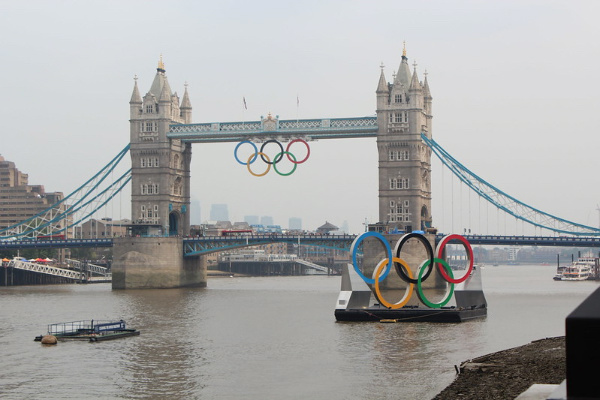
Memories of 2012. This year the Games are in Paris but there’s plenty of places to watch on a big screen in London. PICTURE: Peter Burgess (licensed under CC BY 2.0)
• The Olympics are in full swing across the Channel in Paris and to ensure you don’t miss any of the action, big screens are showing the coverage across London. Among them are official Team GB Fanzones – there’s a list of locations on the Team GB website here. Other locations include Lyric Square in Hammersmith, Bishops Square in Spitalfields, the Old Royal Naval College grounds in Greenwich and by the Thames at London Bridge as part of the Summer by the River festival.
• New portraits of human rights campaigner Peter Tatchell and singer Sam Smith have gone on display at the National Portrait Gallery as part of its History Makers Display. The full-length portrait of Tatchell, which has been acquired by the gallery, was painted by artist Sarah Jane Moon to coincide with his 70th birthday on 25th January, 2022, and is the first portrait of Tatchell to enter the gallery’s collection.. Meanwhile, titled Gloria, the portrait of five-time Grammy Award winner Smith is the work of artistic duo Pierre Commoy and Gilles Blanchard and was created in 2023. It’s on loan from the singer. For more, see www.npg.org.uk.
• On Now: Faithful Companions: Charles Dickens & his Pets. This exhibition at the Charles Dickens Museum in Bloomsbury takes a look at the many pets – dogs, ravens, goldfinches, and cats – that lived in the home of Charles Dickens, exploring the stories of the likes of Grip the raven and Timber the dog as well as those of animals made famous in his novels. The display includes hand-written letters, family photo albums and artworks. Runs until 12th January next year. Admission charge applies. For more, head to https://dickensmuseum.com/blogs/all-events/faithful-companions-charles-dickens-his-pets.
Send all items for inclusion to exploringlondon@gmail.com
The Bloody Tower (centre, with the gateway) at the Tower of London. PICTURE: David Adams
Carrying rather a gruesome name, this rectangular-shaped tower sits over a gate leading from outer ward into the inner ward in the Tower of London.
The tower, which once controlled the watergate before the outer walls were constructed, was originally known as the Garden Tower due to its location adjoining the Tower Lieutenant’s Garden.
To see the rest of this post (and all of our coverage), subscribe for just £3 a month. This small contribution – less than the cost of a cup of coffee – will help us continue and grow our coverage.We appreciate your support!
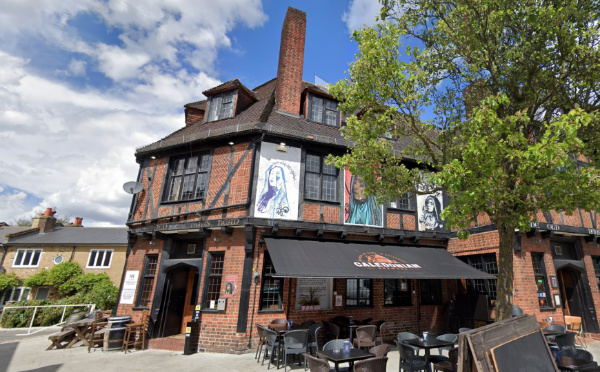
This district of London, which lies to the south-east of Peckham in the London Borough of Southwark, is believed to owe its name to a local tavern named, you guessed it, the Nun’s Head on the linear Nunhead Green (there’s still a pub there, called The Old Nun’s Head, in a building dating from 1905).
The Old Nun’s Head near Nunhead Green. PICTURE: Google Maps
There may well have been actual nuns here (from which the tavern took its name) – it’s suggested that there was a nunnery here which may have been connected to the Augustinian Priory of St John the Baptist founded in the 12th century at Holywell (in what is now Shoreditch).
A local legend gets more specific. It says that when the nunnery was dissolved during the Dissolution, the Mother Superior was executed for her opposition to King Henry VIII’s policies and her head was placed in a spike on the site near the green where the inn was built.
While the use of the name for the area goes back to at least the 16th century, the area remained something of a rural idyll until the 1840s when the Nunhead Cemetery, one of the “Magnificent Seven” cemeteries of Victorian London, was laid out and the area began to urbanise.
A fireworks manufactory – Brocks Fireworks – was built here in 1868 (evidenced by the current pub, The Pyrotechnists Arms). The railway arrived in 1871.
St Antholin’s Church was built in 1877 using funds from the sale of the City of London church, St Antholin’s, Budge Row, which was demolished in 1875. St Antholin’s in Nunhead was destroyed during the Blitz and later rebuilt and renamed St Antony’s (the building is now a Pentecostal church while the Anglican parish has been united with that of St Silas).
There’s also a Dickens connection – he rented a property known as Windsor Lodge for his long-term mistress, actress Ellen Ternan, at 31 Lindon Grove and frequently visited her there (in fact, it has even been claimed that he died at the property and his body was subsequently moved to his home at Gad’s Hill to avoid a scandal).
Nunhead became part of the Metropolitan Borough of Camberwell in 1900. These days, it’s described by Foxtons real estate agency as “a quiet suburb with pretty roads and period appeal”.
Hanging in the Tudor Great Hall at Hampton Court Palace, this series of 10 huge tapestries are believed to have been commissioned by King Henry VIII and were first hung in the hall in 1546.
To see the rest of this post (and all of our coverage), subscribe for just £3 a month. This small contribution – less than the cost of a cup of coffee – will help us continue and grow our coverage.We appreciate your support!
This unusually named church dates back to at least the 13th century and stood on what is now Threadneedle Street.
St Benet is a contraction of St Benedict (he who founded monastic communities in Italy in the 6th century) and this was once of four City churches dedicated to the saint before 1666. The word ‘Fink’, meanwhile, is a corruption of Finch and apparently referred to Robert Finch (or Fink) who paid for a rebuild of the church in the 13th century.
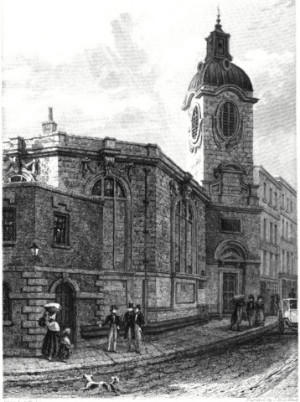
‘The Church of St Benet Fink’ (1839), seen in The Churches of London by George Godwin (1839).
The medieval rectangular church was among those destroyed in the Great Fire of 1666. Rebuilding commenced soon after, thanks in part to a £1,000 donation from a Catholic George Holman (he was rewarded with two pews and a place in the vault). The church was completed in 1675 apparently for a cost at just over £4,000.
Designed by Sir Christopher Wren, the church – due to the irregular shape of the site after the City decided to widen Threadneedle Street, was rebuilt on a decagonal plan, over which sat a dome, with a tower at the west end topped by a bell cage over which sat a ball and cross (apparently this latter feature was unique for a Wren church).
The church survived until the mid-18th century when the Corporation of London petitioned Parliament for permission to demolish the tower of St Benet Fink in order make way for an expanded Royal Exchange (which had burned down in 1838).
Following the demolition of the tower (over which there were some protests), a new entrance was cut into the west wall of the church but it proved less than ideal and the City of London was granted permission to knock down the rest of the church which took place in 1846.
The parish was merged with that of St Peter le Poer. Proceeds of the sale of the site were used to build St Benet Fink Church, Tottenham.
The furniture was sold off and paintings of Moses and Aaron that had formed part of the altarpiece are now in the chapel of Emanuel School in Battersea.
Famous associations include John Henry Newman, the future Catholic cardinal, who was baptised in the church on 9th April, 1801.
An office block now occupies the site. A City of London blue plaque marks the site.
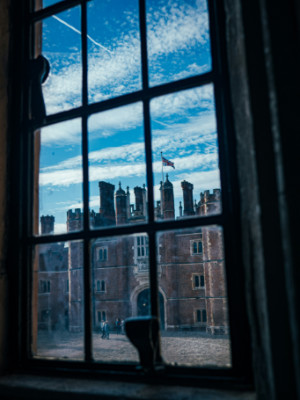
Looking out a window at Hampton Court Palace. PICTURE: Greg Willson/Unsplash
• The oldest surviving rooms at Hampton Court Palace – the Wolsey Rooms which King Henry VIII and Thomas Wolsey once used – are the location of a new display opening today exploring the early years of Henry VIII’s reign and the lives of the ‘ordinary’ men and women who shaped the Tudor dynasty.The Tudor World has, at its centre, rare surviving paintings from the Royal Collection including The Embarkation of Dover – depicting the Tudor navy – and The Field of Cloth of Gold which details Henry VIII’s summit with King Francis I of France in 1520. Also on show is a gold ring believed to have belonged to the Boleyn family, a brightly coloured silk hat linked to King Henry VIII, Wolsey’s portable sundial, a wooden chest used to hide religious contraband by Catholic priests during the reign of Queen Elizabeth I, and, an original Tudor chain pump used to help empty the Hampton Court cesspool. Among the stories of “ordinary” Tudor people being shared is that of Anne Harris, Henry VIII’s personal laundry woman who washed the bandages for his leg ulcers and, Jacques Francis, a free-diver from West Africa who was involved in the expedition to salvage guns from the sunken Mary Rose and who later became one of the first Black African voices heard in an English court, when he was called to testify in a case concerning his employer, Paulo Corsi. Included in palace admission. For more, see www.hrp.org.uk/hampton-court-palace/.
• Crossing Borders, a day of free activities, performances and workshops run by local newly arrived people, will be held at the Horniman Museum Gardens in Forest Hill this Saturday. The day will feature arts and crafts workshops led by IRMO, dance performances by Miski Ayllu and the Honduran Folkloric Pride Group, the chance to learn circus skills with young people from Da’aro Youth Project and South London Refugee Association, and the opportunity to make kites with Southwark Day Centre for Asylum Seekers. The free event runs from 11am to 4pm. For more, see https://www.horniman.ac.uk/event/crossing-borders/.
• Transport for London customers can save 30 per cent on entry to the Painted Hall at the Old Royal Naval College when using the TfL network until 17th November. Simply show customers show your TfL journey on the day of your visit via the TfL Oyster and Contactless app and receive the discount, taking the adult entry price, when booked online to just £11.55. For bookings, head to https://londonblog.tfl.gov.uk/2022/07/27/in-the-city/.
Send all items for inclusion to exploringlondon@gmail.com.
A suffragette and women’s right’s campaigner, Princess Sophia Jindan Alexandrovna Duleep Singh was the daughter of the deposed Maharaja Sir Duleep Singh, last Sikh emperor of Punjab, and god-daughter of Queen Victoria and is known for having leveraged her position to advocate for the rights of others.
Princess Sophia Duleep Singh selling subscriptions for the ‘Suffragette’ newspaper outside Hampton Court in London in about 1913. PICTURE: Via Wikipedia/Public Domain.
Singh was born on 8th August, 1876, at a house in Belgravia, the third daughter of the Maharajah and his German-born first wife, Bamba Müller. The fifth of six children, she was named Sophia for her maternal grandmother, a formerly enslaved woman from Ethiopia who married a wealthy German banker, and Alexandrovna in tribute to her godmother, Queen Victoria.
Following his forced abdication, the Maharaja had travelled to England as a boy in 1854 where he lived on an annual government pension of £25,000. Having later married Bamba in Cairo, he returned to England where in 1863 he purchased Elvedon Hall in Suffolk (which he later rebuilt). Sophia subsequently spent her childhood there.
But after the breakdown of her parents’ marriage (after which her father remarried before being exiled to Paris where he campaigned for a return to India until his death in 1889) and the death of her mother in 1887 from typhoid (she had contracted the disease but survived), Sophia and her siblings were placed in the care of Arthur Craigie Oliphant – chosen by Queen Victoria to be guardian – first at their home in Folkestone and then in Brighton.
After finishing her education at a girls school in Brighton, Sophia and her sisters sisters Bamba and Catherine embarked upon a six-month tour of Holland, Germany, Greece, Italy, and Egypt.
Sophia, who had inherited some of her father’s fortune, was given Faraday House – part of the Hampton Court estate – as a grace-and-favour apartment by Queen Victoria in 1896 (along with an annual grant to maintain the property and a key to Hampton Court Palace where she could walk her dogs).
The princess took a keen interest in dogs – she was a member of the Ladies’ Kennel Association and showed her dogs on several occasions – as well in music, photography and fashion. She also supported Indians in London, particularly those in the Sikh community, and travelled to India a number of occasions.
Princess Sophia is known for her work in the women’s suffrage movement and was an active member of the Women’s Social and Political Union. She was present in Parliament Square ion 18th November, 1910, when more than 300 suffragettes including Emmeline Pankhurst gathered and demanded to see the Prime Minister HH Asquith and, having refused to disperse when he refused to see them, were met with a violent response by police. The day, which resulted in injuries to more than 200 women including two who died of them, became known as Black Friday.
Sophia was also, perhaps more importantly in terms of public impact, a member of the Women’s Tax Reform League and refused to pay fines on a couple of occasions, protesting that taxation without representation was “tyranny” (with the result that some of her jewels were confiscated and auctioned off).
During World War I, Princess Sophia – as well as being part of a 10,000-strong march calling for the establishment of a female volunteer force – was involved in fundraising for organisations such as the Red Cross and in support of Indian soldiers and also worked as a nurse at the Brighton Pavilion and other hospitals where Indian soldiers were recovering.
During World War II, Sophia moved to Penn, Buckinghamshire, with her sister Catherine, and took in evacuee children from London.
Having never married, Princess Sophia died in her sleep in Penn on 22nd August, 1948. A full band played Wagner’s Funeral March at her cremation and her ashes were taken to India for burial.
Sophia’s name and image are among those on the plinth of the statue of Millicent Fawcett in Parliament Square. In 2023, an English Heritage Blue Plaque was unveiled on Faraday House in Richmond.
Sources: Historic Royal Palaces; Oxford Dictionary of National Biography; BBC.
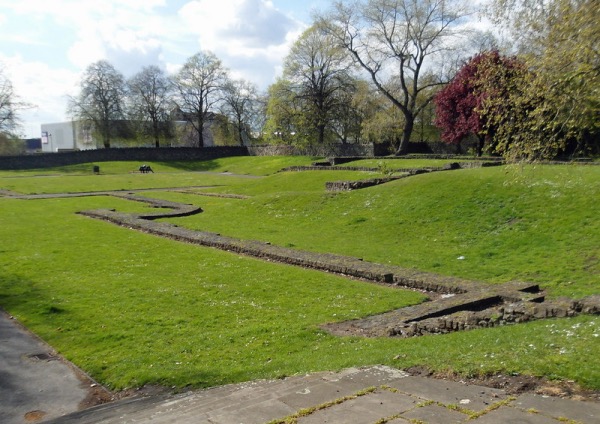
Footings of the abbey (these are modern with the real foundations below ground). PICTURE: diamond geezer (licensed under CC BY-NC-ND 2.0)
Once one of the most important nunneries in the country, Barking Abbey was originally established in the 7th century and existed for almost 900 years before its closure in 1539 during King Henry VIII’s Dissolution.
The abbey was founded by St Erkenwald (the Bishop of London between 675 and 693) for his sister St Ethelburga who was the first abbess.
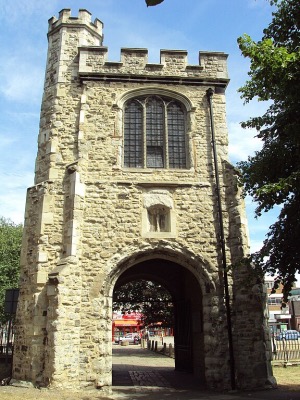
The Curfew Tower. PICTURE: Rept0n1x (licensed under CC BY-SA 3.0)
In the late 900s, St Dunstan, the Archbishop of Canterbury introduced the Rule of St Benedict at the nunnery.
King William the Conqueror stayed here after his coronation while famous abbesses included Mary Becket, the sister of St Thomas Becket, Archbishop of Canterbury, who was given the title in 1173 in reparation for the murder of her brother, as well as several royals including Queen Maud, wife of King Henry I, and Matilda, wife of King Stephen.
The nunnery gained wealth and prestige but this suffered somewhat as a result of floods in 1377 with some 720 acres of land permanently lost. It nonetheless remained one of the wealthiest in England and it’s said the abbess had precedence over all other abbesses in the country.
After the abbey was dissolved, some of the building materials were reused elsewhere and the site was later used as a farm and quarry.
Most of the buildings were demolished – today only the Curfew Tower, which dates from around 1460, remains. The Grade II*-listed tower contains the Chapel of the Holy Rood and now serves at the gateway to the nearby St Margaret’s Church.
Building footings also remain buried under the ground in what is known today as Abbey Green (the layout is marked today by modern additions). There’s a model of how the abbey once appeared inside the gateway.
Looking north up Basinghall Street from Gresham Street. The buildings on the left are part of the Guildhall complex. PICTURE: Google Maps
This City of London street, which sits on the eastern side of the Guildhall complex, is named for the wealthy Basing (or Bassing) family who had a hall here in the 13th century.
The street, which links Gresham Street in the south to Basinghall Avenue in the north, has been the site of numerous prominent buildings including the medieval hall of the Weaver’s Company (demolished in 1856, having replaced an earlier hall which burnt down in the Great Fire of London in 1666, the hall is now located in Gutter Lane), the Cooper’s Company (demolished in 1867, the hall is now located in Devonshire Square) and the Girdler’s Company (destroyed in the Blitz in 1940; the hall is now located in Basinghall Avenue).
It was also the location of the Sir Christopher Wren-designed Church of St Michael Bassishaw until 1899 after it was seriously damaged when the crypt was being cleared of human remains in line with the orders of City authorities. The parish with united with St Lawrence Jewry.
Famous denizens included the goldsmith, banker and civil engineer Sir Hugh Myddelton, most renowned for his design of the New River scheme to bring clean water to the City, who, according to The London Encyclopaedia, would sit in the doorway of his office and smoke his pipe while chatting with the likes of Sir Walter Raleigh.
The family also gave their name to the City of London’s Bassishaw Ward.
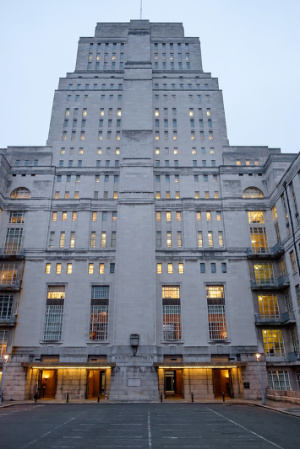
• A new exhibition celebrating the vision architect Charles Holden had for the design of the University of London – including the iconic Senate House – has opened at the venue. Holden had a hand in designing some 48 Tube stations and 55 Broadway – London’s first skyscraper - before in 1931 being appointed to develop the university’s Bloomsbury estate, including its headquarters. While the master plan was never completed (only the Senate House and its library were finished), it provides a fascinating insight into a part of London that could have been. Charles Holden’s Master Plan: Building the Bloomsbury Campus tells the story of institution’s design through architectural models, archival documents, photo albums, and other mixed media. The display in the Chancellor’s Hall Lobby on the first floor of the Senate House runs until 17th March. Entry is free. For more, see www.london.ac.uk/news-events/events/charles-holdens-master-plan-building-bloomsbury-campus.
• A new exhibition tracing the origins and influence of the popular British music genre known as two-tone has opened at the Barbican Music Library. Two-tone, which is also known as ‘ska-rock’ or ‘ska revival’ and which had its heyday in the late 1970s and early 1980s, fused traditional Jamaican ska, rocksteady, and reggae music with elements of punk rock and new wave music. Its name comes from record label 2 Tone Records which was founded in 1978 by Jerry Dammers from The Specials, one of the most popular Two-tone bands of the time. The display – From the Caribbean to Coventry: Plotting the Rise of Two Tone – features band memorabilia as well as clothing, literature, art, photographs, and fan contributions, and explores how Caribbean immigration influenced UK youth culture. Runs until 25th May. Admission is free. For more, see https://fromthecaribbean2coventry.co.uk.
• FURTHER AFIELD: Sir Winston’s family home – Chartwell in Kent – is hosting a new outdoor photography exhibition to mark what would have been his 150th birthday which features some of most spectacular birthday cakes. Press interest into Churchill’s birthday extravaganza – and in particular the cakes – was considerable and historic photographs from TopFoto have now been colourised for the first time, bringing the baking creations vividly to life. The images can be seen until 25th February. For more, see www.nationaltrust.org.uk/visit/kent/chartwell.
Send all items for inclusion to exploringlondon@gmail.com
Sixteenth century historian John Stow wrote numerous chronicles of English history but is mostly remembered for his landmark survey of London, a monumental work which has lead to him being informally given the title “founding father of London history”.
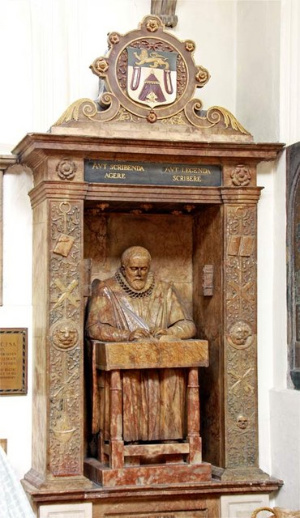
The monument depicting John Stow. PICTURE: John Salmon / St Andrew Undershaft, St Mary Axe, EC2 – Wall monument of John Stow / CC BY-SA 2.0
Stow (sometimes written as Stowe) was born a Londoner in about 1525 in the parish of St Michael, Cornhill. He was the eldest of seven children of Thomas Stow, a tallow chandler, and his wife Elizabeth.
Nothing is known about Stow’s early education - whether he attended a grammar school or was self-taught – but he is known to have developed a deep knowledge of English history, culture and customs as well as of Latin.
He didn’t follow his father’s trade but instead became an apprentice tailor and in 1547 was named a freeman of the Merchant Taylors’ Company. He is said to have worked as a tailor in London for almost 30 years.
In 1560, he started on his best known work, A Survey of London, a detailed topographical survey of the City of London and its suburbs – it was eventually published in 1598 (a second, longer edition followed in 1603). But his first book, on the works of Geoffrey Chaucer, was published in 1561, and he went on to publish numerous editions of English chronicles.
Stow was in contact with many of the era’s leading antiquarians, including the likes of John Dee and William Camden, and he was an active member of the first Society of Antiquaries, established in about 1586.
He also attracted the patronage of some significant figures including the Archbishops of Canterbury Matthew Parker and John Whitgift and Robert Dudley, Earl of Leicester, and was well-known for his collection of manuscripts, the largest group of which is now within the Harley collection at the British Library.
Stow, whose work never made him a wealthy man and who, at times, was the subject of his acquaintances’ charity (although Barrett L Beer in an entry in the Oxford Dictionary of National Biography describes his pleas of poverty as “exaggerated”), married his wife Elizabeth sometime after 1549. They lived initially in Aldgate where his business was also based (and later moved to the Lime Street ward). The couple had three daughters, two of whom – Joan and Julyan – survived him.
Stow died on 5th April, 1605. He was buried in the church of St Andrew Undershaft and his wife commissioned a marble monument to commemorate him which depicts Stow seated at his desk. A commemorative service, organised by the Merchant Taylors Company, is still held in the church every three years during which the quill he writes with is regularly replaced in a sign of respect.
For the final entry in our Wednesday special series, we go to see Sir Christopher Wren’s greatest work – and also his resting place, St Paul’s Cathedral.
Following his death on 25th February, 1723, Wren was buried in the crypt of St Paul’s Cathedral on 5th March.
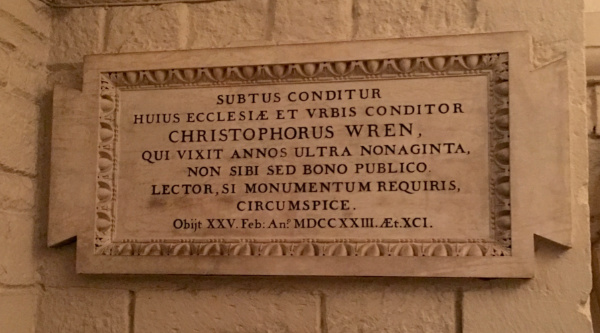
His burial location was in the south-east corner of the crypt and a simple memorial was placed there near that of his daughter Jane and his sister Susan Holder and her husband William.
The plaque which marks the location was written by his eldest son Christopher. Inscribed in Latin, it reads: “Here in its foundations lies the architect of this church and city, Christopher Wren, who lived beyond ninety years, not for his own profit but for the public good. Reader, if you seek his monument – look around you. Died 25 Feb. 1723, age 91.”
It’s a fitting tribute to one responsible for some of London’s most famous landmarks.
Interestingly, a fragment of Wren’s coffin can be seen at the RIBA Library. It was taken from his tomb in 1851 when it was last opened to allow for his last surviving direct descendent to be placed within.
WHERE: St Paul’s Cathedral (nearest Tube stations are St Paul’s, Mansion House and Blackfriars); WHEN: 8.30am to 4.30pm Monday to Saturday; COST: £23 adults/£20.50 concessions/£10 children/£56 family (these are walk-up rates – online advanced and group rates are discounted); WEBSITE: www.stpauls.co.uk.
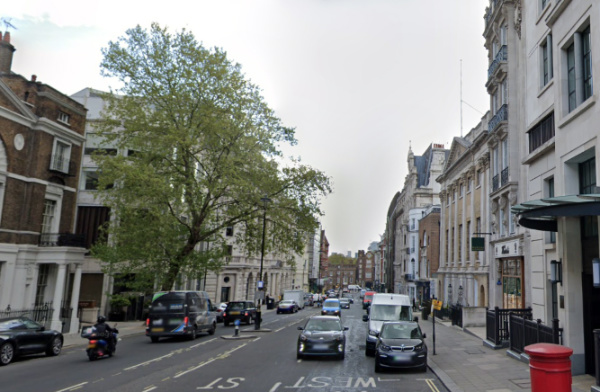
Looking south down St James’s Street. PICTURE: Via Google Maps
As noted at the outset of this series, in his latter years Sir Christopher Wren retired to the property on Hampton Court Palace Green, a property he was granted after he was appointed Surveyor-General to King Charles II in 1669.
But he also still spent time in London and, no longer having access to Scotland Yard, he lodged at his son Christopher’s house in St James’s Street, off Piccadilly. In fact, it was in this property that Wren, having suffered a chill, died while sitting in a chair at the age of 91 on 25th February, 1723.
It’s been suggested that the house in which Wren died was on the west side of the street. There’s an apocryphal story that suggests Wren came to London to check up on his greatest work, St Paul’s Cathedral.
PICTURE: Robin Sones (licensed under CC BY-SA 2.0)
Sir Christopher Wren’s name is one which pops up in association with buildings all over London – some authentically so, others less so.
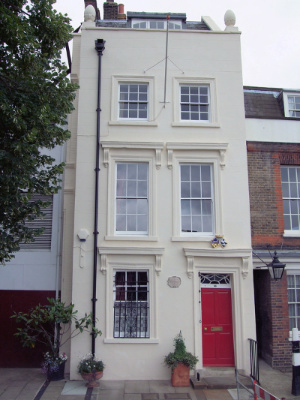
The house at 49 Bankside with the plaque to the left of the door. PICTURE: Jim Linwood (licensed under CC BY 2.0)
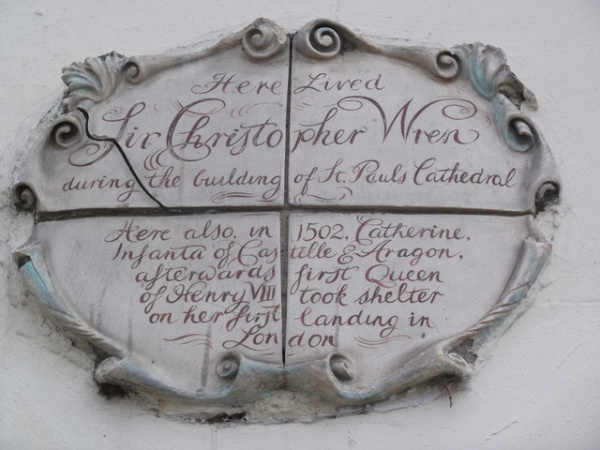
One of the more talked about locations where it can be physically seen is on a plaque attached to the front of a house overlooking the Thames at 49 Bankside, on the corner with Cardinal Cap Alley.
The plaque, written in a flowery script, claims that “Here lived Sir Christopher Wren during the building of St Pauls Cathedral” before going on to state that the property was also where in 1502, Catherine of Aragon, “took shelter” on first arriving in London before her marriage to King Henry VIII.
But author and historian Gillian Tyndall debunks the claim in her 2006 book The House by the Thames and the People who Lived There.
Tyndall explains that the property apparently dates from 1710 – St Paul’s was officially declared complete in 1711, leaving little cross-over (and certainly ruling out any residence by Queen Catherine who actually landed in Plymouth). She says that while it’s true the present house stands in the footprint of an older one, the house where Wren may have actually lodged during the 1670s is located further west along Bankside.
London Remembers notes that this property was apparently marked with an 18th century plaque commemorating Wren. But when that house was demolished in 1906, the plaque was saved and subsequently attached to a power station’s outer wall. When that was redeveloped in the post-war period, the plaque disappeared.
It was apparently that plaque which inspired the creation of the current plaque which was created by Major Malcolm Munthe, who acquired the property in 1945, and subsequently had the plaque made for the home’s exterior.
So it seems the plaque, despite what it says, does not commemorate a Wren residence (although perhaps it may commemorate the residence of Wren in the area). And, it’s been suggested, that while the plaque may not actually have marked a Wren home, its presence may have been enough to protect the building it adorns from threatened redevelopment in the mid-20th century.
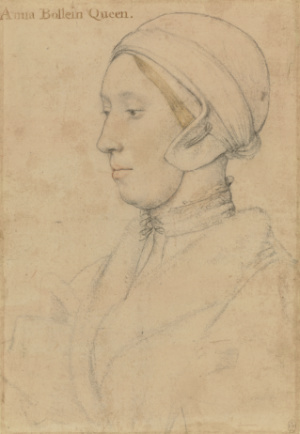
• The largest exhibition of the work of Tudor-era artist Hans Holbein the Younger has opened at The Queen’s Gallery, Buckingham Palace.Holbein at the Tudor Court features more than 50 works by Holbein including intimate portrait drawings of the royal family and the Tudor nobility including one of few surviving drawings of Anne Boleyn made during her lifetime, drawings of Jane Seymour and Sir Thomas More, and an unfinished portrait of King Henry VIII’s son Prince Edward. Other portraits include that of Derich Born, a 23-year-old Steelyard merchant, and one of Richard Southwell, a convicted murderer who was one of King Henry VIII’s closest advisors. The exhibition also features objects including a Brussels tapestry, jewel-like miniatures and Henry VIII’s magnificent armour, usually on show at Windsor and in London for the first time in a decade. Runs until 14th April. Admission charge applies. For more, see www.rct.uk/collection/themes/exhibitions/holbein-at-the-tudor-court/the-queens-gallery-buckingham-palace
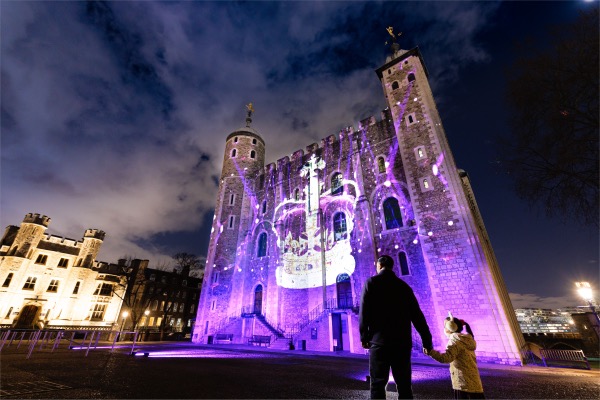
• The magnificence of coronations and the Crown Jewels will be on show at the Tower of London from tomorrow night in a new light and sound show. Crown and Coronation – which has been created by Historic Royal Palaces in partnership with Luxmuralis as part of an artistic collaboration between artist Peter Walker and composer David Harper – brings the “spectacle, significance and shared experience” of coronations to life and demonstrates the pivotal role of the Crown Jewels in the ceremony as it takes visitors on a journey through the past 1,000 years. Images of the jewels will be projected on the White Tower in the show with visitors then able to view the actual jewels themselves in a special after hours opening. But you’ll have to be quick – the show can only be seen for nine days, ending on 25th November before it embarks on a two year UK-wide tour. Admission charge applies. For more, see www.hrp.org.uk/tower-of-london/.
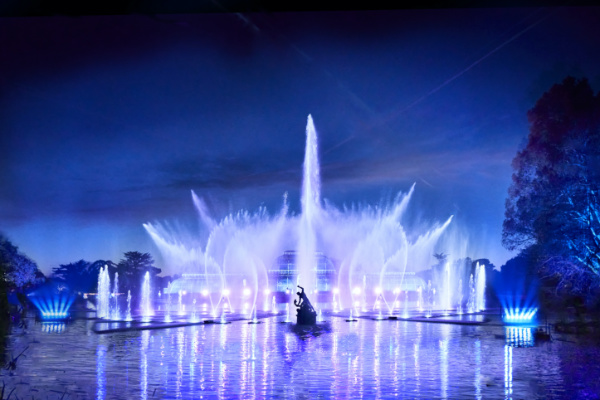
• Christmas returned to Kew this week with the launch of it’s new festive light trail featuring seven new installations. Highlights of this year’s trail include three metre tall illuminated flowers, cascading lights suspended from the tree canopy, one of the longest light tunnels to ever feature in Kew’s Christmas celebrations and the Hive – which recreates life inside a beehive – as well as the iconic Palm House light show, the twinkling tunnel of light inspired by arched church windows known as the ‘Christmas Cathedral’, and a ‘Fire Garden’ at the Temperate House. There’s also festive treats to sample and visitors can experience a traditional Christmas dinner at The Botanical Brasserie. Admission charges applies. Runs until 7th January (advance bookings only). For more, see www.kew.org/christmas.
• Charles Dickens’ friendship and collaboration with writer Wilkie Collins is explored in a new exhibition at The Charles Dickens Museum in Bloomsbury. Dickens met Collins, who would become one of his most significant friends, in 1851 as they performed together in a play at the house of John Forster and their personal and professional relationship lasted more than 15 years. The display features works produced as a result of the friendship – everything from articles in Dickens’s Household Words through to novellas and plays such as The Lazy Tour of Two Idle Apprentices and The Frozen Deep – and features original letters, historic objects, and interactive displays focusing on everything from the pair’s moustache-growing contests and cruising international entertainment districts to co-writing side by side, discussing writer’s block and plot devices. Admission is included with general admission. Runs until 25th February. For more, see https://dickensmuseum.com.
While this series is more focused on Sir Christopher Wren’s life rather than the many works he left behind, we’ve included the remarkable church of St Stephen Walbrook for a couple of reasons.
The first is that it is generally seen as being one of the more important church designs he created, particularly with regard to his later design of St Paul’s Cathedral, of which the St Stephen Walbrook dome is said to be a prototype.
The second is it’s claimed St Stephen Walbrook had a rather personal connection in that Wren lived at number 15 Walbrook during the period the church was being built, making it his parish church.
But the church was built between 1672 and 1679 and we know that from 1669 onwards – when Wren was appointed Surveyor-General of the King’s Works by King Charles II – Wren had a substantial home and office at Scotland Yard which was a perk of the office. Prior to that, he was largely based in Oxford and had rooms within Gresham College.
We’ve been unable to find any detailed reference to Wren living at 15 Walbrook either online or in the biographies we’ve read (we’ll keep searching).
But, his residency in Walbrook aside, it’s clear that St Stephen Walbrook – which has been described as the “pride of English architecture” – was a special church for Wren.
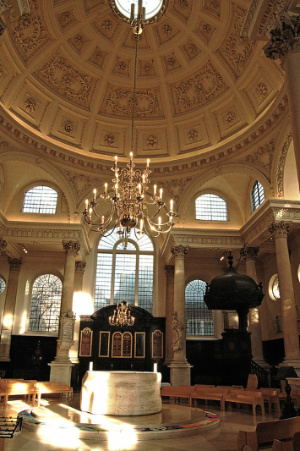
Designed to a rectangular form by Wren (and it’s certain this design was that of Wren himself), the church features a dome located toward the east end supported by eight Corinthian columns with the interior light by sizeable windows at the east end. A tower stands at the west end. The altar, a modern design by Henry Moore, sits under the centre of the dome.
As an interesting final note, it is recorded that Wren attended a dinner hosted by the church wardens – along with collaborator Robert Hooke – at the Swan Tavern in Old Fish Street on 4th March, 1673, as work for the church was underway.
WHERE: St Stephen Walbrook, 39 Walbrook (nearest tube stations are Bank and Cannon Street); WHEN: Opening times vary – check website details; COST: Free; WEBSITE: www.ststephenwalbrook.net.
Think of Sir ChristopherWren and chances are it’s St Paul’s Cathedral – perhaps the most famous building he designed – which comes to mind. Certainly not Westminster Abbey, which he did not.
Yet, aside from his time at the Westminster School as a child, Wren did have a long relationship with the royal church at Westminster. In March, 1698, he was appointed the Surveyor of the Fabric at Westminster Abbey, a post he held until his death (when he was succeeded by Sir Nicholas Hawksmoor).
Wren did some work on the building. Prior to being appointed surveyor he had undertaken some work on schoolmaster Dr Richard Busby’s house (Wren had been one of his students) in the Little Cloister in 1683 (the house was destroyed during the Blitz in World War II).
Following his appointment, Wren did undertake a major restoration of the decayed stonework and roof of the church. He also approved designs by his deputy, William Dickinson, for the north front and an altarpiece which Wren had originally designed for the royal chapel at the Palace of Whitehall was given to the minster by Queen Anne (it was removed in the 19th century).
In 1713, Wren had also created designs for a series of works at the abbey which included the addition of a central tower and spire at the abbey and the completion of the west front which were never realised and which were shelved after his death (the wooden model for the tower and spire is located in Queen’s Diamond Jubilee Galleries, along with a pair of wooden obelisks he designed for the entrance to the Quire).
While there’s no memorial to him in the Abbey, Wren’s image can be seen in the lower right section of a memorial window in the north choir aisle dedicated to 19th century engineer Robert Stephenson while his coat of arms is shown along with numerous others in some post-war glass windows in the Chapter House.
WHERE: Westminster Abbey (nearest Tube stations are Westminster and St James’s Park); WHEN: Times vary – see the website for details; COST: £29 adults/£26 concession/£13 children (family rates available); WEBSITE: www.westminster-abbey.org.
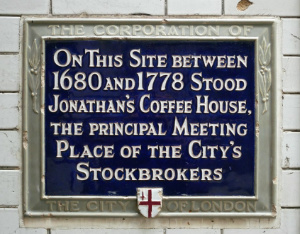
Sir Christopher Wren was apparently a frequent visitor to London’s burgeoning coffee houses in the late 17th and early 18th centuries.
A plaque in the City of London marking the former site of Jonathan’s Coffee House in Exchange Alley. PICTURE: Ethan Doyle White (licensed under CC BY-SA 4.0)
Wren apparently started visiting coffee houses during his time in Oxford (the first in England is said to have opened there in 1652; the first in London – Pasqua Roseé’s premises st Michael’s Alley off Cornhill – opened late that same year) and continued to do so in London.
While it’s hard to pin down those he preferred, he reportedly met Robert Hooke at Man’s Coffee House in Charing Cross. The premises was apparently frequented by stockjobbers.
Wren was in good company attending such premises – other luminaries known to have done so at the time include diarist and naval administrator Samuel Pepys, John Locke, Edmund Halley, John Dryden and Alexander Pope.
Among other prominent coffee houses at the time was Jonathan’s – where in, 1698, the London Stock Exchange was born – and Garraway’s Coffee House, both of them located in Exchange Alley, as well as Button’s in Covent Garden.
Famed 16th century historian and writer William Camden is celebrated not only for the influence he and his career had on writers including the likes of Ben Jonson and Edmund Spenser, but also for his work in helping to transform the idea of historical inquiry.
Camden was born in London on 2nd May, 1551, the son of Sampson, a painter-stainer originally from Lichfield, and his wife Elizabeth (Curwen).
He attended a school at Christ’s Hospital and then St Paul’s School before going on to study at the University of Oxford., graduating with a BA in 1573.
He had returned to London a couple of years earlier and in 1575 was appointed the second master of Westminster School (Jonson was one of his pupils; according to tradition, Camden sponsored his position).
It was during this period that, when not attending his duties at Westminster, he travelled the country, collecting material for what would be the first topographical survey of England. Titled Britannia and written in Latin, it was published in 1586.
Camden was made head master in 1593 and in 1595 published a Greek grammar which became seen as standard work.
In 1597, he was made Clarenceux king-of-arms (one of the three principal heralds at the College of Arms) which allowed him more time for writing (in 1589, he had been granted the prebend of Ilfracombe at Salisbury Cathedral).
Camden, who had established the Society of Antiquities with friends in about 1585 (it helped lay the foundations for the school of 17th century historians), published several history-related works between 1600 and 1607 including the first guide to Westminster Abbey’s monuments.
He was, from the end of that period, also working on his Annales Rerum Anglicarum et Hibernicarum Regnante Elizabetha (Annals of the Affairs of England and Ireland During the Reign of Elizabeth), the first volume of which was published in 1615 (a second volume was completed in 1617 but not published until after Camden’s death).
In 1618, in poor health, Camden retired two Chislehurst in Kent and while there founded the first chair of history at the University of Oxford (in fact the first such chair at any English university). He died, having never married, at Chislehurst on 9th November, 1623.,
Camden was buried in Poet’s Corner, in the south transept, of Westminster Abbey and has a monument which features his bust.
Described as “probably the most famous Gresham College professor in history”, Sir Christopher Wren was appointed professor of astronomy at the college in 1657.
Wren is believed to have been educated at the Westminster School before attending Wadham College in Oxford and graduating with a BA in 1651. An MA followed in 1653 and he was subsequently elected a fellow of All Soul’s College in Oxford.
Engraving of Gresham College in the City of London, looking east at the front onto Old Broad Street by George Vertue(1740). PICTURE: Public domain (via Wikipedia).
That was followed by the Gresham appointment with Wren giving his inaugural lecture in August of 1657. His tenure was somewhat interrupted when, following the resignation of Richard Cromwell in May, 1659, the college was occupied by the military (and Wren stayed in Oxford). He returned to London following the Restoration which culminated in King Charles II’s entry into London in May, 1660.
Wren left Gresham later that same year and four years later, in 1664, he was appointed Savilian professor of astronomy at Oxford – a position he held until his appointment surveyor of works to King Charles II.
Gresham College was established in 1597 under the terms of the will of Sir Thomas Gresham and was originally located in Sir Thomas’ former mansion on Bishopsgate. It was here that Wren – and other lecturers including Sir Robert Hooke – lectured.
In the mid-18th century, Gresham moved to the corner of Gresham and Basinghall Streets. In 1991, it again relocated – this time to the 14th century Barnard’s Inn Hall near Chancery Lane. The college today continues its founding tradition of providing free lectures (there’s now a considerable archive of these online).
There was a Corporation of the City of London plaque commemorating the original location of Gresham College in Old Broad Street but it’s apparently been removed.








 Exploring London