Where’s London’s oldest…(still running) Indian restaurant)?

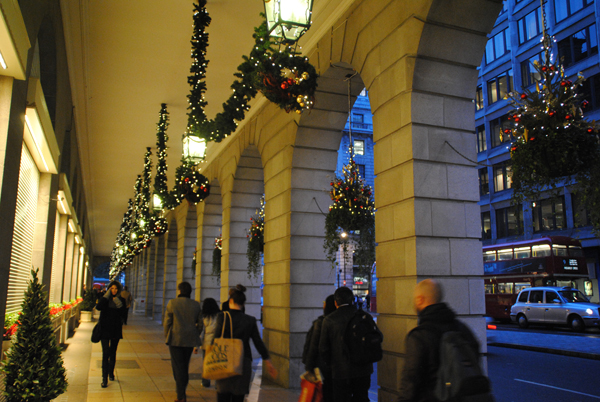
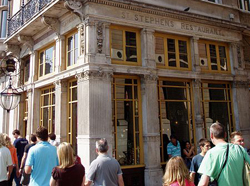
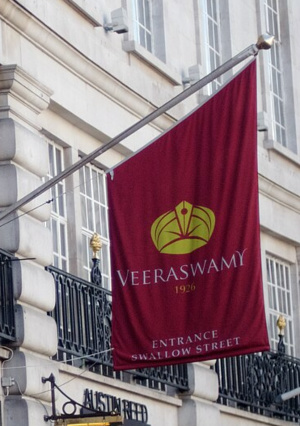
The oldest Indian restaurant in London – and, according to the website, the UK – Veeraswamy was founded in 1926, at 99 Regent Street.

PICTURE: Alex.muller (licensed under CC BY-SA 3.0)

The restaurant was opened by Edward Palmer, the great-grandson of General William Palmer, who was secretary to Warren Hastings, the first Governor General of India and the Moghul Princess Faisan Nissa Begum.

It’s name is said to have come from his mother’s family and Palmer is said to have been greatly influenced by the princess in the creation of the menu.

The restaurant – located in Victory House and entered from Swallow Street – was taken over by the MP William Steward in 1934. He sold it in 1967 and the restaurant later passed through several hands.

The current owners – Namita Panjabi & Ranjit Mathrani of MW Eat – bought it in 1996. They have since modernised the menu and interiors.

Over the years, the restaurant has attracted a star-studded clientele which included royalty including Edward, Prince of Wales (later King Edward VIII), King Abdullah of Jordan, and the Maharajah of Cooch-Behar as well as Winston Churchill, actor Marlon Brando and Princess Anne.

In 2016, the restaurant was awarded a Michelin star.

The restaurant, which is located on the Crown Estate, is currently collecting signatures for a petition asking King Charles III to intercede with the Crown Commissioners, asking them to renew its lease after the commissioner served a notice to vacate. The matter is currently before the courts.

For more, see www.veeraswamy.com/.

This Week in London – Marking Turner’s 250th; ‘Helios’ at the Painted Hall; Churchill in cartoons; and, Royal Parks’ new Elizabeth II garden wins grant…

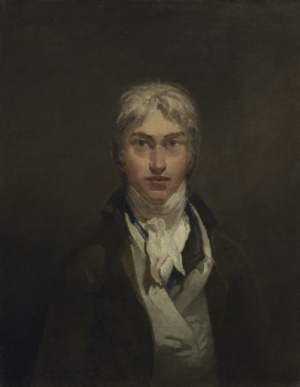
JMW Turner, Self-Portrait, c.1799
Image courtesy of Tate

• Cultural institutions across the UK have announced a year long celebration of renowned painter JMW Turner in honour of the 250th anniversary of his birth. Turner 250 includes more than 30 events with Turner’s birthday on 23rd April a particular focus. Events on the day include the opening of an exhibition of Turner’s rarely-seen images of wildlife at Turner’s House in Twickenham, and the opening of a newly refreshed room in Tate Britain’s Clore Gallery which will be home to a permanent free display of 100 works by the artist. More information will be forthcoming.

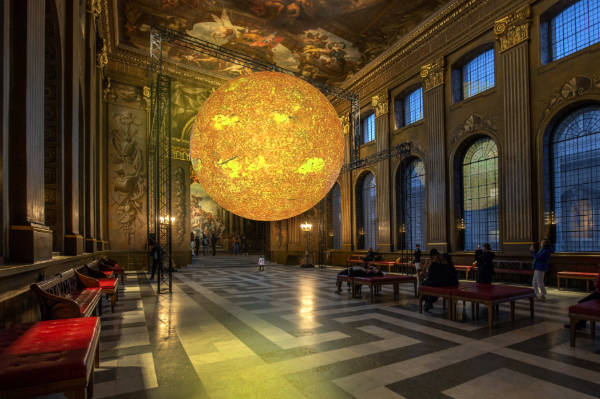
• Luke Jerram’s newest and most ambitious large scale artwork, Helios, is making its London premiere at the Old Royal Naval College. Co-commissioned by the Old Royal Naval College, this new seven-metre celestial artwork depicts the Sun in all its glory at a scale of 1:200 million. The imagery for the artwork has been compiled using photographs of the Sun provided by astrophotographer Dr Stuart Green (taken between May, 2018, to June, 2024) and NASA observations of the Sun along with guidance from solar scientist, Professor Lucie Green of University College London (UCL). The sculptural work is accompanied by a specially created surround sound composition created by acclaimed artists Duncan Speakman and Sarah Anderson. Runs from Saturday until 25th March. Admission charge applies. For more, see https://ornc.org/whats-on/helios/

Helios by Luke Jerram in the Painted Hall. PICTURE: Courtesy of the Old Royal Naval College.

On Now: Churchill in Cartoons: Satirising a Statesman. The Imperial War Museum in Lambeth is marking the 150th anniversary of the birth of Sir Winston Churchill with this exhibition examining how Churchill is represented in political cartoons, both during his life and after. The display features 24 original artworks spanning the period from 1909 to 2003 and examines how these portrayals influenced public perception of the statesman, from his early career as an MP to the role he played in both World Wars, the “Wilderness Years” between and after he lost the 1945 General Election. Among the works are
a cartoon from Punch magazine in 1914 depicting Churchill supporting the Roman sea god Neptune with aircraft (representing the establishment of the Royal Naval Air Service), a 1941 David Low cartoon shows a cigar-smoking Churchill with US President Franklin D Roosevelt during their Atlantic Conference, and, a cartoon by US cartoonist Jim Berryman marking Churchill’s defeat in the 1945 election. The free exhibition closes on 23rd February. For more, see www.iwm.org.uk/events/churchill-in-cartoons-satirising-a-statesman.

Royal Parks have been awarded a £450,000 grant to support the creation of a new, two-acre garden in The Regent’s Park. The garden, to be funded with the grant from the Garfield Weston Foundation, will commemorate the life and legacy of Queen Elizabeth II and will feature a circular pond enhancing wildlife habitats, a central promenade with an accessible platform over the pond, and a vibrant flower garden showcasing species which were significant to the late Queen, such as the specially bred Narcissus ‘Diamond Jubilee’ or Tulipa ‘Royal Celebration’. The new garden is set to open in 2026.

Send all items for inclusion to exploringlondon@gmail.com.

This Week in London – Charles Holden’s university vision; Two-Tone at the Barbican; and celebrating Winston…

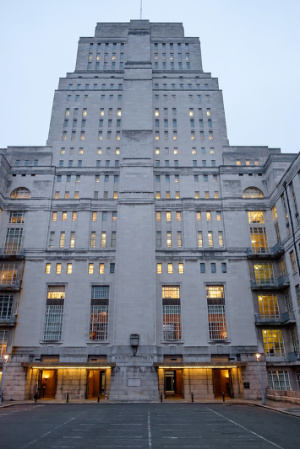
Senate House. PICTURE: Tim Abbott (licensed under CC BY-NC-ND 2.0)

A new exhibition celebrating the vision architect Charles Holden had for the design of the University of London – including the iconic Senate House – has opened at the venue. Holden had a hand in designing some 48 Tube stations and 55 Broadway – London’s first skyscraper - before in 1931 being appointed to develop the university’s Bloomsbury estate, including its headquarters. While the master plan was never completed (only the Senate House and its library were finished), it provides a fascinating insight into a part of London that could have been. Charles Holden’s Master Plan: Building the Bloomsbury Campus tells the story of institution’s design through architectural models, archival documents, photo albums, and other mixed media. The display in the Chancellor’s Hall Lobby on the first floor of the Senate House runs until 17th March. Entry is free. For more, see www.london.ac.uk/news-events/events/charles-holdens-master-plan-building-bloomsbury-campus.

A new exhibition tracing the origins and influence of the popular British music genre known as two-tone has opened at the Barbican Music Library. Two-tone, which is also known as ‘ska-rock’ or ‘ska revival’ and which had its heyday in the late 1970s and early 1980s, fused traditional Jamaican ska, rocksteady, and reggae music with elements of punk rock and new wave music. Its name comes from record label 2 Tone Records which was founded in 1978 by Jerry Dammers from The Specials, one of the most popular Two-tone bands of the time. The display – From the Caribbean to Coventry: Plotting the Rise of Two Tone – features band memorabilia as well as clothing, literature, art, photographs, and fan contributions, and explores how Caribbean immigration influenced UK youth culture. Runs until 25th May. Admission is free. For more, see https://fromthecaribbean2coventry.co.uk.

FURTHER AFIELD: Sir Winston’s family home – Chartwell in Kent – is hosting a new outdoor photography exhibition to mark what would have been his 150th birthday which features some of most spectacular birthday cakes. Press interest into Churchill’s birthday extravaganza – and in particular the cakes – was considerable and historic photographs from TopFoto have now been colourised for the first time, bringing the baking creations vividly to life. The images can be seen until 25th February. For more, see www.nationaltrust.org.uk/visit/kent/chartwell.

Send all items for inclusion to exploringlondon@gmail.com

Where’s London’s oldest…barbershop?

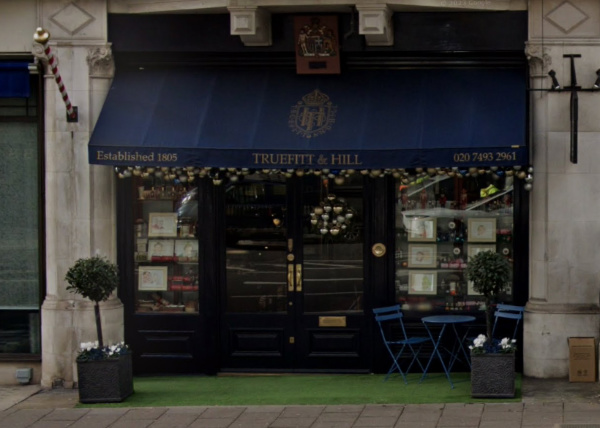
Truefitt and Hill at 71 St James’s Street. PICTURE: Google Maps

This one comes with a Guinness World Records stamp of approval. The oldest barbershop in the world, according to the record-recording organisation, is Truefitt & Hill.

William Francis Truefitt, who styled himself as hairdresser to the British Royal Court, established his first barbershop at 2 Cross-Lane, Long Acre, on 21st October, 1805 – famously on the same day as the Battle of Trafalgar.

In 1811, he moved the business to 40 Old Bond Street. In 1935, Truefitt acquired Old Bond Street firm Edwin S Hill & Co – which had been established in 1911 – and the firm moved to its address at 23 Old Bond Street.

The company, which now has outlets around the world – received its first Royal Warrant – wigmaker – from King George III and also held a warrant from the late Prince Philip.

Royalty aside, customers at the shop have included everyone from Lawrence Olivier to Mahatma Gandhi, Frank Sinatra, John Wayne, David Niven, Oscar Wilde and Winston Churchill. The firm was also referenced by such literary luminaries as Charles Dickens and William Thackeray.

The firm moved to its current location at 71 St James’s Street in 1994.

For more, see www.truefittandhill.co.uk.

10 historic vessels in London’s Thames…8. MV Havengore….

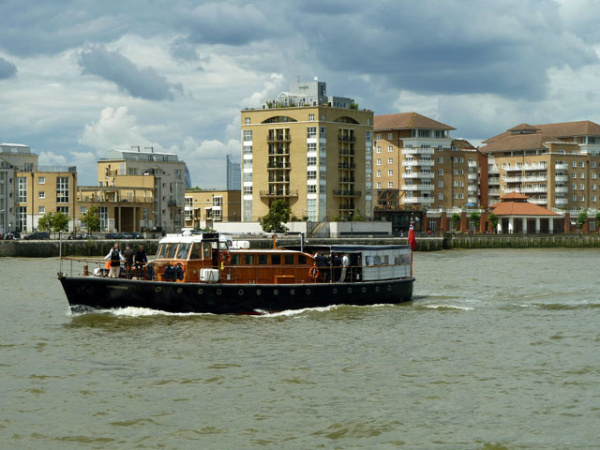
The MV Havengore. PICTURE: Robin Webster (licensed under CC BY-SA 2.0)

Still plying the waters of the Thames, the MV Havengore is perhaps most famous for having carried the coffin of Sir Winston Churchill on the River Thames as part of his state funeral in 1965.

The MV Havengore – named for a low-lying island off the coast of Essex – was originally constructed as a hydrographic survey launch for the Port of London Authority in 1956. As the PLA’s principal survey vessel and flagship, she was moored at Gravesend and tasked with recording changes to Thames bed and estuary. She became the first survey vessel in the UK to have a computer to record survey data.

The highpoint of her during her almost 40 years of service with the PLA came on 30th January, 1965, when she transported the body of Churchill from Tower Pier to Festival Pier. On the journey, she was saluted by flight of 16 fighter jets while dock cranes were made to bow as she passed (there’s a plaque on board commemorating her role in the funeral).

But the almost 26 metre long vessel also participated in other historic events including the river pageant to celebrate the Queen Elizabeth II’s Silver Jubilee in 1977 and, more recently, the flotilla formed to celebrate the Queen’s Diamond Jubilee in 2012 as well as the Thames tribute to the Queen’s long reign in 2015 and the Queen’s 90th birthday parade in 2016.

The MV Havengore was withdrawn from service in 1995 and sold after which she underwent restoration and refitting at the Chatham Historic Dockyard. The vessel was then used to provide excursions for underprivileged children on the Medway.

Sold again in 2006, she has subsequently undergone further restoration work. The MV Havengore is these days used for a range of ceremonial, corporate and private events. When not on the river, she is berthed at St Katharine Docks. The vessel was listed, as of May this year, as being up for sale.

London pub signs…The Red Lion, Westminster…

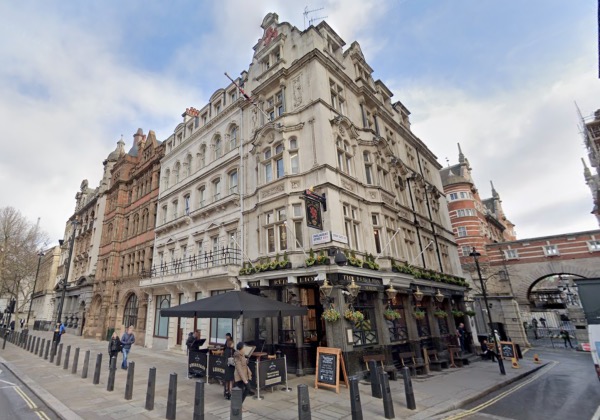
The Red Lion pub. PICTURE: Google Maps

There has been a pub on this storied Whitehall location, located between conveniently for politicians between the Houses of Parliament and Downing Street, since at least the 15th century.

PICTURE: TomasEE (licensed under CC BY 3.0)

Then named Hopping Hall, a pub is recorded on this site at 48 Parliament Street (on the corner with Derby Gate) as early as 1434. It passed into the hands of the Crown by 1531 and by the early 19th century it had taken on the name of the Red Lion (at the time, it was visited by Charles Dickens as a young man). The current, now Grade II-listed, building was erected on the site in 1890.

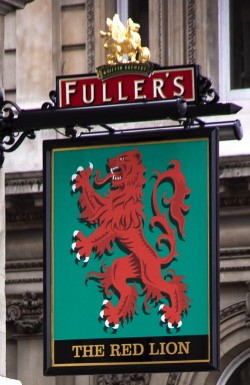
The pub’s name – one of the most common in England (there’s several more in London alone) – apparently originated at the ascension of the Scottish King James I to the throne in 1603. The King ordered that all significant buildings display the red heraldic lion of Scotland and that included pubs. Hence the Red Lion.

The four storey pub has been popular among politicians (and journalists interviewing politicians) including Prime Ministers – indeed, it’s claimed to have served every PM up until Edward Heath in the 1970s (as such it’s one of the many pubs in London which features division bells, although the function of these has apparently been replaced by an app).

For more, see www.redlionwestminster.co.uk.

London Pub Signs – The Churchill Arms, Kensington…

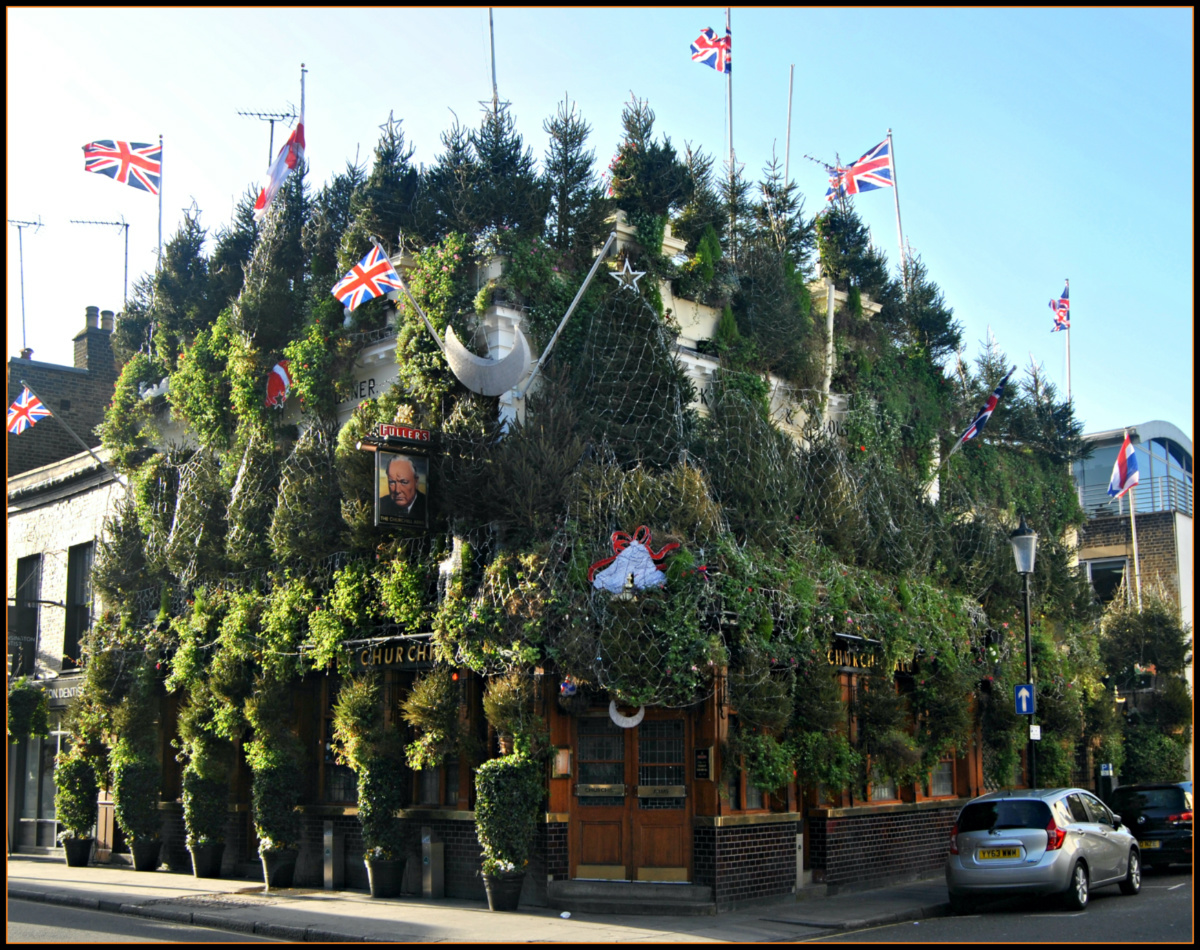
The Churchill Arms decorated for Christmas in 2015. PICTURE: Loco Steve (licensed under CC BY-SA 2.0)

It’s Christmas in London and for such a festive occasion, one pub immediately springs to mind – The Churchill Arms.

The name is certainly not a mystery and doesn’t really have anything to do with the Christmas theme. It stems from, of course, wartime Prime Minister Winston Churchill – or rather, his grandparents, the Duke and Duchess of Marlborough, John and Frances Anne Spencer-Churchill, who were patrons here and which, in honour of Churchill and them, saw the pub so-named after World War II.

Churchill remains a theme in the interior where a good deal of related memorabilia can be found – including wartime posters, pictures of the man himself and a (fake) plaque commemorating Churchill’s use of the pub for his wartime broadcasts (there’s even a celebratory night held each year around Churchill’s birthday).

The pub, which is located at 119 Kensington Church Street, dates from 1750.

But in recent times, it’s become famous for its stunning Christmas light displays which this year reportedly feature some 80 Christmas trees and 22,000 lights. The pub is also known for its extraordinarily profuse flower displays which cost thousands of pounds each year and which have even won at none other than the Chelsea Flower Show.

It also holds the claim to fame of being the first London pub to serve Thai food when it did so as far back as 1988.

A Fullers pub, for more head to www.churchillarmskensington.co.uk.

Treasures of London – War posters from the National Archives…

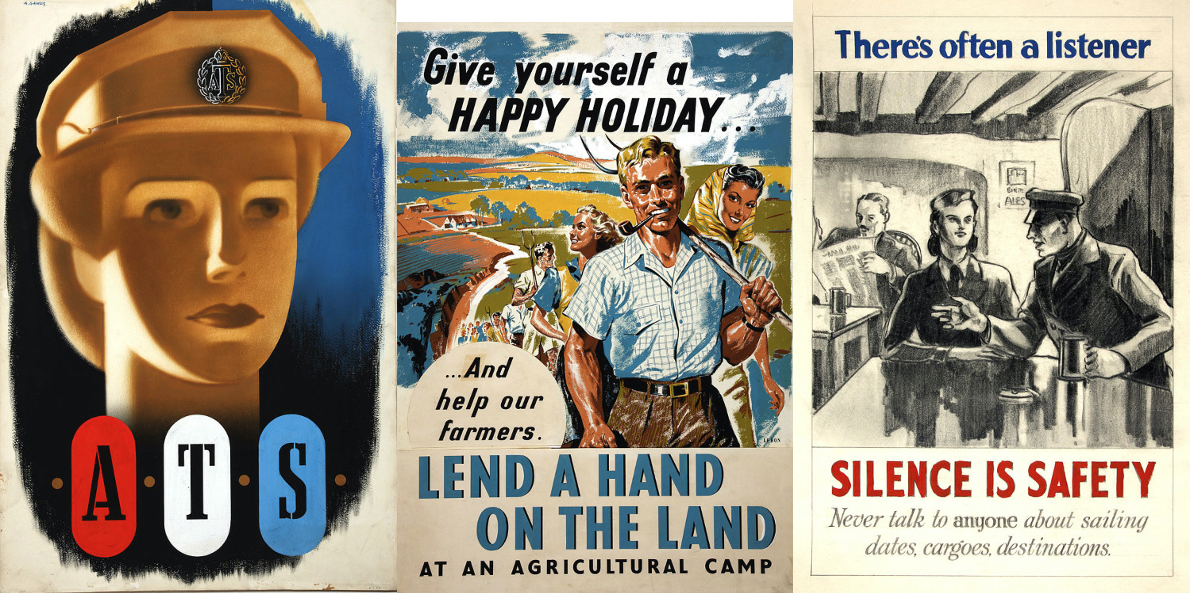
Left to right: Abraham Gomes, Forces Recruitment ATS (girl’s head) (between 1939 and 1946); Mary Le Bon, Give yourself a happy holiday…and help our farmers. Lend a hand on the land at an agricultural camp (between 1939 and 1946); Unknown author, There’s often a listener. Silence is safety. Never talk to anyone about sailing dates, cargoes, destinations (between 1939 and 1946).

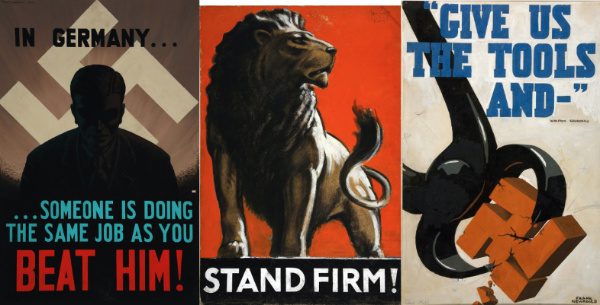
These posters are among almost 2,000 original works created by artists working for the Ministry of Information during World War II now in the collection of The National Archives based in Kew.

The posters tackle a range of issues – from saving on fuel at home to warnings about spies, posters to inspire effort on the homefront and those to recruit new men and women to the service.

Under a partnership with Wikimedia UK, in 2013 The National Archives digitised and released more than 350 images of the posters into the public domain. Here are some those released.

The originals are held at The National Archives.

Left to right: Roy Nockolds, “In Germany…someone is doing the same job as you. Beat him!” (1942); Tom Purvis, “Stand Firm!” (between 1939 and 1946); and, Frank Newbould,  “Give us the tools and-” – Winston Churchill (between 1939 and 1946).

Exploring London’s 100 most popular posts of all time! – Numbers 10, 9, 8 and 7…

We’re into the top 10! Here’s the next four in our countdown…

10. 10 London sites associated with Sir Winston Churchill – 5. London residences…

9. 10 fictional character addresses in London – 3. 32 Windsor Gardens…

8. 10 fictional character addresses in London – 9. 7 Savile Row, Burlington Gardens…

7. 10 fictional character addresses in London – 7. Saffron Hill…

10 London buildings that were relocated…8. Temple Bar…

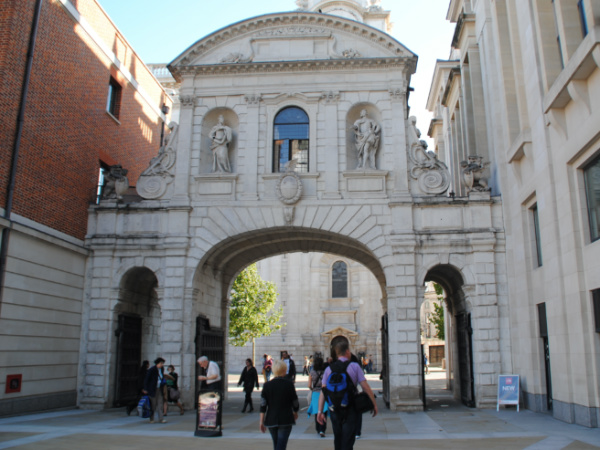
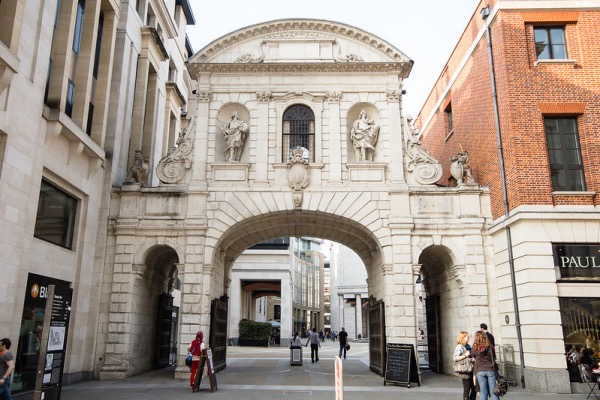
This ornate Baroque archway only stands with walking distance from where it originally stood marking the entrance to the City of London. But it came to this position by a somewhat roundabout route.

Temple Bar – with statues of Queen Anne and King James I (looking towards St Paul’s Cathedral) PICTURE: David Adams.

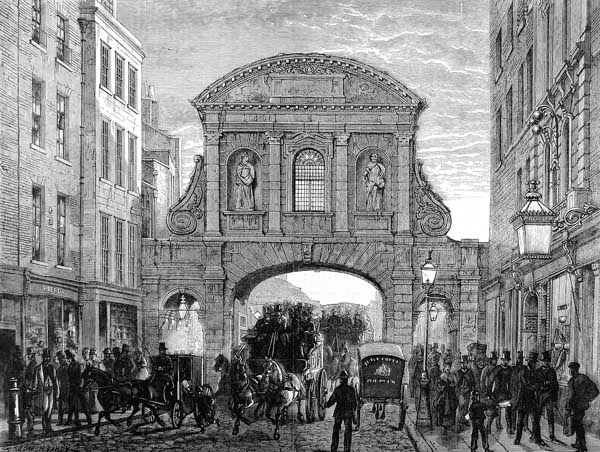
The gate was originally constructed at the junction where Fleet Street becomes the Strand, it marked the boundary between the City of London and Westminster.

While the first gate on the site dates back to the 14th century (prior to that the boundary was apparently marked with a chain two posts), the gate we see today dates from 1672 when, despite having survived the Great Fire of London, the previous gate – a crumbing wooden structure – was demolished and this upmarket replacement built to the design of none other than Sir Christopher Wren (earlier designs for the gate created by Inigo Jones were never acted upon).

An artist’s impression of the Temple Bar in 1870 from Illustrated London News.

Made of Portland stone, the new structure featured figures of King Charles I and King Charles II on the west side and King James I and Queen Anne of Denmark on the east (it’s said that a third of the total £1,500 cost was spent on the statuary alone).

Shortly after its construction, it became a location for the display of the remains of traitors (usually heads), the first of which were the body parts of Rye House plotter Sir Thomas Armstrong and the last of which was the head of Jacobite Francis Towneley in 1746 (there’s also a story that such was the interest when the heads of the Rye House plotters – who had planned to assassinate King Charles II and crown his brother, the future King James II, in his place – were displayed, telescopes were rented out so people could get a closer look).

Temple Bar with statues of King Charles I and King Charles II (looking into Paternoster Square). PICTURE: Eric Heupel (licensed under CC BY-NC-ND 2.0)

Among the luminaries who passed under the central arch were Anne Boleyn (the day before her coronation) and Queen Elizabeth I. The Queen did so most famously on her way to give thanks in St Paul’s Cathedral for the English victory over the Spanish Armada and since then, whenever a Sovereign has wanted to enter the City past Temple Bar, there’s been a short ceremony in which the Sovereign asks permission of the Lord Mayor of London to enter. Granting this, the Mayor then offers the Sword of State as a demonstration of loyalty and this is subsequently carried before the Sovereign as they proceed through the City as a sign of the Lord Mayor’s protection.

The Temple Bar stood in its original location until 1878 when, to help traffic flow, it was carefully removed brick-by-brick over a period of 11 days (the City of London Corporation well aware of its historical significance) . It was initially intended that the gateway would be rebuilt somewhere else in the city, but time passed and no suitable site was found.

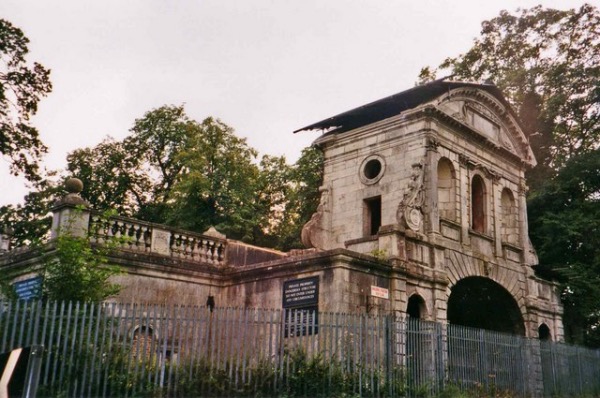
Instead, the gate lay in pieces in a yard in Farringdon Road before, in the mid 1880s, Sir Henry Bruce Meux had all 2,500 stones transported via trolleys pulled by horses to his estate at Theobalds Park in Hertfordshire and re-erected there as a gateway (the Lady Meux apparently used the small upper room for entertaining – among those said to have dined here was King Edward VII and Winston Churchill).

Temple Bar at Theobolds Park. PICTURE: Christine Matthews (licensed under CC BY-SA 2.0)

In 1976, the Temple Bar Trust was formed to have the archway returned to London – they eventually succeeded 30 years later in 2004 when it was re-erected on its current site between St Paul’s and Paternoster Square at a cost of some £3 million.

The original site of the Temple Bar is now marked with a Victorian era memorial – erected in 1888 – which features statues of Queen Victoria and Edward, the Prince of Wales.

10 London buildings that were relocated…3. St Mary Aldermanbury…

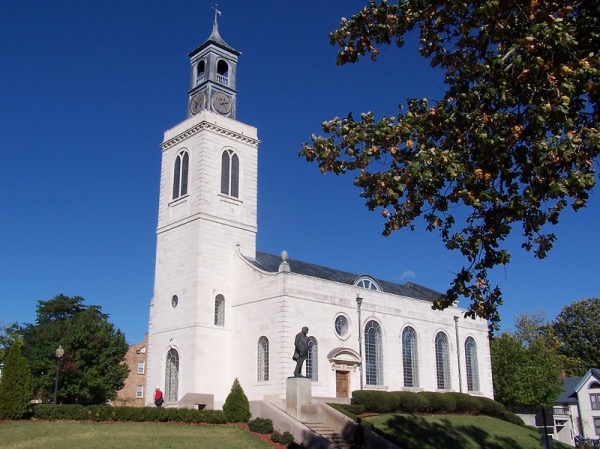
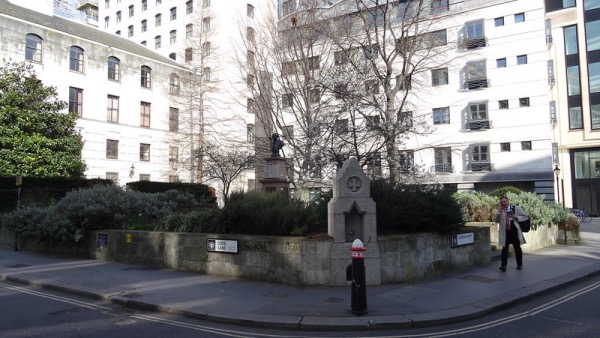
This church – not to be confused with the similarly named but still existing St Mary Aldermary – once stood at the corner of Love Lane and Aldermanbury in the City of London.

St Mary Aldermanbury, now part of the National Churchill Museum on the campus of Westminster College, Fulton, Missouri, in the US. PICTURE: J. Stephen Conn (licensed under CC BY-NC 2.0)

Founded in the 11th or early 12th century, the church – the name of which apparently relates to an endowment it received from an Alderman Bury, was destroyed in the Great Fire of London in 1666 and rebuilt by Sir Christopher Wren in a simple form with no spire.

It was gutted during the Blitz – one of 13 Wren churches hit on the night of 13th December, 1940 – and the ruins were not rebuilt. Instead, in the 1960s (and this is where we get to the relocation part) a plan was put into action to relocate the church so it could form part of a memorial to Winston Churchill in the grounds of Westminster College in Fulton, Missouri.

It was only after four years of planning and fundraising (the project apparently cost some $US1.5 million with the money raised from donors including actor Richard Burton) that the relocation process finally began in 1965.

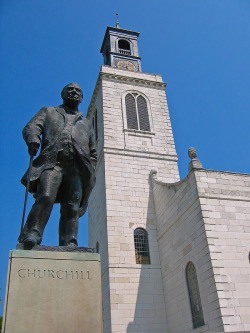
PICTURE: Jonathan Pearson
(licensed under CC BY-NC-ND 2.0)

It started with workers in London cleaning, removing and labelling each of the church’s 7,000 stones so they could be reconstructed correctly on the other side of the Atlantic.

They were shipped free-of-charge – the US Shipping Board moved them as ship’s ballast – and then taken by rail to Fulton.

By the time the stones reached Fulton they had been jumbled. And so began the painstaking process of reassembling what was described as the “biggest jigsaw puzzle in the history of architecture” (with the stones spread over an acre, it apparently took a day just to find the first two stones).

While the first shovel on the project had been turned by former US President Harry S Truman on 19th April, 1964 (his connection to the project will become clear), the foundation stone was laid in October, 1966, 300 years after the Great Fire of London.

The shell of the church was completed by May, 1967. Two more years of work saw the church’s interior recreated with English woodcarvers, working from pre-war photographs, to make the pulpit, baptismal font, and balcony (new glass was also manufactured and five new bronze bells cast for the tower). The finished church, which was rededicated in May, 1969, was almost an exact replica of the original but apparently for a new organ gallery and a tower window.

Why Fulton for a tribute to Churchill? The connection between Churchill and Westminster College went back to the post war period – it was in the college’s historic gymnasium building that, thanks to a connection the institution had with President Truman, Churchill was to give one of his most famous speeches – the 1946 speech known as ‘Sinews of Peace’ in which he first put forward the concept of an “Iron Curtain” descending between Eastern and Western Europe.

The church is now one part of the National Churchill Museum, which also includes a museum building and the ‘Breakthrough’ sculpture made from eight sections of the Berlin Wall. It was selected for the memorial – planned to mark the 20th anniversary of Churchill’s speech – thanks to its destruction in the Blitz, commemorating in particular the inspiring role Churchill had played in ensuring the British people remained stalwart despite the air raids.

St Mary Aldermanbury Gardens in London. PICTURE: Bogdan Tapu (licensed under CC BY-NC 2.0)

Meanwhile, back in London the site of the church has been turned into a garden. It contains a memorial to John Heminges and Henry Condell, two Shakespearean actors who published the first folio of the Bard’s works and were buried in the former church. The footings upon which the church once stood can still be seen in the garden and have been Grade II-listed since 1972.

Special – On the VE Day’s 75th, remembering the ‘Docklands at War’…

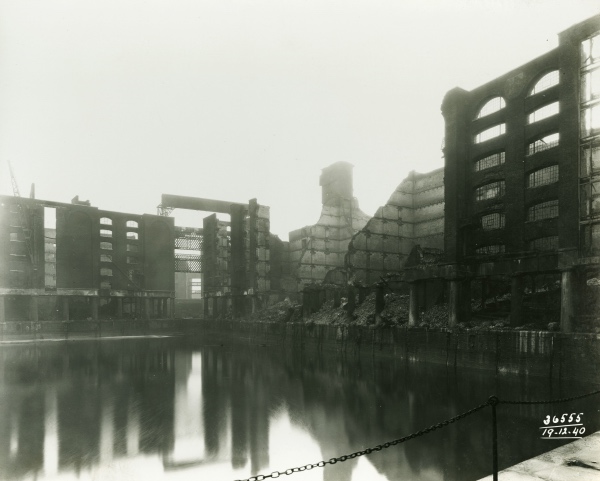
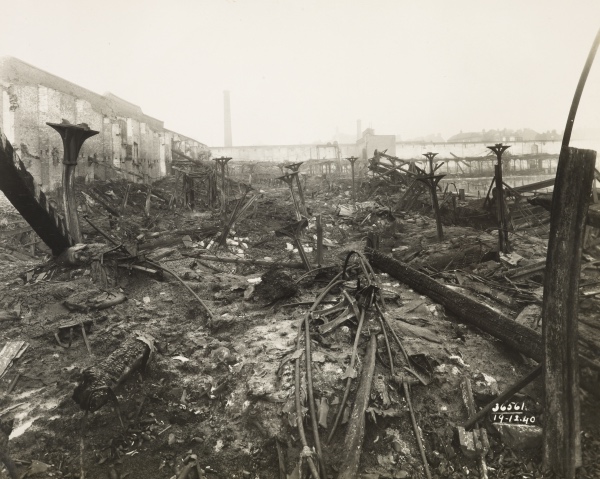
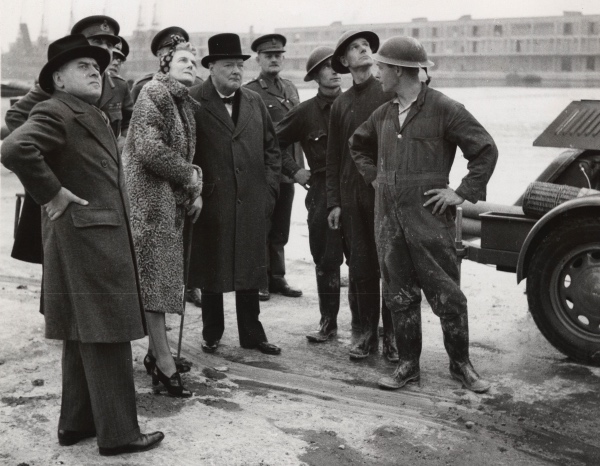
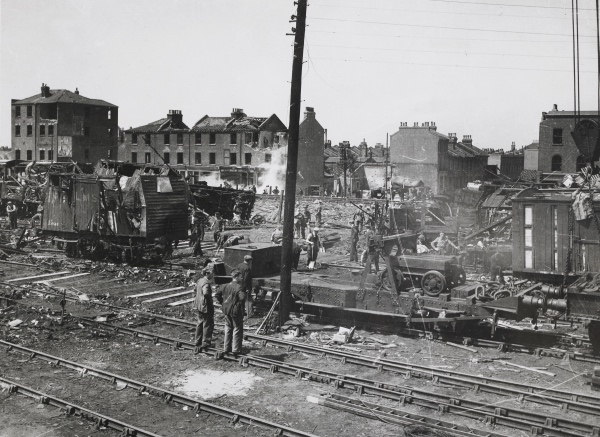
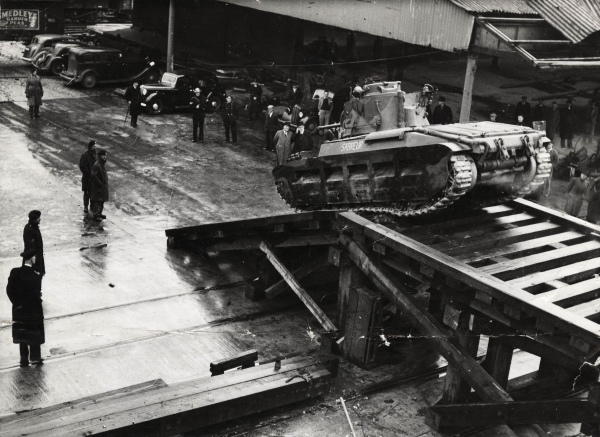
The Museum of London Docklands has released a number of images from its ‘Docklands at War’ collection – including some rarely on display – to mark the 75th anniversary of Victory in Europe. These images of the East End show the scale of the damage and destruction caused to London’s docks during World War II when more than 25,000 German bombs were dropped on it in an attempt to impact the national economy and war production, making tens of thousands of home uninhabitable, damaging businesses and destroying docks with the West India Docks and St Katherine Docks suffering the most damage. The pictures also reveal the remarkable contribution to the war effort by the people who lived and worked in the densely populated area. For more on how the museum is marking the day online, head to www.museumoflondon.org.uk/museum-london-docklands/ve-day.

St Katharine Dock after an air raid on 7th September, 1940, the first attack on Docklands.  PICTURE: John H Avery & Co (© PLA Collection / Museum of London)

Bomb damage to a shed, formerly Guiness’s on west side of eastern dock, looking north from the southend taken on 19th December, 1940, following an air raid on 8th December that year. PICTURE: John H Avery & Co (© PLA Collection / Museum of London)


Prime Minister Winston Churchill and Clementine Churchill, with the Flag Officer, London, and J Douglas Ritchie (on left), touring London’s dock in September, 1940, seen with a group of auxiliary firemen. PICTURE: © PLA Collection / Museum of London

Damage caused by a V1 rocket which hit Royal Victoria Dock in 1944. PICTURE: © PLA Collection / Museum of London

The Docklands ablaze during the Blitz on 7th September, 1940. The rising palls of smoke mark out the London Docks beyond the Tower of London, the Surrey Docks to the right of the bridge and the West India Docks on the Isle of Dogs in the distance. PICTURE: © PLA Collection / Museum of London


Tanks arriving in the London Docks prior to embarkation for the D Day beaches in 1944. PICTURE: © PLA Collection / Museum of London

A Moment in London’s History – London celebrates VE Day…

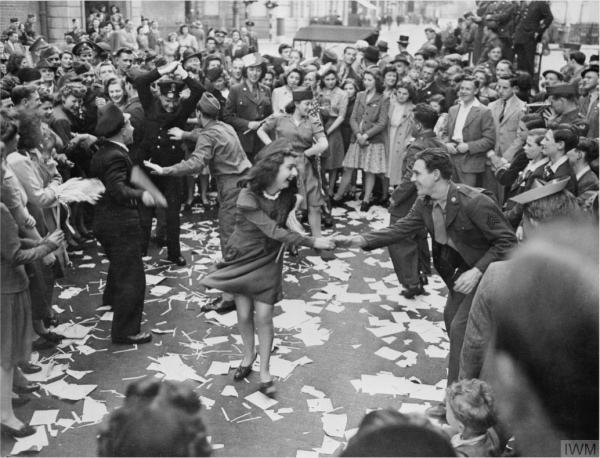
It was 75 years ago this month – 8th May, 1945 – that Londoners poured out onto the city’s streets in celebration of the end of World War II.

Some celebrations had already started in London on 7th May as news of the unconditional surrender of all German troops to the Supreme Allied Commander Dwight Eisenhower in the French city of Reims on 7th May became known.

But Prime Minister Winston Churchill declared 8th May a national holiday and, in response, vast crowds turned out on the streets to celebrate with bunting, flags and fireworks. Church bells were rung and services of thanksgiving held including at St Paul’s Cathedral where 10 consecutive services, each attended by thousands, took place.

British girls, of the Picture Division of the London Office of War Information dance in the street with American soldiers during the “VE Day” celebration in London. This scene took place outside the building of the US Army Pictorial Division has its offices. PICTURE: © IWM EA 65796

At 3pm, Churchill made a national radio broadcast from 10 Downing Street. He told listeners that while “We may allow ourselves a brief period of rejoicing”, they should “not forget for a moment the toil and efforts that lie ahead” a reference to the ongoing war with Japan (the radio broadcast, incidentally, is being re-run on the BBC on 8th May this year to mark the anniversary).

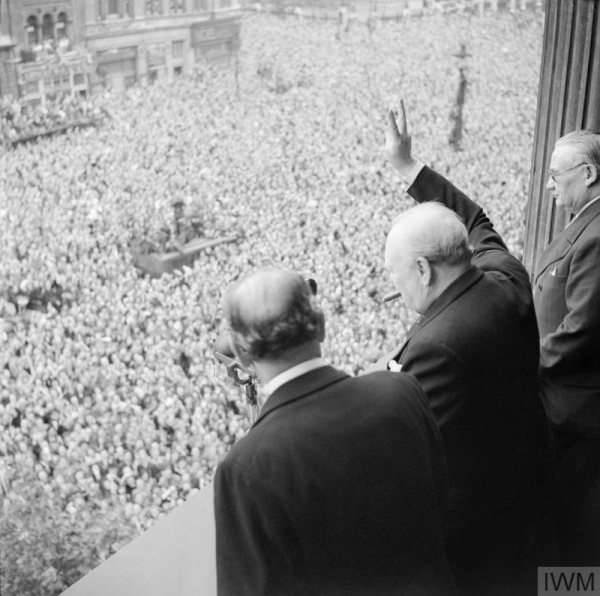
Churchill then proceeded to Parliament where he formally reported the end of the war in Europe to Parliament before leading a procession of members to St Margaret’s Church for a service of thanksgiving. He later appeared on the balcony of the Ministry of Health building in Whitehall to address the teeming crowds below, telling them “This is your victory” to which they roared back that it was his.

Churchill waves to crowds in Whitehall on the day he broadcast to the nation that the war with Germany had been won, 8 May 1945. PICTURE: Horton W G (Major) (Photographer),
War Office official photographer/© IWM H 41849

Meanwhile, King George VI, Queen Elizabeth, initially accompanied by their two daughters, Princesses Elizabeth and Margaret, appeared on the balcony of Buckingham Palace several times to wave to the cheering crowds. The King and Queen, who were at one point joined by Churchill, were still waving when their daughters secretly – and now rather famously – left the palace and joined the crowds outside in what Elizabeth, later Queen Elizabeth II, described as “one of the most memorable moments” of her life. The King also gave a radio address from the palace during which he paid tribute to all those who had died in the conflict.

King George VI and Queen Elizabeth with Princess Elizabeth and Princess Margaret joined by the Prime Minister, Winston Churchill on the balcony of Buckingham Palace, London on VE Day. PICTURE: © IWM MH 21835

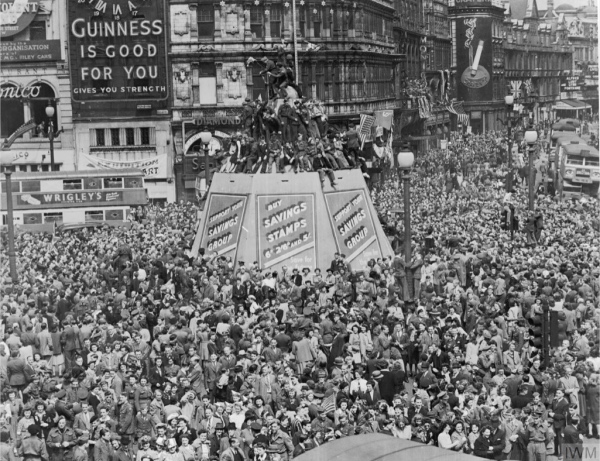
While celebrations took place across London, hotspots included Whitehall, outside Buckingham Palace, Trafalgar Square, Parliament Square and Piccadilly Circus, where by midnight there were an estimated 50,000 people singing and dancing. Licensing hours were extended in pubs and dance halls staying open to midnight.

A mass of civilians and servicemen crowding around Piccadilly Circus, London. PICTURE: Poznak Murray, United States Army Signal Corps official photographerIWM EA 65879

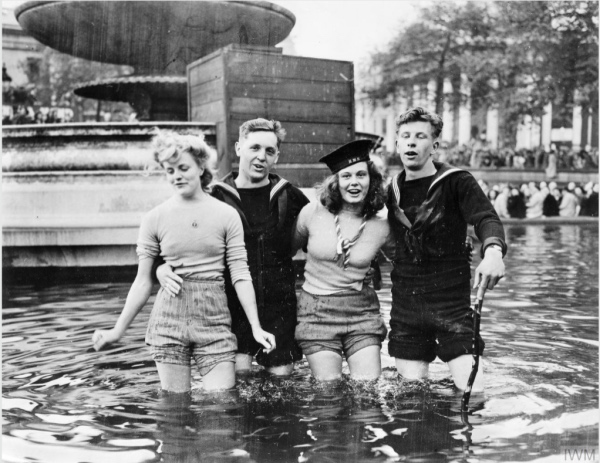
One of the most iconic images of the day was a photograph of two sailors standing in one of the fountains at Trafalgar Square with two women, revealed, thanks to research by the Imperial War Museum to be Cynthia Covello and Joyce Digney who had travelled to join the celebrations from Surrey.

Two British sailors and their girlfriends wading in the fountains in Trafalgar Square on VE Day. PICTURE: Massecar T G, United States Army Signal Corps photographer/© IWM EA 65799

With thanks to the Imperial War Museum, London.


10 historic London hotels…3. Claridge’s…

This five star Mayfair establishment owes its origins and name to William Claridge, possibly a former butler, and his wife Marianne, who took over management of a small hotel at 51 Brook Street in 1853.

In 1854, they purchased the adjoining Mivart’s Hotel, first established in 1812, and substantially expanded the premises. It apparently combined the two names – Mivart’s and Claridge’s – for a short time before the reference to Mivart’s was dropped.
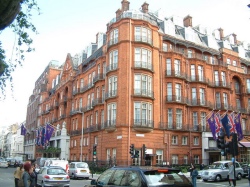
The hotel, which stands on the corner with Davies Street, was bought by Richard D’Oyly Carte (owner of The Savoy) in 1893 and subsequently rebuilt in red brick to the designs of CW Stephens (of Harrods fame) with interiors by Sir Ernest George and the inclusion of modern amenities including en suite bathrooms and lifts. The hotel, which is now Grade II-listed, reopened in 1898, with some 203 rooms and suites.

It was extended in the late 1920s with the addition of 80 new rooms and a ballroom while the lobby was redesigned by art deco pioneer Oswald Milne (much of that decoration, including work by Basil Ionides, remains).

The hotel’s reputation as a place to stay among the well-to-do was given a significant boost when Empress Eugenie, wife of French Emperor Napoleon III stayed in 1860 and entertained Queen Victoria and Prince Albert.

It was also favoured by exiled royals during World War II including King Peter II and Queen Alexandria of Yugoslavia all staying here. In fact, their son, Crown Prince Alexander II, was born in suite 212 in 1945 (now named the Prince Alexander Suite).

The story goes that Prime Minister Winston Churchill declared the suite Yugoslav territory for a day (although evidence supporting the story about Churchill’s involvement is apparently scarce). It’s also said that a spadeful of dirt from Yugoslavia was placed under the bed so the Crown Prince could literally be born on Yugoslav soil (but there’s no mention of this aspect of the story on Crown Prince Alexander II’s official website).

Churchill and Clementine stayed in a suite here on the sixth floor after the wartime PM’s unexpected defeat in the general election of 1945.

Other luminaries to have stayed here include American actors Cary Grant, Katharine (and Audrey) Hepburn, Yul Brynner and Bing Crosby (Spencer Tracey famously said he didn’t want to go to heaven when he died but to Claridge’s) as well as director Alfred Hitchcock, Aristotle and Jackie Onassis, and, more recently, everyone from Mick Jagger and Madonna to Brad Pitt and Tom Cruise. Kate Moss celebrated her 30th birthday here.

And, of course, royals including the late Queen Mother, Queen Elizabeth II and Prince Phillip have all been regular diners.

The hotel, which underwent a major restoration from 1996 and saw 25 new suites designed by David Linley opened in 2012, is now part of the Maybourne Hotel Group, having parted ways with the Savoy Hotel in the mid-noughties.

Current facilities include the restaurant Fera at Claridge’s (this opened in 2014 after the closure of Gordon Ramsay at Claridge’s in 2013) as well as The Foyer & Reading Room (where afternoon tea is served), The Fumoir cocktail bar, Claridge’s Bar and a health club and spa.

The Claridge’s Christmas Tree is a much anticipated part of London’s festive season, with recent years seeing a different world-renowned designer taking on the task of decorating it, including the likes of John Galliano, Domenico Dolce and Stefano Gabbana, and Christopher Bailey of Burberry.

The hotel was the subject of a three part documentary, Inside Claridges, in December, 2012.

For more, see www.claridges.co.uk.

PICTURE: Tim Westcott (licensed under CC BY-SA 2.0)
 

10 historic London hotels…1. The Ritz Hotel…

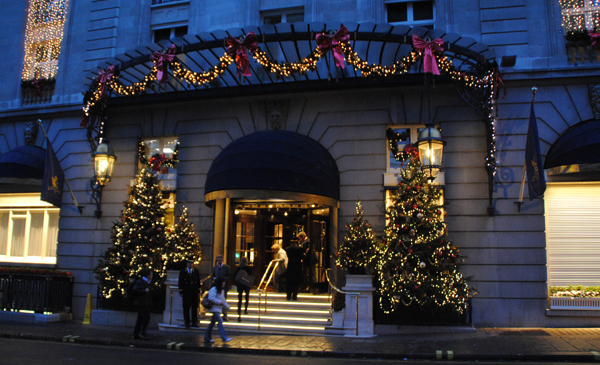
This Piccadilly institution was constructed from 1904 to 1906 and takes its name from Swiss hotelier César Ritz.

It was constructed on the site of a former coaching inn for the Blackpool Building and Vendor Company – it was the first steel-framed building in London – and designed by Mewés and Davis, the architects of the Paris Ritz. And even though Ritz himself was apparently actually retired at the time, it was built according to his specifications.

The exterior facade features Norwegian granite and Portland stone and boasts an arcade on Piccadilly which deliberately evokes the Rue de Rivoli in Paris. The interior, the work of Waring and Gillow, is designed in the style of Louis XVI and was designed to be opulent with all rooms featuring a working fireplace.

Public spaces include the Palm Court – famous for its traditional afternoon teas –  and a Michelin-starred restaurant with floor to ceiling windows overlooking Green Park. Other features include the Rivoli Bar, designed in 2001 by Tessa Kennedy to resemble the bar in the Orient Express, and the basement Ritz Club, a private casino.

The now Grade II*-listed hotel was officially opened by Ritz himself on 24th May, 1906, and was soon adopted by the rich and famous – the patronage of the Prince of Wales (future King Edward VIII) after the death of King Edward VII was one key reason for its success.

Actor Charlie Chaplin, who apparently had to have 40 police hold back the crowd to enter the hotel, is also a name famously associated with it as is that of Russian prima ballerina Anna Pavlova who performed here.

The Aga Khan and Paul Getty both had suites, and playwright Noel Coward and Queen Elizabeth, The Queen Mother, regularly dined here while Tallulah Bankhead famously sipped champagne from a slipper in the bar. The Marie Antoinette Suite was also famously the location of a conference between Winston Churchill, Dwight Eisenhower and Charles de Gaulle during World War II.

The hotel also featured in 1999 film Notting Hill, starring Hugh Grant and Julia Roberts, and in the more recent TV drama Downton Abbey.

The five star hotel underwent a major 10 year refurbishment after it was acquired by the Barclay brothers in 1995. The complex these days includes the adjoining 18th century property William Kent House (designed, of course, by William Kent).

In 2001, the hotel was awarded the first Royal Warrant for Banqueting and Catering Services. Other boasts these days include being the only UK hotel to have a certified tea sommelier (among teas served is the hotel’s own Ritz Royal Blend).

For more, see www.theritzlondon.com.

London Pub Signs – St Stephen’s Tavern, Westminster…

The origins of the name of this pub apparently lie in something of a mistake (well, sort of).

St-Stephens-TavernLocated at 10 Bridge Street on the corner of Canon Row – just across the road from the clock tower at the north end of the Houses of Parliament, its name apparently lies in mistaken belief that the tower was named St Stephen’s Tower.

It never was, at least not officially. Prior to recently being renamed the Elizabeth Tower – in honour of Queen Elizabeth II’s 60 years on the throne, the tower, which contains the bell known as Big Ben, was simply known as the Clock Tower (another common error has been to call the tower itself Big Ben).

The name St Stephen’s Tower apparently was the fault of Victorian journalists. They had the habit of referring to stories relating to the goings-on in the House of Commons as “news from St Stephen’s” because MPs, prior to the destructive fire of 1834, used to sit in St Stephen’s Hall (the entrance to the hall can be found down the road opposite Westminster Abbey).

Hence we have St Stephen’s Tavern, a favoured watering hole of many politicians – including apparently PMs Stanley Baldwin, Winston Churchill and Harold MacMillan.

The pub has been around since at least Victorian times – it was demolished in 1868 when Westminster tube station being built and rebuilt a few years later. In 1924, the pub was expanded to take over the Queen’s Head next door.

It closed in the late 1980s but was reopened in 2003 with many of the original fittings restored. These include one of only 200 parliamentary division bells, located above the bar, which calls MPs back to parliament when it’s time for them to vote (tourists apparently often think it’s a fire alarm and flee when it goes off).

For more, see www.ststephenstavern.co.uk.

PICTURE: Ewan Munro/Flickr/CC BY-SA 2.0 (image cropped)

Daytripper – Secret wartime tunnels open at White Cliffs…

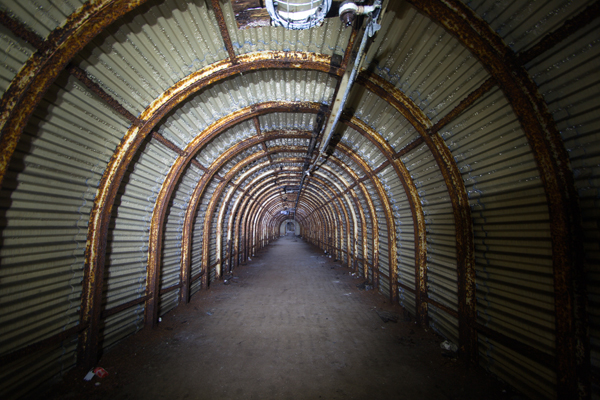
Fan-Bay-Deep-Shelter,-main-tunnel---credit-National-Trust,Barry-Stewart

A series of secret tunnels, built behind the famous White Cliffs of Dover on the orders of former British PM Winston Churchill, have opened to the public for the first time.

More than 50 volunteers along with archaeologists, engineers, mine consultants and a geologist, spent two years excavating and restoring the tunnels which, known as the Fan Bay Deep Shelter, were aimed at housing men manning gun batteries designed to prevent German ships from moving freely in the English Channel.

The shelter, which was personally inspected by Churchill in June, 1941, provided accommodation for four officers and up to 185 men in five bomb-proof chambers for use during bombardments as well as a hospital and a store room. It was originally dug by Royal Engineers from the 172nd Tunnelling Company in just 100 days.

The tunnels, which were decommissioned in the 1950s and then filled in during the 1970s, were discovered after the National Trust bought the land above in 2012. More than 100 tonnes of soil and rubble were removed during the excavation.

Specialist guides now take visitors on 45 minute, torch-lit, hard hat tours into the shelter – the largest of its kind in Dover, taking visitors down the original 125 steps into the tunnels 23 metres below the surface. Inside can be seen graffiti dating from the war which includes the names of men stationed there as well as ditties and drawings. Other personal mementoes include homemade wire hooks, a needle and thread and ammunition.

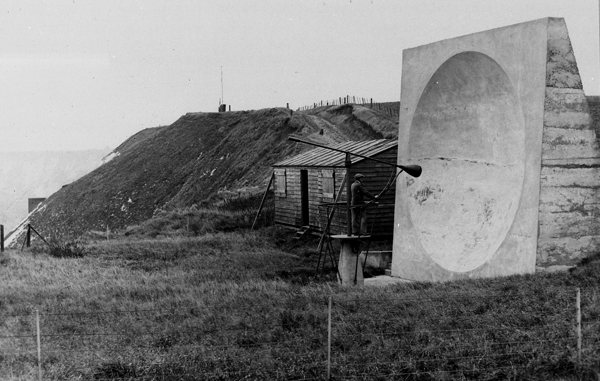
Back above ground, there are two World War I sound mirrors which were originally designed to give advance warning of approaching aircraft but which had become obsolete when radar technology was invented in 1935 (pictured in action below).

The tunnels complement those which are already open at Dover Castle (managed by English Heritage).

WHERE: Fan Bay Deep Shelter, Langdon Cliffs, Upper Road, Dover (nearest train station is Dover Priory (two miles); WHEN: Guided tours only – from 9.30am daily until 6th September – tours then on weekdays only until 30th September); COST:£10 adults/£5 children (aged 12-16) (free for National Trust members); WEBSITE: www.nationaltrust.org.uk/white-cliffs-dover

 PICTURE: Top – National Trust/Barry Stewart/; Bottom – National Trust/Crown Copyright.

Example-of-sound-mirror-in-use,-Abbots-Cliff-near-White-Cliffs-of-Dover---Crown-Copyright

10 small, ‘secret’ and historic gardens in central London…4. St Mary Aldermanbury Gardens…

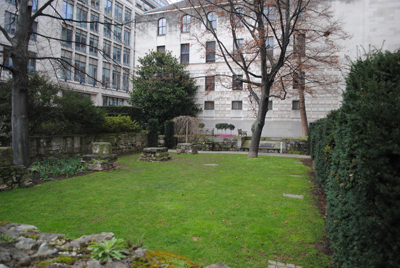
St-Mary-Aldermanbury2Like St Dunstan in the East, these gardens at the corner of Love Lane and Aldermanbury are also based inside the remains of a medieval church.

The church of St Mary Aldermanbury (the name may relate to its proximity close to Guildhall, or the ‘Alderman’s Bury’ or ‘Alderman’s Hall’), mentioned as far back as the late 12th century, was destroyed in the Great Fire of London but was among those rebuilt to the designs of Sir Christopher Wren only to be destroyed again during the Blitz in 1940.

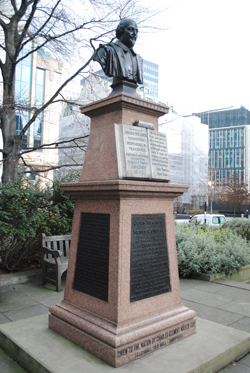
Shakespeare-MonumentThis time there was to be no rebuilding and instead, in 1966 the walls – all that remained – were moved more than 4,000 miles away to the town of Fulton, Missouri, in the US.

There they were reconstructed in the grounds of Westminster College – site of Winston Churchill’s famous “Iron Curtain” speech in 1946 – and the church restored as a memorial to the former British PM. The National Churchill Museum is located beneath.

There’s plaque mentioning this in the gardens (and featuring an image of what the church looked like after its reconstruction in Fulton) which still contains the church’s footings (these date from the 15th century when the church was apparently partially rebuilt) and give an indication of what the church’s footprint would have been along with headstones (among those whose remains were buried here was the notorious Judge Jeffreys).

Other features include a memorial to Henry Condell and John Heminge, both involved in the publication of William Shakespeare’s first folio (you can read more about it in our earlier post here).

The garden was laid out after the church was removed. It is a designated Site of Local Importance for Nature Conservation and attracts wildlife including birds such as blackbirds, woodpigeons, house sparrows and blue tits. Plantings were added in 2011 to maximise the attraction to bird as well as bees and butterflies. On the corner outside the garden is a fountain.

WHERE: St Mary Aldermanbury Garden, Aldermanbury, City of London (nearest Tube stations are St Pauls and Monument); WHEN: 8am to 7pm daily; COST: Free; WEBSITE: www.cityoflondon.gov.uk/things-to-do/green-spaces/city-gardens/visitor-information/Pages/St-Mary-Aldermanbury.aspx.

This Week in London – Marking VE Day’s 70th; Rut Blees Luxemburg at the Museum of London; and India’s Sidi community on show at the NPG…

Three days of events kick off in London tomorrow to mark the 70th anniversary of Victory in Europe (VE) Day. Events will include a Service of Remembrance at the Cenotaph in Whitehall at 3pm tomorrow (Friday) coinciding with two minutes national silence while Trafalgar Square – scene of VE Day celebrations in 1945 – will host a photographic exhibition of images taken on the day 70 years ago (the same images will be on show at City Hall from tomorrow until 5th June) and, at 9.32pm, a beacon will be lit at the Tower of London as part of a nation wide beacon-lighting event. On Saturday at 11am, bells will ring out across the city to mark the celebration and at night, a star-studded 1940s-themed concert will be held on Horse Guards Parade (broadcast on BBC One). Meanwhile, on Sunday, following a service in Westminster Abbey, a parade of current and veteran military personnel will head around Parliament Square and down Whitehall, past the balcony of HM Treasury where former PM Sir Winston Churchill made his historic appearance before crowds on the day, to Horse Guards. A flypast of current and historic RAF aircraft will coincide with the parade and from 1pm the Band of the Grenadier Guards will be playing music from the 1940s in Trafalgar Square. Meanwhile, starting tomorrow, special V-shaped lights will be used to illuminate Trafalgar Square, St Paul’s Cathedral and the Houses of Parliament as a tribute. For more information, see www.gov.uk/government/topical-events/ve-day-70th-anniversary.

The works of leading London-based photographer Rut Blees Luxemburg are on show in at new exhibition at the Museum of London in the City. London Dust will feature three major newly acquired works by Luxemburg including Aplomb – St Paul’s, 2013, Walkie-Talkie Melted My Golden Calf, 2013, and the film London/Winterreise, 2013. Blees Luxemburg’s images – others of which are also featured in the exhibition – contrast idealised architectural computer-generated visions of London that clad hoardings at City-building sites with the gritty, unpolished reality surrounding these. In particular they focus on a proposed 64 floor skyscraper, The Pinnacle, which rose only seven stories before lack of funding brought the work to a halt. The free exhibition runs until 10th January next year. For more, see www.museumoflondon.org.uk.

The Talk: The Cutting Edge – Weapons at the Battle of Waterloo. Paul Wilcox, director of the Arms and Armour Research Institute at the University of Huddersfield, will talk about about the weapons used at Waterloo with a chance to get ‘hands-on’ with some period weapons as part of a series of events at Aspley House, the former home of the Iron Duke at Hyde Park Corner, to mark the bicentenary of the Battle of Waterloo. To be held on Monday, 11th May, from 2.30pm to 4pm. Admission charge applies and booking is essential – see www.english-heritage.org.uk/apsley for more.

On Now: On Belonging: Photographs of Indians of African Descent. A selection of ground-breaking photographs depicting the Sidi community – an African minority living in India – is on show at the National Portrait Gallery off Trafalgar Square. The works, taken between 2005 and 2011, are those of acclaimed contemporary Indian photographer Ketaki Sheth and the exhibition is his first solo display in the UK. They provide an insight into the lives of the Sidi, and include images of a young woman named Munira awaiting her arranged wedding, young boys playing street games, and the exorcism of spirits from a woman as a young girl watches. Admission is free. Runs in Room 33 until 31st August. For more, see www.npg.org.uk.

Send all items for inclusion to exploringlondon@gmail.com.

What’s in a name?…Downing Street…

Downing-Street

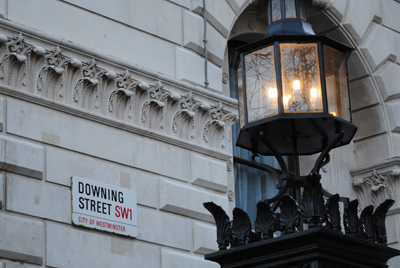
One of the most famous streets (and photographed) in London (though sadly not open to the public), Downing Street in Whitehall is these days most well-known for being the location, at Number 10, of the official residence of the British Prime Minister.

But Downing Street’s history dates back to a time before the first British PM moved in (this was Sir Robert Walpole in the 1735 and even after that, it didn’t become a regular thing for Prime Ministers to live here until the Twentieth century). And its name bears testimony to its creator, Sir George Downing, a soldier and diplomat described as “a miserly and at times brutal” man who served first under both Oliver Cromwell and, following the Restoration, King Charles II (and was, coincidentally, one of the first graduates of Harvard University).

In the 1650s, Sir George took over the Crown’s interest in land here, just east of St James’s Park, and intended to build a row of townhouses upon it. His ambitions were delayed, however, due to an existing lease with the descendants of Elizabethan courtier Sir Thomas Knyvet who had once lived in a large home on the site of what is now Number 10 Downing Street.

By the 1680s, however, the lease had expired and between 1682-84, Downing was able to construct a cul-de-sac, closed at the St James’s Park end, featuring either 15 or 20 two storey terraced townhouses with stables and coach-houses, designed by no less than Sir Christopher Wren.

While the homes were apparently of shoddy craftsmanship and stood upon poor foundations (Churchill famously wrote that Number 10 was “shaky and lightly built by the profiteering contractor whose name they bear”), the street apparently attracted some notable residents from the start.

These included the Countess of Yarmouth, who briefly lived at Number 10 in the late 1680s, Lord Lansdowne and the Earl of Grantham, and even, briefly, apparently the diarist James Boswell in the mid 1700s. Downing himself isn’t thought to have ever lived here – he retired to Cambridge a few months after the houses were completed.

The houses between Number 10 and Whitehall – on the north side of the street – were taken over by the government and eventually demolished in the 1820s to allow for the construction of offices for the Privy Council, Board of Trade and Treasury while the houses on the south side remained until they were demolished in the early 1860s to make way for the Foreign, India, Colonial and Home Offices.

The numbers in the street have changed since Downing’s houses were first built. Of the original homes in the street only Number 10 (home of the PM) and Number 11 (home of the Chancellor of the Exchequer) survive.

Access to the street has been restricted since the 1980s with the current black steel gates put in place in 1989.

An underground tunnel apparently runs under the street connecting number 10 with Buckingham Palace and the underground bunker, Q-Whitehall, built in the 1950s in the event of nuclear war.