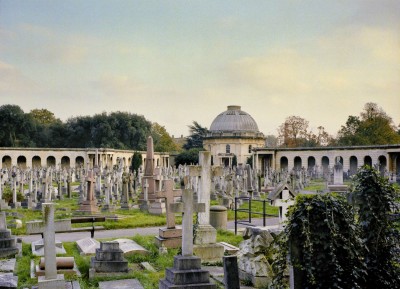
 Brompton Cemetery in London’s west is to undergo a major renovation thanks to a £6.2 million project. Designed by Benjamin Baud and consecrated by the Bishop of London in 1840, the 39 acre cemetery – one of the oldest Grade I listed cemeteries in the country and known as one of London’s “magnificent seven” cemeteries – was strongly influenced by landscapes around St Peter’s in Rome. Among the 205,000 people buried there are suffragette Emmeline Pankhurst, Sir Thomas Spencer Wells – Queen Victoria’s surgeon, and thousands of former Chelsea pensioners. The project will see the chapel, central colonnades and catacombs restored and the transformation of North Lodge into a visitor’s centre with shop and cafe as well as other conservation and improvement works. It is funded by an almost £4.5 million grant from the BIG Lottery Fund and the Heritage Lottery Fund as well as a £1.2 million investment from The Royal Parks, managers of the site, and £500,000 from The Royal Parks Foundation, only half of which has been raised. Those looking to donate to the foundation’s appeal, can visit www.SupportTheRoyalParks.com. PICTURE: © The Royal Parks
Queens of England
What’s in a name?…Savile Row
Famous around the world as the home of bespoke tailoring in London, Savile Row owes its name – like so many other streets in Mayfair – to landowner Richard Boyle, the 3rd Earl of Burlington.
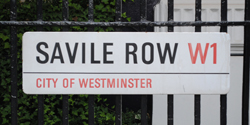 Burlington (1612-98) resided at Burlington House (now home of the Royal Academy of Arts) on Piccadilly and after his death the land around his former home was developed and the streets named for Burlington and members of his family.
Among them was his wife, Lady Burlington, née Lady Dorothy Savile, after whom Savile Row was named. Laid out in 1695, the street was actually located on the site of the former kitchen gardens of Burlington House and was given its name (originally Savile Street) in the 1730s.
The first to reside here were apparently mostly military and politicians (these included PM William Pitt the Younger) and it was only in the early 19th century that the first tailors started to set up shop here. With clients including society dandy Beau Brummell (see our our earlier post here) and the Prince Regent (later King George IV), the street’s fame grew rapidly and continued into the 20th century when customers included some of the biggest names in Hollywood – Cary Grant, Bing Crosby and Frank Sinatra among them.
Among the famous tailoring firms still operating in Savile Row are Anderson & Sheppard (at number 30, it’s where the Prince of Wales has his suits made), Henry Poole (at number 15, Victorian-era owner Henry Poole is credited as the inventor of the tuxedo), and Hardy Amies.
Headquartered at number 14 (with a shop at number 8), Amies gained an international reputation when appointed dressmaker to Queen Elizabeth II in 1955/the address was previously owned by the playwright Richard Brinsley Sheridan and was also the address Jules Vernes gave Phileas Fogg in Around the World in Eighty Days).
One last tailor worth a particular mention is that of Tommy Nutter, who set up shop at number 35 in the late Sixties with a nameplate out front simply reading Nutters and shocked traditionalists with his modern take on tailoring – this modern approach continues among some tailors in the street even today.
The street also has a famous claim in the story of the Beatles – the moved their company Apple Corps Company into number 3 in July, 1968, and it was on the roof of this building that they played their last live gig on 3rd January, 1969.
LondonLife – King Henry VIII’s lost tiltyard tower rediscovered…
 Archaeologists have uncovered the remains of one of five highly ornate towers, luxurious banqueting houses from which the court would view tournaments in King Henry VIII’s walled tiltyard at Hampton Court Palace.
Built in the 1530s, the multi-storey towers were largely demolished by the 1680s and, with the exception of one of the towers which still stands at the palace (and is now a Grade I listed building), their precise location eventually lost.
Until now, that is. The green-glazed tiled floor of one of the ‘lost’ towers were unearthed earlier this month during works taking place as the tiltyard undergoes a family-oriented makeover by award-winning landscape architect, Robert Myers (to be known as ‘The Magic Garden’, it will be unveiled next Easter).
The richly decorated towers – where the king entertained dignitaries and ambassadors – are thought to slightly predate the tiltyard which was apparently laid out in 1537 – perhaps, it’s been suggested, to mark the birth of King Henry VIII’s son, the future King Edward VI.
The first recorded tournament at Hampton Court took place in 1557 when Queen Mary I held one to celebrate Christmas. Her sister Queen Elizabeth I continued the tradition by occasionally holding tournaments there but most days the tiltyard was used to train the young men of the court in warfare.
When tournaments gradually fell out of fashion, the towers were used as multi-purpose storage facilities housing, according to Historic Royal Palaces, everything from pigeons to two Catholic priests in service to King Charles I’s queen, Henrietta Maria, who were spent time ‘quarantined’ there after an outbreak of plague.
For more on Hampton Court Palace, see www.hrp.org.uk/hampton-court-palace/.
This Week in London – Christmas at Kensington and the Geffrye; and Ebola and ISIS at the IWM…
• Christmas is looming and that means Christmas themed events happening all over London. Here’s a couple worth considering:
• Kensington Palace: Head back into the Victorian era where so many of the Christmas traditions we know and love find their origins. The palace and gardens have been decorated with period-inspired decorations while inside decorations include the beautifully decorated tables where Queen Victoria and Prince Albert showcased their Christmas gifts. There’s talks on the origins of Christmas foods such as plum pudding, music and carolling, and the cafe is serving up seasonal food and drink while on Saturday, a special brunch time lecture will look behind the curtains into the world of Victorian pantomime and performance. Admission charges apply – check the website for dates. For more, see www.hrp.org.uk/kensington-palace/.
• The Geffrye Museum: This Shoreditch institution is once again celebrating Christmas traditions of the past in its annual display showcasing the past 400 years of Christmas traditions. Christmas Past has taken place at the museum for the past 25 years and is based on ongoing, original research. It provides insights into everything from traditional Christmas feasts to kissing under the mistletoe, playing parlour games, hanging up stockings, sending cards, decorating the tree and throwing cocktail parties. A series of related events, including a concert by candlelight, are being held over the Christmas season. The display, which has free entry, closes on 3rd January. For more, see www.geffrye-museum.org.uk.
• Ebola and the fight against ISIS are the subject of a new exhibition which opened at the Imperial War Museum in Lambeth last month. Fighting Extremes: From Ebola to ISIS looks at the experiences of British personnel serving on recent operations including the response to the Ebola outbreak in Sierra Leone and the fight against ISIS in the Middle East. The display features behind the scenes interviews such as an in-depth talk with Corporal Anna Cross, a British Army nurse who contracted Ebola, photographs, and recently acquired objects such as the Wellington boots worn by healthcare worker Will Pooley, the first Briton to contract Ebola who was evacuated from Sierra Leone by the RAF, a headset used by an RAF drone pilot, and a shooting target depicting a silhouette of an ISIS suicide bomber used by the British Army to train Peshmerga troops. For more, see www.iwm.org.uk.
Send all items to exploringlondon@gmail.com.
London Pub Signs – The Prince of Wales…
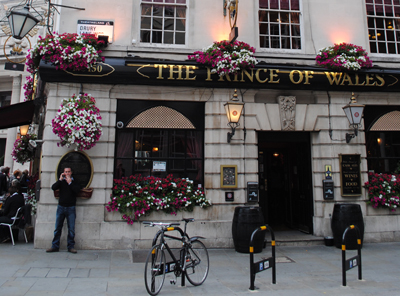 Another Drury Lane pub, the origins of this one go back to 1852 when it was established by Henry Wells on the site of what was once a potato warehouse.
The name, in this case, comes from Queen Victoria and Prince Albert’s eldest son, Albert Edward.
Only about 11-years-old when this West End pub was first built, he remained Prince of Wales until succeeding his mother as King Edward VII (nonetheless, the location proved somewhat prescient – Albert Edward was to become known for his bon vivant lifestyle including his love of the theatre (along with, of course, his love of philandering.))
Located close to theatres and the Royal Opera House, the pub at 150-151 Drury Lane (on the corner of Long Acre) was rebuilt in Portland stone in the early 20th century when the street was widened.
Now part of the Taylor Walker group, it remains a popular pub for theatre goers (and even hosts its own events). For more, see www.taylor-walker.co.uk/pub/prince-of-wales-covent-garden/c0659/.
London Pub Signs – The Princess Louise…
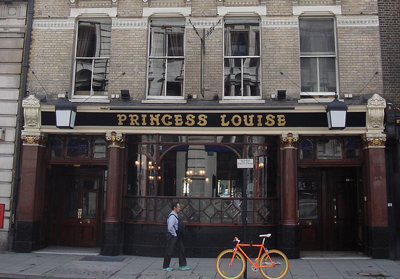 This historic High Holborn pub is named in honour of the sixth child and fourth daughter of Queen Victoria and Prince Albert, Princess Louise, Duchess of Argyle.
The Grade II*-listed pub, which has been described by Peter Haydon and Tim Hampson in their book London’s Best Pubs as a “national treasure” and “the finest, most complete, most original, best preserved, most authentic high-Victorian pub interior in London”, was apparently built in the early 1870s and then remodelled in 1891.
While rather plain externally, this “monument to 19th century craftsmen” boasts a much-vaunted, richly detailed Victorian interior dating from this remodelling which features polychromatic tile work, stained and etched glass and mahogany bar fittings as well as a staggering amount of decoration. The heritage listing even makes reference to the men’s toilets and its marble urinals in the basement.
The pub, at 208 High Holborn, is part of the Samuel Smith Brewery chain who restored it to its former glory in 2007 (including reintroducing glass walled cubicles). It’s also been notable, apparently, for its significant role in hosting folk clubs as part of a revival which occurred in the late 1950s and early 1960s.
Why exactly the pub was named after Princess Louise is something of a mystery and it has been suggested that, thanks to the fact pubs aren’t usually named after living members of the Royal Family, the pub must have originally had a different name.
Princess Louise, meanwhile, is notable for having briefly lived in Canada when her husband served as the Governor-General of that nation. She spent her retirement years at Kensington Palace.
For more, see www.princesslouisepub.co.uk.
PICTURE: Edwardx/Wikipedia
10 small, ‘secret’ and historic gardens in central London…8. Postman’s Park…
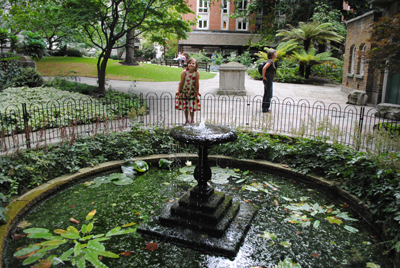 Housing one of London more unique memorials, Postman’s Park in the City’s north is located on what were once the churchyards and burial grounds of three different churches.
The park – which took its name from its popularity with postal workers who came here to escape their job at the nearby former General Post Office (read a Lost London article on the GPO here) – opened in 1880.
It was originally located on the site of the former churchyard of St Botolph’s-without-Aldersgate and was subsequently expanded to incorporate the adjacent churchyard of St Leonard, Foster Lane, and the burial ground of Christ Church, Greyfriars (also known as Christ Church, Newgate Street). Some of the headstones still stand along the park’s boundaries.
 Its key feature is the G.F. Watts Memorial To Heroic Self Sacrifice (pictured, right). Victorian artist and philanthropist George Frederic Watts proposed the memorial commemorating “heroic men and women” who had given their lives to save others to mark Queen Victoria’s Jubilee in 1887 but the memorial which now stands there wasn’t built until 1900.
The memorial consists of a loggia, the inside of which is lined with glazed tablets. Each of these commemorates acts of bravery by “everyday heroes” as they attempted to rescue people from fires, runaway trains, sinking ships and drowning. There were 13 plaques at the time of his death in 1904 and his wife Mary added a further 34.
The latest of the memorials commemorating 62 individuals was added in 2009 (for more details, head to our earlier post here, part of our Curious London Memorials series; you can also find more about the memorial, including a free app, here).
The park also features a sundial and fountain amid bright flower beds and various species of trees including a large banana tree, a dove tree and Tasmanian tree ferns.
Claims to fame include its role in the 2004 film Closer, which starred Natalie Portman, Julia Roberts, Jude Law and Clive Owen (we won’t go into details, just in case you haven’t seen it!).
WHERE: Postman’s Park, between King Edward Street and St Martin’s le Grand (nearest tube stations are St Paul’s and Barbican); WHEN: The park, managed by the Corporation of London, is open 7am to 8pm or dusk (whichever is earlier); COST: Entry is free; WEBSITE: www.cityoflondon.gov.uk/things-to-do/green-spaces/city-gardens/visitor-information/Pages/Postman’s-Park.aspx.

This Week in London – Palaces mark Queen Elizabeth II’s long reign; Richmond Park’s open day; celebrating a famous London redhead; and, London shops features in new work…
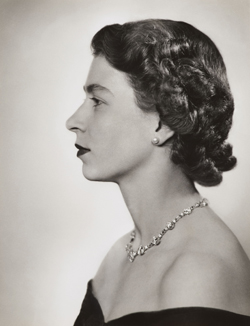 • A special photographic display has opened at Buckingham Palace this week to commemorate the fact that Queen Elizabeth II has this week become Britain’s longest-reigning monarch. The outdoor photographic display Long To Reign Over Us features a selection of photographs spanning the period from 1952 to today including informal family moments, official portraits and visits of the Queen to places across the UK and Commonwealth. Highlights include a black and white portrait by Dorothy Wilding from the start of the Queen’s reign in 1952, Cecil Beaton’s official Coronation Day portrait from 1953 and a 2006 image of the Queen with her Highland Ponies. The displays, which are also being shown as Windsor Castle and the Palace of Holyroodhouse in Edinburgh, can be seen by visitors to Buckingham Palace’s summer opening until 27th September. Admission charge applies. For more, see www.royalcollection.org.uk. PICTURE: Dorothy Wilding. Royal Collection Trust/© William Hustler and Georgina Hustler/National Portrait Gallery, London
• Still celebrating the Queen becoming Britain’s longest reigning monarch, and a new film installation celebrating the reigns of Queen Elizabeth II and Queen Victoria – whose reign she has now surpassed – has opened at Kensington Palace. The film installation explores key moments in the reigns of both – coronations, weddings, births as well as other key moments in their public lives – and also examines the impact of new technologies in the reigns of both queens. For more, see www.hrp.org.uk/kensingtonpalace.
• Richmond Park in London’s south-west is holding its annual open day this Sunday with a range of activities for kids including pony rides, the opportunity to see inside a bug hotel with a fibro-optic camera and the chance make pills in a restored Victorian pharmacy. The Holly Lodge Centre, normally reserved for schools and learning groups, will open its doors to the general public will be at the centre of the day, offering a range of activities for children while there will also be a guided walk led by the Friends of Richmond Park, vintage car displays, and a World War I re-enactment. The day runs from 11am to 4pm. Entrance to the Royal Park is free but parking is £5. For more, see www.royalparks.org.uk.
• This Saturday is Redhead Day UK 2015 and to mark the occasion, the Guildhall Art Gallery in the City of London is inviting visitors to celebrate by taking a selfie with Dante Gabriel Rossetti’s iconic redhead La Ghirlandata. Painted by Rossetti in 1873, the artwork, said to be one of the finest pre-Raphaelite works in the world, is on permanent display at the gallery. The painting features on the cover of Jacky Colliss Harvey’s new book Red: A Natural History of the Redhead, three copies of which will be given away in a special draw at the gallery. Entry is free. For more, see www.cityoflondon.gov.uk/things-to-do/visit-the-city/attractions/guildhall-galleries/Pages/guildhall-art-gallery.aspx.
• A six metre high ceramic installation created for the V&A by artist Barnaby Barford has gone on display in the museum’s Medieval & Renaissance Galleries in South Kensington. The Tower of Babel is composed of 3,000 small bone china buildings, each of which depicts a real London shop. Bamford photographed more than 6,000 shopfronts in the process of making the work, cycling more than 1,000 miles as he visited every postcode in London. The work can be seen until 1st November. Admission is free. See www.vam.ac.uk.
Send all items for inclusion to exploringlondon@gmail.com.
Special – Queen Elizabeth II becomes longest reigning monarch…

We interrupt our regular programming this week to mark the day in which Queen Elizabeth II becomes the UK’s longest reigning monarch, passing the record reign of her great-great-grandmother, Queen Victoria.
The milestone of 63 years, seven months and two days (the length of Queen Victoria’s reign) will reportedly be passed at about 5.30pm today (the exact time is unknown as the Queen’s father, King George VI, passed away in his sleep).
While the Queen, now 89 (pictured here in 2010), will pass the day in Scotland attending official duties, in London Prime Minister David Cameron will lead tributes in the House of Commons.
As we go to press a flotilla of vessels – including Havengore and Gloriana – will process along the River Thames between Tower Bridge, open as a sign of respect, and the Houses of Parliament. As they passed HMS Belfast, the ship will fire a four gun salute.
Today is the 23,226th day of the Queen’s reign during which she has met numerous major historical figures – from Charles de Gaulle to Nelson Mandela – and seen 12 British Prime Ministers come and go.
This Week in London – The Waterloo Cartoon on show; see inside a former Huguenot’s home; and, Royal Parks’ harvest festivals…
• A monumental Victorian-era drawing of the Battle of Waterloo has gone on display in London for the first time since 1972. The Waterloo Cartoon, more formally known as The Meeting of Wellington and Blucher after the Battle of Waterloo, measures more than 13 metres long and three metres high. A preparatory drawing for a wall painting which still exists in the House of Lords’ Royal Gallery, it took artist Daniel Maclise more than a year to complete in 1858-59 and was based on eye-witness accounts (the artist even recruited Queen Victoria and Prince Albert to use their German contacts to gather information from Prussian officers present on the day). Long considered a masterpiece, it was bought by the Royal Academy in 1870 – the year of Maclise’s death – and was on show at Burlington House until the 1920s. It has been in storage for much of last century and, newly restored following a grant from Arts Council England, has now gone on display to mark the 200th anniversary of the Battle of Waterloo. The newly conserved drawing is the focus of a new exhibition – Daniel Maclise: The Waterloo Cartoon, which opened at the Royal Academy in Piccadilly yesterday (between May and August, it was on show as part of a Waterloo exhibition at the Royal Armouries in Leeds). Runs until 3rd January. Admission charge applies. For more, see www.royalacademy.org.uk.
• There’s a rare chance to see inside a former Huguenot merchant’s house dating from 1719 in Spitalfields this weekend. The property at 19 Princelet Street was the home of the Ogier family, who had come to London escaping persecution in France and worked in the silk weaving trade. It was later subdivided into lodgings and workshops with later occupants following a range of trades and professionals while a synagogue was opened in the garden in 1869. The site – which the Spitalfields Centre charity hopes to establish as a museum of immigration – is not generally open to the public but will be open this Saturday and Sunday – from 2pm to 6pm. Entry is free (but donations would be welcome) and there may be queues so its suggested you arrive early. For more, see www.19princeletstreet.org.uk.
• Watch a bee keeping demonstrations, help dig up some potatoes and introduce the children to some farm animals. The Kensington Gardens’ Harvest Festival will be held this Sunday, between 11am and 4pm, and will also include a range of children’ activities, experts from the Royal Parks Guild on hand to answer your questions about food growing and complimentary hot and cold drinks available throughout the day while stocks last. It’s the first of three harvest festivals to be held in Royal Parks this month with Greenwich Park set to host its inaugural harvest festival on 13th September (11am to 4pm) and The Regent’s Park Allotment Garden to host one on 19th September (11am to 5pm). For more, see www.royalparks.org.uk.
Send all items for inclusion to exploringlondon@gmail.com.
Famous Londoners – Judge Jeffreys…
Best known as the “Hanging Judge” thanks to his role in the so-called Bloody Assizes of 1685, George Jeffreys climbed the heights of England’s legal profession before his ignominious downfall.
Born on 15th May, 1645, at the family home of Acton Hall in Wrexham, North Wales, Jeffreys was the sixth son in a prominent local family. In his early 20s, having been educated in Shrewsbury, Cambridge and London, he embarked on a legal career in the latter location and was admitted to the bar in 1668.
 In 1671, he was made a Common Serjeant of London, and despite having his eye on the more senior role of Recorder of London, was passed over. But his star had certainly risen and, despite his Protestant faith, he was a few years later appointed to the position of solicitor general to James, brother of King Charles II and the Catholic Duke of York (later King James II), in 1677.
The same year he was knighted and became Recorder of London, a position he had long sought, the following year. Following revelations of the so-called the Popish Plot in 1678 – said to have been a Catholic plot aimed the overthrow of the government, Jeffreys – who was fast gaining a reputation for rudeness and the bullying of defendants – served as a prosecutor or judge in many of the trials and those implicated by what turned out to be the fabricated evidence of Titus Oates (Jeffreys later secured the conviction of Oates for perjury resulting in his flogging and imprisonment).
Having successfully fought against the Exclusion Bill aimed at preventing James from inheriting the throne, in 1681 King Charles II created him a baronet. In 1683 he was made Lord Chief Justice and a member of the Privy Council. Among cases he presided over was that of Algernon Sidney, implicated in the Rye House Plot to assassinate the king and his brother (he had earlier led the prosecution against Lord William Russell over the same plot). Both were executed.
It was following the accession of King James II in February, 1685, that Jeffreys earned the evil reputation that was to ensure his infamy. Following the failed attempt by James Scott, 1st Duke of Monmouth and illegitimate son of the late King Charles II, to overthrow King James II, Jeffreys was sent to conduct the trials of the captured rebels in West Country towns including Taunton, Wells and Dorchester – the ‘Bloody Assizes’.
Of the almost 1,400 people found guilty of treason in the trials, it’s estimated that between 150 and 200 people were executed and hundreds more sent into slavery in the colonies. Jeffreys’, meanwhile, was busy profiting financially by extorting money from the accused.
By now known for his corruption and brutality, that same year he was elevated to the peerage as Baron Jeffreys of Wem and named Lord Chancellor as well as president of the ecclesiastical commission charged with implementing James’ unpopular pro-Catholic religious policies.
His fall was to come only a couple of years later during Glorious Revolution which saw King James II overthrown by his niece, Mary, and her husband William of Orange (who become the joint monarchs Queen Mary II and King William III).
Offered the throne by a coalition of influential figures who feared the creation of a Catholic dynasty following the birth of King James II’s son, James Francis Edward Stuart, William and Mary arrived in England with a large invasion force. King James II’s rule collapsed and he eventually fled the country.
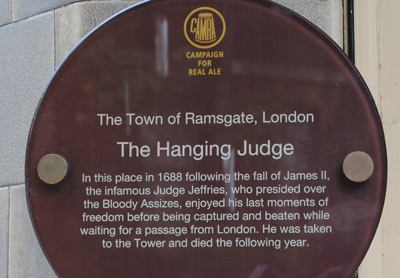
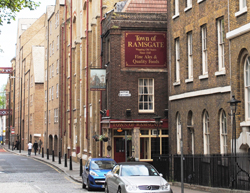
Remaining in London after the king had fled, Lord Jeffreys only attempted to flee as William’s forced approached the city. He made it as far as Wapping where, despite being disguised as a sailor, he was recognised in a pub, now The Town of Ramsgate (pictured above).
Placed in custody in the Tower of London, he died there of kidney problems on 18th April, 1689, and was buried in the Chapel Royal of Saint Peter ad Vincula (before, in 1692, his body was moved to the Church of St Mary Aldermanbury). All traces of his tomb were destroyed when the church was bombed during the Blitz (for more on the church, see our earlier post here).
This Week in London – Buckingham Palace offers a “Royal Welcome”; exploring London’s outdoor spaces; and contemporary portraiture at the V&A…
 • Buckingham Palace opened its 19 State Rooms to the public last weekend under the theme of ‘A Royal Welcome’. As well as the chance to see the State Rooms themselves, a series of displays and films are located throughout the palace which show how Royal Household staff are involved in welcoming the tens of thousands of guests who come to the palace each year for receptions, State Banquets, garden parties and investitures. And, for the first time, the public can enter the palace through the Grand Entrance where the Australian State Coach will be displayed. Other highlights include the Palace Ballroom – set up for a State Banquet with silver gilt candelabra and centrepieces from King George IV’s grand service, displays recreating part of the dresser’s workroom and the palace kitchens, pantries and wine cellars in the throes of preparing for a State Banquet, and some of the gifts received during State Visits to the palace. Items of Queen Elizabeth II’s personal jewellery are also on display including the Kokoshnik Tiara, worn at a State Banquet in honour of the President of Mexico this year, Queen Mary’s Dorset bow brooch and the diamond Coronation necklace and earrings. The palace is open until 27th September. Admission charge applies. For more, see www.royalcollection.org.uk.
• A new interactive map of public outdoor areas in London has been created to help encourage the city’s residents and tourists to make the most of the great outdoors this summer. The map details more than 200 public spaces including squares, green spaces and public street amenities, many of which have been improved as part of the Mayor of London, Boris Johnson’s Great Outdoors initiative which has seen more than £400 million invested in 242 projects since 2009. To check out the map, follow this link.
• A new exhibition examining contemporary portraiture – and its inspiration from traditional modes of portraiture such as miniatures, medals and death masks – opened at the V&A in South Kensington this week. Facing History: Contemporary Portraiture features more than 80 prints and photographs drawn from the V&A’s collection and created by artists including Julian Opie, Grayson Perry, Thomas Ruff, Maud Sulter and Gavin Turk. Works featured include self-referential pieces like Grayson Perry’s pair of prints, Mr and Mrs Perry and Gavin Turk’s Portrait of Something that I’ll Never Really See, portraits of real and fictional characters like Brian D Cohen’s Man with Eyes Closed (Walter White) whose subject is both a character from US TV series Breaking Bad and Bryan Cranston, the actor who played him, Cecilia Mandrile’s identity-card inspired ID-Intensively Displaced series, and 11 pieces from Ellen Heck’s Forty Fridas. Exhibition runs until 24th April. Admission is free. For more, see www.vam.ac.uk.
Send all items for inclusion to exploringlondon@gmail.com
Famous Londoners – Sir Hugh Myddelton…
The Welsh-born “merchant adventurer” Sir Hugh Myddelton (also spelt Myddleton or Middleton) is best remembered in London for the construction of the New River, a water engineering project which still provides some of city’s water.
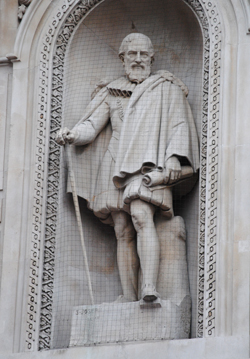 Born about 1560, the sixth son (and one of 16 children) of Richard Myddelton, governor of Denbigh Castle in Wales, Hugh Myddelton travelled to London to seek his fortune and there became apprenticed to a goldsmith before himself becoming a member of the Goldsmith’s Company in 1592 (he later became warden of the company).
Operating out of premises in Bassishaw (now Basinghall Street), he gained a reputation among the wealthy and nobility for his work and was appointed Royal Jeweller to King James I (he had apparently also supplied jewellery to Queen Elizabeth I).
Myddelton became a wealthy merchant and banker, and, in 1603, he also succeeded his father as MP for Denbigh Borough, a post he held repeatedly until 1628.
Sir Hugh became one of the driving forces behind the New River project which aimed to address the strain on London’s water sources by bringing clean water from the River Lea in Hertfordshire via a 39 mile-long canal to New River Head in London.
After an aborted earlier attempt to build a canal from Hertfordshire to London (which had run into financial difficulties), Sir Hugh was granted authority to carry out the works for the New River in 1609 and employed mathematicians like Edward Pond and Edward Wright to direct the course with the man behind the earlier attempt, Edmund Colthurst, overseeing the works.
By 1611 it became clear to Myddelton that he wouldn’t have the necessary funds to complete the works so he obtained the financial aid of the king (in return the king was to get half of all profits).
The project was eventually completed in 1613 and a ceremony was held at the New River Head in Islington where the canal then terminated (just south of where Sadler’s Wells Theatre now stands).
Myddelton, who continued to diversify in business and made considerable sums from his ownership of lead and silver mines in Wales as well as from a land reclamation project on the Isle of Wight, became the first governor of the New River Company when it was created by royal charter in 1619 and remained a key figure in it until his death. He was created a baronet in 1622.
Myddelton, who married twice, had 15 or more children to his second wife – only about half of whom survived him. He died on 7th December, 1631, and was buried in the now demolished St Matthew Friday Street where he had been a church warden (some of his children were buried there as well). One of his brothers, Sir Thomas Myddelton, was a Lord Mayor of London.
Among memorials to Sir Hugh in London is a statue of him on Islington Green which was unveiled in 1872 by William Gladstone, later PM. There is also a statue of him on the Royal Exchange (pictured) and a number of Islington streets have been named for him.
For more on London’s historic water sources, see London’s Lost Rivers: A Walker’s Guide
This Week in London – Tudor jousting at Hampton Court; Black British voices heard to Guildhall Art Gallery; and, V&A extends McQueen…
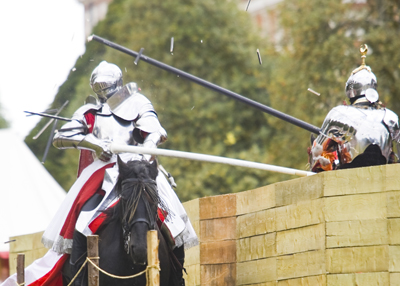 • Enjoy a weekend of jousting, music, dancing and Tudor cookery at Hampton Court Palace this weekend as part of the celebrations surrounding the iconic building’s 500th anniversary. England will take on Spain in the jousting while intrigue abounds at the court of Queen Mary I and King Philip II of Spain as actors perform scenes written by award-winning playwright Elizabeth Kuti. The pageant kicks off at 11am each day with the jousts commencing at noon and 3.30pm in the grounds. The event will be followed by a Baroque-themed celebration in August. Admission charges apply. For more, see www.hrp.org.uk/HamptonCourtPalace/. PICTURE: Courtesy Historic Royal Palaces.
• Black British cultural identities and creative voices and the struggle they’ve had to have their voices heard are the subject of a new exhibition opening at the Guildhall Art Gallery in the City tomorrow. The exhibition, No Colour Bar: Black British Art in Action 1960-1990, focuses on the life works of Eric and Jessica Huntley and the publishing house, pioneering bookshop and cultural hub they founded in 1969 known as Bogle L’Ouverture Press. The bookshop will be physically recreated in the gallery as a “multi-sensory, interactive installation” sitting alongside works by notable artists of the period including Eddie Chambers, Denzil Forrester and Sokari Douglas-Camp. A programme of events has been created to run with the exhibition. Runs until 24th January. Admission is free. For more, follow this link.
• The V&A has announced it will keep its exhibition Alexander McQueen: Savage Beauty open through the night for the final two weekends in the lead-up to its closure on 2nd August. Following the sell out of all existing pre-bookable tickets, the museum has said night tickets are now available for the weekends of 24th to 26th July and 31st July to 2nd August. The exhibition shop will feature special in-house promotions, there will be bar in the Dome with music until 10pm each night and refreshments will be available throughout the night. For more, see www.vam.ac.uk.
Send all items for inclusion to exploringlondon@gmail.com.
A Moment in London’s History – Princess Victoria’s christening…
On Sunday, Princess Charlotte, daughter of Prince William and Princess Kate, was christened at Sandringham. So we thought we’d take a quick look at another christening that took place in London almost 200 years ago, that of Princess Victoria.
The future Queen Victoria was born on 24th May, 1819 – the daughter of Edward, Duke of Kent (fourth son of King George III), and his wife, Princess Victoria Mary Louisa of Saxe-Coburg-Saalfeld.
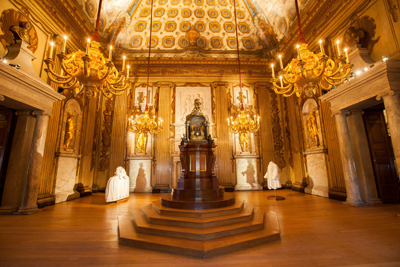
At the insistence of the Prince Regent (later King George IV), the christening was a small affair and was held a month after the birth on the afternoon of 24th June in the magnificent Cupola or Cube Room of Kensington Palace (pictured as it is now, above).
The guest list was small and included the Prince Regent, Prince Frederick, the Duke of York, and his wife Princess Frederica, Princess Augusta Sophia, Princess Mary, the Duchess of Gloucester, and her husband, Prince William, and Prince Leopold, who had recently become a widower after the death of Princess Charlotte.
The ceremony was conducted by Charles Manners-Sutton, the archbishop of Canterbury, and, thanks to the intransigence of the Prince Regent, her name was apparently only decided at the last minute.
The Prince Regent has earlier forbidden the use of such ‘royal’ names including Charlotte, Elizabeth, Georgina or Augusta and when asked by the archbishop what she would be named, he replied brusquely that she would be named Alexandrina in honour of the Russian Tsar Alexander, one of the new princess’s godparents.
Her second name was Victoria in honour of her mother, and while Victoria was often called “Drina” while a girl, she herself apparently preferred her second name to her first.
The gold font used in the ceremony formed part of the Crown Jewels and its origins go back to the time of King Charles II.
Interestingly, there were a couple of significant Victorian connections during Princess Charlotte’s christening – the font used at this christening was known as the Lily Font (like its predecessor, it is usually found with the Crown Jewels in the Tower of London).
It was commissioned by Queen Victoria and Prince Albert for the christening of their first daughter, Princess Victoria, in 1841, apparently due to Queen Victoria’s dislike for the gold font used at her own christening – it had been used by King Charles II to christen his illegitimate children.
The Lily Font has apparently been used at every royal christening since except that of Princess Eugenie who had a public baptism in Sandringham in 1990.
Princess Charlotte also wore a replica of the christening gown worn by Princess Victoria.
WHERE: The Broad Walk, Kensington Gardens, Kensington (nearest Tube stations are High Street Kensington or Queensway); WHEN: Daily 10am to 6pm (until 31st October); COST: £17.50 adult/£14.10 concession/children under 16 free (online booking discounts available, Historic Royal Palaces members free); WEBSITE: www.hrp.org.uk/KensingtonPalace.
PICTURE: HRP/newsteam
10 sites from London at the time of the Magna Carta – 2. St Bartholomew the Great…
St Bartholomew the Great in Smithfield – the oldest parish church in London (see our earlier piece here) – is worth a revisit thanks to the fact that it would have been standing (at least partially) when the seal of King John was first affixed to the Magna Carta .
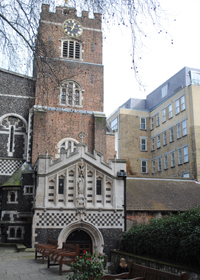 Only half the size it once was, this church was founded in 1123 AD as the priory church for a community of Augustinian Canons and owes its origins to Rahere, a favored courtier of King Henry I who renounced his way of life and made a pilgrimage to Rome, returning to found both the church and nearby hospital for the poor.
Only the eastern part of the church was built by the time of the death of Rahere – the first prior – in 1145 and the building continued for some years afterward. While the interior walls now look somewhat plain, they would have been highly decorated when the building was originally constructed. At the time of the Magna Carta, the church would have only been partly completed.
The tomb of Rahere still lies within the church, on the left hand side of the altar – although the canopy over it dates from the 15th century. There were some healing miracles recorded at the tomb.
The church’s current configuration came about when the priory was dissolved in 1539 and the nave of the church was pulled down, leaving what’s there now – the quire, altar and lady chapel.
The brick tower at the church’s west end dates from the 1620s while the gateway through which you enter the church grounds features a restored 13th century arch topped by a late Tudor building.
The church was briefly used by some Dominican friars but since the reign of Queen Elizabeth I has fulfilled the role of parish church. A concerted restoration effort began in the mid-19th century by Sir Aston Webb (architect of the Victoria & Albert Museum), leaving the Lady Chapel with a very different feel to the Norman choir. The building is now Grade I-listed.
WHERE: Off Little Britain, West Smithfield (nearest tube station is Barbican); WHEN: 8.30am to 5pm Monday to Friday, 10.30am to 4pm Saturday, 8.30am to 8pm Sunday (except for services) ; COST: £4 an adult/£3.50 concession/£10 a family; WEBSITE: www.greatstbarts.com
Treasures of London – Australian War Memorial…

Tomorrow is the 25th April – commemorated every year as Anzac Day in Australia in memory of that country’s soldiers who lost their lives. This year marks 100 years since Australian troops first landed at Gallipoli during World War I.
While attention will be focused on Anzac Cove in modern Turkey and the Australian war memorials on what was the Western Front in western Europe, in London there will be several events including a wreath laying ceremony at The Cenotaph in Whitehall, a commemoration and thanksgiving service in Westminster Abbey and a dawn service held at the Australian War Memorial in Hyde Park Corner.
This last memorial, dedicated to the more than 100,000 Australians who died in both world wars, was unveiled on Armistice Day, 2003, in the presence of Queen Elizabeth II, then-Australian PM John Howard and then British PM Tony Blair.
It records the 23,844 names of town where Australians who served in World War I and II were born.
Superimposed over the top are 47 of the major battles they fought. Principal architect Peter Tonkin said the somewhat curvaceous design of the memorial, made of grey-green granite slabs, “reflects the sweep of Australian landscape, the breadth and generosity of our people, the openness that we believe should characterise our culture”.
For more on the wall – including the ability to search for town names – see www.awmlondon.gov.au.
This Week in London – Charles I’s overlooked artist; St George’s Day in Trafalgar Square; Indigenous Australia; prints from the Royal Collection on show; and, ‘What is Luxury’ at the V&A…
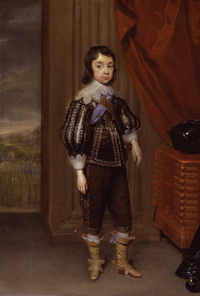 • The first ever display of works of overlooked 17th century artist Cornelius Johnson, court painter to Charles I, has opened at the National Portrait Gallery off Trafalgar Square. Cornelius Johnson: Charles I’s Forgotten Painter features rarely viewed portraits of the king’s children including the future Charles II, James II and Mary (later Princess of Orange-Nassau) as well as a painting of Mary’s son William – all of which have been taken from the gallery’s collection. Overshadowed by Sir Anthony van Dyck, Johnson – who emigrated to The Netherlands when the English Civil War broke out – has been largely ignored by art historians despite the breadth of his work – from group portraits, such as his largest surviving English painting, The Capel Family, to tiny miniatures – and the fact that he is thought to be the first English-born artist who took to signing date his paintings as a matter of course, something he is believed to have picked up during his training in The Netherlands. The display features eight painted portraits and six prints from the gallery’s collection as well as three paintings from the Tate. Runs until 13th September in Room 6. Admission is free. For more, see www.npg.org.uk. PICTURE: King Charles II by Cornelius Johnson , 1639. © National Portrait Gallery, London.
• Trafalgar Square will be at the centre of London’s St George’s Day celebrations on Saturday with live music, celebrity chefs, a masterclass by leading tea experts and children’s games and activities. The musical lineup will feature the band from the West End musical Let It Be and the Crystal Palace Brass Band – one of the few traditional brass bands remaining in London. The free event runs between noon and 6pm on Saturday. For more, see www.london.gov.uk/stgeorges.
• Indigenous Australia, the first major exhibition in the UK to present a history of Indigenous Australia through objects, opens at the British Museum today. Drawing on the museum’s collection, Indigenous Australia features objects including a shield believed to have been collected in Botany Bay on Captain Cook’s voyage of 1770, a protest placard from the Aboriginal Tent Embassy established in 1972 and contemporary paintings and specially commissioned artworks from leading indigenous artists. Many of the objects have never been on display before. Runs until 2nd August. Admission charge applies. For more, see www.britishmuseum.org.
• Thirty prints from the Royal Collection will be on show at The London Original Print Fair to mark its 30th anniversary. The fair runs at the Royal Academy from today until Sunday and among the selected works from the more than 100,000 prints in the Royal Collection are the 2.3 metre long woodcut by Albrecht Durer entitled Triumphal Cart of the Emperor Maximillian (1523), Wenceslaus Hollar’s four etchings of tropical Seashells (c1650), a sequence of proofs of Samuel Reynolds’ portrait of King George III at the end of the monarch’s life, and lithographs produced by Queen Victoria and Prince Albert dating from 1842. For more on the fair, see www.londonprintfair.com. For more on the Royal Collection, see www.royalcollection.org.uk.
• The question of what is meant by the concept of luxury is under examination in the V&A’s new exhibition What is Luxury? Opening at the South Kensington museum Saturday, the exhibition will feature a range of luxury objects – from the George Daniels’ Space Travellers’ Watch to a Hermés Talaris saddle, and Nora Fok’s Bubble Bath necklace. Also on show in a section of the exhibit looking at what could determine future ideas of luxury is American artist Gabriel Barcia-Colombo’s DNA Vending Machine (complete with prepackaged DNA samples) and Henrik Nieratschker’s installation The Botham Legacy which tells the fictional story of a British billionaire who sends altered bacteria into space in an attempt to find valuable metals on distant plants. Runs until 27th September. Admission charge applies. See www.vam.ac.uk/whatisluxury.
Send all items for inclusion to exploringlondon@gmail.com.
Treasures of London – The Australian State Coach…
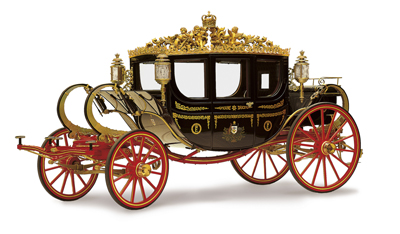
Among the treasures on show at this year’s summer opening of Buckingham Palace, the Australian State Coach was a gift to Queen Elizabeth II by Australia on 8th May, 1988, to mark the Australian Bicentennial.
The coach – the first to be built for the Royal Family since the Coronation of King Edward VII in 1902 – was built by Australian WJ “Jim” Frecklington who also designed the Diamond Jubilee State Coach.
The coach, which is usually kept in the Royal Mews where it can be viewed by the public, has been used at the State Opening of Parliament and other occasions involving foreign royal families and visiting heads of state. It was also used to carry Prince Charles, the Duchess of Cornwall and Michael and Carole Middleton back to Buckingham Palace after the wedding of Prince William and Catherine Middleton.
It was last used to carry the Duke of Edinburgh and Señora Rivera, wife of the president of Mexico, on a State Visit in March this year.
The summer opening of the palace runs from 25th July to 27th September. The coach will be on display in the Grand Entrance portico.
WHERE: Summer Opening of Buckingham Palace (nearest Tube stations are Victoria, Green Park and Hyde Park Corner); WHEN: 25th July to 31st August – 9.30am to 7.30pm daily (last admission 5.15pm)/1st to 27th September – 9.30am to 6.30pm (last admission 4.15pm); COST: £35.60 adults/£20 under 17 and disabled/£32.50 concessions/£91.20 family (2 adults and three under 17s); WEBSITE: www.royalcollection.org.uk/visit/the-state-rooms-buckingham-palace/plan-your-visit.
PICTURE: Royal Collection Trust © Her Majesty Queen Elizabeth II, 2015
A Moment in London’s History – The first Crufts show…
The annual Crufts dog show has been making headlines around the world recently (sadly not all for good reasons), so we thought it was a good chance to take a look back at where it all began.
While the event is this year being held in Birmingham, the first Cruft’s Show was actually held in London in the late 1800s.
 Charles Cruft – the show’s founder – had left college in 1876 and instead of joining the family’s jewellery business, had taken up employment in Holborn with James Spratt’s business selling ‘dog cakes’ (aka dog biscuits).
While he started off as an office boy, he was soon promoted to travelling salesman and he was soon travelling across Europe. So impressed were his customers that in 1878, just two years after leaving school, he was invited to organise the promotion of the canine section of the Paris Exhibition.
Eight years later in 1886, back in England, he took up the role of managing the Allied Terrier Club Show at the Royal Aquarium in Westminster.
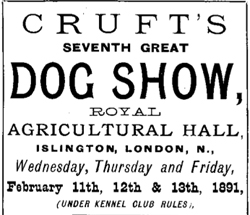
The first show bearing the Crufts name – known then as ‘Cruft’s Great Dog Show’ – followed five years later in 1891 (although this was actually called Cruft’s Seventh Great Dog Show thanks to his involvement with the earlier shows).
Held at the Royal Agricultural Hall in Islington (now a Grade II-listed building) on 11th, 12th and 13th February, the show boasted 2,437 entries spanning 36 different dog breeds.
Among the entries in 1891 were six Pomeranians owned by Queen Victoria – one of them, Gena, placed equal first (apparently the judges didn’t want to mark down the monarch’s dogs!)
It’s not the only landmark Crufts event held in London. In 1948, with Charles Cruft having died 10 years earlier his widow Emma handed over control of the show to the Kennel Club. The first show under the club’s auspices was held at Olympia with 84 different breeds entered (there are now around 200 entered annually). In 1979 the show moved to Earl’s Court before eventually, in 1991, moving to Birmingham.
For more on Crufts, see www.crufts.org.uk
 Exploring London