Lost London – The London Colosseum…

Designed by architect Decimus Burton (he of the Kew Palm House fame), the London Colosseum was a vast, 16-sided domed structure erected in the 1820s to the east of Regent’s Park to house a panoramic view of the city.

ColosseumSaid to be the largest ever painting created at the time, Thomas Hornor – a land surveyor – oversaw the creation of the work which was based on drawings he had made from the top of St Paul’s Cathedral (he had apparently sat in a special, temporary hut or “crow’s nest” positioned where the cross and ball would normally sit – but it was in the process of being replaced). Several artists – led by the renowned ET Parris – were involved in creating the work which took four years to make before it was completed in 1829.

The building – located where Cambridge Gate now stands – had been modelled on the Pantheon in Rome (not the Colosseum as the name would suggest) and was constructed from brick rendered with cement to imitate the appearance of stone. It featured a portico with Doric columns at the front and had inside an “ascending room” or lift to take people to see the panorama.

It’s opening was apparently delayed after Horner and his chief backer, MP Rowland Stevenson, took off to the US after running up rather large debts, leaving the property in the hands of trustees.

The Colosseum changed hands several times over the years and its purpose evolved. At one stage it was reinvented as a museum of sculpture displaying some 180 works while other attractions added to the great rotunda and its surrounding gardens over the years included a “Gothic aviary”, a Swiss chalet from which a visitor could look at a real waterfall and a stalactite cavern as well as a theatre and various other panoramas depicting everywhere from Paris to Lisbon.

Among visitors to the attraction were Queen Victoria and Prince Albert.

The Colosseum was put up for auction in 1855 but failed to attract a bid of the size required and, having passed through several hands (with some of the owners at one stage flirting with the idea of turning it into a grand hotel), it was eventually was demolished in the 1870s.

PICTURE: Via Wikipedia.

LondonLife – The Duke of York has a facelift…

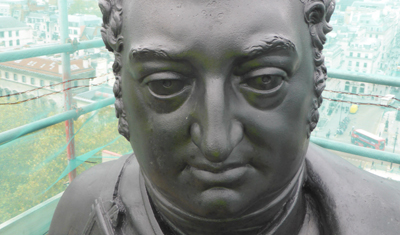
Duke-of-YorkA monument commemorating Prince Frederick, the Duke of York and Albany and commander-in-chief of the British Army during the French Revolutionary wars – the Duke of York Column in St James’s Park – has had a makeover. The monument, which was erected in 1834, is the tallest in the Royal Parks. It features a 124 foot tall column of pink and grey Aberdeen granite designed by Benjamin Wyatt and is topped by a 14 foot tall bronze statue of the duke (thought to be the ‘Grand Old Duke of York’ referred to in the nursery rhyme), designed by Sir Richard Westmacott. The column has been cleaned while the statue, which had developed a green pigment thanks to the oxidation process which also gives the Statue of Liberty its green patina, has been repatinated, rewaxed and buffed. The monument, which cost £100,000 to refurbish, originally cost £15,760 and was funded with a day’s pay from every serving soldier. For more on St James’s Park, check out www.royalparks.org.uk/parks/st-jamess-park. PICTURE: Courtesy of Royal Parks.

This Week in London – Hampton Court Palace lights up; doll house histories; more on Christmas; and, memories of a royal progress at The Queen’s Gallery…

Hampton Court Palace’s world famous gardens have been transformed into an “illuminated wonderland” which can be explored using a specially created trail. From tomorrow, visitors can use a glow-in-the-dark map to follow the trail which starts at the palace’s hedge maze – the UK’s oldest – and meanders through various locations around the grounds – including the formal gardens – before ending up at the palace’s East Front where, through the use of interactive technology, visitors can ‘paint’ the building’s facade just by moving around. Allow about an hour. Entry is timed between 5pm and 8pm. Runs until 23rd December. Admission charge applies. For more, see www.hrp.org.uk/HamptonCourtPalace/.

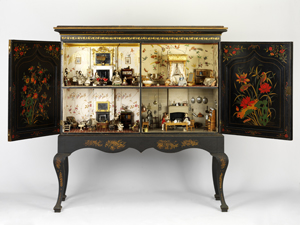
Killer_Cabinet_1840sThe stories behind some of the UK’s best-known dolls’ houses are the focus of a new exhibition which opens at the V&A Museum of Childhood in Bethnal Green on Saturday. Small Stories: At home in a dolls’ house tells the story of 12 dolls’ houses dating as far back as 300 years. Each of the houses – which are displayed chronologically – has been set up to represent a particular time of day and, using interactive technology, tells the story of those who live and work in the building in a series of stories featuring marriages, parties, politics and even crimes. Highlights include: the Tate Baby House – dating from 1760, it features original wallpapers and painted panelling in the style of Robert Adam; the Killer House (pictured) – a gift from surgeon John Egerton Killer to his wife and daughters in the 1830s, this Chinese-style cabinet has gilded wallpapers, a four poster bed and liveried servants; Whiteladies House – a Modernist country villa designed by artist Moray Thomas and built in the 1930s; the Hopkinson House – based on the homes built in the 1930s in the London County Council suburb, the St Helier Estate; and, the Kaleidoscope House – designed by Laurie Simmons to suit a “design conscious step-family living in the new millennium”. There’s a further 20 dolls’ houses, dating from 1673 to 2014, on display in the museum’s permanent galleries (just some of the more than 100 in the museum’s collection). Admission is free. Runs until 6th September, 2015. For more, see www.museumofchildhood.org.uk. PICTURE: Victoria and Albert Museum, London.

The V&A has unveiled its 2014 Christmas Tree at the grand entrance to its South Kensington building. Designed by Gareth Pugh, Ceremony stands at more than four metres in height and, along with a shape not unlike a traditional Christmas tree, features nine tiered gold pyramids located around a central beacon of light to represent the nativity. For more, see www.vam.ac.uk/content/articles/c/christmas-tree-installation-by-gareth-pugh/Meanwhile Winter Wonderland continues to entertain in Hyde Park with rides, markets, ice-skating and all the usual attractions. Open 10am to 10pm every day until 4th January (closed on Christmas Day). For more, see www.hydeparkwinterwonderland.com.

On Now: Cairo to Constantinople: Early Photographs of the Middle East. This exhibition at The Queen’s Gallery, Buckingham Palace, features objects collected by the 20-year-old Prince of Wales, Albert Edward (later King Edward VII), during an educational tour of the Middle East in 1862. The display, which also features photographs taken by Francis Bedford – the first photographer to join a royal tour, follows the prince as he progresses through Egypt, Palestine and the Holy Land, Syria, Lebanon, Turkey and Greece. The exhibition is being show alongside Gold, a display of 50 gold items drawn from the Royal Collection. They include the Rillaton Cup, found in a Bronze Age burial dating from between 1700 and 1500 BC, a gold crown from Ecuador that predates the Incas, and an 18th century tiger’s head made from gold and rock crystal and taken from the throne of the Tipu Sultan of Mysore in India. Both run until 22nd February. Admission charge applies. For more, see www.royalcollection.org.uk.

Send all items for inclusion to exploringlondon@gmail.com.

Treasures of London – Queen Caroline’s Temple…

Queen-Caroline's-Temple

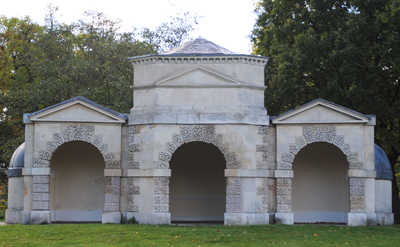
Located in Kensington Gardens, this neo-classical summer house was designed by William Kent for Queen Caroline (who was responsible for much of the shape of the gardens as they are now).

Standing amid naturalistic plantings overlooking the Long Water (which was among the features created at the order of Queen Caroline – consort of King George II), it was built in 1734-35 and designed to be glimpsed down one of the avenues of trees which radiated out from the Round Pond in front of Kensington Palace.

The Grade II-listed ‘temple’, which features graffiti inside dating back until 1821, was later converted to a park keeper’s home but restored to its use as a summer house in 1976.

Kent apparently also designed a second summer house for Kensington Gardens which revolved – it stood on a 13 metre high mound constructed by Kent’s predecessor Charles Bridgeman using spoil from the excavation of the Serpentine in the south-eastern corner of the gardens (the summer house was later demolished and the mound levelled).

Not the most prominent feature of the gardens but like the much later Princess Caroline’s Bath in Greenwich Park (see our earlier post here), it does have an important royal connection and is worthy of a stop when visiting the gardens.

WHERE: Kensington Gardens (nearest tube stations are that of Queensway, Bayswater, Lancaster Gate, South Kensington, Gloucester Road and Kensington High Street); WHEN: 6am to dusk; COST: Free; WEBSITE: www.royalparks.org.uk/parks/kensington-gardens.

8 structures from the London that never was – 3. Sir John Soane’s royal palace…

Prolific early 19th century architect Sir John Soane designed many public buildings in London including, famously, the Bank of England (since considerably altered) and the somewhat revolutionary Dulwich Picture Gallery. He also designed a number that were merely fanciful works and never commissioned nor constructed.

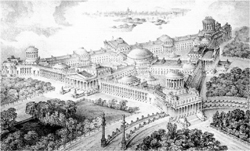
Royal-PalaceForemost among them was a sprawling royal palace which would occupy part of Green Park off Constitution Hill.

While Soane had been designing royal palaces as far back as the late 1770s when in Rome on his Grand Tour, in 1821 he designed one, apparently as a new home for the newly crowned King George IV.

Birds-eye view drawings show a triangular-shaped palace with grand porticoes at each of the three corners as well as in the middle of each of the three sides. Three internal courtyards surround a large central dome.

Despite Soane’s hopes for a royal commission, the king appointed John Nash to the job of official architect and so Soane’s palace never went any further than the drawing board.

He also designed a grand gateway marking the entrance to London at Kensington Gore through which the monarch would travel when heading to the State Opening of Parliament in Westminster – it, too, was never realised.

 PICTURE: Wikipedia

This Week in London – St Paul’s celebrates Shakespeare; Harvest Festival time; and, Horst at the V&A…

It’s Shakespeare month at St Paul’s Cathedral as the august London institution hosts a series of special addresses and music recitals in honour of the Bard’s 450th birthday. Kicking off this weekend, the events will see preachers considering Shakespeare’s life and work – particularly in relation to faith – in a weekly address at Sunday Evensong service while a series of voice and piano recitals will present various interpretations of his work through the music of some of Britain’s greatest composers. Shakespeare, the cathedral staff say, would have known the cathedral well – many printers, including his old Stratford friend Richard Field, were located in the Churchyard, and Shakespeare would have had to regularly journey past St Paul’s to have his plays registered at St John’s Gate. See www.stpauls.co.uk for a detailed programme of events.

The Kensington Gardens Allotment is hosting a free Harvest Festival this Sunday with activities including digging up potatoes and making ‘potato people’ as well as face painting, story telling and a mobile pet farm. Complementary hot and cold drinks will be provided (while stocks last, so don’t be late!). The day runs from 11am to 4pm. Meanwhile, Regent’s Park Allotment Gardens will host its own Harvest Festival on Sunday, 21st September. Along with live folk music, a children’s treasure hunt and the ‘guess the weight of the pumpkin’ competition, the day will also feature a specially-built pizza oven in which visitors will be invited to cook their own pizza. For more, see www.royalparks.org.uk.

The works of renowned 20th century photographer Horst P Horst (1906-1999) will feature in a new exhibition opening at the V&A in South Kensington this Saturday. Horst: Photographer of Style will feature 250 photographs alongside haute couture garments, magazines, film footage and other ephemera and explores Horst’s collaborations and friendships with the likes of Coco Chanel, Marlene Dietrich, Noel Coward and Salvador Dali. Highlights include previously unpublished prints and more than 90 Vogue covers taken by Horst. Runs until 4th January. Admission charge applies. For more, see www.vam.ac.uk/horst.


Treasures of London – Speakers’ Corner…

An iconic location in one London’s most well-known Royal Parks, the history of Hyde Park’s Speakers’ Corner as a site of public oratory dates back to at least the mid 1800s (although thanks to the site being located close to where Tyburn Tree once stood, its arguable that the tradition goes further back, to when condemned prisoners were able to have a final word on the gallows – but for more on the Tyburn Tree, see our previous post here).

Located near Marble Arch on the north-east corner of Hyde Park, the area was the scene of massive protests by the Reform League in the mid 1800s which were aimed at extending the voting franchise to the working class. In 1866, protestors tore up the railings and rioted for three days after they approached the area and found themselves locked out of Hyde Park. They returned en masse the following year in defiance of a government ban but were allowed to protest without intervention.

While there was some opposition to the idea of public protests in the area, in 1872, the passing of the Parks Regulation Act meant the park’s authorities could issue permits for speakers (while it didn’t enshrine the right to speak in law, it did establish the general principle of speaking in parts of the park). The area covered by the act is much larger than Speakers’ Corner but tradition has established that as the site where people gather to speak (and listen).

Anyone can now turn up to address the public at Speakers’ Corner whenever the park is open but tradition has meant most of the speaking happens on a Sunday morning (when you’ll certainly encounter some very regular speakers). The only condition is that the speech be considered “lawful”.

Among the more notable speakers who have attended are Karl Marx, Vladimir Lenin, George Orwell, George Bernard Shaw and William Morris. The suffragettes also held meetings there in the early 1900s and, in 2003, it was the scene of a massive rally against the taking of military action in Iraq.

Numerous other countries have since adopted the idea and created their own version of a “speakers’ corner” including Australia, Singapore, Canada and the US.

London’s Speakers’ Corner has undergone a makeover in recent months (somewhat controversial to some) and was last month reopened by the Culture Secretary Sajid Javid who described Speakers’ Corner as a “deeply symbolic space that celebrates freedom of speech”.

The refurbishment included new trees and plantings, resurfacing and the installation of railings, designed by Royal Parks landscape architect Ruth Holmes and landscape architects Burns + Nice and carried out by award-winners Bowls and Wyer.

For more, see www.royalparks.org.uk/parks/hyde-park/hyde-park-attractions/speakers-corner.

What’s in a name?…Bayswater

The origins of the name of this inner west London location on the northern side of Hyde Park and Kensington Gardens go back to at least the 14th century when it was recorded as Bayard’s or perhaps Baynard’s watering place.

Bayard was the word for a bay-coloured horse but it is thought that instead the name here comes from a local landowner – it’s been suggested he may be the same Baynard whose name is was remembered in the long gone Norman fortification Baynard’s Castle in the City.

The name probably referred to a site where people on their way out of or headed to London stopped for a rest and some water; the water aspect may relate to springs or to the Westbourne Stream which ran through the area.

It’s now known for its culturally diverse population and high concentration of hotels. It’s also known for Georgian terraces – many of which have been converted into flats, mansion blocks and garden squares.

Notable residents have included Peter Pan author JM Barrie and former PM’s Tony Blair and Winston Churchill while landmarks include Whiteleys, a department store which first opened in the mid 19th century (and was later rebuilt after burning down).

10 significant sites from Georgian London – 5. Horse Guards…

Horse-Guards1

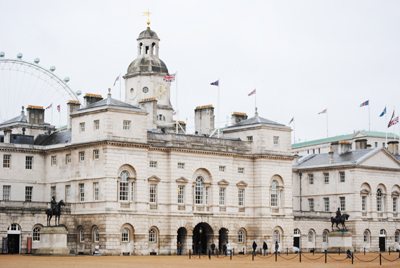
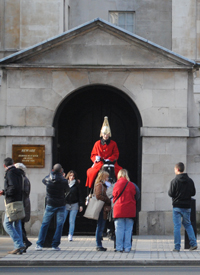
Known around the world for the stoic mounted troopers which stand guard here, this rather fanciful building straddling a site between Whitehall and St James’s Park was built in the early 1750s on land which had previously served as a tiltyard for King Henry VIII.

In the 1660s King Charles II had a barracks built here for the guards manning the entrance to what was then the Palace of Whitehall, but in 1749 it was demolished and the present building constructed.

William Kent had apparently drawn up designs but it was architect John Vardy who oversaw construction of the neo-Palladian building after Kent’s death in 1748. The windows on the St James’s Park side of the building are said to have been based on a drawing by Lord Burlington (he of Chiswick House fame – see our earlier post here).

While the site previously marked the entrance to the Palace of Whitehall, it is now considered the formal entrance to St James’s Palace (although the palace is located some distance away) and, as a result, only the monarch can drive through the central archway without displaying a pass.

Horse-GuardsUntil 1904, the Grade I-listed building housed the office of the Commander-in-Chief of the Forces but the title was then abolished and replaced with Chief of the General Staff, who relocated to the War Office Building. Horse Guards subsequently became the home of the army commands of London District and the Household Division, a role it still fulfils.

As well as being the site of the daily Changing of the Queen’s Life Guard (this free event takes place at 11am every day; 10am on Sundays), Horse Guards is also now home to the Household Cavalry Museum.

Among treasures in the museum are two silver kettledrums presented to the regiment in 1831 by King William IV, a cork leg used by the first Marquess of Anglesey after his real leg was amputated following the Battle of Waterloo (and subsequently became a tourist attraction in its own right) and silverware by Faberge. Visitors to the museum can also see into the working stables via a glazed petition.

The parade ground behind the building is the site of the annual Trooping the Colour ceremony which officially celebrates the Sovereign’s birthday. Although the ceremony has only been held since 1748, it’s interesting to note that some of the birthday celebrations of Queen Elizabeth I were held in the same place.

WHERE: The Household Cavalry Museum, Horse Guards, Whitehall (nearest Tube stations are Westminster, Embankment, St James’s Park and Charing Cross); WHEN: Open 10am to 5pm (November to March)/10am to 6pm (April to October); COST: £6 adults/£4 children (aged 5-16) and concessions/£15 family ticket; WEBSITE: www.householdcavalrymuseum.co.uk.

Treasures of London – Sculptures and reliefs on 55 Broadway…

Night

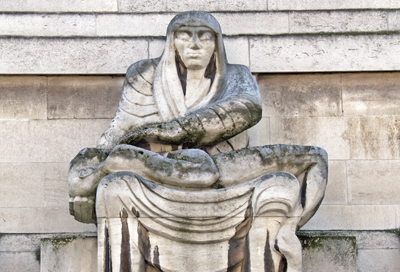
Controversial when first unveiled in the late 1920s, Jacob Epstein’s sculptures of Day and Night adorn the facade on the Grade I-listed building at 55 Broadway – home, for the present at least, to the London Underground HQ and St James’s Park Underground station.

It was the nudity and, no doubt, the stark modernist styling which provoked outrage (and newspaper campaigns) when the two sculptures – Day, depicting a seated smiling male figure with a naked boy standing in front of him and the other, Night, depicting a cowled female seated and cradling a prone, apparently resting, figure (pictured above) – were unveiled.

Such was the outcry that Frank Pick, the then head of the Underground Electric Railways Company of London (predecessor to London Underground and the organisation for whom the building was constructed), even apparently offered his resignation over it. But a compromise was reached – Epstein agreed to alter the naked figure of the boy (a rather painful snip) and the fuss soon died down. These days many people pass the building without even noticing the sculptures upon it.

Epstein’s statues aren’t the only sculptural works to adorn 55 Broadway – a series of eight smaller relief works representing the winds of each cardinal point can also be seen on the facade. All eight representations are of nude figures of different genders and were created by six different artists –  Eric Gill, Alfred Gerrard, Allan Wyon, Eric Aumonier, Samuel Rabinovitch and Henry Moore (interestingly, it was Moore’s first public commission).

It’s been reported that London Underground will be vacating the building next year with the property to be converted into rather expensive flats.

PICTURE:  Wikipedia

Lost London – The aviaries of Birdcage Walk…

The street now known as Birdcage Walk – which runs along the southern side of St James’s Park – refers to the former aviary and menagerie which was located in the south-eastern corner of the park during the reign of King James I in the early 1600s.

Birdcage-WalkAs well as the exotic birds which give the street its name, the menagerie of King James I – who drained marshy ground on which the park now stands and first had the park landscaped – was said to have included camels, crocodiles and an elephant.

The aviaries were apparently expanded during the reign of King Charles II later that same century. It was around this time – in 1664 – that pelicans were first introduced into the park when presented to the king as a gift from the Russian ambassador.

Only the Royal Family and the Duke of St Albans – Hereditary Grand Falconer – were reportedly allowed to drive along Birdcage Walk until 1828 when it was opened to the general public.

Interestingly, Storey’s Gate, a narrow street runs south from Birdcage Walk to Westminster Abbey, is actually named after Edward Storey, who was “keeper of the king’s birds” during the reign of Charles II.

Where is it? #68…

Where-is-it--#68

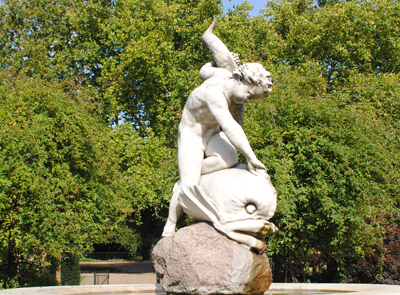
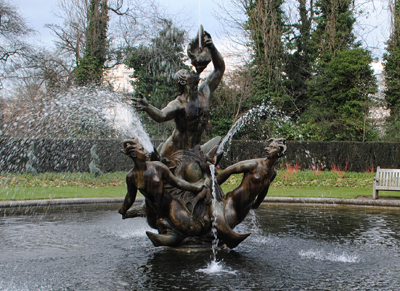
Can you identify where in London this picture was taken and what it’s of? If you think you can, leave a comment below. We’ll reveal the answer early next week. Good luck!

Well done to Renate, John, Diego and José who all correctly named this as the Boy with a Dolphin fountain in Hyde Park’s Rose Garden. The fountain, which is the work of Alexander Munro and dates from 1862, was once the centrepiece of the Victoria-era sunken garden which stood on the site of a former reservoir but was removed to make way for the widening of Park Lane. The fountain was moved to The Regent’s Park in 1960 but returned to Hyde Park in 1995. The Rose Garden, located close to Hyde Park Corner, also contains an older fountain – the Artemis Fountain, which dates from 1822.

LondonLife – The new Serpentine Sackler Gallery…

Serpentine-Sackler-Gallery


Designed by Pritzker Prize winning architect Zada Hadid, the new Serpentine Sackler Gallery opened to the public in Kensington Gardens on Saturday. Located just a few minutes walk from the Serpentine Gallery on the north side of the Serpentine Bridge, the 900 square metre premises is partly located in a renovated Grade II*-listed building, The Magazine (built in 1805 as a gunpowder store and used by the military until 1963), as well as in a curvaceous modern extension to the north and west. The new gallery, which also features a ‘social space’ and restaurant, is named after Dr Mortimer and Dame Theresa Sackler, whose foundation provided the largest donation for the project – the largest single gift donated to the Serpentine Gallery in its 43-year history. The opening exhibition, Today We Reboot The Planet, features the large scale sculptural work of Argentinian artist Adrián Villar Rojas. The exhibition runs until 10th November. For more, see www.serpentinegallery.orgPICTURES: Serpentine Sackler Gallery, © 2013 Luke Hayes

Serpentine-Sackler-Galllery2

10 (more) curious London memorials…9. The Speke Monument…

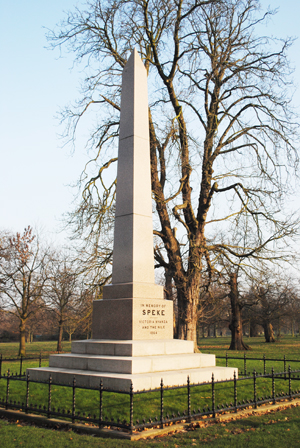
Speke-MonumentWhile thousands walk past this obelisk in Kensington Gardens each day, few probably realise it commemorates the life of John Hanning Speke, a Victorian-era explorer who discovered Lake Victoria in East Africa and named its northern outflow as the source of the Nile.

The red granite monument, designed by Philip Hardwicke and made from stone quarried in Scotland, was paid for by public donations and sponsored by Sir Roderick Murchison, president of the Royal Geographic Society which had paid for two of Speke’s expeditions. It was installed in 1866 and is located near the junction of Lancaster Walk and Budges Walk.

Speke, who had been on several expeditions in Africa, had only died at the age of 37 two years before in relatively controversial circumstances. He was shot by his own gun only the day before he was to participate in a debate with another explorer, Sir Richard Burton, about the source of the River Nile (Speke claimed the source of the Nile was Rippon Falls which flowed out of Lake Victoria; Sir Richard disputed this claim – it was later proven correct). Some have claimed Speke’s death to be suicide; others that it was an accident.

The monument itself was circumspect with regard to Speke’s success – it didn’t directly credit him as being the discoverer of the river’s source. This was rectified in 1995 when a plaque giving credit where it was due was placed on the ground in front of the monument by the Friends of Hyde Park and Kensington Gardens.

LondonLife – Pull up a deckchair…

Deckchair-dreams

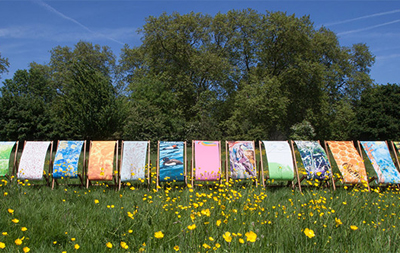
Summer is fading fast but until the end of October, there’s still time to sit back and relax in one of the 550 “designer deckchairs” which have been placed in five central Royal Parks this summer. Designed by the likes of Rolling Stone Ronnie Wood, comedian Harry Enfield and actor Miranda Richardson and artists Michael Craig-Martin, Susan Stockwell and Maggi Hambling under the theme of ‘Nature’s Grand Designs’, the deckchairs can be found in Hyde Park, Green Park, St James’s Park, Kensington Gardens and the Regent’s Park. The chairs join the more than 6,700 deckchairs already in the five Royal Parks which are available for hire (they can also be bought at the Royal Park’s online shop). For more on hiring a deck chair in the Royal Parks, check out http://www.royalparks.org.uk/parks/hyde-park/facilities-in-hyde-park/park-deck-chairs.

10 (more) curious London memorials…6. 7 July Memorial…

77-Memorial

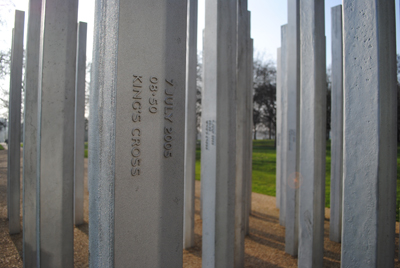
It’s not immediately obvious what this series of upright stainless steel pillars standing on the eastern edge of Hyde Park has been placed there for.

But look a little closer and you’ll see inscribed upon a date which any long-term Londoner immediately recognises – 7th July, 2005: the day when a series of bombs claimed 52 lives on three trains and a bus at various locations around central London.

The memorial, designed by architects Carmody Groarke and engineering team Arup working in consultation with victims’ representatives, Royal Parks and the Department for Culture, Media & Sport, consists of 52 pillars – one for each victim of the bombings.

The 3.5 metre high, 850 kilogram pillars are clustered together in four groups representing the four locations of the bomb attacks – Tavistock Square, Edgware Road, King’s Cross and Aldgate. They are marked with the times, dates and locations of the bombings and there’s also a 1.4 tonne stainless steel plaque upon which are written the names of the victims located nearby.

The RIBA award-winning memorial, which is located just to the north of the colossal statue Achilles and Hyde Park Corner, was unveiled by Prince Charles and Lady Camilla on the fourth anniversary of the attack in 2009.

For more, see the Royal Parks website www.royalparks.org.uk/parks/hyde-park/hyde-park-attractions/7-july-memorial.

Around London – ‘Hidden Treasures’; Open House programme; and the Isabella Plantation celebrates 60 years…

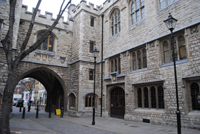
St-John's-GateHidden Treasures – the national initiative to celebrate the UK’s museum and archive collections – kicks off for its second year next Thursday, 22nd August, and runs over the bank holiday weekend until 27th August. Among the London institutions taking part this year are the British Library, the British Postal Museum and Archive in Houghton, the Museum of the Order of St John in Clerkenwell (pictured) and Orleans House Gallery in Twickenham. Hidden Treasures is an initiative of the Collections Trust and the Independent newspaper. All events are free but some have to be pre-booked and have limited spaces so make sure you check out the details at www.hiddentreasures.org.uk/?page_id=118.

The programme for Open House London – held over the weekend of 21st and 22nd September – will be made available online from today (or alternatively you can order a hard copy via the Open House London website). It’s important to note that a few of the buildings involved can only be entered by those successful in a ballot – they include 10 Downing Street, The View from The Shard, EDF Energy London Eye and Gray’s Inn. Head to the website – www.londonopenhouse.org – to enter the ballots which close on 13th September.

The Isabella Plantation – a 40 acre ornamental woodland garden located in the south west area of Richmond Park – is celebrating 60 years since its creation and they’ve kicked off a fortnight’s programme of free events community to mark the occasion. The events, which will be focused around the yurt by Peg’s Pond in the plantation,  include guided walks, a showcase of art for young people and a Teddy Bears picnic on the bank holiday weekend. One of the most visited parts of Richmond Park, the plantation is home to the Wilson 50 National Collection of Evergreen Azaleas, more than 150 hardy hybrid Rhododendrons, 50 species of Rhododendron and a large collection of camellias and magnolia as well as many rare and unusual trees and shrubs. While the plantation can be dated as far back as 1771 (then named Isabella Slade), it was planted for timber in 1831, and in 1953 the present garden was established and the old name Isabella adopted for it. For more on the events, see www.royalparks.org.uk.

As Muslims mark the end of Ramadan this weekend, the festival of Eid-ul-Fitr will be celebrated in Trafalgar Square on Saturday. As well as the chance to sample foods from across the Islamic world, there will also be entertainment on stage, exhibitions and children’s activities. The festival, put on by the Mayor of London Boris Johnson, runs between 1.30pm and 6pm. For more, see www.london.gov.uk/eid.

On Now: Take One Picture – Discover, Imagine, Explore: Children Inspired by Willem Kalf. This display at the National Gallery focuses on Willem Kalf’s Still Life with Drinking-Horn (about 1653) and features alongside it responsive works created by children from 25 schools across the UK and as far afield as Turkey with works from other schools captured in a slide-show. Located at the Annenberg Court (Getty Entrance), admission is free. Runs until 12th September. For more, see www.nationalgallery.org.uk.

10 (more) curious London memorials…2. Animals in War Memorial…

Animals-in-War

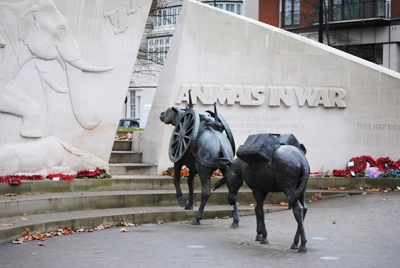
This week we take a look at another of London’s war-related memorials but unlike the vast majority, this one, as its name says, commemorates animals, not humans.

Located in the middle of Park Lane near the intersection with Upper Brook Street on the eastern side of Hyde Park, the memorial is dedicated “to all the animals that served and died alongside British and Allied Forces in wars and campaigns throughout time”. Another inscription on the memorial reads “They had no choice”.

A further dedication at the memorial pays tribute to the “millions” of animals who have died in wars. “From the pigeon to the elephant, they all played a vital role in every region of the world in the cause of human freedom,” it says. “Their contribution must never be forgotten.” It’s been said that as many as eight million horses were killed in World War I alone.

It features a couple of bronze pack mules making their way through a gap in a curved, 58 foot wide Portland stone wall – themselves carrying reliefs of various animals including an elephant, horses, camels and pigeons – while on the other side is a bronze horse and a dog, looking ahead.

The memorial is the work of Somerset-based sculptor David Backhouse and was unveiled by Princess Anne in November 2004, the 90th anniversary of the outbreak of World War I. It was apparently inspired by Jilly Cooper’s book, Animals in War, and commissioned by the Imperial War Museum. It was paid for by £2 million in public donations.

For more, check out www.animalsinwar.org.uk.

Special – 10 facts about royal births of years past…

Buckingham-Palace

As we all know by now, Prince William and Kate, Duchess of Cambridge, are proud parents of a new born son with news of the new arrival provoking celebrations across Britain and, indeed, the world.

To celebrate the royal birth, here are 10 interesting facts about some previous royal births in London…

• The last time a Home Secretary attended a royal birth was in 1936 for the birth of Princess Alexandria, cousin of the Queen. The practice was officially stopped before the birth of Prince Charles in 1948.

• Such was the doubt over whether Mary of Modena, wife of King James II, was really pregnant that more than 40 eminent people were invited to witness the birth of their son Prince James in 1688 (and even then the rumours of that the stillborn baby had been swapped for another were rife).

• Queen Anne, who ruled from 1702-1714, went through 17 pregnancies but, tragically, outlived all of her children, her last surviving child – the Duke of Gloucester – dying in 1700.

• The tradition of firing a 41 gun salute on the news of the birth of a future monarch dates from the birth of the future King Edward VII. Twenty-one shots are fired in honour of the birth with an additional 21 fired because the guns are located in Green Park, a Royal Park.

• Queen Elizabeth II was born by caesarean section at 2.40am on April 21, 1926, at the home of her mother’s parents – 17 Bruton Street in Mayfair. (See our previous post on this here).

• Such was the animosity between Frederick, Prince of Wales, and his father, King George II, that when Frederick’s wife Augusta went into labour at the king’s home of Hampton Court Palace, he bundled her into a coach and had her taken to his home of St James’s Palace. With no preparations made there, his newly born daughter had to be wrapped in a tablecloth (the story is retold in detail in Lucy Worsley’s terrific book, Courtiers: The Secret History of the Georgian Court)

• Queen Victoria, who had nine children, used chloroform for pain relief during later births, despite the concept being frowned upon by some officials.

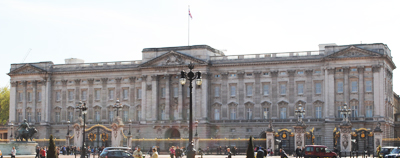
• Buckingham Palace (pictured above) has been the birthplace of numerous Royal Family members. Of course, Prince Charles was born here in 1948 as was his brother Prince Andrew (1960) and Prince Edward (1964) but so too – somewhat earlier – were 14 of King George III and Queen Charlotte’s 15 children when the property was known as Buckingham House and, later, the Queen’s House. King Edward VII was the only monarch who both was born and died in the building.

• Such was the desperation of King Henry VIII for a son, that a document announcing the birth were drawn up to that effect prior to Anne Boleyn giving birth to a daughter, the future Queen Elizabeth I. The document was still issued – the only concession being an ‘s’ added to the end of the word prince.

• The oldest English king to father a child was King Edward I – he was 66-years-old when his last child, Princess Eleanor, was born in 1306. Queen Eleanor of Aquitaine, wife of King Henry II, was the oldest queen to father a child when she gave birth to the future King John at 44-years-of-age in 1166.

Around London: Royal fashion at Kensington; Music in Hyde Park; celebrating African literature at the British Library…

Fashion-RulesA new exhibition looking at the fashions of three royals over four decades last century opens at Kensington Palace today. Fashion Rules features five rooms of dress displays with a focus on the fashions of Queen Elizabeth II in the 1950s, Princess Margaret in the 1960s and 1970s and Diana, Princess of Wales, in the 1980s. Twenty-one dresses are included in the display which explores how the royal women negotiated how to dress fashionably while observing the “rules” of the Royal Wardrobe and includes film footage and photography. The dresses include five of the Queen’s evening dresses – one of which is a gown fashioned for the Queen by Norman Hartnell in the colours of the flag of Pakistan, a full-length kaftan and matching turban of ivory sari silk worn by Princess Margaret while on the island of Mustique (on display for the first time), and, two Eighties dresses worn by Diana which have never before been displayed in the UK. Admission is included in entry price. For more, see www.hrp.org.uk/KensingtonPalace/. PICTURE: HRP/Newsteam.

The Rolling Stones are back in Hyde Park this weekend as part of a summer of music in the Royal Park. The concert will take place almost 44 years to the day since the Stones first played the park and comes in the wake of their ’50 and Counting’ shows last year. Their first performance in the park – on 5th July, 1969 – saw the live debut of guitarist Mick Taylor and was a tribute to founding member Brian Jones who has died only two days before. For the full programme of Barclaycard presents British Summer Time Hyde Park, head to www.bst-hydepark.com.

Ngugi2010-2Daniel-Anderson-UnivCommThe British Library is partnering with the Royal African Society to host the UK’s largest festival of African literature – Africa Writes – this weekend. Kicking off on Friday, the three day festival features Ngugi wa Thiong’o, described as “Africa’s greatest living novelist” (pictured), and his son, rising star Mukoma Ngugi, in a conversation chaired by Ellah Allfrey, deputy editor of Granta Magazine. Other programme highlights include a poetry evening, ‘Diaspora Writes Back’; a tribute to Chinua Achebe, the “father of contemporary African literature”; and the writers short-listed for The Caine Prize – the most prestigious prize for African short fiction. For more, see www.africawrites.org. PICTURE: Ngugi wa Thiong’o © Daniel Anderson.