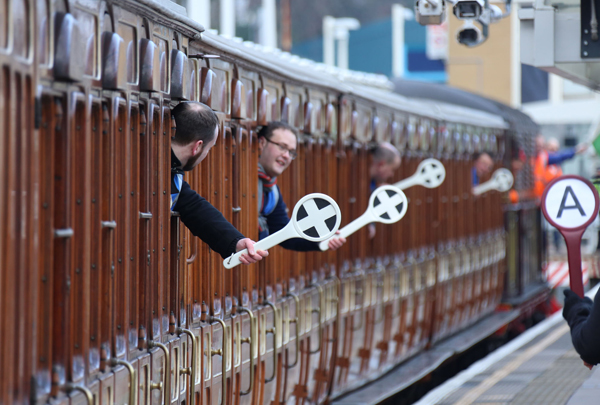
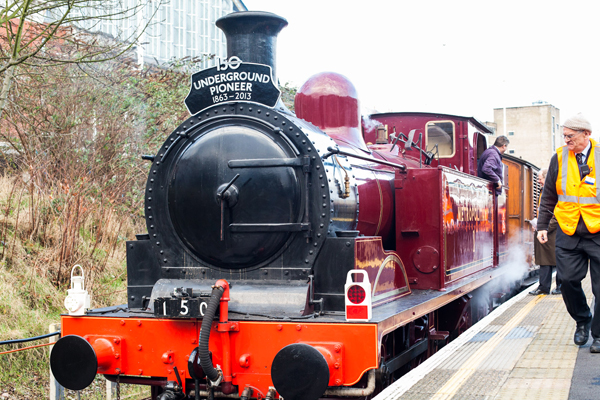
Metropolitan Locomotive No 1 recreated the first London Underground journey, which took place on 9th January, 1863, on the Metropolitan Line between Paddington and Farringdon, as part of the network’s 150th anniversary celebrations last Sunday. The newly restored locomotive was the last to be built at Neasden in 1898 by the Metropolitan Railway. It was pulling the Metropolitan Railway Jubilee Carriage No 353, the oldest operational underground carriage in existence. Ex Metropolitan Railway electric Locomotive No.12 Sarah Siddons also formed part of the train. The train will also be running this coming Sunday (20th January) and on special occasions throughout this year and is just one of a series of events planned by the London Transport Museum to mark the anniversary of what is the world’s oldest underground railway. They include an upcoming exhibition of London Underground’s poster art (more on that to come). For more, see www.ltmuseum.co.uk. PICTURES: © Transport for London from the London Transport Museum collection.
Underground
Where’s London’s oldest…Thames tunnel?
While the Greenwich foot tunnel may these days be more well-known due to the fact it is still open to pedestrians, London’s oldest under-Thames tunnel (also credited as the oldest underwater tunnel in the world) actually runs between Rotherhithe on the river’s southern bank and Wapping on the northern.
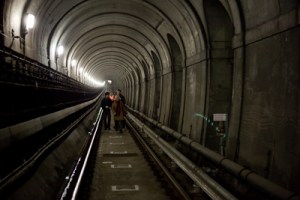
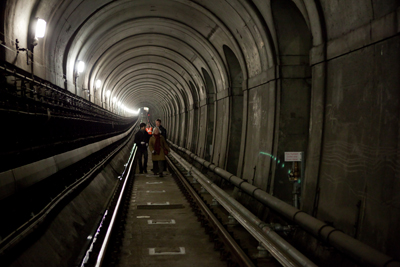
First opened in 1843, the Thames Tunnel (pictured left during a brief reopening to pedestrians in 2010) was the first major project of star Victorian engineer (and delightfully named) Isambard Kingdom Brunel (who, at the age of just 19 started work on the job with his father, a French engineer named Marc Isambard Brunel) and was known for a time as the eighth Wonder of the World.
It was constructed after demand grew for a way to transport goods across the crowded Port of London to the east of London Bridge. Given the height of the masts of larger ships, a bridge was deemed impracticable with the ramps required to take wheeled transport to the necessary height far too long (although this problem was overcome at the end of the 1800s by the use of new bascule technology in the construction of Tower Bridge).
Following several failed attempts to dig a tunnel under the Thames, Marc Brunel was given permission to build the new tunnel in the mid 1820s. The project relied on the use of a ‘tunnelling shield’, a then state-of-the-art technological solution to under river tunnelling which had only a few years earlier been patented by Marc Brunel and Thomas Cochrane, and Brunel initially thought the project would only take three years (it ended up taking as many as 18).
Construction by the newly formed Thames Tunnel Company, which had the support of none other than the Duke of Wellington, commenced in early 1825 at the Rotherhithe end. The shield enabled miners to dig out the tunnel while bricklayers came along behind them. While it significantly reduced the risk of a collapse (although several floods still did occur, taking the lives of six men – a fact which didn’t apparently much deter the sightseers who paid for the privilege of seeing the shield in operation), working conditions remained terrible with the men constantly showered with water from the river which was at that time the city’s main sewer. How many died indirectly as a result of working on the project is unknown.
Indeed, such was the stress of the project that Marc Brunel, later knighted for his efforts in building the tunnel, himself suffered a stroke during its construction. Isambard Brunel, who took over as the project’s engineer when the resident engineer fell ill in 1826, himself came close to being killed when he had to flee the flooding tunnel.
After much delay (including seven years in which the unfinished tunnel was left untouched) and several more disasters, the tunnel was finally completed in November, 1841.
After being fitted out with lighting, spiral staircases and roads in the following years, it was finally opened to pedestrians only on 25th March, 1843. While it was originally envisaged that the primary purpose of the tunnel would be to transport goods under the river, this never occurred.
Still, it did capture the public’s attention and as many as 50,000 people walked through the tunnel on the opening day (among the initial visitors to the tunnel was Queen Victoria herself). Within 10 weeks of its opening, a million people (a figure equal to what was then half the population of London) had reportedly passed through it.
Despite the number of people initially using it, however, the tunnel was still not a financial success and over the ensuing years became noted as a gathering place for unsavoury types. In 1865 it was purchased by the East London Railway Company which subsequently incorporated the tunnel into its railway network with both the Wapping and Rotherhithe entrance shafts converted into stations. It later become part of the London Underground network – the – and since 2010 has been part of the London Overground.
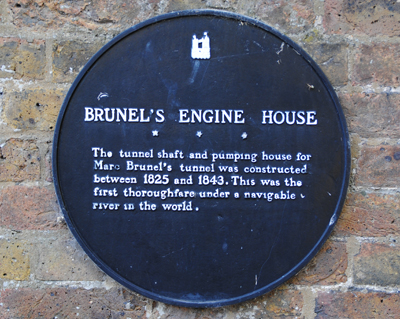
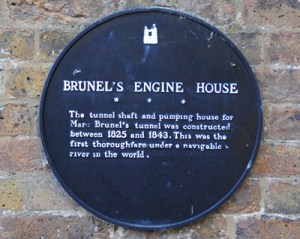
Both stations are still in use and you can get a good sense of what the tunnel was like by riding the overground between Rotherhithe and Wapping. The Brunel Museum in Rotherhithe – actually housed within a building originally used to house machinery for draining the tunnel – see plaque above – is also a great place to find out more about the project and Brunel. Visit www.brunel-museum.org.uk for details.
PICTURES: Top – Lars Plougmann (Wikipedia)/Other – David Adams
For more on the life of Brunel, see Steven Brindle’s Brunel: The Man Who Built the World.
LondonLife – Flying over the Thames by night…
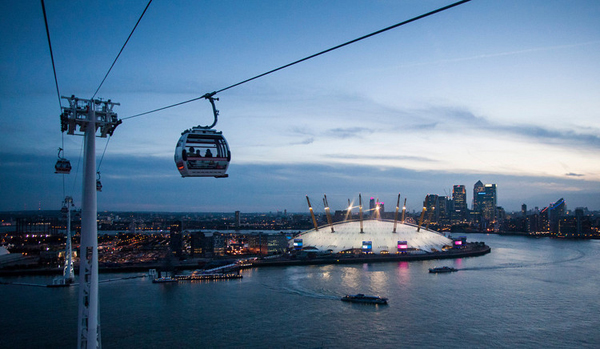
Sailing high over the River Thames between North Greenwich in the river’s southern bank and the Royal Docks on the river’s northern bank is the cable car formally known as the Emirates Air Line. Opened in late June and running every day, the cable car – the UK’s first in an urban area – is operated by Transport for London and links into the Underground and Docklands Light Rail network. Travelling at about 90 metres above the ground along a course of more than half a mile, passengers can take in the City, Docklands, Greenwich and as far eastward down the river as the Thames Barrier. This image, which shows the 02 Arena in the background, was taken just after the Closing Ceremony of the Olympic Games in August. For more, see www.emiratesairline.co.uk. PICTURE: © Transport for London
Where is it?…#46
The latest in the series in which we ask you to identify where in London this picture was taken and what it’s of. If you think you can identify this picture, leave a comment below. We’ll reveal the answer early next week. Good luck!
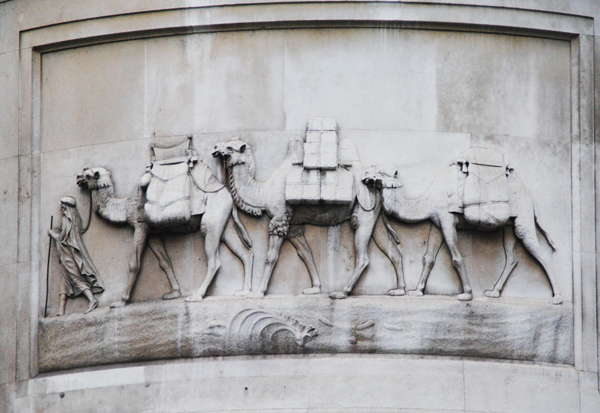
Well done to Carol Stanley – this is indeed located at 20 Eastcheap in the City of London. The building on the facade of which this relief of a camel train sits was formerly the offices of Peek Bros & Co, dealers in tea, coffee and spices. Peek House was built in 1883 after the previous structure, along with others on this side of Eastcheap, was demolished to make way for the Underground’s Metropolitan Line. The picture was carved by William Theed the Younger, who also sculpted the Africa group – including camel – on the Albert Memorial.
Where is it?…#43
The latest in the series in which we ask you to identify where in London this picture was taken and what it’s of. If you think you can identify this picture, leave a comment below. We’ll reveal the answer early next week. Good luck!
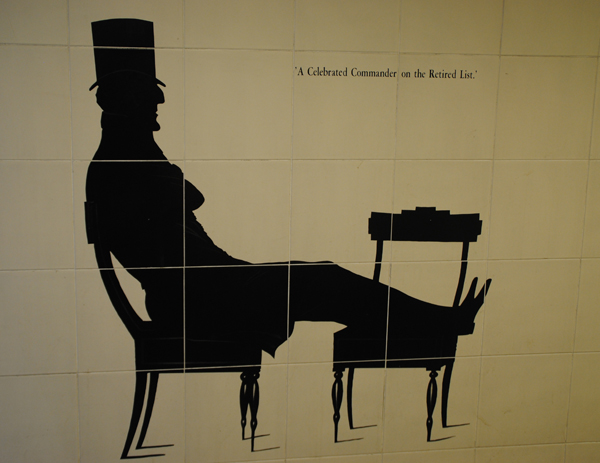
This image is one of many found in a subterranean tunnel surrounding Hyde Park Corner Underground Station and depicts, of course, the 1st Duke of Wellington, Arthur Wellesley, enjoying his latter years. The ‘Iron Duke’ has strong connections to Hyde Park Corner – his former home, Apsley House, No 1. London, is located there as is the Wellington Arch, the Decimus Burton memorial to him. For more on the Duke, see our earlier post here and for more on Wellington Arch, see our earlier ‘Where is it?’ post here.
Around London – London celebrates on the Thames; a fashionable night in London; and, heritage trains in Amersham…
• London will this weekend celebrate the 15th annual Thames Festival, billed as the city’s “largest free festival”. The two day event includes a giant shipwreck sculpture outside City Hall (created with the aid of students from 100 London schools), barge races and a parade of more than 100 boats on the Thames, a wide array of musical and street performances (these include a mass choir of 700 school children and a performance in which the HMS Belfast is used as a percussion instrument) and an illuminated Night Carnival culminating in fireworks. More than 800,000 people are expected to attend the event which takes place at a range of venues stretching from the London Eye to Tower Bridge. Other highlights include the annual Feast on the Bridge on Saturday during which Southwark Bridge will be closed to traffic, Korean Taekwondo displays, a food market and an exclusive cruise on the Thames hosted by the likes of historian David Starkey and the creators of cult children’s character Rastamouse. River boat operators, meanwhile, are offering 2-for-1 tickets for the weekend to help people make the most of the festival. For more information on the festival, see www.thamesfestival.org. For more on the 2 for 1 tickets, see www.tfl.gov.uk/river.
• Regent Street and surrounds will be buzzing tonight with more than 40 shops, bars and restaurants taking part in Vogue Fashion’s Night Out. The event, which is running for its third year in London, will see many stores remaining opening until 11pm and feature special events and promotions. The night is part of a series of nights being held in countries across the globe – from Russia to Brazil, Australia to Spain. For more information, see http://fashions-night-out.vogue.co.uk.
• An art deco Tube train dating from 1938 and the Sarah Siddons, the last operational ex-Metropolitan Railway electric locomotive will be running between Harrow-on-the-Hill, Rickmansworth and Amersham this Sunday as part of the Amersham Old Town’s Heritage Day. Other activities include a best dressed competition showcasing retro fashions, a free heritage bus service, including rides on the Routemaster RM1, street performances including a Punch and Judy show and clowns, and “object handling sessions” at the Amersham Museum. For more information, see the London Transport Museum’s website here.
Around London – 16 Underground stations listed; life in a gun turret at HMS Belfast; and that dress on display at Buckingham Palace
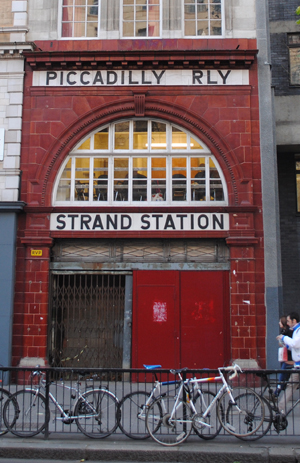
• Sixteen London Underground stations were this week listed as Grade II heritage buildings. The Tube stations – several of which were designed by Leslie Green, known for his pioneering use of ‘ox-blood’ red tiles on the exterior of stations to create a consistent brand for the stations – include the now-closed Aldwych (pictured) along with Oxford Circus (originally two stations), Covent Garden and Russell Square as well as Belsize Park, Brent Cross, Caledonian Road, Chalk Farm, Chesham, Perivale, Redbridge, St John’s Wood, West Acton and Wood Green. Three other stations – Arnos Grove, Oakwood and Sudbury Town – have had their status upgraded from Grade II to Grade II*. These three were all designed by modernist architect Charles Holden for the extension of the Piccadilly Line in the 1930s. The new listings were made by Tourism and Heritage Minister John Penrose on the advice of English Heritage.
• A new permanent exhibition showing would-be sailors what it is like to fight at sea opens at the HMS Belfast this weekend. Gun Turret Experience: A Sailor’s Story, 1943, is an immersive experience using lights, imagery, sound, smoke effects, movement and smell to recreate the atmosphere and conditions of a gun turret tower when a crew was at battle stations. Visitors are encouraged to follow the story of a young sailor on Boxing Day, 1943 when the German battle cruiser Scharnhorst is sighted leading to the Battle of the North Cape. The Gun Turret Experience, housed within the original triple gun turrets overlooking the quarterdeck, was developed with the help of Royal Navy veterans and eye-witness accounts from the Imperial War Museum (of which the HMS Belfast is part). Entry is included in normal admission price. For more information, see www.hmsbelfast.iwm.org.uk.
• Now On: See the dress the Duchess of Cambridge wore when she was married to Prince William in April at this year’s summer opening at Buckingham Palace. The gown, which features a nine foot long train, will be displayed along with the Halo Tiara until 3rd October in the palace ballroom (the same room used for the newly married couple’s reception). The exhibition features video footage of designer Sarah Burton, explaining how the dress was made. This year’s summer opening also features a display of the work of Carl Faberge – including his magnificent jewel-encrusted Imperial Easter Eggs as well as bejewelled boxes and miniature carvings of favorite pets of the royal family. More than half a million people are expected to visit the exhibition. For more information, see www.royalcollection.org.uk/default.asp?action=article&ID=30