A Marylebone street which is synonymous the world over with the private medical profession, Harley Street’s name is taken from the surname of the second Earl of Oxford, Edward Harley.
 His Lordship, who lived between 1689 and 1741, was a land developer and was responsible for the development of land north of Oxford Street in the early 18th century.
As was the fashion, he named Harley Street after himself – but it’s certainly not the only street which he dubbed with his own moniker. The earl also held the titles of Earl Mortimer (Mortimer Street) and Baron Wigmore (Wigmore Street, Wigmore Place and hence the music venue Wigmore Hall) and also came to own Wimpole Hall in Cambridgeshire (Wimpole Street) and Welbeck Abbey in Northamptonshire (Welbeck Street and Welbeck Way).
But the ties to the earl don’t end there: in 1713 he married Lady Henrietta Cavendish Holles (Henrietta Place, Cavendish Square, New Cavendish Street and Holles Street) while their daughter Margaret married William Bentinck (Bentinck Street), the 2nd Duke of Portland (Great Portland Street, Little Portland Street and Portland Place).
Incidentally, after the earl’s death, the area passed to his daughter and become known as the Portland Estate. It remained the property of the Dukes of Portland for five generations until the fifth duke died without issue in 1879 and the land passed to Lucy Joan Bentinck, widow of the 6th Baron Howard de Walden. Thus Harley Street now forms part of a 92 acre area known as the Howard de Walden Estate.
But back to Harley Street itself. Its association with the private medical profession dates from the latter half of the 19th century when there was a dramatic increase in the number of those engaged in the profession moving into the area, attracted by its quality housing and accessibility (the numbers still remain significant today). The name Harley Street today refers to both the street and also more generally to the surrounding area.
The long list of famous residents who have lived in the street have included painter JMW Turner (number 64 between 1799 and 1805), Victorian-era PM William Ewart Gladstone (number 73 and geologist Sir Charles Lyell also lived here in a premises which is now The Harley Street General Practice) and, made famous through the film, The King’s Speech, Australian speech therapist Lionel Logue who had his practice at number 146.





 .
.

 .
. A detailed picture of the inhabitants of Roman London, known as Londinium, has been created for the first time, the Museum of London announced this week. Detailed analysis of the DNA of four skeletons has revealed a culturally diverse population. The examined skeletons include that of a Roman woman (pictured left), likely to have been born in Britain with northern European ancestry, found buried with high status grave goods at Harper Road, Southwark, in 1979, and another of a man, whose DNA revealed connections to Eastern Europe and the Near East, who was found at London Wall in 1989 with injuries to his skull which suggest he may have been killed in the nearby amphitheatre before his head was dumped in a pit. The other two skeletons examined were found to be that of a blue-eyed teenaged girl found at Lant Street, Southwark, in 2003, believed to have been born in north Africa, whose ancestors lived in south-eastern Europe and west Eurasia, and that of an older man found at Mansell Street who was born in London and whose ancestry had links to Europe and north Africa. The examination – the first multi-disciplinary study of the inhabitants of a Roman city anywhere in the empire – also revealed that all four suffered from gum disease. Caroline McDonald, senior curator at the museum, said that while it has always been understood Roman London was a culturally diverse place, science was now “giving us certainty”. “People born in Londinium lived alongside people from across the Roman Empire exchanging ideas and cultures, much like the London we know today.” The four skeletons will form the basis of a new free display, Written in Bone, opening at the Museum of London on Friday. PICTURE: © Museum of London
 .
.
 • The largest exhibition ever mounted about the life of 17th century diarist Samuel Pepys opens at the National Maritime Museum in Greenwich tomorrow. Samuel Pepys: Plague, Fire, Revolution features more than 200 paintings and objects brought together from museums, galleries and private collections which explore the life of the famous diarist (depicted here in a bust outside the Guildhall Art Gallery) against the backdrop of the tumultuous events of Stuart London, from the execution London of King Charles I in 1649 through the Great Fire of London and the Glorious Revolution on 1688. Objects on show include the famous painting, Portrait of Charles II in Coronation Robes, objects connected to Pepys’ mistresses including one of his love letters to Louise de Kéroualle (aka ‘Fubbs’ or ‘chubby’) and other personal items such as a lute owned by Pepys. The exhibition is accompanied by a series of events including Pepys Show Late: Party like it’s 1669 (26th November) and a series of walks and talks. Admission charge applies. The exhibition runs until 28th March. For more, see
 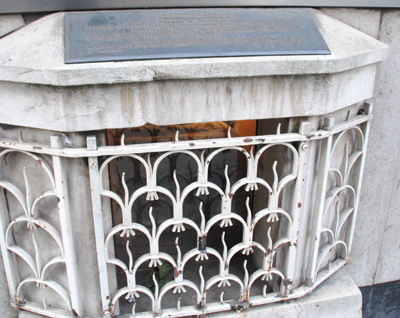 Little is known of Jack Cade until the former soldier from Kent led an uprising against the rule of King Henry VI during the Hundred Years War with France. And London was a key site of fighting during the uprising.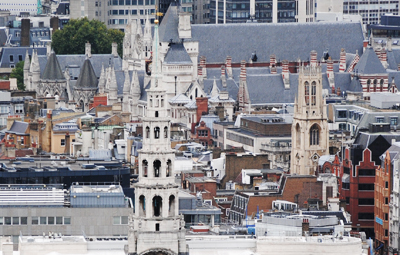

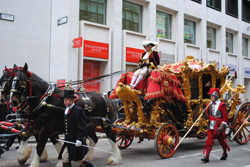 • The Lord Mayor’s Show will mark its 800th anniversary on Saturday as the newly elected Jeffrey Mountevans – the 688th Lord Mayor of the City of London – makes his way through the City to Westminster to swear loyalty to the Crown. The procession of 7,000 people, some 180 horses and 140 vehicles will set off on its way along a three-and-a-half mile route at 11am, starting at Mansion House and traveling down Cheapside to pause at St Paul’s Cathedral (which is open for free all day) before heading on via Ludgate Hill and Fleet Street to the Royal Courts of Justice before returning the City via Queen Victoria Street from 1.10pm. In a special nod to the 800th anniversary, the famous bells of St Mary-le-Bow will ring out a special 800-change at noon. The day will conclude with fireworks over the River Thames kicking off at 5.15pm (for the best view head down to the riverside between Waterloo and Blackfriars Bridges, either on Victoria Embankment or on the South Bank). The show’s origins go back to 1215 when, in exchange for a Royal Charter granting the City of London the right to elect its own mayor, King John insisted the newly elected mayor travelled to Westminster each year to swear loyalty to the Crown. For more (including a map to print out), see
  Exploring London