Roman London – 5. Remains under St Bride’s

Our final entry in our short series on Roman London concerns the Roman remains found under St Bride’s Church in Fleet Street.

Following heavy bombing during World War II, much of the church was destroyed. But the bombing did reveal hitherto unknown secrets below the church.

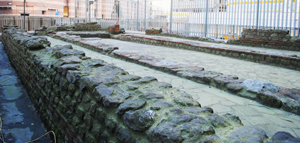
As well as the remains of what were thought to be numerous plague and cholera victims (dating from 1665 and 1854 respectively), these included remains dating back to the 2nd century AD which featured the foundations of a somewhat mysterious Roman building and pavement, both of which were built outside the later Roman wall. There are also the remains of a ditch which is believed by some to be part of what was a quarry.

The remains can now be viewed in the church’s crypt along with those of the earlier churches. For more on St Brides, see our previous entry here.

WHERE: Fleet Street (nearest tube St Paul’s); WHEN: 8am to 6pm Monday to Friday, 11am to 3pm Saturday, 10am to 1pm and 5pm to 7.30pm Sunday; COST: Entry is free but guided tours are available on Tuesday afternoons at 3pm for £5 a person; WEBSITE: www.stbrides.com.

LondonLife – Ice skating at the Tower

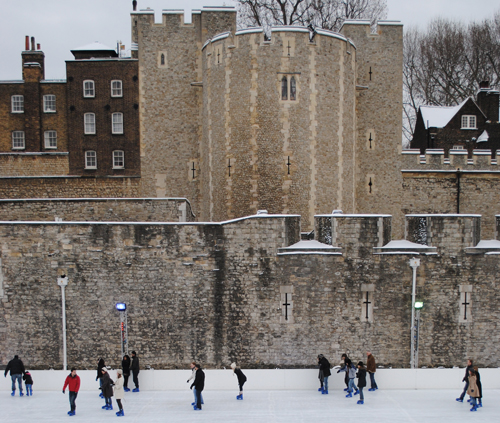
Skaters take to the ice in the moat of the Tower of London. The rink, one of many about London, is open until 10th January, 2011. For more information, see www.toweroflondonicerink.com.

What’s in a name?…Marylebone

This curiously named part of London, pronounced Mar-lee-bone, takes it’s name from a church dedicated to St Mary which was originally built near a small river or stream called the Tyburn or Tybourne. Hence St Mary-le-Burn became St Marylebone.

There was a medieval village here which during the 18th century became subsumed into greater London as fashionable people sought land to the west of the city. The area – in particular Harley Street – became known as a location of choice for doctors to site their consulting rooms and is still known for its medical establishments.

Among the significant sites is the St Marylebone Parish Church (pictured right) which, consecrated in 1817, was where poets Robert Browning and Elizabeth Barrett were married in 1846 following their elopement, the John Nash-designed All Souls Church in Langham Place, the Langham Hotel which opened in 1865 and boasted Oscar Wilde and Mark Twain among guests, 221B Baker Street, fictional home of Sherlock Holmes and now the site of the Sherlock Holmes Museum, and the famous wax museum, Madame Tussauds.

Marylebone is also home to the world famous Wallace Collection, bequeathed to the government in 1897, the concert hall Wigmore Hall, the Royal Academy of Music and the Royal Institute of Architects, and the art-deco headquarters of the BBC, Broadcasting House. Marylebone High Street remains a shopping mecca offering a diverse range of independent boutiques and specialty shops while in the south, Marylebone includes one of London’s most famous shopping strips on Oxford Street.

Other famous people connected with the area include four time Prime Minister William Gladstone who lived at 73 Harley Street from 1876 to 1882, writer Charles Dickens who lived at 18 Bentinck Street while working as a court reporter in the 1830s, author Edward Gibbon, who lived at 7 Bentinck Street while writing his landmark text The Decline and Fall of the Roman Empire from the 1770s, and Sir Arthur Conan Doyle, creator of Sherlock Holmes, who worked in Upper Wimpole Street in the 1890s.

Treasures of London – The Magna Carta

It’s regarded as one of the seminal documents of medieval England. First issued 15th June, 1215, the Magna Carta (“Great Charter”) was endorsed by England’s barons and King John at Runnymede near Windsor Castle and put limits in the power of the king by demanding he govern according to established feudal law.

The document was forced upon King John by rebellious barons after he broke away from established customs and imposed oppressive taxes and fines and seized the estates of nobles.

Its terms were immediately repudiated by the king, leading to further rebellion which ended when the king died on 18th October, 1216. Less than a month after the king’s death, the regent, William Marshal, issued a revised version of the document and a second revision almost exactly a year later. A further version was later issued by King Henry III and later confirmed by King Edward I.

Copies of the document were sent throughout the land in 1215. There is now a copy in the Lincoln Cathedral Archives and another in Salisbury Cathedral Chapter House while the British Library has two copies, both from the collection of Sir Robert Cotton, who died in 1631. One of the library’s two copies was burned in a fire 100 years after Sir Robert’s death and still bears fire damage.

The text of the Magna Carta is not abstract in nature but deals in detail with practical realities, covering issues ranging from what happens when a noble who holds land from the Crown dies through to who heirs may marry, standard measures of wine, ale and corn and the removal of foreign knights from the country.

Only three of the Magna Carta’s 63 clauses are still law: one guaranteeing the liberties of the English Church; another confirming the privileges of London and other towns; and a third, often viewed as a forerunner of clauses contained in documents such as American Bill of Rights and Universal Declaration of Human Rights, which states that no free man shall be imprisoned, dispossessed, outlawed or exiled without the lawful judgement of his equals or by the law of the land.

The legacy of the Magna Carta is not however in the individual rights it seeks to uphold but rather the principle that for the first time in English history, it elevates the law above all men, even the king.

WHERE: Sir John Ritblat Gallery: Treasures of the British Library: Magna Carta and associated documents, The British Library, 96 Euston Road (nearest tube station is Kings Cross St Pancras or Euston); WHEN: 9.30am to 6pm Monday, Wednesday, Thursday and Friday; closes 8pm Tuesday and 5pm Saturday; 11am to 5pm Sunday; COST: Entry is free; WEBSITE: www.bl.uk or for a detailed guide and virtual tour of the Magna Carta, see  www.bl.uk/treasures/magnacarta/index.html.

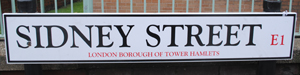
Around London – 100 years since the Siege of Sidney Street;

It’s 100 years since the Siege of Sidney Street and the Houndsditch Murders and to mark the occasion, the Museum of London Docklands opens a special exhibition this Saturday.

The murders took place on 16th December, 1910, when a group of Latvian revolutionaries attempted to break into a jeweller’s shop in Houndsditch. Three City of London policemen were killed and two more disabled for life in the gunfight which broke out.

Two weeks later, on 3rd January, 1911, the Siege of Sidney Street began when more than 200 armed police and a detachment of Scots Guards besieged a home at 100 Sidney Street in Stepney where two of the Houndsditch gang were believed to be hiding.

The exhibition, which has been put together in partnership with the Jewish East End Celebration Society, features objects from the trial of suspected gang members as well as never-before-seen objects including guns taken from the crime scene and safe-breaking equipment. The overcoat Winston Churchill wore on the day of the siege – he attended in his capacity as Home Secretary – will also be on display.

London Under Siege: Churchill and the Anarchists, 1911, runs from 18th December to April 2011. Entry is free. For more information, see www.museumindocklands.org.uk.

• Meanwhile a plaque was unveiled today on the site in Cutler Street where three policemen – Sergeant Robert Bentley, 36, Sergeant Charles Tucker, 46, and PC Walter Choat, 34 – were killed during the gunfight with the gang. Two other policemen were disabled for life and a fireman, Superintendent Charles Pearson, later died after he entered the Sidney Street property which had been gutted by fire. A plaque will be unveiled in his honor on 6th January.

Roman London – 4. Timber from a Roman quay

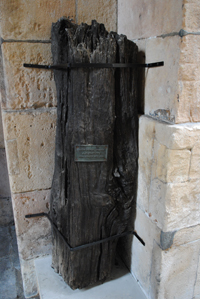
Hidden away in the porch of the church of St Magnus the Martyr on Lower Thames Street, next to London Bridge, is a timber beam which is believed to date from the city’s Roman era and which once formed part of the city’s wharves.

Found, according to a plaque upon the wood, in 1931 under Fish Street Hill, the wood dates from around 75 AD, shortly after the first attempt to create wharves along the riverbank in about 50 AD and about 10 years after Boudicca and her rebels torched the city.

The Roman port did become an important trading centre, continuing to expand during the following two centuries before decline set in during the 400s.

The first controlled excavation of a Roman quay took place in 1973 and have continued sporadically since.

WHERE: St Magnus the Martyr (nearest tube station is Monument); WHEN: Access to the site can be undertaken at any reasonable time; COST: Free.

Lost London – London Bridge

In the first of a new regular series looking at “lost” London, Exploring London takes a look at London Bridge.
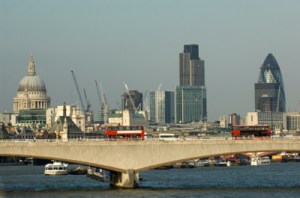
It’s a commonly confused fact that many first-time visitors to London think Tower Bridge and London Bridge are the same. As Londoners know, London Bridge (pictured right with St Paul’s and the city in the background) lies west of Tower Bridge. It’s not a particularly inspiring bridge having been built in the early Seventies. But there’s been a bridge spanning the Thames here for almost 2,000 years. So what happened to Old London Bridge?

The first bridge built across the River Thames on or close to the current site of London Bridge is thought to have been a wooden pontoon bridge constructed by the Romans around 50 AD. It was quickly followed by a more permanent bridge (rebuilt after it was destroyed by Boudicca and her marauding army in 60 AD).

Following the end of the Roman era, the bridge fell into disrepair although it’s known that there was a wooden Saxon bridge on the site by around the year 1,000. A succession of Norman bridges followed the Conquest and in 1176, during the reign of Henry II, construction of a new stone bridge began under the supervision of the priest Peter de Colechurch to service to growing numbers of pilgrims travelling from London to Thomas a Becket’s shrine in Canterbury. The new bridge, which had a chapel dedicated to St Thomas at the centre, wasn’t finished until 1209.

The bridge had 19 arches sitting on piers surrounding by protective wooden ‘starlings’ and a drawbridge and defensive gatehouse. The design of the bridge meant the water shot rapidly through the arches, leading boatmen to describe the practice of taking a vessel between the starlings as “shooting the bridge”.

King John, in whose reign the bridge was completed, licensed the building of houses on the bridge and it soon became a place of business with some 200 shops built upon its length, many of them projecting over the sides and reducing the space for traffic to just four metres. Many of the buildings actually connected at the top, creating a tunnel-like effect.

One of the more remarkable buildings on the bridge was Nonsuch House, built in 1577. A prefabricated building, it had been assembled in the Netherlands before being taken apart, shipped to London, and then reassembled. No nails were used in its construction, just timber pegs.
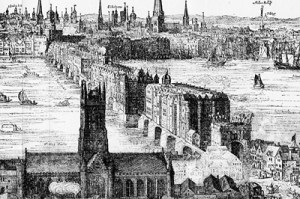
The practice of putting the heads of traitors on pikes above the southern gatehouse (see picture right, dating from 1660) started in 1305 with Scottish rebel William Wallace’s head and continued until it was stopped after 1678 when goldsmith William Stayley’s head was the last to be displayed there. Famous heads to adorn the gateway over the years included Peasant’s Revolt leader Wat Tyler in 1381, rebel Jack Cade in 1450, the former chancellor Sir Thomas More and Bishop John Fisher in 1535, Thomas Cromwell in 1540 and Guy Fawkes in 1606.

Some of the bridge’s arches collapsed over the years and had to be restored and there were several fires which destroyed houses upon it, including those which occurred during the Peasants’ Revolt in 1381 and Jack Cade’s rebellion in 1450.

Congestion reached such a state by the 18th century that in 1756 Parliament passed an act which allowed for the demolition of all the shops and houses upon it (it had remained the only bridge spanning the Thames east of Kingston until Westminster Bridge was completed in 1750). This was carried out in 1758-62 along with the removal of two central arches which were replaced with a single wider span.

With traffic only increasing – by 1896, 8,000 people and 900 vehicles were reportedly crossing the bridge every hour – it was clear a new bridge was needed and work on a new stone bridge with five arches – following a design competition won by John Rennie – began in 1824. The old bridge, located about 30 metres east of the new one, remained in use until the new one was opened in 1831. Widening work carried out the early 20th century, however, was too much for the bridge’s foundations and it began to sink.

What followed was one of the strangest episodes in the bridge’s history when in 1967 the Common Council of the City of London decided to sell the bridge. It was sold the following year to Missourian entrepreneur Robert P. McCulloch of McCulloch Oil for $US2.5 million.

Carefully taken apart piece by piece, the bridge was then transported to the desert resort of Lake Havasu City in Arizona in the US and rededicated in 1971.

The current London bridge, designed by Mott, Hay and Anderson, was built from 1967 to 1972 and opened by Queen Elizabeth II in 1973. It stands on the same site as the previous bridge.

As for the song, “London Bridge is falling down”? There’s several stories to explain its origins – one being that it came about as the result of an attack by a joint force of Saxons and Vikings on Danish held London in 1014 during which they pulled the bridge down, and another being that it became popular after Henry III’s wife, Queen Eleanor, was granted the tolls from the bridge by her husband but instead of spending them on maintenance, used it for her own personal use. Hence, “London Bridge is falling down, my fair lady”.

PICTURES: Top: © Steven Allan (istockphoto.com); Bottom – London Bridge (1616) by Claes Van Visscher. SOURCE: Wikipedia.
Where’s London’s oldest…surviving building?

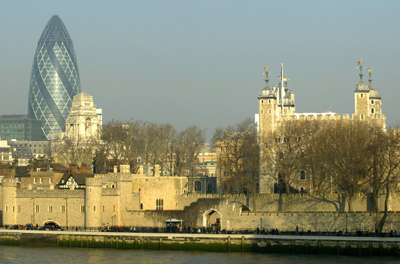
The oldest intact building in London is generally believed to be the White Tower, which stands in the heart of the Tower of London.

Construction on the White Tower (which stands to the right in the picture) was started on the orders of William the Conqueror some time prior to 1070 and was completed by 1100. The newly appointed Bishop of Rochester, Gundulf, was placed in charge of the project which used stone imported from Normandy (much of this was replaced in later centuries).

Built as a towering stronghold and fortress for the English kings, the walls of the tower at 15 feet (4.5 metres) thick and 90 feet (27 metres) high. It was later enclosed by a curtain wall and moat, taking the shape of the Tower of London as we now know it by about 1350.

The White Tower, also known as the Great Tower, has been the scene of many dramatic events in British history – from the deposition of Richard II in 1399 to the disappearance (and possible murder) or the Princes in the Tower – Edward V and his brother Richard, Duke of York, around 1483 (two skeletons, which some believed to be theirs, were unearthed here in 1674).

The White Tower, which is now part of a World Heritage Site, contains the splendid 11th century Chapel of St John the Evangelist. While three of the turrets at the corners of the tower are square, the fourth – the north-east turret, is round and once contained the first royal observatory.

The onion-shaped domes and weathervanes on the turrets were added in the 1520s.

These days the tower contains an exhibition of royal armour – including that worn by King Henry VIII – as well as exhibits on the tower’s history.

WHERE: Tower of London (nearest tube station is Tower Hill); WHEN: Tuesday to Saturday 9am to 4.30pm; Sunday to Monday 10pm to 4.30pm (closing times are 5.30pm between March and October); COST £18.70 an adult/£15.95 concessions/£10.45 a child (children under five free)/£51.70 for a family of two adults and up to six children; WEBSITE: www.hrp.org.uk/TowerOfLondon/

PICTURE: Stephen Pond/Historic Royal Palaces

Around London – Imperial War Museum’s WWI revamp; St Paul’s Christmas broadcasts; House Mill to be restored; Henry III’s rolls online; and, Winter Wonderland in Hyde Park

The Imperial War Museum has unveiled plans for a major rebuilding project at its Lambeth headquarters to culminate with the 100th anniversary of the start of World War I in 2014. Under a £71 million proposal, the size of the existing World War I galleries will be doubled and a new atrium will be created with further works – including a new sunken entrance – to be completed by 2019. The museum moved to its Lambeth location, formerly the Bethlem Royal Hospital, in 1936. Prince William is fronting the first £29 million appeal for funds. Meanwhile plans have reportedly been mooted to have the decommissioned aircraft carrier, the HMS Ark Royal, brought to London where it would be permanently moored in the Thames as a tourist attraction akin to the HMS Belfast.

St Paul’s Cathedral has announced it will provide live outdoor broadcasts of its three most popular Christmas services for the first time to allow those who can fit in the cathedral to participate. A 25 metre screen will be set up in Paternoster Square, next to the cathedral, where ‘A Celebration of Christmas’ will be screen on 16th December at 6.30pm along with Christmas Carol services on the 23rd and 24th December at 4pm. See www.stpauls.co.uk.

An historic 18th century mill in East London will undergo restoration after the granting of a £248,000 lottery grant. House Mill, which dates from 1776, is believed to be the largest tidal mill still in existence anywhere in the world. Built across the River Lea, the mill was used for flour-making and for a distillery located next door on Three Mills Island in Bow. The project, which is being managed by the River Lea Tidal Mill Trust, involves the restoration of the mill as well as the adjoining Miller’s House and the creation of a visitor’s centre. The trust says it has also been given the “green light” for a further £2.65 million Heritage Lottery Fund grant. See http://housemill.org.uk.

A three year project has made documents drawn up for King Henry III in the 13th century available on the internet for the first time. Project partners Canterbury Christ Church University, King’s College London, and the National Archives in Kew have translated and digitised the king’s ‘fine rolls’, written to record money and favours owed to the king. The rolls consist of 56 parchments – one for each year of his reign which started in 1216 and ended in 1272 – and contain as many as 40,000 entries amounting to some two million words. Some of the parchments, the originals of which are held at the National Archives, measure up to three metres in length. See www.finerollshenry3.org.uk.

On now: Winter Wonderland in Hyde Park. Christmas festivity on a vast scale, Winter Wonderland includes the city’s largest open air ice rink, circus acts, a giant observation wheel, rides and eating places including the igloo-style E:Cube and the Spiegel Saloon. For more information see www.hydeparkwinterwonderland.com.

Roman London – 3. The amphitheatre

Only discovered underneath Guildhall Yard in the 1980s, remains of London’s Roman-era amphitheatre can today be seen in the basement of the Guildhall Art Gallery.

Built around 70 AD initially as a simple wooden structure and then remodelled shortly after 120 AD with masonry foundations and walls and timber stands, the amphitheatre would have held as many as 7,000 spectators and was probably used for events such as public executions and other public entertainments including animal fighting and gladitorial combat.

The amphitheatre – the size of which is marked in a black line on the yard above (see picture right) – was abandoned by the mid 4th century.

Don’t expect too much – these days only remnants of the walls remain at what was ground level in the Roman era but they and the accompanying digital reconstruction give a reasonable indication of what it may have once been like.

The Museum of London runs tours of the amphitheatre with the next scheduled for 25th January, 2011. Click here for more details.

WHERE: Entry via Guildhall Art Gallery, Guildhall Yard, off Gresham Street (nearest tube stations are Bank, St Paul’s, Mansion House and Moorgate); WHEN: Monday to Saturday 10am to 5pm; Sunday 12pm to 4pm ; COST (included in gallery admission): £2.50 adults/£1 concessions/children under 16 free (free on Fridays and after 3.30pm any day and to people living and working in the City) ; WEBSITE: http://www.cityoflondon.gov.uk/Corporation/LGNL_Services/Leisure_and_culture/Museums_and_galleries/Guildhall_Art_Gallery/visitor_info.htm

PICTURE: Google maps

Famous Londoners – Beau Brummell

Generally acknowledged as having introduced the concept of men wearing a suit and tie during the Regency, ‘Beau’ Brummell’s sense of fashion continues to impact the way we dress right across the globe.

George Brummell was born in London 0n 7th June, 1788, the son of William Brummell, the private secretary of Lord North. Educated at Eton and Oxford, Brummell later joined the army and it was there that he became friends with George, Prince of Wales (the future King George IV). It was the prince who aided his promotion to captain before he resigned his commission.

Setting up home in Chesterfield Street, Mayfair, using the small fortune he inherited on his father’s death, Brummell became a member of the prince’s inner circle and quickly established a reputation for his elegant – and sober – dress sense and skills at the art of conversation.

But Brummell’s talent for spending above his means and his reckless gambling began to catch up with him as did his, at times, overly sharp tongue, and he gradually fell out of favour with his highly placed friends, including the Prince Regent whom he is said to have famously insulted after the prince snubbed him.

In 1816 he fled to France to escape debtor’s prison and remained there for the rest of his life. While friends helped him to secure the position of British consul in Caen briefly during the 1830s, he gradually slipped into decline and spent time in a French debtor’s prison until, impoverished and now insane, he died in an asylum in Caen in 1840.

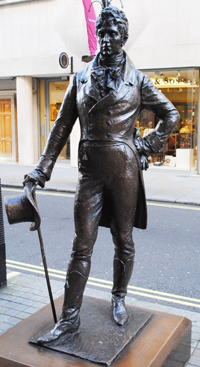
Brummell, whose life has since inspired numerous books, plays and films, can be seen standing on Jermyn Street where a statue of him by Irena Sedlecka was erected in 2002 (pictured). His legacy to fashion lives on.

What’s in a name?…Whitehall

Running southward from Trafalgar Square towards the Houses of Parliament (the southern part of Whitehall is actually known as Parliament Street), Whitehall is lined with government buildings – everything from the Foreign Office to the Cabinet Office, from the Scotland and Wales Offices to the Ministry of Defence – and has become so identified with government that its very name is now used to mean just that. But where does the name come from?

Whitehall takes its name from the Palace of Whitehall which once stood on the site of the current street. The palace’s origins go back to the 14th century when a grand house known as York Place was built as the London residence of the Archbishops of York.

The building was gradually expanded over the years – work which continued when Thomas Wolsey was made Archbishop of York in 1513. When Cardinal Wolsey fell from favour in the late 1520s, however, King Henry VIII seized the house along with his other assests.

With the royal Palace of Westminster badly damaged in a fire in 1512, King Henry VIII had been staying at Lambeth Palace. He saw the newly acquired palace, renamed Whitehall, as a suitable new home and continued expansion works, constructing a series of recreationally-oriented buildings on the west side of what is now Whitehall including tennis courts, a cockfighting pit and a tiltyard for tournaments. By the time of Henry VIII’s death in 1547, the palace covered 23 acres and was the largest in Europe.

The palace continued to be used by subsequent monarchs until much of it was destroyed by fire in 1698. These days the only surviving part of the palace is the Banqueting House. Built by Inigo Jones for King James I, it was from a window on the first floor of this 1622 building that King Charles I stepped onto a scaffold where his head was cut off.

Apart from the Banqueting House, other significant sites in Whitehall including the Cenotaph, the focus of Remembrance Sunday commemorations. Downing Street, meanwhile, runs off the south-eastern end of Whitehall and behind gates which have blocked it off since 1989, stands the Prime Minister’s official residence.

Treasures of London – The Sutton Hoo ship burial

Now housed in the British Museum (pictured), the artefacts discovered in a ship burial at Sutton Hoo near Woodbridge in Suffolk helped to shed new light on what life was like in Anglo-Saxon society.

The excavation at the Sutton Hoo site was carried out in 1939, just before World War II.  The finds were impressive and centred on a 27 metre long oak ship in the midst of which was constructed a burial chamber for a man of some significance along with his possessions.

The latter included his armour (the centrepiece of which is the spectacular and painstakingly reconstructed Sutton Hoo helmet complete with face mask), weapons such as a sword and spears, silverware and silver-mounted drinking horns and cups, clothes and other assorted items of wealth, including a purse with a ‘lid’ containing, among other things, Merovingian gold coins struck believed to have been struck between 595 and 640 AD.

While the remains found date to around the early seventh century, the man’s exact identity remains something of a mystery. But it is possible he may have been one of four Anglo-Saxon kings known to have been buried in the area.

WHERE: Room 41 at the British Museum, Great Russell Street (nearest tube is Tottenham Court Road, Holborn or Russell Square); WHEN: 10.30am-5.3opm daily; COST: Entry to the museum is free; WEBSITE: www.britishmuseum.org. (For more information on visiting the Sutton Hoo site in Suffolk, visit www.nationaltrust.org.uk/main/w-vh/w-visits/w-findaplace/w-suttonhoo)

Around London – Skating at a palace or a tower?; British Military Tournament; and, new blue plaques

Christmas is looming and snow and ice have been besieging London. But there’s plenty you can do to keep warm, including visiting one of the many ice skating venues about the city. Among those with a particularly historic location are rinks at Hampton Court (located against the backdrop of the palace’s west front, it’s open until 9th January – see website for ticket prices and times), in the moat of the Tower of London (also open until 9th January, see website for ticket prices and times), and at Somerset House (open until 23rd January, see website for ticket prices and times).

The British Military Tournament 2010 will be held at Earl’s Court this weekend. The programme features 500 troops, 145 horses, military bands, the field gun run and will include a re-enactment of a combat incident in Afghanistan involving recently returned troops. Presented by ABF The Soldiers’ Charity, with performances on both Saturday and Sunday. For more information – including booking information, see www.britishmilitarytournament.com.

New blue plaques have been unveiled in London marking the former homes of speed daredevils Sir Malcolm Campbell and his son Donald, and ground-breaking photographer Bill Brandt. The plaque for the Campbells, who between them set 10 land speed records and 11 water speed records, is located at Canbury School in Kingston-upon-Thames – Sir Malcolm moved here in 1919, married to Dorothy Whittall the following year, and, Donald was born here in 1921. The family moved in 1922 to Surrey. The plaque for German-born Brandt, meanwhile, was unveiled at 4 Airlie Gardens in Campden Hill. He lived here with his second wife Marjorie Beckett from 1958 and family members still live in the home. Some of his nudes were taken inside. For more information, visit www.english-heritage.org.uk.

Roman London – 2. The Temple of Mithras

Also known as the Mithraeum, the remains of the Temple of Mithras were only discovered in the City during building work in 1954.

The temple was originally located some 18 feet (5.4 metres) below Walbrook Street on the bank of what was Walbrook but was moved to its current location at the eastern end, and south side, of Queen Victoria Street. It is presently again surrounded by building work hoardings so you’ll have to ignore those if you’re trying to soak up some ancient atmosphere.

The temple was built around 240 AD and remained in use until around 350AD when, after it suffered severe subsidence, it was rebuilt and dedicated to the god Bacchus. The original stone temple was dedicated to Mithras, a Persian sun deity and a particular favorite of Roman soldiers, and perhaps to several other gods as well.

These days all that remains are foundations, but you can see the basic layout with a sunken nave – which would have had benches on either side – leading to an altar, remains of which are at the northern end of the site.

Numerous artefacts have been found at the temple site, including a head of Mithras, a sculpture showing a scene of Mithras killing a bull (he apparently did so in a cave so  Mithraeum were built partly or even totally underground), and heads of the Roman gods Minerva and Serapis, all of which can be seen at the Museum of London.

WHERE: Queen Victoria Street (nearest tube station is Bank); WHEN: Open to the public at all times; COST: Free. WEBSITE: The Museum of London’s website has some good information on the temple, http://bit.ly/hzsBrW

Where’s London’s oldest…artificially lit road?

The oldest artificially lit road in London is Rotten Row in Hyde Park.

Running along the south side of the royal park, it was created on the orders of King William III at the end of the 17th century to provide a safe travelling link between Kensington Palace – new home of the court – and St James’s Palace.

The new road was opened in 1690 and included 300 oil lamps, making it the first artifically lit highway, not only in London, but in Britain. According to Royal Parks, the name Rotten Row is a corruption of the French ‘Route de Roi’ (King’s Road) although others have suggested alternative meanings.

In later years, the roadway became a popular meeting place of the upper class and, while it’s now open to the general public, is still used as a bridle path.

~ www.royalparks.org.uk/parks/hyde_park/index.cfm

Treasures of London – Cleopatra’s Needle

Sited relatively unobtrusively on the north bank of the Thames at Victoria Embankment, it’s easy to overlook this ancient Egyptian obelisk which was erected on its current site in 1878.

Although it’s commonly known as “Cleopatra’s Needle”, the red granite obelisk is in fact one of a pair originally constructed in the 15th century BC and placed in the Egyptian city of Heliopolis at the behest of Pharoah Thutmose III (the second one is now in New York’s Central Park and is also known by the name, Cleopatra’s Needle). The inscriptions were added later by Ramsses II. Both obelisks were subsequently moved to Alexandria and placed in a temple honoring Mark Antony. They later toppled over (and were covered in sand, which apparently helped with preservation).

The obelisk was given to the United Kingdom in 1819 by the grateful ruler of Egypt and Sudan, Mehemet Ali, in commemoration of British victories over the French at the Battle of the Nile and the Battle of Alexandria in 1801.

After the British government decided not to transport the obelisk to London due to the high expense, it remained in Alexandria until 1877 when Sir William James Erasmus Wilson contributed £10,000 toward the cost in an act of publicly-minded benevolence. After an eventful journey it which at one point it and the iron cylinder it was encased in – dubbed the Cleopatra – were declared sunk before being found again (tragically six crew drowned in the incident), it was finally erected in October 1878.

A time capsule is buried at the base of the obelisk which contains, among other things, a portrait of Queen Victoria, hairpins, copies of the Bible in several languages and a map of London. One of the two bronze sphinxes which these days guard the obelisk, meanwhile, still bears the scars of damage which took place in World War II when a bomb landed nearby.

Around London – West End’s VIP day; National Curry Week; Kenwood House to close for repairs; and Horatio’s handwriting…

• Oxford Street and Regent Street in London’s West End will be closed to cars and buses this Saturday (27th November) as part of the sixth annual West End VIP Day. The day, which is sponsored by American Express,  will also bring singers, entertainers and celebrities hit the streets as they fundraise for the Starlight Children’s Foundation. Other entertainment will include a seven foot climbing wall on Regent Street, giant TV screens, fair ground style rides and the chance to climb inside a lifesize snow globe. Runs from 9am to 10pm. For more information, see www.westendlondon.com/vip.

• This week was National Curry Week, so to celebrate, we thought we’d tell you about London’s oldest curryhouse (in fact it’s said to be the oldest in the UK). Veeraswamy was founded in 1926 at its current location of 99 Regent Street (entry via Swallow Street) by, according to the restaurant’s website, “the great grandson of an English General, and an Indian princess”. Customers are said to have included Indira Gandhi, Charlie Chaplin, King Hussein of Jordan and Marlon Brando. See www.nationaleatingoutweek.com or www.veeraswamy.com.

Kenwood House in Hampstead, north London, is set to undergo major repair and conservation works meaning the house will be closed to the public from early summer 2012 for just over a year. The grounds will remain open. The current house was designed by Robert Adam and built over the period of 1762 to 1779 for William Murray, 1st Earl of Mansfield and the Lord Chief Justice. It now houses a collection of paintings bequeathed to the nation in 1927 by Edward Cecil Guinness, 1st Earl of Iveagh, which includes works by Rembrandt, Vermeer, Gainsborough and Turner. For more information, see www.english-heritage.org.uk/daysout/properties/kenwood-house/.

On now: Compare Horatio Nelson’s handwriting before and after he lost his right arm in battle at a special showing of two of his letters at the Wellcome Collection tomorrow night (26th November). The letters are part of Hands: Amazing Appendages, a one night only show. There will also be the chance to try out some nail art, try out some surgeon’s tools and hear talks and see performances. Admission is free (but some talks and performances will be tickets – tickets available on the night only from 7pm). See www.wellcomecollection.org/whats-on/events/hands.aspx.


Roman London – 1. The Roman wall

This year marks 1,600 years since what many posit was the “end of Roman Britain” based on a letter Emperor Honorius is said to have written in 410 AD telling Britain to look to its own defence. So we thought we’d take a look at Roman London – Londinium – in a short series running until the year’s end.

To kick it off, we’re taking a look at one of the easier to find Roman remnants, that of the city wall which encircled first Roman and later the medieval City of London.

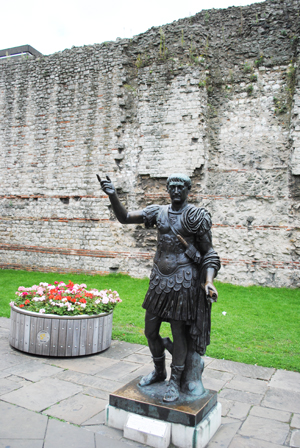
The wall can be seen in several places, but one of the easiest places to see it is next to Tower Hill tube station, where one of the best preserved sections of the wall can be seen (along with a statue believed to be that of the Emperor Trajan – see right).

Standing to a height of more than 35 feet or 10.6 metres, the Roman section extends as high as 14.5 feet or 4.4 metres with the upper part dating from later periods. The Roman wall would have originally been around 20 feet or 6.3 metres high and would have had a V-shaped ditch running along its outside.

First built around 200 AD, the city wall largely ran along the same course over the ensuing centuries. There were initially five gates with another added in the Roman period and another in medieval times. None of these now survive.

Further substantial remains of the Roman wall can be seen in a courtyard at nearby Cooper’s Row (head around the corner from Tower Hill tube station along Cooper’s Row and then turn right, past a hotel, into a courtyard) and on what was the north-west corner of the city at Noble Street, not far from the Museum of London, where a Roman base supports a later brick wall.

LondonLife – One New Change

London’s newest shopping mall (and the first to open in the City for 130 years), One New Change, has opened up some interesting new views of the city, in particular of St Paul’s Cathedral which stands opposite. The views including those seen from the 6th floor public rooftop terrace which was opened last week. Located in Cheapside (‘cheap’ meaning market), the more than £500 million development was designed by Pritzker Prize winning French architect Jean Nouvel. For more information, see www.onenewchange.com.