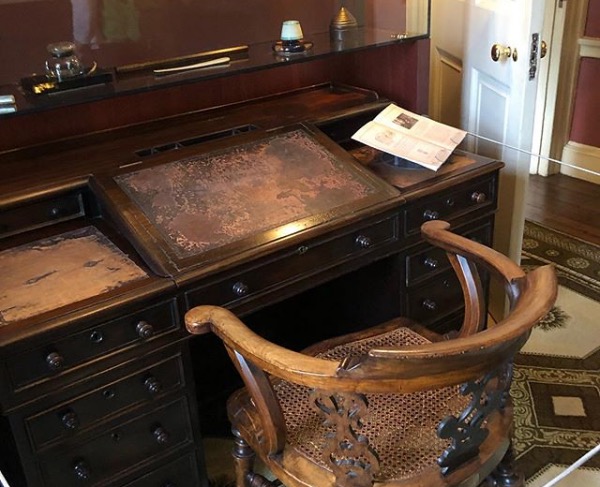
Charles Dickens’ desk and chair at the Charles Dickens Museum. PICTURE: Alyx Dellamonica (Licensed under CC BY-NC 2.0)
Among the treasures to be found at Dickens’ former house (and now the Charles Dickens Museum) in Doughty Street, Bloomsbury, is the desk and accompanying chair where Dickens’ wrote several of his later novels including Great Expectations, Our Mutual Friend and the unfinished The Mystery of Edwin Drood.
Dickens purchased the mahogany pedestal writing desk as well as the walnut and fruitwood smoker’s armchair in 1859. He used them in the study of his final home at Gad’s Hill Place in Kent (Dickens also had an identical chair in his London office which is now in the New York State Library).
After the author’s death in 1870, the desk and chair – which feature in Luke Fildes’ 1870 work The Empty Chair and the RW Buss’ 1875 work Dickens’ Dream – were passed down through the Dickens family until they was auctioned in the 2000s with the funds raised used to benefit the Great Ormond Street Hospital.
While the desk and chair had previously been loaned to the museum for display, in 2015 the establishment was able to purchase the desk and chair and make it part of its permanent collection thanks to a £780,000 grant from the National Heritage Memorial Fund.
While the museum is currently closed due to the coronavirus pandemic, we include these details for when it reopens.
WHERE: 48-49 Doughty Street, Bloomsbury (nearest Tube stations are Russell Square, Chancery Lane or Holborn). WHEN: Currently closed; COST: £9.50 adults/£7.50 concessions/£4.50 children (under six free); WEBSITE: www.dickensmuseum.com.
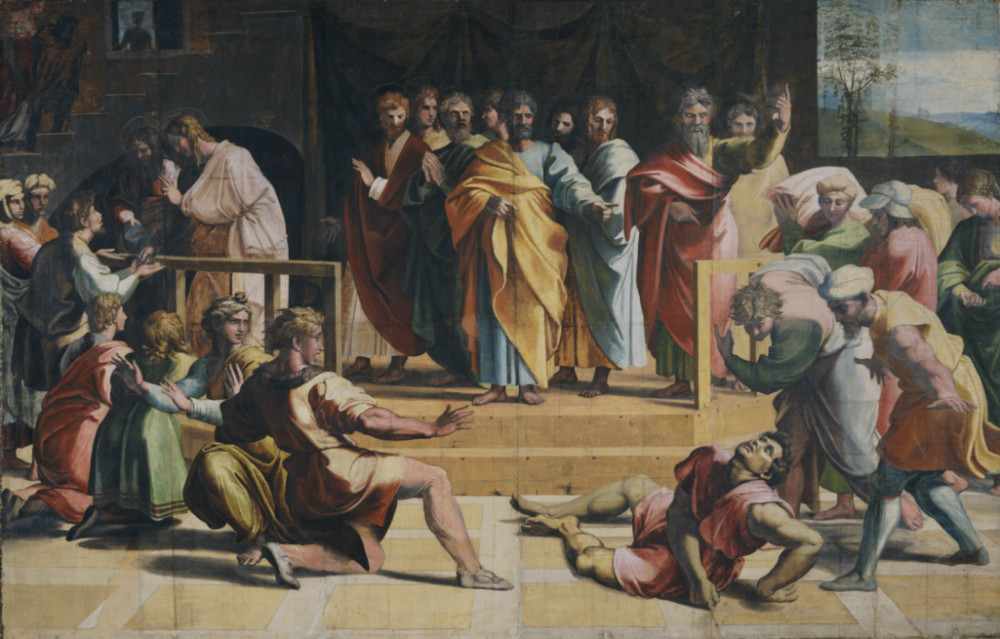
• An in-depth exploration of the so-called ‘Raphael Cartoons’ has gone online at the V&A ahead of the reopening of the newly transformed Raphael Court later this year. Among the greatest Renaissance treasures in the UK, the cartoons were commissioned by Pope Leo X for the Sistine Chapel in the Vatican shortly after his election in 1513. The Pope asked artist Raphael to create a series of 10 designs illustrating the lives of St Peter and St Paul which could then be turned into tapestries to grace the walls of the chapel. Created in the workshop of merchant-weaver Pieter van Aelst in Brussels, the 10 tapestries were each five metres wide and 3.5 metres high. Seven of Raphael’s original cartoons survive – they were brought to Britain in the early 17th century by the Prince of Wales (later King Charles I) and remained behind closed doors in the Royal Collection until they were lent to the South Kensington Museum – now the V&A – by Queen Victoria in 1865 in memory of Prince Albert. The cartoons have been on public display in the museum ever since. The new online offering traces the story of the cartoons and using ultra- high-resolution photography, infrared imagery, and 3D scans, and is the first time people have been able to explore the cartoons in such detail. It was produced as part of the V&A’s ‘Raphael Project’, marking the 500th anniversary of Raphael’s death in 2020, which includes a landmark renovation of the Raphael Court – home to the cartoons. The refurbished gallery will be unveiled when the museum reopens. To see the new online display, head to vam.ac.uk/raphael-cartoons.
• A participatory art project exploring the relationship between the UK and France in a post-Brexit world has commenced this week.I Love You, Moi Non Plus – presented in partnership by Somerset House, Dover Street Market London, The Adonyeva Foundation, Collectif Coulanges, Eurostar and coordinated by Sabir, invites artists to share their interpretation of what the British-French relationship means to them with works to be displayed in a new online gallery alongside bespoke pieces from “project ambassadors” including Chinese artistAi Weiwei, fashion designer Stella McCartney, English electronic musician Brian Eno, English National Ballet artistic director Tamara Rojo,and British artist Bob and Roberta Smith. The project seeks to highlight how art and creativity can “maintain connections between communities across the channels, unifying voices from across Britain and the EU”. Participants are asked to contribute either by sharing their creations on social media with hashtags #ILoveYouMoiNonPlus, #ILYMNP and #LifeAfterBrexit or submit them directly to the website here.
• Does this mean a new Tardis for Dr Who? The City of London Corporation is calling on architects, landscape architects, designers and artists to submit ideas for the design of a “21st century police box”. The competition, which is being run by the City in conjunction with the City of London Police, New London Architecture (NLA) and Bloomberg Associates, aims to provide “a modern and engaging way to provide information and safety” to the Square Mile’s residents, workers and visitors. Up to six shortlisted teams will be awarded funding to develop their idea into a design proposal and the winning design will be unveiled in the summer. For more, head to nla.london/submissions/digital-service-point-open-call-competition.
• The Museum of London has acquired 13 tweets shared by Londoners during the initial coronavirus-related lockdown as part of its ongoing ‘Collecting COVID’ project. The tweets, which were collected under the ‘Going Viral’ strand of the Collecting COVID project, now form part of the museum’s permanent collection and lay bare what people were experiencing during 2020. The Going Viral project focused on collecting text, memes, videos and images that were ‘shared’ or ‘liked’ on Twitter more than 30,000 times. Additional tweets will be considered for acquisition this year.
Send all items for inclusion to exploringlondon@gmail.com.
Around 1145, Thomas Becket left the household of the financier Osbert Huitdeniers and entered the household of Theobold, the Archbishop of Canterbury.
It’s unclear how he made the transition, although it has been speculated it was possibly through family connections, but by the following year, he was well-ensconced as a clerk in the archbishop’s household.
Like many great households, the Archbishop’s moved between various residences including his palace beside Canterbury Cathedral, various manors and the royal court (Lambeth Palace, the current home of the Archbishop of Canterbury in London was constructed after Becket’s death).
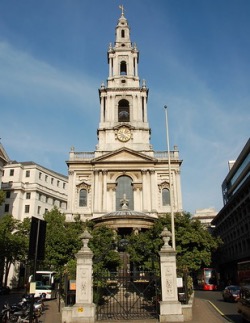
Becket rose in the Archbishop’s favour and while serving in his household was given the living of churches including St Mary le Strand in London and Otford in Kent as well as being made a canon of St Paul’s Cathedral (he wasn’t expected to attend the churches to receive the incomes).
The current St Mary le Strand dates from the early 18th century; the church from which Thomas drew an income was an earlier versions and stood a little to the south of the current building.
St Paul’s, meanwhile, was an early version of the pre-Great Fire of London version of the building. During Becket’s time, the grand structure was still under construction (building had been disrupted by a fire in 1135 and the cathedral wasn’t consecrated until 1240, well after Becket’s death).
The present cathedral has a rather spectacular statue of Becket in the churchyard (but we’ll deal with that separately in a later post in this series).
The bell tower of St Mary-le-Bow. PICTURE: lonpicman (licensed under CC BY-SA 3.0))
A new regular section in which we explain some of the city’s language. First up, we’re taking a quick look at the word ‘Cockney’.
The word, which has been used as far back as the Middle Ages to describe a ‘cock’s egg’ or weird egg, was apparently once used to refer to “weak” urbanite men (as opposed to the tougher men of the country).
But in more recent times, it was used to refer to someone born within hearing distance of the ‘Bow bells’ – the bells of the church of St Mary-le-Bow in the City.
This meant it came to be particularly associated with people from the city’s East End (although the bells can apparently be heard for at least a couple of miles in any direction – legend has Dick Whittington apparently hearing them calling to him more than four miles away in Highgate).
As well as referring to the people, the word is also used for the distinctive dialect, known as Cockney Rhyming slang, of those who lived in the area.
Interestingly, thanks to World War II preparations, the bells of St Mary-le-Bow were silent from 13th June, 1940, and, following their destruction in an air-raid the following year, were not replaced until 1961. This has led some to conclude that because no bells were rung during this 21 year period, no Cockneys were born then.
A waterway said to have been cut by the Viking Canute (also spelled Cnut) in the 11th century, the canal, according to the story, was constructed so his fleet of ships – blocked by London Bridge – could get upstream.
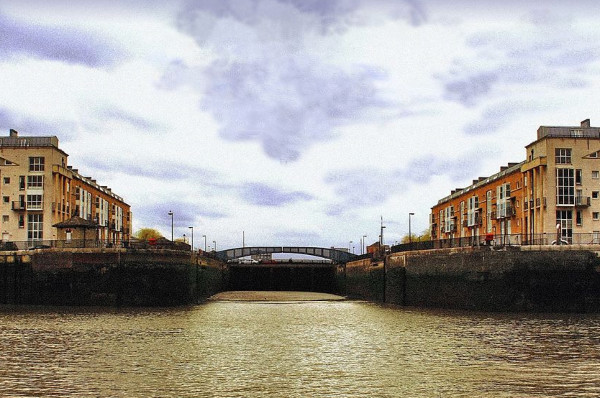
The entrance to Greenland Dock from The Thames in 2012 – one of the many places posited as the location where Canute’s Canal started. PICTURE: Public Domain
The story goes that in May, 1016, the Dane Canute (and future King of England), led an army of invasion into England to reclaim the throne his father, Sweyn Forkbeard, had first won three years earlier.
Canute needed to get his ships upriver of London Bridge to besiege the city which was held by the Saxons under Edmund Ironside (made king in April after his father Athelred’s death) but was blocked by the fortified, although then wooden, London Bridge.
So Canute gave orders for the digging of a trench or canal across some part of Southwark so his ships could pass into the river to the west of the bridge and he could encircle the city.
The canal – also known as ‘Canute’s Trench’ – was duly dug and the city was besieged – although the Vikings lifted the siege without taking the city (which does seems like a lot of work for not much result in the end) and the war was eventually decided elsewhere.
Various routes of the canal have been posited as possibilities – including the suggestion that there was an entry at Rotherhithe (Greenland Dock has been sited as one location) and exit somewhere near Lambeth or further south at Vauxhall (and one possibility is that Canute, rather than digging a long canal, simply cut through the bank holding back the Thames on either side of London Bridge and flooded the lands behind).
Various waterways have also been identified with it including the River Neckinger, parts of which survive, and the now lost stream known as the Tigris.
Whether the canal actually existed – and what form it took – remains a matter of some debate (although the low-lying, marshy land of Southwark at the time surely would have helped with any such project). But whether lost or simply mythical, the truth of ‘Canute’s Canal’ remains something of a mystery. For the moment at least.
• Statues of two prominent men with links to the trans-Atlantic slave trade will be removed from Guildhall, the City of London has said. The City of London Corporation’s policy and resources committee voted to remove statues of William Beckford and Sir John Cass following a recommendation from the corporation’s Tackling Racism Taskforce. The statue of Beckford, a two-time Lord Mayor of London in the late 1700s who accrued wealth from plantations in Jamaica and held African slaves, will be replaced with a new artwork while the likeness of Sir John Cass, a merchant, MP and philanthropist in the 17th and 18th centuries who also profited from the slave trade, will be returned to its owner, the Sir John Cass Foundation. The corporation will now set up a working group to oversee the removal of the statues and replacement works and will also consider commissioning a new memorial to the slave trade in the City.
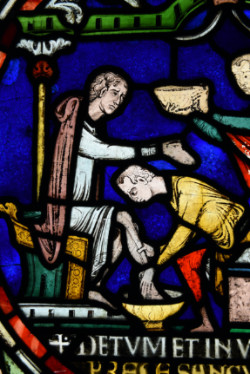
• An 800-year-old stained glass window from Canterbury Cathedral will form the centrepiece of an upcoming exhibition on Thomas Becket. Now scheduled for April after delays due to the coronavirus pandemic, Thomas Becket: murder and the making of a saint will feature more than 100 objects as it tells the story of Becket’s life, death and enduring legacy. The ‘Miracle Window’ – one of seven surviving from an original series of 12 – will be shown in its original arrangement of the first time in more than 350 years. The fifth in the series, it depicts miracles which took place in the three year after Becket’s death including the healing of eyesight and the replacement of lost genitals. The exhibition will represent the first time a complete stained glass window has been lent by the cathedral. Details of tickets will be announced soon. For more, see www.britishmuseum.org/becket.
• The Worshipful Company of Weavers this week announced the donation of £100,000 towards the creation of the new Museum of London in former market buildings at West Smithfield. The donation is one of the largest ever awarded by the livery company which, having a Royal charter dating from 1155, is the oldest surviving. The masterplan for the new museum received planning permission in June last year.
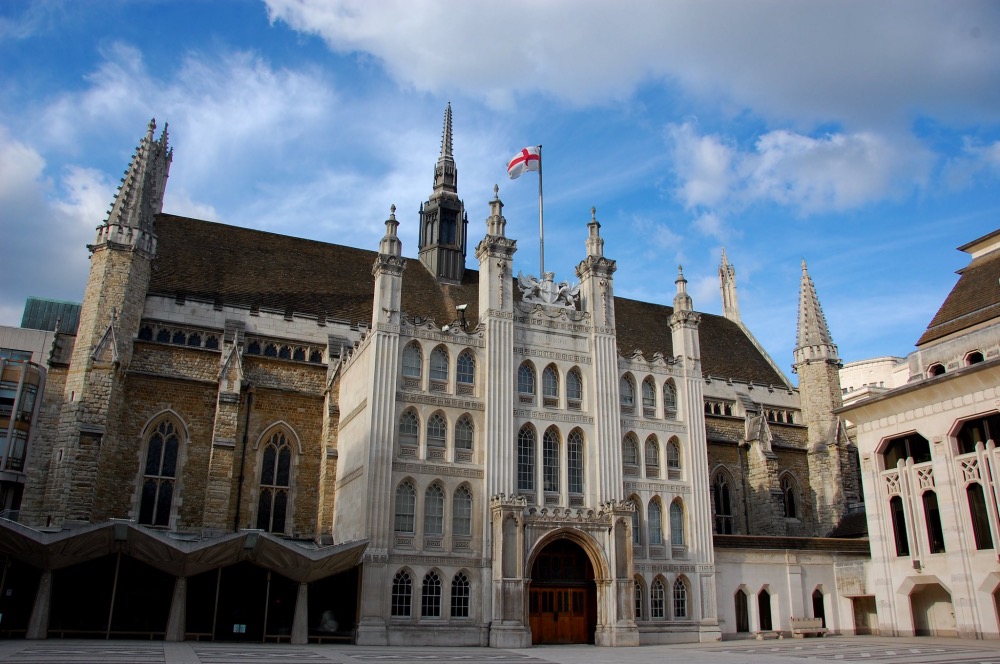
The Guildhall was an important building in Thomas Becket’s London but the earliest parts of the current building date from the early 15th century. PICTURE: stephenarcher (licensed under CC BY-NC 2.0)
This week we look at a location representative of Becket’s brief time working for a former City of London Sheriff and banker, Osbert Huitdeniers (“Eightpence”).
About a year after his return from Paris (possibly around his 22nd birthday in late 1142), Becket – driven apparently by a downturn in the family fortunes – started work as a clerk in the household of Huitdeniers.
A relative of the Becket family, Osbert was a man of some significance – apparently holding a knight’s fee in Kent – and was known at the royal court. He had held the post of sheriff of London from 1139 to 1141 (and may have also been a justiciar at different times).
We’ve been unable to determine where Huitdeniers’ home or business was located, hence why we’ve included Guildhall which certainly would have been known to him as sheriff – and indeed to Becket who grew up nearby, though not in its current form.
Becket’s job would have involved keeping Huitdeniers accounts and during the few years he served the banker, it’s believed he gained some invaluable skills that would prove helpful later in life.
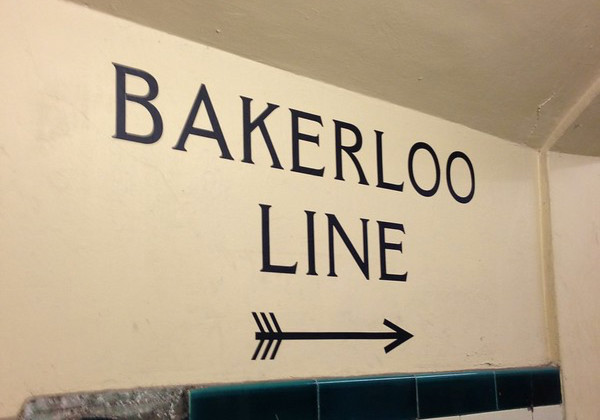
A Tube line which these days runs 14 miles from Harrow & Wealdstone station in the north to Elephant & Castle in the south, the Bakerloo line first opened in 1906 and initially ran just from Baker Street to Kennington.
Not only the first Tube for CT Yerkes’ scheme of electric railways for London, it was also the first line to run across London from north to south (legend says it was built because of complaints from businessmen that they couldn’t get to Lord’s cricket ground fast enough though we’re somewhat sceptical of this claim).
Bakerloo was a nickname, a contraction of the line’s official name – the Baker Street and Waterloo Railway. It was apparently first coined by the Evening Standard. Not everyone was impressed, however – the Railway Magazine described it as a “gutter title” and said it was beneath the dignity of the railway company to accept it.
Despite a rather slow uptake – which initially resulted in trains with as few as two cars being used in off-peak periods, what’s now a brown-coloured coded Underground line did become a success and over the ensuing years expanded (and contracted) before reaching its current length with 25 stations (the busiest apparently being Oxford Circus).
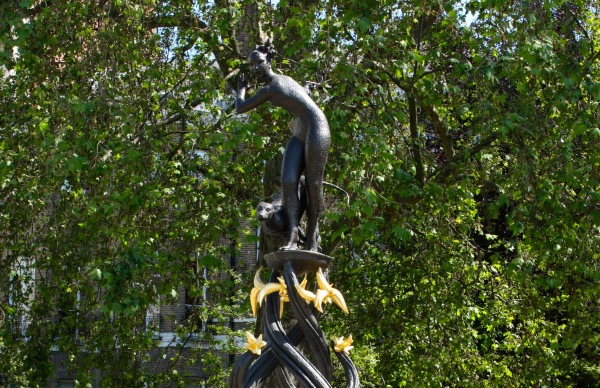
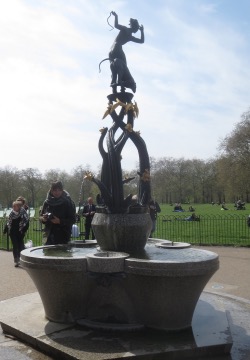
This fountain and statue ensemble – also known as Diana of the Treetops and the Constance Fountain (and not to be confused with the Diana, Princess of Wales Memorial Fountain in Hyde Park or the Diana Fountain in Bushy Park) – for many years stood at the centre of Green Park.
The fountain replaced an earlier one by Sidney Smirke – installed in 1860 – that had fallen into disrepair.
The Ministry of Works approached the Constance Fund – which had been established by artist Sigismund Goetze and was administered by his wife Constance following his death – to provide finances for a replacement and after they agreed, a competition for the design was held overseen by Sir William Reid.
Escourt J “Jim” Clack, a teacher from Devon, won and designed a bronze statue of the Greek goddess Diana to top the fountain. Depicting a naked Diana unleashing a hunting dog, it sits atop a stylised tree under which sit the fountain basins. The fountain was unveiled in 1954.
In 2011, the statue was removed, restored and some gilding added and then placed near the entrance to Green Park tube station in the north-east corner of the park.
• As the inauguration of US President Joe Biden took place in the US this week, the Museum of London announced it had taken possession of the larger-than-life ‘Trump Baby’ balloon. The blimp first appeared at protests in July, 2018, during then-US President Donald Trump’s first visit to the city, and has since followed the President around the world. The museum said it will now form part of its protest collection which also includes objects relating to the Suffrage movement, banners, flags, and tents that belonged to Houses of Parliament protestor Brian Haw and placards used recently by protestors against public spending cuts. Sharon Ament, director of the museum, said: “From the Suffragettes of the early twentieth century to the anti-austerity marches, free speech and Black Lives Matter most recently – the capital has always been the place to have your say. By collecting the baby blimp we can mark the wave of feeling that washed over the city that day and capture a particular moment of resistance – a feeling still relevant today as we live through these exceptionally challenging times – that ultimately shows Londoners banding together in the face of extreme adversity.” The Trump Baby team added that it was their hope the blimp “will stand as a reminder of when London stood against Trump – but will prompt those who see it to examine how they can continue the fight against the politics of hate”. “Most of all we hope the Trump Baby serves as a reminder of the politics of resistance that took place during Trump’s time in office.”
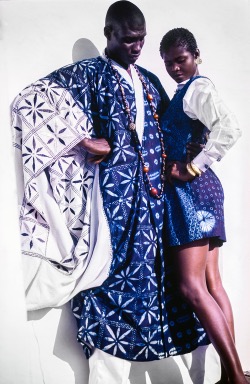
• The V&A is seeking to contact people who have worn fashions designed by the likes of Shade Thomas-Fahm, Chris Seydou, Kofi Ansah, and Alphadi – a group who, along with their peers, represent the first generation of African designers to gain international attention. The call out comes as the South Kensington museum announces plans to hold an exhibition, supported by GRoW @ Annenberg, which aims to celebrate the creativity, ingenuity and global impact of contemporary African fashions in June. The display will feature more than 250 objects, drawn from the personal archives of African fashion creatives, alongside textiles and photographs from the V&A’s collection (many of which are being displayed for the first time). Alongside the objects, the museum is seeking a range of items – and the stories that go with them – from the public. They include Chris Seydou’s 1980s experimental garments in bògòlanfini, 20th century kente, bògòlanfini, khanga and commemorative cloths from the independence and liberation years in Africa, and family portraits and home movies showing African and African diasporic fashion trends. Members of the public with objects that fit the above description are asked to get in touch by email at africafashion@vam.ac.uk, and to share their pictures and memories on social media, using the hashtag #AfricaFashion. For the full list of sought after items, head to www.vam.ac.uk/blog/news/va-africa-fashion-call-out.
Send all items for inclusion to exploringlondon@gmail.com.
There’s little known about Becket’s education but it’s believed that he attended a school in London as a young boy before, at the age of 10, he was sent to Merton Priory in Surrey (now part of Greater London) as a boarder.
The Augustinian priory had been founded in 1114 by Gilbert, the sheriff of Surrey, Cambridgeshire and Huntingdonshire, and moved to a new site beside the River Wandle in 1117.
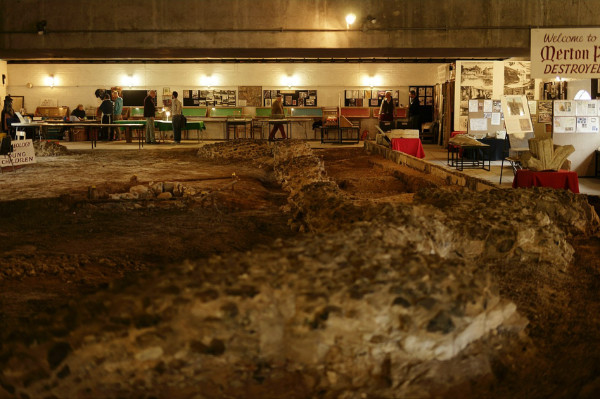
The remains of the Merton Priory chapter house as seen in 2017. PICTURE: Peter Trimming (licensed under CC BY-SA 2.0)
Hence, it was still rather new when he arrived in 1130 and facilities probably rather primitive but there was already a tradition of schooling established there under the first schoolmaster, an Italian named Guy who had apparently died in about 1120.
At some point in his teenage years, Becket was moved to one of the London grammar schools – perhaps one located at St Paul’s Cathedral – to continue his education and then later to Paris where he spent a year before it’s believed he returned home by the age of 21.
Despite his years at various schools, Becket apparently wasn’t much of a scholar, preferring more outdoor pursuits. But his studies, nonetheless, must have covered the trivium, which included Latin grammar, rhetoric and logic, and even some of the more advanced quadrivium, which included arithmetic, geometry, astronomy and music.
Becket’s connections with Merton were to remain strong later in life and included taking one of its canons, Robert, as his chaplain and confessor.
Little of the priory, which was dissolved during the Dissolution, now remains but the ruins of the chapter house can be visited (post-lockdown). Other famous students at the priory included Walter de Merton, the founder of Merton College Oxford.
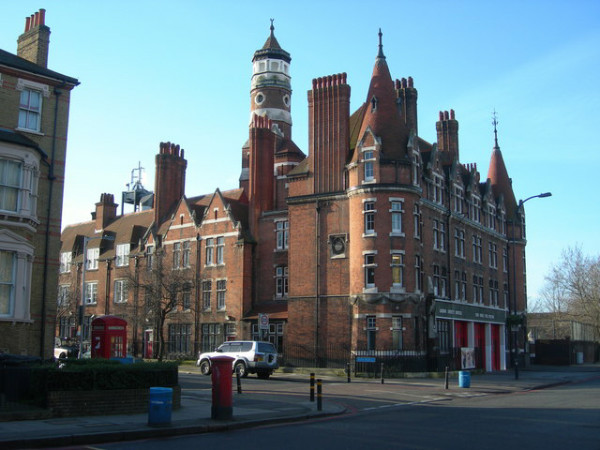
The closure of two fire stations in 2014 – Clerkenwell (which opened in 1872) and Woolwich (which opened in 1887) – has left New Cross Fire Station in the city’s south as the oldest in London (and, according to the London Fire Brigade, the oldest in Europe as well.)
The station, which was designed in a rather grand “chateau-style” by the brigade’s chief architect Robert Pearsall, was opened at 266 Queen’s Road in New Cross in 1894. It was built to accommodate the divisional superintendent, a station foreman and 16 firefighters – eight married and eight unmarried – as well as two coachmen and stables for four horses.
The fire station initially housed a steam-powered and a manual firefighting appliance as well as a hose cart and van, a long ladder (which had its own shed in the yard) and four fire escapes.
The fire station underwent a major upgrade in 1912, improvements included the addition of more flats for married officers and self-contained houses for the superintendent and foreman as well as a sliding pole to give firefighters a quicker trip to the engine house. In 1958, a third appliance bay was added.
One of the most infamous incidents the firefighters from New Cross attended was in November, 1944, when a V2 bomb hit a Woolworths store in New Cross just after midday on a busy Saturday. Some 168 people were killed, 33 of whom were children, and a further 123 were injured in the attack.
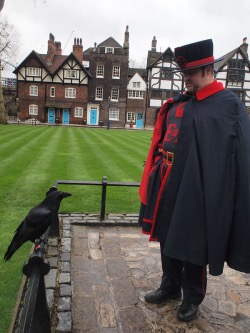
• The ‘Queen’ is missing from the Tower of London. ‘Merlina’, who is one of seven ravens in residence at the Tower under the care of raven master Christopher Skaife, reportedly hasn’t been seen at the fortress for several weeks. A spokesman for the Tower said it was feared Merlina, who joined the flock in 2007, had died. “Merlina was our undisputed ruler of the roost, Queen of the Tower Ravens,” he told the Evening Standard. “She will be greatly missed by her fellow ravens, the ravenmaster, and all of us in the Tower community.” Legend states that there must be six ravens at the Tower or the Kingdom will fall.
• An exhibition of augmented reality art (often known as AR art) is available to be viewed online.Unreal City, described as London’s biggest public festival of AR art, was launched back in December and involved 36 digital sculptures by the likes of Olafur Eliasson, Cao Fei, Alicja Kwade, Koo Jeong A, and Marco Brambilla, arranged in a walking tour along the Thames. The festival, which is a partnership between Acute Art and Dazed Media, has now made the works available to be seen online via the via the Acute Art app. Also to be seen are works by artists KAWS, Bjarne Melgaard, and Tomás Saraceno. The works can be seen for free via the Acute Art app until 9th February.
Send all items for inclusion to exploringlondon@gmail.com.
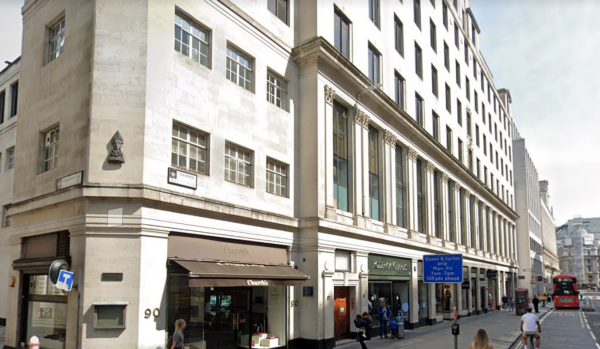
Looking east down Cheapside from the corner of Ironmonger’s Line (with the bust of St Thomas Becket visible in the left). PICTURE: Google Maps.
The 29thDecember, 2020, marked 850 years since the dramatic murder of then Archbishop of Canterbury, Thomas Becket, in Canterbury Cathedral.
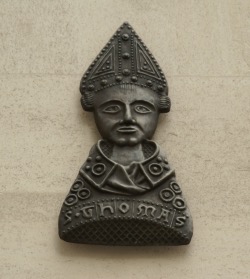
Metallic bust of St Thomas Becket on the wall at 90 Cheapside.PICTURE: Caroline (licensed under CC BY-NC-ND 2.0)
While many of the commemorations have been postponed due to the coronavirus pandemic, we’ve decided to push ahead with our series in commemoration of the martyred saint’s connections with London.
First up, it’s the famous City of London street of Cheapside – one of the main commercial streets in the medieval city – which was where, on 21st December, in what is generally believed to be the year 1120, he was born.
Becket was the son of Norman parents – his father, Gilbert, was a mercer (and served as a City sheriff) and his mother was named Matilda. He is believed to have had at least three sisters.
The location of what was a large residence – and the fact the family owned other property in the area – indicated they were relatively prosperous.
The property was next door to the church of St Mary Colechurch – lost in the Great Fire of London and not rebuilt – which was where St Thomas was baptised, apparently on the evening of his birth suggesting he may have initially been sickly. He was named after the Biblical St Thomas.
The site – which was later occupied by a hospital run by the Order of St Thomas of Acre – is marked with a small metallic bust of St Thomas attached to a wall on 90 Cheapside (on the corner with Ironmongers Lane) as well as a City of London blue plaque.
This month marks the 450th anniversary of the opening of London’s Royal Exchange, a complex created to act as a commercial centre in the City of London.
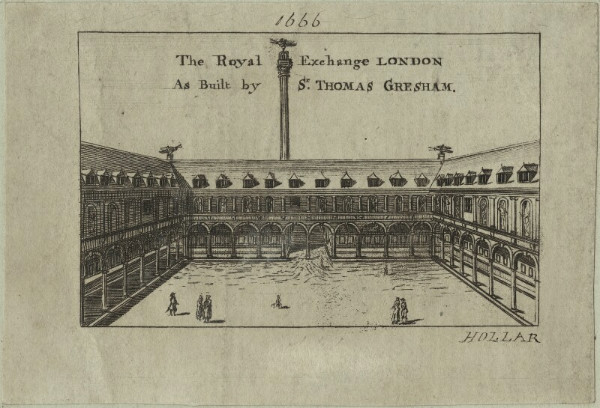
The exchange was built on the orders – and with the funds – of the merchant Sir Thomas Gresham at a site on the junction of Cornhill and Threadneedle streets which was – and still is – jointly owned by the City of London Corporation and the Worshipful Company of Mercers.
Drawing inspiration from the Antwerp Bourse, credited as the oldest financial exchange in the world (and where Sir Thomas had served as an agent of the crown), the Royal Exchange was built in ranges around a central courtyard and designed by an architect from Antwerp.
It was officially opened by Queen Elizabeth I on 23rd January, 1571. The Queen, who was lodging in Somerset House at the time, reportedly took a detailed look at the premises – which had apparently been completed a few years earlier.
At the close of her visit, she awarded the exchange the use of the word ‘Royal’ in its title (an honour announced by a herald and with the sound of a trumpet). She also granted it a license to sell alcohol and other luxury goods.
Earlier in the day, the Queen had dined at Sir Thomas’ own house in Bishopsgate. She was later to return to Somerset House.
Gresham’s original building – to which two floors of retail had been added in 1660, creating what is said to have been England’s first shopping mall – was sadly destroyed in the Great Fire of London in 1666.
It was replaced by a second complex, this time designed by Edward Jarman, in 1669, but this too succumbed to fire, this time on 10th January, 1838. The building which now stands on the site – and is now an upmarket retail centre – was designed by Sir William Tite and was opened by another Queen, Victoria, in 1844.
Gresham’s contribution is remembered by the building’s weathervane which features a golden grasshopper – an insect featured on Sir Thomas’ crest.
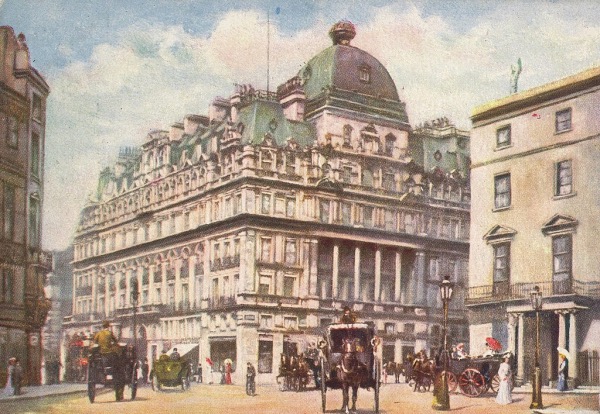
A luxury hotel built at the turn of the 20th century in the West End, the massive Carlton Hotel was part of an even larger redevelopment that included the (still standing) fourth version of Her Majesty’s Theatre (which provides a good idea of what the overall building looked like).
Located on the Crown estate on the corner of Pall Mall and Haymarket, the hotel was designed by CJ Phipps (who died before it was completed). Building started in 1896 and was completed by 1899.
Swiss hotelier César Ritz – who had been dismissed from his position as the manager of the Savoy Hotel in 1897 and subsequently successful opened his own establishment, the Hôtel Ritz, in Paris the following year – agreed to take a 72-year lease of the new hotel and a new company, The Carlton Hotel, Limited, was formed.
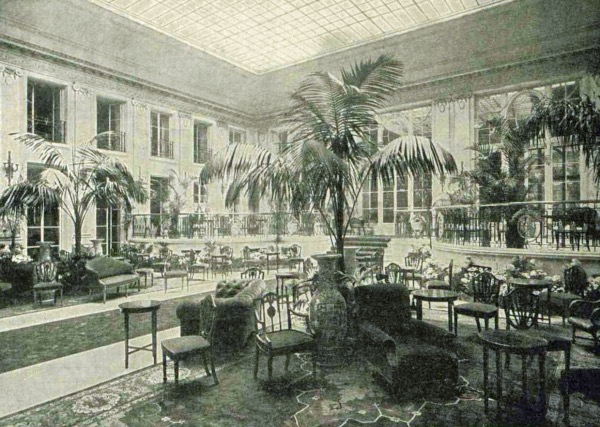
The building, which had interiors designed in the French Renaissance style, contained more than 300 guest rooms, all with telephones, including 72 suites which came with en suite bathrooms. There were also private dining and reception rooms for guests as well as reading and smoking rooms and a highly regarded Palm Court. And, of course, a restaurant in which Auguste Escoffier, who had left the Savoy under a cloud with Ritz, was employed as a head chef.
The Palm Court at The Carlton Hotel as featured in the Illustrated London News on 5th August, 1899.
The hotel, the upper floors of which contained private residences, was a hit and quickly threatened the status of the Savoy as the city’s most fashionable hotel. But in 1902, as the hotel was preparing to mark the coronation of King Edward VII, the king fell ill and the festivities were postponed indefinitely. Ritz suffered a nervous breakdown – apparently from the shock – and Escoffier was left in charge.
While its reputation was never again as high as it had been in the years immediately after opening, the Carlton Hotel remained profitable until World War II when it was heavily damaged during German bombing in 1940. Residential parts of the building were closed and in 1942 the remainder of the building was requisitioned by the British Government (with the exception of the American Bar and Grill Room which remained open).
The hotel never fully reopened, however, and, in 1949, the lease was sold to the New Zealand Government. The Carlton Hotel was demolished in 1957-58 and the New Zealand High Commission subsequently built on the site.
Among the hotel’s most famous clientele was Winston Churchill who was apparently dining in the restaurant with Lloyd George when World War I was declared.
Another famous association is commemorated by an English Heritage Blue Plaque which records the fact that Ho Chi Minh, founder of modern Vietnam, worked there as a cook in 1913 (when he was then known as Nguyen That Tanh).
There’s a story that Tanh, seeing how much food was being thrown away, asked Escoffier if he could give it to the poor, to which Escoffier told him to put aside his revolutionary ideas so he could teach him “the art of cooking, which will make you a great deal of money”. Tanh clearly choose another path.



 Exploring London
_(cropped).jpg)