This tradition, the origins of which go back centuries, centres on a ceremony at the Royal Hospital Chelsea which involves the blessing and cutting of a ‘Christmas Cheese’ with a sword.
The origins of the tradition go back to 1692 when a local cheesemonger donated cheese to the Chelsea Pensioners – retired members of the British Army – for Christmas. Since 1959, it’s been organised by industry body Dairy UK and sees cheesemongers from across the UK donate cheeses to the hospital.
The ceremony involves the largest cheese among those donated being blessed and then cut with a sword by a selected pensioner. The cheese is then distributed to the pensioners at meal times in the run-up to Christmas.
This year a special COVID-safe ceremony was held and some 258 kilograms of cheese were donated to the hospital. The largest cheese – a 25 kilogram Montgomery Cheddar – was cut by Chelsea Pensioner George Reed who had a 25 year career in military as well as a career at the BBC.
As well as last year’s 60th anniversary ceremony aside, other milestones have taken place in 2016 – when Chelsea Pensioner Mary Johnston became the first woman to cut the ceremonial cheese – and in 2009, when two members of Territorial Army London Regiment bound for Afghanistan joined the ceremony for the first time.
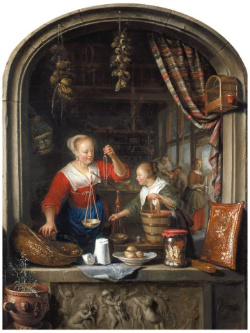
• World renowned artworks from Buckingham Palace’s Picture Gallery go on show at the Queen’s Gallery from tomorrow. Masterpieces from Buckingham Palace features 65 works by the likes of Titian, Rembrandt, Rubens, Vermeer, Van Dyck and Canaletto and, unlike in the tours of the State Rooms, visitors to the Queen’s Gallery will face the chance to enjoy the works close-up. The paintings on show include Johannes Vermeer’s The Music Lesson (early 1660s), Sir Peter Paul Rubens Milkmaids with Cattle in a Landscape, (c1617–18), Rembrandt’s The Shipbuilder and his Wife (1633), Canaletto’s The Bacino di San Marco on Ascension Day (c1733–4), Titian’s Madonna and Child in a Landscape with Tobias and the Angel (c1537) and Gerrit Dou’s The Grocer’s Shop (1672). The exhibition runs until January 2022. Advance booking is essential and admission charge applies. For more, seewww.rct.uk.
• The Museum of London is seeking to record the dreams of Londoners during the coronavirus pandemic in a new project with the Museum of Dreams at Western University in Canada.Guardians of Sleep represents the first time dreams as raw encounters and personal testimonies will be collected by a museum. Londoners are being asked to register their interest to take part by 15th January with conversations with members of the Dreams network – an international team of trained scholars from the psychosocial community, slated to be held over Zoom in February. Contributions will be considered for acquisition by the Museum of London as part of its ‘Collecting COVID’ project. To volunteer to participate in the study, or to find out more details, members of the public should contact info@museumofdreams.org.
• Abdus Salam, a Nobel Prize-winning theoretical physicist, has been honoured with a Blue Plaque at his former property in Putney. The red brick Edwardian house was the Pakistani scientist’s London base from 1957 until his death in 1996. It features a study where Salam would write while listening to long-playing records of Quranic verses and music by composers ranging from Strauss to Gilbert and Sullivan. Salam’s work on electroweak theory contributed to the discovery of the Higgs boson particle – the ‘God particle’ which gives everything mass, and he was also involved in improving the status of science in developing countries.The unveiling comes as English Heritage issues a call for the public to nominate more notable scientists from history for its Blue Plaque scheme in London with only around 15 per cent of the 950 plus blue plaques across the capital dedicated to scientists. For more, see www.english-heritage.org.uk/visit/blue-plaques/.
• A self-portrait series by late Gambian-British artist Khadija Saye can be seen at the British Library’s entrance hall from today.Khadija Saye: in this space we breathe features nine silk-screen prints and demonstrates Saye’s deep concern with “how trauma is embodied in the black experience” as well as her Gambian heritage and mixed-faith background. Saye, who died in 2017, photographed herself with cultural, religious and spiritual objects of significance both to her Christian mother and Muslim father and in African traditions of spirituality. The free display is on show until 2nd May. For more, see www.bl.uk.
Send all items for inclusion to exploringlondon@gmail.com.
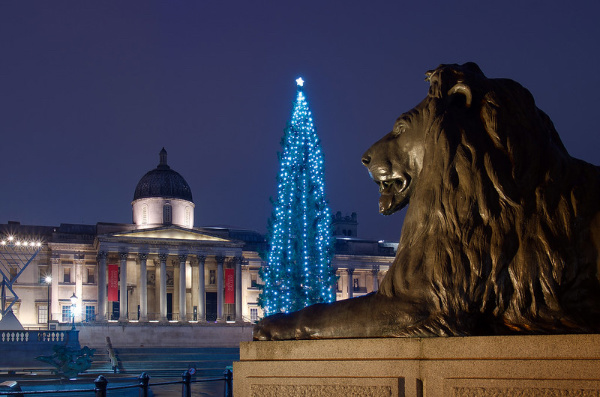
• The traditional Trafalgar Square tree lighting ceremony has gone virtual for the first time this year due to coronavirus restrictions. The online event, which will be held at 6pm on 3rd December via YouTube and Facebook, will include messages from the Lord Mayor of Westminster and the Mayor of Oslo as well as information on the history behind the gift of the tree, footage of its journey from the forests of Norway to London, and performances from the Salvation Army, the Poetry Society and the St Martin-in-the-Fields Choir. While the tree felling ceremony in Norway is usually attended by the Lord Mayor of Westminster, this year COVID restrictions meant he was represented by the British Ambassador to Norway, Richard Wood, who was joined by the Mayor of Oslo, Marianne Borgen, and school children from Maridalen school in Oslo, to witness the tree begin its journey to London. A Norwegian spruce has been given by the people of Oslo to the people of the UK in thanks for their support during World War II in the lead-up to every Christmas since 1947. Once the tree arrives in London, it is decorated with Christmas lights in a traditional Norwegian manner. For more on the tree, see westminster.gov.uk/trafalgar-square-christmas-tree.
• Eighteenth century anti-slavery campaigner Ottobah Cugoano – a former slave himself – has been honoured with an English Heritage Blue Plaque. The plaque is located at Schomberg House at 80–82 Pall Mall, the property where he was employed as a servant by artists Richard and Maria Cosway. It was while living here in the 1780’s that Cugoano wrote the book, Thoughts and Sentiments on the Evil and Wicked Traffic of the Slavery and Commerce of the Human Species, Humbly Submitted to the Inhabitants of Great-Britain, one of the first black-authored anti-slavery books to be published in Britain. The house was actually mentioned in the frontispiece of the 1787 edition of Thoughts and Sentiments as one of the places where copies of the book might be obtained. It is, says English Heritage, “evidence of the Cosways’ support for their servant’s endeavours as an author and a campaigner”. For more, see www.english-heritage.org.uk/visit/blue-plaques/.
• Somerset House is offering virtual tours of its exhibition Leila Alaoui: Rite of Passage. The exhibition is the first major retrospective of the work of Alaoui, a celebrated French-Moroccan photographer, video artist and activist who died in a terrorist attack at the age of 33 while working on a photography project promoting women’s rights in Burkina Faso in 2016. Guided by award-winning broadcaster and cultural commentator Ekow Eshun, the tour of the exhibition takes in three of the artist’s defining series – No Pasara, which documents the lives of North African migrants trying to reach Europe; Natreen (We Wait), which follows families trying to flee the Syrian conflict, and Les Marocains, which, inspired by Robert Frank’s The Americans, meets the many individuals who make up the multifaceted fabric of contemporary Morocco. The exhibition also includes an unfinished video project L’Ile du Diable (Devil’s Island) which Alaoui was working at the time of her death, featuring dispossessed migrant workers at the old Renault factory in Paris. The free tour can be accessed at www.somersethouse.org.uk/blog/virtual-tour-leila-alaoui-rite-passage.
Send all items for inclusion to exploringlondon@gmail.com.
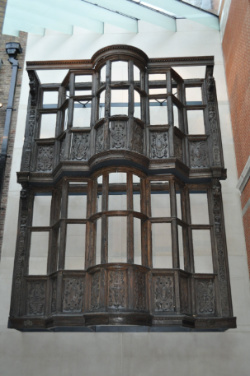
OK, so our last entry in this series isn’t a house, just a facade. But it is a significant and rare example of part of a pre-Great Fire timber-framed house in London which has been relocated.
PICTURE: tx K.B. Thommpson (licensed under CC BY 3.0)
The intricately detailed wooden facade, which can now be found in the V&A in South Kensington, was originally part of a three-and-half storey mansion which stood on the west side of Bishopsgate Without (that is, just outside the City of London’s walls).
It was built by Sir Paul Pindar, a wealthy merchant and diplomat who was knighted by King James I in 1620 (we’ll be featuring more of his story in an upcoming ‘Famous Londoners’ article).
He had purchased several properties in the street in 1597 and then incorporated these properties into a single mansion which also included a new section (of which the striking facade survives).
The house, which Shakespeare himself may well have walked past, was unusually large and sufficiently opulent that it served as the residence of Pietro Contarini, the Venetian ambassador, in 1617–18.
By 1660, it had been divided into smaller dwellings and, having survived the Great Fire of London, subsequently became a residence for the indigent. The front rooms on the ground floor, meanwhile, were turned into a tavern named the Sir Paul Pindar’s Head.
By the late 19th century, however, the nearby Liverpool Street Railway Station needed more room for expansion and, as a result, in 1890 the property was demolished to make space.
Part of the facade, however, was carefully dismantled (albeit some large sections, like the projecting carved window frames, were kept intact) and subsequently moved to the V&A where it was reassembled using carpenters’ marks on the wood.
The restored frontage (without the original glass and leading which was replaced in 1890) initially stood near the front of the museum but in the Noughties was delicately moved to where it now stands in the Medieval and Renaissance Galleries.
While the museum is currently closed as a result of coronavirus restrictions, we publish these details for when you can visit.Timed tickets can be booked for future dates here.
WHERE: Victoria and Albert Museum, Cromwell Road (nearest Tube stations are South Kensington and Gloucester Road); WHEN: Special – see above; COST: Free; WEBSITE: www.vam.ac.uk
Old Masters have been removed from the Picture Gallery at Buckingham Palace for the first time in almost 45 years to allow for essential maintenance works. The works, which include paintings by Titian, Rembrandt, Vermeer, Van Dyck and Canaletto, will be featured in a landmark new exhibition – Masterpieces from Buckingham Palace – which, featuring some 65 artworks in total, opens in the palace’s Queen’s Gallery on 4th December. They have been removed from the Picture Gallery – one of the palace’s State Room where Old Master paintings have hung since the reign of King George IV in the 1820s – over a period of four weeks to allow for building improvements which will include the replacement of electrics and pipework – some of which has not been updated since the 1940s – as well as the gallery’s roof. The refurbishment is part of a £370 million, 10 year refit programme being carried out at the palace due for completion in 2027.
• As controversy continues to swirl around the statue dedicated to Mary Wollstonecraft in Newington Green, another statue was unveiled in London this week – this time depicting two women pirates which some accounts say were lovers. The statue of Mary Read and Anne Bonny was unveiled at Execution Dock on the north bank of the Thames at Wapping – a site where pirates and smugglers were put to death for more than 400 years. Commissioned by audiobook company Audible to mark the release of a podcast, Hell Cats, a dramatic interpretation of the two women’s lives, the statue of Read and Bonny is the work of artist Amanda Cotton. Early next year it will be relocated to Burgh Island off the south Devon coast.
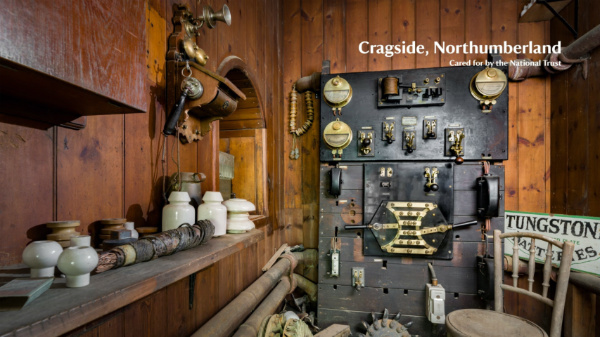
• The National Trust has released a series of six free downloadable backdrops – featuring some of the star interiors from its properties – for use in virtual meetings. The backdrops on offer include Vita Sackville-West’s writing room in the tower at Sissinghurst Castle in Kent, Agatha Christie’s library at Greenway, and the ‘Office of the Caretaker of the Electric Light’ at Cragside (pictured above). Different backgrounds will come online in coming weeks. Head to www.nationaltrust.org.uk/features/virtual-backgrounds-for-zoom.
• The London Transport Museum has unveiled three new virtual tours taking in the Holborn (Kingsway) area, Brompton Road station and King William Street station. The tours, part of the museum’s Hidden London programme, provide access to areas not usually open to the public as well as to historic archival material and footage from the museum’s collection and are led by expert guides on Zoom. Admission charges apply. For more, including dates, see www.ltmuseum.co.uk/hidden-london/virtual-tours.
Send all items for inclusion to exploringlondon@gmail.com
Formerly a noted church in London’s West End, St Andrew’s Church now has a new life in Kingsbury.
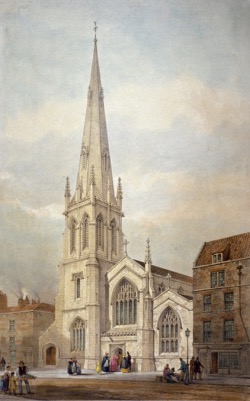
A drawing of St Andrew’s in Wells Street.
The church’s origins go back to its construction in Wells Street, Marylebone, in the mid-19th century. Designed by Samuel Daukes, the church, the construction of which began in 1845, was completed in February, 1847.
St Andrew’s soon become one of the city’s most fashionable churches (Prime Minister, William Gladstone, was an occasional worshipper).
Rev Benjamin Webb was vicar between 1862-85 – a time when the church was known for its High Anglican services, and it was during his tenure that the church’s rather splendid interior fittings were added.
These included a reredos (featuring five sculptures by James Redfern) designed by GE Street, a high altar by Augustus Pugin, a brass reading desk by William Butterfield and a litany desk by William Burges (now in the V&A).
By the start of the 20th century, the area around the church was being transformed as residences gave way to commercial property and warehouses. The congregation dwindled and eventually the church was declared redundant, its doors closing on Easter Sunday, 1931.
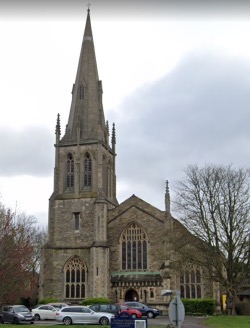
The church in Kingsbury PICTURE: Google Maps
The church was set to be demolished but there was an outcry and eventually a proposal to relocate it to Kingsbury, in London’s north-west, where there was a congregation urgently needing a new building.
The church was carefully dismantled – each stone labelled and numbered – and then transported 10 miles to Kingsbury where it reconstructed in Old Church Lane.
The rebuild – described at the time as putting together “the biggest jigsaw in the world” (yes, it’s a somewhat overused phrase when it comes to building relocations) – took three years and involved making as few changes to the former structure as possible.
The building was finally reconsecrated on 13th October, 1934, by Arthur Foley Winnington Ingram, the Bishop of London. St Andrew’s Kingsbury remains in use as a church today.
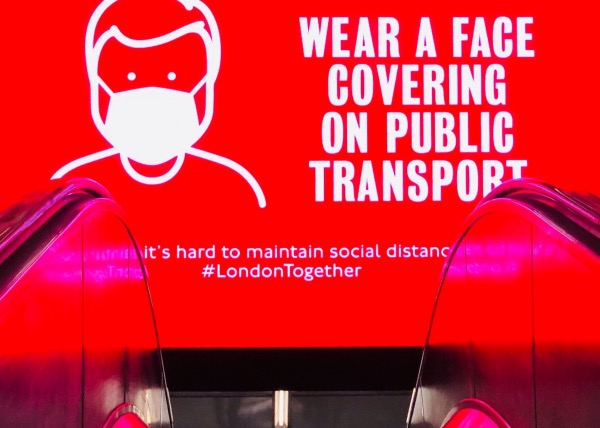
• A controversial new statue commemorating feminist icon Mary Wollstonecraft was unveiled in Newington Green, near where Wollstonescraft lived and opened a girls’ school, in the city’s north this week. Designed by British artist Maggi Hambling, A Sculpture for Mary Wollstonecraft depicts a small nude female figure – described by those behind the campaign for the statue as “Everywoman, her own person, ready to confront the world” – rising out of other, intermingled, female forms below. Hambling said she wanted the sculpture to reflect Wollstonecraft’s spirit, rather than her likeness. The statue’s unveiling is the culmination of a 10 year campaign to see a statue for Wollstonecraft led by author Bee Rowlatt. The statue has already been the target of protestors who have reportedly used black tape, COVID masks, and a T-shirt to cover it up.
Images of Faint Signals on screen by Invisible Flock
• A new work set in an imagined Yorkshire forest and looking at how natural sound has changed over the last 50 years has gone online this week. Commissioned by the British Library, Faint Signals is the work of Yorkshire-based interactive arts studio Invisible Flock and allows people to explore Yorkshire’s flora, fauna, and wildlife – both past and present. Launched to mark World Science Day on Tuesday, the work can be visited until 2nd January. Head here faintsignals.io.
• The National Gallery has launched a new collaboration with camera maker Nikon to showcase the gallery’s works and “explore the synergies between photography and fine art”. In the first collaboration of its kind, the “digital content partnership” will see the gallery work with Nikon to produce a range of online content over the next year. This kicks off with an exploration of Jan van Kessel the Elder’s 1654 work, Butterflies, Moths and Insects with Sprays of Common Hawthorn and Forget-Me-Not, under the Picture of the Month series (the concept of ‘Picture of the Month’ dates back to 1942, when a single painting was returned to the gallery each month from the disused Welsh slate mine where the collection was kept for safety during World War II). The painting is explored in depth in a range of ways on the gallery’s website including through two short films. Further online films, talks and events are planned. For more on the Picture of the Month, head to the National Gallery website.
• Londoners still have two weeks to have their say on what should happen to statues and other landmarks in the City of London which have links to slavery and historic racism. The City of London Corporation said it has received more than 800 responses since launching the consultative exercise in September in which it’s asking people to give their views on which landmarks – including statues, street and building names – they think are a problem, and what action they think should be taken. Among those monuments which have been mentioned to date are statues at Guildhall depicting former Lord Mayor William Beckford and MP and philanthropist Sir John Cass, both of whom profited from the slave trade. In September, the Sir John Cass’s Foundation Primary School in the City announced it was changing its name to The Aldgate School to break the link with its controversial founder. Head to www.cityoflondon.gov.uk/historiclandmarksconsultation by 24th November to take part.
Send all items for inclusion to exploringlondon@gmail.com
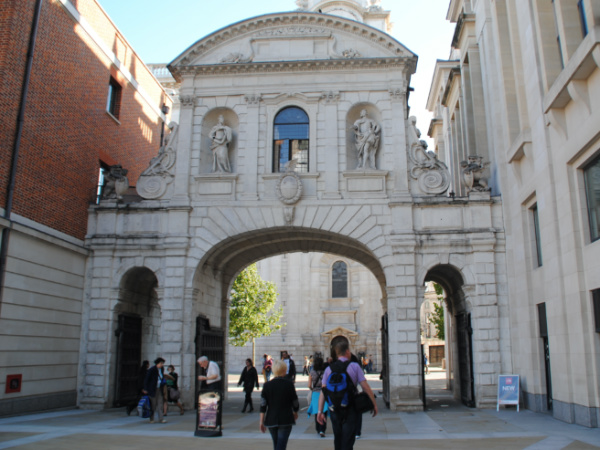
This ornate Baroque archway only stands with walking distance from where it originally stood marking the entrance to the City of London. But it came to this position by a somewhat roundabout route.
Temple Bar – with statues of Queen Anne and King James I (looking towards St Paul’s Cathedral) PICTURE: David Adams.
The gate was originally constructed at the junction where Fleet Street becomes the Strand, it marked the boundary between the City of London and Westminster.
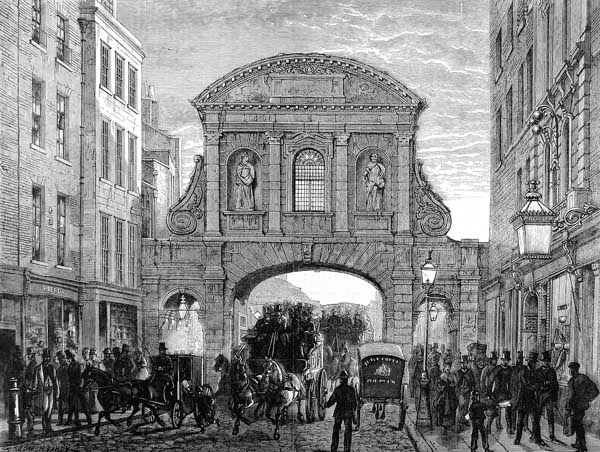
While the first gate on the site dates back to the 14th century (prior to that the boundary was apparently marked with a chain two posts), the gate we see today dates from 1672 when, despite having survived the Great Fire of London, the previous gate – a crumbing wooden structure – was demolished and this upmarket replacement built to the design of none other than Sir Christopher Wren (earlier designs for the gate created by Inigo Jones were never acted upon).
An artist’s impression of the Temple Bar in 1870 from Illustrated London News.
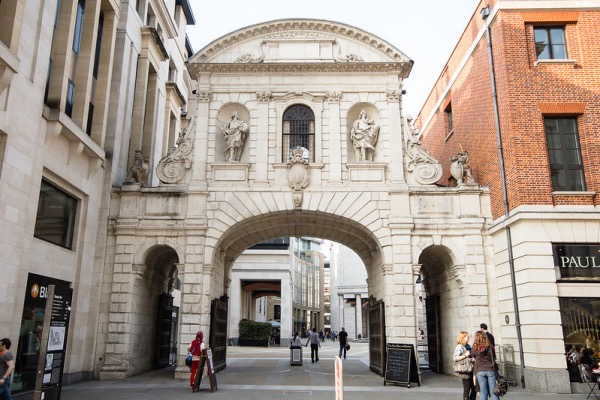
Made of Portland stone, the new structure featured figures of King Charles I and King Charles II on the west side and King James I and Queen Anne of Denmark on the east (it’s said that a third of the total £1,500 cost was spent on the statuary alone).
Shortly after its construction, it became a location for the display of the remains of traitors (usually heads), the first of which were the body parts of Rye House plotter Sir Thomas Armstrong and the last of which was the head of Jacobite Francis Towneley in 1746 (there’s also a story that such was the interest when the heads of the Rye House plotters – who had planned to assassinate King Charles II and crown his brother, the future King James II, in his place – were displayed, telescopes were rented out so people could get a closer look).
Temple Bar with statues of King Charles I and King Charles II (looking into Paternoster Square). PICTURE: Eric Heupel (licensed under CC BY-NC-ND 2.0)
Among the luminaries who passed under the central arch were Anne Boleyn (the day before her coronation) and Queen Elizabeth I. The Queen did so most famously on her way to give thanks in St Paul’s Cathedral for the English victory over the Spanish Armada and since then, whenever a Sovereign has wanted to enter the City past Temple Bar, there’s been a short ceremony in which the Sovereign asks permission of the Lord Mayor of London to enter. Granting this, the Mayor then offers the Sword of State as a demonstration of loyalty and this is subsequently carried before the Sovereign as they proceed through the City as a sign of the Lord Mayor’s protection.
The Temple Bar stood in its original location until 1878 when, to help traffic flow, it was carefully removed brick-by-brick over a period of 11 days (the City of London Corporation well aware of its historical significance) . It was initially intended that the gateway would be rebuilt somewhere else in the city, but time passed and no suitable site was found.
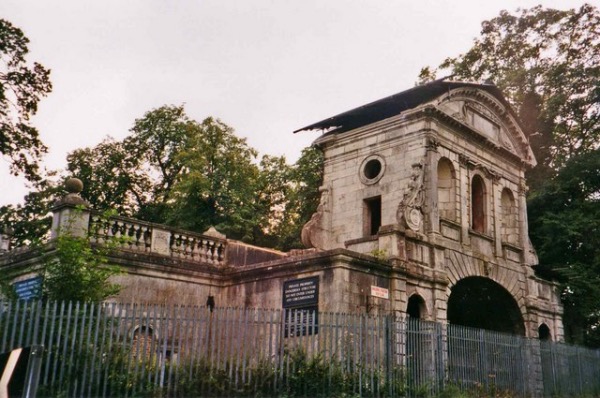
Instead, the gate lay in pieces in a yard in Farringdon Road before, in the mid 1880s, Sir Henry Bruce Meux had all 2,500 stones transported via trolleys pulled by horses to his estate at Theobalds Park in Hertfordshire and re-erected there as a gateway (the Lady Meux apparently used the small upper room for entertaining – among those said to have dined here was King Edward VII and Winston Churchill).
Temple Bar at Theobolds Park. PICTURE: Christine Matthews (licensed under CC BY-SA 2.0)
In 1976, the Temple Bar Trust was formed to have the archway returned to London – they eventually succeeded 30 years later in 2004 when it was re-erected on its current site between St Paul’s and Paternoster Square at a cost of some £3 million.
The original site of the Temple Bar is now marked with a Victorian era memorial – erected in 1888 – which features statues of Queen Victoria and Edward, the Prince of Wales.
While the lockdown means buildings are now closed, we continue with our regular series for visits at a later time…
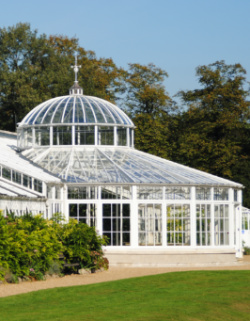
This 300 foot long, now Grade I-listed, conservatory was constructed on the orders of the 6th Duke of Devonshire in the grounds of the neo-Palladian Chiswick House to the west of London and completed in 1813.
Then one of the largest of its kind in the world, the conservatory was designed by Samuel Ware (he also designed the Burlington Arcade in Piccadilly) and while its east and west ranges are of a conventional design, its centre features an unusual domed roof.
The conservatory, which was built on land which the duke had acquired by buying a neighbouring estate, is seen as a forerunner to Decimus Burton’s famous building at Kew Gardens as well as Joseph Paxton’s conservatory at Chatsworth and even the Crystal Palace itself.
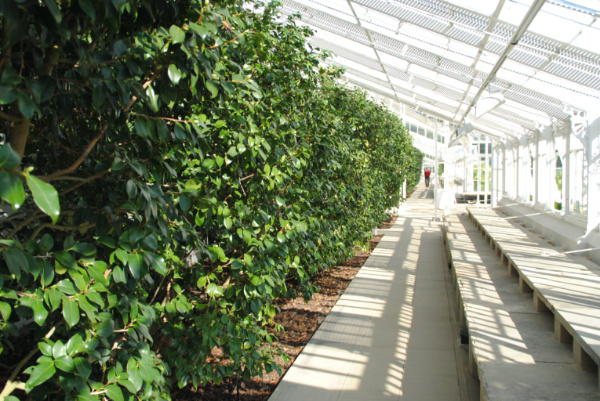
In 1828, the Duke filled it with his exotic collection of camellias. The glasshouse now stands at the heart of Chiswick House’s annual Camellia Festival.
The collection of camellias is, of course, a treasure in its own right. It was first created by the 6th Duke and his gardener, William Lindsay, with plants acquired from Alfred Chandler’s nursery in Vauxhall.
The collection includes 33 different varieties, including some of the earliest introduced to the UK, and one of the rarest plants in the world – a deep pink camellia japonica known as ‘Middlemist’s Red’ which was originally brought to Britain from China in 1804 by Shepherds Bush nurseryman John Middlemist, and apparently presented by one of his descendants to Chiswick sometime after 1823.




 Exploring London