This Week in London – London’s World War I transport in focus; Museums at Night; and, Tony Hancock remembered…

Opening tomorrow, a major exhibition at the London Transport Museum will take an in-depth look at the role transport played in London during World War I – from how London bus drivers took their vehicles to the front lines to the advance of women into the transport workforce for the first time and, of course, how Londoners fared under the deadly aerial attack of the Luftwaffe. Key among the objects on display as part of Goodbye Piccadilly at the Covent Garden site will be ‘Ole’ Bill’ – a 1911 bus on loan from the Imperial War Museum which was requisitioned for the front and, taking its name from Bruce Bairsfather’s popular cartoon character, featured regularly in Armistice Day parades until the 1960s. Other highlights include World War I recruitment posters, a 1914 female bus conductor’s uniform and a newly acquired piece of ‘trench art’ – a decorated Daimler bus steering wheel. Runs until 8th March. Admission charge applies. For more, see www.ltmuseum.co.uk.

The annual Museums at Night event kicks off tonight and runs until Saturday night. Among the premises participating this year is the Hunterian Museum at the Royal College of Surgeons in Lincoln’s Inn Fields which is showing a selection of rarely seen materials from its archives, the Banqueting House in Whitehall, Keat’s House in Hampstead and the Petrie Museum of Egyptian Archaeology at University College London which is running a murder mystery event Friday night. Some events are ticketed and some have an admission charge so check out the website before you go. For more, see www.culture24.org.uk/places-to-go/museums-at-night.

The late comedian Tony Hancock was honoured with an English Heritage Blue Plaque at his former home in South Kensington on Monday on what would have been his 90th birthday. Hancock, famous for Hancock’s Half Hour on radio and TV, lived on the fourth floor of a Grade II-listed building at 20 Queen’s Gate Place with his wife Cicely Romanis between 1952 and 1958. It was the longest time he lived at any property in London and coincided with the most creative and successful period of his career with the show first board cast on BBC radio in 1954 and also appearing on TV from 1956 onwards. Hancock died in 1968. For more, see www.english-heritage.org.uk/discover/blue-plaques/.

Send all items of interest for inclusion to exploringlondon@gmail.com.

This Week in London – A rare chance to walk through a Thames tunnel; Matisse at the Tate; and, Spitting Image on show…

It’s a rare chance to walk the historic Thames Tunnel between Wapping and Rotherhithe – the first tunnel ever dug under a navigable waterway. Transport for London and London Overground are offering the chance to purchase tickets to walk the tunnel – built by Marc Brunel, it’s now used by the London Overground – over the May Bank Holiday weekend on 24th to 26th May. Tickets, which cost £18 plus booking fee, go on sale today at 10am via the London Transport Museum in Covent Garden and are strictly limited (with no on the day admissions allowed). Proceeds from the day will go to the Railway Children’s Charity and the Brunel Museum. Also, worth noting is that the London Transport Museum is offering tours of its depot this Friday and Saturday. Admission charge applies. For more, see www.ltmuseum.co.uk.

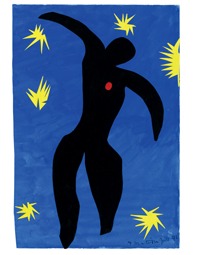
MatisseThe paper cut-outs of Henri Matisse are the focus of a landmark exhibition which opened at Tate Modern last week. Henri Matisse: The Cut-Outs features about 130 works created between 1937 and 1954 with many seen together for the first time. Highlights include maquettes featured in the 1947 book Jazz, The Snail and its sister work Memory of Oceania (both 1953) and the largest number of the Blue Nudes ever shown together. The display takes an in-depth look at the methods and materials Matisse used in the production of the cut-outs. Runs until 7th September (and keep an eye out for the accompanying film, Matisse: Live in cinemas). Admission charge applies. For more, see www.tate.org.uk. PICTURE: Henri Matisse, Icarus 1946, Maquette for plate VIII of the illustrated book Jazz 1947, Digital image: © Centre Pompidou, MNAMCCI, Dist. RMN-Grand Palais / Jean-Claude Planchet, Artwork: © Succession Henri Matisse/DACS 2014.

On Now: Spitting Image. This exhibition at the Cartoon Museum in Bloomsbury centres on the partnership of three dimensional artists Peter Fluck and Roger Law and their key role in the creation of what became known as Spitting Image. It features caricature drawings and photographs created for magazines in the 1970s and 1980s of the likes of Paul McCartney, Michael Jackson, Kate Moss, Saddam Hussein, Billy Connolly, Rupert Murdoch, Jo Brand and John Paul II as well as members of the Royal Family and politicians including Margaret Thatcher. Also present are some of the puppets used in the TV show which ran for 18 series between 1984 and 1996 – these include those of Thatcher, The Queen, Princess Diana and Mr Spock. Runs until 8th June (with selected late opening nights). Admission charge applies. For more, see www.cartoonmuseum.org.

Send all items of interest for inclusion to exploringlondon@gmail.com.

This Week in London – William Shakespeare’s influence; new Fourth Plinth commissions; the car and landscape; and London Stories…

First up, apologies that we were unable to launch our new Wednesday series yesterday due to some technical difficulties (stayed tuned for next week). And now, on with the news…

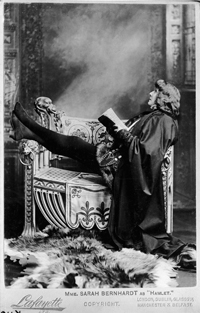
Sarah_Bernhardt_by_Lafayette_Ltd_1899_c__Victoria_and_Albert_Museum_London__William Shakespeare’s influence on successive generations of theatrical performance is the subject of a new exhibition at the V&A to mark the 450th anniversary of his birth on 23rd April. Shakespeare: Greatest Living Playwright centres on the Bard’s First Folio which, published in 1623, contains 36 plays including 18 works – Macbeth, The Tempest and Twelfth Night among them – which would be unknown without it. The display includes interviews, archive footage and photography and objects from the V&A collections as well as an audio-visual presentation by Fifty Nine Productions featuring interviews with contemporary theatre practitioners such as actors, directors and designers. Objects on display include a skull used by Sarah Bernhardt when playing Hamlet in 1899, an embroidered handkerchief used by Ellen Terry when playing Desdemona in 1881 at the Lyceum Theatre, and a pair of red boots worn by actor-manager Henry Irving in an 1887 production of Richard III. Runs in the V&A’s Theatre and Performance Galleries until 21st September. Admission is free. For more, see www.vam.ac.uk. PICTURE: Sarah Bernhardt as Hamlet, 1899, © Victoria and Albert Museum, London.

A skeletal horse and a giant hand giving a thumbs up will adorn the Fourth Plinth in Trafalgar Square during 2015-16. Hans Haacke’s Gift Horse is derived from an etching by painter George Stubbs and, while being a comment on the equestrian statue of King William IV which was intended for the plinth, also features an electronic ribbon displaying a live ticker of the London Stock Exchange on its front leg. Meanwhile David Shrigley’s Really Good is a 10 metre high hand giving a thumbs up – sending a positive message to those who see it. For more, see www.london.gov.uk/priorities/arts-culture/fourth-plinth.

The impact of the car on England’s landscape and the listed buildings of motoring history are the focus of a new exhibition in Wellington Arch. Carscapes: How the Motor Car Reshaped England features archive photographs, historic advertising, cartoons and motoring magazines as well as a 1930s traffic light, a petrol pump and other accessories and memorabilia. Wellington Arch, which is managed by English Heritage, is a fitting location for the exhibition – it was moved to its current position due to increasing traffic back in 1883. Admission charge apply. For more, see www.english-heritage.co.uk.

A new exhibition exploring some of the true and not-so-true stories inspired by and produced in London opens at the London Transport Museum in Covent Garden tomorrow. London Stories features the best entries from The Serco Prize for Illustration 2014 with more than 50 works of art on display depicting a well-known or obscure London narrative. The short-listed illustrations tackle everything from ghost buses to Buffalo Bill’s Wild West Show of 1887, a Pearly King and Queen, Lenin’s ‘Love letter to London’ and an escaped monkey jazz band. There’s also a host of musical and literary references – everything from Mary Poppins to Sweeney Todd and Oranges and Lemons. Tomorrow there will be a late opening of the exhibition complete with cash bar, DJ and story-telling for adults as well as the chance to create your own London story with illustration workshops and a photo-booth. Organised by London Transport Museum in partnership with the Association of Illustrators, it runs until 6th April. Admission charge applies. For more, see www.ltmuseum.co.uk.

Send all items of interest for inclusion to exploringlondon@gmail.com.

Around London – Reclaiming Castiglione; transport open weekend; and, Australia at the RA…

Oriental The UK’s first major exhibition on the work of the innovative but violent 17th century artist Giovanni Benedetto Castiglione opens tomorrow at the Queen’s Gallery next to Buckingham Palace. The exhibition, which features 90 drawings and prints from the Royal Collection, is aimed at re-establishing Castiglione as one of the greatest artists of the Baroque period, thanks to his being credited with creating huge drawings in oil directly on paper, producing about 60 etchings and inventing the technique of monotype. Works include his monotype prints Head of an oriental (late 1640s) and The Nativity with angels (about 1655), a translation of Titian’s Sacred and Profane Love and drawings like Circe with the companions of Odysseus transformed into animals. Castiglione’s “nomadic” career was marred by his violent temperament – he was repeatedly before the courts for assaulting people, apparently tried to throw his sister off a roof and was forced to leave Rome because, it is believed, he had committed murder. Castiglione: Lost Genius runs with Gifted: From the Royal Academy to The Queen, an exhibition of prints and drawings given to the Queen by Royal Academicians to mark her Diamond Jubilee, until 16th March. Admission charge applies. For more, see www.royalcollection.org.uk. PICTURE: Giovanni Benedetto Castiglione, The head of an oriental, late 1640s. Royal Collection Trust/©Her Majesty Queen Elizabeth II 2013.

The restored Met Locomotive 1 and the Victorian Jubilee Carriage 353 will be on show this weekend as part of the London Transport Museum’s Open Weekend at its Acton Depot. Visitors will be able to explore the depot’s vast collection of more than 400,000 objects along with a range of other activities including miniature tram and railway rides, heritage bus rides, talks and film screenings, and costumed interpreters as well as the chance to watch artist Ross Ashmore paint the locomotive and Jubilee Carriage. The weekend kicks off tomorrow. For more information and bookings, see www.ltmuseum.co.uk/whats-on/museum-depot/events.

On Now: Australia. This landmark exhibition at the Royal Academy of Arts at Burlington House in Piccadilly features more than 200 works including paintings, drawings, photography, watercolours and multimedia pieces by 146 Australian artists. Spanning the period from 1800 until today, the display includes works by Aboriginal artists such as Albert Namatjira, nineteenth century immigrants such as John Glover and Eugene von Guerard, impressionists like Arthur Streeton and Tom Roberts, early modernists like Margaret Preston and Roy de Maistre, 20th century painters including Arthur Boyd, Albert Tucker and Brett Whiteley and contemporary artists including Gordon Bennett, Fiona Hall and Shaun Gladwell. Highlights include Frederick McCubbin’s The Pioneer (1904), four paintings from Sidney Nolan’s Ned Kelly series (1946), Rover Thomas’ Cyclone Tracy (1991) and Emily Kame Kngwarreye’s Big Yam Dreaming (1995). Organised with the National Gallery of Australia, the exhibition runs until 8th December. Admission charge applies. For more, see www.royalacademy.org.uk.

10 Questions – Simon Murphy, curator at the London Transport Museum…

Simon Murphy is a curator at the London Transport Museum in Covent Garden – the museum is currently celebrating the 150th birthday of the Underground with a series of events including a landmark exhibition on the art of the Tube (Poster Art 150 – London Underground’s Greatest Designs)…
Underground-2How significant was the construction of the London Underground in world terms? And how does it stack up 150 years later? “The Metropolitan Railway was a true world class pioneer, but like all pioneers it made mistakes that subsequent operators learned from. Similarly the first tube railways tested the ground for others to follow. But these pioneering lines are still part of today’s world class Tube network, and some of the original stations, like King’s Cross, are still amongst the busiest, so they must have been on the right track.”

I understand the initial stretch of line ran between Farringdon and Paddington. How quickly were other sections opened? “The Metropolitan Railway’s first extension was authorised by Parliament in 1861, two years before the original line even opened. The railway made a profit in its first year, so financial backing was relatively easy to find, and the extension east to Moorgate opened in 1865, with a westward extension to South Kensington following in 1868. The Met’s main competitor, the Metropolitan District Railway, opened its first section from South Ken to Westminster in 1868. The plan was for the two companies to work together to create an Inner Circle service, but their respective directors fell out and the Circle was not completed until 1884.”

How many miles of line is the Underground composed of today? “The first underground started with less than four miles of track and seven stations; today’s system has 250 miles of track, serving 270 stations.”

When were steam trains on the Underground replaced? “Steam trains worked in central London until 1905, but were still used on the furthest reaches of the Met until 1961.”

When did the Underground take on the name ‘Tube’? “The Central London Railway opened with a flat fare of 2d in 1900, and was promoted as the Twopenny Tube – the name caught on, although the Underground has only been referring to itself officially as the Tube since the 1990s.”

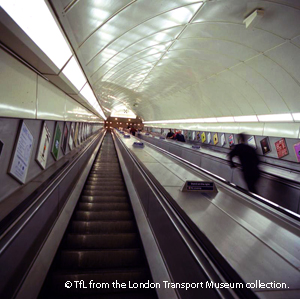
Underground1It’s fairly widely known that Underground stations and tunnels were used as air raid shelters during World War II. Do you know of any other different uses they have been put to? “The station at South Kentish Town on the Northern Line closed in 1924, but the surface building, still looking very much like a station is now occupied by a branch of Cash Converters. During the war unfinished tunnels on the Central line were occupied by a secret factory run by Plessey Components. Also during the war, paintings from the Tate Gallery were stored in  a disused part of Piccadilly Circus station for safe keeping.”

Stylish design has always been an important part of the Underground’s appeal. What’s your favourite era stylistically when it comes to the Underground and why? “Most people admire the golden age of the 1920s and 30s when the Underground’s corporate identity and personality reached its peak with Charles Holden’s architecture, the roundel, Harry Beck’s diagrammatic map and the amazing posters issued in that era, but personally I find the earlier period from 1908 to 1920 more interesting. You can trace the roots of each element of today’s brand being developed at this time, under Frank Pick’s critical eye, starting with the early solid-disc station name roundels, the joint promotion of the individual tube railways under the UndergrounD brand and the introduction of Edward Johnston’s typeface. You can see the company gaining confidence and momentum, especially in relation to the increasingly sophisticated posters and promotion that Pick commissioned.”

Can you tell us a bit about how the London Transport Museum is marking the 150th anniversary? “
We started the year by bringing steam back to the Circle line, after restoring an original Metropolitan Railway carriage and overhauling an original Met steam locomotive, and have just opened our fabulous overview of the 150 best Underground posters at the museum in Covent Garden, which runs until October. We are opening our Depot store, near Acton Town station in April for a steam weekend, and have a range of lectures and evening events at Covent Garden linking to the history of the Underground and its poster art heritage. There’s also our comprehensive new history of the Tube published last year and a wide range of new products and souvenirs in our amazing shop.”
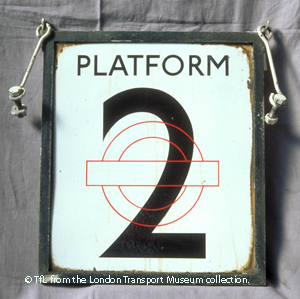
Underground3What are some of your favourite Underground-related objects on display at the museum? “The Design for Travel gallery on the ground floor is the literal and metaphorical heart of the Museum for me. Packed with close to 300 objects including signs, posters, models, leaflets and other documents, it’s hard to single out individual items, but I love the simplicity of the small ‘Platform 2’ hanging sign (pictured right) – it’s a real example of the design consistency and attention to detail that I associate with the Underground.”

And lastly, can you tell us a couple of little-known facts about the Underground? History is more than a chronological list of facts, and what one person finds fascinating sends another to sleep, so it’s quite a challenge to choose something that is little known, but genuinely interesting, but I’ll try: I grew up near Brent Cross station so I might be biased, but I reckon that if there was a top trumps for Underground lines, the Northern line would win. It has the longest escalators (at Euston), the deepest lift shaft (at Hampstead), the highest point ve sea level (on a viaduct near Mill Hill East), the longest tunnels (between East Finchley and Morden – 17 miles) and has had more names than any other line – it only became the Northern line in 1937.”

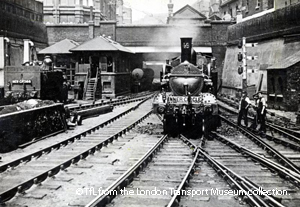
IMAGES: Top: Steam engine at Aldgate (1902); Middle: Platform 2 sign, 1930s design; and Bottom, Angel Underground Station (1990s). © TfL from the London Transport Museum collection. 

Poster Art 150 – London Underground’s Greatest Designs runs at the London Transport Museum until October. Admission charge applies. For more (including the many events around the exhibition), see www.ltmuseum.co.uk/whats-on/events/events-calendar#posterart150.
Around London – Celebrating the art of the Underground and art on the web; Picasso at the Courtauld; and, Frederic Church at the National…

A new exhibition celebrating the art of the Underground opens at the London Transport Museum in Covent Garden tomorrow. Poster Art 150 – London Underground’s Greatest Designs showcases 150 posters with examples taken from each decade over the past 100 years. Artists include the likes of Edward McKnight Kauffer, Paul Nash and Man Ray. The posters were selected from the museum’s archive of more than 3,300 by a panel of experts. Visitors to the exhibition will be able to vote on their favorite poster as well as online with the most popular poster to be revealed at the end of the exhibition. The last major exhibition of Underground posters – the first commission of which was in 1908 – was held in 1963 to celebrate the system’s centenary. The exhibition is based around six themes – ‘Finding your way’, ‘Brightest London’, ‘Capital culture’, ‘Away from it all’, ‘Keeps London going’ and, ‘Love your city’. Runs until 27th October. Admission fee applies. For more on the exhibition and surrounding events, see www.ltmuseum.co.uk.

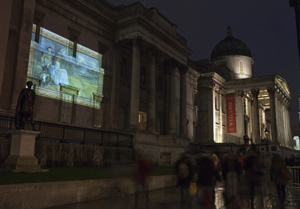
National-Gallery The external facade of the National Gallery in Trafalgar Square was decorated with artworks last Friday night (pictured right) in celebration of the completion of Your Paintings – a website which hosts the UK’s entire national collection of oil paintings (more than 210,000!). The projections – which were happening in 28 UK cities simultaneously – featured two National Gallery paintings – Van Gogh’s Sunflowers and Gainsborough’s Mr and Mrs Andrews. To see the website, head to www.bbc.co.uk/arts/yourpaintings/. PICTURE: © The National Gallery, London.

• On Now: Becoming Picasso: Paris 1901. This exhibition at The Courtauld Gallery in Somerset House on The Strand tells the story of Pablo Picasso’s break-through year as an artist – 1901 – when the then 19-year-old launched his career in Paris at a summer exhibition. The display follows Picasso from his debut and into the start of his Blue period. Works exhibited are among the first to bear his famous signature. Runs until 26th May. There is an admission charge. For more, see www.courtauld.ac.uk/gallery/index.shtml.

On Now: Through American Eyes: Frederic Church and the Landscape Oil Sketch. This free exhibition of 30 works at the National Gallery focuses on the work of Frederic Church (1826-1900), a member of the Hudson River School of artists and considered by many to be the greatest of the American landscape oil sketch artists. Works on display include those made at exotic locations such as Ed Deir, Petra, painted in Jordan in 1868, and Distant View of the Sangay Volcano, Ecuador, painted in 1857, as well as the paintings created closer to home, such as Hudson, New York at Sunset, painted in 1867. The exhibition is held in Room 1. Runs until 28th April. For more see www.nationalgallery.org.uk.

LondonLife – Celebrating London Underground’s 150th…

London-Underground1

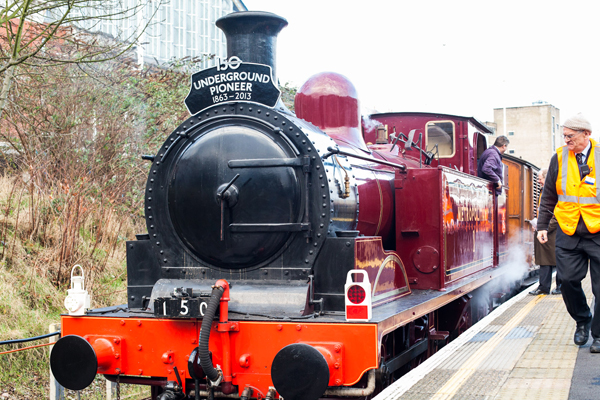
Metropolitan Locomotive No 1 recreated the first London Underground journey, which took place on 9th January, 1863, on the Metropolitan Line between Paddington and Farringdon, as part of the network’s 150th anniversary celebrations last Sunday. The newly restored locomotive was the last to be built at Neasden in 1898 by the Metropolitan Railway. It was pulling the Metropolitan Railway Jubilee Carriage No 353, the oldest operational underground carriage in existence. Ex Metropolitan Railway electric Locomotive No.12 Sarah Siddons also formed part of the train. The train will also be running this coming Sunday (20th January) and on special occasions throughout this year and is just one of a series of events planned by the London Transport Museum to mark the anniversary of what is the world’s oldest underground railway. They include an upcoming exhibition of London Underground’s poster art (more on that to come). For more, see www.ltmuseum.co.uk. PICTURES: © Transport for London from the London Transport Museum collection.

London-Underground3

Around London – The Tower hosts Royal Beasts; take a ride on a 1938 tube train; Lambeth Palace Library celebrates the King James Bible; and, see model cathedrals at Sir John Soane’s house…

• The history of the Royal Menagerie is the focus of a new exhibition on now at the Tower of London. Royal Beasts explores the history of the Tower menagerie which, founded during the reign of King John in the early 1200s, remained there for more than 600 years. Among the animals were lions (the first record of which dates from 1210), a grizzly bear (a gift from the Hudson Bay Company to King George III), elephants, tigers, ostriches and kangaroos. Highlights of the exhibition include modern animal sculptures by artist Kendra Haste and interactive sensory displays. The recently restored north wall walk and the never before opened Brick Tower will host some of the displays, including sights, sounds and smells of some of the animals. See www.hrp.org.uk/TowerofLondon.

A 1938 tube train will run along the western end of the Piccadilly Line this Sunday (that’s Father’s Day in case you’ve forgotten) as part of the London Transport Museum’s Heritage Vehicles on the Move 2011 programme. Leaving Northfields, the train will travel to High Street Kensington via Earl’s Court (crossing from the Piccadilly to the District Line in a move not normally experienced by the general public) before heading back down the District Line to Acton Town where it will change back onto the Piccadilly Line. The train will then undertake the “fishhook move”, visiting Heathrow Terminal 4 before going to Terminals 1,2,3 and 5. The entire journey is expected to last about two hours. Tickets, which can be purchased at the museum ticket desk or by calling 020 7565 7298, will need to be collected at Northfields Station. For more, see www.ltmuseum.co.uk/whats-on/events/vehicles-on-the-move.

• Lambeth Palace Library is celebrating the 400th anniversary of the King James Bible with a new exhibition. The exhibits include a 1611 edition of the Bible as well as Medieval Bible translations, landmark editions of the Bible which drew on the textual scholarship of the Renaissance and Reformation and early printed vernacular versions. Runs until 29th July. Admission is by pre-booking only. For information on buying tickets and more, see www.lambethpalacelibrary.org/content/2011exhibition.

On Now: Time is running out to see Sir Herbert Oakley’s collection of 27 models of European and English cathedrals at the Sir John Soane Museum. The models were made in the 1850s by William Gorringe, who was a modelmaker by appointment to Queen Victoria. Runs until 25th June. For more, see www.soane.org/exhibitions/

Marking 70 years since the Blitz began…

Today – 7th September – marks 70 years since the start of the Blitz when, between 7th September 1940 and 10th May 1941, more than 43,000 civilians were killed, at least 140,000 injured and an estimated million homes across the UK suffered damage or destruction as a result of air raids.

London, which suffered 57 consecutive nights of attacks starting on 7th September, features numerous memorials relating to World War II including the National Firefighters Memorial located on the Jubilee Walkway, just south of St Paul’s in the City. It depicts firefighters in action during the Blitz and serves as a tribute to those who fought against the fires caused by the raids as well as commemorating the lives of all firefighters who have died while on active duty. For more on the memorial, see www.firefightersmemorial.co.uk.

For a series of interesting reconstructed photos showing the difference between London during the Blitz and now, visit Sky News here. Or for more on the history of the Blitz, see the dedicated BBC website here. And for a terrific graphic showing fire brigade callouts in London on the first day of the Blitz, see The Guardian’s datablog.

Meanwhile, the London Transport Museum in Covent Garden has today opened a new exhibition, Under Attack, which explores the role public transport played during World War II in three cities – London and Coventry – both of which are marking 70 years since the start of the Blitz, and Dresden in Germany which is marking the 65th anniversary of the Dresden Firestorm. The exhibition, developed in conjunction with Coventry Transport Museum and the Verkehrsmuseum Dresden, runs until 31st March next year. For more details, visit www.ltmuseum.co.uk.