LondonLife – St Paul’s celebrates 300 years since its completion…

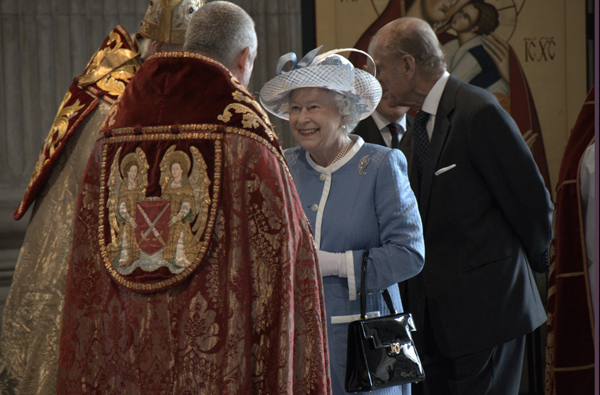
Queen Elizabeth II attends the tercentenary service at St Paul’s. PICTURE: Graham
Lacdao/St Paul’s Cathedral

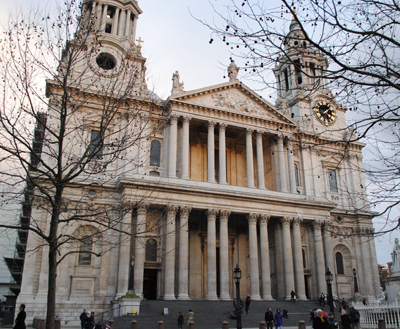
A service was held at St Paul’s today in celebration of the 300 year anniversary of the cathedral’s completion.

The tercentenary service also marks the end of a massive 15 year, £40 million repair and cleaning project, meaning the cathedral is now clear of scaffolding for the first time in 15 years.

Designed by the indomitable Sir Christopher Wren, work on St Paul’s Cathedral began in 1677 and was formally completed in 1710 (although it had been holding services since 1697). (For more on the history of St Paul’s, see our earlier post, part of our series on Wren’s London, here).

Said to have the largest dome after St Peter’s in Vatican City, St Paul’s has been at the centre of London’s (and the United Kingdom’s) religious and political life for centuries, hosting state funerals (Lord Nelson, the Duke of Wellington and Winston Churchill’s were all held here) as well as the royal wedding of Prince Charles and Lady Diana and many celebration services.

Sights include the crypt – containing the tombs of both Nelson and Wellington – and the Whispering Gallery (see our earlier post on the Whispering Gallery here) as well as the exterior viewing galleries.

To celebrate the cathedral’s liberation from scaffolding, St Paul’s is holding a 300th Anniversary Photography Competition in which photographers are invited to submit their best exterior shots of the building. The 10 winning images will then be displayed in the cathedral crypt. The competition runs until 16th July.

To enter, upload pictures to St Paul’s 300th anniversary competition group at Flickr – www.flickr.com/groups/stpaulslondon/. For more information, see www.stpauls.co.uk/photocomp.
LondonLife – Trooping the Colour…

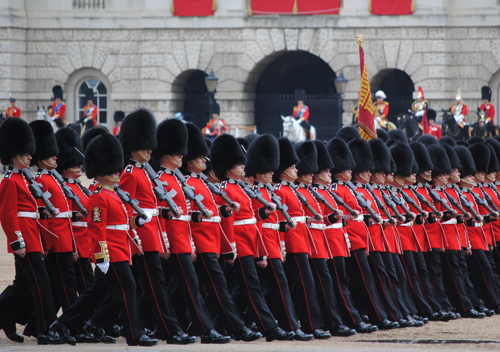
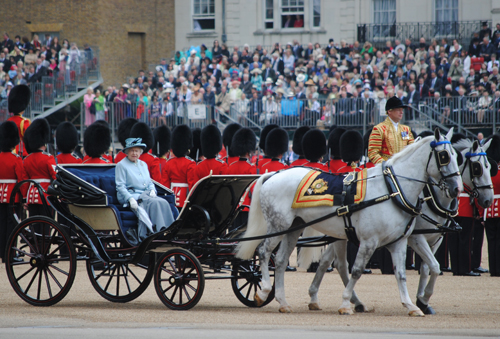
A ceremony first believed to have been performed during the reign of King Charles II, since 1748 the parade has been used to mark the Official Birthday of the Sovereign.

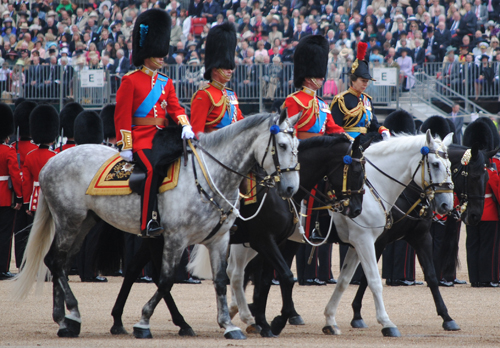
 Queen Elizabeth II inspects the Guards in her phaeton.

Prince William, Prince Charles, the Duke of Kent and Princess Anne riding Queen’s Escort behind the Queen.

The parade includes six Guards groups. This year it was the turn of the Scots Guards, raised in 1642 at the behest of King Charles I, to parade their colours.

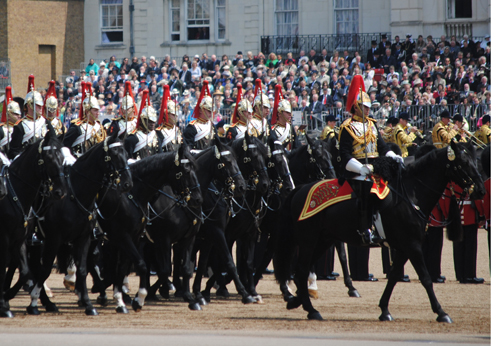
Part of the Household Mounted Cavalry, the Blues and Royals.

At 1pm, back at Buckingham Palace following the firing of a 41 gun salute, the Queen and the Royal Family watch Royal Air Force aircraft performing a fly past overhead.

The RAF’s Red Arrows aerobatic display team perform a colorful flypast over Buckingham Palace.
All images and text are © David S. Adams

The Royal Wedding – A view from The Mall…

Along with tens of thousands of others, Exploring London took up a post in The Mall to watch festivities surrounding the London wedding of Prince William and Kate Middleton. Here’s some of what we saw…

Kate Middleton, newly titled Her Royal Highness the Duchess of Cambridge, rides in a 1977 Rolls Royce Phantom IV from the Goring Hotel in Belgravia to Westminster Abbey via The Mall, greeting crowds along the way. Others, including Prince William, had already passed by.

The crowds cheered along The Mall throughout the morning, including after Rowan Williams, the Archbishop of Canterbury, was heard over loudspeakers announcing that the couple were now man and wife. The Bishop of London, Dr Richard Chartres, delivered the address while James Middleton read the lesson.

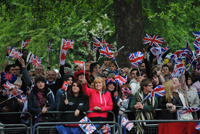
After the ceremony, the newly married couple processed in the 1902 State Landau down Whitehall and The Mall through a sea of flag-waving well-wishers towards Buckingham Palace after the wedding ceremony. The Landau was the same used by Prince Charles and Princess Diana after their 1981 wedding.

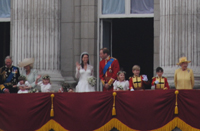
The couple, along with other members of the royal family and Kate Middleton’s parents, appear on the balcony of Buckingham Palace at around 1.30pm, waving to the crowd and exchanging kisses. Here they are flanked by Queen Elizabeth II (right) and the Duke and Duchess of Cornwall (left) along with bridesmaids and pageboys.

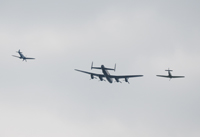
A Lancaster bomber and two Spitfires flew over the top of Buckingham Palace as part of an RAF flypast. They were followed by two tornados and two typhoons. The flypast brought official celebrations to an end after which the royal rejoined the champagne and canape reception already underway.

Crowds fill The Mall in the wedding’s aftermath. The newly weds later left Buckingham Palace driving a vintage convertible Aston Martin owned by Prince Charles. Overhead hovered a Sea King helicopter manned by some of Prince William’s colleagues.

The Royal Wedding – Eight curious facts about Royal Weddings past and present…

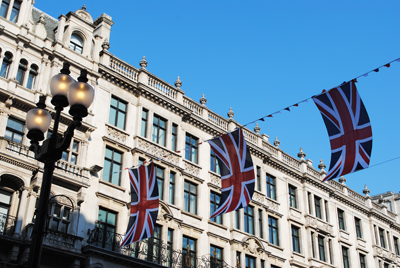
PICTURE: Bunting in Regent Street ahead of the Royal Wedding tomorrow.

Ahead of the wedding of Prince William and Kate Middleton tomorrow, here’s a look at some of the more curious and interesting facts related to London’s Royal Wedding past…

The first public Royal Wedding in modern times was that of Prince Albert, Duke of York (later King George VI), and Lady Elizabeth Bowes-Lyon (later Queen Elizabeth, the Queen Mother) which took place on 26th April, 1923. Instead of being held at a royal chapel as was more usual, they were married at Westminster Abbey in a public display which was apparently staged to lift the national spirit in the aftermath of World War I.

Lady Diana Spencer (later Diana, Princess of Wales) memorably said Prince Charles’ name in the wrong order during their wedding ceremony at St Paul’s Cathedral on 29th July, 1981. Lady Diana accidentally called him Philip Charles Arthur George instead of the correct Charles Philip Arthur George.

• Queen Victoria’s extravagant wedding cake was the first to feature a model of the bride and groom on its summit (with a figure of Britannia looming over them). The two tier cake measured nine foot across and weighed 300 lbs.

While white wedding dresses had been worn for some time, it was apparently after Queen Victoria wore a white dress at her 1840 wedding that the idea spread to the masses. (Interestingly, the first documented princess to wear a white wedding dress is said to have been Philippa of England, the daughter of King Henry IV, in 1406).

The first televised Royal Wedding was that of Princess Margaret, younger sister of Queen Elizabeth II, to Antony Armstrong-Jones (Lord Snowdon) on 6th May, 1960. It attracted some 300 million viewers worldwide.

The tradition of a royal bride leaving her bouquet on the Tomb of the Unknown Warrior in Westminster Abbey was started by Queen Elizabeth, the Queen Mother. She apparently did so in tribute to her brother Fergus who had died during World War I. Princess Mary, daughter of King George V, made a similar gesture at her wedding in 1922 – she left her bouquet at the Cenotaph in Whitehall after her wedding.

One of the most scandalous Royal Weddings was that of George, Prince of Wales (later King George IV) to Princess Caroline of Brunswick on 8th April, 1795 at the Chapel Royal in St James’s Palace. Described as being “far from a love match” on the Historic Royal Palaces’ website, Prince George was said to have been drunk during the wedding and at one stage apparently even attempted to escape from the ceremony.

If the rain stays away, the newly married prince and his bride will be returning to Buckingham Palace in the 1902 State Landau. The open-topped carriage was constructed for King Edward VII’s coronation and apparently made roomy to accommodation him. The carriage was used by Prince Charles and Lady Diana when they left St Paul’s Cathedral after their 1981 wedding. If the weather it poor, it’s expected that the 1881 Glass Coach, bought for the coronation of King George V in 1911, will be used instead.

For more fascinating facts on Royal Weddings, see the BBC website (www.bbc.co.uk/history/royal_weddings), or Historic Royal Palaces’ blog, The ‘other’ royal weddings (http://blog.hrp.org.uk). For more on the current Royal Wedding, see the official website (www.officialroyalwedding2011.org).

The Royal Wedding – Royal residences…

Word is that Prince William and his soon-to-be wife, Catherine Middleton, have yet to formally decide where they will live when in London (they are expected to spend much of their first two-and-a-half years of marriage in North Wales). 

Their initial London base, however, will reportedly be Clarence House. Located in The Mall, just down the road from Buckingham Palace and beside St James’s Palace, the grand building is currently the home of William’s father Charles, the Prince of Wales, his wife Camilla, Duchess of Cornwall, and, William’s brother, Prince Harry (it is also the home of William himself).

In years gone past, Clarence House served as the home of the newly married Queen Elizabeth II (then Princess Elizabeth) and her husband, Prince Philip, the Duke of Edinburgh. Prince Charles, who lived there with his parents until the age of three, returned to the property in August 2003 after the death of his grandmother Queen Elizabeth, the Queen Mother, who had lived in the building from 1953.

Clarence House was built between 1825 and 1827 to the designs of architect John Nash on the orders of Prince William Henry, the Duke of Clarence and later King William IV.

Choices for a permanent home in London for the soon-to-be married couple reportedly include Buckingham Palace (see yesterday’s entry), as well as Kensington Palace.

It was converted from a Jacobean mansion for King William III and Queen Mary II and has since been the home of many royals including, most famously, Diana, Princess of Wales. She and her then husband, Prince Charles, moved in following their wedding in 1981, and Princess Diana continued to live there after her divorce in 1996.

Other notable royal residents have included Queen Anne and Princess Margaret, sister of Queen Elizabeth II.

Another option – St James’s Palace – was built in 1531 on the site of a medieval leper hospital by King Henry VIII. Used initially for state occasions and to house royal relatives (Tudor monarchs actually lived at Whitehall Palace), it became the official royal residence in 1702, when Whitehall Palace burnt down, and remained so until the 1830s when King George III moved to Buckingham Palace.

The Royal Wedding – London’s royal reception venue

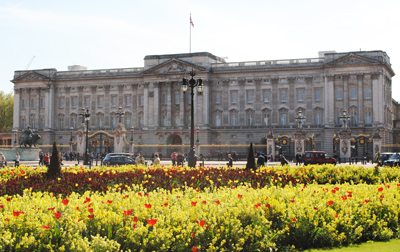
Following the wedding ceremony at Westminster Abbey on Friday, the now married happy couple will head in a carriage via a processional route down The Mall to Buckingham Palace.

There, they will enjoy a champagne reception with 600 guests hosted by the Queen before, at 1.30pm, appearing on the balcony of the palace to wave to the crowds and watch an aircraft flypast expected to include a Lancaster, Spitfire, Hurricane, two Typhoons and two Tornados.

Buckingham Palace, which has served as the official London residence of the reigning monarch since 1837, has a long tradition of hosting royal events. Then much smaller and known as Buckingham House, the property was built for the Duke of Buckingham in 1705.

It passed into royal hands when it was bought by King George III in 1761 for his wife, Queen Charlotte, to use as a family home located conveniently close to St James’s Palace where many court functions were held.

The house was extensively remodelled in 1762 and again, this time on the orders of King George IV, in the 1820s (after initially wanting to use it, like his father, as a family home, the king decided after the works had started to instead transform it into a palace, created to the designs of architect John Nash).

When King George IV died in 1830, his brother King William IV ordered the works to be continued albeit with a new architect, Edward Blore (the spiralling costs of Nash’s work are said to have cost him the contract). The king himself never lived in the house – even offering at at one stage as a seat for Parliament after the Houses of Parliament were destroyed by fire in 1834 – and it wasn’t until the accession of Queen Victoria in 1837 that the palace became the sovereign’s official residence.

Further works were subsequently needed to ensure there was adequate accommodations for the Queen’s family and it was during these works that the monumental Marble Arch – designed as the centrepiece of the palace’s courtyard – was moved away to its present location on the north-eastern corner of Hyde Park.

The palace, which now boasts 775 rooms including 19 staterooms, has since been the site of numerous royal wedding receptions – it was on the balcony  where Queen Elizabeth II and Philip, the Duke of Edinburgh, greeted crowds on 20th November, 1947, after their wedding in Westminster Abbey and, similarly, where Prince William’s parents, Prince Charles and Princess Diana, held a reception before greeting crowds on 29th July, 1981, after their ceremony at St Paul’s Cathedral.

Buckingham Palace was also the location for Queen Victoria’s wedding breakfast following the ceremony in the Chapel Royal at St James’s Palace on 10th February, 1840.

The Royal Wedding – London’s Royal Wedding venues

In the first of a series this week looking at aspects of royal weddings in London in days past, we canvas some of the venues which have hosted the sometimes glittering occasions.

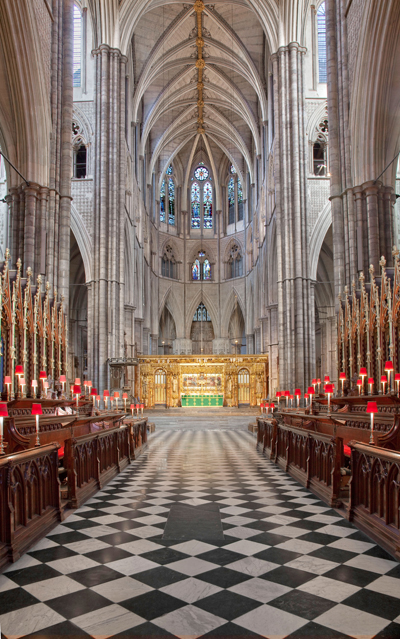
First up is Westminster Abbey (pictured), the location of Prince William and Kate Middleton’s wedding this Friday, which, despite its thousand year history, is only believed to have hosted 15 royal weddings.

Among them is said to have been the wedding of King Henry I to Matilda of Scotland on 11th November, 1100, as well as that of Richard, Earl of Cornwall and brother of King Henry III, who married his second wife, Sanchia of Provence, there on 4th January, 1243, and Joan of Acre, daughter of King Edward I, who married Gilbert, Earl of Gloucester, on 30th April, 1290 (her sister Margaret married John, Duke of Brabant, at the same venue less than three months later). The abbey also hosted the wedding of King Richard II to Anne, daughter of Emperor Charles IV of Bohemia, on 20th January, 1382.

The abbey church has become increasingly favored as a venue for royal weddings in more recent times. Among the most prominent hosted there last century were that of Prince Albert, Duke of York (later King George VI), who married Lady Elizabeth Bowes-Lyon on 26th April, 1923 and that of their daughter Princess Elizabeth (later Queen Elizabeth II) who married Prince Philip of Greece (later the Duke of Edinburgh) there on 20th November, 1947.

Two of the current Queen’s children were also married there – Princess Anne, who married Captain Mark Phillips on 14th November, 1973, and Prince Andrew, who married Sarah Ferguson on 23rd July 1986. (For more on Royal Weddings at the Abbey, see www.westminster-abbey.org/our-history/royals/weddings)

A notable break with the trend in recent times was the marriage of Prince Charles and Lady Diana Spencer – they were married in a fairytale ceremony at St Paul’s Cathedral on 29th July, 1981.

Other London locations for royal weddings have included the now non-existent Greenwich Palace (King Henry VIII married Katherine of Aragon on 11th June, 1509) and Hampton Court Palace (another of King Henry VIII’s marriages – that in which he was wed to Catherine Parr – was held here in a private chapel on 12th July, 1543).

Along with St George’s Chapel at Windsor, the Chapel Royal at St James’s Palace  in London was particularly popular in Victorian times – Queen Victoria married Prince Albert there on 10th February, 1840, and their eldest daughter, Princess Victoria, married Prince Frederick (the future German Emperor Frederick III) there on 25th January, 1858. On 6th July, 1893, the chapel also hosted the wedding of the future King George V and Princess Mary of Teck.

PICTURE: Copyright Dean and Chapter of Westminster

Around London – South Bank marks 60 years since the Festival of Britain; Royal wedding cakes; and, a new cable car for London…

• South Bank is celebrating the 60th anniversary of the 1951 Festival of Britain with a four month series of events. The official celebrations kicked off yesterday and will run until early September. Highlights of the celebrations include the Museum of 1951 – a temporary museum located in Royal Festival Hall featuring exhibits relating to the 1951 festival, themed weekends including next weekend’s ‘London in Love’, featuring performances by Billy Bragg, and a Festival of Britain-inspired ‘Meltdown’ curated by Ray Davies of The Kinks (runs from 10th to 19th June). The original Festival of Britain was opened on 3rd May, 1951, with the intention of developing a sense of “recovery and progress” among the British in the aftermath of World War II and marked the centenary of the 1851 Great Exhibition. The South Bank Exhibition was at the heart of what were national celebrations and was attended by more than eight million people. For more information on what’s happening, see www.southbankcentre.co.uk.

• Historic royal wedding cakes have been recreated this Easter weekend  in an exhibition celebrating the lead-up to this Friday’s Royal Wedding. The English Heritage-event Let Them Eat Cake, which is being held at Wellington Arch near Hyde Park Corner, features a “four-and-20 blackbirds pie” of the sort King Henry VIII gave to his new wife Anne Boleyn as well as recreations of Prince Charles and Lady Diana’s wedding cake and that of Queen Elizabeth II. The event, which is sponsored by Tate & Lyle Sugars, involves some of Britain’s leading bakers. For more, see www.english-heritage.org.uk/daysout/events/765107/. See Exploring London this week for more on the upcoming Royal Wedding.

• The Mayor of London, Boris Johnson, confirmed this week that work will begin on a new cable car to cross the Thames River in East London this summer. The 34 gondola cable car will stretch for 1.1 kilometres, connecting Greenwich Peninsula and the O2 on the river’s south bank with Royal Victoria Docks and the ExCel centre on the north and carrying up to 2,500 people every hour. Construction will be carried out by a consortium of firms led by Mace – the company currently building the Shard Tower – and it is hoped it will be completed before next year’s Olympics.

Wren’s London – 1. St Paul’s Cathedral

In a new special, we’re taking a look at some of the key sites London landmarks designed by renowned 17th century architect Sir Christopher Wren. To kick it off, we’re taking a look at the building for which he is most known, St Paul’s Cathedral.

Wren’s involvement with the current St Paul’s came after the Great Fire of London in 1666 left the old medieval cathedral in ruins (there is believed to have been four previous cathedrals built on the site with the first dating from around the early 600s). He had already been involved in repairing the old cathedral and had even submitted plans for a new domed cathedral on the site when the Great Fire swept through the city.

Wren had already been appointed Surveyor to the King’s Works when, in 1668, he was asked to submit plans for the a new cathedral. After his first few designs were rejected and abandoned, Wren’s plans, albeit substantially altered, were finally approved and the first stone laid in 1677.

The design was ambitious and the church now features what is the second biggest dome in the world after that of St Peter’s in Rome as well as a monumental west-facing facade complete with two towers (the final form of the western facade wasn’t settled until 1707 and both of the towers were originally designed to hold clocks. In the end only the right tower did.)

Building took more than 30 years and it wasn’t until 1710 that the new cathedral was officially declared completed. Interior features include the Whispering Gallery (located 30 metres above the floor below the central dome, it gets its name from the fact that a person whispering into the wall can be heard across the dome by someone who puts their ear to the wall), choir stalls which feature the work of renowned woodcarver Grinling Gibbons, and poet/preacher John Donne’s memorial from 1631, the only pre-Great Fire monument to survive intact. There are spectacular views over London from the Stone Gallery or the highest point of public access, the Golden Gallery.

Since its opening, St Paul’s has hosted the burials of numerous of Britain’s luminaries – the tombs of Admiral Horatio Nelson and the Arthur Wellesley, the Duke of Wellington, are both in the crypt as are those of 18th century painter Sir Joshua Reynolds and Sir Alexander Fleming, the man who discovered penicillin along with a host of memorials. Others events hosted at the cathedral include Winston Churchill’s funeral and the wedding of Prince Charles and Lady Diana in 1981.

Wren, who died in 1723, was the first person to be interred in the crypt. His tomb bears an inscription in Latin which says: “Reader, if you seek a monument, look around you.”

WHERE: Ludgate Hill. Nearest tube is St Paul’s; WHEN: Monday to Saturdays, 8.30am to 4pm. COST: £12.50 adults/£11.50 seniors/£9.50 students/£4.50 children (aged 6-16)/£29.50 family; WEBSITE: www.stpauls.co.uk