10 iconic London film locations…7. The London Eye is saved by the Fantastic Four…

London-Eye

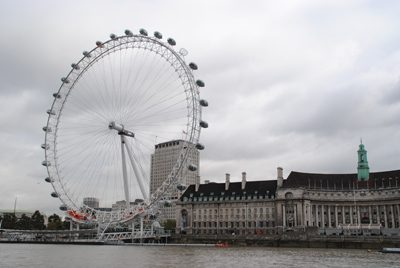
The London Eye features in the background of numerous recent films – everything from 2002’s 28 Days Later to 2004’s Thunderbirds and 2007’s Harry Potter and the Order of the Phoenix.

But the structure, which was built in 1999 and is currently known formally as the Coca-Cola London Eye, has a bigger role in another 2007 film – Fantastic Four: Rise of the Silver Surfer in which the film’s heroes must prevent it toppling into the Thames and a gaping hole that opens up in the river.

Thankfully, in the 2007 film, The Thing (played by Michael Chiklis), Mr Fantastic (Ioan Gruffudd) and the Invisible Woman (Jessica Alba) manage to do so, using their unique powers to save all the people being thrown around inside the Eye’s many pods.

Of course, as an iconic symbol of the city today, the London Eye has also been recreated in several animated films – from Flushed Away to Cars – and is even recreated, tongue-in-cheek, in wood for A Knight’s Tale.

There’s also quite a few films and TV shows which have featured scenes filmed inside the Eye’s pods, including Wimbledon in which one of them plays host to a punch-up.

The area of South Bank around where the Eye is located is a popular spot for films. The OXO Brasserie in the OXO Tower, for example, features in Thor: The Dark World, Millennium Bridge, linking South Bank to St Paul’s Cathedral, can be seen as part of the (imaginary) city on Xander in the film Guardians of the Galaxy and Jubilee Gardens, next to the Eye, was used as a landing pad in Thunderbirds for the T2.

10 iconic London film locations…2. James Bond’s not-so-secret HQ…

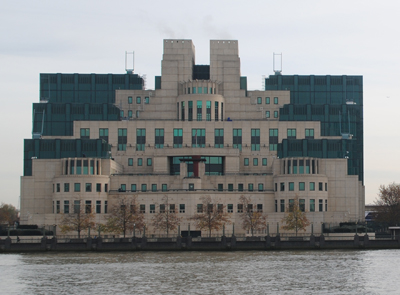
MI6Of course, James Bond has a long-standing relationship with London and there’s a long list of locations that have featured in the many Bond films over the years. But today we’re looking at just one – the Thames-side HQ of spy agency MI6.

The actual London home of the organisation (also known as the Secret Intelligence Service), the not-so-secret building – which is also called the Vauxhall Cross building – is located on Albert Embankment in Vauxhall, sitting alongside Vauxhall Bridge.

It has made numerous appearances in the past few James Bond films – from its first appearance in Golden Eye to its being attacked in The World Is Not Enough, blown up in Skyfall and the featuring of its ruinous remains in the latest film, Spectre.

The subject of some criticism when it was unveiled (and much loved by others), the fortress-like building was designed by architect Terry Farrell. It was built in the early 1990s and officially opened by Queen Elizabeth II in 1994. It suffered – and survived – a real-life rocket attack in 2000.

Other locations to have featured in recent Bond films in London, meanwhile, include Somerset House (passed off as St Petersburg in Golden Eye), the National Gallery (Bond, played by Daniel Craig, first encounters the new Q, played by Ben Wishaw, in Room 34 in Skyfall), and the rooftops of Whitehall (also Skyfall). And that’s just for starters.

LondonLife Special – Expressing solidarity with Paris…

Pray for Paris

A week ago tonight the world was left reeling in the wake of the devastating series of coordinated terrorist attacks in Paris, France, which have left 132 people dead and hundreds more wounded. In the wake of the attacks, national landmarks across the world were lit up in the colours of the French flag, among them, the London Eye, overlooking the River Thames. PICTURE: Martin Sylvester/Digital Concepts.


10 London ‘battlefields’ – 2. ‘London Bridge is falling down’…

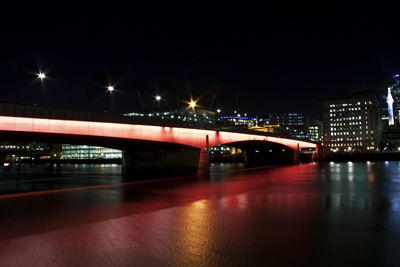
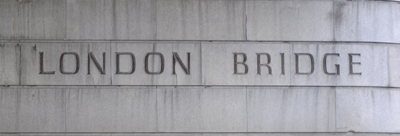
London-Bridge3We’ve touched on this story before but it’s worth a revisit as part of this series. London changed hands several times during the later half of the first millennium as the Anglo-Saxons fought Vikings for control of the city, meaning the city was the site of several battles during the period.

One of the most memorable (or so legend has it, there are some archaeologists who believe the incident never took place) was the battle in 1014 in which London Bridge – then a timber structure (today’s concrete bridge is pictured above) – was pulled down. A story attributed to the Viking skald or poet Ottarr the Black but not found in Anglo-Saxon sources, the event, if it did take place, did so against the backdrop of an ongoing conflict between the Danes and Anglo-Saxons.

Anglo-Saxon London had resisted several attempts at being taken by the Vikings – a fire was recorded in the city in 982, possibly caused by a Viking attack – and in 994, the Anglo-Saxon Chronicle reports that a fleet of 94 Danish and Norwegian ships were repelled with prejudice. Further attacks was driven back in 1009 and it wasn’t until 1013 that the city finally submitted to Danish rule after Sweyn Forkbeard had already claimed Oxford and Winchester.

But Sweyn, the father of the famous King Canute (Cnut), didn’t hold it long – he died on 3rd February the following year.

The deposed Anglo-Saxon King Æthelred II (also spent Ethelred, he was known as ‘the Unready’) – who had been forced to flee from London, which he used as his capital, to what is now Normandy thanks to Sweyn’s depredations – is said to have seized his chance and along with the forces of his ally, the Norwegian King Olaf II, he sailed up the Thames to London in a large flotilla.

The Danish had taken the city, occupying both the city proper and Southwark, and were determined to resist. According to the Viking account, they lined the timber bridge crossing the river and rained spears down on the would-be invaders. (The bridge, incidentally, had apparently been built following the attack in 993, ostensibly to block the river and prevent further incursions further upstream – there is certainly archaeological evidence that a bridge existed in about the year 1000).

Not to be beaten, Æthelred’s forces, using thatching stripped from the rooves of nearby houses to shield themselves, managed to get close enough to attach some cables to the bridge’s piers, pulling the bridge down and winning the battle, retaking the city.

There’s much speculation that the song London Bridge is Falling Down was inspired by the incident but it, like much of this story itself, remains just that – conjecture (although Ottarr’s skald does sound rather familiar).

The bridge was subsequently rebuilt and King Æthelred died only two years later, on 23rd April, 2016. The crown subsequently passed to his son Edmund Ironside but he too died after ruling for less than a year leaving Viking Canute to be crowned king.

PICTURE: http://www.freeimages.com

What’s in a name?…Kew…

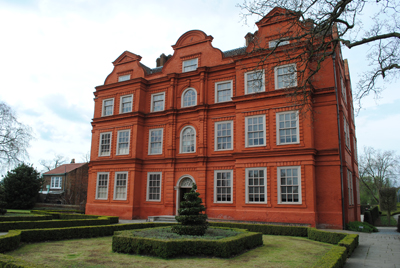
Kew-PalaceFamed as the location of the Royal Botanic Gardens, Kew is a Thames-side suburb in London’s west.

It’s the riverside location which gives the area its name – Kew is apparently a corrupted form of Cayho, a word first recorded in the early 14th century which is itself made of two words referring to a landing place (the ‘Cay’ part) and a spur of land (the ‘ho’ part). The latter may refer in this case to the large “spur” of land upon which Kew is located, created by a dramatic bend in the Thames. The former may refer to a ford which crossed the river here (explaining the name of Brentford on the other side).

While the area had long been the home of a small hamlet for the local farming and fishing community, more substantial houses began to be developed in Kew in the late 15th and early 16th centuries thanks to the demand for homes for courtiers attending the King Henry VII and his successors at nearby Richmond Palace (the royal connections of the area in fact go back much further to the early Middle Ages).

But it was during the Georgian era, when the Royal Botanic Gardens were founded and Kew Palace, formerly known as the Dutch House, became a royal residence (it is pictured above), that Kew really kicked off (and by the way, Kew Palace is not the only surviving 17th century building in the area – West Hall, once home of painter William Harriot, is also still here).

While King George II and his wife Queen Caroline used Richmond Lodge, now demolished but then located at the south end of what is now the gardens, as their summer residence, they thought Kew Palace would make a good home for their three daughters (their heir, Frederick, Prince of Wales, lived opposite his sisters at the now long-gone White House). Kew Palace, meanwhile, would later be a residence of other members of the Royal Family as well, including King George III during his bouts of madness.

Other buildings of note from the Georgian era in Kew include Queen Charlotte’s Cottage, a thatched property built between 1754 and 1771 and granted to Queen Charlotte by her husband, King George III (like the palace, it now lies within the grounds of Kew Gardens). St Anne’s Church, located on Kew Green, dates from 1714 and hosts the tombs of artists Johann Zoffany and Thomas Gainsborough.

In 1840, the gardens which surrounded the palace were opened to the public as a national botanic garden and the area further developed with the opening of the railway station in 1869, transforming what was formerly a small village into the leafy largely residential suburb which we find there today (although you can still find the village at its heart).

As well as Kew Gardens (and Kew Palace), Kew is today also the home of the National Archives, featuring government records dating back as far as 1086.

Special – Queen Elizabeth II becomes longest reigning monarch…

Queen-Elizabeth-II
We interrupt our regular programming this week to mark the day in which Queen Elizabeth II becomes the UK’s longest reigning monarch, passing the record reign of her great-great-grandmother, Queen Victoria.

The milestone of 63 years, seven months and two days (the length of Queen Victoria’s reign) will reportedly be passed at about 5.30pm today (the exact time is unknown as the Queen’s father, King George VI, passed away in his sleep).

While the Queen, now 89 (pictured here in 2010), will pass the day in Scotland attending official duties, in London Prime Minister David Cameron will lead tributes in the House of Commons.

As we go to press a flotilla of vessels – including Havengore and Gloriana – will process along the River Thames between Tower Bridge, open as a sign of respect, and the Houses of Parliament. As they passed HMS Belfast, the ship will fire a four gun salute.

Today is the 23,226th day of the Queen’s reign during which she has met numerous major historical figures – from Charles de Gaulle to Nelson Mandela – and seen 12 British Prime Ministers come and go.

LondonLife – See the Thames…in Blackfriars station…

Photo-exhibition-at-Blackfriars-station

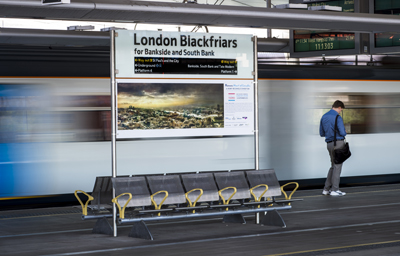
This is one of a series of works by renowned photographer Henry Reichhold which features in the exhibition Thames – Heart of London, currently on show at Blackfriars Thameslink railway station. Thameslink and JCDecaux have provided 49 platform advertising sites for the display, part of the Totally Thames celebrations taking place throughout September. The photographs, which measure 2.5 metres long, are an attempt to capture the character of the Thames as it winds its way through the city and were taken from a series of notable vantage points including the Shard, City Hall, OXO Tower, One Canada Square, Southbank Tower and the Houses of Parliament. As well as the river itself, they also capture some of the many events which have taken place upon it – from the Diamond Jubilee Pageant to New Year’s Day celebrations. Each image has taken between one and three weeks to create from up to 100 separate photographs – selected out of more than 800 taken on a single day – which have then been put together in a stunning panorama. New York-born Reichhold says the process of “extracting” the final image is “never the same”. “The camera is very stubborn about creating a ‘mechanical’ view and it is the reinterpretation of these files to in some way reflect what the human eye sees that I find so troublesome and fascinating.” The exhibition is at Blackfriars Station, 179 Queen Victoria Street, London, and runs until 30th September.  Entry is free to passengers with a valid GTR train ticket and to holders of a 10p platform ticket.

This Week in London – Tall ships at Greenwich; immersive art at Tate Britain; and, ‘Nature’s Bounty’ at Kew…

It’s all about big masted ships at Greenwich this Bank Holiday weekend as up to 15 ships drop anchor at the Royal Greenwich Tall Ships Festival. Two tall ships, the Dar Mlodziezy and Santa Maria Manuela, will be moored on Tall Ships Island in the river at Maritime Greenwich (accessed via MBNA Thames Clippers) while an additional 13 ships will be taking people on cruises from their base at Royal Arsenal Woolwich (tickets can be booked via Sail Royal Greenwich). On Saturday, a free family festival will be held in Woolwich Town Centre and at Royal Arsenal Riverside with music, roving entertainers, food and other activities including a fireworks display on the river at 10pm (fireworks can also be seen on Thursday, Friday and Sunday nights on the river at Maritime Greenwich at around 9.15pm). For more information – including how and where to book tickets, see www.royalgreenwich.gov.uk/tallships2015.

An immersive art project allowing visitors to engage with paintings in a multi sensory experience opened at Tate Britain on Milbank yesterday. Tate Sensorium has won this year’s annual IK Prize, presented by the Tate and supported by the Porter Foundation, awarded for a project which uses innovative technology to enable the public to explore the gallery’s collection in new ways. The display features four works by celebrated figures in 20th century painting: Francis Bacon’s Figure in a Landscape (1945), David Bomberg’s In the Hold (c 1913-1914), Richard Hamilton’s Interior II (1964) and John Latham’s Full Stop (1961). As part of the experience, which has been produced by creative studio Flying Object in conjunction with a cross-disciplinary team, visitors are offered the chance to wear biometric measurement wristbands to record the emotional impact of the experience. Admission to exhibition in gallery 34 is free but tickets are limited. Runs until 20th September. For more, see www.tate.org.uk/sensorium.

A series of detailed paintings of fruit, vegetables and edible plants from all over the world goes on show at the Shirley Sherwood Gallery of Botanical Art at Kew Gardens on Saturday. Nature’s Bounty features works from the Shirley Sherwood and Kew collections including works from the 19th century text, Fleurs, Fruits et Feuillages Chosis de la Flore et de la Pomona de L’ile de Java drawn by botanical artist Berthe Hoola Van Nooten as well as works from the Shirley Sherwood and Kew collections. The exhibition runs until 31st January. Admission charge applies. For more, see www.kew.org.

Send all items for inclusion to exploringlondon@gmail.com.

This Week in London – Party like a Georgian; a playground with a history; and, a Dickens whodunnit…

Kensington-Palace• Join the Georgian Queen Caroline for a garden party in the grounds of Kensington Palace this weekend. The Georgian Court will be taking to the palace gardens for a summer celebration featuring music, military drills and theatre as they bring the era to life. Visitors are encouraged to immerse themselves in the experience as a courtier with the gardens decked out in a range of tents where they can try out costumes and powdered wigs as well as learn court etiquette, swordplay and dancing while the ice-house will feature Georgian ice-cream (and it’s rather odd flavours such as parmesan). Runs from tomorrow until Sunday. Admission charges apply (under 16s go free with a maximum of six children per paying adult). For more, see www.hrp.org.uk/KensingtonPalace/. PICTURE: ©Historic Royal Palaces

First created in 1923, a playground in Victoria Tower Gardens – newly named the Horseferry Playground – has been reopened after improvement works. The works, carried out under the management of Royal Parks, have seen the reintroduction of a sandpit as well as the installation of new swings and slide, dance chimes and a stare play installation to represent the River Thames. The playground, located close to the Houses of Parliament in Westminster, also features a series of timber horse sculptures, new seating and a refreshment kiosk with metal railings designed by artist Chris Campbell depicting events such as the Great Fire of London and Lord Nelson’s funeral barge and views of the River Thames. The project has also seen the Spicer Memorial, commemorating role of paper merchant and philanthropist Henry Spicer in the establishment of the playground – then just a large sandpit, restored. For more, see www.royalparks.org.uk/parks/victoria-tower-gardens.

Now On – A Dickens Whodunnit: Solving the Mystery of Edwin Drood. This temporary exhibition at the Charles Dickens Museum in Bloomsbury explores the legacy of Dickens’ final novel The Mystery of Edwin Drood, left unfinished after his death in 1870. Visitors are able to investigate crime scenes, search for murder clues and see the table on which the novel was penned as well as clips from theatrical adaptations, and a wealth of theories on ‘whodunit’. The exhibition runs until 11th November. Admission charge applies. For more, see www.dickensmuseum.com.

Send all items for inclusion to exploringlondon@gmail.com.

10 sites from London at the time of the Magna Carta – 8. Bermondsey Abbey…

Bermondsey Abbey, which was more than 130-years-old by the time King John put his seal to the Magna Carta in 1215, has an unusual connection to the unpopular king – it is one of a number of buildings in London which has, at various times in history, been erroneously referred to as King John’s Palace.

This suggestion – that it was a palace which was later converted into an abbey – may have arisen from a site on the former abbey grounds being known at some point in its history as King John’s Court (that name was said to commemorate the fact that King John visited the abbey).

Putting how King John’s name came to be linked with the abbey aside, we’ll take a quick look at the history of the abbey which rose to become an important ecclesiastical institution in medieval times.

While there was a monastic institution in Bermondsey as far back as the early 8th century, the priory which was here during the reign of King John was founded in 1082, possibly on the site of the earlier institution, by a Londoner named as Aylwin Child(e), apparently a wealthy Saxon merchant who was granted the land by King William the Conqueror.

In 1089, the monastery –  located about a mile back from the river between Southwark and Rotherhithe – became the Cluniac Priory of St Saviour, an order centred on the French abbey of Cluny, and was endowed by King William II (William Rufus) with the manor of Bermondsey.

It was “naturalised” – that is, became English – by the first English prior, Richard Dunton, in 1380, who paid a substantial fine for the process. It was elevated to the status of an abbey by Pope Boniface IX in 1399.

It had some important royal connections – King John’s father, King Henry II and his wife Queen Eleanor celebrated Christmas here in 1154 (their second child, the ill-fated Henry, the young King, was born here a couple of months later), and Queen Catherine (of Valois), wife of King Henry V, died here in 1437. It was also at Bermondsey Abbey that Elizabeth Woodville, the widow of King Edward IV and mother of the two “Princes in the Tower”, died in 1492 following her retirement from court.

The abbey, which grew to have an enormous income thanks to its acquisition of property in a range of counties, survived until the Dissolution when, in 1537, King Henry VIII closed its doors. It was later acquired by Sir Thomas Pope who demolished the abbey and built a mansion for himself on the site (and founded Trinity College in Oxford apparently using revenues from the property). We’ll deal more with its later history in an upcoming post.

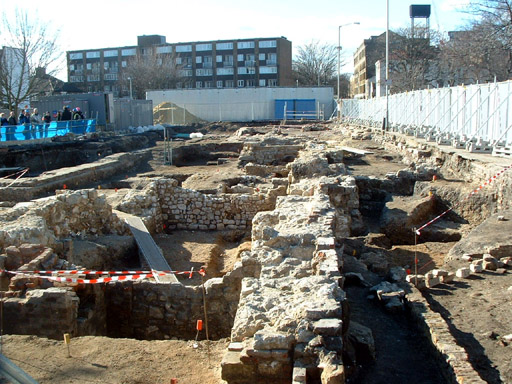
The ruins of the abbey were extensively excavated in the past few decades and some of the remaining ruins of the abbey can still be seen buildings around Bermondsey Square and a blue plaque commemorating the abbey was unveiled in 2010. Bermondsey Street runs roughly along the line of the path which once led from the abbey gates to the Thames and the abbey had a dock there still commemorated as St Saviour’s Dock. The abbey’s name is commemorated in various streets around the area.

For more on the history of the Magna Carta, see David Starkey’s Magna Carta: The True Story Behind the Charter.

PICTURE: An archaeological dig at the ruins of Bermondsey Abbey in 2006. Zefrog/Wikipedia.

Famous Londoners – Peter de Colechurch…

We recently ran a piece on the building of the first stone London Bridge (see our earlier post here) and so we thought it timely to take a look at the life of the builder, priest and ‘architect’ Peter de Colechurch.

Not a lot is known about the life of de Colechurch – although we do know he took his name from the fact he the chaplain of St Mary Colechurch, a church which once stood at the junction of Poultry and Old Jewry (and was destroyed in the Great Fire of 1666).

The stone London Bridge wasn’t his first attempt at bridge-building – in 1163 he had supervised the rebuilding of the wooden London Bridge after a fire some 30 years before.

His role in building the subsequent stone bridge remains a little unclear but he was known to have been in charge of the building works themselves and also headed the fundraising and it is believed he headed a guild responsible for the upkeep of the bridge known as the Fraternity of the Brethren of London Bridge.

His seal depicts a priest celebrating mass at an altar with the Latin Sigillum Petri Sacerdotis Pontis Londoniarum (Seal of Peter Priest of London Bridge).

The chapel on the bridge was dedicated to St Thomas á Becket and it’s suggested that he and de Colechurch would have known each other – Becket had been christened at St Mary Colechurch in 1118.

Sadly, de Colechurch did not live to see the stone London Bridge completed – he died in 1205 and was buried under the floor of the chapel on the bridge.

Some bones in a small casket were disinterred in from the chapel undercroft in 1832 – now in the Museum of London, these were rumoured to be those of de Colechurch although after analysis the bones were found to be part of a human arm bone, a cow bone and goose bones. (Other accounts suggest most of Peter’s bones were tossed into the Thames and a small number sold at auction).

10 sites from London at the time of the Magna Carta – 7. Old London Bridge…

London-Bridge2

The current London Bridge, which spans the River Thames linking Southwark to the City, is just the latest in several incarnations of a bridge which originally dates back to Roman times.

This week, we’re focusing on first stone bridge to be built on the site. Constructed over a period of some 33 years, it was only completed in 1209 during the reign of King John, some six years before the signing of the Magna Carta.

Construction on the bridge began in 1176, only 13 years after the construction of an earlier wooden bridge on the site (the latest of numerous wooden bridges built on the site, it had apparently built of elm under the direction of Peter de Colechurch, chaplain of St Mary Colechurch, a now long-gone church in Cheapside).

It was the priest-architect de Colechurch who was also responsible for building the new bridge of stone, apparently on the orders of King Henry II. While many of the wealthy, including Richard of Dover, the Archbishop of Canterbury, gave funds for the construction of the bridge, a tax was also levied on wool, undressed sheepskins and leather to provide the necessary monies – the latter led to the phrase that London Bridge was “built upon woolpacks”. King John, meanwhile, had decreed in 1201 that the rents from several homes on the bridge would be used to repair it into perpetuity.

The bridge, which featured 20 arches – a new one built every 18 months or so, was apparently constructed on wooden piles driven into the river bed at low water with the piers of Kentish ragstone set on top. It was dangerous work and it’s been estimated that as many as 200 men may have died during its construction.

The bridge was almost completely lined with buildings on both sides of the narrow central street. These included a chapel dedicated to St Thomas á Becket – a stopping point for pilgrims heading to the saint’s shrine in Canterbury, as well as shops and residences (although, apart from the chapel, we know little about the original buildings). There was also a drawbridge toward the southern end and the Great Stone Gate guarding the entrance from Southwark.

Peter de Colechurch died in 1205, before the bridge was completed. He was buried in the undercroft of the chapel on the bridge.

Three men subsequently took on the task of completing the bridge – William de Almaine, Benedict Botewrite and Serle le Mercer who would go on to be a three time Lord Mayor of London. All three were later bridge wardens, the City officials charged with the daily running of the bridge itself.

One of key events on the bridge in the years immediately after its completion was the arrival of Louis, the Dauphin of France, in May, 1216. Louis had been invited to depose John by the rebellious barons after the agreement sealed at Runnymede fell apart and in 1216, he and his men marched over London Bridge on their way to St Paul’s Cathedral. (We’ll deal with this in more detail in a later post).

What became known as ‘Old London Bridge’, which stood in line with Fish Street Hill, survived the Great Fire of 1666, albeit badly damaged, but was eventually replaced with a new bridge, known, unsurprisingly as ‘New London Bridge’, which opened in 1831. Designed by John Rennie, this bridge was later replaced by one which opened in 1971 (Rennie’s bridge was sold off and now stands in Lake Havasu City, Arizona).

For a detailed history of Old London Bridge, check out Old London Bridge: The Story of the Longest Inhabited Bridge in Europe.

What’s in a name?…Waterloo…

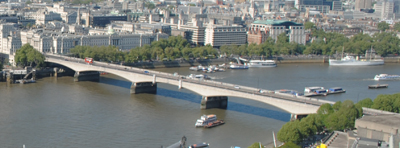
Waterloo-Bridge

Given the recent commemorations surrounding the bicentenary of the Battle of Waterloo (including a re-enactment of the arrival of news of Wellington’s victory in London where it was delivered to the Prince Regent), we thought it only fitting to take a look at the use of the name in London.

The name Waterloo, which now refers to a district in Lambeth centred on Waterloo Station, was first used to designate the bridge which crosses the Thames here.

Opened in 1817 as a toll bridge, the John Rennie-designed structure was known as Strand Bridge during its construction but renamed Waterloo at its opening two years after the battle. (Rennie’s bridge was later demolished and rebuilt in the 20th century – the current bridge is pictured above).

The name was also used to designate Waterloo Road and in the early 1820s was given to the church St John’s Waterloo (now St John’s and St Andrew’s at Waterloo) located on the road.

In 1848, Waterloo Station opened and it was after this that the surrounding district, known in past ages for its swampiness (hence streets like Lower Marsh), generally became known as Waterloo.

Landmarks in the Waterloo district include the historic Old Vic Theatre, which opened in 1818, and the Young Vic Theatre as well as the Lower Marsh Market.

On 3rd July, Waterloo will host the Waterloo Carnival with a picnic on Waterloo Millennium Green and a procession (for more on that, see www.waterlooquarter.org/news/come-and-support-this-years-waterloo-carnival) while the month-long Waterloo Food Festival kicks on on 1st July. For more on events in Waterloo commemorating bicentenary, see www.wearewaterloo.co.uk/waterloo200/.

LondonLife – Battersea in rebirth…

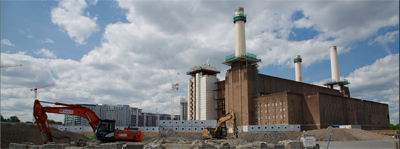
BatterseaWork continues on repurposing the former Battersea Power Station as part of the £15 billion Nine Elms project that will create a whole new precinct located on the south bank of the Thames. Photographer Ian Wylie recently captured the work in progress. He writes: “I’ve been keeping an eye on the huge redevelopment of the entire Nine Elms area, including the new American Embassy quarter and the Battersea Power Station development. Also noticing the work going on to remove, rebuild and replace the four iconic power station chimneys as seen from other London viewpoints, including this one: flic.kr/p/rpGocV. So (these) photos were simply a result of another walk around the area where so much is changing so fast and yet reminders of London’s past still remain, such as this very old street sign: flic.kr/p/tQVY9W. It’s not an area that attracts a large number of visitors but it was interesting to see a few people walking around, just as I was, obviously also intrigued by the past, present and future of this site.” For more on the project, see www.batterseapowerstation.co.uk and www.nineelmslondon.com.

10 sites from London at the time of the Magna Carta – 4. Thorney Island…

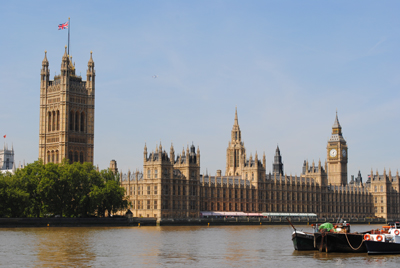
Houses-of-Parliament2 Both Westminster Abbey and the Palace of Westminster (these days better known as the Houses of Parliament – pictured) pre-date 1215 but unlike today in 1215 the upon which they stood was known as Thorney Island.

Formed by two branches of the Tyburn River as they ran down to the River Thames, Thorney Island (a small, marshy island apparently named for the thorny plants which once grew there) filled the space between them and the Thames (and remained so until the Tyburn’s branches were covered over).

One branch entered the Thames in what is now Whitehall, just to the north of where Westminster Bridge; another apparently to the south of the abbey, along the route of what is now Great College Street. (Yet another branch apparently entered the river near Vauxhall Bridge).

The abbey’s origins go back to Saxon times when what was initially a small church – apparently named after St Peter – was built on the site. By 960AD it had become a Benedictine monastery and, lying west of what was then the Saxon city in Lundenwic, it become known as the “west minster” (St Paul’s, in the city, was known as “east minster”) and a royal church.

The origins of the Palace of Westminster don’t go back quite as far but it was the Dane King Canute, who ruled from 1016 to 1035, who was the first king to build a palace here. It apparently burnt down but was subsequently rebuilt by King Edward the Confessor as part of a grand new palace-abbey complex.

For it was King Edward, of course, who also built the first grand version of Westminster Abbey, a project he started soon after his accession in 1042. It was consecrated in 1065, a year before his death and he was buried there the following year (his bones still lie inside the shrine which was created during the reign of King Henry III when he was undertaking a major rebuild of the minster).

Old Palace Yard dates from Edward’s rebuild – it connected his palace with his new abbey – while New Palace Yard, which lies at the north end of Westminster Hall, was named ‘new’ when it was constructed with the hall by King William II (William Rufus) in the late 11th century.

Westminster gained an important boost in becoming the pre-eminent seat of government in the kingdom when King Henry II established a secondary treasury here (the main treasury had traditionally been in Winchester, the old capital in Saxon times) and established the law courts in Westminster Hall.

King John, meanwhile, followed his father in helping to establish London as the centre of government and moved the Exchequer here. He also followed the tradition, by then well-established, by being crowned in Westminster Abbey in 1199 and it was also in the abbey that he married his second wife, Isabella, daughter of Count of Angouleme, the following year. 

LondonLife – Riverside gaze…

Somerset-House2

Detail of the stonework on the facade of Somerset House, on the north bank of the Thames. For more on Somerset House, see our earlier post here.


8 structures from the London that never was – 5. Sir Joseph Paxton’s Great Victorian Way…

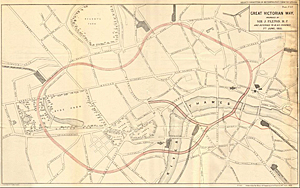
Fresh from the success of designing The Crystal Palace for the Great Exhibition of 1851 (see our earlier post here), in 1855 Sir Joseph Paxton came up with the idea of building a covered elevated railway “girdle” which would circle parts of central and west London and alleviate traffic congestion.

Great-Victorian-WayThe proposed 10 mile long, eight track railway – which would feature trains propelled by air pressure (an “atmospheric” system) rather than conventional steam engines and included  “express” trains which would only stop at select stations – was to be constructed inside a vast, 108 foot high glass covered arcade which would also contain a road, shopping and even housing.

The trains would travel at such a speed that to get from any one point on the “girdle” to its opposite point would only take 15 minutes.

Paxton presented his proposal to a Parliamentary Select Committee in June 1855 – he had already shown it to Prince Albert whom, he said, “gives it his approval”.

He estimated the cost of his proposal – which he thought would carry some 105,000 passengers every day – at some £34 million – a figure which parliament, which had initially been supportive of the idea, found a little hard to stomach.

This was especially thanks to the fact they were already dealing with the costs of Sir Joseph Bazalgette’s vast sewer system (see our earlier post here), created as a result of the ‘Great Stink’ in 1858 when the smell of untreated human excrement and other waste in the Thames became so strong, parliament had to act.

As a result, the project – which would have crossed the Thames three times, once with a spur line that ended near Piccadilly Circus – never eventuated but the Underground’s Circle Line today follows roughly the same route Paxton’s railway would have.

LondonLife – Thames life…


Thameslife


LondonLife – Rotherhithe from the Thames…


Wapping


Pictured is the south bank of the Thames showing the buildings of the former Thames Tunnel Mills (now converted to residences). The tower of the Church of St Mary the Virgin is in the background – the church dates from 1716 and was designed by John James, an associate of Sir Christopher Wren.

This Week in London – Gothic literature at the British Library; founder of War Graves Commission honoured; and, New Year’s Eve tickets on sale…

Gothic The UK’s largest exhibition of Gothic literature opens at the British Library in Kings Cross on Saturday (4th October), marking the 250th anniversary of the publication of the breakthrough book, Horace Walpole’s The Castle of Otranto. Terror and Wonder: The Gothic Imagination will feature manuscripts and rare and personal editions of Gothic classics like Bram Stoker’s Dracula, Mary Shelley’s Frankenstein, Robert Louis Stevenson’s Strange Case of Dr Jekyll and Mr Hyde and Charles Dickens’ Oliver Twist as well as the work of contemporary writers like Angela Carter and Mervyn Peake. There will also be Gothic-inspired artworks by the likes of Henry Fuseli and William Blake and modern art, photography, costumes and movies by the likes of Chapman Brothers and Stanley Kubrick. A range of literary, film and music events will accompany the exhibition which runs until 20th January. Admission charge applies. For more, see www.bl.uk/whatson/exhibitions/gothic/. PICTURE: Percival Delivering Belisane from the Enchantment of Urma, Henry Fuselli. © Tate.

The founder of the Imperial (now Commonwealth) War Graves Commission, Sir Fabian Ware (1869-1949), has been honoured with an English Heritage blue plaque at his former home in Marylebone. Sir Fabian lived at the early 19th century Grade II-listed terraced house at 14 Wyndham Place between 1911 and 1919. It was during this period that he served with the British Red Cross in France and first began recording the graves of soldiers killed in battle. In 1917, the Imperial War Graves Commission was formed with the task of reburying the war dead in permanent cemeteries in France. Knighted in 1920, Sir Fabian was to be director of graves registration and enquiries at the War Office during World War II and it was at this time that he extended the war graves scheme to civilians killed in the conflict. The commission changed its name to the Commonwealth War Graves Commission in 1960. Today it cares for cemeteries and memorials at 23,000 locations in 153 countries. For more, see www.english-heritage.org.uk/discover/blue-plaques/.

New Year’s Eve in London will be a ticketed event for the first time this year with 100,000 tickets being made available to the public with each costing a £10 administration fee – the entire sum of which will apparently be used to pay for the ticketing system. Making the announcement last month, the Mayor of London, Boris Johnson’s, office, said the growth in numbers of those who have gathered to watch the fireworks on the Thames – from around 100,000 in 2003 to an estimated 500,000 last year – has put an enormous strain on transport and safety infrastructure and meant people have had to turn up earlier and earlier to get a good view, facing hours waiting in cold and cramped conditions, or risk being among the “hundreds of thousands” unable to get a good view or even see the display at all. Booking tickets – people may secure up to four – will guarantee “good views of the celebrations and a better visitor experience”. To book tickets, head to www.london.gov.uk/nye.

Send all items for inclusion to exploringlondon@gmail.com.