 This month the Festival of Archaeology is being celebrated all across the UK, including in London where about 30 different events are being held. This year they include the chance to visit the remains of the Elizabethan Rose Theatre in Bankside and see for yourself preparations for an excavation to start next year, the opportunity to walk through the London offices of the Egypt Exploration Society, a series of hands-on archaeology-related activities at Eltham Palace in south London, behind the scenes tours of the Museum of London, and the chance (next weekend – 27th/28th July) to go mud-larking along the foreshore of the River Thames outside the Tower of London and then present your findings to archaeologists for identification (pictured above from a previous year). Get in there and have some fun! For more details of events, check out www.archaeologyfestival.org.uk.
River Thames
LondonLife – Celebrating the 60th anniversary of Queen Elizabeth II’s coronation…
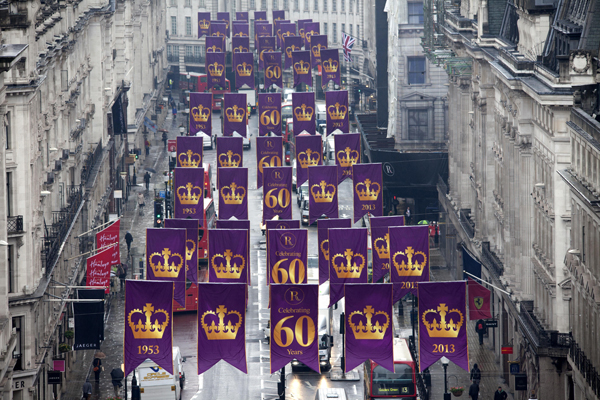
Regent Street is adorned with flags in celebration of the 60th anniversary of Queen Elizabeth II’s coronation, among the many ways in which London has been celebrating the occasion. The official anniversary was on Sunday – it was 2nd June, 1953, some 16 months after the 25-year-old Queen took the throne following the death of her father King George VI, that Queen Elizabeth II was crowned in Westminster Abbey. In celebrations yesterday, the King’s Troop Royal Horse Artillery fired a 41-gun salute in Green Park at midday followed an hour later by a 62-gun salute fired by the Honourable Artillery Company across the River Thames from the Tower of London. The Queen and other members of the royal family (along with some 2,000 guests) is attending a special service at Westminster Abbey today (for more on how the abbey is celebrating the event, see our earlier post here). More than 8,000 people attended the coronation which was watched by an estimated 27 million people across the country. PICTURE: RegentStreetOnline
What’s in a name?…Sloane Square
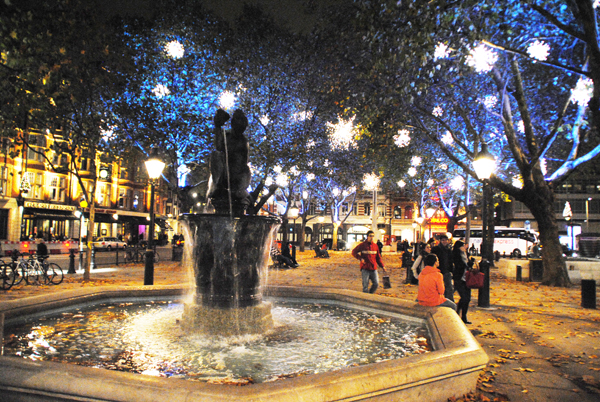 This upmarket square in west London is named in honor of Sir Hans Sloane, the physician come botanist who bought the manor of Chelsea in 1712 and, in doing so, provided grounds for the Chelsea Physic Garden.
Sloane Square was developed by architect Henry Holland Sr and his son Henry Holland Jr in 1771 as part of a residential development they called Hans Town (also named after Sir Hans, it’s still a ward in the Royal Borough of Kensington and Chelsea). For more on Sir Hans Sloane, see our earlier post here.
The square, pictured above as it looks decorated for Christmas, initially consisted of a village green bordered with posts and chains and the surrounding buildings were all residential. Apparently the square initially failed to attract the right sort of residents (it was a little too far from Mayfair) but despite this initial setback, it gradually became the centre of a desirable residential precinct.
Private houses began making way for other buildings in the square in the nineteenth century – in 1810, the New Chelsea Theatre opened, subsequently renamed the Royal Court Theatre (this was later moved to another site still on the square and remains there today), and in 1812, the Chelsea, Brompton and Belgrave Dispensary was established for the relief of the sick and the poor.
The Sloane Square Underground station opened in 1868 and rebuilt after it was damaged by bombs in World War II (it’s interesting to note that the River Westbourne actually runs through some iron conduit over the top of the platforms on its way to the River Thames).
Other notable buildings in the square today include the Peter Jones department store which first arrived in the square in the late nineteenth century.
The square itself was redesigned in the 1930s when the war memorial was put in its current position. The Venus Fountain (pictured above) which now stands there – the work of Gilbert Ledward – was erected in 1953.
Where is it?…#61…
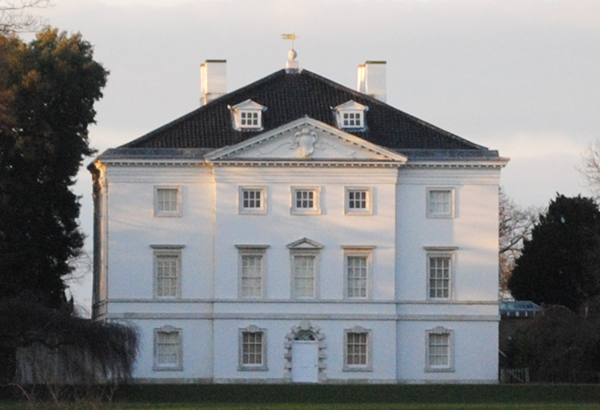 Can you identify where in London this picture was taken and what it’s of? If you think you can, leave a comment below. We’ll reveal the answer early next week. Good luck!
Well done to Sue and Helen – this is, of course, Marble Hill House, located in south-west London on the banks of the River Thames between Richmond and Twickenham (this picture is taken from the opposite side of the Thames). Built for Henrietta Howard, mistress of King George II when he was Prince of Wales, for the lady in her “retirement” from court, the Palladian villa is set among 66 acres of parkland. We’ll look at the house in more detail in a later post.
WHERE: Marble Hill House, Richmond Road, Twickenham (nearest Tube station is Richmond (1 mile) or train station, St Margarets (0.5 mile)); WHEN: 10am-2pm Saturday, 10am to 5pm Sunday (cafe and park are open daily); COST: £5.70 adults/£5.10 concessions/£3.40 child (5-15 years); WEBSITE: www.english-heritage.org.uk/daysout/properties/marble-hill-house/.
Around London – Olympics at the Museum of London; Oxford wins the Boat Race; restoration project at Kew; and, Phantom Ride at the Tate…
• Diver Tom Daley’s swimming trunks, cyclist Bradley Wiggins’ yellow jersey and a Mary Poppins outfit worn in last year’s Olympic Games’ opening ceremony are among the items on display as part of the Museum of London’s 2012 display. The free display, which opened last week, exactly 200 days after the Paralympics closing ceremony, features a selection of 70 items connected with the Games. Runs in the Galleries of Modern London until 31st October. For more, see www.museumoflondon.org.uk.
• Oxford took line honours at the 159th Boat Race, held on the River Thames last weekend. The Dark Blues – whose crew included Olympic medalists Constantine Louloudis and Malcolm Howard – still trail Cambridge (the Light Blues) – whose crew included another Olympic medallist, George Nash, however, with 77 wins to 81 wins. For more, see www.theboatrace.org or our previous articles – here and here.
• Kew Garden’s historic Temperate House has received a £14.7 million Lottery Fund grant for conservation of the Grade One listed building, the largest Victorian glasshouse in the world. The grant – which adds to £10.4 million from the government and £7.7 million from private donors – will also be used to create a “more inspiring” public display for visitors with the overall £34.3 million project completed by May, 2018. The building opened in 1863 and was last refurbished 35 years ago. It houses some of the world’s rarest plants, including a South African cycad (Encephalartos woodii). For more, see www.kew.org.
• On Now: Phantom Ride. This “haunting” film installation by artist Simon Starling was commissioned by the Tate Britain in Millbank and is located in the neo-classical Duveen galleries. Referencing the late nineteenth century tradition of ‘phantom rides’ – films, often made by cameramen strapped to the front of a train, that gave a dramatic sense of motion as if one is aboard an invisible vehicle – the installation includes a “compelling flow of images” of artworks that once filled the Duveen galleries, creating a sense of movement as the works move up and down the walls. Admission is free. Runs until 20th October. For more, see www.tate.org.uk.
10 of London’s greatest Victorian projects – 9. The Underground…
Apologies for the delay in posting this piece – next week we’ll post the final in this series!
The first underground railway system in the world, the London Underground – fondly known as the ‘Tube’ – is this year celebrating the 150th anniversary of its creation.
Born out of an idea to link the inner city with the various large rail termini on the outskirts, the first section of what is now the underground system – a six kilometre stretch between Paddington and Farringdon – opened on 9th January, 1863, and was run by the Metropolitan Railway, known less formally as the ‘Met’.
 It was constructed using the ‘cut and cover’ method in which streets were dug up and tracks laid in a trench before being covered by brick-lined tunnels and the street above replaced (the method was later abandoned, apparently due to the disruption it caused to traffic). The first trains were steam-driven locomotives and drew gas-lit wooden carriages behind them (the first journey was re-enacted earlier this year – see our earlier post here. Other events commemorating the 150th included a visit to Baker Street Station by Queen Elizabeth II, Prince Philip and the Duchess of Cambridge).
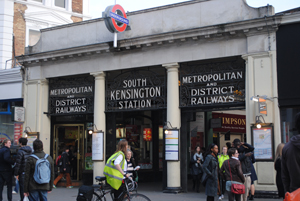
The idea proved a success – 26,000 people used the new railway every day during the first six months of its operation – and the Metropolitan District Railway opened a new line between Westminster and South Kensington (station is pictured) in December, 1868, while the first Tube tunnel under the Thames, from the Tower of London to Bermondsey, opened in 1880, and what is now the Circle Line was completed in 1884.
In December 1890, the world’s first deep-level electric railway opened, running between King William Street in the City and passing under the Thames to Stockwell. Ten years later the ‘Twopenny Tube’, more formally known as the Central London Railway, opened between Shepherd’s Bush and Bank (it was from this that the use of the word ‘Tube’ to describe the Underground system caught on).
The uniting of the system began the following year with the creation of the Underground Electric Railway Company of London and by World War I, all but the Met were within a single group organisation. The name Underground first appeared on stations in 1908, the same year electric ticket machines were introduced.
In 1933, the Underground came under the control of the London Passenger Transport Board – the same year that Harry Beck’s first diagrammatic map of the underground system appeared.
Stations in the system were used as air raid shelters during World War II – part of the Piccadilly Line was closed and used as a storage site for treasures from the British Museum. Following the war, the organisation running the system went through various name changes until the formation of London Underground in 1985.
The system has since expanded – the Victoria Line was opened in the late 1960s and the Jubilee Line a decade later – and now consists of more than 408 kilometres of railway lines and 275 stations which serve more than three million passengers a day – equating to more than a billion a year, the same as the entire national rail network.
For more on the history of the Underground, see our earlier 10 Questions with London Transport Museum curator Simon Murphy. Poster Art 150 – London Underground’s Greatest Designs runs at the London Transport Museum until October. Admission charge applies. For more (including the many events around the exhibition), see www.ltmuseum.co.uk/whats-on/events/events-calendar#posterart150.
For more, check out David Bownes’ Underground: How the Tube Shaped London

LondonLife – The city illuminated…
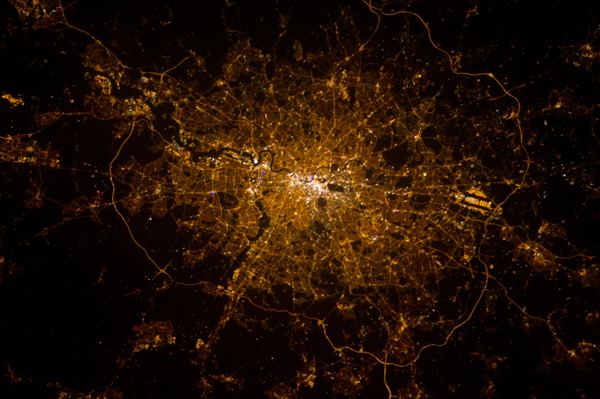
An image of London taken from the International Space Station, about 240 miles above the Earth, on 2nd February, 2013. Writes Expedition 34 flight engineer Chris Hadfield – an astronaut with the Canadian Space Agency: “London, on the Thames, from the city to the encircling motorway. Heathrow very visible on the (west).” North is at the bottom of the image, making west on the right in this image. As well as the M25, the winding River Thames can be clearly seen cutting through the city centre. PICTURE: NASA
10 of London’s greatest Victorian projects – 4. The Palace of Westminster…
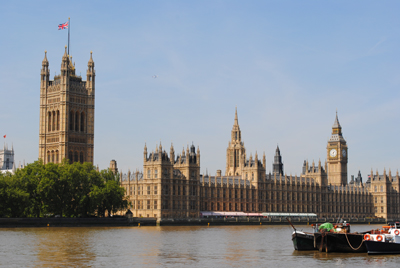
Commonly thought to be older than it actually is due to its Gothic stylings (although, to be fair, parts of it do date from medieval times), the Palace of Westminster – or, as it’s more commonly known, the Houses of Parliament – didn’t actually take on much of its current appearance until the latter half of the 19th century.
The need for a new building for parliament arose after 1834 when a fire, caused by the overheating of two underfloor stoves used to incinerate the Exchequer’s obsolete tally sticks, tore through the former complex, leaving only some structures from the old palace intact. They included the 11th century Westminster Hall (the largest in Europe when it was built), 14th century Jewel Tower and a chapterhouse, crypt and cloisters, all of which was once attached to the now gone St Stephen’s Chapel.
 While King William IV offered the use of Buckingham Palace for Parliament, the idea – along with a host of other options – was rejected as unsuitable. Instead, a competition was held for a new design and after almost 100 entries were considered, architect Charles Barry and his design for a new palace in the perpendicular Gothic style was chosen. Interestingly, while Barry was a classical architect, under the terms of the competition, designs were required to be in a Gothic style, thought to embody conservative values .
Incorporating some of the remains of the old palace – including Westminster Hall but not the Jewel Tower which to this day stands alone – the design was based around a series of internal courtyards with the House of Commons and House of Lords located on either side of a central lobby (first known as Octagonal Hall). The design involved reclaiming some land from the Thames so the building’s main river-facing facade could be completed.
Towers stand at either end of the complex – the Victoria Tower over the Sovereign’s Entrance at the southern end of the complex (for many years the tallest square stone tower in the world) and the narrower tower formerly known as the Clock Tower which houses the bell Big Ben, at the northern end – and there is a central Octagonal Tower which stands directly over the Central Lobby. The Clock Tower, incidentally, was renamed the Elizabeth Tower last year in honour of Queen Elizabeth II’s Diamond Jubilee (for more on it and Big Ben, see our earlier entries here and here).
Other towers include the Speaker’s Tower (located at the northern end of the building on the waterfront, this contains a residence for the Speaker), the Chancellor’s Tower (located at the southern end, it too contained a residence originally used by the Lord Chancellor) and St Stephen’s Tower – located in the middle of the building’s west front, it contains the public entrance to the building. Significant other rooms in the palace complex include the Robing Room – where the Queen puts on her ceremonial robes and crown before the State Opening of Parliament – and the Royal Gallery, used for state occasions.
The foundation stone (the building was constructed out of sand-coloured limestone from Yorkshire) was laid in 1840 and construction of the monumental building – which features more than 1,100 rooms and two miles of passageways – wasn’t completely finished until the 1870s although most of the work had been completed by 1860 (the year Barry died). The House of Lords first sat in their new chamber in 1847 and the House of Commons in 1852 (it was at this point that Barry was knighted for his work).
The cost, meanwhile, originally estimated at less than £750,000, ended up coming in at more than £2 million.
Much of the interior decoration owes its appearance to the Gothic revivalist Augustus Pugin who designed everything from wallpapers, to floor tiles and furnishings. Pugin also helped Barry with the external appearance but like Barry died before the project was completely finished (in 1852).
The palace was bombed numerous times in World War II – in one raid, the Commons Chamber was destroyed as firefighters opted to save the much older Westminster Hall instead. It was later rebuilt under the direction of Sir Giles Gilbert Scott and completed by 1950. Other aspects of the building have also been restored.
A Grade I-listed building classified as a World Heritage Site, Barry’s Houses of Parliament remain one of London’s most iconic structures. We’ll be looking in more detail at some of the building’s features in future posts.
WHERE: Houses of Parliament (nearest Tube stations are Westminster, St James’s Park and Embankment); WHEN: Tours (75 minutes) are run from 9.15am to 4.30pm on Saturdays (also six days a week during summer opening); COST: £15 adults/£10 concessions/£6 children five to 15 years (children under five are free). Prices go up after 1st April – check website for details and to purchase tickets (tours for UK residents, including climbing the Elizabeth Tower, can also be arranged through your MP); WEBSITE: www.parliament.uk.
For more, see Robert Wilson’s guide to the The Houses of Parliament


What’s in a name?…Richmond
It was King Henry VII, father of King Henry VIII, who brought the name Richmond to London.
 Inheritor of the title of the Earl of Richmond (the title relates to lands in Yorkshire and centres on the castle of Richmond), on being crowned king, Henry VII gained the use of Sheen (or Shene) Palace located on the banks of the Thames, about seven miles south west of Westminster (the history of which we’ll look at in greater detail in an upcoming post).
Sheen Palace was largely destroyed in a fire in 1497 and the king gave orders for it to be rebuilt (Richmond Palace is pictured here – found on a sign at Richmond). It was on its completion in around 1502 that Henry decided to rename the palace after his former earldom – Richmond.
The name Richmond, by the way, comes from a French word for ‘old hill’.
The once separated town of Richmond is now at the centre of the London Borough of Richmond upon Thames (it became a municipal borough in 1890) and a popular residential suburb for London’s wealthy (among those who have lived there are Mick Jagger and Jerry Hall) – sought after for its riverside amenity, quaint village green, and panoramic views from Richmond Hill as well as its fine shopping and dining.
Richmond’s other great drawcard is Richmond Park, one of the city’s eight Royal Parks, and home to more than 600 deer (see our earlier entry on it here).
LondonLife – Flying over the Thames by night…
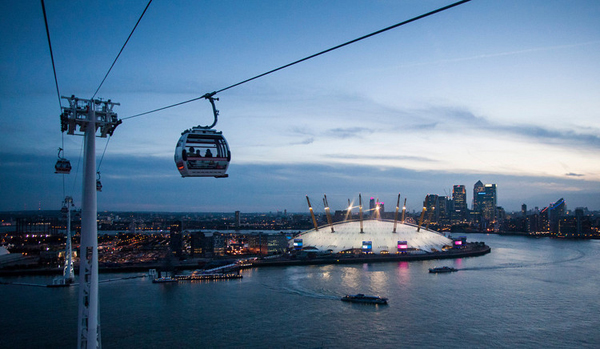
Sailing high over the River Thames between North Greenwich in the river’s southern bank and the Royal Docks on the river’s northern bank is the cable car formally known as the Emirates Air Line. Opened in late June and running every day, the cable car – the UK’s first in an urban area – is operated by Transport for London and links into the Underground and Docklands Light Rail network. Travelling at about 90 metres above the ground along a course of more than half a mile, passengers can take in the City, Docklands, Greenwich and as far eastward down the river as the Thames Barrier. This image, which shows the 02 Arena in the background, was taken just after the Closing Ceremony of the Olympic Games in August. For more, see www.emiratesairline.co.uk. PICTURE: © Transport for London
What’s in a name?…Southwark
One of those somewhat confusing placenames where the ‘w’ is effectively silent, Southwark (pronounced something like Suh-thuck) is a sizeable district south of the River Thames and one of the city’s oldest areas.
 The area, which was settled as far back as Saxon times, takes its name from the Old English words suth or sud weorc which translates as “southern defensive work” and relates to the fact that the site is south of the City of London and at the southern end of London Bridge (the first bridge here was built by the Romans). While it was this name which was recorded in the Domesday Book of 1086, in the 900s the area was recorded as Suthriganaweorc which meant ‘fort of the men of Surrey’.
The name Southwark was also applied to borough which sat south of the river and still exists today – the Borough of Southwark. This in turn became shortened to just Borough, hence the name borough still exists as an alternative for part of Southwark even today (think of Borough Market and Borough High Street).
Part of Roman Londinium, Southwark was effectively abandoned after the end of Roman rule and then reoccupied by Saxons in the late 800s when the ‘burh’ (borough) of Southwark was created. It developed considerably in the medieval period and became known for its inns (think of the pilgrim inn, The Tabard, in The Canterbury Tales).
The area, particularly Bankside – part of the Borough of Southwark, also become known as an entertainment district with theatres and bear-baiting pits as well as a red-light district. It was also known for its prisons, in particular The Clink (controlled by the Bishop of Winchester), Marshalsea and the King’s Bench.
The area was also a centre of industry – everything from brewing to tanning – and came to boast numerous docks and warehouses (when it also became a centre of the food processing industry). With the closure of the docks, it’s retail, tourism, creative industries and the financial services which are dominant in the area today.
Landmarks are many thanks to the area’s long and colorful history (far too many to list in this short piece) but among major sites are Southwark Cathedral, Borough Market, and the George Inn as well as the Old Operating Theatre, Guy’s Hospital, and a replica of Sir Francis Drake’s ship, the Golden Hinde. Personalities associated with the area (again far too many to list here) include Geoffrey Chaucer, William Shakespeare and Charles Dickens.
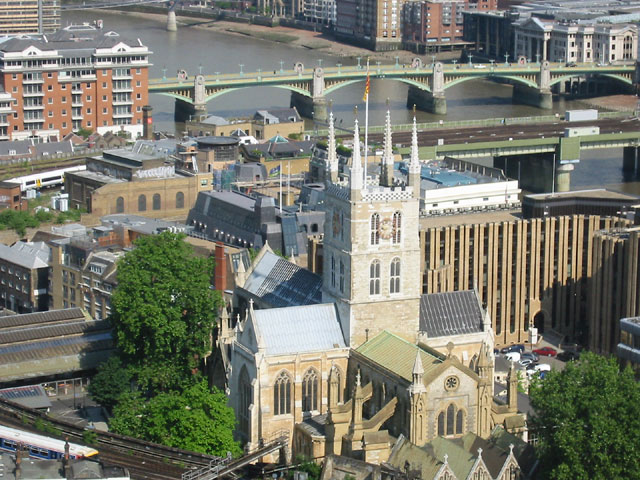
PICTURE: Southwark Cathedral © Copyright Kevin Danks and licensed for reuse under this Creative Commons Licence
For more, check out Southwark: A History of Bankside, Bermondsey and the Borough
Daytripper – Oxford
The “city of dreaming spires”, Oxford is a delight for the student of historic architecture, boasting an impressive array of medieval and later, classically-inspired, buildings.
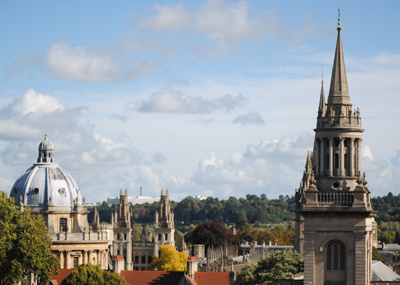 Only about an hour from London by train (leave from Paddington Station), Oxford was established as a town in the 9th century and rose to prominence during the medieval period as the location of a prestigious university, an institution which remains synonymous with the city today.
Major development followed the Norman Conquest the castle was constructed, the remains of which were included in a £40 million redevelopment several years ago of the area in which it stands and which now houses the Oxford Castle Unlocked exhibition which looks at some of the key figures in the castle’s past (you can also climb St George’s Tower for some great views over the city).
The university first appears in the 1100s and gradually expanded over the ensuing centuries gradually evolved to encompass the many medieval colleges which can still be seen there today.
Something of a hotbed of activity during the Reformation, Oxford saw the burning of three bishops – Hugh Latimer, Nicholas Ridley and Archbishop of Canterbury Thomas Cranmer at a site marked by a memorial in Magdalen Street. Constructed in the 1840s, it was designed by Sir George Gilbert Scott who drew inspiration from the Eleanor Crosses King Edward I had erected in honor of his deceased wife, Eleanor of Castile, following her death in 1290.
Oxford was also the site of the headquarters of King Charles I during the English Civil War after the king was forced to leave London (the town eventually yielded to parliamentarian forces after a siege in 1646) and was later home to the court of King Charles II after he fled London during the Great Plague of 1665-66.
Canals arrived in the late 18th century and the railways followed. Industrialisation came – in particular, in the 20th century, in the form of a large car manufacturing plant at the suburb of Cowley – and with it an increasingly cosmopolitan population. But at its heart Oxford remains a student city and it’s the students that continue to provide the lively atmosphere in the city centre.
Look for Carfax Tower to get your bearings – formerly the tower of a 14th century church, this lies at the heart of the town and can be climbed for some great views over the surrounding streets. Some of the colleges are also open to the public (see noticeboards outside the colleges for times) – particularly worth visiting is Christ Church which dates from 1524 and, founded by Cardinal Wolsey, was initially known as Cardinal’s College. It features the Tom Tower, home of the bell Great Tom, which was designed by former student Sir Christopher Wren. The college, which is unique in that the college chapel is also a cathedral, is also home to the Christ Church Picture Gallery.
Other colleges of note include the beautiful Magdalen (pronounced Maudlin, it was founded in 1458 – alumni have included writers John Betjeman, CS Lewis and Oscar Wilde), All Souls (founded in 1438 with King Henry VI its co-founder), and Merton College (the oldest of Oxford’s colleges, it was founded in 1264 and is home to Mob Quadrangle, the oldest quadrangle in the university).
Other university buildings which are a must include the Radcliffe Camera – now the reading room of the Bodleian Library, this Baroque rotunda dates from 1748 and was built as a memorial to 18th century physician Dr John Radcliffe, the Sheldonian Theatre – another of Wren’s designs, it was built in the 1660s as the university’s principal assembly room, and St Mary the Virgin Church – the official church of the university, the present building partly dates from the 13th century and boasts terrific views from the tower.
Make sure you also take the time to wander through the water meadows along the River Cherwell (there are also punt rides) and walk along the River Thames, known as the Isis as it passes through Oxford. Keep an eye out also for the ‘Bridge of Sighs’, similar in design to the Venetian landmark, it spans New College Lane and joins two sections of Hertford College.
Other sites in Oxford include the Ashmolean Museum of Art and Archaeology. Considered of the UK’s best, the original Ashmolean was the first purpose built museum in England, opening in 1683. It now houses treasures include art and antiquities with the late ninth century Alfred Jewel, said to have been made for King Alfred the Great, among its prized objects. Other museums include the Pitt Rivers Museum which cares for the university’s collection of anthropology and world archaeology and includes exhibits brought back to Britain by explorer Captain James Cook.
Take the time also to wander through the covered market off high street which has some interesting shops selling everything from clothes to fresh food and flowers and gifts. Fans of Inspector Morse, meanwhile, may also enjoy seeing some of the sites of particular significance in the TV series – there’s an interactive online map here.
A vibrant city redolent with history, Oxford remains of England’s jewels. Perfect as a day-trip destination from London.
 Exploring London