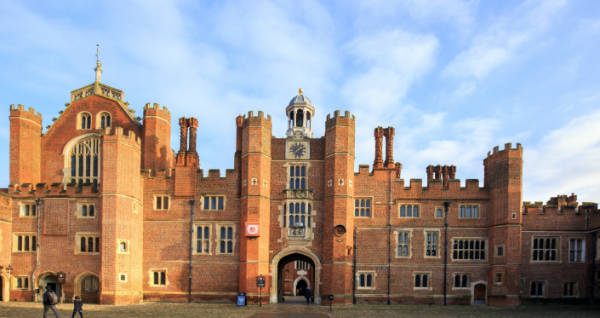
This Week in London – Christmas at Hampton Court; Caravaggio’s Victorious Cupid; and, Romani art, culture and heritage…

PICTURE: paulafrench/iStockphoto

Christmas has come to Hampton Court Palace with the one-time home of King Henry VIII decorated with traditional decorations and hosting a range of Christmas-related activities. Musicians located throughout the palace are playing a mixture of classical tunes and familiar Christmas melodies while in the Wine Cellar “intriguing history” of Christmas is being brought to life in story-telling sessions. The culinary Christmas traditions of the Tudors, meanwhile, are on display in the historic kitchens with, between 20th December and 4th January, the Historic Kitchens team recreating recipes from the Tudor court. The Magic Garden is hosting a special playful outdoor adventure for younger ones between 17th December and 4th January. The Hampton Court Palace Ice Rink has also returned (until 4th January) and there’s a Christmas market being held in the Great Fountain Garden on 5th to 7th December and again on 12th to 14th December. The Festive Fayre will feature more than 100 independent exhibitors offering artisan food and drink, unique gifts and stocking fillers while there will be live music on the East Front bandstand and horse and cart rides in the grounds. Admission charge applies. For more on Christmas activties at the palace head to www.hrp.org.uk/hampton-court-palace/whats-on/christmas-festivities/.

Caravaggio’s Victorious Cupid – never-before seen in public in the UK – is at the centre of a new exhibition which has opened at the Wallace Collection. The sculpture is presented with two Roman sculptures that along with the Caravaggio were all once part of the portfolio of Marchese Vincenzo Giustiniani (1564–1637), one of the most celebrated collectors of his day. The life-sized Cupid was once displayed along with works by the likes of Raphael, Titian and Giorgione in his grand palazzo located near the Pantheon in Rome along with an extensive gallery of classical sculpture. Caravaggio’s Cupid, which is free to enter, can be seen in the Exhibition Galleries until 12th April. For more, see www.wallacecollection.org/whats-on/exhibitions-displays/caravaggios-cupid/.

A new display honouring the livelihoods, creativity and craft of Romani communities and their contribution to British society has opened at the London Museum Docklands. By Appointment Only: Romani art, culture and heritage centres on three works, Sugar Coated (2025) by Corrina Eastwood, Tap Your Heels Together Three Times (2025) by Delaine Le Bas and What Makes a Home? (2025) by Dan Turner. There’s also timeline by John-Henry Phillips which illustrates the history of Romani communities from 500-1000 up to 2022. This is displayed along with the Historic England film Searching for Romani Gypsy Heritage with John Henry Phillips (2024) and an oral history piece both of which contextualise the timeline. The exhibition in the Reflections Room is free. For more, see www.londonmuseum.org.uk/whats-on/by-appointment-only/.

Send all items for inclusion to exploringlondon@gmail.com.
This Week in London – New artworks on the Tube network; Boulle clocks at the Wallace Collection; and, see extinct-in-the-wild doves at London Zoo…

Transport for London has announced it will be unveiling four major new artworks on the Tube network this year as part of its Art on the Underground programme which this year celebrates its 25th anniversary. The works include Saved by the Whale’s Tail, Saved by Art, a large-scale piece by artist Ahmet Öğüt in collaboration with New Contemporaries In Art which, to be unveiled at Stratford Underground station in March, explores the role art plays in everyday life. There’s also a new artwork by Hungarian-born American artist Agnes Denes which will be featured in a new pocket Tube map, a new audio work produced by artist and composer Rory Pilgrim with the Mayor of London’s Culture and Community Spaces at Risk (CCSaR) programme which will be heard at Waterloo Station in June and July, and, a new mural by Rudy Loewe which will be unveiled at Brixton Tube station in November. For more on Art on the Underground, see https://art.tfl.gov.uk.

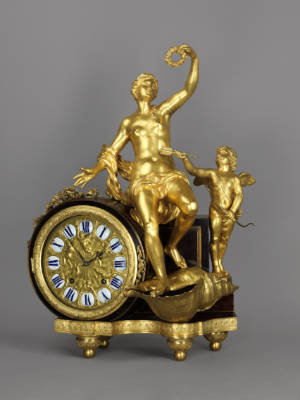
Attributed to André-Charles Boulle, movement by Jean Jolly, Mantel clock (About 1715)/© The Trustees of the Wallace Collection 

On Now: Keeping Time: Clocks by Boulle. This exhibition at the Wallace Collection in Manchester Square explores the art and science of timekeeping through a display of five pieces created by André-Charles Boulle (1642–1732). Boulle, the most famous cabinetmaker working for the court of the Sun King, Louis XIV (1638–1715), ended up giving his name to a style that featured elaborate veneer designs incorporating turtleshell, brass and other materials. The objects on show in the Housekeeper’s Room include a monumental wardrobe from 1715 that encloses a clock; two mantel clocks, one from around 1715 featuring Venus and Cupid, and another, from a decade later, with the figure of Father Time; as well as two pedestal clocks. A complementary display in the museum’s Billiard Room brings together two artworks as it explores the concept of time – The Dance to the Music of Time (about 1634-6) by Nicolas Poussin in which the Four Seasons dance to the song of Father Time, the composition of their rhythmic bodies echoing the workings of a clock movement, and The Borghese Dancers (1597–1656), where five female figures masquerade as the Hours, attendants to the goddesses of the Dawn and Moon. Runs until 2nd March. Free admission. For more, see www.wallacecollection.org.

Adult Socorro doves at London Zoo’s Blackburn Pavilion. PICTURE: © London Zoo

London Zoo has welcomed three new Socorro doves as part of a global effort to breed and reintroduce them to the wild. The three doves, which moved from Portugal’s Lagos Zoo at the end of 2024, have joined six other Socorro doves at the zoo. The species, which is extinct in the wild, is endemic to the tiny Socorro Island off the coast of Mexico and the Socorro Dove Project, an international initiative, is working to reintroduce the species to the island by 2030. The Socorro doves can be seen in Blackburn Pavilion, London Zoo’s historic tropical birdhouse, which is also home to the endangered Sumatran laughingthrush, the critically endangered Bali starling and the critically endangered blue-crowned laughingthrush. For more, see www.londonzoo.org

Send all items for collection to exploringlondon@gmail.com.

This Week in London – Maharaja Ranjit Singh at the Wallace Collection; Anne Desmet’s Kaleidoscope/London and displaced Ukrainians at the Foundling Museum…

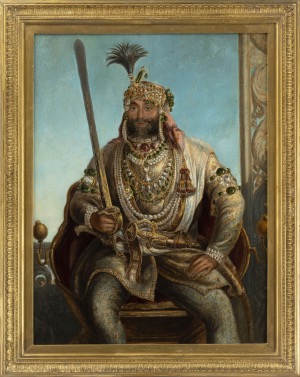
August Schoefft, Maharaja Sher Singh (1807–1843) seated on his father’s golden throne
Lahore, Punjab or Delhi, c 1841–42 © Toor Collection 

The remarkable life and legacy of Maharaja Ranjit Singh (1780-1839), the founder of the Sikh Empire, is the subject of a new exhibition which opened at the Wallace Collection this week. Ranjit Singh: Sikh, Warrior, King features historic objects from Ranjit Singh’s court, courtiers and family members, including those personally owned by the Maharaja and the most famous of his wives, Maharani Jind Kaur, as well as their son, Maharaja Duleep Singh. Highlights include a fine miniature painting of Ranjit Singh and his favourite, a Golden Throne made by Hafez Muhammad Multani, and a sword richly mounted in gold and gemstones which was thought to belong to the Maharajah. Runs until 20th October at the Manchester Square institution. Admission charge applies. For more, see www.wallacecollection.org/whats-on/events/ranjit-singh-sikh-warrior-king/.

A “fresh perspective” on London can be seen in a new exhibition by multi-award-winning wood engraver Anne Desmet at the Guildhall Art Gallery. Inspired by looking at a fragmented view of the world through a toy kaleidoscope, Anne Desmet: Kaleidoscope/London features works created by the artist slicing into prints focused on London from her earlier wood-engravings, linocuts and hand-drawn lithographs to make a new series of digital collages. The display features 150 works including 41 London-themed kaleidoscopic prints created exclusively for this exhibition. Among highlights is a complex collage, Fires of London, created using 18 razor-clam shells to present a theme of the many historic fires of London over the last 1,500 years. Admission is ‘pay what you can’. There are an accompanying series of artist-led tours. Runs until 8th September. For more, see www.cityoflondon.gov.uk/events/anne-desmet-kaleidoscopelondon-exhibition.

• Photographs depicting women and children forced to leave their Ukrainian homes following Russia’s invasion is on at the Foundling Museum in Bloomsbury. Polly Braden: Leaving Ukraine features the work of photographer Polly Braden and includes first-hand photographs, personal films and recorded conversations. It focuses on four central stories – that of three school friends trying to forge new lives and continue their education; that of a young graduate making a fresh start as a lawyer in London; that of a mother whose baby was born shortly after a perilous escape from Kherson to Warsaw; and that of two friends and their children who fled to Moldova with help from a kickboxing club, now struggling to find work in Italy. Admission charges apply. Can be seen until 1st September. For more, see https://foundlingmuseum.org.uk/event/polly-braden-leaving-ukraine/.

Send all items to exploringlondon@gmail.com

This Week in London – Disney’s French influence; Eid in the Square; and, Sir Isaiah Berlin’s Blue Plaque…

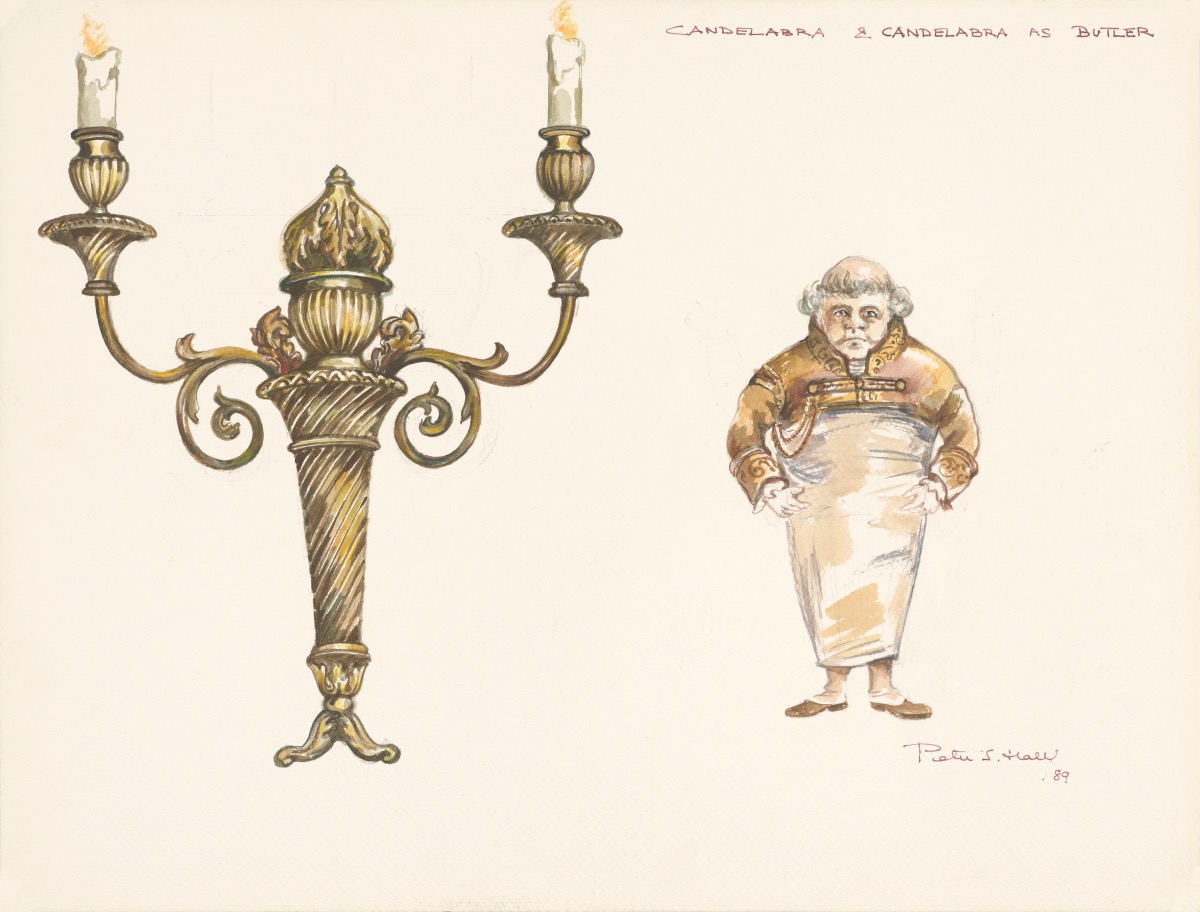
Beauty and the Beast, 1991, Peter J Hall, Concept art, gouache, marker and ink on paper © Disney

• The connection between Disney’s animated films and French 18th-century art is explored in an exhibition at the Wallace Collection. Inspiring Walt Disney: The Animation of French Decorative Arts, which is being held in collaboration with New York’s Metropolitan Museum of Art, features more than 120 examples of production artwork and works on paper from the Walt Disney Animation Research Library and the Walt Disney Archives alongside approximately 30 18th-century artworks. The latter include Jean-Honoré Fragonard’s much-loved painting, The Swing (c1767), which provided inspiration for Disney films including Beauty and the Beast (1991), Tangled (2010) and Frozen (2013) and which is being showcased for the first time since its recent conservation. The exhibition, which was previously at the New York’s Metropolitan Museum of Art, can be seen until 16th October. Admission charge applies. For more, see www.wallacecollection.org.

• Eid in the Square returns to Trafalgar Square this Saturday for the first time since 2019. The day, held from noon to 6pm to mark the celebration that follows the end of Ramadan, features Islamic inspired art, culture and comedy on the main stage alongside a feast of food stalls from across the world. Performers include Baha Yetkin Sufi Ensemble, Nafees Ifran & Qalandar Qawwali Band, Dur Dur Band, Star Children’s Choir, spoken word poet Hussain Manawer, comedy sketch show favourites, ‘The Halalians’, Alif New Beginnings, and award-winning music producer Naughty Boy who will present his Naughty Boy Kitchen pop-up serving signature dishes fusing his British upbringing and Pakistani heritage. Other family-friendly activities being held on the day including calligraphy, storytelling, mehndi, face painting, and drama and poetry workshops, as well as a variety of sports activities including Muslim Girls Fencing and Sisterhood FC.

World renowned philosopher and historian of ideas, Sir Isaiah Berlin (1909-1997), was commemorated with an English Heritage Blue Plaque at his former Holland Park home. Berlin lived at 33 Upper Addison Gardens for nearly six-and-a-half years while attending St Paul’s School, then located in Hammersmith – a period he later referred to as “my golden childhood”. The house, which was purchased by his timber merchant father, was the family’s first permanent home in the UK following their arrival from Latvia. Berlin was also commemorated this week with a plaque on another of his former homes, this one in Hampstead. The Heath and Hampstead Society plaque was placed on the property at number 49 Hollycroft Avenue which was where Berlin’s family moved in October, 1928. While he left for Oxford University that same month, he spent much time there during his university vacations. Oxford was Berlin’s main base for the rest of his life. For more, see www.english-heritage.org.uk/visit/blue-plaques/.

Send all items to exploringlondon@gmail.com.

10 (more) historic London garden squares…9. Manchester Square…

This Marylebone square is one of the better preserved Georgian-era squares in London. 

Located on the Portman Estate, it was laid out in the 1770s as a residential square with the north side of the square dominated by Manchester House, built in the 1770s as the home of the 4th Duke of Manchester (from whom the house and square, now derive their name).

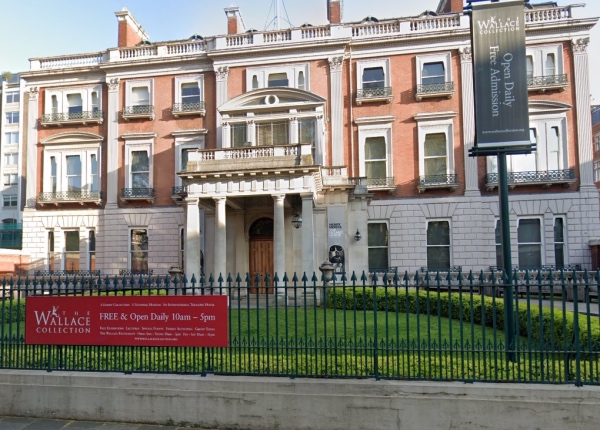
The house, meanwhile, changed its name when the 2nd Marquess of Hertford took over the lease in 1797. It became known as Hertford House and now houses The Wallace Collection (pictured below), a collection of artworks left to the nation – along with the house – by Lady Wallace, widow of Sir Richard Wallace, illegitimate son of 4th Marquess, in 1897, and opened to the public as a museum in 1900.

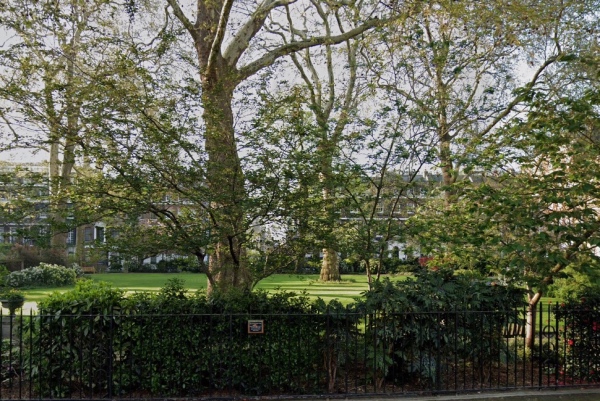
The almost circular private gardens in the centre were laid out in the mid-1770s with garden beds and railings (there was apparently a church planned for the centre of the square on which the gardens were located, but it was never built).

During World War II, trenches were dug in the garden and railings removed and the gardens did receive some bomb damage but they were restored in the 1960s and then extensively replanted in the mid-Noughties. The garden (pictured above, looking south) features mature London plane and lime trees.

Famous residents in the square, which has now largely been converted to offices, have included German-born composer Sir Julius Benedict (he lived at number two), surgeon and neurologist John Hughlings Jackson (number three) and colonial administrator Alfred, Lord Milner (number 14) – all of which have English Heritage Blue Plaques on their former properties – as well as Admiral Sir Thomas Foley (number one).

The square, which, along with Portman Square is Grade II-listed, also become briefly famous in around 1815 when it was reported a “pig-faced woman” lived there.

It is also known for being the former site of record label EMI – the cover shot for the Beatles’ first LP, Please Please Me, was shot in the modernist building’s stairwell in 1963 (the building has since been demolished but EMI took part of the staircase with them when they left in 1995).

Interestingly, Manchester Square Fire Station, which was decommissioned in 2005, was actually located a few blocks away in Chiltern Street (it was also known as the Chiltern Firehouse).

PICTURES: Google Maps

This Week in London – London Tree Week kicks off; illustrated London at the LT Museum; and, Joshua Reynolds at the Wallace Collection…

London Tree Week kicks off on Saturday with a range of free events happening across the city. They include ‘tree walks’ in Richmond and Greenwich Royal Parks, a tour of paintings featuring trees at the National Gallery in Trafalgar Square, an exhibition at City Hall featuring some of the city’s great trees, and family-friendly activities at Stave Hill Ecological Park in the city’s south-east. Londoners can also download a free ‘Tree Route’ app which uses the Tube map to showcase the capital’s trees including “must see” trees located near Underground stations such as St Pauls (a swamp cypress) and Angel (a black poplar). There’s also a photo sharing challenge where you can upload photos of trees that have made a difference to your part of London to Instagram or Twitter using the hashtag #LondonTreeWeek. For the complete listing of what’s on, follow this link. Runs until 31st May.

One hundred illustrations capturing a variety of aspects of life in London form the heart of an exhibition, The Prize for Illustration 2015: London Places & Spaces, which has opened at the London Transport Museum in Covent Garden. The artworks – which range from the past to the present and the contemplative to the loud – are all on the shortlist for the prestigious Prize for Illustration and were selected from more than 1,000 entries. Each of the works is accompanied by a short description written by the artist. The works are on show until 6th September. Admission charge applies. For more, see www.ltmuseum.co.uk.

On Now – Joshua Reynolds: Experiments in Paint. Now entering its final days, this exhibition at the Wallace Collection in Marylebone provides a fresh perspective on a giant of the British art world, 18th century portraitist Joshua Reynolds and features such famous works as Nelly O’Brien, Mrs Abingdon as Miss Prue, and Self Portrait Shading the Eyes. Admission is free. Runs until 7th June. For more information, see www.wallacecollection.org.

Send items for inclusion to exploringlondon@gmail.com

This Week in London – Garden art from the Royal Collection; A Royal Welcome at Buckingham Palace; photographic history; and, Joshua Reynolds reconsidered…

GardensKing Henry VIII’s well-thumbed gardening manual, a late 15th century copy of the Ruralia Commoda, and a 16th century portrait of Jacopo Cennini, factor and estate manager to the House of Medici – believed to be the earliest surviving portrait of a gardener – are among more than 150 objects on display at a new exhibition celebrating the art of gardens. Opening at The Queen’s Gallery in Buckingham Palace tomorrow, Painting Paradise: The Art of the Gardens features some of the earliest surviving records of gardens and plants in the Royal Collection including Jan Brueghel the Elder’s Adam and Eve in the Garden of Eden (1615), The Family of Henry VIII (c. 1545) featuring King Henry VIII’s Great Garden at Whitehall Palace – the first real garden recorded in British art, and A View of Hampton Court by Leonard Knyff (c. 1702-14) – described as the “greatest surviving Baroque painting of an English garden”. There are also works by Frenchman Jean-Baptiste Martin, Swiss artist Johan Jacob Schalch and Sir Edwin Landseer. The exhibition runs until 11th October. Admission charge applies. For more, see www.royalcollection.org.uk. PICTURE: Illustration from Henry VIII’s copy of the gardening manual, c. 1490-95. Royal Collection Trust/© Her Majesty Queen Elizabeth II 2015. 

Buckingham Palace, meanwhile, has announced its summer opening under the theme of A Royal Welcome. From 25th July to 27th September, displays in the State Rooms will recreate the settings for some of the many occasions in which the palace welcomes guests – from State Visits and garden parties to investitures and private audiences. The displays will show the behind-the-scenes preparations that go into a state visit and show the ballroom set up for a State Banquet. There will also be a display featuring the knighting stool and a knighting sword and, for the first time ever, visitors will enter the State Rooms through the Grand Entrance, used by those who come to the palace at the invitation of the Queen, including heads of state and prime ministers. The Australian State Coach, most recently used to carry the Duke of Edinburgh and the wife of the Mexican President, Señora Rivera, in March this year, will be displayed in the Grand Entrance portico. Admission charge applies. For more, see www.royalcollection.org.uk.

About 100 of the “most stunning photographs ever created” go on show in the Science Museum’s Media Space in South Kensington from tomorrow. Revelations explores the role of early scientific photography in inspiring later art photographers and will feature rare shots from the National Photography Collection including an original negative of X-Ray, 19th century photographs capturing electrical charge and William Henry Fox Talbot’s experiments with photomicrography. Displayed alongside are images by some of the 20th century’s pre-eminent art photographers such as Trevor Paglen, Idris Khan and Clare Strand. Runs until 13th September. Admission charge applies. For more, see www.sciencemuseum.org.uk/revelations.

On Now: Joshua Reynolds: Experiments in Paint. This exhibition at the Wallace Collection in Marylebone provides a new perspective on the portraits of Reynolds, one of the greatest artists of his day. Works on show including Nelly O’Brien, Mrs Abington as Miss Prue and Self Portrait Shading the Eyes as well as lesser known pictures and a rare history painting. The exhibition reveals discoveries made recently during a four year research project into the works of Reynolds now in the care of the collection. Runs until 7th June. Admission is free. For more, see www.wallacecollection.org.

Send items for inclusion to exploringlondon@gmail.com.

What’s in a name?…Marylebone

This curiously named part of London, pronounced Mar-lee-bone, takes it’s name from a church dedicated to St Mary which was originally built near a small river or stream called the Tyburn or Tybourne. Hence St Mary-le-Burn became St Marylebone.

There was a medieval village here which during the 18th century became subsumed into greater London as fashionable people sought land to the west of the city. The area – in particular Harley Street – became known as a location of choice for doctors to site their consulting rooms and is still known for its medical establishments.

Among the significant sites is the St Marylebone Parish Church (pictured right) which, consecrated in 1817, was where poets Robert Browning and Elizabeth Barrett were married in 1846 following their elopement, the John Nash-designed All Souls Church in Langham Place, the Langham Hotel which opened in 1865 and boasted Oscar Wilde and Mark Twain among guests, 221B Baker Street, fictional home of Sherlock Holmes and now the site of the Sherlock Holmes Museum, and the famous wax museum, Madame Tussauds.

Marylebone is also home to the world famous Wallace Collection, bequeathed to the government in 1897, the concert hall Wigmore Hall, the Royal Academy of Music and the Royal Institute of Architects, and the art-deco headquarters of the BBC, Broadcasting House. Marylebone High Street remains a shopping mecca offering a diverse range of independent boutiques and specialty shops while in the south, Marylebone includes one of London’s most famous shopping strips on Oxford Street.

Other famous people connected with the area include four time Prime Minister William Gladstone who lived at 73 Harley Street from 1876 to 1882, writer Charles Dickens who lived at 18 Bentinck Street while working as a court reporter in the 1830s, author Edward Gibbon, who lived at 7 Bentinck Street while writing his landmark text The Decline and Fall of the Roman Empire from the 1770s, and Sir Arthur Conan Doyle, creator of Sherlock Holmes, who worked in Upper Wimpole Street in the 1890s.