Eighteenth century artists William Hogarth and Joshua Reynolds gaze down from the facade of the V&A in South Kensington. The Victoria and Albert Museum was established in 1852 – capitalising on the success of the Great Exhibition the previous year – and moved to its current site in 1857. The foundation stone for the current building was laid by Queen Victoria herself in 1899 and it was to mark this occasion that the museum was renamed the Victoria and Albert Museum after the queen and late Prince Albert (although the queen really just wanted it to be the Albert Museum). For more on the V&A, see www.vam.ac.uk.
Author: exploringlondon
Famous Londoners – Sir Hugh Myddelton…
The Welsh-born “merchant adventurer” Sir Hugh Myddelton (also spelt Myddleton or Middleton) is best remembered in London for the construction of the New River, a water engineering project which still provides some of city’s water.
Born about 1560, the sixth son (and one of 16 children) of Richard Myddelton, governor of Denbigh Castle in Wales, Hugh Myddelton travelled to London to seek his fortune and there became apprenticed to a goldsmith before himself becoming a member of the Goldsmith’s Company in 1592 (he later became warden of the company).
Operating out of premises in Bassishaw (now Basinghall Street), he gained a reputation among the wealthy and nobility for his work and was appointed Royal Jeweller to King James I (he had apparently also supplied jewellery to Queen Elizabeth I).
Myddelton became a wealthy merchant and banker, and, in 1603, he also succeeded his father as MP for Denbigh Borough, a post he held repeatedly until 1628.
Sir Hugh became one of the driving forces behind the New River project which aimed to address the strain on London’s water sources by bringing clean water from the River Lea in Hertfordshire via a 39 mile-long canal to New River Head in London.
After an aborted earlier attempt to build a canal from Hertfordshire to London (which had run into financial difficulties), Sir Hugh was granted authority to carry out the works for the New River in 1609 and employed mathematicians like Edward Pond and Edward Wright to direct the course with the man behind the earlier attempt, Edmund Colthurst, overseeing the works.
By 1611 it became clear to Myddelton that he wouldn’t have the necessary funds to complete the works so he obtained the financial aid of the king (in return the king was to get half of all profits).
The project was eventually completed in 1613 and a ceremony was held at the New River Head in Islington where the canal then terminated (just south of where Sadler’s Wells Theatre now stands).
Myddelton, who continued to diversify in business and made considerable sums from his ownership of lead and silver mines in Wales as well as from a land reclamation project on the Isle of Wight, became the first governor of the New River Company when it was created by royal charter in 1619 and remained a key figure in it until his death. He was created a baronet in 1622.
Myddelton, who married twice, had 15 or more children to his second wife – only about half of whom survived him. He died on 7th December, 1631, and was buried in the now demolished St Matthew Friday Street where he had been a church warden (some of his children were buried there as well). One of his brothers, Sir Thomas Myddelton, was a Lord Mayor of London.
Among memorials to Sir Hugh in London is a statue of him on Islington Green which was unveiled in 1872 by William Gladstone, later PM. There is also a statue of him on the Royal Exchange (pictured) and a number of Islington streets have been named for him.
For more on London’s historic water sources, see London’s Lost Rivers: A Walker’s Guide.
Treasures of London – Daniel Defoe grave memorial, Bunhill Fields…
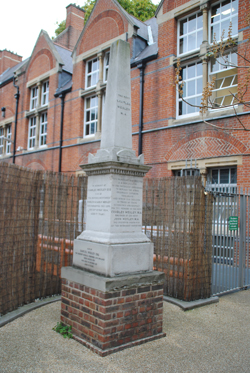
Located in Bunhill Fields Burial Ground in City Road, this memorial to Daniel Defoe, the author of numerous books including Robinson Crusoe and Moll Flanders as well as a journalist, pamphleteer and ‘provocateur’ or spy, wasn’t erected until 1870, almost 140 years after his death.
After he died in 1731 at the age of 70, Defoe was among the more than 120,000 people buried in Bunhill Fields, a Nonconformist cemetery which opened in 1665 and had closed by 1853. He was apparently buried under the name Dabow, thanks to a spelling mistake made by the gravedigger.
When he died in relative obscurity (he was believed to have been hiding from his creditors at the time), his fame rose after his death – due in large part to the rising popularity of Robinson Crusoe, and by the mid-19th century, it was believed that the simple headstone over his grave didn’t do justice to him.
Hence an appeal was run by children’s magazine Christian World for a more suitable memorial for the writer – named as Daniel De-Foe on the memorial – and more than £150 was raised from 1,700 people, an amount which apparently exceeded expectations.
Sculptor Samuel Horner was subsequently commissioned to carve the memorial obelisk, which features projections at the base resembling a coffin lid, to the designs of CC Creeke of Bournemouth. It was unveiled on 16th September, 1870, in a ceremony attended by three of Defoe’s great grand-daughters.
There was apparently a newspaper story that the sculptor uncovered a coffin bearing Defoe’s name in preparing the site for the monument and had to get the aid of police to prevent watchers from making off with the bones from within.
The monument, which may not mark the exact location of Defoe’s grave site due to the movement of graves in the burial ground, is now Grade II*-listed (and the burial ground itself Grade I-listed). Others buried at Bunhill Fields include author John Bunyan, artist William Blake and Susanna Wesley, mother of John Wesley, founder of Methodism.
WHERE: Bunhill Fields Burial Ground, 38 City Road (nearest Tube station is Old Street); WHEN: 7.30am to 7pm or dusk; COST: Free; WEBSITE: www.cityoflondon.gov.uk/things-to-do/green-spaces/city-gardens/visitor-information/Pages/Bunhill-Fields.aspx
This Week in London – Celebrate summer at the Tate; Titian revealed at Apsley House; and, exploring the unconscious at The Freud Museum…
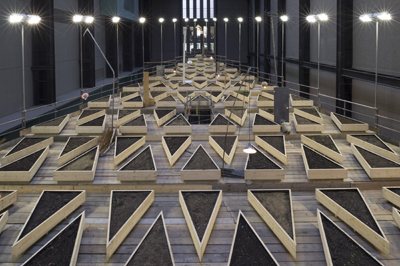
• On Saturday, the Tate Modern’s Turbine Hall on South Bank will host an “audio-visual feast” of music, performances, art installations and activities. The free Turbine Festival will feature everything from an alternative hair salon and a London bus built on the day by artist John Costi to a pop-up juice bar where you can make your own drinks and a record shop where you can design your own vinyl record sleeve. The day will also feature performances by Grime/HipHop/AfroPop artist Afrikan Boy, Felix’s Machines – who will transform live music and sound into a 3D visual show, and poet Jacob Sam-La Rose, as well as a programme of “bite-sized” films running in collaboration with the London Short Film Festival, and a series of interactive workshops covering everything from beatboxing to crafting. Visitors to the festival, sponsored by Hyundai, are also encouraged to contribute to a special project by My Culture Museum by submitting photographs or bringing objects to be archived and curated. Runs from 12.30pm to 9.30pm. For more, see www.tate.org.uk.
• Three paintings previously attributed to later followers of 16th century Venetian artist Titian but subsequently found to be by the artist himself and his studio have gone on display together for the first time at Apsley House. The three paintings – which include Titian’s Mistress (c1560), A Young Woman Holding Rose Garlands (c1550) and Danae (c1553) – were all in poor condition before conservation and cleaning by experts from English Heritage, the Museo del Prado in Madrid and the Hamilton Kerr Institute revealed their true quality (and Titian’s signature on two of the paintings). All three works were held in the Spanish Royal Collection and among 160 that Joseph Bonaparte, brother of Napoleon and King of Spain, tried to take out of the country following his defeat by the Duke of Wellington at the Battle of Vittoria in 1813. Wellington was subsequently given the paintings by a grateful King Ferdinand VII. The Titian at Apsley House exhibition, which opened earlier this month, runs at the Duke of Wellington’s home at Hyde Park Corner until 31st October. Admission charges apply. For more, see www.english-heritage.org.uk/visit/places/wellington-arch/.
• On Now: Festival of the Unconscious. This festival at Sigmund Freud’s former London home and now home to The Freud Museum sees artists, designers, writers and performers taking another look at Freud’s seminar 1915 paper, The Unconscious. Features of the festival, which runs until 4th October, include specially commissioned films by animators from Kingston University running throughout the house, sound and video installations by London-based art project Disinformation in the dining room and an installation from stage designers at the Royal Central School of Speech and Drama in Freud’s study. There’s also a display by Julian Rothenstein, co-author of Psychobox, and a chance to recline and “free-associate” on a psycho-analytic couch in Freud’s bedroom. An extensive programme of events accompanies the displays. Admission charges apply. For more, see www.freud.org.uk.
Send all items for inclusion to exploringlondon@gmail.com.
10 small, ‘secret’ and historic gardens in central London…1. Goldsmiths’ Garden…
Welcome to the first in our new Wednesday series, looking at some of central London’s small historic gardens which, while not secret in the strictest sense of the word, may tend to get overlooked. Each of the gardens we’re looking at is accessible to the public and has a link to the city’s history as well as providing a peaceful oasis out of the hustle and bustle…
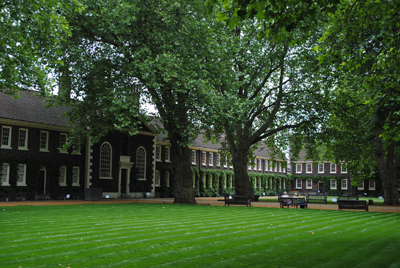
First up, it’s the Goldsmiths’ Garden, located on the site of the former medieval church of St John Zachary at the corner of Gresham and Noble Streets in the City.
The church, which dates back to at least the late 12th century, was destroyed in the Great Fire of London in 1666 and not rebuilt (its parish was united with that of St Anne and St Agnes) although its ruins apparently remained until the 19th century. The church’s layout can be seen in the sunken area of the current garden.
The Worshipful Company of Goldsmiths had acquired land in the area in medieval times and built their first hall here in 1339 on the site of the current hall (which lies across the road from the garden and dates from the early 19th century).
The first garden was constructed on the site of the former church in 1941 by fire watchers after the area suffered in the Blitz and it apparently won a Gardener’s Company award for “Best Garden on a Blitzed Site” in 1950.
The garden has since been altered and refurbished several times since, including in around 1960 by landscape architect Sir Peter Shepheard and in the 1990s by landscape architect Anne Jennings.
Features today include the iron entrance archway (top) which was commissioned by the Blacksmiths Company during the 1990s renovation. It features the leopard’s head hallmark of the Goldsmiths’ Company Assay Office, used to verify the purity of silver since the early 14th century.
As well as the central fountain installed in the 1990s (and donated by the Constructors’ Company), the garden also features a two metre high, 2.5 tonne Portland stone monument called the Three Printers (pictured right).
The work of Wilfred Dudeney, it was commissioned by the Westminster Press Group in the late 1950s for their new headquarters in New Street Square, off Fleet Street, and depicts a newsboy, editor and printer. It was placed in a demolition yard in Watford when the group moved headquarters before taking its current position in 2009.
WHERE: Goldsmiths’ Garden, corner of Gresham and Noble Streets, City of London (nearest Tube stations are St Paul’s, Bank and Barbican); WHEN: Anytime; COST: Free; WEBSITE: www.thegoldsmiths.co.uk/goldsmiths’-hall/.
For more on London’s parks and gardens, check out Jill Billington’s London’s Parks and Gardens.
LondonLife – From Burning Man to the British Library…
Visual artist David Normal brings the British Library’s collections to life in an “epic suite of murals” called Crossroads of Curiosity. Unveiled at the library at a special event on the eve of the summer solstice (20th June), the art installation – which has its origins in a work first created for Nevada’s Burning Man Festival in 2014 – juxtaposes images from millions of digitised book illustrations the library released onto Flickr in 2013. The installation can be seen in the library’s piazza in King’s Cross until 8th November. Entry is free. For more, see www.crossroadsofcuriosity.com. PICTURES: Courtesy of the British Library.
What’s in a name?…Drury Lane…
Famous for its associations with London’s theatreland, Drury Lane takes its name from the Drury family who once owned a mansion here.
Previously known as the Via de Aldwych (apparently for a stone monument the Aldwych Cross which stood at the street’s northern end), Drury Lane – which runs between High Holborn and Aldwych – was renamed after Drury House which was built at the southern end of the street.
Some accounts suggest it was Sir Robert Drury (1456-1535), an MP and lawyer, who built the property around 1500; others say it was his son, Sir William Drury, also an MP and a Privy Councillor, who did so in around 1600 – which may mean there were two versions of the one property.
The street, meanwhile, is said to have been briefly renamed Prince’s Street during the reign of King James I (1603-1625) but, following the Restoration in 1660, the name Drury once more gained supremacy.
The origins of the street’s famous theatre (London’s oldest), the Theatre Royal Drury Lane, dates from the same year (see our earlier post here). Other theatres in the street included the Cockpit Theatre which had been designed at one stage by Inigo Jones.
The street is also famous for being the site of the worst outbreak of the plague in London – the Great Plague of 1665, burned away the following year by the Great Fire – and by the 18th century was a slum noted for its seediness, in particular for prostitution (it features in William Hogarth’s work The Harlot’s Progress).
This didn’t change until the second half of the 19th century – author Charles Dickens had been among others who had commented on the poverty he had seen there – when gentrification took hold. Among the shops opened there during this time was the first Sainsbury’s, founded at number 173 in 1869.
Alongside the Theatre Royal Drury Lane (although the main entrance is in Catherine Street), other theatres in the street today include the New London Theatre and the London Theatre.
This Week in London – Exploring London’s archaeology; Alice in Bloomsbury; and, ‘Soundscapes’ at the National Gallery…
• Descend into ice wells at the London Canal Museum; delve into the archaeological archives of the Egypt Exploration Society; discover the history of the Spitalfields Charnel House; and, tour the remains of London’s Roman military fort with experts from the Museum of London. The British Festival of Archaeology kicked off last weekend and there’s a plethora of events happening across London as part of the more than 1,000 taking place across the country. For a full programme of events – many of which are free – head to www.archaeologyfestival.org.uk. The festival runs until 26th July.
• Follow Alice down the rabbit hole in a new exhibition which opened at the Cartoon Museum in Bloomsbury yesterday. Marking the 150th anniversary of the book’s publication, Alice in Cartoonland looks at how cartoonists, caricaturists, satirists, animators and graphic artists adapted and used author Lewis Carroll (aka Charles Lutwidge Dodson) and original illustrator John Tenniel’s work in social and political commentaries as well as just to have fun. The display features posters, cartoon strips, comic and graphic novels and artwork from TV and film versions of Alice with Low, Vicky, Shepard, Steadman and Gilroy among the artists represented. Runs until 1st November (with some events held in conjunction with it). Admission charge applies. For more, see www.cartoonmuseum.org.
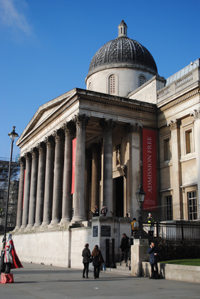
• Exploring the National Gallery’s art collection is usually done with the eyes but thanks to an innovative project which kicked off last week, it’s now also about listening. A series of contemporary sound artists and musicians including Nico Muhly, Gabriel Yared, Susan Philipsz, Jamie xx, Chris Watson, Janet Cardiff and George Bures Miller have created sounds and musical pieces in response to works they have chosen from the gallery’s collection. Selected works include the late 14th century The Wilton Diptych (Muhly), Hans Holbein’s 1533 painting The Ambassadors (Philipsz) and Paul Cézanne’s painting Bathers (Les Grandes Baigneuses) (Yared). Soundscapes runs until 6th September in the Sainsbury Wing. Admission charge applies. For more, see www.nationalgallery.org.uk.
Send all items for inclusion to exploringlondon@gmail.com.
10 sites from London at the time of the Magna Carta – 10. Priory of the Order of St John of Jerusalem…
Founded in Clerkenwell in 1144, the Priory of the Order of St John of Jerusalem served as the order’s English headquarters.
The order, also known as the Knights Hospitaller, was founded in Jerusalem in 1080 to care for the sick and poor, and soon spread across Europe with the English ‘branch’ established on 10 acres just outside the City walls apparently by a knight, Jorden de Briset.
The original buildings – of which only the 12th century crypt (pictured above) survives complete with some splendid 16th century tomb effigies including that of the last prior, Sir William Weston – included a circular church, consecrated in 1185, and monastic structures including cloisters, a hospital, living quarters and a refectory or dining hall.
There are records of dignitaries staying at the priory as it grew in size and renown – among them was King John who in 1212, apparently stayed here for an entire month. There are also surviving accounts of Knights Hospitaller riding out in procession from the priory and through the City at the start of a journey to the Holy Land.
The priory and church were attacked during the Peasant’s Revolt of 1381, thanks to its connection with the hated Poll Tax (Prior Robert Hales was also the Lord High Treasurer and was beheaded during the revolt on Tower Hill).
The church was subsequently rebuilt as a rectangular-shaped building and then, in the early 16th century, enlarged when the site was significantly renovated. These renovations were still relatively new when the priory was dissolved in 1540 during the Dissolution of King Henry VIII.
The priory church, which survived the Great Fire of 1666, was later used as a parish church but was destroyed in an air raid in World War II. Subsequently rebuilt, it can be visited today along with the crypt below and the cloister garden, created in the 1950s as a memorial to St John’s Ambulance members from the London area (the original shape of the circular church is picked out in the paving here).
Perhaps the most famous building to survive is St John’s Gate which dates from the 16th century and was once the gatehouse entrance to the priory (added in the final renovations).
After the Dissolution it served various roles including as the office of the Master of Revels (where Shakespeare’s plays were licensed), the home of The Gentleman’s Magazine (Samuel Johnson was among contributors and worked on site), a coffee house (run by William Hogarth’s father) and a public house called the Old Jerusalem Tavern (yes, Charles Dickens was said to be a regular). It is now home to the recently renovated Museum of the Order of St John (you can see our earlier post on the museum here).
WHERE: Museum of the Order of St John, St John’s Gate (and nearby priory church), St John’s Lane, Clerkenwell (nearest Tube stations is Farringdon); WHEN: 10am to 5pm, Monday to Saturday (tours are held at 11am and 2.30pm on Tuesday, Friday and Saturday); COST: Free (a suggested £5 donation for guided tours); WEBSITE: www.museumstjohn.org.uk.
We’ll kick off a new Wednesday series next week…
LondonLife – A riot of summer colour…
Flowers in Regent’s Park, north London. The park, which was designed by John Nash, was opened to the public in 1835. For more on the history of the park, see our earlier post here.
London Pub Signs – Jamaica Wine House…
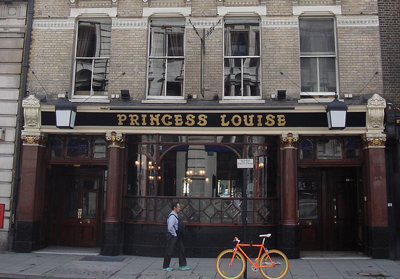
Located on the site of London’s first coffee house in St Michael’s Alley in the City, the Jamaica Wine House comes with plenty of yesteryear atmosphere.
The coffee house, which was established in 1652 at the sign of ‘Pasqua Rosee’s Head’ (named for one of the co-owners, a Turk and former manservant called Pasqua Rosee), was once frequented by the likes of diarist Samuel Pepys who apparently had a pleasurable night there on 10th December, 1660.
Standing in the midst of what became a hotspot for coffee houses in London, it was apparently damaged in the Great Fire of London of 1666. Rebuilt as the Jamaica Coffee House in the 1670s, it become known as something of a gathering place for seafarers who were involved in the West Indies trade. The current name bears testament to that past (we’ll take a more in-depth look at the history of the coffee house in an upcoming Lost London post).
While the building which housed the coffee shop is long gone, the current Grade II-listed building, located just of Cornhill, dates from 1869 and was built as a public house. Built of red brick and red stone, retains much of its Victorian character outside and in – with the latter featuring dark wood panelling on the walls and decorative ceilings and glasswork. The basement features a wine bar.
These days the establishment – which is known fondly to regulars as the ‘Jampot’ – boasts a clientele which includes City workers as well as “bell-ringers” and walking tourists (or so the website says). And then there’s the three ghosts – one of which is said to be a dog.
Now part of the Shepherd Neame chain (which purchased it in 2009). For more, see www.shepherdneame.co.uk/pubs/london/jamaica-wine-house.
PICTURE: Matthew Black/Flickr. Used under licence CC BY-SA 2.0
Treasures of London – ‘Timepiece’, Thames embankment…
In honour of the sun and the heatwave it’s brought this summer, here’s the giant “equinoctial” sundial on the north bank of the Thames, just east of Tower Bridge. Known as Timepiece, it is the work of London-based sculptor Wendy Taylor and was installed here, beside the lock that leads into St Katharine Docks, in 1973. Measuring more than 3.5 metres across, the dial is made from stainless steel and is supported by three chunky chain link cables. According to the plaque, it was commissioned by Strand Hotels Ltd. It’s now a Grade II-listed structure.
This Week in London – Tudor jousting at Hampton Court; Black British voices heard to Guildhall Art Gallery; and, V&A extends McQueen…
• Enjoy a weekend of jousting, music, dancing and Tudor cookery at Hampton Court Palace this weekend as part of the celebrations surrounding the iconic building’s 500th anniversary. England will take on Spain in the jousting while intrigue abounds at the court of Queen Mary I and King Philip II of Spain as actors perform scenes written by award-winning playwright Elizabeth Kuti. The pageant kicks off at 11am each day with the jousts commencing at noon and 3.30pm in the grounds. The event will be followed by a Baroque-themed celebration in August. Admission charges apply. For more, see www.hrp.org.uk/HamptonCourtPalace/. PICTURE: Courtesy Historic Royal Palaces.
• Black British cultural identities and creative voices and the struggle they’ve had to have their voices heard are the subject of a new exhibition opening at the Guildhall Art Gallery in the City tomorrow. The exhibition, No Colour Bar: Black British Art in Action 1960-1990, focuses on the life works of Eric and Jessica Huntley and the publishing house, pioneering bookshop and cultural hub they founded in 1969 known as Bogle L’Ouverture Press. The bookshop will be physically recreated in the gallery as a “multi-sensory, interactive installation” sitting alongside works by notable artists of the period including Eddie Chambers, Denzil Forrester and Sokari Douglas-Camp. A programme of events has been created to run with the exhibition. Runs until 24th January. Admission is free. For more, follow this link.
• The V&A has announced it will keep its exhibition Alexander McQueen: Savage Beauty open through the night for the final two weekends in the lead-up to its closure on 2nd August. Following the sell out of all existing pre-bookable tickets, the museum has said night tickets are now available for the weekends of 24th to 26th July and 31st July to 2nd August. The exhibition shop will feature special in-house promotions, there will be bar in the Dome with music until 10pm each night and refreshments will be available throughout the night. For more, see www.vam.ac.uk.
Send all items for inclusion to exploringlondon@gmail.com.
10 sites from London at the time of the Magna Carta – 9. Old St Paul’s Cathedral…
The first great stone cathedral on the site where Sir Christopher Wren’s St Paul’s now stands was a relative – and as yet incomplete – newcomer in 1215. Construction on it had started more than 120 years before in 1087 but it eventually took more than 200 years to finish.
It was Bishop Maurice, chaplain to William the Conqueror (he donated some Caen stone for its construction), who began the project after the previous wooden Saxon church on the site – the latest in a succession of them dating back to the 7th century – had been destroyed by fire (although it was under successor Bishop Richard de Beaumis that work began to really take shape).
The first part of the building to be completed was the quire in 1148 – its opening was delayed by another fire in 1135 caused during civil unrest following the death of King Henry I – but it wasn’t until after the Magna Carta’s advent – in 1240 – that the church was eventually consecrated by Bishop Roger Niger.
Originally designed in the Norman Romanesque-style, the architectural style changed during the building process into the Early English Gothic style.
Enlarged and renovated several times since construction began, it wasn’t fully completed until the 14th century – when it was the largest church in England and the third largest in Europe featuring the tallest steeple, built in 1221, and spire, built in 1315, ever built (that is, until 1561 when it was knocked down by lightning).
It later contained a number of important relics including the arms of Mellitus, the first bishop of London (see our earlier post on him here), St Mary Magdalene’s hair, the head of King Ethelbert and, importantly for the time, some pieces from the skull of St Thomas á Becket. Among the tombs inside the emerging church in 1215 were those of Sebba, King of the East Saxons, who had been buried in the north aisle in 695, and that of King Ethelred “The Unready”.
While the exterior was remodelled in the early 17th century – including the addition of a monumental new porch by architect Inigo Jones – the medieval building remained standing until the Great Fire of 1666.
PICTURE: Via Wikipedia
LondonLife – Remembering 7/7…
A Moment in London’s History – Princess Victoria’s christening…

On Sunday, Princess Charlotte, daughter of Prince William and Princess Kate, was christened at Sandringham. So we thought we’d take a quick look at another christening that took place in London almost 200 years ago, that of Princess Victoria.
The future Queen Victoria was born on 24th May, 1819 – the daughter of Edward, Duke of Kent (fourth son of King George III), and his wife, Princess Victoria Mary Louisa of Saxe-Coburg-Saalfeld.
At the insistence of the Prince Regent (later King George IV), the christening was a small affair and was held a month after the birth on the afternoon of 24th June in the magnificent Cupola or Cube Room of Kensington Palace (pictured as it is now, above).
The guest list was small and included the Prince Regent, Prince Frederick, the Duke of York, and his wife Princess Frederica, Princess Augusta Sophia, Princess Mary, the Duchess of Gloucester, and her husband, Prince William, and Prince Leopold, who had recently become a widower after the death of Princess Charlotte.
The ceremony was conducted by Charles Manners-Sutton, the archbishop of Canterbury, and, thanks to the intransigence of the Prince Regent, her name was apparently only decided at the last minute.
The Prince Regent has earlier forbidden the use of such ‘royal’ names including Charlotte, Elizabeth, Georgina or Augusta and when asked by the archbishop what she would be named, he replied brusquely that she would be named Alexandrina in honour of the Russian Tsar Alexander, one of the new princess’s godparents.
Her second name was Victoria in honour of her mother, and while Victoria was often called “Drina” while a girl, she herself apparently preferred her second name to her first.
The gold font used in the ceremony formed part of the Crown Jewels and its origins go back to the time of King Charles II.
Interestingly, there were a couple of significant Victorian connections during Princess Charlotte’s christening – the font used at this christening was known as the Lily Font (like its predecessor, it is usually found with the Crown Jewels in the Tower of London).
It was commissioned by Queen Victoria and Prince Albert for the christening of their first daughter, Princess Victoria, in 1841, apparently due to Queen Victoria’s dislike for the gold font used at her own christening – it had been used by King Charles II to christen his illegitimate children.
The Lily Font has apparently been used at every royal christening since except that of Princess Eugenie who had a public baptism in Sandringham in 1990.
Princess Charlotte also wore a replica of the christening gown worn by Princess Victoria.
WHERE: The Broad Walk, Kensington Gardens, Kensington (nearest Tube stations are High Street Kensington or Queensway); WHEN: Daily 10am to 6pm (until 31st October); COST: £17.50 adult/£14.10 concession/children under 16 free (online booking discounts available, Historic Royal Palaces members free); WEBSITE: www.hrp.org.uk/KensingtonPalace.
PICTURE: HRP/newsteam
Daytripper – Rochester Castle…
We’ve visited Rochester before but given it’s the 800th anniversary of the Magna Carta we thought it would be good to take a more in-depth look at Rochester Castle and the events that took place there after the sealing of the “Great Charter”.
Rochester Castle was first built in the aftermath of the Battle of Hastings as a Norman stronghold to control the Medway and the Roman road – Watling Street – which crossed it at that point. There was a Roman-era town on the site and it’s likely the first castle – surrounded by a deep ditch and featuring walls of earth topped with timber – was built within the town’s walls – possibly on the site of the existing castle.
Work on a stone castle was started in the late 1080s by Gundulf, the Bishop of Rochester (he also built the first Tower of London), and the castle precincts outer walls still largely follow the line of his original curtain walls. The keep was built by William de Corbeil, Archbishop of Canterbury, who was granted the castle by King Henry I in 1127. It remained in the custody of the archbishops until the events of 1215.
Following the sealing of the Magna Carta in May, relations between King John and the barons soured again into outright civil war with the castle declared for the rebels. In October and November, 1215, it was held for some seven weeks by a force of knights – accounts suggest between 95 and 140 – against the forces of King John. These eventually breached the south curtain wall and after the forces of the knights – who were led by William de Albini and Reginald de Cornhill – retreated to the keep, the king ordered his sappers to work.
The miners were successful in undermining the south-west tower which collapsed along with a large section of the keep (the fat of 40 pigs were apparently used to make sure the fire in the mine was hot enough). The defenders nonetheless kept fighting, retreating further into the remains of the keep, until they were eventually forced to surrender when faced with starvation. King John’s fury at their resistance was said to be great but while some of the defenders lost their hands and feet when they were apparently lopped off on his orders after surrendering, he was convinced to spare the holdouts from being hanged on the spot and merely had them imprisoned.
The tower was later rebuilt by King John’s long ruling son, King Henry III, and you can see its distinct round shape (in contrast with the earlier, square towers) when looking at the keep today. (Incidentally, King John’s siege was the castle’s second major siege – the first had taken place in 1088 when the forces of King William II (Rufus) had besieged the castle which was then held by the rebellious Odo, Bishop of Bayeaux, who was involved in an attempt to put William the Conqueror’s eldest son, Robert, Duke of Normandy, on the throne in place of William (who was the second son). Odo was forced to come to terms and exiled as a result of the siege).
In the hands of the Crown after King John’s siege, the castle was again the site of a siege in 1264 – this time unsuccessful when rebels under the command of Simon de Montfort failed to take it from those of King Henry III (although the garrison was later forced to surrender following events elsewhere).
It was rebuilt and repaired a number of times, including during the reigns of King Edward III and that of King Richard II (during whose reign it was also ransacked in the Peasant’s Revolt of 1381). Other kings to visit it over the years included King Henry VII and King Henry VIII.
Already much deteriorated and neglected, in 1610, King James I gave the castle to Sir Anthony Weldon whose family sold off some of the timber and stone to local builders. It survived the Civil War without incident and was used as a public pleasure garden from the 1870s onward before, in 1884, it was sold to the City of Rochester. In 1965 responsibility for its care was given to the Ministry of Public Building and Works. Current managers, English Heritage, took over the site in 1984.
The castle remains an imposing site in Rochester and the outer walls of the keep remain intact even if it’s no more than a shell. Worth the climb to the top simply to take advantage of the spectacular views of the town and cathedral below!
WHERE: Rochester Castle, Rochester, Kent – nearest train station is Rochester (half a mile); WHEN: 10am to 6pm daily (until 30th September); COST:£6.20 adults/£3.90 children (aged 5-15) and concessions (free for English Heritage members); WEBSITE: www.english-heritage.org.uk/visit/places/rochester-castle.
This Week in London – Audrey Hepburn, Barbara Hepworth and Joseph Cornell…
It’s all galleries this week- not a bad way to escape the heat!
• Thirty-five photographs of late actor Audrey Hepburn from the personal collection of her sons form the centrepiece of a new exhibition at the National Portrait Gallery. Audrey Hepburn: Portraits of an Icon, which opens today and is the first UK exhibition to be organised with the Audrey Hepburn Estate, explores the life and career of the celebrated film star. Among the images lent by her sons Sean Hepburn Ferrer and Luca Dotti are a portrait of the actor performing a dance recital at the age of 13 in 1942, a photograph of her taken while filming The Nun’s Story in Africa in 1958, and a behind-the-scenes photograph of Hepburn during a costume fitting for the 1954 film Sabrina. Other images in the display include those taken during the shooting of numerous films ranging from 1955’s War and Peace to 1967’s Two for the Road as well as vintage magazine covers. Runs until 18th October. Admission charge applies. For more, see www.npg.org.uk/hepburn. PICTURE: Audrey Hepburn by Philippe Halsman for LIFE magazine, 1954. © Philipe Halsman/Magnum Photos.
• The works of Barbara Hepworth, one of the UK’s greatest artists, are on show at the Tate Britain on Millbank. Barbara Hepworth: Sculpture for a Modern World features more than 100 works, from major carvings and bronzes to less familiar pieces. Juxtaposed with works of other great artists – including paintings, prints and drawings of her second husband Ben Nicholson, they include her earliest surviving carvings, her more purely abstract works of the late 1930s, wooden sculptures made while Hepworth lived in Cornwall in the mid-1940s and four large carvings made in the mid-1950s in African hardwood guarea which, reunited for this exhibition, arguably represent the highpoint of her carving career. There are also bronzes from her 1965 retrospective at the Kroller-Muller Museum. Runs until 25th October. Admission charge applies. For more, see www.tate.org.uk.
• American artist Joseph Cornell’s art is the subject of an exhibition at the Royal Academy of Arts in Piccadilly which opens on Saturday. Joseph Cornell: Wanderlust, organised in conjunction with Kunsthistoriches Museum in Vienna, features about 80 of the artist’s box constructions, assemblages, collages and films including rarely seen masterpieces lent from public and private collections in the US, Europe and Japan. Arranged in four sections, the display features works from his major series including Museums, Aviaries, Soap Bubble Sets, Palaces, Medici Slot Machines, Hotels and Dovecotes. Runs until 27th September. Admission charge applies. For more, see www.royalacademy.org.uk.
• Send all items for inclusion to exploringlondon@gmail.com.
10 sites from London at the time of the Magna Carta – 8. Bermondsey Abbey…
Bermondsey Abbey, which was more than 130-years-old by the time King John put his seal to the Magna Carta in 1215, has an unusual connection to the unpopular king – it is one of a number of buildings in London which has, at various times in history, been erroneously referred to as King John’s Palace.
This suggestion – that it was a palace which was later converted into an abbey – may have arisen from a site on the former abbey grounds being known at some point in its history as King John’s Court (that name was said to commemorate the fact that King John visited the abbey).
Putting how King John’s name came to be linked with the abbey aside, we’ll take a quick look at the history of the abbey which rose to become an important ecclesiastical institution in medieval times.
While there was a monastic institution in Bermondsey as far back as the early 8th century, the priory which was here during the reign of King John was founded in 1082, possibly on the site of the earlier institution, by a Londoner named as Aylwin Child(e), apparently a wealthy Saxon merchant who was granted the land by King William the Conqueror.
In 1089, the monastery – located about a mile back from the river between Southwark and Rotherhithe – became the Cluniac Priory of St Saviour, an order centred on the French abbey of Cluny, and was endowed by King William II (William Rufus) with the manor of Bermondsey.
It was “naturalised” – that is, became English – by the first English prior, Richard Dunton, in 1380, who paid a substantial fine for the process. It was elevated to the status of an abbey by Pope Boniface IX in 1399.
It had some important royal connections – King John’s father, King Henry II and his wife Queen Eleanor celebrated Christmas here in 1154 (their second child, the ill-fated Henry, the young King, was born here a couple of months later), and Queen Catherine (of Valois), wife of King Henry V, died here in 1437. It was also at Bermondsey Abbey that Elizabeth Woodville, the widow of King Edward IV and mother of the two “Princes in the Tower”, died in 1492 following her retirement from court.
The abbey, which grew to have an enormous income thanks to its acquisition of property in a range of counties, survived until the Dissolution when, in 1537, King Henry VIII closed its doors. It was later acquired by Sir Thomas Pope who demolished the abbey and built a mansion for himself on the site (and founded Trinity College in Oxford apparently using revenues from the property). We’ll deal more with its later history in an upcoming post.
The ruins of the abbey were extensively excavated in the past few decades and some of the remaining ruins of the abbey can still be seen buildings around Bermondsey Square and a blue plaque commemorating the abbey was unveiled in 2010. Bermondsey Street runs roughly along the line of the path which once led from the abbey gates to the Thames and the abbey had a dock there still commemorated as St Saviour’s Dock. The abbey’s name is commemorated in various streets around the area.
For more on the history of the Magna Carta, see David Starkey’s Magna Carta: The True Story Behind the Charter.
PICTURE: An archaeological dig at the ruins of Bermondsey Abbey in 2006. Zefrog/Wikipedia.
LondonLife – The Serpentine’s 2015 Pavilion…
This year’s Serpentine Pavilion, marking the 15th anniversary of the annual summer commission by the Serpentine Galleries in Kensington Gardens, is a polygonal multi-coloured structure designed by Spanish architects selgascano. Made from a fluorine-based polymer, the pavilion has multiple entry and exit points and takes as its inspiration the site itself as well as the way in which people move through London, notably via the web-like network of the London Underground. Say selgascano: “We sought a way to allow the public to experience architecture through simple elements: structure, light, transparency, shadows, lightness, form, sensitivity, change, surprise, colour and materials. We have therefore designed a pavilion which incorporates all of these elements.” The architects say the pavilion was also designed as a tribute to the previous pavilion commissions, designed by the likes of Frank Gehry, Oscar Niemeyer and Zaha Hadid. For more, see www.serpentinegalleries.org. PICTURE: © Iwan Baan