10 historic London hotels…2. The Savoy…


The first purpose-built luxury hotel built in Britain (and often referred to as London’s “most famous” hotel), The Savoy opened its doors on 6th August, 1889.

Located on the river side of the Strand on the site of what had been the medieval Savoy Palace (its most famous resident was John of Gaunt), the hotel was built by theatre impresario Richard D’Oyly Carte using profits made from his staging of Gilbert and Sullivan operas, some of which were performed in the neighbouring Savoy Theatre.
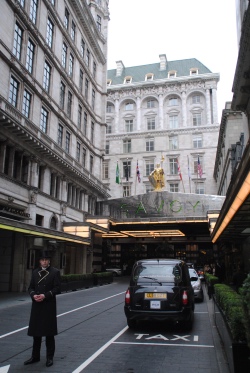
The now Grade II-listed building, which apparently had no overall architect in its initial design process, exuded opulence and its interiors included the latest in modern amenities such as electric lighting and lifts, en suite bathrooms in most of the guest rooms and constant cold and hot running water.

César Ritz, who would later rise to fame as the owner of The Ritz Hotel in Paris and then London (see our recent post), was hired as the manager and Auguste Escoffier as the chef. Together they oversaw the introduction of a new, unprecedented level of hotel service which would set the standard for future enterprises. This included keeping a comprehensive index of guest’s tastes and preferences and saw Escoffier revolutionise the restaurant industry in the country with the creation of various “stations” in the kitchen (his pots and pans are apparently still at the hotel).

The hotel was expanded in 1903-04 under the eye of architect Thomas Edward Collcutt (the designer of Wigmore Hall) with new east and west wings and the main entrance was moved from the river side of the building to Savoy Court running off The Strand. The Front Hall is a survivor of this period while the Lancaster Ballroom dates from 1910.

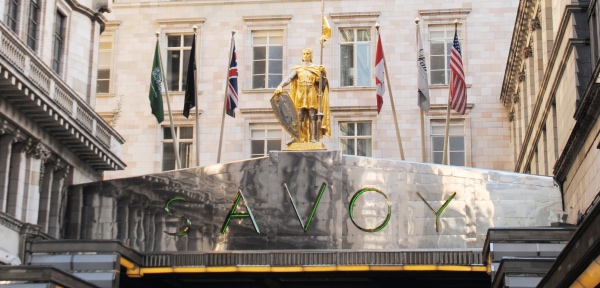
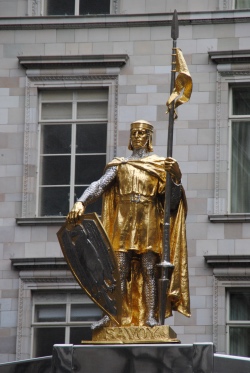
The hotel underwent further remodelling in the 1920s – it was during this period that the famous stainless steel sign over the Savoy Court entrance, designed by art deco architect Howard Robertson (later Sir Howard), was created (Savoy Court incidentally is the only street in the UK where traffic must keep to the right – more on that another time). The sign is topped with a gilt statue of Peter of Savoy, the uncle to King Henry III’s wife, Eleanor of Provence (pictured below). It was Peter who first built the Savoy Palace on the land where the hotel now stands. The sign, meanwhile, was created for the 1904 extension but placed here during the 1920s works.

Further modifications – including the introduction of air conditioning – followed in later decades. The hotel now boasts some 267 rooms and suites (the latter include the Royal Suite which spans the entire riverside of the fifth floor), many of which feature panoramic views of the River Thames.

Famous guests over the years have included royalty such as King Edward VII (when Prince of Wales) as well as more recent royals, French actress Sarah Bernhardt, Oscar Wilde, Charlie Chaplin, Sir Henry Irving and Sir Laurence Olivier. It’s also hosted a who’s who of Hollywood – everyone from Marilyn Monroe and Judy Garland to Frank Sinatra, Humphrey Bogart and John Wayne – and US President Harry S Truman.

Others associated with the hotel include opera singer Dame Nellie Melba – the dessert known as a Peach Melba was created here in her honour, and artist Claude Monet, who painted Waterloo Bridge from a position on one of the balconies.
Among other significant events to take place within its walls was a 1905 “Gondola Party” hosted by American millionaire George A Kessler which saw the central courtyard flooded as part of a recreation of Venice with guests dining on an enormous gondola and entertainment featuring singer Enrico Caruso.

In 1953, to mark the coronation of Queen Elizabeth II, the hotel hosted a ball attended by 1,400 of the rich and famous with special touches including 16 Yeoman Warders from the Tower of London who lined the entrance staircase.

Films shot here include Kipps (1921), based on a HG Wells novel (Wells was in attendance during the filming), The French Lieutenant’s Woman (1981) and Notting Hill (1999).

The Savoy remained in the Carte family until it was bought by an American private equity house in 1998 and eventually sold, in the mid-2000s, to become part of Fairmont Hotels and Resorts of Canada.

Closed in late 2007 for a complete renovation (the cost of which has been put at £220 million), it reopened in October, 2010. Among restaurants and bars now in the premises are the Thames Foyer restaurant – hosted in a glass atrium, it’s where afternoon tea is taken, the American Bar – described as the oldest cocktail bar in Britain, the Beaufort Bar, and the restaurant Kaspar’s.

The latter is named after the hotel’s oldest “employee” – Kaspar the Cat. Carved in 1927 by Basil Ionides, the cat was created to act as a 14th guest in the private dining rooms when 13 guests were present, a figure which was considered unlucky and which, tradition held, meant the first person to leave the table would one the first to die.

Its origins go back to 1898 when a wealthy South African by the name of Woolf Joel apparently scoffed at the idea of 13 being an unlucky number at the table and volunteered to leave it first. He was shot dead back in South Africa just a few week’s later. In the wake of his death, management at the hotel decreed that any table of 13 would be joined by a staff member.

But this was only a short-term solution – not only there was there the privacy of diners to consider, the fact staff would be a person down when this was required was a problem. So when Ionides redecorated the private dining room ‘Pinafore’ in the 1920s, he created the cat, complete with napkin, to fulfil the role of the 14th diner. And so he has ever since. Kaspar, the subject of a children’s book written by Michael Morpugo in 2008, can these days be found in Kaspar’s or, when not working, in the Front Hall.

For more, see www.thesavoylondon.com
Happy New Year! (and the conclusion to our most popular (new) posts countdown for 2018)…

2019 is upon us so we at Exploring London would like to take the opportunity to wish all our readers a very Happy New Year! We look forward to bringing you fascinating new stories about London’s history and culture in the year to come.

Meanwhile, here are the two most popular (new) posts of 2018…

2. Treasures of London – The Great Hall at Eltham Palace…

1. A Moment in London’s History – The execution of the George, Duke of Clarence…

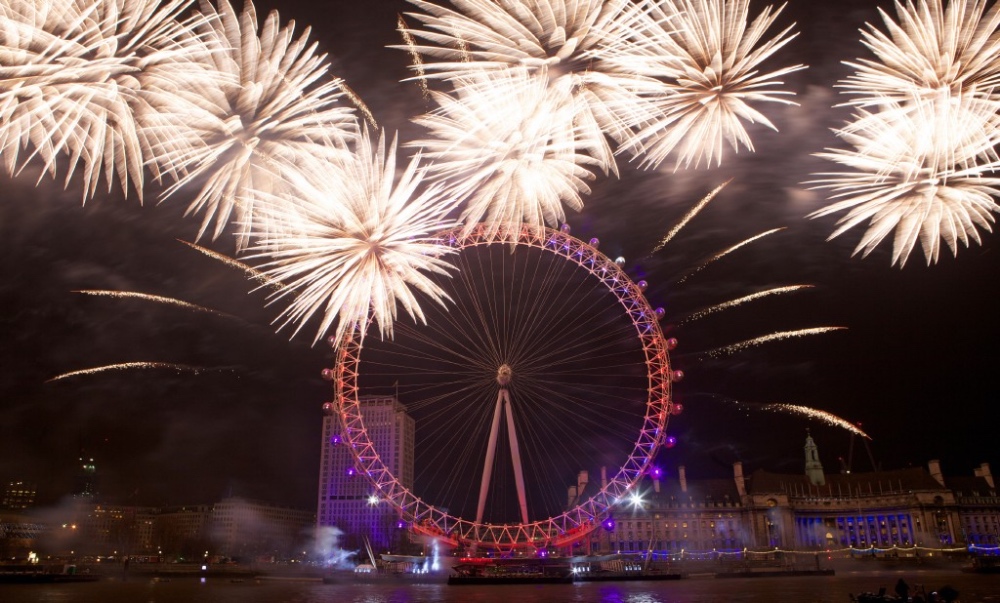
PICTURE: © ENGLAND’S HISTORIC CITIES (New Year’s Eve fireworks from 2014).

10 most popular (new) posts of 2018…Numbers 4 and 3…

The next two posts on our annual countdown…

4. LondonLife – Still waters at Hampstead Heath…

3. Lost London – Jacob’s Island…


10 most popular (new) posts of 2018…Numbers 6 and 5…

The next two on our countdown of most popular (new) posts for 2018…

6. 10 islands in the Thames – 3. Brentford Ait…

5. LondonLife – Victorian London in photographs…

10 most popular (new) posts of 2018…Numbers 8 and 7…

The next two on our countdown of most popular (new) posts for 2018…

8. 10 islands in the Thames – 1. Chiswick Eyot…

7. Where’s London’s oldest…umbrella shop?

10 most popular (new) posts of 2018…Numbers 10 and 9…

And so we’ve reached the end of another year on Exploring London. As always, we counting down our 10 most popular new posts for the year, starting with numbers nine and 10 (and they both come from the same special Wednesday series on Thames islands)…

9. 10 islands in the Thames – 10. Garrick’s Ait…

10. 10 islands in the Thames – 6. Glover’s Island…


Merry Christmas!


Wishing all our readers a very Merry Christmas and a great start to 2019!


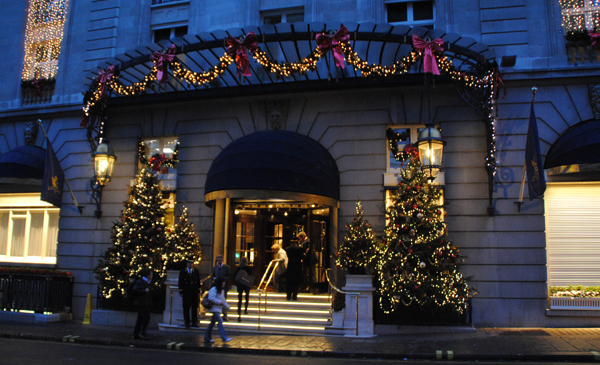
PICTURE: Christmas tree in St James (KotomiCreations (licensed under CC BY-NC 2.0))

This Week in London – ‘The Favourite’ costumes at Kensington; contemporary portraiture; and, Artemisia Gentileschi’s self portrait…

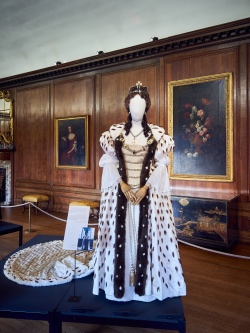
Costumes from a new film about Queen Anne, The Favourite, have gone on show at Kensington Palace where the Queen once lived. The film, directed by Yorgos Lanthimos, explores the relationships and power struggles between the Queen (played by Olivia Coleman) and two of her closest female attendants – Lady Sarah Churchill (Rachel Weisz) and Lady Churchill’s impoverished cousin turned chambermaid, Abigail (Emma Stone). The costumes have been designed by three-time Oscar winner Sandy Powell who worked with Fox Searchlight Pictures and Historic Royal Palaces in creating the display in the Queen’s Gallery, once used by Queen Anne and her husband for exercise when the weather was bad. The display can be seen until 8th February. Admission charge applies. The Favourite opens in the UK and Ireland on 1st January. For more, see www.hrp.org.uk/kensington-palace/. PICTURE: © Historic Royal Palaces/Michael Bowles

Previously unseen portraits of Amy Winehouse and Sir Kenneth Branagh and newly acquired portraits of explorer Sir Rannulph Fiennes, astronaut Tim Peake and British Museum director Neil MacGregor have gone on show at the National Portrait Gallery. The portraits, which also include photographs from the Duke and Duchess of Sussex’s wedding in May this year, form part of a major new display of the gallery’s contemporary collection which features works produced from the year 2000 until today. Sitting alongside the collection is a new exhibition of works by artist Njideka Akunyili Crosby from her series The Beautyful Ones – comprised of portraits of Nigerian youth, including some members of her own family. Admission is free and The Beautyful Ones display can be seen until 3rd February. For more. see www.npg.org.uk.

A recently discovered rare self portrait of Artemisia Gentileschi, the most celebrated female artist of the Italian Baroque, has gone on show at the National Gallery. Self Portrait as Saint Catherine of Alexandria (1615-17), which was acquired by the gallery in July, 2017, can be seen in the Central Hall of the gallery after going through a five month conversation and restoration process which was documented in a series of short films shared on social media via #NGArtemisia. In March, the painting will leave the gallery on a “pop-up” tour of unexpected venues across the UK. A major exhibition of Gentileschi’s work is planned at the National Gallery in 2020. Admission to see the painting is free. For more, see www.nationalgallery.org.uk.

Send all items for inclusion to exploringlondon@gmail.com.

10 historic London hotels…1. The Ritz Hotel…

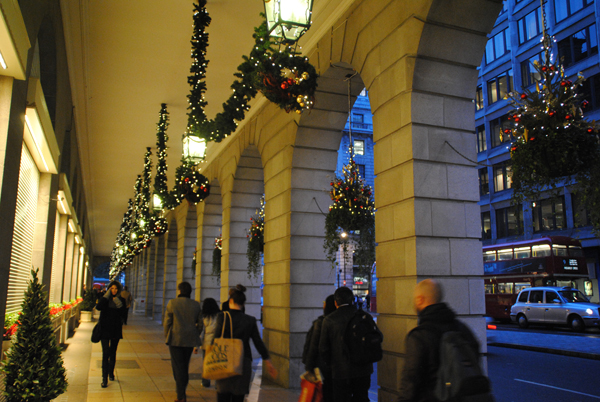
This Piccadilly institution was constructed from 1904 to 1906 and takes its name from Swiss hotelier César Ritz.

It was constructed on the site of a former coaching inn for the Blackpool Building and Vendor Company – it was the first steel-framed building in London – and designed by Mewés and Davis, the architects of the Paris Ritz. And even though Ritz himself was apparently actually retired at the time, it was built according to his specifications.

The exterior facade features Norwegian granite and Portland stone and boasts an arcade on Piccadilly which deliberately evokes the Rue de Rivoli in Paris. The interior, the work of Waring and Gillow, is designed in the style of Louis XVI and was designed to be opulent with all rooms featuring a working fireplace.

Public spaces include the Palm Court – famous for its traditional afternoon teas –  and a Michelin-starred restaurant with floor to ceiling windows overlooking Green Park. Other features include the Rivoli Bar, designed in 2001 by Tessa Kennedy to resemble the bar in the Orient Express, and the basement Ritz Club, a private casino.

The now Grade II*-listed hotel was officially opened by Ritz himself on 24th May, 1906, and was soon adopted by the rich and famous – the patronage of the Prince of Wales (future King Edward VIII) after the death of King Edward VII was one key reason for its success.

Actor Charlie Chaplin, who apparently had to have 40 police hold back the crowd to enter the hotel, is also a name famously associated with it as is that of Russian prima ballerina Anna Pavlova who performed here.

The Aga Khan and Paul Getty both had suites, and playwright Noel Coward and Queen Elizabeth, The Queen Mother, regularly dined here while Tallulah Bankhead famously sipped champagne from a slipper in the bar. The Marie Antoinette Suite was also famously the location of a conference between Winston Churchill, Dwight Eisenhower and Charles de Gaulle during World War II.

The hotel also featured in 1999 film Notting Hill, starring Hugh Grant and Julia Roberts, and in the more recent TV drama Downton Abbey.

The five star hotel underwent a major 10 year refurbishment after it was acquired by the Barclay brothers in 1995. The complex these days includes the adjoining 18th century property William Kent House (designed, of course, by William Kent).

In 2001, the hotel was awarded the first Royal Warrant for Banqueting and Catering Services. Other boasts these days include being the only UK hotel to have a certified tea sommelier (among teas served is the hotel’s own Ritz Royal Blend).

For more, see www.theritzlondon.com.

LondonLife – It’s Christmas!…

Trafalgar Square bedecked for Christmas with its famous Norwegian tree. PICTURE: Ben Pipe Photography via London Partners.

Famous Londoners – Mary Shelley…

This year marks 200 years since the publication of Mary Shelley’s book, Frankenstein: or, The Modern Prometheus, so it’s timely to have a look at the life of this famous Londoner.

Shelley was born on 30th August, 1797, in Somers Town, London, to feminist philosopher Mary Wollstonecraft and political philosopher, novelist and journalist William Godwin. Her mother died soon after her birth, leaving her upbringing to Godwin (and his second wife Mary Jane Clairmont who apparently didn’t get on with Mary).

While she received little formal education, she was tutored in a range of subjects – everything from literature to art, French and Latin – by her father and visiting tutors. Godwin described her as having a great desire for knowledge.

She first met her future husband, the Romantic poet Percy Bysshe Shelley, while still a teenager. Shelley, who was estranged from his wife, had struck up a friendship with her father and was subsequently a regular visitor to their house.

Mary and Percy began secretly meeting each other at Mary Wollstonecraft’s grave in St Pancras Churchyard and then on 28th June, 1814, the couple eloped to France, taking Mary’s step-sister Claire Clairmont with them but leaving Shelley’s pregnant wife behind.

They went on to Paris and then, through war-ravaged France, to Switzerland. At Lucerne, however, a lack of money forced them to turn back and they returned to London where Mary’s father refused to have anything to do with her.

Now pregnant, Mary and Shelley moved into lodgings with Claire in Somers Town and later in Nelson Square where they were known for entertaining his friends. Shelley’s wife, meanwhile, gave birth to his son – something that must have been hard for Mary – and it is believed that he was also a lover of Mary’s step-sister Claire.

Mary gave birth to her first child, a daughter, on 22nd February, 1815, but she died just 12 days later. That same year, the death of Shelley’s grandfather brought himself considerable wealth and with their financial situation now relieved, in August, 1815, they moved to Bishopgate, in Windsor Great Park. In January, 1816, Mary gave birth to her second child, a son, William.

In May, 1816, the couple travelled with their son William and Mary’s step-sister Claire to Geneva in Switzerland where they hoped to improve Percy’s health. It was during the time they spent there that a ghost-writing contest in June, 1818, led her to write what would be the basis of the novel Frankenstein – credited with introducing genre of science fiction into English literature.

Returning to England, the Shelley’s took up residence in Bath (Clairmont was pregnant by Lord Byron and they wanted to keep this from the Godwins). Harriet Shelley, Percy’s estranged wife, drowned herself in the Thames on 9th November and it was following that, that on 30th December, Mary and Percy married at St Mildred’s Church in London with Mary’s father and step-mother as witnesses.

In March, 1817, the Shelley’s took up residence in Marlow where Mary gave birth to second daughter, Clara Everina Shelley, on 2nd September. Then in March, 1818, the family – along with Claire Clairmont and her daughter – travelled to Italy where it was hoped the warmer climate would help Shelley, who had been diagnosed with pulmonary disease.

There they lived at various addresses and were in Venice when Clara died of dysentery on 24th September, 1818. They traveled to Rome in April the following year and there, on 7th June, William died of malaria, leaving the couple devastated.

Their fourth child and only surviving child, Percy Florence Shelley, was born in Florence on 12th November. Their Italian sojourn continued for the next couple of years until, on 8th July, 1822, Percy Shelley and his friend Edward Williams were drowned in a squall in the Gulf of Spezia.

Determined to show she could write and look after her son, Mary Shelley returned to England in mid-1823 and lived in The Strand with her father and stepmother until in the summer of 1824 she moved to Kentish Town. Her novel, The Last Man, was published in 1826 followed by The Fortunes of Perkin Warbeck (1830), Lodore (1835), and Falkner (1837) as well as working on numerous other writing projects.

Shelley never remarried although she was linked to various men romantically including American actor John Howard Payne whose offer of marriage she rejected.

After her son Percy left university in 1841, he came to live with her and between 1840 and 1842 Shelley travelled to various locations in Europe with her son. Sir Timothy Shelley, Percy Bysshe Shelley’s father, died in 1844 with the result that Shelley and her son were now financially independent.

Percy married Jane Gibson St John in 1848 and Mary lived her son and daughter-in-law, splitting their times between the ancestral Shelley home – Field Place in Sussex – and Chester Square in London as well as accompanying them on their travels overseas.

Shelley suffered considerable illness in the last years of her life – including debilitating headaches and bouts of paralysis in her body – before on 1st February, 1851, she died at the age of 53 from a suspected brain tumour at the Chester Square property.

She had asked to be buried with her mother and father, but Percy and Jane instead buried her at St Peter’s Church in Bournemouth closer to their home. In order to fulfill her wishes, they had the bodies of her parents exhumed from St Pancras graveyard and reburied with her.

Despite gaining respect as a writer in her own lifetime, Shelley’s reputation in the literary arts was overshadowed by that of Percy’s after her death. But in more recent decades her overall writing career has come to be more closely examined and applauded.

If you missed it, for more on Mary Shelley’s links with London, see our special series 10 sites from Mary Shelley’s London.

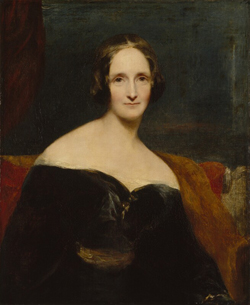
PICTURE: Mary Shelley by Richard Rothwell (oil on canvas, exhibited 1840/NPG 1235). © National Portrait Gallery, London (licensed under CC BY-NC-ND 3.0)

This Week in London – Cast Court reopens at V&A; ‘Visionaries’ at Guildhall; and ‘Cats on the Page’…

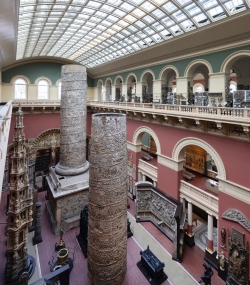
The V&A has reopened the second of its two Cast Courts following a redevelopment which has seen the addition of a new interpretation gallery, new exhibits and the restoration of historic original features. The West Court, now renamed the Ruddock Family Cast Court, has been returned to its historic past with original 19th century floors and wall colours and the Central Gallery, now renamed the Chitra Normal Sethia Gallery, features a new exhibition exploring the history, significance and contemporary relevance of the casts on display. Among the new exhibits are a scaled down digital reproduction of the arch of Palmyra destroyed by the so-called Islamic State in 2015 while one of the key existing exhibits, a 35 metre high cast of Trajan’s Column (displayed in two parts – see picture) has had its base permanently opened so visitors can gain an internal perspective. The reopening follows that of the Weston Cast Court in 2014 and completes a project which was begun in 2011. The Cast Courts were first opened in 1873, then known as the Architecture Courts, and house a collection of casts of some of the world’s most inspiring objects including everything from Michelangelo’s David to 16th-century tombs by Peter Vischer in Nuremberg and the Pórtico de la Gloria from the Cathedral of Santiago de Compostela. They are the only public galleries in the South Kensington institution to display the same collection of objects as when they first opened. Entry to the Cast Courts is free. For more, see www.vam.ac.uk. PICTURE: © Victoria and Albert Museum, London.

Works by Edward Burns-Jones, Dante Gabriel Rossetti, John Everett Millais and Grayson Perry are among those on show as part of a new exhibition at the City of London Corporation’s Guildhall Art Gallery. Visions and Visionaries – a collaboration between the Guildhall Art Gallery, The Sir Denis Mahon Charitable Trust, Flat Time House, and the Bologna-based Association Age of Future, highlights some of the key figures who defined the ‘Visionary’ idea of art and laid the foundations for a later generation of avant-garde artists. Among the works on show are Sir John Gilbert’s depiction of two knights ambushed by fairies in a moon-lit forest, Marcello Pecchioli’s Alien Priest, and John Latham’s experimental screen print, NO IT, 1967 as well as Sir John Gilbert’s The Enchanted Forest, Burne-Jones’ St Agnes and St Dorothy; and a series of 25 drawings by Blake to illustrate two poems by Thomas Gray, The Bard and The Fatal Sisters. Admission is free. Runs until 28th April. For more, follow this link.

On Now: Cats on the Page. Featuring original illustrations of Mog by Judith Kerr, Beatrix Potter’s Kitty-in-Boots as imagined by Quentin Blake and two illustrations by Axel Scheffler for TS Eliot’s Old Possum’s Book of Practical Cats, this exhibition at the British Library is a celebration of literary felines and their creators. Objects on show include Lewis Carroll’s own copy of the exceptionally rare 1893 (third) edition of Through the Looking-Glass and what Alice found there (in which the author expresses frustration with the printing including a comment on an illustration of Alice’s kitten), an 1879 letter by Edward Lear in which he included doodles of himself and his cat Foss, a 16th century pamphlet on witchcraft with a woodcut image accompanying the description of a black cat or familiar belonging to ‘Mother Devell’, and a letter written by TS Eliot to Alison, daughter of his friend Geoffrey Tandy, which contains a draft of his poem Mungojerrie and Rumpelteazer as well as Alison’s reply which includes drawings of the two cats. Coinciding with the 80th anniversary year of the original publication of Old Possum’s Book of Practical Cats, the free exhibition is being accompanied by a programme of events and can be seen until 17th March. For more, see www.bl.uk/events/cats-on-the-page.

Send all items to exploringlondon@gmail.com

LondonLife – ‘Human vending machine’ sets up shop near St Paul’s…

A “human vending machine” appeared near St Paul’s Cathedral in central London on Monday – Human Rights Day – as part of an initiative to highlight the plight of the estimated 25 million people trapped in forced labour around the world. An initiative of the University of Hull’s Wilberforce Institute, the machine, which was only present for the day, was stocked with everyday food items to illustrate that fruit, vegetables, meat, fish and cheese bought in the UK are at high risk of being supplied, at some point in the chain, by forced labour. To be seen the university’s campus in Hull on Thursday, the ‘human vending machine’ is part of the “It’s Time to Break the Chain” campaign which the institute has launched to “galvanise consumer power and influence companies to combat slavery practices in supply chains across all sectors”. For more on how you can help “break the chain”, see www.hull.ac.uk/special/hidden-human-cost.aspx. PICTURE: David Parry/PA Wire (Courtesy University of Hull).

LondonLife – Dame Judi Dench calls for people to nominate women for blue plaques…


Dame Judi Dench has called for the public to nominate “women you admire” for more English Heritage blue plaques in London.
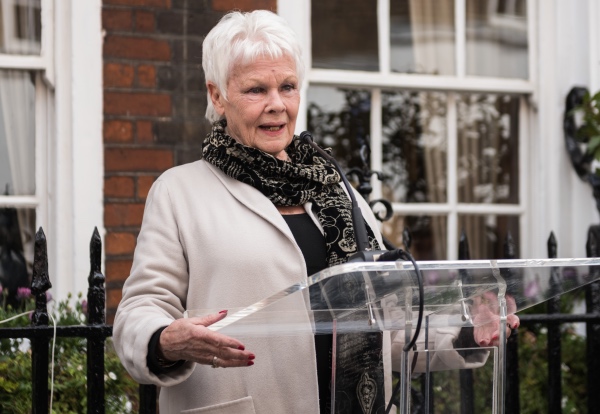
Dame Judi (here pictured at the 2017 unveiling of a blue plaque commemorating actor Sir John Gielgud) call comes after news that women make up just 14 per cent of the more than 900 blue plaques in London. “So far the scheme honours some brilliant women; Florence Nightingale, Ava Gardner and the Pankhursts, but there are many, many more unsung female heroes who deserve recognition,” Dame Judi said. “So nominate the women you admire, the women who did great and remarkable things throughout history, and the women who did not go quietly. English Heritage needs your help.” The most recent woman to appear on a blue plaque is actor Margaret Lockwood. A popular actor in the 1930s and 1940s, Lockwood (1916-1990) was the star of Alfred Hitchcock’s The Lady Vanishes (1938) and lived at 14 Highland Road in Upper Norwood after moving to London as a child in the 1920s. To make your nomination, head to www.english-heritage.org.uk/visit/blue-plaques/. PICTURES: English Heritage.


This Week in London – Hampton Court kicks off Christmas festivities; ‘The Monarch of the Glen’ returns to National Gallery; and Alfred Munnings’ World War I art…

Visitors to Hampton Court Palace will be transported back to 1906 from Saturday as the palace community prepares for Christmas. Christmas Present, Christmas Past features a range of activities from carol singing around the tree to telling ghost stories (and looking at the traditions behind them) as well as live culinary demonstrations in the kitchens showing the evolution of Christmas dinner as we know it today. Meanwhile, the Hampton Court Palace Festive Fayre returns next weekend (7th to 9th December) with more than 90 stalls set up in the palace courtyards selling mince pies, mulled wine and a host of other festive treats. And the palace’s ice-skating rink has returned to the Tudor West Front (and will be there until 6th January). Admission charges apply. For more, see www.hrpfoodfestivals.com.

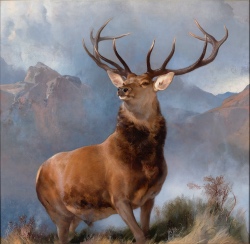
Sir Edwin Landseer’s dramatic work – The Monarch of the Glen – is at the centre of a new exhibition celebrating the connections between the 19th century artist and the National Gallery. “Coming home” to the Trafalgar Square-based institution for the first time in more than 160 years, the painting – arguably the most famous animal painting in the world – is one of 14 works included in a new free show opening today. Among paintings created to decorate the Palace of Westminster after fire devastated the building in 1834, Landseer’s (1802-1873) work was first exhibited at the Royal Academy in 1851, then housed in what is now the National Gallery building. It’s now on loan from the National Galleries of Scotland, which acquired the work in 2017. This is the first London showing since 1983. Other works in the display include Landseer’s Ecorche drawing of a dog’s leg (1821), as well as paintings and drawings connected with the famous lions Landseer designed for Trafalgar Square including a John Ballantyne portrait of the artist modelling the lions in his studio and a work by Queen Victoria, whom Landseer tutored in etching, entitled A pencil drawing of a stag after Landseer’s mural on the Dining Room wall at Ardverikie Shooting-lodge (1847). Can be seen in Room 1 until 3rd February. For more, see www.nationalgallery.org.uk. PICTURE: Edwin Landseer, ‘The Monarch of the Glen’ (about 1851), © National Galleries of Scotland

More than 40 paintings created during the final year of World War I by artist Alfred Munnings (1878-1959) go on show at the National Army Museum in Chelsea tomorrow. Alfred Munnings: War Artist, 1918 shows his mastery of equine subjects as well as portraiture and landscapes. Munnings was commissioned by the Canadian War Memorials Fund as an official war artist to capture the fighting front and logistics behind the scenes and in early 1918 was embedded with the Canadian Expeditionary Force. The exhibition has been developed by the Canadian War Museum in partnership with The Munnings Art Museum and is supported but The Beaverbrook Canadian Foundation. Can be seen until 3rd March. Admission charge applies. For more, see www.nam.ac.uk.

Send all items for inclusion to exploringlondon@gmail.com.

LondonLife – Christmas comes to ZSL London Zoo…

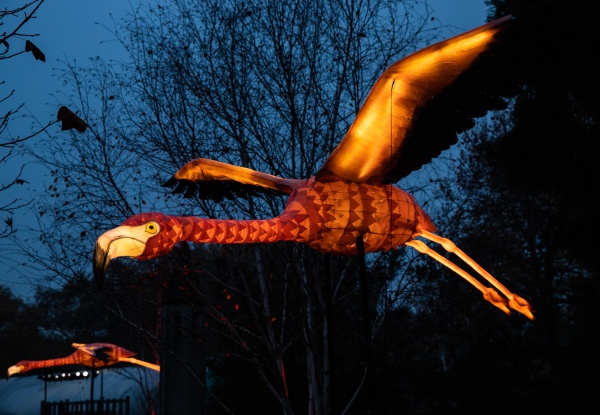
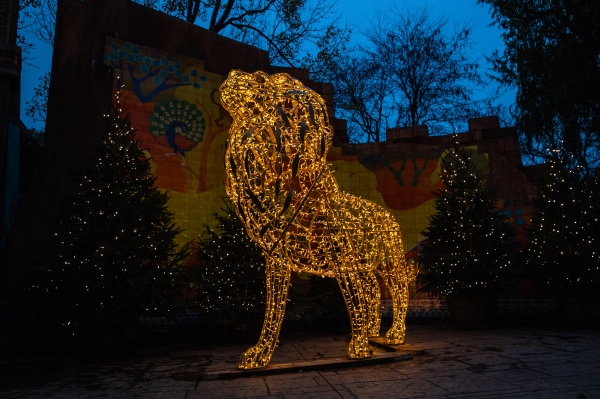
Christmas has arrived at ZSL London Zoo with a series of light sculptures illuminating a mile long festive trail. More than a million pea lights have been used in the first show of its kind at the zoo which taking a month to build, features 200 visual displays including a pair of giant golden giraffes (above), an 11 metre tall Christmas tree made of recycled Christmas sledges (below) and two illuminated flying flamingoes (below). Historic zoo buildings have been lit up as well, including the Grade I-listed Penguin Pool and the historic Mapping Terraces. The trail, which circles the zoo’s 36 acre site so as not to wake up the sleeping animals, has been created in partnership with Raymond Gubbay Limited and designed by Culture Creative. It can seen on selected nights until 1st January. Admission charge applies. For dates and times, see  christmasatlondonzoo.co.ukPICTURES: ZSL London Zoo.


Where’s London’s oldest…ice skating rink?

The ice skating season is upon us so we thought it timely to take a look at where the oldest rink is located.

QUEENS: Skate, Dine, Bowl at 17 Queensway in Bayswater houses what’s generally said to be the oldest surviving ice skating rink in London, having opened its doors as QUEENS Ice Club on 3rd October, 1930.

It was the work of architect and entrepreneur Alfred Octavius Edwards who apparently had a passion for ice skating.

It was apparently the first rink used by the BBC for televised ice skating and a number of world and Olympic champions have skated here.

The establishment underwent a revamp a couple of years ago (although bowling lanes were added as far back as 1994) and now features a wide range of amenities including, as well as the ice rink, bowling lanes, a vintage games arcade and bars and a diner. For more on Queens, see https://queens.london.

Ice-skating. PICTURE: rawpixel/Unsplash


This Week in London – Kew gets all Christmassy; Thomas Gainsborough’s family; and, William Heath Robinson and home life…

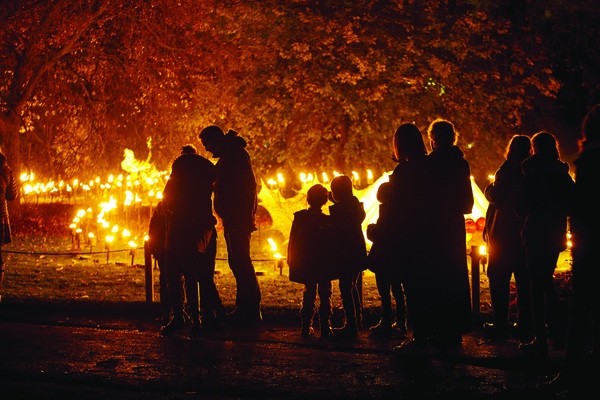
Christmas at Kew kicks off tonight with the garden landscape once again transformed into a spectacular light and sound show. Highlights from this year’s display include a ‘Field of Light’ by Brighton based artists Ithaca which reaches across the landscape towards the newly restored Great Pagoda, a laser garden by Australian studio Mandylights, 300 illuminated origami boats floating on Kew’s lake in an installation by Italian artists Asther & Hemera, ‘Firework Trees’ lit up by explosions of coloured light, a seven metre tall Cathedral of Light, a fire garden and “enchanted walkway” of giant glowing peonies and papyrus by French artists TILT and, of course, the famous Palm House finale which brings the giant glasshouse to life with a show featuring criss-crossing laser beans, jumping jets of light and kaleidoscopic projections playing across a giant water screen. Santa and his helpers can be found along the trail and there is a festival fairground with a Victorian carousel as well as food and drink at a range of stalls in Victoria Plaza. Runs from 5pm on select dates until 5th January. Admission charge applies. For more, head to www.kew.org/christmas. PICTURE – Below: The Fire Garden/Raymond Gubbay Ltd (RBG Kew).

All 12 surviving portraits of celebrated 18th century artist Thomas Gainsborough’s daughters have been brought together for the first time in a major new exhibition at the National Portrait Gallery. Gainsborough’s Family Album depicts the development of the Gainsborough girls from playful young children to fashionable adults with highlights including The Artist’s Daughters chasing a Butterfly (c1756) and The Artist’s Daughters with a Cat (c1760-1) as well as the little seen double full-length of Mary and Margaret Gainsborough as young women (c1774). More than 50 works are included in the display and a number have never been seen in the UK before. The latter include an early portrait of the artist’s father John Gainsborough (c 1746-8) and a drawing of Thomas and his wife Margaret’s pet dogs, Tristram and Fox. The display traces the career of the artist (1727-88) who, despite his passion for landscapes, painted more portraits of his family members than any other artist of the time or earlier. Together they form an “unusually comprehensive” visual record of an 18th century British kinship network, with several of its key players shown more than once at different stages of their lives. The exhibition runs until 3rd February. Admission charge applies. For more, see www.npg.org.uk.

Artist William Heath Robinson and his fascination with domestic life is the subject of a new exhibition opening at the Heath Robinson Museum in Pinner on Saturday. Heath Robinson’s Home Life centres on the fact that from about 1930 onwards, the artist’s humour was centred on domestic life including the construction of his house, ‘The Gadgets’, at the Ideal Home Exhibition of 1934 and the release, from 1936, of the first of his ‘How to’ books, How to Live in a Flat. The display features an early series of “Ideal Home” cartoons published in 1933 and rare photographs of ‘The Gadgets’ under construction at the Ideal Home Exhibition. There’s also original artwork from How to Live in a Flat and examples of a set of nursery china that he designed for a Knightsbridge department store in 1927. Runs until 17th February. Admission charge applies. For more see www.heathrobinsonmuseum.org.

Send all items for inclusion to exploringlondon@gmail.com

10 sites from Mary Shelley’s London…A recap…

We’ve come to the end of our series on significant London sites related to Mary Shelley – in honour of the 200th anniversary of the publication of Frankenstein – so it’s time for a quick recap before launching our next Wednesday series…

1. Somers Town…

2. St Pancras Old Churchyard…

3. Marchmont Street, Somers Town…

4. Church of St Mildred, Bread Street

5. The Temple of the Muses, Finsbury Square…

6. St Giles-in-the-Fields…

7. Charles and Mary Lamb’s house…

8. Chester Square…

9. A lock of Mary Shelley’s hair…

10. Memorials to Percy Bysshe Shelley…


LondonLife – Brompton’s new memorial for those lost in World War I…


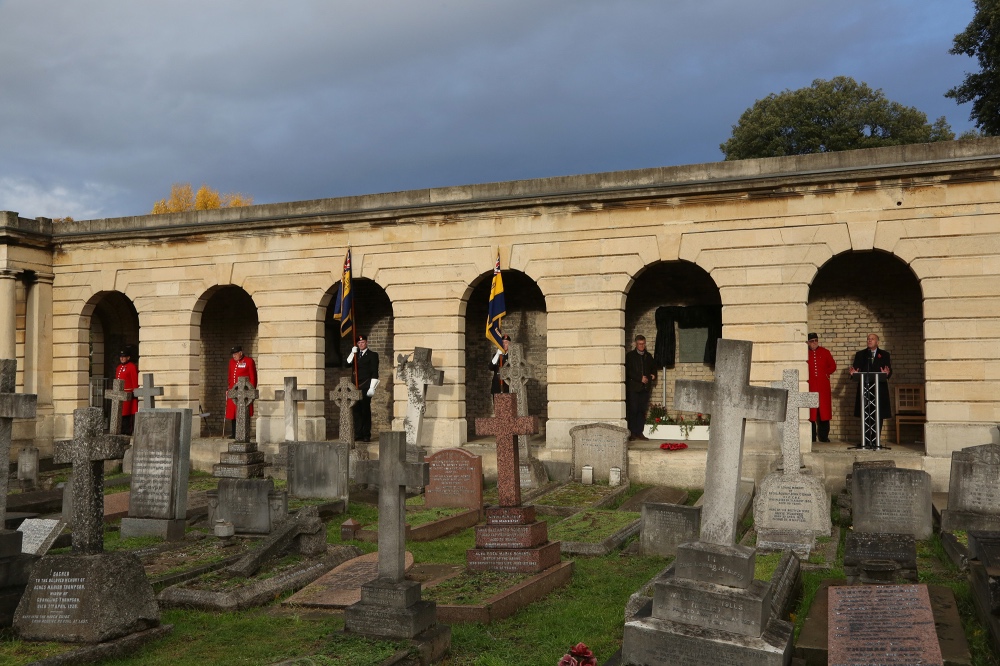
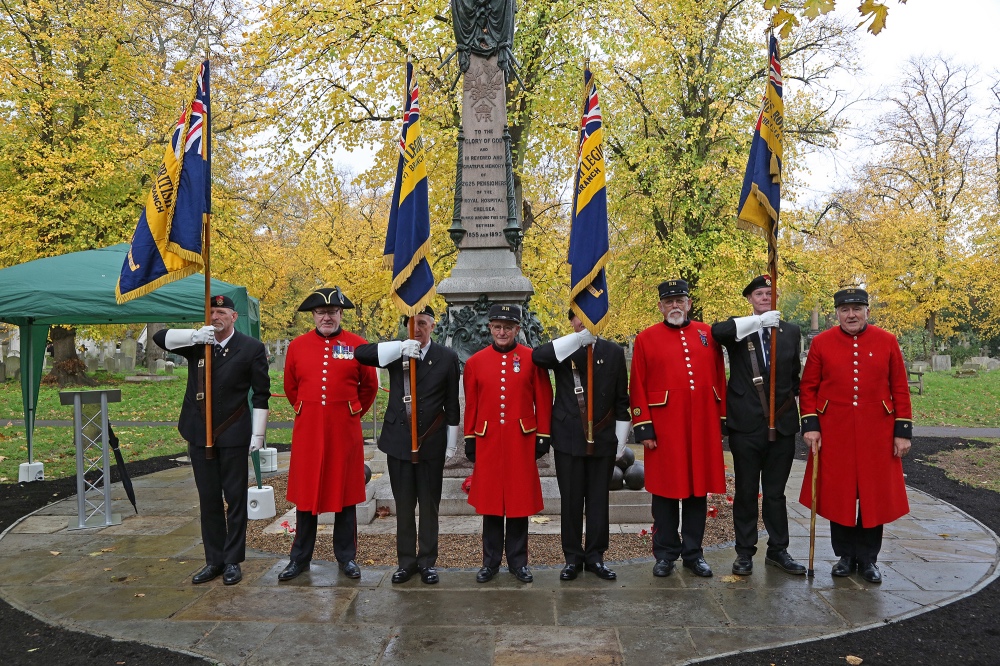
A new permanent World War I memorial was unveiled at Brompton Cemetery earlier this month dedicated to the 24 members of the Royal Parks and Palaces staff who died in the Great War. The inscribed memorial stone, placed on one of the chapel’s colonnades (pictured above), also commemorates all the parks, gardens and grounds staff from across the UK who never returned from the war. It was unveiled at a service conducted by Reverend Canon Anthony Howe, Chaplain to the Chapel Royal at Hampton Court Palace, the gardens of which were managed by the Royal Parks during World War I. Meanwhile, the foundations for a new permanent wildflower meadow honouring the 2,625 Chelsea Pensioners buried in the cemetery were also laid near the Chelsea Pensioners’ monument (pictured below). The meadow will feature flowers which appeared in French fields after the Battle of the Somme including poppies, cornflowers, loosestrife, mallow and cranesbill. Two benches, positioned to either side of the Grade II-listed memorial, have been donated by the Royal Hospital Chelsea as a place for quite reflection. For more on the cemetery, see www.royalparks.org.uk/parks/brompton-cemetery. PICTURE: The Royal Parks/Paul Keene.