Around London – The Bard is back; Foundling Museum displays; and, exhibitions on iconoclasm and explicit Japanese art…

The Bard is back in Leicester Square with the announcement last week that restoration work on the square’s 19th century Grade II listed statue of William Shakespeare – the only full-length statue the playwright in central London – has been completed. The 11 month restoration was carried out as part of £17 million revamp of the square which has seen the installation of a new fountain. The statue, which was the work of James Knowles, has been in the square since it was completed in its current configuration in 1874. Meanwhile, in other sculpture-related news, Sorry, Sorry Sarajevo – a life-size statue of a man holding  a dead or badly injured man in his arms has been placed in St Paul’s Cathedral where it will remain for the rest of the year. The work by Nicola Hicks dates from 1993 – when the Bosnian war was at its height – and has been placed opposite Henry Moore’s 1983 sculpture, Mother and Child: Hood as part of the cathedral’s approach to next year’s World War I centenary.

Two new displays opened at the Foundling Museum in Bloomsbury last month. Hogarth and Copyright, which runs until 5th January, looks at the role the artist William Hogarth played in the passing of the 1735 Engravers’ Copyright Act (also known as Hogarth’s Act – it was the first law to protect artist’s rights over their work) while Handel and Lucretia, presented in conjunction with The Sir Denis Mahon Charitable Trust and running until 26th January, shows Guercino’s painting Lucretia alongside two early manuscripts of Handel’s cantata La Lucretia. Entry is part of admission price. For more, see www.foundlingmuseum.org.uk.

A new exhibition tracing the history of attacks on artworks in Britain from the 16th century to today opened at Tate Britain in Millbank this week. Art under Attack: Histories of British Iconoclasm looks at why and how monuments have been damaged over the past 500 years. The display includes the remarkable pre-Reformation sculpture, the Statue of the Dead Christ (about 1500-1520), which was discovered in 1954 beneath the chapel floor at the Mercer’s Hall. Already damaged – most likely at the hands of Protestant iconoclasts – it may have been buried there to protect it. Also displayed are fragments of monuments destroyed in Ireland last century, paintings including Edward Burne-Jones’ 1898 painting Sibylla Delphica which was attacked by suffragettes in 1913-14, and Allen Jones’ 1969 work Chair – damaged in a feminist attack in 1986. Runs until 5th January. Admission charge applies. For more, see www.tate.org.uk.

A controversial exhibition of sexually explicit Japanese works of art created between 1600-1900 opened at the British Museum this week. Shunga: sex and pleasure in Japanese Art – which carries a warning of “parental guidance for visitors under 16 years – features 170 works including paintings, prints and illustrated books. Drawn from collections in the UK, Japan, Europe and the US, the exhibition of explores the phenomena of what are known as shunga (‘spring pictures’), looking at why it was produced and to whom it was circulated. Admission charge applies. Runs until 5th January. For more, see www.britishmuseum.org.

Where’s London’s oldest…tea shop?

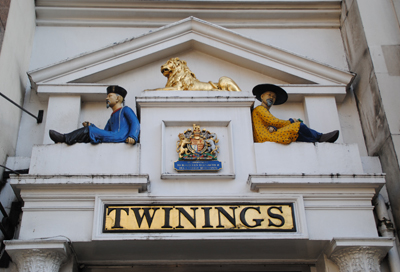
Twinings

Opened in the Strand in 1706, Thomas Twining’s tea shop can still be found there today.

Twining, a tea merchant whose family originally hailed from Gloucestershire, started selling tea from what had been a coffee house – Tom’s Coffee House – in an effort to tap into tea’s growing popularity. It had apparently been introduced to England by Catherine of Braganza, the Portuguese wife of King Charles II, soon after the Restoration.

Amid resistance from other coffee house owners and despite high taxes on tea, Twining’s venture succeeded, attracting a wealthy clientele which apparently included Jane Austen, thanks at least in part to its location on the border between the City of Westminster and the City of London.

By 1717, Twining had purchased three houses adjacent to his coffee house and converted them into a shop which still stands today at number 216 Strand (the original Tom’s Coffee House was located behind this premises). He was soon selling more dry tea than wet at the sign of the “Golden Lyon”.

Following Thomas’ death in 1741, Twining’s son Daniel took over the business and by the mid-1700s, was exporting to America where he counted the Governor of Boston among his clients (but, apparently it was not Twining’s tea which was tossed into the sea at the Boston Tea Party).

It was Daniel’s son (and Thomas’ grandson), Richard Twining, who was successful in lobbying for the lowering of tea taxes and so paving the way for tea to become the commonly consumed drink it is today. It was also Richard who built the shop’s current entrance portal in 1787 incorporating the golden lion.

The Twinings shop today is the oldest in the City of Westminster while the company’s logo, which dates back to 1787, is the oldest commercial logo in continuous use.

Twinings, which since 1964 had been owned by Associated British Foods, was granted a Royal Warrant in 1837 by Queen Victoria.

For more, see www.twinings.co.uk.

Lost London – St Dunstan in the East…

St-Dunstan-in-the-East

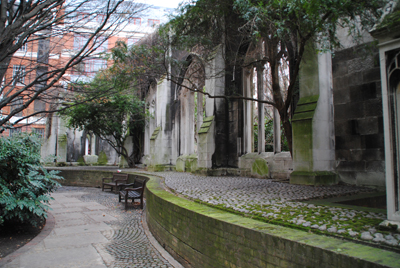
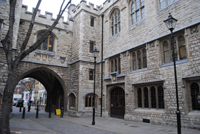
The ruins of this medieval church can still be found in the eastern end of the City of London and now play host to a rather delightful little park.

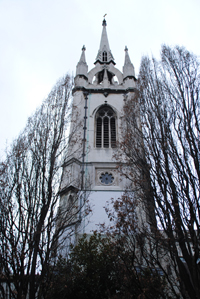
Originally built around 1,100 in the Gothic style, the church – which stands between St Dunstan’s Hill and Idol Lane (off Great Tower Street) was enlarged and repaired in ensuing centuries before suffering severe damage in the Great Fire of London in 1666. Not enough to destroy the church, however, and it was repaired in the late 1660s with a new steeple and tower designed by Sir Christopher Wren to fit with the existing structure, was added in the late 1690s. Inside were carvings by Grinling Gibbons.

St-Dunstan-in-the-East-smallBut by the early 19th century, however, the weight of the roof had pushed the walls dramatically out of line and, after an unsuccessful attempt to repair the church, it was decided to demolish it (with the exception of Wren’s tower) and rebuild.

Built in the Perpendicular style to the designs of David Laing, the new church reopened in 1821.

The church lasted for more than 100 years before it was again severely damaged, this time during the Blitz of 1941. Wren’s spire and tower thankfully remained but other than that it was a shell with only the north and south walls remaining.

The Anglican Church decided not to rebuild – the parish was incorporated into that of All Hallows by the Tower – and the City of London Corporation opted to turn the (now) Grade I-Iisted remains into a public park. It was opened in 1971 by the then Lord Mayor of London, Sir Peter Studd.

It remains there today, with beautiful climbing foliage – including many exotic plants – and a fountain in the nave. The tower, meanwhile, is used by a complementary medical centre.

A great place to pass a lunch hour!

What’s in a name?…St Mary Axe

There’s several stories behind the rather odd name given to this narrow street which runs between Houndsditch and Leadenhall Street in the City of London – now famous for the gherkin-shaped skyscraper located within it.

St-Mary-AxeIt’s generally agreed that street’s name comes – at least partly – from a former church which it has been suggested once stood where the building known as Fitzwilliam House now stands.

Known as the Church of St Mary Axe (although its full name was apparently the somewhat longer Church of St Mary, St Ursula and her 11,000 Virgins), the medieval building was apparently demolished in the 1560s and the parish united with that of St Andrew Undershaft (this church still sits on the corner of St Mary Axe and Leadenhall Street).

The reasons for the church to be so named remain a matter of speculation. The most interesting version (and the one that would explain the church’s longer name) has it that the name was given due to an axe that was once on display in the church.

The axe had apparently come from Europe where legend says it was one of three axes used by the Huns (some say the three included Atilla himself) to slaughter 11,000 handmaidens who had been travelling in Europe with St Ursula. St Ursula herself was fatally shot with arrows by the Huns’ leader.

How and why the axe came to be on display in this particular church remains something of a mystery but so well did the church become identified with the gruesome relic that it became known as the church of St Mary Axe.

Another version we’ve come across states that the church took on the name because its patrons were the the Skinners’ Company who used such axes. Yet another suggests that the street was named after the church of St Mary and that of a nearby tavern which operated under a sign bearing the image of an axe (but it’s possible the tavern had such a sign because of its proximity to the church in the first place).

These days, as well as being the location of St Andrew Undershaft (now part of the parish of St Helen’s Bishopsgate) and the building known as the Gherkin (it’s official name is 30 St Mary Axe), St Mary Axe is also the place where, on 10th April, 1992, an IRA bomb exploded outside the Baltic Exchange, killing three people.

PICTURE: The Gherkin with St Andrew Undershaft in the foreground.

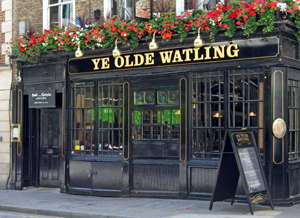
London Pub Signs – Ye Olde Watling…

Ye-Olde-WatlingThis pub, located in the City, takes its name from the street upon which it stands – Watling Street.

The street, which is just 180 metres long, bears the same name as a great Roman road which ran all the way from Dover through London to the long gone Roman town of Viroconium (now known as Wroxeter in Shropshire).

The Roman road followed, to some extent, the route of an ancient Celtic pathway. But while the Celtic pathway crossed the Thames at Westminster, the Roman road, once the bridge was constructed, crossed at London Bridge and headed through London, apparently taking in this surviving piece.

The building itself – located on the intersection with Bow Lane – is said to have been constructed from old ship’s timbers by none other than Sir Christopher Wren in 1668. The upstairs rooms were said to have been used as a drawing office during the construction of Wren’s masterpiece, St Paul’s Cathedral. It may have also been used as  pub by the workmen building the cathedral – in fact it’s said to have been the first pub built after the Great Fire of 1666.

The pub is part of the Nicholson group. For more on it, check out www.nicholsonspubs.co.uk/yeoldewatlingwatlingstreetlondon.

PICTURE: Duncan Harris/Wikipedia

Around London – ‘Hidden Treasures’; Open House programme; and the Isabella Plantation celebrates 60 years…

St-John's-GateHidden Treasures – the national initiative to celebrate the UK’s museum and archive collections – kicks off for its second year next Thursday, 22nd August, and runs over the bank holiday weekend until 27th August. Among the London institutions taking part this year are the British Library, the British Postal Museum and Archive in Houghton, the Museum of the Order of St John in Clerkenwell (pictured) and Orleans House Gallery in Twickenham. Hidden Treasures is an initiative of the Collections Trust and the Independent newspaper. All events are free but some have to be pre-booked and have limited spaces so make sure you check out the details at www.hiddentreasures.org.uk/?page_id=118.

The programme for Open House London – held over the weekend of 21st and 22nd September – will be made available online from today (or alternatively you can order a hard copy via the Open House London website). It’s important to note that a few of the buildings involved can only be entered by those successful in a ballot – they include 10 Downing Street, The View from The Shard, EDF Energy London Eye and Gray’s Inn. Head to the website – www.londonopenhouse.org – to enter the ballots which close on 13th September.

The Isabella Plantation – a 40 acre ornamental woodland garden located in the south west area of Richmond Park – is celebrating 60 years since its creation and they’ve kicked off a fortnight’s programme of free events community to mark the occasion. The events, which will be focused around the yurt by Peg’s Pond in the plantation,  include guided walks, a showcase of art for young people and a Teddy Bears picnic on the bank holiday weekend. One of the most visited parts of Richmond Park, the plantation is home to the Wilson 50 National Collection of Evergreen Azaleas, more than 150 hardy hybrid Rhododendrons, 50 species of Rhododendron and a large collection of camellias and magnolia as well as many rare and unusual trees and shrubs. While the plantation can be dated as far back as 1771 (then named Isabella Slade), it was planted for timber in 1831, and in 1953 the present garden was established and the old name Isabella adopted for it. For more on the events, see www.royalparks.org.uk.

As Muslims mark the end of Ramadan this weekend, the festival of Eid-ul-Fitr will be celebrated in Trafalgar Square on Saturday. As well as the chance to sample foods from across the Islamic world, there will also be entertainment on stage, exhibitions and children’s activities. The festival, put on by the Mayor of London Boris Johnson, runs between 1.30pm and 6pm. For more, see www.london.gov.uk/eid.

On Now: Take One Picture – Discover, Imagine, Explore: Children Inspired by Willem Kalf. This display at the National Gallery focuses on Willem Kalf’s Still Life with Drinking-Horn (about 1653) and features alongside it responsive works created by children from 25 schools across the UK and as far afield as Turkey with works from other schools captured in a slide-show. Located at the Annenberg Court (Getty Entrance), admission is free. Runs until 12th September. For more, see www.nationalgallery.org.uk.

Treasures of London – The Pearl Sword…

Pearl-Sword1

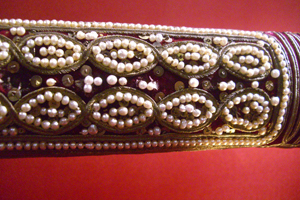
One of five City of London swords, tradition holds that the sword was given to the City Corporation by Queen Elizabeth I when the Royal Exchange opened in 1571.

It takes its name from its pearl-encrusted scabbard – there’s said to be 2,500 of them sewn onto it – and was traditionally used in celebrations. These include a ceremony which takes place when the reigning monarch comes in State to the City.

Pearl-Sword2Seen during last year’s Diamond Jubilee celebrations, the ceremony involves the Lord Mayor taking the sword from the Sword-Bearer and offering it hilt-first to the monarch to touch – a symbol of the monarch’s authority over the city. It is then borne aloft in front of the monarch by the Lord Mayor.

Interestingly, the tradition of the monarch touching the sword hilt is said to date from the reign of King Charles I when the king entered the City in 1641 and just touched the sword given to him and handed it back to the Lord Mayor. Prior to that, the sword was handed over to the sovereign for the during the visit.

The City’s other four swords include the State Sword, the Mourning Sword, the Old Bailey Sword and Mansion House Justice Room Sword.

Guided tours of Mansion House – official residence of the Lord Mayor of London and where the Pearl Sword can be seen – are conducted on Tuesdays at 2pm (although it’s closed for August for refurbishments and on selected dates after that). Head here www.cityoflondon.gov.uk/mansionhousetours details. PICTURES Courtesy City of London.

Around London – The ‘Line of Kings’ has a makeover; London captured from St Paul’s; and, cycles at the Museum of London…

Line-of-Kings

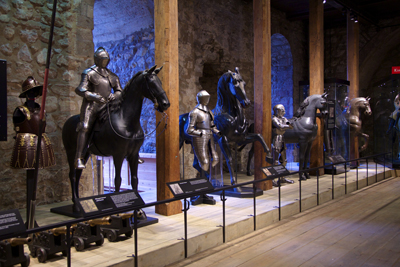
The Tower of London’s iconic exhibition, the Line of Kings, has had a makeover. Described as the “world’s longest running visitor attraction”, the Line of Kings features more than 500 objects including historic suits of armour – such as those worn by King Henry VIII, King Charles I and King James II – as well as life-sized wooden horses and individually carved king’s heads, many of which were made between 1685 and 1690. The exhibition was originally created following the Restoration in 1660 and was used as propaganda to promote the king’s rule (interestingly omitting queens and featuring only those deemed “good kings”). Rearranged and dispersed over the centuries, it’s been brought back together in the White Tower and reopened last month. Entry to the exhibition – a collaboration between Historic Royal Palaces and the Royal Armouries – is free as part of general admission to the Tower. For more, check out www.royalarmouries.org/line-of-kings. PICTURE: HRP/Newsteam

Four cameras mounted on top of St Paul’s Cathedral’s Golden Gallery have captured a 360 degree time lapse video of the capital. The video, which was shot in early July, captured 36 hours in the life of London and is the work of specialist photographer Henry Stuart who previously completed two projects from the Golden Gallery – a GigaPixel image of London and a Day Meets Night image. The latest project captured some 8,000 panoramic images. The time lapse video, which is set to Kyrie from Wolfgang Amadeus Mozart’s Missa in C major ‘Missa solemnis’ K337 being sung by the St Paul’s Cathedral Choir, can be found at http://visualise.com/videos/london-360-time-lapse-from-st-pauls-cathedral.

• On Now: London Cycles. This free exhibition at the Museum of London looks at cycling in the capital with highlights including 10 large scale portraits by Ugo Gattoni, bikes including an 1880s “boneshaker”, a penny farthing, an 1930s Enfield cycle and a ‘Boris’ bike as well as head cam footage from riders including from the annual Tweed Run bike. The free display runs until 22nd September. For more, see www.museumoflondon.org.uk.

10 (more) curious London memorials…4. ‘People of London’ Memorial…

People-of-London

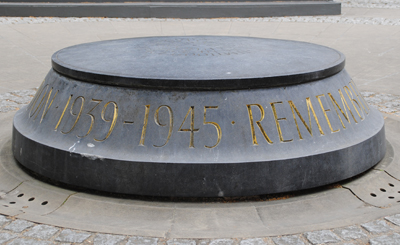
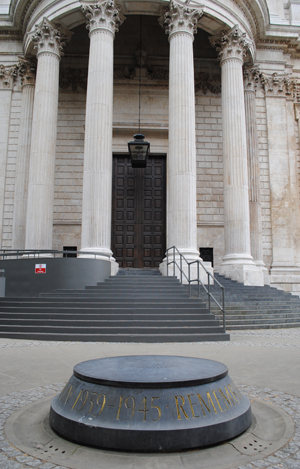
Amid all the grand war-related memorials of London, this rather humble memorial sitting outside the north transept of St Paul’s Cathedral in St Paul’s Churchyard can easily be overlooked. 

Known as the Memorial to the Londoners killed in World War II Bombardments or simply as the ‘People of London’ memorial as it’s called on the sculptor’s website, it commemorates the 30,000 Londoners who were killed during the Blitz  (not to be confused with the National Firefighters’ Memorial, known informally to many as the Blitz Memorial, which sits opposite the cathedral’s south transept and commemorates firefighters who died during the Blitz).

People-of-London---smallThe round memorial was carved from a three tonne block of Irish limestone and is set into paving (it was initially very shiny).

The gilded inscription which runs around the outside reads “Remember before God the people of London 1939-1945” while on top, written in a spiral, is an inscription written by Sir Edward Marsh – “In war resolution, in defeat defiance, in victory magnanimity, in peace goodwill”, the text of which was used by Sir Winston Churchill in the frontispiece to his history, The Second World War.

Unveiled by the Queen Mother on 11th May, 1999, the memorial is the work of Richard Kindersley, whose other memorials include the Commonwealth Memorial on Constitution Hill.

Kindersley writes on his website, that the “position of the memorial adjacent to St Paul’s is most appropriate, as most people will remember the dramatic photograph of the Cathedral dome of the taken during a devastating attack in 1941.”

It was paid for by public funds raised following an appeal in the Evening Standard newspaper, launched in connection with the 50th anniversary of VE Day.

Around London – Radio Times celebrated at MoL; IWM reopens; and Lowry at the Tate…

A new exhibition marking the 90th anniversary of the iconic publication, Radio Times, opens at the Museum of London tomorrow (Friday). Cover Story: Radio Times at 90 features some of the magazines most famous covers depicting the likes of Tony Hancock, The Goon Show, Only Fools and Horses and Coronation Street, and charts the history of radio from the BBC’s first transmission to today’s multiple channels. As well as original artwork and photographs used in Radio Times, the display includes a special focus on Doctor Who with the chance for visitors to create their own Radio Times cover as they stand alongside a life-size Dalek. Other highlights include an original 1941 illuminated map used by the Luftwaffe which shows Radio Times‘ Waterlows printing plant in Park Royal alongside other targets. Radio Times was first published by the BBC in London on 29th September, 1923, and since 2011 has been owned by Immediate Media Co. The free exhibition runs until 3rd November. For more, check out www.museumoflondon.org.uk.

The Imperial War Museum has partially reopened this week. As well as the re-opening of its permanent galleries and exhibitions, the museum has launched a major new family-oriented exhibition Horrible Histories: Spies, a new art exhibition entitled Architecture of War and ‘IWM Contemporary’, a new programme showcasing significant works by leading artists in response to war and conflict. The museum will fully reopen in summer next year with the opening of new First World War Galleries. Horrible Histories: Spies, which runs until 4th January (admission charge applies), immerses visitors in the world of World War II spycraft with families able to uncover the techniques used by the most cunning spies. More on Architecture of War and IWM contemporary in upcoming posts. For more, see www.iwm.org.uk.

On Now: Lowry and the Painting of Modern Life. This exhibition at the Tate Britain represents the first to be held by a public London institution featuring  the works of LS Lowry since his death in 1976 and is the first to explore his connections with French art. Among works on display is a little known, untitled painting depicting a busy town square set against the backdrop of industrial Salford which was found on the back of the wooden panel on which Lowry painted his 1937 work The Mission Room. Others among the 90 works on display include Coming Out Of School (1927), The Pond (1950), Industrial Landscape (1955) and Hillside in Wales (1962) as well as Ancoats Hospital Outpatients Hall (1952), The Cripples (1949), Piccadilly Circus, London (1960) and Excavating Manchester (1932). Runs until 20th October. For more, see www.tate.org.uk.

What’s in a name?…Old Bailey…

Running from Ludgate Hill to Newgate Street in the western part of the City, there are a couple of explanations behind the thoroughfare known as the Old Bailey.

Old-BaileyOne suggests that the name is derived from Latin word ballium which referred to a wall built for defence and which, in this instance, referred to the old Roman wall which surrounded the City.

Another, according to Antony Badsey-Ellis’ book What’s in a Street Name?, is that the name could be a corrupt form of ‘Bail Hill’ – a place where a bailiff held court.

For centuries the street’s name has also been used for that of a court based there. Now formally known as the Central Criminal Court, the first court – or sessions house – was built here in 1539 on part of the site now occupied by the court.

Built next to the Old Bailey court house – and pre-dating it was Newgate Prison – but when this was demolished in 1902, the Old Bailey (which itself had been rebuilt in the 1670s having been destroyed in the Great Fire of London and then subsequently remodelled) was again rebuilt and, opening in 1907, now covers the site.

For an archive of the court’s proceedings, check out www.oldbaileyonline.orgFor more on the history of The Old Bailey, check out Theresa Murphy’s The Old Bailey: Eight Hundred Years of Crime, Cruelty and Corruption.

Treasures of London – Shakespeare’s Blackfriars deed…

Shakespeare's-DeedIn 1613, the playwright William Shakespeare – now widely regarded as the greatest writer of the English language – purchased a property in Blackfriars.

The only real estate he was to buy in London, the purchase of the gatehouse – which may have stood on the junction of St Andrew’s Hill and Ireland Yard – was apparently made as an investment (Shakespeare never lived there).

The deed which recorded the sale (dated 10th March, 1613) – only one of six documents in the entire world which bears Shakespeare’s authenticated signature – is in the care of the London Metropolitan Archives.

According to the deed, he bought the property from Henry Walker, a minstrel, paying £140 for the property (he mortgaged £60 of it the next day – the document for this is located in the British Library).

Other parties mentioned on the document are William Johnson, a London-based vintner and possibly landlord of the Mermaid tavern in Cheapside, and two ‘gentlemen’ John Jackson and John Heminges, an actor, manager and editor of Shakespeare’s first folio.

They were appointed as trustees in Shakespeare’s interest and handled the sale of the property after Shakespeare’s death in 1616. The copy of the deed held by the LMA was that of Henry Walker (Shakespeare’s copy is in the Folger Shakespeare Library in Washington).

The deed is currently on display as part of an exhibition surrounding the 400th anniversary of its signing. ‘Shakespeare and London’, a free exhibition, also features other documents from the period as well as maps, prints and models and runs at the LMA (40 Northampton Road) until 26th September. Due to the age and importance of the deed, the deed itself will only be displayed at specific times – check the LMA website for details.

Special – London unearthed…

ForeshoreThis month the Festival of Archaeology is being celebrated all across the UK, including in London where about 30 different events are being held. This year they include the chance to visit the remains of the Elizabethan Rose Theatre in Bankside and see for yourself preparations for an excavation to start next year, the opportunity to walk through the London offices of the Egypt Exploration Society, a series of hands-on archaeology-related activities at Eltham Palace in south London, behind the scenes tours of the Museum of London, and the chance (next weekend – 27th/28th July) to go mud-larking along the foreshore of the River Thames outside the Tower of London and then present your findings to archaeologists for identification (pictured above from a previous year). Get in there and have some fun! For more details of events, check out www.archaeologyfestival.org.uk.

10 (more) curious London memorials…1. Kindertransport memorial

KindertransportWay back in 2011 we ran a series looking at some of London’s most curious memorials. We’ve decided to revisit that theme in our new special series.

To kick it off, we’re taking a look at a group memorial found just outside Liverpool Street Station and dedicated to the thousands of Jewish children who arrived in the UK as refugees over nine months in 1938 and 1939, having fled the Nazis in Europe after the anti-Semitic attacks of the Kristallnacht.

Called Kindertransport – The Arrival, the group of bronze statues representing children with their luggage having just stepped off a train at the station were unveiled in 2006 in Hope Square. A short stretch of railway tracks lays behind them.

The memorial is the work of Frank Meisler – himself a child who travelled on a Kindertransport train from Danzig – and bears an inscription: “Children of the Kindertransport. In gratitude to the people of Britain for saving the lives of 10,000 unaccompanied mainly Jewish children who fled from Nazi persecution in 1938 and 1939. ‘Whosoever rescues a single soul is credited as though they had saved the whole world.’ Talmud.”  It is dedicated by the Association of Jewish Refugees and the Central British Fund for Jewish World Relief.

Around the statue group are a series of blocks upon which is inscribed the names of the cities from which the children fled. They include the cities of Cologne, Hanover, Stuttgart, Frankfurt, Munich, Danzig, Breslau, Prague, Hamburg, Leipzig, Berlin and Vienna along with others.

The statue is one of four, all created by Meisler, which have been erected along the route the children took to reach safety. Others can be found at the main railway station Gdansk in Poland, Friedrichstraße railway station in Berlin, and another in Rotterdam, The Netherlands.

Hope Square also contains another plaque which dedicates the square to the children of the Kinderstransport “who found hope and safety in Britain through the gateway of Liverpool Street Station”.

In late June, an event was held in the St James’s Palace to mark the 75th anniversary of the Kindertransport.

LondonLife – A look into London’s wartime past…

StreetMuseum

Images from the Museum of London’s Streetmuseum app give a glimpse into London’s past – in this case, its wartime history. The image above, taken by Police Constable Arthur Cross, official photographer of the City of London Police, and his assistant PC Fred Tibbs, shows bomb damage at Bank Underground Station, following a direct hit on 10th January, 1941. An estimated 111 people who had been sheltering in the Tube died, some of them thrown into the path of an incoming train. The crater that was left outside the Royal Exchange was so large the Royal Engineers had to build a bridge across it. For details on how to download the app, head to www.museumoflondon.org.uk/Resources/app/you-are-here-app/home.htmlPICTURE: © Museum of London/By Kind Permission of The Commissioner of the City of London Police.

10 Historic London Garden Squares…10. Charterhouse Square…

Charterhouse-Square-GardensThe final in our series on historic garden squares in London (for this year, anyway), we’re taking a look at Charterhouse Square.

The five sided square, located just to the east of Smithfield, takes its name from a Carthusian monastery which was established in 1371 on what is now its north side. Prior to this, what is now the square had from 1348 served as a location for a plaque burial pit (a number of skeletons from the plaque pit have been unearthed as part of the Crossrail project – for our earlier story on this, follow this link).

The monastery was dissolved in 1537 after the monk’s refused to recognise King Henry VIII’s Act of Supremacy (some were later executed at Tyburn) and it was subsequently transformed into a manor house with Thomas Howard, the 4th Duke of Norfolk, among its residents over the years (in fact he was imprisoned there around 1570 for allegedly plotting to marry Mary, Queen of Scots – he was later executed by Queen Elizabeth I for treason).

Under the will of Thomas Sutton, an almshouse and school was subsequently established on the site – the almshouse remains there while the school, whose students had included Methodism founder John Wesley and writer William Makepeace Thackeray, moved out to Godalming in Surrey in 1872. As well as the almshouse (which is open for guided tours, check this site for details), some of the buildings are now occupied by medical related institutions.

In the 1600s, the square was also home to numerous other large residences among them Rutland House, which had been the residence of the Venetian ambassador. It lost its aristocratic inhabitants in the ensuing centuries but remained mainly residential up until the late 19th century when it gradually became taken over by businesses and other organisations. Interesting to note is that the east side of the square is still home to the residential unit complex known as Florin Court, better known as Whitehaven Mansions, the home of Hercule Poirot in the TV series which bears his name.

The area of the garden square itself was variously referred to as the Charterhouse Churchyard, the Charterhouse Yard and Charterhouse Close over the years and has gone through numerous incarnations with efforts to improve and formalise its look dating back to at least the 16th century. It was at least partly enclosed by the late 1600s and the fences replaced several times, notably in 1742 when an Act of Parliament was passed allowing residents to fine those who entered without authorisation. The enclosing fences have since been modified several more times.

One of the major changes to the shape of the square occurred in 1860 when the Metropolitan Railway was extended between Farringdon and Moorgate. It was at this time that the road surface which surrounds the central garden, which has a Grade II heritage listing, was laid down.

Today the gardens in the centre of the square remain under the management of the Charterhouse (and hence aren’t open to the general public except on tours) but even without a tour it’s still a quiet place to walk around the outside of, evoking a strong sense of years gone past.

Around London – The City of London Festival; last chance to see the Temperate House; and, Vermeer and music at the National Gallery…

City-of-London-FestivalThe City of London Festival kicked off last Sunday and runs for the next month in what is being billed as an “extravaganza of music, dance, art, film, poetry, family and participation events” in the Square Mile. Among the highlights of this year’s festival – the 51st – is a series of musical performances at St Paul’s Cathedral and a range of other locations including livery halls, churches and Mansion House – home of the Lord Mayor of London – as well as walks and talks including a two-day conference this Friday and Saturday, Worlds in Collision, which will explore questions surrounding the healing power of music in the treatment of post-traumatic stress disorders resulting from conflict. There’s also a range of free events such as a family day on Hampstead Heath celebrating Northern Irish culture and heritage and artistic installations such as that by artist Konstantin Dimopoulos which this week saw the trees of Festival Gardens near St Paul’s turn bright blue. Trees around Devonshire Square are also expected to be ‘coloured’ and both sites will form part of a ‘Tree Trail’ in the square mile which is aimed at revealing the ‘secret stories’ of some of the city’s trees and the locations they inhabit. The festival, which runs until 26th July, will be reflecting on a number of significant historical landmark anniversaries taking place this year, including the 400-year relationship between the City of London and the Northern Irish community of Derry-Londonderry, the 300th anniversary of the Treaty of Utrecht and the 100th anniversary of the birth of composer Benjamin Britten. For more information and a full programme of events, see www.colf.org. PICTURE: London Symphony Orchestra at St Paul’s Cathedral, © City of London Festival/Robert Piwko

The next month represents the last chance to visit Kew Gardens’ historic Temperate House – the world’s largest surviving Victorian glasshouse – for five years. The Grade I-listed building is about to undergo a five year restoration project, funded by a £14.7 million grant from the Heritage Lottery Fund. It is home to Kew’s rarest plant, the South African cycad Encephalartos woodii while other rarities include the St Helena ebony (Trochetiopsis ebenus). The Temperate House will close on 4th August and won’t reopen until May 2018. For more, see www.kew.org.

On Now: Vermeer and Music: The Art of Love and Leisure. Opened yesterday, this landmark exhibition at the National Gallery explores the motif of music in Dutch painting, in particular in the works of Johannes Vermeer and his contemporaries. Displayed alongside actual examples of 17th century virginals, guitars, lutes and other instruments, visitors will be able to see for themselves how accurate the painters were and discover why they may have taken artistic liberties. At the centre of the exhibition are three works by Vermeer – A Young Woman Standing at a Virginal and A Young Woman seated at a Virginal (both of which form part of the gallery’s collection) and The Guitar Player (on loan from Kenwood House). A fourth Vermeer, The Music Lesson, has been loaned from the Queen. Other artists featured in the exhibition include Gerard ter Borch, Gabriel Metsu, Jan Steen, Pieter de Hooch and Godfried Schalcken. Live musicians from the Academy of Ancient Music will be playing at the gallery three days each week. Runs until 8th September. Admission charge applies. For more, see www.nationalgallery.org.uk.

Treasures of London – Henry Moore altar at St Stephen Walbrook…

Henry-Moore-altar

A beautiful church in the round, St Stephen Walbrook has a rich history with one of its stand-out features is an altar designed by world renowned sculptor Henry Moore. 

The centrally located circular altar, carved between 1972 and 1983 of polished travertine marble (the marble was taken from the same quarry as that used in Michelangelo’s work), is eight foot across and weighs several tons.

It was commissioned  by property developer and churchwarden, Lord Palumbo, as part of a £1.3 million restoration of the church – built under the supervision of Sir Christopher Wren in the 1670s, replacing an earlier church which burnt down in the Great Fire – which took place between 1978 and 1987.

It was deliberately designed to be placed at the centre of the church and didn’t take up its new position without controversy with objectors to it taking the matter to the Court of Ecclesiastical Cases Reserved (they ruled the altar was acceptable for use in a Church of England church).

WHERE: St Stephen Walbrook, 39 Walbrook (nearest tube stations are Bank and Cannon Street); WHEN: 10am to 4pm weekdays (check website for changes); COST: Free; WEBSITE: www.ststephenwalbrook.net.  

Around London – Sculpture in the City; Taste of London; Paddington’s 1st Festival; and, Gauguin at the Courtauld…

LoveA free outdoor exhibition of nine artworks by world famous artists can be seen in the City of London from today. Works featured in this year’s Sculpture in the City exhibition – the third year the event has run – include Robert Indiana’s iconic LOVE sculpture (found at 99 Bishopsgate), Shirazeh Houshiary’s five spiralling stainless steel ribbons String Quintet (St Helen’s Square), and three giant steel dinosaurs, The Good, The Bad and The Ugly, made by the Jake & Dinos Chapman (30 St Mary Axe). Other artists whose work is featured include Antony Gormley, Keith Coventry, Richard Wentworth, Jim Lambie and Ryan Gander. The works will be on display in the Square Mile for the next 12 months. For more – including the locations of all nine installations – see www.cityoflondon.gov.uk/sculptureinthecity. PICTURE: Robert Indiana ‘LOVE’ (1966)  ∏ Morgan Art Foundation, Artists Right Socienty (ARS), New York – DACS, London. Photograph – A et cetera

The 10th Taste of London festival – London’s biggest outdoor food festival – kicks off in Regent’s Park today and runs over the weekend. This year sees amateur BBQ enthusiasts going head-to-head in a “battle of the BBQs” on Saturday while professionals will hit the grills on Sunday with the winners crowned champions of the Weber BBQ Challenge. Meantime, visitors can experience the food of 40 of the city’s top restaurants, shop at 200 food and drink stalls, enjoy fine wine tasting and watch demonstrations by some of the world’s top chefs including three generations of the Roux dynasty – Albert Roux, Michel Roux Jr and Emily Roux – as well as Rene Redzepi, Raymond Blanc, Ben Tish, Pascal Aussignac and Bruno Loubet. For more, see www.tastefestivals.com/london.

The first ever Paddington Festival – an 11 week showcase of art and culture supported by the City of Westminster – kicks off this weekend. Events include a “puppet theatre barge” at Little Venice and a launch event featuring an appearance by Chucky Venn (Eastenders) and steelpan and performances from local dance group, The Phoenix Dancers, at the Maida Hill Market. For more on the festival and for the full programme, see www.paddingtonfestival.co.uk. Other festivals kicking off this weekend include Shubbak 2013 – an international festival of Arab culture (www.shubbak.co.uk).

On Now: Collecting Gauguin: Samuel Courtauld in the 20s. Opening today, this exhibition at the Courtauld Gallery at Somerset House features the gallery’s collection of works by the Post-Impressionist master Paul Gauguin. The most important collection of Gauguin’s works in the UK, it was assembled by Samuel Courtauld between 1923 and 1929 and includes major paintings and works on paper by  along with one of only two marble sculptures the artist ever created. The exhibition, the gallery’s “summer showcase”, also features two important works formerly in the Courtauld’s collection and now on loan – Martinique Landscape and Bathers at Tahiti. Runs until 8th September. Admission charges apply. Meanwhile, The Courtauld Institute of Art’s MA Curating the Art Museum programme is also launching its annual exhibition, Imagining Islands: Artists and Escape, in response to the gallery’s summer showcase. A “trans-historical” exhibition displayed in two rooms, it explores artists’ fascination with other worlds and the search for utopia. Works include a 1799 engraving of Jan Brueghel the Elder’s Adam and Eve in Paradise, Barbara Hepworth’s 1957 work Icon and John Everett Millais’ 1862 painting, The Parting of Ulysses. For more, see www.courtauld.ac.uk.

Where is it?…#65…And the answer is…

Where-is-it--#65

Can you identify where in London this picture was taken? If you think you can, leave a comment below. We’ll reveal the answer early next week. Good luck!

Apologies for the delay in revealing the answer to this. The picture shows a bronze sculpture entitled ‘Break the Wall of Distrust’, located in a niche at the corner of Cannon Street and Laurence Poutney Lane (number 108 Cannon Street). Designed by Soviet artist Zurab Tsereteli, it dates from 1990.