Where’s London’s oldest…Thames tunnel?

While the Greenwich foot tunnel may these days be more well-known due to the fact it is still open to pedestrians, London’s oldest under-Thames tunnel (also credited as the oldest underwater tunnel in the world) actually runs between Rotherhithe on the river’s southern bank and Wapping on the northern.

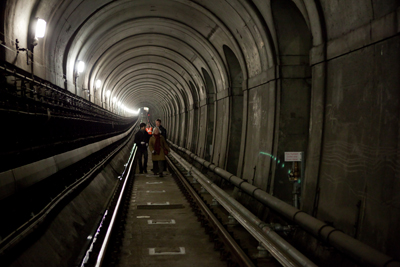
Thames_Tunnel-in-2010First opened in 1843, the Thames Tunnel (pictured left during a brief reopening to pedestrians in 2010) was the first major project of star Victorian engineer (and delightfully named) Isambard Kingdom Brunel (who, at the age of just 19 started work on the job with his father, a French engineer named Marc Isambard Brunel) and was known for a time as the eighth Wonder of the World.

It was constructed after demand grew for a way to transport goods across the crowded Port of London to the east of London Bridge. Given the height of the masts of larger ships, a bridge was deemed impracticable with the ramps required to take wheeled transport to the necessary height far too long (although this problem was overcome at the end of the 1800s by the use of new bascule technology in the construction of Tower Bridge).

Following several failed attempts to dig a tunnel under the Thames, Marc Brunel was given permission to build the new tunnel in the mid 1820s. The project relied on the use of a ‘tunnelling shield’, a then state-of-the-art technological solution to under river tunnelling which had only a few years earlier been patented by Marc Brunel and Thomas Cochrane, and Brunel initially thought the project would only take three years (it ended up taking as many as 18).

Construction by the newly formed Thames Tunnel Company, which had the support of none other than the Duke of Wellington, commenced in early 1825 at the Rotherhithe end. The shield enabled miners to dig out the tunnel while bricklayers came along behind them. While it significantly reduced the risk of a collapse (although several floods still did occur, taking the lives of six men – a fact which didn’t apparently much deter the sightseers who paid for the privilege of seeing the shield in operation), working conditions remained terrible with the men constantly showered with water from the river which was at that time the city’s main sewer. How many died indirectly as a result of working on the project is unknown.

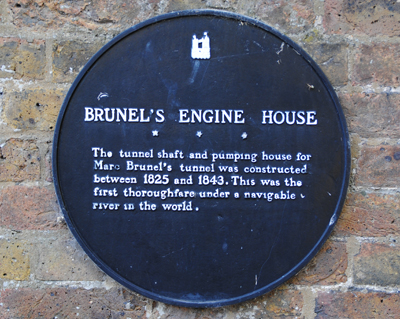
Brunel-plaqueIndeed, such was the stress of the project that Marc Brunel, later knighted for his efforts in building the tunnel, himself suffered a stroke during its construction. Isambard Brunel, who took over as the project’s engineer when the resident engineer fell ill in 1826, himself came close to being killed when he had to flee the flooding tunnel.

After much delay (including seven years in which the unfinished tunnel was left untouched) and several more disasters, the tunnel was finally completed in November, 1841.

After being fitted out with lighting, spiral staircases and roads in the following years, it was finally opened to pedestrians only on 25th March, 1843. While it was originally envisaged that the primary purpose of the tunnel would be to transport goods under the river, this never occurred.

Still, it did capture the public’s attention and as many as 50,000 people walked through the tunnel on the opening day (among the initial visitors to the tunnel was Queen Victoria herself). Within 10 weeks of its opening, a million people (a figure equal to what was then half the population of London) had reportedly passed through it.

Despite the number of people initially using it, however, the tunnel was still not a financial success and over the ensuing years became noted as a gathering place for unsavoury types. In 1865 it was purchased by the East London Railway Company which subsequently incorporated the tunnel into its railway network with both the Wapping and Rotherhithe entrance shafts converted into stations. It later become part of the London Underground network – the  – and since 2010 has been part of the London Overground.

Both stations are still in use and you can get a good sense of what the tunnel was like by riding the overground between Rotherhithe and Wapping. The Brunel Museum in Rotherhithe – actually housed within a building originally used to house machinery for draining the tunnel – see plaque above – is also a great place to find out more about the project and Brunel. Visit www.brunel-museum.org.uk for details.

PICTURES: Top – Lars Plougmann (Wikipedia)/Other – David Adams

For more on the life of Brunel, see Steven Brindle’s Brunel: The Man Who Built the World.

10 Historic London Markets – 10. Greenwich Market…

While there is said to have been a market in Greenwich since as far back as the 1300s, it was on 19th December, 1700, that Lord Romney granted the Commissioners of Greenwich Hospital a charter to hold a market on Wednesdays and Saturdays.

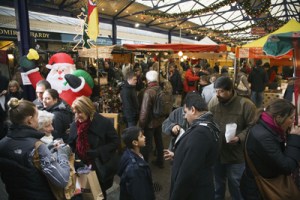
Greenwich-MarketThe market was originally located on the site of the Old Royal Naval College’s west gate and the surrounding area but under an initiative to clean up the area in the early 1800s – when the market sold all manner of foodstuffs, including livestock, as well as general goods – saw the commissioners move it to its current location on an “island site” in the midst of a block bounded by Nelson Road, King William Walk, College Approach and Greenwich Church Street.

Under the direction of Greenwich surveyor Joseph Kay (he also built Greenwich’s Trafalgar Tavern), between 1827-1833 the market was rebuilt with three roofs constructed over three linked buildings to protect traders and customers from the weather.

In 1849 an Act of Parliament was passed giving Greenwich Hospital the right to regulate the marketplace including creating byelaws and collecting fees from traders.

In the early 1900s, the byelaws were changed so the market could trade six days a week (except Sundays) and in 1908, the original timber roofing of the market was replaced with the steel and glass roof that still stands today.

The market, which lost its roof when it was struck by flying bombs in 1944, was established as a wholesale market in the years after the war and renovations carried out in the late 1950s/early 1960s. The market remained a wholesale fruit and vegetable market until 1980s when, inspired by the success of Camden Lock Market in London’s north (we’ll look at this market in a later post), it was transformed into an arts and crafts market (officially opened on 14th May, 1985) with shops around the edge let to craft-related businesses.

These days the market has about 150 stalls, selling everything from antiques and fashion to art and photographic work, jewellery, books and gifts as well a host of places to eat and drink in the market and surrounding streets.

A regeneration plan – under which a 100 bed hotel, 17,000sq ft of retail space and 155 trading stalls would be located on the 1.64 acre site currently occupied by the market – is now under consideration by Greenwich Hospital. The market is expected to be relocated to the grounds of the Old Royal Naval College while the regeneration takes place in January with the market reopened in late 2014.

WHERE: The market has four entrances – off Greenwich Church Street, Nelson Road, King William Walk and College Approach, Greenwich (nearest DLR is Cutty Sark); WHEN: 10am to 5.30pm, Tuesday to Sunday and Bank Holidays (different stalls operate on different days – check website for details); COST: Free; WEBSITE: www.shopgreenwich.co.uk/greenwich-market.

This is the last in our series on 10 Historic London Markets (we’ll be looking at more markets in upcoming posts). PICTURE: visitlondonimages/britainonview/Stephen McLaren.

For more on London’s markets, check out The London Market Guide.

Famous Londoners – Sir Peter Lely…

One of the most famous painters of his age, Dutchman Sir Peter Lely – currently the subject of an exhibition at London’s Courtauld Gallery – rose to become the foremost portrait painter at the English Court during the latter half of the 17th century.

Born to Dutch parents on 14th September, 1618, in Westphalia (now part of Germany) where his father was serving as an infantry captain, Peter – originally named Pieter van der Faes – studied art as an apprentice in Haarlem in what is now The Netherlands. While there he is believed to have changed his name to Lely based on a heraldic lily which appeared on the gable of the house where his father was born in The Hague.

Lely appeared in London in the early 1640s and, while he initially devoted himself to the sort of narrative-style paintings inspired by classical mythology, the Bible and literature he had been working on in Haarlem but having found no great success there, soon turned his hand to portraiture.

The death of court portraitist Anthony van Dyck in 1641 had left a vacuum he stepped into the gap, soon becoming the most in-demand portrait painter at the Royal Court, his sitters including none other than King Charles I himself.

However, Lely, who was made a freeman of the Painter-Stainers Company in London in 1647, managed to straddle the political divide and after the beheading of King Charles I and the end of the English Civil War in 1651, was able to continue painting portraits of the most powerful people in the land including Oliver Cromwell – whom he painted “warts and all” as per the Lord Protector’s request – and his Cromwell’s brother Richard.

Already renowned as the best artist in the country, following the Restoration in 1660, Lely became Principal Painter of King Charles II, placed on an annual stipend as van Dyck had been before him during the reign of King Charles I.

Lely’s workshop was large and its output prolific, with his students and employees – who at one stage apparently included scientist and architect Robert Hooke – often completing his paintings after he sketched out some details, only painting the sitter’s face in any great detail.

Among his most famous works are a series of 10 portraits known as the Windsor Beauties (currently at Hampton Court Palace), a series of portraits of senior naval officers who served in the Second Anglo-Dutch War, known as the Flagmen of Lowestoft (most of the works at are the National Maritime Museum in Greenwich) and Susannah and the Elders (currently at Burghley House in Cambridgeshire) as well as some of the paintings in the current Courtauld exhibition including Nymphs by a Fountain (usually found at the Dulwich Picture Gallery) and Boy as a Shepherd (also the Dulwich Picture Gallery).

Lely was also known as an avid collector of art and is credited as being the first artist in England to do so in any serious manner – among his purchases were works which formerly formed part of King Charles I’s collection. At the time of his death, he is said to have owned more than 500 paintings, although more than half of these were works of his or his studio.

Sir Peter, who never married but had two children who survived him with a common-law wife Ursula, lived at a house in the north-east corner of Covent Garden from about 1650 until his death in 1680 (some sources have him knighted in this year, others in 1679) but also had a house at Kew and owned property outside of London including in Lincolnshire and The Hague.

He was apparently working at his easel in the studio of his Covent Garden house when he died on 30th November, 1680. He was buried at St Paul’s Church, Covent Garden. The monument to him, the work of Grinling Gibbons, was destroyed by fire in 1795.

Peter Lely: A Lyrical Vision – which focuses on some of his early non-portrait works – runs at The Courtauld Gallery until 13th January. For more on the exhibition, visit www.courtauld.ac.uk/gallery/exhibitions/2012/peter-lely/index.shtml. Running alongside the exhibition is a display of some of the drawings from Sir Peter’s own collection, Peter Lely: The Draughtsman and His Collection.

Around London – Lord Mayor’s Show; Remembrance Sunday; Ansel Adams at the NMM; and, Mughal India at the British Library…

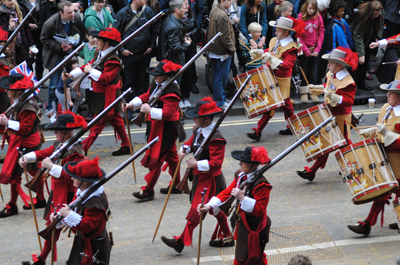
• The 2012 Lord Mayor’s Show is just about upon us and while you may not have a grandstand seat, there’s still plenty of places you can stand and watch the parade of more than 6,500 people pass by. Saturday’s parade – which celebrates the election of the 685th Lord Mayor of London, Alderman Roger Gifford – leaves Mansion House at 11am and travels via Poultry and Cheapside to St Paul’s Cathedral where it pauses for the Lord Mayor and his officials to receive a blessing – before continuing on via Ludgate Hill and Fleet Street to the Royal Courts of Justice, arriving there at about 12.30pm. There the Lord Mayor gives his oath of loyalty to the Crown (while in the surrounding streets the participants and 125 horses are fed and watered) before the parade reassembles and sets off from Embankment at 1pm, heading back to Mansion House via Queen Victoria Street – the Lord Mayor arrives sometime between 2pm and 2.30pm. (The website has a terrific one page map of the route you can download and print). There’s no fireworks display after the parade – although there’s a host of other activities taking place in the City of London – but if you’re up and about early enough, you may want to watch the Lord Mayor as he boards the barge QRB Gloriana at the Westminster Boating Base in Vauxhall at 8.30am and, escorted by a flotilla, makes his way up the Thames to HMS President, just below St Katharine Docks, arriving at about 9.35am after Tower Bridge opens in salute. For more, head to www.lordmayorsshow.org.

• The annual Remembrance Sunday service – commemorating the contribution of British and Commonwealth servicemen and women in the two World Wars and later conflicts – will take place at the Cenotaph on Whitehall at 11am this Sunday. While no tickets are required to watch the event, the Department of Culture, Media and Sport, who organise the service, advise arriving early if you wish to secure a good viewing space (and leave time for security checks at the entrance to either end of Whitehall). Whitehall opens at 8am. For more details, see www.culture.gov.uk/what_we_do/honours/3333.aspx.

A new exhibition of the work of US photographic pioneer Ansel Adams opens at the National Maritime Museum in Greenwich tomorrow (Friday). Ansel Adams: Photography from the Mountains to the Sea, which comes from the Peabody Essex Museum in Salem, Massachusetts, will feature more than 100 original prints, many of which have never been exhibited before in the UK. It is said to be the first exhibition to focus on his “lifelong fascination” with water and the display features some of Adams’ finest images based on this subject including what are some of the most famous photographs of the 20th century. Highlights include the first photograph Adams’ ever image – taken at age 14 – which features a pool located at the Panama Pacific Exhibition at the 1915 World’s Fair, the three American Trust murals produced in the 1950s on an “unprecedented scale”, Adam’s favorite work – Golden Gate before the Bridge – which hung above his desk, and iconic images such as Clearing Winter Storm, Yosemite and Stream, Sea, Clouds, Rodeo Lagoon, Marin Country, California. There is an admission charge. Runs until 28th April. For more details on the exhibition, see www.rmg.co.uk.

Also opening tomorrow (Friday) is the British Library’s major autumn exhibition – Mughal India: Art, Culture and Empire. The exhibition focuses on the Mughal dynasty – which once ruled over much of the Indian sub-continent – and is the first to document the period spanning the 16th to 19th centuries. Featuring more than 200 manuscripts and paintings, most of which come from the library’s own collection, highlights include Akbar ordering the slaughter to cease in 1578 – a work attributed to the artist Miskina in 1595, Abu’l Hasan’s early 17th century painting Squirrels in a plane tree, the historically important illustration Prince Aurangzeb reports to the Emperor Shah Jahan in durbar, and a portrait of Prince Dara Shikoh, favorite son and heir-apparent of 17th century Emperor Shah Jahan. Runs until 2nd April. Admission charge applies. For more on the exhibition and accompanying events, see www.bl.uk.

Around London – Naval caricatures; James Bond; a Taliban motorbike; and Sir Peter Lely at the Courtauld…

Naval caricatures of the late 18th and early 19th century go on display in a new exhibition which opens at the National Maritime Museum today. Broadsides! Caricature and the Navy 1756-1815 features a small selection of the museum’s extensive collection of caricatures – one of the largest in the world, it features works by James Gillray, George M Woodward and Thomas Rowlandson. It explores the role the caricatures played in shaping public opinion during the period which included the American War of Independence and wars against revolutionary and Napoleonic France. The exhibition features 20 prints with visitors able to see others in the museum’s collection via the website www.rmg.co.uk/collections. Admission is free. Runs until 3rd February. For more, see www.rmg.co.uk.

Celebrate the 50th anniversary of James Bond and the premiere of the latest film in the franchise, Skyfall, with a look at a rare collection of James Bond posters and other memorabilia as well as the latest Bond vehicle this weekend. The Hospital Club in Covent Garden is hosting the event, in conjunction with Blue Robin, which features about 50 vintage posters from movies such as 1973’s Live And Let Die and 1963’s From Russia With Love. There’s also the chance to have your photo taken beside the double-cab Land Rover Defender which features in the opening chase sequence of Skyfall. Also exhibited will be M’s chauffeur-driven Jaguar XJ long wheel base and the black Range Rover driven by Bill Tanner, M’s chief of staff. The free exhibition is open to the public from 11am to 7pm from tomorrow until Monday (please call reception on 020 7170 9100 before visiting). For more, see www.thehospitalclub.com.

A motorbike captured from Taliban insurgents in Afghanistan by members of the 1st Battalion The Rifles has gone on display at the Imperial War Museum in London. The Honda motorbike forms part of the interactive display, War Story: Serving in Afghanistan, in which visitors can delve into the lives of service personnel taking part in Operation Herrick through personal artefacts, photographs and video. The bike was recovered by soldiers after it was left behind by two insurgents during an encounter on 4th May last year. It is the largest item to be donated through the War Story project and is the only item of enemy equipment acquired by the project to date. The motorbike will be displayed until 18th December. For more, see www.iwm.org.uk.

Now On: Peter Lely: A Lyrical Vision. This newly opened exhibition at the Courtauld Gallery is the first to look at the group of large scale narrative paintings produced by Sir Peter during the turmoil of the Civil War in the 1640s and 1650s. Renowned as the principal painter of King Charles II and the “outstanding artistic figure of Restoration England”, Sir Peter apparently never wished to be seen principally as a portraitist and following his arrival in England in the early 1640s, initially devoted himself to paintings inspired by classical mythology, the Bible and contemporary literature. The exhibition centres on The Courtauld’s own work, The Concert, and features an important group of little known paintings from private collections. Runs until 13th January. Admission charge applies. For more, see www.courtauld.ac.uk/gallery/index.shtml.

LondonLife – Flying over the Thames by night…

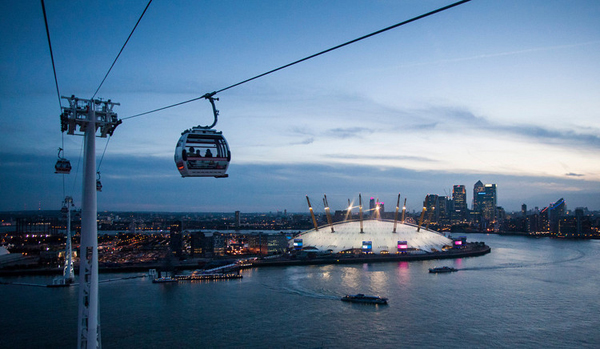
Sailing high over the River Thames between North Greenwich in the river’s southern bank and the Royal Docks on the river’s northern bank is the cable car formally known as the Emirates Air Line. Opened in late June and running every day, the cable car – the UK’s first in an urban area – is operated by Transport for London and links into the Underground and Docklands Light Rail network. Travelling at about 90 metres above the ground along a course of more than half a mile, passengers can take in the City, Docklands, Greenwich and as far eastward down the river as the Thames Barrier. This image, which shows the 02 Arena in the background, was taken just after the Closing Ceremony of the Olympic Games in August. For more, see www.emiratesairline.co.ukPICTURE: © Transport for London

Around London – Dickens and the foundlings; astronomy photographs at the Royal Observatory; Royal Parks allotments; and, Asian drinking vessels at the British Museum…

• A new exhibition exploring the relationship between author Charles Dickens, the Foundling Hospital and its secretary and former foundling, John Brownlow, opened at the Foundling Museum today. Received, a Blank Child: Dickens, Brownlow and the Foundling Hospital looks at how Dickens supported the institution in various ways including helping a young mother petition for a place for her child and publicising the work of the hospital through his writing – in particular the 1853 article Received, A Blank Child (the phrase comes from the wording used on the hospital’s entry forms). Among the items on display are never before displayed letters from Dickens relating to the hospital. The exhibition, which runs until 16th December, is free with the museum admission. And if you haven’t yet had a chance to see it, there’s still time to catch Dickens and the Foundling, in which six contributors including actor Gillian Anderson and journalist Jon Snow, have chosen objects to be displayed. This ends on 28th October. For more, see www.foundlingmuseum.org.uk.

Images from the Astronomy Photographer of the Year competition have gone on display at the Royal Observatory in Greenwich (which runs the competition in conjunction with Sky at Night Magazine). Among the winning images were The Whirlpool Galaxy taken by Martin Pugh of the UK/Australia, Star Icefall by Masahiro Miyasaka of Japan, and Venus-Jupiter Close Conjunction, by Laurent Laveder of France. The exhibition is free of charge and runs until February next year. For more (including an online gallery), see www.rmg.co.uk/visit/exhibitions/astronomy-photographer-of-the-year/2012-winners/.

It’s Harvest Festival time at London’s Royal Parks and this Sunday, between 11am and 4pm, people are invited to attend the Kensington Gardens’ allotment to see the fruits of the gardeners’ labour including the “big dig” of the potato crop as well as seasonal vegetables. There’s also the chance for families to see the allotment chickens being fed and children’s activities run by Ginger Cat. This week’s event follows one last weekend at Regent’s Park. For more, see www.royalparks.org.uk.

• On Now: Ritual and revelry: the art of drinking in Asia. This new free exhibition in room 91 of the British Museum features a display of objects which have been used in the consumption of liquids in various Asian contexts and the manner in which their use is intertwined with ritual, religious and otherwise. Among the vessels on display is a Tibetan skull-cap known as a kapala which is made from a human skull and used in religious rituals as well as a silver tea set from western India which features handles shaped like bamboo stems and a lacquered wooden sake bottle which was used as an altar piece. Runs until 6th January. For more, see www.britishmuseum.org.

Lost London – Princess Caroline’s bath, Greenwich Park

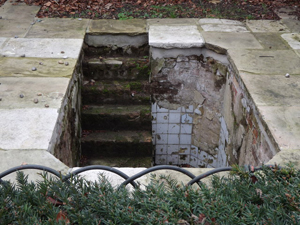
A white tiled plunge bath which once belonged to Princess Caroline of Brunswick, the estranged wife of George, Prince of Wales (later King George IV), still lies in the south-west corner of Greenwich Park between the Rose Garden and Chesterfield Gate.

Princess Caroline, a cousin of the prince, married him in 1795 in an arrangement made so he could get out of debt. Theirs was never a marriage of love – the prince is said to have spread rumours that she was adulterous, had bad breath and never washed – and after Princess Caroline gave birth to a daughter, Princess Charlotte, the couple separated.

Two years later, in 1798, Princess Caroline was banished to live at Montague House near Greenwich Park while the prince dallied with his mistress Maria Fitzherbert. The princess, known for her scandalous and indiscreet behaviour during her residence at the house, used the sunken bath, which the stood inside a bathhouse partly attached to the main building.

The house was demolished in 1815 on the orders of the king (a decision apparently prompted by a fit of pique at the Queen’s lifestyle), a year after Princess Caroline left England for the Continent plagued by rumours that she’d mothered an illegitimate child (a secret commission into her behaviour cleared her of a charge of adultery but did find her behaviour to be improper).

The sunken bath, meanwhile, was filled in during the 1980s and served as a flowerbed until, in 2001, it was re-excavated by Royal Parks in a dig funded by the Friends of Greenwich Park, Greenwich Society, the Friends of Ranger’s House and donations from individuals.

WHERE: Princess Caroline’s Bath, south-west corner of Greenwich Park (nearest DLR station is Cutty Sark – other nearby stations include Greenwich, Maze Hill and Blackheath); WHEN: 6am to at least 8pm (but beware, closing times vary depending on the month); COST: Free entry; WEBSITE: www.royalparks.gov.uk/Greenwich-Park.aspx

PICTURE: © Copyright Colin Smithwww.geograph.org.uk 

10 Historic Sporting Events in London – 8. The first London Marathon…

Now one of the world’s largest long distance running events, the first London Marathon was held on 29th March, 1981, and saw some 6,255 people lead across the finish line by American Dick Beardsley and Norwegian Inge Simonsen, who finished in a dead heat. The first woman to finish was the UK’s Joyce Smith.

The idea of holding such an event in London arose after John Disley and the late Chris Brasher (a former Olympian), both members of Richmond’s Raneleigh Harriers running club, decided to enter the New York Marathon in 1979. Returning to London exhilarated by their experience, they began investigating the possibly of holding such an event here and, meeting with a positive response from authorities, pushed ahead with it.

About 20,000 people applied to enter the first London Marathon but only 7,747 people were accepted to run. The course, which is still roughly the same, starts at various locations in Blackheath and passes through Charlton, Woolwich and Greenwich before crossing the Thames at Tower Bridge, looping around through the East End and Docklands before following the river into Westminster.

While the first race finished at Constitution Hill, between Green Park and Buckingham Palace, the race now finishes in The Mall (although for many years in between it finished on Westminster Bridge).

Such was the success of the first event – which was covered by the BBC – that the following year more than 90,000 people applied to run in the race from all around the world. Slightly more than 18,000 were accepted to run.

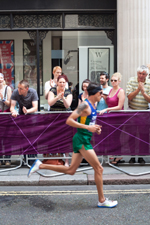
At the end of this year’s event – held on 22nd April (a runner from which is pictured) – more than 882,000 people have now completed the race. Now formally known as the Virgin London Marathon, a record high of 37,227 completed the run this year.

This year’s men’s race was won by Kenyan Wilson Kipsang who completed the race in  2:04:44 – the second fastest time over the London course – while the women’s was also won by a Kenyan – Mary Keitany – who, in taking back-to-back titles, completed the course in 2:18:37.

Since its inception, one of the key aspects of the race has been its fund-raising for a variety of charitable causes. Key among these is The London Marathon Charitable Trust which, established at the race’s outset, helps fund community sports facilities and develop recreational projects around the city.

For more on the Virgin London Marathon, see www.virginlondonmarathon.com.

PICTURE: © photocritical/istockphoto.com

LondonLife – A giant shot put hits Greenwich…

Another reminder of the Olympic and Paralympic Games in London can be found at the Old Royal Naval College in Greenwich. The sculpture, a three metre wide shot put embedded in the ground, is one of a series of three different Gifts from the Gods sculptures which have appeared around the city. As well as shot puts, the other sculptures – all of which look as though they’ve been dropped from a great height – depict a 10 metre high javelin and a seven metre long bow with arrows. The sculptures, which will remain in place until 10th September, are part of Wonder, a series of interactive installations put in place as part of the Mayor of London Presents program. For more, see www.molpresents.com/wonder. For more on the Old Royal Naval College, see www.ornc.orgPICTURE: Steve Bradbury/Courtesy of ORNC.

LondonLife – The Olympic Torch Relay (so far)…

The Olympic Torch Relay arrived in London last Friday night and has been moving around the capital ever since. Here are some of the highlights so far (all images are courtesy of LOCOG)…

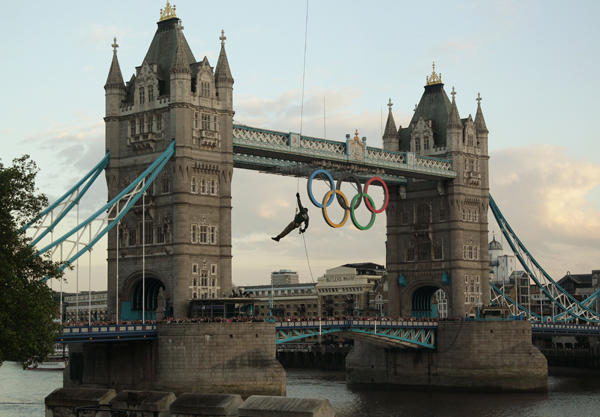
Day 63 (20th July): A Royal Marine, believed to be Martin Williams, is carrying the Olympic Flame as he abseils from a helicopter into the grounds of the Tower of London.

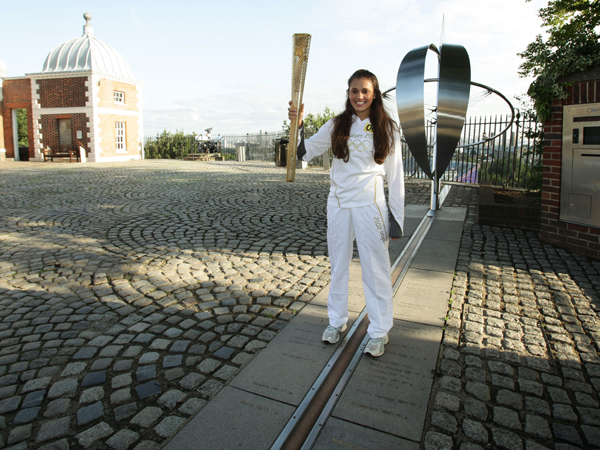
Day 64 (21st July): Swimmer Natasha Sinha holds the Olympic Flame on the Meridian Time Line outside the Royal Observatory in Greenwich.

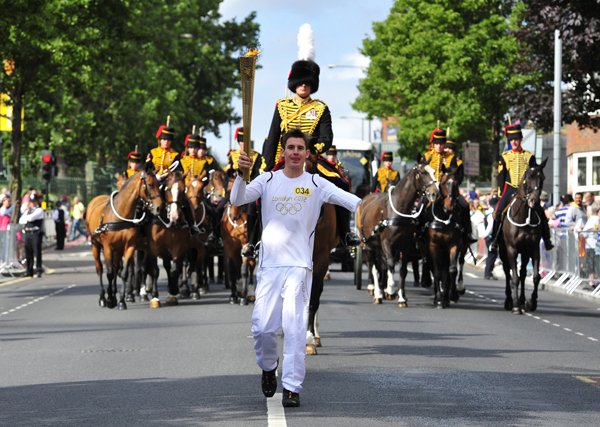
Jaco-Albert Van Gass carries the Olympic Flame through Greenwich.

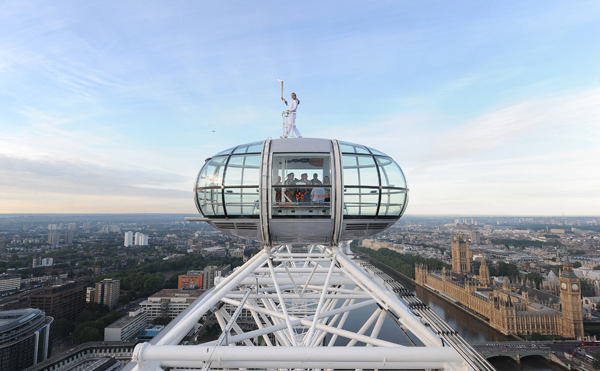
Day 65 (22nd July): Student explorer Amelia Hempleman-Adams poses with the Olympic Flame on top of a London Eye pod.

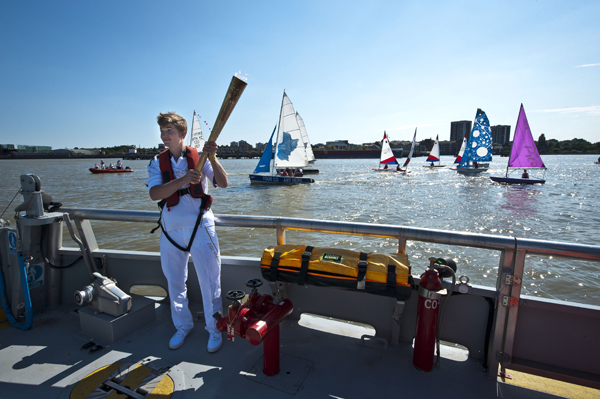
Sailor Aaron Reynolds carries the Olympic Flame on a London Fire Brigade Boat.

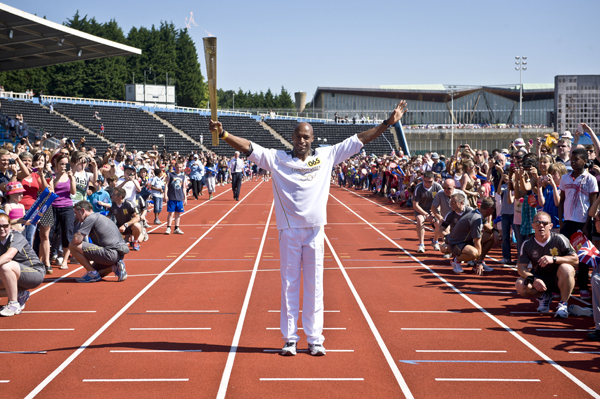
Day 66 (23rd July): Sprinter Marlon Devonish carries the Olympic Flame at Crystal Palace stadium in south London.

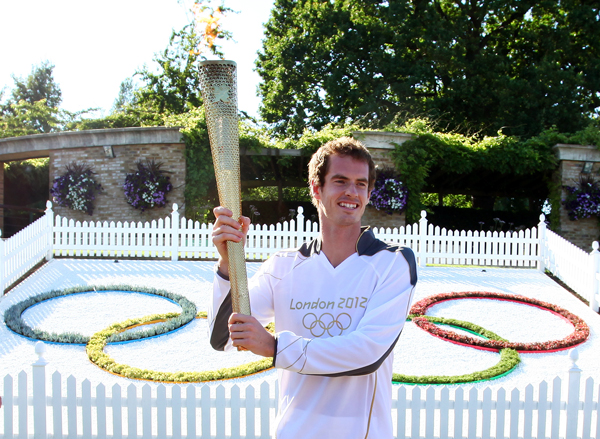
Tennis player Andy Murray carries the Olympic Flame at Wimbledon.

For more on the Torch Relay, see www.london2012.com/torch-relay/

ALL PICTURES: LOCOG.

Around London: Olympic Torch Relay hits London; mascots pop-up all over the city; and Shakespeare at the British Museum…

• The Olympic Torch Relay arrives in London tomorrow night before working its way around all of the city’s 33 boroughs and reaching the Olympic Stadium for the Opening Ceremony next Friday.  The torch will arrive in the city by helicopter from Guildford tomorrow night and then be abseiled into the Tower of London where it will spend the night ensconced with the Olympic medals. The relay will travel 200 miles over the next week, carried by more than 980 torchbearers. The route is as follows:

  • Saturday, 21st July – Greenwich via Newham, Tower Hamlets and Hackney to Waltham Forest (highlights include a visit to the Cutty Sark);
  • Sunday, 22nd July – Redbridge via Barking & Dagenham and Havering to Bexley (highlights include a ride on the London Eye and a crossing of the Thames);
  • Monday, 23rd July – Lewisham via Bromley, Croydon, Sutton and Merton to Wandsworth (highlights include a visit to a live filming of Eastenders);
  • Tuesday, 24th July – Kingston via Richmond, Hounslow, Hillingdon and Denham to Ealing (highlights include a visit to Kew Gardens);
  • Wednesday, 25th July – Harrow via Brent, Barnet and Enfield to Haringey (highlights include a visit to Wembley Arena);
  • Thursday, 26th July – Camden via Islington, the City of London, Southwark, Lambeth, Wandsworth, Kensington & Chelsea and Hammersmith & Fulham  to Westminster (the many landmarks to be visited include St Paul’s Cathedral, Shakespeare’s Globe, Trafalgar Square, Buckingham Palace and Hyde Park);
  • Friday, 27th July – From Hampton Court Palace (where it will be taken into the maze) on board Gloriana via the Thames to Olympic Park for the Opening Ceremony.

The 70 day torch relay, which kicked off on 19th May, will have travelled a total distance of about 8,000 miles and have involved 8,000 torchbearers by the time it reaches its end. LOCOG and Transport for London have advised people to see the relay at a location closest to their home given the expected crowds. For more detailed route information, see www.london2012.com/torch-relay/route/. PICTURE: LOCOG

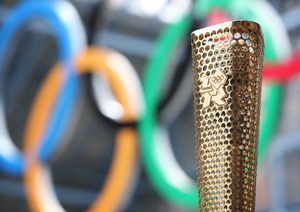
Still talking all things Olympics and London’s largest ever ‘pop up’ shop – where you can buy Olympic merchandise – was officially opened by multiple gold medalist Sir Steve Redgrave in Hyde Park last week. The shop, located on Rotten Row, will be the site of special athlete visits during the Games and visitors can have their photo taken with the Olympic Torch.

• Meanwhile, life-sized versions of the Olympic mascot Wenlock and Paralympic mascot Mandeville are popping up at some of London’s key tourist locations. The 83 two metre tall sculptures capture various elements of life in London with incarnations including a Beefeater, a giant red phone box and a replica of Big Ben. The figures can be found on the routes of Stroll, six new discovery trails designed to help both tourists and Londoners get more out of the city. A QR code on the bottom of each of the sculptures directs smartphone users to further information about the discovery trails. The discovery trails are part of the Mayor of London Presents, a city-wide programme featuring free events, shows and activities. For more on what’s happening in your area, see www.molpresents.com. Some of these events are also being run as part of the Festival of London 2012. For more on this, see http://festival.london2012.com.

• On Now: Shakespeare: staging the world. Part of the World Shakespeare Festival taking place in London, this exhibition at the British Museum looks at the then emerging role of London as a “world city” as interpreted through Shakespeare’s plays and examines the role the playhouse performed in this. The museum has collaborated with the Royal Shakespeare Company to produce the exhibition which features more than 190 objects including paintings, jewels and rare manuscripts. These include the Ides of March coin, a Roman gold aureus commemorating the assassination of Julius Caesar (Julius Caesar), the Lyte Jewel, presented to Thomas Lyte in 1610 in thanks for his work in tracing King James I’s lineage back through Banquo (Macbeth), and a 1610 bird’s-eye view of Venice (Othello and The Merchant of Venice). Runs until 25th November. Admission charge applies. For more, see www.britishmuseum.org.

LondonLife – The ‘Royal River’ celebrated at the National Maritime Museum

Canaletto’s image of Greenwich Hospital from the north bank of the Thames (1750-52) is among almost 400 paintings, manuscripts and objects selected to be part of the National Maritime Museum’s new exhibition, Royal River: Power, Pageantry & The Thames.

Curated by historian David Starkey, the exhibition, part of the Diamond Jubilee celebrations, focuses on the use of the river across five centuries covering events including Anne Boleyn’s coronation procession and Admiral Lord Nelson’s stately funeral through to the evolving Lord Mayor’s pageant and the ‘Great Stink’ of the mid-1800s.

Highlights include the oldest known copy of Handel’s Water Music, the sixteenth century Pearl Sword (which the monarch must touch on entering the City of London), a stuffed swan, treasures from the City’s livery companies, and another Canaletto work – this time his famous view of the river filled with boats getting ready for the Lord Mayor’s Day, seen as an inspiration for this year’s Diamond Jubilee Pageant and on show in the UK for the first time since its completion.

As well as celebrating the Diamond Jubilee, the exhibition also marks the 75th anniversary of the opening of the National Maritime Museum by King George VI on 27th April, 1937. The king’s speech from that day and his Admiral of the Fleet uniform also feature in the exhibition.

WHERE: National Maritime Museum Greenwich (nearest DLR station is Cutty Sark); WHEN: Daily 10am to 5pm (opening times may vary during the Paralympic and Olympic Games) until 9th September; COST: £11 adult/£9 concession/family ticket £24.50; WEBSITE: www.rmg.co.uk.

PICTURE: © National Maritime Museum, London

Around London – Cutty Sark reopens; Genghis Khan at Marble Arch; New theatre for the West End; and, Shakespeare’s cash…

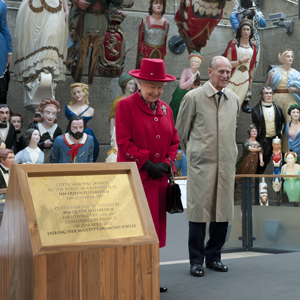
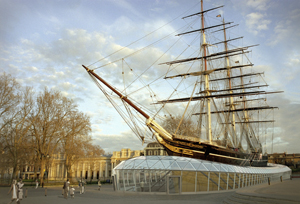
• The Cutty Sark, the world’s last surviving 19th century tea clipper, reopens to the public today following a £50 million, six year conservation project. The project to restore the Greenwich-docked ship has involved raising it more than three metres so visitors can walk underneath and see for themselves the sleek lines which helped the vessel set a then record-breaking speed of 17.5 knots or 20mph in sailing from Sydney to London. As well as raising the ship three metres, the project has involved encasing the ship’s hull in a glass casing to protect it from the weather – this area also contains the museum’s extensive collection of more than 80 ships’ figureheads, never been seen in its entirety on the site. The ship’s weather deck and rigging, meanwhile, have been restored to their original specification and new, interactive exhibitions on the vessel’s history have been installed below deck. Originally launched in 1869 in Dumbarton, Scotland, Cutty Sark visited most major ports around the world, carrying cargoes including tea, gunpowder, whiskey and buffalo horns and made its name as the fastest ship of the era when carrying wool between Australia and England. The ship became a training vessel in the 1920s and in 1954 took up her current position in the dry dock at Greenwich before opening to the public. In November 2006, the ship’s rig was dismantled in preparation for a restoration project – this received a setback on 21st May, 2007, when a fire broke out aboard the ship and almost destroyed it. The ship – which was officially reopened by Queen Elizabeth II and the Duke of Edinburgh (pictured) yesterday – is now under the operational management of the umbrella body, Royal Museums Greenwich. For more (including the online purchasing of tickets), see www.rmg.co.uk/cuttysark or www.cuttysark.org.uk. PICTURE: National Maritime Museum, London.

• A large statue of Genghis Khan has invaded Marble Arch. The 16 foot (five metre) tall sculpture of the Mongolian warlord, created by artist Dashi Namdakov, was erected by Westminster City Council as part of its ongoing City of Sculpture festival which is running in the lead-up to the Olympics. The statue has sparked some controversy – Labour councillors at Westminster have reportedly suggested Dambusters hero Guy Gibson would be a more suitable subject for a statue than the warlord Khan. The Russian artist, who has an exhibition opening at the Halcyon Gallery in Mayfair next month, told the Evening Standard he simply wanted to honor Khan on the 850th anniversary of his birth.

• Development of a new West End theatre, the first to be built in the area in 30 years, has been given the green light. The new 350 seat theatre will be part of a development project located between Charing Cross Road and Oxford Street which will also feature office and retail spaces. The site was occupied by a pickle factory in the 19th and 20th centuries and from 1927 was the home of the Astoria cinema, remodelled as a live venue in the 1980s. Live music was last presented there in 2009 when the site was compulsorily acquired for the Crossrail project.

• On Now: Crowns and Ducats: Shakespeare’s money and medals. This exhibition at the British Museum explores the role of money in Shakespeare’s world and looks at how coins – a frequently recurring motif in Shakespeare’s work – and medals were issued to mark major events. Objects in the display include Nich0las Hilliard’s ‘Dangers Averted’ medal of Elizabeth I and William Roper’s print of the Queen, the first to be signed and dated by a British artist, as well as a money box such as might have been used at the Globe and a hoard of coins, including a Venetian ducat, deposited in Essex around the time of Shakespeare’s birth. Almost every coin mentioned in Shakespeare’s plays will be on show – from ‘crack’d drachmas’ to ‘gilt twopences’. Runs until 28th October in room 69a. Entry is free. For more, see www.britishmuseum.org.

Around London – Europe’s oldest intact book at British Library; 100 days to the Games; world’s largest archaeological archive; the London Marathon; and, Turner at the National Gallery…

• The British Library has paid £9 million for a 7th century text, the St Cuthbert Gospel, which is also the oldest intact European book. The acquisition follows the library’s most successful fund-raising effort ever – it included a £4.5 million grant from the National Heritage Memorial Fund. The book – a Gospel of John bound in beautifully tooled red leather – was produced in north-east England in the late 7th century and was placed in the saint’s coffin after his death on the Isle of Lindisfarne in 698. It was retrieved when the coffin was opened at Durham Cathedral in 1104. The Gospel is on display in the Sir John Ritblat Treasures Gallery at the library in St Pancras and following a conservation review, it is anticipated it will soon be displayed with the pages open for the first time. There will be a public event celebrating the acquisition on 15th May. For more, see www.bl.uk/whatson/events/may12/index.html.

• London this week marked 100 days until the Opening Ceremony of the 2012 Olympic Games. This included unveiling the latest installation of the Olympic rings – made of 20,000 plants the 50 metre long rings are located in the Royal Botanic Gardens at Kew in the city’s west and can be seen from planes on the Heathrow flight path. The organising committee also announced the Red Arrows aerobatic display team will perform a nine-ship flypast in ‘big battle’ formation on the day of the Opening Ceremony (27th July) and stated that the games motto will be ‘Inspire a Generation’. For more, see www.london2012.com.

• The Museum of London’s archaeological archive – known as the London Archaeological Archive and Research Centre (LAARC) – is officially the largest in the world according to Guinness World Records. The archive contains more than five million artefacts and the records of almost 8,500 excavations dating back to 1830. Items in the archive include shoes dating back to Roman times, a 200-year-old set of false teeth, ‘witching bottles’ including one with human hair and toenails, and coffin plates from London’s cemeteries. The world record has been recorded as part of World Record London, a series of world record breaking events being held in the run-up to the Olympics. Others have included the Faberge Big Egg Hunt.

• Thousands of people are expected to take part in the Virgin London Marathon this Sunday. The 26.2 mile route starts in Blackheath, passes through Woolwich and Greenwich and crosses the Thames at Tower Bridge before looping around the east end of London, through Canary Wharf, and the west along The Highway (formerly known as The Ratcliffe Highway) and Embankment to Parliament Square, Birdcage Walk and finally to Buckingham Palace. The first London marathon was run in 1981. For more, see www.virginlondonmarathon.com.

• On Now: Turner Inspired – In the Light of Claude. The first major presentation of 17th century artist Claude Gellée’s influence on the English romantic artist J M W Turner, the exhibition focuses on Claude-inspired themes which run through Turner’s work including “the evocation of light and air in landscape, the effect of light upon water and his often radical reworking of contemporary scenes”. The display includes works from large scale oils on canvas through to leaves from Turner’s pocket sketchbooks. Interestingly, the exhibition also explores the story behind the so-called Turner Bequest – that on his death, Turner linked himself to Claude forever by leaving the National Gallery two pictures – Dido building Carthage (1815) and Sun rising through Vapour: Fishermen cleaning and selling Fish (before 1807) –  on condition that they were hung between two pictures by Claude, Seaport with the Embarkation of the Queen of Sheba (1648) and Landscape with the Marriage of Isaac and Rebecca (1648). Runs until 5th June. Admission charge applies. For more, see www.nationalgallery.org.uk.

Around London – Cutty Sark to reopen next month; Bed of Ware leaves V&A; and, Quentin Blake at the Foundling Museum…

• London landmark, the 19th century tea clipper Cutty Sark, will reopen to the public on 26th April following a five year, £50 million conservation project. Visitors to the ship will now be able to explore the vessel as well as, for the first time, walk under the ship after it was raised three metres above the dry dock. A glass canopy has been designed to protect the base of the ship’s hull. The Cutty Sark was built in 1869 by ship-builders Scott & Linton at Dumbarton, Scotland, and, one of the last tea clippers built, was designed to move very fast through the water. After the tea trade was taken over by steamers, the Cutty Sark was used to carry more general trade including wool from Australia. Later sold to a Portuguese company and renamed Ferriera, in 1922 Captain Dowman of Falmouth bought the ship and used her in the floating nautical school. Following his death, the clipper was donated to the Thames Nautical Training School at Greenhithe. After the formation of the Cutty Sark Preservation Society in the early 1950s, the ship was moved to Greenwich and permanently installed in a stone dry-dock where the clipper’s appearance restored to that of an active sailing vessel. In November 2006, the ship rig was dismantled in preparation for a full restoration project – this received a set back the following 21st May a fire broke out aboard the ship. But with the restoration now complete, the ship will once again accommodate visitors wishing to explore its 140 year history. For more on the Cutty Sark, see www.cuttysark.org.uk. PICTURE: © Cutty Sark London

• A treasure of the V&A Museum, the 16th century Great Bed of Ware, is being loaned to the Ware Museum, located not surprisingly in the Hertfordshire town of Ware, for a year from early next month. Believed to date from around 1590 and to have been made in Ware, the bed is believed to have been created as a tourist attraction for people traveling the pilgrim route between London and Walsingham or Cambridge University. More than three metres wide, it was said to be able to sleep 12 people and was such an attraction that people apparently stopped in Ware for the night just to sleep in the bed.  It’s even mentioned in Shakespeare’s Twelfth Night – the author has Sir Toby Belch describe a piece of paper as “big enough for the Bed of Ware”. The bed was acquired by the V&A in 1931 and hasn’t left the museum since. For more, see www.vam.ac.uk.

• Now On: Quentin Blake – As large as life. This exhibition at the Foundling Museum in Bloomsbury features more than 60 works by artist Quentin Blake, best known for his illustrations of Roald Dahl’s books and Britain’s first Children’s Laureate. The works – which are recent commissions by UK and French hospitals – are contained in four series of pictures which are displayed throughout the museum. They include Our Friends in the Circus – a 2009 series featuring circus performers, Ordinary Life – a 2o10 series celebrating the “pleasures of everyday life”, the 2007 work Planet Zog – a 2007 series in which aliens and young people swap doctor and patient roles, and Mothers and Babies Underwater – a 2011 series created for a French maternity ward. Admission charge applies. The event draws on the long history of artists’ aiding the work of hospitals and child welfare organisations – including William Hogarth who donated paintings to the Foundling Museum. Runs until 15th April. For more information, see www.foundlingmuseum.org.uk.

Treasures of London – Painted Hall, Greenwich

Often described as the “finest dining hall in Europe”, the Painted Hall in Greenwich was originally designed to be the Royal Hospital for Seamen’s communal dining hall. 

But the domed hall, which forms part of King William Court – the image, right, is taken from the west end, wasn’t used as such following its completion in the mid 1720s – designed by Sir Christopher Wren and his assistant Nicholas Hawksmoor with spectacular interior paintings by Sir James Thornhill, it was deemed too grand for such a mundane purpose and instead the veteran seamen, who had moved their dining hall to the undercroft, acted as tour guides for those who would pay to see its splendour.

The paintings, for which Thornhill received his knighthood, took almost 20 years to complete. They were designed to show Britain’s naval power as well as a variety of royal subjects in their splendour. The Stuart dynasty are featured on the ceiling of the Lower Hall while the West Wall depicts the Hanoverians – King George I surrounded by his children and grandchildren including the future King George II. Thornhill himself is also present on the lower right hand section of the West Wall painting while in the background is the dome of St Paul’s Cathedral – a reference to Sir Christopher Wren.

The hall has since served a variety of purposes but among the most significant events to take place there was the lying in state of the body of Admiral Lord Nelson following his death in the Battle of Trafalgar in October, 1805. A plaque at the top of the hall marks the spot where the coffin stood.

Between 1834 and 1936, the Painted Hall served as the National Gallery of Naval Art during which more than 300 paintings around naval themes were displayed there (today these form part of the basis of the National Maritime Museum’s art collection).

After an extensive restoration, in 1939 it was again used as a dining room for officers attending the Royal Naval College and for other grand dinners, including one celebrating the formation of the United Nations in 1946.

It’s now available for hire and has also served as a film location – including for films such as The Madness of King George, Quills and the more recent film Pirates of the Caribbean: On Stranger Tides.

An appeal has been launched to restore the hall with the expected nine month, £450,000 restoration of the West Wall paintings slated to begin after the Olympic Games. To donate, head here.

WHERE: King William Court, Old Royal Naval College, Greenwich (nearest Docklands Light Rail station is Cutty Sark for Maritime Greenwich). WHEN: 10am to 5pm daily COST: Free; WEBSITE: www.ornc.org/visit/attractions/painted-hall.

The Royal Parks – 6. Greenwich Park

The oldest of the royal parks, the 74 hectare (183 acre) Greenwich Park has been associated with royalty since at least the 15th century.

The area covered by the park had been occupied by the Romans (there are some remains of a building, possibly a temple, near Maze Hill Gate) and later the Danes, who raised protective earthworks here in the 11th century. After the Norman Conquest, it became a manor.

Its enclosure only happened in 1433 after the land came into the possession of Humphrey of Lancaster, Duke of Gloucester and brother of King Henry V. At the time regent to the young King Henry VI, Duke Humphrey also built a tower on the heights above the park – where the Royal Observatory now stands.

Following the duke’s death in 1447, the land was seized by Margaret of Anjou – wife of King Henry VI – and subsequently became known as the Manor of Placentia. King Henry VII later rebuilt the manor house, creating what was known as Greenwich Palace or the Palace of Placentia.

Not surprisingly, it was King Henry VIII, who, having been born at Greenwich Palace, introduced deer to the park. Indeed the park was to have strong associations with others in his family – the king married Catherine of Aragorn and Anne of Cleeves at Greenwich Palace, and his daughters, later Queen Mary I and Queen Elizabeth I, were born there while his son, King Edward VI, died there in 1553 at the age of only 15. (There’s a tree in the park known as Queen Elizabeth’s Oak, which is said to be where she played as a child).

In 1613, King James I gave the palace and accompanying park – which he had enclosed with a high wall – to his wife, Queen Anne of Denmark, apparently as an apology after swearing at her in public when she accidentally shot one of his favorite dogs. Queen Anne subsequently commissioned Inigo Jones to design what is now known as the Queen’s House – for more on that, see our earlier post.

Following the Restoration, King Charles II ordered the palace rebuilt and while this work remained unfinished, the king did succeed in having the park remodelled – it is believed that Andre Le Notre, gardener to King Louis XIV of France, had a role in this.

The works included cutting a series of terraces into the slope – these were known as the Great Steps and lined with hawthorn hedges – as well as creating a formal avenue of chestnut trees (now known as Blackheath Avenue), and some woodlands. Work is currently taking place on restoring an orchard which dates from 1666 at the park.

King Charles II also commissioned Sir Christopher Wren to build the Royal Observatory that still stands on the hill overlooking the park – it stands on the site once occupied by the Duke Humphrey Tower (the Royal Observatory is home of the Prime Meridian – see our earlier post on the Royal Observatory for more).

King James II was the last monarch to use the palace and park – his daughter Queen Mary II donated the palace for use as a hospital for veteran sailors and the park was opened to the pensioners in the early 1700s. The hospital later become the Royal Naval College and the National Maritime Museum later moved onto the site (for more on this, see our earlier post).

As an aside, Royal Parks say the truncated shape of some of the trees in the park is apparently due to the fact that when anti-aircraft guns were positioned in the flower garden during World War II, the trees had to be trimmed to ensure a clear field of fire.

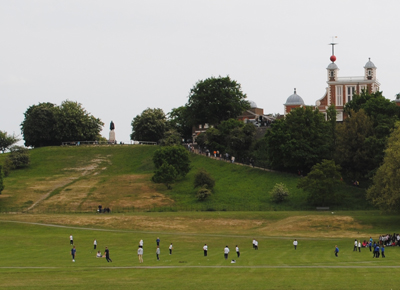
Facilities in the park today include a tea house, a children’s playground, sporting facilities such as tennis courts and, of course, the Wilderness Deer Park where you can see wildlife at large. Statues include that of Greenwich resident General James Wolfe, an instrumental figure in establishing British rule in Canada – it sits on the crest of the hill opposite the Royal Observatory looking down towards the Thames.

The park, which is part of the Greenwich World Heritage Site, is slated as a venue for next year’s Olympics – it will host equestrian events and the shooting and running events of the pentathlon.

WHERE: Greenwich Park (nearest DLR station is Cutty Sark – other nearby stations include Greenwich, Maze Hill and Blackheath); WHEN: 6am to at least 6pm (closing times vary depending on the month); COST: Free entry; WEBSITE: www.royalparks.gov.uk/Greenwich-Park.aspx

LondonLife – Cutty Sark under wraps – but not for much longer…

Former tea clipper Cutty Sark is finally nearing the end of £50 million restoration project in its dry dock at Greenwich. The ship, almost destroyed in a fire in May 2007 which broke out while the ship was undergoing conservation work, is expected to reopen to the public next year – just in time for the Olympics. The extensive restoration project recently marked the completion of the ship’s intricate gold leaf “gingerbread”, located on the upper hull on either side of the bow, and the figurehead (pictured). The Cutty Sark undertook her first voyage – to Shanghai – in 1870 and continued to ply the waters between China and the UK until 1878 when steamships took over the route. The ship continued, however, to operate as a cargo vessel (including hauling wool between Australia and the UK) until the early twentieth century when she was eventually restored and used as a training ship. The Cutty Sark, which last went to sea in 1938, came to London in 1951 as part of the Festival of Britain celebrations. She was saved from the scrapyard in 1954 when she took up her position in the drydock at Greenwich and was opened to the public in 1957. For more – including a diary of the restoration work – see www.cuttysark.org.uk.

Around London: The East India Company at National Maritime Museum; Open days at London Transport Museum’s depot; and, Atkinson Grimshaw at the Guildhall Art Gallery…

• The National Maritime Museum in Greenwich has launched five month-long festival looking at the East India Company and the mark it’s left on London and the world. The festival, which was launched late last month as a new gallery, Traders: The East India Company and Asia, opened its doors at museum, features musical performances, film screenings, games, discussions, story-telling and debates surrounding the company and its legacy as well as ‘curry and a pint’ nights and tea parties. Also included are two days of celebrations marking Diwali, the Hindu Festival of Lights, on 12th November, and Chinese New Year on 18th February. For more on the events and the museum, see www.nmm.ac.uk.

London Transport Museum’s Depot in Acton is holding a family open weekend this Saturday and Sunday with ‘make and take’ workshops, object handling sessions and rides on the open air miniature railway and life-sized heritage vehicles. Among those on hand to answer all your questions will be London’s Emergency Response Unit. Open between 11am and 5pm both days (last admission 4pm). An admission charge applies. To book or to find out more information, see www.ltmuseum.co.uk/whats-on/museum-depot/events.

• On Now: Atkinson Grimshaw: Painter of Moonlight. The first major show of Grimshaw’s work for more than 30 years, this exhibition at the Guildhall Art Gallery includes more than 60 paintings from his earliest Pre-Raphaelite inspired landscapes to the Impressionist style seascapes of his last years along with drawings, manuscripts and photographs on loan from public and private collections and descendants of the artist. Grimshaw (1836-1893) was a popular Victorian artist known for his evocative scenes of the urban environment at night and for his landscapes. Runs until 15th January (admission charge applies). There is also a special late viewing (the gallery’s first) on 21st October. For more on the exhibition, see www.guildhallartgallery.cityoflondon.gov.uk/gag/.