Famous Londoners – Sir Peter Lely…

One of the most famous painters of his age, Dutchman Sir Peter Lely – currently the subject of an exhibition at London’s Courtauld Gallery – rose to become the foremost portrait painter at the English Court during the latter half of the 17th century.

Born to Dutch parents on 14th September, 1618, in Westphalia (now part of Germany) where his father was serving as an infantry captain, Peter – originally named Pieter van der Faes – studied art as an apprentice in Haarlem in what is now The Netherlands. While there he is believed to have changed his name to Lely based on a heraldic lily which appeared on the gable of the house where his father was born in The Hague.

Lely appeared in London in the early 1640s and, while he initially devoted himself to the sort of narrative-style paintings inspired by classical mythology, the Bible and literature he had been working on in Haarlem but having found no great success there, soon turned his hand to portraiture.

The death of court portraitist Anthony van Dyck in 1641 had left a vacuum he stepped into the gap, soon becoming the most in-demand portrait painter at the Royal Court, his sitters including none other than King Charles I himself.

However, Lely, who was made a freeman of the Painter-Stainers Company in London in 1647, managed to straddle the political divide and after the beheading of King Charles I and the end of the English Civil War in 1651, was able to continue painting portraits of the most powerful people in the land including Oliver Cromwell – whom he painted “warts and all” as per the Lord Protector’s request – and his Cromwell’s brother Richard.

Already renowned as the best artist in the country, following the Restoration in 1660, Lely became Principal Painter of King Charles II, placed on an annual stipend as van Dyck had been before him during the reign of King Charles I.

Lely’s workshop was large and its output prolific, with his students and employees – who at one stage apparently included scientist and architect Robert Hooke – often completing his paintings after he sketched out some details, only painting the sitter’s face in any great detail.

Among his most famous works are a series of 10 portraits known as the Windsor Beauties (currently at Hampton Court Palace), a series of portraits of senior naval officers who served in the Second Anglo-Dutch War, known as the Flagmen of Lowestoft (most of the works at are the National Maritime Museum in Greenwich) and Susannah and the Elders (currently at Burghley House in Cambridgeshire) as well as some of the paintings in the current Courtauld exhibition including Nymphs by a Fountain (usually found at the Dulwich Picture Gallery) and Boy as a Shepherd (also the Dulwich Picture Gallery).

Lely was also known as an avid collector of art and is credited as being the first artist in England to do so in any serious manner – among his purchases were works which formerly formed part of King Charles I’s collection. At the time of his death, he is said to have owned more than 500 paintings, although more than half of these were works of his or his studio.

Sir Peter, who never married but had two children who survived him with a common-law wife Ursula, lived at a house in the north-east corner of Covent Garden from about 1650 until his death in 1680 (some sources have him knighted in this year, others in 1679) but also had a house at Kew and owned property outside of London including in Lincolnshire and The Hague.

He was apparently working at his easel in the studio of his Covent Garden house when he died on 30th November, 1680. He was buried at St Paul’s Church, Covent Garden. The monument to him, the work of Grinling Gibbons, was destroyed by fire in 1795.

Peter Lely: A Lyrical Vision – which focuses on some of his early non-portrait works – runs at The Courtauld Gallery until 13th January. For more on the exhibition, visit www.courtauld.ac.uk/gallery/exhibitions/2012/peter-lely/index.shtml. Running alongside the exhibition is a display of some of the drawings from Sir Peter’s own collection, Peter Lely: The Draughtsman and His Collection.
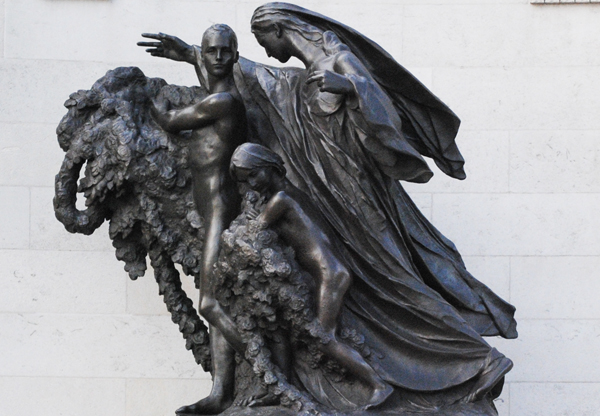
Where is it?…#49

The latest in the series in which we ask you to identify where in London this picture was taken and what it’s of. If you think you can identify this picture, leave a comment below. We’ll reveal the answer early next week. Good luck!

Sunday was Remembrance Day, so we thought it appropriate to have a war memorial as last week’s Where is it? This memorial, located at Victoria Embankment on the north bank of the Thames, is the Anglo-Belgian War Memorial, given in 1920 as a gift to Britain by the people of Belgium as a thank you for their help in providing a refuge in England during World War I. The work of celebrated Belgian sculptor Victor Rosseau, it features three bronze figures – a Belgian mother, a boy and a girl, the latter two carrying garlands – and although you can’t see it in this picture, there’s two figures behind them on the Portland stone surround representing ‘honour’ and ‘liberty’.

Around London – Lord Mayor’s Show; Remembrance Sunday; Ansel Adams at the NMM; and, Mughal India at the British Library…

• The 2012 Lord Mayor’s Show is just about upon us and while you may not have a grandstand seat, there’s still plenty of places you can stand and watch the parade of more than 6,500 people pass by. Saturday’s parade – which celebrates the election of the 685th Lord Mayor of London, Alderman Roger Gifford – leaves Mansion House at 11am and travels via Poultry and Cheapside to St Paul’s Cathedral where it pauses for the Lord Mayor and his officials to receive a blessing – before continuing on via Ludgate Hill and Fleet Street to the Royal Courts of Justice, arriving there at about 12.30pm. There the Lord Mayor gives his oath of loyalty to the Crown (while in the surrounding streets the participants and 125 horses are fed and watered) before the parade reassembles and sets off from Embankment at 1pm, heading back to Mansion House via Queen Victoria Street – the Lord Mayor arrives sometime between 2pm and 2.30pm. (The website has a terrific one page map of the route you can download and print). There’s no fireworks display after the parade – although there’s a host of other activities taking place in the City of London – but if you’re up and about early enough, you may want to watch the Lord Mayor as he boards the barge QRB Gloriana at the Westminster Boating Base in Vauxhall at 8.30am and, escorted by a flotilla, makes his way up the Thames to HMS President, just below St Katharine Docks, arriving at about 9.35am after Tower Bridge opens in salute. For more, head to www.lordmayorsshow.org.

• The annual Remembrance Sunday service – commemorating the contribution of British and Commonwealth servicemen and women in the two World Wars and later conflicts – will take place at the Cenotaph on Whitehall at 11am this Sunday. While no tickets are required to watch the event, the Department of Culture, Media and Sport, who organise the service, advise arriving early if you wish to secure a good viewing space (and leave time for security checks at the entrance to either end of Whitehall). Whitehall opens at 8am. For more details, see www.culture.gov.uk/what_we_do/honours/3333.aspx.

A new exhibition of the work of US photographic pioneer Ansel Adams opens at the National Maritime Museum in Greenwich tomorrow (Friday). Ansel Adams: Photography from the Mountains to the Sea, which comes from the Peabody Essex Museum in Salem, Massachusetts, will feature more than 100 original prints, many of which have never been exhibited before in the UK. It is said to be the first exhibition to focus on his “lifelong fascination” with water and the display features some of Adams’ finest images based on this subject including what are some of the most famous photographs of the 20th century. Highlights include the first photograph Adams’ ever image – taken at age 14 – which features a pool located at the Panama Pacific Exhibition at the 1915 World’s Fair, the three American Trust murals produced in the 1950s on an “unprecedented scale”, Adam’s favorite work – Golden Gate before the Bridge – which hung above his desk, and iconic images such as Clearing Winter Storm, Yosemite and Stream, Sea, Clouds, Rodeo Lagoon, Marin Country, California. There is an admission charge. Runs until 28th April. For more details on the exhibition, see www.rmg.co.uk.

Also opening tomorrow (Friday) is the British Library’s major autumn exhibition – Mughal India: Art, Culture and Empire. The exhibition focuses on the Mughal dynasty – which once ruled over much of the Indian sub-continent – and is the first to document the period spanning the 16th to 19th centuries. Featuring more than 200 manuscripts and paintings, most of which come from the library’s own collection, highlights include Akbar ordering the slaughter to cease in 1578 – a work attributed to the artist Miskina in 1595, Abu’l Hasan’s early 17th century painting Squirrels in a plane tree, the historically important illustration Prince Aurangzeb reports to the Emperor Shah Jahan in durbar, and a portrait of Prince Dara Shikoh, favorite son and heir-apparent of 17th century Emperor Shah Jahan. Runs until 2nd April. Admission charge applies. For more on the exhibition and accompanying events, see www.bl.uk.

10 Historic London Markets – 6. Old (and New) Spitalfields Market…

There has been a market on the site now known as Old Spitalfields Market, located on the eastern outskirts of the City of London next to what was the Priory and Hospital of St Mary Spital, since the thirteenth century.

But it was centuries later when, following the tumult of the Civil War, in 1682, John Balch was formally granted a Royal Charter by King Charles II to hold a “flesh, fowl and roots” market on Thursdays and Saturdays in or on the rectangle of land known as Spital Square. A ‘market-house’ was built on the site around this time for administrators with traders selling their wares from stalls.

The success of the market drew people to the area – in particular, Huguenots fleeing France who brought with them new skills in silk-weaving, and later Irish fleeing the Potato Famine and Jews escaping the harsh political climate in Eastern Europe – and the market gained a name for itself as a place to buy fresh produce.

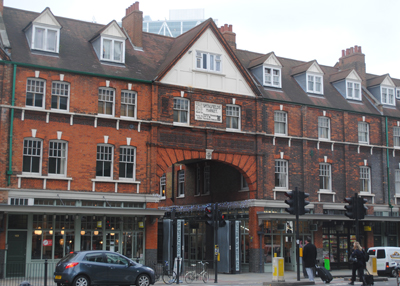
By late in the 19th century, the market had fallen into decline. So, in 1876, a former market porter by the name of Robert Horner decided it needed an upgrade and, buying the lease, had the central market square roofed with glass and new market buildings, known as the Horner Buildings (pictured above), constructed around the northern, eastern and southern sides of the site. Having cost £80,000, it was completed in 1893.

In 1920, the City of London took over control of the market and later than decade expanded the original buildings. Having continued to grow over the ensuing years and with traffic congestion continuing to increase in the surrounding streets, it was decided to move the fresh produce aspect of the market to a new location at Leyton to the north-east.

The new market, known as New Spitalfields Market, covers more than 31 acres and boasts more than 100 traders.

Meanwhile, Old Spitalfields Market, the western end of which was redeveloped in the late 20th century, continues to operate on the original market site – now known as Horner Square, with stalls selling everything from contemporary and vintage fashion to music, gems and jewellery, bric-a-brac and antiques as well as various themed market days – check the website for more details.

Old Spitalfields Market
WHERE: Horner Square, Spitalfields (nearest Tube stations are Shoreditch High Street and Liverpool Street); WHEN: Markets are held every day – times vary so check website for details; COST: Free; WEBSITE: www.oldspitalfieldsmarket.com.
.
New Spitalfields Market
WHERE: 23 Sherrin Road, Leyton (nearest Tube station is Leyton); WHEN: Trading hours midnight to around 9am, Monday to Saturday; COST: Free; WEBSITE: www.cityoflondon.gov.uk/business/wholesale-food-markets/new-spitalfields/Pages/default.aspx.

LondonLife Special – It’s Bonfire Night!…

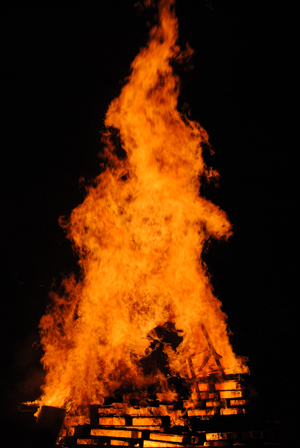
Today marks what was traditionally known as Guy Fawkes Day or, as it’s known more popularly today, Bonfire Night, when, along with people throughout the UK, Londoners celebrate the capture of would be regicide Guy Fawkes and his conspirators, who in 1605 plotted to blow up the House of Lords and with it, King James I, during the State Opening of Parliament.

We’ve previously run a couple of pieces on the conspiracy and some of the key people and places involved – check out our earlier entries here and here.

Meantime, if you’re wanting to attend a celebration in London, Time Out has a terrific guide to all the events taking place – simply head to their page here. Enjoy the night!

Where is it?…#48

The latest in the series in which we ask you to identify where in London this picture was taken and who it’s of. If you think you can identify this picture, leave a comment below. We’ll reveal the answer early next week. Good luck!

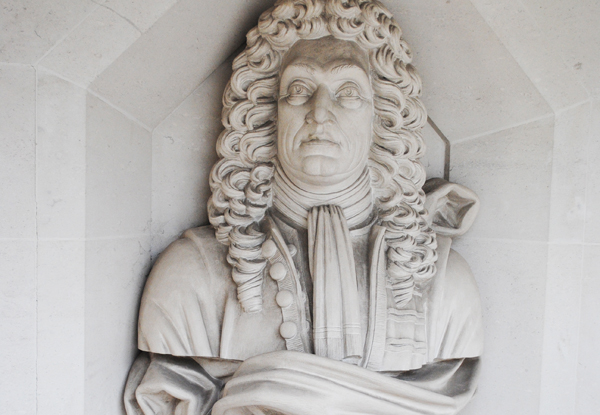
Well done to Angelo (and, I suspect the correct location for Mike), this is indeed a bust of Sir Christopher Wren and is located in a loggia outside the Guildhall Art Gallery facing into Guildhall Yard. It and three other larger than life busts of notable Londoners – playwright William Shakespeare, statesman Oliver Cromwell and diarist Samuel Pepys – are all the work of Tim Crawley and were installed when the gallery was completed in 1999. Along with them is a full length statue of Dick Whittington and his famous cat – these are the work of Laurence Tindall.

Treasures of London – The State Coach…

Eight days from now, the Lord’s Mayor’s Show will be winding its way through the streets of the City London with star of the show, the new Lord Mayor of London, Roger Gifford, riding in a spectacular gilt State Coach.

The coach’s origins go back to the mid 18th century although the reason why a coach is used go back some years earlier – to 1711, in fact, when then Lord Mayor Sir Gilbert Heathcote fell off the horse he was riding in the procession and broke his leg. It’s worth noting that up until the 1420s, the Lord Mayor rode all the way to the Palace of Westminster to swear fealty to the monarch – after that they went on a river barge down the Thames, a practice which continued until 1857 (although they still had to ride to and from the watercraft which is when Sir Gilbert had his accident).

While a stand-in coach was used for some years after Sir Gilbert’s fall, in 1757 Sir Charles Asgill, a banker who was set to be the next Lord Mayor, commissioned Joseph Berry of Leather Lane in Holborn to make the splendid vehicle still in use today (the coach was designed by architect Sir Robert Taylor). Built at a cost of £1,065.0s.3d, the substantial sum was met by the Aldermen. It’s now apparently worth more £2 million.

Richly ornate, many of the four ton coach’s features emphasise the role of the City of London as a centre of world trade – the cherubs at each of the coach’s four corners, for example, represent the four continents of Asia, Africa, America and Europe. The City’s coat-of-arms is on the back of the coach, the front panel has an image of Hope pointing at St Paul’s Cathedral and the side panels are decorated with representations of moral virtues.

The coach, which has undergone many restorations (in an indication of this, it’s said there’s as many as 100 coats of paint and varnish on the ceiling), has since been used in every Lord Mayor’s Show and when not in use, can be seen in the Museum of London.

PICTURE: The State Coach at last year’s Lord Mayor Show/© David Adams

Around London – Henry Stuart at the NPG; the Lord Mayor’s Show; prehistoric Japanese pots; and, photography at the National Gallery…

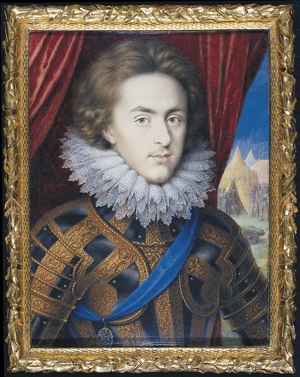
• The first ever exhibition focusing on Henry Stuart, older brother of King Charles I, has opened at the National Portrait Gallery. The Lost Prince: The Life and Death of Henry Stuart features more than 80 exhibits including paintings, miniatures, manuscripts, books and armour gathered from museums and personal collections around the UK and abroad – with some of the objects being displayed in public for the first time. Opened on 18th October – the 400th anniversary of the Prince’s death, among the paintings displayed in the exhibition are works by Holbein, Nicholas Hilliard and Isaac Oliver as well as Robert Peake as well as masque designs by Inigo Jones and poetry  by Ben Jonson. Henry, Prince of Wales, was the eldest son of King James I and Queen Anne of Denmark, and died at the age of 18 of typhoid fever. As well as looking at his short life, the exhibition covers the extraordinary reaction to his premature death (and the end of hope that King Henry IX would sit next upon the throne). The exhibition runs until 13th January. An admission fee applies. For more, see www.npg.org.uk. PICTURE:  Henry, Prince of Wales by Isaac Oliver, c. 1610-12; Copyright: The Royal Collection Photo: Supplied by Royal Collection Trust / © HM Queen Elizabeth II 2012

The Lord Mayor’s Show – the largest unrehearsed procession in the world – will be held on 10th November. This year’s procession – celebrating the election of the 685th Lord Mayor of London, Alderman Roger Gifford – will feature more than 6,500 people winding their way through the City of London in a three-and-a-half mile-long display including 22 marching bands, 125 horses, 18 vintage cars, 21 carriages, an original American stagecoach, a Sherman tank, a steamroller and a Japanese Taiko drum band. While there will be no fireworks after this year’s parade, following the success of last year’s trial there will be an early morning flotilla with the Lord Mayor conveyed in the barge QRB Gloriana from Vauxhall up the Thames to HMS President, just below St Katharine Docks, from where he will make his way to the Mansion House to join the procession as it heads first to St Paul’s and then on to the Royal Courts of Justice before returning (via a different route). There are no grand stand seats left but plenty of places you can watch it for free (for a chance to win free Grandstand tickets, head to the Lord Mayor’s Show Facebook page and ‘like’ it). We’ll be talking about this more next week, but in the meantime, for maps and details of a new smart phone app, head to www.lordmayorsshow.org.

Two prehistoric Japanese pots have gone on display at the British Museum. Loaned from the Nagaoka Municipal Science Museum, the pots date from the Middle Jomon period (3,500-2,500 BCE) and consist of a ‘flame’ and a ‘crown’ pot which were excavated in Nagaoka city. The pots form part of the Asahi Shimbun Displays in room 3 and will be there until 20th January. Meanwhile, continuing the Asian theme, an exhibition of more than 100 contemporary carved Chinese seals by artist Li Lanqing is on display in room 33 until 15th January. Admission to both is free. For more, see www.britishmuseum.org.

• On Now: Seduced by Art: Photography Past and Present. The National Gallery’s first major exhibition of photography, the display looks at the relationship between historical paintings and photography, both its early days in the mid-19th century and the work of contemporary photographers – in particular how photographers have used the traditions of fine art to “explore and justify” their own works. Almost 90 photographs are displayed alongside a select group of paintings for the show. Admission is free. Runs until 20th January in the Sainsbury Wing. For more, see www.nationalgallery.org.uk.

10 Historic London Markets – 5. Covent Garden Market…

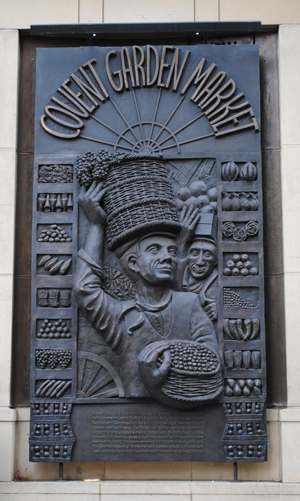
We’ve had a quick look at the origins of Covent Garden before (as part of our What’s in a name? series) but it’s worth a recap.

Now a favorite of tourists visiting London, Covent Garden is these days largely known as a specialty shopping and entertainment precinct in the West End. But its beginnings as a market go back at least to the 1600s when a licence was formally granted to hold a market in the piazza.

The land had been formerly owned by the Abbey (or Convent) of St Peter in Westminster which had established 40 acre kitchen garden here (hence ‘Convent Garden’) and had passed into the hands of the Crown at the Dissolution. Later owned by the Earls of Bedford, it was the 4th earl, Francis Russell, who commissioned Inigo Jones to design a great residential square- including St Paul’s Church, known as the Actor’s Church – on the site.

By 1650, fruit and vegetable markets were regularly been held on the site and, interestingly, around this time the market adopted the pineapple, a symbol of wealth, as its emblem (it was also around this time that Punch and Judy shows were introduced to the area (see our earlier post on Mr Punch here)). Covent Garden’s rise to prominence as a market came when the Great Fire of London destroyed many of London’s other markets leaving it as the foremost fruit, vegetable and flower market. In May 1670, the 5th Earl of Bedford, William Russell (later 1st Duke of Bedford), obtained the formal right to hold a market on the site from King Charles II.

The growth of the market and the development of fashionable residential developments further west in Soho and Mayfair saw many of the affluent people who had lived around the market move out and the character of the square changed (in an indication of this, a list of Covent Garden prostitutes was published in 1740).

In 1813, the 6th Duke of Bedford, John Russell, secured an Act of Parliament regulating the market and in the late 1820s began to redevelop the site, commissioning architect Charles Fowler to design new buildings (up until then the market was housed in makeshift stalls and sheds). These include the grand main market building which still stands on the site today.

The market continued to grow – there is said to have been 1,000 porters employed at the market’s peak – and in 1860 a new flower market was built on the south piazza (where the London Transport Museum now stands), while in the 1870s, a glass roof was added to the market building. A “foreign” flower market opened in what is now Jubilee Hall in 1904.

In 1918, the Bedford family sold the market to the Covent Garden Estate Company. The next major installment in the market’s life came in 1974 when the market, which had outgrown the West End site, moved out to a new site in Nine Elms at Vauxhall in London’s inner south.

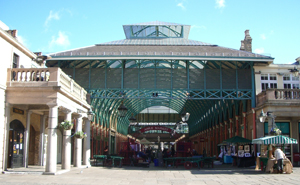
The Covent Garden site was left to fall into disrepair but, saved from demolition and redevelopment largely through the efforts of Geoffrey Rippon, then Secretary of State for the Environment, it subsequently underwent restoration, reopening as a speciality shopping centre in 1980 with areas including the Apple Market (pictured above), the East Colonnade Market and the Jubilee Market. Now owned by Capital & Counties who purchased it in 2006, the market – along with the larger 97 acre Covent Garden area – remain under the care of the Covent Garden Area Trust.

Meanwhile, the New Covent Garden Market at Nine Elms is these days the largest fruit, vegetable and flower market in the UK and boasts more than 200 businesses. There are currently plans to redevelop the 57 acre market site which will include providing more space for market tenants as well as new homes, shops and community facilities like parks.
.
Covent Garden
WHERE: King Street, Covent Garden (nearest Tube stations are Covent Garden, Leicester Square and Embankment); WHEN: Public areas are open 24 hours; check with individual shops for opening times; COST: Free; WEBSITE: www.coventgardenlondonuk.com
.
New Covent Garden Market
WHERE: New Covent Garden Market, Nine Elms, Vauxhall (nearest Tube station is Vauxhall); WHEN: The fruit and vegetable market’s core trading hours are between midnight and 6am, Monday to Saturday, while the flower market’s core trading hours are between 2am and 8am, Monday to Saturday (times may vary for individual businesses); COST: Free (charge for cars); WEBSITE: www.newcoventgardenmarket.com.
.
PICTURE: Apple Market Picture courtesy of www.coventgardenlondonuk.com.

LondonLife – National Trust founder Octavia Hill honoured at Westminster Abbey…

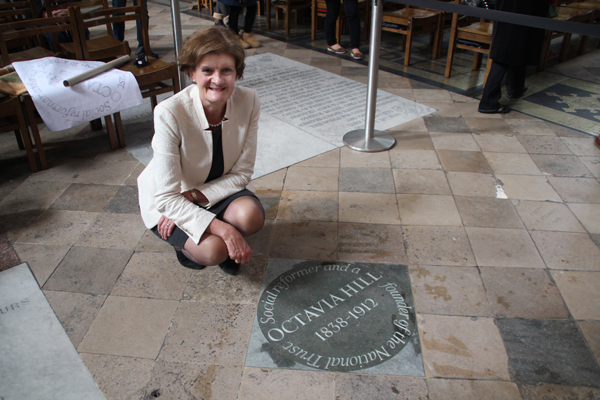
Social reformer and co-founder of the National Trust Octavia Hill (1838-1912) was honoured at a service at Westminster Abbey earlier this month when a new memorial stone to her was dedicated. Concerned about the impact of development and industrialisation, Hill, who died 100 years ago this year, founded the National Trust with Sir Robert Hunter and Canon Hardwicke Rawnsley in 1895. A Londoner, Hill was also an important figure in the housing reform movement. Among those who attended the service were Simon Jenkins, the chairman of the Trust, and the organisation’s director-general, Dame Fiona Reynolds (pictured). The memorial stone, unveiled by Jenkins in the floor of the nave of the abbey, is made of Purbeck marble and was designed and made by Rory Young. For more on the National Trust, see www.nationaltrust.org.uk. For more on Westminster Abbey, see www.westminster-abbey.org. PICTURE: National Trust Images.

London Pub Signs – Doggett’s Coat and Badge…

Perhaps not so much a sign as a pub name, the strangely monikered Doggett’s Coat and Badge in South Bank is named after a rowing race – said to be the oldest continuous sporting event in the country – in which apprentice waterman traditionally competed for a prize consisting of waterman’s coat and badge and named after Irish-born actor and theatre manager, Thomas Doggett.

The race – which is held in July and runs over a course of four miles and seven furlongs from London Bridge to Chelsea (the starting and finishing points were originally both marked by pubs called The Swan) – was first held in 1715 when it was first organised by Doggett who financed it up until his death in 1721 after which he left instructions in its will for it to be carried on by The Fishmongers’ Company (which it still is today).

While there’s a nice story that Doggett, who managed the Drury Lane Theatre and later the Haymarket Theatre and carving out a name for himself as a ‘wit’, started the race as thanks to Thames watermen for rescuing him when he fell off a watercraft while crossing the Thames, Doggett – a committed Whig – actually started the race to commemorate the ascension of King George I – the first ruler of the House of Hanover – on 1st August, 1714, following the death of Queen Anne.

This year’s race winner was Merlin Dwan (London Rowing Club) who beat four others to finish in 24 minutes, 28 seconds.

The pub, one of the Nicholson franchise, is located in a multiple storey modern building complex and sits along the course of the race in South Bank. It features a range of bars including Thomas Doggett’s Bar and the Riverside Bar as well as a dining room and other function rooms.

For more on the pub, see www.nicholsonspubs.co.uk/doggettscoatandbadgesouthbanklondon/. For more on the race (which we’ll be mentioning, along with more on Thomas Doggett, in more detail in upcoming posts), see www.DoggettsRace.org.uk.

Lost London – Greyfriars…

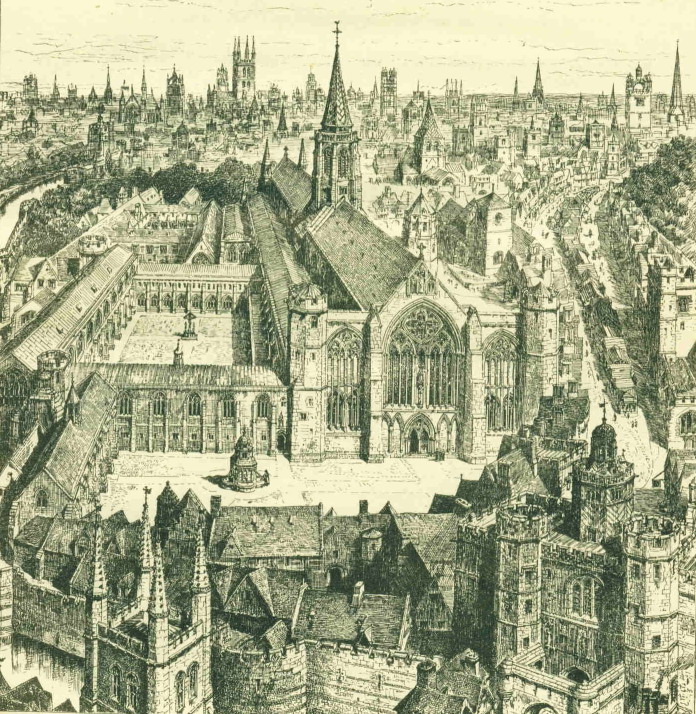
A now long gone Franciscan friary located in the north-west of the City of London near Newgate (just to the north of St Paul’s Cathedral), Greyfriars, so known for the color of the friars’ clothing, was the second Franciscan religious house to have been founded in England.

The foundations of the friary date from the early part of the 13th century – the Franciscans, as members of the Order of Friars Minor were known, had arrived in 1224 and are recorded as settling on land granted to them by a rich mercer, John Iwyn, just inside the City wall, in 1225, in the butcher’s quarter of the city.

King Henry III apparently gave them some oak to build their own friary in 1229 and by the mid 1200s, there were more than 80 friars living on the site which was gradually extended over the ensuing years to the north and the west.

Using funds given them by Sir William Joyner, Lord Mayor of London in 1239, they built a chapel which was later extensively enlarged and improved in the late 13th and early 14th centuries – the new church was said to be 300 feet long – with much of the work funded by Queen Margaret, second wife of King Edward I, and later in the 14th century, Queen Isabella, wife of Edward III. It apparently suffered some damage in a storm in 1343 but was restored by King Edward III.

When it was finally completed in 1348, the church is said to have been the second largest in London. A library was later added to the buildings, founded by the famous Lord Mayor of London, Richard “Dick” Whittington.

Such was the fame of the church that, the heart of Queen Eleanor, wife of King Henry III, was buried here after her death in 1291 while, despite dying at her castle in Marlborough, Queen Margaret was also buried here in 1318 (apparently wearing a Franciscan habit).

But perhaps the most notorious person to be buried here was Queen Isabella, wife of King Edward II and known by many as the “She-Wolf of France”, after her death in 1358. In fact, it’s said that the ghost of Isabella still haunts the former location of Greyfriars, driven forth from the grave for her role in deposing her husband.

Other non royal luminaries said to have been buried here include the 15th century writer Sir Thomas Mallory, author of Le Morte d’Arthur and 16th century Catholic nun Elizabeth Barton, the so-called ‘mad maid of Kent’ who was executed for her rather unwise prophecies predicting King Henry VIII’s death if he married Anne Boleyn.

The end of the friary, pictured above in the sixteenth century, came in 1538 when it fell victim to King Henry VIII’s policy of dissolving monasteries and was surrendered to his representatives.

Some of the houses were subsequently converted for private use and the church, which was somewhat damaged during this period with many of the elaborate tombs destroyed, was briefly closed before it and other buildings were given to the City of London Corporation who reopened it again in 1547 as Christ Church Greyfriars, a parish church serving the now joined parishes of St Nicholas Shambles and St Ewen.

Only a few year’s later King Edward IV founded a school for poor orphans in some of the old friary buildings known as Christ’s Hospital or informally as The Bluecoat School thanks to the uniforms students wore. Some of the school buildings, along with part of the church which was also used by the school, was destroyed by the Great Fire of London in 1666, but the school was rebuilt and remained in use until the late 1800s when the last of the students were relocated to a new facility in Sussex (where the school still exists today).

The church (also known as Christ Church Newgate Street), meanwhile, was also rebuilt after the Great Fire – it was one of Sir Christopher Wren’s designs and was completed in 1704. The church remained in use until World War II when a firebomb struck it during a German raid on 29th December, 1940, all but destroying it.

The church was not rebuilt and the parish merged with the nearby St Sepulchre-without-Newgate – the largest parish church in London – and eventually what’s left of the church – the tower with rebuilt steeple and the west and north walls – were converted into a public garden (rose beds were planted where the pews once stood and there are wooden towers representing the church’s pillars). Pictured right, it’s now a terrific place to sit and have lunch pondering the past which the bustle of the city goes on about you.

PICTURE: (top) Wikipedia

For a great biography of Isabella, the She-Wolf of France, see Alison Weir’s Isabella: She-Wolf of France, Queen of England. For more on Sir Christopher Wren’s churches in London, see John Christopher’s Wren’s City of London Churches.

Around London – Naval caricatures; James Bond; a Taliban motorbike; and Sir Peter Lely at the Courtauld…

Naval caricatures of the late 18th and early 19th century go on display in a new exhibition which opens at the National Maritime Museum today. Broadsides! Caricature and the Navy 1756-1815 features a small selection of the museum’s extensive collection of caricatures – one of the largest in the world, it features works by James Gillray, George M Woodward and Thomas Rowlandson. It explores the role the caricatures played in shaping public opinion during the period which included the American War of Independence and wars against revolutionary and Napoleonic France. The exhibition features 20 prints with visitors able to see others in the museum’s collection via the website www.rmg.co.uk/collections. Admission is free. Runs until 3rd February. For more, see www.rmg.co.uk.

Celebrate the 50th anniversary of James Bond and the premiere of the latest film in the franchise, Skyfall, with a look at a rare collection of James Bond posters and other memorabilia as well as the latest Bond vehicle this weekend. The Hospital Club in Covent Garden is hosting the event, in conjunction with Blue Robin, which features about 50 vintage posters from movies such as 1973’s Live And Let Die and 1963’s From Russia With Love. There’s also the chance to have your photo taken beside the double-cab Land Rover Defender which features in the opening chase sequence of Skyfall. Also exhibited will be M’s chauffeur-driven Jaguar XJ long wheel base and the black Range Rover driven by Bill Tanner, M’s chief of staff. The free exhibition is open to the public from 11am to 7pm from tomorrow until Monday (please call reception on 020 7170 9100 before visiting). For more, see www.thehospitalclub.com.

A motorbike captured from Taliban insurgents in Afghanistan by members of the 1st Battalion The Rifles has gone on display at the Imperial War Museum in London. The Honda motorbike forms part of the interactive display, War Story: Serving in Afghanistan, in which visitors can delve into the lives of service personnel taking part in Operation Herrick through personal artefacts, photographs and video. The bike was recovered by soldiers after it was left behind by two insurgents during an encounter on 4th May last year. It is the largest item to be donated through the War Story project and is the only item of enemy equipment acquired by the project to date. The motorbike will be displayed until 18th December. For more, see www.iwm.org.uk.

Now On: Peter Lely: A Lyrical Vision. This newly opened exhibition at the Courtauld Gallery is the first to look at the group of large scale narrative paintings produced by Sir Peter during the turmoil of the Civil War in the 1640s and 1650s. Renowned as the principal painter of King Charles II and the “outstanding artistic figure of Restoration England”, Sir Peter apparently never wished to be seen principally as a portraitist and following his arrival in England in the early 1640s, initially devoted himself to paintings inspired by classical mythology, the Bible and contemporary literature. The exhibition centres on The Courtauld’s own work, The Concert, and features an important group of little known paintings from private collections. Runs until 13th January. Admission charge applies. For more, see www.courtauld.ac.uk/gallery/index.shtml.

10 Historic London Markets – 4. Leadenhall Market…

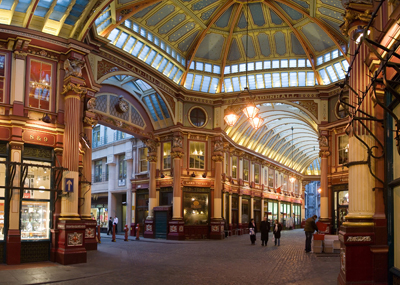
A covered – and splendidly decorated – Victorian-era market located just off Gracechurch Street in the heart of the City of London, Leadenhall Market might go un-noticed by many but visit at lunchtime on a weekday and you’ll to fight for space among the besuited City workers looking for sustenance there.

The history of a market on this site goes back to Roman times for it was under the current market that the remains of Londinium’s basilica and forum – the Roman marketplace – can be found (there’s apparently a part of the basilica wall in the basement of one of the Leadenhall shops).

This fell into disuse following the Roman period, however, and the origins of the current market are generally agreed upon as emerging in the 14th century when it occupied the site of a lead-roofed manor (hence “leaden hall) which was at one stage leased by the famous Lord Mayor Richard “Dick” Whittington before it burnt down in the late 1400s. The subsequent market was initially associated with poultry and then with cheese and other foodstuffs (it remained known for game and poultry) and separate areas were later developed for trade in wool, leather and cutlery.

In 1666, a small section of the market was destroyed in the Great Fire of London but it was rebuilt shortly after – for the first time under cover – and was divided into three sections: the Beef Market, the Green Yard and the Herb Market.

In 1881, after the existing building was demolished, a new structure boasting wrought iron and glass was designed by Sir Horace Jones (architect for the Corporation of the City of London, he also designed Billingsgate and Smithfield Markets – see our earlier entries here and here). The market is now one of the City’s five principal shopping centres and, as well as fresh food and flowers, hosts a variety of specialty shops, restaurants, cafes and pubs.

The Grade II* listed building was extensively restored in 1991. It has since starred in Harry Potter and the Philosopher’s Stone as well as other films including The Imaginarium of Doctor Parnassus and the recent Tinker, Tailor, Soldier, Spy.

Before we finish, we would be remiss not to mention Old Tom. A celebrated gander, he managed to avoid the axe for years and became a favorite of traders and customers (even being fed by local innkeepers) – so much so, that when he died at the age of 38 in 1835, his body lay in state before he was buried on site. There’s a bar in the market named for him.

WHERE: Gracechurch Street, City of London (nearest Tube stations are Monument, Bank and Cannon Street); WHEN: Public areas are generally open 24 hours a day with core trading hours between 10am and 5pm weekdays (check with individual shops for opening hours); COST: Free; WEBSITE: www.leadenhallmarket.co.uk

PICTURE: DAVID ILIFF. Licence CC-BY-SA 3.0. Via Wikipedia.

LondonLife – Flying over the Thames by night…

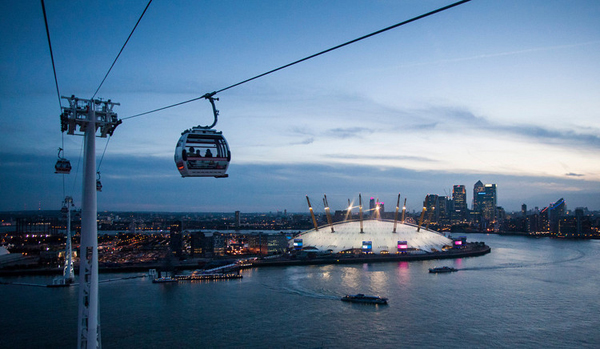
Sailing high over the River Thames between North Greenwich in the river’s southern bank and the Royal Docks on the river’s northern bank is the cable car formally known as the Emirates Air Line. Opened in late June and running every day, the cable car – the UK’s first in an urban area – is operated by Transport for London and links into the Underground and Docklands Light Rail network. Travelling at about 90 metres above the ground along a course of more than half a mile, passengers can take in the City, Docklands, Greenwich and as far eastward down the river as the Thames Barrier. This image, which shows the 02 Arena in the background, was taken just after the Closing Ceremony of the Olympic Games in August. For more, see www.emiratesairline.co.ukPICTURE: © Transport for London

Where’s London’s oldest…bridge over the Thames?

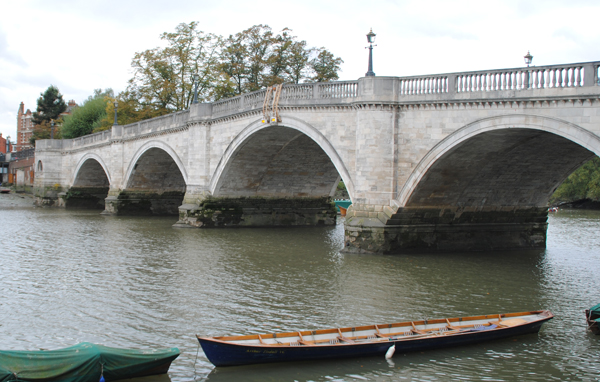
While there’s been a bridge over the River Thames near where London Bridge now stands since Roman times, the bridge which is currently there was built in the early 1970s. To find Greater London’s oldest surviving bridge across the Thames we have to head to Richmond in the city’s west.

The 300 foot long stone arch bridge, made from Portland stone, was built between 1774-77 and replaced a ferry crossing between Richmond to the east and East Twickenham to the west (this had apparently been in operation since shortly after the Norman Conquest and at the time it was discontinued consisted of two vessels – a passenger craft and a ‘horse boat’).

Designed by James Paine and Kenton Couse and built by Thomas Kerr, the bridge features five arches including a 60 foot wide central span which was big enough for larger watercraft and gave the bridge its rather humpbacked appearance. Its construction was privately funded with the £26,000 required to build the bridge partly raised via tontine schemes under which subscribers paid an agreed sum into a fund after which they each receive an annuity, the value of which increases as members of the fund die off.

Initially a toll bridge (the tolls – which were 1/2d for passengers and up to 2s 6d for coaches drawn by six horses – were ended in 1859 when the last tontine shareholder died), the bridge was widened in the late 1930s but – now a Grade I listed structure – remains essentially true to its original design.

It was the eighth bridge to be built across the the Thames in Greater London but is now the oldest still standing (among those which predated it but have been demolished are London Bridge, Westminster Bridge and Blackfriars Bridge) and has been featured in paintings by the likes of  Thomas Rowlandson, John Constable and JMW Turner.

Treasures of London – Temple Church knight effigies…

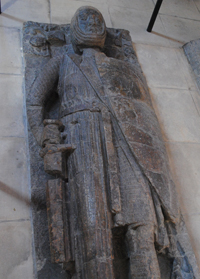
A relic of the early medieval age, the late 12th century Temple Church in the City of London is a marvel in its own right, its circular nave modelled on the Church of the Holy Sepulchre in Jerusalem (for more on its history, see our earlier entry here). But it’s inside the round church – once based inside property that formed the London headquarters of the Templar Knights – that we are concerned with in this piece – for there can be found are series of remarkable effigies of knights which date from the 13th century.

There are nine effigies in all (and one grave cover) and, having survived the Great Fire of 1666, most of them were damaged during World War II when, in a bombing raid on 10th May, 1941, the roof was set alight and came crashing down on top of them. They have since been repaired, using as much of the original material as possible, and still make an imposing sight redolent with the history they depict.

Pre-eminent (at least in his lifetime) among those depicted is William Marshal, the 1st Earl of Pembroke (1146 -1219) and an advisor of kings including King Henry II, King Richard ‘the Lionheart’ and King John who was named Regent during the infancy of King Henry III.

One of the most influential men of his age (described by early thirteenth century Archbishop of Canterbury, Stephen Langton, as the “greatest knight who ever lived”), he lies in the southern group of effigies near his sons William, 2nd Earl of Pembroke (1190-1231) and Gilbert, the 4th Earl of Pembroke (1194-1241). (The 3rd Earl of Pembroke, Richard, was the second son of William – he died after being captured during fighting in Ireland and was buried in Kilkenny). Another of this group is believed t0 depict Robert, Lord de Ros, one of the 25 barons to guarantee the observance of the Magna Carta, signed by King John in 1215.

The only identified effigy in the northern group is that of Geoffrey de Mandeville, the 1st Earl of Essex and a man known for the cruelties he inflicted during the troubled reign of King Stephen (he shifted his allegiances between King Stephen and his rival, the Empress Matilda several times), particularly in the eastern counties where he seized Ramsey Abbey near Peterborough to use as his base.

Interestingly, none of the men named was a Templar but are believed to have been benefactors of the Templar Knights. Some of those shown are cross-legged but whether this denotes a crusader or not remains a matter of debate.

WHERE: Off Fleet Street and down Inner Temple Lane (nearest tube station is Temple); WHEN: Check website for times; COST: £4 (free to under 18s, seniors); WEBSITE: www.templechurch.com.

Around London – Resurrection men at the MoL; Hollywood costumes at the V&A; Hanwell locks “at risk”; and, David Nash sculptures at Kew…

• A new exhibition at the Museum of London opens tomorrow (Friday) looking at the “murky world” of the early 19th century ‘resurrection men’ and the surgeon/anatomist whom they supplied with bodies. Doctors, Dissection and Resurrection Men will centre around the 2006 excavation of a until then forgotten burial ground at the Royal London Hospital in Whitechapel. The excavation of the area – which was used between 1825-41 – uncovered some 262 burials and while many contained just one person, others contained a mix of bones providing ample evidence of dissections, autopsies, amputations and the wiring together of bones for teaching as well as evidence animals had been dissected for comparative studies. The excavation revealed that rather than rely on body snatchers, the hospital had used its own ‘unclaimed’ patients for dissection practice. As well as human remains from the find (displayed for the first time), exhibition highlights include various instruments used in early 19th century surgery, a plaster cast of James Legg who was hanged for murder before his body was flayed and cast in plaster for study purposes and a wooden skeleton and other detailed anatomical models made by Joseph Browne. The exhibition runs until 14th April. An admission charge applies. For more details – including the programme of talks taking place alongside the exhibition – see www.museumoflondon.org.uk.

• The three piece white suit worn by John Travolta in Saturday Night Fever, the blue and white gingham pinafore dress worn by Judy Garland in The Wizard of Oz and costumes worn by Meryl Streep in the recent film, The Iron Lady,  are all making their public appearance in London this weekend with the V&A’s major autumn exhibition. Opening on Saturday, Hollywood Costume features more than 100 iconic costumes designed for some of the big screen’s most unforgettable characters. A three gallery (or three ‘act’) journey covering the silent film era of Charlie Chaplin through to a look at motion capture costume design in Avatar, the exhibition explores the role costume design plays in cinematic storytelling and examine the changing social and technological context in which designers worked over the past century. Sourced from major motion picture studios, costume houses, museums, archives and private collections, the costumes will be  displayed alongside interviews with costume designers, actors and directors. Runs until 27th January. Admission charge applies. For more, see www.vam.ac.uk/hollywoodcostume.

A flight of locks which raise the Grand Union Canal 53 feet over the course of a third of a mile at Hanwell in west London is among the top Grade II heritage sites at risk in England, according to English Heritage. The organisation released its Heritage At Risk Register 2012 this week and announced a new program to examine how Grade II listed buildings not already covered by the register can be assessed. Other “at risk” sites in London include Kensal Green (All Souls) Cemetery – one of London’s “magnificent seven” Victoria cemeteries, Abney Park Cemetery in Hackney, Gunnersbury Park in Houslow and 94 Piccadilly (Cambridge House) in Westminster. For more, see www.english-heritage.org.uk/caring/heritage-at-risk/.

• On Now: David Nash at Kew: A Natural Gallery. New works by renowned sculptor David Nash were officially unveiled at Kew Gardens last weekend. Mostly created using Kew trees which have come to the end of their life whether through storms, lightning or disease, the series of sculptures – created on site since April in a ‘wood quarry’ in the arboretum – has been installed in gallery spaces across the gardens including The Nash Conservatory, the Temperate House and The Shirley Sherwood Gallery of Botanical Art. They are displayed along with a series of drawings and short films. Runs until 14th April. An admission charge applies. See www.kew.org.

10 Historic London Markets – 3. Billingsgate Market…

Now the UK’s largest inland fish market (and located in Poplar, east London), the history of Billingsgate Market goes back centuries.

Known originally by various spellings including Blynesgate and Byllynsgate, Billingsgate may have been named for watergate on the north bank of the Thames near where the market was originally established (an alternate theory is that it was named for a man named Biling or an mythological British king, Belin).

The right to collect tolls and customs at Billingsgate, along with Cheap and Smithfield, was granted by King Henry IV in 1400.

Billingsgate only became particularly associated with fish in the 1500s and in 1699, an Act of Parliament was passed making it “a free and open market for all sorts of fish whatsoever” (this was with the exception of eels, restricted to being sold by Dutchmen from boats in the river – a reward for the help they provided after the Great Fire of 1666).

While for much of the market’s history, fish was sold for stalls and sheds around the ‘hythe’ or dock at the site known as Billingsgate, in 1850 the first purpose-built market building was constructed in Lower Thames Street.

Deemed inadequate for the task at hand, however, it was demolished after slightly more than 20 years of service. A new building, designed by then City Architect Sir Horace Jones and constructed by John Mowlem, was opened in on the same site in 1876. In the late 19th century, it is said to have been the largest fish market in the world. The heritage listed former fish market building in Lower Thames Street (pictured above) is now used as a venue for corporate events, catwalk shows, post premiere parties and concerts (see the website for more www.oldbillingsgate.co.uk).

In 1982, the market was relocated to a 13 acre site on the Isle of Dogs, just to the north-east of Canary Wharf. The building contains a trading floor with some 98 stands and 30 shops as well as an 800 tonne freezer store. An average of 25,000 tonnes of fish and fish products are sold through its merchants every year and the market has an annual turnover of around £200 million.

The role of the fish porter – who traditionally have been the only people licensed to move fish around the market – was opened up to anyone following a fiercely fought battle between the porters, traders and the City of London Corporation earlier this year.

The market is open to the general public and tours can be arranged – head to the website for details.

WHERE: Billingsgate Market, Trafalgar Way, Poplar (nearest Tube Station is Canary Wharf); WHEN: 4am to 9.30am Tuesday to Saturday (children under 12 are not permitted on the market floor and non-slip shoes are advisable); COST: Free; WEBSITE: www.cityoflondon.gov.uk/business/wholesale-food-markets/billingsgate/Pages/default.aspx.

LondonLife – Canary Wharf skyline…


Skyline of Canary Wharf, Docklands, east London. Taken from a ferry on the Thames. Canary Wharf is one of the city’s main financial districts and is centred around One Canada Square (pictured with the pyramidal top), formerly the tallest building in the UK (it has been surpassed by The Shard).