Lost London – King Edward III’s Thames-side manor house…

The remains of one of the lesser known former royal residences in London, King Edward III’s manor house, sit amid a grassy park on the south bank of the Thames at the corner of Bermondsey Wall East and Cathay Street in Rotherhithe.

Believed to have been built in about 1350 during the reign of the king (1312-1377), the 14th century property – which consisted of stone buildings arranged around two courtyards – was originally built on what was then an island surrounded by marshes.

The premises was surrounded on three sides by a moat – the fourth side opened directly to the river, allowing the king to travel to the property by boat.

Among the buildings in the complex were a hall with a fireplace as well as private chambers for the king and utility spaces like kitchens (pictured below is a reconstruction of the property as depicted on an information plaque located at the site).

The function of the building remains somewhat a mystery – with no nearby royal parks it is unlikely it was a conventional hunting lodge although documentary evidence does point to falcons being house there so perhaps it was a place where the king hunted with falcons.

As the Thames riverbank was pushed northward over the following centuries, the residence became completely surrounded by a moat. It was eventually sold into private hands.

The site was apparently used as a pottery in the 17th century and warehouses occupied it in the 18th and 19th centuries (in fact a 14th century wall was incorporated into one of these and was still standing in 1907).

The warehouses were demolished in the 1970s and the remains of the palace confirmed on the site during an excavation by English Heritage 1985 (they also found a lot of Delftware on the site apparently related to its days as a pottery).

Around London – Europe’s oldest intact book at British Library; 100 days to the Games; world’s largest archaeological archive; the London Marathon; and, Turner at the National Gallery…

• The British Library has paid £9 million for a 7th century text, the St Cuthbert Gospel, which is also the oldest intact European book. The acquisition follows the library’s most successful fund-raising effort ever – it included a £4.5 million grant from the National Heritage Memorial Fund. The book – a Gospel of John bound in beautifully tooled red leather – was produced in north-east England in the late 7th century and was placed in the saint’s coffin after his death on the Isle of Lindisfarne in 698. It was retrieved when the coffin was opened at Durham Cathedral in 1104. The Gospel is on display in the Sir John Ritblat Treasures Gallery at the library in St Pancras and following a conservation review, it is anticipated it will soon be displayed with the pages open for the first time. There will be a public event celebrating the acquisition on 15th May. For more, see www.bl.uk/whatson/events/may12/index.html.

• London this week marked 100 days until the Opening Ceremony of the 2012 Olympic Games. This included unveiling the latest installation of the Olympic rings – made of 20,000 plants the 50 metre long rings are located in the Royal Botanic Gardens at Kew in the city’s west and can be seen from planes on the Heathrow flight path. The organising committee also announced the Red Arrows aerobatic display team will perform a nine-ship flypast in ‘big battle’ formation on the day of the Opening Ceremony (27th July) and stated that the games motto will be ‘Inspire a Generation’. For more, see www.london2012.com.

• The Museum of London’s archaeological archive – known as the London Archaeological Archive and Research Centre (LAARC) – is officially the largest in the world according to Guinness World Records. The archive contains more than five million artefacts and the records of almost 8,500 excavations dating back to 1830. Items in the archive include shoes dating back to Roman times, a 200-year-old set of false teeth, ‘witching bottles’ including one with human hair and toenails, and coffin plates from London’s cemeteries. The world record has been recorded as part of World Record London, a series of world record breaking events being held in the run-up to the Olympics. Others have included the Faberge Big Egg Hunt.

• Thousands of people are expected to take part in the Virgin London Marathon this Sunday. The 26.2 mile route starts in Blackheath, passes through Woolwich and Greenwich and crosses the Thames at Tower Bridge before looping around the east end of London, through Canary Wharf, and the west along The Highway (formerly known as The Ratcliffe Highway) and Embankment to Parliament Square, Birdcage Walk and finally to Buckingham Palace. The first London marathon was run in 1981. For more, see www.virginlondonmarathon.com.

• On Now: Turner Inspired – In the Light of Claude. The first major presentation of 17th century artist Claude Gellée’s influence on the English romantic artist J M W Turner, the exhibition focuses on Claude-inspired themes which run through Turner’s work including “the evocation of light and air in landscape, the effect of light upon water and his often radical reworking of contemporary scenes”. The display includes works from large scale oils on canvas through to leaves from Turner’s pocket sketchbooks. Interestingly, the exhibition also explores the story behind the so-called Turner Bequest – that on his death, Turner linked himself to Claude forever by leaving the National Gallery two pictures – Dido building Carthage (1815) and Sun rising through Vapour: Fishermen cleaning and selling Fish (before 1807) –  on condition that they were hung between two pictures by Claude, Seaport with the Embarkation of the Queen of Sheba (1648) and Landscape with the Marriage of Isaac and Rebecca (1648). Runs until 5th June. Admission charge applies. For more, see www.nationalgallery.org.uk.

Celebrating the Diamond Jubilee with 10 royal London locations – 1. The Queen’s birthplace

This week we start a new series in honour of this year being the Diamond Jubilee of Queen Elizabeth II. We’ll be looking at locations across the city which have played an important role in the story of the Queen. First up, it’s the Queen’s birthplace – a now non existent townhouse in Mayfair.

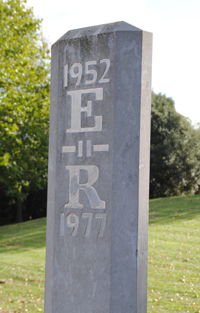
The property at 17 Bruton Street, which is marked by a small plaque installed in 1977 – the Queen’s Silver Jubilee (it’s in the middle of the image to the right), was actually the home of the Queen Mother’s parents, the Earl and Countess of Strathmore. It and the neighbouring townhouse at 18 Bruton Street have both been demolished and replaced with a rather bland office building.

Born here at 2.40am on 21st April, 1926, the Queen, named Elizabeth Alexandra Mary, was the first child of the then Duke and Duchess of York (later King George VI and Queen Elizabeth). At her birth, Queen Elizabeth II was only third in line to the throne after her uncle, the Prince of Wales (later, briefly, King Edward VIII), and her father.

The Queen’s grandparents, King George V and Queen Mary, both visited the newborn child at the property (along with an apparently large crowd outside). Elizabeth was christened five weeks later at the Chapel Royal in Buckingham Palace. She spent the first few months of her life living in a room at 17 Bruton Street which had been previously used by her mother before her marriage.

Recent books on the Queen include Andrew Marr’s  The Diamond Queen: Elizabeth II and Her People, the souvenir album Queen Elizabeth II: A Diamond Jubilee Souvenir Album, and Sarah Bradford’s Queen Elizabeth II: Her Life in Our Times.

• Correction: Bruton Street was mistakenly copied here as Brunton Street. It has been corrected. Apologies for the error!

London Pub Signs – The John Snow

Located on the corner of Broadwick and Lexington Streets in Soho, this pub is named for the man who, through his meticulous research, was able to show that London’s cholera epidemic of 1854 was the result of a contaminated water supply.

A physician then working in London, John Snow didn’t believe in the current theory that diseases such as cholera were caused by bad air and instead, through a study looking at where those affected by the disease in 1854 lived and obtained their water, was able to pinpoint a water pump in what was then Broad Street (the ‘wick’ wasn’t added to the street’s name until the 1930s) as the original source.

The pump, which initially apparently stood just outside the pub, is now located down the street. A pink granite curbstone outside the side door of the John Snow pub and plaque on the pub wall mark where the pump formerly stood.

The building housing the pub dates from the 1870s and the pub was apparently initially called the Newcastle-upon-Tyne but this was formally changed to John Snow in May, 1955, to mark the centenary of Snow’s research into the 1854 epidemic.

For a terrific book about John Snow’s work, see Steven Johnson’s The Ghost Map: A Street, an Epidemic and the Hidden Power of Urban Networks.

Celebrating Charles Dickens – 9. Dickens’ literary connections, part 2…

In which we continue our look at some of London’s connections with Dickens’ writings…

• ‘Oliver Twist’ workhouse, Cleveland Street. The building, recently heritage listed following a campaign to save it, is said to have served as the model for the workhouse in Oliver Twist and was apparently the only building of its kind still in operation when Dickens wrote the book in the 1830s. Dickens had lived as a teenager nearby in a house in Cleveland Street and was living less than a mile away in Doughty Street (now the Charles Dickens Museum) when he wrote Oliver Twist. Thanks to Ruth Richardson – author of Dickens and the Workhouse: Oliver Twist and the London Poor – for mentioning this after last week’s post.

• Clerkenwell Green. It is here that Mr Brownlow first comes into contact with Oliver Twist and, mistakenly suspecting him of stealing from him, chases him through the surrounding streets. Interestingly, the grass (which you would expect when talking about a green) has been gone for more than 300 years – so it wasn’t here in Dickens’ time either.

• Barnard’s Inn, Fetter Lane. It was here, at one of London’s Inns of Court, that Pip and Herbert Pocket had chambers in Great Expectations. Barnard’s Inn, now the home of Gresham College, is only one of a number of the Inns of Court with which Dickens and his books had associations – the author lived for a time at Furnival’s Inn while Lincoln’s Inn (off Chancery Lane) features in Bleak House and the medieval Staple Inn on High Holborn makes an appearance in his unfinished novel, The Mystery of Edwin Drood. And, as mentioned last week, Middle Temple also features in his books.

• ‘Dickens House’, Took’s Court. Renamed Cook’s Court in Bleak House, the house – located in a court between Chancery and Fetter Lane – was where the law stationer Mr Snagsby lived and worked in the book. It’s now occupied by music promoter and impresario Raymond Gubbay.

• London Bridge. The bridge, a new version of which had opened in 1831 (it has since been replaced), featured in many of Dickens’ writings including Martin Chuzzlewit, David Copperfield and Great Expectations. Other bridges also featured including Southwark Bridge (Little Dorrit) and Blackfriars Bridge (Barnaby Rudge) and as well as Eel Pie Island, south-west along the Thames River at Twickenham, which is mentioned in Nicholas Nickleby.

We’ve only included a brief sample of the many locations in London related in some way to Dickens’ literary works. Aside from those books we mentioned last week, you might also want to take a look at Richard Jones’ Walking Dickensian London,  Lee Jackson’s Walking Dickens’ London or, of course, Claire Tomalin’s recent biography, Charles Dickens: A Life.

Famous Londoners – Jack Ketch

A 17th century public executioner famed for his botched executions, Jack Ketch looms as an infamous figure in British history and a byword for brutality and executioners in general.

Ketch’s origins are unknown (he’s also known as John Catch) but he is believed to have received his appointment as a public hangman sometime in the early to mid 1660s – the first recorded mention of him in that role, in a pamphlet celebrating his handiwork, dates from 1678. Such was his self-importance that he apparently adopted the title Esquire and apparently asked for his letters to be addressed to Dr John Ketch.

Among those who died at his hand were those accused of involvement in the Popish Plot against the Crown – a Catholic conspiracy to assassinate King Charles II which was all apparently fabricated by Titus Oates. These included William Staley and Edward Coleman both of whom were hung, drawn and quartered in 1678 (Ketch was also charged with whipping Oates following his perjury conviction).

But Ketch’s most infamous executions, the only two beheadings he is known to have performed, became notorious because of the botched manner in which they were carried out.

It was reported that it took Ketch three blows to strike off the head of William, Lord Russell, when he was executed for treason on 21st July, 1683 (he had opposed the succession of James II and was accused of involvement in the Rye House Plot), although Ketch apparently denied suggestions he had turned up drunk and blamed Lord Russell for flinching.

The beheading of James Scott, the Duke of Monmouth (and illegitimate son of King Charles II), on 15th July, 1685 (pictured above in a print from the time), was apparently even worse – it took Ketch five blows to take off his head and he apparently finished the job with a knife after having almost given up halfway through. Monmouth had been captured following the Battle of Sedgemoor in July 1685 in which he led an army having declared himself king (more on that another time).

Ketch fell out of favor with the authorities later that year and was briefly gaoled in Bridewell prison. He was reinstated but his return to the job of public executioner was only short-lived for he died in 1686 and is believed to have been buried in St James’ in Clerkenwell on 29th November, 1686.

He was survived by his wife Katherine, who apparently stood by her man despite the public feeling against him, and is it generally assumed a girl Susanna who was baptised at the church in Clerkenwell in 1668 – some 18 years before his death – was his daughter.

Following his death, Ketch’s name was adopted by subsequent public hangmen – he even appeared as an ongoing character in Punch and Judy shows.

For more on Ketch, see Tim Wales’ article Jack Ketch in the Oxford Dictionary of National Biography (a subscription is required for access).

PICTURE: Wikipedia.

Where is it? #23…

The latest in the series in which we ask you to identify where in London this picture was taken and what it’s of. If you think you can identify this picture, leave a comment below. We’ll reveal the answer early next week. Good luck!

Well done to Jameson Tucker and Sean Dennis, both of whom identified this correctly as the Serpentine Gallery in Kensington Gardens. The gallery, which features modern and contemporary art, was created in 1970 and is housed in a tea pavilion which dates from the 1930s. Every summer since the year 2000, the Serpentine – named for the body of water which, strictly speaking, just runs through Hyde Park (although the section in Kensington Gardens is also often referred to in the same way) – has had a different temporary pavilion, designed by a leading architect, set up outside.

The Serpentine Gallery is to be expanded this year with the creation of the Serpentine Sackler Gallery in The Magazine building in the gardens. Located only a short distance from the existing gallery, the new premises is being designed by Pritzker Prize-winning architect Zaha Hadid and is named after Dr Mortimer and Theresa Sackler, whose foundation made the project possible through the largest single donation ever received by the Serpentine Gallery.

WHERE: Kensington Gardens; WHEN: Daily 10am to 6pm; COST: Free; WEBSITE: www.serpentinegallery.org.

Around London – Crown Jewels polished for Diamond Jubilee; Diana’s dresses at Kensington Palace; a plaque for Ziggy Stardust; and At Home with the World…

• A revamped Crown Jewels display opens today at the Tower of London to mark the Diamond Jubilee of Queen Elizabeth II. The new display features graphics, music and newly restored film footage and will focus on the coronation ceremony as its central theme, exploring how the regalia are used in the ceremony. The regalia – which includes some of the most extraordinary diamonds in the world such as the Star of Africa and Koh-i-Nur – is being displayed in the order in which it is used at the coronation ceremony. The Crown Jewels have been on show to the public at the Tower of London since at least 1661 after they were remade for King Charles II’s coronation. The previous collection had been largely destroyed in the Civil War although some pieces survived including a gilt silver spoon probably made for King Henry II or King Richard I (the “Lionheart”). For more information, see www.hrp.org.uk/TowerOfLondon/.

Five dresses worn by Diana, Princess of Wales, have gone on display at Kensington Palace  which re-opened to the public this week following a £12 million overhaul. The five dresses include a black silk taffeta gown (designed by Emanuel) which Diana wore to a fundraising event at the Goldsmith’s Hall in 1981 – her first official engagement with Prince Charles as well as a formal dinner dress of ivory silk (Catherine Walker) created for a State Banquet for the King and Queen of Malaysia in 1993 and a black ribbed silk shift evening dress (Gianni Versace) worn to the London premiere of Apollo 13 in Hammersmith in 1995. For more on the revamp of the palace see our earlier post. Or visit www.hrp.org.uk/KensingtonPalace/.

• A plaque commemorating the site where the iconic image for the cover of David Bowie’s 1972 album The Rise and Fall of Ziggy Stardust and the Spiders of Mars was photographed has been unveiled in the West End. The plaque at the somewhat innocuous site at 23 Heddon Street, just off Regent Street, was installed by the Crown Estate and unveiled this week by Gary Kemp of Spandau Ballet. The image for the album cover was shot by the late photographer Brian Ward who managed to persuade Bowie to step outside the ‘studio’ space he had rented upstairs despite the fact it was a cold, wet January night.

• On Now: At Home with the World. This exhibition at the Geoffrye Museum explores the cosmopolitan nature of London’s homes over the past 400 years and looks at how diverse cultures have helped shaped the homes – covering everything from Chinese porcelain and the tea craze of the 1700s to the use of Islamic and Indian patterns in the 1800s, the popularity of Scandinavian and American design in the 1900s and the globalism of today. The period rooms on show at the museum have been reinterpreted to highlight the international influences. This is one of a series of Stories of the World: London exhibitions taking place across the city which are exploring four aspects of life – home, identity, journeys and place – as part of the London 2012 Cultural Olympiad program. Runs until 9th September. Entry is free. For more, see www.geffrye-museum.org.uk.

Celebrating Charles Dickens – 8. Dickens’ literary connections, part 1…

London is redolent with sites which appeared in the books of Charles Dickens and, having had a look at his life, it’s time we turn our attention to some of the sites relevant to his writing. For the next two weeks, we’re looking at just a few of the many, many sites which feature in his novels. So, here’s seven places to get us going…

• Saffron Hill, Clerkenwell. Once a notorious slum akin to St Giles (see last week’s entry) and the city’s Italian Quarter, Saffron Hill is where Fagin and his gang of thieves operate in Oliver Twist and have their den.

• Chancery Lane, Holborn. Much of the novel Bleak House is set around this narrow street between High Holborn and Fleet Street – Tom Jarndyce kills himself in a coffee shop here in the novel and Lincoln’s Inn Hall – formerly home of the High Court of Chancery – also features.

• The Old Bailey. Some have suggested Dickens worked here as a court reporter although there is no compelling evidence he did so. But the the Old Bailey (the current building dates from the early 20th century, well after Dickens’ death) and Newgate Prison certainly featured in his books – it is here that Fagin is eventually hung in Oliver Twist.

• Child & Co’s Bank, Fleet Street. While the present building dates from 1878, Dickens is believed to have used the bank as the model for Tellson’s Bank in A Tale of Two Cities.

• St Dunstan-in-the-West, Fleet Street. In David Copperfield, David and his aunt, Betsy Trotwood, make a special trip to see the giants Gog and Magog strike the church bells. It also features in Barnaby Rudge and Dickens dedicated his Christmas story, The Chimes, to the church.

• Garden Court and Fountain Court (pictured), Middle Temple. Garden Court is where Pip lived in Great Expectations and where Abel Magwitch turned up to reveal himself as Pip’s benefactor. Fountain Court features in Martin Chuzzlewit as the site for the romance of Ruth Pinch and John Westlock.

• Golden Square, Soho. Mentioned in Nicholas Nickleby – Nicholas’ uncle, Ralph Nickleby, was thought to live in a previous building at number seven.

There’s some great books about London sites which appear in Dickens’ books – among them are Ed Glinert’s Literary London: A Street by Street Exploration of the Capital’s Literary Heritage and Michael Paterson’s Inside Dickens’ London as well as Paul Kenneth Garner’s 
A Walk Through Charles Dickens’ London.

LondonLife – The Old Bailey and the notorious case of Dr Crippen…

Image

As well as being relevant to our recent focus on author Charles Dickens (as well as featuring in his works, some suggest he worked here as a court reporter), the Old Bailey (home of the Central Criminal Court) has been in the news recently for its role in the conviction of the  infamous murderer Dr Hawley Crippen. An American, Dr Crippen was tried and found guilty at the court of poisoning his first wife Cora and then of cutting her up (he was found to have hidden the body parts in the cellar of their home in Hilldrop Crescent, Holloway). He was hanged in 1910, having been arrested while fleeing on a ship to Canada with his mistress Ethel Le Neve. Now reportedly come plans to hold a posthumous retrial of the case in front of a judge at the Islington Museum. The event, which will be held later this year, is being organised by Archway-based human rights solicitor Greg Foxsmith and will see John Cooper, QC, defending Dr Crippen. The move comes follows an earlier investigation by US scientists who concluded from DNA evidence that the victim may have in fact been male. For a great read on the case of Dr Crippen – and the important role the new invention of the wireless telegraph played in his capture – have a look at Erik Larsen’s Thunderstruck.

What’s in a name?…St John’s Wood

This well-to-do area in London’s north-west, just outside Regent’s Park, takes its name from the historic ownership of land here by the Order of St John of Jerusalem (also known as the Knights Hospitaller).

The land had previously been part of the Great Forest of Middlesex. The Order of St John of Jerusalem, which since 1140s had its English headquarters in a Clerkenwell priory where St John’s Gate stands (this now houses the Museum of the Order of St John – see our previous entry here), took over ownership of land in the early 1300s after the previous owners, the Knights Templar, fell into disgrace.

Following the Dissolution, it became Crown land and remained so until 1688 after which it passed into the hands of private families, notably the Eyre family who owned much of the area.

It remained relatively undeveloped until the early 19th century when, following the introduction of semi-detached villas on planned estates, it was marketed as a residential alternative for London’s middle classes, away from the smog and congestion of central London.

It became favored by the bohemian set and residents included creative types like artists and authors as well as scientists and traditional craftsmen (apparently in the late 19th century it was also known for its upmarket brothels).

Rebuilt with swanky apartment complexes in the early twentieth century, these days it remains a leafy enclave for the wealthy. Many of the houses which have survived are heritage listed.

Landmarks include St John’s Church (pictured above, this was consecrated in 1814) and the St John’s Wood Barracks and a Riding School (this was completed in 1825 and is the oldest building still on the site) which is now home to the King’s Troop Royal Horse Artillery which carries out mounted ceremonial artillery duties such as firing royal salutes for the State Opening of Parliament, royal birthdays and state visits.

St John’s Wood is also home to Abbey Road Studios (home of the Beatles and that famous zebra crossing), Lord’s Cricket Ground (officially the home of the Marylebone Cricket Club which was moved here in 1814, the same year the church was consecrated) and the Central London Mosque located on the edge of Regent’s Park.

For more on St John’s Wood, take a look at the website of The St John’s Wood Society.

Where is it? #22

The latest in the series in which we ask you to identify where in London this picture was taken and what it’s of. If you think you can identify this picture, leave a comment below. We’ll reveal the answer early next week. Good luck!

Congrats to Parktown – this image of people on the Tube is part of a 12 metre long frieze which runs around the base of Paul Day‘s monumental statue, The Meeting Place, which stands on the upper concourse in St Pancras International Station.

The five ton statue above – which itself stands under the station’s clock – features a 30 foot (nine metre) tall bronze couple embracing and was installed before the station’s reopening in 2007.

The frieze – the images of which depict scenes from the history of the Tube and railways –  was added in 2008. There was initially some controversy over some of the images in the frieze panels and one which depicted a grim reaper driving a train was replaced.

Treasures of London – The Banqueting House…

While we’ve looked at some of the history of the Banqueting House during last year’s special on King James I’s London, we thought we’d take a more in-depth look as part of our Treasures of London series…

A perfect double cube with a sumptuous painted ceiling, this early 17th century building is the only remaining complete structure from the Palace of Whitehall which was destroyed by fire in 1698.

The building replaced an earlier banqueting hall built on the orders of Queen Elizabeth I and another, shorter-lived hall, built by King James I, which was destroyed by fire in 1619.

Following its destruction, King James had Inigo Jones design a new hall to provide, as the previous hall had, a location for state occasions, plays and masques – something of a cross between an organised dance, an amateur theatrical performance and just a chance to dress up.

Jones, who partnered with Ben Jonson to produce masques, designed the hall – which has a length double the width – with these performances specifically in mind. The first one – Jones and Jonson’s Masque of Augurs – was performed on Twelfth Night, 1622, even before the building was completed (the last masque was performed here, incidentally, in 1635, after which, thanks they were moved to a purpose built structure nearby, ostensibly to save the newly installed paintings from being damaged by the smoke of torches – see below).

The incredible paintings on the ceilings, which celebrate the reign of King James I and will be the subject of their own Treasures of London article at a later date, were installed by March 1636. Produced by Flemish artist Sir Peter Paul Rubens, they had been commissioned by King Charles I, King James’ son, in commemoration of his father. Ironically, it was outside the building where the monarchy was so celebrated that King Charles I was beheaded in 1649 (this is marked in a ceremony held at the Banqueting House on 30th January each year).

Following the king’s execution, Whitehall Palace wasn’t used for several years until Lord Protector Oliver Cromwell took up residence there in 1654, using the Banqueting House as a hall if audience. It stood empty after Cromwell’s death in 1658 until the Restoration in 1660 when King Charles II again used it as a grand ceremonial hall for receiving foreign embassies and conducting court ceremonies (these including the ancient custom of what is known as ‘Touching for the King’s Evil’ to cure those afflicted with the disease of scrofula as well as the washing of the feet of the poor by the sovereign on Maundy Thursday.)

King James II was the last king to live at Whitehall Palace and during his reign, from 1685-88, it was used as a royal storehouse. But it was revived for formal use following his reign – it was here that King William III and Queen Mary II were officially offered the crown on 13th February, 1689.

During their reign, the court’s focus shifted to Kensington but the Banqueting House was used for Queen Mary to lay in state after her death in 1694.

Following the destruction of the remainder of Whitehall Palace in 1698 – the origins of this fire are apparently owed to a maid who had put some linen by a charcoal fire to dry – the Banqueting Hall was used briefly as a Chapel Royal and, following a renovation in the late 1700s, it was used for concerts and, from 1808, as a place of worship for the Horse Guards.

Further renovation works followed and in 1837, it was re-opened as a Chapel Royal and used as such until 1890 when this practice was formally discontinued. In 1893, Queen Victoria gave the Royal United Services Institute the use of the building as a museum – among the things displayed there were the skeleton of Napoleon’s horse, Marengo. In 1962, the exhibits were dispersed and the Banqueting House today is used for a range of royal, corporate and social events.

There is an undercroft underneath, designed as a place where King James I could enjoy drinking with his friends. It was later used for storage.

WHERE: Corner of Whitehall and Horse Guards Avenue (nearest Tube stations are Westminster and Embankment); WHEN: Monday to Saturday 10am to 5pm; COST: £5 adults/£4 concessions/children under 16 free (Historic Royal Palaces members free); WEBSITE: www.hrp.org.uk/BanquetingHouse/.

PICTURE: Courtesy of Historic Royal Palaces/newsteam.co.uk

Around London – Your Roman influences; celebrating the City; and, of Journeys and kinship…

• The Museum of London is calling on Londoners to submit images showing “Roman influences in London today” as part of its forthcoming Our Londinium 2012 exhibition, a revamping of the museum’s Roman gallery. In what is the largest update made to the museum’s Roman gallery since it opened in 1994, the  reworked gallery looks at parallels between Roman London and the city today and features important Roman artifacts such as a bust of the Emperor Hadrian found on the Thames foreshore (part of the British Museum’s collection, this will be displayed for six months before being replaced by a replica) alongside modern objects such as the V for Vendetta masks worn by protestors in the Occupy movement. The exhibition is being co-curated by young people from Junction, the Museum of London’s youth panel, and they’re calling on people to submit their images showing how the city’s Roman past still resonates even today (see example pictured). For details on how to submit images via email of Flickr, head to www.museumoflondon.org.uk/ol2012map.

Secrets will be revealed, we’re promised, as part of the City of London’s Celebrate the City: four days in the Square Mile event to be held from 21st to 24th June. Events held in the City our the four days, many of which will be free, include a musical extravaganza to launch the event in Guildhall Yard as well as exhibitions, walks and talks, a chance to explore buildings like Livery Company Halls, the Bank of England and the Mansion House, family entertainment at the Cheapside Fayre and music and activities at sites across the Square Mile including the Barbican Centre, Museum of London and churches. We’ll have more to come on this. For now, head to www.visitthecity.co.uk/culture2012 for more information.

• Architectural historian and former director of the Sir John Soane Museum, Sir John Summerson, has been honored with an English Heritage blue plaque at his former home  London’s north-west. Sir John (1904-1992) lived at the property at 1 Eton Villas in Chalk Farm for more than 40 years. He was the director of the Sir John Soane Museum from 1945 to 1984. For more, see www.english-heritage.org.uk/discover/blue-plaques/.

• Architecture students are being invited to submit designs for a new stone seating area on the City thoroughfare of Cheapside. The winning student will work with trainee masons from the Cathedral Works Organisation and The Mason’s Company with the new seating area unveiled in October. For an application pack and full brief, see For an application pack and full brief, please contact Melanie Charalambous, Department of the Built Environment, City of London Corporation, PO Box 270, Guildhall, London, EC2P 2EJ or call 020 7332 3155 or email stonebench@cityoflondon.gov.uk.

• Now On: Journeys and kinship. This display at the Museum of London Docklands showcases the creative output of a community collaboration project which involved a group of young Londoners working with visual artist Jean Joseph, Caribbean Calypso musician Alexander D Great and Yvonne Wilson from training organisation Equi-Vision. The centrepiece of the exhibition – which explores themes highlighted in the museum’s permanent gallery, London, Sugar and Slavery, on the city’s involvement in the trans-Atlantic slave trade  – is an artwork by Joseph entitled Sales Over Centuries, 2010, which features plaster face casts of 42 people from the African diaspora who were born in or currently live in London. In response to it, the young Londoners have created their own works including face casts, music, film and photography. Runs until 4th November. Entry is free. For more, see www.museumoflondon.org.uk/Docklands/.

Celebrating Charles Dickens – 7. Five other London sites of significance…

We’ve looked at Charles’ Dickens childhood in London and some of his residences, workplaces and the pubs he attended. Before we take a look at some of the sites relevant to his writings, Exploring London takes a look at just a handful of the many other London sites associated with the famous Victorian author…

• Seven Dials and the former St Giles slum, Soho. An notorious slum of the 19th century, this area was among a number of “rookeries” or slums toured by Dickens in 1850 in the company of Inspector Field and police from Scotland Yard, and later helped to inform much of his writing. Seven Dials itself – located at the junction of Mercer and Earlham Streets and Upper St Martin’s Lane (pictured right is the monument at the junction’s centre) – has just undergone a renovation but much of the St Giles area is now irrevocably modernised. We’ll be mentioning another notorious slum located in Saffron Hill, Clerkenwell, in an upcoming week.

• Holland House, Kensington. Dickens became a friend of Lady Holland’s after attending one of her exclusive soirees at the age of 26. He was a guest at the house, now a youth hostel, in Holland Park on numerous occasions.

• Royalty House, Dean Street, Soho. The former site of the Royalty Theatre, known in Dickens’ day as Miss Kelly’s Theatre, it was here on 21st September, 1845, that Dickens and a group of friends performed Ben Jonson’s play, Every Man in his Humour (1598). Dickens acted as stage manager and director as well as playing the part of Captain Bobadil.

• Buckingham Palace. It was here in March 1870 – not long before his death – that Dickens had his only face-to-face meeting with Queen Victoria. She apparently found him to have a  “large, loving mind and the strongest sympathy with the poorer classes”.

• Westminster Abbey. Our final stop for it was here that Dickens was buried on 14th June, 1870, following his death at his home near Rochester in Kent. Dickens had apparently wanted to be buried in Rochester but given his public profile, Westminster Abbey was seen as the only fitting place of rest for him (his wishes for a small, private funeral were, however, respected but thousands did visit the site in the days following). His grave sits in Poet’s Corner.

LondonLife – The Queen visits the newly transformed Kensington Palace…

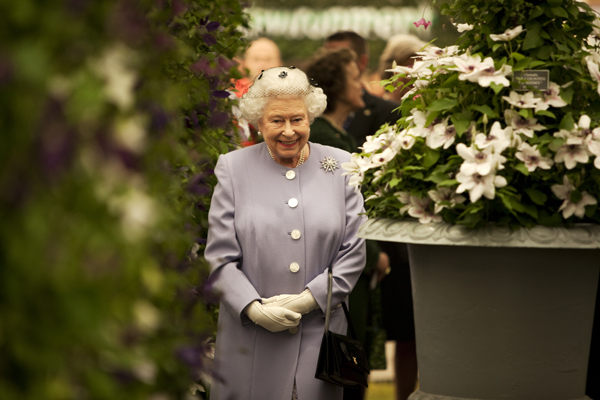
Queen Elizabeth II looks over gifts exchanged by Queen Victoria and Prince Albert in a display which forms part of the Victoria Revealed exhibition at Kensington Palace.

The Queen and Duke of Edinburgh visited palace last week to officially reopen the building following a £12 million, two year renovation project aimed at “transforming the visitor experience”.

The works have involved restoring the palace gardens – which will now be permanently open to the public free-of-charge – and reconnecting the palace with the surrounding parklands of Kensington Gardens partly through the provision of a new entrance. Landscape designer Todd Longstaffe-Gowan’s plan – which centres on a statue of Queen Victoria – features new lawns and avenues and a “maze-like path” inspired by 18th century “wilderness walks”.

There is also a new visitor reception area and “orientation hub” as well as a new courtyard terrace and cafe to complement The Orangery, shop and learning centre.

Victoria Revealed, a new permanent exhibition at the palace looks in intimate detail at the life of the Queen who once lived here and features everything from her black silk baby shoes to her wedding dress and the mourning clothing she wore following the death of Prince Albert as well as archive film footage showing the celebrations for the Diamond Jubilee of her reign in 1897.

The palace reopens on 26th March.

WHERE: The Broad Walk, Kensington Gardens, Kensington (nearest Tube stations are High Street Kensington or Queensway); WHEN: Daily 10am to 6pm (until 31st October); COST: £14.50 adult/£12 concession/children under 16 free (online booking discounts available, Historic Royal Palaces members free); WEBSITE: www.hrp.org.uk/KensingtonPalace.

PICTURES: Courtesy of Historic Royal Palaces/newsteam.co.uk

London Pub Signs – The Old Dr Butler’s Head

Once one of a number of pubs named after King James I’s odd court physician, Dr William Butler, the pub is now the last in the city to bear his image on  a sign.

Bearing the sign of Dr Butler’s head apparently meant it was among an exclusive number of pubs which offered the good doctor’s ‘medicinal ale’. According to ‘Historic Food‘, this was apparently made by hanging a thin canvas bag containing senna, polypody of oak, agrimony, maidenhair and scurvy grass in a barrel of strong ale, making what some have said would result in a strong laxative.

One couldn’t be blamed for being somewhat sceptical without even knowing the ingredients – other ‘cures’ the good doctor came up with included dropping patients suffering nervous disorders through a trapdoor on London Bridge into the Thames and firing pistols near someone to ‘scare away’ their epilepsy.

The pub, located at 2 Mason’s Avenue off Coleman Street in Moorgate, is said to have been originally built in 1610 and had to be rebuilt after the Great Fire of London. It’s since been renovated several times.

For more on the pub, see www.shepherdneame.co.uk/pub/moorgate/old-doctor-butlers-head.aspx.

Where is it? #21

The latest in the series in which we ask you to identify where in London this picture was taken and what it’s of. If you think you can identify this picture, leave a comment below. We’ll reveal the answer early next week. Good luck!

Congrats to Jameson Tucker who correctly placed this in the gardens which now occupy the site of the former church of St John Zachary which lie, as Mike Paterson correctly pointed out, near the Goldsmiths’ Hall.

In fact, the gardens, located at the corner of Gresham and Noble Streets in the City (opposite the Goldsmith’s Hall), are also known as the Goldsmith’s Garden and were laid out following bomb damage during the Blitz (the church of St John Zachary had been destroyed in the Great Fire of London and not rebuilt).

The gardens were redesigned in 1957 by landscape architect Sir Peter Shepheard and have been added to and amended over the years since (including by landscape architect Anne Jennings in the mid-Nineties).

The iron arch, which was commissioned by the Blacksmith’s Company and put here in 1994, features the leopard’s head which is the hallmark of the Goldsmiths’ Company Assay Office, the premier hallmark in the UK (the term hallmark dates from the 15th century when London craftsmen were first required to bring their creations to the Goldsmiths’ Hall for verification and marking although the mark of the leopard’s head has been in use since the early 1300s).

For more on the Goldsmiths, see www.thegoldsmiths.co.uk.

Lost London: Gates Special – Newgate

Better known now as the name for the infamous former prison which whom its history is intertwined, Newgate was originally one of the seven principal gates of London and, like five others, originally dates back to Roman times.

The gate, which apparently took the name ‘new’ thanks to a rebuild in the early medieval era, possibly in the reign of King Henry I or King Stephen, was located close to where the street known as Newgate meets the Old Bailey (see picture – there’s a blue plaque marking the spot on Newgate).

It was used as a prison from the 12th century for housing debtors and felons  – in the 13th century King Henry III is recorded as having issued orders for the prison’s repair (You can see our earlier entry on the prison here.)

The gate’s prison function – this was really no more than a few ‘cells’ – was substantially added to in the 1420s when, apparently as required under the terms of former Mayor Richard Whittington’s will, the gate was rebuilt and a new prison building was constructed to the south on what is now the site of the Old Bailey (home of the Central Criminal Court).

The gate was eventually demolished in the mid 18th century apparently due to urban planning issues. The prison, meanwhile, continued to be used until 1902 and was finally pulled down two years later.

Around London – Cutty Sark to reopen next month; Bed of Ware leaves V&A; and, Quentin Blake at the Foundling Museum…

• London landmark, the 19th century tea clipper Cutty Sark, will reopen to the public on 26th April following a five year, £50 million conservation project. Visitors to the ship will now be able to explore the vessel as well as, for the first time, walk under the ship after it was raised three metres above the dry dock. A glass canopy has been designed to protect the base of the ship’s hull. The Cutty Sark was built in 1869 by ship-builders Scott & Linton at Dumbarton, Scotland, and, one of the last tea clippers built, was designed to move very fast through the water. After the tea trade was taken over by steamers, the Cutty Sark was used to carry more general trade including wool from Australia. Later sold to a Portuguese company and renamed Ferriera, in 1922 Captain Dowman of Falmouth bought the ship and used her in the floating nautical school. Following his death, the clipper was donated to the Thames Nautical Training School at Greenhithe. After the formation of the Cutty Sark Preservation Society in the early 1950s, the ship was moved to Greenwich and permanently installed in a stone dry-dock where the clipper’s appearance restored to that of an active sailing vessel. In November 2006, the ship rig was dismantled in preparation for a full restoration project – this received a set back the following 21st May a fire broke out aboard the ship. But with the restoration now complete, the ship will once again accommodate visitors wishing to explore its 140 year history. For more on the Cutty Sark, see www.cuttysark.org.uk. PICTURE: © Cutty Sark London

• A treasure of the V&A Museum, the 16th century Great Bed of Ware, is being loaned to the Ware Museum, located not surprisingly in the Hertfordshire town of Ware, for a year from early next month. Believed to date from around 1590 and to have been made in Ware, the bed is believed to have been created as a tourist attraction for people traveling the pilgrim route between London and Walsingham or Cambridge University. More than three metres wide, it was said to be able to sleep 12 people and was such an attraction that people apparently stopped in Ware for the night just to sleep in the bed.  It’s even mentioned in Shakespeare’s Twelfth Night – the author has Sir Toby Belch describe a piece of paper as “big enough for the Bed of Ware”. The bed was acquired by the V&A in 1931 and hasn’t left the museum since. For more, see www.vam.ac.uk.

• Now On: Quentin Blake – As large as life. This exhibition at the Foundling Museum in Bloomsbury features more than 60 works by artist Quentin Blake, best known for his illustrations of Roald Dahl’s books and Britain’s first Children’s Laureate. The works – which are recent commissions by UK and French hospitals – are contained in four series of pictures which are displayed throughout the museum. They include Our Friends in the Circus – a 2009 series featuring circus performers, Ordinary Life – a 2o10 series celebrating the “pleasures of everyday life”, the 2007 work Planet Zog – a 2007 series in which aliens and young people swap doctor and patient roles, and Mothers and Babies Underwater – a 2011 series created for a French maternity ward. Admission charge applies. The event draws on the long history of artists’ aiding the work of hospitals and child welfare organisations – including William Hogarth who donated paintings to the Foundling Museum. Runs until 15th April. For more information, see www.foundlingmuseum.org.uk.