The memorial on Queens Ride, close to Gipsy Lane, marks the spot where the 29-year-old Bolan died on 16th September, 1977, after the purple Mini he was a passenger in – driven by his girlfriend, singer Gloria Jones – left the road and struck a fence, coming to rest against a tree.
The site of the crash quickly became a place of pilgrimage for fans and in September, 1997, the Performing Right Society installed a memorial stone for Bolan. It pays tribute to Bolan as a “musician, writer, poet” and says it was erected “in recognition of his outstanding contribution to British music”.
In 2002, a bronze bust of Bolan, the work of Canadian sculptor Jean Robillard, was installed behind the memorial stone by the T.Rex Action Group in commemoration of the 25th anniversary of his death.
The TAG had taken over care of the site – including the ‘Bolan Tree’ – in 1999 under a perpetual lease and, prior to the bust’s arrival, had added since added a series of steps at the site.
The bust, which was paid for by the group’s founder Fee Warner and is located at the top of the steps, was unveiled by Bolan’s only child Rolan.
In 2005, further plaques were added at the site commemorating the other members of T.Rex who had died – Steve Peregrin Took, Steve Currie, Mickey Finn and Dino Dines – as well as Bolan’s widow June Bolan (they were married in 1970).
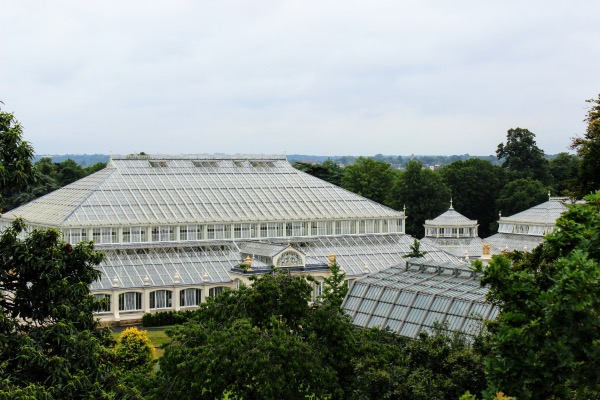
Kew Gardens was last month recognised as holding the world’s “largest collection of living plants at a single-site botanic garden” by Guinness World Records. The 320 acre site in west London, which is home to 16,900 species of plants from all over the world, is actually no stranger to Guinness World Records. Its plants include the world’s largest waterlily species – Victoria amazonica (found in the Princess of Wales Conservatory), the world’s smallest water lily species – Nymphaea thermarum (also found in the conservatory) and the plant with the world’s tallest bloom – the titan arum (Amorphophallus titanum) which also holds the record as the world’s smelliest plant. In 2020, Kew was also home to the world’s longest Nepenthes plant trap which measured 43 centimetres from the base to the lid. For more on Kew, head to www.kew.org.
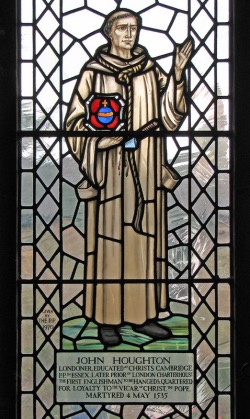
St John Houghton is remembered as the first Catholic Englishman to have been executed for refusing to take the oath prescribed by King Henry VIII’s Act of Supremacy.
Stained glass depicting St John Houghton in St Etheldreda’s Catholic Church in Ely. PICTURE: Lawrence OP (licensed under CC BY-NC 2.0)
Houghton was born around 1487 and is believed to have been educated at Cambridge, becoming ordained around 1511 before he entered the London Charterhouse in 1515 or 1516. By 1523, he held the position of sacristan and in 1528 that of procurator before, in 1531, he was transferred to Beauvale Priory in Nottinghamshire to serve as its prior.
But he returned to London in November that same year when he was unanimously elected Prior of the London Charterhouse. The following year was named Visitor of the English Province for the Carthusian Order.
When the King’s agents visited in April, 1534, requiring the community to take an oath as required under the 1534 Act of Succession (which excluded Katherine of Aragon’s daughter Mary in favour of Anne Boleyn’s daughter, Elizabeth), Houghton asked that the community be exempted.
Such a request was not looked upon kindly and Houghton, along with his procurator, Humphrey Middlemore, was arrested and taken to the Tower of London. Subsequently convinced that the oath was consistent with their Catholic faith by fellow clerics, the two returned to the Charterhouse in May, and there, in the presence of an armed force, the whole community eventually took the oath.
But in 1535, the community was again required to take an oath – this time recognising King Henry VIII as the Supreme Head of the Church of England as required by the 1534 Act of Supremacy. But Houghton, along with the heads of the other two English Carthusian houses – Robert Lawrence, Prior of Beauvale, and Augustine Webster, Prior of Axholme – sought an audience with Thomas Cromwell and asked for an exemption. All three were sent to the Tower.
The three men were interrogated by Cromwell on 26th April and then, a few days later, were called before a special commission and sentenced to death.
Houghton was among five clerics – along with the other two Carthusian priors as well as Bridgettine monk Richard Reynolds and John Haile, the parish priest of Isleworth – who were dragged through the streets to Tyburn on 4th May. There, Houghton – wearing his religious habit – is said to have embraced his executioner as he recited the words of the 31st Psalm before he was the first to be hanged, drawn and quartered.
Catholic tradition says that when Houghton’s body was cut open to remove his heart, he said to have prayed: “O Jesus, what wouldst thou do with my heart?”
Pieces of Houghton’s body were then displayed around London – his head was displayed above London Bridge and his arm was nailed to the gate of the Charterhouse,
Houghton was beatified on 9th December, 1886, and canonised in 25th December, 1970. He is considered one of the 40 Catholic Martyrs of England and Wales, all of whom were executed between 1535 and 1679 during the English Reformation.
• The extraordinary story of 18th century foundling and sailor George King, who fought in the Battle of Trafalgar, is the subject of a new exhibition opening at the Foundling Museum in Bloomsbury tomorrow.Fighting Talk: One Boy’s Journey from Abandonment to Trafalgar features King’s hand-written account of his life, a fragment of the flag from Nelson’s coffin, letters between the Foundling Hospital’s matron and Lady Emma Hamilton (annotated by Nelson himself) and two rare Naval General Service Medals, of which only 221 were awarded retrospectively when the medal was first issued in 1849, belonging to King and the foundling William South, who served aboard HMS Victory. There is also a display of works by contemporary artist and photographer Ingrid Pollard – Ship’s Tack – which reflects on the Foundling Hospital’s connections with Empire, trade and the Navy and which includes newly commissioned work responding directly to George’s autobiography. Runs until 27th February. Admission charge applies. For more, see www.foundlingmuseum.org.uk.
• Two Guildhall statues portraying figures with links to the slave trade will be retained but have information added detailing those links. The City of London Corporation’s Court of Common Council voted last week to keep the statues of William Beckford and Sir John Cass which will have plaques or notices placed alongside them containing contextual information about the two men’s links to slavery. William Beckford was an 18th century slave owner and two-time Lord Mayor of London, while Cass – an MP and philanthropist – was a key figure in the Royal African Company, which traded in slaves in the 17th and 18th centuries. Sir John Cass’s Foundation Primary School in the City and the nearby Cass Business School have already changed their names to remove the association with their founder and his links to slavery.
• French underwater photographer and biologist Laurent Ballesta has won the Natural History Museum’s Wildlife Photographer of the Year for an image showing camouflage groupers exiting their milky cloud of eggs and sperm in Fakarava, French Polynesia. The image was selected out of 50,000 entries from 95 countries and is being displayed with 100 images in an exhibition opening at the museum on Friday. Meanwhile 10-year old Vidyun R Hebbar, who lives in Bengaluru, India, was awarded the Young Wildlife Photographer of the Year 2021 for his colourful image, Dome home, showing a tent spider as a tuk-tuk passes by. The exhibition can be seen until 5th June next year. Admission charge applies. For more, see www.nhm.ac.uk/visit/exhibitions/wildlife-photographer-of-the-year.
Send all items for inclusion to exploringlondon@gmail.com.
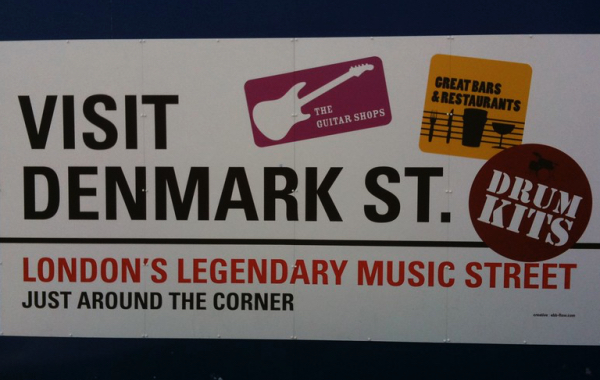
A sign promoting Denmark Street in 2009. PICTURE: Ged Carroll (licensed under CC BY 2.0)
Nicknamed ‘Tin Pan Alley’ after a famous New York City area associated with music publishers and songwriters, Denmark Street in Soho is famous for its 20th century music connections.
The street, which is just 100 yards long, was home to most major music publishing and management companies during the 1950s and 1960s as well as recording studios while publications Melody Maker and New Musical Express (better known to some as the NME) were also founded there.
Artists with a connection include David Bowie, Paul Simon, The Rolling Stones, The Kinks, and The Sex Pistols (who reportedly left a considerable amount of graffiti at number six), while two members of Bananarama apparently lived there in the 1970s. Lionel Bart, writer of the musical Oliver!, also started out here and was later known as the “King of Denmark Street”.
The street was also home to the famous Gioconda Cafe – whose patrons have included Bowie, Jimi Hendrix and Elton John.
These days home to many musical instrument shops, the future of the Denmark Street has been a matter of some controversy in recent years with a planned redevelopment attracting considerable protest.
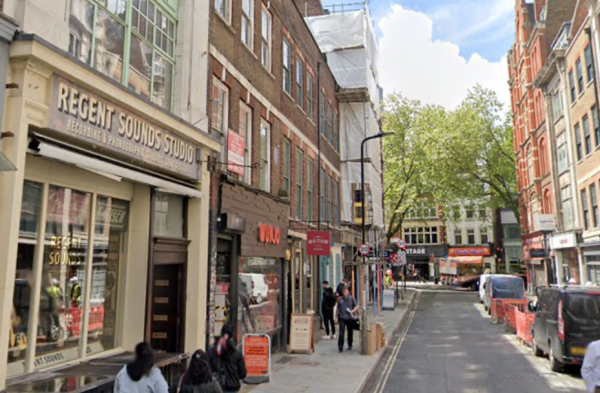
Looking west down Denmark Street in May, 2021. PICTURE: Google Maps.
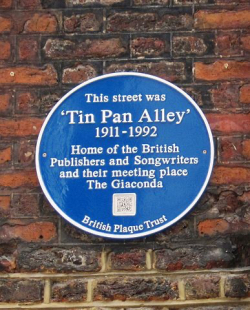
A plaque – put in place by the British Plaque Trust (pictured above; it’s not to be confused with the English Heritage Blue Plaque commemorating dive helmet pioneer Augustus Siebe on number five) – was unveiled at number nine in 2014 commemorating the street’s musical connections between 1911 and 1992. It reads “Home of the British Publishers and Songwriters and their meeting place The Giaconda.”
Sixties pop singer Donovan, who recorded here, performed a song he’d written specifically for the occasion – appropriately named Tin Pan Alley.
Not to be confused with the Mayor of London (a position currently held by Sadiq Khan, the Mayor is the head of the Greater London Authority – more on that in a later post), the Lord Mayor of London serves as the head of the City of London Corporation which governs the Square Mile.
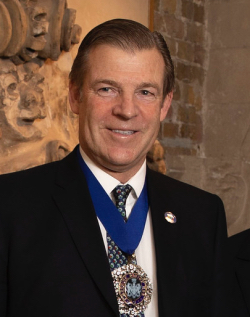
Lord Mayor of London William Russell in February, 2020. PICTURE: Bank of England (licensed under CC BY-NC-ND 2.0/image cropped)
The Lord Mayor of London is generally elected annually (last year was an exception due to the coronavirus pandemic) by members of the City’s livery companies who are summoned by the previous Mayor to meet at at Guildhall on Michaelmas Day (29th September) or on the closest weekday
The Lord Mayor is subsequently sworn into office in November in an event known as the ‘Silent Ceremony’ because, aside from a short declaration from the incoming mayor, no speeches are made. The following day, the Lord Mayor participates in a procession from the City of London to the Royal Courts of Justice in the City of Westminster, where they swear allegiance to the Crown. The event is known as the Lord Mayor’s Show (this year it’s being held on 13th November).
Lord Mayors must be one of the City of London’s 25 alderman (elected to represent the City’s wards) and must first served as one of the City’s two sheriffs prior to taking on the position – the sheriffs support the Lord Mayor in their role as advisors. They also host dinners for visiting dignitaries, accompany the Lord Mayor in their business travels and look after the judges at the Old Bailey.
The first Lord Mayor is said to have been Henry FitzAilwin, who served between 1189 and 1212. The current Lord Mayor, William Russell, is the 692nd to hold the post. Until 1354, the title was simply Mayor of London.
The role of the Lord Mayor these days is to serve as an international ambassador for the UK’s financial and professional services sector.
The official residence of the Lord Mayor is called the Mansion House. It is used for some of the City’s official events.
Thankfully much copied (at least in part), this full length portrait of King Henry VIII, his third wife and parents was the work of Hans Holbein the Younger.
Holbein, appointed the king’s painter in 1536, was commissioned to create the work following the King’s marriage to Jane Seymour on 30th May, 1536, and completed it in 1537 (there’s some speculation it may have been commissioned in celebration of the birth of King Henry’s son, King Edward VI).
The mural featured the King standing in full splendour, although without typical symbols of royalty such as a crown or sceptre, as well as his wife Jane Seymour, and his parents, King Henry VII and Queen Elizabeth of York. They were all standing around a central pillar upon which are inscribed verses in Latin extolling the Tudor dynasty.
The work is understood to have been commissioned for one of the King’s more private chambers in the Palace of Whitehall which Henry had seized after the downfall of Cardinal Thomas Wolsey.
The portrait survived the reign of King Henry VIII but was destroyed in the fire which devastated the palace in 1698.
A full-sized cartoon of the left-hand side of the work which was completed by Holbein in preparation for its creation is held in the collection of the National Portrait Gallery (pictured right).
While there are numerous copies of the figure of King Henry VIII, the only complete copy of the mural is attributed to Remigius van Leemput who created it in 1667 – it can be seen at Hampton Court Palace.
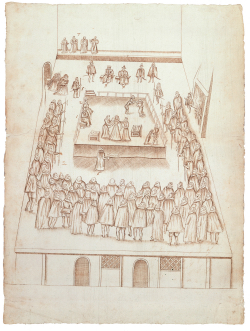
• The complex relationship between Queen Elizabeth I and Mary, Queen of Scots, is the subject of a new exhibition opening at the British Library in King’s Cross tomorrow. Highlights of Elizabeth and Mary: Royal Cousins, Rival Queens, the first major exhibition to consider both women together, include Queen Elizabeth I’s 1545 handwritten translation of her stepmother Katherine Parr’s Prayers and Meditations – a gift for her father King Henry VIII, a sonnet by Mary, Queen of Scots, which was handwritten the night before she was executed in 1587 (possibly the last thing she ever wrote), the ‘Penicuik Jewels’ which she is thought to have given away on the day of her death and Robert Beale’s eye-witness drawing depicting her entering the hall, disrobing, and placing her head on the block (pictured right). Other items on show include King Henry VIII’s Great Bible (dating from 1540, it was later inherited by Elizabeth I), Elizabeth I’s mother-of-pearl locket ring (c1575) containing miniature portraits of herself and her mother Anne Boleyn, and the warrant confining Mary, Queen of Scots, in Lochleven Castle in 1567. The exhibition is accompanied by a programme of events. Runs until 20th February. Admission charge applies. For more, see www.bl.uk/events/elizabeth-and-mary.
• Nineteenth century African-American abolitionists Ellen and William Craft have been honoured with an English Heritage Blue Plaque at their former Hammersmith home. The Crafts escaped from enslavement in Georgia in the US in December, 1848, and fled to Britain, settling in a mid-Victorian house at 26 Cambridge Grove where they raised a family and campaigned for an end to slavery. The Crafts returned to the US following the end of the American Civil War and the emancipation of enslaved people and settled in Boston with three of their children. In 1873, they established the Woodville Cooperative Farm School in Bryan County, Georgia, for the children of those who had been emancipated. Ellen died in Georgia in 1891 and William in Charleston in 1900.
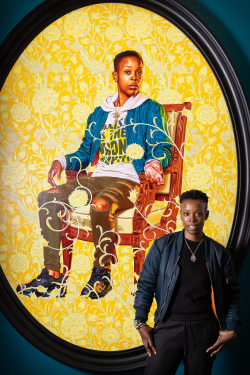
• American artist Kehinde Wiley’s monumental Portrait of Melissa Thompson has gone on display in the V&A’s British Galleries, alongside William Morris’s Wild Tulip designs that inspired it. The massive oil painting, which was created as part of Wiley’s series The Yellow Wallpaper and was first exhibited at the William Morris Gallery in Walthamstow in 2020, was acquired earlier this year and is being displayed as part of a series of initiatives marking the 125th anniversary of William Morris’s death this October. The painting will be displayed in the William Morris Room (room 125) until 2024, after which it will move to its permanent home at V&A East Museum in 2025. Admission is free. For more, head to vam.ac.uk.
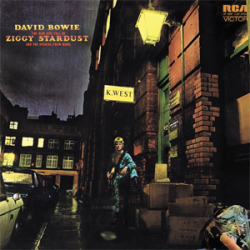
This property (and the street, which runs in a horseshoe off Regent Street in the West End, I which it sits) is famous for its appearance on the cover of David Bowie’s 1972 album, The Rise and Fall of Ziggy Stadust and the Spiders from Mars.
The famous album cover.
The cover – which features Bowie (who was ill with the flu at the time) dressed as Ziggy Stardust standing outside the building under the light of a lamp – was one of several shots taken by photographer Brian Ward on a cold and wet night in January, 1972.
Originally taken in black and white, the selected image was subsequently hand-coloured by artist Terry Pastor for the album cover.
There’s been much commentary over the years about the sign which appears over Bowie’s head in the shot and reads K West. Bowie himself, lamenting the fact the sign had been removed when the furrier moved out in the early 1990s, commented later that that it had taken on “mystical overtones” for some fans who thought it was code for the word quest. But the truth is more mundane – it was apparently the name of a furrier who at the time occupied part of the building.
The back cover of the album featured Ziggy inside an iconic red phone box which was located just around the corner from number 23, still in Heddon Street. One of the K2 boxes, it’s since been replaced.
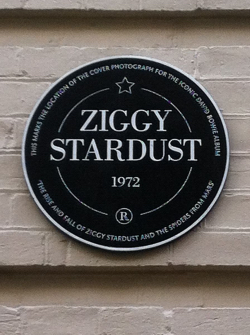
While the street has been considerably gentrified since Ziggy stood there (rather than a deserted back street, it’s now a popular al fresco dining area), a plaque was unveiled commemorating the role of the building in 2012 (pictured above).
The album, meanwhile, was released on 16th June, 1972, by RCA Records to what was generally a favourable reception.
One Thousand Springs, an artwork by internationally renowned artist Chiharu Shiota, is the centrepiece of the Japan festival taking place at Kew Gardens in west London. The work features 5,000 haikus submitted by members of the public which have been suspended on red threads in the Victorian-era Temperate House. Says Shiota: “The Japanese language was formed by a culture that cherishes the natural world. Many cultural practices like ikebana, bonsai and hanami are based on the contemplation and enjoyment of nature. For One Thousand Springs I chose to focus on the haiku. The traditional haiku mentions one of the seasons and many haikus are based on observations in nature.” The installation can be seen throughout the month-long festival along with horticultural displays including a specially commissioned Chalk Garden, a contemporary response to a Japanese garden showcasing native plants including grasses, shrubs and trees. For more on the festival, including after hours events, see www.kew.org/kew-gardens/whats-on/festival-japan.
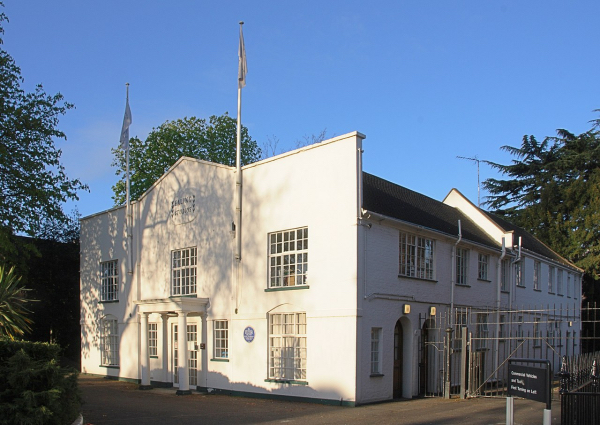
The oldest continuously operating film studio in London also happens to be the oldest in the world, according to Guinness World Records.
Ealing Studios in West London has been operating at the same site – the White Lodge on Ealing Green – since 1902.
Originally founded by silent film pioneer Will Barker (and so originally known as the Will Barker Studios), the studios were further developed by Associated Talking Pictures who opened the sound stages in 1931.
In 1938, film producer Michael Balcon took over and it was he who named them Ealing Studios. Later owners included the BBC and then in 2000 the studios were bought by a consortium including independent production company Fragile Films and the Manhattan Loft Corporation.
Among the famous films made there was one of first screen versions of Hamlet in 1910, as well as classics such as The LadyKillers, The Lavender Hill Mob, and Passport to Pimlico. More recent films and TV shows have included the St Trinian’s franchise, The Importance of Being Earnest (2002), Shaun of the Dead (2005), and The Theory of Everything (2014), as well as recent TV series The Durrells and Downton Abbey.
The White Lodge bears an English Heritage Blue Plaque commemorating Sir Michael Balcon’s time working here between 1938 and 1956.
• Visitors to Kew Gardens are being invited to immerse themselves in the art, plants and culture of Japan in a month long celebration of the Asian nation. The Japan Festival kicks off this Saturday in Kew’s Temperate House and features at its heart a large-scale artistic installation by Japanese artist Chiharu Shiota entitled One Thousand Springs which is constructed of 5,000 haikus submitted by members of the public. There will also be a specially commissioned Chalk Garden – a contemporary response to a Japanese garden showcasing native plants including grasses, shrubs and trees – as well as a display showcasing six different chrysanthemums, Japan’s national flower, and an immersive soundscape by sound artist Yosi Horikawa featuring the natural sounds of the rivers and waterfalls of Kagoshima, atmospheric soundscapes from the Cedar mountains of Gifu and bird calls set across the waves of the Philippine Sea. The Temperate House will also be illuminated for Japan: After hours featuring a varied programme of dance, theatre, and live music performances as well as traditional flower arranging and sake sipping. The festival, supported by Daikin UK, runs to 31st October. Admission charge applies. For more, see www.kew.org.
Sky Brown from Great Britain during women’s park skateboard at the Olympics at Ariake Urban Park, Tokyo, Japan on August 4, 2021. PICTURE: Ulrik Pedersen/NurPhoto via Getty Images.
• Thirteen-year-old Olympian Sky Brown’s skateboard, children’s garments created by sustainable fashion designer, humanitarian and artist Bethany Williams, and Open Bionics’ 3D printed prosthetic, The Hero Arm, are among new acquisitions to be displayed at what was the former V&A Museum of Childhood. Now renamed the Young V&A, the Grade II* Bethnal Green institution is undergoing a £13m transformation ahead of reopening in 2023. The new interior fit-out, by firm AOC Architecture, will include three new galleries – Play, Imagine and Design – as well as interactive collection displays, a suite of dedicated learning workshops, an in-gallery design studio for visitors, and a new café and shop.
• The late Princess Diana has been honoured with an English Heritage Blue Plaque at her former flat in Kensington. Flat 60, Coleherne Court, Old Brompton Road, was her home between 1979 and 1981 during her courtship with Prince Charles. She shared it with three friends including Virginia Clarke who was at the unveiling ceremony this week. Diana, who died aged 36 in a Paris car crash in 1997, described her years at the property as “the happiest time of her life”, according to biographer Andrew Morton’s book Diana, In Her Own Words.
• Vincent Keaveny was this week elected as the 693rd Lord Mayor of the City of London. Alderman Keaveny succeeds Lord Mayor William Russell, who served a second year in office after his term was extended to ensure continuity of leadership during the current COVID-19 pandemic (the last time a Lord Mayor served a second year in office was in 1861 when William Cubitt was re-elected). The annual Lord Mayor’s Show is scheduled for Saturday, 13th November, and will be followed by Lord Mayor’s Banquet at Guildhall on 15th November.
OK, so we all know about the Abbey Road crossing and its connection with the Beatles, but where are some other sites of historic musical significance in London?
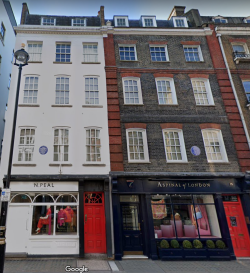
23 and 25 Brook Street, Mayfair. PICTURE: Google Maps.
First up, it’s the Mayfair home where 18th century composer George Frideric Handel lived from 1723 until his death in 1759 – and where he composed much of his best known work including masterpieces such as Zadok the Priest (1727, it was composed for the coronation of King George II), Israel in Egypt (1739), Messiah (1741), and Music for the Royal Fireworks (1749).
The German-born Handel, who settled permanently in London in 1712 (and who became a naturalised British citizen in 1727), was the first occupant of the terraced house located at what is now 25 Brook Street (but previously known as 57) which is now a museum dedicated to his life and work.
The property, which is today decorated as it would have been during early Georgian times, is thought to have been convenient for its proximity to be the theatres where his works works were performed and St James’s Palace, where he served as Composer of Music for the Chapel Royal.
A small room on the first floor is believed to be where Handel did most of his composing. He is also understood to have used the larger adjoining music room for rehearsing his works from the 1730s (possibly due to a lack of space at the venue where he mainly performed, the Covent Garden Theatre).
Handel died in the house on 14th April, 1759. The property, which subsequently was lived in by various people, became a museum dedicated to the composer in 2001.
Known for the first 15 years of its existence as the Handel House Museum, in 2016 it was expanded to include the upper floors of the adjoining home, 23 Brook Street, a flat which served as home to another musical great, Jimi Hendrix, in 1968-1969. The museum is now known as Handel & Hendrix in London.
Both properties have English Heritage Blue Plaques upon them. The first plaque were erected on Handel House in about 1870 by the Society of Arts and was replaced in 1952 and again in 2001, when his middle name was corrected to Frideric from Frederick. The plaque commemorating Hendrix’s residence in Number 23 was erected in 1997.
The museum is closed, with limited exceptions, until March, 2023, for a refurbishment project called the The Hallelujah Project. But you can head to the website to take a 3D virtual tour: https://handelhendrix.org.
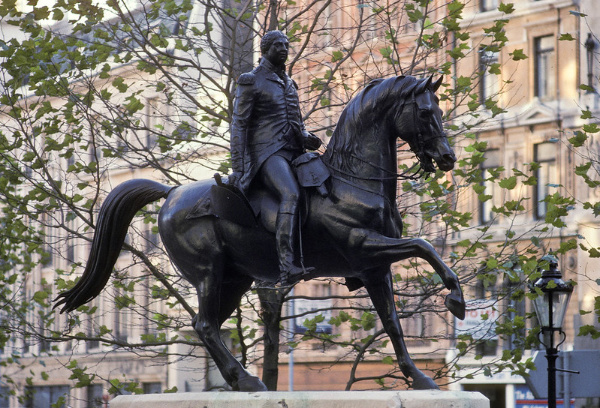
Equestrian statue of King George III in Cockspur Street. PICTURE: David Nicholls (licensed under CC BY-NC 2.0)
This month marks 260 years since King George III and Charlotte of Mecklenburg-Strelitz were crowned King and Queen of the Kingdom of Great Britain at a ceremony at Westminster Abbey.
Only 23-years-old at the time, King George III had ascended to the throne before following the death of his grandfather, King George II, in October, 1760. He and his wife, then Princess Charlotte of Mecklenburg-Strelitz, had married in the Chapel Royal at St James’s Palace just two weeks prior to the coronation on 8th September, 1761 (they had met earlier the same day).
The royal couple started the day of the coronation – 22nd September – at St James’s Palace and were carried in sedan chairs to Westminster Hall, arriving at about 11am. They then processed on foot through crowds from the hall to Westminster Abbey (the crowds were said to be such that numerous carriages had collided with each other in the bid to reach the abbey). There, they proceeded to a special platform built in the abbey for the occasion.
Commencing at about 3pm, the coronation ceremony began. In an elaborate ceremony overseen by the Archbishop of Canterbury Thomas Secker, the new King was then crowned (Zadok the Priest, which George Frideric Handel had written for the coronation of King George II, was the anthem at the new king’s request). A simpler ceremony followed in which Charlotte was crowned Queen Consort.
The whole affair reportedly lasted more than six hours, so long that some guests are said to have tucked into snacks while watching.
A feast was subsequently held in Westminster Hall during which the King’s Champion, wearing full armour, rode into the hall and threw down a gauntlet challenging any who questioned the King’s legitimacy to step up (none did). During the feast, spectators in the galleries above let down baskets and handkerchiefs for their better placed friends below to fill with food.
The King and Queen departed the feat at about 10pm followed by guests. After they’d vacated the premises, the doors were then opened for the public to come in and to finish off the food.
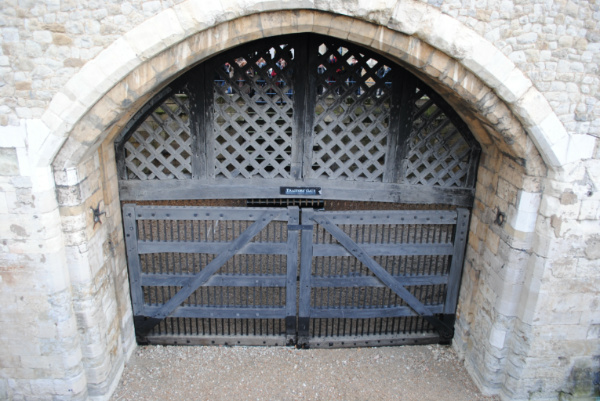
Built by King Edward I in the 13th century as a water gate to provide access from the Tower of London to the River Thames, the name ‘Traitor’s Gate’ came to be applied to this portal in Tudor times in relation to those accused of treason who were brought into the tower under its arch.
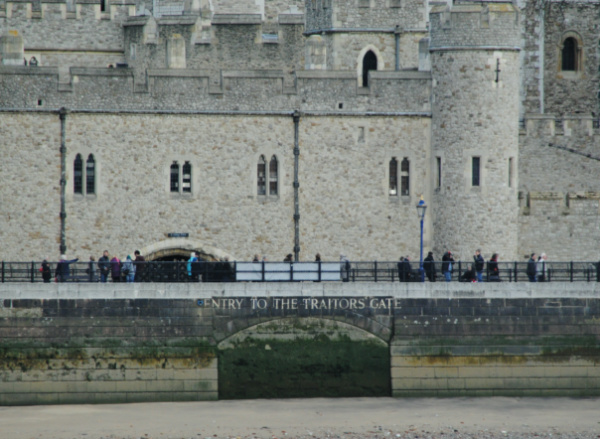
The double gateway is part of St Thomas’s Tower, which was designed by a Master James of St George, and behind it is a pool which was used to feed water to a cistern on the roof of the White Tower. While the gate was originally built to give access directly to the river, Traitor’s Gate now sits behind a wharf which runs along the river bank (and where can be seen the bricked up entrance says ‘Entry to the Traitor’s Gate’ – this was bricked up in the 19th century when embankment works were carried out)
Sir Thomas More, Sir Walter Raleigh and even the future Queen Elizabeth I (when a princess) were among those who were brought in by barge through the Traitor’s Gate (their journey would have led them under London Bridge where the heads of executed prisoners were on display). Whether Henry VIII’s disgraced Queen Anne Boleyn entered the tower through the gate remains a matter of some dispute.
• Some 5,000 papers and photographs relating to the life and legacy of Prince Albert, consort of Queen Victoria, have been published online. The move, which marks the completion of the Prince Albert Digitisation Project, means some 22,000 archival documents, prints and photographs from the Royal Archives, the Royal Collection and the Royal Commission for the Exhibition of 1851 are now publicly available, many for the first time, through the website Prince Albert: His Life and Legacy which was launched in mid-2019 to mark the 200th anniversary of the Prince’s death. The new items predominantly consist of the Prince’s private and official papers and correspondence as well as excerpts from Albert’s now lost diaries, spanning the years from 1841 to 1852. Highlights include a note he wrote to Victoria on October, 1858, which reads: “I declare that I have every confidence in you. A”; a letter from 10-year-old Princess Louise to her father from Swiss Cottage, the life-sized playhouse he had installed for his children at Osborne House on the Isle of Wight, in which she reports cooking and making “some wafers and schneemilch” (a type of Austrian pudding); and, an annotated list of candidates for the role of Master of the Household in which Albert lists why they are unsuitable with reasons including ‘too old’ and ‘too useful to the Navy’ and ‘bad temper’ and ‘French mistress’.
• London Transport Museum are offering people the chance to go behind the scenes at its depot in Acton, West London, this weekend. The depot, which houses more than 320,000 objects from London’s transport history, will play host to a programme of events – ‘Underground Uncovered’ – which includes talks, vintage vehicle displays and family activities. Highlights include a talk by Siddy Holloway, a disused station history expert and co-presenter of the new Secrets of the London Underground TV series, the chance to try your hand at being a train operator in the Victoria Line driving cab, and the opportunity to watch a demonstration of restored London Underground signalling frames. The open days are being held from today until Sunday, 11am to 5pm. Admission charge applies. To book and see the full programme of events, see www.ltmuseum.co.uk/visit/depot/events.
• W1 Curates and artist Anthony James’ light exhibition inside the Marble Arch Mound has opened to the public with free entry to what has been a somewhat controversial attraction to continue. James’ Lightfield installation involves a series of 12 cubed light sculptures in three rooms inside the mound through which visitors will make their way after first visiting the viewing platform on top. James, who has described the cubes as alluding to the “mycorrhizal nature of birch tree forests”, says it’s the first time his works have been displayed and viewed in such a “fully immersive way”. Visitors are asked to book an entry time at www.themarblearchmound.com.
Send all items for inclusion to exploringlondon@gmail.com.
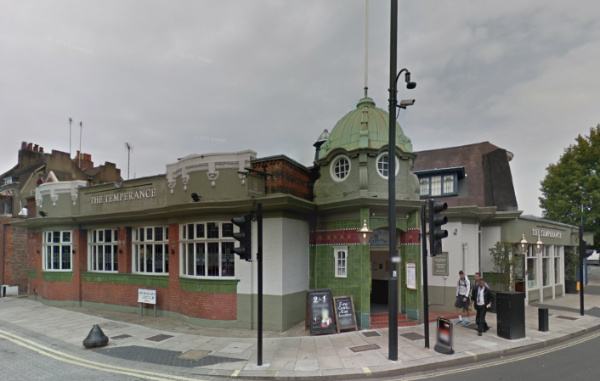
The Temperance, Fulham, in 2020. PICTURE: Google Maps
This pub’s name seems somewhat at odds with its purpose for the Temperance, as the name suggests, was once actually a Temperance Billards Hall, built as part of a movement to reduce or prohibit the drinking of alcoholic beverages.
The property, now Grade II-listed, was built in 1910 for Temperance Billiard Halls Ltd and designed by the company architect, Norman Evans. It was one of five such halls the company built in London, along with another 12 in Manchester.
The halls were located in areas where numerous news pubs had been established and, as its Historic England listing notes, such buildings “often used the same decorative materials as pubs, such as tiled facades and stained glass windows, to create the congenial atmosphere of a public house without the pitfalls of available alcohol”.
The building, at 90 Fulham High Street not far from Putney Bridge, was subsequently converted into a pub. It was apparently briefly previously known as The Pharaoh & Firkin and then became part of the O’Neills chain before taking on the current name in a nod to the history’s building.
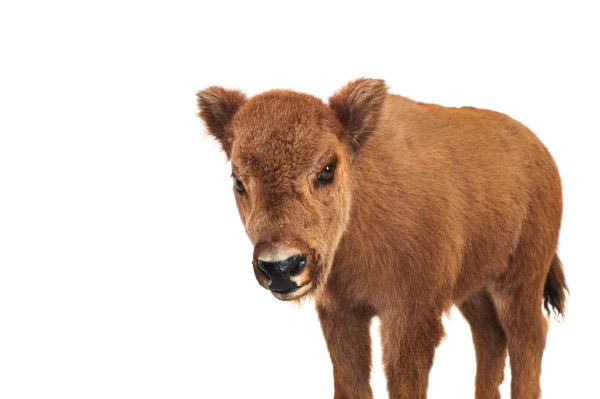
• The third and final part of the free exhibition, Our Broken Planet: How We Got Here and Ways to Fix It, has opened at the Natural History Museum. Following on from sections exploring the food we eat and the products we use, the third phase of the display explores the energy humans consume and how we can we create a greener, cleaner future. Specimens in the display include a juvenile European bison, illustrating an experimental rewilding project in Kent which is investigating if bison feeding habits will improve the forest’s biodiversity and store more carbon in the soil, blue-green algae collected during Captain Scott’s famed RRS Discovery expedition which is being used in the study of climate change, and the recently extinct Chinese paddlefish, a casualty of the global boom in hydroelectric dams. Entry to the South Kensington museum is free but visitors are encouraged to book a time ticket in advance to ensure entry. For more, see www.nhm.ac.uk/visit/our-broken-planet.html.
• The West End comes to Trafalgar Square this weekend with a line-up of free performances from top shows taking to the stage. Forming part of Westminster City Council’s Inside Out Festival and the Society of London Theatre’s #BackOnStage campaign, the West End LIVE event will feature the first ever West End LIVE appearances from award-winning musicals Hamilton and The Book Of Mormon, as well as an exciting roster of new shows including The Prince Of Egypt, Dear Evan Hansen, Cinderella, Back To The Future: The Musical and Pretty Woman. More than 30 acts will be involved in the free and unticketed event. For the full programme, see www.westendlive.co.uk.
• The first major UK exhibition of woodcuts by the leading abstract expressionist, Helen Frankenthaler, opened at the Dulwich Picture Gallery this week. Helen Frankenthaler: Radical Beauty brings together more than 30 works on loan from the Helen Frankenthaler Foundation which span the artist’s career from her first ever woodcut in 1973 to her last work published in 2009. Works include including Madame Butterfly (2000), East and Beyond (1973), Cameo (1980) and Freefall (1993). The display can be seen until 18th April. Admission charge applies. For more, see www.dulwichpicturegallery.org.uk.