LondonLife – Shakespeare in bronze at The Globe…

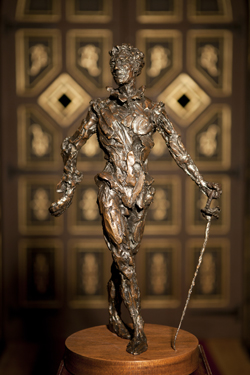
Shakespeare's-Globe2A series of bronze sculptures inspired by the characters of William Shakespeare’s plays is appearing at the Shakespeare’s Globe Theatre on Bankside this summer. The work of Susan Bacon, the sculptures are being displayed alongside some of the clay maquettes – or “sculptural calligraphy” – Bacon created before working in bronze. She explains: “The characters start with a small sketch in clay. These maquettes are to me the beginning of an idea, the seeds that make up Shakespeare’s characters. As in the study of the spontaneous fluency in Zen Calligraphy with ink, so it can be in clay; a natural attempt to transfer these ideas and their energy into uninterrupted form. Working on images and speeches I combine in my mind many ideas and thoughts that are drawn out by the words. Only then do I execute a quick sculptural response.” The sculptures can be seen in the foyer of the Globe until 18th October (open daily, 9am to 11pm, free admission). For more, see www.shakespearesglobe.com.

PICTURE: Pete Le May

What’s in a name?…Waterloo…

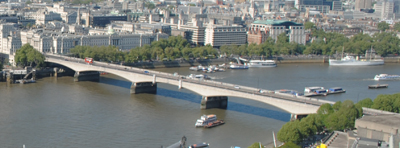
Waterloo-Bridge

Given the recent commemorations surrounding the bicentenary of the Battle of Waterloo (including a re-enactment of the arrival of news of Wellington’s victory in London where it was delivered to the Prince Regent), we thought it only fitting to take a look at the use of the name in London.

The name Waterloo, which now refers to a district in Lambeth centred on Waterloo Station, was first used to designate the bridge which crosses the Thames here.

Opened in 1817 as a toll bridge, the John Rennie-designed structure was known as Strand Bridge during its construction but renamed Waterloo at its opening two years after the battle. (Rennie’s bridge was later demolished and rebuilt in the 20th century – the current bridge is pictured above).

The name was also used to designate Waterloo Road and in the early 1820s was given to the church St John’s Waterloo (now St John’s and St Andrew’s at Waterloo) located on the road.

In 1848, Waterloo Station opened and it was after this that the surrounding district, known in past ages for its swampiness (hence streets like Lower Marsh), generally became known as Waterloo.

Landmarks in the Waterloo district include the historic Old Vic Theatre, which opened in 1818, and the Young Vic Theatre as well as the Lower Marsh Market.

On 3rd July, Waterloo will host the Waterloo Carnival with a picnic on Waterloo Millennium Green and a procession (for more on that, see www.waterlooquarter.org/news/come-and-support-this-years-waterloo-carnival) while the month-long Waterloo Food Festival kicks on on 1st July. For more on events in Waterloo commemorating bicentenary, see www.wearewaterloo.co.uk/waterloo200/.

Treasures of London – Waterloo Memorial…

Waterloo-MemorialUnveiled earlier this month at Waterloo Station to mark the bicentenary of the Battle of Waterloo, the memorial features a supersized solid bronze replica of the obverse side of the Waterloo Campaign medal depicting Nike, the Greek goddess of victory.

The memorial, which was installed on a balcony above the main concourse by The London Mint Office on behalf of Waterloo200 – the organisation overseeing bicentenary commemorations, is dedicated to the 4,700 members of the allied armies who were killed in the battle on 18th June, 1815 (which also left 14,600 wounded and 4,700 missing).

The upsized medal, which has a diameter of 65 centimetres, is a replica of one which was the first to be commissioned for every soldier who fought in the battle, regardless of their rank.

Designed by London-based artist Jason Brooks, the memorial also features a famous quote from the Duke of Wellington on granite: “My heart is broken by the terrible loss I have sustained in my old friends and companions and my poor soldiers. Believe me, nothing except a battle lost can be half so melancholy as a battle won.”

It was unveiled on 10th June by the 9th Duke of Wellington (pictured with the memorial) in a ceremony attended by some of the descendants of those who fought and died in the battle.

Waterloo Station was itself, of course, named in commemoration of the battle (well, indirectly – it, like the surrounding district itself, took its name from nearby Waterloo Bridge which was in fact named after the battle).

This Week in London – The Waddesdon Bequest has a new home; history painted at the Tate; and, early release NYE tickets…

Holy-Thorn-ReliquaryThe Waddesdon Bequest, a collection of medieval and Renaissance treasures left to the British Museum by Baron Ferdinand de Rothschild in 1898, has a new home. Redisplayed in a new gallery which opened at the museum last week, the collection features the Christian relic known as Holy Thorn Reliquary (pictured) – a concocotion of gold, enamel and gems set around a thorn supposedly taken from Christ’s Crown of Thorns, the Lyte Jewel – a diamond-studded locket made in London in 1610-11 to hold a miniature of King James I and presented by the king to Thomas Lyte as thanks for a genealogy he created representing the king as a descendant of the Trojan Brutus, and the Cellini Bell – cast from silver in Nuremberg around 1600 and later displayed by Horace Walpole at his west London villa in Strawberry Hill. The bequest collection, which must always be displayed in a room of its own under its original terms, was first displayed at Baron Ferdinand’s country home of Waddesdon Manor in Buckinghamshire (now a National Trust property) and moved to the museum after his death. The redisplay reconnects the collection with its past at the manor and the history of the museum – the room where it is now displayed, Room 2a, was the museum’s original Reading Room and part of a neo-classical suite of rooms designed by Robert Smirke in 1820. It has been given the “most ambitious digital treatment” of any permanent gallery in the institution. Admission is free. For more, see www.britishmuseum.org.

The “enduring significance and emotional power” of British history painting is under examination in a new exhibition which opened at Tate Britain on Millbank last week. Fighting History features everything from the large scale works of 18th century painters John Singleton Copley and Benjamin West through to 20th century and contemporary works by Richard Hamilton and Jeremy Deller and looks at how they reacted, captured and interpreted key historical events. Works on show include Singleton Copley’s 1778 work The Collapse of the Earl of Chatham in the House of Lords, 7 July, William Frederick Yeames’ 1877 work Amy Robsart, John Minton’s 1952 work The Death of Nelson and Deller’s 2001 work The Battle of Orgreave, a re-enactment of 1984 protest in South Yorkshire. The exhibition also compares traditional and contemporary renderings of events from scripture, literature and the classical world and features a room dedicated to interpretations of the great Biblical flood of Noah. Runs until 13th September. Admission charges apply. For more, see www.tate.org.uk.

A limited number of early release tickets to London’s New Year’s Eve celebrations will go on sale from noon tomorrow (Friday, 19th June). The tickets, the bulk of which will be released in September, cost £10 a person with the proceeds being used to cover costs including printing and infrastructure. As was the case last year, people without tickets will not be able to access the event. To get hold of tickets, head to www.london.gov.uk/nye.

Send all items for inclusion to exploringlondon@gmail.com.

10 sites from London at the time of the Magna Carta – 6. St Helen’s Bishopsgate…

St-Helen-Bishopsgate2

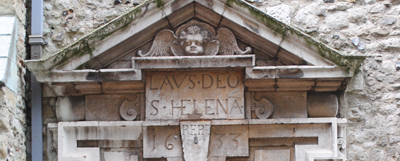
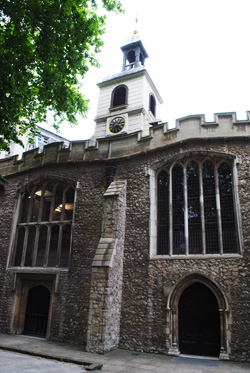
This church in the shadow of 30 St Mary Axe (aka The Gherkin) is all that remains of a Benedictine nunnery that was founded here during the reign of King John in 1210.

St-Helen's-BishopsgateEstablished by one “William, son of William the goldsmith” after he was granted the right by the Dean and Chapter of St Paul’s Cathedral, the priory was built to the north of a previously existing church with a new church for the nuns to use built right alongside the existing structure (thus accounting for the rarely seen side-by-side naves of the current building).

While the new church was built longer than the existing church, the latter was then lengthened to give them both the same length. A line of arches and a screen separated the nun’s choir and the parish church.

The church which stands today has been much altered over the centuries and what we now see there largely dates from the 14th and 15th centuries (although the bell turret which sits over the west front is an 18th century addition).

One of the priory’s claims to fame in medieval times was that it apparently was once home to a piece of the True Cross, presented by King Edward I in 1285.

The nunnery was dissolved in 1538 during the Great Dissolution of King Henry VIII and the buildings, excepting the church, sold off to the Leathersellers’ Company (all were eventually demolished by the 18th century). The screen separating the nun’s choir and the parish church, meanwhile, was removed, leaving the main body of the church as it can be seen today.

The now Grade I-listed church, which was William Shakespeare’s parish church when he lived in the area in the 1590s, survived both the Great Fire of London and the Blitz but was severely damaged by two IRA bombs in the early 1990s leading to some major – and controversial – works under the direction of architect Quinlan Terry.

Inside the church today is a somewhat spectacular collection of pre-Great Fire monuments including the 1579 tomb of Sir Thomas Gresham, founder of the Royal Exchange, the 1636 tomb of judge, MP and Chancellor of the Exchequer, Sir Julius Caesar Adelmare, and the 1476 tomb of merchant, diplomat, City of London alderman and MP, Sir John Crosby.

It was also once the site of the grave of 17th century scientist Sir Robert Hooke but these were apparently removed from the church crypt in the 19th century when repairs to the floor of the nave were being made and placed in an unmarked common grave. Their location apparently remains unknown.

WHERE: St Helen’s Bishopsgate, Great St Helens (nearest Tube stations are Aldgate, Bank and Liverpool Street); WHEN: 9.30am to 12.30pm weekdays daily (also usually open Monday, Wednesday and Friday afternoons but visitors are advised to telephone first); COST: Free; WEBSITE: www.st-helens.org.uk.

LondonLife – Exposing London’s criminal past…

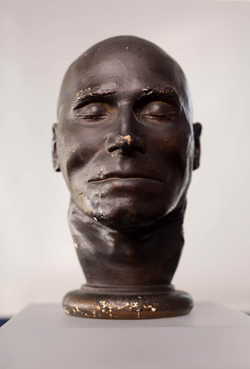
Daniel-GoodThe death mask of Daniel Good, executed outside Newgate prison on 23rd May, 1842, for the murder of his wife Jane Jones. It was thanks to delays in apprehending Good caused by communication problems that a dedicated detective was formed within the Metropolitan Police. Good’s death mask is just one of the many items from the Metropolitan Police’s Crime Museum which will be on display at the Museum of London’s forthcoming exhibition, The Crime Museum Uncovered. Opening in October, the display will feature never-before-seen objects from the police museum which are usually only accessible to police professionals and their invited guests. Along with the death mask, other objects to be seen in the display will include a memoir by Donald Swanson, senior investigating officer on the investigation into the Jack the Ripper killings in the late 1880s, a pin cushion embroidered with human hair by Annie Parker, who died in 1879 after having been arrested more than 400 times for alcohol-related offences, and ‘microdots’ containing secret messages along with a microdot reader founder in Mrs Helen Kroger’s handbag when she was arrested for involvement in the Portland Soviet Spy Ring in 1961. The exhibition will run from 9th October to 10th April, 2016. Admission charges apply. For more, see www.museumoflondon.org.uk.

Celebrating the Magna Carta’s 800th anniversary!…

Magna-Carta4

We interrupt our regular programming today to mark a truly historic milestone – 800 years since King John set his seal to the Magna Carta (Great Charter) in a field at Runnymede to the west of London.

So, where can you see a copy in London?

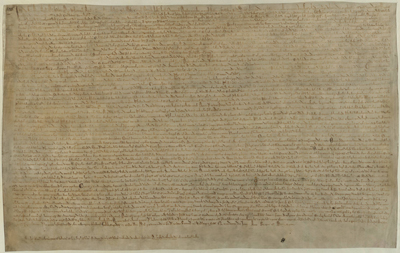
The British Library actually holds two of the four surviving documents from 1215 (one is pictured above) – the other two are held by Lincoln and Salisbury Cathedrals.

One of the copies in the British Library was damaged in an 18th century fire; the other was found in a tailor’s shop in London in the 17th century – made of sheepskin, it was apparently about to be taken apart to line collars.

The library’s current Magna Carta exhibition, Magna Carta: Law, Liberty, Legacy, features the two documents (along with Jefferson’s handwritten copy of the Declaration of Independence and one of the original copies of the US Bill of Rights). For more about the exhibition, see www.bl.uk/events/magna-carta–law-liberty-legacy (runs until 1st September – for more see our earlier post here).

Meanwhile, the City of London Corporation also possesses a copy of the Magna Carta – although a later one that that issued in 1215.

Issued by King Edward I in 1297, this was the one which saw the document’s clauses, somewhat changed from 1215, written into the statutes for the first time.

Stored at the Guildhall Art Gallery, it is too delicate to be on permanent display but is currently on display in the City of London  Heritage Gallery until 1st October (for more follow this link).

You can read more about the Magna Carta and its London connections in our Wednesday series, 10 sites from London at the time of the Magna Carta.

PICTURE: British Library.

LondonLife – Battersea in rebirth…

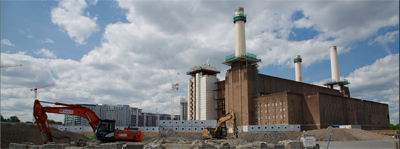
BatterseaWork continues on repurposing the former Battersea Power Station as part of the £15 billion Nine Elms project that will create a whole new precinct located on the south bank of the Thames. Photographer Ian Wylie recently captured the work in progress. He writes: “I’ve been keeping an eye on the huge redevelopment of the entire Nine Elms area, including the new American Embassy quarter and the Battersea Power Station development. Also noticing the work going on to remove, rebuild and replace the four iconic power station chimneys as seen from other London viewpoints, including this one: flic.kr/p/rpGocV. So (these) photos were simply a result of another walk around the area where so much is changing so fast and yet reminders of London’s past still remain, such as this very old street sign: flic.kr/p/tQVY9W. It’s not an area that attracts a large number of visitors but it was interesting to see a few people walking around, just as I was, obviously also intrigued by the past, present and future of this site.” For more on the project, see www.batterseapowerstation.co.uk and www.nineelmslondon.com.

Treasures of London – The Great Pagoda, Kew Gardens…

pagoda

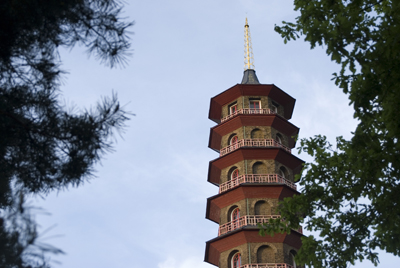
News this week that Historic Royal Palaces and the Royal Botanic Gardens are embarking on a two year project to restore eighty decorative dragons to the Kew Pagoda has led us to take a look at the history of the exotic tower set amid the trees.

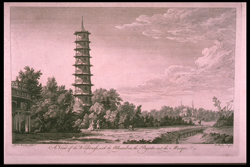
pagoda15Designed by architect Sir William Chambers (one of his drawings is depicted here), the pagoda was built in 1762 during the eighteenth century craze for Chinoiserie and was probably commissioned by Princess Augusta as part of the ongoing works she undertook in the gardens after the death of her husband Prince Frederick, eldest son of King George II and Queen Caroline.

Standing 163 feet (or almost 50 metres) high, the 10 storey pagoda was originally decorated with eighty golden dragons. It was designed to be the high point of a world tour through the gardens which also took in Roman ruins and Arabic mosques.

While the pagoda remains, the dragons were only on the structure for some 22 years before being removed in 1784 during roof repairs. Thanks to rumours they were made of solid gold, it was suggested they were sold off to pay the debts of the Prince Regent (the future King George IV), but experts say the wooden figures had simply rotted and so had to be removed.

Following their removal, the dragons subsequently disappeared and despite several attempts to find them – including one by Decimus Burton, architect of the famous Palm House (for more on that, see our earlier post), in 1843 – they have never been found.

Historic Royal Palaces and the Royal Botanic Gardens have now decided to replace them with new ones, drawing on contemporary accounts and drawings and using a team of specialist craftsmen to create them.

The restored pagoda – complete with new dragons – will be open to the public in 2017.

It is one of several ornamental buildings still located in the gardens. Others include a Japanese gateway and a Japanese wooden house called a minka.

WHERE: The Great Pagoda, Kew Gardens (nearest Tube station is Kew Gardens); WHEN: 10am daily (closing times vary – see websites for details); COST: £16.50 adults/£13 concessions/children £3.50 (discounts apply for online bookings); WEBSITE: www.kew.org.

PICTURES: RBG Kew

This Week in London – London Festival of Architecture’s ‘Work in Progress’; objects and sestudes at the Foundling Museum; and, sculpting Sir Tim Berners-Lee…

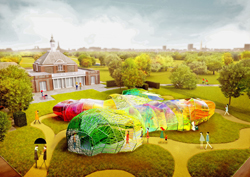
SerpentineThe month-long London Festival of Architecture is underway with this year’s theme ‘Work in Progress’. Highlights of this year’s programme – which includes 220 exhibitions, installations, talks and tours – include a discussion at this year’s Serpentine Gallery (pictured) by architects SelgasCano, access to development sites including Olympic Park, Goodman’s Fields, and Nine Elms, a London Transport Museum tour of London’s first skyscraper, an installation exploring the role of coffee shop as workspace by the Not to Scale Collective, and a Routemaster tour of the West End. For more, including a downloadable PDF of the programme, see www.londonfestivalofarchitecture.org.

A series of  26 ‘sestudes’ – texts exactly 62 words long – are being displayed along with the objects that inspired them in a new exhibition, 26 Pairs of Eyes, at The Foundling Museum in Bloomsbury. The sestudes have been written by the likes of former Poet Laureate Sir Andrew Motion in a bid cast new light on the objects, which are all from the museum’s collection and which range from a pencil which once belonged to Hospital Secretary John Brownlow to George Frideric Handel’s will. The display, which opens today, is on show until 6th September. Meanwhile the museum is also hosting another exhibition, Lines of Beauty, which explores the tradition of decorative plasterwork including the restored Rococo splendour of the hospital’s Court Room (donated by William Wilton in the 1740s and saved when the Foundling Hospital building was demolished in the 1920s). Admission charges apply. For more, see www.foundlingmuseum.org.uk.

A new portrait of the inventor of the World Wide Web, Sir Tim Berners-Lee, has been unveiled at the National Portrait Gallery. The work of Sean Henry, the painted bronze sculpture depicts a two-thirds life size Berners-Lee carrying the leather rucksack in which he keeps his laptop. It was commissioned to mark Sir Tim’s 60th birthday and is the gallery’s first commissioned portrait sculpture for seven years. On display in Room 40. Admission is free. For more, see www.npg.org.uk.

Send all items for inclusion to exploringlondon@gmail.com.

10 sites from London at the time of the Magna Carta – 5. Lambeth Palace…

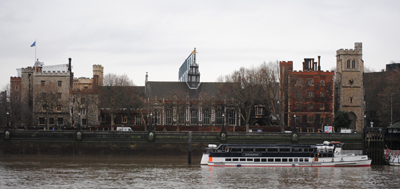
Lambeth-palaceThe London residence of the Archbishop of Canterbury, Lambeth Palace was first acquired by the archbishopric in around the year 1200 with Archbishop Stephen Langdon – an important figure in the whole Magna Carta saga – believed to be the first to have lived there.

Lambeth-Palace2The complex built in the early 13th century included a chapel, a great hall, a ‘great chamber’ where the archbishop would receive guests, and private apartments for Archbishop Langdon, who was appointed to the archbishopric in 1207 and remained in the post until his death in 1228 (his appointment was a major point of contention between King John and Pope Innocent III and a key factor in the dispute which led to the creation of the Magna Carta).

Not much remains of the original palace but the sections that do include the originally free-standing Langdon’s Chapel (although now much altered and connected to the rest of the complex) and the crypt beneath it (described as one of the best preserved medieval stone vaults in London it is now a chapel but was originally used for the storage of wine and beer).

They are both believed to have been completed in about 1220 with the other buildings now present added later over the centuries.

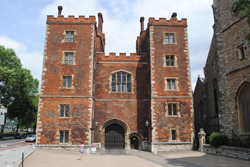
These include the formidable red brick gatehouse that fronts the complex today – known as Morton’s Tower, it is named after Archbishop Cardinal John Morton and dates from 1490 – while the Guard Room, which has its origins in the archbishop’s ‘great chamber’, dates from the 14th century and the infamous Lollard’s Tower – used as a prison in the 17th century – from the 15th century.

The Great Hall – now used as a library, first established in 1610 – was rebuilt in the mid 17th century although it is believed to stand on the site of that first used by Langdon (we’ll deal more with the later history of Lambeth Palace in a later post).

WHERE: Lambeth Palace, corner of Lambeth Palace Road and Lambeth Road (nearest tube stations are Westminster, Waterloo, Vauxhall, and Lambeth North); WHEN: Guided tours (90 minutes) only – check website for details; COST: £12 a person plus £2.95 booking fee (under 17s are free); WEBSITE: www.archbishopofcanterbury.org/pages/about-lambeth-palace.html.

Famous Londoners – Larry the Chief Mouser…

It’s not often that we feature living people in ‘Famous Londoners’, but this prominent figure, albeit not a human, deserves special mention.

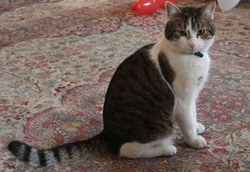
Larry_the_cat_No10A resident of Number 10 Downing Street in Whitehall, Larry the cat is officially Chief Mouser to the Cabinet Office – a position for which he has won accolades (and, at times, reproaches, for a seeming lack of action in the face of invasion – this includes, most recently the arrival of a heron at the residence, with Larry nowhere to be found).

Larry arrived at Downing Street (then home to Conservative PM David Cameron) in February, 2011, then a four-year-old tabby who came from the Battersea Dogs & Cats Home in south London and was apparently recruited to deal with a rodent problem after they were spotted in news broadcasts behind correspondents. It was June, some four months later, before he apparently made his first kill.

Larry has had an at times prickly relationship with the media – it started soon after his arrival at Downing Street when he scratched ITV reporter Lucy Manning who was trying to get him to pose for a news item (you can see it here).

He’s also apparently had some run-ins with visiting dignitaries – although US President Barack Obama apparently was able to stroke him without incident – and with Freya, Chancellor George Osborne’s cat (who has since been exiled to Kent).

Larry isn’t the first cat to live at Downing Street – his predecessors include Wilberforce who lived there for 18 years during the tenure of PMs including Edward Heath, Harold Wilson, Jim Callaghan, and Margaret Thatcher, and Humphrey, who served Ms Thatcher, John Major and, briefly Tony Blair, before he retired in 1997. But Larry is the first who has officially held the title of Chief Mouser to the Cabinet Office.

PICTURE: HM Government (via Wikipedia).

This Week in London – Spices the centre of attention at Kew; and, the museum explored at the V&A…

RickshawsThe botanical origins of the spices which continue to excite our palates have centre stage at a new festival which kicked off at Kew Gardens last week. The Full of Spice festival brings their stories to life through a series of interactive installations and exhibitions. Visitors are invited to come face-to-face with nutmeg, turmeric and tamarind in the Palm House, join in the bartering at a ‘Spice Exchange’, take part in hands-on sessions with Kew scientists and explore different parts of the world on ‘Spicy’ Saturdays and Sundays. You can also book a ride on a rickshaw, see the innards of giant inflatable spices, take part in the Strictly Spice Dance competition or simply hang out with a spiced No.3 gin cocktail at a pop-up ‘Botanical Bar’ on weekends. The festival runs until 6th September. For a comprehensive listing of events and activities (of which the above is just a portion), head to www.kew.org. PICTURE: RBG Kew.

On Now: All of This Belongs to You. This free exhibition at the V&A in South Kensington examines the role as a museum as a public space and that of public institutions in contemporary life. Distributed across both the physical and online spaces of the V&A, the exhibition comprises four site-specific installations, three displays, two online commissions as well as weekly events. More than 40 new acquisitions have been made for the project and loaned objects on display include hard-drives that held documents leaked to the Guardian newspaper by whistleblower Edward Snowden. Runs until 19th July. For more, see www.vam.ac.uk/allofthisbelongstoyou.

Send all items for inclusion to exploringlondon@gmail.com.

10 sites from London at the time of the Magna Carta – 4. Thorney Island…

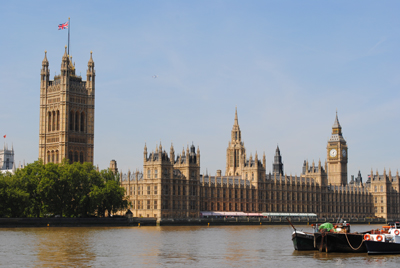
Houses-of-Parliament2 Both Westminster Abbey and the Palace of Westminster (these days better known as the Houses of Parliament – pictured) pre-date 1215 but unlike today in 1215 the upon which they stood was known as Thorney Island.

Formed by two branches of the Tyburn River as they ran down to the River Thames, Thorney Island (a small, marshy island apparently named for the thorny plants which once grew there) filled the space between them and the Thames (and remained so until the Tyburn’s branches were covered over).

One branch entered the Thames in what is now Whitehall, just to the north of where Westminster Bridge; another apparently to the south of the abbey, along the route of what is now Great College Street. (Yet another branch apparently entered the river near Vauxhall Bridge).

The abbey’s origins go back to Saxon times when what was initially a small church – apparently named after St Peter – was built on the site. By 960AD it had become a Benedictine monastery and, lying west of what was then the Saxon city in Lundenwic, it become known as the “west minster” (St Paul’s, in the city, was known as “east minster”) and a royal church.

The origins of the Palace of Westminster don’t go back quite as far but it was the Dane King Canute, who ruled from 1016 to 1035, who was the first king to build a palace here. It apparently burnt down but was subsequently rebuilt by King Edward the Confessor as part of a grand new palace-abbey complex.

For it was King Edward, of course, who also built the first grand version of Westminster Abbey, a project he started soon after his accession in 1042. It was consecrated in 1065, a year before his death and he was buried there the following year (his bones still lie inside the shrine which was created during the reign of King Henry III when he was undertaking a major rebuild of the minster).

Old Palace Yard dates from Edward’s rebuild – it connected his palace with his new abbey – while New Palace Yard, which lies at the north end of Westminster Hall, was named ‘new’ when it was constructed with the hall by King William II (William Rufus) in the late 11th century.

Westminster gained an important boost in becoming the pre-eminent seat of government in the kingdom when King Henry II established a secondary treasury here (the main treasury had traditionally been in Winchester, the old capital in Saxon times) and established the law courts in Westminster Hall.

King John, meanwhile, followed his father in helping to establish London as the centre of government and moved the Exchequer here. He also followed the tradition, by then well-established, by being crowned in Westminster Abbey in 1199 and it was also in the abbey that he married his second wife, Isabella, daughter of Count of Angouleme, the following year. 
What’s in a name?…Houndsditch…

This City of London thoroughfare runs between St Botolph and Outwich Streets and its name – first recorded in the 13th century – apparently relates to its location on the outer side of the wall, dating from the Roman era, which once encircled the city.

HoundsditchOn the outer side of the wall lay a ditch which, although filled and redug several times in its history, was eventually filled permanently in the 16th century (and became the street you can now walk upon).

Dogs were associated with this ditch – the skeletons of some dogs were found here in 1989 during an archaeological dig at the wall, possibly dating back to Roman times – although there’s a couple of theories on exactly how.

According to one version, the ditch, before it was finally filled, had become the repository of all sorts of rubbish but was particularly known as a site to deposit the corpses of dogs. An alternate theory, meantime, suggests that kennels which housed dogs used in hunting were once located here.

The name ‘houndsditch’ was apparently used for many sections of the ditch which lay outside the city wall before it came to be associated with this particular stretch of ditch.

The street (and the area in which it sits, also known as Houndsditch) has apparently been associated with several different trades over its history including bell founding, gunmaking and cannon founding and, later for the rag trade. In the 20th century, it was the site of department store, The Houndsditch Warehouse.

It was in Houndsditch that Dr Thomas Barnardo found 11 boys sleeping huddled together on the roof of the old rag market – a fact which helped push him to found the first of the Barnardo’s homes for the destitute in Stepney.

Famously, of course, it was also the scene of an attempted robbery and shoot-out in 1910 which led to the infamous Siege of Sidney Street (see our earlier post here).

For more on the Houndsditch murders, see Donald Rumbelow’s The Houndsditch Murders and the Siege of Sidney Street.

Lost London – East India House…

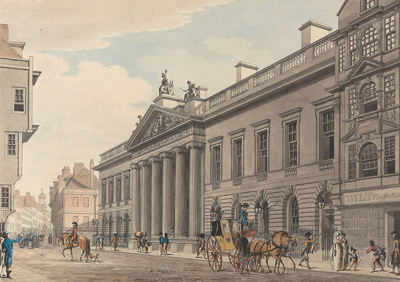
East-India-HouseThe headquarters of the East India Company, the ‘New’ East India House, was built in the 1720s at the corner of Leadenhall and Lime Streets on the site of what had been a late Elizabethan mansion known as Craven House.

The company, which was founded in 1600, was housed in several different properties (including Crosby Hall – now located at Chelsea) until it moved into Craven House in 1648 – built by a former Lord Mayor, Sir Robert Lee, and named after one of its later occupants Sir William Craven. In 1661 an ornamental wooden structure featuring paintings of some of the Company’s ships and a wooden sculpture of a seaman, was added to the facade of the building.

By the 1720s, the mansion was crumbling and so construction began on a new building on the site designed by Theodore Jacobsen (the Company was relocated to a temporary premises in Fenchurch Street while it was built).

The three storey building on Leadenhall Street was designed with five bays and beyond the facade featured grand meeting rooms including the Directors’ Court Room, offices for the directors as well as a hall, courtyard, garden and warehouses. Famous art works inside included the fresco The East Offering its Riches to Britannia by then little known Greek artist Spiradone RomaThe East Offering its Riches to Britannia which once adorned the ceiling of the Revenue Committee Room (it’s now in the collection of the British Library).

The building was renovated and extended significantly in the 1790s creating what was essentially a grand new neo-classical building. Among the new additions – although it seems a matter of some debate the building was apparently designed by Henry Holland with the work was overseen by the Company’s surveyor Richard Jupp until his death in 1799 – were a museum and library. A new pediment topped by Brittania dominated the facade.

When the East India Company was wound up in 1858 after the Indian Mutiny its assets were transferred to the government and the building briefly became home to the India Office (which subsequently moved to a new purpose-built building which still stands in Whitehall).

In 1861, the building was sold for redevelopment and subsequently demolished. Many of its fittings, art collection and furnishings were transferred elsewhere including the British Library, V&A and the Foreign and Commonwealth Office in Whitehall where many of the fittings of the Directors’ Court Room – including a great marble chimneypiece – were reused.

The location of the property is now covered by the landmark Lloyd’s building with little to indicate such a grand premises had once stood here.

PICTURE: The extended East India House in about 1800, by Thomas Malton the Younger (1748-1804)/via Wikipedia.

For more on the history of the East India Company, see John Keay’s The Honourable Company: A History of the English East India Company.

This Week in London – London Tree Week kicks off; illustrated London at the LT Museum; and, Joshua Reynolds at the Wallace Collection…

London Tree Week kicks off on Saturday with a range of free events happening across the city. They include ‘tree walks’ in Richmond and Greenwich Royal Parks, a tour of paintings featuring trees at the National Gallery in Trafalgar Square, an exhibition at City Hall featuring some of the city’s great trees, and family-friendly activities at Stave Hill Ecological Park in the city’s south-east. Londoners can also download a free ‘Tree Route’ app which uses the Tube map to showcase the capital’s trees including “must see” trees located near Underground stations such as St Pauls (a swamp cypress) and Angel (a black poplar). There’s also a photo sharing challenge where you can upload photos of trees that have made a difference to your part of London to Instagram or Twitter using the hashtag #LondonTreeWeek. For the complete listing of what’s on, follow this link. Runs until 31st May.

One hundred illustrations capturing a variety of aspects of life in London form the heart of an exhibition, The Prize for Illustration 2015: London Places & Spaces, which has opened at the London Transport Museum in Covent Garden. The artworks – which range from the past to the present and the contemplative to the loud – are all on the shortlist for the prestigious Prize for Illustration and were selected from more than 1,000 entries. Each of the works is accompanied by a short description written by the artist. The works are on show until 6th September. Admission charge applies. For more, see www.ltmuseum.co.uk.

On Now – Joshua Reynolds: Experiments in Paint. Now entering its final days, this exhibition at the Wallace Collection in Marylebone provides a fresh perspective on a giant of the British art world, 18th century portraitist Joshua Reynolds and features such famous works as Nelly O’Brien, Mrs Abingdon as Miss Prue, and Self Portrait Shading the Eyes. Admission is free. Runs until 7th June. For more information, see www.wallacecollection.org.

Send items for inclusion to exploringlondon@gmail.com

LondonLife – Blooming beauty at Chelsea…

Chelsea4

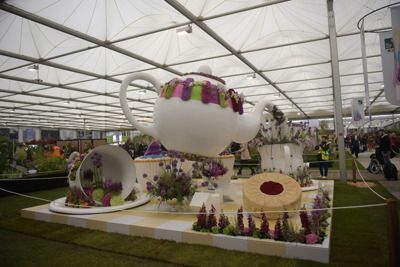
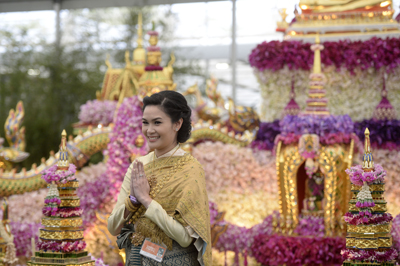
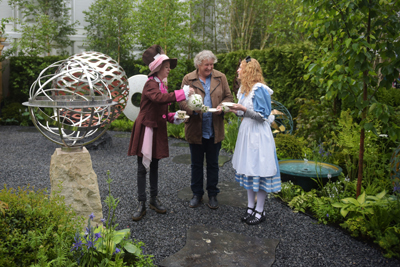
The RHS Chelsea Flower Show opened in London’s west this week so we thought we’d take a look at some of the treasures on show. The show, which is in its 102nd year, has been held in the grounds of the Royal Hospital Chelsea since 1913 (except during the two World Wars) and while its claim to be Britain’s largest flower show has been lost to the RHS Hampton Court Palace Flower Show, it remains the nation’s most prestigious. The five day show runs until Saturday. From the top – Chelsea pensioners look at ‘Peter Beales Roses’ in the Great Pavilion; the Inter-flora display in the Great Pavilion; a model poses in front of the Thailand, Land of Buddhism display; and, award-winning garden sculptor David Harber hosts the Mad Hatter’s tea party. For more on the show, visit www.rhs.org.uk/shows-events/rhs-chelsea-flower-show PICTURES: RHS/Hannah McKay and RHS.


Chelsea3

Chelsea2

Chelsea1

London Pub Signs – The Lamb & Flag…

We’ve mentioned this Covent Garden pub, redolent with history as it is,  before but we thought it worth a second look.

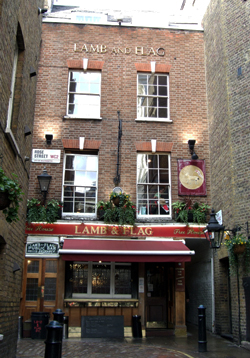
Lamb-and-FlagThere’s not much mystery surrounding the origins of the name – the Christian symbolism of the sign is fairly obvious and the symbol, which was used by the Templars and is also that of the Middle Temple, was apparently a reasonably common one for pubs. But the Lamb & Flag hasn’t always been its name.

While there’s been a pub on the site dating as far as back as the 17th century (the building was survivor of the Great Fire of 1666), it was apparently only named the Lamb & Flag in 1833.

Prior to that it was apparently known as the Cooper’s Arms (in what we assume was a reference to barrel-makers) and at one time in its long history was nick-named the ‘Bucket of Blood’ thanks to the location being used for prizefights.

The core of the present, Grade II-listed, building at 33 Rose Street is said to date from 1772, but the brick facade is 20th century. A narrow passageway known as Lazenby Court, which dates from the late 17th century and connects Rose Street to Floral Street, runs alongside it.

Regular patrons have included author Charles Dickens (one of the many London pubs he apparently attended not infrequently) and other famous associations include the poet John Dryden – he is famously associated with Rose Street thanks to the fact he was beaten up there twice in 1679 after upsetting people with his satires (the pub’s upstairs room is named after him).

For more on the pub, see www.lambandflagcoventgarden.co.uk.

PICTURE: Ewan Munro, Flickr (CC BY-SA 2.0)

This Week in London – Dunkirk Little Ships at Royal Docks a highlight of ‘Museums at Night’; the Magna Carta in stitches; and Peter Kennard’s works on show…

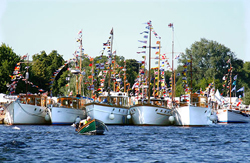
Dunkirk-Little-Ships-More than 20 Dunkirk Little Ships will gather at London’s Royal Docks this weekend ahead of their Return to Dunkirk journey marking the 75th anniversary of the Dunkirk evacuations. The event, which is part of the UK’s annual festival of late openings Museums at Night, will see the ships parade around Royal Victoria Dock on Saturday night with the Silver Queen offering twilight trips and the chance to step on board some of the other ships (the Little Ships will continue with their own festival on Sunday commencing with a church service by the quayside at 11am). Other events being offered in London as part of Museums at Night include ‘Dickens After Dark’ in which the Charles Dickens Museum will open its doors to visitors for night of Victorian entertainment on Friday night and a night of music featuring the Royal College of Music at Fulham Palace (also on Friday night). Among the other London properties taking part are the Handel House Museum, Benjamin Franklin House, the Wellcome Collection, Museum of the Order of St John, and the National Archives in Kew. For a full list of events, check out http://museumsatnight.org.uk

Meanwhile, Dulwich Picture Gallery in south London is holding its first weekend culture festival, MayFest: Men of Mystery, as part of Museums at Night. On Friday and Saturday nights, there will be tours of the gallery’s new exhibition featuring the work of artist Eric Ravilious followed by outdoor cinema screenings of Alfred Hitchcock’s Rear Window and The 39 Steps as well as free swing dance lessons, street foods and a pop-up vintage shop which will help people get the vintage look. Visitors are being encouraged to dress up in styles of the 1930s and 1940s with a prizes awarded to those with the “best vintage style”. The gallery will also be inviting visitors to take part in a mass installation drop-in workshop held in the gallery’s grounds over the weekend and Saturday morning will see special events for children. For more, see www.dulwichpicturegallery.org.uk/whats-on/.

A major new work by acclaimed artist Cornelia Parker goes on display in the entrance hall of the British Library in King’s Cross tomorrow to mark the 800th anniversary of the Magna Carta. The almost 13 metre long Magna Carta (An Embroidery) replicates the entire Wikipedia entry on the Magna Carta as it was on the 799th anniversary of the document and was created by many people ranging from prisoners and lawyers to artists and barons. It accompanies the library’s exhibition Magna Carta: Law, Liberty, Legacy. Entry to see the artwork is free. For more, see www.bl.uk/cornelia-parker.

The works of Peter Kennard, described as “Britain’s most important political artist”, are on display in a new exhibition which opens at the Imperial War Museum in London today. Peter Kennard: Unofficial War Artist is the first major retrospective exhibition of his work and features more than 200 artworks and other items drawn from his 50 year career including an art installation, Boardroom, created especially for the display. Works on show include his iconic transposition of Constable’s painting Haywain which he showed carrying cruise missiles about to be deployed in Greenham Common, the Decoration paintings created in 2004 in response to the Iraq War of 2003, his seminal STOP paintings which reference events of the late 1960s such as the ‘Prague Spring’ and anti-Vietnam war protests and his 1997 installation Reading Room. The free exhibition runs at the Lambeth institution until 30th May next year. For more, see www.iwm.org.uk/london.

Send all items for inclusion to exploringlondon@gmail.com.