LondonLife: Those Christmas Lights (part two)…

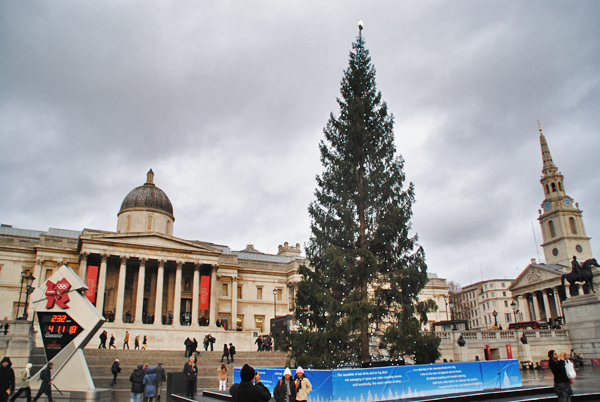
The Trafalgar Square Christmas Tree – donated  by the people of Oslo each year since 1947 as a thanks for the support Britain gave to Norway during World War II. On the left is the Olympic countdown clock.

A giant hedge-like reindeer outside Covent Garden, a market since at least the 1600s but once the site of a large kitchen garden for the monks of the Convent of St Peter, Westminster (see our earlier post for more).

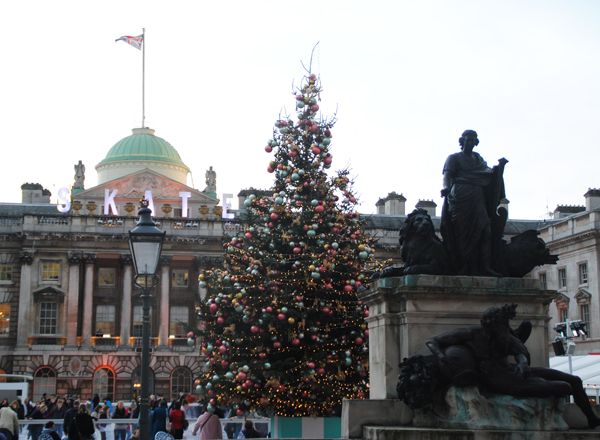
Christmas tree near the ice-skating rink at Somerset House, now an arts and cultural centre but originally built on the site of a Tudor palace in the late 1770s as a home for three “learned societies” – the Royal Academy of Arts, the Royal Society, and the Society of Antiquaries – as well as government offices (including the Navy Board).

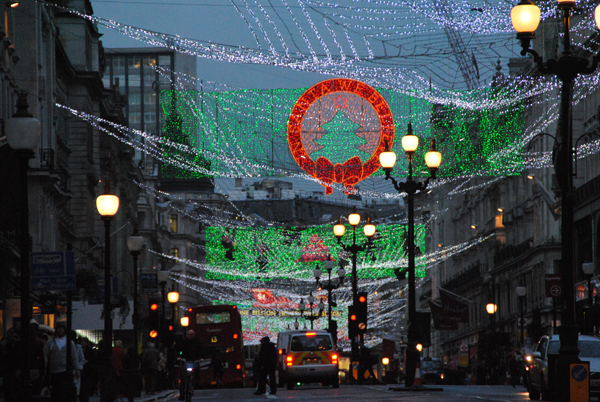
Christmas lights in Regent Street, one of the city’s premier shopping streets, in the West End. It’s current shape was designed by architect John Nash in the early 19th century.

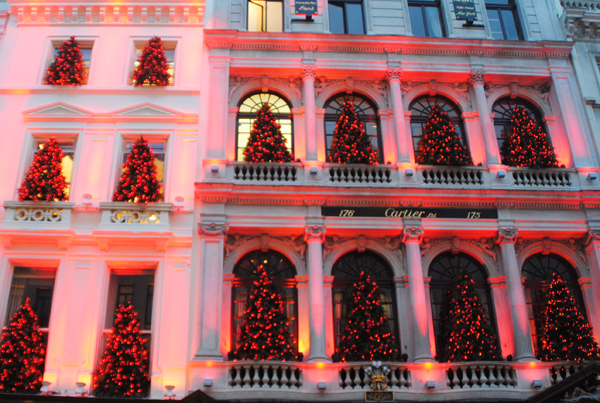
Christmas decorations on the exterior of Cartier in Old Bond Street, Mayfair. The area takes its name from the May Fair once held there and is now one of the most expensive areas within London (see our earlier post for more).

Looking for a book about London? See The Exploring London Little List of Books for Christmas…

LondonLife – Those Christmas lights…

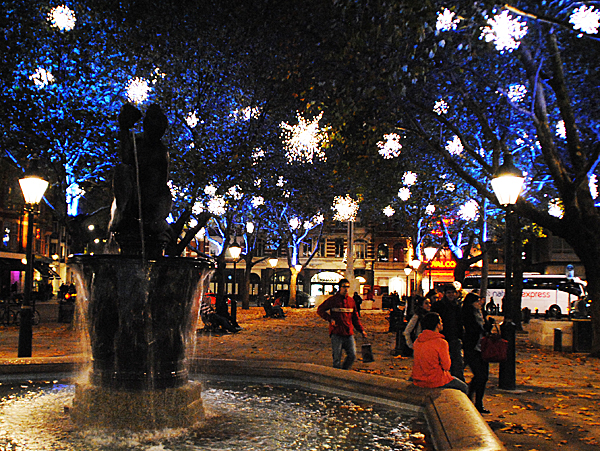
And so Christmas is on our doorstep. The Christmas lights in the West End were officially turned on last week and lights have started appearing all over the city, including in Sloane Square (pictured) in the city’s west, where the treetops are all a glitter. The square was named for Sir Hans Sloane (see our earlier post on him here). We’re looking for your pictures of London’s Christmas lights to post here over the coming weeks. Simply send in pictures to exploringlondon@virginmedia.com and we’ll post the best of them!

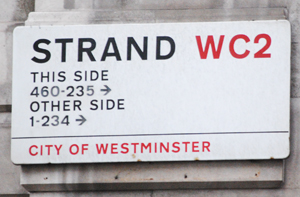
What’s in a name?…Strand

Now one of the major thoroughfares of the West End, the origins of the roadway known as the Strand go back to the Roman times leading west out of the city.

Later part of Saxon Lundenwic which occupied what is now the West End, it ran right along the northern shore of the Thames and so became known as the Strand (the word comes from the Saxon word for the foreshore of a river). During the following centuries the river was pushed back as buildings were constructed between the road and the river, leaving it now, excuse the pun, ‘stranded’ some distance from where the Thames flows.

Sitting on the route between the City of London and Westminster, seat of the government, the street proved a popular with the wealthy and influential and during the Middle Ages, a succession of grand homes or palaces was built along its length, in particular along the southern side.

All are now gone but for Somerset House – originally the home of the Dukes of Somerset, it was built in the 16th century but rebuilt in the 18th century after which it served a variety of roles including housing the Navy Office, before taking on its current role as an arts centre. Others now recalled in the names of streets coming off the Strand include the Savoy Palace, former residence of John of Gaunt which was destroyed in the Peasant’s Revolt, and York House, once home of the Bishops of Norwich and later that of George Villiers, favorite of King James I (see our earlier Lost London entry on York Watergate for more).

After the aristocracy decamped further west during the 17th and 18th centuries, the road and surrounding area fell into decline but was resurrected with a concerted building effort in the early 19th century (this included the creation of the Victoria Embankment which pushed the Thames even further away) which saw it become a favorite of the those who patronised the arts, including the opening of numerous theatres. Among those which still stand on the Strand today are the Adelphi and Savoy Theatres (this was apparently the first in London to be fitted with electric lights and sits on a site once occupied by the Savoy Palace).

Among the other landmarks along the Strand are the churches of St Mary-le-Strand (the present building which sits on what amounts to a traffic island) dates from 1717 and was designed by James Gibbs, and St Clement Danes, designed by Sir Christopher Wren and completed in 1682 (it is now the Central Church of the Royal Air Force). The Strand is also home to the Victorian-era Royal Courts of Justice (it boasts more than 1,000 rooms), Australia House (home of the oldest Australian diplomatic mission), the Strand Palace Hotel (opened in 1907) and Charing Cross Railway Station.

Where’s London’s oldest…(still-in-use) theatre?

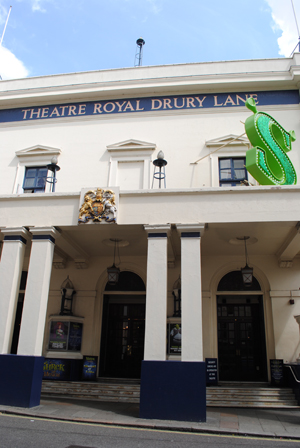
While the remains of some of London’s oldest purpose-built theatres – such as The Rose and The Globe – can be found in once notorious Southwark, London’s oldest, still-in-use theatre is in fact in the West End. The Theatre Royal Drury Lane (not to be confused with the Theatre Royal Haymarket) apparently takes the honor – the latest incarnation of a theatre which has still on the same location since 1663.

First built on the orders of Restoration-era dramatist and theatre manager Thomas Killigrew, the original theatre on the site – where King Charles II’s mistress Nell Gwynn apparently trod the boards and which was originally known as the Theatre Royal in Bridges Street – was burnt down in 1672 only to be rebuilt to the designs of Sir Christopher Wren two years later.

This building lasted for more than a century before it too was demolished – this time to make way for a larger theatre which opened its doors in 1794. Fire seems to have been a perennial problem, for it too burned down in 1809, being rebuilt and opened again in 1812 with a performance of Hamlet (the current building, designed by BenjaminWyatt).

Now owned by star composer Andrew Lloyd Webber via his Really Useful Group, the building has associations with some of London’s theatreland’s finest names – everyone from eighteenth century actor David Garrick (one of the theatre’s managers) to early nineteenth century child actress Clara Fisher and, in more recent times, Monty Python.

Currently hosting Shrek: The Musical, other recent productions there have included Miss Saigon and a musical adaption of Lord of the Rings.

Around London – Ronald Reagan unveiled, two ways in Pall Mall, Hungarian photography at the RA, and a celebration of the Arab world…

A new statue of former US President Ronald Reagan was unveiled in Grosvenor Square near the US embassy on Monday, 4th July. The 10 foot tall bronze statue of the president, who died in 2004, was unveiled at a private ceremony by the Foreign Secretary William Hague – former US Secretary of State Condoleezza Rice were also among the more than 2,000 people who attended along with current US ambassador Louis Susman (a frail Margaret Thatcher was reportedly too frail to attend). Commissioned by the Ronald Reagan Presidential Foundation, the statue is the work of sculptor Chas Fagan. Its unveiling is one of a series of events marking the centenary of the birth of the former actor turned politician.

Pall Mall and St James Street in the West End were opened to two-way traffic this week for the first time in 50 years. The changeover came into effect last Sunday morning. The roads were made one-way in 1963 under a scheme to deal with increasing traffic in the area. But it has been reopened in the first stage of a £14 million overhaul of traffic around Piccadilly Circus – home to world-famous neon billboards and the Eros Statue. The area is visited by 200,000 every day.

Time to get your togs on. Scores of swimmers will be taking the plunge at the Hampstead Heath Lido tomorrow and Saturday to raise funds for the Lord Mayor’s Appeal, Bear Necessities. A 4,000 metre swim, the City Dip, will be swum by teams and individuals with every swimmer receiving a commemorative certificate and medal. The current Lord Mayor of London is Michael Bear. To sign up or for more information, see  www.lordmayorsappeal.org.uk/dip

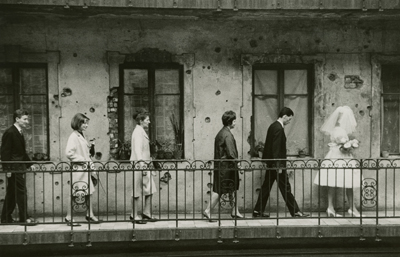
On Now: Eyewitness: Hungarian Photography in the 20th Century – Brassaï, Capa, Kertész, Moholy-Nagy, MunkácsiThis new exhibition at the Royal Academy of the Arts at Burlington House in Piccadilly, organised to mark the Hungarian Presidency of the EU, is dedicated to the birth of modern photography and features the work of Brassaï, Robert Capa, André Kertész, László Moholy-Nagy and Martin Munkácsi. It comprises more than 200 photographs, dating from 1914 to 1989, which usually form part of the collection of the Hungarian National Museum of Photography as well as the National Museum in Budapest and other public and private collections in both Hungary and the UK. Runs until 2nd October. For more information, see www.royalacademy.org.ukPICTURE: Laszlo Fejes, Wedding, Budapest, 1965, Copyright Hungarian Museum of Photography.

On Now: Shubbak: A Window on Contemporary Arab Culture. London’s first ever celebration of contemporary culture from across the Arab world will feature more than 100 artists involved in 70 events at some 30 venues over the weeks until 24th July. The program includes visual arts, film, music, theatre, dance, literature, architecture, lectures and discussions with many events boasting free admission. Highlights include A Girl in her Room, an exhibition of photo works by highly acclaimed Lebanese/American artist, Rania Matar, at the Mosaic Rooms, one of London’s leading centres for Arab contemporary arts (runs until 23rd July), Shopopolis, a series of collaborations with shoppers at Westfield Shopping Centre (runs until 24th July) and this weekend’s Interference, a series of free films, talks and workshops at the ICA curated by Mathaf: Arab Museum of Modern Art in Doha. For full details of all events, see www.london.gov.uk/shubbak.

Around London – Captain Kidd at Docklands; London’s Olympic Torch Relay path; St Giles’ seedy past; speech therapist Lionel Logue honored; and, The Seven Seas at Selfridges…

The true story of Captain Kidd and an exploration of London’s links with piracy is the focus of a new major exhibition at the Museum of London Docklands. Pirates: The Captain Kidd Story features original artefacts dating from 300 years ago when London was a site of pirate executions and tells the story of the infamous Captain Kidd’s life until his execution at Wapping’s Execution Dock. Among the artefacts is the original costume worn by actor Johnny Depp as he played Captain Jack Sparrow in the film Pirates of the Caribbean. The exhibition, which opens tomorrow and runs until 30th October, is being held in conjunction with a series of pirate related events including an adults-only pirate night on 27th May where you have the chance to sample some genuine “pirate drink” and take part in pirate speech lessons. Admission charges apply. For more information, visit the Museum of London Docklands website www.museumoflondon.org.uk/Docklands/Whats-on/Exhibitions-Displays/Pirates.htm.

The path of London’s Olympic Torch Relay has been announced and will finish with a week long jaunt through London. The torch will arrive in Waltham Forest on 21st July next year and then pass through Bexley, Wandsworth, Ealing, Haringey and Westminster before its arrival at the Olympic Stadium on 27th July. To find out how to nominate someone to carry the torch or for more information on the relay, visit www.london2012.com/olympic-torch-relay.

• On Now: London’s Underworld Unearthed: the Secret Life of the Rookery. The seedy side of the St Giles Rookery, a once infamous quarter of the capital, is laid bare in this new exhibition at the Coningsby Gallery. Back in 1751, the area was known as “a pit of degradation, poverty and crime” known for its free-flowing gin. Artist Jane Palm-Gold has displayed 18th and 19th century artifacts found during the Museum of London Archaeology’s recent excavation of old St Giles (conducted prior to the construction of the recent Central St Giles development which now covers the site) alongside her paintings, building what has been described as a “multi-layered psycho-geography that both mesmerises and disturbs”. Runs until 3rd June at the Coninsby Gallery at 30 Tottenham Street (nearest tube station is Goodge Street). Admission is free. For more information, see www.coningsbygallery.com

Australian speech therapist Lionel Logue – known for having helped cure King George VI of his stammer, the story of which is told in the recent Oscar-winning film, The King’s Speech – has been honored with a green plaque by Westminster Council. The plaque was expected to be unveiled today at 146 Harley Street, where Logue, who is known to have used fees from wealthier client to subsidise free treatments for those who could not afford them, lived from 1926 until 1952. The plaque is one of 94 which Westminster Council has placed to mark buildings of particular significance for their association with people who have made lasting contributions to society.

• On Now: The Seven Seas at Selfridges in Oxford Street. Conceptual artist Beth Derbyshire’s seven minute video installation features seven films of seven different seas around the globe. On show as part of Project Ocean – an initiative by Selfridges and 20 environmental and conservation groups aimed at celebrating the ocean’s beauty and highlighting the issue of overfishing. Runs until 8th June. For more information, see www.selfridges.com.

What’s in a name?…Charing Cross

The West End location of Charing Cross is named after the large stone cross that once stood at the top of Whitehall on what is now the southern side of Trafalgar Square – a site currently occupied by a statue of King Charles I.

The cross – an embellished Victorian-era replica of which can be found standing outside Charing Cross Station in the Strand – was one of a series of 12 erected by King Edward I in 1291-94 to commemorate his wife Eleanor of Castile.

They marked the sites where her funeral cortege rested overnight as it made its way from near Lincoln where she died south to Westminster Abbey where she was to be buried (for more on the cross and the Victorian replica, see our previous post here).

The final of these ‘Eleanor Crosses’ – which were originally made from wood before being replaced with stone ones –  was erected on a site which stood in the medieval village of Charing, located between the City of London and Westminster. The cross was pulled down in the 1640s by order of Parliament. Since 1675, the statue of King Charles I (pictured, with Trafalgar Square, once the site of the royal mews, in the background) has occupied the site.

The word Charing is an Anglo-Saxon or “Old English” term and is believed to relate to the nearby bend in the River Thames.

Between the mid-1700s until the mid-20th century, the former site of the Charing Cross was the point from which all distances from London were measured. There was also a famous pillory located here.

Curious London Memorials – 5. Eros (or the Shaftesbury Memorial Fountain)

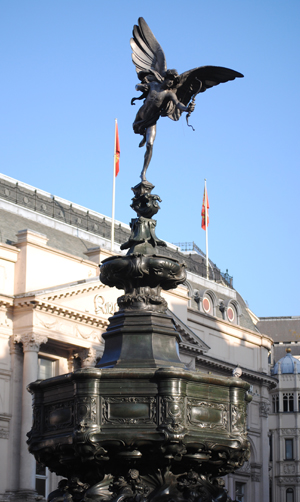
Situated in the heart of Piccadilly Circus, the Eros statue has become an icon of London. Yet few of those who cluster around this iconic figurine realise that the aluminium statue (a rarity in itself) is actually a memorial, not to mention that it wasn’t intended to represent Eros at all.

The monument – which also features a bronze fountain below – was erected in the late nineteenth century to commemorate Anthony Ashley-Cooper, the 7th Earl of Shaftesbury and a well-regarded Christian reformer and philanthropist of the Victorian era, and is formerly known as the Shaftesbury Memorial Fountain.

Designed by Alfred Gilbert and unveiled in 1893, the winged figure holding a bow was apparently actually intended to represent Eros’ brother, Anteros – a Greek god associated with selfless love as opposed to his brother Eros, who is associated with erotic love – and, according to some, bore the name The Angel of Christian Charity, which makes sense given the man whom it is intended to commemorate.

While the statue attracted controversy when it was first unveiled thanks not least to its nudity, it has stood in Piccadilly Circus ever since (or at least mostly ever since – there have been a couple of brief periods such as when it was moved while Piccadilly Underground station was built and during World War II when it was moved for safe-keeping). It was restored in the 1980s.

A copy of the fountain and statue by Gilbert was later placed in Liverpool’s Sefton Park.