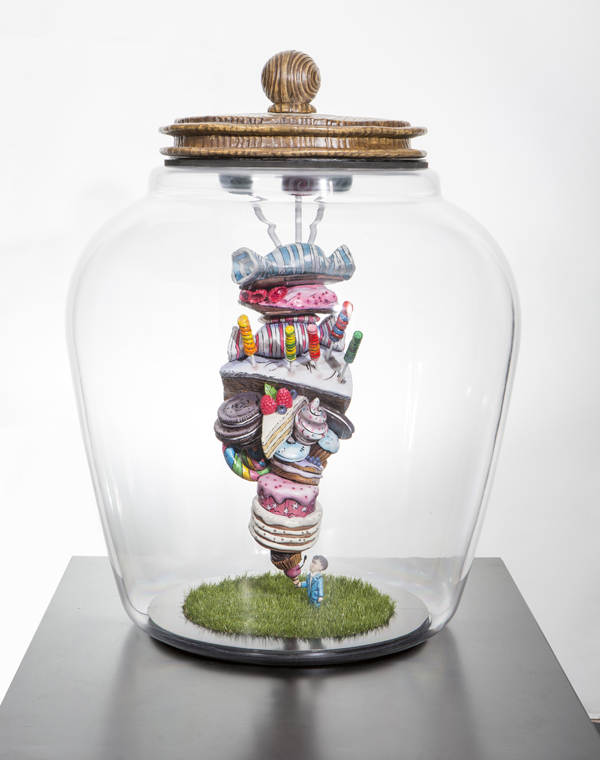
 Director Steven Spielberg, actor and playwright Mark Rylance, physicist Professor Stephen Hawking, TV personality Simon Cowell, and The Duchess of Cornwall are among 50 high profile personalities who have put their childhood dreams and aspirations on show around the country – including in London – to mark not only the release of the film The BFG but also the 100th anniversary of Roald Dahl’s birth. Launched last weekend, the ‘BFG Dream Jar Trail’ features a series of up-to-six-foot-tall ‘Dream Jars’, each of which contains a sculpture representing the childhood dreams of a different personality. The free trail – which takes in London sites such as Trafalgar Square, the Tower of London, Leicester Square, Harrods, Emirates Stadium and The Shard – has been created in support of the work of Save the Children and a specialist nursing programme supported by Roald Dahl’s Marvellous Children’s Charity with the jars to be auctioned in collaboration with Paddle8 later this year to raise money for both causes (the auction will be launched on the film’s premiere on 17th July). At least 34 jars have already gone on display with more to be unveiled in coming days. The joint creation of Save the Children, the Roald Dahl Literary Estate, Entertainment One and VisitLondon.com with support from Unilever, the trail can be seen until 31st August. To see the art trail map and discover the stories behind each jar and its location, head to www.visitlondon.com/bfg. For more on the 100th anniversary of Roald Dahl’s birth, head to www.roalddahl.com/roalddahl100. PICTURED: Above – director Steven Spielberg’s self-designed jar, on display in Leicester Square, illustrating his childhood fantasy of having all the sweets in the world but none of the ill effects from overindulgence.
Westminster
10 notable blue plaques of London – 8. A notorious ‘tree’ recalled…
To look at it, you wouldn’t necessarily imagine the memorial marking the former site of the ‘Tyburn Tree’ near Marble Arch was part of the English Heritage Blue Plaques scheme.
 But, located on the ground on a traffic island at the junction of Edgware and Bayswater Roads, this memorial commemorating the site of the former gallows at what was once London’s execution grounds (and those who died upon it) is just that.
It’s estimated by some that as many as 60,000 people may have been executed here over the 600 years until the late 1700s
While the plaque only mentions one of the names by which the various gallows erected here were known – Tyburn being the name of the village originally here, others included ‘The Elms’, the ‘The Deadly Never Green Tree’ and the ‘Triple Tree’, the latter presumably a reference to the famous three-sided gallows set up here during the reign of Queen Elizabeth I.
The last gallows was removed in 1759 when executions were moved into Newgate Prison (for more on the Tyburn Tree, see our earlier post here).
The plaque was erected on the site in 1964 by the London County Council; it replaced an earlier triangular plaque the council had erected here in 1909.
The memorial was restored and rededicated in a ceremony in 2014 with the placement of three oak trees around it (this picture was taken before the restoration).
There is a green City of Westminster plaque nearby which commemorates 105 Roman Catholic martyrs who lost their lives on the gallows between 1535 and 1681 while the deaths of the more than 350 Roman Catholics who died across England and Wales during the Reformation, including those on the Tyburn Tree, are also recalled in a shrine at the nearby Tyburn Convent.
London Pub Signs – St Stephen’s Tavern, Westminster…
The origins of the name of this pub apparently lie in something of a mistake (well, sort of).
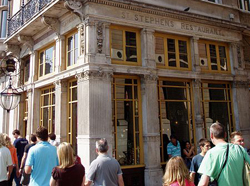 Located at 10 Bridge Street on the corner of Canon Row – just across the road from the clock tower at the north end of the Houses of Parliament, its name apparently lies in mistaken belief that the tower was named St Stephen’s Tower.
It never was, at least not officially. Prior to recently being renamed the Elizabeth Tower – in honour of Queen Elizabeth II’s 60 years on the throne, the tower, which contains the bell known as Big Ben, was simply known as the Clock Tower (another common error has been to call the tower itself Big Ben).
The name St Stephen’s Tower apparently was the fault of Victorian journalists. They had the habit of referring to stories relating to the goings-on in the House of Commons as “news from St Stephen’s” because MPs, prior to the destructive fire of 1834, used to sit in St Stephen’s Hall (the entrance to the hall can be found down the road opposite Westminster Abbey).
Hence we have St Stephen’s Tavern, a favoured watering hole of many politicians – including apparently PMs Stanley Baldwin, Winston Churchill and Harold MacMillan.
The pub has been around since at least Victorian times – it was demolished in 1868 when Westminster tube station being built and rebuilt a few years later. In 1924, the pub was expanded to take over the Queen’s Head next door.
It closed in the late 1980s but was reopened in 2003 with many of the original fittings restored. These include one of only 200 parliamentary division bells, located above the bar, which calls MPs back to parliament when it’s time for them to vote (tourists apparently often think it’s a fire alarm and flee when it goes off).
For more, see www.ststephenstavern.co.uk.
PICTURE: Ewan Munro/Flickr/CC BY-SA 2.0 (image cropped)
This Week in London – Commemorating the Battle of the Somme; Transported by Design; and, Winifred Knights at Dulwich…
 • The Imperial War Museum in Lambeth is holding a free late night opening tonight featuring live music, film screenings, immersive theatre and poetry to mark the 100th anniversary of the Battle of the Somme. Highlights of Night Before the Somme, which runs from 8pm to midnight tonight, include slam poet Kat Francois’ critically acclaimed play Raising Lazarus, poet and broadcaster Ian McMillan’s show Magic Lantern Tales, and extracts from the immersive production Dr Blighty – which tells the story of the million Indians who travelled to fight in the war. Visitors will also have the chance to watch the film, The Battle of the Somme (filmed and screened in 1916, it was the first feature-length documentary about war), listen in to a series of Q&A’s with experts on the battle, and preview the major exhibition, Real to Reel: A Century of War Movies. Real to Reel, which officially opens on Friday, explores how film-makers have found inspiration in compelling personal stories and the real events of wars from the past century. As well as audio-visual installations, the display features film clips, costumes, props, scripts, sketches and designs from films such as The Dam Busters, Where Eagles Dare, Apocalypse Now, Battle of Britain, Das Boot, Casablanca, Jarhead, Atonement and War Horse along with original archival material and artefacts from the IWM collections. The exhibition, which is divided into five sections, runs until 8th January. Admission charges apply. See www.iwm.org.uk for more. PICTURE: © IWM (Q 70164. Staged scene from The Battle of the Somme film, 1916 British troops go ‘over the top’ into ‘No Man’s Land’. This scene was staged for the camera at a training school behind the lines.
• Don’t forget tonight’s vigil at Westminster Abbey to mark the 100th anniversary (as mentioned in last week’s entry here).
• Still on the centenary of the Battle of the Somme and a new exhibition opened at the Science Museum in South Kensington this week focusing on the innovations in medical practice and technologies developed as a result of the new kind of industrialised warfare seen in the battle. Wounded: Conflict, Casualties and Care has at its centre a collection of historic objects from the museum’s World War I medical collections including stretchers adapted for use in narrow trenches and made-to-measure artificial arms fitted to the wounded in British hospitals as well as lucky charms and personal protective items carried by frontline soldiers. There are also artworks from the period including Henry Tonk’s famous pastel drawings of facial injuries and a 1914 painting by John Lavery that depicts the arrival of the first British wounded soldiers at the London hospital. Admission is free and the exhibition can be seen until early 2018. For more, see www.sciencemuseum.org.uk.
• Regent Street will be transformed on Sunday, 3rd July, with the Transported by Design Festival featuring transport designs which have shaped and will shape London. The festival, which will stretch from Piccadilly Circus to Oxford Circus Tube stations, will see the street divided into three zones – past, present and future. Among the objects on show in ‘past’ section will be a horse-drawn bus and other heritage buses, a 1927 train carriage and an exhibition of classic advertising posters and signage while the ‘present’ section will feature ‘Cycle Spin Fun’ by Santander Cycles, Moquette Land – a showcase of fabric used across the transport network, and, a ‘design a bus’ competition, and the ‘future’ section will feature a range of technologies, including virtual reality headsets, exploring what transport could look like in 2040. The free festival, part of the ‘Summer Streets’ program which sees Regent Street closed to traffic on Sundays over summer, runs from noon to 6pm. For more, see www.tfl.gov.uk/campaign/transported-by-design/event-calendar?intcmp=40582.
• The work of artist Winifred Knights, the first British woman to win the Prix de Rome scholarship, is the subject of a recently-opened exhibition at the Dulwich Picture Gallery. The display, the first major retrospective of the work of Knights (1899-1947), brings together more than 70 preparatory studies and her most ambitious works including The Deluge (1920), The Potato Harvest (1918) and Leaving the Munitions Works (1919). Winifred Knights (1899-1947) runs until 18th September. Admission charge applies. For more, see www.dulwichpicturegallery.org.
Send all items for inclusion to exploringlondon@gmail.com.
This Week in London – Westminster Abbey open overnight for Somme vigil; ‘Painters’ Paintings’; and, the East End Canal Festival…
• Westminster Abbey is to remain open all night next Thursday (30th June) for a vigil in commemoration of the 100th anniversary of the Battle of the Somme. It’s the first time the abbey has been open for an all-night vigil since the Cuban missile crisis more than 50 years ago. The vigil around the Grave of the Unknown Warrior will be mounted from 8.45pm next Thursday, 30th June, through to 7.30am on Friday, 1st July (last entry to the abbey is at 7.15am). The public are invited to attend the vigil following an evening service at 8pm on Thursday which will be attended by Queen Elizabeth II and broadcast live on BBC Two. The vigil, which will end with the firing of World War I guns in Parliament Square by The King’s Troop Royal Horse Artillery, will see a series of 15 minute watches kept by service personnel and community groups representing those involved in the battle and there will also be readings from contemporary accounts. No tickets are required and entry, which is free, is via the abbey’s visitor entrance at the North Door. For more, see www.westminster-abbey.org.
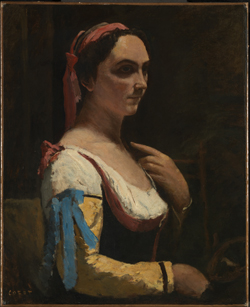 • Ever wondered what attracts artists to collect particular paintings? Answers abound at a new summer exhibition opening at The National Gallery today. Painters’ Paintings’: From Freud to Van Dyck features a series of ‘case studies’, each of which is devoted to works gathered by a particular ‘painter-collector’ including Lucien Freud, Henri Matisse, Hillaire-Germain-Edgar Degas, Frederic, Lord Leighton, Sir Thomas Lawrence, Sir Joshua Reynolds and Sir Anthony van Dyck. The display was inspired by Jean-Baptiste-Camille Corot’s work Italian Woman which was left to the nation by Lucien Freud following his death in 2011. “It made us start considering questions such as which paintings do artists choose to hang on their own walls,” explains Anne Robbins, curator of the exhibition. “How do the works of art they have in their homes and studios influence their personal creative journeys? What can we learn about painters from their collection of paintings? Painters’ Paintings’: From Freud to Van Dyck is the result.” The exhibition features works from the gallery’s own collection as well as loans from public and private collections. Admission charges apply. Runs until 4th September. For more, see www.nationalgallery.org.uk. PICTURE: Jean-Baptiste-Camille Corot’s Italian Woman, or Woman with Yellow Sleeve (L’Italienne) about 1870/© The National Gallery, London.
• The East End Canal Festival takes place at the Art Pavilion, Mile End Park this Sunday. The programme, being run by the Friends of Regent’s Canal, includes boat trips as well as guided canal history walks and a range of performances, films, stalls, exhibitions featuring historic photos and locally made artworks, children’s activities and food. The festivities at the Clinton Road site are free. For more, see http://friendsofregentscanal.org/events/eecf.html.
Send all items for inclusion to exploringlondon@gmail.com.
A Moment in London’s history…The ‘longest night’…
 It was 75 years ago this year – on the night of 10th/11th May, 1941 – that the German Luftwaffe launched an unprecedented attacked on London, an event that has since become known as the ‘Longest Night’ (it’s also been referred to as ‘The Hardest Night’).
Air raid sirens echoed across the city as the first bombs fells at about 11pm and by the following morning, some 1,436 Londoners had been killed and more than that number injured while more than 11,000 houses had been destroyed along and landmark buildings including the Palace of Westminster (the Commons Chamber was entirely destroyed and the roof of Westminster Hall was set alight), Waterloo Station, the British Museum and the Old Bailey were, in some cases substantially, damaged.
The Royal Air Force Museum records that some 571 sorties were flown by German air crews over the course of the night and morning, dropping 711 tons of high explosive bombs and more than 86,000 incendiaries. The planes were helped in their mission – ordered in retaliation for RAF bombings of German cities – by the full moon reflecting off the river below.
The London Fire Brigade recorded more than 2,100 fires in the city and together these caused more than 700 acres of the urban environment, more than double that of the Great Fire of London in 1666 (the costs of the destruction were also estimated at more than double that of the Great Fire – some £20 million).
Fighter Command sent some 326 aircraft into the fight that night, not all of them over London, and, according to the RAF Museum, the Luftwaffe officially lost 12 aircraft (although others put the figure at more than 30).
By the time the all-clear siren sounded just before 6am on 11th May, it was clear the raid – which turned out to be the last major raid of The Blitz – had been the most damaging ever undertaken upon the city.
Along with the landmarks mentioned above, other prominent buildings which suffered in the attack include Westminster Abbey, St Clement Danes (the official chapel of the Royal Air Force, it was rebuilt but still bears the scars of the attack), and the Queen’s Hall.
Pictured above is a statue of firefighters in action in London during the Blitz, taken from the National Firefighters Memorial near St Paul’s Cathedral – for more on that, see our earlier post here.
For more on The Longest Night, see Gavin Mortimer’s The Longest Night: Voices from the London Blitz: The Worst Night of the London Blitz
LondonLife – London sunset…
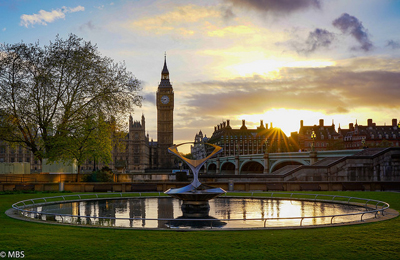
Taken by Murray, this picture captures some of the city’s iconic attractions as it looks across the River Thames to Elizabeth Tower (formerly known as the Clock Tower) at the northern end of the Houses of Parliament just as the sun is setting. Westminster Bridge can be seen to the right while pictured in the foreground, in the middle of a garden located at St Thomas’ Hospital, is the Grade II*-listed sculpture/fountain, Revolving Torsion, which is the work of Russian-born artist Naum Gabo and has been on long-term loan to the hospital since the mid-1970s. Says the photographer: “Funnily enough, I shot this picture handheld and spontaneously as I though I might miss the shot. I then tried to take better ones with a tripod etc – but I think this was my best effort. Spontaneous pictures are always the best…I used to work in St Thomas’ which is behind me in the picture and looked out at this view constantly during the daytime.” PICTURE: Murray/www.flickr.com/photos/muffyc30/.
LondonLife – Gothic spires…
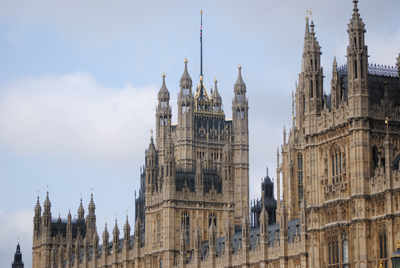
The Houses of Parliament in the early morning light. For more on their history, see our earlier post here.
A Moment in London’s History – Sir Walter Raleigh leaves the Tower…
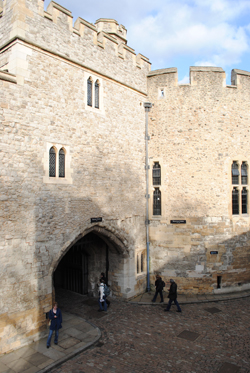 It was in February, 1616 – 400 years ago this year – that the adventurer and courtier Sir Walter Raleigh (Ralegh) was released from the Tower of London where he had spent the last 13 years of his life. Sadly, his freedom was to be short-lived.
Raleigh had been imprisoned in 1603 by King James I – not his biggest fan – after being accused of plotting against the king and subsequently sentenced to death for treason (a sentence which was then commuted to life imprisonment).
The Tower, where he’d been imprisoned a couple of times before – most notably by Queen Elizabeth I for secretly marrying Bessy Throckmorton, one of her maids-of-honour, was to be his home for the next 13 years.
It was in Bloody Tower (in left of picture) that his rather luxurious ‘cell’ was located. Originally known as the Garden Tower, it was renamed for the tradition that the two ‘Princes in the Tower’, King Edward V and his brother Richard, had been murdered here in 1483.
The tower’s top floor was added specifically to provide more room for his family in 1605-06 (and Raleigh’s son Carew was conceived and born while he was imprisoned here). It was also during this time of imprisonment that he wrote his History of the World (published in 1614).
Raleigh was released in 1616 to lead an expedition to the New World – he’d previously been on a couple of expeditions there including one with his half-brother Sir Humphrey Gilbert aimed at finding the Northwest Passage (but which deteriorated into privateering and led to his brief imprisonment following his return to England), and one aimed at finding the legendary ‘golden land’ of El Dorado (which he failed to do). It was again with the purpose of finding gold that he now returned to the Orinoco River region of South America.
Failure, however, was once more the outcome, and on Raleigh’s return to England, the death sentence issued on 1603 was reimposed (for his failure but also for attacking the Spanish in defiance of the king’s instructions to specifically not do so, although the blame was not all his). He would be executed in Old Palace Yard at Westminster on 29th October, 1618.
This Week in London – London illuminated; commemorating Shakespeare’s death; and, of bees and pollination…
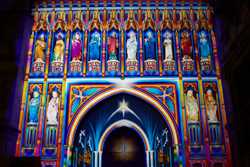 • The biggest ever light festival to hit London opens tonight. Lumber London, produced by Artichoke with the support of the Mayor of London and visitlondon.com, will see a host of international artists transform a series of iconic buildings and locations in four areas across the city – Piccadilly, Regent Street and St James’s, Trafalgar Square and Westminster, Mayfair and King’s Cross. The 30 installations include French collective TILT’s Garden of Light featuring giant illuminated plants in Leicester Square, Patrice Warrener’s The Light of the Spirit which envelopes the west front of Westminster Abbey in colour and light, Deepa Mann-Kler’s Neon Dogs – a collection of 12 neon dogs inspired by the balloon dogs seen at children’s parties, this sits near Trafalgar Square, and, Pipette, a colourful installation by Miriam Gleeman (of The Cross Kings) and Tom Sloan (of Tom Sloan Design) which sits in the pedestrian subway, the King’s Cross Tunnel. Other highlights include Julian Opie’s work Shaida Walking, 2015 which will be permanently located in Broadwick Street, Soho, and Janet Echelon’s enormous net sculpture 1.8 London which is strung between buildings at Oxford Circus. The festival runs from 6.30pm to 10.30pm over the next four nights. You can download a free map on the installations or use the free London Official City Guide app to locate them. For more information – including the full programme – see www.visitlondon.com/lumiere.
• A property deed signed by playwright William Shakespeare and one of the most complete first folios of his works have gone on show in the London Heritage Gallery at the Guildhall Art Gallery. Alongside the two documents which dates from 1613 and 1623, the Shakespeare and London exhibition marks the 400th anniversary of Shakespeare’s death – to be commemorated on 23rd April this year – will also display other documents related to the story of London’s playhouses. The property deed – which relates to a property in Blackfriars – is only one of six surviving documents to bear the playwrights authenticated signature while the first folio is one of five of the most complete copies in existence and is apparently usually only brought out for consultation by Shakespearean scholars and actors. The exhibition runs until 31st March. Admission is free. For more on it and other events being run to commemorate the Bard’s death, see www.cityoflondon.gov.uk/shakespeare400. For more on other events this year, check out www.shakespeare400.org.
• See your art featured in an upcoming exhibition on the importance of bees and pollination by attending a drop-in workshop at Victoria Tower Gardens next to the Houses of Parliament next week. The workshop, which will be held from 10am to 2pm on 20th January, will see participants create their own 3D flowers based on famous paintings by Vincent Van Gogh and Jan Van Huysum currently in The National Gallery’s collection – all as part of a focus looking at what plants bees are attracted to. The art created in the workshop will be seen in an exhibition A Right Royal Buzz which is the result of a collaboration between The Royal Parks, The National Gallery and Mall Galleries and will be seen across all three venues (Victoria Tower Gardens representing the Royal Parks) from 17th t0 20th February. For more, head to this link.
Send all items for inclusion to exploringlondon@gmail.com.
A Moment in London’s History – Westminster Abbey is consecrated – and a king dies…
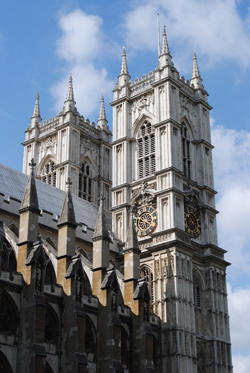 It was 950 years ago as of 28th December – Holy Innocents Day – that Westminster Abbey was consecrated following its construction on the orders of King Edward the Confessor.
The minster – popularly named ‘west’ minster to distinguish it from St Paul’s Cathedral (the ‘east’ minster) – was rebuilt when King Edward refounded the abbey between 1042-52, ostensibly to provide himself with a royal church in which he could be buried.
An abbey had apparently originally been founded on the site in the 7th century during the time of Bishop Mellitus, first Bishop of London (see our earlier post here).
The abbey church isn’t believed to have been completed when it was consecrated – this it’s suggested didn’t take place until 1090, well after the Norman Conquest. Unfortunately Edward was too ill to attend the consecration – he died on the 5th January and was buried a week later in the church (his wife Edith followed nine years later).
King Harold Godwinson – King Harold II – was apparently crowned in the church the day after Edward’s death but the first recorded coronation is that of King William the Conqueror on Christmas Day, 1066.
Very little survives of Edward’s church – most of what was see now is the Gothic masterpiece constructed in the mid 13th century by King Henry III with later additions such as King Henry VII’s Lady Chapel.
Top posts of 2015 – The ‘lost’ chapel of St Thomas; and, inside King Henry V’s chantry chapel…
2016 is fast approaching and to celebrate, we’re looking back at the 10 most popular posts we published in 2015. Today, we present our most popular and second most popular articles posted this year…
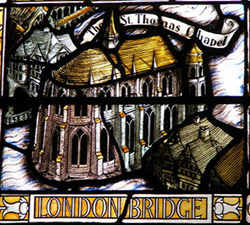 2. Our second most popular article, posted in August, was another in our Lost London series and this time looked at a long-lost feature of Old London Bridge – Lost London – Chapel of St Thomas á Becket.
1. And we are finally there – the most popular of our posts published this year was run in conjunction with the 600th anniversary of the Battle of Agincourt. Part of our LondonLife series, it took a look inside King Henry V’s rarely opened chantry chapel in Westminster Abbey – LondonLife – A rare glimpse inside King Henry V’s chantry chapel.
10 London ‘battlefields’ – 8. The Gordon Riots…
Well, not so much a battle as a widespread civil insurrection, the Gordon Riots, often described as the worst riots London has ever seen, resulted in considerable property destruction and numerous deaths.
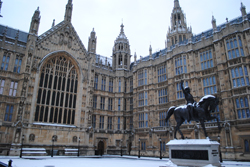 The riots, which took place against a backdrop of high taxation, widespread poverty, and unjust laws, had its origin in the passing of the Catholic Relief Act of 1778 which intended to reduce entrenched discrimination against Roman Catholics in Britain and redress some of anti-Catholic laws which had been introduced 80 years earlier, partly in an attempt to get more Catholics to join the British Army to fight against the United States of America in what’s now known as the War of Independence.
While it initially passed without any real hostility, an attempt to extend the Act’s provisions to Scotland in 1779 provoked such a serious response there that the action was withdrawn. Following the Scottish success in having the provisions withdrawn, the Protestant Association of London was founded with the aim of spear-heading opposition to the act’s provisions. Lord George Gordon was elected president of the newly formed Protestant Association of London in November of that year.
Following failed attempts to have King George III repeal the Act (Lord Gordon had several audiences with the King but failed to convince him of his case and was eventually banned from His Majesty’s presence), on 2nd June, 1780, Gordon and the members of the association marched on the Houses of Parliament (pictured above although the current buildings date from much later than these events) to deliver a petition demanding the Act be repealed.
They crowd, estimated to have been as big as 60,000 strong although a figure in the mid-40,000s is generally accepted, attempted unsuccessfully to force their way into the House of Commons before Lord Gordon, wearing a blue cockade (the symbol of the Protestant Association in his hat) was granted access to deliver the document.
Outside, meanwhile, things went from bad to worse and the crowd erupted into rioting, attacking members of the House of Lords, including bishops, as they attempted to enter and damaging carriages (including that of Lord Chief Justice William Murray, 1st Earl of Mansfield). Soldiers were eventually summoned to quell the riot which they did without violence. Inside, the members of the House of Commons voted down the petition by an overwhelming majority.
That night violence flared up again with the Roman Catholic Sardinian Embassy Chapel in Lincoln’s Inn Fields set alight while the chapel of the Bavarian Embassy in Golden Square, Soho, was destroyed and random violence carried out in streets known to be the residence of wealthy Catholics.
The next day, a crowd gathered in Moorfields – known to be home to many poor Irish Catholic immigrants – and that night attacked many homes.
The violence spread over the following days and among the buildings attacked was Newgate Prison (which was set on fire), the Fleet Prison, and the Clink in Southwark – hundreds of prisoners escaped – as well as Catholic churches, more embassy chapels, homes of known Catholics and politicians who had been associated with the passing of the act (including that of Lord Mansfield and Sir George Savile, who had proposed the Catholic Relief Act) and the Bank of England (the attack on the bank led to the long-standing tradition of soldiers guarding the bank).
Without a standing police force to tackle the mobs, on 7th June the army was called out with orders to fire on groups of four or larger who refused to disperse. In the next few days, well over 200 people (possibly more than 300) were shot dead and hundreds more wounded. Hundreds of the rioters were arrested and, of those, about 25 eventually executed. Gordon himself was arrested and charged with high treason but found not guilty.
Treasures of London – ‘Locking Piece’…

A Henry Moore original, Locking Piece was created in 1963-64 and first located on its current site on Riverwalk Gardens at Millbank, site of the former Millbank Penitentiary, four years later. The bronze sculpture consists of, as the name suggests, two interlocking pieces. There’s a couple of conflicting stories about where the idea for the work came from – in one, Moore said he was visiting a gravel pit near his home at Perry Green in Hertfordshire where he was playing with two pebbles which suddenly locked together (and hence came the idea of a sculpture of two interlocking pieces); and in another, Moore said the idea came from a bone fragment featuring a socket and joint found in his garden. Originally loaned to Westminster City Council, in 1978 the sculpture was given to the Tate Gallery which subsequently decided to leave the piece in situ. It’s one of numerous Moore works in London. For more on Henry Moore’s London works, see www.henry-moore.org/works-in-public/world/uk/london.
This Week in London – Lord Mayor’s Show marks 800 years; Dutch masters and Thomas Rowlandson at Queen’s Gallery; and, Alexander Calder on show at Tate…
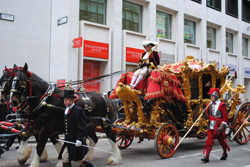 • The Lord Mayor’s Show will mark its 800th anniversary on Saturday as the newly elected Jeffrey Mountevans – the 688th Lord Mayor of the City of London – makes his way through the City to Westminster to swear loyalty to the Crown. The procession of 7,000 people, some 180 horses and 140 vehicles will set off on its way along a three-and-a-half mile route at 11am, starting at Mansion House and traveling down Cheapside to pause at St Paul’s Cathedral (which is open for free all day) before heading on via Ludgate Hill and Fleet Street to the Royal Courts of Justice before returning the City via Queen Victoria Street from 1.10pm. In a special nod to the 800th anniversary, the famous bells of St Mary-le-Bow will ring out a special 800-change at noon. The day will conclude with fireworks over the River Thames kicking off at 5.15pm (for the best view head down to the riverside between Waterloo and Blackfriars Bridges, either on Victoria Embankment or on the South Bank). The show’s origins go back to 1215 when, in exchange for a Royal Charter granting the City of London the right to elect its own mayor, King John insisted the newly elected mayor travelled to Westminster each year to swear loyalty to the Crown. For more (including a map to print out), see https://lordmayorsshow.london. PICTURE: From a previous show.
• Vermeer’s The Music Lesson is among 27 of the finest 17th and 18th century Dutch paintings in the Royal Collection which will go on display in a new exhibition at the Queen’s Gallery at Buckingham Palace from tomorrow. Masters of the Everyday: Dutch Artists in the Age of Vermeer also features works by the likes of Gerrit Dou, Pieter de Hooch and Jan Steen, all produced during what is known as the Dutch ‘Golden Age’. The exhibition is being shown alongside another display – High Spirits: The Comic Art of Thomas Rowlandson – which will focus on the work of 18th and early 19th century caricaturist Thomas Rowlandson. Around 100 of Rowlandson’s works feature in the display with highlights including The Two Kings of Terror featuring Napoleon and Death sitting face-to-face after Napoleon’s defeat at Leipzig in 1813, The Devonshire, or Most Approved Method of Securing Votes depicting Georgiana, Duchess of Devonshire, kissing a butcher (it was claimed she had claimed kisses for votes in the Westminster election of 1784), and A York Address to the Whale. Caught lately off Gravesend in which the Duke of York thanks a whale for distracting attention from accusations that his mistress was paid by army officers to secure promotions from the Duke. Admission charge applies. Both exhibitions run until 14th February, 2015. For more, see www.royalcollection.org.uk.
• The first major UK exhibition of the works of kinetic sculpture pioneer Alexander Calder opened at the Tate Modern this week. Alexander Calder: Performing Sculpture features more than 100 of the ground-breaking 20th century artist’s works which trace how Calder turned sculpture from the idea of a static object to a continually changing work to be experienced in real time. Works on show include figurative wire portraits of artists – Joan Miró and Fernand Léger (both 1930), works exploring the idea of forms in space – Red Panel, White Panel and Snake and the Cross (1936), motorised mobiles such as Black Frame and A Universe (1934), and chiming mobiles such as Red Gongs (1950) and Streetcar (1951). It closes with the large scale Black Widow (c.1948), shown for the first time ever outside Brazil. Runs until 3rd April. Admission charge applies. For more, see www.tate.org.uk.
Send all items for inclusion to exploringlondon@gmail.com.
LondonLife – 600 years on, Westminster Abbey commemorates the Battle of Agincourt…
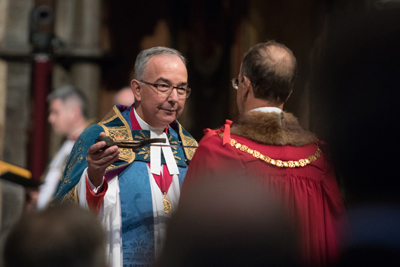
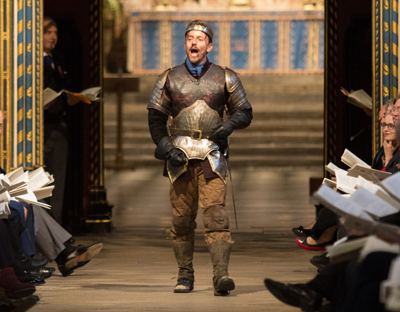 Hundreds gathered at Westminster Abbey last Thursday for a service to commemorate the 600th anniversary of the Battle of Agincourt – 600 years to the day when word of the battle’s victory arrived in London. During the service, the sword of King Henry V – who was buried in the abbey and whose chantry chapel is located above his tomb (see our earlier post here) – was carried through the abbey and presented to the Dean of Westminster, the Very Reverend Dr John Hall, at the High Altar (pictured below). “A hundred years ago, as our countrymen fought alongside the French, the old enmities had been put away,” Rev Dr Hall told those at the service who included the Duke of Kent and Princess Michael of Kent. “In the dark days before the Second World War, the story of Agincourt encouraged men and women alike to strive their utmost for freedom from tyranny. Today we give hearty thanks for our freedoms, and we pray for an end to tyranny wherever it is found, and for enduring peace and prosperity.” Royal Shakespeare Company actor Sam Marks read the St Crispin’s Day speech from the Bard’s Henry the Fifth (pictured above) while veteran of the stage and screen, Robert Hardy, read the prologue from Act IV of the same play. For more on abbey, visit www.westminster-abbey.org. PICTURES: Ian Stratton/Westminster Abbey.
A Moment in London’s History – News of the victory at Agincourt reaches the city…
It wasn’t until four days after the battle which had taken place on 25th October, 1415, that news of King Henry V’s stunning victory over the French reached the English capital.
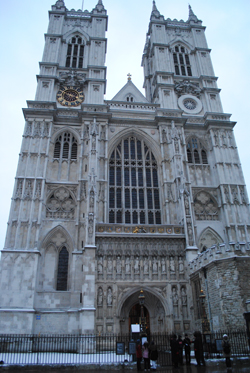 The news apparently reached London very early in the morning and church bells were rung in celebration and a Te Deum sang in thanksgiving in many.
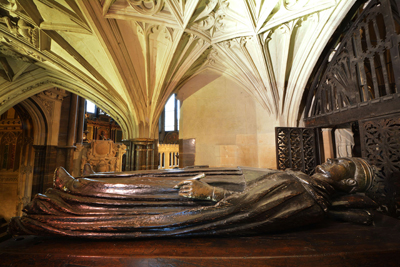
At 9am, a solemn procession of clergy made their way from St Paul’s Cathedral in the City to the shrine of St Edward the Confessor in Westminster Abbey (pictured) to give thanks.
Other attendees at the abbey included the Mayor-elect, Nicholas Wotton (this was the first of two occasions on which he was elected Lord Mayor), and the alderman of London, as well as the Queen Dowager, Joan of Navarre.
A few days later, on the 4th November, King Henry V’s brother – John of Lancaster, the Duke of Bedford, announced the news to Parliament.
King Henry V, meanwhile, arrived back in Dover on 16th November (apparently as a great snowstorm was making its presence felt) and headed for London. After pausing in Canterbury to give thanks in the cathedral and St Augustine’s Abbey, he reached the manor of Eltham (now in south-east London) on 22nd November.
He was met the next day on Blackheath by Wotton and City dignitaries who then, along with what were recorded as a crowd of 20,000 citizens, accompanied him and his small retinue, which included some of his most high profile prisoners such as Charles d’Orléans, Duke of Orléans (who spent 25 years as a prisoner in England), and Marshal Boucicaut (he would die six years later in Yorkshire), towards London.
There, welcomed as Henry V, “King of England and France”, he processed through the City which had been elaborately decorated – the decorations included the hanging of various coats of arms from various prominent sites as well as the positioning of statues of the likes of St George – ahead of his arrival.
Travelling down Cheapside, the king – who was modestly dressed in a purple gown and had eschewed wearing a crown for the event – stopped at St Paul’s where he performed his devotions, before proceeding to Westminster where he did the same before taking up residence for the night in the nearby Palace of Westminster.
On the king’s orders, a solemn mass was held in St Paul’s the next day for the fallen of both sides. The victorious king had returned!
LondonLife – A rare glimpse inside King Henry V’s chantry chapel…
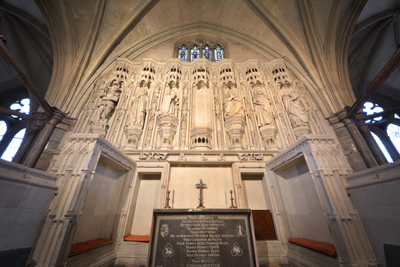 A fortunate few last weekend had the chance to have a look inside King Henry V’s elaborately carved chantry chapel in Westminster Abbey as part of commemorations marking the 600th anniversary of the Battle of Agincourt.
The chapel, which is located on a sort of mezzanine level above the king’s tomb at the east end of the Shrine of Edward the Confessor, is one of the smallest of the abbey’s chapels. It was constructed on the orders of the king – who died Vincennes in August, 1422, and was buried in the abbey on 7th November that year – so prayers could be said in perpetuity for his soul.
The tomb was completed in 1431 and the chantry chapel was built above between 1437 and 1450. The latter is entered via narrow stairways of worn steps hidden inside a pair of stone turrets which flank the tomb.
For centuries the Henry V’s funeral ‘achievements’ – the king’s saddle, helm and shield – were displayed on a wooden beam above the chantry chapel but these were restored and moved to the abbey museum in 1972.
Henry V’s wife, Catherine de Valois, who survived her husband by 15 years was eventually – in the Victorian age – buried under the chantry chapel altar (originally buried in the old Lady Chapel, King Henry VII had her removed and placed in an open coffin in the open air next to the tomb of King Henry V, when building his new chapel – among visitors to her mummified body was diarist Samuel Pepys who even kissed her. In 1778 she was buried in a vault before being relocated to her current position in 1878).
An inscription on the altar in the chantry chapel reads: “Under this slab (once the altar of this chapel) for long cast down and broken up by fire, rest at last, after various vicissitudes, finally deposited here by command of Queen Victoria, the bones of Catherine de Valois, daughter of Charles VI, King of France, wife of Henry V, mother of Henry VI, grandmother of Henry VII, born 1400, crowned 1421, died 1438”.
The chantry chapel is still occasionally used for services but, measuring just seven by three metres, is not usually open to the public because of size and access issues.
Westminster Abbey will hold a special service of commemoration on 29th October in partnership with charity Agincourt600. The day before, 28th October, it will host a one day conference for Henry V enthusiasts entitled ‘Beyond Agincourt: The Funerary Achievements of Henry V’. For more, see www.westminster-abbey.org/events/agincourt.
Above – King Henry V’s chantry chapel; Below – King Henry V’s tomb which sits below the chantry chapel. PICTURE: Jim Dyson/Dean & Chapter of Westminster
This Week in London – World’s oldest clock and watch collection moves to the Science Museum; commemorating Agincourt; and, black experiences in war at the Imperial War Museum…
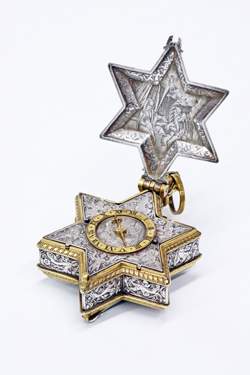 • The world’s oldest clock and watch collection can be seen at its new home at the Science Museum in South Kensington from tomorrow. The Clockmaker’s Museum, which was established in 1814 and has previously been housed at City of London Corporation’s Guildhall, has taken up permanent residence in the Science Museum. Assembled by the Worshipful Company of Clockmakers – founded in 1631 – the collection features some 600 watches, 80 clocks and 25 marine timekeepers spanning the period from the 15th century to today. Highlights among the collection include: a year duration long case clock made by Daniel Quare of London (c. 1647-1724); a star-form watch (pictured) by David Ramsay, first master of the Clockmaker’s Company; the 5th marine timekeeper completed in 1770 by John Harrison (winner in 1714 of the Longitude Prize); a timekeeper used by Captain George Vancouver on his 18th century voyage around the Canadian island that bears his name; a watch used to carry accurate time from Greenwich Observatory around London; and, a wristwatch worn by Sir Edmund Hillary when he summited Mount Everest in 1953. The collection complements that already held by the Science Museum in its ‘Measuring Time’ gallery – this includes the third oldest clock in the world (dating from 1392, it’s on loan from Well’s Cathedral) and a 1,500-year-old Byzantine sundial-calendar, the second oldest geared mechanism known to have survived. Entry is free. For more, see www.sciencemuseum.org.uk/clocks. PICTURE: The Worshipful Company of Clockmakers.
• Westminster Abbey is kicking off its commemorations of the 600th anniversary of the Battle of Agincourt by opening Henry V’s chantry chapel in Westminster Abbey to a selected few on Saturday night, the eve of the battle’s anniversary. The chapel, which is above the king’s tomb at the east end of the abbey, will be seen by the winners of a public ballot which opened in September. It has never before been officially opened for public tours. The chapel is one of the smallest of the abbey’s chapels. It is occasionally used for services but, measuring just seven by three metres, is not usually open to the public because of size and access issues. Meanwhile the abbey will hold a special service of commemoration on 29th October in partnership with charity Agincourt600 and on 28th October, will host a one day conference for Henry V enthusiasts entitled Beyond Agincourt: The Funerary Achievements of Henry V. For more, see www.westminster-abbey.org/events/agincourt.
• The role the black community played at home and on the fighting front during conflicts from World War I onward is the focus of a programme of free events and tours as Imperial War Museums marks Black History Month during October. IWM London in Lambeth will host a special screening of two documentary films – Burma Boy and Eddie Noble: A Charmed Life – telling the stories of African and Caribbean mean who served in World War II on 25th October. IWM London will also feature a series of interactive talks from historians revealing what it was like for black servicemen during both world wars from this Saturday until Sunday, 1st November. For more, see www.iwm.org.uk.
Send all items for inclusion to exploringlondon@gmail.com.
A Moment in London’s History – The execution of William Wallace…

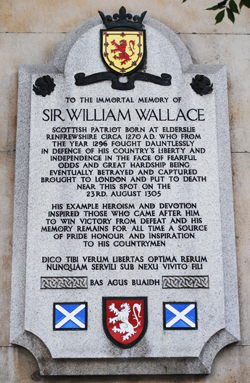
This year marks the 710th anniversary of the execution of Scottish rebel William Wallace in Smithfield so we thought we’d take a quick look at the circumstances of that event – made famous in recent times through the movie Braveheart.
 For some eight years, Wallace had been a thorn in the side of the King Edward I, promoting active resistance to his rule in Scotland after Edward forced the abdication and usurption of the crown of John Balliol.
Following a crushing defeat at the Battle of Falkirk on 22nd July, 1298, however, Wallace went to France where he attempted to gain French support for rebellion in Scotland but the effort proved ultimately futile and Wallace, back in Britain but refusing to submit to English rule, remained on the run.
At least until he was captured on 5th August, 1305, by Sir John Monteith, who had been made Sheriff of Dumbarton by King Edward I, at Robroyston near Glasgow.
Taken to Carlisle, he was bound hand and foot before being taken south to London in chains.
Wallace’s trial took place on 23rd August that year at Westminster Hall and, despite his protestations that he couldn’t be guilty of treason having never sworn loyalty to the English Crown, a guilty verdict was handed down along with the sentence of a traitor’s death – being hung, drawn and quartered.
Taken to the Tower of London, Wallace was stripped naked and then strapped to a wooden hurdle which was dragged by two horses through the streets via Aldgate to The Elms at Smithfield where he was hanged on a gallows.
Cut down while yet living, he was disembowelled and castrated and his entrails burnt. Wallace was then decapitated and his body cut into quarters which were sent to Berwick, Newcastle, Stirling and Perth as a warning against treason. His tarred head, meanwhile, was put on a pike and set above London Bridge.
A memorial to Wallace can now be found on the wall of St Bartholomew’s Hospital at West Smithfield (pictured – for more on that, see our earlier post here).
 Exploring London