This Week in London – Marking the transatlantic cable’s 150th; Sir James Thornhill celebrated; and, food at the Foundling Museum…

commerce-and-sea-power_william-lionel-wyllie

• This year marks the 150th anniversary of the transatlantic cable connecting Europe and America and in celebration of the event, the City of London Corporation’s Guildhall Art Gallery is holding an exhibition looking at the impact of cable telegraphy on people’s understanding of time, space and the speed of communication. Victorians Decoded: Art and Telegraphy, a collaboration between the gallery, King’s College London, The Courtauld Institute of Art and the Institute of Making at University College London, features never-before-seen paintings from the gallery’s collection as well as rare artefacts such as code books, communication devices, samples of transatlantic telegraph sales and ‘The Great Grammatizor’, a messaging machine that will enable the public to create a coded message of their own. It took nine years, four attempts and the then largest ship in the world, the Great Eastern, to lay the cable which stretched from Valentia Island in Ireland to Newfoundland in Canada and enabled same-day messaging across the continents for the first time. Displayed over four themed rooms – ‘Distance’, ‘Resistance’, ‘Transmission’ and ‘Coding’, the exhibition features works by artists including Edward John Pointer, Edwin Landseer, James Clarke Hook, William Logsdail, William Lionel Wyllie and James Tissot. The free exhibition, which runs until 22nd January, is accompanied by a series of special curator talks. For more information, see www.cityoflondon.gov.uk/victoriansdecoded. PICTURE: Commerce and Sea Power, William Lionel Wyllie/Courtesy Guildhall Art Gallery.

• The life of artist Sir James Thornhill – the painter behind the remarkable Painted Hall at the Old Royal Naval College in Greenwich, has opened at The Stephen Lawrence Gallery in Greenwich. A Great and Noble Design: Sir James Thornhill’s Painted Hall explores the story behind the commissioning of the Painted Hall, painted between 1708 and 1727, through a series of preparatory sketches made by the artist, including three newly-conserved original sketches by Thornhill. Also on show will be the results of new research undertaken into the paintings in the light of upcoming conservation work on the hall’s ceiling. The free exhibition runs at the centre at Stockwell Street until 28th October. For more, see www.ornc.org.

The food served at the Foundling Hospital comes under scrutiny in a new show at The Foundling Museum in Bloomsbury. Based on new research, Feeding the 400 looks at the impact food and eating regimes had on children at the hospital between 1740 and 1950 through an examination of art, photographs, objects including tableware and the voices of former student captured in the museum’s extensive sound archive. Guest curated by Jane Levi, the exhibition also includes a newly commissioned sound work which evokes the experience of communal eating. A programme of events accompanies the exhibition which runs until the 8th January. Admission charge applies. For more, see www.foundlingmuseum.org.

Send all items for inclusion to exploringlondon@gmail.com.

10 sites commemorating the Great Fire of London – 7. The ancient plaque commemorating St Olave Silver Street…

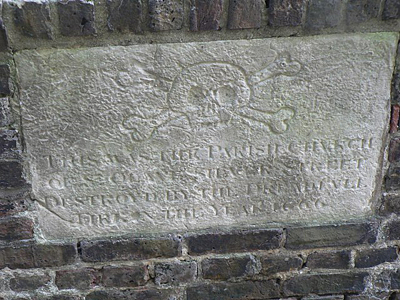
st-olave-silver-streetMany of the monuments commemorating the Great Fire of London, date from succeeding centuries (the Monument being a notable exception), one of the earliest can apparently commemorating the site of the Church of St Olave Silver Street.

The church dated from at least the 12th century and is one of a number in London which were apparently named after King Olaf, the first Christian King of Norway who fought alongside the Anglo-Saxon King Ethelred II against the Danes in England in the 11th century.

The church served as the parish church of the silversmiths and apparently in recognition of that boasted a figure of Christ on the cross which had silver shoes.

The church had been rebuilt in the early 1600s but was completely destroyed in the Great Fire of London and never rebuilt, the parish united with that of St Alban Wood Street.

The site of the church, now on the corner of London Wall and Noble Street, is now a garden and boasts an almost illegible plaque featuring a skull and crossbones, which is believed to date from the late 17th century, and which commemorates the destruction of the church in the Great Fire.

PICTURE: © Chris Downer/CC BY-SA 2.0

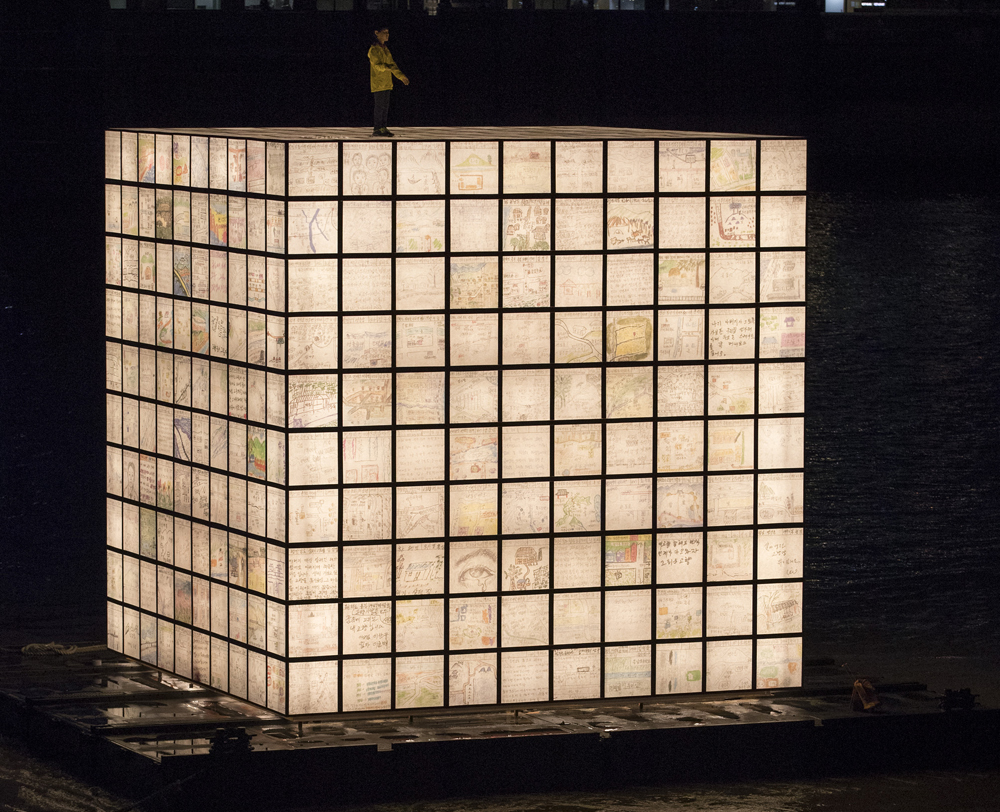
LondonLife – ‘Floating Dreams’ on the Thames

floating-dreams1

Part of the Totally Thames festival, South Korean artist Ik-Joong Kang’s eye-catching installation, Floating Dreams, acts a memorial to the millions of people who were displaced and divided during the Korean War (1950-53) as well as symbolising the hopes that North and South Korea will once again be unified. The three-storey high installation, which sits on the river alongside Millennium Bridge, is constructed from 500 drawings created by the generation, now aged in their 80s and 90s, who had fled North Korea for South Korea during the war. Their images have been transferred on pieces of a traditional Korean rice paper known as Hanji and then compiled into the cube. The illuminated installation can be seen throughout the festival which runs until 30th September. For more on what’s happening throughout Totally Thames, see http://totallythames.org.

totally-thames-2

10 sites commemorating the Great Fire of London – 6. A rare survivor…

Walk around the streets of the City of London and it’s hard to miss the myriad of plaques commemorating many buildings lost in the Great Fire of London. On the Strand, however, can be found a plaque which commemorates a building that survived the fire.

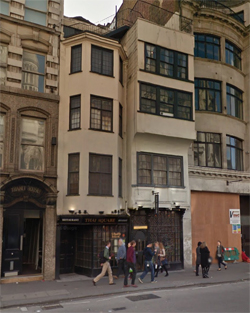
strand-buildingLocated at 230 Strand (opposite the Royal Courts of Justice), the narrow four storey building, complete with projecting second floor, dates from 1625 and was apparently originally built as the home of the gatekeeper of Temple Bar.

According to the sign upon it, the now Grade II* building was the only structure on the Strand to survive the fire of 1666.

Now a rather plain-looking building, it has been much altered over the years and for much of the 20th century housed the Wig and Pen Club for journalists and lawyers – running from at least 1908, it closed in 2003.

Along with the late 17th century building next door (the two are pictured above with number 230 on the right), it’s now part of a Thai restaurant.

PICTURE: Google Street View

10 sites commemorating the Great Fire of London – 5. Paternoster Square Column…

paternoster-square-column2
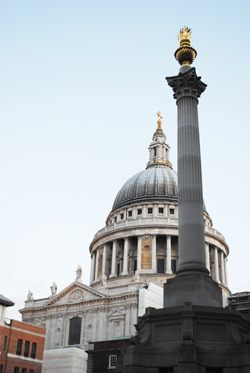
Located just to the north of St Paul’s Cathedral can be found Paternoster Square in the centre of which stands a column.

paternoster-square-columnThe 75 foot (23.3 metre) tall Corinthian column of Portland stone, which was designed by Whitfield Architects and erected in 2003, is topped by a gold leaf covered flaming copper urn which is lit up at night.

While it has been said that the column is “purely decorative”, the developers of Paternoster Square claim on their website that it actually serves several purposes in this case including both commemorative and practical.

Not only is it part of the ventilation system for the carpark underneath, they say its design is apparently a recreation of columns designed by Inigo Jones for the west portico of Old St Paul’s Cathedral.

And then there’s the three metre high urn on top which, not unlike that found on The Monument, they say commemorates the fact the site of the square has twice been destroyed by fire – the first time in the Great Fire of 1666 and the second in the Blitz during World War II.

The area around Paternoster Square was once home to booksellers and publishers’ warehouses.

LondonLife – Remembering the Great Fire of 1666…

London-1666,-designed-by-David-Best-for-London's-Burning,-produced-by-Artichoke,-(c)-Matthew-Andrews0.1

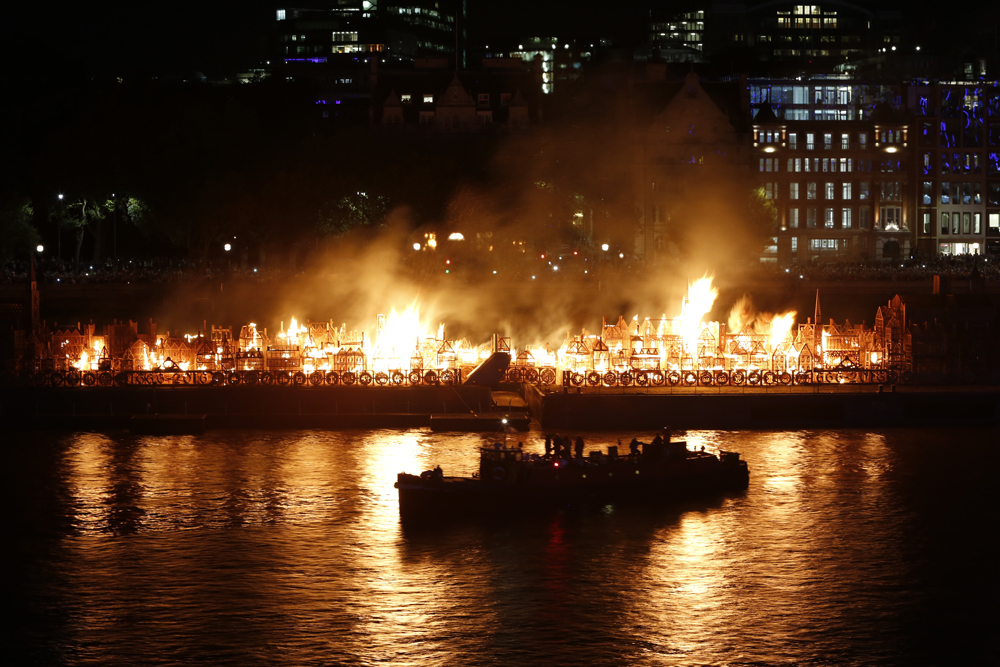
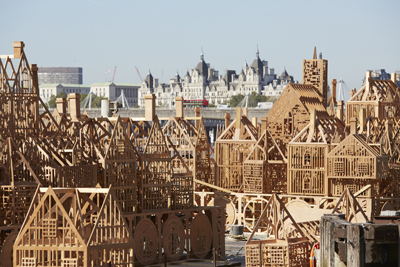
London blazed again on Sunday night when a 120 metre long wooden replica of the city as it was in Restoration times was set alight to mark 350th years since the Great Fire of London. London 1666 was designed by US “burn artist” David Best for London’s Burning – a festival of events in the City of London produced by Artichoke to mark the anniversary. It had been placed on a barge moored in the River Thames before it was lit up to ensure that the fire didn’t spread anywhere it wasn’t wanted. The actual Great Fire of London broke out in a bakery on Pudding Lane shortly after midnight on 2nd September, 1666, and blazed across the city for four days, destroying more than three quarters of the old City of London as it render tens of thousands of Londoners homeless and devastated iconic structures like Old St Paul’s Cathedral. You can see a video of the burn herePICTURES: © Matthew Andrews.


London-1666,-designed-by-David-Best-for-London's-Burning,-produced-by-Artichoke,-(c)-Matthew-Andrews

This Week in London – The Great Fire of London’s 350th anniversary…

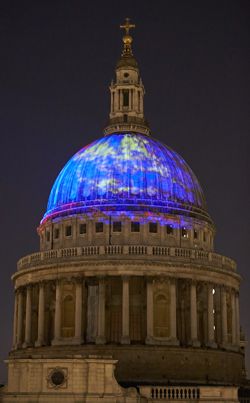
London-1666-by-David-Best-in-collaboration-with-Artichoke-©-Matthew-Andrews-(3)• The 350th anniversary of the Great Fire of London is upon us and to mark the event, the City of London is playing host to London’s Burning, a “festival of arts Fires-of-London--Fires-Ancient-and-Moden-by-Martin-Firrell-©-C.-Totman-(1)and ideas”, over the coming weekend. Produced by Artichoke, the festival includes everything from Fire Garden – an installation by French street art group Compagnie Carabosse at the Tate Modern, and Holoscenes – a six hour underwater performance installation by Los Angeles-based company, Early Morning Opera, in Exchange Square, Broadgate, to Fires of London: Fires Ancient and Fires Modern – two large scale projections by artist Martin Firrell onto St Paul’s Cathedral (pictured right) and The National Theatre, Station House Opera’s Dominoes – a kinetic sculpture of breeze block dominoes which retraces the path of the fire through the streets, and London 1666 – a 120 metre long wooden sculpture of Restoration London by American artist David Best working in collaboration with Artichoke which will be set alight on Sunday at a site on the river between Blackfriars Bridge and Waterloo Bridge (the sculpture is pictured above – you can also watch it live online here). Events run until 4th September. Head here to see the list of events in London’s Burning and to download a copy of the programme complete with map. PICTURES: © Matthew Andrews and C Totman.

Entry to The Monument – built as a permanent reminder of the great conflagration of 1666 – will be free from 2nd to 4th September in celebration of the Great Fire anniversary. Opening hours at the iconic 202 foot tall column have also been extended for the weekend but be warned that due to limited capacity, tickets mist be booked in advance with allotted time slots for entry. To book, head here.

A free exhibition telling the story of London’s bakers and their cakes, bread and puddings over the 350 years since 1666 has opened at the London Metropolitan Archives this week. London’s Baking! Bakers, Cakes, Bread and Puddings from 1666 takes its inspiration from Thomas Farriner and his Pudding Lane bakery, ground zero for the fire. And along with the displays, it features recipes for you to take away and bake including almond cakes from 1700, suet puddings from 1850 and “questionable” school dinner chocolate sponge traybake from the 1970s. Runs at the Clerkenwell-based organisation until 1st February. For more, see www.cityoflondon.gov.uk/events/Pages/event-detail.aspx?eventid=2749.

• Of course, these are just some of the events taking place as part of Great Fire 350. Others include the Fire Food Market in Guildhall Yard, running from 6.30pm to 10pm Saturday night and from 5pm to 10pm Sunday night, as well as events we’ve previously mentioned including the programme of events running at St Paul’s Cathedral and the Fire! Fire! exhibition at the Museum of London. For more of the walks, talks, performances, installations and other events taking place, head to www.visitlondon.com/greatfire350.

Send all items for inclusion to exploringlondon@gmail.com.

10 sites commemorating the Great Fire of London – 4. St Paul’s ‘Resurgam’…

Resurgam3
Old St Paul’s Cathedral was certainly the largest and most famous casualty of the Great Fire of London of 1666. And its passing – and rebirth – is recorded on several memorials, one of which can be found on the building itself.

Set on the pediment which, carved by Caius Gabriel Cibber, sits above south portico off Cannon Street, the memorial depicts a phoenix rising from clouds of smoke (ashes), a symbol of Sir Christopher Wren’s new cathedral which rose on the site of the old Cathedral in the wake of the fire. Below the phoenix is the Latin word, ‘Resurgam’, meaning “I Shall Rise Again”.

The story goes that Wren had this carved after, having called for a stone to mark the exact position over which St Paul’s mighty dome would rise, the architect was shown a fragment of one of the church’s tombstones which had been inscribed with the word.

The foundation stone for the new cathedral, largely built of Portland stone, was laid without any fanfare on 21st June, 1675, and it only took some 35 years before it was largely completed. Some of the stonework from the old cathedral was used in the construction of the new.

We should note that the old cathedral was in a state of some disrepair when the fire swept through it – the spire had collapsed in 1561 and despite the addition of a new portico by Inigo Jones, it was generally in poor condition.

Stonework from the Old St Paul’s – everything from a Viking grave marker to 16th century effigies – are now stored in the Triforium, rarely open to the public (tours of the Triforium are being run as part of the programme of events being held at the cathedral to mark the 350th anniversary of the Great Fire – see www.stpauls.co.uk/fire for more).

PICTURE: givingnot@rocketmail.com/CC BY-NC 2.0 (image cropped)

LondonLife – Capturing nearly 600 years of London’s past…

©-London-Met-Archives-Collage-59154

©-London-Met-Archives-Collage-323131Albury Street in Deptford, 1911. The image, taken by the London County Council, is just one of thousands which form part of a new free, online resource, Collage – The London Picture Archive. The world’s largest collection of images of London, the archive contains more than 250,000 images of London spanning the period from 1450 to the present day. It includes more than 8,000 historical photographs of life on the capital’s streets as well as major events – everything from the Great Fire of London in 1666 to the construction of Tower Bridge in the late 19th century. The photographs, maps, prints, paintings and films in the collection are all drawn from the collections of the City of London Corporation’s Guildhall Art Gallery and the London Metropolitan Archives in Clerkenwell. Other images shown here include (above right) ‘Street Life in London’, 1877 (taken by Adolphe Smith and John Thomson, this image was an early use of photography); (below) ‘Construction of the Metropolitan Railway (the first tube line)’, 1862 (taken at King’s Cross Station); and (far below), ‘The Construction of Tower Bridge’, 1891-1892 (taken from Tower Embankment). Collage – The London Picture Archive is free to access and available at www.collage.cityoflondon.gov.uk.

All images © London Metropolitan Archives (City of London).

©-London-Met-Archives-Collage-278766

©-London-Met-Archives-Collage-323343

This Week in London – The Notting Hill Carnival turns 50; St Paul’s marks the Great Fire’s 350th; and, London’s subcultures captured on film…

The Notting Hill Carnival, the largest street festival in Europe, is celebrating its 50th birthday this Bank Holiday weekend. Events at the west London-based celebration of Caribbean culture, music, food and drink include a Children’s Day on Sunday with a parade for children, performances on the World Music Stage at Powis Square as well as food and drink (runs from 10am to 8.30pm); and, the main event, the 3.5 mile long Monday Parade and Grand Finale featuring 60 bands, performances at the World Music Stage as well as food and other activities (runs from 10am to 8.30pm). For more, see www.thenottinghillcarnival.com.

St-Paul's St Paul’s Cathedral, created after Old St Paul’s was destroyed in the Great Fire of London, has been marking the 350th anniversary of that event with a special programme of walks, talks, tours, special sermons and debates. Running until next April, they include special ‘fire tours’ of the cathedral, a special ‘family trail’ through the cathedral (which you can download for free), and Triforium tours in which you can see carved stones from Old St Paul’s and Sir Christopher Wren’s ‘great model’ of the new cathedral. In addition, an exhibition featuring a collection of pre-Great Fire artefacts, Out of the Fire, opens on 1st September (admission included in cathedral admission charge) and the cathedral will be kept open for two nights next week until 9pm, on 2nd and 3rd September. For the full programme of events, bookings and more information, head to www.stpauls.co.uk/fire.

On Now – Stomping Grounds: Photographs by Dick Scott-Stewart. This free exhibition at the Museum of London features images taken by the relatively unknown London-based photographer in the late 1970s and early 1980s, depicting everyone from the New Romantics of Covent Garden and Rockabillies of Elephant and Castle to wrestling matches at the Battersea Arts Centre and punks congregating on the Kings Road. The exhibition features 38 photographs and other “ephemera”. Entry is free. Closes on 18th September. For more, see www.museumoflondon.org.uk.

Send all events for inclusion to exploringlondon@gmail.com

10 sites commemorating the Great Fire of London – 3. The Templar’s column…

Knights-atop-the-columnStanding outside the Temple Church, in the west of the City of London (between Fleet Street and the River Thames), stands a pillar topped with a pair of Templar knights riding a horse in an obvious commemoration of the military order that once had its preceptory here.

But what many people don’t realise is that the column was also erected, apparently like the Golden Boy of Pye Corner, to commemorate another point where the all-consuming Great Fire of London was finally stopped.

The 10 metre high column was erected in 2000 (another of its purposes was to mark the millennium) in what was once the cloister courtyard of the headquarters of the Templars, which had originally founded to protect pilgrims to the Holy Land in 1119.

The bronze figures of the two men atop a single horse which caps the column was a representation of the image found on the order’s official. It represents the poverty of those who initially joined it – so poor they could only afford one horse for every two men, a situation which was to change dramatically in coming centuries as the order accumulated wealth, a situation which, eventually, in France, led to its downfall.

London Remembers reports that the column was designed in the gothic style, similar to the Purbeck marble columns in the church (which, incidentally, are said to be the oldest surviving free-standing examples of their kind) and deliberately made to contrast with the more florid column of Sir Christopher Wren’s Monument, which marks where the fire started and, also, according to a signboard, “the arrival of the new classical order”.

The column, designed by Ptolemy Dean, and the sculpture, designed by Nicola Hicks, were the gift of Lord Lloyd of Berwick, Treasurer of the Inner Temple in 1999. A Latin inscription around the base of the column reads: “Lest the Temple should be without a memorial of the start of the third millennium the Inner Temple caused this monument to be erected for the greater glory of God.”

For more on Temple and the Temple Church, see our earlier posts here and here and here.

This Week in London – A Queen’s garden party; the Great Fire 350 Festival; and, getting behind the scenes at the Museum of London…

Kensington-Palace-garden-partyJoin Queen Caroline, wife of King George II, for a garden party in the grounds of Kensington Palace this weekend. The celebrations include music, military drills and live performances in a bid to bring the era of the Georgians to life. Visitors can listen to court gossip, learn how to play popular music and devise ways to amuse the queen as they pop in and out of a range of tents set up in the gardens, each of which contains a different activity, from uncovering dress secrets to designing a mini-garden fit for a king or queen. There’s even the chance to sample some Georgian ice-cream in the ice-house. The days will be held from today until 21st August. Admission charges apply. For more, see www.hrp.org.uk/kensington-palace/. PICTURE: Via HRP

The Great Fire 350 Festival – marking the 350th anniversary of the Great Fire of London – is underway and there’s a range of events being held in London over this month and next. While we’ll be mentioning some of these a little closer to actual anniversary date, meantime there are bi-weekly walks, a ‘Fire Trail’ treasure hunt and a new Monument app to keep you busy. The latter allows visitors to conduct a self-guided ‘Great Fire journey’ focusing on the fire itself, the commemoration of the blaze and London as we know it now as well as taking users into the minds of Sir Christopher Wren and Robert Hooke – designers of The Monument. Available for download from Android Market and Apple App Store. For more on the events running as part of the anniversary, see www.visitlondon.com/greatfire350/events.

 Take a behind the scenes look at the Museum of London – and see some rarely exhibited objects – in an exhibition which opened late last month. The free display allows visitors to catch a glimpse of some of the work that goes on behind the scenes and see objects usually housed in the museum’s extensive stores including a detailed model of the process engraving department at the Evening Standard newspaper in 1977, an ice-cream maker and moulds from around 1910, and a confectioner’s icing stand from about 1900. The exhibition can be seen until 15th September. For more, see www.museumoflondon.org.uk.

Send all items for inclusion to exploringlondon@gmail.com.

10 sites commemorating the Great Fire of London – 2. The Golden Boy of Pye Corner…

Golden-Boy-of-Pye-CornerWe’ve mentioned this memorial before but it’s worth a revisit. While last week’s entry looked at a plaque marking the site of the start of the Great Fire of London in September, 1666, this week we’re taking a (second) look at one of the sites where it was stopped.

Positioned high on a building on the corner of Giltspur Street and Cock Lane in Smithfield, this small wooden gilt 17th century statue, by an unknown maker, was once located on front of the pub, The Fortune of War, which stood on the site until it was demolished in 1910 (it was apparently used by body-snatchers as a place to display stolen corpses for surgeons from the nearby St Bartholomew’s Hospital to take their pick from).

The statue marks one of the locations on the city fringes where the fire was ‘stayed’ through the demolition of buildings. It bears an inscription which reads “This Boy is in Memmory put up for the late Fire of London Occasion’d by the Sin of Gluttony 1666”.

Well below it is an explanatory note below explains that the boy was made deliberately fat (the statue was apparently originally known as ‘The Fat Boy’ although to the modern eye it doesn’t look particularly so) in reference to the rather odd claim the fire was started in Pudding Lane as a result of the sin of gluttony and not by Papists as had been originally claimed on The Monument.

It has been said that the statue – which is believed to have once had wings and which is the reason why the building it is upon carries a Grade II heritage listing – was merely a shop sign and originally had nothing to do with the Great Fire, which may well be the case, but that said it is known that the fire stopped here (sparing St Bart’s further up Giltspur Street).

PICTURE: David Adams

A Moment in London’s History – The rebuilding of London in the aftermath of the Great Fire…

It’s the 350th anniversary of the Great Fire of London ands we thought we’d take a quick look at what happened in the aftermath.

The-MonumentWith much of the city razed in the four day fire of early September, 1666, attention quickly turned to the rebuilding of the City and within just a few days, proposals began coming in for the recreation – and transformation – of London.

Christopher Wren, John Evelyn and Robert Hooke were among those who put forward new designs for the city along with the likes of one Richard Newcourt, whose proposed rigid grid featuring churches set in squares wasn’t adopted for London but was eventually for the streets of Philadelphia in what is now the United States of America.

None of these plans – Wren’s vision had apparently been inspired by the Gardens of Versailles while Evelyn’s was an Italianate city with wide piazzas – were eventually adopted, however, thanks largely to the difficulty in working out who owned which properties in the city (people had more on their mind, such as survival perhaps).

In October, 1666, King Charles II – who had encouraged many of those left homeless to move out of the City out of fears that a rebellion was in the offing – joined with the City authorities in appointing six commissioners to regulate the rebuilding (a key factor in which was the mandatory use of brick in place of wood).

Their actions were supported by a couple of parliamentary acts – drawn up to regulate the rebuilding and allow for the opening and widening of roads, among other things – and the establishment of specially convened Fire Courts to deal with property disputes (owners had to clear roadways of debris and establish their rights of ownership before they could start reconstruction).

Rebuilding was, not surprisingly, to take years – after all, almost 400 acres had been burned within the City walls and 63 acres outside them with more than 80 churches, 44 livery halls and more than 13,000 houses among the casualties. And it was patchy with new buildings standing alongside empty blocks awaiting reconstruction.

Construction of the many grand public buildings destroyed in the fire, such as St Paul’s Cathedral, would also take years (the cathedral, Wren’s Baroque masterpiece, wasn’t completed until 1711).

PICTURE: The Monument, which commemorates the Great Fire of London, is among the works of Sir Christopher Wren (for more on the Monument, see our earlier post here).

This Week in London – Turner back at the Tate; another Great Fire exhibition; and, Heroes and Villains…

Some of painter JMW Turner’s greatest works have returned to the Tate Britain – home of the largest collection of the artist’s works – where they have been put into a new free display. The works, which include Norham castle – Sunrise (c1845), Peace – Burial at Sea (exhibit 1842) and The Dogani, San Giorgio (exhibit 1842), have travelled more than 12,000 miles and been seen by more than 750,000 people in the UK, US and Canada as part of The EY Exhibition: Late Turner – Painting Set Free. They now form part of a new display of more than 100 works spread over eight rooms of the Tate Britain’s Clore Gallery. The three central spaces of the gallery present an overview of the major paintings Turner exhibited during his lifetime – his Self-Portrait (c1799), which will feature on the Bank of England’s new £20 note, is among works shown here – while four smaller galleries located to the sides will show themed groups of work. One brings together scenes from the artist’s British travels and another those from his European jaunts while the final two show the artist’s works on paper and a group of “radical late works” found in his studio after his death. For more, see www.tate.org.uk/visit/tate-britain

A new exhibition exploring the Great Fire of London to mark its 350th anniversary opens at the Guildhall Library in the City of London on Monday. That Dreadful Fire: The Hand of God, a Great Wind and a Very Dry Season explores the story through the collections of the Guildhall Library, including English and foreign accounts, sermons and public records. Runs until 30th November. For more and walks and talks, see www.cityoflondon.gov.uk/things-to-do/guildhall-library/events-exhibitions/Pages/the-dreadful-fire.aspx.

On Now: Heroes and Villains. This exhibition at the Cartoon Museum in Bloomsbury features art “depicting real life, the cartoon and comic world that highlights those we love and those we love to hate”. Featuring political cartoons, cartoon and comic strips, and caricatures, including some selected by celebrities and members of the public, it runs until 30th October. Admission charge applies. For more, see www.cartoonmuseum.org.

Send all items for inclusion to exploringlondon@gmail.com.

10 sites commemorating the Great Fire of London – 1. Thomas Farriner’s plaque

This year marks 350 years since the Great Fire of London destroyed much of the City of London and to mark the anniversary, we’re today launching a new special series looking at some of the lesser known – and, in some cases, more unusual – memorials and plaques commemorating the event.

Thomas-Farriner-plaqueSure, everyone knows about The Monument near London Bridge erected to commemorate the event (see our earlier post on it here). But often overlooked is the plaque located in nearby Pudding Lane commemorating the site where the fire began in the early hours of 2nd September, 1666 – the bakery of Thomas Farriner (also variously spelt Faryner or Farynor).

The plaque, located close to the corner of Pudding Lane and Monument Street, was erected in 1986 by the Worshipful Company of Bakers to mark the anniversary of their Royal Charter being granted by King Henry VII some 500 years earlier. It reads (in part): “Near this site stood the shop belonging to Thomas Faryner, the King’s baker, in which the Great Fire of September 1666 began.”

While that fits with the long-held idea that the location of the bakery was 202 feet (61 metres) from the where the Monument stands, the same height of the memorial column itself, new research claims that the site of the bakery was not actually where Pudding Lane now stands but in nearby Monument Street instead.

Drawing on a planning document dating from 1679 and found within the London Metropolitan Archives, academic Dorian Gerhold reportedly cross-referenced the document with later maps and concluded that the baker’s oven was actually located on what is now Monument Street, 60 feet to the east of the intersection with Pudding Lane.

Farriner, meanwhile, was, as a king’s baker, a supplier to the Royal Navy. During the fire, the widower managed to escape the flames along with his three children (although their housemaid, unable or unwilling to escape out a window, perished). He was later able to rebuild the bakery and his home and when he died only a few years after the fire, left considerable sums to his children.

Incidentally, Farriner, his daughter Hanna and his son Thomas were all in the jury which convicted Frenchman Robert Hubert of starting the fire in their bakery by tossing a grenade in through the window (Hubert had confessed and, despite the fact that it’s believed few thought him actually guilty, he was convicted and hanged at Tyburn on 27th October, 1666, for the crime of arson.)

PICTURE: Steve James/Flickr/CC BY_NC-ND 2.0 (cropped and straightened)

Treasures of London – Restored 17th century fire engine…

Fire-Engine-Restoration

Originally built in the late 1670s by John Keeling in the aftermath of the Great Fire of London, the engine was acquired by the Museum of London in 1928.

Late-19th-century-photographThen only consisting of the central barrel and pump, it has been restored for the current exhibition, Fire! Fire!, being held to mark the 350th anniversary of the fire which wiped out much of the City of London.

Based on a 19th century photograph (pictured) which showed it still intact with undercarriage, wheels, tow bar and pumping arm, the restoration was carried out by the museum in partnership with Kent-based Croford Coachbuilders using traditional techniques and materials over a three month period.

Meriel Jeater, curator of the Fire! Fire! exhibition, said the reconstruction had revealed new insights into how the fire engine worked and shows that, weighing more than 500 kilograms without water, it would have been extremely difficult to manoeuvre along London’s narrow streets.

“Also, the relatively crude pump mechanism was only able to squirt out about six pints of water over a rather short distance, so it would have been perilously close to the flames to have had any chance of putting them out.”

Fire! Fire! can be seen at the Museum of London until 17th April. Admission charge applies. For more, see www.museumoflondon.org.uk/fire-fire.

PICTURES: © Museum of London.

This Week in London – Family festival celebrates Queen’s 90th at Buckingham Palace; Kew Garden’s first Science Festival; and big data examined…

Buckingham-PalaceBuckingham Palace will host a family festival in celebration of the 90th birthday of Queen Elizabeth II this Saturday. The festival, which will be held in the Family Pavilion on the West Terrace, at the Royal Mews and in The Queen’s Gallery, will feature a 24 foot high, life-sized drawing of the Roald Dahl’s Big Friendly Giant (BFG) by Sir Quentin Blake, story-telling sessions, arts and crafts activities including the chance to make hats inspired by the Queen’s outfits and a BFG ‘dream jar’, and a toy kitchen where under fives can decorate a birthday cake. There will also be dressing-up activities in the Royal Mews and a special family tour of current exhibitions at The Queen’s Gallery while a selection of refreshments will be available. Admission charge applies. For more information, check out www.royalcollection.org.uk.

Kew Gardens holds it first Science Festival this weekend with a range if interactive activities for visitors to get hands-on with. The family friendly festival will celebrate the ground-breaking discoveries made by Kew scientists and allow visitors to explore how to use a DNA sequencer, clone a cabbage or pollinate orchids with tuning forks. The festival will also features a special display and talks about carnivorous plants and there’s special activities for younger “budding scientists” such as making their own mushroom spore print. The festival kicks off tomorrow and runs until Sunday. For more, see www.kew.org.

On Now: Our Lives in Data. This free exhibition at the Science Museum in South Kensington explores some of the many ways in which our data is collected, analysed and used for a variety of purposes – from a toy that learns from a child’s personality to become a better playmate to new virtual reality tools created by game designers to help researchers understand vast collections of data. There is also the chance to test facial recognition software through an “intelligent mirror” and an exploration of some of the latest products developed to help people protect their data, including a Cryptophone and wi-fi blocking paint. Runs until September, 2017. For more, visit www.sciencemuseum.org.uk/data.

Send all items for inclusion to exploringlondon@gmail.com.

Famous Londoners – Scipio Africanus ‘Sam’ Mussabini…

The Olympics kick off in Rio de Janeiro this week, so we thought it a good occasion to recall a Londoner intimately associated with the Olympics, though not as an athlete but as a coach.

MussabiniBorn in Blackheath, Scipio Africanus – ‘Sam’ – Mussabini was a pioneering athletics coach who, in early 20th century, coached 11 athletes to win medals, including five gold, over five different Olympic Games.

Mussabini, the son of a Syrian-Italian father and French mother, was educated in France and worked, like his father, in journalism, writing for sports magazines and specialising in billiards (which he also played to a high standard).

From the 1890s, he started working, first as a cycling coach and later as an athletics coach in south London, based at Herne Hill Stadium.

His first major success as the latter came when young South African sprinter, Reggie Walker, won gold in the 100 metres at the 1908 London Olympics. In 1913, he was appointed coach of the Polytechnic Harriers at the Herne Hill athletics track.

He would go on to train the likes of Albert Hill – he won gold in the 800 and 1,500 metres at the 1920 Olympics in Antwerp – and his most famous student Harold Abrahams who won gold in the 100 metres and silver in the 4 x 100 metre relay at the 1924 Paris Olympics – a role which is depicted in the 1981 film Chariots of Fire (the coach is played by Ian Holm).

Mussabini is famous for the comprehensive and systematic approach he took to training his athletes, an approach which covered the athletes’ lifestyle and diet as well as a rigorous training regime, and which saw him use techniques such as using a cine-camera t0 film his athletes in action and then analysing the footage. He is also noted for having ensured female athletes, like world record sprinter Vera Palmer-Searle, received high quality coaching.

As a paid coach in an age when most were amateurs, he was ostracised by the establishment and apparently only started to receive the recognition he deserved well after his death, particularly following his depiction in Chariots of Fire.

Mussabini, who suffered from diabetes, died in March, 1927, at the age of 60. He was buried in Hampstead Cemetery. There is an English Heritage blue plaque on the house he lived in at 84 Burbage Road (it backs onto the Herne Hill Stadium) between 1911 and 1916.

Mussabini was inducted into the English Athletics Hall of Fame in 2011 while the Mussabini Medal was awarded every year between 1998 and 2007 by Sports Coach UK to honour outstanding coaches.

PICTURE: Spudgun67/Wikimedia/CC BY-SA 4.0
Lost London – Christ’s Hospital…

One of the achievements of the short-lived reign of King Edward VI, son of King Henry VIII, was the establishment of this hospital for orphans in 1552 in what were once buildings used by the Greyfriars Monastery (for more on the history of Greyfriars, see our earlier post here).

Christs-HospitalLocated in Newgate Street, the hospital soon had a school attached which became known as the Blue Coat School thanks to the distinctive long blue coats the students wore (and still do, the school is now located near Horsham in West Sussex).

Many of the hospital buildings were destroyed in the Great Fire of London of 1666 but most were later rebuilt under the supervision of Sir Christopher Wren, although the actual work was apparently carried out by others.

Students at the school have included antiquarian William Camden, Romantic poet Samuel Taylor Coleridge and writer Charles Lamb.

New buildings for girls were opened in Hertford in 1704 and the school moved out to Sussex in 1902 with the General Post Office built over the top of the demolished buildings.