This Week in London – Marking VE Day’s 70th; Rut Blees Luxemburg at the Museum of London; and India’s Sidi community on show at the NPG…

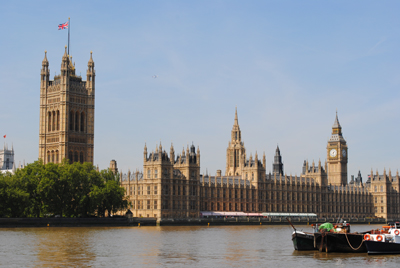
Three days of events kick off in London tomorrow to mark the 70th anniversary of Victory in Europe (VE) Day. Events will include a Service of Remembrance at the Cenotaph in Whitehall at 3pm tomorrow (Friday) coinciding with two minutes national silence while Trafalgar Square – scene of VE Day celebrations in 1945 – will host a photographic exhibition of images taken on the day 70 years ago (the same images will be on show at City Hall from tomorrow until 5th June) and, at 9.32pm, a beacon will be lit at the Tower of London as part of a nation wide beacon-lighting event. On Saturday at 11am, bells will ring out across the city to mark the celebration and at night, a star-studded 1940s-themed concert will be held on Horse Guards Parade (broadcast on BBC One). Meanwhile, on Sunday, following a service in Westminster Abbey, a parade of current and veteran military personnel will head around Parliament Square and down Whitehall, past the balcony of HM Treasury where former PM Sir Winston Churchill made his historic appearance before crowds on the day, to Horse Guards. A flypast of current and historic RAF aircraft will coincide with the parade and from 1pm the Band of the Grenadier Guards will be playing music from the 1940s in Trafalgar Square. Meanwhile, starting tomorrow, special V-shaped lights will be used to illuminate Trafalgar Square, St Paul’s Cathedral and the Houses of Parliament as a tribute. For more information, see www.gov.uk/government/topical-events/ve-day-70th-anniversary.

The works of leading London-based photographer Rut Blees Luxemburg are on show in at new exhibition at the Museum of London in the City. London Dust will feature three major newly acquired works by Luxemburg including Aplomb – St Paul’s, 2013, Walkie-Talkie Melted My Golden Calf, 2013, and the film London/Winterreise, 2013. Blees Luxemburg’s images – others of which are also featured in the exhibition – contrast idealised architectural computer-generated visions of London that clad hoardings at City-building sites with the gritty, unpolished reality surrounding these. In particular they focus on a proposed 64 floor skyscraper, The Pinnacle, which rose only seven stories before lack of funding brought the work to a halt. The free exhibition runs until 10th January next year. For more, see www.museumoflondon.org.uk.

The Talk: The Cutting Edge – Weapons at the Battle of Waterloo. Paul Wilcox, director of the Arms and Armour Research Institute at the University of Huddersfield, will talk about about the weapons used at Waterloo with a chance to get ‘hands-on’ with some period weapons as part of a series of events at Aspley House, the former home of the Iron Duke at Hyde Park Corner, to mark the bicentenary of the Battle of Waterloo. To be held on Monday, 11th May, from 2.30pm to 4pm. Admission charge applies and booking is essential – see www.english-heritage.org.uk/apsley for more.

On Now: On Belonging: Photographs of Indians of African Descent. A selection of ground-breaking photographs depicting the Sidi community – an African minority living in India – is on show at the National Portrait Gallery off Trafalgar Square. The works, taken between 2005 and 2011, are those of acclaimed contemporary Indian photographer Ketaki Sheth and the exhibition is his first solo display in the UK. They provide an insight into the lives of the Sidi, and include images of a young woman named Munira awaiting her arranged wedding, young boys playing street games, and the exorcism of spirits from a woman as a young girl watches. Admission is free. Runs in Room 33 until 31st August. For more, see www.npg.org.uk.

Send all items for inclusion to exploringlondon@gmail.com.

This Week in London – Duke of Wellington on show; wartime City bank recreated in Warwickshire; and early photographs at the Tate…

ArthurWellesleyThe Duke of Wellington’s political and military career as well as his personal life is being explored in an exhibition running at the National Portrait Gallery off Trafalgar Square until August. Wellington: Triumphs, Politics and Passions features 59 portraits and other works including a rarely seen portrait of the Iron Duke painted by Sir Thomas Lawrence and commissioned by Sarah, Countess of Jersey, a year after Wellington had become Prime Minister. The portrait (pictured) remains unfinished – the state it was in when Lawrence died in 1830 – and, held in a private collection, hasn’t been shown in public for any significant period until now. The exhibition also includes a John Hoppner portrait of the duke as a young soldier, a daguerreotype taken by Antoine Claudet on Wellington’s 75th birthday in 1844 and drawings by Lawrence of Wellington’s wife, Kitty. The exhibition – which is part of the commemorations marking 200 years since the Battle of Waterloo, runs until 7th June. Admission is free. For more see www.npg.org.uk. PICTURE: Arthur Wellesley, 1st Duke of Wellington by Sir Thomas Lawrence (1829), © On loan to National Portrait Gallery by kind permission of Mr. & Mrs. Timothy Clode.

Upton House is Warwickshire has turned the clock back to 1939 with a display dedicated to the time when the Bearstead family moved their City-based bank, M Samuel & Co, to their historic family mansion to escape the Blitz in London. Twenty-two bank staff took over the house, sleeping in shared dormitories and taking meals of rook pie in the home’s Long Gallery while secretaries typed surrounded by works of art. The National Trust has returned 12 rooms to their wartime look based on research conducted by 80 of the volunteers at the house. They’re filled with thousands of objects, from ration-book toothpaste to wartime toilet rolls, to recreate a wartime experience at the home. Outside an Anderson Shelter stands in the garden where heritage vegetables are being grown in an allotment. Visitors will also find out how 40 of the most precious works in the home were sent to a special storage facility in a Welsh slate mine to protect them. Admission charge applies. For more, see www.nationaltrust.org.uk/upton-house/

On Now – Salt and Silver: Early Photography 1840-1860. This exhibition at Tate Britain in Millbank is the first major exhibition in Britain dedicated to salt prints, the earliest form of paper photography, and features 90 images including some of the best and rarest early photographs. The salt print technique was invented in Britain in the 1840s and 1850s and spread across the world, hence as well as portraits, still lifes and scenes from ‘modern life’, the images on show include from William Fox Talbot’s images of a Paris street to Nelson’s Column under construction, Linnaeus Tripe’s views of Puthu Mundapam in India and Auguste Salzmann’s studies of statues in Greece. Runs in the Linbury Galleries until 7th June. Admission charge applies. For more, see www.tate.org.uk.

Send all items for inclusion to exploringlondon@gmail.com.

Treasures of London – Australian War Memorial…

Australian-War-Memorial

Tomorrow is the 25th April – commemorated every year as Anzac Day in Australia in memory of that country’s soldiers who lost their lives. This year marks 100 years since Australian troops first landed at Gallipoli during World War I. 

While attention will be focused on Anzac Cove in modern Turkey and the Australian war memorials on what was the Western Front in western Europe, in London there will be several events including a wreath laying ceremony at The Cenotaph in Whitehall, a commemoration and thanksgiving service in Westminster Abbey and a dawn service held at the Australian War Memorial in Hyde Park Corner.

This last memorial, dedicated to the more than 100,000 Australians who died in both world wars, was unveiled on Armistice Day, 2003, in the presence of Queen Elizabeth II, then-Australian PM John Howard and then British PM Tony Blair.

It records the 23,844 names of town where Australians who served in World War I and II were born.

Superimposed over the top are 47 of the major battles they fought. Principal architect Peter Tonkin said the somewhat curvaceous design of the memorial, made of grey-green granite slabs, “reflects the sweep of Australian landscape, the breadth and generosity of our people, the openness that we believe should characterise our culture”.

For more on the wall – including the ability to search for town names – see www.awmlondon.gov.au.

10 London sites associated with Sir Winston Churchill – 10. Odd Churchill memorials…

We finish our series on Winston Churchill, we take a look at a couple of the more odd memorials to him in London.

St-Mary-Aldermanbury

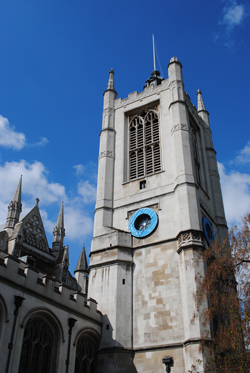
First up, it’s the remains of the church of St Mary Aldermanbury in the City. Among the scores of churches destroyed in the Great Fire of London, it was rebuilt to the designs of Sir Christopher Wren but was again gutted by fire during the Blitz of 1940, leaving only the walls standing. In 1966, the town of Fulton, Missouri, in the US had the remains of the building transported to their town where they were reconstructed in the grounds of Westminster College. It was there that he had made his famous “Iron Curtain” speech in 1946 and the citizens had the church restored as a  memorial to him (beneath the reconstructed church now lies National Churchill Museum). The scant remains of the church in London (pictured above), meanwhile, is now a green oasis in the midst of the city. There’s a memorial plaque at the site which were added by the US college. (The grounds, incidentally are also home to a monument to John Heminge and Henry Condell, two actors and friends of Shakespeare – you can read more on that in an earlier post here).

Bracken-House-clockThe second odd Churchill memorial we’re looking at is a clock face located on the facade of Bracken House – a building which sits opposite St Paul’s in the City. The astronomical clock, the work of Philip Bentham, features shows the time, date and astronomical symbol as well as a sunburst at its centre – look closely and you’ll see a familiar face at the centre. The building, which dates from the 1950s, is apparently named after Brendan Bracken, onetime chairman of the Financial Times which was published in the building until the 1980s. The Churchill connection comes in thanks to the fact that Bracken was a close personal friend of Churchill and served as his Minister of Information from 1941 to 1945.

And that brings to an end our series on Churchill. Next week we kick off a new Wednesday series.

10 London sites associated with Sir Winston Churchill – 9. Memorialising Churchill…

There are numerous memorials to Sir Winston Churchill around London and today we’ll look at a handful of them (while next week we’ll take a look at a couple of the most unusual memorials). We’ve already looked at the most famous statue of him in Parliament Square (in an earlier post here), but here’s some more…

Allies1 AlliesMayfair. These almost life-size bronze statues, located at the juncture of Old and New Bond Streets, depict Churchill and US President Franklin D Roosevelt in an informal pose, sitting and talking together on a bench. The sculpture was a gift from the Bond Street Association to the City of Westminster and was unveiled by Princess Margaret on 2nd May, 1995 commemorating 50 years since the end of World War II. It is the work of US sculptor Lawrence Holofcener. There’s a space between the two World War II leaders where the passerby can sit and have their picture taken between them.

• Member’s Lobby, House of Commons. We’ve already mentioned this bronze statue (see our previous post here), erected in 1969, which stands just outside Churchill Arch opposite one of another former PM, David Lloyd George.  It is the work of Croatian-born sculptor Oscar Nemon who also created numerous other busts of the former PM now located both in the UK (one of which is mentioned below) and around the world.

Great Hall, Guildhall. Commissioned by the Corporation of the City of London and unveiled in 1955, this bronze statue shows Churchill, wearing a suit and bow tie, seated in an armchair and looking ahead. Another work of Nemon’s, it was commissioned as a tribute to “the greatest statesman of his age and the nation’s leader in the Great War of 1939-1945”.

Outside former Conservative Club, Wanstead. A very thick-necked bust of Churchill, erected in 1968, sits outside the 18th century mansion in Wanstead High Street, north-east London, which was once the Conservative Club and is now occupied by a restaurant. The bigger than life-sized bust is the work of Italian artist Luigi Fironi and stands on a plinth once part of old Waterloo Bridge. Churchill was the Conservative member for this area between 1924-1964 and based at the club from 1930 to 1940.

 • Woodford Green. Another tribute from his former constituents, this full length bronze statue in north-east London is the work of Scottish artist David McFall and was unveiled in 1959 in the presence of Churchill himself and Field Marshal Viscount Montgomery. Churchill was the MP for Woodford between 1945 and 1964.

10 London sites associated with Sir Winston Churchill – 7. St Margaret’s Church…

Nestled next to Westminster Abbey opposite the Houses of Parliament, St Margaret’s has long been known as the “parish church of the House of Commons” (although we should point out it’s not officially a parish church). As a result, it probably doesn’t come as a surprise that it has a couple of significant links to former PM Winston Churchill.

St-Margarets-ChurchAmong the most momentous personal occasions was when Churchill married Clementine Hozier in the church on 12th September, 1908, after a short courtship. A headline in the Daily Mirror called it ‘The Wedding of the Year’.

After the fighting of World War II ended in 1945, on VE Day Churchill, in a move reflecting that taken by then PM David Lloyd George after World War I, led the members of the House of Commons in procession from the Houses of Parliament into the church for a thanksgiving service.

In 1947, the church was the scene of another Churchill wedding, this time that of Sir Winston’s daughter, Mary who was wedded to Captain Christopher Soames of the Coldstream Guards on 11th February. 

WHERE: St Margaret’s Church, Westminster (nearest Tube stations are St James’s Park and Westminster); WHEN: 9.30am to 3.30pm weekdays/9.30am to 1.30pm Saturday/2pm to 4.30pm Sunday; COST: Free; WEBSITE: www.westminster-abbey.org/st-margarets-church.


10 London sites associated with Sir Winston Churchill – 6. Claridge’s…

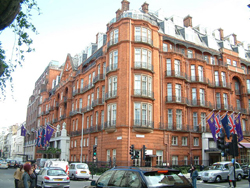
Churchill’s association with this landmark Mayfair hotel was a long one – not only did he convene key meetings here during World War II, the hotel also served as his residence.

ClaridgesEntertaining the upper crust since the mid 1800s, Claridge’s was the scene of many meetings during World War II, including all night meetings convened by Churchill with US military intelligence personnel which would only end when Churchill’s barber appeared at 6am.

The Brook Street hotel became something of a haven for deposed heads of state both in the lead-up to and during World War II – King Peter II and his family had moved in after he was exiled in 1941 and it was at the orders of Sir Winston that in 1945 Suite 212 was declared Yugoslavian territory so Crown Prince Alexander II could be born on “home soil” (there’s a story that a clod of earth from Yugoslavia was  placed under the bed during the birth).

Alongside the king of Yugoslavia, other heads of state to have stayed here during this period include the kings of Greece and Norway.

The scene of many a Churchill dinner, Churchill and Lady Clementine made Claridge’s – specifically the sixth floor penthouse suite – their home for a period after his election defeat in 1945 (Churchill apparently wasn’t that keen on the idea of living so high up!).

For more on the history of Claridge’s, check out the hotel’s website here: www.claridges.co.uk.

PICTURE:  © Copyright Tim Westcott and licensed for reuse under this Creative Commons Licence

10 London sites associated with Sir Winston Churchill – 5. London residences…

Throughout his life – as a child, bachelor, husband and family man, Sir Winston lived in many properties in London (although, of course, a couple of the most famous properties associated with him – his birthplace, Blenheim Palace, and the much-loved family home, Chartwell in Kent – are located outside the city). But, those and 10 Downing Street aside, here are just some of the many places he lived in within London…

29 St James’s Place, St James: Having been born at Blenheim Palace in Oxfordshire and then having spent time in Dublin, at the age of five (1880) he came to live here with his family. He remained here until 1882 when he was sent off to school in Ascot (he later attended schools in Sussex and, most famously, Harrow School). The family, meanwhile, moved to a townshouse at 2 Connaught Place which backed on to Hyde Park.

33 Eccleston Square, Pimlico: The Churchills moved here in 1909 and it was here that their first two children Diana and Randolph were born in 1909 and in 1911. The family remained here until 1913. A blue plaque marks the property.

• Admiralty House, Whitehall: The Churchills first moved into Admiralty House – part of the Admiralty complex on Whitehall – in 1913 (from the aforementioned Eccleston Square) after Churchill was made First Lord of the Admiralty. They remained here until 1915 – years he would go onto to describe as the happiest in his life – before he resigned but returned in 1939 when he was once again appointed to the position.

• 2 Sussex Square, Bayswater: In 1920, the Churchills bought this property just north of Hyde Park which they kept until 1924 when they moved into 11 Downing Street (see below). The property is marked with a blue plaque.

• 11 Downing Street, Whitehall: The Churchills lived at 11 Downing Street when Sir Winston was Chancellor of the Exchequer, from 1925 to 1929. The property, located in Downing Street, is not accessible to the public.

11 Morpeth Mansions, Morpeth Terrace, Westminster:  The Churchill family lived at this Westminster address between 1930 and 1939 (prior to him becoming Prime Minister). The property is marked by a brown plaque.

28 Hyde Park Gate, Kensington: Churchill died in this Grade II-listed, mid 19th century property on the morning of 24th January, 1965. The couple moved in after the end of World War II and, while it’s not clear whether they fully vacated the residence when he was prime minister between 1951-55, it remained their property until his death 10 years later. The property next door, number 27, provided accommodation for his staff. The property is marked with a blue plaque.

This Week in London – War fashions; the “inventor” of Impressionism; looking a Gift Horse in the mouth; and, having a look at the Queen’s House…

A new exhibition exploring how fashion survived and even flourished during World War II has opened at the Imperial War Museum in Lambeth to mark the 70th anniversary of the war’s end. Fashion on the Ration brings together more than 300 exhibits including clothes and accessories like the ‘respirator carrier handbag’, photographs and films as well as official documents from the period, letters and interviews. The exhibition is divided into six parts which examine in detail everything from the uniforms worn during the period to clothes rationing (introduced in 1941) and how the end of the war impacted fashion. Runs until 31st August. Admission charge applies. For more, see www.iwm.org.uk.

The UK’s first major exhibition devoted to Paul Durand-Ruel, the man who “invented Impressionism”, has opened at the National Gallery off Trafalgar Square this week. Inventing Impressionism features around 85 works including some of Impressionism’s greatest masterpieces, a number of which have never been seen in the UK before. The majority of the works were traded by Durand-Ruel (1831-1922) who is noted for having discovered and supported Impressionist painters like Monet, Pisarro, Degas and Renoir. Durand-Ruel purchased an astonishing 12,000 pictures between 1891 and 1922, including more than 1,000 Monets, about 1,500 Renoirs, more than 400 Degas’, some 800 Pissarros and close to 200 Manets. The images on display include a series of rarely-seen portraits of the dealer and his family by Renoir which are being exhibited in the UK for the first time as well as five paintings from Manet’s ‘Poplars’ series and all three of Renoir’s famous ‘Dances’, not seen in the country together since 1985. The exhibition finishes with a reference to an exhibition Durand-Ruel organised in London in 1905. Held at the Grafton Galleries, it presented 315 paintings. Admission charge applies. Runs until 31st May. For more, see www.nationalgallery.org.uk.

Gift Horse, New York-based German artist Hans Haacke’s sculpture of a skeletal riderless horse, will be unveiled on the Fourth Plinth in Trafalgar Square today. The horse, derived from an etching by English painter George Stubbs – whose works are in the nearby National Gallery, features an electronic ribbon tied to the horse’s front leg showing a live ticker of the London Stock Exchange. The statue, described as a ‘wry comment’ on the equestrian statue of King William IV which was originally to occupy the plinth, is the 10th to occupy the plinth since the first commission – Marc Quinn’s sculpture Alison Lapper Pregnant – was unveiled in 2005.

 Contemporary artist Dryden Goodwin’s first feature-length film is on show as part of a new exhibition, Unseen: The Lives of Looking, at the Queen’s House in Greenwich. Continuing Goodwin’s investigations into portraiture, the newly commissioned film focuses on three individuals who have a “compelling” relationship to looking – eye surgeon Sir Peng Tee Khaw, planetary explorer Professor Sanjeev Gupta and human rights lawyer Rosa Curling. Alongside the screening is a series of drawings made by Goodwin after observing the three individuals as well as tools and papers related to each of their trades and a series of objects connected three leading observers related to the history of the Royal Museums Greenwich sites – John Flamsteed, first Astronomer Royal, Edward Maunder, who observed Mars from the Royal Observatory Greenwich, and the artist Willem van de Velde the Elder who made detailed drawings of naval battles in preparation for producing paintings in his studio at the Queen’s House. Runs until 26th July. Admission is free. For more, see www.rmg.co.uk.

Send all items for inclusion to exploringlondon@gmail.com.

10 London sites associated with Sir Winston Churchill – 4. 10 Downing Street…

10-Downing-Street

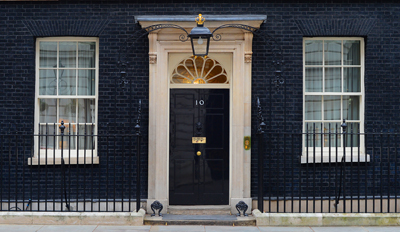
Sir Winston Churchill lived a number of residences in London but, of course, the most famous in its own right is the traditional home of British PMs, 10 Downing Street.

Located in a short street just off Whitehall (now closed to the public), the property has been home to Prime Ministers since Sir Robert Walpole, officially First Lord of the Treasury but effectively the first PM, took up residence in 1735.

Churchill moved in following his election to the office of Prime Minister in 1940 and he and his wife Clementine took up residence in a second floor flat. It was in this property where, cigar in hand, he is famously known to have dictated speeches and letters to his secretary while propped up in bed.

The building suffered some bomb damage during the Blitz – on 14th October, 1940, a bomb fell on nearby Treasury Green and damaged the home’s kitchen and state rooms. Three civil servants doing Home Guard duty were killed but the kitchen staff were saved thanks to Churchill who, dining in the Garden Rooms when the bombing raid began, ordered them to leave their duties and get into a bomb shelter.

The Garden Rooms – which included a bedroom, meeting area and the small dining room – were subsequently reinforced with steel and heavy metal shutters although these apparently would have made little difference had there been a direct hit.

Cabinet moved out of Number 10 into the underground bunker complex now referred to as the Churchill War Rooms (see last week’s post) in October, 1939, and, after several near misses, the Churchills – Sir Winston apparently very begrudgingly – moved into the Number 10 Annex above the war rooms in 1940 (although Churchill continued to visit Number 1o for working and dining).

Much of the furniture and valuables were removed from Number 10 and only the Garden Rooms, Cabinet Room and Private Secretaries’ office remained in use (along with a reinforced bomb shelter built underneath – King George VI is known to have sheltered here when he was dining with Churchill when a raid began).

At the end of the war the Churchills quickly moved back into Number 10 and it was from the Cabinet Room that he made his Victory in Europe (VE) Day broadcast on 8th May, 1945.

He vacated the premises after his election defeat later in 1945 but returned when re-elected PM in 1951 and left after he resigned in 1955 having held a dinner party attended by Queen Elizabeth II and Prince Philip the night before.

A couple of interesting facts about Churchill’s time at number 10: Churchill had many pets who usually had free rein in the house – even at 10 Downing Street his poodle Rufus was known to have wandered into a meeting in the Cabinet Room (before he was ejected) – while in 1958, Georgina Landemare, the cook during his time at number 10, famously published a book, Recipes from No. 10, which featured an introduction by Churchill’s wife, Clementine.

There are apparently two portraits of Churchill among those of other PMs which grace the wall of the Grand Staircase.

For more on the history of 10 Downing Street, see www.gov.uk/government/history/10-downing-street

PICTURE: Sergeant Tom Robinson RLC/Crown Copyright 


10 London sites associated with Sir Winston Churchill – 3. Churchill War Rooms…

Churchill2

Now a museum, the Churchill War Rooms is actually the underground bunker system beneath Whitehall from where Churchill directed operations during the Blitz of World War II.

Churchill1The subterranean complex includes a series of historic rooms where Churchill and his cabinet met which remain in the same state they were in when the lights were switched off at the end of the war in 1945. There’s also a substantial cutting-edge museum dedicated to exploring Churchill’s life which boasts an interactive “lifeline” containing more than 1,100 images and a similar number of documents as well as animations and films.

With the coming conflict on the horizon, the complex was constructed from 1938 to 1939 as an emergency government centre in the basement of the now Grade II* listed government building then known as the New Public Offices (and now home to HM Treasury). It became operational on 27th August, 1939, shortly before the outbreak of the war.

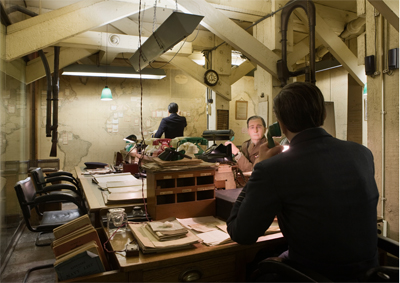
Key rooms include the Map Room (pictured, top, it was manned around the clock by military officers producing intelligence reports) and the War Cabinet Room where more than 100 meetings of Cabinet were held (including just one gathering of Prime Minister Neville Chamberlain’s cabinet in October, 1939).

Other facilities included a private office/bedroom for Churchill (this came with BBC broadcasting equipment which Churchill used four times and, although it had a bed, Churchill apparently rarely used it), the Transatlantic Telephone Room (pictured above, it was disguised as a toilet) from where Churchill could speak directly to the US President. There are also staff dormitories, bedrooms for officers and government ministers, and rooms for typists and telephone switchboard operators.

In October, 1940, a massive layer of concrete – up to five feet thick and known simply as ‘The Slab’ – was added to protect the rooms. Other protective devices included a torpedo net slung across the courtyard overhead to catch falling bombs and an air filtration system to prevent poisonous gases entering.

Abandoned after the war, the premises hosted some limited tours but, despite growing demand to see inside, it wasn’t until the early 1980s when PM Margaret Thatcher pushed for the rooms to be opened to the public that the Imperial War Museum eventually took over the site. The museum opened on 4th April, 1984, in a ceremony attended by the PM as well as members of Churchill’s family and former staff.

Then known as the Cabinet War Rooms, they were extended in 2003 to include rooms used by Churchill, his wife and associates, and, in 2005, following the development of the Churchill Museum, it was rebranded the Churchill Museum and Cabinet War Rooms. In 2010, the name was shortened to the Churchill War Rooms. The entrance to the premises was redesigned in 2012.

Among the objects in the museum are one of Churchill’s famous “siren suits”, an Enigma machine and the flag from his funeral.

WHERE: Churchill War Rooms, Clive Steps, King Charles Street (nearest Tube stations are Westminster and St James’s Park); WHEN: 9.30am to 6pm daily; COST: £18 adults (with donation)/£9 children aged 5-15 (with donation)/£14.40 concessions (with donation) (family tickets available); WEBSITE: www.iwm.org.uk/visits/churchill-war-rooms/

PICTURES: Churchill War Rooms/Imperial War Rooms

10 London sites associated with Sir Winston Churchill – 2. Houses of Parliament…

Houses-of-Parliament

Of course, no look at London sites associated with Sir Winston Churchill would be complete without a mention of the Palace of Westminster, better known as the Houses of Parliament.

Churchill made his maiden speech in the House of Commons on 18th February, 1901, having won the seat of Oldham for the Conservative Party the year before (he switched to the Liberal Party in 1904 and eventually rejoined the Conservatives in 1924).

Over his long career in politics (he was an MP for 62 years), he served in a variety of roles including the President of the Board of Trade, Home Secretary, First Lord of the Admiralty, Minister of Munitions, Chancellor of the Exchequer, and twice, Prime Minster.

Some of the most famous speeches Churchill gave in the House of Commons were during World War II – they include the ‘blood, toil, tears and sweat’ speech given on 13th May, 1940 – the first after he had been made Neville Chamberlain’s replacement as PM, the ‘we shall fight them on the beaches’ speech given on 4th June, 1940, and the ‘this was their finest hour’ speech of 18th June, 1940, in which he gave the ‘Battle of Britain’ its name and, as the name suggests, first recorded the phrase “their finest hour” (the speech ended with it).

Churchill’s last speech to Parliament was given on 1st March, 1955, in which he spoke about the British development of a hydrogen bomb.

There’s several places within the Houses of Parliament which now bear Churchill’s name. Among them are the Churchill Room (named as such in 1991 when ownership of the room passed from the Lords to the Commons, it features two of his paintings and a bronze bust of the PM).

They also include the Churchill Arch – this leads from the Members’ Lobby into the Commons Chamber and is flanked by a 1969 statue of Churchill ( and one of fellow former PM, David Lloyd George (one foot on each of the statues has been burnished thanks to the practice of MPs to touch them as they enter the Commons Chamber).

It took on its current name after it was rebuilt following damage from bombs during World War II – at Churchill’s suggestion damaged stone was reused in its construction as a memorial to the “ordeal” Westminster had endured during the war. The statue of Churchill, incidentally, was the focus of recent commemorations on the 50th anniversary of his death.

Churchill’s stamp can also be seen on the Commons Chamber itself – it was he who recommended that when the chamber was rebuilt after World War II that it retain its rectangular shape rather than be redesigned in a semi-circle.

Churchill’s body lay in state in Westminster Hall prior to his funeral service in January, 1965 (for more on that, see our previous post here.

For more on Churchill’s Parliamentary career, check out the UK Parliament’s Living History page here: www.parliament.uk/about/living-heritage/transformingsociety/private-lives/yourcountry/collections/churchillexhibition/.

This Week in London – Churchill’s Scientists; Waterloo online; a Chelsea murder case reopened; exploring Crossrail; and, astronomical photography…

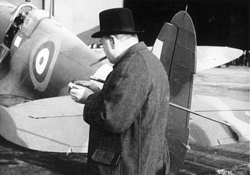
Churchill-with-a-Spitfire-from-Castle-Bromwich,-credit-Philip-Insley,-CBAF-Archive-Vickers-ArchiveSyndics Marking the 50th anniversary of the death of Winston Churchill, a new exhibition at the Science Museum in South Kensington looks at his passion for science and the influence that had on bringing World War II to an end. Churchill’s Scientists celebrates the individuals who flourished under Churchill’s patronage (and , as well as helping to bring about the end of World War II, also launched a post-war “science renaissance”) – from Robert Watson-Watt (inventor of radar) through to Bernard Lovell (creator of the world’s largest telescope) – and also delves into more personal stories of Churchill’s own fascination with science and tech. The display include objects from the museum’s collection as well as original archive film footage, letters and photographs. Highlights include the high speed camera built at Aldermaston to film the first microseconds of the detonation of the UK’s first home grown atomic bomb, the cigar Churchill was smoking when he heard news of his re-election as PM in 1951, and a one-piece green velvet “siren suit” designed by Churchill to wear during air raids (only one of three originals known to exist, it’s never been on public display outside of the tailors who created it). The free exhibition runs until 1st March and is part of the Churchill 2015 programme of events. Visit www.sciencemuseum.org.uk/churchill for more. PICTURE: Churchill with a Spitfire from Castle Bromwich (Philip Insley, CBAF Archive Vickers ArchiveSyndics).

The National Army Museum and Waterloo2oo have launched an online gallery which will eventually comprise images and information on more than 200 artefacts associated with the Battle of Waterloo ahead of the 200th anniversary in June. Among the objects featured on Waterloo200.org are the Duke of Wellington’s boots, a French eagle standard captured in battle and the saw used to amputate the Earl of Uxbridge’s leg. One hundred items – drawn from the Army Museum’s collection as well as from European museums and private collections – can already be seen on the site with a further 100 to be added before the bicentenary on 18th June.

The Talk: Death in Disguise: The Amazing True Story of the Chelsea Murders. On 12th February, the Guildhall Library in the City of London will host Gary Powell as he examines the facts of this double murder which took place in Chelsea in May, 1870, and left Victorian society reeling. For more events at the library, follow this link.

On Now: Breakthrough: Crossrail’s tunnelling story. This exhibition at the London Transport Museum in Covent Garden brings a new perspective on the massive Crossrail project currently underway in the city. Visitors will experience the tunnel environment through a five metre high walk-through installation featuring a computer simulation of a giant boring machine as well as learn about how the project is shaping up, play interactive tunnelling games and hear firsthand from those who work underground. Admission charge for adults applies. Runs until August. For more, see www.ltmuseum.co.uk.

Extended: Astronomy Photographer of the Year Exhibition. This exhibition at the Royal Observatory Greenwich features the winning images from last year’s competition. They include the Briton James Woodend’s image of a vivid green aurora in the Icelandic night sky; American Patrick Cullis’ view of earth taken from 87,000 feet above ground; and, New Zealander Chris Murphy’s image of dusty clouds dancing across the Milky Way. The exhibition can be seen for free in the Observatory’s Astronomy Centre until 19th July. For more, see www.rmg.co.uk/astrophoto.

• Send all items for inclusion to exploringlondon@gmail.com. 

LondonLife – Mary and infant Jesus back on display in St Paul’s…

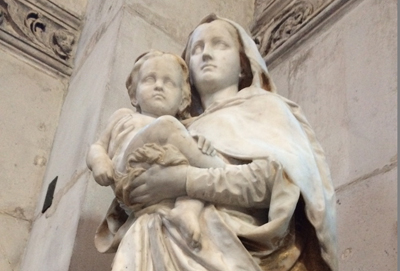
The-Madonna-and-ChildThis Victorian-era marble statue of the Virgin and Child has gone back on show in St Paul’s Cathedral more than 70 years after it taken down following bombing during World War II. Part of an ornate high altar and reredos installed at the cathedral’s east end in 1888, the statue – the work of Thomas Garner – was put into storage after that part of the cathedral took a direct hit during the Blitz of 1940 and what remained of the altar was dismantled (the statue and a crucifix were the only parts retained by the cathedral). It can now be seen in the Chapel of St Erkenwald and St Ethelburga (also known as the Middlesex Chapel) in the north transept. For more, see www.stpauls.co.uk. PICTURE: The Chapter of St Paul’s Cathedral.


Treasures of London – Winston Churchill statue, Parliament Square…

Winston-ChurchillFormer British PM, Sir Winston Churchill, died 50 years ago tomorrow, so we thought it was a good time to take a look at one of London’s most iconic statues.

Standing tall among some of the towering figures of British politics (and others), the over life-sized bronze statue of Sir Winston Churchill on Parliament Square in Whitehall was designed by Welsh sculptor Ivor Roberts-Jones and is located on a site on the square’s north-east corner chosen by the great man himself.

Standing 12 feet (3.6 metres) high on an eight foot (2.4 metre) high pedestal opposite the Houses of Parliament (which he faces), Churchill, who was 90 when he died, is portrayed during the years of World War II wearing a navy greatcoat but wears no hat and leans on a cane.

The full length, Grade II-listed statue, which Roberts-Jones was commissioned to create in 1970, was unveiled by Lady Churchill with the aid of Queen Elizabeth II in 1973.

Interestingly, it’s said that there’s a mild electric current which runs through the statue to ensure pigeons don’t perch and snow doesn’t gather on his head. Another quirky fact – Roberts-Jones was subsequently commissioned to make another Churchill statue in 1977 – this one for New Orleans.

PICTURE: Adam Carr

This Week in London – Gothic literature at the British Library; founder of War Graves Commission honoured; and, New Year’s Eve tickets on sale…

Gothic The UK’s largest exhibition of Gothic literature opens at the British Library in Kings Cross on Saturday (4th October), marking the 250th anniversary of the publication of the breakthrough book, Horace Walpole’s The Castle of Otranto. Terror and Wonder: The Gothic Imagination will feature manuscripts and rare and personal editions of Gothic classics like Bram Stoker’s Dracula, Mary Shelley’s Frankenstein, Robert Louis Stevenson’s Strange Case of Dr Jekyll and Mr Hyde and Charles Dickens’ Oliver Twist as well as the work of contemporary writers like Angela Carter and Mervyn Peake. There will also be Gothic-inspired artworks by the likes of Henry Fuseli and William Blake and modern art, photography, costumes and movies by the likes of Chapman Brothers and Stanley Kubrick. A range of literary, film and music events will accompany the exhibition which runs until 20th January. Admission charge applies. For more, see www.bl.uk/whatson/exhibitions/gothic/. PICTURE: Percival Delivering Belisane from the Enchantment of Urma, Henry Fuselli. © Tate.

The founder of the Imperial (now Commonwealth) War Graves Commission, Sir Fabian Ware (1869-1949), has been honoured with an English Heritage blue plaque at his former home in Marylebone. Sir Fabian lived at the early 19th century Grade II-listed terraced house at 14 Wyndham Place between 1911 and 1919. It was during this period that he served with the British Red Cross in France and first began recording the graves of soldiers killed in battle. In 1917, the Imperial War Graves Commission was formed with the task of reburying the war dead in permanent cemeteries in France. Knighted in 1920, Sir Fabian was to be director of graves registration and enquiries at the War Office during World War II and it was at this time that he extended the war graves scheme to civilians killed in the conflict. The commission changed its name to the Commonwealth War Graves Commission in 1960. Today it cares for cemeteries and memorials at 23,000 locations in 153 countries. For more, see www.english-heritage.org.uk/discover/blue-plaques/.

New Year’s Eve in London will be a ticketed event for the first time this year with 100,000 tickets being made available to the public with each costing a £10 administration fee – the entire sum of which will apparently be used to pay for the ticketing system. Making the announcement last month, the Mayor of London, Boris Johnson’s, office, said the growth in numbers of those who have gathered to watch the fireworks on the Thames – from around 100,000 in 2003 to an estimated 500,000 last year – has put an enormous strain on transport and safety infrastructure and meant people have had to turn up earlier and earlier to get a good view, facing hours waiting in cold and cramped conditions, or risk being among the “hundreds of thousands” unable to get a good view or even see the display at all. Booking tickets – people may secure up to four – will guarantee “good views of the celebrations and a better visitor experience”. To book tickets, head to www.london.gov.uk/nye.

Send all items for inclusion to exploringlondon@gmail.com.

10 of London’s World War I memorials – 8. The RAF Memorial…

RAF-Memorial
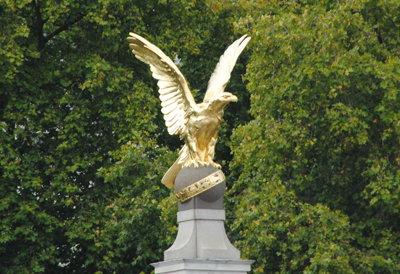
Aerial combat probably isn’t the first thing that springs to mind when thinking about the fighting in World War I but, as the Royal Air Force Memorial on Victoria Embankment records, air crew played a vital role.

The memorial features a bronze eagle perched on an orb girded with a belt depicting the signs of the zodiac which sits atop a Portland stone pylon. It was designed by Sir Reginald Blomfield with the eagle, inspired by the RAF’s badge, sculpted by William Reid Dick. Along with the dedication, it carries an inscription from the Bible (Exodus 19:4) –  “I bare you on eagles wings and brought you unto myself” (sic).

Various other sites were apparently considered for the memorial before the location – amid a string of other memorials between Westminster and Hungerford Bridge – was settled upon (as were other designers including the renowned Edwin Lutyens).

Unveiled on 13th July, 1923, by the Prince of Wales, the memorial was dedicated to the memory of all those who gave their lives in the ranks of the Royal Flying Corps, the Royal Naval Air Service  and the Royal Air Force  (formed through the amalgamation of the RFC and RNAS at a hotel in Strand in 1918) during World War I, along with those who had died while serving in air forces from across the British Empire.

A further dedication was later unveiled in 1946 on Battle of Britain Sunday remembering the men and women of air forces from across the Commonwealth and Empire who died during World War II.

A simple, yet still evocative, memorial.

10 of London’s World War I memorials – 6. The Royal Fusilier’s Memorial…

Fusiliers-MonumentLocated at Holborn Bar – one of the traditional entry points to the City of London, this memorial was erected in 1922 to the memory of the almost 22,000 solider of the Royal Fusiliers (City of London Regiment) who died during the Great War.

The monument, which stands on a traffic island in the middle of busy High Holborn, was designed by sculptor Albert Toft (and hence is known affectionately as “Albert”) along with architects Cheadle and Harding at the behest of several senior officers from the regiment.

It was originally intended to be erected in one of the capital’s many parks. Hounslow Barracks was the next intended location but, after consultation with the City, the site in Holborn was eventually settled upon.

The larger-than-life bronze figure, which stands on a Portland stone pedestal holding a rifle with fixed bayonet, was apparently modelled on an actual person – a Sgt Cox, who served with the Royal Fusiliers throughout the war. The east face features a plate listing all the battalions who served in World War I; the west face features the regimental crest and dedication.

The Grade II-listed memorial, which was officially unveiled by the Lord Mayor of London (we think it was Sir Edward Cecil Moore) on 4th November, 1922, was later updated with inscriptions commemorating those who fell during World War II and in subsequent conflicts.

The original model for the monument can now be seen in the Fusilier Museum at the Tower of London. Interestingly, there is a twin monument, dedicated to the 41st Division, at Flers on the Somme, in France. It was unveiled in 1932.

PICTURE: Mike Peel (www.mikepeel.net)

Famous Londoners – Sir Edwin Lutyens…

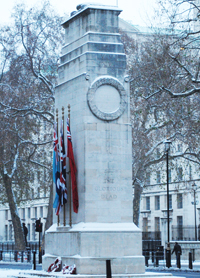
We’re looking at some of London’s World War I memorials so it’s only fitting we look at the life of acclaimed architect Sir Edwin Lutyens, the man credited with designing the Cenotaph – the UK’s national war memorial – in Whitehall (pictured below).

Lutyens was born in London at 16 Onslow Square, South Kensington, on 29th March, 1869, and – the ninth son and 10th of 13 children of soldier Captain Charles Lutyens and his wife Mary – was named for painter and sculptor Edwin Henry Landseer, a friend of his father’s. He grew up in London and Surrey and in 1885 commenced studying architecture at the South Kensington School of Art. In 1887, he left before completing the course, briefly joining the practice of Ernest George and Harold Peto before starting his own practice in 1889.

Cenotaph-in-LondonEarly commissions included country houses and it was during this period that he met with mentor and landscape gardener Gertrude Jekyll, a relationship which led him to design her home, Munstead Wood near Godalming in Surrey.

In 1897, Lutyens, known familiarly as ‘Ned’, married Emily Lytton – daughter of the late Viceroy of India and first earl of Lytton, Edward Buller-Lytton – and by 1908 the couple had five children. The family’s London addresses included 29 Bloomsbury Square (which also served as his office), 31 Bedford Square and 13 Mansfield Street, Marylebone, while his offices were located in numerous places including at 17 Queen Anne’s Gate.

Lutyens continued designing country houses – he eventually designed more than 35 major properties and altered and added many more – and among his commissions were Castle Drogo in Devon and the refurbishment of Northumberland’s spectacularly sited Lindisfarne Castle – both now National Trust properties. He was also involved in helping to plan and design Hampstead Garden Suburb in London, work which included designing two churches.

In 1912, Lutyens was invited to advise on the planning of the new Indian capital in New Delhi and his most important contribution was the design of the Viceroy’s House which combined elements of classical architecture with traditional Indian decoration. He was knighted in 1918 for his contributions in India and for his advice to the Imperial War Graves Commission.

It was his role in this latter effort which led to his becoming a national figure. He was involved in the creation of numerous monuments to commemorate the war dead, the best known of which are the Cenotaph in Whitehall – initially commissioned as a temporary structure (see our earlier post here) –  and the Memorial to the Missing of the Somme in Thiepval in northern France as well as the Australian War Memorial at Villers-Bretonneux and the Anglo-Boer War Memorial in Johannesburg.

He also designed more than 100 war cemeteries in France and Belgium and other war memorials – including overseas in places like Dublin – as well as London’s Tower Hill Memorial (see our earlier post here). Other London buildings he designed included the headquarters of Country Life magazine in Tavistock Street, Britannic House in Finsbury Square, the head office of the Midland Bank in Poultry and the Reuters and Press Association headquarters at 85 Fleet Street (now home to the Lutyens Restaurant, Bar and Private Rooms).

Lutyens was elected a fellow of the Royal Academy in 1920 (he was later president) and in 1924 was appointed a founding member of the Royal Fine Arts Commission. Even as he continued work in Delhi, he took on other commissions – such as the British Embassy in Washington, DC – and in 1924 he completed one of his most lauded – and smallest – designs: that of the one twelfth scale Queen Mary’s Dolls’ House which was shown at the 1924 British Empire Exhibition at Wembley and which can still be seen at Windsor Castle.

In 1929 Lutyens was commissioned to design a new Roman Catholic Cathedral for Liverpool but when he died on 1st January, 1944, this work was still unfinished with only the crypt completed thanks to the outbreak of World War II broke. Lutyens’ funeral was held in Westminster Abbey a few days later and his ashes were subsequently placed in the crypt of St Paul’s Cathedral.

For more information on Lutyens’ life and works, check out The Lutyens Trust, founded in 1984 to preserve and protect his legacy.

10 of London’s World War I memorials – 5. Royal Artillery Memorial…

Royal-Artillery-Memorial

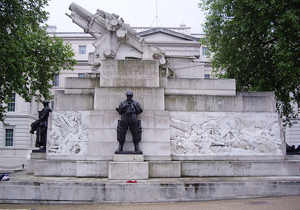
Often deemed to be one of London’s finest war memorials, if not the finest (indeed London Historians’ Mike Paterson has said so previously on these very pages), the Royal Artillery Memorial at Hyde Park Corner commemorates the more than 49,000 members of the Royal Artillery Regiment who died in World War I.

Royal-Artillery-Memorial3Designed by sculptor Charles Sargeant Jagger – who had served in the infantry during the war – and architect Lionel Pearson, it was unveiled in 1925 by Prince Arthur and Anglican priest, Rev Alfred Jarvis.

The monument, described by architectural historian Nikolaus Pevsner as a “masterpiece of British 20th century sculpture”, features an oversized stone replica of a 9.2 inch Howitzer Mk I atop a stone plinth accompanied by a series of four realistic bronze figures and a series of carved reliefs depicting scenes of military life.

The figures represent a gun crew: a driver, artillery captain, shell carrier and, controversially at the time, a dead soldier lying beneath his cape and helmet with an inscription from Shakespeare’s Henry V –  “Here was a royal fellowship of death”.

Three bronze panels were later added at the south end of the monument in commemoration of the almost 30,000 of the Royal Artillery who died in World War II. It was unveiled by the then Princess Elizabeth in 1949.

In late 2011, English Heritage completed a major restoration of the Grade I-listed work with a grant from the Bulldog Trust.

PICTURE: Above – David Adams. Below – virtusincertus/Flickr