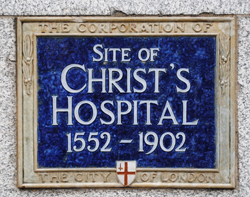
Lost London – Christ’s Hospital…

One of the achievements of the short-lived reign of King Edward VI, son of King Henry VIII, was the establishment of this hospital for orphans in 1552 in what were once buildings used by the Greyfriars Monastery (for more on the history of Greyfriars, see our earlier post here).

Christs-HospitalLocated in Newgate Street, the hospital soon had a school attached which became known as the Blue Coat School thanks to the distinctive long blue coats the students wore (and still do, the school is now located near Horsham in West Sussex).

Many of the hospital buildings were destroyed in the Great Fire of London of 1666 but most were later rebuilt under the supervision of Sir Christopher Wren, although the actual work was apparently carried out by others.

Students at the school have included antiquarian William Camden, Romantic poet Samuel Taylor Coleridge and writer Charles Lamb.

New buildings for girls were opened in Hertford in 1704 and the school moved out to Sussex in 1902 with the General Post Office built over the top of the demolished buildings.

This Week in London – Kew Gardens celebrates its herbaceous borders; the global ‘War on Terror’ at the IWM; Bobby Moore honoured; exposing the camera; and, 60 years of fanzines…

The first of three weekends celebrating the creation of the world’s longest double herbaceous borders – known as the Great Broad Walk Borders – will be held at Kew Gardens this weekend. Made up of 30,000 plants, the borders run along 320 metres of the Broad Walk which was originally landscaped in the 1840s by William Nesfield to provide a more dramatic approach to the newly constructed Palm House (completed in 1848). The spirit of the formal colourful beds he created along either side of the walk have been recreated using a range of plants. To celebrate, Kew are holding three themed weekends, the first of which, carrying a history and gardens theme, is this Saturday and Sunday. As well as talks and drop-in events, there will be a range of family-related activities as well as craft workshops, tours, and shopping. Further weekends will be held on 13th and 14th August (around the theme of the excellence of horticulture at Kew) and the bank holiday weekend of 27th to 29th August (around the theme of a celebration of beauty). For more, head to www.kew.org.

A new exhibition centring on the experiences of UK citizens and residents suspected but never convicted of terrorism-related activities and the role of the British Government in the ‘Global War on Terror’ opens at the Imperial War Museum in Lambeth today. Edmund Clark: War on Terror, Clark’s first major solo show in the UK, looks at the measures taken by states to protect their citizens from the threat of international terrorism and their far-reaching effects, exploring issues like security, secrecy, legality and ethics. Among the photographs, films and documents on display are highlights from five series of Clark’s work including Negative Publicity: Artefacts of Extraordinary Rendition, created in collaboration with counter-terrorism investigator Crofton Black, and other works including the film Section 4 Part 20: One Day on a Saturday, photographs and images from the series Guantanamo: If the Light Goes Out and Letter to Omar as well as the first major display of the work Control Order House. Runs until 28th August, 2017. Admission is free. For more, see www.iwm.org.uk/exhibitions/iwm-london/edmund-clark-war-of-terror.

The only English football captain to win a World Cup, Bobby Moore, has become the first footballer to be honoured with an English Heritage blue plaque. The plaque was unveiled at the footballer’s childhood home at 43 Waverley Gardens in Barking, East London, this week. Moore is best remembered for leading England to a 4-2 win over West Germany in the 1966 World Cup. For more, see www.english-heritage.org.uk/visit/blue-plaques/.

The camera is the subject of a new photography display which opened at the V&A in South Kensington last weekend. The Camera Exposed features more than 120 photographs, including works by more than 57 known artists as well as unknown amateurs. Each work features at least one camera and include formal portraits, casual snapshots, still-lifes, and cityscapes. Among the images are pictures of photographers such as Bill Brandt, Paul Strand and Weegee with their cameras along with self-portraits by Eve Arnold, Lee Friedlander and André Kertész in which the camera appears as a reflection or shadow. The display includes several new acquisitions including a Christmas card by portrait photographer Philippe Halsman, an image of photojournalist W Eugene Smith testing cameras and a self-portrait, taken by French photojournalist Pierre Jahan using a mirror. Runs in gallery 38A until 5th March. Free admission. For more, see www.vam.ac.uk/exhibitions/the-camera-exposed.

Sixty years of fanzines – from the development of zine-making back in the 1940s through to today’s – go on show at the Barbican Music Library in the City on Monday. FANZINES: a Cut-and-Paste Revolution features zines including VAGUE, Sniffing’ Glue, Bam Balam, Fatal Visions, Hysteria and Third Foundation among others. The exhibition, which runs until 31st August, is being held in conjunction with this year’s PUNK LONDON festival. For more, see www.cityoflondon.gov.uk/services/libraries-and-archives/our-libraries/Pages/Barbican-Music-Library.aspx.

Send all items for inclusion to exploringlondon@gmail.com.

What’s in a name?…Putney…

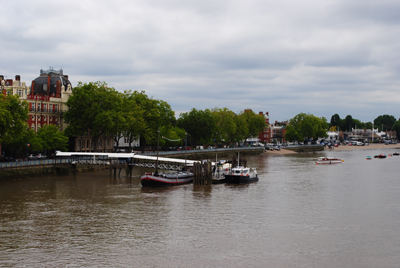
PutneyThis south-west London Thames-side district (and the bridge named after it), traces the origin of its name back to Saxon times.

Putney2Recorded in the Domesday Book as Putelei and known in the Middle Ages as Puttenhuthe, it apparently goes back to a Saxon named Puttan who lived in the area and the Old English word ‘hyp’, which means ‘landing place’. Hence, “Puttan’s landing place” (or Puttan’s wharf).

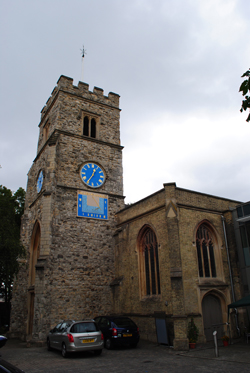
Putney has something of a storied history – it was the birthplace of Tudor heavyweight Thomas Cromwell, Georgian-era author Edward Gibbon and it was here, in the still-standing parish church of St Mary the Virgin (pictured), that the Putney Debates were held in 1647 among members of the New Model Army.

The first bridge was apparently built here in the first half of the 18th century and the present stone bridge in the 1880s.

Today a sought-after riverside residential district, Putney boasts a sizeable high street, great riverside pubs and eateries and is particularly popular every April when The Boat Race is held between Oxford and Cambridge universities thanks to the starting point being just upstream of Putney Bridge.

The area also is home to the 400 acre Putney Heath (which adjoins Wimbledon Common), a popular site for duels in the 18th century, and also home to a stone and brick obelisk, erected in 1770 to mark the 110th anniversary of the Great Fire of London (more on that in an upcoming post).

LondonLife – Sculpture returns to the City…

Sculpture1
Sculpture in the City has returned to the Square Mile for summer with 17 contemporary artworks by internationally renowned artists located in public spaces across the City of London.
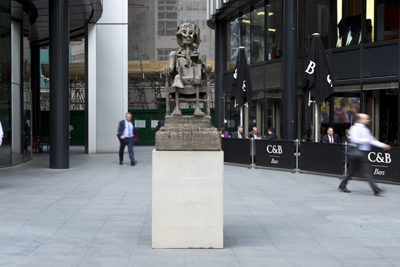
 With the event now in its sixth year, this year’s sculptures include Jaume Plensa’s seven metre high cast iron work Laura (located at 30 St Mary Axe (aka The Gherkin), it’s pictured above), Matt Collishaw’s work, Magic Lantern Small – a grand scale “zoetrope”, one of the earliest moving image machines (located in Bury Court, it’s pictured below), and Huma Bhabha’s work, The Orientalist (located in Fenchurch Avenue, it’s pictured far below). Other works can be found in locations including St Botolph-without-Bishopsgate Gardens, The Leadenhall Building and St Helen’s Bishopsgate Churchyard. A map of the SITC trail and extra commentary on the individual artworks can be accessed by downloading the SMARTIFY app for Apple and Android devices and then scanning any of the sculptures. There’s also a map and information available at www.cityoflondon.gov.uk/sculptureinthecity. PICTURES: Nick Turpin

Sculpture2

Sculpture3

This Week in London – Remembering the Great Fire of 1666; rediscovering the Palace of Whitehall; and, the Queen’s dresses go on show…

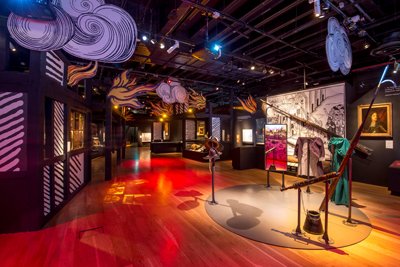
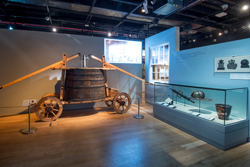
Fire2• A new “theatrical” exhibition marking the 350th anniversary of the Great Fire of London is opening at the Museum of London on Saturday. Fire! Fire! takes visitors on an interactive journey from before, during and after the great fire, looking at how the fire started and spread and the personal stories of Fire1Londoners present at the time. Visitors will be able to step in Pudding Lane and see what life was like for 17th century Londoners, walk into the bakery where the fire started, and identify objects melted by the flames. Exhibits on show include a restored 17th century fire engine, originally built in London in the last 1670s, other firefighting equipment including a squirt, a leather bucket and fire hook, a pair of bed hangings, a burnt Geneva Bible, and letters written in the fire’s aftermath. Admission charges apply. Can be seen until 17th April next year. A series of events, including walks, tours, lectures, workshop and family activities, accompanies the exhibition. For more, see www.museumoflondon.org.uk/fire-fire.  The museum has also commissioned a Minecraft building group recreate London as it was in 1666 with the first of three interactive maps to be released next week (available for free download from www.museumoflondon.org.uk) and further maps to follow in September and February. For more information on other events surrounding the anniversary, see www.visitlondon.com/greatfire350.
The long lost Palace of Whitehall is the subject of a new visitor experience which kicks off at the last surviving part of the palace – the Banqueting House – today. Handheld devices, binaural 3D sound and haptic technology is being made available to guests as they stroll around the streets of modern Whitehall, allowing them to immerse themselves in the former palace during the time of the Tudors and the Stuarts. The Lost Palace experience, created in a collaboration between Historic Royal Palaces and Chomko & Rosier and Uninvited Guests, includes a chance to see the jousts which so delighted Queen Elizabeth I at Horse Guards Parade, accompany King Charles I as he walks through St James’s Park to his execution at the Banqueting House, meet Guy Fawkes following his arrest in the Gunpowder Plot, take part in a performance of King Lear and eavesdrop on an encounter between King Henry VIII and Anne Boleyn before their doomed love affair began. The Palace of Whitehall was once the largest palace in Europe with 1,500 rooms spread across 23 acres. Tickets can be purchased at the Banqueting House. Runs until 4th September. For more details, see www.hrp.org.uk/thelostpalace.
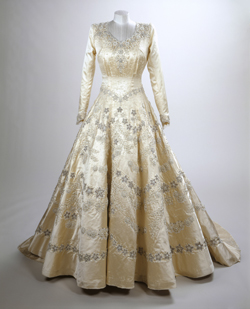
DressDresses worn by Queen Elizabeth II during two of the most significant events in Her Majesty’s life – her wedding and her coronation – can be seen as part of the Summer Opening of the State Rooms at Buckingham Palace from Saturday. The two dresses will form part of a special exhibition – Fashioning a Reign: 90 Years of Style from The Queen’s Wardrobe, the largest display of the Queen’s dress ever held. Alongside the two feature dresses, both designed by British couturier Sir Norman Hartnell, are around 150 outfits created by designers including Hartnell, Hardy Amies and Ian Thomas. The then Princess Elizabeth’s wedding dress (pictured), made for her marriage to the Duke of Edinburgh on 20th November, 1947, was made in ivory silk, decorated with crystals and 10,000 seed pearls and attached to a 15 foot long train, while the Queen’s Coronation dress – created for the event on 2nd June, 1953, is made of white duchesse satin and encrusted with seed pearls, sequins and crystals (along with an extra four-leaf shamrock on the left side of the skirt, added secretly by Sir Norman, to bring her good luck). The exhibition, open to 2nd October, is being accompanied by special displays at both Windsor Castle and Holyroodhouse in Edinburgh. Admission charges apply. For more, see www.royalcollection.org.uk. PICTURE: Royal Collection Trust/© Her Majesty Queen Elizabeth II 2016. 

The world’s largest collection of London images – more than 250,000, dating from 1450 to now – are being made available on a free-to-access website hosted by the London Metropolitan Archives from today. Collage – The London Picture Archive features more than 8,000 historical photographs of capital’s streets as well as images of the Great Fire of London in 1666 and photographs of the construction of Tower Bridge along with maps, prints, paintings and films, all drawn from the collections at the City of London Corporation’s Guildhall Art Gallery and the Clerkenwell-based London Metropolitan Archives. The collection can be accessed at www.collage.cityoflondon.gov.uk.

It’s hands-on gaming at the Science Museum for two weeks from Friday with more than 160 systems and hundreds of games available to play on. Power UP spans 40 years of gaming with games ranging from classics like Pong and Pac-Man to modern games like Halo and systems from Atari and SEGA to PS4 and Xbox One. Ninety minute sessions are being held four times daily from 11am tomorrow until 7th August. Ticket charges apply. For more , see www.sciencemuseum.org.uk/powerup.

Send all items for inclusion to exploringlondon@gmail.com.
10 notable blue plaques of London – 10. A man…and his work…

We finish our series looking at notable English Heritage blue plaques with a look at a plaque which not only commemorates a prominent Londoner but, unusually, also displays there for all to see the reason (well, an important part of it, anyway) for his prominence.

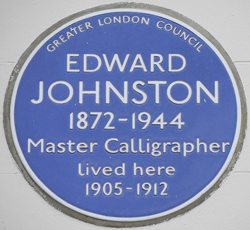
Edward-Johnston1Yes, we’re talking about Edward Johnston (1872-1944), a master calligrapher who was not only credited with starting the modern revival of the art but is also noted for having created the famous Johnston typeface which he developed for London Transport in the early 20th century.

In a lovely touch, the sans serif typeface he created is that used on the plaque – located at premises at 3 Hammersmith Terrace in Chiswick where he lived from 1905-1912 – itself.

The plaque, which was erected on the building in 1977 by the Greater London Council, was the first to feature the typeface but isn’t the only one: in fact there are four, all of which commemorate people related to London Transport.

The other three commemorated include Frank Pick (1878-1941), a London transport administrator who steered the development of London’s corporate identity – he’s commemorated with a plaque on his former property at 15 Wildwood Road, Hampstead Garden Suburb, with a Greater London Council plaque erected in 1981).

They also include Albert Henry Stanley, Lord Ashfield (1874-1948), the first chairman of London Transport (placed on his former home at 43 South Street, Mayfair, in 1984 by London County Council); and, the most recent plaque commemorating Harry Beck (1902-1974), designer of the London Underground map (placed by English Heritage in 2013 on his former property at 14 Wesley Road in Leyton).

PICTURE: Edwardx/CC BY-SA 4.0

10 notable blue plaques of London – 9. A family affair…

Freud-Museum

The fact the properties can have many residents with the passing of the years means that there’s a select number of properties in London (18 to be exact) which bear more than one English Heritage blue plaque – among them 4 Carlton Gardens in St James’s (home to 19th century PM Lord Palmerston and where General Charles De Gaulle set up the headquarter of the free French forces in 1940).

But among that group is an even more select group – properties which bear two blue plaques with both of those people commemorated coming from the same family.  The home at 20 Maresfield Gardens in Hampstead (pictured above) falls into this group.

Now a museum, the home’s celebrated occupants have included psycho-analyst Sigmund Freud, who lived here briefly in the final years of his life (between 1938 and his death on 23rd September, 1939), and his daughter Anna Freud, the youngest of his six children and herself a pioneering psycho-analyst, who lived here from 1938 until her death in 1982.

Both occupants have their own blue plaques on the property: Sigmund’s original London County Council blue plaque was unveiled on the site by his daughter Anna – then still occupant in the home – in 1956, the 100th anniversary of his birth. It had deteriorated and was replaced in 2002, at the same time a plaque to Anna herself was unveiled.

When Freud had moved to London from Vienna in June, 1938 – following the annexation of Austria by the Third Reich, he had initially lived in Primrose Hill before settling in the property in Maresfield Gardens along with his family and a significant collection of furniture from his Vienna consulting rooms.

In 1986, four years after Anna’s death, property was reopened as the Freud Museum and the public can still go inside and see Freud’s study, including his famed consulting couch, just as it was when he lived there.

The Freuds aren’t, of course, the only family members commemorated by English Heritage Blue Plaques – others include suffragette mother and daughters Emmeline and Christabel and Sylvia Pankhurst (the first two commemorated on a single plaque at 50 Clarendon Road in Notting Hill and the latter at 120 Cheyne Walk in Chelsea), and father and son Prime Ministers William Pitt the Elder and his son William Pitt the Younger (at 10 St James’s Square in St James’s and 120 Baker Street in Marylebone respectively).

WHERE: Freud Museum London, 20 Maresfield Gardens, Hampstead (nearest Tube stations are Finchley Road and Swiss Cottage);  WHEN: Noon to 5pm, Wednesday to Sunday; COST: £7 adults; £5 seniors; £4 concessions (including children 12-16); children under 12 free; WEBSITE: www.freud.org.uk.

PICTURE: Rup11/CC BY-SA 3.0/Wikimedia.

This Week in London – I am London; Gerrit Dou’s women reunited; and, Georgia O’Keeffe…

A new free exhibition featuring 60 Londoners photographed in front of an historic building or special place to them opens in Kings Cross on Monday. The Historic England exhibition I am London features well-known Londoners, such as reproductive health expert Professor Lord Robert Winston, philosopher AC Grayling, feminist activist and journalist Caroline Criado Perez, artist Bob and Roberta Smith, designer Morag Myerscough and performer Amy Lamé as well as “unsung Londoners” – everyone from a Yeoman Warder at the Tower of London and the park manager at Kensington Gardens to a 7/7 paramedic, an apprentice at a Savile Row tailors and a student at the Royal School of Needlework – in telling stories which illustrate how the city’s heritage can be “inspirational, provocative, frustrating, fun, familiar, humbling and home”. Taken by Historic England photographer Chris Redgrave, the photographs will be displayed in the UAL Window Galleries at Central Saint Martins along with a selection of objects the sitters chose to be photographed with, including the Pearly King of Finsbury’s jacket, Bob and Roberta Smith’s ‘Vote Bob Smith’ badge and a submarine once owned by Morag Myerscough’s father. Can be seen until 4th September. For more, see https://historicengland.org.uk/get-involved/visit/exhibitions/i-am-london/.

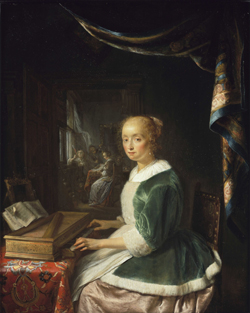
Gerrit-Dou Two of 17th century Dutch painter Gerrit Dou’s finest works – Woman playing a Clavichord and Lady Playing a Virginal (pictured), both dating from about 1665 – have been reunited for the first time in 350 years at the Dulwich Picture Gallery in south London. Opening this week, Dou in Harmony examines how Dou created two distinctly different takes on a similar subject and will be accompanied by a contemporary sound installation in the Mausoleum. Composed and played on the viola da gamba by Liam Byrne, the modern piece takes its cue from 17th century music and aims to evoke the mood of Dou’s paintings. The display is the latest in the Making Discoveries: Dutch and Flemish Masterpieces series which showcases four artists from the gallery’s collection: Van Dyck, Rubens, Dou and Rembrandt (whose work will be featured in an upcoming display in November). Runs until 6th November. Admission charge applies. For more, see www.dulwichpicturegallery.org.uk.

Georgia O’Keeffe’s celebrated work, Jimsyn Weed, White Flower No 1 (1932), is among highlights at the major retrospective of the US artist’s work which opened at the Tate Modern this week. The display marks a century since O’Keeffe’s debut in New York in 1916 and, with none of her works in public collections in the UK, provides a “once-in-a-generation opportunity” for audiences outside the US to view her portfolio of works in such depth. The display features more than 100 major works and charts the progression of O’Keeffe as an artist over a span of six decades. Runs until 30th October. For more, see www.tate.org.uk.

Send all items for inclusion to exploringlondon@gmail.com.

10 notable blue plaques of London – 8. A notorious ‘tree’ recalled…

To look at it, you wouldn’t necessarily imagine the memorial marking the former site of the ‘Tyburn Tree’ near Marble Arch was part of the English Heritage Blue Plaques scheme. 

Tyburn-Tree2But, located on the ground on a traffic island at the junction of Edgware and Bayswater Roads, this memorial commemorating the site of the former gallows at what was once London’s execution grounds (and those who died upon it) is just that.

It’s estimated by some that as many as 60,000 people may have been executed here over the 600 years until the late 1700s

While the plaque only mentions one of the names by which the various gallows erected here were known – Tyburn being the name of the village originally here, others included ‘The Elms’, the ‘The Deadly Never Green Tree’ and the ‘Triple Tree’, the latter presumably a reference to the famous three-sided gallows set up here during the reign of Queen Elizabeth I.

The last gallows was removed in 1759 when executions were moved into Newgate Prison (for more on the Tyburn Tree, see our earlier post here).

The plaque was erected on the site in 1964 by the London County Council; it replaced an earlier triangular plaque the council had erected here in 1909.

The memorial was restored and rededicated in a ceremony in 2014 with the placement of three oak trees around it (this picture was taken before the restoration).

There is a green City of Westminster plaque nearby which commemorates 105 Roman Catholic martyrs who lost their lives on the gallows between 1535 and 1681 while the deaths of the more than 350 Roman Catholics who died across England and Wales during the Reformation, including those on the Tyburn Tree, are also recalled in a shrine at the nearby Tyburn Convent.

LondonLife – Digging up Greenwich Park’s past…

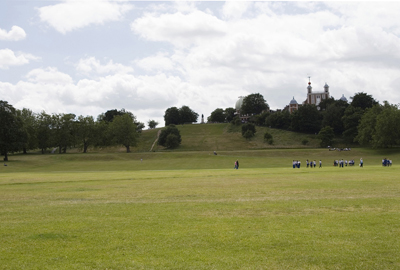
Greenwich-Park-in-summerThe remains of the 17th century Old Keeper’s Cottage in Greenwich Park are being brought to light in an archaeological dig underway in the park this week. The lodge stood close to Queen Elizabeth’s Oak near the centre of the park and was demolished in 1853. This year’s dig is the final of a three year project to unearth the lodge’s remains, sparked after tiles were discovered near the site of the cottage in 2010. Finds so far include a second century Roman brooch, post-medieval pottery and a Victorian watch-winder. The digs have also revealed remains associated with the lodge including two buildings and part of the boundary of the complex. Toni Assirati, head of education and community engagement at Royal Parks, says while much is already known about the history of Greenwich Park – which dates back to 1427 – much remains to be yet discovered about its social history. “This project will hopefully help us find out more about the lives of the people who worked and lived in the park.” Members of the public are invited to attend from 3pm to 6pm on 13th July to hear more about the project from the archaeologists involved as well as see some of the unearthed artefacts. For more about Greenwich Park, see our earlier post here or head to www.royalparks.org.uk/parks/greenwich-park. PICTURE: Greenwich Park, looking toward Observatory Hill (the site of the dig is to the left of the hill). © Anne Marie Briscombe/Royal Parks.

London Pub Signs – St Stephen’s Tavern, Westminster…

The origins of the name of this pub apparently lie in something of a mistake (well, sort of).

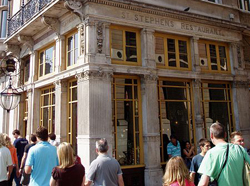
St-Stephens-TavernLocated at 10 Bridge Street on the corner of Canon Row – just across the road from the clock tower at the north end of the Houses of Parliament, its name apparently lies in mistaken belief that the tower was named St Stephen’s Tower.

It never was, at least not officially. Prior to recently being renamed the Elizabeth Tower – in honour of Queen Elizabeth II’s 60 years on the throne, the tower, which contains the bell known as Big Ben, was simply known as the Clock Tower (another common error has been to call the tower itself Big Ben).

The name St Stephen’s Tower apparently was the fault of Victorian journalists. They had the habit of referring to stories relating to the goings-on in the House of Commons as “news from St Stephen’s” because MPs, prior to the destructive fire of 1834, used to sit in St Stephen’s Hall (the entrance to the hall can be found down the road opposite Westminster Abbey).

Hence we have St Stephen’s Tavern, a favoured watering hole of many politicians – including apparently PMs Stanley Baldwin, Winston Churchill and Harold MacMillan.

The pub has been around since at least Victorian times – it was demolished in 1868 when Westminster tube station being built and rebuilt a few years later. In 1924, the pub was expanded to take over the Queen’s Head next door.

It closed in the late 1980s but was reopened in 2003 with many of the original fittings restored. These include one of only 200 parliamentary division bells, located above the bar, which calls MPs back to parliament when it’s time for them to vote (tourists apparently often think it’s a fire alarm and flee when it goes off).

For more, see www.ststephenstavern.co.uk.

PICTURE: Ewan Munro/Flickr/CC BY-SA 2.0 (image cropped)

This Week in London – Commemorating the Battle of the Somme; Transported by Design; and, Winifred Knights at Dulwich…

Battle-of-the-SommeThe Imperial War Museum in Lambeth is holding a free late night opening tonight featuring live music, film screenings, immersive theatre and poetry to mark the 100th anniversary of the Battle of the Somme. Highlights of Night Before the Somme, which runs from 8pm to midnight tonight, include slam poet Kat Francois’ critically acclaimed play Raising Lazarus, poet and broadcaster Ian McMillan’s show Magic Lantern Tales, and extracts from the immersive production Dr Blighty – which tells the story of the million Indians who travelled to fight in the war. Visitors will also have the chance to watch the film, The Battle of the Somme (filmed and screened in 1916, it was the first feature-length documentary about war), listen in to a series of Q&A’s with experts on the battle, and preview the major exhibition, Real to Reel: A Century of War Movies. Real to Reel, which officially opens on Friday, explores how film-makers have found inspiration in compelling personal stories and the real events of wars from the past century. As well as audio-visual installations, the display features film clips, costumes, props, scripts, sketches and designs from films such as The Dam Busters, Where Eagles Dare, Apocalypse Now, Battle of Britain, Das Boot, Casablanca, Jarhead, Atonement and War Horse along with original archival material and artefacts from the IWM collections. The exhibition, which is divided into five sections, runs until 8th January. Admission charges apply. See www.iwm.org.uk for more. PICTURE: © IWM (Q 70164. Staged scene from The Battle of the Somme film, 1916 British troops go ‘over the top’ into ‘No Man’s Land’. This scene was staged for the camera at a training school behind the lines.

• Don’t forget tonight’s vigil at Westminster Abbey to mark the 100th anniversary (as mentioned in last week’s entry here).

Still on the centenary of the Battle of the Somme and a new exhibition opened at the Science Museum in South Kensington this week focusing on the innovations in medical practice and technologies developed as a result of the new kind of industrialised warfare seen in the battle. Wounded: Conflict, Casualties and Care has at its centre a collection of historic objects from the museum’s World War I medical collections including stretchers adapted for use in narrow trenches and made-to-measure artificial arms fitted to the wounded in British hospitals as well as lucky charms and personal protective items carried by frontline soldiers. There are also artworks from the period including Henry Tonk’s famous pastel drawings of facial injuries and a 1914 painting by John Lavery that depicts the arrival of the first British wounded soldiers at the London hospital. Admission is free and the exhibition can be seen until early 2018. For more, see www.sciencemuseum.org.uk.

Regent Street will be transformed on Sunday, 3rd July, with the Transported by Design Festival featuring transport designs which have shaped and will shape London. The festival, which will stretch from Piccadilly Circus to Oxford Circus Tube stations, will see the street divided into three zones – past, present and future. Among the objects on show in ‘past’ section will be a horse-drawn bus and other heritage buses, a 1927 train carriage and an exhibition of classic advertising posters and signage while the ‘present’ section will feature ‘Cycle Spin Fun’ by Santander Cycles, Moquette Land – a showcase of fabric used across the transport network, and, a ‘design a bus’ competition, and the ‘future’ section will feature a range of technologies, including virtual reality headsets, exploring what transport could look like in 2040. The free festival, part of the ‘Summer Streets’ program which sees Regent Street closed to traffic on Sundays over summer, runs from noon to 6pm. For more, see www.tfl.gov.uk/campaign/transported-by-design/event-calendar?intcmp=40582.

• The work of artist Winifred Knights, the first British woman to win the Prix de Rome scholarship, is the subject of a recently-opened exhibition at the Dulwich Picture Gallery. The display, the first major retrospective of the work of Knights (1899-1947), brings together more than 70 preparatory studies and her most ambitious works including The Deluge (1920), The Potato Harvest (1918) and Leaving the Munitions Works (1919). Winifred Knights (1899-1947) runs until 18th September. Admission charge applies. For more, see www.dulwichpicturegallery.org.

Send all items for inclusion to exploringlondon@gmail.com.

LondonLife – Spying a new view of London in a 40 second rush…

TOP-OF-SLIDE-MOCK-UP
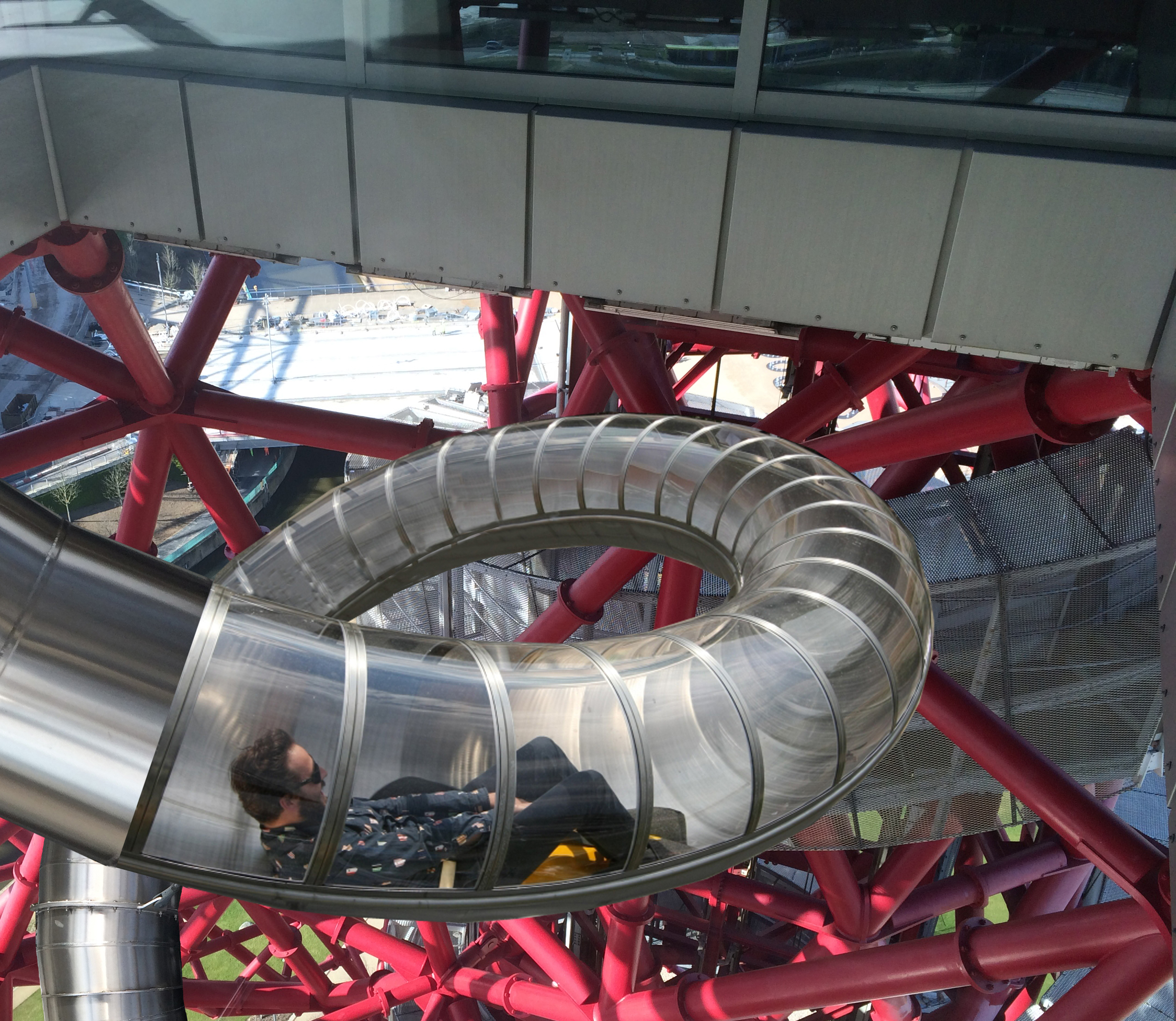
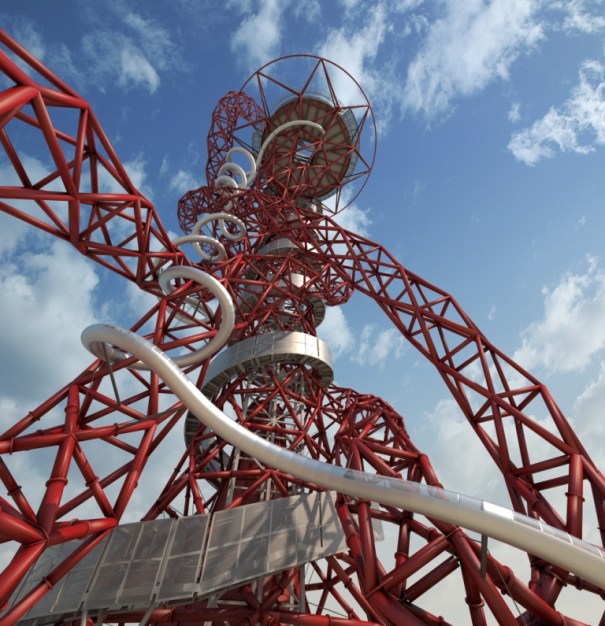
The world’s longest and tallest tunnel slide opened at the ArcelorMittal Orbit sculpture in Queen Elizabeth Olympic Park – the UK’s tallest public artwork – in London’s east last week.
Standing 178 metres high, the slide wraps around the sculpture 12 times as it descends toward earth, providing a 40 second ride of speeds up to 15 kph through a series of twists and turns including a tight corkscrew section known as the ‘bettfeder’ (named after the German word for ‘bedspring’). The slide, which was designed by Belgian artist Carsten Höller at the invitation of Sir Anish Kapoor, designer of the ArcelorMittal Orbit (constructed for the 2012 Olympic Games), is open until 30th December. For more on the Slide and to book, see http://arcelormittalorbit.com/whats-on/the-slide/. PICTURES: Supplied.

Copy-of-Slide-CGI-3

This Week in London – Westminster Abbey open overnight for Somme vigil; ‘Painters’ Paintings’; and, the East End Canal Festival…

Westminster Abbey is to remain open all night next Thursday (30th June) for a vigil in commemoration of the 100th anniversary of the Battle of the Somme. It’s the first time the abbey has been open for an all-night vigil since the Cuban missile crisis more than 50 years ago. The vigil around the Grave of the Unknown Warrior will be mounted from 8.45pm next Thursday, 30th June, through to 7.30am on Friday, 1st July (last entry to the abbey is at 7.15am). The public are invited to attend the vigil following an evening service at 8pm on Thursday which will be attended by Queen Elizabeth II and broadcast live on BBC Two. The vigil, which will end with the firing of World War I guns in Parliament Square by The King’s Troop Royal Horse Artillery, will see a series of 15 minute watches kept by service personnel and community groups representing those involved in the battle and there will also be readings from contemporary accounts. No tickets are required and entry, which is free, is via the abbey’s visitor entrance at the North Door. For more, see www.westminster-abbey.org.

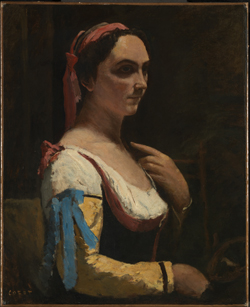
CorotEver wondered what attracts artists to collect particular paintings? Answers abound at a new summer exhibition opening at The National Gallery today. Painters’ Paintings’: From Freud to Van Dyck features a series of ‘case studies’, each of which is devoted to works gathered by a particular ‘painter-collector’ including Lucien Freud, Henri Matisse, Hillaire-Germain-Edgar Degas, Frederic, Lord Leighton, Sir Thomas Lawrence, Sir Joshua Reynolds and Sir Anthony van Dyck. The display was inspired by Jean-Baptiste-Camille Corot’s work Italian Woman which was left to the nation by Lucien Freud following his death in 2011. “It made us start considering questions such as which paintings do artists choose to hang on their own walls,” explains Anne Robbins, curator of the exhibition. “How do the works of art they have in their homes and studios influence their personal creative journeys? What can we learn about painters from their collection of paintings? Painters’ Paintings’: From Freud to Van Dyck is the result.” The exhibition features works from the gallery’s own collection as well as loans from public and private collections. Admission charges apply. Runs until 4th September. For more, see www.nationalgallery.org.uk. PICTURE: Jean-Baptiste-Camille Corot’s Italian Woman, or Woman with Yellow Sleeve (L’Italienne) about 1870/© The National Gallery, London.

The East End Canal Festival takes place at the Art Pavilion, Mile End Park this Sunday. The programme, being run by the Friends of Regent’s Canal, includes boat trips as well as guided canal history walks and a range of performances, films, stalls, exhibitions featuring historic photos and locally made artworks, children’s activities and food. The festivities at the Clinton Road site are free. For more, see http://friendsofregentscanal.org/events/eecf.html.

Send all items for inclusion to exploringlondon@gmail.com.

10 notable blue plaques of London – 6. A blue plaque for a deadly bomb…

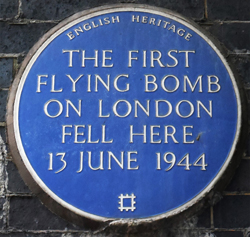
V1-flying-bombNot all of the plaques in the English Heritage blue plaques scheme commemorate people, some also commemorate places and events – the saddest of which is no doubt the landing of the first deadly V1 flying bomb on London during World War II.

Located in Bow in the East End is a plaque commemorating the site where the first flying bomb fell on London on 13th June, 1944, a week after D-Day and several months since the last bombs had fallen on London in what was known as the “mini-blitz”.

Carrying some 850 kilograms of high explosive, the unmanned, fast-moving bomb dived to the ground at about 4.25am on the morning of the 13th, badly damaging the railway bridge and track, destroying houses and, sadly, killing six people.

It was to be the start of a new bombing offensive which would eventually see around 2,500 of the V1 flying bombs reach London between June, 1944, and March, 1945.

They were responsible for killing more than 6,000 people and injuring almost 18,000 and were followed by the even more advanced V2 long range rockets – the world’s first ballistic missiles – in September, 1944. These were responsible for another 2,754 deaths in London before the war’s end.

The current plaque on the railway bridge in Grove Road was erected in 1998 by English Heritage and replaced one which was erected by the Greater London Council in 1985 and subsequently stolen.

PICTURE: Spudgun67/CC BY-SA 4.0

LondonLife – The Hive arrives at Kew…

The-Hive1

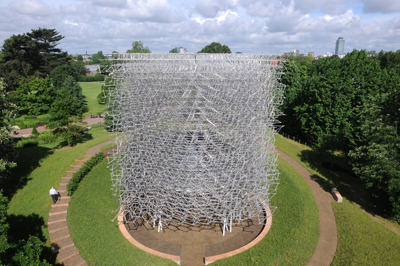
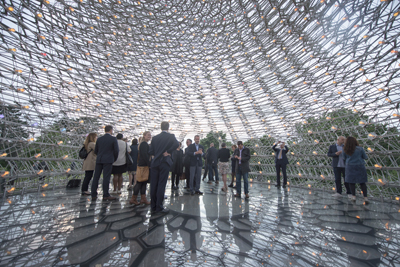
An award-winning art installation exploring the world of the British bee has been installed at Kew Gardens in west London. Designed by artist Wolfgang Buttress and created by BDP, Simmonds Studio and Stage One, the Hive was the centrepiece of the UK Pavilion at the 2015 Milan Expo and has become the first British pavilion to be brought home and reused. The 17 metre-high, 40 tonne installation, which has been set in a flower meadow, twists into the sky suggesting the shape of a swarm of bees. Inside, thousands of flickering LED lights create a sense of what life is like inside a beehive while a soundtrack inspired by the deep humming of the bees fills the air. Both sound and light inside the hive will change in intensity as energy levels in a real beehive located elsewhere in the gardens changes, providing a unique insight into life inside a bee colony. Between 2nd July and 30th October, the installation is being accompanied by a ‘Pollination Trail’ across the gardens which explores the relationship between bees and plants and a series of specially trained ‘hive explainers’ will also be on hand inside The Hive. The gardens are also hosting a series of special talks, films, workshops and ‘lates’ as well as special, family-oriented events. For more see, www.kew.org. PICTURES: Jeff Eden, RBG Kew.

The-Hive2

This Week in London – Engineering feats explained; Tate Modern reopens; app for blue plaques; and, the RA’s summer exhibition…

Sydney_Opera_House_under_construction_6_April_1966__Robert_Baudin_for_Hornibrook_Ltd._Courtesy_Australian_Air_PhotosThe stories behind some of the world’s most iconic buildings – from the Sydney Opera House to the Centre Pompidou in Paris – and engineering projects like London’s Crossrail will be exposed in a new exhibition at the V&A on the work of Ove Arup – arguably the most influential engineer of the 20th century. Engineering the World: Ove Arup and the Philosophy of Total Design, which is being staged on conjunction with the global engineering and design company he founded – Arup, surveys the life, work and legacy of Arup (1895-1988) and features more than 150 previously unseen prototypes, models, films, drawings and photographs as well as new immersive digital displays featuring animations, simulations and virtual reality. As well as presenting information relating to a selection of Arup’s most ground-breaking projects – including collaborations with architects such as Richard Rogers and Norman Foster, the display, which is divided into several distinct sections arranged chronologically, also explores the pioneering work of Arup today on projects like Crossrail, technologies for acoustics studies like SoundLab and SolarLeaf – an experimental bio-reactive facade system that uses micro algae to generate renewable energy. The first major exhibition led by the V&A’s new Design, Architecture and Digital Department, Engineering the World runs at the South Kensington museum until 6th November. Admission charges apply. For more, see www.vam.ac.uk/EngineeringSeason. PICTURE (above): Sydney Opera House under construction, 1966; © Robert Baudin for Hornibrook Ltd. Courtesy Australian Air Photos.

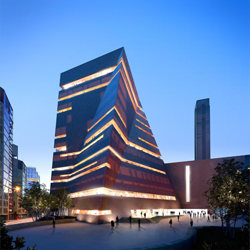
New-Tate-ModernThe new Tate Modern opens its doors to the public tomorrow following a £260 million renovation and expansion. Designed by architects Herzog & de Meuron (who also designed the original conversion of the Battersea Power Station which opened in 2000), the new Switch House building increases the size of the Tate Modern by 60 per cent. As well as redisplaying the 800 works previously on show, the revamped Tate Modern – which still features the Turbine Hall at its centre – also offers a range of new experiences for visitors, from the  subterranean concrete ‘Tanks’ – the first permanent museum spaces dedicated to live art, and a panoramic public viewing terrace on level 10. The museum’s reopening will be celebrated by a free programme of live performances, new commissions and other special events and the museum will stay open until 10pm each evening this weekend when events will include a specially commissioned choral work being performed by more than 500 singers from community choirs around London at 5pm on Saturday. Entry to the Tate Modern on Bankside is free. For more, see www.tate.org.uk/visit/tate-modern. PICTURE: © Hayes Davidson and Herzog & de Meuron/Tate 

English Heritage blue plaques were unveiled to ballet dancer Dame Margot Fonteyn and choreographer Sir Frederick Ashton earlier this month. Dame Margot’s plaque was unveiled at her former flat at 118 Long Acre in Covent Garden (conveniently close to the nearby Royal Opera House where she performed) while Sir Frederick’s plaque was unveiled at his former property at 8 Marlborough Street in Chelsea. The pair’s 25 year relationship produced many of her most celebrated performances and his greatest ballets, including Daphnis and Chloe (1951), Sylvia (1952) and Ondine (1958). The unveiling coincided with the release of a new free Blue Plaques app which, as well as helping users to find blue plaques and uncover the stories of those they commemorate, is also intended to provide an expanding series of walking tours. The first, ‘Soho’s Creatives and Visionaries’, follows a route from Oxford Circus to Tottenham Court Road Station, taking in the property where Karl Marx began writing Das Kapital, the house where Canaletto lived and the attic rooms where John Logie Baird first demonstrated television in 1926. For more, see www.english-heritage.org.uk/visit/blue-plaques/.

The 248th ‘summer exhibition’ – featuring the work of 15 international artistic duos in a display curated by leading British sculptor Richard Wilson – opened at the Royal Academy of Arts this week. On display in the Piccadilly institution’s main galleries, the exhibition’s highlights include a new large scale, suspended kite sculpture by Heather and Ivan Morison, two hand-coloured prints from Jake and Dinos Chapman’s Human Rainbow II series, and, an atmospheric photographic installation from Jane and Louise Wilson’s seminal Chernobyl series. Turkish film-maker and artist Kutlug Ataman’s monumental multi-image video installation, THE PORTRAIT OF SAKIP SABANCI, featuring 10,000 LCD panels will also be displayed. Can be seen until 21st August. Admission charges apply. For more, see www.royalacademy.org.uk.

Send all items for inclusion to exploringlondon@gmail.com.

10 notable blue plaques of London – 5. Five Londoners with more than one blue plaque…

There’s quite a few whose London residence (or otherwise) is commemorated by more than one blue plaque. So, breaking away from our usual ‘one plaque’ format, here were listing five of those who have made the grade…

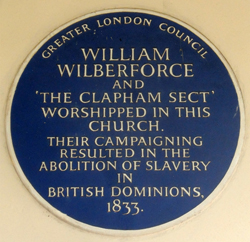
William-Wilberforce-blue-plaque1. William Wilberforce (1759-1833). The late 18th century and early 19th century politician and anti-slavery campaigner tops our list with three English Heritage blue plaques. The first is at 111 Brookwood Road in Battersea – the site of Brookwood House where Wilberforce resided during his anti-slavery campaign. The second is on Holy Trinity Church on Clapham Common, the church where Wilberforce and the Clapham Sect with whom he is associated worshipped. And the third is on a property at 44 Cadogan Place in Chelsea where Wilberforce died.

2. Dr Samuel Johnson (1709-1784). Like Wilberforce, the 18th century lexicographer Dr Johnson has three English Heritage blue plaques to his name. The first, on his famous Gough Square property in the City of London we’ve already mentioned (see our earlier post here), while the second is on a property at 8 Russell Street, Covent Garden, then occupied by bookseller Thomas Davies, which was where Dr Johnson famously first met James Boswell in 1763. The third time Dr Johnson’s name appears, more unusually, is on a plaque commemorating Essex Street – Dr Johnson is among a number of names listed on it for his role in establishing an “evening club” at the pub, the Essex Head, in the street in 1783.

3. Samuel Pepys (1633-1703): The 17th century diarist seems to pop-up everywhere in central London so it’s not surprising there are two plaques in the English Heritage blue plaques scheme dedicated to him (although both are located in the same street – one he apparently liked very much). The plaques are located at number 12 and number 14 Buckingham Street in Covent Garden and both mark the site of a Pepys residence.

4. Virginia Woolf (1882-1941): The writer, publisher and literary critic’s name appears on two properties – at 29 Fitzroy Square in Fitzrovia where Woolf lived between 1907-1911 and on Hogarth House at 34 Paradise Road in Richmond where she and Leonard Woolf lived between 1915-1924 (and also where they founded the Hogarth Press in 1917).

5. William Morris (1834-1896): The poet and artist has two English Heritage blue plaques to his credit – the first on 17 Red Lion Square in Holborn where Morris lived in a flat from 1856-1859 with Sir Edward C Burne-Jones, and the second on Red House in Bexleyheath where he and his wife Jane Burden lived from 1860-1865.

PICTURE: Spudgun67/Wikimedia/CC BY-SA 4.0 (image cropped)

LondonLife – The Queen’s 90th birthday marked at Trooping the Colour…

Queen-in-The-Mall

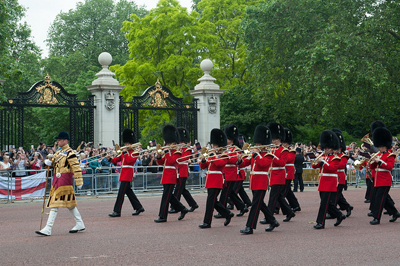
Photographer John Pannell was among the crowds who gathered in The Mall to witness Trooping the Colour on Saturday. Traditionally held to mark the Queen’s birthday, this year’s event – in honour of the fact that the Queen has turned 90 (her actual birthday being 21st April) – was followed on Sunday by a lunch for 10,000, known as the Patron’s Lunch, in The Mall. Trooping the Colour has marked the official birthday of the sovereign since the reign of King George II. Above are the Queen and Prince Philip while below are part of the Massed Bands of the Household Division, among those who marched, and, RAF planes fly-past Buckingham Palace while watched from the palace’s famed balcony by the Queen and the royal family.

Trooping-the-Colour
PlanesPICTURES: John Pannell/Flickr

LondonLife – Beetle-inspired moving installation at the V&A…

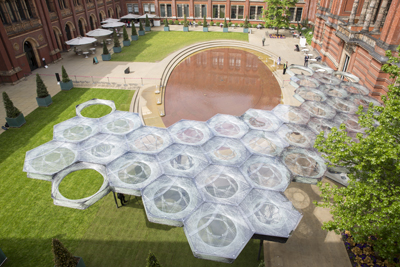
Elytra_Filament_Pavilion_at_the_VA_c_Victoria_and_Albert_Museum_London_5The result of four years of research, the Elytra Filament Pavilion is inspired by the fibrous forewing shells of flying beetles known as elytra. Featuring components which have been fabricated by a robot at the University of Stuttgart and then assembled on site in the V&A’s John Madejski Garden, the installation will grow and move in response to how visitors use the canopy thanks to anonymous data collected from sensors installed in the canopy fibres. On select dates – 17th and 18th June and 22nd September – visitors will be able to see new cells – each of which weighs about 45 kilograms and take an average of three hours to create – manufactured live by a Kuka robot. The installation is the work of experimental architect Achim Menges with Moritz Dorstelmann, structural engineer Jan Knippers and climate engineer Thomas Auer. The pavilion is one of the highlights of the V&A’s first ever ‘engineering season’ with the landmark exhibition – Engineering the World: Ove Arup and the Philosophy of Total Design opening on 18th June. Admission to see the installation, which can be seen at the South Kensington location until 6th November, is free. For more, see www.vam.ac.uk/EngineeringSeasonPICTURES: © Victoria and Albert Museum, London.Elytra_Filament_Pavilion_at_the_VA_c_Victoria_and_Albert_Museum_London_8