This Week in London – Charlotte Bronte celebrated; A Right Royal Buzz; iconic London etching revisited; and, Delacroix at the National Gallery…

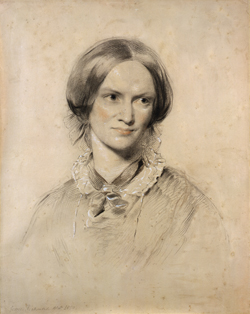
Charlotte-BrontePaintings and drawings by Charlotte Bronte, the first of famous “little books” she ever made, and a pair of her ankle boots worn will go on show at the National Portrait Gallery on Monday. Celebrating Charlotte Bronte 1816-1855 is being held to mark the 200th anniversary of the author’s birth and features 26 items loaned from the Bronte Parsonage Museum in Haworth. As well as portraits from the gallery’s collection (including the only painted portrait of Charlotte), the display will also feature first editions of her novel Jane Eyre and Elizabeth Gaskell’s biography, Life of Charlotte Bronte, as well as chalk drawings George Richmond made of both women. The exhibition, which is free to enter, is in Room 24 and runs until 14th August. For more, see www.npg.org.uk. PICTURE: National Portrait Gallery, London.

Find out what the buzz is all about in London this week when The Royal Park’s A Right Royal Buzz exhibition is held across three venues – Duck Island Cottage in St James’s Park, The National Gallery and the Mall Galleries. The community arts project features art created in a series of workshops under the guidance of artist Alex Hirtzel – all in a bid to teach the public about the importance of pollination. The installations a blacked out box in the Mall Galleries where you can discover how bees see, a room of 3D flowers at the National Gallery inspired by Van Gogh’s Sunflowers and Jan Van Huysum’s Flowers in a Terracotta Vase, and a four foot high beehive and bug hotel made of ceramic tiles on Duck Island in St James’s Park. For more on the project – which can only be seen until 20th February – see www.royalparks.org.uk/arightroyalbuzz.

• A recreation of Claes Jansz Visscher’s iconic 1616 engraving of London goes on show in the Guildhall Art Gallery from Saturday as part of commemorations of the 400th anniversary of William Shakespeare’s death. Artist Robin Reynolds has recreated the work and depicts London, reaching from Whitehall to St Katharine’s Dock, on four large plates. In recognition of the Shakespearean commemoration, the new drawing also features references to the Bard’s 37 plays, three major poetic works and sonnets. Visscher Redrawn: 1616-2016 can be seen until 20th November and is part of a full program of events being held as part of the commemoration (including the Shakespeare Son et Lumiére show in Guildhall Yard on 4th and 5th March). For more, see www.cityoflondon.gov.uk/visscher and www.cityoflondon.gov.uk/shakespeare400.

The first major presentation of the art of Eugene Delacroix to be held in the UK in more than 50 years has opened at the National Gallery’s Sainsbury Wing. Delacroix and the Rise of Modern Art celebrates the career and legacy of the artist, arguably the most famous and controversial French painter of the late 19th century and one of the first “modern masters” yet whose name today is overshadowed by those of many of his contemporaries. The display features more than 60 works borrowed from 30 public and private collections around the world with highlights including Delacroix’s Self Portrait (about 1837), The Convulsionists of Tangiers (1838), and Bathers (1854) as well as works by other artists which pay tribute to the impact he had: among them, Bazille’s La Toilette, Van Gogh’s Pieta and Cezanne’s Battle of Love. Organised by the National Gallery in conjunction with the Minneapolis Institute of Art, the exhibition runs until 22nd May. Admission charge applies. For more, see www.nationalgallery.org.uk.

Send all items for inclusion to exploringlondon@gmail.com.
This Week In London – Artists and gardens at the RA; London tattoos; and, out of this world photos at the Natural History Museum…

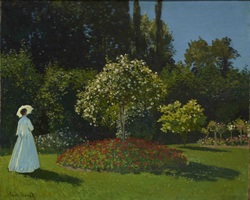
Monet A major exhibition looking at the role of gardens in the paintings of Claude Monet and his contemporaries opens at the Royal Academy of Arts in Piccadilly on Saturday. Painting the Modern Garden: Monet to Matisse spans the period from the 1860s to the 1920s and includes more than 120 Impressionist, Post-Impressionist and Avant-Garde works including 35 by Monet as well as “rarely seen” masterpieces by Paul Klee, Emil Nolde, Gustav Klimt and Wassily Kandinsky. Highlights include Monet’s Agapanthus Triptych (1916-1919) as well as his Water Lilies (1904) and Lady in the Garden (1867), Auguste Renoir’s Monet Painting in His Garden at Argenteuil (1873) , Kandinsky’s Murnau The Garden II (1910) and Pierre Bonnard’s Resting in the Garden (1914). The exhibition, which has previously been at The Cleveland Museum of Art in Ohio, runs until 20th April. Admission charge applies. For more, see www.royalacademy.org.uk. PICTURE: Claude Monet, Lady in the Garden, 1867;  © The State Hermitage Museum/Vladimir Terebenin.

The world of professional tattooing is the subject of a new display at the Museum of London. Tattoo London, which opens at the City-based museum tomorrow, looks at the history of tattooing in the capital – which dates back to a time before Captain Cook – as well as life inside four contemporary tattoo studios. Also on display will be newly commissioned artworks by tattooists from the studios – Lal Hardy at New Wave, Alex Binnie at Into You, Claudia de Sabe at Seven Doors, and Mo Coppoletta at The Family Business. A series of events are being held in conjunction with the display which runs until 8th May. Entry is free. For more, see www.museumoflondon.org.uk.

A new photographic exhibition exploring the solar system has opened at the Natural History Museum. Otherworlds: Visions of our Solar System features 77 composite images pieced together from date collected on NASA and ESA missions by artist, curator and writer Michael Benson. Highlights include A Plutonian haze – a colourised image of Pluto created from data captured during New Horizon’s flyby of the dwarf planet in July last year, Enceladus vents waters into space – captured in 2009 by NASA’s Cassini mission it shows Saturn’s sixth largest moon Enceladus spraying water into space, and, A Warming Comet – a picture of the twin-lobed comet 67P/Churyumov-Gerasimenko venting gas and dust captured by ESA’s Rosetta probe in July last year. The exhibition can be seen until 15th May at the South Kensington museum. Admission charge applies. For more, see www.nhm.ac.uk/otherworlds.

Send all items for inclusion to exploringlondon@gmail.com.
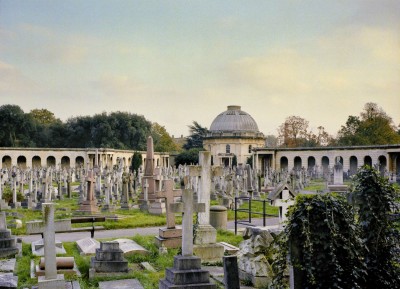
LondonLife – Facelift for one of the UK’s “most unique” cemeteries…

A4605B1E7E3F-21Brompton Cemetery in London’s west is to undergo a major renovation thanks to a £6.2 million  project. Designed by Benjamin Baud and consecrated by the Bishop of London in 1840, the 39 acre cemetery – one of the oldest Grade I listed cemeteries in the country and known as one of London’s “magnificent seven” cemeteries – was strongly influenced by landscapes around St Peter’s in Rome. Among the 205,000 people buried there are suffragette Emmeline Pankhurst, Sir Thomas Spencer Wells – Queen Victoria’s surgeon, and thousands of former Chelsea pensioners. The project will see the chapel, central colonnades and catacombs restored and the transformation of North Lodge into a visitor’s centre with shop and cafe as well as other conservation and improvement works. It is funded by an almost £4.5 million grant from the BIG Lottery Fund and the Heritage Lottery Fund as well as a £1.2 million investment from The Royal Parks, managers of the site, and £500,000 from The Royal Parks Foundation, only half of which has been raised. Those looking to donate to the foundation’s appeal, can visit www.SupportTheRoyalParks.com. PICTURE: © The Royal Parks

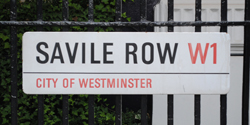
What’s in a name?…Savile Row

Famous around the world as the home of bespoke tailoring in London, Savile Row owes its name – like so many other streets in Mayfair – to landowner Richard Boyle, the 3rd Earl of Burlington.

Savile-RowBurlington (1612-98) resided at Burlington House (now home of the Royal Academy of Arts) on Piccadilly and after his death the land around his former home was developed and the streets named for Burlington and members of his family.

Among them was his wife, Lady Burlington, née Lady Dorothy Savile, after whom Savile Row was named. Laid out in 1695, the street was actually located on the site of the former kitchen gardens of Burlington House and was given its name (originally Savile Street) in the 1730s.

The first to reside here were apparently mostly military and politicians (these included PM William Pitt the Younger) and it was only in the early 19th century that the first tailors started to set up shop here. With clients including society dandy Beau Brummell (see our our earlier post here) and the Prince Regent (later King George IV), the street’s fame grew rapidly and continued into the 20th century when customers included some of the biggest names in Hollywood – Cary Grant, Bing Crosby and Frank Sinatra among them.

Among the famous tailoring firms still operating in Savile Row are Anderson & Sheppard (at number 30, it’s where the Prince of Wales has his suits made), Henry Poole (at number 15, Victorian-era owner Henry Poole is credited as the inventor of the tuxedo), and Hardy Amies.

Headquartered at number 14 (with a shop at number 8), Amies gained an international reputation when appointed dressmaker to Queen Elizabeth II in 1955/the address was previously owned by the playwright Richard Brinsley Sheridan and was also the address Jules Vernes gave Phileas Fogg in Around the World in Eighty Days).

One last tailor worth a particular mention is that of Tommy Nutter, who set up shop at number 35 in the late Sixties with a nameplate out front simply reading Nutters and shocked traditionalists with his modern take on tailoring – this modern approach continues among some tailors in the street even today.

The street also has a famous claim in the story of the Beatles – the moved their company Apple Corps Company into number 3 in July, 1968, and it was on the roof of this building that they played their last live gig on 3rd January, 1969.

Lost London – Holywell Street…

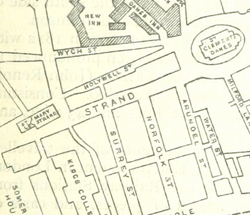
Holywell Street, which ran parallel to the Strand in the West End, was – as we pointed out in a story earlier this week – named for a ‘holy well’ which is still located in the basement of Australia House.

Holywell-StreetOnce a favoured location for secondhand clothes dealers (it was then known to many as ‘Rag Street’), the street became known as something of a hot-house for those selling books containing radical and dissenting opinions in the late 18th century and early 19th century and it was during this time that it also started to attract a less reputable trade – that of the pornography industry.

So much so that by the 1820s, the narrow street – also then known as Bookseller’s Row – had effectively become the centre of the pornographic industry in London (one estimate puts at 57 the number of purveyors of indecency in the street by 1834). William Dugdale, who died in ignominy in prison, was the most infamous purveyor of such goods to work in the street.

The combination of its proximity to the church of St Clement Danes – which sits at the eastern end of what was the street (St Mary le Strand stands at what was the western end) – and the indecent trade which went on in it led to it being nicknamed the “Backside of St Clements”.

The street and is disreputable trade were removed during the building of what is now Aldwych – a crescent at the southern end of Kingsway – in 1901.

PICTURE: Holywell Street shown in 1888 book, The District Railway Guie to London, with coloured maps, plans etc./via British Library Flickr

A Moment in London’s History – Publication of Charles Dickens’ ‘A Christmas Carol’…

St-Michael's-CornhillCredited as “the man who invented Christmas”, Victorian author Charles Dickens’ featured Christmas celebrations in many of his works – but none more so than in his famous story, A Christmas Carol.

Published 172 years ago this December, the five part morality tale centres on the miserly Londoner Ebenezer Scrooge who, following several ghostly visitations by the likes of the Ghosts of Christmas Past, Present and Yet to Come, becomes a changed man and recaptures the essence of what Christmas is all about.

The book – whose characters (said to have been partly based on people he knew in real life) also include the abused clerk Bob Cratchit and his ever positive youngest son, Tiny Tim – is based in London.

Among key locations mentioned in the book is Scrooge’s counting house, said to have been located in a courtyard off Cornhill (it’s been suggested this is Newman’s Court, thanks to a reference to a church tower, believed to be St Michael’s Cornhill – pictured), the home of Scrooge (it has been speculated this was located in Lime Street), and the home in Camden Town where the Cratchits celebrate their Christmas (perhaps based on one of Dickens’ childhood homes in Bayham Street). City of London institutions like the home of the Lord Mayor, Mansion House, and the Royal Exchange are also mentioned.

The book, which apparently only took Dickens six weeks to write while he was living at 1 Devonshire Terrace in Marylebone, was first published on 19th December, 1843, by London-based firm Chapman & Hall. Based at 186 Strand, they published many of Dickens’ works – everything from The Old Curiosity Shop to Martin Chuzzlewit – along with those of authors such as William Makepeace Thackeray and Elizabeth Barrett Browning.

A Christmas Carol‘s first print run of 6,000 sold out any Christmas Eve that same year and sales continued to be strong into the following year. Despite its warm reception by critics and popularity among the public, the book’s profits were somewhat disappointing for Dickens who had hoped to pay off his debts (he also lost out when he took on some pirates who printed their own version two months after its publication; having hauled them to court Dickens was apparently left to pay costs when they declared bankruptcy).

Dickens would later give some public readings of the book, most notably as a benefit for the Great Ormond Street Hospital for Sick Children (his last public reading of the book took place at St James’s Hall in London on 15th March, 1870, just three months before his death).

The book, which has apparently never been out of print, went on to become something of a Christmas classic and has been adapted into various films, theatre productions, radio plays and TV shows (one of our favourites is The Muppet Christmas Carol, dating from 1992).

What’s in a name?…Harley Street…

A Marylebone street which is synonymous the world over with the private medical profession, Harley Street’s name is taken from the surname of the second Earl of Oxford, Edward Harley.

Harley-StreetHis Lordship, who lived between 1689 and 1741, was a land developer and was responsible for the development of land north of Oxford Street in the early 18th century.

As was the fashion, he named Harley Street after himself – but it’s certainly not the only street  which he dubbed with his own moniker. The earl also held the titles of Earl Mortimer (Mortimer Street) and Baron Wigmore (Wigmore Street, Wigmore Place and hence the music venue Wigmore Hall) and also came to own Wimpole Hall in Cambridgeshire (Wimpole Street) and Welbeck Abbey in Northamptonshire (Welbeck Street and Welbeck Way).

But the ties to the earl don’t end there: in 1713 he married Lady Henrietta Cavendish Holles (Henrietta Place, Cavendish Square, New Cavendish Street and Holles Street) while their daughter Margaret married William Bentinck (Bentinck Street), the 2nd Duke of Portland (Great Portland Street, Little Portland Street and Portland Place).

Incidentally, after the earl’s death, the area passed to his daughter and become known as the Portland Estate. It remained the property of the Dukes of Portland for five generations until the fifth duke died without issue in 1879 and the land passed to Lucy Joan Bentinck, widow of the 6th Baron Howard de Walden. Thus Harley Street now forms part of a 92 acre area known as the Howard de Walden Estate.

But back to Harley Street itself. Its association with the private medical profession dates from the latter half of the 19th century when there was a dramatic increase in the number of those engaged in the profession moving into the area, attracted by its quality housing and accessibility (the numbers still remain significant today). The name Harley Street today refers to both the street and also more generally to the surrounding area.

The long list of famous residents who have lived in the street have included painter JMW Turner (number 64 between 1799 and 1805), Victorian-era PM William Ewart Gladstone (number 73 and geologist Sir Charles Lyell also lived here in a premises which is now The Harley Street General Practice) and, made famous through the film, The King’s Speech, Australian speech therapist Lionel Logue who had his practice at number 146.

This Week in London – V&A reopens Europe 1600-1815 galleries; the Victorian era’s finest; and, ‘Handel’s Performers’…

ZMMA_VA_Dec_2015_DG_01

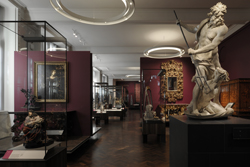
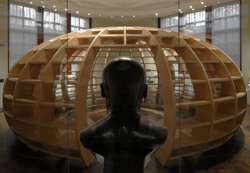
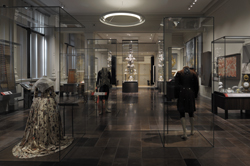
The V&A has reopened its ‘Europe 1600-1815’ galleries to the public this week following a major £12.5 million refurbishment. The seven transformed galleries, located close to the South Kensington museum’s grand entrance, tell the story of how France succeeded Italy as the “undisputed leader” of fashionable art and design in Europe in the late 17th century and how Europeans systematically “explored, exploited and collected” resources from Africa, Asia and the Americas. Featuring more than 1,100 objects, the galleries – redesigned in conjunction with architectural practice ZMMA – include four V&A2large rooms introducing the story of Europe across the period and three smaller rooms focusing on specific activities – ‘collecting in the Cabinet’, ‘enlightened thought in the Salon’, and ‘entertainment and glamour in the Masquerade’. Objects on display include a highly ornate Rococo writing cabinet made from Augustus III (on show for the first time since it has undergone a conservation work), a newly conserved 18th century bed from the Parisian workshop of George Jacob – furniture maker to Napoleon, a 17th century Venetian table by Lucio de Lucci and Pierre-Denis Martin’s oil painting, The Visit of Louis XIV to the Chateau de V&A3Juvisy (both on show for the first time) as well as several large recently cleaned tapestries including the 1860s Gobelins tapestry, The infant Moses tramples on Pharoah’s crown. The display also includes three recreated period rooms – a 17th century French bedchamber, Madame de Sérilly’s cabinet and a mirrored room from 18th century Italy – while in the Salon can be found a contemporary installation, The Globe. A curved architectural sculpture, it is the creation of Havana-based artist collective Los Carpinteros and forms a “room within a room” within the ‘Salon’. It will be used for events and discussions. Entry to the galleries is free. For more, see www.vam.ac.uk/europegalleries. PICTURES: David Grandorge/©Victoria and Albert Museum, London.

On Now: A Victorian Obsession: The Pérez Simón collection. This exhibition at the Leighton House Museum – former home of artist Frederic, Lord Leighton – features more than 50 works by leading Victorian artists, some of which are rarely exhibited. The paintings, which include six works by Leighton himself as well as works by Dante Gabriel Rossetti, Edward Burne-Jones, John Everett Millais and John William Waterhouse, all form part of the collection of Mexican Juan Antonio Pérez Simón who has the largest private collection of Victorian art outside the UK. The highlight of the exhibition, however, is Lawrence Alma-Tadema’s The Roses of Heliogabalus, being shown in London for the first time since 1913. Admission charge applies. The exhibition at the property on the edge of Holland Park runs until 6th April. For more, see www.leightonhouse.co.uk.

On Now: Handel’s Performers. This display of portraits and documents in The Foundling Museum’s Handel Gallery is a showcase of celebrities and singers who brought the work of composer George Frideric Handel’s work to the public in the 18th century. Among those depicted are Anastasia Robinson and Senesino, among the highest paid singers of their time, Anna Maria Strada, a leading soprano, Gustavus Waltz, a bass singer who sang at the benefit performance of Handel’s Messiah at the Foundling Hospital in 1754, and John Hebden, who played in the orchestra during benefit performances of the Messiah in 1754 and 1758. Runs at the Bloomsbury museum until 1st May. Admission charge applies. For more, see www.foundlingmuseum.org.

Send all items for inclusion to exploringlondon@gmail.com.
London Pub Signs – The Old Bank of England…

This Fleet Street pub has an intriguing history. Its name comes from the fact it is housed in what was, until 1975, the former Law Courts branch of the Bank of England.

Sold to a building society, it was transformed into a rather spectacular pub after it was purchased and refurbished by Fuller, Smith and Turner in 1994.

The-Old-Bank-of-EnglandGo further back to the 16th and 17th centuries and the site was occupied by two taverns, The Cock and The Haunch of Venison.

They were both demolished in 1888 to make room for the new bank branch, located, as the name suggests, just up the street from the Royal Courts of Justice.

While it’s been reworked to suit a pub instead of a bank, the remains of the opulent “High Victorian” interior of the bank can still be seen when you step through the doors – no more so than from the upstairs gallery which overlooks the pub.

It also plays a role in the story of legendary 18th century figure Sweeney Todd, the ‘demon barber’ of Fleet Street.

The site stands between Todd’s barber shop at number 186 Fleet Street and the pie shop on Bell Yard owned by his lover, Mrs (Margery) Lovett. As such, it’s said that it was in tunnels below the building on the site that the bodies of Todd’s victims were dismembered and used for pie filling before the pies were sold by Mrs Lovett.

The basement now contains what’s left of vaults which were formerly used to store gold bullion – they were also apparently briefly used to store the Crown Jewels during World War I.

The pub is located at 194 Fleet Street. For more on the pub – which also has an outdoor eating area, see www.oldbankofengland.co.uk.

This Week in London – Christmas at Kensington and the Geffrye; and Ebola and ISIS at the IWM…

Christmas is looming and that means Christmas themed events happening all over London. Here’s a couple worth considering:

Kensington Palace: Head back into the Victorian era where so many of the Christmas traditions we know and love find their origins. The palace and gardens have been decorated with period-inspired decorations while inside decorations include the beautifully decorated tables where Queen Victoria and Prince Albert showcased their Christmas gifts. There’s talks on the origins of Christmas foods such as plum pudding, music and carolling, and the cafe is serving up seasonal food and drink while on Saturday, a special brunch time lecture will look behind the curtains into the world of Victorian pantomime and performance. Admission charges apply – check the website for dates. For more, see www.hrp.org.uk/kensington-palace/.

The Geffrye Museum: This Shoreditch institution is once again celebrating Christmas traditions of the past in its annual display showcasing the past 400 years of Christmas traditions. Christmas Past has taken place at the museum for the past 25 years and is based on ongoing, original research. It provides insights into everything from traditional Christmas feasts to kissing under the mistletoe, playing parlour games, hanging up stockings, sending cards, decorating the tree and throwing cocktail parties. A series of related events, including a concert by candlelight, are being held over the Christmas season. The display, which has free entry, closes on 3rd January. For more, see www.geffrye-museum.org.uk.


Ebola and the fight against ISIS are the subject of a new exhibition which opened at the Imperial War Museum in Lambeth last month. Fighting Extremes: From Ebola to ISIS looks at the experiences of British personnel serving on recent operations including the response to the Ebola outbreak in Sierra Leone and the fight against ISIS in the Middle East. The display features behind the scenes interviews such as an in-depth talk with Corporal Anna Cross, a British Army nurse who contracted Ebola, photographs, and recently acquired objects such as the Wellington boots worn by healthcare worker Will Pooley, the first Briton to contract Ebola who was evacuated from Sierra Leone by the RAF, a headset used by an RAF drone pilot, and a shooting target depicting a silhouette of an ISIS suicide bomber used by the British Army to train Peshmerga troops. For more, see www.iwm.org.uk.

Send all items to exploringlondon@gmail.com.

This Week in London – Alice in Wonderland’s 150th; Remembering Julia Margaret Cameron; and, Imperial Britain’s artistic influence…

John-Tennial-illustrationA new exhibition has opened at the British Library in Kings Cross to mark the 150th anniversary of the publication of Alice’s Adventures in Wonderland. The free exhibition explores the story of how the tale came to be written and features Lewis Carroll’s handwritten manuscript of Alice’s Adventures Under Ground (complete with 37 illustrations by Carroll) as well as an entry from Carroll’s diary in which he relates how he first came to tell the story to Alice Liddell and her sisters on the “golden afternoon” of 4th July, 1862. Other highlights include two first editions of Alice’s Adventures in Wonderland with illustrations by Sir John Tenniel (including the suppressed first edition; suppressed because Carroll and Tenniel were unhappy with the quality of the illustrations), the first movie adaption of the story – a 1903 silent film, early Alice memorabilia, and three new computer game concepts. The exhibition, which runs until 17th April, is accompanied by a series of events and a pop-up shop. For more, see www.bl.uk/events/alice-in-wonderland-exhibition. PICTURE: Sir John Tenniel’s illustration of Alice and the Cheshire Cat from the 1866 edition of Alice’s Adventures in Wonderland by Lewis Carroll © The British Library Board.

An exhibition featuring more than 100 photographs by celebrated 19th century photographer Julia Margaret Cameron opens at the V&A on Saturday to mark the bicentenary of her birth. The display at the South Kensington museum offers a retrospective of her work and looks at her relationship with the V&A’s founding director Sir Henry Cole who presented the only exhibition of her work during her lifetime in 1865. Her relationship with the museum goes back to the very start of her work – within two years of being given a camera by her daughter she was selling and giving photographs to what was then the South Kensington Museum while, in 1868 she was granted the use of two rooms at the institution to use as a portrait studio, becoming the museum’s first artist-in-residence. The exhibition features original prints acquired from Cameron as well as a selection of her letters to Cole, his 1865 diary, the first photograph identified as being of her studio and a variety of her portraits in which family, friends and servants posed as characters from Biblical, historical and allegorical stories. The free exhibition runs until 21st February. For more, see www.vam.ac.uk/juliamargaretcameron.

The influence of the British Empire on art over the past 400 years is the subject of a new exhibition which opened in Tate Britain’s Linbury Galleries yesterday. Artist and Empire will showcase art from across the empire – including the British Isles, North America, the Caribbean, the Pacific, Asia and Africa – and features some 200 paintings, drawings, photographs, sculptures and artefacts. These include paintings by the likes of George Stubbs and Anthony Van Dyck through to Indian miniatures, Maori objects, and the works of contemporary artists such as Sonia Boyce and Judy Watson. Runs until 10th April at the Milbank gallery. The exhibition is free. For more, see www.tate.org.uk.

Send all items for inclusion to exploringlondon@gmail.com.
What’s in a name?…Bleeding Heart Yard

Bleeding

There’s a couple of different suggestions as to how Bleeding Heart Yard – a small courtyard located in the Farringdon area of the City of London, just north of Ely Place – obtained its rather descriptive – and gory – name.

The more prosaic answer is that it was named after an inn which, from the 16th century, stood on the yard and had a sign showing the heart of the Virgin Mary pierced by five swords.

The more interesting answer, on the other hand, is that the name commemorates the horrible murder of Lady Elizabeth Hatton (of the famed Cecil family), second wife of Sir William Hatton (formerly known as Newport), and, after his death, wife of Sir Edward Coke.

The story goes that her corpse was found here on 27th January, 1626, with the beating heart torn from the body.

A version of the legend – albeit with a slightly different protagonist – appears in a story published in Bentley’s Miscellany in 1837 which told of how the wife of Sir Christopher Hatton (he was actually the uncle of Sir William Hatton), made a somewhat ill-conceived pact with the Devil to secure wealth, position and a mansion in Holborn. The Devil dances with her during the housewarming party at the new home and then tears out her heart, found beating in the yard the next morning.

The yard also features in Charles Dickens’ Little Dorrit where it is the location of the home of the Plornish family.

LondonLife – A rare 17th century survivor in Pall Mall…

Pall-Mall

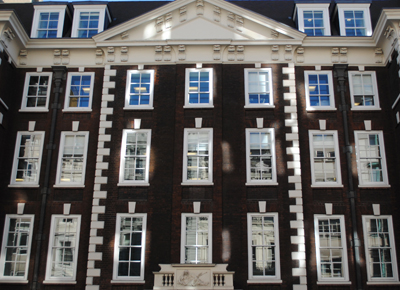
Facade of New Schomberg House at number 80-82 on the south side of Pall Mall. While the rest of the building dates from the 1950s, much of the facade from what is now known as Old Schomberg House (among numerous buildings in Pall Mall once occupied by the War Office) was retained and the eastern end restored. The house was originally built in the late 17th century for the Duke of Schomberg, a general in the service of King William III (hence the name), and replaced Portland House on the site. Later residents here included the painter Thomas Gainsborough, who lived here between 1774 until his death in 1788.

London Pub Signs – The Prince of Wales…

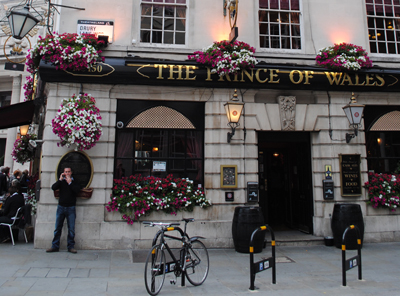
Prince-of-WalesAnother Drury Lane pub, the origins of this one go back to 1852 when it was established by Henry Wells on the site of what was once a potato warehouse. 
The name, in this case, comes from Queen Victoria and Prince Albert’s eldest son, Albert Edward.

Only about 11-years-old when this West End pub was first built, he remained Prince of Wales until succeeding his mother as King Edward VII (nonetheless, the location proved somewhat prescient – Albert Edward was to become known for his bon vivant lifestyle including his love of the theatre (along with, of course, his love of philandering.))

Located close to theatres and the Royal Opera House, the pub at 150-151 Drury Lane (on the corner of Long Acre) was rebuilt in Portland stone in the early 20th century when the street was widened.

Now part of the Taylor Walker group, it remains a popular pub for theatre goers (and even hosts its own events). For more, see www.taylor-walker.co.uk/pub/prince-of-wales-covent-garden/c0659/.

LondonLife – A rare glimpse inside King Henry V’s chantry chapel…

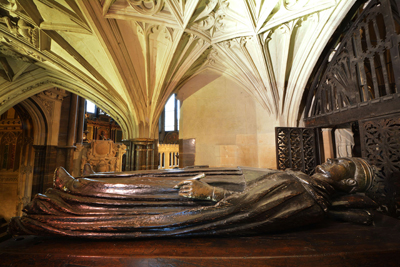
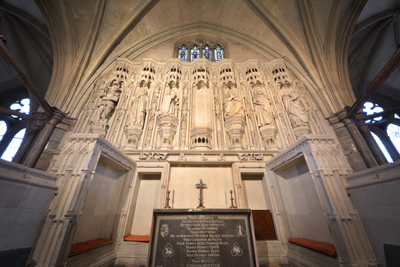
Henry-V-chantry-chapelA fortunate few last weekend had the chance to have a look inside King Henry V’s elaborately carved chantry chapel in Westminster Abbey as part of commemorations marking the 600th anniversary of the Battle of Agincourt. 

The chapel, which is located on a sort of mezzanine level above the king’s tomb at the east end of the Shrine of Edward the Confessor, is one of the smallest of the abbey’s chapels. It was constructed on the orders of the king – who died Vincennes in August, 1422, and was buried in the abbey on 7th November that year – so prayers could be said in perpetuity for his soul.

The tomb was completed in 1431 and the chantry chapel was built above between 1437 and 1450. The latter is entered via narrow stairways of worn steps hidden inside a pair of stone turrets which flank the tomb.

For centuries the Henry V’s funeral ‘achievements’ – the king’s saddle, helm and shield – were displayed on a wooden beam above the chantry chapel but these were restored and moved to the abbey museum in 1972.

Henry V’s wife, Catherine de Valois, who survived her husband by 15 years was eventually – in the Victorian age – buried under the chantry chapel altar (originally buried in the old Lady Chapel, King Henry VII had her removed and placed in an open coffin in the open air next to the tomb of King Henry V, when building his new chapel – among visitors to her mummified body was diarist Samuel Pepys who even kissed her. In 1778 she was buried in a vault before being relocated to her current position in 1878).

An inscription on the altar in the chantry chapel reads: “Under this slab (once the altar of this chapel) for long cast down and broken up by fire, rest at last, after various vicissitudes, finally deposited here by command of Queen Victoria, the bones of Catherine de Valois, daughter of Charles VI, King of France, wife of Henry V, mother of Henry VI, grandmother of Henry VII, born 1400, crowned 1421, died 1438”.

The chantry chapel is still occasionally used for services but, measuring just seven by three metres, is not usually open to the public because of size and access issues.

Westminster Abbey will hold a special service of commemoration on 29th October in partnership with charity Agincourt600. The day before, 28th October, it will host a one day conference for Henry V enthusiasts entitled ‘Beyond Agincourt: The Funerary Achievements of Henry V’. For more, see www.westminster-abbey.org/events/agincourt.

Above – King Henry V’s chantry chapel; Below – King Henry V’s tomb which sits below the chantry chapel. PICTURE: Jim Dyson/Dean & Chapter of Westminster

Henry-V-tomb

Wrapping up 10 small, ‘secret’ and historic gardens in central London…

Over the past couple of months our special Wednesday series has looked at “10 small, ‘secret’ and historic gardens in central London”. So we’re finishing the series by taking a quick look back at the 10 gardens we featured (and providing a single point where you can find any you may have missed)…

10 small, ‘secret’ and historic gardens in central London…1. Goldsmiths’ Garden…

10 small, ‘secret’ and historic gardens in central London…2. Whittington Garden…

10 small, ‘secret’ and historic gardens in central London…3. St Dunstan in the East Garden…

10 small, ‘secret’ and historic gardens in central London…4. St Mary Aldermanbury Gardens…

10 small, ‘secret’ and historic gardens in central London…5. Seething Lane Garden…

10 small, ‘secret’ and historic gardens in central London…6. Red Cross Garden, Southwark…

10 small, ‘secret’ and historic gardens in central London…7. St Swithin’s Church Garden…

10 small, ‘secret’ and historic gardens in central London…8. Postman’s Park…

10 small, ‘secret’ and historic gardens in central London…9. Garden of Rest, Marylebone…

10 small, ‘secret’ and historic gardens in central London…10. Geffrye Museum Gardens…

Do you have a favourite? Or maybe there’s a ‘small, secret and historic’ garden we didn’t mention that you love (and we may mention in a future special)?


London Pub Signs – The Princess Louise…

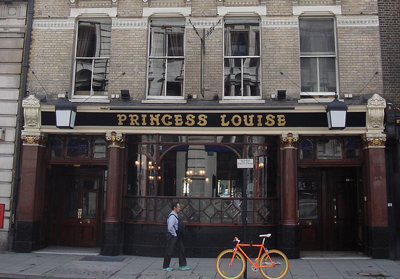
Princess-LouiseThis historic High Holborn pub is named in honour of the sixth child and fourth daughter of Queen Victoria and Prince Albert, Princess Louise, Duchess of Argyle.

The Grade II*-listed pub, which has been described by Peter Haydon and Tim Hampson in their book London’s Best Pubs as a “national treasure” and “the finest, most complete, most original, best preserved, most authentic high-Victorian pub interior in London”, was apparently built in the early 1870s and then remodelled in 1891.

While rather plain externally, this “monument to 19th century craftsmen” boasts a much-vaunted, richly detailed Victorian interior dating from this remodelling which features polychromatic tile work, stained and etched glass and mahogany bar fittings as well as a staggering amount of decoration. The heritage listing even makes reference to the men’s toilets and its marble urinals in the basement.

The pub, at 208 High Holborn, is part of the Samuel Smith Brewery chain who restored it to its former glory in 2007 (including reintroducing glass walled cubicles). It’s also been notable, apparently, for its significant role in hosting folk clubs as part of a revival which occurred in the late 1950s and early 1960s.

Why exactly the pub was named after Princess Louise is something of a mystery and it has been suggested that, thanks to the fact pubs aren’t usually named after living members of the Royal Family, the pub must have originally had a different name.

Princess Louise, meanwhile, is notable for having briefly lived in Canada when her husband served as the Governor-General of that nation. She spent her retirement years at Kensington Palace.

For more, see www.princesslouisepub.co.uk.

PICTURE: Edwardx/Wikipedia

10 small, ‘secret’ and historic gardens in central London…10. Geffrye Museum Gardens…

Geffrye-Garden

We’ve mentioned the Geffrye Museum gardens before but they’re well worth a more detailed mention.

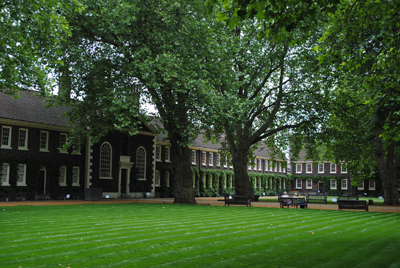
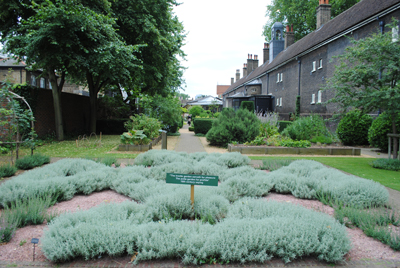
There are two distinct gardens at the Geffrye – the first are the public gardens located just off Kingsland Road which were originally laid out when the almshouses in which the museum is now based were constructed while the second is the walled herb garden and series of period garden ‘rooms’ which are much more recent additions.

While origins of the former date back to when the almshouses – 14 homes of four rooms each with a central chapel – were built in 1712-14 by the Ironmonger’s Company under instructions in the will of Sir Robert Geffrye (for more on him, see our earlier Famous Londoners entry here), they weren’t opened to the public until 1912 when the London County Council took over the site (for more on the history of the almshouses, see our earlier entries here and here).

These gardens originally featured a series of lime trees and by the early 19th century, an image shows lawns surrounded by railings with some flower beds and trees. The front lawns were apparently grazed by sheep or employed for growing crops of potatoes.

By the mid-1800s, the lime trees had been replaced by London plane trees, most of which are still standing. The gardens were again laid out in 1900-01 and again after the LCC took over in 1910 when a small pool was added in front of the chapel and a bandstand and playground elsewhere in the gardens.

The grounds also include a small graveyard – that of the Ironmongers’ – and among those buried here are Geffrye and his wife, their remains brought here from the chapel of St Dionis Backchurch in Lime Street when it was demolished in 1878.

The walled herb garden and period garden ‘rooms’, meanwhile, were added in the 1990s. The herb garden opened in 1992 on a what had been a derelict site to the north of the building – it features four square beds containing more than 170 different herbs and plants.

The period garden ‘rooms’, meanwhile, were laid out in 1998 to showcase middle class town gardens from different eras. They currently include a Tudor “knot garden”, a Georgian garden, a Victorian garden and an Edwardian garden.

Each of these gardens has been carefully constructed using evidence gathered from drawings and prints, maps and garden plans along with plant lists, diaries and literature.

WHERE: Geffrye Museum, 136 Kingsland Road, Shoreditch (nearest tube station is Old Street; nearest Overground station is Hoxton); WHEN: 10am to 5pm, Tuesday to Sunday (front gardens are open all year round by period and herb gardens are only open until 1st November and reopen on 28th March; COST: Entry is free; WEBSITE: www.geffrye-museum.org.uk/explore-the-geffrye/explore-gardens/.

The-Knot-Garden

LondonLife – The Australian coast comes to London…

Blue-PacificThe National Gallery has unveiled a coastal masterpiece by Australian painter Sir Arthur Streeton, Blue Pacific, lent to the gallery by a private collector for the next two years.

Painted in 1890, the painting – never seen before in the UK – depicts people strolling along the clifftops at Coogee in Sydney, looking eastward over the gleaming blue of the Pacific Ocean.

Christopher Riopelle, the gallery’s curator of post-1800 European paintings, says Streeton’s use of the vertical format was “brilliantly calculated to exploit the contrast between the azure sheet of water and the subtly observed depictions of rock face and sky”.

“Still young, but at the height of his powers, Streeton demonstrates here how impression was a capacious and flexible tool for confronting the awesome landscape unique to Australia.”

Streeton (1867-1943) was considered one of the most advanced landscape painters in Australia in the 1880s and 1890s and was one of the first to adopt an impressionist style. His masterpiece, Golden Summer (1889), was exhibited at the Royal Academy of Arts in 1891.

Blue Pacific is now on show in Room 43 at the gallery off Trafalgar Square alongside Monet’s Water-Lilies and Manet’s The Execution of Maximilian.  Entry is free. For more on the gallery, see www.nationalgallery.org.uk.

PICTURE: Blue Pacific, 1890, Sir Arthur Streeton (1867 – 1943), oil on canvas, © on loan from a private collection/via National Gallery.

Lost London – Church of St Alban, Wood Street…

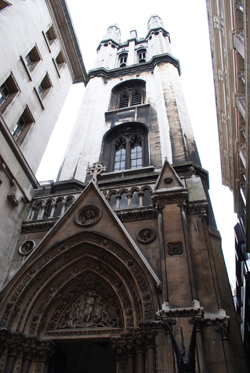
This church, which survived until it was largely destroyed by bombing in World War II, isn’t completely lost – its tower still survives in the middle of Wood Street in the City.

St-Alban's-Wood-StreetThe church, one of a number dedicated to St Alban (Britain’s first Christian martyr) in London throughout its history, was medieval in origin although it has been argued its foundation dates back to the 8th century Saxon King Offa of Mercia who is believed to have had a palace here with the chapel on this site (Offa is also credited as the founder of St Alban’s Abbey).

The church had fallen into disrepair by the early 17th century and was demolished and rebuilt in 1630s. It proved unfortunate timing for only 32 years later it was completely destroyed again, this time in the Great Fire of London.

Following the Great Fire, the church, now combined with the parish of St Olave, Silver Street, was among those rebuilt to the designs of Sir Christopher Wren and completed in the mid-1680s.

It was restored in the late 1850s under the eye of Victorian architect Sir George Gilbert Scott and the four pinnacles on the tower, which stood on the north side of the church, were replaced later that century.

It survived until World War II when the building was burnt out and partly destroyed on a single night during the Blitz in December, 1940. The remains, with the exception of Wren’s Perpendicular-style tower, were later demolished in the 1950s (by which time the church had been united with the parish of  St Vedast, Foster Lane).

The Grade II*-listed tower was converted into a rather unusual private dwelling in the 1980s.