Famous Londoners – William Hewer…

The National Maritime Museum is hosting a new exhibition on the life of Samuel Pepys and, while we’ve looked at the life of the famous diarist before (see our earlier post here), we thought we’d take a look at his not-so-famous manservant and clerk William Hewer.

“Will” Hewer, who is mentioned several times in Pepys’ diary and, as well as being a business partner also became a fast friend of Pepys, is thought to have been born in about 1642.

He was first introduced to Pepys when still a young man – about 17 – by his uncle Robert Blackborne in 1660. They obviously hit it off because Hewer, who was the son of a stationer, was soon working as a manservant and clerk for Pepys in his role as Clerk of the Acts to the Navy Board.

Hewer, who was subjected to some bullying by Pepys who apparently could reduce him to tears (but at the same time Pepys also defended him at work from attacks from others), at first lived with Pepys at his Seething Lane home. However, by late 1663 – apparently thanks to his misbehaviour which included staying out late, drunkenness and corrupting maids – he was told to leave Pepys’ house and moved into his own lodgings.

Pepys moved to the Admiralty in 1673 and Hewer went with him, appointed Chief Clerk the following year. In 1677, he was appointed as Judge Advocate-General.

Hewer’s star continued to climb and in 1685, he was appointed MP for Yarmouth, on the Isle of Wight. The following year he was appointed to the Special Commission which replaced the Navy Board and had a special responsibility for accounts.

After King James II fled the country in 1688, Hewer, along with Pepys, lost their patronage from the Crown; both were briefly imprisoned, but were released without trial.

Thanks largely to his involvement in trading with his uncle Blackborne – who served as both Secretary to the Admiralty and Secretary to the British East India Company and to an inheritance he received from his father, Hewer became a wealthy man (as was the case with Pepys, there have been suggestions he may have made considerable illicit sums from people doing trade with the Navy thanks to his position, but these claims have not been substantiated).

Hewer, who never married (but he did apparently have a special attachment to Pepys wife Elizabeth who was of a similar age), owned a house near The Strand which became the Admiralty Office when he followed Pepys from the Navy Board. Pepys lived with him in the house when he was at the Admiralty.

He also owned other properties, including a country retreat on Clapham Common which he bought in 1688. It was here that Pepys lived in during his latter years (and where he died in 1703).

Hewer was the executor of Pepys’ will and kept his library – including, of course, his famous diary until his own death on 3rd December, 1715. He was buried in St Paul’s Church, Clapham. In an odd twist, his estate was left to his godson Hewer Edgeley but only on the condition that he change his surname to Hewer, becoming Hewer Edgeley-Hewer.

Hewer is depicted in a painting by Godfrey Kneller (1689) now in the National Maritime Museum’s collection. It was a pair with another painting by Kneller of Pepys.

WHERE: Samuel Pepys: Plague, Fire, Revolution is at the National Maritime Museum, Greenwich (nearest DLR station is Cutty Sark; nearest railway stations are Greenwich and Maze Hill; and nearest river pier is Greenwich); WHEN: 10am to 5pm daily; COST: £12 adults/£6 children WEBSITE: www.rmg.co.uk/see-do/exhibitions-events/samuel-pepys-plague-fire-revolution-exhibition.

For more on Pepys, see Margarette Lincoln’s book Samuel Pepys: Plague, Fire, Revolution.

10 London ‘battlefields’ – 4. Jack Cade’s rebellion…

London-StoneLittle is known of Jack Cade until the former soldier from Kent led an uprising against the rule of King Henry VI during the Hundred Years War with France. And London was a key site of fighting during the uprising.
Cade, who adopted the name John Mortimer and who some claimed to have been a relative of Richard, Duke of York, was said to have been a veteran of the war who led rebels protesting against the king’s rule amid the general state of disorder affecting England at the time which saw such abuses as lands being illegally seized and a lack of confidence in courts to rule fairly. There was also some discontent over the loss of lands of Normandy.

While many of the rebels were peasants, the rebellion – which rose in late May or early June, 1450 – was also supported by nobles and churchmen who were protesting what they saw as poor governance.

Led by Cade, who also attracted the title ‘Captain of Kent’, were camped on Blackheath in what is now the city’s south-east by mid-June and there apparently presented an embassy from the king with a list of grievances.

Thomas, Lord Scales – authorised by the king to raise troops, subsequently marched out to Blackheath but Cade and his rebels retreated into the forests of Kent and managed to lure the royal troops into an ambush.

Cade and the rebels returned to Blackheath while back in London the Royal soldiers turned mutinous, angered over the defeat. They were disbanded to protect the City and the king retired to Kenilworth Castle, effectively abandoning London to the rebels (despite the offer of the Lord Mayor and aldermen to resist the rebels).

Cade then marched on London itself, reaching Southwark on 2nd July (apparently using the now vanished White Hart Inn as his HQ). He forced his way over London Bridge the next day, cutting the drawbridge ropes personally with his sword to ensure it couldn’t be raised again

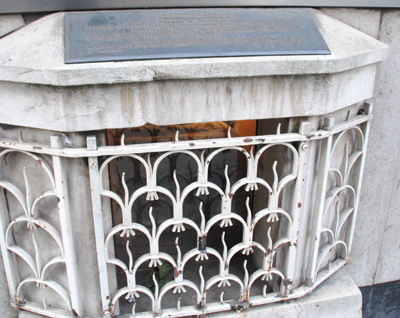
Such was the support the rebels had in London, that resistance was initially minimal. Following his entry to London, Cade struck the famous London Stone (pictured above – for more on it, see our earlier post here) with his sword, declaring “Mortimer” was now lord of the city.

While initially under tight control, Cade gradually lost control of many of his followers who turned to looting. Meanwhile, to head off an attack on the Tower of London – where Lord Scales had retreated – he handed over the hated Lord Treasurer, James Fiennes, Lord Saye, and his son-in-law William Crowmer, Under Sheriff of Kent (they had apparently been imprisoned in the Tower by the King for their own protection such as their unpopularity). Both were beheaded – Fiennes at Cheapside, Crowmer at Mile End – and their heads placed on poles on London Bridge.

The king’s supporters in the Tower had regrouped by early July and, with the rebels, while initially welcomed by many, now clearly having outstayed their welcome, they and city militias drove the rebels from the streets and had taken back the northern half of London Bridge (another bloody battle over the bridge) when William of Waynflete, Bishop of Winchester, arrived with promises of pardon for the rebels on behalf of the Lord Chancellor and Archbishop of Canterbury, John Kemp.

His forced much reduced, Cade – a pardon in his pocket under Mortimer’s name only – moved back into Kent and continued to cause trouble. He was, however, captured by the new Sheriff of Kent, Alexander Iden, on 12th July, – one version says this took place near Heathfield in Sussex at a hamlet now known as Cade Street. In any event, Cade was mortally wounded during the struggle and died en route to London.

His corpse, however, completed the journey and Cade was hanged, drawn and quartered and his head placed atop a pole on London Bridge.

While the rebel ringleaders were later captured and killed, in the most part King Henry VI honoured the pardons he had granted.

The story of Cade’s rebellion features in William Shakespeare’s play, King Henry the Sixth.

This Week in London – Lord Mayor’s Show marks 800 years; Dutch masters and Thomas Rowlandson at Queen’s Gallery; and, Alexander Calder on show at Tate…

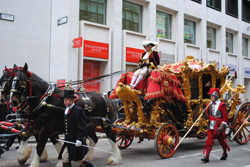
Lord-Mayor's-ShowThe Lord Mayor’s Show will mark its 800th anniversary on Saturday as the newly elected Jeffrey Mountevans – the 688th Lord Mayor of the City of London – makes his way through the City to Westminster to swear loyalty to the Crown. The procession of 7,000 people, some 180 horses and 140 vehicles will set off on its way along a three-and-a-half mile route at 11am, starting at Mansion House and traveling down Cheapside to pause at St Paul’s Cathedral (which is open for free all day) before heading on via Ludgate Hill and Fleet Street to the Royal Courts of Justice before returning the City via Queen Victoria Street from 1.10pm. In a special nod to the 800th anniversary, the famous bells of St Mary-le-Bow will ring out a special 800-change at noon. The day will conclude with fireworks over the River Thames kicking off at 5.15pm (for the best view head down to the riverside between Waterloo and Blackfriars Bridges, either on Victoria Embankment or on the South Bank). The show’s origins go back to 1215 when, in exchange for a Royal Charter granting the City of London the right to elect its own mayor, King John insisted the newly elected mayor travelled to Westminster each year to swear loyalty to the Crown. For more (including a map to print out), see https://lordmayorsshow.london. PICTURE: From a previous show.
Vermeer’s The Music Lesson is among 27 of the finest 17th and 18th century Dutch paintings in the Royal Collection which will go on display in a new exhibition at the Queen’s Gallery at Buckingham Palace from tomorrow. Masters of the Everyday: Dutch Artists in the Age of Vermeer also features works by the likes of Gerrit Dou, Pieter de Hooch and Jan Steen, all produced during what is known as the Dutch ‘Golden Age’. The exhibition is being shown alongside another display – High Spirits: The Comic Art of Thomas Rowlandson – which will focus on the work of 18th and early 19th century caricaturist Thomas Rowlandson. Around 100 of Rowlandson’s works feature in the display with highlights including The Two Kings of Terror featuring Napoleon and Death sitting face-to-face after Napoleon’s defeat at Leipzig in 1813, The Devonshire, or Most Approved Method of Securing Votes depicting Georgiana, Duchess of Devonshire, kissing a butcher (it was claimed she had claimed kisses for votes in the Westminster election of 1784), and A York Address to the Whale. Caught lately off Gravesend in which the Duke of York thanks a whale for distracting attention from accusations that his mistress was paid by army officers to secure promotions from the Duke. Admission charge applies. Both exhibitions run until 14th February, 2015. For more, see www.royalcollection.org.uk.

The first major UK exhibition of the works of kinetic sculpture pioneer Alexander Calder opened at the Tate Modern this week. Alexander Calder: Performing Sculpture features more than 100 of the ground-breaking 20th century artist’s works which trace how Calder turned sculpture from the idea of a static object to a continually changing work to be experienced in real time. Works on show include figurative wire portraits of artists – Joan Miró and Fernand Léger (both 1930), works exploring the idea of forms in space – Red Panel, White Panel and Snake and the Cross (1936), motorised mobiles such as Black Frame and A Universe (1934), and chiming mobiles such as Red Gongs (1950) and Streetcar (1951). It closes with the large scale Black Widow (c.1948), shown for the first time ever outside Brazil. Runs until 3rd April. Admission charge applies. For more, see www.tate.org.uk.

Send all items for inclusion to exploringlondon@gmail.com.


LondonLife – A rare 17th century survivor in Pall Mall…

Pall-Mall

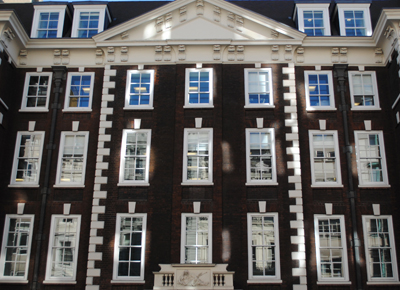
Facade of New Schomberg House at number 80-82 on the south side of Pall Mall. While the rest of the building dates from the 1950s, much of the facade from what is now known as Old Schomberg House (among numerous buildings in Pall Mall once occupied by the War Office) was retained and the eastern end restored. The house was originally built in the late 17th century for the Duke of Schomberg, a general in the service of King William III (hence the name), and replaced Portland House on the site. Later residents here included the painter Thomas Gainsborough, who lived here between 1774 until his death in 1788.

London Pub Signs – The Prince of Wales…

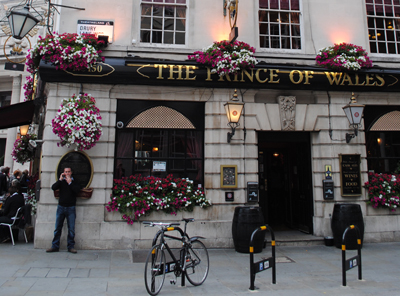
Prince-of-WalesAnother Drury Lane pub, the origins of this one go back to 1852 when it was established by Henry Wells on the site of what was once a potato warehouse. 
The name, in this case, comes from Queen Victoria and Prince Albert’s eldest son, Albert Edward.

Only about 11-years-old when this West End pub was first built, he remained Prince of Wales until succeeding his mother as King Edward VII (nonetheless, the location proved somewhat prescient – Albert Edward was to become known for his bon vivant lifestyle including his love of the theatre (along with, of course, his love of philandering.))

Located close to theatres and the Royal Opera House, the pub at 150-151 Drury Lane (on the corner of Long Acre) was rebuilt in Portland stone in the early 20th century when the street was widened.

Now part of the Taylor Walker group, it remains a popular pub for theatre goers (and even hosts its own events). For more, see www.taylor-walker.co.uk/pub/prince-of-wales-covent-garden/c0659/.

10 London ‘battlefields’ – 3. London sacked in the Peasant’s Revolt…

Tower-of-London1OK, so not really a battle although it must have felt something like that to those involved (and the ‘battlefield’ turned out to be much of the City itself), the uprising known as Peasant’s Revolt of 1381 saw two great armies march upon London – one from Kent led by Wat Tyler and another from Essex which is said to have been under the command of Jack Straw.

The armies had risen in response to a series of events which they saw as unjust and which trace their origins back to the Black Death. Killing about a third of the population when it struck some 30 years earlier, this had resulted in a growing demand for labourers to work the fields raising, as one might expect, hopes of increased wages and greater freedom of movement among the peasant class.

But to ensure the social order was maintained, authorities had not only put limits on how much farm workers could be paid but ensured long-standing but increasingly unpopular practices – such as serfs being forced to work some time for free for their landlords – were maintained. On top of this came the imposition and enforcement of a series of poll taxes to fund England’s wars with France.

The poll taxes – and the harsh way in which they were enforced – were a step too far and when a tax collector visited the village of Fobbing in Essex in May, 1381, he was shown short shrift and thrown out. The unrest soon spread and by June, the rebels, having rampaged through the countryside were marching on London.

By 12th June, the men from Essex were camped at Mile End while Tyler and his army from Kent were at Blackheath. The next day, after being denied a meeting with the king, the rebels headed into the City where sympathetic Londoners opened the gates. Once inside, they targeted the property of those they deemed responsible for their misfortune, opening prisons and destroying any legal records they could find.

Foremost among the sites attacked and looted was the Palace of Savoy (see our earlier post here), home of the King’s uncle John of Gaunt, Duke of Lancaster, and, as the power behind the throne, the man many deemed as the ultimate source of the ills besetting them (John himself had a lucky escape – he was away from the city when the palace was attacked.).

King Richard met with the leaders of the men from Essex on 14th June at their camp at Mile End and, after they pledged their allegiance, agreed to their petitions to abolish serfdom and allow them to sell their labour. But the attacks, meanwhile, were continuing in the City with a group of rebels led by Tyler storming the Tower of London (pictured above) the same day and seizing and beheading the Simon of Sudbury, the Archbishop of Canterbury and Chancellor, along with the Robert Hales, Lord High Treasurer and Prior of St John’s in Clerkenwell – both key figures in the government of the king (you can read more about Simon of Sudbury here).

The following day – 15th June – King Richard again met with the rebel leaders – this time with Wat Tyler, leader of the Kentish band, at Smithfield. It was then that things went awry for the rebels. Apparently enraged by Tyler’s insolence (already stories differ as to exactly why he did so), the Lord Mayor of London, Sir William Walworth (see our earlier post here), stabbed Tyler in the neck. King Richard managed to keep the situation under control until armed troops arrived and after the king declared a general pardon, the rebels dispersed.

Tyler, meanwhile, was taken to St Bartholomew’s Hospital but on the orders of the Lord Mayor was dragged from his bed and beheaded (his head was displayed atop a pole positioned in a field). He was among dozens of the rebels who were subsequently executed for their role in the uprising (leaders Jack Straw and another, John Ball, were among them).

LondonLife – 600 years on, Westminster Abbey commemorates the Battle of Agincourt…

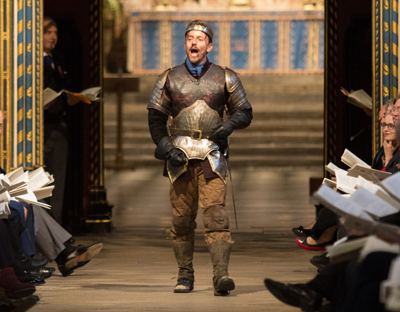
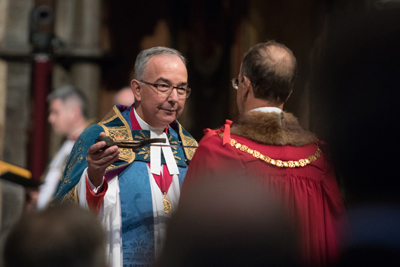
Sam-MarksHundreds gathered at Westminster Abbey last Thursday for a service to commemorate the 600th anniversary of the Battle of Agincourt – 600 years to the day when word of the battle’s victory arrived in London. During the service, the sword of King Henry V – who was buried in the abbey and whose chantry chapel is located above his tomb (see our earlier post here) – was carried through the abbey and presented to the Dean of Westminster, the Very Reverend Dr John Hall, at the High Altar (pictured below). “A hundred years ago, as our countrymen fought alongside the French, the old enmities had been put away,” Rev Dr Hall told those at the service who included the Duke of Kent and Princess Michael of Kent. “In the dark days before the Second World War, the story of Agincourt encouraged men and women alike to strive their utmost for freedom from tyranny. Today we give hearty thanks for our freedoms, and we pray for an end to tyranny wherever it is found, and for enduring peace and prosperity.” Royal Shakespeare Company actor Sam Marks read the St Crispin’s Day speech from the Bard’s Henry the Fifth (pictured above) while veteran of the stage and screen, Robert Hardy, read the prologue from Act IV of the same play. For more on abbey, visit www.westminster-abbey.org.  PICTURES: Ian Stratton/Westminster Abbey.

The-Dean-of-Westminster,-the-Very-Reverend-Dr-John-Hall-receives-the-sword-of-Henry-V

A Moment in London’s History – News of the victory at Agincourt reaches the city…

It wasn’t until four days after the battle which had taken place on 25th October, 1415, that news of King Henry V’s stunning victory over the French reached the English capital.

Westminster-Abbey-frontThe news apparently reached London very early in the morning and church bells were rung in celebration and a Te Deum sang in thanksgiving in many.

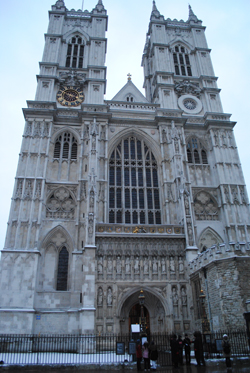
At 9am, a solemn procession of clergy made their way from St Paul’s Cathedral in the City to the shrine of St Edward the Confessor in Westminster Abbey (pictured) to give thanks.

Other attendees at the abbey included the Mayor-elect, Nicholas Wotton (this was the first of two occasions on which he was elected Lord Mayor), and the alderman of London, as well as the Queen Dowager, Joan of Navarre.

A few days later, on the 4th November, King Henry V’s brother – John of Lancaster, the Duke of Bedford, announced the news to Parliament.

King Henry V, meanwhile, arrived back in Dover on 16th November (apparently as a great snowstorm was making its presence felt) and headed for London. After pausing in Canterbury to give thanks in the cathedral and St Augustine’s Abbey, he reached the manor of Eltham (now in south-east London) on 22nd November.

He was met the next day on Blackheath by Wotton and City dignitaries who then, along with what were recorded as a crowd of 20,000 citizens, accompanied him and his small retinue, which included some of his most high profile prisoners such as Charles d’Orléans, Duke of Orléans (who spent 25 years as a prisoner in England), and Marshal Boucicaut (he would die six years later in Yorkshire), towards London.

There, welcomed as Henry V, “King of England and France”, he processed through the City which had been elaborately decorated – the decorations included the hanging of various coats of arms from various prominent sites as well as the positioning of statues of the likes of St George – ahead of his arrival.

Travelling down Cheapside, the king – who was modestly dressed in a purple gown and had eschewed wearing a crown for the event – stopped at St Paul’s where he performed his devotions, before proceeding to Westminster where he did the same before taking up residence for the night in the nearby Palace of Westminster.

On the king’s orders, a solemn mass was held in St Paul’s the next day for the fallen of both sides. The victorious king had returned!

10 London ‘battlefields’ – 2. ‘London Bridge is falling down’…

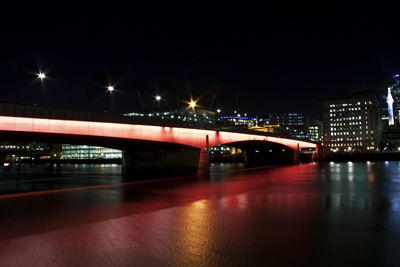
London-Bridge3We’ve touched on this story before but it’s worth a revisit as part of this series. London changed hands several times during the later half of the first millennium as the Anglo-Saxons fought Vikings for control of the city, meaning the city was the site of several battles during the period.

One of the most memorable (or so legend has it, there are some archaeologists who believe the incident never took place) was the battle in 1014 in which London Bridge – then a timber structure (today’s concrete bridge is pictured above) – was pulled down. A story attributed to the Viking skald or poet Ottarr the Black but not found in Anglo-Saxon sources, the event, if it did take place, did so against the backdrop of an ongoing conflict between the Danes and Anglo-Saxons.

Anglo-Saxon London had resisted several attempts at being taken by the Vikings – a fire was recorded in the city in 982, possibly caused by a Viking attack – and in 994, the Anglo-Saxon Chronicle reports that a fleet of 94 Danish and Norwegian ships were repelled with prejudice. Further attacks was driven back in 1009 and it wasn’t until 1013 that the city finally submitted to Danish rule after Sweyn Forkbeard had already claimed Oxford and Winchester.

But Sweyn, the father of the famous King Canute (Cnut), didn’t hold it long – he died on 3rd February the following year.

The deposed Anglo-Saxon King Æthelred II (also spent Ethelred, he was known as ‘the Unready’) – who had been forced to flee from London, which he used as his capital, to what is now Normandy thanks to Sweyn’s depredations – is said to have seized his chance and along with the forces of his ally, the Norwegian King Olaf II, he sailed up the Thames to London in a large flotilla.

The Danish had taken the city, occupying both the city proper and Southwark, and were determined to resist. According to the Viking account, they lined the timber bridge crossing the river and rained spears down on the would-be invaders. (The bridge, incidentally, had apparently been built following the attack in 993, ostensibly to block the river and prevent further incursions further upstream – there is certainly archaeological evidence that a bridge existed in about the year 1000).

Not to be beaten, Æthelred’s forces, using thatching stripped from the rooves of nearby houses to shield themselves, managed to get close enough to attach some cables to the bridge’s piers, pulling the bridge down and winning the battle, retaking the city.

There’s much speculation that the song London Bridge is Falling Down was inspired by the incident but it, like much of this story itself, remains just that – conjecture (although Ottarr’s skald does sound rather familiar).

The bridge was subsequently rebuilt and King Æthelred died only two years later, on 23rd April, 2016. The crown subsequently passed to his son Edmund Ironside but he too died after ruling for less than a year leaving Viking Canute to be crowned king.

PICTURE: http://www.freeimages.com

LondonLife – A rare glimpse inside King Henry V’s chantry chapel…

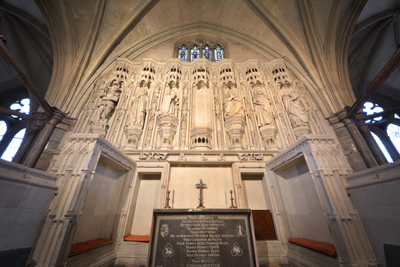
Henry-V-chantry-chapelA fortunate few last weekend had the chance to have a look inside King Henry V’s elaborately carved chantry chapel in Westminster Abbey as part of commemorations marking the 600th anniversary of the Battle of Agincourt. 

The chapel, which is located on a sort of mezzanine level above the king’s tomb at the east end of the Shrine of Edward the Confessor, is one of the smallest of the abbey’s chapels. It was constructed on the orders of the king – who died Vincennes in August, 1422, and was buried in the abbey on 7th November that year – so prayers could be said in perpetuity for his soul.

The tomb was completed in 1431 and the chantry chapel was built above between 1437 and 1450. The latter is entered via narrow stairways of worn steps hidden inside a pair of stone turrets which flank the tomb.

For centuries the Henry V’s funeral ‘achievements’ – the king’s saddle, helm and shield – were displayed on a wooden beam above the chantry chapel but these were restored and moved to the abbey museum in 1972.

Henry V’s wife, Catherine de Valois, who survived her husband by 15 years was eventually – in the Victorian age – buried under the chantry chapel altar (originally buried in the old Lady Chapel, King Henry VII had her removed and placed in an open coffin in the open air next to the tomb of King Henry V, when building his new chapel – among visitors to her mummified body was diarist Samuel Pepys who even kissed her. In 1778 she was buried in a vault before being relocated to her current position in 1878).

An inscription on the altar in the chantry chapel reads: “Under this slab (once the altar of this chapel) for long cast down and broken up by fire, rest at last, after various vicissitudes, finally deposited here by command of Queen Victoria, the bones of Catherine de Valois, daughter of Charles VI, King of France, wife of Henry V, mother of Henry VI, grandmother of Henry VII, born 1400, crowned 1421, died 1438”.

The chantry chapel is still occasionally used for services but, measuring just seven by three metres, is not usually open to the public because of size and access issues.

Westminster Abbey will hold a special service of commemoration on 29th October in partnership with charity Agincourt600. The day before, 28th October, it will host a one day conference for Henry V enthusiasts entitled ‘Beyond Agincourt: The Funerary Achievements of Henry V’. For more, see www.westminster-abbey.org/events/agincourt.

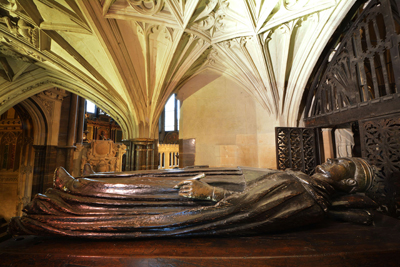
Above – King Henry V’s chantry chapel; Below – King Henry V’s tomb which sits below the chantry chapel. PICTURE: Jim Dyson/Dean & Chapter of Westminster

Henry-V-tomb

Treasures of London Special – Remembering Agincourt at the Tower…

This weekend marks the 600th anniversary of the Battle of Agincourt (25th October, 1415) when King Henry V and his army of English archers overcame the larger French host in what is now northern France during the Hundred Years War.

To mark the occasion, the Royal Armouries have launched a new exhibition at the Tower of London, The Battle of Agincourt: 600th Anniversary Exhibition which tells the story of the battle and its aftermath as well as some of the myths which sprang up in its wake.

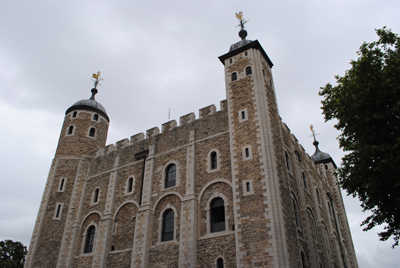
Below are some of the “treasures” presented in the exhibition in the White Tower which runs until 31st January. There will also be a programme of associated events running at the Tower from tomorrow until 1st November. For more, see www.royalarmouries.org/agincourt.

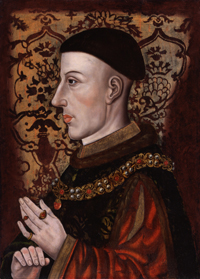
King Henry V played a key role in the battle, which came more than two-and-a-half months after he launched an invasion of Normandy. Until Agincourt, the campaign had not gone well – dysentery had taken a considerable toll on his men and his army had only taken one target – the port of Harfleur – when, after crossing the River Somme, the French heralds summoned him to the fight. It was on the morning of the battle – St Crispin’s Day, 25th October – that he gave a short speech to stiffen the resolve of his army which William Shakespeare subsequently embellished in his play Henry V: “We few, we happy few, we band of brothers…”. This painting of the king is by unknown artist, oil on panel, late 16th or early 17th century. PICTURE: © National Portrait Gallery.

Agincourt2b


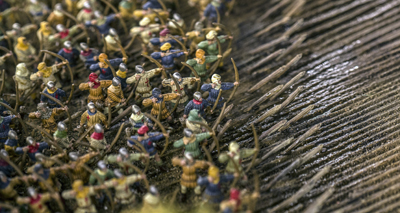
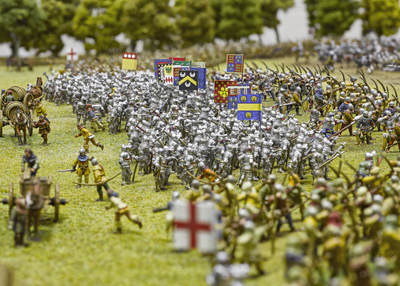
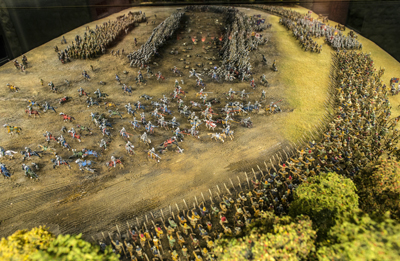
Three scenes from a four metre by two metre model of the battlefield of Agincourt, supported by the Arms and Armour Heritage Trust and constructed by MM Dioramas and Perry Miniatures. The model features 4,000 detailed scale model figures – 2,600 French and 1,750 English, representative of the larger forces each brought the fight (the exhibition puts the number of English 8,500-9,000 and the French at 12,000 although we should note others have claimed the English were outnumbered by as much as three or four to one). In the model, which draws on recent research to accurately bring to life the arms, armour and heraldry of those involved, English archers – who played a critical role in the battle (in fact, the battle is seen as an exemplar of the use of archers in battle) – are shown positioned behind wooden stakes that King Henry V asked them each to carry for protection against the French cavalry, seen charging towards them. The battle, which started in late morning when the English archers provoked the French into attacking, was all over by early afternoon and while it’s not certain how many died, sources are agreed that the French losses were considerably higher than the English. Following the exhibition the model will be going on permanent display at the Royal Armouries Museum in Leeds. PICTURE © Royal Armouries.

Agincourt3

Agincourt1

Agincourt6


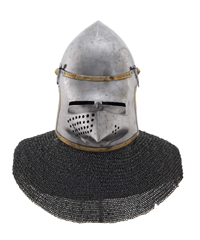
Lyle Bacinet, north Italian, late 14th century. Rare in terms of its quality, it would have been used mostly by mounted knights. By the late 14th century, men-at-arms would have worn complete plate armour. PICTURE © Royal Armouries.

Agincourt5b


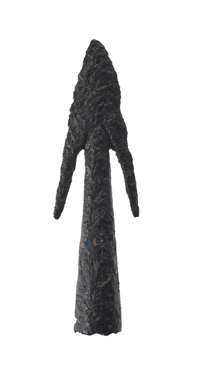
An arrowhead typical of the period. These would have been made in ‘sheaves’, bundles of 24 arrows which would have been worn on the archer’s waist. PICTURE © Royal Armouries.

Agincourt5a

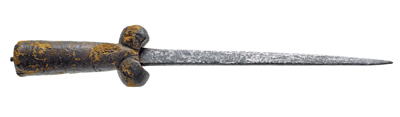
 An English ‘ballock dagger’, dating from the late 14th – early 15th centuries. A common weapon and characteristic shape of the period. Such weapons may have been carried by archers to finish off the wounded. PICTURE © Royal Armouries.


Agincourt9

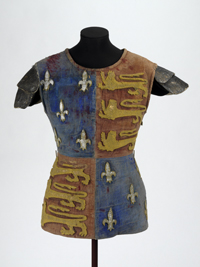
Shakespeare’s retelling of events in Henry V has kept the story of the famous battle alive down the centuries. In a nod to the important role the Bard has played, the exhibition features a rare First Folio of Shakepeare’s plays as well as tabard (below) worn by Richard Burton in the title role of King Henry V at Stratford-upon-Avon in 1951. It was made of hessian and felt with simulated armour at the shoulders so it would appear to have been worn on the battlefield. PICTURE © Victoria and Albert Museum.

Agincourt2a


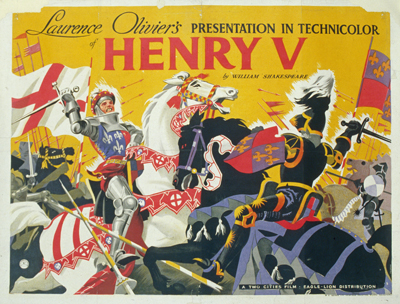
Other 20th century artefacts related to Agincourt include a film poster for Henry V (1944), a film adaptation of Shakespeare’s play which starred and was directed by Laurence Olivier. PICTURE: © ITV / REX.

Agincourt7

For more information on events surrounding the 600th anniversary of the Battle of Agincourt, see www.agincourt600.com.

This Week in London – World’s oldest clock and watch collection moves to the Science Museum; commemorating Agincourt; and, black experiences in war at the Imperial War Museum…

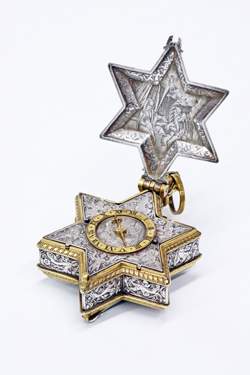
Star-clockThe world’s oldest clock and watch collection can be seen at its new home at the Science Museum in South Kensington from tomorrow. The Clockmaker’s Museum, which was established in 1814 and has previously been housed at City of London Corporation’s Guildhall, has taken up permanent residence in the Science Museum. Assembled by the Worshipful Company of Clockmakers – founded in 1631 – the collection features some 600 watches, 80 clocks and 25 marine timekeepers spanning the period from the 15th century to today. Highlights among the collection include: a year duration long case clock made by Daniel Quare of London (c. 1647-1724); a star-form watch (pictured) by David Ramsay, first master of the Clockmaker’s Company; the 5th marine timekeeper completed in 1770 by John Harrison (winner in 1714 of the Longitude Prize); a timekeeper used by Captain George Vancouver on his 18th century voyage around the Canadian island that bears his name; a watch used to carry accurate time from Greenwich Observatory around London; and, a wristwatch worn by Sir Edmund Hillary when he summited Mount Everest in 1953. The collection complements that already held by the Science Museum in its ‘Measuring Time’ gallery – this includes the third oldest clock in the world (dating from 1392, it’s on loan from Well’s Cathedral) and a 1,500-year-old Byzantine sundial-calendar, the second oldest geared mechanism known to have survived. Entry is free. For more, see www.sciencemuseum.org.uk/clocks. PICTURE: The Worshipful Company of Clockmakers.

Westminster Abbey is kicking off its commemorations of the 600th anniversary of the Battle of Agincourt by opening Henry V’s chantry chapel in Westminster Abbey to a selected few on Saturday night, the eve of the battle’s anniversary. The chapel, which is above the king’s tomb at the east end of the abbey, will be seen by the winners of a public ballot which opened in September. It has never before been officially opened for public tours. The chapel is one of the smallest of the abbey’s chapels. It is occasionally used for services but, measuring just seven by three metres, is not usually open to the public because of size and access issues. Meanwhile the abbey will hold a special service of commemoration on 29th October in partnership with charity Agincourt600 and on 28th October, will host a one day conference for Henry V enthusiasts entitled Beyond Agincourt: The Funerary Achievements of Henry V. For more, see www.westminster-abbey.org/events/agincourt.

• The role the black community played at home and on the fighting front during conflicts from World War I onward is the focus of a programme of free events and tours as Imperial War Museums marks Black History Month during October. IWM London in Lambeth will host a special screening of two documentary films – Burma Boy and Eddie Noble: A Charmed Life – telling the stories of African and Caribbean mean who served in World War II on 25th October. IWM London will also feature a series of interactive talks from historians revealing what it was like for black servicemen during both world wars from this Saturday until Sunday, 1st November. For more, see www.iwm.org.uk.

Send all items for inclusion to exploringlondon@gmail.com.

This Week in London – A look inside The Crime Museum; Goya at The National Gallery; and, Africa on the Square…

Objects and evidence from some of the UK’s most notorious crimes including the ‘Acid Bath Murder’ of 1949, the ‘Great Train Robbery’ of 1963 and the ‘Millennium Dome Diamond Heist’ of 2000 will go on show at the Museum of London from Saturday. Created with the support of the Metropolitan Police Service and the Mayor’s Office for Policing and Crime, The Crime Museum Uncovered exhibition features never-before-seen objects from the Metropolitan Police’s Crime Museum as it takes visitors through a series of real cases and tackles some of key challenges of policing in London – everything from terrorism and espionage through to counterfeiting and narcotics. The Crime Museum, which is now housed inside New Scotland Yard, was established in the mid-1870s as a teaching tool for police. Its Visitor’s Book contains some high profile names including that of King George V, Sir Arthur Conan Doyle – creator of Sherlock Holmes, illusionist Harry Houdini and comedians Stan Laurel and Oliver Hardy. Runs until 10th April. Admission charge applies. For more, see www.museumoflondon.org.uk.

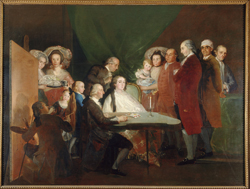
GoyaAlmost half of Goya’s surviving portraits are on show in The National Gallery in an exhibition which opened yesterday. Goya: The Portraits features more than 60 of the celebrated Spanish artist’s surviving portraits, borrowed from public and private collections around the world. Highlights include the Duchess of Alba (a 1797 work depicting one of Goya’s patrons which has only left the US once before), the immense group portrait The Family of the Infante Don Luis De Borbon (pictured), the never-seen-in-public work Don Valentin Bellvis de Moncada y Pizzaro, the rarely exhibited Countess-Duchess Benavente, and the recently conserved 1798 portrait Francisco de Saavedra, exhibited for the first time in 50 years alongside a pendant painted the same year of Gaspar Melchor de Jovellanos. There are also works of royals including Charles IV in Hunting Dress and more personal works such as self portraits and paintings of his family members. Runs until 10th January in the Sainsbury Wing near Trafalgar Square. Admission charge applies. For more, see www.nationalgallery.org.uk. PICTURE: © Fondazione Magnani Rocca, Parma, Italy.

Black History Month is being celebrated in Trafalgar Square this Saturday in Africa on the Square, a programme of events inspired by the traditions and cultures of the continent.  The line-up includes a musicians and singers, acrobats, dancers, a fashion show and a market selling African-themed products as well as a host of activities for families, from hair braiding and face painting to mosaics and batik making. There will also be a talent show giving aspiring performances aged between 16 and 25 the chance to perform in front of a live audience. The free event runs between noon and 6pm. For more, see www.london.gov.uk/africa.

Send all items for inclusion to exploringlondon@gmail.com.

A Moment in London’s History – The execution of William Wallace…

William-Wallace-big

This year marks the 710th anniversary of the execution of Scottish rebel William Wallace in Smithfield so we thought we’d take a quick look at the circumstances of that event – made famous in recent times through the movie Braveheart.

William-WallaceFor some eight years, Wallace had been a thorn in the side of the King Edward I, promoting active resistance to his rule in Scotland after Edward forced the abdication and usurption of the crown of John Balliol.

Following a crushing defeat at the Battle of Falkirk on 22nd July, 1298, however, Wallace went to France where he attempted to gain French support for rebellion in Scotland but the effort proved ultimately futile and Wallace, back in Britain but refusing to submit to English rule, remained on the run.

At least until he was captured on 5th August, 1305, by Sir John Monteith, who had been made Sheriff of Dumbarton by King Edward I, at Robroyston near Glasgow.

Taken to Carlisle, he was bound hand and foot before being taken south to London in chains.

Wallace’s trial took place on 23rd August that year at Westminster Hall and, despite his protestations that he couldn’t be guilty of treason having never sworn loyalty to the English Crown, a guilty verdict was handed down along with the sentence of a traitor’s death – being hung, drawn and quartered.

Taken to the Tower of London, Wallace was stripped naked and then strapped to a wooden hurdle which was dragged by two horses through the streets via Aldgate to The Elms at Smithfield where he was hanged on a gallows.

Cut down while yet living, he was disembowelled and castrated and his entrails burnt. Wallace was then decapitated and his body cut into quarters which were sent to Berwick, Newcastle, Stirling and Perth as a warning against treason. His tarred head, meanwhile, was put on a pike and set above London Bridge.

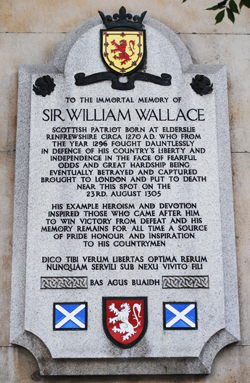
A memorial to Wallace can now be found on the wall of St Bartholomew’s Hospital at West Smithfield (pictured – for more on that, see our earlier post here).

Famous Londoners – Hans Holbein the Younger…

Famed as the court painter of King Henry VIII, Hans Holbein the Younger was one of the greatest portrait painters of the sixteenth century.

Born in Augsburg, in southern Germany, in 1497-98, Holbein was the son of painter and draughtsman Hans Holbein the Elder. Hans, like his brother Ambrosius, followed the family trade which he apparently learnt under the tutelage of his father and uncle until breaking away to make his own mark.

National-GalleryJourneying with Ambrosius to Basel in what is now Switzerland, the two brothers became apprenticed to the city’s leading painter Hans Herbster. In 1517, Holbein went with father to Lucerne where they worked painting murals for a leading merchant. It is thought while there, that he visited northern Italy where he studied Italian frescos.

Returning to Basel in 1519, he quickly re-established his business there, becoming a member of the artists’ guild, and married Elsbeth Schmid, their first son arriving in the first year of their marriage (the couple apparently had four children, two of whom are depicted in a portrait with his wife he painted in the late 1520s).

He was soon completing numerous major projects for the city – including painting internal murals for the Town Hall’s council chamber – and was also involved in creating illustrations for books – the most famous being the series of images known as the Dance of Death – and painting portraits, including his first portraits of the Renaissance scholar, Erasmus. It was these and other portraits that ensured his fame across Europe.

The decline in the production of religious art, thanks to the Reformation which was then sweeping over the continent, apparently led Holbein to look further afield for work and, having first gone to France, in 1526 he went to England.

There he was welcomed by Sir Thomas More, then a key figure in the regime of King Henry VIII, who soon found him some commissions. His works during this period included portraits of More, William Warham, Archbishop of Canterbury, astronomer Nicholas Kratzer and courtiers like Sir Henry Guildford.

He returned to Basel a wealthy and successful man in 1528 and remained there for four years before once again leaving his family and heading to England, this time finding favour with the Boleyn family and Thomas Cromwell.

It was early during this period – he remained in England until his death in 1543 – that he painted portraits of Hanseatic League merchants of the Steelyard (see our earlier post here) as well as The Ambassadors (see our earlier post here).

In 1536, he was employed as painter to King Henry VIII and the following year he painted what is arguably his most famous image – that of King Henry VIII in all his glory in the image known as the Whitehall Mural which pictured the king with his the wife, Queen Jane Seymour, his father, King Henry VII and his mother, Queen Elizabeth of York (the image was lost in the fire which destroyed Whitehall Palace in 1698 but copies were made and a copy is now at Hampton Court Palace).

King Henry VIII was to be his subject on numerous occasions as were other members of the Royal Family, courtiers and prospective wives including, famously, a portrait of Anne of Cleves which may have oversold her beauty to the king who was unimpressed with her in person (there is apparently no evidence the king blamed Holbein himself for this).

While he had successfully navigated his way past the downfall of Sir Thomas More and then the Boleyn family, the fall of Sir Thomas Cromwell did cause significant damage to his standing. Nonetheless he retained his official position at court and it was during this time that he painted some of his finest miniatures including those of the sons of Henry VIII’s friend, Charles Brandon, 1st Duke of Suffolk.

It is believed Holbein may have returned to visit his family in late 1540 before returning to London where he died sometime in October or November, 1543, having made his will on 7th October at his home in Aldgate (plague has been suggested as the cause of his death). The site of his grave is unknown.

Holbein’s legacy is such that the portraits he created in his two stints in London have become a key component in how we view Tudor England – and in particular, the Tudor court – today.

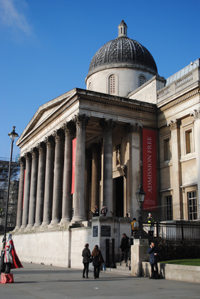
His works can be seen in key locations across London including the National Gallery (pictured above), the National Portrait Gallery (where his bust is one of a series of artists on the exterior) and Hampton Court Palace.

What’s in a name?…Kew…

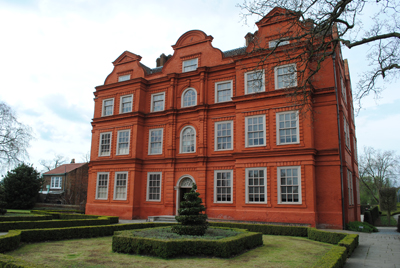
Kew-PalaceFamed as the location of the Royal Botanic Gardens, Kew is a Thames-side suburb in London’s west.

It’s the riverside location which gives the area its name – Kew is apparently a corrupted form of Cayho, a word first recorded in the early 14th century which is itself made of two words referring to a landing place (the ‘Cay’ part) and a spur of land (the ‘ho’ part). The latter may refer in this case to the large “spur” of land upon which Kew is located, created by a dramatic bend in the Thames. The former may refer to a ford which crossed the river here (explaining the name of Brentford on the other side).

While the area had long been the home of a small hamlet for the local farming and fishing community, more substantial houses began to be developed in Kew in the late 15th and early 16th centuries thanks to the demand for homes for courtiers attending the King Henry VII and his successors at nearby Richmond Palace (the royal connections of the area in fact go back much further to the early Middle Ages).

But it was during the Georgian era, when the Royal Botanic Gardens were founded and Kew Palace, formerly known as the Dutch House, became a royal residence (it is pictured above), that Kew really kicked off (and by the way, Kew Palace is not the only surviving 17th century building in the area – West Hall, once home of painter William Harriot, is also still here).

While King George II and his wife Queen Caroline used Richmond Lodge, now demolished but then located at the south end of what is now the gardens, as their summer residence, they thought Kew Palace would make a good home for their three daughters (their heir, Frederick, Prince of Wales, lived opposite his sisters at the now long-gone White House). Kew Palace, meanwhile, would later be a residence of other members of the Royal Family as well, including King George III during his bouts of madness.

Other buildings of note from the Georgian era in Kew include Queen Charlotte’s Cottage, a thatched property built between 1754 and 1771 and granted to Queen Charlotte by her husband, King George III (like the palace, it now lies within the grounds of Kew Gardens). St Anne’s Church, located on Kew Green, dates from 1714 and hosts the tombs of artists Johann Zoffany and Thomas Gainsborough.

In 1840, the gardens which surrounded the palace were opened to the public as a national botanic garden and the area further developed with the opening of the railway station in 1869, transforming what was formerly a small village into the leafy largely residential suburb which we find there today (although you can still find the village at its heart).

As well as Kew Gardens (and Kew Palace), Kew is today also the home of the National Archives, featuring government records dating back as far as 1086.

10 Questions – Sheila Dunsmore, a State Apartment warder at Hampton Court Palace…

HamptonCourtPalace500thBirthday-3

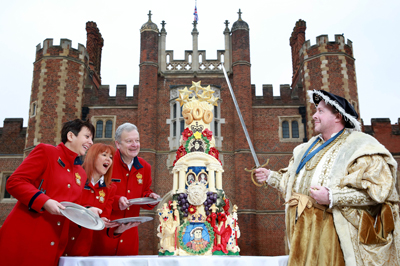
This year marks the 500th anniversary of the building of Hampton Court Palace in Greater London’s south-west. We speak to Sheila Dunsmore, a State Apartment warder at Hampton Court Palace (pictured above in centre on the left)…

1. It’s Hampton Court Palace’s 500th anniversary – who first built the palace and why? “In 1514, Thomas Wolsey came to survey the land at Hampton Court. He wanted to find a suitable place to build a sumptuous country retreat away from the dirt of London, but close enough to the capital to travel back for meetings. It was also to be a place to entertain the important company his position as Archbishop of York provided, of which none were more important than young King Henry VIII.”

2. Where are the oldest parts of the palace today? “The oldest part of the palace is the Tudor kitchens, more specifically the area were the great fire is. This was once part of Sir Giles Daubeney’s original kitchen, and dates back to the manor already on the site when it was acquired by Wolsey. Sir Giles Daubeney was Lord Chamberlain to Henry VII, and acquired an 80 year lease on the property from the Knights Hospitallers of St John of Jerusalem, the then owners. The bell in the tower above the astronomical clock is also said to have come from the Knights Hospitallers’ original manor house.”

3. Hampton Court’s 500 years of history spans a number of definable eras – from Tudor to the 21st century. Which is your favourite and why? “My favourite era is the 1660s when Charles II came back to England to take up his rightful place as king. Although visitors do not really associate Charles with the palace, he did spend time here, most famously his honeymoon!”

4. With this in mind what is your favourite part of the palace? “I love the west front façade – it just looks so imposing and mysterious. Whether you are driving or walking past it it’s guaranteed to draw you in under its spell!”

5. Do you have a favourite anecdote from the palace’s history? “I love the story of Horace Beauchamp Seymour, a dashing military hero who had fought at the Battle of Waterloo. He came to live at the palace in 1827 and, as a handsome eligible widower, he caused quite a sensation amongst the ladies, especially when he joined the Sunday services at the Chapel Royal. It was not long before a series of fainting episodes began, with the strategically placed young lady fainting into the arms of the dashing Horace, who then proceeded to carry the lady out and stay with her until she regained her composure. After a third successive Sunday of fainting’s, the epidemic was brought to a swift halt by the aunt of Mr Seymour, herself also a palace resident. The feisty old lady pinned a sign to the chapel door warning any lady feeling faint that forthcoming Sunday that Bransome the dustbin man would be carrying her out. Needless to say the fainting ceased!”

6. A complex of buildings dating back as far as 500 years obviously requires considerable upkeep. What are the greatest challenges with regard to maintaining the palace? “I think the biggest challenge would have to be generating the money to keep restoring and conserving this historic palace. To do this we have to keep making sure that people want to visit, from international tour groups to local families who might visit again and again. To do this teams right across the palace work to create exciting exhibitions, immersive events and guided tours to ensure we’re offering people a memorable experience.”

7. Are there any areas of the palace which remain unseen by the public? And any plans to open further areas up? “The palace contains over 1,000 rooms, and visitors get to discover about a quarter of these during their visit. Some years ago we held a Servants, Soldiers and Suffragettes exhibition in a suite of rooms on the top floor of Fountain Court (previously unseen). It was incredibly popular so I’d imagine that in the future we’d look for other such opportunities to share other areas of the palace with our visitors. For anyone that can’t wait that long, on one night of the year (Halloween no less), our adults-only ghost tour offers the chance to peek behind the scenes and explore some areas of the palace off the beaten track!”

8. Are there any ‘secrets’ about the palace you can reveal to us? “A palace as old and as large as Hampton Court holds its fair share of secrets…When the fire took hold in 1986 it was devastating, but in a strange twist of fate some good came from it as well. As restoration of the damaged interiors took place little secrets were revealed to us; behind wood panelling in King William’s damaged rooms hand prints were found in the plaster from the palace’s builders, and sketches were found from the architects with designs for the rooms, all worked directly onto the bare walls. Most exciting of all, however, was the object found downstairs. During work to return King William’s private dining room (which had lost its original look over the years and been used as a function room for the grace and favour residents) to its former glory, a gun was found behind some wooden panelling. The gun dated from the late 1800s, and had a regimental dinner menu was wrapped around it. This is so intriguing – what was the story behind this gun? Who did it belong to? Why did they hide the weapon?”

9. If someone has just one day to visit the palace, what’s your ideal itinerary? “This is a tricky one, and depends very much on the individual…and the weather! I would say on a sunny day start by enjoying a historic welcome with our costumed interpreters, which really helps to set the scene. If it’s a bit chilly pick up a cloak to wear – you can choose between dressing as a Tudor or Georgian courtier. Heading inside, I’d start in the Tudor State Apartments to discover the rich opulence of Henry VIII’s Hampton Court, then visit the recently opened Cumberland Art Gallery, which contains masterpieces by Rembrandt, Canaletto and Van Dyck. Next I’d take in the baroque splendour of the Queen’s State Apartments, then explore the maze, East Front Garden and Privy Garden (weather permitting!). After a spot of lunch I’d suggest visiting the Mantegna Gallery, then the Young Henry exhibition which explores the life of the young Henry VIII, before finishing the day in King William III’s apartments.”

10. Finally, Historic Royal Palaces has already commemorated the 500th anniversary in numerous ways – from a spectacular fireworks display to a jousting tournament. Are there any more events coming up? “The beginning of September saw our costumed interpreters back with their own inimitable brand of entertainment, while at the end of September we’re hosting a sleepover inside the palace! As the evenings draw in, our popular ghost tours return for the winter season. Even further ahead we’ve got a series of carol evenings and even an ice rink for our visitors to enjoy!”

WHERE: Hampton Court Palace, East Molesey, Surrey (nearest station is Hampton Court from Waterloo); WHEN: 10am to 6pm until 24th October after which it’s open to 4.30pm); COST: Adult £19.30, Concession £16, Child under 16 £9.70 (under fives free), family tickets, garden only tickets and online booking discounts available; WEBSITE:www.hrp.org.uk/HamptonCourtPalace/.

Lost London – The Great Conduit…

CheapsideLocated at the junction of Cheapside and Poultry, the Great Conduit, also known as the Cheapside Standard, was a famous medieval public fountain.

The Great Conduit (the word conduit refers to column fountains fitted with ‘cocks’ or taps for dispensing the water) gave access to water piped using gravity four kilometres from the Tyburn into the City largely via lead pipes.

It was constructed by the City Corporation from the mid-13th century after King Henry III approved the project in 1237. It was rectangular-shaped timber building with an elevated lead tank inside from which the water was drawn.

It took the name ‘Great’ after further conduits were built further west in Cheapside in the 1390s. There were at least 15 conduits or standards scattered about the City by the time of the Great Fire in 1666.

It was rebuilt several times over its life, notably in the reign of King Henry VI, but after being severely damaged in the fire was deemed irreparable and orders were given for it to be taken down in 1669 (many houses by then had alternate water supplies, notably from the New River project). From the 1360s, management of the conduit was the responsibility of four wardens, maintaining the pipes and charging professional water carriers and tradesmen who required water by allowing free

The Cheapside Conduit was a notable landmark – some executions and other punishments were carried out here, speeches were made from here and the conduit building itself was used as a place for posting information. And to celebrate special occasions it was made to flow with wine – this took place in 1432 when King Henry VI marched through London after being crowned King of France, at the coronation of Queen Margaret in 1445 and at the wedding procession of King Henry VIII’s queen Anne Boleyn in 1533.

The substructure of the Great Conduit was rediscovered at the end of the 19th century and again in the 1990s. A plaque marking the location of the Great Conduit at the eastern end of Cheapside was unveiled in late 1994 by Thames Water and the Worshipful Company of Water Conservators. There’s also a memorial set into the pavement over the substructure.

Special – Queen Elizabeth II becomes longest reigning monarch…

Queen-Elizabeth-II
We interrupt our regular programming this week to mark the day in which Queen Elizabeth II becomes the UK’s longest reigning monarch, passing the record reign of her great-great-grandmother, Queen Victoria.

The milestone of 63 years, seven months and two days (the length of Queen Victoria’s reign) will reportedly be passed at about 5.30pm today (the exact time is unknown as the Queen’s father, King George VI, passed away in his sleep).

While the Queen, now 89 (pictured here in 2010), will pass the day in Scotland attending official duties, in London Prime Minister David Cameron will lead tributes in the House of Commons.

As we go to press a flotilla of vessels – including Havengore and Gloriana – will process along the River Thames between Tower Bridge, open as a sign of respect, and the Houses of Parliament. As they passed HMS Belfast, the ship will fire a four gun salute.

Today is the 23,226th day of the Queen’s reign during which she has met numerous major historical figures – from Charles de Gaulle to Nelson Mandela – and seen 12 British Prime Ministers come and go.

Famous Londoners – Judge Jeffreys…

The-Town-of-Ramsgate2

Best known as the “Hanging Judge” thanks to his role in the so-called Bloody Assizes of 1685, George Jeffreys climbed the heights of England’s legal profession before his ignominious downfall.

Born on 15th May, 1645, at the family home of Acton Hall in Wrexham, North Wales, Jeffreys was the sixth son in a prominent local family. In his early 20s, having been educated in Shrewsbury, Cambridge and London, he embarked on a legal career in the latter location and was admitted to the bar in 1668.

Town-of-RamsgateIn 1671, he was made a Common Serjeant of London, and despite having his eye on the  more senior role of Recorder of London, was passed over. But his star had certainly risen and, despite his Protestant faith, he was a few years later appointed to the position of solicitor general to James, brother of King Charles II and the Catholic Duke of York (later King James II), in 1677.

The same year he was knighted and became Recorder of London, a position he had long sought, the following year. Following revelations of the so-called the Popish Plot in 1678 – said to have been a Catholic plot aimed the overthrow of the government, Jeffreys – who was fast gaining a reputation for rudeness and the bullying of defendants – served as a prosecutor or judge in many of the trials and those implicated by what turned out to be the fabricated evidence of Titus Oates (Jeffreys later secured the conviction of Oates for perjury resulting in his flogging and imprisonment).

Having successfully fought against the Exclusion Bill aimed at preventing James from inheriting the throne, in 1681 King Charles II created him a baronet. In 1683 he was made Lord Chief Justice and a member of the Privy Council. Among cases he presided over was that of Algernon Sidney, implicated in the Rye House Plot to assassinate the king and his brother (he had earlier led the prosecution against Lord William Russell over the same plot). Both were executed.

It was following the accession of King James II in February, 1685, that Jeffreys earned the evil reputation that was to ensure his infamy. Following the failed attempt by James Scott, 1st Duke of Monmouth and illegitimate son of the late King Charles II, to overthrow King James II, Jeffreys was sent to conduct the trials of the captured rebels in West Country towns including Taunton, Wells and Dorchester – the ‘Bloody Assizes’.

Of the almost 1,400 people found guilty of treason in the trials, it’s estimated that between 150 and 200 people were executed and hundreds more sent into slavery in the colonies. Jeffreys’, meanwhile, was busy profiting financially by extorting money from the accused.

By now known for his corruption and brutality, that same year he was elevated to the peerage as Baron Jeffreys of Wem and named Lord Chancellor as well as president of the ecclesiastical commission charged with implementing James’ unpopular pro-Catholic religious policies.

His fall was to come only a couple of years later during Glorious Revolution which saw King James II overthrown by his niece, Mary, and her husband William of Orange (who become the joint monarchs Queen Mary II and King William III).

Offered the throne by a coalition of influential figures who feared the creation of a Catholic dynasty following the birth of King James II’s son, James Francis Edward Stuart, William and Mary arrived in England with a large invasion force. King James II’s rule collapsed and he eventually fled the country.

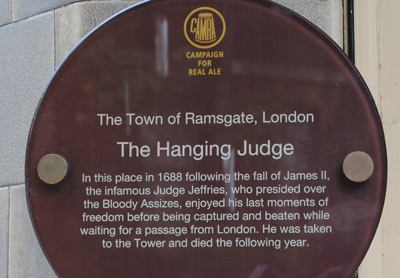
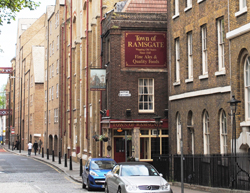
Remaining in London after the king had fled, Lord Jeffreys only attempted to flee as William’s forced approached the city. He made it as far as Wapping where, despite being disguised as a sailor, he was recognised in a pub, now The Town of Ramsgate (pictured above).

Placed in custody in the Tower of London, he died there of kidney problems on 18th April, 1689, and was buried in the Chapel Royal of Saint Peter ad Vincula (before, in 1692, his body was moved to the Church of St Mary Aldermanbury). All traces of his tomb were destroyed when the church was bombed during the Blitz (for more on the church, see our earlier post here).