Lost London – Chapel of St Thomas á Becket…

Known informally as the Chapel on the Bridge, the Chapel of St Thomas á Becket was located in the middle of London Bridge and, as the name suggests, was dedicated to the ill-fated archbishop of Canterbury.
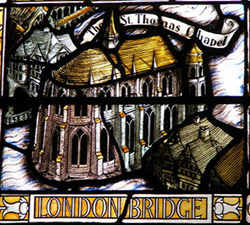
London-Bridge-chapelFounded in 1205, the stone chapel was among the first buildings constructed on the bridge by priest-architect Peter de Colechurch in 1176, who was actually buried beneath the chapel (for more on him and the construction of the bridge, see our earlier posts here and here).

Facing downstream and located on a wider than normal pier – the 11th pier from the Southwark end of the bridge and the ninth from the City end – the original chapel was built in the early English Gothic style and consisted of an upper chapel with a groined roof and columns and vaulted lower chapel or undercroft. Standing some 40 foot high, it would have towered over the shops and residences on the bridge. There is some suggestion it was damaged by fire in 1212 and may have had to have been extensively repaired.

It’s name ensured its popularity – Becket was martyred in Canterbury Cathedral in 1170, apparently on the orders of King Henry II, and, canonised just three years later, had quickly become the focus of a popular religious cult in his home town of London. The chapel also became renowned as a wayside stop for pilgrims to receive the saint’s blessing before making their way to Canterbury where his shrine was located.

But it wasn’t just pilgrims who had an attachment – the chapel was apparently popular among watermen who, when the tide allowed them, were known to tie up their craft on the chapel pier and ascend to the undercroft through a lower entrance.

The chapel – which apparently had two priests at the beginning as well as a number of clerks although the number of priests is known to have climbed as high as five in the 14th century – was nominally under the control of the priest of the church of St Magnus-the-Martyr, located at the City end of the bridge. The reality seems to have been however, that the priests and other “Brothers of the Bridge” enjoyed considerable freedom in their roles, including, after 1483, obtaining the right keep alms taken during services provided he made a generous contribution to the parish finances. Like most who worked on the bridge, the priests and “clerks of the chapel” would likely have lived on it.

Relics housed in the chapel apparently included fragments of the True Cross and a number of chantries were built inside the chapel in the 14th century – it’s believed this may have led to some overcrowding and been one of the reasons for a major rebuilding of the chapel – this time in the Perpendicular Gothic style – between 1384 and 1397.

The chapel survived until the Dissolution when, in 1548, the priest was ordered to close it up and it was desecrated and later converted into a dwelling (later still, parts of it were used as a warehouse). It was demolished over succeeding years – by the late 18th century just the lower chapel remained –  with the final remnants removed in the early 1800s.

Some bones in a small casket were disinterred in from the chapel undercroft during this process in the early 19th century. Although these were rumoured to be those of de Colechurch, analysis found them to be part of a human arm bone, a cow bone and goose bones. (Other accounts suggest most of Peter’s bones were tossed into the Thames and that a small number were even sold at auction).

There’s a stained glass window commemorating the bridge in St Magnus-the-Martyr Church today (pictured above).
This Week in London – Virtual reality at the British Museum; British Library’s Grade I listing; and, Deptford’s cardboard tower…

Get an up close and in-depth look at the Bronze Age as virtual reality comes to the British Museum this weekend. For the first time, families including children aged 13 or over will be able to wear Samsung Gear VR devices to virtually explore a Bronze Age site designed by Soluis Heritage which features objects from the museum’s collections. They will also be able to enter an “immersive fulldome” where they can explore a virtual reality world featuring a Bronze Age roundhouse and objects. The event will take place in the Samsung Digital Discovery Centre on Saturday and Sunday. For more, see www.britishmuseum.org.

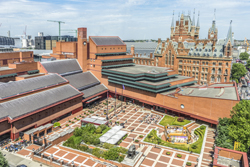
british-library-aerial-shotThe British Library at St Pancras has been given Grade I heritage status, joining the top 2.5 per cent of listed buildings in England. Designed by architect Sir Colin St John Wilson and his partner MJ Long and completed in the late Nineties, the library is the largest public building to have been built in the UK in the 20th century. At the heart of the library is the King’s Library tower which houses the library of George III as well as the Treasures Gallery where national treasures such as the Magna Carta, Lindisfarne Gospels and original Beatles lyrics are displayed. The library was listed along with seven other libraries in England, all of which have been given Grade II status. Meanwhile the record-breaking exhibition Magna Carta: Law, Liberty, Legacy has entered its final month before closing on 1st September. The display features two of the four surviving Magna Cartas as well as the US Declaration of Independence and Bill of Rights – in the UK for the first time – and more than 200 objects including medieval manuscripts, artworks, 800-year-old garments and esoterica such as King John’s teeth and thumb bone. Admission charge applies. For more, see www.bl.uk/magna-carta. PICTURE: Tony Antoniou/British Library.

Help build The People’s Tower in Douglas Square in Deptford, south east London, this weekend. French artist Olivier Grossetete has been invited by the Albany to build the tower – with your help – out of cardboard boxes. Tower assembly takes place between 10am and 3pm on Saturday and then between 11am and 5pm on Sunday, there will be free live music and family entertainment in the Albany Garden as the tower is finished and then knocked down. No booking is required. For more, check out www.thealbany.org.uk.

Send all items for inclusion to exploringlondon@gmail.com.

A Moment in London’s History – Outbreak of the Great Plague…

St-Olave-Hart-StreetIt’s 350 years ago this year that the Great Plague broke out in London in 1665, bringing death on an unprecedented scale to the city.

The plague, which was apparently also known as the Poor’s Plague, is said to have broken out in early 1665 – perhaps February – with the first areas to be affected dockside districts and the crowded slum of St Giles in the Fields before it moved into the City proper. There are claims that the outbreak’s origins occurred a couple of months earlier at a property in Drury Lane where contaminated bales of goods imported from Holland were opened by Flemish weavers.

However it came to be in London, it soon spread and by July was running rampant with many of the nobility, merchants, and tradesmen choosing to flee the city in the hope of escaping its reach. They included King Charles II and his family and court who moved to Hampton Court in early July and then to Salisbury at the start of August before, following some cases there, to Oxford in September.

Those who did come down with the disease – generally thought to have been bubonic plague, a disease of rats which is transmitted to humans via fleas – were confined to their homes with red crosses and the words ‘Lord, have mercy on us’ painted on the door while gatherings in public – such as for the theatre – were banned to prevent the disease’s spread.

Other measures to contain the disease included the imposition of a curfew and the killing of an estimated 40,000 dogs and 200,000 cats, thought to be spreaders of the disease, on the orders of the mayor, Sir John Lawrence.

Bills of mortality recorded the number of deaths weekly – in the week of 19th to 26th September, the number peaked at 7,165 people before declining. By late in the year life in the capital had started returning to normal.

While the bodies were buried in mass graves, by September the growing numbers of dead meant many were simply left to rot where they fell.

The estimated numbers of those who died varies somewhat depending on the source but according to the Museum of London’s website, the Great Plague of 1665 is estimated to have killed 100,000 people – about a fifth of the population – within just seven months of its outbreak.

While the sheer number of dead is unprecedented, other plagues were proportionally deadlier, in particular the coming of the Black Death in 1348 which killed about half of all Londoners over an 18 month period (equating to an estimated 40,000 people).

The Great Plague was, thankfully, the last major plague to affect London. Among those who had survived was the diarist Samuel Pepys whose entries provide a valuable source of information on how the plague affected Londoners (pictured above is detail from the gateway into the church of St Olave Hart Street – Pepys’ parish church at the time of the plague – where a number of victims of the Great Plague were buried).

Lost London – Inigo Jones’ Grand Portico on Old St Paul’s Cathedral…

Inigo-Jones-portico

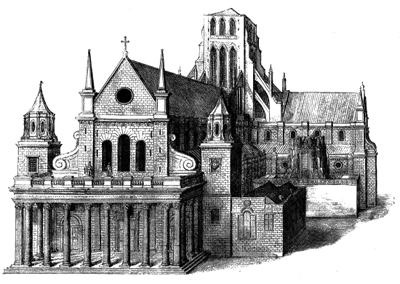
A short-lived addition to Old St Paul’s Cathedral before it burned down in the Great Fire of 1666, the classical-style portico was designed by Inigo Jones as part of makeover King James I ordered him to give the cathedral in the first half of the 17th century.

St Paul’s, which was completed in the early 14th century in the Early English Gothic style (see our post here for more on its earlier history), had fallen into a state of disrepair by the 1620s, thanks in part to a fire caused by lightning which had brought the spire – 489 feet (149 metres) high when built – crashing down through the nave roof in 1561.

The spire wasn’t rebuilt and repair works undertaken to the cathedral roof were apparently shoddy, meaning that by the early 1600s, things were in a parlous state.

Jones started work in the 1620s, cleaning and repairing the massive structure and adding a layer of limestone masonry over the exterior to give the building a more classical look inspired by the temples of ancient Rome he had seen in that city and in Naples and the work of Italian Renaissance architect Andrea Palladio.

This was complemented by the grand portico he added to the west front in the 1630s (and which was paid for by King James’ son, King Charles I). Featuring 10 columns across its breadth and four deep (these, it has been suggested, stood about 45 feet tall), it was topped by a frieze of lions’ heads and foliage with plans for a series of statues which some say were to be saints and others kings to be placed along the top (in the end only statues of King Charles I and King James I were ever placed there). The facade also featured turrets at either side.

Work on the repairs came to a halt in 1642 thanks to the Civil War, during which Parliamentarian forces famously used the cathedral’s great nave for stables.

Following the Restoration in 1660, with Jones now dead (he died in 1652), Sir Christopher Wren was invited by King Charles II to restore the grand old building but Sir Christopher proposed it be demolished instead, a decision which lead to an outcry among London’s citizens.

Wren then changed his plans to instead restore the existing build but replace the spire with a dome. His scaffolding was in place around the cathedral when the Great Fire broke out in 1666 and badly damaged the building (although the portico apparently remained standing until 1687-88 when Sir Christopher had it demolished to make way for his new western front).

Interestingly, it is said Wren used blocks from the portico to create the foundations for the building which now stands on the site.

PICTURE: Wenceslaus Hollar’s rendering of Inigo Jones’ West Portico/Wikipedia

For more on the history of St Paul’s Cathedral see Ann Saunders’ St Paul’s Cathedral: 1,400 Years at the Heart of London.

This Week in London – Buckingham Palace offers a “Royal Welcome”; exploring London’s outdoor spaces; and contemporary portraiture at the V&A…

Buckingham-PalaceBuckingham Palace opened its 19 State Rooms to the public last weekend under the theme of ‘A Royal Welcome’. As well as the chance to see the State Rooms themselves, a series of displays and films are located throughout the palace which show how Royal Household staff are involved in welcoming the tens of thousands of guests who come to the palace each year for receptions, State Banquets, garden parties and investitures. And, for the first time, the public can enter the palace through the Grand Entrance where the Australian State Coach will be displayed. Other highlights include the Palace Ballroom – set up for a State Banquet with silver gilt candelabra and centrepieces from King George IV’s grand service, displays recreating part of the dresser’s workroom and the palace kitchens, pantries and wine cellars in the throes of preparing for a State Banquet, and some of the gifts received during State Visits to the palace. Items of Queen Elizabeth II’s personal jewellery are also on display including the Kokoshnik Tiara, worn at a State Banquet in honour of the President of Mexico this year, Queen Mary’s Dorset bow brooch and the diamond Coronation necklace and earrings. The palace is open until 27th September. Admission charge applies. For more, see www.royalcollection.org.uk.

A new interactive map of public outdoor areas in London has been created to help encourage the city’s residents and tourists to make the most of the great outdoors this summer. The map details more than 200 public spaces including squares, green spaces and public street amenities, many of which have been improved as part of the Mayor of London, Boris Johnson’s Great Outdoors initiative which has seen more than £400 million invested in 242 projects since 2009. To check out the map, follow this link.

A new exhibition examining contemporary portraiture – and its inspiration from traditional modes of portraiture such as miniatures, medals and death masks – opened at the V&A in South Kensington this week. Facing History: Contemporary Portraiture features more than 80 prints and photographs drawn from the V&A’s collection and created by artists including Julian Opie, Grayson Perry, Thomas Ruff, Maud Sulter and Gavin Turk. Works featured include self-referential pieces like Grayson Perry’s pair of prints, Mr and Mrs Perry and Gavin Turk’s Portrait of Something that I’ll Never Really See, portraits of real and fictional characters like Brian D Cohen’s Man with Eyes Closed (Walter White) whose subject is both a character from US TV series Breaking Bad and Bryan Cranston, the actor who played him, Cecilia Mandrile’s identity-card inspired ID-Intensively Displaced series, and 11 pieces from Ellen Heck’s Forty Fridas. Exhibition runs until 24th April. Admission is free. For more, see www.vam.ac.uk.

Send all items for inclusion to exploringlondon@gmail.com

Famous Londoners – Sir Hugh Myddelton…

The Welsh-born “merchant adventurer” Sir Hugh Myddelton (also spelt Myddleton or Middleton) is best remembered in London for the construction of the New River, a water engineering project which still provides some of city’s water.

Sir-Hugh-MyddeltonBorn about 1560, the sixth son (and one of 16 children) of Richard Myddelton, governor of Denbigh Castle in Wales, Hugh Myddelton travelled to London to seek his fortune and there became apprenticed to a goldsmith before himself becoming a member of the Goldsmith’s Company in 1592 (he later became warden of the company).

Operating out of premises in Bassishaw (now Basinghall Street), he gained a reputation among the wealthy and nobility for his work and was appointed Royal Jeweller to King James I (he had apparently also supplied jewellery to Queen Elizabeth I).

Myddelton became a wealthy merchant and banker, and, in 1603, he also succeeded his father as MP for Denbigh Borough, a post he held repeatedly until 1628.

Sir Hugh became one of the driving forces behind the New River project which aimed to address the strain on London’s water sources by bringing clean water from the River Lea in Hertfordshire via a 39 mile-long canal to New River Head in London.

After an aborted earlier attempt to build a canal from Hertfordshire to London (which had run into financial difficulties), Sir Hugh was granted authority to carry out the works for the New River in 1609 and employed mathematicians like Edward Pond and Edward Wright to direct the course with the man behind the earlier attempt, Edmund Colthurst, overseeing the works.

By 1611 it became clear to Myddelton that he wouldn’t have the necessary funds to complete the works so he obtained the financial aid of the king (in return the king was to get half of all profits).

The project was eventually completed in 1613 and a ceremony was held at the New River Head in Islington where the canal then terminated (just south of where Sadler’s Wells Theatre now stands).

Myddelton, who continued to diversify in business and made considerable sums from his ownership of lead and silver mines in Wales as well as from a land reclamation project on the Isle of Wight, became the first governor of the New River Company when it was created by royal charter in 1619 and remained a key figure in it until his death. He was created a baronet in 1622.

Myddelton, who married twice, had 15 or more children to his second wife – only about half of whom survived him. He died on 7th December, 1631, and was buried in the now demolished St Matthew Friday Street where he had been a church warden (some of his children were buried there as well). One of his brothers, Sir Thomas Myddelton, was a Lord Mayor of London.

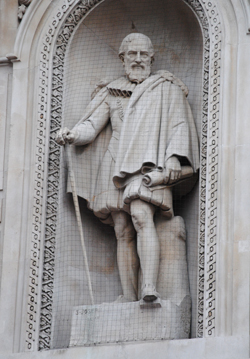
Among memorials to Sir Hugh in London is a statue of him on Islington Green which was unveiled in 1872 by William Gladstone, later PM. There is also a statue of him on the Royal Exchange (pictured) and a number of Islington streets have been named for him.

For more on London’s historic water sources, see London’s Lost Rivers: A Walker’s Guide.

What’s in a name?…Drury Lane…

Famous for its associations with London’s theatreland, Drury Lane takes its name from the Drury family who once owned a mansion here.

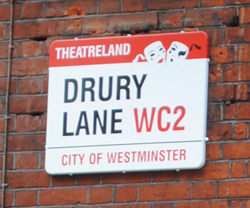
Drury-LanePreviously known as the Via de Aldwych (apparently for a stone monument the Aldwych Cross which stood at the street’s northern end), Drury Lane – which runs between High Holborn and Aldwych – was renamed after Drury House which was built at the southern end of the street.

Some accounts suggest it was Sir Robert Drury (1456-1535), an MP and lawyer, who built the property around 1500; others say it was his son, Sir William Drury, also an MP and a Privy Councillor, who did so  in around 1600 – which may mean there were two versions of the one property.

The street, meanwhile, is said to have been briefly renamed Prince’s Street during the reign of King James I (1603-1625) but, following the Restoration in 1660, the name Drury once more gained supremacy.

The origins of the street’s famous theatre (London’s oldest), the Theatre Royal Drury Lane, dates from the same year (see our earlier post here). Other theatres in the street included the Cockpit Theatre which had been designed at one stage by Inigo Jones.

The street is also famous for being the site of the worst outbreak of the plague in London – the Great Plague of 1665, burned away the following year by the Great Fire – and by the 18th century was a slum noted for its seediness, in particular for prostitution (it features in William Hogarth’s work The Harlot’s Progress).

This didn’t change until the second half of the 19th century – author Charles Dickens had been among others who had commented on the poverty he had seen there – when gentrification took hold. Among the shops opened there during this time was the first Sainsbury’s, founded at number 173 in 1869.

Alongside the Theatre Royal Drury Lane (although the main entrance is in Catherine Street), other theatres in the street today include the New London Theatre and the London Theatre.

10 sites from London at the time of the Magna Carta – 10. Priory of the Order of St John of Jerusalem…

Crypt

Founded in Clerkenwell in 1144, the Priory of the Order of St John of Jerusalem served as the order’s English headquarters.

The order, also known as the Knights Hospitaller, was founded in Jerusalem in 1080 to care for the sick and poor, and soon spread across Europe with the English ‘branch’ established on 10 acres just outside the City walls apparently by a knight, Jorden de Briset.

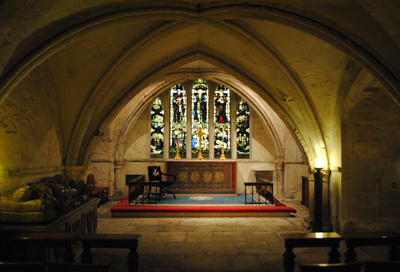
The original buildings – of which only the 12th century crypt (pictured above) survives complete with some splendid 16th century tomb effigies including that of the last prior, Sir William Weston – included a circular church, consecrated in 1185, and monastic structures including cloisters, a hospital, living quarters and a refectory or dining hall.

There are records of dignitaries staying at the priory as it grew in size and renown – among them was King John who in 1212, apparently stayed here for an entire month. There are also surviving accounts of Knights Hospitaller riding out in procession from the priory and through the City at the start of a journey to the Holy Land.

The priory and church were attacked during the Peasant’s Revolt of 1381, thanks to its connection with the hated Poll Tax (Prior Robert Hales was also the Lord High Treasurer and was beheaded during the revolt on Tower Hill).

The church was subsequently rebuilt as a rectangular-shaped building and then, in the early 16th century, enlarged when the site was significantly renovated. These renovations were still relatively new when the priory was dissolved in 1540 during the Dissolution of King Henry VIII.

The priory church, which survived the Great Fire of 1666, was later used as a parish church but was destroyed in an air raid in World War II. Subsequently rebuilt, it can be visited today along with the crypt below and the cloister garden, created in the 1950s as a memorial to St John’s Ambulance members from the London area (the original shape of the circular church is picked out in the paving here).

Perhaps the most famous building to survive is St John’s Gate which dates from the 16th century and was once the gatehouse entrance to the priory (added in the final renovations).

After the Dissolution it served various roles including as the office of the Master of Revels (where Shakespeare’s plays were licensed), the home of The Gentleman’s Magazine (Samuel Johnson was among contributors and worked on site), a coffee house (run by William Hogarth’s father) and a public house called the Old Jerusalem Tavern (yes, Charles Dickens was said to be a regular). It is now home to the recently renovated Museum of the Order of St John (you can see our earlier post on the museum here).

WHERE: Museum of the Order of St John, St John’s Gate (and nearby priory church), St John’s Lane, Clerkenwell (nearest Tube stations is Farringdon); WHEN: 10am to 5pm, Monday to Saturday (tours are held at 11am and 2.30pm on Tuesday, Friday and Saturday); COST: Free (a suggested £5 donation for guided tours); WEBSITE: www.museumstjohn.org.uk.

We’ll kick off a new Wednesday series next week…

10 sites from London at the time of the Magna Carta – 9. Old St Paul’s Cathedral…

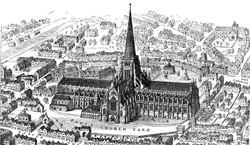
The first great stone cathedral on the site where Sir Christopher Wren’s St Paul’s now stands was a relative – and as yet incomplete – newcomer in 1215. Construction on it had started more than 120 years before in 1087 but it eventually took more than 200 years to finish.

Old-St-PaulsIt was Bishop Maurice, chaplain to William the Conqueror (he donated some Caen stone for its construction), who began the project after the previous wooden Saxon church on the site – the latest in a succession of them dating back to the 7th century – had been destroyed by fire (although it was under successor Bishop Richard de Beaumis that work began to really take shape).

The first part of the building to be completed was the quire in 1148 – its opening was delayed by another fire in 1135 caused during civil unrest following the death of King Henry I – but it wasn’t until after the Magna Carta’s advent – in 1240 – that the church was eventually consecrated by Bishop Roger Niger.

Originally designed in the Norman Romanesque-style, the architectural style changed during the building process into the Early English Gothic style.

Enlarged and renovated several times since construction began, it wasn’t fully completed until the 14th century – when it was the largest church in England and the third largest in Europe featuring the tallest steeple, built in 1221, and spire, built in 1315, ever built (that is, until 1561 when it was knocked down by lightning).

It later contained a number of important relics including the arms of Mellitus, the first bishop of London (see our earlier post on him here), St Mary Magdalene’s hair, the head of King Ethelbert and, importantly for the time, some pieces from the skull of St Thomas á Becket. Among the tombs inside the emerging church in 1215 were those of Sebba, King of the East Saxons, who had been buried in the north aisle in 695, and that of King Ethelred “The Unready”.

While the exterior was remodelled in the early 17th century – including the addition of a monumental new porch by architect Inigo Jones – the medieval building remained standing until the Great Fire of 1666.

PICTURE: Via Wikipedia

A Moment in London’s History – Princess Victoria’s christening…

Cupola-Room

On Sunday, Princess Charlotte, daughter of Prince William and Princess Kate, was christened at Sandringham. So we thought we’d take a quick look at another christening that took place in London almost 200 years ago, that of Princess Victoria.

The future Queen Victoria was born on 24th May, 1819 – the daughter of Edward, Duke of Kent (fourth son of King George III), and his wife, Princess Victoria Mary Louisa of Saxe-Coburg-Saalfeld.

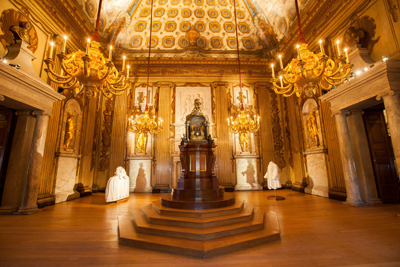
At the insistence of the Prince Regent (later King George IV), the christening was a small affair and was held a month after the birth on the afternoon of 24th June in the magnificent Cupola or Cube Room of Kensington Palace (pictured as it is now, above).

The guest list was small and included the Prince Regent, Prince Frederick, the Duke of York, and his wife Princess Frederica, Princess Augusta Sophia, Princess Mary, the Duchess of Gloucester, and her husband, Prince William, and Prince Leopold, who had recently become a widower after the death of Princess Charlotte.

The ceremony was conducted by Charles Manners-Sutton, the archbishop of Canterbury, and, thanks to the intransigence of the Prince Regent, her name was apparently only decided at the last minute.

The Prince Regent has earlier forbidden the use of such ‘royal’ names including Charlotte, Elizabeth, Georgina or Augusta and when asked by the archbishop what she would be named, he replied brusquely that she would be named Alexandrina in honour of the Russian Tsar Alexander, one of the new princess’s godparents.

Her second name was Victoria in honour of her mother, and while Victoria was often called “Drina” while a girl, she herself apparently preferred her second name to her first.

The gold font used in the ceremony formed part of the Crown Jewels and its origins go back to the time of King Charles II.

Interestingly, there were a couple of significant Victorian connections during Princess Charlotte’s christening – the font used at this christening was known as the Lily Font (like its predecessor, it is usually found with the Crown Jewels in the Tower of London).

It was commissioned by Queen Victoria and Prince Albert for the christening of their first daughter, Princess Victoria, in 1841, apparently due to Queen Victoria’s dislike for the gold font used at her own christening – it had been used by King Charles II to christen his illegitimate children.

The Lily Font has apparently been used at every royal christening since except that of Princess Eugenie who had a public baptism in Sandringham in 1990.

Princess Charlotte also wore a replica of the christening gown worn by Princess Victoria.

WHERE: The Broad Walk, Kensington Gardens, Kensington (nearest Tube stations are High Street Kensington or Queensway); WHEN: Daily 10am to 6pm (until 31st October); COST: £17.50 adult/£14.10 concession/children under 16 free (online booking discounts available, Historic Royal Palaces members free); WEBSITE: www.hrp.org.uk/KensingtonPalace.

PICTURE: HRP/newsteam

Daytripper – Rochester Castle…

Rochester-Castle

We’ve visited Rochester before but given it’s the 800th anniversary of the Magna Carta we thought it would be good to take a more in-depth look at Rochester Castle and the events that took place there after the sealing of the “Great Charter”.

Rochester Castle was first built in the aftermath of the Battle of Hastings as a Norman stronghold to control the Medway and the Roman road – Watling Street – which crossed it at that point. There was a Roman-era town on the site and it’s likely the first castle – surrounded by a deep ditch and featuring walls of earth topped with timber – was  built within the town’s walls – possibly on the site of the existing castle.

Rochester-Castle2Work on a stone castle was started in the late 1080s by Gundulf, the Bishop of Rochester (he also built the first Tower of London), and the castle precincts outer walls still largely follow the line of his original curtain walls. The keep was built by William de Corbeil, Archbishop of Canterbury, who was granted the castle by King Henry I in 1127. It remained in the custody of the archbishops until the events of 1215.

Following the sealing of the Magna Carta in May, relations between King John and the barons soured again into outright civil war with the castle declared for the rebels. In October and November, 1215, it was held for some seven weeks by a force of knights – accounts suggest between 95 and 140 – against the forces of King John. These eventually breached the south curtain wall and after the forces of the knights – who were led by William de Albini and Reginald de Cornhill – retreated to the keep, the king ordered his sappers to work.

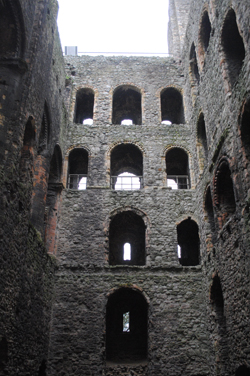
The miners were successful in undermining the south-west tower which collapsed along with a large section of the keep (the fat of 40 pigs were apparently used to make sure the fire in the mine was hot enough). The defenders nonetheless kept fighting, retreating further into the remains of the keep, until they were eventually forced to surrender when faced with starvation. King John’s fury at their resistance was said to be great but while some of the defenders lost their hands and feet when they were apparently lopped off on his orders after surrendering, he was convinced to spare the holdouts from being hanged on the spot and merely had them imprisoned.

The tower was later rebuilt by King John’s long ruling son, King Henry III, and you can see its distinct round shape (in contrast with the earlier, square towers) when looking at the keep today. (Incidentally, King John’s siege was the castle’s second major siege – the first had taken place in 1088 when the forces of King William II (Rufus) had besieged the castle which was then held by the rebellious Odo, Bishop of Bayeaux, who was involved in an attempt to put William the Conqueror’s eldest son, Robert, Duke of Normandy, on the throne in place of William (who was the second son). Odo was forced to come to terms and exiled as a result of the siege).

Rochester-Castle3In the hands of the Crown after King John’s siege, the castle was again the site of a siege in 1264 – this time unsuccessful when rebels under the command of Simon de Montfort failed to take it from those of King Henry III (although the garrison was later forced to surrender following events elsewhere).

It was rebuilt and repaired a number of times, including during the reigns of King Edward III and that of King Richard II (during whose reign it was also ransacked in the Peasant’s Revolt of 1381). Other kings to visit it over the years included King Henry VII and King Henry VIII.

Already much deteriorated and neglected, in 1610, King James I gave the castle to Sir Anthony Weldon whose family sold off some of the timber and stone to local builders. It survived the Civil War without incident and was used as a public pleasure garden from the 1870s onward before, in 1884, it was sold to the City of Rochester. In 1965 responsibility for its care was given to the Ministry of Public Building and Works. Current managers, English Heritage, took over the site in 1984.

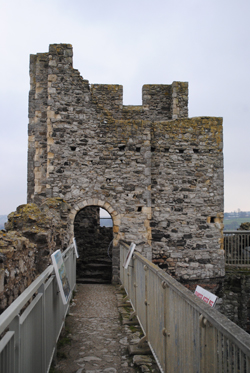
The castle remains an imposing site in Rochester and the outer walls of the keep remain intact even if it’s no more than a shell. Worth the climb to the top simply to take advantage of the spectacular views of the town and cathedral below!

WHERE: Rochester Castle, Rochester, Kent – nearest train station is Rochester (half a mile); WHEN: 10am to 6pm daily (until 30th September); COST:£6.20 adults/£3.90 children (aged 5-15) and concessions (free for English Heritage members); WEBSITE: www.english-heritage.org.uk/visit/places/rochester-castle.

10 sites from London at the time of the Magna Carta – 8. Bermondsey Abbey…

Bermondsey Abbey, which was more than 130-years-old by the time King John put his seal to the Magna Carta in 1215, has an unusual connection to the unpopular king – it is one of a number of buildings in London which has, at various times in history, been erroneously referred to as King John’s Palace.

This suggestion – that it was a palace which was later converted into an abbey – may have arisen from a site on the former abbey grounds being known at some point in its history as King John’s Court (that name was said to commemorate the fact that King John visited the abbey).

Putting how King John’s name came to be linked with the abbey aside, we’ll take a quick look at the history of the abbey which rose to become an important ecclesiastical institution in medieval times.

While there was a monastic institution in Bermondsey as far back as the early 8th century, the priory which was here during the reign of King John was founded in 1082, possibly on the site of the earlier institution, by a Londoner named as Aylwin Child(e), apparently a wealthy Saxon merchant who was granted the land by King William the Conqueror.

In 1089, the monastery –  located about a mile back from the river between Southwark and Rotherhithe – became the Cluniac Priory of St Saviour, an order centred on the French abbey of Cluny, and was endowed by King William II (William Rufus) with the manor of Bermondsey.

It was “naturalised” – that is, became English – by the first English prior, Richard Dunton, in 1380, who paid a substantial fine for the process. It was elevated to the status of an abbey by Pope Boniface IX in 1399.

It had some important royal connections – King John’s father, King Henry II and his wife Queen Eleanor celebrated Christmas here in 1154 (their second child, the ill-fated Henry, the young King, was born here a couple of months later), and Queen Catherine (of Valois), wife of King Henry V, died here in 1437. It was also at Bermondsey Abbey that Elizabeth Woodville, the widow of King Edward IV and mother of the two “Princes in the Tower”, died in 1492 following her retirement from court.

The abbey, which grew to have an enormous income thanks to its acquisition of property in a range of counties, survived until the Dissolution when, in 1537, King Henry VIII closed its doors. It was later acquired by Sir Thomas Pope who demolished the abbey and built a mansion for himself on the site (and founded Trinity College in Oxford apparently using revenues from the property). We’ll deal more with its later history in an upcoming post.

The ruins of the abbey were extensively excavated in the past few decades and some of the remaining ruins of the abbey can still be seen buildings around Bermondsey Square and a blue plaque commemorating the abbey was unveiled in 2010. Bermondsey Street runs roughly along the line of the path which once led from the abbey gates to the Thames and the abbey had a dock there still commemorated as St Saviour’s Dock. The abbey’s name is commemorated in various streets around the area.

For more on the history of the Magna Carta, see David Starkey’s Magna Carta: The True Story Behind the Charter.

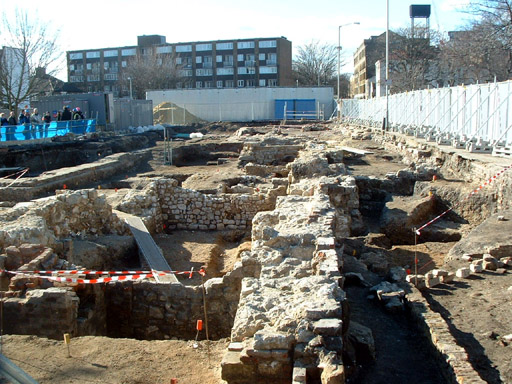
PICTURE: An archaeological dig at the ruins of Bermondsey Abbey in 2006. Zefrog/Wikipedia.

10 sites from London at the time of the Magna Carta – 7. Old London Bridge…

London-Bridge2

The current London Bridge, which spans the River Thames linking Southwark to the City, is just the latest in several incarnations of a bridge which originally dates back to Roman times.

This week, we’re focusing on first stone bridge to be built on the site. Constructed over a period of some 33 years, it was only completed in 1209 during the reign of King John, some six years before the signing of the Magna Carta.

Construction on the bridge began in 1176, only 13 years after the construction of an earlier wooden bridge on the site (the latest of numerous wooden bridges built on the site, it had apparently built of elm under the direction of Peter de Colechurch, chaplain of St Mary Colechurch, a now long-gone church in Cheapside).

It was the priest-architect de Colechurch who was also responsible for building the new bridge of stone, apparently on the orders of King Henry II. While many of the wealthy, including Richard of Dover, the Archbishop of Canterbury, gave funds for the construction of the bridge, a tax was also levied on wool, undressed sheepskins and leather to provide the necessary monies – the latter led to the phrase that London Bridge was “built upon woolpacks”. King John, meanwhile, had decreed in 1201 that the rents from several homes on the bridge would be used to repair it into perpetuity.

The bridge, which featured 20 arches – a new one built every 18 months or so, was apparently constructed on wooden piles driven into the river bed at low water with the piers of Kentish ragstone set on top. It was dangerous work and it’s been estimated that as many as 200 men may have died during its construction.

The bridge was almost completely lined with buildings on both sides of the narrow central street. These included a chapel dedicated to St Thomas á Becket – a stopping point for pilgrims heading to the saint’s shrine in Canterbury, as well as shops and residences (although, apart from the chapel, we know little about the original buildings). There was also a drawbridge toward the southern end and the Great Stone Gate guarding the entrance from Southwark.

Peter de Colechurch died in 1205, before the bridge was completed. He was buried in the undercroft of the chapel on the bridge.

Three men subsequently took on the task of completing the bridge – William de Almaine, Benedict Botewrite and Serle le Mercer who would go on to be a three time Lord Mayor of London. All three were later bridge wardens, the City officials charged with the daily running of the bridge itself.

One of key events on the bridge in the years immediately after its completion was the arrival of Louis, the Dauphin of France, in May, 1216. Louis had been invited to depose John by the rebellious barons after the agreement sealed at Runnymede fell apart and in 1216, he and his men marched over London Bridge on their way to St Paul’s Cathedral. (We’ll deal with this in more detail in a later post).

What became known as ‘Old London Bridge’, which stood in line with Fish Street Hill, survived the Great Fire of 1666, albeit badly damaged, but was eventually replaced with a new bridge, known, unsurprisingly as ‘New London Bridge’, which opened in 1831. Designed by John Rennie, this bridge was later replaced by one which opened in 1971 (Rennie’s bridge was sold off and now stands in Lake Havasu City, Arizona).

For a detailed history of Old London Bridge, check out Old London Bridge: The Story of the Longest Inhabited Bridge in Europe.

This Week in London – The Waddesdon Bequest has a new home; history painted at the Tate; and, early release NYE tickets…

Holy-Thorn-ReliquaryThe Waddesdon Bequest, a collection of medieval and Renaissance treasures left to the British Museum by Baron Ferdinand de Rothschild in 1898, has a new home. Redisplayed in a new gallery which opened at the museum last week, the collection features the Christian relic known as Holy Thorn Reliquary (pictured) – a concocotion of gold, enamel and gems set around a thorn supposedly taken from Christ’s Crown of Thorns, the Lyte Jewel – a diamond-studded locket made in London in 1610-11 to hold a miniature of King James I and presented by the king to Thomas Lyte as thanks for a genealogy he created representing the king as a descendant of the Trojan Brutus, and the Cellini Bell – cast from silver in Nuremberg around 1600 and later displayed by Horace Walpole at his west London villa in Strawberry Hill. The bequest collection, which must always be displayed in a room of its own under its original terms, was first displayed at Baron Ferdinand’s country home of Waddesdon Manor in Buckinghamshire (now a National Trust property) and moved to the museum after his death. The redisplay reconnects the collection with its past at the manor and the history of the museum – the room where it is now displayed, Room 2a, was the museum’s original Reading Room and part of a neo-classical suite of rooms designed by Robert Smirke in 1820. It has been given the “most ambitious digital treatment” of any permanent gallery in the institution. Admission is free. For more, see www.britishmuseum.org.

The “enduring significance and emotional power” of British history painting is under examination in a new exhibition which opened at Tate Britain on Millbank last week. Fighting History features everything from the large scale works of 18th century painters John Singleton Copley and Benjamin West through to 20th century and contemporary works by Richard Hamilton and Jeremy Deller and looks at how they reacted, captured and interpreted key historical events. Works on show include Singleton Copley’s 1778 work The Collapse of the Earl of Chatham in the House of Lords, 7 July, William Frederick Yeames’ 1877 work Amy Robsart, John Minton’s 1952 work The Death of Nelson and Deller’s 2001 work The Battle of Orgreave, a re-enactment of 1984 protest in South Yorkshire. The exhibition also compares traditional and contemporary renderings of events from scripture, literature and the classical world and features a room dedicated to interpretations of the great Biblical flood of Noah. Runs until 13th September. Admission charges apply. For more, see www.tate.org.uk.

A limited number of early release tickets to London’s New Year’s Eve celebrations will go on sale from noon tomorrow (Friday, 19th June). The tickets, the bulk of which will be released in September, cost £10 a person with the proceeds being used to cover costs including printing and infrastructure. As was the case last year, people without tickets will not be able to access the event. To get hold of tickets, head to www.london.gov.uk/nye.

Send all items for inclusion to exploringlondon@gmail.com.

10 sites from London at the time of the Magna Carta – 6. St Helen’s Bishopsgate…

St-Helen-Bishopsgate2

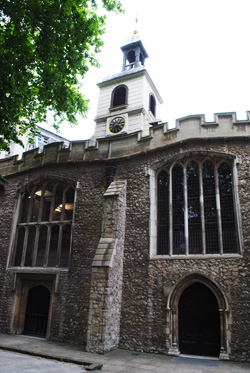
This church in the shadow of 30 St Mary Axe (aka The Gherkin) is all that remains of a Benedictine nunnery that was founded here during the reign of King John in 1210.

St-Helen's-BishopsgateEstablished by one “William, son of William the goldsmith” after he was granted the right by the Dean and Chapter of St Paul’s Cathedral, the priory was built to the north of a previously existing church with a new church for the nuns to use built right alongside the existing structure (thus accounting for the rarely seen side-by-side naves of the current building).

While the new church was built longer than the existing church, the latter was then lengthened to give them both the same length. A line of arches and a screen separated the nun’s choir and the parish church.

The church which stands today has been much altered over the centuries and what we now see there largely dates from the 14th and 15th centuries (although the bell turret which sits over the west front is an 18th century addition).

One of the priory’s claims to fame in medieval times was that it apparently was once home to a piece of the True Cross, presented by King Edward I in 1285.

The nunnery was dissolved in 1538 during the Great Dissolution of King Henry VIII and the buildings, excepting the church, sold off to the Leathersellers’ Company (all were eventually demolished by the 18th century). The screen separating the nun’s choir and the parish church, meanwhile, was removed, leaving the main body of the church as it can be seen today.

The now Grade I-listed church, which was William Shakespeare’s parish church when he lived in the area in the 1590s, survived both the Great Fire of London and the Blitz but was severely damaged by two IRA bombs in the early 1990s leading to some major – and controversial – works under the direction of architect Quinlan Terry.

Inside the church today is a somewhat spectacular collection of pre-Great Fire monuments including the 1579 tomb of Sir Thomas Gresham, founder of the Royal Exchange, the 1636 tomb of judge, MP and Chancellor of the Exchequer, Sir Julius Caesar Adelmare, and the 1476 tomb of merchant, diplomat, City of London alderman and MP, Sir John Crosby.

It was also once the site of the grave of 17th century scientist Sir Robert Hooke but these were apparently removed from the church crypt in the 19th century when repairs to the floor of the nave were being made and placed in an unmarked common grave. Their location apparently remains unknown.

WHERE: St Helen’s Bishopsgate, Great St Helens (nearest Tube stations are Aldgate, Bank and Liverpool Street); WHEN: 9.30am to 12.30pm weekdays daily (also usually open Monday, Wednesday and Friday afternoons but visitors are advised to telephone first); COST: Free; WEBSITE: www.st-helens.org.uk.

Celebrating the Magna Carta’s 800th anniversary!…

Magna-Carta4

We interrupt our regular programming today to mark a truly historic milestone – 800 years since King John set his seal to the Magna Carta (Great Charter) in a field at Runnymede to the west of London.

So, where can you see a copy in London?

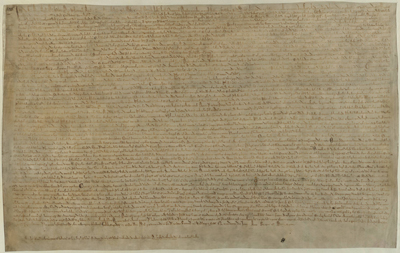
The British Library actually holds two of the four surviving documents from 1215 (one is pictured above) – the other two are held by Lincoln and Salisbury Cathedrals.

One of the copies in the British Library was damaged in an 18th century fire; the other was found in a tailor’s shop in London in the 17th century – made of sheepskin, it was apparently about to be taken apart to line collars.

The library’s current Magna Carta exhibition, Magna Carta: Law, Liberty, Legacy, features the two documents (along with Jefferson’s handwritten copy of the Declaration of Independence and one of the original copies of the US Bill of Rights). For more about the exhibition, see www.bl.uk/events/magna-carta–law-liberty-legacy (runs until 1st September – for more see our earlier post here).

Meanwhile, the City of London Corporation also possesses a copy of the Magna Carta – although a later one that that issued in 1215.

Issued by King Edward I in 1297, this was the one which saw the document’s clauses, somewhat changed from 1215, written into the statutes for the first time.

Stored at the Guildhall Art Gallery, it is too delicate to be on permanent display but is currently on display in the City of London  Heritage Gallery until 1st October (for more follow this link).

You can read more about the Magna Carta and its London connections in our Wednesday series, 10 sites from London at the time of the Magna Carta.

PICTURE: British Library.

Treasures of London – The Great Pagoda, Kew Gardens…

pagoda

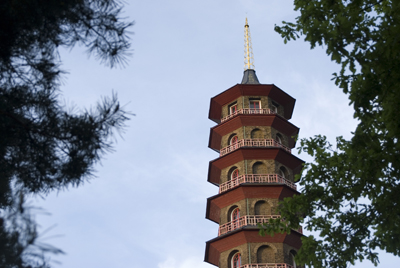
News this week that Historic Royal Palaces and the Royal Botanic Gardens are embarking on a two year project to restore eighty decorative dragons to the Kew Pagoda has led us to take a look at the history of the exotic tower set amid the trees.

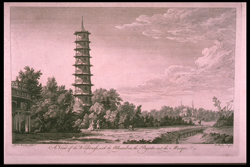
pagoda15Designed by architect Sir William Chambers (one of his drawings is depicted here), the pagoda was built in 1762 during the eighteenth century craze for Chinoiserie and was probably commissioned by Princess Augusta as part of the ongoing works she undertook in the gardens after the death of her husband Prince Frederick, eldest son of King George II and Queen Caroline.

Standing 163 feet (or almost 50 metres) high, the 10 storey pagoda was originally decorated with eighty golden dragons. It was designed to be the high point of a world tour through the gardens which also took in Roman ruins and Arabic mosques.

While the pagoda remains, the dragons were only on the structure for some 22 years before being removed in 1784 during roof repairs. Thanks to rumours they were made of solid gold, it was suggested they were sold off to pay the debts of the Prince Regent (the future King George IV), but experts say the wooden figures had simply rotted and so had to be removed.

Following their removal, the dragons subsequently disappeared and despite several attempts to find them – including one by Decimus Burton, architect of the famous Palm House (for more on that, see our earlier post), in 1843 – they have never been found.

Historic Royal Palaces and the Royal Botanic Gardens have now decided to replace them with new ones, drawing on contemporary accounts and drawings and using a team of specialist craftsmen to create them.

The restored pagoda – complete with new dragons – will be open to the public in 2017.

It is one of several ornamental buildings still located in the gardens. Others include a Japanese gateway and a Japanese wooden house called a minka.

WHERE: The Great Pagoda, Kew Gardens (nearest Tube station is Kew Gardens); WHEN: 10am daily (closing times vary – see websites for details); COST: £16.50 adults/£13 concessions/children £3.50 (discounts apply for online bookings); WEBSITE: www.kew.org.

PICTURES: RBG Kew

10 sites from London at the time of the Magna Carta – 5. Lambeth Palace…

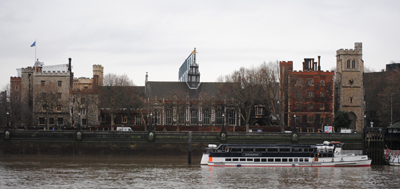
Lambeth-palaceThe London residence of the Archbishop of Canterbury, Lambeth Palace was first acquired by the archbishopric in around the year 1200 with Archbishop Stephen Langdon – an important figure in the whole Magna Carta saga – believed to be the first to have lived there.

Lambeth-Palace2The complex built in the early 13th century included a chapel, a great hall, a ‘great chamber’ where the archbishop would receive guests, and private apartments for Archbishop Langdon, who was appointed to the archbishopric in 1207 and remained in the post until his death in 1228 (his appointment was a major point of contention between King John and Pope Innocent III and a key factor in the dispute which led to the creation of the Magna Carta).

Not much remains of the original palace but the sections that do include the originally free-standing Langdon’s Chapel (although now much altered and connected to the rest of the complex) and the crypt beneath it (described as one of the best preserved medieval stone vaults in London it is now a chapel but was originally used for the storage of wine and beer).

They are both believed to have been completed in about 1220 with the other buildings now present added later over the centuries.

These include the formidable red brick gatehouse that fronts the complex today – known as Morton’s Tower, it is named after Archbishop Cardinal John Morton and dates from 1490 – while the Guard Room, which has its origins in the archbishop’s ‘great chamber’, dates from the 14th century and the infamous Lollard’s Tower – used as a prison in the 17th century – from the 15th century.

The Great Hall – now used as a library, first established in 1610 – was rebuilt in the mid 17th century although it is believed to stand on the site of that first used by Langdon (we’ll deal more with the later history of Lambeth Palace in a later post).

WHERE: Lambeth Palace, corner of Lambeth Palace Road and Lambeth Road (nearest tube stations are Westminster, Waterloo, Vauxhall, and Lambeth North); WHEN: Guided tours (90 minutes) only – check website for details; COST: £12 a person plus £2.95 booking fee (under 17s are free); WEBSITE: www.archbishopofcanterbury.org/pages/about-lambeth-palace.html.

10 sites from London at the time of the Magna Carta – 4. Thorney Island…

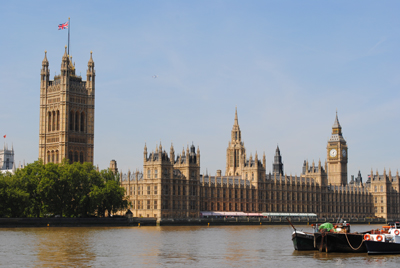
Houses-of-Parliament2 Both Westminster Abbey and the Palace of Westminster (these days better known as the Houses of Parliament – pictured) pre-date 1215 but unlike today in 1215 the upon which they stood was known as Thorney Island.

Formed by two branches of the Tyburn River as they ran down to the River Thames, Thorney Island (a small, marshy island apparently named for the thorny plants which once grew there) filled the space between them and the Thames (and remained so until the Tyburn’s branches were covered over).

One branch entered the Thames in what is now Whitehall, just to the north of where Westminster Bridge; another apparently to the south of the abbey, along the route of what is now Great College Street. (Yet another branch apparently entered the river near Vauxhall Bridge).

The abbey’s origins go back to Saxon times when what was initially a small church – apparently named after St Peter – was built on the site. By 960AD it had become a Benedictine monastery and, lying west of what was then the Saxon city in Lundenwic, it become known as the “west minster” (St Paul’s, in the city, was known as “east minster”) and a royal church.

The origins of the Palace of Westminster don’t go back quite as far but it was the Dane King Canute, who ruled from 1016 to 1035, who was the first king to build a palace here. It apparently burnt down but was subsequently rebuilt by King Edward the Confessor as part of a grand new palace-abbey complex.

For it was King Edward, of course, who also built the first grand version of Westminster Abbey, a project he started soon after his accession in 1042. It was consecrated in 1065, a year before his death and he was buried there the following year (his bones still lie inside the shrine which was created during the reign of King Henry III when he was undertaking a major rebuild of the minster).

Old Palace Yard dates from Edward’s rebuild – it connected his palace with his new abbey – while New Palace Yard, which lies at the north end of Westminster Hall, was named ‘new’ when it was constructed with the hall by King William II (William Rufus) in the late 11th century.

Westminster gained an important boost in becoming the pre-eminent seat of government in the kingdom when King Henry II established a secondary treasury here (the main treasury had traditionally been in Winchester, the old capital in Saxon times) and established the law courts in Westminster Hall.

King John, meanwhile, followed his father in helping to establish London as the centre of government and moved the Exchequer here. He also followed the tradition, by then well-established, by being crowned in Westminster Abbey in 1199 and it was also in the abbey that he married his second wife, Isabella, daughter of Count of Angouleme, the following year. 

10 sites from London at the time of the Magna Carta – 3. The Temple…

Templars

Not much remains today of the original early medieval home of the Templar Knights which once existed just west of the City of London. While the area still carries the name (as seen in the Underground station, Temple), most the buildings now on the site came from later eras. But there are some original elements.

First though, a bit of history. The Templar precinct which become known as the Temple area of London was the second site in the city given to the military order, known more completely as the Knights of the Temple of Solomon (thanks to their Jerusalem HQ being located near the remains of the Temple of Solomon).

Temple-churchThe first was in Holborn, located between the northern end of Chancery Lane and Staple Inn, and was known as the ‘Old Temple’ after which, in the latter years of the 12th century, the Templars moved their headquarters to the new site – ‘New Temple’ or Novum Templum – on unoccupied land on the bank of the River Thames. 

This new precinct included consecrated and unconsecrated areas. The consecrated part was a monastery and was located around what is now Church Court with the monastic refectory built on the site of what is now Inner Temple Hall – the medieval buttery is the only part of the original building which survives.

The lay or unconsecrated part of the precinct lay east of Middle Temple Lane, where a second hall was built on the site of what is now the Middle Temple Hall (you’ll find more on that here) which was used to house the lay followers of the order.

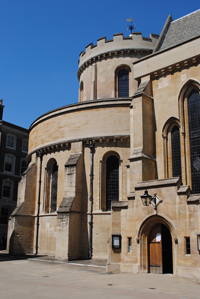
The original buildings also included the still existing Templar Church (pictured, along with a monument depicting the Templars outside the church), which was consecrated in 1185 during the reign of King Henry II by Heraclius, the Patriarch of Jerusalem, on a visit to London. Like all other Templar churches, its circular design was based on the design of the Church of the Holy Sepulchre in Jerusalem (the chancel was added later and consecrated in the presence of King Henry III in 1240 – for more on the Temple Church, you can see our earlier post here.

The New Temple become an important site in London (and the kingdom as a whole – the Masters of the Temple were the heads of the order in England) and was used by many of the nobility as a treasury to store valuables (and to lend money). It also had close connections with the monarchy and was, as we saw earlier this week, a power base for King John and from where he issued what is known as the King John Charter in 1215. He also used it for a time as a repository for the Crown jewels.

In an indication of the Temple’s prominence in state affairs, some of the great and powerful were buried here during this period including William Marshal, 1st Earl of Pembroke, who died in 1219, and his sons William and Gilbert (for more on those buried in the Temple, see our earlier post here). There were also apparently plans to bury King Henry III and his Queen here – this apparently spurred on the building of the chancel on the church – but they were eventually buried in Westminster Abbey instead.

Numerous relics were also apparently housed here during the Templar times including a phial believed to contain Christ’s blood and pieces of the true Cross.

The Templar era came to an end in 1312 when the order was dissolved on the authority of Pope Clement V amid some heinous allegations of blasphemy and sexual immorality which had the support of King Philip IV of France. While the pope awarded their property to the rival order, the Knights of the Hospital of St John of Jerusalem (also known as the Hospitallers), King Edward II had other ideas and ignored their claims with regard to the London property and instead, claimed it for the Crown (a dispute which went on for some years).

It later became associated particularly with lawyers, although lawyers would have certainly been at work in the New Temple given its role as banker to the wealthy (but more on its later associations with lawyers in later post).

For more on the history of the Templars, see Malcolm Barber’s The New Knighthood: A History of the Order of the Temple.