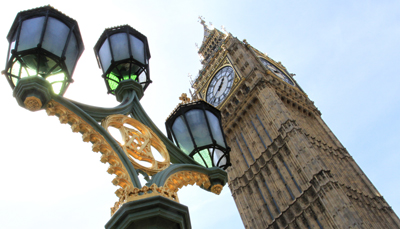
The Clock Tower of the Houses of Parliament, home to Big Ben. For more on it, see our earlier posts on the Palace of Westminster, the Clock Tower and Big Ben. PICTURE: Tony Kerrigan.
The Clock Tower of the Houses of Parliament, home to Big Ben. For more on it, see our earlier posts on the Palace of Westminster, the Clock Tower and Big Ben. PICTURE: Tony Kerrigan.
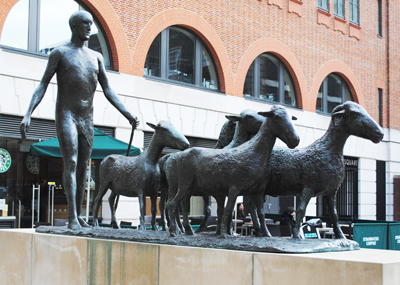
A small flock of sheep made their way across London Bridge this week as the Freemen of the City of London exercised their ancient prerogative to drive sheep over the span. A reported 600 Freemen from the City’s 110 livery companies took part in the annual drive along with a score of sheep – all in an effort to raise for the Lord Mayor’s Appeal. There’s a permanent reminder of the tradition of driving sheep in the heart of the City in Paternoster Square near St Paul’s Cathedral where Dame Elisabeth Frink’s bronze sculpture of Shepherd and Sheep can be found (pictured above).
 A memorial to Admiral Arthur Phillip, described as the “father of modern Australia”, was unveiled in Westminster Abbey back in July. Admiral Phillip (1738-1814) commanded the ‘First Fleet’ which left the UK in 1787, transporting convicts and military to the new colony Phillip founded as New South Wales. Prince Phillip, the Duke of Edinburgh, attended the memorial’s dedication service on 9th July which was conducted by the Dean of Westminster, Dr John Hall, who credited Admiral Phillip – a “modest, yet world-class seaman, linguist and patriot”- with laying the foundations “on which was developed the Commonwealth of Australia”. Among other dignitaries who attended was Dame Marie Bashir, the Governor of the Australian state of New South Wales, who described Admiral Phillip as “enlightened, far-sighted and indeed humane” and paid tribute to his attempts to actively foster harmonious relations with the Aboriginal people. Carved from Sydney sandstone, the memorial is set in the floor of the nave of the minster close to memorials of David Livingstone, Thomas Cochrane and Isaac Newton. The memorial stone is among a number of projects around Britain instigated by the Britain-Australia Society to mark the bicentenary year of Admiral Phillip’s death. For more on the abbey, see www.westminster-abbey.org. PICTURE: Andrew Dunsmore/Westminster Abbey.

Singer Amy Winehouse was remembered with the unveiling of a life-size bronze statue at the Stables Market in Camden this week. The work of London-based artist and designer Scott Eaton, the statue – seen here in the studio – was commissioned by her father Mitch Winehouse. Located in the north London district where Winehouse lived until her death in 2011, the statue was unveiled on what would have been her 31st birthday. For more of Eaton’s work, see www.scott-eaton.com. PICTURE: Courtesy of Scott Eaton.
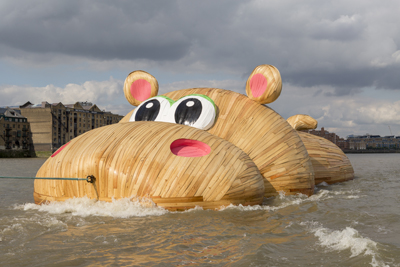
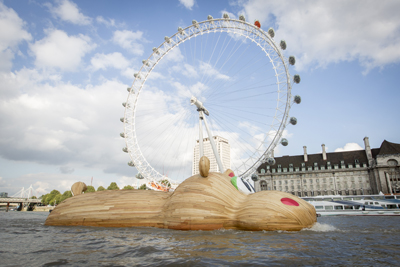
A 21 metre long wooden hippopotamus, HippopoThames, has been spotted in the River Thames off the new quarter of Nine Elms near Battersea in the city’s west. The semi-immersed sculpture, by Dutch artist Florentijn Hofman (famed for his huge yellow Rubber Duck), is part of the month long celebration of London’s river known as Totally Thames and can be seen at the site until 28th September. The sculpture was inspired by the history of the Thames – in particular, the hippos which once inhabited it (in fact, there’s a talk on the subject of the hippos at the Doodle Bar in Battersea tonight – admission charge applies, see www.totallythames.org/events/info/thames-natural-history). Hippopo is moored off Riverside Gardens, Nine Elms Lane, SW8 2DU. For foreshore access times, see www.totallythames.org/events/info/florentijn-hofman. PICTURES: Steve Stills.
 Looking from Kensington Gardens to the Albert Memorial and Royal Albert Hall in South Kensington.
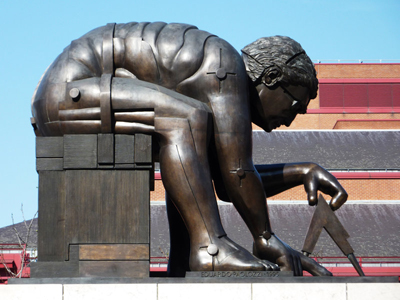
Eduardo Paolozzi’s 1995 statue of Isaac Newton which stands on the British Library’s piazza in King’s Cross has been granted a ‘voice’ as part of a new project called Talking Statues. Visitors who swipe their smartphones on a nearby tag will receive a call from the famous scientist – voiced by Simon Beale Russell – as part of the initiative which is being spear-headed by Sing London. It is one of 35 different statues across London and Manchester which will be brought to life by a range of public identities. Among the other statues in London which have been brought to life are Samuel Johnson’s cat Hodge in Gough Square (voiced by Nicholas Parsons) and Dick Whittington’s Cat in Islington (Helen Lederer), John Wilkes in Fetter Lane (Jeremy Paxman), the Unknown Soldier at Paddington Station (Patrick Stewart) and Sherlock Holmes outside Baker Street Underground (Anthony Horowitz). The British Library and Sing London are also holding a competition to give William Shakespeare a voice by writing a monologue for the statue in the library’s entrance hall which will then be read by an as yet unannounced actor. Entries close 17th October. For more, visit www.talkingstatues.co.uk.
PICTURE: British Library
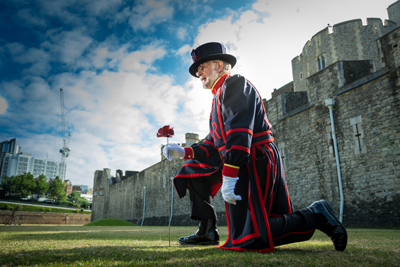
More than 800,000 ceramic poppies are being “planted” in the moat of the Tower of London to commemorate the centenary of World War I.
The work of ceramic artist Paul Cummins, Blood Swept Lands and Seas of Red will grow throughout the summer until, by Armistice Day, 888,246 ceramic poppies are ‘planted’ in the dry moat, each one representing a British or colonial military fatality during the war.
The first poppy was planted by Yeoman Warder Crawford Butler back in July (pictured) and the work was officially “unveiled” today – 100 years since the first full day of Britain’s involvement in the war.
More than 8,000 volunteers will be involved in planting the poppies which can be purchased for £25 with 10 per cent from each poppy plus all net proceeds shared equally among six service charities: the Confederation of Service Charities (COBSEO), Combat Stress, Coming Home, Help for Heroes, Royal British Legion and SSAFA (formerly the Soldiers, Sailors, Airmen and Families Association).
Starting today, the public will also be able to witness the daily twilight reading of a roll of honour featuring the names of 180 serving military killed during the World War I from Tower Hill terrace. The reading will be followed by the bugler playing the Last Post. Members of the public can nominate a name for the roll of honour.
For more, see poppies.hrp.org.uk. PICTURE: Photo: © Richard Lea-Hair/Historical Royal Palaces

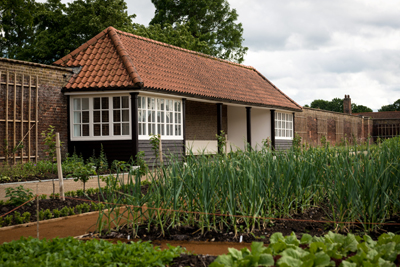
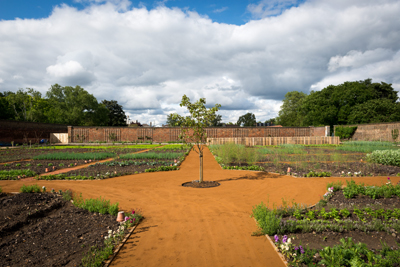
Historic Royal Palaces has reopened Hampton Court Palace’s royal kitchen garden, having recreated it according to a plan dating from 1736. The six acre garden – constructed on the site of King Henry VIII’s tiltyard on the orders of Queen Anne in 1702 – was used to supply the table of monarchs from the early 1700s through to the 1840s. The recreated version showcases rare and heritage varieties of fruit and vegetables including Italian celery, borrage, skirret and swelling parsnips as well as apricots, nectarine and peaches while on site displays showcase some of the techniques used by the royal gardeners. The gardens are open to the public free-of-charge and it’s hoped that as they mature, vegetable growing classes will be held there. The gardens have been opened as part of celebrations marking the 300th anniversary of the Hanoverian accession. For more on Hampton Court Palace, see www.hrp.org.uk/HamptonCourtPalace/. PICTURES: Courtesy Historic Royal Palaces.
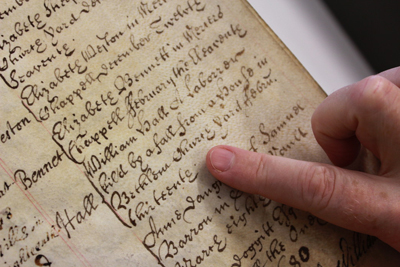 A team of volunteers are searching through historical records for evidence of people buried at the Bedlam burial ground in the 16th and 17th centuries. The 15 member team are carrying out the work at the London Metropolitan Archives as archaeologists prepare to excavate 3,000 skeletons from the former burial site next year in anticipation of the construction of the new Liverpool Street Crossrail Station – part of the £14.8 billion cross London Crossrail project. About 400 skeletons have already been removed during preliminary works. Located near Bethlem Hospital, the burial ground opened in the 16th century as part of the city’s response to the plague and was the first burial ground in London not associated with a parish church. Among those buried here were Robert Lockyer, a soldier executed under the orders of Oliver Cromwell for leading the Bishopsgate mutiny of 1649, and Leveller John Lilburne. Crossrail are keen to hear from members of the public who may be able to provide further details of burials at Bedlam – if you can help, email bedlamrecords@crossrail.co.uk.
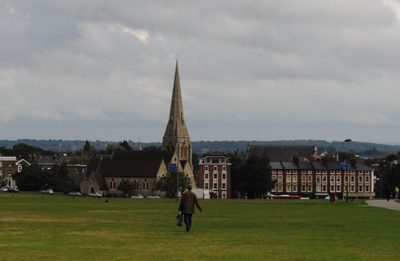
An overcast day on Blackheath, in the south-east of the city. All Saint’s Church is located in the centre of the picture. The Grade II-listed church, the parish church of Blackheath, was built between 1857-67 to the designs of architect Benjamin Ferrey.
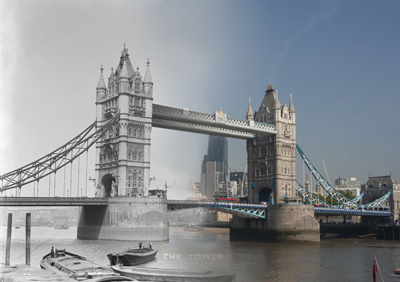
Some of 16 hybrid images showing London’s bridges old and new which have been released by the Museum of London Docklands to mark the recent opening of the museum’s new free art exhibition Bridges. The images have been created using historic photographs showcased in the exhibition which opened last Friday and runs until 2nd November. The photographs were taken by renowned late 19th and 20th century photographers, including Henry Grant, Henry Turner, Sandra Flett, Christina Broom, Roger Mayne and George Davison Reid. Above is Tower Bridge, taken by Christina Broom (c. 1903–10) from Shad Thames Jetty. For more, see www.museumoflondon.org.uk/docklands/. PICTURE © Christina Broom/Museum of London.
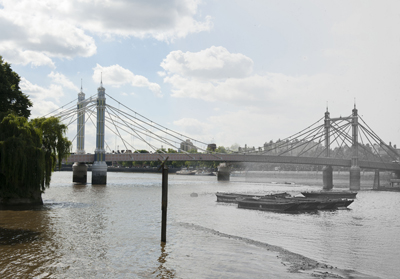
Albert Bridge (unknown photographer), Chelsea. Glass lantern slide, c. late 19th century. © Museum of London.

Vauxhall Bridge from Cambridge Wharf (taken by Albert Gravely Linney), 1928. Taken from the north bank of the Thames. © Albert Gravely Linney/Museum of London
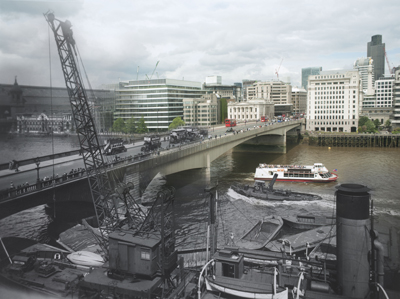
Looking north across London Bridge (taken by George Davison Reid), c. 1920s. Taken from inside on the 5th floor of No1 London Bridge. © George Davison Reid/Museum of London

Richmond Bridge, glass lantern slide, c. late 19th century. Taken from the south side of the river. © Museum of London.
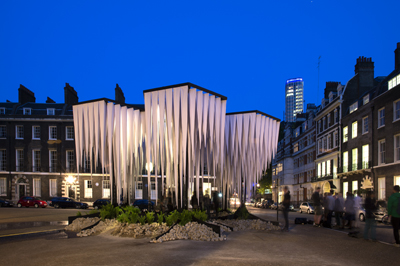
Rainforest by GUN Architects, located in Bedford Square in Bloomsbury outside the offices of the Architectural Association, has been one of the highlights of the London Festival of Architecture, now into its final week. The five metre high tree-like structures, created by the German-Chilean architectural practice, feature fabric stalactites which drip water into pools below. As well as installations like Rainforest, the festival features debates, exhibitions, film screenings, walks, cycle rides, open studios and family events which focus on the importance of architecture and design under this year’s central theme of ‘capital’. The festival runs until 30th June. For more details and a full programme of events still to run, see www.londonfestivalofarchitecture.org.
PICTURE: © Valerie Bennett
 A new pop-up shop has appeared in iconic Carnaby Street as part of a campaign aimed at helping to save endangered Asian lions, like Heidi, pictured above.
The initiative, supported by ZSL London Zoo and Carnaby, aims to help raise £5.7 million in funds for the Zoological Society of London’s Lions400 campaign through the sale of specially designed products.
There are only some 400 Asian lions left in the wild, living in the isolated Gir Forest in Western Gujarat, India, and vulnerable to threats including disease, disaster, poaching and a growing human population.
The funds raised in the campaign will be used to build a state-of-the-art lion breeding centre and visitor experience at the zoo – where about a million people a year come into contact with the Asian lions including Heidi – as well as being used to extend conservation work in the field.
Among the items for sale in the shop at 15 Carnaby Street (pictured below) are T-shirts, bone china pieces, notebooks and badges created by fashion designer Elizabeth Emanuel and based on her lion sketch drawings as well as animal print notebooks and cards created by pop artist Rose Hill.
As well as selling products, the shop – which is only open for six weeks – is also hosting a series of free events. On Thursday, 19th June, Phd student Simon Dures will talk about African lions and their genetics at 1pm, 1,30pm, 6pm and 6.30pm. On 3rd July, Joanna Barker, the UK and Europe Conservation Programme coordinator will talking about marine mammal conservation in the Thames Estuary at similar times and, on 17th July, Nisha Owen, EDGE Conservation Biologist will talk about EDGE (Evolutionary Distinct and Globally Endangered) species.
For more, on the campaign, see www.zsl.org/support-us/lions400. For more on Carnaby Street, see www.carnaby.co.uk.


Part of the history of Kenwood House in north London hits the big screen this week with the premiere of the film Belle.
The film, which opens on Friday, is inspired by the story of Dido Elizabeth Belle (played by Gugu Mbatha-Raw), the illegitimate daughter of Admiral Sir John Lindsay and a slave woman named Maria, who spent her childhood years at the property in the care of her great-uncle Lord Mansfield (played by Tom Wilkinson) in the second half of the 18th century.
The idea for film was apparently sparked when Belle‘s writer Misan Sagay saw a painting of Dido which hangs at Scone Palace in Scotland (a copy of the painting, which was formerly attributed to Johann Zoffany but is now unattributed, can be seen hanging in the Housekeeper’s Room at Kenwood).
Lauren Houlistan, English Heritage senior curator, says Dido grew up at Kenwood from about the age of five (about 1766) and seemed to have been considered one of the family.
She says that while Lord Mansfield was “very fond of her”, Dido’s position was, however, “lower than that of her white, legitimate cousin, Elizabeth – Dido was given a smaller allowance and is noted as only joining visitors after dinner”. Dido is known to have managed the dairy at Kenwood in 1779 and was described as “superintendent” over the daily and poultry yard (for more on Dido’s extraordinary life, see our earlier post here).
Kenwood House was undergoing restoration when the film was being made so scenes for the film set in the house were shot at various other English Heritage properties including Chiswick House and the Ranger’s House in Greenwich.
WHERE: Kenwood House, Hampstead Lane, Hampstead (nearest Tube stations are Golders Green and Archway/nearest train stations are Gospel Oak and Hampstead Heath); WHEN: 10am to 5pm daily; COST: Free; WEBSITE: www.english-heritage.org.uk/daysout/properties/kenwood/.
PICTURE: Gugu Mbatha-Raw stars as Dido Elizabeth Belle and Sarah Gadon Lady Elizabeth Murray and in Belle. © Twentieth Century Fox.

Crowds lined the banks of The Thames last weekend as Her Majesty’s Watermen rowed from Hampton Court Palace to the Tower of London in the annual “Tudor Pull”. The palace-to-palace rowing event on Sunday kicked off around 10am with a ceremony at Hampton Court during which the ‘Stela’ – an ancient piece of medieval water pipe made from a hollowed-out tree trunk which symbolises the power of The Thames – is passed to the watermen who then took it up river to the Tower in the royal barge Gloriana. The barge, which was accompanied by a fleet of other traditional rowing craft, stopped at several locations along the journey, before it arrived at the Tower in Sunday afternoon where the ‘Stela’ was presented to the Governor. The event is also said to commemorate the sinking in 1256 of Queen Eleanor’s royal barge under old London Bridge. For more on the Historic Royal Palaces in London, head to www.hrp.org.uk.
PICTURE: Courtesy of Historic Royal Palaces.
Our new special series will kick off next week!
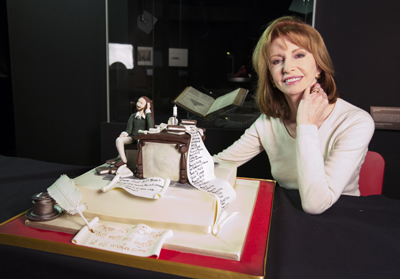
Time is running out for your entry into Cakespeare – the V&A’s competition to find the best Shakespeare-themed cake as part of the institution’s celebration of the 450th anniversary of William Shakespeare’s birth. The competition, which closes on 4th May, was launched earlier this month with an almost 15 kilogram cake created by Jane Asher Party Cakes (actress Jane Asher and the cake are pictured). A fruitcake, it features the playwright at work with a writing table and feature quill made from icing while a scroll lists the 36 plays in Shakespeare’s First Folio (which is on show in the V&A’s Theatre and Performance Galleries). To enter the competition, design, bake and decorate your cake celebrating Shakespeare and then upload an image of it to social media, tagged #Cakespeare. Oh, and the winner – selected by Asher and Geoff Marsh, director or the V&A’s department of theatre and performance – will receive a weekend for two in Stratford-upon-Avon complete with tickets to see the Royal Shakespeare Company. The V&A’s Shakespeare Festival runs until 4th May. For more, see www.vam.ac.uk. So enjoy your Shakespeare – and your cake…might be a way to take your mind off London’s transport woes! PICTURE: Victoria and Albert Museum, London.
 Angular rooftops stacked one upon the other in Chelsea in London’s west.

A flight of pigeons meet outside Embankment Tube Station.
 Exploring London
