10 notable blue plaques of London – 6. A blue plaque for a deadly bomb…

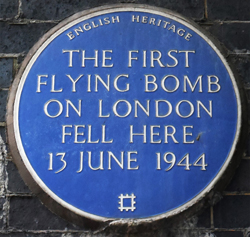
V1-flying-bombNot all of the plaques in the English Heritage blue plaques scheme commemorate people, some also commemorate places and events – the saddest of which is no doubt the landing of the first deadly V1 flying bomb on London during World War II.

Located in Bow in the East End is a plaque commemorating the site where the first flying bomb fell on London on 13th June, 1944, a week after D-Day and several months since the last bombs had fallen on London in what was known as the “mini-blitz”.

Carrying some 850 kilograms of high explosive, the unmanned, fast-moving bomb dived to the ground at about 4.25am on the morning of the 13th, badly damaging the railway bridge and track, destroying houses and, sadly, killing six people.

It was to be the start of a new bombing offensive which would eventually see around 2,500 of the V1 flying bombs reach London between June, 1944, and March, 1945.

They were responsible for killing more than 6,000 people and injuring almost 18,000 and were followed by the even more advanced V2 long range rockets – the world’s first ballistic missiles – in September, 1944. These were responsible for another 2,754 deaths in London before the war’s end.

The current plaque on the railway bridge in Grove Road was erected in 1998 by English Heritage and replaced one which was erected by the Greater London Council in 1985 and subsequently stolen.

PICTURE: Spudgun67/CC BY-SA 4.0

What’s in a name?…St Mary Overie…

The-Legend-of-St-Mary-Overie

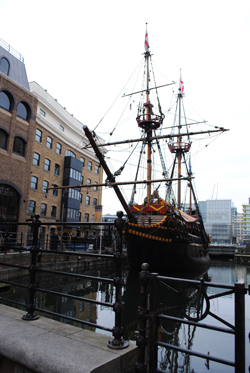
Now the name of a dock on Bankside (pictured below), St Mary Overie (also spelt as Overy) also forms part of the formal name of Southwark Cathedral, more properly known as The Cathedral and Collegiate Church of St Saviour and St Mary Overie.

St-Mary-OverieThe simple version of the name’s origins is that it simply means St Mary “over the river” (that is, St Mary on the south side of the Thames) which was used in relation to a priory founded there in the Norman era by two knights (it’s to this foundation that what is now Southwark Cathedral owes its origins, something we’ll take a more detailed look at the nunnery in an upcoming Lost London post).

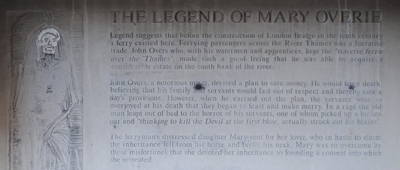
But there’s also another, more romantic version, of the name’s origins. That story, as it’s told on a plaque located at the dock (pictured above), goes back to before the Norman founding of priory, back to the days when, before the building of London Bridge, a ferry ran between the two banks of the River Thames.

The man responsible for the ferry was John Overs, a “notorious miser”, who decided to save money by feigning his death and thus plunging his household into mourning, saving that day’s provisions. As one may imagine, however, Overs was not a popular man and his servants, instead of fasting in their mourning, held a feast in celebration of his death.

In rage, the old master leapt out of his bed and a servant, terrified and imaging some sort of demonic manifestation, struck him fatally with an oar on the head.

Overs’ daughter, Mary, sent for her lover so that he may come and together with her claim her father’s inheritance but such was his haste, he fell from his horse and broke his neck. So overcome was Mary by her misfortunes that she founded a convent into which she subsequently retired (this was subsequently ‘refounded’ by the two Norman knights).

The dock, meanwhile, is today the berthing place of the Golden Hinde II, a sea-worthy replica of the flagship in which Elizabethan explorer Sir Francis Drake circumnavigated the globe (for more on the ship, see our earlier post here).

10 notable blue plaques of London – 5. Five Londoners with more than one blue plaque…

There’s quite a few whose London residence (or otherwise) is commemorated by more than one blue plaque. So, breaking away from our usual ‘one plaque’ format, here were listing five of those who have made the grade…

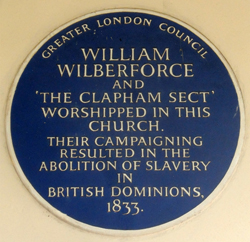
William-Wilberforce-blue-plaque1. William Wilberforce (1759-1833). The late 18th century and early 19th century politician and anti-slavery campaigner tops our list with three English Heritage blue plaques. The first is at 111 Brookwood Road in Battersea – the site of Brookwood House where Wilberforce resided during his anti-slavery campaign. The second is on Holy Trinity Church on Clapham Common, the church where Wilberforce and the Clapham Sect with whom he is associated worshipped. And the third is on a property at 44 Cadogan Place in Chelsea where Wilberforce died.

2. Dr Samuel Johnson (1709-1784). Like Wilberforce, the 18th century lexicographer Dr Johnson has three English Heritage blue plaques to his name. The first, on his famous Gough Square property in the City of London we’ve already mentioned (see our earlier post here), while the second is on a property at 8 Russell Street, Covent Garden, then occupied by bookseller Thomas Davies, which was where Dr Johnson famously first met James Boswell in 1763. The third time Dr Johnson’s name appears, more unusually, is on a plaque commemorating Essex Street – Dr Johnson is among a number of names listed on it for his role in establishing an “evening club” at the pub, the Essex Head, in the street in 1783.

3. Samuel Pepys (1633-1703): The 17th century diarist seems to pop-up everywhere in central London so it’s not surprising there are two plaques in the English Heritage blue plaques scheme dedicated to him (although both are located in the same street – one he apparently liked very much). The plaques are located at number 12 and number 14 Buckingham Street in Covent Garden and both mark the site of a Pepys residence.

4. Virginia Woolf (1882-1941): The writer, publisher and literary critic’s name appears on two properties – at 29 Fitzroy Square in Fitzrovia where Woolf lived between 1907-1911 and on Hogarth House at 34 Paradise Road in Richmond where she and Leonard Woolf lived between 1915-1924 (and also where they founded the Hogarth Press in 1917).

5. William Morris (1834-1896): The poet and artist has two English Heritage blue plaques to his credit – the first on 17 Red Lion Square in Holborn where Morris lived in a flat from 1856-1859 with Sir Edward C Burne-Jones, and the second on Red House in Bexleyheath where he and his wife Jane Burden lived from 1860-1865.

PICTURE: Spudgun67/Wikimedia/CC BY-SA 4.0 (image cropped)

10 notable blue plaques of London – 4. Oldest surviving blue plaque commemorating a woman…

Much has been made about the dearth of women featured on blue plaques in this 150th year of the scheme – according to English Heritage, only 13 per cent of the 900 odd blue plaques in London commemorate a woman.

Fanny-Burney-plaqueAmong them are ballet dancer Margot Fonteyn, suffragette Sylvia Pankhurst, socialite Nancy Astor, and, in recent times, cookery writer Elizabeth David.

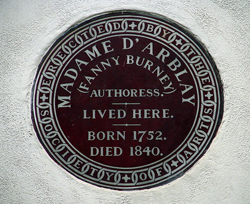
The oldest surviving blue plaque commemorating a woman, however, is that commemorating what is today a less well-known name, that of Fanny Burney.

Burney (1752-1840), who was known as Madame D’Arblay after she married, was a widely applauded novelist who was also noted for her diaries which record her involvement in the literary circles around Samuel Johnson and the Bluestocking Group.

The blue plaque commemorating her residence at 11 Bolton Street in Mayfair was erected in 1885 by the Society of Arts (which means that like others erected by the society, later the Royal Society of Arts, it’s brown not blue).

Burney, whose most profitable work, Camilla, was published in 1796 after she had spent five years as Second Keeper of the Robs to Queen Charlotte, lived in the house following the death of her husband, the Frenchman Alexandre D’Arblay.

She spent 10 years here – from 1818 until 1828 – and had apparently thought it would be her last residence but she went on to move into three further properties after this one.

PICTURE: Simon Harriyott/CC BY 2.0

LondonLife – Beetle-inspired moving installation at the V&A…

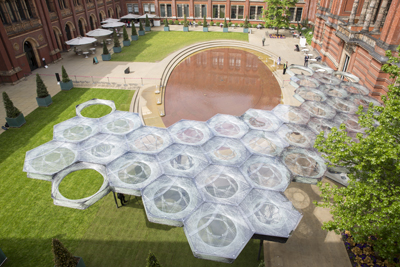
Elytra_Filament_Pavilion_at_the_VA_c_Victoria_and_Albert_Museum_London_5The result of four years of research, the Elytra Filament Pavilion is inspired by the fibrous forewing shells of flying beetles known as elytra. Featuring components which have been fabricated by a robot at the University of Stuttgart and then assembled on site in the V&A’s John Madejski Garden, the installation will grow and move in response to how visitors use the canopy thanks to anonymous data collected from sensors installed in the canopy fibres. On select dates – 17th and 18th June and 22nd September – visitors will be able to see new cells – each of which weighs about 45 kilograms and take an average of three hours to create – manufactured live by a Kuka robot. The installation is the work of experimental architect Achim Menges with Moritz Dorstelmann, structural engineer Jan Knippers and climate engineer Thomas Auer. The pavilion is one of the highlights of the V&A’s first ever ‘engineering season’ with the landmark exhibition – Engineering the World: Ove Arup and the Philosophy of Total Design opening on 18th June. Admission to see the installation, which can be seen at the South Kensington location until 6th November, is free. For more, see www.vam.ac.uk/EngineeringSeason. PICTURES: © Victoria and Albert Museum, London.Elytra_Filament_Pavilion_at_the_VA_c_Victoria_and_Albert_Museum_London_8

Treasures of London – Elfin Oak, Kensington Gardens…

Elfin-OakDelightfully carved out of a hollow oak tree, the Elfin Oak takes its name from the many colourful figures that adorn it.

The sculpture, which sits beside the Diana Princess of Wales Memorial Playground is the work of children’s book illustrator Ivor Innes.

He spent two years – 1928 to 1930 – carving “Little People” upon an ancient oak tree trunk that had been found in Richmond Park and relocated to Kensington Gardens (and in 1930, with his wife Elsie, published the children’s book, The Elfin Oak of Kensington Gardens).

The characters depicted include animals and fanciful creatures such as a gnome called Huckleberry, a series of elves including Grumples and Groodles and a witch named Wookey.

The hollow, incidentally, had been presented to The Royal Parks by Lady Fortescue in response to an appeal run to improve facilities in line with a scheme by George Lansbury (among other things, he also founded the Serpentine Lido).

Now a Grade II listed structure (and well protected by wire mesh), it has a few pop culture associations – among them, the fact that it appeared on the cover of Pink Floyd’s 1969 album, Ummagumma (the head of the band’s lead singer and guitarist David Gilmour can be seen projecting from the trunk).

Meanwhile, in 1996, Spike Milligan – long a fan of the oak – was the face of a successful campaign to raise funds for its restoration.

Announcing the Grade II listing in 1997, then Heritage Minister Tony Banks noted that the oak sat alongside the late Victorian fascination with Little People and complemented Sir George Frampton’s statue of Peter Pan (also located within the gardens).

“Together the two sculptures make Kensington Gardens very much the world capital of fairies, gnomes and elves,” he reportedly said.

PICTURE: Lonpicman/Wikimedia/CC BY-SA 3.0/

10 notable blue plaques of London – 3. The City of London’s only ‘blue plaque’ (and it’s not even blue)…

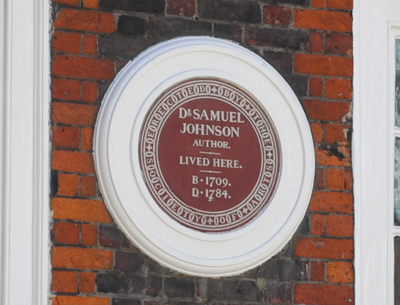
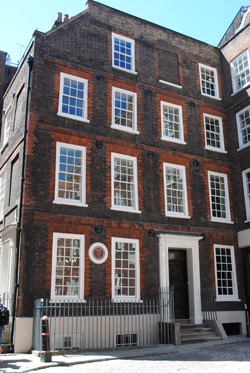
Samuel-Johnson-plaqueThere is only one official blue plaque in the square miles of the City of London – that which marks the property of lexicographer Dr Samuel Johnson in Gough Square (he always did like to stand out from the crowd) – and, like many of the plaques in the scheme, it’s not even blue.

Samuel-Johnson-plaque2The plaque was among the 35 erected in the first 35 years of the scheme – this one in 1876 – and was done so by the Society of Arts which then ran the scheme (later the Royal Society of Arts). In common with most of the first 35 plaques, it is brown in colour.

In 1879, just three years after this plaque was erected, the Society of Arts came to an agreement with the Corporation of the City of London that the corporation – the governing body of the square mile – would commemorate sites of historic significance within its boundaries and the agreement has stood ever since.

The hundreds of “blue plaques” since erected by the City of London Corporation are rectangular in nature and commemorate everything from structures like the long-gone historic gate of Aldgate (88 Aldgate High Street) to homes of the notable such as martyred Archbishop of Canterbury Thomas á Becket (86 Cheapside).

There’s a searchable database of all the City of London plaques which can be found here.

And, of course, Dr Johnson’s house, which he lived in from 1748-59 which compiling his famous A Dictionary of the English Language (the first comprehensive English language dictionary), is now a museum – for details of that, see our earlier post here.

10 notable blue plaques of London – 2. The (now long gone) first Blue Plaque…

The concept of a scheme involving placing commemorative plaques on what was once the homes of notable people was first raised by MP William Ewart in 1863 in Parliament.

Byron-plaqueThree years later, in 1866, the idea was adopted by the then Society of Arts (later the Royal Society of Arts) and in 1867 it erected two blue plaques, the first being one commemorating the birthplace of Lord Byron at 24 Holles Street just south of Cavendish Square in Marylebone and the second being that erected to Emperor Napoleon III in King Street (see last week’s post).

But the Byron plaque had the honour of being the first and it remained on the property until it was demolished in 1889 and the plaque, presumably, lost.

It has, however, been replaced several times on subsequent buildings on the site – the latest incarnation, is a “green plaque” erected by Westminster City Council on what is now a John Lewis store and was unveiled on National Poetry Day in 2012 (it replaced a non-standard, rectangular-shaped plaque – pictured above – which was installed after the building was bombed during World War II).

The current plaque describes Lord Byron as “one of the greatest British poets” and quotes him: “Always laugh when you can. It is a cheap medicine.”

Byron is said to have been born at the property on 22nd January, 1788 and was baptised George Gordon Byron at the nearby St Marylebone Parish Church. Interestingly, English Heritage says that recent research has shown there is no clear evidence for which house in Holles Street Lord Byron actually lived in meaning none of the plaques may have actually marked the correct site.

During the first 35 years of the scheme’s existence it erected on some 35 plaques (there are now some 900 in existence, so the pace has quickened since).

Less than half of them now survive but among those that do are plaques to poet John Keats (erected in 1896 on Keats’ House in Hampstead), novelist William Makepeace Thackeray (erected in 1887 on 2 Palace Green in Kensington) and politician and author Edmund Burke (erected in 1876 on 37 Gerrard Street in Soho.

PICTURE:  Wikimedia

10 notable blue plaques of London – 1. The oldest surviving blue plaque…

English Heritage are celebrating 150 years of the blue plaque scheme this year – the oldest of its kind in the world – and so to celebrate we’re looking at 10 of the most notable among them.

Napoleon-III-blue-plaqueFirst up, it’s the oldest surviving blue plaque. Located in King Street in Mayfair, just off St James’s Square, it commemorates the last French Emperor, Napoleon III, who lived at the property while a prince in 1848.

It was only a brief stay for the then soon-to-be emperor. The nephew and heir of Emperor Napoleon I, he , like other members of his family was exiled from France after the Battle of Waterloo in 1815 and spent the following years in various other countries in Europe as well as, finally, London where he lived firstly at Carlton Gardens and then at the King Street property.

He took the lease on this newly built house in February, 1847, and created what English Heritage has called a “shrine to the Bonapartes” inside, displaying such relics as Napoleon I’s uniforms and a portrait of his famous uncle by the celebrated French artist Paul Delaroche.

The prince was something of a society favourite during his time in London and was invited to join various of St James’s clubs and apparently even enrolled as a special constable during the Chartist riots of 1848.

When the Bourbon monarchy – in the person of King Louis Philippe – was overthrown in France in September that year, the prince abandoned the house to rush back to France (apparently in such a hurry that the story goes that he left his bed unmade and his bath still full of water).

The prince was elected first President of the Second Republic on his return to Paris and in 1852 took his place as Emperor Napoleon III on the restoration of the empire (incidentally, he ended up returning to England in exile following his defeat in the Franco-Prussian War and died in Kent in 1873).

The plaque, installed in 1867, also has the distinction of being the only one installed while the person it commemorates was still alive. The rule now is that those commemorated by a blue plaque need to have been dead for at least 20 years before the honour can be bestowed.

The plaque, which is rather more elaborate than modern versions, was put up by the Society of Arts (they’re mentioned on it) and the design features a French imperial eagle. It was manufactured by Minton Hollins & Co.

For more on Blue Plaques, see www.english-heritage.org.uk/visit/blue-plaques/.

Treasures of London – A lodge (or two) to commemorate a French friendship…

Lodge

This gardener’s lodge, featuring embedded sea-shells, is located in Lower Grosvenor Garden in Victoria. It’s one of a pair given by the French Government and, like its twin, was placed in the gardens in 1952 when they were remodelled in formal French style – including paths laid out in the design of a fleur-de-lis – in honour of Anglo-French cooperation in both world wars. The gardens were designed by French architect Jean-Charles Moreux and some of the shells were apparently brought over from France. In keeping with the French theme, the gardens also feature an equestrian statue of World War I figure, Marshal Ferdinand Foch, placed there in 1930.

LondonLife – An odd couple take a breather…

Cabot-Square

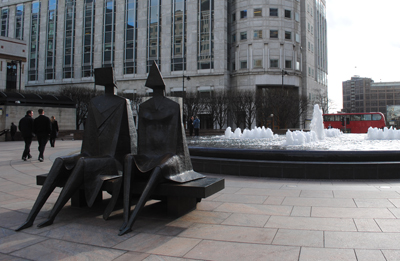
Couple on seat, Cabot Square, Canary Wharf. The much wondered at (who are the couple?; why do their heads have such odd shapes?) bronze sculpture is by Lynn Chadwick (2000).

LondonLife – Celebrating International Women’s Day…

Cavell

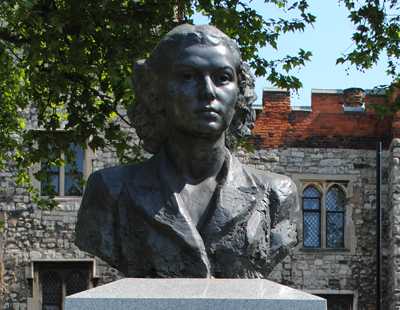
It’s International Women’s Day, so we’re celebrating by remembering two heroic women immortalised in statues in central London. Above is Edith Cavell, a British nurse who was trapped in Brussels by advancing German armies in 1914 and then subsequently arrested for aiding French and British soldiers to escape before being executed by firing squad on 12th October, 1915 – an event widely condemned around the world. The marble statue, located in St Martin’s Place at the intersection of Charing Cross Road and St Martin’s Lane, is by George Frampton and was erected in 1920. Below, meanwhile, is a bust of Violette Szabo which tops a memorial to the Special Operations Executive (SOE). Szabo, who was posthumously awarded the George Cross and the Croix de Guerre after she was captured and eventually executed by the German Army in early 1945, was among 117 SOE agents who did not return from their missions to France. Located on Albert Embankment, the statue – which is the work of Karen Newman – was unveiled in 2009.
Szabo

Treasures of London – Queen Alexandra Memorial…

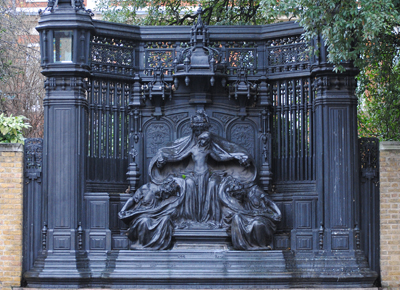
Queen-Alexandra-MemorialErected to the memory of Queen Alexandra, the consort of King Edward VII, the memorial – an ornate bronze screen – is located on the exterior of the garden wall of Marlborough House – the Queen’s former home – in Marlborough Road, opposite St James’ Palace.

Queen-Alexandra-Memorial-smallThe now Grade I-listed bronze memorial, which is the work of Alfred Gilbert and was erected in 1932, is sometimes described as London’s only Art Nouveau statue.

It depicts a central figure, described as “Love Enthroned”, supporting a young girl (perhaps a symbol of the Queen’s support for the next generation), and attended by two crowned bowing figures which it’s believed represent faith and hope. An inscription – “Faith, hope, love – The guiding virtues of Queen Alexandra” – sits below.

The memorial was unveiled on 8th June, 1932, with the Archbishop of Canterbury, Cosmo Gordon Lang, in attendance. Queen Alexandra’s Memorial Ode, composed by Sir Edward Elgar, was first performed at the ceremony.

The memorial was the last public artwork to be completed by Gilbert, noted for having also created what is arguably London’s most famous statue – that of Eros in Piccadilly (see our earlier post here), who was knighted by King George V after the unveiling.

The Queen lived at the property during her widowhood until her death in 1925.

Apologies – we neglected to put in the link! Now corrected.

10 London ‘battlefields’ – 10. The Battle of London…

The final in our series looking at London ‘battlefields’, this week we take a look at the so-called Battle of London, the air war fought over London during World War II which, along with the bombing of other British cities, is best known by the phrase The Blitz (it forms part of the greater Battle of Britain).
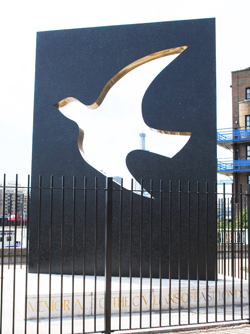
Blitz-memorialTaking place from the afternoon of 7th September, 1940, until May, 1941, the Blitz saw London sustain repeated attacks from the German Luftwaffe, most notably between 7th September and mid November when the city was bombed on every night bar one.

The night of 7th September, the first night of the Blitz (a short form of ‘Blitzkrieg’ – German for ‘lightning war’), was among the worst – with more than 450 killed and 1,300 injured as wave after wave of bombers attacked the city. Another 412 were killed the following night.

One of the most notorious raids took place on 29th December when  incendiary bombs dropped on the City of London starting what has been called the Second Great Fire of London. Around a third of the city was destroyed, including more than 30 guild halls and 19 churches, 16 which had been rebuilt by Sir Christopher Wren in the aftermath of the Great Fire of London in 1666.

The city was only attacked sporadically in the early months of 1941 but the night of the last major raid of the Blitz – that of 10th May, a night subsequently known as The Longest Night – saw the highest casualties of any night with almost 1,500 people reportedly killed.

The Blitz killed almost 30,000 civilian in London, and destroyed more than a million homes with the worst hit districts poorer areas like the East End.

The battle wasn’t one-sided – the RAF fought the Luftwaffe in the skies and did have some wins – on 15th September (a day known as Battle of Britain Day), for example, they shot down some 60 aircraft attacking London for the loss of less than 30 British fighters.

It was this victory which led the Germans to reduce the number of daylight attacks in favour of night-time raids which, until the launch of the RAF’s night-time fighters in 1941, meant they met little effective resistance. This included that of ground defences – throughout December, 1940, it’s said that anti-aircraft fire only brought down 10 enemy planes.

Yet, the Blitz did not lead to a German victory. For the Nazi regime, the purpose of the constant bombing of London (and other cities) was aimed at sapping the morale of its residents to the extent that they would eventually be forced to beg for peace. But the plan failed and Londoners, digging deep, proved their mettle in the face of fear.

Hundreds of thousands of people were involved in  Civil Defence working in a range of jobs – everything from air raid shelter wardens to rescue and demolition teams – and worked alongside firefighters whose numbers were supplemented by an auxiliary service. Naturally all suffered a high level of casualties.

As the weeks passed, the carnage mounted in terms of the loss of and damage to life, destruction of property and psychological toll. And yet the Londoners – sheltering Underground, most famously in the tunnels of the Tube – survived and, as had been the case after the first Great Fire of London, the ruined city was eventually rebuilt.

There are numerous Blitz-related memorials in London, many related to specific bombings. But among the most prominent are the National Firefighters Memorial, located opposite St Paul’s Cathedral, which pays tribute to the firefighters who lost their lives in the war (as well as in peacetime), and a riverside memorial in Wapping honouring civilians of East London killed in the Blitz.
Treasures of London – The Lampedusa Cross…

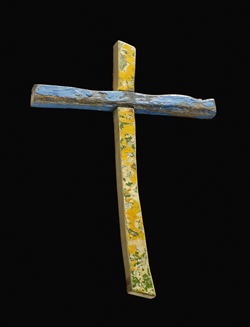
The-Lampedusa-CrossDonated to the British Museum in October (the last acquisition made under former director Neil MacGregor), the Lampedusa Cross was constructed by carpenter Francesco Tuccio out of wreckage from a refugee boat which sank off the Italian island of Lampedusa on 3rd October, 2013. At least 349 of the 500 refugees on board were drowned, some of whom were Eritrean Christians fleeing persecution, while 151 survived. Mr Tuccio, a resident of Lampedusa, decided to make a series of small crosses from the wreckage after meeting some of the refugees in the church of San Gerlando as a gift for them to both reflect their salvation and as a symbol of hope for the future. He was subsequently also asked to make a further cross which was carried by Pope Francis at the memorial service for the survivors. Asked by the British Museum if it could acquire a cross for its collection, Mr Tuccio made a cross specifically for the museum which he then donated to the institution, saying after he received a letter of thanks that “it is I who should thank you for drawing attention to the burden symbolised by this small piece of wood.” The cross went on display in Room 2 of the museum on 18th December (the last day of Mr MacGregor’s directorship). Entry is free. For more on the British Museum, see www.britishmuseum.org. PICTURE: © Trustees of the British Museum.

10 London ‘battlefields’ – 9. The Battle of Cable Street…

We hit the 20th century with this London ‘battle’, a confrontation in Stepney between police and a range of anti-fascist and fascist forces in the lead-up to World War II.

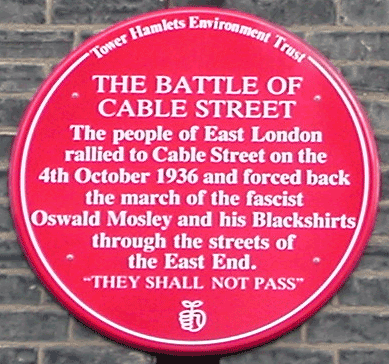
Battle-of-Cable-Street-red-plaqueThe ‘battle’ took place on a Sunday – 4th October, 1936 – following a summer of anti-Semitic violence and was sparked by a decision by the British Union of Fascists, led by Sir Oswald Mosley , to march through the East End, then the heartland of London’s Jewish community.

Incensed at the plans (and faced with government inaction despite calls for the march to be called off), anti-fascist protestors – which included large numbers of Jewish and Irish people as well as trade unionists, communists, socialists, anarchists and local residents – gathered initially at Gardiner’s Corner (named for a department store which once on the site at the junction of Whitechapel High Street and Commercial Road) to prevent the march.

The protestors were chanting and carrying banners which read “No Parasan” (“They shall not pass”, a slogan taken from anti-fascist forces who used it during the Spanish Civil War).

Estimates as to how many people turned out in protest vary widely – from 100,000 people up to as many as 250,000 or even 500,000 – but it’s clear that whatever the actual number, the crowd was huge and vastly outnumbered the up to 3,000 fascists – known as Blackshirts – who turned up to march and the 10,000 Metropolitan Police officers, some of whom were on horseback, sent to prevent the march from being disrupted.

With the path blocked despite police charges into the crowd, Mosley and his Blackshirts were advised by authorities to head south to Cable Street but there they encountered road-blocks made from furniture, paving stones and even apparently overturned lorries which appeared at the street’s west end, around the junction with Christian Street.

Police again attempted to clear the road but were blocked by the makeshift barricades and a wall of protestors while residents in houses lining the streets threw rubbish and even the contents of chamber pots at them. Police responded by sending in squads of men to snatch the ringleaders of the protests; protestors responded by ‘kidnapping’ some police officers.

Faced with continuing violence, Mosley was forced to abandon the march and the BUF were dispersed back through the City of London. The protestors meanwhile were said to have turned the event into a giant street party in celebration of their victory.

More than 100 people were said to have been injured in the violence and some 150 of the demonstrators were arrested. Most of the charges were of a minor nature but some of the ringleaders were given up to three year terms of imprisonment.

A large mural depicting the battle was painted on the side of St George’s Town Hall in Cable Street in the 1980s and there’s also a red plaque in nearby Dock Street (pictured) commemorating the incident.

Aside from a victory in itself, the battle was the catalyst for the passing of the Public Order Act of 1936 which meant the organisers of marches would henceforth have to seek permission of the police before holding them. It also banned demonstrators from marching in uniform.

PICTURED: A plaque commemorating the ‘battle’ in Dock Street which runs off the west end of Cable Street. Via Richard Allen/Wikipedia

Treasures of London – ‘Locking Piece’…

Locking-Piece

A Henry Moore original, Locking Piece was created in 1963-64 and first located on its current site on Riverwalk Gardens at Millbank, site of the former Millbank Penitentiary, four years later. The bronze sculpture consists of, as the name suggests, two interlocking pieces. There’s a couple of conflicting stories about where the idea for the work came from – in one, Moore said he was visiting a gravel pit near his home at Perry Green in Hertfordshire where he was playing with two pebbles which suddenly locked together (and hence came the idea of a sculpture of two interlocking pieces); and in another, Moore said the idea came from a bone fragment featuring a socket and joint found in his garden. Originally loaned to Westminster City Council, in 1978 the sculpture was given to the Tate Gallery which subsequently decided to leave the piece in situ. It’s one of numerous Moore works in London. For more on Henry Moore’s London works, see www.henry-moore.org/works-in-public/world/uk/london.

LondonLife – A rare glimpse inside King Henry V’s chantry chapel…

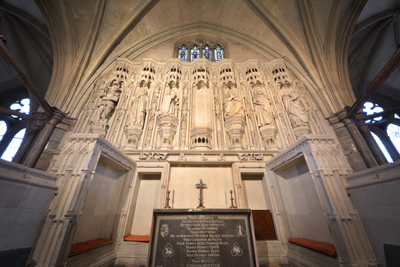
Henry-V-chantry-chapelA fortunate few last weekend had the chance to have a look inside King Henry V’s elaborately carved chantry chapel in Westminster Abbey as part of commemorations marking the 600th anniversary of the Battle of Agincourt. 

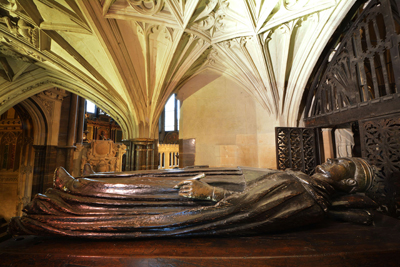
The chapel, which is located on a sort of mezzanine level above the king’s tomb at the east end of the Shrine of Edward the Confessor, is one of the smallest of the abbey’s chapels. It was constructed on the orders of the king – who died Vincennes in August, 1422, and was buried in the abbey on 7th November that year – so prayers could be said in perpetuity for his soul.

The tomb was completed in 1431 and the chantry chapel was built above between 1437 and 1450. The latter is entered via narrow stairways of worn steps hidden inside a pair of stone turrets which flank the tomb.

For centuries the Henry V’s funeral ‘achievements’ – the king’s saddle, helm and shield – were displayed on a wooden beam above the chantry chapel but these were restored and moved to the abbey museum in 1972.

Henry V’s wife, Catherine de Valois, who survived her husband by 15 years was eventually – in the Victorian age – buried under the chantry chapel altar (originally buried in the old Lady Chapel, King Henry VII had her removed and placed in an open coffin in the open air next to the tomb of King Henry V, when building his new chapel – among visitors to her mummified body was diarist Samuel Pepys who even kissed her. In 1778 she was buried in a vault before being relocated to her current position in 1878).

An inscription on the altar in the chantry chapel reads: “Under this slab (once the altar of this chapel) for long cast down and broken up by fire, rest at last, after various vicissitudes, finally deposited here by command of Queen Victoria, the bones of Catherine de Valois, daughter of Charles VI, King of France, wife of Henry V, mother of Henry VI, grandmother of Henry VII, born 1400, crowned 1421, died 1438”.

The chantry chapel is still occasionally used for services but, measuring just seven by three metres, is not usually open to the public because of size and access issues.

Westminster Abbey will hold a special service of commemoration on 29th October in partnership with charity Agincourt600. The day before, 28th October, it will host a one day conference for Henry V enthusiasts entitled ‘Beyond Agincourt: The Funerary Achievements of Henry V’. For more, see www.westminster-abbey.org/events/agincourt.

Above – King Henry V’s chantry chapel; Below – King Henry V’s tomb which sits below the chantry chapel. PICTURE: Jim Dyson/Dean & Chapter of Westminster

Henry-V-tomb

10 London ‘battlefields’ – 1. Queen Boudicca takes on the Romans…

boudicca

This month marks the 600th anniversary of the Battle of Agincourt and to mark the occasion, we’re looking at 10 of London’s “battlefields” (well, maybe not officially recognised battlefield sites but 10 places where fighting took place – or, as in this instance, legend says took place – at various times throughout London’s history).

First up it’s to King’s Cross, once said to have been site of a village known as ‘Battle Bridge’, so named because, according to tradition, it here in about 60AD that the rebellious hoards of Queen Boudicca (also known as Boadicea or Boudica) ran into the well-disciplined army of the Roman Governor of Britain, Gaius Suetonius Paulinus.

Paulinus had been campaigning in northern Wales when the Iceni rebellion broke out in East Anglia, apparently sparked by the Romans’ refusal to honour the will of the deceased King Prasutagus. He had left his land to the Emperor Nero and his two daughters but instead, the story goes that the Romans seized the land, flogged his wife Boudicca and raped his two daughters.

Understandably incensed at this treatment, the Iceni and members of other tribes rose in rebellion under Boudicca and laid waste to the Roman city of Camulodunum (what is now Colchester in Essex).

Boudicca then turned toward Roman Londinium, the provincial capital, and while Paulinus beat her there with a small number of troops, he quickly concluded he couldn’t defend it and ordered it evacuated. Boudicca, who is claimed to have fought from a chariot, and her army of tribesman apparently spared no-one when they arrived and burnt it to the ground. They then moved on to attack another Roman city – Verulamium (St Albans).

Paulinus, meanwhile, marshalled his forces – still apparently vastly outnumbered – and chose his battleground carefully. One legend suggests King’s Cross – then site of an ancient bridge across the River Fleet – as the battle’s location (although we should mention there are also numerous other sites which have been suggested as the location for the battle including locations in the Midlands along the Roman road of Watling Street, now the A5).

Where-ever it was, Paulinus had apparently chosen his position so that Boudicca couldn’t bring her greater numbers to bear on his flanks. Her army collapsed and, according to the Roman historian Tacitus, there was a rumour that 80,000 Britons were killed and just 400 Romans in the ensuing battle (although fair to say such numbers may be a stretch!).

The outcome was obviously devastating for Boudicca – there’s various accounts of what happened to her next with one being that she fell during the battle and another that, having survived, she committed suicide by poisoning herself. There is a legend that Boudicca was subsequently buried at a site now covered by platform nine or 10 at King’s Cross railway station. It’s also been suggested she was buried at Parliament Hill.

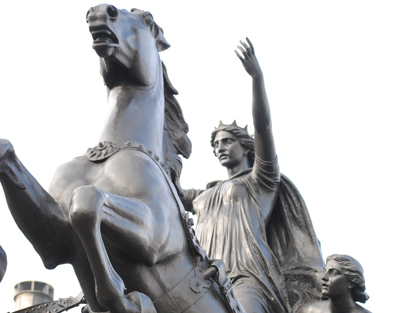
There’s a statue commemorating Boudicca and her daughters (pictured above) at the western end of Westminster Bridge. Designed by Thomas Thornycroft, it was made in 1850 but not erected on the site until 1902.

A Moment in London’s History – The execution of William Wallace…

William-Wallace-big

This year marks the 710th anniversary of the execution of Scottish rebel William Wallace in Smithfield so we thought we’d take a quick look at the circumstances of that event – made famous in recent times through the movie Braveheart.

William-WallaceFor some eight years, Wallace had been a thorn in the side of the King Edward I, promoting active resistance to his rule in Scotland after Edward forced the abdication and usurption of the crown of John Balliol.

Following a crushing defeat at the Battle of Falkirk on 22nd July, 1298, however, Wallace went to France where he attempted to gain French support for rebellion in Scotland but the effort proved ultimately futile and Wallace, back in Britain but refusing to submit to English rule, remained on the run.

At least until he was captured on 5th August, 1305, by Sir John Monteith, who had been made Sheriff of Dumbarton by King Edward I, at Robroyston near Glasgow.

Taken to Carlisle, he was bound hand and foot before being taken south to London in chains.

Wallace’s trial took place on 23rd August that year at Westminster Hall and, despite his protestations that he couldn’t be guilty of treason having never sworn loyalty to the English Crown, a guilty verdict was handed down along with the sentence of a traitor’s death – being hung, drawn and quartered.

Taken to the Tower of London, Wallace was stripped naked and then strapped to a wooden hurdle which was dragged by two horses through the streets via Aldgate to The Elms at Smithfield where he was hanged on a gallows.

Cut down while yet living, he was disembowelled and castrated and his entrails burnt. Wallace was then decapitated and his body cut into quarters which were sent to Berwick, Newcastle, Stirling and Perth as a warning against treason. His tarred head, meanwhile, was put on a pike and set above London Bridge.

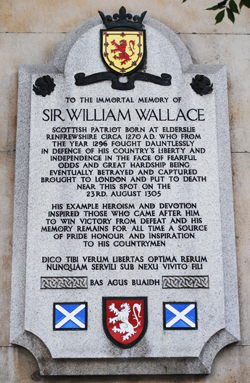
A memorial to Wallace can now be found on the wall of St Bartholomew’s Hospital at West Smithfield (pictured – for more on that, see our earlier post here).