Treasures of London – Queen Caroline’s Temple…

Queen-Caroline's-Temple

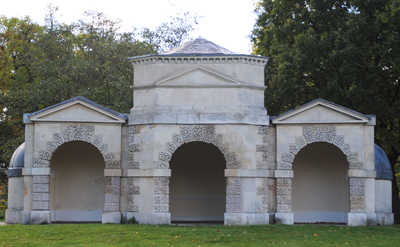
Located in Kensington Gardens, this neo-classical summer house was designed by William Kent for Queen Caroline (who was responsible for much of the shape of the gardens as they are now).

Standing amid naturalistic plantings overlooking the Long Water (which was among the features created at the order of Queen Caroline – consort of King George II), it was built in 1734-35 and designed to be glimpsed down one of the avenues of trees which radiated out from the Round Pond in front of Kensington Palace.

The Grade II-listed ‘temple’, which features graffiti inside dating back until 1821, was later converted to a park keeper’s home but restored to its use as a summer house in 1976.

Kent apparently also designed a second summer house for Kensington Gardens which revolved – it stood on a 13 metre high mound constructed by Kent’s predecessor Charles Bridgeman using spoil from the excavation of the Serpentine in the south-eastern corner of the gardens (the summer house was later demolished and the mound levelled).

Not the most prominent feature of the gardens but like the much later Princess Caroline’s Bath in Greenwich Park (see our earlier post here), it does have an important royal connection and is worthy of a stop when visiting the gardens.

WHERE: Kensington Gardens (nearest tube stations are that of Queensway, Bayswater, Lancaster Gate, South Kensington, Gloucester Road and Kensington High Street); WHEN: 6am to dusk; COST: Free; WEBSITE: www.royalparks.org.uk/parks/kensington-gardens.

LondonLife – Farewell to the poppies…

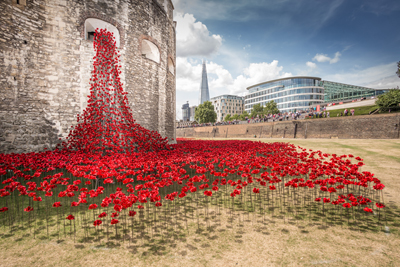
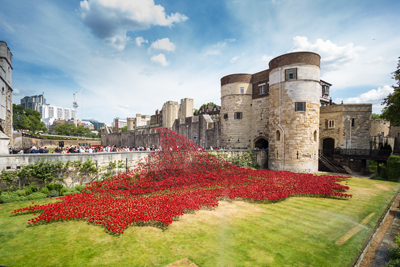
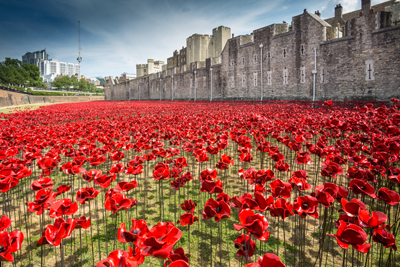
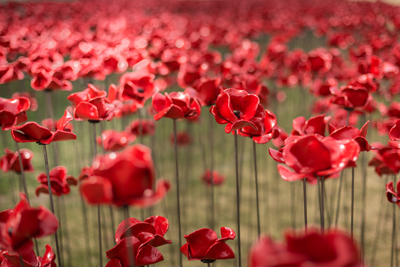
Poppies4The Tower of London is bidding farewell to the sea of poppies that has filled its dry moat while two major features of the instalment – created to mark the centenary of World War I – prepare to head off on tour. Known as Weeping Window (shown above) and Wave (shown immediately below) – the two features of the Blood Swept Lands and Seas of Red installation will both tour various locations across the UK for the next few years before going on permanent display at the Imperial War Museum in London and Manchester. So, we thought we’d take a look back at what has proved to be one of the most popular and moving memorials to appear in the capital in recent years. Created by ceramic artist Paul Cummins (with setting by stage designer Tom Piper), the project saw as many as 888,246 ceramic poppies –  representing all British and Colonial fatalities during the war – planted by volunteers in the moat. The last one was planted on Armistice Day  – 11th November – last week before the process of removal began. PICTURES: ©Richard Lea-Hair and Historic Royal Palaces. 

Poppies5

Poppies2

Poppies1

Poppies6

A Moment in London’s History – Peace Day Parade, 1919…

With Remembrance Sunday having been observed earlier this month, we thought it was an appropriate time to take a quick look at the Peace Day Parade of 19th July, 1919, at which the Cenotaph – the National War Memorial – was first unveiled.

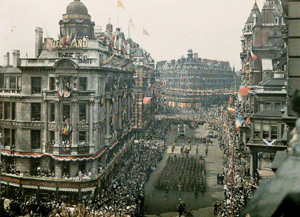
London-Victory-ParadeThe parade, organised by a Peace Celebrations Committee appointed by the War Cabinet, was seen as the high point of a series of celebrations to mark the end of the war which had only officially ended on 28th June with the signing of the Treaty of Versailles.

Prime Minister David Lloyd George, on hearing French troops were to salute a ‘great catafalque’ (a raised structure upon which sits a coffin) built beside the Arc de Triomphe in honour of their war dead as part of their victory march, commissioned architect Edwin Lutyens to create a similar monument for the occasion.

Lutyens had apparently already started sketching, having been sounded out earlier about the possibility of such a structure, and eventually opted for a cenotaph, an empty tomb erected in honour of people buried elsewhere, in place of the catafalque.

The Cenotaph, one of a number of temporary structures built for the day, was unveiled in Whitehall early on the morning of Saturday, 19th July. Made of plaster and wood, it had been constructed in just two weeks (and, of course, it was replaced the following year with the stone Cenotaph which now stands there). Wreaths were soon piled high around its base.

As many as five million people reportedly turned out for the parade along a seven mile route from Knightsbridge (depicted above) through to Westminster and onto Buckingham Palace on Saturday – many of them had arrived from other parts of the country the previous night – and, eager not to miss out, had secured their space by sleeping in parks or streets overnight.

Also known as the London Victory Parade, the procession included some 15,000 Allied forces representing 12 victorious nations including, of course, Britain as well as France, the US, various European and Asian nations and small contingents from Australia, New Zealand and South Africa.

Also marching were military commanders such as Field Marshall Sir Douglas Haig – the British Commander-in-Chief, French Marshal Ferdinand Foch – Supreme Allied Commander during the last year of the war, and General John J Pershing, head of the American Expeditionary Force.

Some veterans apparently refused to take part, seeing the parade as “militaristic celebrations”.

After splitting into two columns and filing past the Cenotaph – inscribed with the words ‘The Glorious Dead”, those in the parade then marched down the Mall, which was lined with stands set aside for widows and orphans before King George V took their salute standing beneath a golden cupola erected at the base of the Victoria Memorial outside Buckingham Palace.

Treasures of London – A fragment of the Berlin Wall…

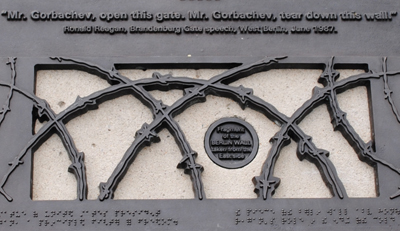
Berlin-WallThis Sunday marks 25 years since the fall of the Berlin Wall so we decided it was a fitting time to mention the fragment of the wall which accompanies the bronze statue of former US President Ronald Reagan in Grosvenor Square, Mayfair.

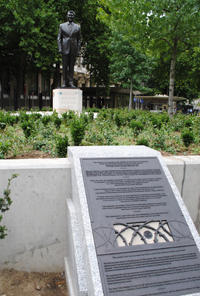
Reagan2The remnant of the wall, recorded as taken from the “east side”, can be seen through a window in a bronze plaque which commemorates the role President Reagan played in the coming down of the wall.

The plaque also features quotes from President Reagan – including the famous line from his 1987 Brandenburg Gate speech, “Mr Gorbachev, open this gate. Mr Gorbachev, tear down this wall” – and other figures including former UK PM Margaret Thatcher and Mikhail Gorbachev as well as information about the wall itself.

In a dedication to the president, it further reads: “Ronald Reagan, the 40th President of the United States of America, was a principled fighter for freedom. With a clear vision and will, he gave hope to the oppressed and shamed the oppressors. His contribution to world history in the 20th century, culminated in his determined intervention to end the Cold War. President Reagan has left a lasting legacy as a campaigner for global peace.”

The memorial was unveiled on 4th July, 2011, outside the US Embassy by the Ronald Reagan Presidential Foundation, to mark the 100th birthday of the former president. Among those present at the unveiling of the statue were then Foreign Minister William Hague and former US Secretary of State Condoleezza Rice.

There are also larger sections of the wall outside the Imperial War Museum in Lambeth and in the National Army Museum in Chelsea (closed for redevelopment until 2016).

For more on London’s monuments, check out Andrew Kershman’s aptly named London’s Monuments.

10 of London’s World War I memorials – 10. Grave of the Unknown Warrior, Westminster Abbey…

In this, the final in our series looking at London’s World War I memorials, we’re taking a look at one of the city’s most visited monuments – the grave of the Unknown Warrior in Westminster Abbey.

Located at the west end of the minster nave (pictured is the west front of the abbey inside of which lies the grave), the grave is that of a British soldier whose body was brought back from France and buried on the site on 11th November, 1920. The grave, which also contains soil brought from France, is covered by a slab of black marble from Belgium.
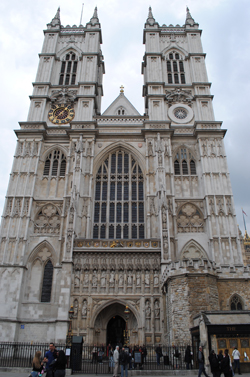
Westminster-Abbey2The slab bears an inscription written by Herbert Ryle, then dean of the abbey, which commemorates the “many multitudes” who died during World War I. “They buried him among the kings because he had done good toward God and toward his house”.

It is believed the idea for the memorial was that of a chaplain at the front during the war – Rev David Railton – who in 1916 saw a grave in northern France which featured a cross upon which was written, “An Unknown British Soldier”. He wrote to Ryle about what he’d seen and the idea for the new memorial slowly took shape – albeit with the initial misgivings of some including King George V.

Representing servicemen from the army, navy or air force from anywhere within Britain and its dominions who died in the war and have no other memorial or known grave, the unidentified body which lies in the grave is believed to have been selected at random from among a number bodies of soldiers who died early in the war – accounts suggest they numbered either four or six – and which were exhumed from battle areas at the Aisne, the Somme, Arras and Ypres.

Covered with Union flags, the bodies were taken to a chapel at St Pol on 7th November, 1920, and one selected by Brigadier General LJ Wyatt, commander of troops in France and Flanders. 

The three remaining bodies were reburied while the selected remains were placed in two coffins, the outer one made of oak harvested from a tree which had grown at Hampton Court Palace. A 16th century crusader’s sword taken from the Tower of London’s collection was placed in the wrought iron bands of the coffin and it was then covered with a flag which Rev Railton had used as an altar cloth during the war (known as the Ypres or Padre’s Flag, it now hangs nearby in St George’s Chapel at the abbey).

The coffin was then transported on the destroyer HMS Verdun to Dover and then taken by train to Victoria Station before, on the morning of 11th November, it was placed on a gun carriage drawn by six black horses and transported through massive but silent crowds which lined the streets.

Pausing at the Cenotaph in Whitehall, King George V unveiled the monument which represent an empty tomb (see our earlier post here) and placed a wreath on the coffin and then, followed by the king, other royal family members and dignitaries, it was taken to the abbey minster and lowered into the grave at a special service attended by the king, Queen Alexandra, the queens of Spain and Norway, and Prime Minister David Lloyd George and former Prime Minister HH (later Lord) Asquith (a recording made of some of the service – apparently conducted simultaneously with one at the Arc de Triomphe in Paris – became the first ever electrical recording to be sold to the public).

Thousands of mourners paid their respects at the open grave before the grave was filled in and covered with temporary stone on 18th November. The marble stone which now stands there was unveiled at a special service on 11th November the following year. A framed US Congressional Medal of Honor, conferred by General John J Pershing on the unknown warrior on 17th October, 1921, hangs from a pillar nearby.

WHERE: Westminster Abbey, Westminster (nearest Tube station is Westminster or St James’s Park); WHEN: Generally open to tourists everyday except Sunday  (times vary so check the website); COST: £18 an adult/£15 concessions/£8 schoolchildren (11-18 years), free for children aged under 11/£44 for a family (two adults, two children); WEBSITE: www.westminster-abbey.org.
10 of London’s World War I memorials – 9. Great Western Railway War Memorial…

One of many memorials located in London’s railway stations, the  Great Western Railway War Memorial is located on platform one of Paddington Station.

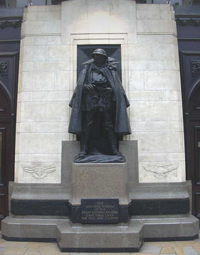
The memorial features a bronze figure of a soldier sculpted by Charles Sargeant Jagger standing against a granite and marble backdrop designed by Thomas S Tait. The soldier, who is dressed in battle gear with a helmet on his head and a great coat thrown about his shoulders, is depicted apparently reading a letter from home.

GWR-Memorial-smallTo either side of the soldier are reliefs depicting the emblems of the Royal Air Force and the Royal Navy while inscribed on the plinth beneath him is an inscription dedicated the memorial to employees of the railway who died in World War I. Inside the plinth was placed a sealed casket containing a vellum roll on which is written the names of all 2,524 men who died.

The memorial, known as the ‘GWR Memorial’, was unveiled on Armistice Day by Viscount Churchill, chairman of the Great Western Railway, in 1922 before a crowd estimated at around 6,000 people. It was later updated after World War II.

Restored in 2001, the memorial recently featured in the World War I commemorative project – “Letter to an Unknown Soldier” – in which members of the public were invited to write a letter to the soldier. The statue is also among more than 20 in London which have been brought to life as part of Sing London’s Talking Statues initiative (it has the voice of Patrick Stewart!).

Among our favourite railway memorials, others include the magnificent “Victory Arch” at Waterloo Station.

PICTURE: Cnbrb at the English language Wikipedia

LondonLife – Sheep in the City…

Sheep

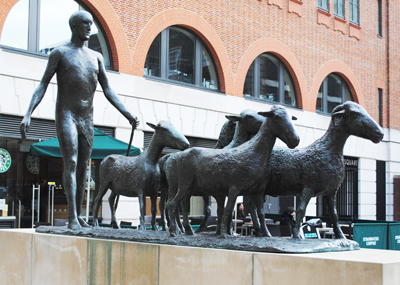
A small flock of sheep made their way across London Bridge this week as the Freemen of the City of London exercised their ancient prerogative to drive sheep over the span. A reported 600 Freemen from the City’s 110 livery companies took part in the annual drive along with a score of sheep – all in an effort to raise for the Lord Mayor’s Appeal. There’s a permanent reminder of the tradition of driving sheep in the heart of the City in Paternoster Square near St Paul’s Cathedral where Dame Elisabeth Frink’s bronze sculpture of Shepherd and Sheep can be found (pictured above).

10 of London’s World War I memorials – 8. The RAF Memorial…

RAF-Memorial
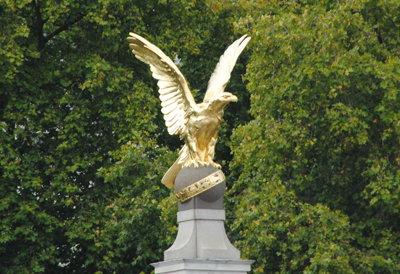
Aerial combat probably isn’t the first thing that springs to mind when thinking about the fighting in World War I but, as the Royal Air Force Memorial on Victoria Embankment records, air crew played a vital role.

The memorial features a bronze eagle perched on an orb girded with a belt depicting the signs of the zodiac which sits atop a Portland stone pylon. It was designed by Sir Reginald Blomfield with the eagle, inspired by the RAF’s badge, sculpted by William Reid Dick. Along with the dedication, it carries an inscription from the Bible (Exodus 19:4) –  “I bare you on eagles wings and brought you unto myself” (sic).

Various other sites were apparently considered for the memorial before the location – amid a string of other memorials between Westminster and Hungerford Bridge – was settled upon (as were other designers including the renowned Edwin Lutyens).

Unveiled on 13th July, 1923, by the Prince of Wales, the memorial was dedicated to the memory of all those who gave their lives in the ranks of the Royal Flying Corps, the Royal Naval Air Service  and the Royal Air Force  (formed through the amalgamation of the RFC and RNAS at a hotel in Strand in 1918) during World War I, along with those who had died while serving in air forces from across the British Empire.

A further dedication was later unveiled in 1946 on Battle of Britain Sunday remembering the men and women of air forces from across the Commonwealth and Empire who died during World War II.

A simple, yet still evocative, memorial.

10 of London’s World War I memorials – 7. The Machine Gun Corps Memorial…

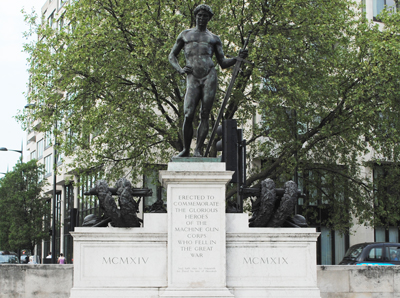
Machine-Gun-Corps-MemorialWhile most of London’s World War I memorials feature sculptures depicting soldiers or weaponry, the controversial Machine Gun Corps Memorial at Hyde Park Corner takes as its centrepiece a more classical theme.

Designed by Francis Derwent Wood (known for his role in making masks for soldiers disfigured during the war), the larger than life-sized sculpture on top of this memorial is a nude statue of the Biblical character, David, who stands holding a giant sword – that of Goliath whose head he cut off. The Biblical theme is also found in an accompanying inscription from the Bible: 1 Samuel 18: 7 – “Saul hath slain his thousands but David his tens of thousands”.

To either side of the bronze figure – which has led to the memorial also being known as The Boy David – are two real bronzed Vickers guns wrapped in laurels while the Italian marble plinth carries a dedicated to the almost 14,000 of the corps who died between the raising of the corps in 1915 and its disbanding in 1922. The reverse of the memorial details the corps’ history, recording its service in “France, Flanders, Russia, Italy, Egypt, Palestine, Mesopotamia, Salonica, India, Afghanistan and East Africa”.

The Grade II* listed monument, which was much criticised thanks to the juxtaposition of the naked figure and machine guns, was unveiled by the Duke of Connaught in 1925. Originally located on a traffic island to the south of the Royal Artillery Memorial it was dismantled in 1945 when roadworks were carried out and it wasn’t until 1963 that it was reassembled on its current site.

Interestingly, there is another statue of The Boy David by Edward Bainbridge Copnall standing atop a column which stands on Chelsea Embankment.

Treasures of London – Geffrye almshouses…

GeffryeIt’s a big year for the Geffrye Museum in Shoreditch – not only 300 years since the almshouses were first opened to house the poor and elderly, it’s 100 years since the almshouses were converted into the museum which now occupies the site.

Geffrye2With that in mind, we thought we’d take a look at the almshouses themselves (we’ve looked at the museum – which features 11 period rooms from the 17th to 20th centuries – a couple of times previously). The Grade I-listed almshouses were built in 1714 by the Worshipful Company of Ironmongers, using funds that had been bequeathed to them by Sir Robert Geffrye, a Cornishman who became twice-master of the company and a Lord Mayor of London (there’s a fine statue of him adorning the front of the building).

They comprised 14 houses, each of which had four rooms, and provided accommodation for up to 56 pensioners. Arranged in a U-shape around a courtyard, the two storey almshouses came complete with a chapel which still stands at the centre of the the complex and where residents were expected to attend each week (a walkway which runs around the back of the chapel was added in 1914 offers some great views of the garden).

The almshouses, which had originally been built in what was a largely rural context, remained in use until the early 20th century by which time the area had become one of London’s most crowded with poor sanitation. In 1910, the Ironmongers’ decided to sell off the almshouses and move out to the safer, cleaner area of Mottingham in Kent.

In 1912, the houses and gardens were purchased by the London County Council – attracted by the public open space – and following representations from members of the Arts and Crafts movement, the museum opened its doors in 1914.

It’s still possible to visit a former almshouse – number 14 –  which was restored and opened in 2002 and has been furnished to show what life was like there for the pensioners (contrast the sparse furnished there with that with some of the more opulent rooms on display in the museum – and don’t forget to allow some time to visit the gardens; there is also a shop and cafe on site).

WHERE: 136 Kingsland Road, Shoreditch. Nearest tube is Liverpool Street or Old Street (a fair walk) or Hoxton Overground Station (next door); WHEN: The almshouses are open on select days only – check website. The museum is open Tuesdays to Sundays, 10am-5pm (gardens open until 31st October); COST: £3 for admission to  almshouses/admission to the museum and gardens is free; WEBSITE: www.geffrye-museum.org.uk

10 of London’s World War I memorials – 6. The Royal Fusilier’s Memorial…

Fusiliers-MonumentLocated at Holborn Bar – one of the traditional entry points to the City of London, this memorial was erected in 1922 to the memory of the almost 22,000 solider of the Royal Fusiliers (City of London Regiment) who died during the Great War.

The monument, which stands on a traffic island in the middle of busy High Holborn, was designed by sculptor Albert Toft (and hence is known affectionately as “Albert”) along with architects Cheadle and Harding at the behest of several senior officers from the regiment.

It was originally intended to be erected in one of the capital’s many parks. Hounslow Barracks was the next intended location but, after consultation with the City, the site in Holborn was eventually settled upon.

The larger-than-life bronze figure, which stands on a Portland stone pedestal holding a rifle with fixed bayonet, was apparently modelled on an actual person – a Sgt Cox, who served with the Royal Fusiliers throughout the war. The east face features a plate listing all the battalions who served in World War I; the west face features the regimental crest and dedication.

The Grade II-listed memorial, which was officially unveiled by the Lord Mayor of London (we think it was Sir Edward Cecil Moore) on 4th November, 1922, was later updated with inscriptions commemorating those who fell during World War II and in subsequent conflicts.

The original model for the monument can now be seen in the Fusilier Museum at the Tower of London. Interestingly, there is a twin monument, dedicated to the 41st Division, at Flers on the Somme, in France. It was unveiled in 1932.

PICTURE: Mike Peel (www.mikepeel.net)

LondonLife – Amy Winehouse remembered at Camden…

Amy-Winehouse

Singer Amy Winehouse was remembered with the unveiling of a life-size bronze statue at the Stables Market in Camden this week. The work of London-based artist and designer Scott Eaton, the statue – seen here in the studio – was commissioned by her father Mitch Winehouse. Located in the north London district where Winehouse lived until her death in 2011, the statue was unveiled on what would have been her 31st birthday. For more of Eaton’s work, see www.scott-eaton.com. PICTURE: Courtesy of Scott Eaton.

Famous Londoners – Sir Edwin Lutyens…

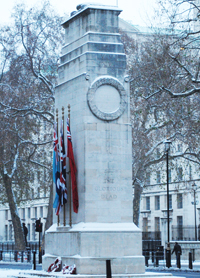
We’re looking at some of London’s World War I memorials so it’s only fitting we look at the life of acclaimed architect Sir Edwin Lutyens, the man credited with designing the Cenotaph – the UK’s national war memorial – in Whitehall (pictured below).

Lutyens was born in London at 16 Onslow Square, South Kensington, on 29th March, 1869, and – the ninth son and 10th of 13 children of soldier Captain Charles Lutyens and his wife Mary – was named for painter and sculptor Edwin Henry Landseer, a friend of his father’s. He grew up in London and Surrey and in 1885 commenced studying architecture at the South Kensington School of Art. In 1887, he left before completing the course, briefly joining the practice of Ernest George and Harold Peto before starting his own practice in 1889.

Cenotaph-in-LondonEarly commissions included country houses and it was during this period that he met with mentor and landscape gardener Gertrude Jekyll, a relationship which led him to design her home, Munstead Wood near Godalming in Surrey.

In 1897, Lutyens, known familiarly as ‘Ned’, married Emily Lytton – daughter of the late Viceroy of India and first earl of Lytton, Edward Buller-Lytton – and by 1908 the couple had five children. The family’s London addresses included 29 Bloomsbury Square (which also served as his office), 31 Bedford Square and 13 Mansfield Street, Marylebone, while his offices were located in numerous places including at 17 Queen Anne’s Gate.

Lutyens continued designing country houses – he eventually designed more than 35 major properties and altered and added many more – and among his commissions were Castle Drogo in Devon and the refurbishment of Northumberland’s spectacularly sited Lindisfarne Castle – both now National Trust properties. He was also involved in helping to plan and design Hampstead Garden Suburb in London, work which included designing two churches.

In 1912, Lutyens was invited to advise on the planning of the new Indian capital in New Delhi and his most important contribution was the design of the Viceroy’s House which combined elements of classical architecture with traditional Indian decoration. He was knighted in 1918 for his contributions in India and for his advice to the Imperial War Graves Commission.

It was his role in this latter effort which led to his becoming a national figure. He was involved in the creation of numerous monuments to commemorate the war dead, the best known of which are the Cenotaph in Whitehall – initially commissioned as a temporary structure (see our earlier post here) –  and the Memorial to the Missing of the Somme in Thiepval in northern France as well as the Australian War Memorial at Villers-Bretonneux and the Anglo-Boer War Memorial in Johannesburg.

He also designed more than 100 war cemeteries in France and Belgium and other war memorials – including overseas in places like Dublin – as well as London’s Tower Hill Memorial (see our earlier post here). Other London buildings he designed included the headquarters of Country Life magazine in Tavistock Street, Britannic House in Finsbury Square, the head office of the Midland Bank in Poultry and the Reuters and Press Association headquarters at 85 Fleet Street (now home to the Lutyens Restaurant, Bar and Private Rooms).

Lutyens was elected a fellow of the Royal Academy in 1920 (he was later president) and in 1924 was appointed a founding member of the Royal Fine Arts Commission. Even as he continued work in Delhi, he took on other commissions – such as the British Embassy in Washington, DC – and in 1924 he completed one of his most lauded – and smallest – designs: that of the one twelfth scale Queen Mary’s Dolls’ House which was shown at the 1924 British Empire Exhibition at Wembley and which can still be seen at Windsor Castle.

In 1929 Lutyens was commissioned to design a new Roman Catholic Cathedral for Liverpool but when he died on 1st January, 1944, this work was still unfinished with only the crypt completed thanks to the outbreak of World War II broke. Lutyens’ funeral was held in Westminster Abbey a few days later and his ashes were subsequently placed in the crypt of St Paul’s Cathedral.

For more information on Lutyens’ life and works, check out The Lutyens Trust, founded in 1984 to preserve and protect his legacy.

10 of London’s World War I memorials – 5. Royal Artillery Memorial…

Royal-Artillery-Memorial

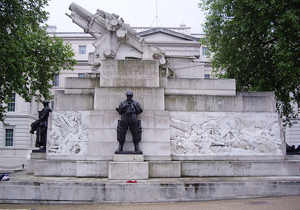
Often deemed to be one of London’s finest war memorials, if not the finest (indeed London Historians’ Mike Paterson has said so previously on these very pages), the Royal Artillery Memorial at Hyde Park Corner commemorates the more than 49,000 members of the Royal Artillery Regiment who died in World War I.

Royal-Artillery-Memorial3Designed by sculptor Charles Sargeant Jagger – who had served in the infantry during the war – and architect Lionel Pearson, it was unveiled in 1925 by Prince Arthur and Anglican priest, Rev Alfred Jarvis.

The monument, described by architectural historian Nikolaus Pevsner as a “masterpiece of British 20th century sculpture”, features an oversized stone replica of a 9.2 inch Howitzer Mk I atop a stone plinth accompanied by a series of four realistic bronze figures and a series of carved reliefs depicting scenes of military life.

The figures represent a gun crew: a driver, artillery captain, shell carrier and, controversially at the time, a dead soldier lying beneath his cape and helmet with an inscription from Shakespeare’s Henry V –  “Here was a royal fellowship of death”.

Three bronze panels were later added at the south end of the monument in commemoration of the almost 30,000 of the Royal Artillery who died in World War II. It was unveiled by the then Princess Elizabeth in 1949.

In late 2011, English Heritage completed a major restoration of the Grade I-listed work with a grant from the Bulldog Trust.

PICTURE: Above – David Adams. Below – virtusincertus/Flickr

10 of London’s World War I memorials – 4. Imperial Camel Corps Monument…

Camel-Corps2

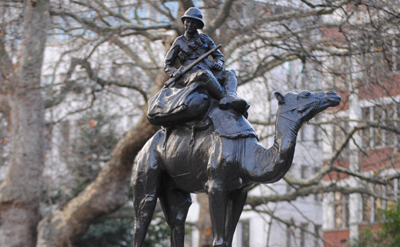
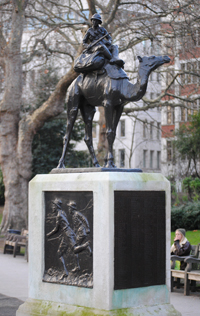
A reminder that it’s not just humans involved in war, the small but distinctive Imperial Camel Corps monument commemorates the role dromedaries played in the Middle East during World War I.

Camel-CorpsRaised in December, 1916, the Imperial Camel Corps Brigade fought in the Sinai and Palestine during the war and its four battalions were eventually comprised of British, Australian, New Zealand and Indian troops. It was disbanded at the end of the war.

The Grade II-listed monument, located in Victoria Embankment Gardens, was designed by Scottish sculptor Cecil Brown, himself a World War I veteran, and features a bronze soldier mounted on a camel set on a Portland stone pedestal.

It was unveiled on 22nd July, 1921, and, on bronze plaques on the side of the plinth can be found the names of those soldiers who died in battle as well as a list of all the battles and engagements fought by the corps.

For more on the history of the corps, see the Australian War Memorial’s page.

10 of London’s World War I memorials – 3. Tower Hill Memorial…

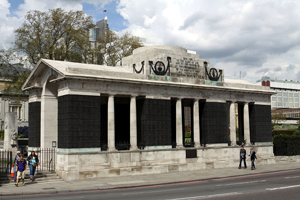
The Tower Hill Memorial was originally built to commemorate those of the Merchant Navy and fishing fleets who died at sea in World War I and was later expanded to include those who died in World War II.

Tower-Hill-MemorialLocated in the south-west corner of the garden in Trinity Square, the part of the memorial relating to World War I has the form of a 20-plus metre long vaulted corridor inside of which are a series of bronze plaques engraved with the names of 11,919 people whose grave was the sea.

Designed by Sir Edwin Lutyens and featuring sculptures by Sir William Reid-Dick, the Portland Stone memorial was unveiled on 12th December, 1928, by Queen Mary. The names are placed alphabetically under the names of their ships with the skipper or master the first name.

Located to the north of the original monument, the World War II extension, which was unveiled by Queen Elizabeth II on 5th November, 1955, takes the form of a semi-circular sunken garden and features the names of almost 24,000 seamen who died in World War II. It was designed by Sir Edward Maufe with sculpture by Charles Wheeler.

The memorial’s register is located inside nearby Corporation of Trinity House office (Cooper’s Row entrance).

PICTURE: Chmee2/Wikimedia Commons


LondonLife – Isaac Newton comes to life…

Isaac-Newton

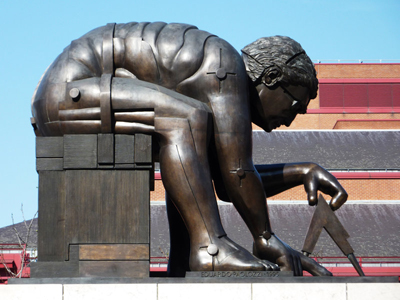
Eduardo Paolozzi’s 1995 statue of Isaac Newton which stands on the British Library’s piazza in King’s Cross has been granted a ‘voice’ as part of a new project called Talking Statues. Visitors who swipe their smartphones on a nearby tag will receive a call from the famous scientist – voiced by Simon Beale Russell – as part of the initiative which is being spear-headed by Sing London. It is one of 35 different statues across London and Manchester which will be brought to life by a range of public identities. Among the other statues in London which have been brought to life are Samuel Johnson’s cat Hodge in Gough Square (voiced by Nicholas Parsons) and Dick Whittington’s Cat in Islington (Helen Lederer), John Wilkes in Fetter Lane (Jeremy Paxman), the Unknown Soldier at Paddington Station (Patrick Stewart) and Sherlock Holmes outside Baker Street Underground (Anthony Horowitz). The British Library and Sing London are also holding a competition to give William Shakespeare a voice by writing a monologue for the statue in the library’s entrance hall which will then be read by an as yet unannounced actor. Entries close 17th October. For more, visit www.talkingstatues.co.uk

PICTURE: British Library

This Week in London – Breaker’s Yard opens at Sutton House; WWI remembered; and, preparing for an Open House…

A former car breaker’s yard in Hackney has reopened as a “pocket park” of “installations and hidden spaces” following an extensive transformation project. Located next to the National Trust’s Tudor manor house, Sutton House, Breaker’s Yard incorporates elements from the site’s history including car tyres, a bus greenhouse, bespoke metal gates made out of more than 1,000 toy cars donated by celebrities, locals and artists, and a multi-storey caravan sculpture, The Grange, created by landscape designer Daniel Lobb who also designed the park in collaboration with arts-based educational charity, The House of Fairy Tales. The flower-filled park also features an ice-cream van, decorated by Rose Blake – daughter of Sir Peter Blake, which will act as a “playful shop”. The park is one of a 100 ‘pocket parks’ created under a $2 programme by the Mayor of London, Boris Johnson, in this case in collaboration with the National Trust and a host of volunteers. Entry to the park is free but admission charge applies to the house. For more on the park and Sutton House, see www.nationaltrust.org.uk/sutton-house/.

A photographic exhibition, Exploring London’s First World War Memorials, is running at City Hall near Tower Bridge in Southwark. Organised by the Mayor of London with aid from the War Memorials Trust, English Heritage and others, the exhibition is centred on new images of war memorials by London-based photographer James O Jenkins. As well as more traditional monuments, the memorials take the form of everything from fountains to paintings, buildings and landscape features. Entry is free. Runs until 12th September. For more, see www.london.gov.uk/events. Meanwhile, the Guildhall Library is showcasing images taken by photographer Simon Gregor for the Remembrance Image Project. Runs until 12th November and is part of a series of World War I commemorative events the library is running. Others include an installation by artist Rebecca Louise Law called Poppy made up of 8,000 paper poppies from the Royal British Legion. For more on World War I commemorative events at the Guildhall LIbrary follow this link.

Open House London’s programme is available for download from tomorrow (Friday, 15th August). The event, which will be held over the weekend of 20th and 21st September, will this year be conducted under the theme of ‘revealing’ and will feature more than 800 buildings, from Open House “favourites” like The Gherkin (aka 30 St Mary Axe) and the Foreign and India Office through to lesser known properties like Wandsworth’s Quaker Meeting House or the Butcher’s Hall in the City (some of which have to be booked before the weekend). There will also be a free programme of neighbourhood walks, engineering and landscape tours, cycle rides and talks by experts. To see the programme, head to www.openhouselondon.org.uk.

Send all items for inclusion to exploringlondon@gmail.com.

10 sites from Shakespearean London – 9: Memorialising Shakespeare (part 2)…

Following on from last week’s post, we look at a couple more London memorials to The Bard,  playwright William Shakespeare…

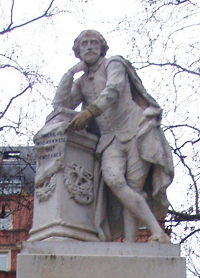
Shakespeare-Leicester-SquareLeicester Square: Returned to the West End square last year following its restoration (and the square’s redevelopment), this statue of Shakespeare – claimed to be the only outdoor one in London – was designed by architect John Knowles in 1874 when the square was constructed. Now Grade II-listed, it depicts Shakespeare leaning on a pedestal, pointing to a scroll which reads “There is no darkness but ignorance”, a quote from Twelfth Night. An inscription on the plinth upon which Shakespeare stands, refers to the laying out of the square by Albert Grant and doesn’t mention the playwright at all. The statue stands in the middle of a fountain, upgraded  as part of the recent overhaul of the site. PICTURE: Carcharoth/Wikipedia.

Primrose Hill: Shakespeare’s Tree on Primrose Hill was originally planted in April, 1864, to mark the 300th anniversary of his birth. An estimated 100,000 people marched to the site to watch the tree planting by poet Eliza Cooke and actor Samuel Phelps which was organised by the Workingmen’s Shakespeare Committee – apparently in response to the lacklustre efforts of a government-backed committee to mark the anniversary. The tree stood for 100 years before it died and was replaced with an oak sapling planted in 1964 actress Dame Edith Evans. A plaque which was attached to the tree detailing when it was planted has long since gone but there is talk of some sort of a permanent new memorial on the site.

There are other numerous places in London where Shakespeare – and his works – are remembered in London. One of our favourites is based in Love Lane and recalls the work of John Heminge and Henry Condell is getting Shakespeare’s works out to the world (for more on this, see our previous post here).

In our final post in this series next week, we take a look at some of the key London locations mentioned in Shakespeare’s plays.

Treasures of London – Swiss Court…

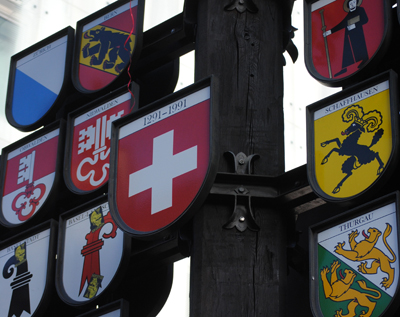
Cantonal-treeIn the hubbub of the West End, it’s easy to walk past the colourful monuments of Swiss Court without realising their significance is. 

Located between Piccadilly Circus and Leicester Square, the area was formerly home of the Swiss Centre, completed in the late 1960s as a showcase and trade centre for Switzerland. The centre was demolished in the late Noughties and replaced by the building now housing the W London Hotel and M&M’s World.

It was named Swiss Court on 15th April, 1991 – the 700th anniversary of the Swiss Confederation – by the then Lord Mayor of Westminster, Cr David Avery – and has two monuments commemorating the friendship between Switzerland and the UK.

The first is a “cantonal tree” (pictured) which displays the coats of arms of 26 cantons of Switzerland and was presented as a gift from Switzerland to mark the Silver Jubilee of Queen Elizabeth II in May 1977, “as a token of the friendship that exists between our two countries.”

The second is a glockenspiel featuring 27 bells and 11 moving figures which was originally attached to the front of the Swiss Centre after it was gifted to the City of Westminster by Switzerland and Liechtenstein in 1985.

It was removed when the building was demolished but, following a restoration and update (it’s now wirelessly controlled from Derby), returned to Swiss Court as a freestanding, 10 metre monument in late 2011. It now stands just a couple of metres from the cantonal tree.