What’s in a name?…Mayfair

Still the address to have in London, the origins of the name Mayfair are just as they appear – this area to the west of the City was named for the annual May Fair which was held at what is now the trendy (and picturesque) cafe precinct of Shepherd Market during the late 17th and early 18th centuries.
The two week long annual fair was established by King James II as a cattle market on what was then known as Brookfield Market in the 1680s. Attracting other pleasure-related activities, it soon became known for its licentiousness and, having survived Queen Anne’s attempts to have it banned, was eventually stopped in the mid-1700s. Edward Shepherd, who today gives his name to the area on which Brookfield Market once stood, was an architect and developer who subsequently redeveloped the site.

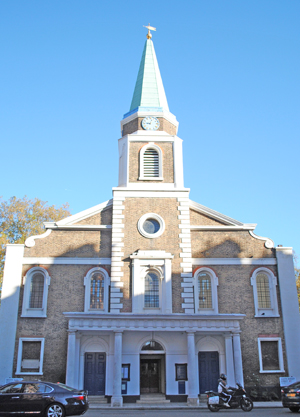
These days Mayfair is generally taken to encompass an area bordered by Hyde Park to the west, Oxford Street to the north, Piccadilly to the south and Regent Street to the east. The area’s development really took off in the century following the mid 1600s (landowners included the Grosvenor family – whose name is reflected in landmarks like London’s third largest square Grosvenor Square and Grosvenor Chapel (pictured) – as well as the Berkeleys and Burlingtons) and it became a favored residential location among the wealthy – indeed, it was this very gentrification which indirectly put an end to the fair.

Today, as well as being known for high end residential real estate, it’s one of London’s most expensive shopping precincts. Landmark buildings in the area today include the hulking bulk of the US Embassy at the western end of Grosvenor Square, the Royal Academy of Arts in Piccadilly, the Handel House Museum (located in what was the home of composer George Frideric Handel), shopping arcades such as the Burlington and Royal Arcades, and various luxury hotels like Claridge’s and The Dorchester in Park Lane.
What’s in a name?…Clerkenwell

Located just to the north of the City, the area of Clerkenwell takes its name from the Clerk’s Well which stands in Farringdon Lane.

The well was mentioned as far back as 1174 and was the scene of medieval mystery plays which were performed by the parish clerks of London. It was formerly located inside the wall of the 12th century St Mary’s Nunnery (located on the site of St James Parish Church) but is now found in the basement of a building named Well Court.

Islington Council record that a pump was installed at pavement level in 1800 to enable the public to use the well to draw water but this was closed by the mid 1800s and the exact site of the well lost to public knowledge. It was only in 1924 that the well was rediscovered during building work.

Alongside the nunnery, Clerkenwell was also home to the Priory of St John of Jerusalem, English headquarters of the crusader order known as the Knights Hospitallers. The Order of St John is still headquartered on the site of the former priory – the remains of the original priory include the Norman crypt under the rebuilt church and the priory’s main entrance, St John’s Gate, now home to a museum on the order. Also found in Clerkenwell is the Charterhouse, founded by Carthusian monks in 1370 and later a school (it’s these days home to a school of medicine and dentistry).

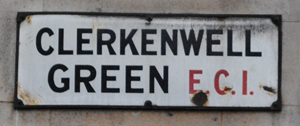
The area, centred on Clerkenwell Green (although apparently there hasn’t been a green here for several hundred years), become famous for its leisure-related institutions in the 1600s – these included spas, tea gardens and theatres (Sadler’s Wells Theatre still remains, albeit in a modern, dance-related form) – and gradually evolved into a more built-up residential area.

It was initially favored by the fashionable until the Industrial Revolution saw printing houses, breweries and distilleries, and clock and watchmakers move in. A survivor from the 18th century is the Middlesex Sessions House, built on Clerkenwell Green as a court around 1782 and now used by the Freemasons.

Industry declined in the area after World War II and Clerkenwell, which had also become a noted location for communists in the early 1900s (Lenin edited a paper here at one stage), was gradually transformed back into a residential area. Since the Eighties, Clerkenwell has again been going through a process of transformation – this time one of gentrification.

The well, located at 14-16 Farringdon Lane, can be visited – to arrange a visit, contact the Islington Local History Centre on 020 7527 7988 or email local.history@islington.gov.uk. For walks in Clerkenwell, see the Clerkenwell & Islington Guides Association  at www.clerkenwellwalks.org.uk.

Around London – Transport depot open day; Brixton Windmill to reopen; and, St Pancras’ Olympic Rings

The London Transport Museum Depot’s ‘Open Weekend’ kicks off on Saturday. The weekend of events at the depot in Gunnersbury Lane, Acton, will feature model railways, the chance to ride the Acton Miniature Railway – on either a replica 1938 tube train or a Metropolitan steam train – as well as heritage buses, and talks by author and broadcaster Christian Wolmar on his books Engines of War and Subterranean Railway. There will also be events specifically for children. The depot is home to more than 370,000 objects including road and rail vehicles, posters and artwork, and ticket machines. Events run from 11am to 5pm (last entry 4pm). There is an admission charge. For more information, see www.ltmuseum.co.uk/whats-on/museum-depot/events

Brixton Windmill, the only surviving windmill in inner London, will be open to the public from 2nd May after a major restoration project. The Grade II* listed building, located in Windmill Gardens in Brixton, south-east London, was built in 1816 and was owned by the Ashby family until it ceased production in 1934. It was purchased by the London County Council in 1957 but had since fallen into disrepair. The restoration project, which kicked off in October last year, was partly funded by a £397,700 Heritage Lottery Fund grant obtained by Friends of Windmill Gardens and Lambeth Council. It is envisaged that interpretation materials will be installed and a programme of educational activities run at the site – including growing wheat and mixing flour – after the completion of the restoration work. See www.brixtonwindmill.org for more information.

Giant Olympic Rings were unveiled at St Pancras International earlier this month. The 20 metre wide and nine metre high rings, which have been suspended from the station’s roof, weigh 2,300 kilograms and are made from aluminium. Built in Hertfordshire over four weeks, they took seven nights to install. They’re the first in a series of Olympic Rings that will appear around the city in the lead-up to the 2012 Games. The Olympics was last held in London in 1948.

Around London – Burial place of Bunyan, Defoe and Blake gets Grade I listing; Kew Gardens joins Streetview; and, Afghan treasures on show…

The London burial place of writers John Bunyan and Daniel Defoe and artist and poet William Blake has been recognised as one of the city’s most significant historic landscapes with a Grade I listing on the national Register of Parks and Gardens. The news, which was announced last month, also sees 75 tombs located within Bunhill Fields Cemetery individually listed. Bunhill, located between City Road and Bunhill Row, is one of 106 registered cemeteries in London (and now one of only seven Grade I listed cemeteries). It was established in 1660 and, thanks to its not being associated with Anglican place of worship, is viewed as the “pre-eminent graveyard for Nonconformists in England” . About 123,000 burials took place in its four acres before it was closed in 1869. The oldest monument is that of theologian Theophilus Gale, who died in 1678. As well as the tombs of Buynan, Defoe and Blake, others listed on the register include that of Dame Mary Page, who died in 1728 and whose tomb inscription talks of her stoicism in the face of 240 gallons of water being taken out of her prior to her death, and Joseph Denison, a banker who died in 1806 and was one of England’s wealthiest commoners at the time. The listing was made by the Department of Culture, Media and Sport following advice from English Heritage. For more on Bunhill Fields, follow this link

Kew Gardens has joined Google Streetview, meaning it’s now possible to navigate your way around the gardens from the comfort of your own home. More than 26 kilometres of paths and the interiors of some of the garden’s glasshouses – including the Palm House and the Temperate House – can now be seen on Streetview which offers 360 degree views. Professor Stephen Hopper, director at Kew, says the new technology is “bound to encourage people to visit us and experience Kew for themselves”. Follow this link to see the gardens on Streetview.

• On Now: Afghanistan’s heritage is on display in a newly opened exhibition at the British Museum. Afghanistan: Crossroads of the Ancient World showcases more than 200 objects from the National Museum of Afghanistan as well as some items from the British Museum and includes sculptures, ivory inlays once attached to furniture, Roman glassware and Egyptian stone tableware, and inlaid gold ornaments once worn by the area’s “nomadic elite”. The objects were found between 1937 and 1978 and were preserved thanks to officials who kept them out of harm’s way during the Soviet and Taliban eras. The museum announced this week that they would be joined by carved ivory fragments that were stolen from Afghanistan’s national museum in the early 1990s and only recently presented to the British Museum by a benefactor with the idea that they will eventually be returned to Kabul. The exhibition runs until 3rd July. There is an admission charge. For more information, see www.britishmuseum.org.

Treasures of London – The Cheapside Hoard

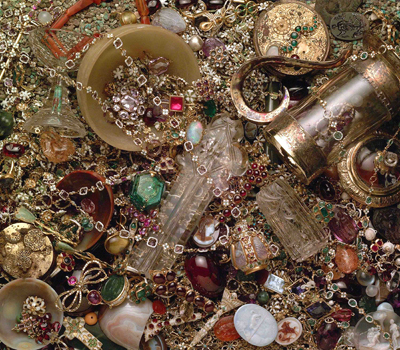
It’s been described as the greatest find of Jacobean and Elizabethan jewellery ever made – an extraordinary cache of some 500 gemstones, jewellery and other related items found buried under the floor during the demolition of a building at 30-32 Cheapside on 18th June, 1912.

Now known as the Cheapside Hoard, it dates from the 16th and 17th centuries and includes neck chains, pendants, hat ornaments, cameos and rings – among the items is a gold watch set into a hinged case made from a Columbian emerald, a tiny bejewelled gold scent bottle, and an onyx cameo of Queen Elizabeth I.

Other items include unfinished ornaments and unmounted gemstones which have origins spanning the world – from Asia and Middle East to South America. While these give support to the idea that the hoard is part of a goldsmith’s reserve stock, mystery still surrounds why it was buried in the building (although Cheapside was known for its goldsmiths during the era which the hoard dates from).

The majority of the hoard is held at the Museum of London where some of the items are on display. Other items are at the British Museum and one, an enamelled gold chain, is at the Victoria & Albert Museum. The Museum of London is planning major exhibition of the hoard starting in late 2013. Stay tuned for more information.

WHERE: Museum of London, 150 London Wall (nearest tube station is Barbican, St Paul’s or Moorgate); WHEN: 10am to 6pm, Monday to Sunday; COST: Free; WEBSITE: www.museumoflondon.org.uk

PICTURE: Museum of London

Around London – Sir John Soane’s private apartments to be restored; Highland cattle to return to Richmond; and two new photographic exhibitions…

• An appeal has been launched to raise the final £500,000 of a £7 million project to restore Sir John Soane’s private apartments in his former home overlooking Lincoln’s Inn Fields in Holborn. Phase one of the three year restoration project, Opening up the Soane, is expected to be complete by late 2012 with the entire project – which will see all of the rooms open to the public – to be completed by 2o14. The eight rooms being restored in the project, all of which are located on the second floor of No. 13 Lincoln’s Inn Fields – one of three adjoining properties Soane owned , include the architect’s bedroom, bathroom, oratory and book passage as well as Mrs Soane’s morning room and a room containing Soane’s architectural models. The building  already contains the Sir John Soane Museum which features an eclectic and at time outright strange mix of artefacts Soane, designer of the Bank of England (although it has since been substantially altered), collected during his lifetime. For more information, see www.soane.org.

Highland cattle will return to Richmond Park in autumn to help create patches of bare ground for wildflowers to grow after the success of a recent grazing trial. Richmond Park has the most extensive area of natural grassland in London and the type of grassland – known as ‘acid grassland’ – is a nationally rare habitat. Richmond Park is already home to 650 red and fallow deer. For more information, see www.royalparks.org.uk.

On Now – A new exhibition of street photography in London has just opened at the Museum of London. London Street Photography showcases 200 candid images of everyday life in the city with images ranging from sepia-toned scenes of horse-drawn cabs captured by tripod mounted cameras through to the use of digital cameras in snapping images of 21st century residents. Among the 59 photographers whose work is on display is that of Paul Martin, who pioneered the idea of candid street photography in London in the early 1890s, freelance photojournalist Henry Grant who photographed London’s streets in the Fifties and Sixties, and Stephen McLaren, known for his contemporary “quirky and colorful” street images. Entry is free. The exhibition runs until 4th September. For more information, see www.museumoflondon.org.uk.

On Now – The first major exhibition in 30 years of the work of EO Hoppe has opened at the National Portrait Gallery. Hoppe, who lived from 1878 to 1972, is considered one of the most important photographers of the early 20th century and is described as the “prototypical celebrity photographer”, shooting among others Margot Fonteyn, George Bernard Shaw, King George V, David Lloyd George and Ezra Pound. He also published the Book of Fair Women – photographs of women he believed to be the most beautiful of earth – in 1922 and in the Twenties and Thirties increasinly spent time outside the studio photographing street life. Hoppe Portraits: Society, Studio and Street runs until 30th May. For more information, see www.npg.org.uk.

Around London – New fourth plinth sculptures announced; Australian Season at British Museum; and Kenwood House shows off gardens…

• Sculptures of a child on a rocking horse and a giant blue cockerel will occupy Trafalgar Square’s fourth plinth in 2012 and 2013 respectively, it was announced late last week. The Mayor of London, Boris Johnson, described the artworks as “witty and enigmatic creations”. The first proposed first sculpture, correctly titled Powerless Structures, Fig. 101, is the creation of Elmgreen & Dragset while the second, Hahn/Cock, is that of Katharina Fritsch. The plinth is currently occupied by Yinka Shonibare’s Nelson’s Ship in a Bottle. See www.fourthplinth.co.uk.

The British Museum has announced it will be holding a series of exhibitions and events focusing on Australia later this year. Highlights of Australian Season will include Australia Landscape: Kew at the British Museum (21st April to 16th October), an exhibition of prints and drawings dating from the ‘Angry Penguin’ school of the 1940s through to the rise of Aboriginal printmaking (Out of Australia: prints and drawings from Sidney Nolan to Rover Thomas, from 26th May to 11th September), and an exhibition focusing on indigenous Australian baskets (Baskets and belong: Indigenous Australian histories, 26th May to 29th August). See www.britishmuseum.org.

On Now: Kenwood House in Hampstead is hosting a new exhibition, The Gardens of English Heritage. The exhibition, which is based on the publication of the same name, features stunning images of some of the UK’s most impressive gardens.Runs until 3rd April. For more information, see www.english-heritage.org.uk/daysout/properties/kenwood-house/

Around London – Composer Herbert Howells honored; London Eye’s new name; and, the Natural History Museum’s new gallery…

Composer and teacher Herbert Howells has been commemorated with a blue plaque on his former home in Barnes, south west London. Known for composing “recognisably English” works, Howells is considered by man to be the last of the great English Romantic composers and is particularly remembered for this contributions to the Anglican liturgy. According to English Heritage, Howells lived at the house at 3 Beverley Close from 1946 until a few weeks before he died in 1983. For more on Howells, see www.howellstrust.org.uk.

The London Eye is to have a name change. Having started life as the Millennium Wheel (while still under construction), it was officially named the British Airways London Eye when it first opened in March 2000 and later renamed the Merlin Entertainments London Eye when the BA naming deal expired. Following a new deal, the wheel will be known as the EDF Energy London Eye from the end of this month.

On Now – The Natural History Museum’s new Images of Nature gallery opens tomorrow. The new permanent gallery showcases the museum’s collection of natural history artworks and includes works by bird illustrator, John Gerrard Keulemans, and botanical artist, Georg Ehret as well as a range of more modern-day creations such as a 3D scan of a shark’s head. The gallery also boasts a temporary annual exhibition with the first, a rotating collection of Chinese watercolors, featuring works by 19th century amateur naturalist John Reeves as well as contemporary works by the museum’s Shanghai-based artist-in-residence. Entry is free. See www.nhm.ac.uk.

Treasures of London – The Magna Carta

It’s regarded as one of the seminal documents of medieval England. First issued 15th June, 1215, the Magna Carta (“Great Charter”) was endorsed by England’s barons and King John at Runnymede near Windsor Castle and put limits in the power of the king by demanding he govern according to established feudal law.

The document was forced upon King John by rebellious barons after he broke away from established customs and imposed oppressive taxes and fines and seized the estates of nobles.

Its terms were immediately repudiated by the king, leading to further rebellion which ended when the king died on 18th October, 1216. Less than a month after the king’s death, the regent, William Marshal, issued a revised version of the document and a second revision almost exactly a year later. A further version was later issued by King Henry III and later confirmed by King Edward I.

Copies of the document were sent throughout the land in 1215. There is now a copy in the Lincoln Cathedral Archives and another in Salisbury Cathedral Chapter House while the British Library has two copies, both from the collection of Sir Robert Cotton, who died in 1631. One of the library’s two copies was burned in a fire 100 years after Sir Robert’s death and still bears fire damage.

The text of the Magna Carta is not abstract in nature but deals in detail with practical realities, covering issues ranging from what happens when a noble who holds land from the Crown dies through to who heirs may marry, standard measures of wine, ale and corn and the removal of foreign knights from the country.

Only three of the Magna Carta’s 63 clauses are still law: one guaranteeing the liberties of the English Church; another confirming the privileges of London and other towns; and a third, often viewed as a forerunner of clauses contained in documents such as American Bill of Rights and Universal Declaration of Human Rights, which states that no free man shall be imprisoned, dispossessed, outlawed or exiled without the lawful judgement of his equals or by the law of the land.

The legacy of the Magna Carta is not however in the individual rights it seeks to uphold but rather the principle that for the first time in English history, it elevates the law above all men, even the king.

WHERE: Sir John Ritblat Gallery: Treasures of the British Library: Magna Carta and associated documents, The British Library, 96 Euston Road (nearest tube station is Kings Cross St Pancras or Euston); WHEN: 9.30am to 6pm Monday, Wednesday, Thursday and Friday; closes 8pm Tuesday and 5pm Saturday; 11am to 5pm Sunday; COST: Entry is free; WEBSITE: www.bl.uk or for a detailed guide and virtual tour of the Magna Carta, see  www.bl.uk/treasures/magnacarta/index.html.

Around London – 100 years since the Siege of Sidney Street;

It’s 100 years since the Siege of Sidney Street and the Houndsditch Murders and to mark the occasion, the Museum of London Docklands opens a special exhibition this Saturday.

The murders took place on 16th December, 1910, when a group of Latvian revolutionaries attempted to break into a jeweller’s shop in Houndsditch. Three City of London policemen were killed and two more disabled for life in the gunfight which broke out.

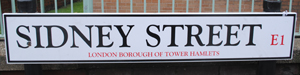
Two weeks later, on 3rd January, 1911, the Siege of Sidney Street began when more than 200 armed police and a detachment of Scots Guards besieged a home at 100 Sidney Street in Stepney where two of the Houndsditch gang were believed to be hiding.

The exhibition, which has been put together in partnership with the Jewish East End Celebration Society, features objects from the trial of suspected gang members as well as never-before-seen objects including guns taken from the crime scene and safe-breaking equipment. The overcoat Winston Churchill wore on the day of the siege – he attended in his capacity as Home Secretary – will also be on display.

London Under Siege: Churchill and the Anarchists, 1911, runs from 18th December to April 2011. Entry is free. For more information, see www.museumindocklands.org.uk.

• Meanwhile a plaque was unveiled today on the site in Cutler Street where three policemen – Sergeant Robert Bentley, 36, Sergeant Charles Tucker, 46, and PC Walter Choat, 34 – were killed during the gunfight with the gang. Two other policemen were disabled for life and a fireman, Superintendent Charles Pearson, later died after he entered the Sidney Street property which had been gutted by fire. A plaque will be unveiled in his honor on 6th January.

Around London – Imperial War Museum’s WWI revamp; St Paul’s Christmas broadcasts; House Mill to be restored; Henry III’s rolls online; and, Winter Wonderland in Hyde Park

The Imperial War Museum has unveiled plans for a major rebuilding project at its Lambeth headquarters to culminate with the 100th anniversary of the start of World War I in 2014. Under a £71 million proposal, the size of the existing World War I galleries will be doubled and a new atrium will be created with further works – including a new sunken entrance – to be completed by 2019. The museum moved to its Lambeth location, formerly the Bethlem Royal Hospital, in 1936. Prince William is fronting the first £29 million appeal for funds. Meanwhile plans have reportedly been mooted to have the decommissioned aircraft carrier, the HMS Ark Royal, brought to London where it would be permanently moored in the Thames as a tourist attraction akin to the HMS Belfast.

St Paul’s Cathedral has announced it will provide live outdoor broadcasts of its three most popular Christmas services for the first time to allow those who can fit in the cathedral to participate. A 25 metre screen will be set up in Paternoster Square, next to the cathedral, where ‘A Celebration of Christmas’ will be screen on 16th December at 6.30pm along with Christmas Carol services on the 23rd and 24th December at 4pm. See www.stpauls.co.uk.

An historic 18th century mill in East London will undergo restoration after the granting of a £248,000 lottery grant. House Mill, which dates from 1776, is believed to be the largest tidal mill still in existence anywhere in the world. Built across the River Lea, the mill was used for flour-making and for a distillery located next door on Three Mills Island in Bow. The project, which is being managed by the River Lea Tidal Mill Trust, involves the restoration of the mill as well as the adjoining Miller’s House and the creation of a visitor’s centre. The trust says it has also been given the “green light” for a further £2.65 million Heritage Lottery Fund grant. See http://housemill.org.uk.

A three year project has made documents drawn up for King Henry III in the 13th century available on the internet for the first time. Project partners Canterbury Christ Church University, King’s College London, and the National Archives in Kew have translated and digitised the king’s ‘fine rolls’, written to record money and favours owed to the king. The rolls consist of 56 parchments – one for each year of his reign which started in 1216 and ended in 1272 – and contain as many as 40,000 entries amounting to some two million words. Some of the parchments, the originals of which are held at the National Archives, measure up to three metres in length. See www.finerollshenry3.org.uk.

On now: Winter Wonderland in Hyde Park. Christmas festivity on a vast scale, Winter Wonderland includes the city’s largest open air ice rink, circus acts, a giant observation wheel, rides and eating places including the igloo-style E:Cube and the Spiegel Saloon. For more information see www.hydeparkwinterwonderland.com.

Treasures of London – The Sutton Hoo ship burial

Now housed in the British Museum (pictured), the artefacts discovered in a ship burial at Sutton Hoo near Woodbridge in Suffolk helped to shed new light on what life was like in Anglo-Saxon society.

The excavation at the Sutton Hoo site was carried out in 1939, just before World War II.  The finds were impressive and centred on a 27 metre long oak ship in the midst of which was constructed a burial chamber for a man of some significance along with his possessions.

The latter included his armour (the centrepiece of which is the spectacular and painstakingly reconstructed Sutton Hoo helmet complete with face mask), weapons such as a sword and spears, silverware and silver-mounted drinking horns and cups, clothes and other assorted items of wealth, including a purse with a ‘lid’ containing, among other things, Merovingian gold coins struck believed to have been struck between 595 and 640 AD.

While the remains found date to around the early seventh century, the man’s exact identity remains something of a mystery. But it is possible he may have been one of four Anglo-Saxon kings known to have been buried in the area.

WHERE: Room 41 at the British Museum, Great Russell Street (nearest tube is Tottenham Court Road, Holborn or Russell Square); WHEN: 10.30am-5.3opm daily; COST: Entry to the museum is free; WEBSITE: www.britishmuseum.org. (For more information on visiting the Sutton Hoo site in Suffolk, visit www.nationaltrust.org.uk/main/w-vh/w-visits/w-findaplace/w-suttonhoo)

Roman London – 2. The Temple of Mithras

Also known as the Mithraeum, the remains of the Temple of Mithras were only discovered in the City during building work in 1954.

The temple was originally located some 18 feet (5.4 metres) below Walbrook Street on the bank of what was Walbrook but was moved to its current location at the eastern end, and south side, of Queen Victoria Street. It is presently again surrounded by building work hoardings so you’ll have to ignore those if you’re trying to soak up some ancient atmosphere.

The temple was built around 240 AD and remained in use until around 350AD when, after it suffered severe subsidence, it was rebuilt and dedicated to the god Bacchus. The original stone temple was dedicated to Mithras, a Persian sun deity and a particular favorite of Roman soldiers, and perhaps to several other gods as well.

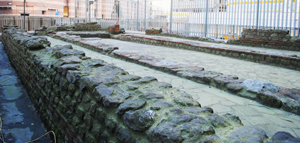
These days all that remains are foundations, but you can see the basic layout with a sunken nave – which would have had benches on either side – leading to an altar, remains of which are at the northern end of the site.

Numerous artefacts have been found at the temple site, including a head of Mithras, a sculpture showing a scene of Mithras killing a bull (he apparently did so in a cave so  Mithraeum were built partly or even totally underground), and heads of the Roman gods Minerva and Serapis, all of which can be seen at the Museum of London.

WHERE: Queen Victoria Street (nearest tube station is Bank); WHEN: Open to the public at all times; COST: Free. WEBSITE: The Museum of London’s website has some good information on the temple, http://bit.ly/hzsBrW

Around London – West End’s VIP day; National Curry Week; Kenwood House to close for repairs; and Horatio’s handwriting…

• Oxford Street and Regent Street in London’s West End will be closed to cars and buses this Saturday (27th November) as part of the sixth annual West End VIP Day. The day, which is sponsored by American Express,  will also bring singers, entertainers and celebrities hit the streets as they fundraise for the Starlight Children’s Foundation. Other entertainment will include a seven foot climbing wall on Regent Street, giant TV screens, fair ground style rides and the chance to climb inside a lifesize snow globe. Runs from 9am to 10pm. For more information, see www.westendlondon.com/vip.

• This week was National Curry Week, so to celebrate, we thought we’d tell you about London’s oldest curryhouse (in fact it’s said to be the oldest in the UK). Veeraswamy was founded in 1926 at its current location of 99 Regent Street (entry via Swallow Street) by, according to the restaurant’s website, “the great grandson of an English General, and an Indian princess”. Customers are said to have included Indira Gandhi, Charlie Chaplin, King Hussein of Jordan and Marlon Brando. See www.nationaleatingoutweek.com or www.veeraswamy.com.

Kenwood House in Hampstead, north London, is set to undergo major repair and conservation works meaning the house will be closed to the public from early summer 2012 for just over a year. The grounds will remain open. The current house was designed by Robert Adam and built over the period of 1762 to 1779 for William Murray, 1st Earl of Mansfield and the Lord Chief Justice. It now houses a collection of paintings bequeathed to the nation in 1927 by Edward Cecil Guinness, 1st Earl of Iveagh, which includes works by Rembrandt, Vermeer, Gainsborough and Turner. For more information, see www.english-heritage.org.uk/daysout/properties/kenwood-house/.

On now: Compare Horatio Nelson’s handwriting before and after he lost his right arm in battle at a special showing of two of his letters at the Wellcome Collection tomorrow night (26th November). The letters are part of Hands: Amazing Appendages, a one night only show. There will also be the chance to try out some nail art, try out some surgeon’s tools and hear talks and see performances. Admission is free (but some talks and performances will be tickets – tickets available on the night only from 7pm). See www.wellcomecollection.org/whats-on/events/hands.aspx.


Around London – New VC gallery at Imperial War Museum; Roman remains unearthed at Syon Park; and, High Society at the Wellcome Collection…

An exhibition containing the world’s largest collection of Victoria Crosses has opened at the Imperial War Museum, housed in what is the museum’s first new major permanent gallery for 10 years. The Extraordinary Heroes exhibition – housed in the Lord Ashcroft Gallery – contains his Lordship’s collection of 162 Victoria Crosses, awarded for parts played in wars stretching from the Crimean to the Falklands, displayed alongside the 48 Victoria Crosses and 31 George Crosses already held by the museum. As well as the awards, the new gallery will display many objects for the first time, including a badly damaged backpack worn by Lance Corporal Matt Croucher when he leapt on a grenade during action in Afghanistan in 2008 to save the lives of his fellow soldiers (he survived as well), and the diving suit worn by Acting Leading Seaman James Magennis who won a VC for his role in placing limpet mines in the Johore Straits in World War II. The gallery was paid for with a £5 million donation from Lord Ashcroft. Admission is free. For more information, see www.iwm.org.uk.

The remains of a Roman settlement have been unearthed at historic home, Syon Park, in London’s west. Archaeological experts from the Museum of London have already removed around 11,500 pieces of pottery, jewellery and about 100 coins from the site on the Syon Park estate. Syon Park, the home of the Duke of Northumberland, sits on the northern bank of the Thames, opposite Kew Gardens. The site was excavated in 2008 in preparing for the construction of a new luxury hotel there. Some of the artefacts will go on display at the new hotel, the London Syon Park, A Waldorf Astoria Hotel, which will open early next year. The settlement, which includes a Roman road and burials, was discovered only half a metre below ground level. For more information on the property, see www.syonpark.co.uk.

Now on: From an early morning coffee in European cities to chewing betel nut in Asia, the Wellcome Collection’s major winter exhibition, High Society, traces the role mind-altering drugs have played in history and culture. The display includes more than 200 exhibits, from an 11th century manuscript written by monks in Suffolk detailing poppy remedies, to a 17th century account by Captain Thomas Bowrey describing his crew’s experiments with the cannabis drink bhang, and an account of NASA’s experiments with intoxicated spiders. Admission is free. The exhibition runs until 27th February. For more information, see www.wellcomecollection.org.

Around London – Lord Mayor’s Show tomorrow; Book of the Dead at British Museum; and Evolving English at the British Library

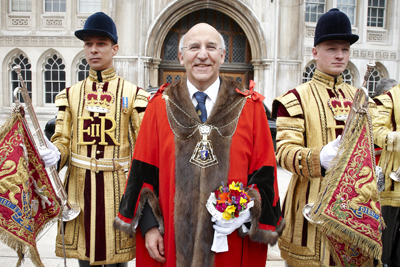
The Lord Mayor’s Show is tomorrow. The world’s oldest civic procession, it’s been held for 795 years (the last time it was interrupted was due to the Duke of Wellington’s funeral) and commemorates the day when the newly elected Mayor had to make the journey from the City to Westminster to declare his allegiance to the monarch. This year’s Lord Mayor of the City of London – the City’s 683rd – is Alderman Michael Bear (not to be confused with the Mayor of London Boris Johnson). The procession kicks off at 11am and travels from Mansion House to St Paul’s Cathedral, where the Lord Mayor, who formally took office yesterday in a silent ceremony held at Guildhall, is blessed. The procession then moves on to the Royal Courts of Justice where the Lord Mayor swears an oath of allegiance before returning to Mansion House via Victoria Embankment. This year the procession will involve from than 6,000 people from livery companies, military units, marching bands, local schools and businesses and community groups as well as 200 vehicles, 21 carriages – including, of course, the Lord Mayor’s State Coach – and 71 floats. Don’t forget to hang around for the fireworks. For more about the event – where to stand and what you’ll be seeing, see www.lordmayorsshow.org.

PICTURE: Alderman Michael Bear on the occasion of his election as the 683rd Lord Mayor of London. Courtesy Lord Mayor’s Show.

•  Now On: The British Museum exhibition, Journey through the afterlife: ancient Egyptian Book of the Dead, was launched last week. The exhibition centres on the museum’s collection of Book of the Dead papyri, many of which have never before been put on display to the public. They include the Greenfield Papyrus, which at 37 metres long is the longest Book of the Dead in the world and has never been displayed in its entirity before. The display also features famous paintings from the papyri of Ani and Hunefer and an array of painted coffins, gilded masks, amulets, jewellery, tomb figurines and mummy trappings. Runs until 6th March. For more information, including admission prices, see www.britishmuseum.org.

• Now On: A new exhibition exploring the development of the English language opens today at the British Library. Evolving English: One Language, Many Voices looks at how the language has evolved from Anglo-Saxon runes to modern day rap and where it’s headed next. Highlights of the exhibition include the first book printed in English, Recuyell of the Historyes of Troye (printed by William Caxton), a 1611 King James Bible, Poor Letter H – a pamphlet dating from 1854 explaining why pronouncing your h’s correctly is important to climbing the social ladder, and the earliest surviving copy of Beowulf. On until April 3rd. Admission is free. For more information, see www.bl.uk.

Favourite Places – The Museum of London’s Lynne Connell revisits Greenwich

In the first of a new series looking at some of the favorite historical places of Londoners, Lynne Connell, a host at the Museum of London, nominates Greenwich…

“When I was a child my grandparents took me to Greenwich for the day.  I remember being very impressed with Admiral Nelson’s uniform (complete with blood stains) and the haunted tulip staircase in the Queen’s house. While we sat and ate cheese and onion crisps in front of the Cutty Sark, my Grandmother (who was a little eccentric) told me ‘there is so much history here you can feel it’.

“So what can you see in Greenwich today?

“You can visit the Greenwich Observatory, stand on the Meridian line and know you are in the centre of the world! Admission is free there, as well as the National Maritime Museum and the Queen’s House. You can also see the magnificent Wernher collection at Ranger’s House (free to members of English Heritage) and don’t forget the tiny Fan Museum.

“A favourite lazy Sunday morning, includes a stroll in the Royal Park to visit the deer enclosure, a leisurely coffee in one of the two cafes and a visit to the craft market.

“The remains of a Roman villa can be seen in the park and you can visit Princess Caroline’s bath. Don’t miss Queen Elizabeth’s oak, Henry VIII is reputed to have courted Anne Boleyn under the boughs of his ancient hollow tree. It fell during high winds in the 1990’s and is now slowly rotting away.

“Look down from the Observatory Gardens upon the magnificent Royal Naval College and go to visit the beautiful painted hall. Remember, beneath the college lie the remains of the Royal Palace of Placentia, birth place of Henry VIII and Elizabeth I.

“It is easy to get to Greenwich by over ground train, DLR or (to really pick up the atmosphere) by river boat.

“It is more than 40 years since my introduction to the history of Greenwich, and perhaps I am becoming a little eccentric myself, but my grandmother was right, you really can ‘feel the history’.”

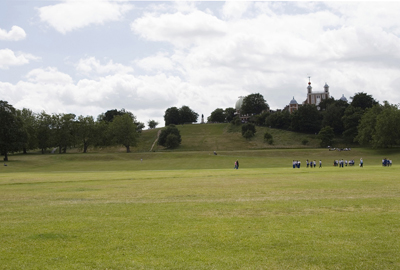
PICTURE: Greenwich Park, © Anne Marie Briscombe (Royal Parks)

Around London – where did you go last weekend?

Exploring London visited the home of 19th century artist Lord Frederic Leighton in Kensington last weekend as part of Open House London.

Built over a period of more than 30 years from 1864 until Lord Leighton’s death in the home in 1896, the house is a monument to the decorative arts with a series of intricately decorated halls and rooms including the superb domed ‘Arab Hall’ featuring tiles brought from Damascus in Syria and an overhanging lattice window from Egypt.

The house, which once hosted Queen Victoria as well as nineteenth century luminaries poet Robert Browning and artist William Morris, was preserved as a museum as far back as 1900 and is now in the care of the Royal Borough of Kensington and Chelsea.

WHERE: 12 Holland Park Road (nearest tube station is High Street Kensington); WHEN: 10am to 5.30pm, closed Tuesdays; COST: £5 adult, £1 concessions ( with free return entry within 12 months); WEBSITE: www.rbkc.gov.uk/subsites/museums/leightonhousemuseum.aspx

So where did you go as part of Open House London and what was good about it? Share your experiences with us here…

Around London…

A 9 ft (2.7 metre) tall bronze statue of Air Chief Marshal Sir Keith Park, commander of the RAF in London and the south-east during the Battle of Britain, was unveiled in Waterloo Place, just off Pall Mall, this week. Sir Keith, a New Zealander who joined the RAF after fighting at Gallipoli and the Somme during World War I, was described as the “brain” behind London’s air defences. The unveiling of the statue on Battle of Britain Day (12th September) follows a three year campaign to honor Sir Keith, who died in 1975, with such a monument. A prototype of the statue occupied the Fourth Plinth at Trafalgar Square for six months after it was unveiled in November last year. For more information, see www.sirkeithpark.com.

Spend a night at the museum (well, part of one anyway). The Natural History Museum is opening its doors for one night only as part of European Researchers’ Night on Friday, 24th September. Scientists will be on hand to chat and there will be opportunities to see rare specimens not usually on display including a giant squid. There will also be three bars offering drinks and food. The event, which we can promise won’t include you being chased down hallways by dinosaur skeletons, runs from 4pm – 10pm. For more information, see www.nhm.ac.uk.

Don’t forget! Open House London kicks off this weekend. For more information, see last week’s Around London post.

10 sites in London you may not know about – 7. Geffrye Museum

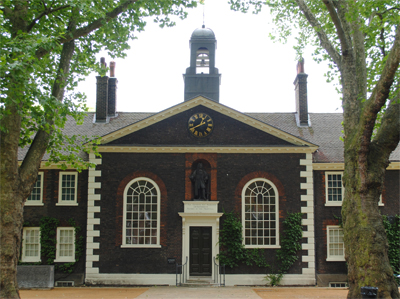
Tucked away just north-east of the city of London, this surprisingly interesting museum features reconstructed interiors of London homes from the 1600s through to modern times. The museum is located in former almhouses built in the early 1700s by the Company of Ironmongers using a bequest left them by Sir Robert Geffrye, a former twice-master of the company and a former Lord Mayor of London.

Worth visiting for the almhouses alone, these were used until early in the 20th century when, given the overcrowding in Shoreditch, the company decided to relocate the remaining pensioners. Thankfully, due to the fact that the almshouses were built around a large garden not to mention the lack of public open space in the area, the almhouses and grounds were preserved; the former to be used as a museum.

The museum itself features a series of informational rooms between those in which the lavishly detailed reconstructions – which are largely of the main living rooms – are contained and there’s an audio guide which is well worth taking the time to listen to as you work your way through. There’s also a restaurant and special exhibition spaces on site (contained in a modern wing opened in 1998) and preserved within the museum are the chapel once used by the pensioners and the promenade which overlooks gardens at the rear.

For those who want a closer look at what life was like for the pensioners, for a £2 fee you can take a tour of one of the former almshouses which has been restored to show the living conditions of the almhouses in the 18th and 19th centuries. At the rear of the museum, meanwhile, lies some magnificent gardens including a walled herb garden filled with herbs from Roman times onward and a series of ‘period garden rooms’. Keep an eye out as well for the statue of Sir Robert which adorns the front of the building.

WHERE: 136 Kingsland Road, Shoreditch. Nearest tube is Liverpool Street or Old Street (a fair walk) or Hoxton Overground Station (next door); WHEN: Tuesdays to Saturdays, 10am-5pm or Sundays and Bank Holidays, 12-5pm; COST: Free (admission to almhouses £2 at set times during the day); WEBSITE: www.geffrye-museum.org.uk