10 small (and fascinating) museums in London…9. HMS Belfast

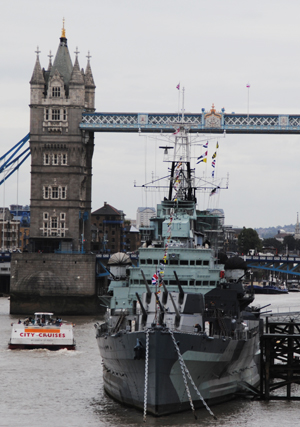
OK, so it’s not exactly small but HMS Belfast – an offshoot of the Imperial War Museum moored permanently on the Thames near Tower Bridge – does make a fascinating museum in which to spend a few hours.

Commissioned into the Royal Navy on 5th August, 1939 (just in time for the start of World War II), the HMS Belfast is a large light cruiser built, along with the HMS Edinburgh, as an improvement on the then existing ‘Southampton’ class vessels. It is now the only surviving example of the many big gun armoured warships which were built for the Royal Navy in first half of the twentieth century.

Assigned to the Home Fleet on the outbreak of war, the ship operated out of Scapa Flow in the Orkney Isles in far north Scotland and was charged with patrolling the northern waters as part of efforts to impose a maritime blockade on Germany. Striking a mine in November of that year, however, it was put of out action until two years later when it rejoined the Home Fleet and then began escorting Arctic convoys to the Soviet Union – a mission which saw it take part in the Battle of North Cape off the Norwegian coast in late 1943 (this battle saw the sinking of the German battle cruiser Scharnhorst).

The HMS Belfast later saw action on D-Day, the Allied invasion of Normandy in 6th June, 1944, when it was employed to bombard German positions onshore before, heading to Japan where, after the end of the war, it was used to evacuate survivors of prisoners-of-war and internment camps in China.

The HMS Belfast saw action in the Korean War and then spent further time in the Far East before – under threat of being disposed of and broken up – it was acquired as a museum and moored in London. The first visitors were admitted on Trafalgar Day, 1971, and, as of last year, nearly 10 million people have taken up the chance to look at the ship.

These days there’s a well-defined route through the vessel, complete with audio guide (it’s included in the admission price), which takes visitors on an informative journey describing what life was like for those who served onboard the Belfast – including everything from the Arctic messdecks where ratings slept in hammocks to the NAAFI store where they could buy supplies, sick bay, the ‘modern’ laundry room, and chapel as well as the engine room, shell rooms and magazines, and , of course, the bridge.

Many of the rooms have been set up – some using life-sized manniquins – to show how they would have looked during a typical day. Particularly worth a look is the new Gun Turret Experience: A Sailor’s Story 1943, an immersive film, light and sound show which gives a glimpse into what life was like working inside one of the six inch gun turrets.

It can take a while to get around the whole ship (and parents are asked not to take small children into the boiler room) but it’s well worth taking the time to explore properly. In addition to the features of the ship itself, there are two exhibitions – one looking at the role of the ship in peace and war, and the other, an interactive experience in what life was like on board.

WHERE: HMS Belfast is moored on the Thames between London Bridge and Tower Bridge. Entry is from the south bank of the Thames near Morgans Lane (nearest Tube stations are London Bridge, Tower Hill or Monument); WHEN: 10am-6pm (last admission 5pm) daily until 31st October, then 10am to 5pm (last admission 4pm); COST: £13.50 adults/£10.80 seniors and students/children under 16 free (price includes a voluntary donation); WEBSITE: http://hmsbelfast.iwm.org.uk.

Around London – Tens of thousands expected for weekend’s Sky Ride; IWM marks 10th anniversary of September 11; Liberty festival hits South Bank; British Library launches new 19th century app; and, a new slavery exhibition at Museum of London…

• Tens of thousands of people are expected to join London Mayor Boris Johnson for the annual Sky Ride this Sunday. The event, organised by the Mayor of London, Sky and British Cycling in partnership with Transport for London, allows people to cycle a 11.6 kilometre route through the city centre minus the usual car traffic. The circular route, which takes in Westminster Bridge, the Mall and Buckingham Palace, Trafalgar Square and Whitehall, will be vehicle-free between 9.30am and 4.30pm. Last year more than 85,000 took part. For more information, seewww.goskyride.com/london.

• The Imperial War Museum is marking the 10th anniversary of the 9/11 attacks in the US with a new photographic exhibition showing artefacts recovered after the destruction of the World Trade Center in New York. Memory Remains, which opened on 26th August and runs until 26th February, is a photographic exploration of Hangar 17 – a previously empty hanger at John F. Kennedy Airport in New York where debris and material retrieved from the 16 acre World Trade Center site were stored. It features images taken by Spanish-American artist Francesc Torres, who was commissioned by the National September 11 Memorial & Museum to capture what was happening inside the hangar and granted special access to do so. The exhibition is being accompanied by another at Imperial War Museum North in Manchester. In the Spotlight: Remembering 9/11, which runs from 10th September until September next year, features artefacts from the World Trade Center including a British flag which was laid on the altar in St Paul’s Cathedral on the first anniversary of the attacks. Admission to both exhibitions is free. For more information, see www.iwm.org.uk.

South Bank hosts the Liberty festival, an annual showcase by deaf and disabled artists, this Saturday. The festival, which will take place at two sites – the Southbank Centre and the National Theatre, will feature a mix of music, dance, street theatre, comedy, circus performances and aerial displays. Highlights include Mark Smith’s Deaf Men Dancing, performance artist Bobby Baker, Jean-Marie Akkerman’s Cirque Nova featuring four disabled aerial artists, and Kazzum, who produce theatrical work for children up to 16-years-old. The event is free. For more information, see www.london.gov.uk/liberty.

The British Library and BiblioLabs have launched a new 19th century historical collection app for iPad users. The app (which costs £1.99 a month or $US2.99 for those outside the UK and is available through Apple’s App Store) allows users to explore historical and antiquarian books including classic novels, original accounts by Victorian travellers, books on science and poetry, memoirs and military histories. Around 45,000 titles are initially available with a further 15,000 to be added by the end of the year.

On Now: Freedom from: modern slavery in the capital. A new exhibition looking at the reality of trafficking and forced labour has opened at the Museum of London and the Museum of London Docklands – the museum first cross-site exhibition. Created in partnership with Anti-Slavery International and coinciding with the launch of its Slavery-Free London campaign, the exhibition looks at the personal impact of human trafficking and slavery in 21st century London and includes personal testimonies such as that of ‘Gheeta’ who was trafficked from India and forced into work. It also features a series of large scale photographs by Chris Steele-Perkins of Magnum Photos. Runs until 20th November. Admission is free. For more information, see www.museumoflondon.org.uk.

10 small (and fascinating) museums in London…8. The Geffrye Museum

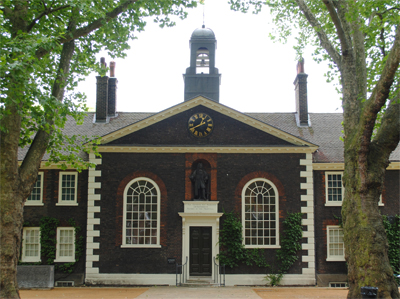
We have mentioned this museum before, but it’s well worth doing so again (particularly for those who may have missed the first entry). Located in former almhouses in Shoreditch, the Geffrye Museum is a survey of house interiors from the 17th century through to modern times.

Featuring 11 reconstructed period interiors created using authentic furnishings, it tells the story of the city through its residents’ homes (albeit largely wealthy ones) and includes a look at a hall in 1630, a parlour in 1790, a drawing room in 1870 and a loft conversion dating from 1998. There’s an audio guide which provides details on each room and information panels as you go along (and if you can’t get there but want to have a look, the website gives a detailed look at each room with notes on select furnishings).

The almshouses in which the museum resides (it runs along the rear wing of a U-shaped courtyard and takes in the chapel) were built in the early 1700s by the Company of Ironmongers after it received a bequest from Sir Robert Geffrye, a former twice-master of the company and a former Lord Mayor of London (his statue adorns the front of the chapel and faces out into the courtyard, itself a quiet oasis in busy Shoreditch).

These were used until early in the 20th century when the company decided to relocate the remaining pensioners. But the buildings have been preserved and it is possible to visit a former almshouse which has been restored and opened as a museum with displays on what life was like for the pensioners. Meanwhile, at the rear of the museum is a walled herb garden filled with herbs and a series of ‘period garden rooms’ ranging from the 17th to 20th centuries.

There’s also a restaurant and shop onsite (housed in a new extension opened in 1998).

WHERE: 136 Kingsland Road, Shoreditch. Nearest tube is Liverpool Street or Old Street (a fair walk) or Hoxton Overground Station (next door); WHEN: Tuesdays to Saturdays, 10am-5pm or Sundays and Bank Holidays, 12-5pm (gardens open until 31st October); COST: Free (admission to almhouses £2.50 at set times on select days); WEBSITE: www.geffrye-museum.org.uk


Around London – Story of London Festival; a new filmlovers’ walk; ‘pocket histories’ of London; and, Your 2012…

The third Story of London Festival kicked off at the start of the month with a programme of events aimed at celebrating the 60th anniversary of the 1951 Festival of Britain. This year’s festival is being coordinated by the Museum of London in partnership with the Southbank Centre. It also involves five London borough museums – that of Brent, Dagenham, Haringey, Redbridge and Wandsworth – which are hosting free displays and events around the theme of how they celebrated in 1951. The festival runs until the end of the month, so there’s still plenty of time to get involved. Among the highlights still to come is the Floral Bicycle Parade around the Southbank Centre on 28th August (‘decorating stations’ will be set up at the centre prior to the parade). For a full listing of what’s happening, see www.london.gov.uk/priorities/art-culture/storyoflondon.

The City of London has released a new filmlovers’ walking tour of London which takes in locations featured in films and TV shows. Lights, camera, action starts on Millennium Bridge (destroyed in the opening sequence of Harry Potter and the Half-Blood Prince) and takes in 23 other locations including St Paul’s Cathedral (The Madness of King George and Great Expectations), Bank Junction (28 Days Later, National Treasure II), St Bart’s Hospital (Bridget Jones: The Edge of Reason), Moorgate (Ocean’s 13 and The Bourne Ultimatum) and Tower Bridge (BranniganThe Mummy ReturnsThunderbirdsTomb RaiderSherlock Holmes) before finishing at Postman’s Park (Closer). The walk has been mapped out by the City’s film team which works with location managers and film directors when they’re working in the Square Mile. The leaflet can be picked up free-of-charge from the City of London Information Centre (opposite St Paul’s) or downloaded here.

• Interested in a snapshot of what London was like during a particular historical era? The Museum of London has launched a series of 16 “pocket histories”, each of which, in up to 1,000 words, tackles a particular aspect of the city’s history based around five objects or images. The subjects covered range from a look at the River Thames in prehistory to life in medieval London, from an examination of the history of Jack the Ripper and the East End, to a detailed look at the London’s plagues. While designed for a general audience, the histories are expected to be particularly useful to school students. They can be looked at online or downloaded as a PDF. Further subjects are expected to be added in the future. See www.museumoflondon.org.uk/pockethistories. The museum has also launched Picturebank, a collection of images which can be accessed online and viewed, printed or copied for educational use.

• On Now: Your 2012. The Museum of London Docklands is hosting a free exhibition featuring images capturing the construction work at the Olympic site in East London and the impact on the surrounding boroughs and the environment as well as archival images which show the history of the site. The free exhibition runs until 5th February. For more, see www.museumoflondon.org.uk/docklands/.

10 small (and fascinating) museums in London…7. The Cartoon Museum

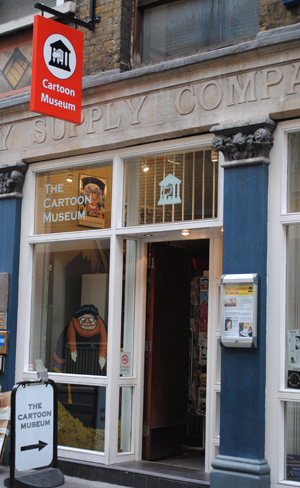
Hidden away in Bloomsbury almost in the shadow of the gigantic bulk of the British Museum, this small museum offers an interesting insight into the development of cartoons and comic strips from a uniquely British perspective.

Opened in 2006, the museum exhibits are spread over two floors and trace the history of cartoons and comic strips from their origins in the 1700s through to today’s graphic novels.

While it can seem at first glance only a small display, there’s a wealth of information accompanying the more than 200 exhibits which range from Hogarth prints and early satirical political cartoons by the likes of James Gillray and George Cruikshank through to the works of more modern artists like David Low and Donald McGill, originals of comic strips like Dennis the Menace and Andy Capp and even manga Shakespeare.

And no need to worry about the kids – if they become bored (as is likely), there’s an interesting exhibition on the creation of Peppa Pig complete with original storyboards and a cartoon running on the television as well as plenty of reading materials and, upstairs, the chance for them to indulge their passion for cartoons by designing their own.

The museum is also currently running a splendid exhibition on Dr Who comics spanning the period from 1964 (the year after the first Dr Who was televised) through to today. For Dr Who fans, this exhibition – which runs until 30th October – is a must.

Don’t forget to pause at the shop on the way out – it’s stocked with all sorts of comic-related paraphernalia.

WHERE: The Cartoon Museum, 35 Little Russell Street (nearest Tube stations are Tottenham Court Road, Holborn and Russell Square); WHEN: 10.30am to 5.30pm, Tuesday to Saturday, 12.30pm to 5pm Sundays; COST: £5.50 an adult/£4 concessions (£3 students)/children under 18 free (children 12 or under must be accompanied by an adult); WEBSITE: www.cartoonmuseum.org

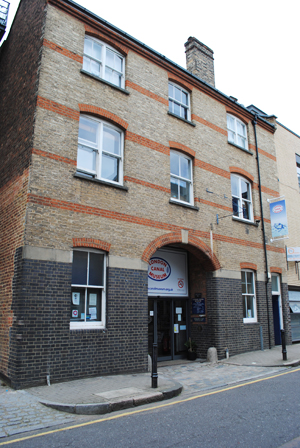
10 small (and fascinating) museums in London…6. London Canal Museum

London’s Regent’s Canal no longer plays the important transport role it once did – it’s now largely for pleasure that people ply the waters from the East London Docks up to Little Venice. But its key contribution to the city’s development and those of other canals across the country are celebrated at this small museum.

The museum, which sits just behind King’s Cross railway station, was opened in 1992 and features two floors of exhibits. They include half a narrow boat, the Coronis, which you can walk through to experience the cramped conditions in which the boatmen and their families once lived. There are also some fascinating recordings of people who actually did live on narrowboats about what life was like as well as displays and photographs of a lifestyle now long gone.

Outside, in Battlebridge Basin, is a moored a small collection of narrowboats while upstairs is a more detailed history of how the canals were developed, some fascinating film archival footage on a continuous loop, and a chance to operate a model of a lock.

As an added bonus, the museum is housed in what was once an ice warehouse and it’s still possible to view one of two massive ice wells which occupied the basement space where blocks of ice imported from Norway were once stored.

There are also displays on the history of the former ice business owner, Carlo Gatti, and some interesting information about the early days of ice and icecream in London – of particular note is the collection of ‘licking dishes’ in which icecream was sold for a penny.

WHERE: London Canal Museum, 12-14 New Wharf Road (nearest Tube station is King’s Cross); WHEN: 10am to 4.30pm, Tuesday to Sunday (open late until 7.30pm on the first Thursday of each month); COST: £4 an adult/£3 concessions/£2 children/£10 a family; WEBSITE: www.canalmuseum.org.uk

10 small (and fascinating) museums in London…5. The Old Operating Theatre Museum and Herb Garret

It’s the most unlikely location for anything to do with a hospital. High above the street in what was a herb garrett above a former church sits what was the operating theatre for females of St Thomas’ Hospital.

Built in 1703, the attic space resembles something of a large barn and was likely first used for storing and drying herbs by the resident apothecary at the then newly reconstructed St Thomas’ Hospital (this was largely rebuilt at the end of the 17th century on the same site previously occupied by the hospital as far back as the 1200s).

In 1822, the hospital’s governors decided that part of the herb garrett be converted into a new purpose-built operating theatre for female patients. The addition of windows in what was left of the adjoining garret, meanwhile, suggest it may have been used as a recovery ward.

The first thing that assails you as you enter the herb garrett these days, having clambered up a narrow twisting staircase is the sweet, spicy smell of herbs.

There are plenty of these within the garret, each with a hand written card explaining the curative properties they were renowned for – who knew, for example, that the ash of bladderwrack, dried kelp or seaweed, could be used to treat scrofula and goitre, or that the origins of aspirin go back to 1758 when a Chipping Norton clergyman chewed on a willow twig?

Elsewhere in the space are displays featuring early surgeon’s implements (and all the horror that entails), specimen jars containing human organs, anatomical models, pill and medicine making equipment and a display on nursing (there’s also a display on the poet John Keats who briefly served as an apprentice apothecary at St Thomas’ and St Guy’s in 1815-17).

Through the garret is located the operating theatre itself, complete with the wooden operating table and series of seats for spectators. Information panels nearby speak of such things as the blood box located below the floor into which the blood drained away and the speed with which surgeon’s had to work (until 1846 there was no reliable anaesthetic and it wasn’t until 1865 that Sir Joseph Lister introduced antiseptic procedures). There’s also a panel on the resurrection men – people who traded in cadavers to meet the growing needs of anatomists in the 18th and 19th centuries (and whom were known in London and elsewhere to have murdered people to meet the demand for bodies).

For all the faux-horror of nearby attractions like the London Dungeon, it’s here that you can truly experience the horrors some people have had to face as they prepared to go under the surgeon’s knife.

WHERE: The Old Operating Theatre Museum and Herb Garret, 9a St Thomas’s Street, London Bridge (nearest Tube station is London Bridge); WHEN: 10.30am to 5pm daily; COST: £5.90 an adult/£4.90 concessions/£3.80 children under 16/£13.80 a family (up to four children); WEBSITE: www.thegarret.org.uk.

Around London – 16 Underground stations listed; life in a gun turret at HMS Belfast; and that dress on display at Buckingham Palace

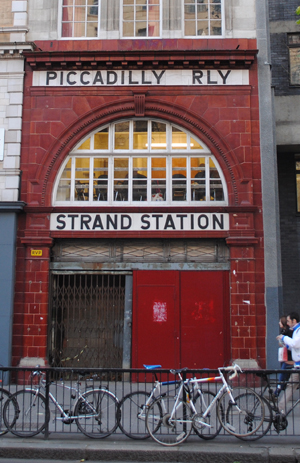
Sixteen London Underground stations were this week listed as Grade II heritage buildings. The Tube stations – several of which were designed by Leslie Green, known for his pioneering use of ‘ox-blood’ red tiles on the exterior of stations to create a consistent brand for the stations – include the now-closed Aldwych (pictured) along with Oxford Circus (originally two stations), Covent Garden and Russell Square as well as Belsize Park, Brent Cross, Caledonian Road, Chalk Farm, Chesham, Perivale, Redbridge, St John’s Wood, West Acton and Wood Green. Three other stations – Arnos Grove, Oakwood and Sudbury Town – have had their status upgraded from Grade II to Grade II*. These three were all designed by modernist architect Charles Holden for the extension of the Piccadilly Line in the 1930s. The new listings were made by Tourism and Heritage Minister John Penrose on the advice of English Heritage.

A new permanent exhibition showing would-be sailors what it is like to fight at sea opens at the HMS Belfast this weekend. Gun Turret Experience: A Sailor’s Story, 1943, is an immersive experience using lights, imagery, sound, smoke effects, movement and smell to recreate the atmosphere and conditions of a gun turret tower when a crew was at battle stations. Visitors are encouraged to follow the story of a young sailor on Boxing Day, 1943 when the German battle cruiser Scharnhorst is sighted leading to the Battle of the North Cape. The Gun Turret Experience, housed within the original triple gun turrets overlooking the quarterdeck, was developed with the help of Royal Navy veterans and eye-witness accounts from the Imperial War Museum (of which the HMS Belfast is part). Entry is included in normal admission price. For more information, see www.hmsbelfast.iwm.org.uk.

• Now On: See the dress the Duchess of Cambridge wore when she was married to Prince William in April at this year’s summer opening at Buckingham Palace. The gown, which features a nine foot long train, will be displayed along with the Halo Tiara until 3rd October in the palace ballroom (the same room used for the newly married couple’s reception). The exhibition features video footage of designer Sarah Burton, explaining how the dress was made. This year’s summer opening also features a display of the work of Carl Faberge – including his magnificent jewel-encrusted Imperial Easter Eggs as well as bejewelled boxes and miniature carvings of favorite pets of the royal family. More than half a million people are expected to visit the exhibition. For more information, see www.royalcollection.org.uk/default.asp?action=article&ID=30

10 small (and fascinating) museums in London…4. The Wimbledon Windmill Museum

A tiny museum located in an 1817 windmill standing in the middle of Wimbledon Common, the Wimbledon Windmill Museum provides an interesting insight into the work and lives of the millers who once occupied it and the thousands of other windmills around the UK.

Displays are located over three levels – the last reached by a steep climb up a ladder – and range from the tools and machinery used by the millers to a room packed with models of different types of windmills (all of which turn when you press a button) through to a room set up as the mill was in the 1870s when it was divided into homes for six families.

As well as the more static displays, there’s also a chance for the kids to make their own flour and a video playing on a loop which goes into considerable detail on the history and function of windmills in the UK.

There are tearooms located next door (and, if you happen to visit when it’s snowing, there’s a great toboggan run located nearby!).

The windmill itself has some interesting historic connections – it was in the miller’s cottage behind the windmill (now much enlarged) that Scouts founder Robert Baden-Powell was staying when he wrote Scouting for Boys in 1907.

While this mill dates from 1817, there is a record of millers being on the common as far back as the 17th century. As well as making flour, the miller also served as the common’s constable.

This job entailed keeping an eye out for robbers operating on the common as well as illegal duelists (Wimbledon Common and Putney Heath were apparently popular spots for this).

Indeed, history records that Thomas Dann – the first miller about whom there is a record – and his wife witnessed an infamous duel between Lord Cardigan and Captain Tuckett from the windmill’s roof. Tuckett was wounded during the second round of shots and subsequently taken into the windmill for treatment of his injuries while Dann took Lord Cardigan into custody (he was eventually acquitted after a trial in the House of Lords).

This is certainly a small museum but, with an entry price of only a couple of pounds, well worth spending a little time to look through.

WHERE: The Wimbledon Windmill Museum, Wimbeldon Common (nearest Tube stations are Wimbledon, Wimbledon Park and Southfields); WHEN: 2pm to 5pm Saturdays, 11am to 5pm Sundays (and Bank Holiday Mondays) until October 30th; COST: £2 adults/£1 concessions and children/£5 families (two adults and up to four children); WEBSITE: www.wimbledonwindmill.org.uk.

Around London – Yuri Gagarin honored; Londinium by iPhone; celebrating a year to the Olympics; and, British Museum hopes to buy Europe’s oldest book…

Earlier this month it was former US President Ronald Reagan’s turn to be honored with statue in Grosvenor Square. Last week it was the turn of former Soviet Cosmonaut Yuri Gagarin – the first man in space – to be so honored with a new statue located outside the British Council’s offices in the Mall (opposite another explorer, Captain James Cook). The statue, a gift of the Russian Space Agency Roscosmos, was unveiled to mark the 50th anniversary of Gagarin’s celebratory visit to London on 14th July, 1961, just three months after he completed his orbit of the earth on 12th April that year. The 3.5 metre high zinc alloy figure stands close to Admiralty Arch which was where Gagarin met then Prime Minister Harold MacMillan after he was invited to the UK by the National Union of Foundrymen. Among those present for the unveiling of the statue – which is a replica of one in the town of Lubertsy where Gagarin worked as a foundryman as a teenager – was Gagarin’s daughter Elena Gagarina, now director of the Kremlin Museums, and Vladimir Popovkin, head of the Russian Federal Space Agency. The British Council is running an exhibition, Gagarin in Britain, which looks at the life of Gagarin and the early Soviet space programme, until 14th September – among the objects on display is the first space suit and an ejector seat similar to that Gargarin used when he ejected out of Vostok 1. Entry is by registration only and space is limited – email gargarin@britishcouncil.org is you’d like to register for a place. For more information, see www.britishcouncil.orgPICTURE: Frank Noon/British Council

A new iPhone app which directs people to key sites in what was Roman London (Londinium) will go live on Monday. Developed by the Museum of London and the History Channel, Streetmuseum Londonium will bring to life some of the city’s most significant Roman sites, such as the amphitheatre at Guildhall, using “augmented reality video” which will overlay scenes of Roman London over the modern city while soundscapes will allow users to listen to a ritual at the Temple of Mithras or traders at the forum. In addition, users will be able to ‘digitally excavate’ Roman artifacts including leather bikini briefs and an ancient manicure set. Navigation to these “immersive experiences” will be via a specially created new map of Roman London which will be superimposed on a modern map of the capital, allowing users to see how the city has changed. The launch follows the earlier creation of the Streetmuseum app which guides people to more than 200 sites across the city. More than 200,000 people from across the world have so far downloaded this. Streetmuseum Londinium will be available free to download from 25th July. See www.museumoflondon.org.uk/apps for more.

London will mark one year to go until the Olympic Games next Wednesday with a ceremony in Trafalgar Square which will be broadcast live on BBC1. Among those present with be the International Olympic Committee (IOC) President Jacques Rogge, London Organising Committee of the Olympic and Paralympic Games (LOCOG) chairman Sebastian Coe and Mayor of London Boris Johnson. The event will also feature a live cross to the Aquatics Centre in Olympic Park where Olympic hopeful Tom Daley will make the first dive into the pool.

• The British Library hopes to raise £2.75 million to acquire the world’s earliest surviving intact European book, the 7th century St Cuthbert Gospel. A copy of the Gospel of St John, the book was buried with St Cuthbert on the isle of Lindisfarne in 698 and later found in the saint’s coffin in Durham Cathedral in 1104. The National Heritage Fund Memorial has already awarded £4.5 million to obtain the St Cuthbert Gospel and the Art Fund and The Garfield Weston Foundation have donated £250,000 each. The book has been on long-term loan to the library since 1979 and is regularly on view in the Sir John Ritblat Treasures Gallery. The library was approached last year and given first option to acquire the text after the Society of Jesus (British Province) decided to sell it. A price of £9 million has been agreed, of which £2.75 million remains outstanding. For more, see www.bl.uk.

10 small (and fascinating) museums in London…3. The Foundling Museum

Opened in 2004, the Foundling Museum was created to look after the former Foundling Hospital’s collection of art and artifacts and provides a unique and deeply moving insight into the work of the hospital and those who came under its care.

The Foundling Hospital’s origins go back to the 1720s when former mariner and ship-builder Captain Thomas Coram, shocked by the number of abandoned babies he saw in London (it’s estimated that in the early 1700s, there were as many as 1,000 babies being abandoned every year), began a campaign to found a hospital for “exposed and deserted young children”, that is, ‘foundlings’.

The hospital was founded in 1739 after King George II granted it a royal charter and, from that date until its closure in 1953, had some 27,000 children pass through its doors.

The museum’s story is not an easy one to tell for while the hospital was founded with the best of intentions, the life of the children who came into its care – even in the 20th century – remained far from easy; it was not, as one of those who formerly lived at the hospital notes, a life they would wish on anyone else. But the museum handles their story – as well as that of those behind the hospital’s founding – with care and dignity.

Located at 40 Brunswick Square – close to the site of the original hospital, the museum is spread over four floors. On the ground floor is an exhibition which details the hospital’s history and features objects including a series of sketches by the controversial 18th century artist William Hogarth, an ardent supporter of the hospital’s work and later one of the many artists who became a governor, as well as the founding charter document itself.

Among the most poignant of the artifacts to be found in the museum are the tokens mothers left with their children so they could later identify them (these were removed from the children on being taken into the hospital, however, to ensure the child’s anonmity).

The lower ground floor has a space for temporary exhibitions – at present this contains the ‘Foundling Voices’ exhibition in which those who once lived under the care of the hospital tell their stories firsthand in what is an emotional journey into the hospital’s relatively recent past (the exhibition runs until 30th October). It is also home to the reconstructed Committee Room, built as part of the original hospital in the mid-1700s, dismantled and then reconstructed in the new headquarters.

Upstairs (the stairs themselves were taken from the boy’s wing of the original hospital), is a reconstruction of the hospital’s original Picture Gallery which was London’s first public art gallery and was instrumental in raising the profile of the work of the hospital. Among the works it contains is Hogarth’s 1740 portrait of Captain Thomas Coram. Nearby is the Court Room, another reconstruction from the original hospital, this time of the building’s most splendid room, used for meetings of the Board and Governors and other special occasions. It too contains numerous artworks.

The top floor of the building houses the Gerald Coke Handel Collection, said to be the greatest collection of artifacts relating to composer George Frideric Handel in the world. Handel’s assocation with the museum goes back to 1749 when he offered a performance of his music to help fund the hospital’s completion. He held another the following year, this time performing the Messiah, and after that Handel agreed to an annual benefit performance – a practice which continued until his death in 1759.

Key artifacts in the Handel collection include the composer’s will and codicils, written in his own hand, as well as programme from the first performance of the Messiah along with other documents and artworks.

WHERE: The Foundling Museum, 40 Brunswick Square, Bloomsbury (nearest Tube station is Russell Square); WHEN: 10am to 5pm, Tuesday to Saturday/11am to 5pm Sunday (closed Mondays); COST: £7.50 an adult/£5 concessions/children under 16 free; WEBSITE: www.foundlingmuseum.org.uk.

Around London – National Maritime Museum expands; new galleries proposed for British Museum; Festival of British Archaeology in London; and, the London Street Photography Festival…

The National Maritime Museum in Greenwich opened the doors of its new £36.5 million Sammy Ofer Wing today. The new, architecturally slick extension – which is being touted as bringing with it a change of direction in the way the museum operates – features a new permanent gallery known as Voyages as well as a temporary exhibition space, library and archive. There’s also a lounge, cafe and brasserie – the latter boasting views out over Greenwich Park. The Voyages gallery has been designed as an introduction to the museum and features a 30 metre long thematic ‘object wall’ hosting more than 200 objects – everything from a letter written by Horatio Nelson to his mistress Emma Hamilton while he was on board the Victory in 1803 through to a watch belonging to Robert Douglas Norman – among those who perished on the Titanic, and a somewhat battered Punch puppet. The special exhibition space initially hosts High Arctic which uses technology to create an “immersive environment” exploring the Arctic world from the perspective of the future. The museum is also introducing the Compass Card scheme, a new initiative which will eventually be rolled out across the museum. Visitors are presented with a unique card with which, by inserting it into special units placed in galleries, they can flag their interest in receiving further information on a specified subject. The card can then be used to call up related archival information in the museum’s Compass Lounge or using the visitor’s home computer. For more information, see www.nmm.ac.uk.

The British Museum has announced funding has been secured for two new gallery spaces. These will include a new gallery looking at the history of world money from 2000 BC to present day. Known as the Citi Money Gallery, it will be opened in 2012. A donation from Paul and Jill Ruddock, meanwhile, means the museum will also be working on a major redisplay of Room 41 which covers the Mediterranean and Europe from 300 to 1,100 AD. The artefacts in the room include treasures taken from Sutton Hoo and the Vale of York Viking Hoard. The gallery will open in 2013/14. For more, see www.britishmuseum.org.

Now On: Festival of British Archaeology. Coordinated by the Council for British Archaeology, the 21st festival (formerly known as National Archaeology Week) kicks off this weekend and runs until the end of July. It boasts more than 800 events across Britain including in London where they include guided tours of the Rose Theatre, a range of Roman themed events and activities – including a gladiator show – at the Museum of London, gallery talks at the Bank of England Museum and British Museum, the chance to visit the Billingsgate Roman House and Baths, and a guided walk of Londinium (Roman London) organised by All Hallows by the Tower. For a complete events listing, see http://festival.britarch.ac.uk/.

Now OnThe London Street Photography Festival is running until the end of the month with a series of exhibitions, talks, walks and workshops, the majority of which are taking place in and around King’s Cross. Key events include Street Markets of London in the 1940s – Walter Joseph featuring never before seen images at the British Library, Vivien Maier: A Life Uncovered at the German Gymnasium, and Seen/Unseen – George Georgiou and Mimi Mollica at the Collective Gallery. For more information, see www.londonstreetphotographyfestival.org.

10 small (and fascinating) museums in London…2. Bank of England Museum

The Bank of England Museum, located on the east side of the “Old Lady of Threadneedle Street”, provides a fascinating account of life behind the bank’s fortress-like walls, spanning the period from its origins and founding in 1694 to its nationalisation in post-World War II Britain through to the high-tech nature of banking – and banknotes – today. 

The museum is partly housed in a 1988 reconstruction of architect Sir John Soane’s 1793 stock office (Sir John designed the bank’s original headquarters –  much of this was later demolished with the exception being the outer windowless walls of the bank which still frown down on passersby) as well as in the Rotunda – designed by Herbert Baker and dating from the 1930s, it features some of the original Caryatids which decorated Soane’s design.

Highlights among the permanent exhibition include the Great Iron Chest, a precursor to today’s safes dating from around 1700, the Bank of England Charter of 1694 still afixed with the Great Seal, the earliest known Bank of England running cash note (relating to a deposit of £22 and dating from 1697), muskets and pistols used for security at the bank, and documents relating to some of the bank’s more high profile customers (these include Admiral Lord Nelson and former US President George Washington) as well as extensive collection of banknotes and coins. There’s also the opportunity to feel the weight of a solid gold bar (worth £393,884 at the time of our visit).

The exhibition also includes a display on Kenneth Grahame, author of The Wind in the Willows and a long-time (30 year) employee of the bank until his sudden resignation, possibly in part due to him being shot by an intruder several years before, in 1908, only four months before his internationally renowned book was published. Key artifacts include his resignation letter in which he asks for “relief” from the burden of his responsibilities at the bank.

Among current temporary exhibitions is The Pound in Your Pocket which looks in detail at the issue of inflation through a variety of entertaining devices including a balance in which you have to keep inflation at a level during a series of “economic shocks”.

WHERE: The Bank of England Museum, Bartholomew Lane off Threadneedle Street (nearest Tube stations are Bank/Monument and Mansion House); WHEN: 10am to 5pm, Monday to Friday (last entry 4.45pm); COST: Free; WEBSITE: www.bankofengland.co.uk/education/museum/index.htm.

Around London – Ronald Reagan unveiled, two ways in Pall Mall, Hungarian photography at the RA, and a celebration of the Arab world…

A new statue of former US President Ronald Reagan was unveiled in Grosvenor Square near the US embassy on Monday, 4th July. The 10 foot tall bronze statue of the president, who died in 2004, was unveiled at a private ceremony by the Foreign Secretary William Hague – former US Secretary of State Condoleezza Rice were also among the more than 2,000 people who attended along with current US ambassador Louis Susman (a frail Margaret Thatcher was reportedly too frail to attend). Commissioned by the Ronald Reagan Presidential Foundation, the statue is the work of sculptor Chas Fagan. Its unveiling is one of a series of events marking the centenary of the birth of the former actor turned politician.

Pall Mall and St James Street in the West End were opened to two-way traffic this week for the first time in 50 years. The changeover came into effect last Sunday morning. The roads were made one-way in 1963 under a scheme to deal with increasing traffic in the area. But it has been reopened in the first stage of a £14 million overhaul of traffic around Piccadilly Circus – home to world-famous neon billboards and the Eros Statue. The area is visited by 200,000 every day.

Time to get your togs on. Scores of swimmers will be taking the plunge at the Hampstead Heath Lido tomorrow and Saturday to raise funds for the Lord Mayor’s Appeal, Bear Necessities. A 4,000 metre swim, the City Dip, will be swum by teams and individuals with every swimmer receiving a commemorative certificate and medal. The current Lord Mayor of London is Michael Bear. To sign up or for more information, see  www.lordmayorsappeal.org.uk/dip

On Now: Eyewitness: Hungarian Photography in the 20th Century – Brassaï, Capa, Kertész, Moholy-Nagy, MunkácsiThis new exhibition at the Royal Academy of the Arts at Burlington House in Piccadilly, organised to mark the Hungarian Presidency of the EU, is dedicated to the birth of modern photography and features the work of Brassaï, Robert Capa, André Kertész, László Moholy-Nagy and Martin Munkácsi. It comprises more than 200 photographs, dating from 1914 to 1989, which usually form part of the collection of the Hungarian National Museum of Photography as well as the National Museum in Budapest and other public and private collections in both Hungary and the UK. Runs until 2nd October. For more information, see www.royalacademy.org.ukPICTURE: Laszlo Fejes, Wedding, Budapest, 1965, Copyright Hungarian Museum of Photography.

On Now: Shubbak: A Window on Contemporary Arab Culture. London’s first ever celebration of contemporary culture from across the Arab world will feature more than 100 artists involved in 70 events at some 30 venues over the weeks until 24th July. The program includes visual arts, film, music, theatre, dance, literature, architecture, lectures and discussions with many events boasting free admission. Highlights include A Girl in her Room, an exhibition of photo works by highly acclaimed Lebanese/American artist, Rania Matar, at the Mosaic Rooms, one of London’s leading centres for Arab contemporary arts (runs until 23rd July), Shopopolis, a series of collaborations with shoppers at Westfield Shopping Centre (runs until 24th July) and this weekend’s Interference, a series of free films, talks and workshops at the ICA curated by Mathaf: Arab Museum of Modern Art in Doha. For full details of all events, see www.london.gov.uk/shubbak.

10 small (and fascinating) museums in London…1. Museum of the Order of St John

This is the first in our new special series looking at 10 of the best of London’s small museums. We’re not including houses once lived in by famous people (that will be the subject of a later series), but rather those museums which contain some of the city’s most eclectic collections yet still tend to fly a little under the radar when it comes to the crowds…

First up, we take a look at the Museum of the Order of St John. The museum – which was reopened in late 2010 following a £3.7 million redevelopment – is located in St John’s Gate in Clerkenwell (pictured), the Tudor era gatehouse of the order’s once substantial London priory.

Told inside is the story of the order, from its founding in the 12th century as the Order of the Hospital of St John of Jerusalem with the aim of caring for sick pilgrims who had travelled to the Holy Land through to its later role as a military order and its Middle Ages moves – following the capture of Palestine by Muslim forces in 1291 – to Cyprus, then Rhodes, and eventually Malta, along with its current work through the charitable foundation of St John Ambulance.

Exhibits include weapons and armour, paintings and illuminated manuscripts (such as the Rhodes Missal of 1504), coins, furnishings, ceramics, silverware and textiles. There is also a 16th or 17th century bust of Jean de la Valette, Grand Master of the Knights Hospitaller from 1557 to 1568 and famed for leading the order to victory in the Great Siege of Malta in 1565 (he is remembered still in the name of the island nation’s capital, Valletta).

As well as the gatehouse (which, following the Dissolution, was used for various purposes including being the childhood home of 18th century artist William Hogarth and, at another time, housing a printing press used by famed lexicographer Dr Samuel Johnson), the museum’s assets also encompass the 12th century crypt under what was once the priory church (it’s located just to the north across Clerkenwell Road). It’s well worth a visit for the stunning 16th century tomb effigies alone.

WHERE: The Museum of the Order of St John, St John’s Gate, St John’s Lane, Clerkenwell (nearest Tube stations is Farringdon); WHEN: 10am to 5pm, Monday to Saturday (tours are held at 11am and 2.30pm on Tuesday, Friday and Saturday); COST: Free (a small donation for guided tours); WEBSITE: www.museumstjohn.org.uk.

Famous Londoners – Sir Hans Sloane

An Ulster-Scots born physician, scientist and avid collector, Sir Hans Sloane served as doctor to no less than three British monarchs during the 17th and 18th centuries and during his life amassed a vast collection of natural specimens and curiosities which after his death were used to form the core of the British Museum’s collection.

Born on 16th April, 1660, at Killyleagh in County Down, Ireland, Sir Hans was the son of Alexander Sloane, a “receiver-general of taxes” who originally hailed from Scotland.

Even as a young man, he developed a keen interest in the natural sciences. Having suffered from some ill-health which, at the age of 16 is said to have kept him confined to a room for a year, in 1679, at the age of 19, he moved to London where he studied chemistry at the Apothecaries Hall and botany at the Chelsea Physic Garden – a period during which he befriended the botanist John Ray and chemist Robert Boyle.

Four years later, he travelled through France where he received his Doctorate of Physics. On his subsequent return to London in 1685, he was made a Fellow of the Royal Society and in 1687 a Fellow of the Royal College of Physicians.

Given the chance to travel to Jamaica as physician to the new Governor, Christopher, the 2nd Duke of Albemarle, he only spent 15 months there (the Governor died soon after arrival). But it was an important period during which not only did he document and collect a vast amount of flora and fauna (bringing some 800 specimens back to London), he also came up with the idea of drinking chocolate with milk after witnessing locals drinking the dark chocolate with water but finding the mix made him “nauseous” (back in England, his concoction was first sold as a medicine and was later manufactured as a drink by Cadburys).

Having returned to London in 1689, he published the information he had gathered in Jamaica, and in 1693 he become secretary to the Royal Society.

In 1695 he married a Jamaican sugar planter’s widow, Elizabeth Langley Rose (with whom he had several children but of whom only two daughters, Sarah and Elizabeth, survived) and, thanks in part to an ongoing association with the duke’s widow, was able to set up a fashionable medical practice at 3 Bloomsbury Place on the northern end of Bloomsbury Square.

The house, not far from where the British Museum now stands, become something of an attraction in its own right, filled with objects and specimens he had collected on his travels as well as those – in some cases complete collections – given to him by others including friends and patients (in fact, he had to purchase the property next door, number four, to find room for them all – this property is now marked with a Blue Plaque).

The composer Handel is said to have been among those who visited the property and there is a delightful tale that says Sir Hans was outraged when Handel placed a buttered scone on one of his rare books.

With his services as a physician highly prized, in 1696, he was appointed physician to Queen Anne, the first of the three monarchs he would serve. In 1712-13, with his collection still growing, he purchased the Manor of Chelsea to help house it (four acres of which were leased to the Chelsea Physic Garden, which had been founded in 1673 with the idea of providing a training ground for apprentice apothecaries, in perpetuity).

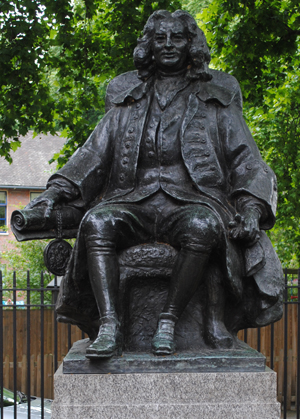
He subsequently moved his collection out to this property and his connection with Chelsea is still celebrated in place names such as name Sloane Square (not to mention Sloane Street, Sloane Gardens, Hans Street, Hans Crescent, Hans Road and Hans Place). There is also a statue of the bewigged man in Duke of York Square (pictured), not far from Sloane Square – this is a 2007 copy of 1737 original by John Rysbrack, another (older) copy of which can be found in the Chelsea Physic Garden.

Following Queen Anne’s death in 1714, in 1716 Sir Hans was appointed physician to her successor, King George I (he was also created a baronet the same year, becoming the first medical practitioner to receive a hereditary title).

Three years later, in 1719, he become president of the Royal College of Physicians, an office he held for 16 years, and in 1727, he was appointed physician to King George II. The same year he succeeded Isaac Newton as president of the Royal Society, an office which he held until 1741.

In 1742, Sir Hans retired to his property in Chelsea.

By the time of his death on 11th January, 1753 at the ripe old age of 93, Sir Hans had collected more than 71,000 objects including books, manuscripts, drawings, coins and medals and plant specimens which he bequeathed to King George II in exchange for a payment of £20,000 to his executors.

Parliament agreed, following a lottery to raise the money, his collection went on to form the basis of the British Museum, first opened to the public in 1759 in Bloomsbury. It was also to form the basis of the museum’s later offshoot, the Natural History Museum at South Kensington.

Sir Hans was buried at Chelsea Old Church with his wife Elizabeth who died in 1724.

Around London – Website to showcase UK’s oil paintings; Arctic explorer John Rae gets Blue Plaque; sharing experiences of kindness; and Toulouse-Lautrec and Jane Avril hit the Courtauld…

• A new website has been launched to showcase the UK’s vast national collection of oil paintings. While the website, which is a partnership between the BBC, the Public Catalogue Foundation, and participating collections and museums, currently hosts around 60,000 works, it is envisaged that by the end of 2012 it will carry digitised images of all 200,000 oil paintings in the UK (in an indicator of how many there are, the National Gallery currently has around 2,300 oil paintings, about one hundredth of all those in the nation). The works on the site will eventually include almost 40,000 by British artists. The 850 galleries and organisations participating so far include 11 in London – among them the National Gallery, the Tate Gallery, the Victoria and Albert Museum, the Bank of England, the Imperial War Museum and Dr Johnson’s House. For more, see www.bbc.co.uk/arts/yourpaintings/

• Arctic explorer John Rae has had a Blue Plaque unveiled in his honor at his former home in Holland Park. Although his feats were relatively unsung in his lifetime, the explorer’s expeditions in the Canadian Arctic saw him travel 13,000 miles by boat and foot and survey more than 1,700 miles of coastline. He is also credited with having “signposted” the only north-west passage around America that is navigable without icebreakers. Rae, who died in 1893, lived at the property at 4 Lower Addison Gardens in Holland Park for the last 24 years of his life.

Transport For London is calling on Londoners to share experiences of “kindness” that they have witnessed or participated in while travelling on the Underground. Artist Michael Landy has created a series of posters which are calling on people to submit their stories. Some of the stories will then be shown at Central Line stations (the first four posters go up on 23rd July at stations including Hollard Park, Holborn and Liverpool Street). For more, go to www.tfl.gov.uk/art.

On the Olympic front, the City of London Corporation has announced Tower Bridge will be bedecked with a set of giant Olympic Rings and the Paralympic Agitos during the 45 days of next year’s Games. Meanwhile, the Corporation has also unveiled it will host next week the launch of a London-wide campaign to get people involved in sport and activity in the lead-up to the Games. More to come on that.

On Now: Toulouse-Lautrec and Jane Avril Beyond the Moulin Rouge. The Courtauld Gallery, based at Somerset House, is running an exhibition celebrating the “remarkable creative partnership” between Jane Avril, a star of the Moulin Rouge in Paris during the 1890s, and artist Henri de Toulouse-Lautrec. Lautrec created a series of posters featuring Avril which ensured she became a symbol of Lautrec’s world of “dancers, cabaret singers, musicians and prostitutes”. Runs until 18th September. See www.courtauld.ac.uk for more.


What’s in a name?…Knightsbridge

Now famed for its shopping and proximity to museums, the former village of Knightsbridge takes its name from a bridge which once spanned the Westbourne River (a river now located underground which flows from Hampstead down through Sloane Square to enter the Thames at Chelsea) and linked the village of Kensington with London.

While the origins of the bridge’s name remain shrouded in mystery (the bridge itself reportedly stood at what is today Albert Gate), the anecdotal stories which might explain it include a tale that two knights once fought here and another which attributes the name to the fact that the area was thought so unsafe that to come without a knight was considered foolhardy. Indeed the name Knightsbridge was once synonymous with highwayman and robbers waiting to plunder passersby.

While the name is apparently not mentioned in the Doomsday Book, by the 13th century it is listed as a manor belonging to the monks at Westminster Abbey (this was apparently a gift from King Edward I – in fact some accounts have the area also recorded as King’s Bridge, Kyngesbrigg). One of the key events which the area apparently hosted was the meeting of Empress Matilda with representatives of London’s citizens in 1141 during her ongoing fight for supremacy with King Stephen.

The area remained relatively rural – and as a village in its own right – until the late 18th century when the area finally became joined to the ever-expanding metropolis.

These days Knightsbridge is little more than a road and a strip of highly developed land to the south (Westminster City Council’s Knightsbridge conservation area, which contains more than 275 listed buildings, runs as far east as Queen’s Gate) but it does boast some very high end shopping – think Harrods (pictured), founded in 1824 and opened on the current site almost 30 years later, and Harvey Nichols, founded in 1813.

There’s also some very grand late Victorian residential real estate (much of which is owned by the the Duke of Westminster and Earl Cadogan), which, along with new developments, have made Knightsbridge one of the highest price property markets in London (and indeed, the world).

The eastern end of Knightsbridge – Westminster Council include Royal Albert Hall in its Knightsbridge Conservation Zone – runs into the museum district of South Kensington, home to some of London’s best museums, including the Victoria & Albert Museum and the National History Museum.

PICTURE: Wikipedia

Treasures of London – Admiral Lord Nelson’s coat

It was roughly two hours into the Battle of Trafalgar on 21st October, 1805, about 1.15pm, that Great Britain’s most famous seaman, Admiral Horatio Lord Nelson, was fatally struck by a musket ball.

Fired by a marksmen in the rigging of the French ship Redoubtable, the musket ball struck him in the left shoulder as he stood on the deck of his flagship, HMS Victory.

Having fallen to his knees, he was spotted by the Victory‘s captain, Thomas Hardy, before he collapsed. Carried below the decks to the ship’s cockpit, it was there that he died (the Victory can still be visited at Portsmouth).

His damaged coat, meanwhile, was placed under the head of Midshipman George Augustus Westphal, who was being treated for his injuries nearby. Blood from the midshipman (late himself an admiral) stuck his hair to one of the epaulettes, part of which was was cut away and retained by his family as a memento.

The “undress jacket” was later returned to Nelson’s mistress, Emma Lady Hamilton, in accordance with his wishes. She later gave it to Joshua Jonathan Smith, Lord Mayor of London in 1810-1811, to as payment of a debt just prior to retiring to France in 1814. It was Prince Albert, the consort of Queen Victoria, who later purchased the coat for £150 from Smith’s widow and presented it to Greenwich Hospital in 1845.

The jacket can now be found in the National Maritime Museum in Greenwich (housed in a section of the former Naval College). Along with the fatal musket ball hole on the left shoulder, the tails and left sleeve of the jacket are stained with the blood of John Scott, Nelson’s secretary, who had died in the early moments of the battle on the spot where Nelson was later shot. It’s also possible to see where the epaulette was damaged during the treatment of Midshipman Westphal.

The front of the coat also features embroidered versions of the four orders of chivalry awarded to Nelson – these are the star of the Order of the Bath, the Order of the Crescent awarded by the Sultan of Turkey, the Order of St Ferdinand and of Merit awarded by Ferdinand IV of Naples, and the German Order of St Joachim. According to the National Maritime Museum, “Nelson habitually wore them on all his uniform coats”.

The coat’s right sleeve is positioned as Nelson would have worn it – in 1797 he had lost his right arm at the Battle of Santa Cruz de Tenerife.

PICTURE: Vice-admiral’s undress coat worn by Nelson (1758-1805) at the Battle of Trafalgar. There is a bullet hole on the left shoulder, close to the epaulette. (c) National Maritime Museum, Greenwich, London, Greenwich Hospital Collection.

WHERE: National Maritime Museum, Romney Road, Greenwich, (nearest DLR station is Cutty Sark or Greenwich mainline station); WHEN: Open 10am to 5pm daily; COST: Free; WEBSITE: www.nmm.ac.uk.

Around London – The Tower hosts Royal Beasts; take a ride on a 1938 tube train; Lambeth Palace Library celebrates the King James Bible; and, see model cathedrals at Sir John Soane’s house…

• The history of the Royal Menagerie is the focus of a new exhibition on now at the Tower of London. Royal Beasts explores the history of the Tower menagerie which, founded during the reign of King John in the early 1200s, remained there for more than 600 years. Among the animals were lions (the first record of which dates from 1210), a grizzly bear (a gift from the Hudson Bay Company to King George III), elephants, tigers, ostriches and kangaroos. Highlights of the exhibition include modern animal sculptures by artist Kendra Haste and interactive sensory displays. The recently restored north wall walk and the never before opened Brick Tower will host some of the displays, including sights, sounds and smells of some of the animals. See www.hrp.org.uk/TowerofLondon.

A 1938 tube train will run along the western end of the Piccadilly Line this Sunday (that’s Father’s Day in case you’ve forgotten) as part of the London Transport Museum’s Heritage Vehicles on the Move 2011 programme. Leaving Northfields, the train will travel to High Street Kensington via Earl’s Court (crossing from the Piccadilly to the District Line in a move not normally experienced by the general public) before heading back down the District Line to Acton Town where it will change back onto the Piccadilly Line. The train will then undertake the “fishhook move”, visiting Heathrow Terminal 4 before going to Terminals 1,2,3 and 5. The entire journey is expected to last about two hours. Tickets, which can be purchased at the museum ticket desk or by calling 020 7565 7298, will need to be collected at Northfields Station. For more, see www.ltmuseum.co.uk/whats-on/events/vehicles-on-the-move.

• Lambeth Palace Library is celebrating the 400th anniversary of the King James Bible with a new exhibition. The exhibits include a 1611 edition of the Bible as well as Medieval Bible translations, landmark editions of the Bible which drew on the textual scholarship of the Renaissance and Reformation and early printed vernacular versions. Runs until 29th July. Admission is by pre-booking only. For information on buying tickets and more, see www.lambethpalacelibrary.org/content/2011exhibition.

On Now: Time is running out to see Sir Herbert Oakley’s collection of 27 models of European and English cathedrals at the Sir John Soane Museum. The models were made in the 1850s by William Gorringe, who was a modelmaker by appointment to Queen Victoria. Runs until 25th June. For more, see www.soane.org/exhibitions/