10 most viewed posts of 2013 (so far)..

Stay tuned – we’re launching our new Wednesday series next week. In the meantime, here’s a link to our 10 most viewed posts on Exploring London for the first quarter of this year (counting backwards from 10)…

10. LondonLife – The city illuminated…

9. Treasures of London – Admiral Lord Nelson’s coat

8. Where is it?…#58

7. LondonLife – A new crown for King Henry VIII…

6. Where is it?…#60…

5. Where’s London’s oldest…church?

4. Where’s London’s oldest…Thames tunnel?

3. Lost London – The ‘Tyburn Tree’

2. Treasures of London – The Cheapside Hoard

1. Where’s London’s oldest…department store?

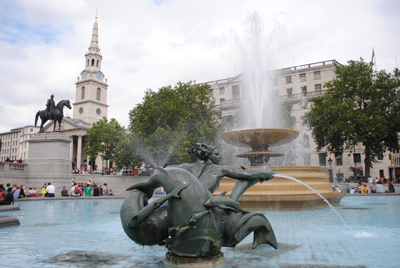
What’s in a Name?…Trafalgar Square

It wasn’t until some time after Admiral Lord Nelson’s victory over the French fleet in the Battle of Trafalgar off the coast of Spain on 21st October, 1805, that the large public space in Westminster we now know as Trafalgar Square took its name.
Prior to the development of the square, much of the area it covers was occupied the King’s Mews – stables linked to the Palace of Whitehall – and was simply seen as part of the district known as Charing Cross (named for the memorial cross which stood close to where the equestrian statue of King Charles I now stands – for more on this, see our earlier post and follow the links).

Following the relocation of the Mews in the early 19th century, plans were drawn up by architect-of-the-age John Nash to redevelop the area while the square itself, completed in 1845, was designed by Sir Charles Barry (best known for his work on the Houses of Parliament).

The final design incorporated a statue of Admiral Lord Nelson atop a column, known as ‘Nelson’s Column’, in the centre – apparently against Barry’s wishes (see our earlier post for more on Nelson’s Column).

Originally designed with an upper terrace and a lower piazza linked by stairs at the eastern and western end of the terrace, the square contains two fountains on either side of the column – the current fountains were designed by Sir Edwin Lutyens in 1937-9 and replaced earlier ones.

It was originally suggested that the square be named King William IV Square but it was apparently architect George Ledwell Taylor who provided the alternative of Trafalgar Square in honor of Nelson’s great battle.

Bordered by significant landmarks including the National Gallery to the north, the church of St Martin’s-in-the-Fields to the north-east, South Africa House to the east and Canada House to the west, the square stands at the confluence of a number of major roadways including Whitehall, Strand, Charing Cross Road and The Mall.

Aside from the aforementioned statue of King Charles I, monuments within the square include Nelson’s Column along with plinths set in the four corners of the square. These bear statues of King George IV, Victorian military figures General Sir Charles James Napier and Major-General Sir Henry Havelock while the fourth plinth, located in the north-west corner, was originally intended to bear an equestrian statue of King William IV.

Instead, it was left empty for many years before the advent of the Fourth Plinth project under which a variety of contemporary artworks – most recently a massive sculpture of a boy astride a rocking horse – have occupied the space (you can see a picture of the current work in our earlier post here).

The square, once known as the home of thousands of pigeons before these were banished midway through last decade to allow greater public use of the space, also features the busts of three admirals – John Jellicoe, David Beatty and Andrew Cunningham, located against the north wall under the terrace.

There are also two statues on a lawn in front of the National Gallery – these are of US President George Washington and King James II. Curiously, the square also features a small pillar box in the south-east corner, referred to by some as the smallest police station in London.

A renovation project in 2003 pedestrianised the roadway along the north side of the square and installed a central stairway between the the upper and lower levels along with lifts, public toilets and a cafe.

For some more on the history of Trafalgar Square, see Jean Hood’s Trafalgar Square: A Visual History of London’s Landmark Through Time.

LondonLife – The ‘Royal River’ celebrated at the National Maritime Museum

Canaletto’s image of Greenwich Hospital from the north bank of the Thames (1750-52) is among almost 400 paintings, manuscripts and objects selected to be part of the National Maritime Museum’s new exhibition, Royal River: Power, Pageantry & The Thames.

Curated by historian David Starkey, the exhibition, part of the Diamond Jubilee celebrations, focuses on the use of the river across five centuries covering events including Anne Boleyn’s coronation procession and Admiral Lord Nelson’s stately funeral through to the evolving Lord Mayor’s pageant and the ‘Great Stink’ of the mid-1800s.

Highlights include the oldest known copy of Handel’s Water Music, the sixteenth century Pearl Sword (which the monarch must touch on entering the City of London), a stuffed swan, treasures from the City’s livery companies, and another Canaletto work – this time his famous view of the river filled with boats getting ready for the Lord Mayor’s Day, seen as an inspiration for this year’s Diamond Jubilee Pageant and on show in the UK for the first time since its completion.

As well as celebrating the Diamond Jubilee, the exhibition also marks the 75th anniversary of the opening of the National Maritime Museum by King George VI on 27th April, 1937. The king’s speech from that day and his Admiral of the Fleet uniform also feature in the exhibition.

WHERE: National Maritime Museum Greenwich (nearest DLR station is Cutty Sark); WHEN: Daily 10am to 5pm (opening times may vary during the Paralympic and Olympic Games) until 9th September; COST: £11 adult/£9 concession/family ticket £24.50; WEBSITE: www.rmg.co.uk.

PICTURE: © National Maritime Museum, London

Treasures of London – Painted Hall, Greenwich

Often described as the “finest dining hall in Europe”, the Painted Hall in Greenwich was originally designed to be the Royal Hospital for Seamen’s communal dining hall. 

But the domed hall, which forms part of King William Court – the image, right, is taken from the west end, wasn’t used as such following its completion in the mid 1720s – designed by Sir Christopher Wren and his assistant Nicholas Hawksmoor with spectacular interior paintings by Sir James Thornhill, it was deemed too grand for such a mundane purpose and instead the veteran seamen, who had moved their dining hall to the undercroft, acted as tour guides for those who would pay to see its splendour.

The paintings, for which Thornhill received his knighthood, took almost 20 years to complete. They were designed to show Britain’s naval power as well as a variety of royal subjects in their splendour. The Stuart dynasty are featured on the ceiling of the Lower Hall while the West Wall depicts the Hanoverians – King George I surrounded by his children and grandchildren including the future King George II. Thornhill himself is also present on the lower right hand section of the West Wall painting while in the background is the dome of St Paul’s Cathedral – a reference to Sir Christopher Wren.

The hall has since served a variety of purposes but among the most significant events to take place there was the lying in state of the body of Admiral Lord Nelson following his death in the Battle of Trafalgar in October, 1805. A plaque at the top of the hall marks the spot where the coffin stood.

Between 1834 and 1936, the Painted Hall served as the National Gallery of Naval Art during which more than 300 paintings around naval themes were displayed there (today these form part of the basis of the National Maritime Museum’s art collection).

After an extensive restoration, in 1939 it was again used as a dining room for officers attending the Royal Naval College and for other grand dinners, including one celebrating the formation of the United Nations in 1946.

It’s now available for hire and has also served as a film location – including for films such as The Madness of King George, Quills and the more recent film Pirates of the Caribbean: On Stranger Tides.

An appeal has been launched to restore the hall with the expected nine month, £450,000 restoration of the West Wall paintings slated to begin after the Olympic Games. To donate, head here.

WHERE: King William Court, Old Royal Naval College, Greenwich (nearest Docklands Light Rail station is Cutty Sark for Maritime Greenwich). WHEN: 10am to 5pm daily COST: Free; WEBSITE: www.ornc.org/visit/attractions/painted-hall.

Exploring London’s 10 most popular posts for 2011 – Numbers 10 and 9…

As we approach the end of the year, we’re taking a look back at our 10 most popular posts for 2011. We start the countdown with numbers 10 and 9…

10. LondonLife – The Royal Menageriein which, inspired by what was a new exhibition at the Tower of London, we take at the Royal Menagerie kept there by England’s monarchs for more than 600 years;

9. Treasures of London – Admiral Lord Nelson’s coat: part of a series looking at some of the many, many ‘treasures’ of London, this piece focused on the coat which Admiral Lord Nelson when he was fatally shot aboard the HMS Victory during the Battle of Trafalgar and which can now be seen at the National Maritime Museum in Greenwich (complete with bullet hole).

Stay tuned by numbers 8 and 7 tomorrow. We love to hear from you if there was a particular post that was your favorite. Leave your comment below…

Around London – Dickens’ supernatural leanings at the British Library; Art Fund looking to relocate Shop in a Bottle; HMS Belfast closed; and, Winter Wonderland returns to Hyde Park…

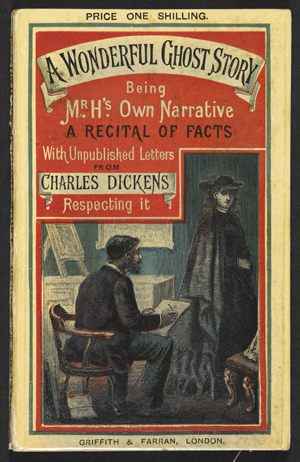
• Next year – 7th February to be precise – marks 200 years since the birth of celebrated 19th century novelist Charles Dickens and to mark the bicentenary, London institutions are among those across the country organising a raft of exhibitions under the banner of Dickens 2012. First up for us is a new exhibition launched this week at the British Library. A Hankering after Ghosts: Charles Dickens and the Supernatural explores the way in which Dickens used supernatural phenomena in his works (remember the ghosts of A Christmas Carol anyone?), while at the same time placing them in the context of the “scientific, technological and philosophical debates of his time”. The exhibition includes a letter from Dickens to his wife Catherine written in 1853 (this alludes to a disagreement which arose between them after Catherine became jealous of the attention Dickens was paying to another lady; he apparently used mesmerism to treat Catherine’s “nervous condition”), an article in an 1858 Household Words magazine in which Dickens questions the motivation of the spirits who supposedly tapped out messages to spiritualists, and, a 1821 copy of The Terrific Register: or, record of crimes, judgements, providences and calamities, a publication which was one of Dickens’ favorite reads as a youth. There is a range of accompanying events including talks by Dickens’ biographer Claire Tomalin (author of Charles Dickens: A Life) and John Bowen, author of Other Dickens: Pickwick to Chuzzlewit. Admission is free. Runs until 4th March. For more, see www.bl.ukImage: Courtesy of British Library
• The Art Fund has launched an appeal to have Yinka Shonibare’s Ship in a Bottle, currently sitting atop Trafalgar Square’s fourth plinth, relocated to a permanant home outside the National Maritime Museum in Greenwich. The fund, which has kick started the campaign with a £50,000 grant, needs £362,500 to buy the work – a scaled down replica of Nelson’s flagship, HMS Victory – which has been on display in Trafalgar Square since May, 2010, but is due to be removed in January next year. The replica work features 80 cannon and 37 sails, set as on a day of battle, and is made out of materials including oak, hardwood, brass, twine and canvas. For more, see www.artfund.org/ship/.

• The historic ship HMS Belfast, moored on the Thames between London Bridge and Tower Bridge, has been closed until further notice after a section of gangway which provides access to the ship collapsed earlier this week. Two contractors received minor injuries in the collapse and staff and visitors were evacuated by boat. The HMS Belfast is described as the most significant surviving Royal Navy warship from World War II and later served in places like Korea. It contains extensive displays on what life was like aboard the vessel. Keep on eye on www.iwm.org.uk for more information.

Now On: Winter Wonderland in Hyde Park. Hyde Park’s annual festival of all things Christmas is on again and this year’s festive offerings include, an ice rink, circus, giant observation wheel, rides and the chance for younger people to visit Santa Land as well as a plethora of opportunities to purchase presents at the Angels Christmas Market and warm-up with some of the fare available at eateries including the Bavarian Village, English Food Fair, and Spiegel Saloon. Winter Wonderland is free to enter and open between 10am and 10pm daily. Runs until 3rd January. For more, see www.hydeparkwinterwonderland.com.

Around London – National Maritime Museum expands; new galleries proposed for British Museum; Festival of British Archaeology in London; and, the London Street Photography Festival…

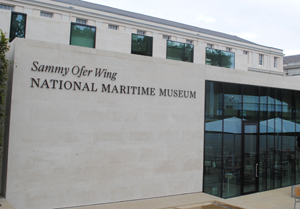
The National Maritime Museum in Greenwich opened the doors of its new £36.5 million Sammy Ofer Wing today. The new, architecturally slick extension – which is being touted as bringing with it a change of direction in the way the museum operates – features a new permanent gallery known as Voyages as well as a temporary exhibition space, library and archive. There’s also a lounge, cafe and brasserie – the latter boasting views out over Greenwich Park. The Voyages gallery has been designed as an introduction to the museum and features a 30 metre long thematic ‘object wall’ hosting more than 200 objects – everything from a letter written by Horatio Nelson to his mistress Emma Hamilton while he was on board the Victory in 1803 through to a watch belonging to Robert Douglas Norman – among those who perished on the Titanic, and a somewhat battered Punch puppet. The special exhibition space initially hosts High Arctic which uses technology to create an “immersive environment” exploring the Arctic world from the perspective of the future. The museum is also introducing the Compass Card scheme, a new initiative which will eventually be rolled out across the museum. Visitors are presented with a unique card with which, by inserting it into special units placed in galleries, they can flag their interest in receiving further information on a specified subject. The card can then be used to call up related archival information in the museum’s Compass Lounge or using the visitor’s home computer. For more information, see www.nmm.ac.uk.

The British Museum has announced funding has been secured for two new gallery spaces. These will include a new gallery looking at the history of world money from 2000 BC to present day. Known as the Citi Money Gallery, it will be opened in 2012. A donation from Paul and Jill Ruddock, meanwhile, means the museum will also be working on a major redisplay of Room 41 which covers the Mediterranean and Europe from 300 to 1,100 AD. The artefacts in the room include treasures taken from Sutton Hoo and the Vale of York Viking Hoard. The gallery will open in 2013/14. For more, see www.britishmuseum.org.

Now On: Festival of British Archaeology. Coordinated by the Council for British Archaeology, the 21st festival (formerly known as National Archaeology Week) kicks off this weekend and runs until the end of July. It boasts more than 800 events across Britain including in London where they include guided tours of the Rose Theatre, a range of Roman themed events and activities – including a gladiator show – at the Museum of London, gallery talks at the Bank of England Museum and British Museum, the chance to visit the Billingsgate Roman House and Baths, and a guided walk of Londinium (Roman London) organised by All Hallows by the Tower. For a complete events listing, see http://festival.britarch.ac.uk/.

Now OnThe London Street Photography Festival is running until the end of the month with a series of exhibitions, talks, walks and workshops, the majority of which are taking place in and around King’s Cross. Key events include Street Markets of London in the 1940s – Walter Joseph featuring never before seen images at the British Library, Vivien Maier: A Life Uncovered at the German Gymnasium, and Seen/Unseen – George Georgiou and Mimi Mollica at the Collective Gallery. For more information, see www.londonstreetphotographyfestival.org.

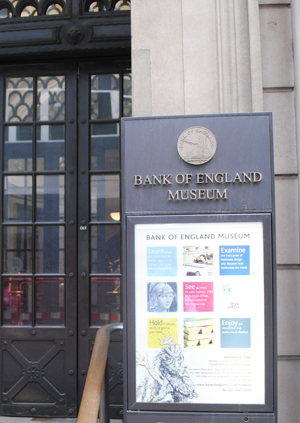
10 small (and fascinating) museums in London…2. Bank of England Museum

The Bank of England Museum, located on the east side of the “Old Lady of Threadneedle Street”, provides a fascinating account of life behind the bank’s fortress-like walls, spanning the period from its origins and founding in 1694 to its nationalisation in post-World War II Britain through to the high-tech nature of banking – and banknotes – today. 

The museum is partly housed in a 1988 reconstruction of architect Sir John Soane’s 1793 stock office (Sir John designed the bank’s original headquarters –  much of this was later demolished with the exception being the outer windowless walls of the bank which still frown down on passersby) as well as in the Rotunda – designed by Herbert Baker and dating from the 1930s, it features some of the original Caryatids which decorated Soane’s design.

Highlights among the permanent exhibition include the Great Iron Chest, a precursor to today’s safes dating from around 1700, the Bank of England Charter of 1694 still afixed with the Great Seal, the earliest known Bank of England running cash note (relating to a deposit of £22 and dating from 1697), muskets and pistols used for security at the bank, and documents relating to some of the bank’s more high profile customers (these include Admiral Lord Nelson and former US President George Washington) as well as extensive collection of banknotes and coins. There’s also the opportunity to feel the weight of a solid gold bar (worth £393,884 at the time of our visit).

The exhibition also includes a display on Kenneth Grahame, author of The Wind in the Willows and a long-time (30 year) employee of the bank until his sudden resignation, possibly in part due to him being shot by an intruder several years before, in 1908, only four months before his internationally renowned book was published. Key artifacts include his resignation letter in which he asks for “relief” from the burden of his responsibilities at the bank.

Among current temporary exhibitions is The Pound in Your Pocket which looks in detail at the issue of inflation through a variety of entertaining devices including a balance in which you have to keep inflation at a level during a series of “economic shocks”.

WHERE: The Bank of England Museum, Bartholomew Lane off Threadneedle Street (nearest Tube stations are Bank/Monument and Mansion House); WHEN: 10am to 5pm, Monday to Friday (last entry 4.45pm); COST: Free; WEBSITE: www.bankofengland.co.uk/education/museum/index.htm.

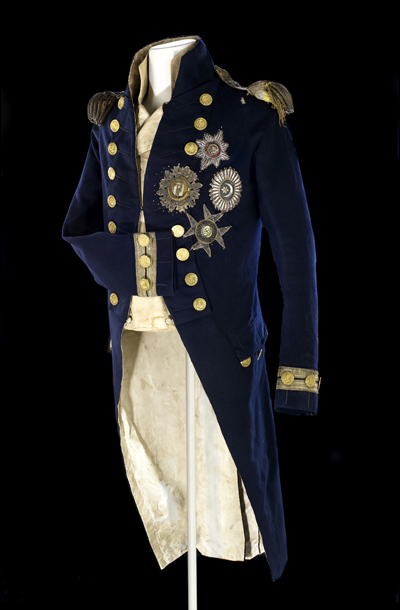
Treasures of London – Admiral Lord Nelson’s coat

It was roughly two hours into the Battle of Trafalgar on 21st October, 1805, about 1.15pm, that Great Britain’s most famous seaman, Admiral Horatio Lord Nelson, was fatally struck by a musket ball.

Fired by a marksmen in the rigging of the French ship Redoubtable, the musket ball struck him in the left shoulder as he stood on the deck of his flagship, HMS Victory.

Having fallen to his knees, he was spotted by the Victory‘s captain, Thomas Hardy, before he collapsed. Carried below the decks to the ship’s cockpit, it was there that he died (the Victory can still be visited at Portsmouth).

His damaged coat, meanwhile, was placed under the head of Midshipman George Augustus Westphal, who was being treated for his injuries nearby. Blood from the midshipman (late himself an admiral) stuck his hair to one of the epaulettes, part of which was was cut away and retained by his family as a memento.

The “undress jacket” was later returned to Nelson’s mistress, Emma Lady Hamilton, in accordance with his wishes. She later gave it to Joshua Jonathan Smith, Lord Mayor of London in 1810-1811, to as payment of a debt just prior to retiring to France in 1814. It was Prince Albert, the consort of Queen Victoria, who later purchased the coat for £150 from Smith’s widow and presented it to Greenwich Hospital in 1845.

The jacket can now be found in the National Maritime Museum in Greenwich (housed in a section of the former Naval College). Along with the fatal musket ball hole on the left shoulder, the tails and left sleeve of the jacket are stained with the blood of John Scott, Nelson’s secretary, who had died in the early moments of the battle on the spot where Nelson was later shot. It’s also possible to see where the epaulette was damaged during the treatment of Midshipman Westphal.

The front of the coat also features embroidered versions of the four orders of chivalry awarded to Nelson – these are the star of the Order of the Bath, the Order of the Crescent awarded by the Sultan of Turkey, the Order of St Ferdinand and of Merit awarded by Ferdinand IV of Naples, and the German Order of St Joachim. According to the National Maritime Museum, “Nelson habitually wore them on all his uniform coats”.

The coat’s right sleeve is positioned as Nelson would have worn it – in 1797 he had lost his right arm at the Battle of Santa Cruz de Tenerife.

PICTURE: Vice-admiral’s undress coat worn by Nelson (1758-1805) at the Battle of Trafalgar. There is a bullet hole on the left shoulder, close to the epaulette. (c) National Maritime Museum, Greenwich, London, Greenwich Hospital Collection.

WHERE: National Maritime Museum, Romney Road, Greenwich, (nearest DLR station is Cutty Sark or Greenwich mainline station); WHEN: Open 10am to 5pm daily; COST: Free; WEBSITE: www.nmm.ac.uk.

LondonLife – St Paul’s celebrates 300 years since its completion…

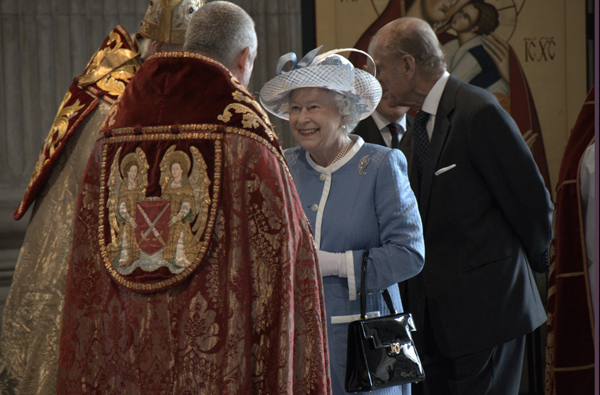
Queen Elizabeth II attends the tercentenary service at St Paul’s. PICTURE: Graham
Lacdao/St Paul’s Cathedral

A service was held at St Paul’s today in celebration of the 300 year anniversary of the cathedral’s completion.

The tercentenary service also marks the end of a massive 15 year, £40 million repair and cleaning project, meaning the cathedral is now clear of scaffolding for the first time in 15 years.

Designed by the indomitable Sir Christopher Wren, work on St Paul’s Cathedral began in 1677 and was formally completed in 1710 (although it had been holding services since 1697). (For more on the history of St Paul’s, see our earlier post, part of our series on Wren’s London, here).

Said to have the largest dome after St Peter’s in Vatican City, St Paul’s has been at the centre of London’s (and the United Kingdom’s) religious and political life for centuries, hosting state funerals (Lord Nelson, the Duke of Wellington and Winston Churchill’s were all held here) as well as the royal wedding of Prince Charles and Lady Diana and many celebration services.

Sights include the crypt – containing the tombs of both Nelson and Wellington – and the Whispering Gallery (see our earlier post on the Whispering Gallery here) as well as the exterior viewing galleries.

To celebrate the cathedral’s liberation from scaffolding, St Paul’s is holding a 300th Anniversary Photography Competition in which photographers are invited to submit their best exterior shots of the building. The 10 winning images will then be displayed in the cathedral crypt. The competition runs until 16th July.

To enter, upload pictures to St Paul’s 300th anniversary competition group at Flickr – www.flickr.com/groups/stpaulslondon/. For more information, see www.stpauls.co.uk/photocomp.

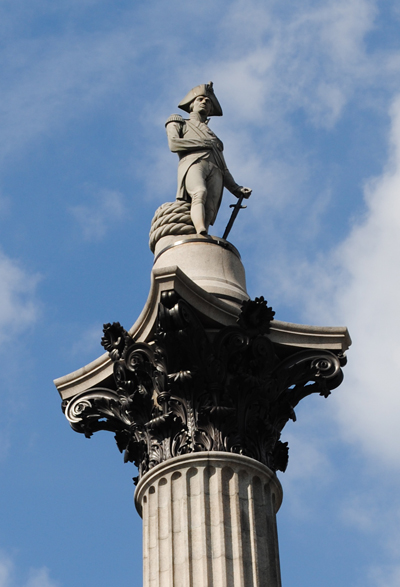
Treasures of London – Nelson’s Column

Towering over Trafalgar Square, Nelson’s Column was constructed in the 1840s to commemorate the man many believe to be Britain’s greatest naval hero, Admiral Lord Nelson.

Parliament started discussions on a monument commemorating Nelson only 10 years after his death at the Battle of Trafalgar in October 1805, but it wasn’t until 1838 that the Nelson Memorial Committee was finally formed and public subscriptions called for to raise funds for the monument.

The government agreed to provide the location and, following a controversial competition (which had to be run twice), William Railton’s designs showing a Corinthian column topped by a statue of Nelson (which it was stipulated had to be made by EH Bailey) with four lions at its base, was adopted.

The column was completed in 1843. It featured a bronze capital, made from old cannons taken from the Woolwich Arsenal and shaped in the form of acanthus leaves, and Bailey’s 5.5 metre (17 foot) tall statue of Nelson (made from Craigleith sandstone quarried in Scotland and donated by the Duke of Buccleuch). The four bronze identical lions, made by sculptor Sir Edwin Landseer and said to be modelled on a dead cat from a zoo, were not added until 1867.

On the column’s pedestal are four bronze relief panels showing Nelson’s four great victories – the Battle of Cape St Vincent, the Battle of the Nile, the Battle of Copenhagen and the Battle of Trafalgar, the scene of which depicts the admiral in the throes of dying (he was killed by a musket bullet fired from the French vessel Redoubtable and was carried below decks where he died). They were apparently made from French guns captured at each of the battles.

The Grade I-listed column, which cost £47,500 to build, was refurbished in a four month exercise costing £420,000 in 2006, during which it was discovered that it was actually 16 foot shorter than had previously been thought (its total height, to the tip of Nelson’s hat, is actually 169 feet instead of the 185 feet previously supposed). It had previously been refurbished in 1986 and in 1968. You can see a gallery of images taken during the most recent restoration here.

Interestingly, it is reported that just before Bailey’s statue was raised to the top of the column in 1843, 14 stonemasons who had worked on it during construction held a celebration dinner party on the plinth at the top.

Around London – West End’s VIP day; National Curry Week; Kenwood House to close for repairs; and Horatio’s handwriting…

• Oxford Street and Regent Street in London’s West End will be closed to cars and buses this Saturday (27th November) as part of the sixth annual West End VIP Day. The day, which is sponsored by American Express,  will also bring singers, entertainers and celebrities hit the streets as they fundraise for the Starlight Children’s Foundation. Other entertainment will include a seven foot climbing wall on Regent Street, giant TV screens, fair ground style rides and the chance to climb inside a lifesize snow globe. Runs from 9am to 10pm. For more information, see www.westendlondon.com/vip.

• This week was National Curry Week, so to celebrate, we thought we’d tell you about London’s oldest curryhouse (in fact it’s said to be the oldest in the UK). Veeraswamy was founded in 1926 at its current location of 99 Regent Street (entry via Swallow Street) by, according to the restaurant’s website, “the great grandson of an English General, and an Indian princess”. Customers are said to have included Indira Gandhi, Charlie Chaplin, King Hussein of Jordan and Marlon Brando. See www.nationaleatingoutweek.com or www.veeraswamy.com.

Kenwood House in Hampstead, north London, is set to undergo major repair and conservation works meaning the house will be closed to the public from early summer 2012 for just over a year. The grounds will remain open. The current house was designed by Robert Adam and built over the period of 1762 to 1779 for William Murray, 1st Earl of Mansfield and the Lord Chief Justice. It now houses a collection of paintings bequeathed to the nation in 1927 by Edward Cecil Guinness, 1st Earl of Iveagh, which includes works by Rembrandt, Vermeer, Gainsborough and Turner. For more information, see www.english-heritage.org.uk/daysout/properties/kenwood-house/.

On now: Compare Horatio Nelson’s handwriting before and after he lost his right arm in battle at a special showing of two of his letters at the Wellcome Collection tomorrow night (26th November). The letters are part of Hands: Amazing Appendages, a one night only show. There will also be the chance to try out some nail art, try out some surgeon’s tools and hear talks and see performances. Admission is free (but some talks and performances will be tickets – tickets available on the night only from 7pm). See www.wellcomecollection.org/whats-on/events/hands.aspx.


Daytripper – The Historic Dockyard, Chatham

Once a pivotal player in ensuring the UK’s navy remained on top at sea, the Historic Dockyard in Chatham has been involved in preparing ships involved in some of history’s greatest naval engagements – everything from England’s defeats of the Spanish Armada in 1588 to Admiral Lord Nelson’s famous victory at the Battle of Trafalgar.

Located 35 miles south-east of London on the River Medway, these days the dockyard plays host to tourists rather than hundreds of craftsmen who once worked there, eager to gain an insight into its rich history (as well as two film crews for movies and TV series).

While the history of the dockyard on its present site goes back to the 1600s, most of the surviving buildings date from between 1700 to the end of the Napoleonic Wars in 1815, during which time the Chatham Dockyard built and launched 125 ships including Nelson’s Victory (which can now be found at Portsmouth).

The dockyard officially closed in 1984 and is now under the care of the Chatham Historic Dockyard Trust.

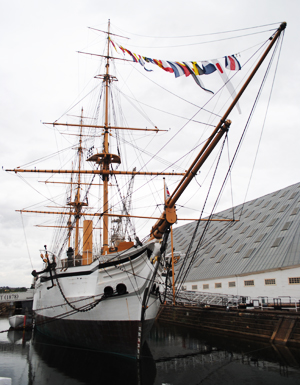
Attractions these days are many and range from the chance to ramble over historic warships permanently docked there – these include the sloop, the HMS Gannet – launched in 1878 it served as an anti-slaver and later as a training ship, the HMS Cavalier – launched in 1944, it was one of 96 emergency destroyers built during the Second World War and, having served in various places around the world until being ‘paid off’ in 1972, is now preserved as a memorial, and the last vessel built for the Royal Navy there, the Oberon class submarine HMS Ocelot – launched in 1962.

Other features include the Wooden Walls of England – an interactive walk-through looking at what life was like aboard England’s timber-hulled vessels of the mid-1700s, No 1 Smithery which now houses the maritime model collections of the National Maritime Museum and the Imperial War Museum as well as paintings and other artefacts, the Royal National Lifeboat Institution’s collection of historic lifeboats and The Royal Dockyard Museum which houses a large range of artefacts.

Also well worth a visit is the still working Victorian Ropery. Its curmudeonly attendants who provide a fascinating insight in what life was like for those formerly employed there and you can see how rope is still made in the 346 metre long rope house which, when constructed, was the longest brick building in Europe.

There’s also a cafe on site and a range of other odd artefacts at various locations – including the railway carriage used by Lord Kitchener in Sudan in 3 Slip – The Big Space – as well as the historic buildings of the dockyard itself.

There’s certainly more than can be seen in a day but thankfully all tickets are valid for a year.

WHERE: Chatham, Kent (nearest railway station is Chatham). For detailed driving instructions see website; WHEN: Open everyday until 12th December from 10am-4pm (check for times after that); COST: £15 an adult/£12.50 concessions/£10.50 children (aged five to 15 years)/£42.50 for a family; WEBSITE: www.thedockyard.co.uk