Lost London – Vauxhall Pleasure Gardens

First laid out in the mid 17th century, Vauxhall Pleasure Gardens, on the east bank of the Thames just south of Lambeth, rose in fame to become one of London’s leading public entertainment venues.

The gardens, initially known as New Spring Gardens, are believed to have opened around the time of the Restoration of 1660 on a site which had been formerly an estate owned by vintners John and Jane Vaux (Jane was apparently widowed).
Initially apparently no more than an ale-house with a garden attached, the gardens grew to span several acres and featured a central hub and long avenues for strolling. Admission was initially free with money made from food and drink sold there. Among the earliest recorded visitors to the gardens was John Evelyn in 1661, describing it as a “pretty contrived plantation” and diarist Samuel Pepys, who wrote of a visit he made on 29th May, 1662 (he is known to have returned numerous times).

From 1729, the gardens came under ownership and management of John Tyers, entrepreneur, property developer and patron of the arts, and it was he who, until his death in 1767, oversaw the transformation of the area into an arts hotspot which included sculpture (in particular a fine statue of the composer Handel), music, painting and architecture. Thanks partly due to the patronage of Frederick, Prince of Wales, the gardens become the fashionable place to be seen.

The variety of entertainment on offer at the gardens – the name of which was only officially changed to Vauxhall Gardens in 1785 – grew substantially over the years: from concerts and fireworks displays to performances by tight rope walkers and lion tamers and even re-enactments of famous battles. The gardens became renowned as site for balloon ascents and, for its architecture – the number of buildings there grew over the years to include a rococo ‘Turkish tent’, Chinese pavilion, and, another rococo building, the Rotunda (where concerts could be held in wet weather). There was also a cascade and private ‘supper boxes’ for those who could afford them; those who couldn’t could dine at tables set under the trees.

From the outset, Vauxhall was known as a place where the sexes could mix freely and, therefore, for romantic assignations – in fact, one area of the gardens became known as the ‘Dark Walk’ for the fact it was, unlike other areas of the gardens, never illuminated by lamps and it was in this area, frequented by prostitutes, that many of the more illicit liaisons took place.
By the late 1700s and early 1800s, the gardens, one of a number of pleasure gardens in London, had reached the height of their popularity with reportedly more than 60,000 people said to have  attending a fancy dress party held one night in the late 1700s.

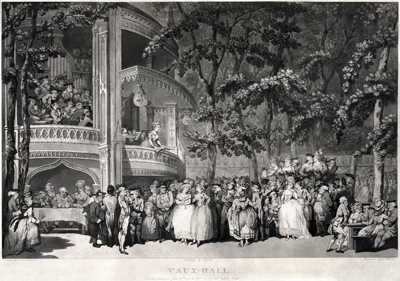
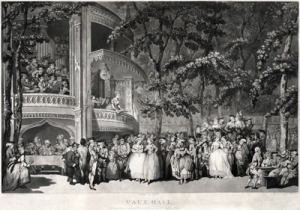
Those who attended events in the gardens included royalty as well as the likes of Samuel Johnson and James Boswell (see Thomas Rowlandson’s image above, Vauxhall Gardens, showing the likes of Johnson and Boswell, along with Georgina, Duchess of Devonshire, and the future King George IV, at the gardens in about 1779) as well as, much later, Charles Dickens (by the time Dickens visited, however, the heyday of the gardens was already well over).

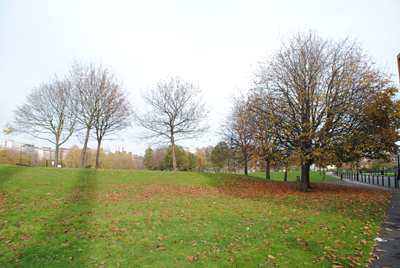
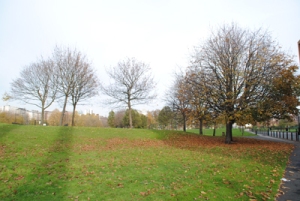
The gardens closed in 1859 due apparently to declining popularity and were eventually replaced with housing. After being badly bombed in World War II, however, the site once again returned to being a garden, known as Spring Gardens. The gardens (pictured) still occupy the site not far from Vauxhall tube station – part of them is used by the Vauxhall City Farm as paddocks for horses and livestock and they also contain a multi-use games court.

For an authoritative and comprehensive work on the Vauxhall Gardens, try David Coke and Dr Alan Borg’s Vauxhall Gardens: A History. There’s also much more information on David Coke’s website here. There’s also a detailed history here.

David Coke is curating an exhibition at The Foundling Museum, The Triumph of Pleasure, which looks at the way in which the gardens and the establishment of the Foundling Hospital in 1739 “changed the face of British art forever”. Runs from 11th May to 9th September. For more, see www.foundlingmuseum.org.uk.

PICTURES: Wikipedia and David Adams

Daytripper – Rochester

We’ve talked about the Medway town of Rochester earlier in the week as part of our Dickens series but it’s also worth talking about this town in Kent in its own right. 

While Dickens’ connection with the town is a key part of the reason for its charm, this town, which dates from as far back as Roman times and remained an important centre thanks to its strategic position on the Medway, has plenty more to offer.

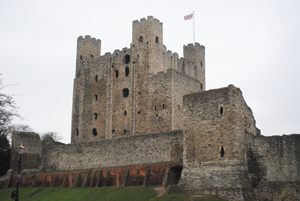
Foremost among its attractions are the Norman castle and cathedral. Rochester Castle has its origins in a wooden castle built soon after the Battle of Hastings in 1066 with the stone defences following soon after.

The tallest Norman keep in England, from which there are spectacular views, was built around 1127 on the order of its then owner, the Archbishop of Canterbury, William de Corbeil. It was about 90 years later, in 1215, when King John laid siege to it during the rebellion of his barons, only taking the castle after a seven week siege when his sappers undermined the south-east tower of the keep (famously it was the fat of 40 pigs which stoked the fire they laid in the tunnels under the tower). The castle was repaired and continued to be used until late medieval times when it fell into disuse and while much of the keep – the highest in England – is now ruined, it remains a stirring sight.

Rochester Cathedral, meanwhile, was first built in Saxon times (there has been a bishop here since 604) although no trace remains of this above ground. The current building, rather, dates from the Norman era – it was consecrated in 1130 in a ceremony attended by King Henry I – and was extensively added to over the following centuries with the completion of the Lady Chapel in 1492 the last major work. Among the most famous bishops here were Bishop Fisher and Bishop Ridley – both of whom died for their faith.

Strolling through the cobbled streets of this historic town, about 30 to 40 minutes from London by train, you’ll also come across the Guildhall Museum, which is housed in the 17th century guildhall and features a range of displays and exhibitions on the history of the Medway including a Dickens discovery room.

Also worth seeing is Eastgate House, the model for Dickens’ Westgate House and now the location of the Swiss chalet in which he wrote, and Restoration House – created from two medieval buildings in the 16th or 17th centuries and the inspiration for Miss Havisham’s home  (see our earlier post).

One unmissable gem is the Six Poor Travellers – an atmospheric and well preserved almshouse in the High Street which dates from Elizabethan times and has an amazing backstory which you can explore as you make your way through its narrow rooms.

Part of the charm of Rochester (and for more on Rochester generally visit www.cometorochester.co.uk/visit/index.htm) lies in its close proximity to Chatham and Gillingham and here you’ll find much more to amuse and entertain including Chatham’s Historic Dockyards (see our earlier daytripper on this), Fort Amherst, Britain’s largest Napoleonic fortress, and for those who can’t get enough of Charles Dickens, Dickens World.

Just to the north of Rochester is Upnor Castle, a rare surviving Elizabethan artillery fortress built to defend the fleet at Chatham Dockyard.

Celebrating Charles Dickens – 10. Four Dickens daytrips…

And so we come to the final in our series celebrating the bicentenary of the birth of author Charles Dickens. This week we thought we’d take a look at a few of the key places you can go for a daytrip from London to find more Dickens-related sites…

• Portsmouth. Dickens was born here on 7th February, 1812, and the modest home in which this took place is now the Charles Dickens Birthplace Museum (www.charlesdickensbirthplace.co.uk). The house featured three furnished rooms and an exhibition room with a display on Dickens’ connections with Portsmouth and memorabilia including the couch on which he died at Gad’s Hill Place. Fans from all over the world will be converged in Portsmouth later this year when the International Dickens Fellowship Bicentenary Conference 2012 is held over 9th to 14th August (www.dickensfellowship.org/Events/annual-conference-2012).

• Chatham and Rochester, Kent.  Dickens spent five years of his childhood (from 1817 to 1822) living in Chatham and as a result it and the neighbouring Medway town of Rochester helped to inspire some of the characters and places in some of his most famous works. Restoration House in Rochester, for example, is believed to have been the inspiration for Satis House, where Miss Havisham lived in Great Expectations while Eastgate House (pictured) features as Westgate in both The Pickwick Papers and as the Nun’s House in The Mystery of Edwin Drood. Until 2004, the house served as the Charles Dickens Centre and interestingly, the Swiss chalet in which Dickens wrote was moved here in the 1960s from Gad’s Hill Place – it can be seen over the fence. The area has celebrated its connections with Dickens with an annual festival every year since 1978 – this year’s takes place on the 8th, 9th and 10th June. See www.medway.gov.uk/leisureandculture/events/dickensfestival.aspx for more. (Late addition: We neglected to mention Dickens World located at Chatham, an interactive experience which recreates nineteenth century England – you can find more about it here www.dickensworld.co.uk).

• Broadstairs, Kent. Dickens first came to stay at this seaside resort in 1837 when he was 25-years-old and already had a reputation on the rise. He repeatedly returned over the next couple of decades. The Dickens House Museum (www.dickensfellowship.org/branches/broadstairs) was once the home of Miss Mary Pearson Strong on whom much of the character of Miss Betsey Trotwood in David Copperfield is believed to be based. It features a range of Dickens-related artefacts, including letters he wrote from or about Broadstairs. The Broadstairs Dickens Festival runs from 16th to 22nd June.

• Gad’s Hill Place, Higham, Kent. Dickens died here in 1870 after spending the last 13 years of his life living at the property. It’s now a school (www.gadshill.org) but the ground floor will be open to the public this summer, from 25th July to 19th August, for pre-booked tours of reception rooms and the study where he wrote Great ExpectationsOur Mutual FriendA Tale of Two Cities and the unfinished novel Edwin Drood. For more information on the tours, see www.dickensmuseum.com/news/gads-hill-place-to-open-to-public/.

This was the last in our series on Charles Dickens – next week we start a new series in honor of Queen Elizabeth II’s Diamond Jubilee. For more events surrounding the Dickens celebrations both in London and elsewhere, see www.dickens2012.org.

Celebrating Charles Dickens – 9. Dickens’ literary connections, part 2…

In which we continue our look at some of London’s connections with Dickens’ writings…

• ‘Oliver Twist’ workhouse, Cleveland Street. The building, recently heritage listed following a campaign to save it, is said to have served as the model for the workhouse in Oliver Twist and was apparently the only building of its kind still in operation when Dickens wrote the book in the 1830s. Dickens had lived as a teenager nearby in a house in Cleveland Street and was living less than a mile away in Doughty Street (now the Charles Dickens Museum) when he wrote Oliver Twist. Thanks to Ruth Richardson – author of Dickens and the Workhouse: Oliver Twist and the London Poor – for mentioning this after last week’s post.

• Clerkenwell Green. It is here that Mr Brownlow first comes into contact with Oliver Twist and, mistakenly suspecting him of stealing from him, chases him through the surrounding streets. Interestingly, the grass (which you would expect when talking about a green) has been gone for more than 300 years – so it wasn’t here in Dickens’ time either.

• Barnard’s Inn, Fetter Lane. It was here, at one of London’s Inns of Court, that Pip and Herbert Pocket had chambers in Great Expectations. Barnard’s Inn, now the home of Gresham College, is only one of a number of the Inns of Court with which Dickens and his books had associations – the author lived for a time at Furnival’s Inn while Lincoln’s Inn (off Chancery Lane) features in Bleak House and the medieval Staple Inn on High Holborn makes an appearance in his unfinished novel, The Mystery of Edwin Drood. And, as mentioned last week, Middle Temple also features in his books.

• ‘Dickens House’, Took’s Court. Renamed Cook’s Court in Bleak House, the house – located in a court between Chancery and Fetter Lane – was where the law stationer Mr Snagsby lived and worked in the book. It’s now occupied by music promoter and impresario Raymond Gubbay.

• London Bridge. The bridge, a new version of which had opened in 1831 (it has since been replaced), featured in many of Dickens’ writings including Martin Chuzzlewit, David Copperfield and Great Expectations. Other bridges also featured including Southwark Bridge (Little Dorrit) and Blackfriars Bridge (Barnaby Rudge) and as well as Eel Pie Island, south-west along the Thames River at Twickenham, which is mentioned in Nicholas Nickleby.

We’ve only included a brief sample of the many locations in London related in some way to Dickens’ literary works. Aside from those books we mentioned last week, you might also want to take a look at Richard Jones’ Walking Dickensian London,  Lee Jackson’s Walking Dickens’ London or, of course, Claire Tomalin’s recent biography, Charles Dickens: A Life.

Celebrating Charles Dickens – 8. Dickens’ literary connections, part 1…

London is redolent with sites which appeared in the books of Charles Dickens and, having had a look at his life, it’s time we turn our attention to some of the sites relevant to his writing. For the next two weeks, we’re looking at just a few of the many, many sites which feature in his novels. So, here’s seven places to get us going…

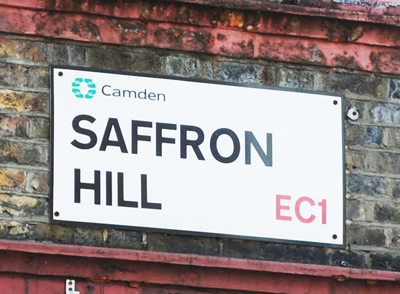
• Saffron Hill, Clerkenwell. Once a notorious slum akin to St Giles (see last week’s entry) and the city’s Italian Quarter, Saffron Hill is where Fagin and his gang of thieves operate in Oliver Twist and have their den.

• Chancery Lane, Holborn. Much of the novel Bleak House is set around this narrow street between High Holborn and Fleet Street – Tom Jarndyce kills himself in a coffee shop here in the novel and Lincoln’s Inn Hall – formerly home of the High Court of Chancery – also features.

• The Old Bailey. Some have suggested Dickens worked here as a court reporter although there is no compelling evidence he did so. But the the Old Bailey (the current building dates from the early 20th century, well after Dickens’ death) and Newgate Prison certainly featured in his books – it is here that Fagin is eventually hung in Oliver Twist.

• Child & Co’s Bank, Fleet Street. While the present building dates from 1878, Dickens is believed to have used the bank as the model for Tellson’s Bank in A Tale of Two Cities.

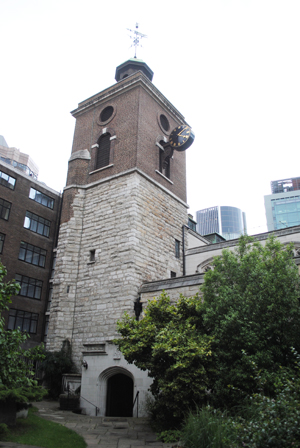
• St Dunstan-in-the-West, Fleet Street. In David Copperfield, David and his aunt, Betsy Trotwood, make a special trip to see the giants Gog and Magog strike the church bells. It also features in Barnaby Rudge and Dickens dedicated his Christmas story, The Chimes, to the church.

• Garden Court and Fountain Court (pictured), Middle Temple. Garden Court is where Pip lived in Great Expectations and where Abel Magwitch turned up to reveal himself as Pip’s benefactor. Fountain Court features in Martin Chuzzlewit as the site for the romance of Ruth Pinch and John Westlock.

• Golden Square, Soho. Mentioned in Nicholas Nickleby – Nicholas’ uncle, Ralph Nickleby, was thought to live in a previous building at number seven.

There’s some great books about London sites which appear in Dickens’ books – among them are Ed Glinert’s Literary London: A Street by Street Exploration of the Capital’s Literary Heritage and Michael Paterson’s Inside Dickens’ London as well as Paul Kenneth Garner’s 
A Walk Through Charles Dickens’ London.

Celebrating Charles Dickens – 7. Five other London sites of significance…

We’ve looked at Charles’ Dickens childhood in London and some of his residences, workplaces and the pubs he attended. Before we take a look at some of the sites relevant to his writings, Exploring London takes a look at just a handful of the many other London sites associated with the famous Victorian author…

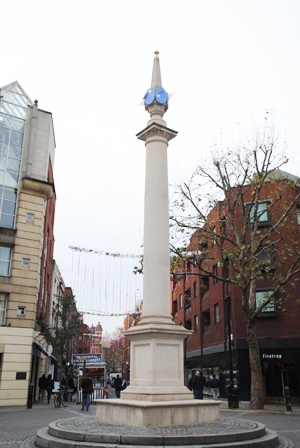
• Seven Dials and the former St Giles slum, Soho. An notorious slum of the 19th century, this area was among a number of “rookeries” or slums toured by Dickens in 1850 in the company of Inspector Field and police from Scotland Yard, and later helped to inform much of his writing. Seven Dials itself – located at the junction of Mercer and Earlham Streets and Upper St Martin’s Lane (pictured right is the monument at the junction’s centre) – has just undergone a renovation but much of the St Giles area is now irrevocably modernised. We’ll be mentioning another notorious slum located in Saffron Hill, Clerkenwell, in an upcoming week.

• Holland House, Kensington. Dickens became a friend of Lady Holland’s after attending one of her exclusive soirees at the age of 26. He was a guest at the house, now a youth hostel, in Holland Park on numerous occasions.

• Royalty House, Dean Street, Soho. The former site of the Royalty Theatre, known in Dickens’ day as Miss Kelly’s Theatre, it was here on 21st September, 1845, that Dickens and a group of friends performed Ben Jonson’s play, Every Man in his Humour (1598). Dickens acted as stage manager and director as well as playing the part of Captain Bobadil.

• Buckingham Palace. It was here in March 1870 – not long before his death – that Dickens had his only face-to-face meeting with Queen Victoria. She apparently found him to have a  “large, loving mind and the strongest sympathy with the poorer classes”.

• Westminster Abbey. Our final stop for it was here that Dickens was buried on 14th June, 1870, following his death at his home near Rochester in Kent. Dickens had apparently wanted to be buried in Rochester but given his public profile, Westminster Abbey was seen as the only fitting place of rest for him (his wishes for a small, private funeral were, however, respected but thousands did visit the site in the days following). His grave sits in Poet’s Corner.

10 London sites to celebrate Charles Dickens – 5. Seven pubs associated with Dickens (including one he never visited)…

There hardly seems to be a pub in London which doesn’t claim some connection with the Victorian author but we thought we’d confine ourselves to five pubs with more well-established credentials…

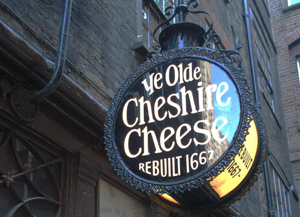
• Ye Olde Cheshire Cheese. This pub is a Fleet Street institution with parts of the current building dating back to 1667 when it was rebuilt following the Great Fire. Dickens was among numerous literary figures who frequented the premises – the pub is perhaps most famously associated with the lexicographer Dr Samuel Johnson (although there is apparently no recorded evidence he ever attended here); other literary figures who came here include Mark Twain and Sir Arthur Conan Doyle – and, according to a plaque in Wine Court, worked out of the pub for a period while producing his journal All The Year Round.

• The One Tun, Saffron Hill. Said to have been established as an ale house on its present site in 1759, the pub was rebuilt in the mid-Victorian era  and was apparently patronised by Dickens between 1833 and 1838. It’s also apparently the inspiration for the pub called The Three Cripples in Oliver Twist (The Three Cripples was actually a lodging house next door to the One Tun and didn’t sell ale). For more, see www.onetun.com

• The George Inn, Southwark. Dating from the 17th century, the George Inn in Borough High Street is the last galleried coaching inn left standing in London and is now cared for by the National Trust (and leased for use by a private company). Dickens is known to have come here when it was running as a coffee house and he mentions it in the book, Little Dorrit. For more, see     www.nationaltrust.org.uk/george-inn/.

• George & Vulture, Castle Court (near Lombard Street). Established in the 18th century on the site of an older inn, this well-hidden pub was not only frequented by Dickens but is mentioned in The Pickwick Papers more than 20 times.

• The Grapes, Limehouse. Formerly known as The Bunch of Grapes, there has been a pub on the site for almost more than 430 years. Dickens was known to be a patron here (his godfather lived in Limehouse) and mentioned the pub – renamed The Six Jolly Fellowship Porters – appears in his novel Our Mutual Friend. For more, see www.thegrapes.co.uk.

• Ye Olde Mitre, Ely Place. This pub dates from the mid 1500s by Bishop Goodrich of Ely to house his retainers and later rented out to Sir Christopher Hatton (it still houses the remains of a cherry tree which Sir Christopher is said to have danced around during a May Day celebration with none other than the future Queen Elizabeth I). Dickens (and the ubiquitous Dr Johnson) are both said to have drunk here.

• And lastly, The Dickens Inn in St Katharine Docks. It’s worth noting up front that Charles Dickens had nothing to do with this pub – dating back to at least 1800, it was once a warehouse and is thought to have been used to either house tea or play a role in a local brewing operation – but it was his great grandson, Cedric Charles Dickens, who formally opened the pub in 1976, apparently declaring, “My great grandfather would have loved this inn”. For more, see www.dickensinn.co.uk.

This list is by no means comprehensive – we’d love to hear from you if you know of any other pubs Dickens frequented…

Where’s London’s oldest…shop?

We’re celebrating the bicentenary of the birth of Charles Dickens this year so it’s only fitting that we look at a building which has been, rightly or wrongly, associated with one of his books.

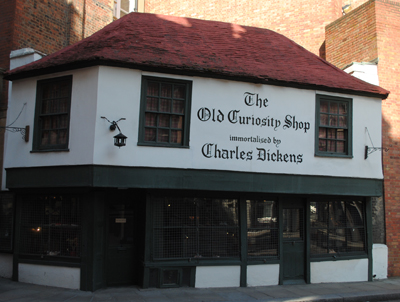
Located at 13-14 Portsmouth Street in Westminster, The Old Curiosity Shop now operates as a shop selling handmade fashions and footwear but the building apparently dates back 1567, making it a strong contender for the title of London’s oldest shop.

The name – The Old Curiosity Shop – was apparently applied to the building some years after Dickens first published his story, The Old Curiosity Shop, in the weekly serial, Master Humphrey’s Clock, in 1840 and 1841. The belief subsequently arose that it was this building the author had in mind when writing the book which tells the tale of Little Nell and her grandfather, a shopkeeper, and their interactions with the evil moneylender Daniel Quilp.

The claim is disputed by some, author Ed Glinert among them. In his book Literary London: A Street by Street Exploration of the Capital’s Literary Heritage he says the model for Dickens’ building was located at either 24 Fetter Lane or 10 Orange Street near Leicester Square and notes that at the end of the novel, Dickens said the building had long since been pulled down.

The Grade II* listed building, which survived the Great Fire of 1666 and the Blitz of World War II, is said to have been made from wood taken from old ships. Apparently at one stage it was a dairy which belonged to an estate awarded by King Charles II to one of his mistresses.

For more, see www.curiosityuk.com.

10 London sites to celebrate Charles Dickens – 4. Dickens at home…

We’ve already mentioned Charles Dicken’s Doughty Street house (now the Charles Dickens Museum) and his many childhood homes, but where else in London did Dickens reside during his adult life?

Following his marriage to Catherine Hogarth on 2nd April, 1836, at St Luke’s Church in Chelsea, Dickens and his new bride settled into chambers the writer had taken the now non-existent Furnival’s Inn (the author had been living there prior to his marriage), the site of which  is now occupied by the Holborn Bars Building).

In January the following year the couple had their first child – Charles Culliford Boz Dickens – and shortly afterwards made the move to the property at 48 Doughty Street. As we mentioned, the house was where two of his children were born and where Catherine’s 17-year-old sister Mary died (her death is believed to be the inspiration for that of the character Little Nell in the novel The Old Curiosity Shop) as well as being where Dickens wrote some of his most famous novels, including Oliver TwistNicholas Nickleby, and The Pickwick Papers.

In 1839, however, the family upsized into a much grander property at 1 Devonshire Terrace in Marylebone near Regent’s Park. This property at what is now 15-17 Marylebone Road was demolished in the late Fifties but there is a sculptural frieze on the wall marking where the property once stood.

Among the works Dickens wrote while living here were The Old Curiosity Shop, A Christmas Carol, Martin Chuzzlewit and David Copperfield. Six of Dickens’ children were born while he lived in this property. During this time, Dickens also made his first visit to North America and also travelled with his family in Europe for considerable periods.

In November 1851, Dickens moved the family again – this time to Tavistock House, located Tavistock Square in Bloomsbury. The property was demolished in 1901 and the site is now occupied by the headquarters of the British Medical Association (there’s a blue plaque commemorating Dickens’ time here).

Among the works Dickens wrote while living here were Bleak House, Hard Times, Little Dorrit and A Tale of Two Cities. The last of Dickens’ 10 children were born here – Edward Bulwer Lytton Dickens, later an Australian MP – and it was while living here, that in 1858 he separated from his wife Catherine. Dickens also put on amateur theatricals in the property.

Dickens’ time at Tavistock house ended around 1860 when Gad’s Hill in Kent became the main family home.

PICTURE: A section of the sculptural frieze depicting Dickens and some of his characters on the building that now stands at what was 1 Devonshire Terrace now in Marylebone Road. PICTURE: grahamc99 

10 London sites to celebrate Charles Dickens – 3. Recalling a journalistic career…

We kick off this week’s special – which looks at some of the London premises in which Dickens spent his working life – where we left off last week. Charles Dickens, now 15, had once again been forced to leave school and seek employment – this time as a solicitor’s clerk. From 1827 to 1828, the future author worked at two firms before, having taught himself shorthand, he launched his career as a journalist.

Dickens started his life in his new profession as a freelance law reporter working out of Doctor’s Commons where civil cases were heard (the site of which is marked with a blue plaque on the north side of Queen Victoria Street). Around 1830, he began to work for the newspaper, Mirror of Parliament, which was owned by his uncle and then, in 1832 he was employed at the True Sun newspaper.

His first published literary works started appearing in Monthly Magazine in December the following year (his first printed story was initially entitled A Dinner at Poplar Walk) and eight months later, in August 1834, he took on a new job as a reporter at the influential Whig paper, the Morning Chronicle. His writing was subsequently also published in the Evening Chronicle.

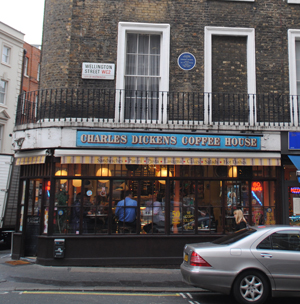
Among the magazine’s Dickens edited were Bentley’s Miscellany – this was the vehicle in which Oliver Twist was first published – and Household WordsHard Times was first published in this – as well as All the Year RoundA Tale of Two Cities and Great Expectations were both first serialised in this magazine which was located at 26 Wellington Street not far from Covent Garden. The building is now the home to the Charles Dickens Coffee House (pictured).

Next week we’ll be taking a look at some of places in London where Dickens lived…

10 London sites to celebrate Charles Dickens – 2. A London childhood…

Born the second child of a naval clerk then stationed in Portsmouth, Charles Dickens had what one would imagine was a fairly typical childhood for the son of a naval clerk, his family following his father John Dickens from one place to another – Sheerness, Chatham and briefly, in 1815, in London – as he took up different posts.

But in 1822, amid increasing financial difficulties, John Dickens was recalled to London and he and the family moved into a house at 16 Bayham Street in Camden Town in the city’s north, Charles joining them after completing schooling in Chatham (the house at number 16 Bayham Street is now commemorated by a plaque – it was demolished in 1910).

The family subsequently moved to another, recently built, premises at 4 Gower Street North (later renumbered 147 Gower Street) but soon after this, on 20th February, 1824, John Dickens was arrested over debt and taken to Marshalsea Prison where he subsequently resided with his family with the exception of Charles (the prison, in use since the 14th century, was closed in 1842 and finally mostly demolished in the 1870s – a single wall of the second prison on the site is all that remains).

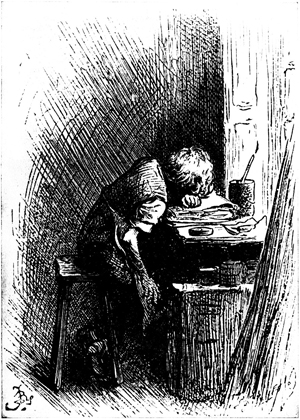
Twelve-year-old Charles, meanwhile, was put to work in the Warren’s Blacking Factory (pictured) near Hungerford Stairs, which stood just off the Strand (it’s said to have stood roughly where Charing Cross Railway Station now stands). While doing so, he roomed firstly at a house in Little College Street, Camden Town, and then in rooms at Lant Street in Borough (which was much closer to the prison).

John Dickens was out of prison in May but Charles continued working at the factory for almost another year until his father’s fortunes improved and Charles, now living with the family once again – at 29 Johnson Street and then, after being evicted, at The Polygon in Somers Town (an area in St Pancras) – returned to school, becoming enrolled at the Wellington House Classical and Commercial Academy in Hampstead Road.

In 1827, his father’s finances once more having taken a turn for the worse, he began work as a solicitor’s clerk (but more of that later)…

PICTURE: A nineteenth century etching of Dickens at Warren’s Blacking Factory – Source: Wikipedia.

10 London sites to celebrate Charles Dickens – 1. The Charles Dickens Museum

In the first of a new special series written in honor of the bicentenary of the birth of author Charles Dickens (he was born on 7th February, 1812), we take a look at the Charles Dickens Museum.

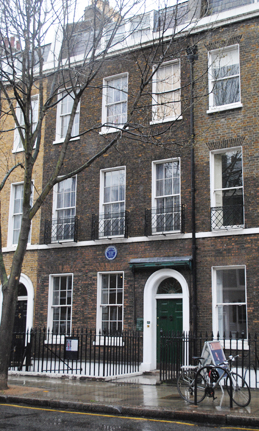
Housed in one of Dickens’ former London residences at 48 Doughty Street in Bloomsbury, this property is now the focal point for people wanting to find out more about the writer and his life as evidenced by the visit of Prince Charles and Camilla, the Duchess of Cornwall, on Tuesday to officially mark Dickens’ birth.

Dickens lived in the property from 1837 to 1839 and it was here that significant family events, such as the birth of two of his children – Mary and Kate – and the death of his wife Catherine’s 17-year-old sister Mary took place (Mary’s tragic death is believed to be the inspiration for that of the character Little Nell in the novel The Old Curiosity Shop). It was also at the property that he wrote some of his most famous novels, including Oliver Twist, Nicholas Nickleby, and The Pickwick Papers.

A growing demand for space, however, led Dickens to move his household to 1 Devonshire Terrace in 1839. The Doughty Street house meanwhile, the only one of Dickens’ London homes to have survived, remained a residential property but in 1923 it was threatened with demolition and subsequently acquired by the Dickens Fellowship. The museum opened there two years later.

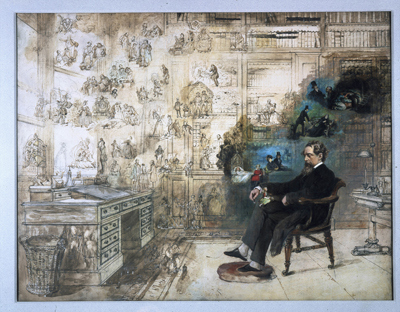
The museum now claims to hold more than 100,000 Dickens-related artifacts. The house is displayed as it might have been when Dickens lived there – artifacts on display over four floors include his personal possessions and furnishings as well as manuscripts, letters, first edition copies of some of his books and portraits, including R.W. Buss’ spectacular (and unfinished) Dickens’ Dream, showing the author at his country home of Gads Hill Place in Kent surrounded by many of the characters that he had created.

It’s important to note that from 9th April, the museum will be closed as it undergoes a £3.2 million project, called Great Expectations, which will involve the restoration and expansion of the museum. It is expected to reopen in December this year in time to celebrate a Dickensian Christmas.

For more on events celebrating Charles Dickens and his works this year, see www.dickensfellowship.org or www.dickens2012.org.

WHERE: 48 Doughty Street, Bloomsbury (nearest Tube stations are Russell Square, Chancery Lane or Holborn). WHEN: 10am to 5pm Monday to Sunday (last admission 4.30pm) COST: £7 adults/£5 concessions/£3 children (under 10 free); WEBSITE: www.dickensmuseum.com.

10 curiously named churches of London – 10. St Olave Hart Street

One of a few London churches to have escaped the Great Fire of 1666 (the flames are said to have come within 100 metres before the wind changed direction), St Olave Hart Street is named after the patron saint of Norway, St Olaf – a figure more known for his ability as a warrior than as a saint.

King Olaf II was King of Norway in the early 11th century and an ally of the Saxon King, Ethelred the Unready. The Norwegian king won the thanks of the English after he fought alongside Ethelred against the Danes in 1014 in what some refer to as the Battle of London Bridge.

According to some, the church was built on the site of where the battle was fought – many also believe the battle was also the inspiration for the nursery rhyme, London Bridge Is Falling Down, for it was during that battle that Olaf, who was helping Ethelred retake London, is credited with using his longships to pull down London Bridge in a effort to thwart the Danish occupiers.

The church, meanwhile, was rebuilt a couple of times in the Middle Ages, when it was said to have been known as St Olave-towards-the-Tower. The church which now stands on the site was built in 1450 with the distinctive red brick on the tower added in the early 18th century.

Having survived the Great Fire in 1666, the church was not so fortunate during the Blitz when it was struck by German bombs. It was subsequently restored with King Haakon VII of Norway attending the re-opening in the mid-1950s (there is a stone laid in front of the sanctuary which he brought from Trondheim Cathedral).

Other features inside include a recently returned 17th century bust of a prominent physician Dr Peter Turner – part of a monument which went missing after World War II, it resurfaced at an auction in 2010.

The church’s most famous parishioner was the 17th century diarist Samuel Pepys who lived and worked in the nearby Naval Office (for more on Pepys see our earlier entry here). The door through which he would have entered the church is marked with a 19th century memorial.

Pepys and his wife Elizabeth are both buried in the church (the memorial Pepys commissioned for her is still there) as is his brother John. Samuel Pepys’ life is commemorated at a service held close to the day he died – 26th May – each year.

Others associated with the church include Sir William Penn, an admiral and father of the William Penn who founded Pennsylvania in what is now the United States, and Charles Dickens, who gave it the name “Ghastly Grim” thanks to the skulls above its Seething Lane entrance.

St Olave’s is also the chapel of the The Clothworker’s Company, The Worshipful Company of Environmental Cleaners and Trinity House, a charitable organisation dedicated to the safety, welfare and training of mariners established by Royal Charter from King Henry VIII in 1514.

WHERE: Corner of Hart Street and Seething Lane in the City (nearest Tube stations are Tower Hill and Monument). WHEN: See website for detailsCOST: Free; WEBSITE: www.sanctuaryinthecity.net/St-Olaves.html

LondonLife – Poet Ted Hughes commemorated in Poets’ Corner


The late Poet-Laureate Ted Hughes was honored in a ceremony in Westminster Abbey’s Poets’ Corner last week with the dedication of a hand-carved memorial slab. 
The memorial includes a quotation from his work That Morning: “So we found the end of our journey, So we stood alive in the river of light, Among the creatures of light, creatures of light…”. The memorial to Hughes, who died in 1998 at the age of 68, was placed at the foot of that of TS Eliot, who was a mentor to Hughes. Among those who attended the commemoration were Hughes’ widow Carol and his daughter Frieda as well as literary figures including Nobel Laureate Seamus Heaney, Sir Andrew Motion, Michael Morpurgo and Graham Swift. Other literary luminaries commemorated in Poets’ Corner (only some of whom are buried here) include Geoffrey Chaucer, Edmund Spenser, John Milton, Lord Byron and John Keats as well as Charles Dickens, William Shakespeare and Rudyard Kipling. For more on Poets’ Corner, see www.westminster-abbey.org.

PICTURE: Carol Hughes lays a bouquet of flowers and herbs from the garden of the Hughes’ Devon home at the memorial. (Copyright Dean and Chapter of Westminster).

Around London – Dickens at the Museum of London; looking at Leicester Square’s past; Mr Chinnery’s art; and, Wellcome’s Miracles & Charms…

• Dickens fever is well and truly upon us in the lead-up to the bicentenary of his birth in February and tomorrow the Museum of London opens its own unmissable exhibition, Dickens and London. Displays centre on the relationship between Dickens and the city and visitors will be able to follow in the great novelist’s footsteps as they visit some of the places which sparked his imagination as well as confront some of the great social issues of the 19th century – including childhood mortality, prostitution and poverty – and be taking on a tour of some of the age’s greatest innovations – everything from railways and steamboats to the Penny Post. Among the objects on display will be Dickens’ writing desk and chair, his bank ledger, excavated items from Jacob’s Island, a notorious slum which was located near Bermondsey, and manuscript pages describing an East End opium den which was featured in Dicken’s unfinished novel, The Mystery of Edwin Drood (this, along with William Powell Frith’s celebrated portrait of the author, are being lent by the Victoria and Albert Museum). The exhibition also features a specially commissioned film looking at London after dark in Dickens’ time and today. Costumes from the upcoming BBC One drama series, Great Expectations, will also be on display and there is also a specially commissioned window display by acclaimed creative director and set designer Simon Costin showing a wintery London in the mid-19th century. The museum is also offering a new iPhone and iPad graphic novel app, Dickens: Dark London, which will take users on a “journey through the darker side” of Dickens’ London. Opens on 9th December (tomorrow) and runs until 10th June, 2012. Admission charges apply. For more, see www.museumoflondon.org.uk. For more on Dickens, see www.dickens2012.org. PICTURE: Dickens Dream by Robert William Buss (Courtesy Museum of London).

New hoardings have gone up at Leicester Square celebrating the area’s history as work continues on an £18 million plan by Westminster City Council to revitalise the Leicester Square streetscape. The more than 160 square metres of hoardings feature 11 images spanning a period of 250 years (and selected from thousands of archive images of the square). Meanwhile in Trafalgar Square, the famous Norwegian Christmas Tree was lit in a ceremony last Thursday. The tree is an annual gift from the people of Oslo as thanks for British support during Norway’s years of occupation in World War II. It will be lit from noon until midnight every day until 6th January.

And, briefly…..London’s Kew Gardens has been voted the top visitor attraction in Britain at the British Airways magazine travel award while the London Eye and Tate Modern came runner’s up…..Figures released to mark the 10th anniversary of free admission to England’s national museums show that visitor numbers to the museums have more than doubled over the past decade…..and, the first woman Tube driver, Hannah Dadds, reportedly died at the age of 70.

On Now: The Flamboyant Mr. Chinnery: An English artist in India and China. This exhibition at Asia House in New Cavendish Street in the West End, focuses on the work of 19th century artist George Chinnery and features landscapes and portraits he painted while in China and India. Runs until 21st January. Admission is free. For more, see www.asiahouse.org.

• On Now: Miracles & Charms. The Wellcome Collection is hosting this exhibition which features two shows – Infinitas Gracias: Mexican miracle paintings, the first major exhibition of Mexican votive paintings outside of Mexico, and Charmed life: The solace of objects, an exhibition of unseen London amulets from Henry Wellcome’s collection. Runs until 26th February, 2012. For more, see www.wellcomecollection.org.

Around London – Dickens’ supernatural leanings at the British Library; Art Fund looking to relocate Shop in a Bottle; HMS Belfast closed; and, Winter Wonderland returns to Hyde Park…

• Next year – 7th February to be precise – marks 200 years since the birth of celebrated 19th century novelist Charles Dickens and to mark the bicentenary, London institutions are among those across the country organising a raft of exhibitions under the banner of Dickens 2012. First up for us is a new exhibition launched this week at the British Library. A Hankering after Ghosts: Charles Dickens and the Supernatural explores the way in which Dickens used supernatural phenomena in his works (remember the ghosts of A Christmas Carol anyone?), while at the same time placing them in the context of the “scientific, technological and philosophical debates of his time”. The exhibition includes a letter from Dickens to his wife Catherine written in 1853 (this alludes to a disagreement which arose between them after Catherine became jealous of the attention Dickens was paying to another lady; he apparently used mesmerism to treat Catherine’s “nervous condition”), an article in an 1858 Household Words magazine in which Dickens questions the motivation of the spirits who supposedly tapped out messages to spiritualists, and, a 1821 copy of The Terrific Register: or, record of crimes, judgements, providences and calamities, a publication which was one of Dickens’ favorite reads as a youth. There is a range of accompanying events including talks by Dickens’ biographer Claire Tomalin (author of Charles Dickens: A Life) and John Bowen, author of Other Dickens: Pickwick to Chuzzlewit. Admission is free. Runs until 4th March. For more, see www.bl.ukImage: Courtesy of British Library
• The Art Fund has launched an appeal to have Yinka Shonibare’s Ship in a Bottle, currently sitting atop Trafalgar Square’s fourth plinth, relocated to a permanant home outside the National Maritime Museum in Greenwich. The fund, which has kick started the campaign with a £50,000 grant, needs £362,500 to buy the work – a scaled down replica of Nelson’s flagship, HMS Victory – which has been on display in Trafalgar Square since May, 2010, but is due to be removed in January next year. The replica work features 80 cannon and 37 sails, set as on a day of battle, and is made out of materials including oak, hardwood, brass, twine and canvas. For more, see www.artfund.org/ship/.

• The historic ship HMS Belfast, moored on the Thames between London Bridge and Tower Bridge, has been closed until further notice after a section of gangway which provides access to the ship collapsed earlier this week. Two contractors received minor injuries in the collapse and staff and visitors were evacuated by boat. The HMS Belfast is described as the most significant surviving Royal Navy warship from World War II and later served in places like Korea. It contains extensive displays on what life was like aboard the vessel. Keep on eye on www.iwm.org.uk for more information.

Now On: Winter Wonderland in Hyde Park. Hyde Park’s annual festival of all things Christmas is on again and this year’s festive offerings include, an ice rink, circus, giant observation wheel, rides and the chance for younger people to visit Santa Land as well as a plethora of opportunities to purchase presents at the Angels Christmas Market and warm-up with some of the fare available at eateries including the Bavarian Village, English Food Fair, and Spiegel Saloon. Winter Wonderland is free to enter and open between 10am and 10pm daily. Runs until 3rd January. For more, see www.hydeparkwinterwonderland.com.

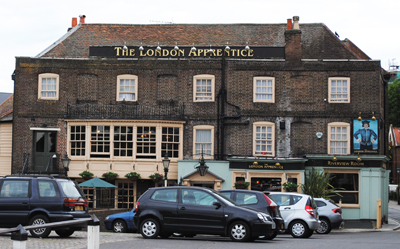
London Pub Signs – The London Apprentice

Sitting on the bank of the Thames at Old Isleworth in the city’s west stands The London Apprentice public house.

The pub’s licence dates back to at least 1731 and it has been associated with the likes of such luminaries as King Henry VIII (it’s suggested he met Catherine Howard here – she was later imprisoned in nearby Syon House), King Charles I and King Charles II (the latter apparently cavorted with his mistress, actress Nell Gwynne, here), as well as the ill-fated Lady Jane Grey and Lord Protector Oliver Cromwell.

Others whose names come up in reference to the pub include the ever-present author Charles Dickens (this is said to have been one his favorite pubs) and notorious highwayman Dick Turpin.

While there remain some doubts over its origins, the name of the pub – which stands opposite the small isle known as the Isleworth Ait – is said to stem from the fact that it was here that London apprentices, having faithfully served their masters, came to while away the hours in their downtime. They are said to have entertained themselves by playing about in decorated barges on the river.

There is said to be a tunnel, now blocked, which links the pub with the nearby All Saint’s Church – the story goes that this was used by smugglers to get their contraband into the pub’s cellars.

For more information or to pay a visit, see www.thelondonapprentice.co.uk.

King James I’s London – 5. Holland House

A Jacobean mansion located in Kensington’s Holland Park, Holland House was first built in 1605 for Sir Walter Cope, Chancellor of the Exchequer for King James I. 

Sir Walter apparently entertained the king and his wife, Queen Anne of Denmark, at the property – then named Cope Castle – on numerous occasions at the property and reportedly hosted the king the night after his son, Henry Frederick, the Prince of Wales, died in 1612.

Its name came with a later owner – the ill-fated Henry Rich, Cope’s son-in-law, who was made the 1st Earl of Holland in 1624 and was later executed for his role in supporting the Royalist cause during the Civil War during which the house was occupied by parliamentary troops.

The home was later used by various family members – among luminaries associated with the property are the essayist Joseph Addison who died there in 1719 as well as, in later years, the likes of Lord Byron, Benjamin Disraeli, Charles Dickens and Sir Walter Scott, all of whom visited the property during the property’s golden age in the 19th century when it was an important social gathering place.

The house was largely destroyed in a bombing raid in September 1940 and passed into ownership of the local authority. A youth hostel is now housed inside the restored east wing of the building while other buildings are used for a restaurant and function centre – all set within the 22 hectare (55 acre) Holland Park. Some of the ruins provide a backdrop for open-air theatre performances and concerts in summer.

WHERE: Holland Park (nearest tube stations are Holland Park, Kensington High Street and Notting Hill); WHEN: 7.30am to 30 minutes before dusk (check signs by entrance); COST: Park entrance is free (house is not open to the public); WEBSITE: www.rbkc.gov.uk/leisureandlibraries/parksandgardens/yourlocalpark/hollandpark.aspx

Around London – Happy St Patrick’s Day; 18th century workhouse saved; David Gestetner honored; and, Watteau’s drawings…

• First-up, we’d like to wish you all a happy St Patrick’s Day! And if you missed the St Patrick’s Day Parade and free festival in London last Sunday, don’t worry, there’s still plenty of Irish cheer on the city streets with the London Eye and Battersea Power Station both turning green to mark the occasion while the green beer is flowing at the city’s many Irish pubs.

The building some believe served as a model for the workhouse in Charles Dickens’ novel Oliver Twist has been saved from demolition with a Grade II listing. Completed in 1778, the Covent Garden Workhouse in Cleveland Street became the workhouse of The Strand Poor Law Union in 1836 and was later used as an infirmary before more recently serving as the outpatients department of the Middlesex Hospital. The workhouse is believed to the most well preserved of the three surviving 18th century workhouses in London. Announcing the listing this week, John Penrose, Minister for Heritage and Tourism, said that while it is unknown whether or not the building was the inspiration for the workhouse featured in Oliver Twist, “we know that it is the sole survivor of the workhouses  that were operating in the capital when Dickens wrote his famous novel and that as a young man he lived just nine doors along from it”. Simon Thurley, chief executive of English Heritage, said the listing also recognised the association between the workhouse and Dr Joseph Rogers, whose direct experience of the workhouse when working as Chief Medical Officer led him to launch important reforms of the system of healthcare provision for the poor.

David Gestetner, a key player in the development of office copying technology, has been commemorated with a blue plaque outside his former residence at 124 Highbury New Park in Islington. The Hungarian-born Gestetner lived at the property for 41 years until his death in 1939. The plaque was unveiled on Tuesday by two of his great grand-children.

On Now: Watteau: The Drawings. The first retrospective exhibition of the drawings of French artist Jean-Antoine Watteau opened last Saturday at the Royal Academy of Arts. Watteau is known for inventing the genre of fetes galantes (small pictures of social gatherings of elegant people in parkland settings) and for his mastery of the ‘three chalks’ or trois crayons technique using red, black and white. The exhibition features more than 80 works on paper. There is an admission charge. Runs until 5th June. See http://www.royalacademy.org.uk for more information.