10 sites from Victoria and Albert’s London – 8. Paddington Railway Station…

Queen Victoria was a monarch known for breaking records and, thanks to her rule being in an age when technology was advancing at an incredible pace, performing royal-related “firsts”.

Among the latter is the fact that the Queen was the first British monarch to travel by train – a feat she performed with Prince Albert by her side on 13th June, 1842. It was he, who having first travelled on a train in 1839, had encouraged the rather nervous 23-year-old to make the journey (which she apparently agreed to undertake only two days before she actually did).

Travelling in a specially adapted “royal saloon” decorated with flowers, the royal couple travelled on the Great Western Railway, leaving Slough, which they had travelled to from Windsor Castle, at noon and arriving at London’s Paddington Station some 25 minutes later. Queen Victoria later wrote that there was no dust or great heat during the journey which, in fact, was “delightful and so quick”.

The train – which was pulled by the Firefly-class steam engine Phlegethon – was driven by Sir Daniel Gooch who was assisted by engineer Isambard Kingdom Brunel, builder of the railway. The Queen’s carriage was sandwiched in between six other carriages and trucks to act as a buffer in case of an accident.

On arriving at Paddington (at a temporary building which had been opened in 1838 and which would be replaced in 1854), the Queen was greeted by railway officials and their families along with a detachment of hussars on a platform covered with a red carpet. Crowds quickly grew and the royal couple were then escorted to Buckingham Palace.

The Queen would go on to regularly use railways as she travelled about Britain and even had a special signal installed on the roof of the royal carriage so the driver could be instructed to slow down as required.

Interestingly, the current Queen – Elizabeth II – and Prince Philip re-enacted the journey in 2017 to mark its 175th anniversary. They were accompanied by Isambard Thomas, the great, great, great grandson of Brunel and Gillian White, great, great grand-daughter of Gooch.

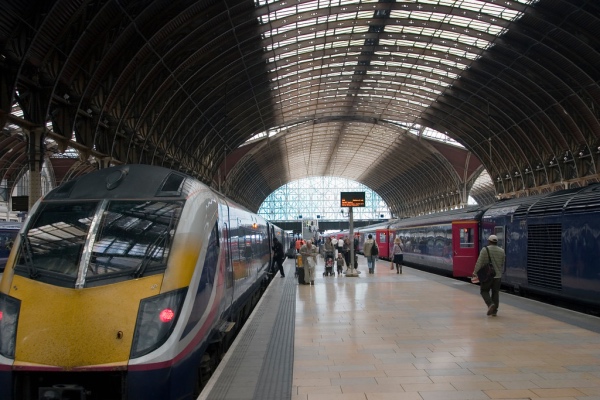
PICTURE: Inside Paddington Station today (Jimmy Harris/licensed under CC BY 2.0)

10 sites from Victoria and Albert’s London – 7. The Palace of Westminster…


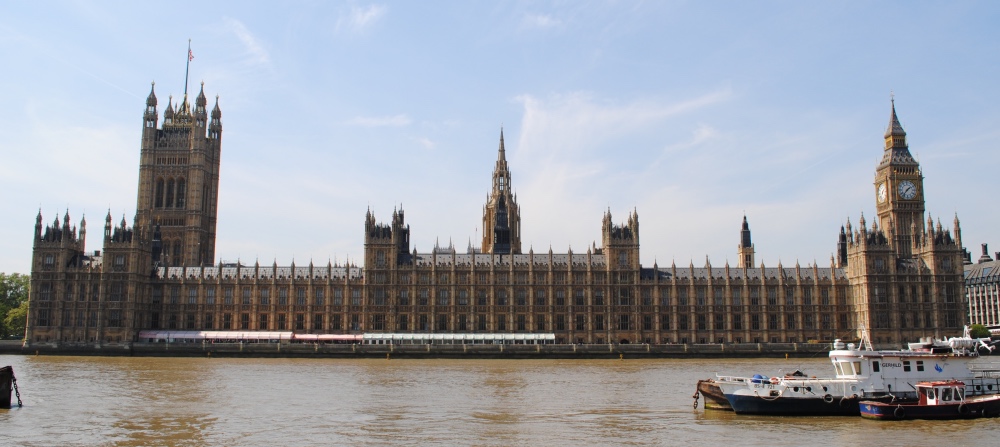
Following the destruction of much of the Palace of Westminster in a fire which broke out on 16th October, 1834, work was launched on a new building to house both the House of Commons and the House of Lords – a building to which both Queen Victoria and Prince Albert had strong connections.

Rebuilding commenced in earnest for the new building 27th August, 1840, when Sarah Barry, wife of architect Charles Barry (his plans for a new Perpendicular Gothic-style Parliament building had been selected from some 97 submissions), laid the foundation stone of the new complex.

Work, to the designs of Barry with the aid of Augustus Pugin, progressed (although a lot slower than was originally envisaged – and a lot more expensively) and the new House of Lords was opened in 1847 followed by the new House of Commons in 1852 (when Barry received a knighthood).

The Clock Tower, meanwhile, now renamed the Elizabeth Tower, was not completed until 1858, but when the Victoria Tower was roofed in 1860, the work was largely complete (although construction wasn’t officially completed until 10 years later – Barry died in 1860 and the work was continued by his son, Edward Middleton Barry).

In 1852, Queen Victoria became the first monarch to take the route since used by all sovereigns at the State Opening of Parliament – arriving in the Irish State Coach (still used by Queen Elizabeth II today) she entered the entrance at the base of the Victoria Tower (now known as the Sovereign’s Entrance) and proceeded to the Robing Room where she was dressed in the Imperial State Crown and the Robe of State before processing through the Royal Gallery to the chamber of the House of Lords where she took her seat on the Throne (located opposite the door leading to the House of Commons).

Prince Albert, known for his passion for the arts, chief connection came when he was appointed chair of the Royal Fine Arts Commission in 1835. It oversaw the placement of paintings and sculptures in the building, including five vast frescoes by William Dyce depicting the Arthurian legend which can be seen in the Robing Room.

The prince tragically died on 14th December, 1861, and while the structural work had largely been completed, much of the decorative schemes the commission had envisaged for the palace hadn’t been finished. As a result, many of the decorative aspects Prince Albert had overseen the planning of were never completed.

Portrayals of the Queen and Prince in the building today include a white marble statue of Queen Victoria holding a sceptre and laurel crown in the Prince’s Chamber and portraits of the Queen and Prince Albert by Franz Xaver Winterhalter which flank the Chair of State in the Robing Room.

WHERE: Houses of Parliament (nearest Tube stations are Westminster, St James’s Park and Embankment); WHEN: Tours are held on Saturdays until 25th January 2020 and Monday to Friday between until 30th August 2019 (except 26th August); COST: £26.50 adults/£22 concessions/£11.50 children five to 15 years (children under five are free); WEBSITE: www.parliament.uk.

10 sites from Victoria and Albert’s London – 6. The South Kensington Museum…

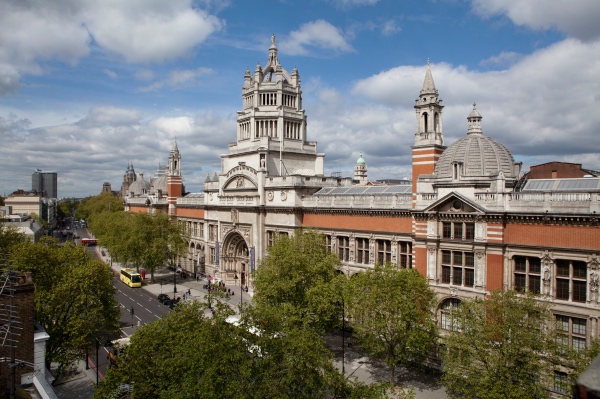
Better known today as the Victoria and Albert Museum following its renaming in 1899, the South Kensington Museum was created in the aftermath of the success of the Great Exhibition of 1851.

Initially located in Marlborough House on the Mall, it moved to its South Kensington site in 1857, opening to the public on 22nd June that year. Recorded among the visitors in the initial couple of years was Queen Victoria – who visited twice in February, 1858, and then again open 14th April when she was accompanied by Prince Albert.

The purpose of the later visit was to open the Art Rooms on the ground floor of Sheepshanks Gallery, a building which had been specifically constructed to house paintings given by John Sheepshanks (the building, located on the eastern side of the John Madejski Garden now contains sculptures on the ground floor and silver and stained glass on the first floor).

One interesting connection between the Queen and the museum can be found in a six metre tall plaster cast of Michelangelo’s David. The cast was given to Queen Victoria as a gift from the Grand Duke of Tuscany in 1857 but she didn’t want the trouble of housing the giant figure (and she was apparently shocked by its nudity – more on that in a moment). So the Queen gave the statue to the museum where it was installed in a prominent position (and can today be seen in Room 46b).

But ah, yes, the nudity. The story goes that in response to the Queen’s shock, a proportionally accurate plaster fig leaf was commissioned to cover David‘s nether regions whenever the Queen visited (apparently by being hung on two small hooks on the cast). The fig leaf, like the statue, can still be seen – it’s housed in a small case on the back of the plinth David‘s standing on.

David is one of only a few items in the V&A’s collection today which once belonged to the Queen or Prince Albert. Others include the Raphael cartoons which she loaned to the museum in 1865 (and are still on loan from the current Queen).

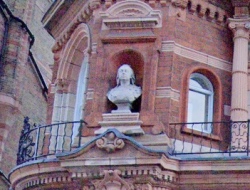
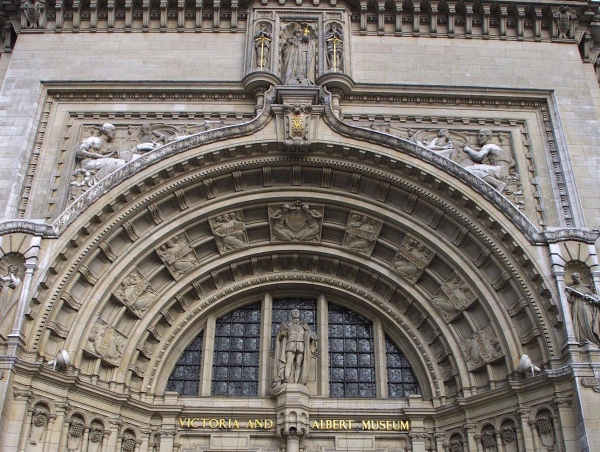
As part of the redevelopment of the museum in the late 19th and early 20th centuries (when it was also renamed the Victoria and Albert Museum despite the Queen’s wishes it be called the Albert Museum), statues of the royal couple were installed above the museum’s main entrance in Cromwell Road with Prince Albert positioned just below the Queen who is flanked  by St George and St Michael (see above).

PICTURES: Courtesy V&A

WHERE: Victoria and Albert Museum, Cromwell Road (nearest Tube stations are South Kensington and Gloucester Road); WHEN: 10am to 5.45pm daily (Fridays to 10pm); COST: Free; WEBSITE: www.vam.ac.uk

This Week in London – Queen Victoria at Buckingham Palace; royal etchings; and, Ed Ruscha at Tate Modern…

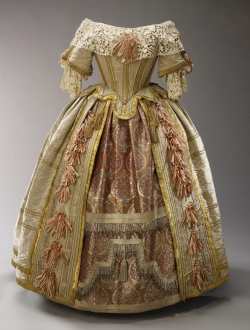
The impact of Queen Victoria on Buckingham Palace, transforming what was empty residence into “the most glittering court in Europe”, is a special focus of this year’s summer opening of Buckingham Palace. Marking the 200th anniversary of the birth of the Queen, the exhibition Queen Victoria’s Palace recreates the music, dancing and entertaining that characterised the early part of the Queen’s reign using special effects and displays. Highlights include the Queen’s costume (pictured) for the Stuart Ball of 13th July, 1851, where attendees dressed in the style of King Charles II’s court. There’s also a recreation of a ball held in the palace’s newly completed Ballroom and Ball Supper Room on 17th June, 1856, to mark the end of the Crimean War and honour returning soldiers which uses a Victorian illusion technique known as Pepper’s Ghost to bring to life Louis Haghe’s watercolour, The Ball of 1856. The table in the State Dining Room, meanwhile, has been dressed with items from the ‘Victoria’ pattern dessert service, purchased by the Queen at the 1851 Great Exhibition, and the room also features the Alhambra table fountain, a silver-gilt and enamel centrepiece commissioned by Victoria and Albert in the same year, and silver-gilt pieces from the Grand Service, commissioned by the Queen’s uncle, King George IV, on which sit replica desserts based on a design by Queen Victoria’s chief cook, Charles Elme Francatelli. The summer opening runs until 29th September. Admission charges apply. For more, see www.rct.uk/visit/the-state-rooms-buckingham-palace. PICTURE: Royal Collection Trust/ © Her Majesty Queen Elizabeth II 2019

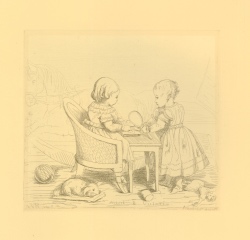
 The Victorian reign is also the subject of a new exhibition at the British Museum where rare etchings by Queen Victoria and Prince Albert have gone on display. At home: Royal etchings by Queen Victoria and Prince Albert features 20 artworks that they created during the early years of their marriage and depict scenes of their domestic lives at Windsor Castle and Claremont including images of their children and pets. The display includes three works donated to the museum by King George V, Queen Victoria’s grandson, in 1926, and it’s the first time they’ve gone on public display. Prince Albert introduced the Queen to the practice of etching soon after their wedding and under the guidance of Sir George Hayter they made their first works on 28th August, 1840. They would go on to collaborate on numerous works together. The display can be seen in Room 90a until mid-September. Admission is free. For more, see www.britishmuseum.org. PICTURE: The Princess Royal and Prince of Wales, 1843, by Albert, Prince Consort (after Queen Victoria) © The Trustees of the British Museum.

American artist Ed Ruscha is the subject of the latest “Artist Rooms” annual free display in the Tate Modern’s Blavatnik building on South Bank. The display features works spanning Ruscha’s six-decade career, including large, text-based paintings and his iconic photographic series. There is also a display of Ruscha’s artist’s books – including Various Small Fires 1964 and Every Building on the Sunset Strip 1966 – as well as some 40 works on paper gifted to Tate by the artist. Highlights include his series of photographs of LA’s swimming pools and parking lots, paintings inspired by classic Hollywood cinema, and works such as DANCE? (1973), Pay Nothing Until April (2003) and Our Flag (2017). Runs until spring 2020. Admission is free. For more, see www.tate.org.uk.

Send all items for inclusion to exploringlondon@gmail.com.

10 sites from Victoria and Albert’s London – 5. West End theatres…

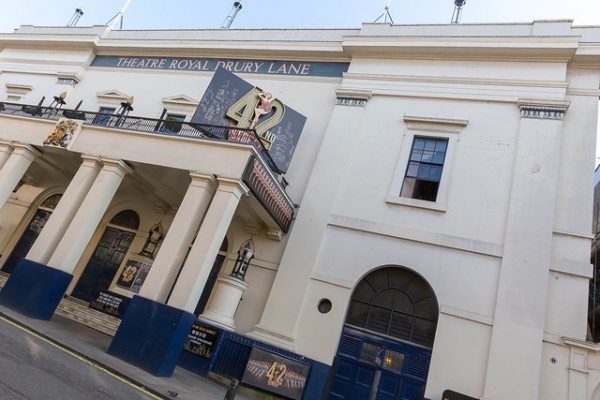
Queen Victoria and Prince Albert both had an abiding love of performance and were avid theatre-goers (the Queen first attended the theatre as monarch to watch The Siege of Rochelle and Simpson & Co at the Drury Lane Theatre just a few months after ascending the throne in 1837).

Until Prince Albert’s death in 1861, they were regularly seen at various theatres with the Queen attending both ‘in state’ (that is, formally as monarch with all the pomp and ceremony that entails) as well as in private (despite Prince Albert’s concerns over her security). The royal couple’s visits to the theatre generally took place from February to June when the Queen was principally in residence at Buckingham Palace.

As well as the Drury Lane Theatre (more formally, the Theatre Royal Drury Lane – pictured above in 2018), other theatres they attended include the Theatre Royal Haymarket and the Covent Garden Theatre, now the Royal Opera House.

They also attended the now demolished Princess’s Theatre in Oxford Street, most notably to see Charles Kean’s production of The Corsican Brothers in February, 1852. Keen not only directed but played both brothers mentioned in the title. So enamoured was the Queen of it, that she would see it four times.

The royal couple were such great admirers of Kean that they even had him stage private theatrical performances at Windsor Castle and when he died, Queen Victoria sent a letter of condolence to his wife.

PICTURE: Marco Verch (licensed under CC BY 2.0)


A Moment in London’s History – Samuel Pepys writes the last entry in his diary…

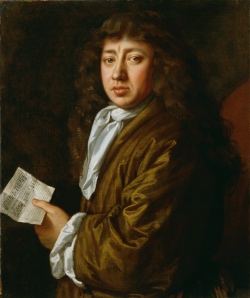
This year marks 350 years since London’s now famous diarist, Samuel Pepys, wrote the final entry in what was his private diary.

The final entry was written on 31st May, 1669, and mentions a liaison with one Betty Mitchell, a trip on the Thames to Whitehall where he met with the Duke of York, and an outing with his wife Elizabeth and friends to the The World’s End, a drinking house at the western end of Hyde Park in Knightsbridge.

Pepys had started writing the diary on 1st January, 1660, at the age of just 26, and over the next nine years, its more than a million words covered some of the critical events including the coronation of King Charles II, the Great Plague of 1665 and The Great Fire of 1666.

Many believe that the diary was never intended for a mass readership (although some scholars disagree with this opinion), but, if that was the case, Pepys did take some precautions just in case, using codes for the mistresses he met, for example.

He stopped writing the diary because he assumed he was going blind – he asks in the final sentence for God to help him “prepare all the discomforts that will accompany my being blind”.

You can read Pepys’ final entry and the the complete diary of Pepys online at www.pepysdiary.com.

PICTURE: Samuel Pepys by John Hayls, 1666 © National Portrait Gallery, London (licensed under CC BY-NC-ND 3.0)

10 sites from Victoria and Albert’s London – 3. Constitution Hill…

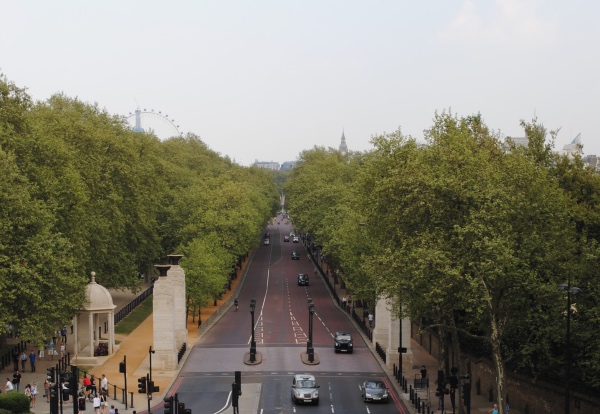
It was on this road connecting the western end of The Mall outside Buckingham Palace with Hyde Park Corner that an infamous incident took place during Queen Victoria and Prince Albert’s early years together.

For it was from a footpath on Constitution Hill that the first of eight assassination attempts were made on the Queen as the couple – the Queen then pregnant – rode out from the palace in a low slung carriage headed for Hyde Park as was their custom.

Edward Oxford was just 18-years-old when at on 10th June, 1840, he took up a position on a footpath on Constitution Hill where he stood for a couple of hours before, at about 6pm, as the royal couple’s carriage sailed past, he fired two pistols at them.

Both shots missed (in fact, no bullets were ever found) and Queen Victoria was quick to order the carriage to drive on (she and Albert would also ride out along the same route the next day despite the scare – this time there was a sizeable crowd of well-wishers eager to convey their good sentiments to the Queen and a procession of these followed their carriage up the hill to Hyde Park).

Oxford, meanwhile, was immediately seized by onlookers and stripped of his guns. He immediately admitted his crime, was subsequently arrested, charged with treason and later acquitted on grounds of insanity before being detained in an asylum at Her Majesty’s pleasure (he was eventually discharged with the proviso that he head to one of England’s overseas colonies and ended up living out his days in Melbourne, Australia).

An interesting footnote is that future artist John Everett Millais, then aged just 11-years-old, was among those standing on Constitution Hill watching the Queen drive past on the day of the assassination attempt.

There were another seven assassination attempts on Queen Victoria over the ensuing years. For more on them, check out Paul Thomas Murray’s detailed book Shooting Victoria: Madness, Mayhem and the Modernisation of the Monarchy.

PICTURE: A view down Constitution Hill towards Buckingham Palace fro, the top of Wellington Arch.

10 sites from Victoria and Albert’s London – 2. Buckingham Palace…

You may have noticed that last week we kicked off a new Wednesday series on 10 (more) London garden squares, only having kicked off a new series on 10 sites from Victoria and Albert’s London the week before. To clarify, we are currently running the Victoria and Albert series, the garden squares entry snuck in by accident (but we’ll be returning to the garden squares down the track)! Apologies for any confusion...


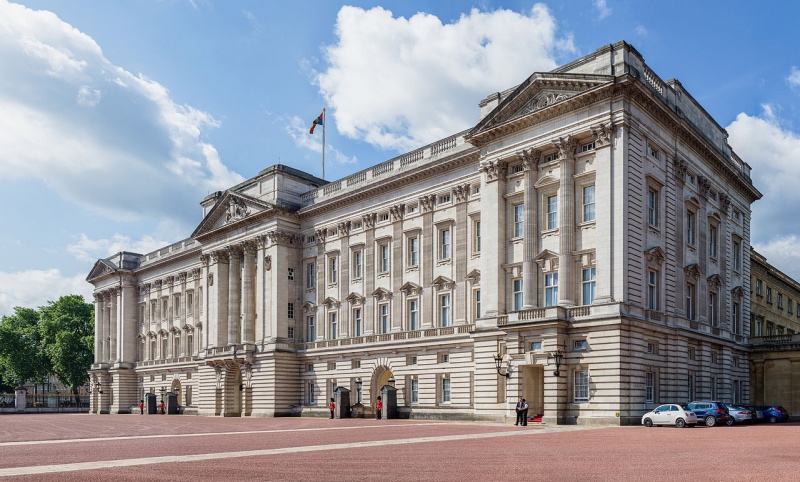
Queen Victoria, the first British monarch to use Buckingham Palace as an official residence, moved her household into the palace just three weeks after ascending to the throne on 20th June, 1837.

The palace, which had been empty for seven years following the death of her uncle King George IV, had been undergoing a grand repurposing under architect John Nash, transforming it from a house into a palace.

Originally built in 1703 as a London residence for John Sheffield, the 3rd Earl of Mulgrave, in 1761 the property had been purchased by King George III as a family home for his wife Queen Charlotte (14 of the couple’s 15 children were born here).

Remodelling of the property began the following year and had been continued by King George IV following his accession to the throne in 1820. As a result of the ongoing work, George IV never lived in the palace nor did his successor, King William IV, who preferred Clarence House.

The building works still weren’t finished when Victoria moved in. Her ministers had advised her to remain at Kensington Palace, her childhood home, until the works were finished but Victoria wasn’t having any of that – the move would help her escape the overbearing care of her mother Victoria, Duchess of Kent, the ambitious Sir John Conroy, and the so-called (and stifling) ‘Kensington System’ of rules under which she’d been brought up.

When Victoria married Albert (see the previous entry) on 10th February, 1840, the newly weds made the palace their London home. It was here that, over the next 17 years, Victoria would give birth to eight of their nine children (starting with Victoria ‘Vicky’, in 1840), and where the couple would work, controversially at side-by-side desks.

The couple’s growing family was soon stretching the palace accommodations and following a request from Queen Victoria, in 1846 some £20,000 was granted by Parliament on 13th August to complete and extend the grand property with an additional £50,000 for the works raised from the sale of the Royal Pavilion to the Brighton Corporation.

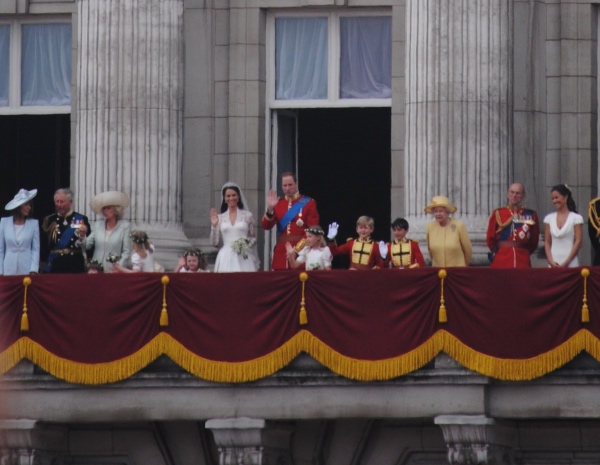
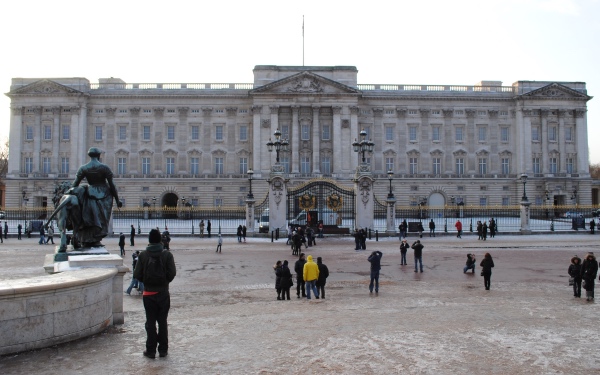
Under the direction of architect Edward Blore and builder Thomas Cubitt, the East Wing was added at the front of the palace, enclosing what had previously been a horseshoe-shaped courtyard and creating the famous central balcony where the Royal Family now gather on special occasions. Queen Victoria made the first public appearance on the balcony in 1851 during the Great Exhibition (pictured above are members of the Royal Family at the wedding of Prince William and Kate Middleton).

A new ballroom – designed by Nash’s student James Pennethorne – was added to the State Rooms shortly after. This was inaugurated in May, 1856, with a ball held there the following month to mark the end of the Crimean War.

The ball was one of several held at the palace during those years along with official royal ceremonies and other entertainments including musical performances by the likes of Felix Mendelssohn and Johann Strauss II.

A new exhibition, Queen Victoria’s Palace, opens at Buckingham Palace next month. 

WHERE: State Rooms, Buckingham Palace (nearest Tube stations are Victoria, Green Park and Hyde Park Corner); WHEN: 20th July to 29th September (opening at 9am, closing times vary – see website for details); COST: £25 an adult/£14 a child (under 17s/under fives free)/£22.80 concession/£64 family; WEBSITE: www.royalcollection.org.uk/visit/buckinghampalace.

PICTURES: Top – Diliff (licensed under CC BY-SA 1.0); Lower – David Adams.

What’s in a name?…Cockfosters…


No more than the name of a Tube terminus (the north-east end of the Piccadilly Line) to many Londoners, Cockfosters has an interesting origin story.

The area in north London, which lies partly in the London Borough of Enfield and partly in the London Borough of Barnet, owes its name to its location on the edge of what was the royal forest of Enfield Chase.

In the 15th century, the forest was protected by foresters housed in three lodges – one of which was located where the West Lodge Park hotel, built in 1838, now stands.

(An interesting side note is that after the foresters stopped using the original lodge, it became, at one stage, the home of King Charles II’s Secretary of State, Henry Coventry. Diarist John Evelyn is among those who visited him.)

The ‘fosters’ part of the name is apparently derived from an Elizabethan-era variant of the word forester while ‘cock’ is a old word for leader or chief. Cockfosters, then, literally means the home of the chief or head forester.

The modernist Tube station, designed by Charles Holden and opened in 1933, is a key landmark as is the stately, Grade II-listed property Trent Park which is located on a remnant of Enfield Chase.

Other notable buildings include Christ Church Cockfosters, founded in 1839, and The Cock Inn, which opened in Chalk Lane in 1798.

PICTURED: Top – Trent Park House (© Christine Matthews/licensed under CC BY-SA 2.0; below – Cockfosters Tube Station (Steve Cadman/licensed under CC BY-SA 2.0).

This Week in London – British printmaking; the Taste of London; and, Dickens abroad…

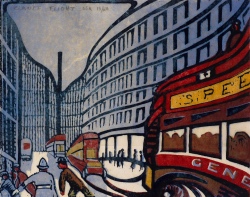
British printmaking between World War I and II is under the spotlight in a new exhibition which opened at Dulwich Picture Gallery this week. Cutting Edge: Modernist British Printmaking, which marks 90 years since the inaugural exhibition on British linocuts was held at the Redfern Gallery, features 120 prints, drawings and posters and spotlights the work of artists of the Grosvenor School including those of teacher Claude Flight and nine of his leading students – Cyril Power, Sybil Andrews, Lill Tschudi, William Greengrass and Leonard Beaumont among them. A number of the works are being displayed publicly for the first tome and several international loans – including prints by the Australian students Dorrit Black, Ethel Spowers and Eveline Syme – are making their debut as part of a major UK showing. The display can be seen until 8th September. Admission charge applies. For more, see www.dulwichpicturegallery.org.uk. PICTURE: Claude Flight, Speed, 1922, © The Estate of Claude Flight. All Rights Reserved, [2019] / Bridgeman Images/ photo Photo © Elijah Taylor (Brick City Projects)

Food festival, the Taste of London, is on again in The Regent’s Park across this weekend. Opened last night, the festival features the chance to sample food from London’s best restaurants as well as learn from world-class chefs, and visit gourmet food and artisan producer markets. For more, including tickets, see https://london.tastefestivals.com.

On Now: Global Dickens: For Every Nation Upon Earth. This exhibition at the Charles Dickens Museum in Bloomsbury paints a global picture of one of London’s favourite sons, starting with his trips to Europe and North America and going on to consider how his influence spread across the world. On display is his leather travelling bag, a Manga edition of A Christmas Carol,  and a copy of David Copperfield that went to the Antarctic on the 1910 Scott expedition. Can be seen until 3rd November. Included in admission charge. For more, see www.dickensmuseum.com.

Send all items for inclusion to exploringlondon@gmail.com.

10 sites from Victoria and Albert’s London – 1. Chapel Royal, St James’s Palace…

This year marks the 200th anniversary of the births of both Queen Victoria (24th May) and Prince Albert (26th August) and, in celebration, we’re running a special series on London locations that played a key role in their joint lives.

First up is the Chapel Royal at St James’s Palace where the royal couple were married on 10th February, 1840. It was the first marriage of a reigning queen since Queen Mary I in 1554.

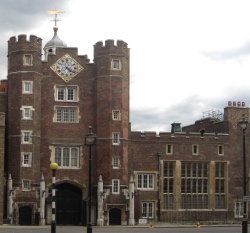
The chapel, which hosted the christening of Prince George in 2013 and Prince Louis in 2018, was built in about 1540 and substantially altered since, including under the eye of Sir Robert Smirke in 1837.  It was built on a north-south axis rather than the more usual east-west (a sizeable window on its northern wall can be seen to the right of the palace’s main gatehouse – see picture).

The chapel, which features a richly decorate ceiling said to have been painted by Holbein, has been used regularly by the Chapel Royal – a department of Royal Household – since 1702.

At the wedding, the Queen wore a white satin gown with a deep flounce of handmade Honiton lace, designed by William Dyce, which featured a long veil and an 18 foot long train (she had 12 train bearers). Her jewellery included a sapphire broach given to her by Albert and she wore a headress of orange blossoms. Victoria’s dress is said by some to have popularised the idea of the white wedding dress among the English (although there is apparently some debate over this).

Among those in attendance was Victoria’s mother, the Dowager Duchess of Kent and Strathearn, Albert’s father and brother, the Duke and Prince of Saxe-Coburg and Gotha respectively, and various other royals including Queen Adelaide, the widow of King William IV, as well as the Prime Minister, Lord Melbourne (who, in fact, carried the Sword of State). Given the fact Victoria’s father was dead, it was her uncle, the Duke of Sussex, who walked her up the aisle.

It was a big affair in the city – people lined the roads between Buckingham and St James’s palaces and some reportedly even climbed trees for a better view. Victoria wrote in her diary that she’d never seen such crowds “and they cheered most enthusiastically”.

The wedding breakfast, which featured a 300lb cake which was nine foot in circumference, was held at Buckingham Palace after which the newly weds headed off to Windsor for a two day honeymoon.

Famously, before the wedding, the Archbishop of Canterbury had apparently asked Victoria whether, given she was Queen, she wanted to remove the word “obey” from her wedding vows. Victoria had refused.

There are limited opportunities for the public to attend services in the Chapel Royal at certain times of the year.

PICTURE: Johan Bilien (licensed under CC BY-SA 2.0)

10 of London’s most curious (and historic) graves – 9. Horatio, Lord Nelson (St Paul’s Cathedral)…

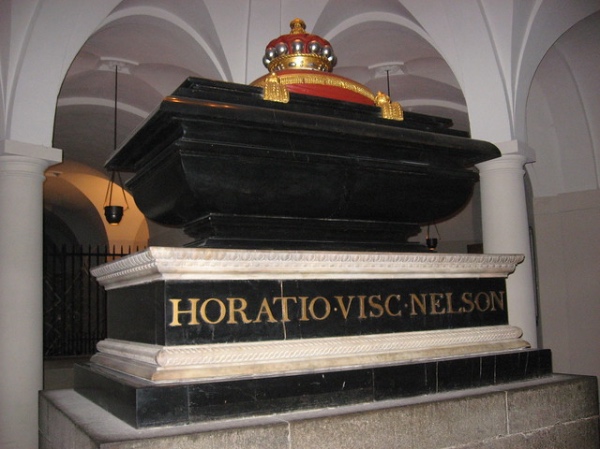
One of the star sites in the crypt of St Paul’s Cathedral, the tomb of Horatio, Lord Nelson, is certainly grand.

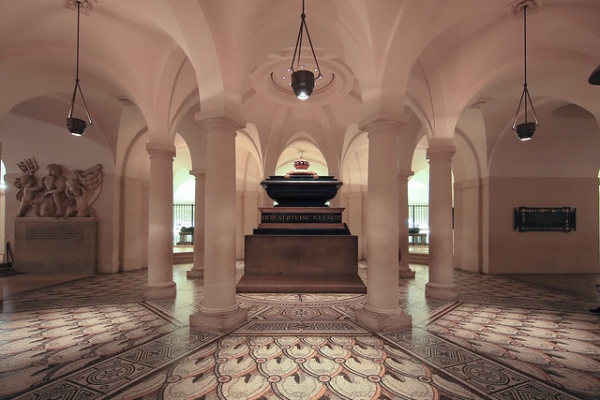
Located in what is known as the Nelson Chamber, it centres on a polished back sarcophagus which sits on a stone plinth surrounded by columns with a mosaic floor featuring nautical motifs underneath.

But what makes this tomb unusual is that the sarcophagus actually predates the cathedral itself – and it wasn’t originally made for Nelson.

The sarcophagus was initially commissioned by Cardinal Thomas Wolsey, Lord Chancellor of King Henry VIII, and made by Florentine sculptor Benedetto da Rovezzano in about 1524. But when Wolsey fell out of favour – and eventually died in disgrace – the then unfinished sarcophagus was seized by King Henry VIII.

King Henry intended to use it for himself and commissioned Benedetto to rework it but it wasn’t complete when he died and while his children – King Edward VI, Queen Mary I and Queen Elizabeth I – had intended to complete it after his death, none did so.

It was Queen Elizabeth I who moved the unfinished work out of Westminster to Windsor but during the Commonwealth various pieces designed to accompany the completed tomb were dispersed.

They included four large bronze angels that Benedetto had completed in 1529 which were intended to stand on the tomb’s four corners – for many years these were used as decorative features on gate pillars at Harrowden Hall in Northampshire but were finally recovered by the V&A in 2015 after a national appeal and can now be seen there.

The sarcophagus itself remained at Windsor until King George III presented it to the Admiralty in tribute to Lord Nelson.

Suitably fitted out, his remains were enclosed within when he was buried in St Paul’s crypt on 9th January, 1806.

Nelson’s body, which had been preserved in a keg of brandy on its journey aboard the HMS Victory back from the Battle of Trafalgar where he was killed in 1805, is actually held inside a wooden coffin which sits inside the sarcophagus. This coffin was made from the mainmast of the French ship L’Orient which was presented to Nelson following victory at the Battle of the Nile.

Meanwhile, the sarcophagus itself, which would have been topped with Wolsey’s cardinal’s hat had it fulfilled its original intention, is now topped with a coronet – a symbol of Nelson’s title of viscount.

A monument to Nelson, the work of John Flaxman, can also be seen inside the cathedral.

WHERE: Nelson Chamber, The Crypt, St Paul’s Cathedral (nearest Tube stations are St Paul’s, Mansion House and Blackfriars); WHEN: 8.30am to 4.30pm Monday to Saturday; COST: £20 adults/£17.50 concessions/£8.50 children (online and group discounts; family tickets available); WEBSITE: www.stpauls.co.uk.

PICTURE: Above – Michael Broad  (licensed under CC BY-NC-ND 2.0); Below – reverendlukewarm (licensed under CC BY-SA 2.0).

Famous Londoners – Inigo Jones…

Born to humble origins in London, Inigo Jones rose to become the first notable architect in England and, thanks to his travels, is credited with introducing the classical architecture of Rome and the Italian Renaissance to the nation.

Jones came into the world on 15th July, 1573, as the son of a Welsh clothworker, also named Inigo Jones (the origins of the name are apparently obscure), in Smithfield, London. He was baptised in St Bartholomew-the-Less but little else is known of his early years (although he was probably apprenticed to a joiner).

At about the age of 30, Jones is believed to have travelled in Italy – he certainly spent enough time there to be fluid in Italian – and he is also said to have spent some time in Denmark, apparently doing some work there for King Christian IV.

Returning to London, he secured the patronage of King Christian’s sister Queen Anne, the wife of King James I, and became famous as a designer of costumes and stage settings for royal masques (in fact, he is credited with introducing movable scenery to England).

Between 1605 and 1640, he staged more than 500 performances – his first was The Masque of Blackness performed on twelfth night in 1605 – including many collaborations with playwright Ben Jonson with whom he had an, at times, acrimonious relationship.

His architectural work in England – heavily influenced by the Italian architect Andrea Palladio (his copy of Palladio’s Quattro libri dell’architettura is dated 1601) as well as the Roman architect Vitruvius – dates from about 1608 with his first known building design that of the New Exchange in the Strand, built for Robert Cecil, 1st Earl of Salisbury.

In 1611 Jones was appointed surveyor of works to Henry Frederick, the Prince of Wales, but, following the prince’s death on 6th November, 1612, he was, in 1615, appointed Surveyor of the King’s Works (having first accompanied Thomas Howard, the 2nd Earl of Arundel, on what would be his second visit to Italy).

Jones’ big break came in 1615 when he was made Surveyor-General of the King’s Works, a post he would hold for 27 years. He was subsequently was responsible for the design and building of the Queen’s House in Greenwich for Queen Anne (started in 1616 and eventually completed in 1635), the Banqueting House in Whitehall (built between 1619 and 1622, it’s arguably his finest work), the Queen’s Chapel in St James’s Palace (1623 to 1627) and, in 1630, Covent Garden square for the Earl of Bedford including the church of St Paul’s, Covent Garden.

Other projects included the repair and remodelling of parts of Old St Paul’s Cathedral prior to its destruction in 1666 and a complete redesign of the Palace of Whitehall (which never went ahead). He’s also credited with assisting other architects on numerous other jobs.

Jones’ career – both as an architect and as a producer of masques – stopped rather abruptly with the outbreak of the Civil War in 1642 and the subsequent seizing of the king’s properties. Forced to leave London, he was eventually captured by Parliamentarians following a siege at Basing House in Hampshire in October, 1645.

His property was initially confiscated and he was heavily fined but he was later pardoned and his property returned.

Never married, Jones ended up living in Somerset House in London and died on 21st June, 1652. He was buried with his parents at St Benet Paul’s Wharf. A rather elaborate monument to his memory erected inside the church was damaged in the Great Fire of 1666 and later destroyed.

Jones’ legacy can still be seen at various sites around London where his works survive and also in the works of those he influenced, including Richard Boyle, 3rd Earl of Burlington, designer and builder of Chiswick House, and architect and landscape designer William Kent.

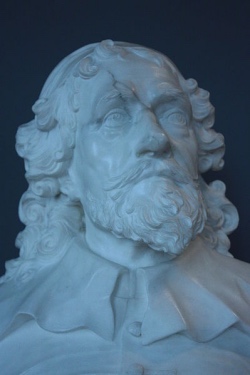
PICTURE: Bust of Inigo Jones by John Michael Rysbrack, (1725) (image by Stephencdickson/licensed under CC BY-SA 4.0)

10 of London’s most curious (and historic) graves – 7. Ben Jonson (Westminster Abbey)…

Many people are aware of the memorial to 17th century playwright and poet Ben Jonson that sits among the who’s who of the literary world commemorated in Westminster Abbey’s famous Poet’s Corner. But fewer people visit the poet’s actual grave, located a short distance away in the northern aisle of the nave.

And while visitors to the northern aisle of the nave may think its a small stone set into the wall above the floor itself, with the inscription ‘O rare Ben Johnson’ (note the ‘h’ used here in his name), which marks the grave’s location, we’re not quite there yet.

The stone, which was indeed the original stone covering Jonson’s grave, was actually moved from the floor to this position when the entire nave floor was being relaid in the 19th century. For the actual location of Jonson’s grave you have to head back to the aisle’s floor and there, just to the east of a brass commemorating John Hunter, you’ll find a small, grey lozenge-shaped stone which marks the actual grave site (and bears the same inscription with the same spelling).

The inscription can also be found on his Poet’s Corner memorial. It was apparently put on Jonson’s grave stone when one Jack Young passed by the grave as it was being covered and gave a mason 18 pence to carve it (Young is said to have been knighted later on).

All that’s very well but what really sets Ben Jonson’s grave apart from the other more than 3,500 graves buried in the abbey is that Jonson is the only person known to have been interred below the abbey floor standing upright.

The poet died in a somewhat impoverished state and it’s that which is said to explain the unusual arrangement. One version of the tale has the poet begging for just 18 square inches of ground for his burial from King Charles I; another has him telling the Abbey’s Dean that he was too poor to be buried with his fellow poets and that a space two foot square would serve him (the Dean apparently granted him his wish which meant Jonson’s coffin lowered into the ground end on end).

The fact he was buried upright in his coffin was apparently confirmed in 1849 when a clerk saw skeletal remains of a standing person in the spot Jonson was buried while doing another burial nearby.

The monument in Poet’s Corner, meanwhile, was erected in the early 1720s by the Earl of Oxford. It features a medallion portrait of him with actor’s masks and a broken golden lamp symbolising death on top. It was designed by James Gibbs and attributed to the sculptor JM Rysbrack.

WHERE: North Aisle, Westminster Abbey (nearest Tube stations are Westminster and St James’s Park); WHEN: Times vary – see the website for details; COST: £23 adults/£20 concession/£10 children (discounts for buying online; family rates available); WEBSITE: www.westminster-abbey.org

PICTURES: Top – The original grave marker now set in the wall; Below – The tile marking the actual grave site (Google Maps – images have been treated to improve resolution).

10 of London’s most curious (and historic) graves – 6. Sir John Soane’s family (St Pancras Old Church)…


It should probably come as no surprise that this rather elegant memorial in the former graveyard of St Pancras Old Church is that of architect – and founder of a rather remarkable museum – Sir John Soane (as well as his wife Eliza and their oldest son, John).

The tomb, described by architectural commentator Nikolaus Pevsner as an “outstandingly interesting monument”, was, of course, designed by the heart-broken Soane, the architect of neo-classical buildings like the Bank of England and Dulwich Picture Gallery, following the death of his wife on 22nd November, 1815.

Erected in 1816, it features a central cube of Carrara marble with four faces for inscriptions topped by a domed canopy supported on four ionic columns. A Portland stone balustrade surrounds the whole structure as well as stairs down to the subterranean tomb itself.

Among the symbolic decorative elements on the monument are a pine cone finial – a symbol of regeneration, a serpent swallowing its tail – a symbol of eternity, and reliefs of boys holding extinguished churches – symbols of death.

Sir John’s son, John, was buried in the tomb after his death in 1823 and Sir John himself was interred following his death on 20th January, 1837.

The monument is said to be only one of two Grade I-listed monuments in London – the other being Karl Marx’s gravestone in Highgate Cemetery. It is also famously said to have formed part of the inspiration for Sir Giles Gilbert Scott’s design of famous K2 red telephone box.

The Soane tomb was vandalised in 1869 – and it was suggested at the time that it should be relocated to Lincoln’s Inn Fields for its protection.

It was more recently restored in 1996 by the Soane Monuments Trust and again, after more vandalism, in 2000-01 as part of a restoration of St Pancras Gardens by the London Borough of Camden.

The graveyard of St Pancras Old Church, incidentally, is also the site of The Hardy Tree.

WHERE: St Pancras Gardens, Pancras Road, Camden Town (nearest Tube station is Kings Cross St Pancras); WHEN: Daylight hours; COST: free; WEBSITE: https://posp.co.uk/st-pancras-old-church/; www.camden.gov.uk/parks-in-camden.

PICTURES: Michael Day (licensed under CC BY-NC 2.0).

This Week in London – The written word at the British Library; London below ground; and, women artists at Tate Britain…

Carved stone inscriptions, medieval manuscripts and early printed works are among items on display in a new exhibition looking at the act of writing and its impact on human civilisation at the British Library. Writing: Making Your Mark spans five millennia and five continents and includes writing examples from more than 30 writing systems including Greek, Chinese and Arabic. Highlights include an 1,800-year-old ancient wax tablet, early 19th century Burmese tattooing instruments, the final diary entry of Antarctic explorer Captain Robert Falcon Scott, James Joyce’s notes for Ulysses, Caxton’s 1476-7 printing of The Canterbury Tales – the first book printed in England, and the personal notebooks of Elizabethan explorer Sir Walter Raleigh (pictured). There’s also a 60,000 signature petition from 1905 protesting the first partition of Bengal, Mozart’s catalogue of his complete works from 1784-1791 featuring his handwriting and musical notation, and Alexander Fleming’s notebook in which he recorded his discovery of penicillin in 1928. A programme of events accompanies the exhibition which runs until 27th August. Admission charge applies. For more see www.bl.uk. PICTURE: © British Library.

London’s forgotten rivers, tunnels, sewers, deep shelters, and the world’s first subterranean railway are all explored in a new free exhibition at the London Metropolitan Archives in Clerkenwell. Under Ground London in part celebrates the 200th anniversary of the birth of Victorian engineer Sir Joseph Bazalgette – who designed the scheme to overhaul the city’s sewers in the 19th century. As well as Bazalgette’s landmark work, the exhibition explores the legend of a cobbled street buried beneath today’s Oxford Street and tells the story of the Thames Tunnel which, when it opened in 1843, was the world’s first tunnel under a river. There’s also information on London’s ‘ghost stations’, including Strand and King William Street; and the Metropolitan Railway – the world’s first underground railway as well as images of the River Fleet, displayed for the first time. The display can be seen until 31st October. For more, follow this link.

Women artists working in Britain in the past 60 years are being celebrated in a new display at the Tate Britain in Millbank. Sixty Years features about 60 works spanning painting, photography, sculpture, drawing and film and includes many recent acquisitions. Artists whose works are on show include Mona Hatoum, Sarah Lucas, Bridget Riley, Mary Martin and Anthea Hamilton. Highlights include Gillian Wearing’s film Sacha and Mum (1996), Susan Hiller’s large scale multimedia installation Belshazzar’s Feast, the Writing on Your Wall (1983-84), and two new mixed media works by Monster Chetwynd – Crazy Bat Lady (2018) and Jesus and Barabbas (Odd Man Out 2011) (2018). For more, see www.tate.org.uk/visit/tate-britain.

Send all items for inclusion to exploringlondon@gmail.com.

LondonLife – Shakespeare at home?

A theatre historian believes he has discovered where William Shakespeare lived while he was writing some of his most famous works including Romeo and Juliet and A Midsummer Night’s Dream. While it has long been known the playwright lived close to the site of Liverpool Street station in the late 1590s, Geoffrey Marsh says an examination of official records has pinpointed the location as being on the site of what is now an office block at 35 Great St Helen’s, only a stone’s throw from The Gherkin. The BBC reports that Marsh, who is also the director of the V&A’s department of theatre and performance, found Shakespeare was a tenant of the Company of Leatherworkers and most likely lived among dwellings overlooking the churchyard of St Helen’s Bishopsgate, pictured above. PICTURE: Via Google maps

This Week in London – Victoria’s coronet in new display; Edvard Munch at the British Museum; and Abram Games wartime posters…

A sapphire and diamond coronet made for Queen Victoria goes on permanent display in the V&A’s William and Judith Bollinger Gallery from today. The new display is being unveiled as part of the V&A’s commemoration of the 200th anniversary of the births of the Queen and her husband, Prince Albert. The coronet was designed for the Queen by Prince Albert in 1840, the year they were married. Albert based the design on the Saxon Rautenkranz (circlet of rue) which runs diagonally across the coat of arms of Saxony. Victoria wore the coronet in a famous portrait by Franz Xavier Winterhalter completed in 1842 and again in 1866 when she wore it instead of her crown at the opening of Parliament. Entrance to the gallery is free. For more, see www.vam.ac.uk.

A major new exhibition of the work of Edvard Munch (1863-1944) opens at the British Museum in Bloomsbury today. Edvard Munch: love and angst, a collaboration with Norway’s Munch Museum, features 83 artworks taken from the museum’s collection as well as loans from across the UK and Europe. Highlights include a black-and-white lithograph of The Scream – the first time any version of the work has been on show in the UK for a decade, Vampire II – considered to be one of his most elaborate and technically accomplished prints, the controversial erotic image Madonna, and, Head by Head, a print representing the complex relationship between human beings. All of the latter three latter prints are being displayed alongside their original matrix (the physical objects Munch used to transfer ink onto paper). Runs until 21st July in the Sir Joseph Hotung Exhibition Gallery. Admission charge applies. For more, see www.britishmuseum.org. (PICTURE: The Scream (1895), Edvard Munch (1863-1944), Private Collection, Norway. Photo: Thomas Widerberg)

A retrospective of the work of Abram Games (1914-1996), a poster artist for the War Office during World War II, has opened at the National Army Museum in Chelsea. The Art of Persuasion: Wartime Posters By Abram Games features more than 100 posters he designed while working in the War Office’s Public Relations Department between 1941 and 1945. It explores how his Jewish refugee heritage, his experiences while a soldier and the turbulent politics of the time shaped his career and how his work – Games is described as a “master of reductive design” – still influences design professionals today. In conjunction with the opening of the exhibition last week, Games has been commemorated with an English Heritage Blue Plaque at his former home in Golders Green. Runs until 24th November. Admission charge applies. For more, see www.nam.ac.uk/artofpersuasion.

Send all items for inclusion to exploringlondon@gmail.com.

Famous Londoners – Sir Richard Mayne…

One of the first joint commissioners of the London Metropolitan Police, Sir Richard Mayne was also the youngest ever commissioner, and – with a stint of some 39 years, between 1829 and 1868 – the longest serving commissioner in the service’s history.

Mayne was born in Dublin, Ireland, on 27th November, 1796, as the son of Judge Edward Mayne of the Queen’s Bench in Dublin. He studied at Trinity College, graduating in 1818 with an arts degree and then at Trinity College in Cambridge, graduating with a Master of Arts in 1821.

He was called to the Bar at Lincoln’s Inn in February, 1822, and commenced practice as a barrister in England’s north where he would spend the next seven years.

In 1829, he was selected by Home Secretary Sir Robert Peel – without interview – after applying to serve as one of the two new commissioners of the Metropolitan Police. Just 33-years-old, he was officially known as the “Second Joint Commissioner” with Colonel Charles Rowan his senior colleague.

The pair – with his military background, Rowan brought his organisational and leadership skills to the job; Mayne his legal expertise – took up their posts on 7th July, 1829, and from their offices in 4 Whitehall Place (the back entrance was in Scotland Yard) set about creating the new police force.

The first constables of the new force were sworn in at the Foundling Hospital on 16th September and commenced their work patrolling the streets of the capital on 29th of that month.

Supported by his new income of £800 a year, Mayne married Georgina Marianne Catherine in 1831. The couple’s children would include Richard Charles Mayne who became a Royal Navy vice admiral.

In 1850, when Rowan retired, Mayne became the First Commissioner with Captain William Hay appointed the Second Commissioner.

In 1851, Mayne took personal charge of policing at the Great Exhibition and, despite Hay’s protests that he should have done that job given his military background, so successful was Mayne’s efforts that he was made a Knight Commander of the Bath (he had been made a Companion of the Bath in 1848 at the same time Rowan had been made a Knight Commander of the Bath – it had been suggested by some at the time that Mayne should have received the same honour as Rowan but it’s worth noting the latter had been a Companion of the Bath for his military services since 1815).

When Hay died in 1855, an Act of Parliament was passed changing the force’s structure so that it was to be headed by a single commissioner with two assistant commissioners. Mayne would serve in the role of sole commissioner for the next 13 years.

His period as sole commissioner was not a particularly happy one – the force’s handling of the Hyde Park riot of June, 1866, and the force’s mishandling of the Clerkenwell bombing in December, 1867 were two events which led Mayne to offer his resignation (which wasn’t accepted).

Mayne died while still in office at his home in Chester Square in Belgravia on Boxing Day, 1868, as the head of a force which had grown to almost 8,000 officers and policed a huge area.

Mayne, who was survived by his wife, was buried at Kensal Green Cemetery. A monument to him was unveiled there on 25th January, 1871.

Mayne’s legacy – his work in the formation of the Metropolitan Police – can still be felt in the capital today as well as in other police forces, not only in the UK but around the world.

PICTURE: Portrait of Richard Mayne in an illustration from an 1869 edition of The Illustrated London News. (Via Wikipedia).

This Week in London – ‘Beasts of London’; the Cold War remembered; Prince Albert and the V&A; and, ‘Power UP’ returns..

A state-of-the-art, multi-sensory experience focusing on the beasts, large and small, that have helped shaped London opens at the Museum of London tomorrow. Beasts of London, being run in conjunction with the Guildhall School and Music & Drama, tells the story of the capital from before London existed through to the city today, all through the perspective of animals. Inspired by objects in the museum’s collection, the nine “episodes” of the experience encompass subjects including the arrival of the Romans, the creation of the first menageries during the medieval period, the plague years of the 1600s, the first circuses in the late 1700s, the end of the animal-baiting period in the Victorian era and the role of animals in today’s contemporary city. There’s also a special episode on the contribution horses have made to the city. Well-known identities including Kate Moss, Brian Blessed, Pam Ferris, Nish Kumar, Stephen Mangan, Angellica Bell and Joe Pasquale provide voices for the animals alongside actors from the Guildhall School. The family-friendly experience can be enjoyed until 5th January, 2020. Admission charge applies. For more, see www.museumoflondon.org.uk/beastsoflondon. PICTURE: Lion sculpture; courtesy Museum of London.

A new exhibition about Britain’s role in the Cold War opens at the National Archives in Kew today – exactly 70 years since the formation of NATO. Protect and Survive: Britain’s Cold War Revealed features original documents including political memos, spy confessions, civil defence posters and even a letter from Winston Churchill to the Queen as it explores the complexities of government operations during a time of paranoia, secrets and infiltration. Other highlights include George Orwell’s infamous list of suspected communist sympathisers, Winston Churchill and Joseph Stalin’s ‘percentages agreement’, a plan of Lionel ‘Buster’ Crabb’s fateful spy mission, ‘Atom spy’ Klaus Fuchs’ confession and Civil Defence posters. There’s also a recreated government bunker and a 1980s living room showing the impact of the Cold War on both government and ordinary lives as well as digital screens on which Dame Stella Rimington, the first female Director General of MI5, shares her experiences along with insights from historian Dominic Sandbrook and curator Mark Dunton. The display is being accompanied by a series of events including night openings, film screening and talks. Runs until 9th November (30th anniversary of the fall of the Berlin Wall). Admission charge applies. For more, see nationalarchives.gov.uk/coldwar.

Prince Albert’s personal contributions to the V&A’s Library collection are the subject of a new exhibition which opened this week as part of the South Kensington Institute’s celebration of the 200th anniversaries of the births of both the Prince and Queen Victoria. Prince Albert: Science & the Arts on the Page features books and photographs include one volume containing a letter written by the Prince’s librarian Ernst Becker highlighting Albert’s wish to promote knowledge and learning in science and the arts. There’s also a volume of songs written and set to music by Albert and his brother, featuring amendments in Albert’s own hand, as well as his signed season ticket to the Great Exhibition of 1851. Runs until 1st September on the Library Landing. Admission is free. Head here for more.

Forty years of computer game history is once again on show at the Science Museum from Saturday. Returning for its fourth year, Power UP features 160 consoles and hundreds of games, from retro classics like Space Invaders to the latest in VR technology. Special events include two adults-only evening sessions on 10th and 17th April. Runs until 22nd April. For more, see sciencemuseum.org.uk/power-up.

Send all items for inclusion to exploringlondon@gmail.com.