This Week in London – New museum on policing in the Square Mile; the 801st Lord Mayor’s Show; and maps on show at the BL…

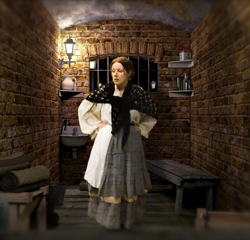
catherineeddowes2Stories including that of Catherine Eddowes, one of the victims of the notorious Jack the Ripper whose tale is brought to life through a virtual hologram (pictured), that of the Houndsditch Murders which claimed the lives of three police officers, and those of the more than 70 horses which have served in the City of London Police are among those told in the new purpose-built City of London Police Museum. A collaboration between the City of London Police and the City of London Corporation’s Guildhall Library, the new facility covers the 177 year history of the men and women charged with policing the Square Mile. Other stories highlighted in the museum include that of the recruitment of women into the force, the impact of the two World Wars on policing in the capital (featuring photographs taken by City of London police officers Arthur Cross and Fred Tibbs), the force’s tackling of terrorism and the progress of its communications, uniforms and kit and the victory of the City of London Police as the winner of the Olympic gold medal for the tug of war in 1920 (which, given the event was dropped, leaves them as the current champions). Entry to the museum, which opened this week at Guildhall, is free. For more, see www.cityoflondon.police.uk/about-us/history/museum/Pages/default.aspx. PICTURE: Courtesy City of London Police Museum.

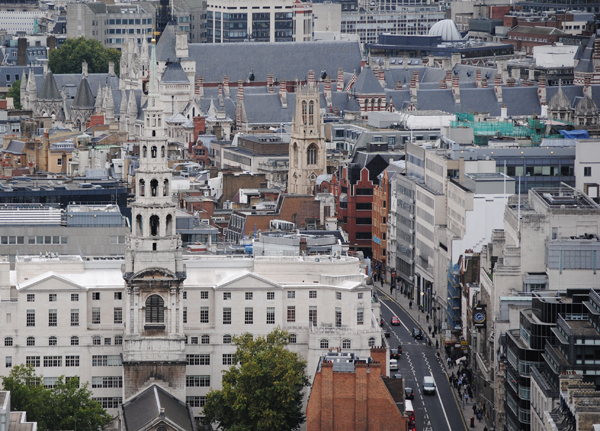
The Lord Mayor’s Show takes place this Saturday, kicking off with a river pageant followed by the grand procession through City streets and fireworks over the Thames. The 801st Lord Mayor’s Show celebrates the election of Andrew Parmley as the 689th Lord Mayor of the City of London. This year’s procession, which kicks off at 11am and runs from Mansion House down Cheapside to the Royal Courts of Justice – where the Lord Mayor swears allegiance to the Crown – and back again at 1pm via Victoria Embankment, features 6,500 participants, 180 horses and 164 vehicles including steam engines, fire engines and a tank. The Show’s Pageantmaster, Dominic Reid, is celebrating his 25th consecutive show this year (his father organised 20 shows before him). The river pageant, featuring the QRB Gloriana, sets off from Westminster at 8.30am with Tower Bridge opening in salute at 9.25am. The fireworks display, which takes place over the Thames between Blackfriars and Waterloo, starts at 5.15pm. The tradition dates back to 1215. For more, see https://lordmayorsshow.london.

A major new exhibition looking at the history of the 20th century through maps has opened at the British Library in King’s Cross. Maps and the 20th Century: Drawing the Line features maps ranging from the first sketch of the London Underground dating from 1931, to declassified Ministry of Defence maps from the Cold War era, John Betjeman’s personal set of Ordinance Survey maps from the 1920s, a Russian moon globe from 1961 and EH Shepard’s first map of the Hundred Acre Wood (home of Winnie the Pooh). Other highlights include 3D relief models of the Western Front from 1917, a dress made of World War II escape maps printed on silk, an aerial photograph of Liverpool with targets marked used by the Luftwaffe, a map of the Atlantic Ocean floor from 1968. The exhibition, which runs to 1st March, is running in conjunction with a series of events exploring how maps continue to shape and influence our world. Admission charge applies. For more, follow this link.

Send all items for inclusion to exploringlondon@gmail.com

This Week in London – Emma Hamilton’s life explored; artist self-portraits; and, National Trust garnitures…

Emma Hamilton, the mistress of Horatio Nelson – hero of the Battle of Trafalgar, is the subject of a new exhibition at the National Maritime Museum in Greenwich. One of the most famous figures of her time, Hamilton rose from obscure beginnings to the heights of celebrity and is best remembered for the scandalous affair she had with Lord Nelson for the six years prior to his death in 1805. Emma Hamilton: Seduction and Celebrity brings together more than 200 objects, many of which have never been displayed before, including paintings, letters, costumes and jewellery. Highlights include works by artists George Romney, Sir Joshua Reynolds and Sir Thomas Lawrence, letters from Hamilton and her lovers, betrothal rings exchanged between Hamilton and Nelson, her songbooks and decorative objects. The exhibition, which runs until 17th April, is accompanied by a series of events including walking tours and late openings. Admission charges apply. For more, see www.rmg.co.uk/national-maritime-museum.

The first-ever exhibition of portraits of artists in the Royal Collection opens at The Queen’s Gallery, Buckingham Palace, tomorrow. Portrait of the Artist features more than 150 paintings, drawings, prints, photographs and decorative arts including a self-portrait by Sir Peter Paul Rubens (1623) which was hung in Whitehall Palace, a portrait of his former assistant Anthony van Dyck (c1627-28), and Cristofano Allori’s work Head of Holofernes (1613) in which the artist appears as the decapitated Holofernes as well as self-portraits by everyone from Rembrandt to Lucien Freud and David Hockney. The exhibition runs until 17th April. Admission charges apply. For more, see www.royalcollection.org.uk/visit/the-queens-gallery-buckingham-palace.

Sir Joseph Lyons, founder of Lyons tea shops and the ‘Corner Houses’ of London – among the first chain restaurants in England, has been honoured with an English Heritage Blue Plaque at his former home in Hammersmith. Sir Joseph, who lived at the property in the 1890s close to the now-demolished headquarters of his catering empire at Cadby Hall, opened the doors to his first teashop at 213 Piccadilly in 1894. He was knighted by King George V in 1911. For more, see www.english-heritage.org.uk/visit/blue-plaques/.

On Now: Garnitures: Vase sets from National Trust Houses. Being run in conjunction with the National Trust, the display at the Victoria & Albert Museum in South Kensington explores the history of ‘garniture’ – sets of ornamental vases unified by their design and a specific context. A status symbol for a period between the 17th and 19th century, garnitures fell out of fashion and complete sets are now extremely rare. The display features garnitures loaned from 13 different National Trust houses as well as objects from the V&A’s collection. Highlights include a garniture made in miniature for a doll’s house, an extremely rate 17th century silver set of jars, a Rococo set and Wedgwood ceramics. The free exhibition runs until 30th April. For more, see www.vam.ac.uk/exhibitions/garnitures.

Send all items for inclusion to exploringlondon@gmail.com.

Treasures of London – ‘The Fighting Temeraire’

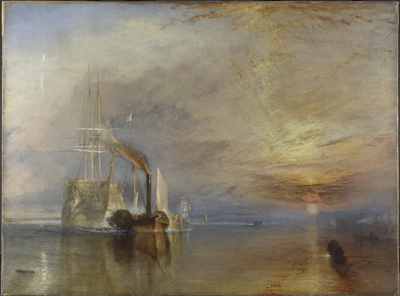
fighting-temeraireIt’s an atmospheric image – both literally and metaphorically – that will soon be sitting in wallets and purses across the UK. Painter JMW Turner’s The Fighting Temeraire tugged to her last berth to be broken up, 1838 is among the most famous artworks hanging in The National Gallery and, as the Bank of England has announced earlier this year, will adorn newly produced £20 notes from 2020 onwards. It commemorates the end of the famous ship, the 98 gun HMS Temeraire, which had played a heroic role in Lord Nelson’s victory at the Battle of Trafalgar in 1805 and, say reports, had been dubbed the “Fighting” Temeraire ever since (although it’s also suggested the ship was actually known by the crew as the “Saucy” Temeraire) . The oil painting, which Turner created in 1839, depicts the ship being towed away to be broken up (although, while it was actually towed from Sheerness to Rotherhithe in London –  a westerly trip, the painting depicts it going eastward). The Temeraire itself is drawn romantically, almost spectrally, while in front of it is a steam tug shown in hard modernity and, of course, in the backdrop is the majestic setting sun, evoking a sense of the end. The painting, which was bequeathed to the gallery by the artist in the 1850s, and which incidentally appeared in the James Bond film Skyfall in a scene in which 007 (Daniel Craig) meets Q (Ben Wishaw) in front of it, can be found in Room 34 of gallery.

WHERE: The National Gallery, Trafalgar Square (nearest Tube stations are Charing Cross and Leicester Square); WHEN: 10am to 6pm daily (open to 9pm Saturdays); COST: free; WEBSITE: www.nationalgallery.org.uk.

PICTURE:  Joseph Mallord William Turner, The Fighting Temeraire tugged to her last berth to be broken up, 1838, © National Gallery, London

This Week in London – Medieval embroidery; Maino on show; former toilet block becomes Kensington Garden’s newest eatery; and, a new Lord Mayor…

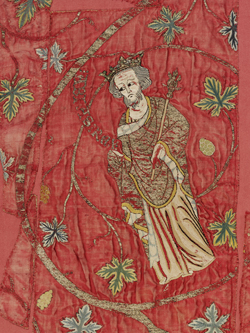
the_jesse_cope_detail_ca-_1310-25_c_victoria_and_albert_museum_londonObjects associated with some of the most notable personages of the Middle Ages – from King Edward I and his wife, Queen Eleanor of Castile through to Edward, the Black Prince, and martyred archbishop, Thomas Becket – will go on show at the V&A in South Kensington as part of a display of medieval embroidery. Opening Saturday, Opus Anglicanum: Masterpieces of English Medieval Embroidery features embroidered treasures such as a seal-bag which, dating from the early 12th century, was made to hold the foundation document of Westminster Abbey, the Toledo Cope which has been brought back to England from Spain for the first time since its creation in the 14th century and an embroidered vestment associated with Thomas Becket. There’s also the Hólar Vestments from Iceland, the Jesse Cope from the V&A’s own collections (pictured), the Daroca Cope from Madrid and an embroidered tunic worn by Edward, the Black Prince. As well as embroidery, the display features panel paintings, manuscripts, metalwork and sculpture. Runs until 5th February along with a season of events. Admission charges apply. See www.vam.ac.uk/opus for more. PICTURE: © Victoria and Albert Museum, London.

Two works by Spanish painter Fray Juan Bautista Maino have gone on exhibition for the first time in the UK at The National Gallery, off Trafalgar Square. The Adoration of the Shepherds and The Adoration of the Kings, dating from 1612-14, have been loaned from the Museo Nacional del Prado in Madrid, Spain, and can be seen for free in a display being held in conjunction with the upcoming exhibition Beyond Caravaggio. Each of the paintings measures more than three metres in height and were originally part of a retable (altarpiece) created for the altar of the Dominican church of San Pedro Martir in Toledo. The work took three years to complete and it was while he was doing so that Maino took religious vows and joined the Dominican Order (there’s also a chance he included a self portrait in the work in the form of a pilgrim on the altar’s far left). Can be seen until 29th January. For more, see www.nationalgallery.org.uk.

A former disused toilet block has been converted into a new cafe overlooking the 150-year-old Italian Gardens in the Kensington Gardens. Formally opened by Loyd Grossman, chairman of the Royal Parks charity, earlier this month, the cafe has a “living roof” aimed at supporting the biodiversity and wildlife of the gardens and has been designed in sympathy with the gardens and the nearby Grade 2* listed Queen Anne’s Alcove, currently being restored. The Italian Gardens were a gift from Prince Albert to Queen Victoria. For more on the cafe, including opening times, head here.

Alderman Andrew Parmley has been elected as the 689th Lord Mayor of London. In keeping with tradition, he will take up the office after the ‘Silent Ceremony’ in Guildhall on 11th November followed by the annual Lord Mayor’s Show parade through the City the following day.

Send all items to exploringlondon@gmail.com for inclusion.

Famous Londoners – Sir Thomas Bludworth…

fireSir Thomas Bludworth (also spelt Bloodworth) is usually only remembered as the man who had the unfortunate job of being Lord Mayor of London when the Great Fire broke out in 1666. So, given the fire’s 350th anniversary this month, we thought it timely to take a more in-depth look at his life and career.

Bludworth was born in London in February, in about 1620, the second surviving son of John Bludworth, master of the Vintner’s Company and a wealthy merchant. Trained to succeed his father – his elder brother having joined the clergy, Bludworth was himself admitted to the Vintner’s Company in the 1640s and joined the Levant Company in 1648.

First elected an alderman in 1658, he was discharged when he refused to serve as a sheriff and the following year served as the master of the Vintner’s Company. In 1660, he was briefly arrested along with 10 other members of City of London’s common council after the body refused to pay taxes until a representative parliament was convened.

Elected MP for Southwark later that year, Bludworth among city and parliamentary representatives who sailed to The Netherlands to attend the king, Charles II, in exile, and invite him to return to England. It was while attending the king in The Hague that he was knighted. Re-elected in 1661, he was an active parliamentarian who served in numerous different capacities.

Sir Thomas was twice married and had a number of children including a formidable daughter Anne who eventually married the historically unpopular George Jeffreys, (later King James II’s Lord Chief Justice and Lord Chancellor).

In mid-1662, he was once again made a City of London alderman and appointed one of two sheriffs for the following year. He became Lord Mayor of London in November, 1665, but apparently there was no pageant as was customary due to the plague.

During his year in the office – “the severest year any man had” – he faced both the plague and the Great Fire and his reputation has been largely formed out of his response to the latter thanks in large part his alleged response when woken and told of the fire as being: “Pish, a woman might piss it out!”.

Bludworth was heavily criticised at the time and over the years since his reaction to the fire – including not pulling down homes to create a firebreak and thus prevent the spread of the fire, but it should be noted that had he done so before he had received the king’s permission, he would have found himself personally liable.

Diarist Samuel Pepys’ who, following two encounters in the months before the fire had already described Bludworth as “mean man of understanding and despatch of any public business”, recorded that when he finally brought a message from the king ordering the creation of a firebreak, Sir Thomas seemed like “a man spent”.

“To the King’s message (to create a firebreak by pulling down houses), he cried, like a fainting woman, ‘Lord, what can I do? I am spent: people will not obey me. I have been pulling down houses, but the fire overtakes us faster than we can do it’.”

Another eyewitness describes him as looking like he was “frighted out of his wits” during the fire.

Sir Thomas’ own property at Gracechurch Street was among the casualties of the fire but he later built a new mansion in Maiden Lane.

He continued to serve as an MP after the fire and was, perhaps ironically, appointed to a committee working on a bill to provide “utensils” for the “speedy quenching of fire”. In the mid-1670s, he become one of the governing members of the Royal African Company.

Sir Thomas died on 12th May, 1682, aged around 60. He was apparently buried in Leatherhead.

10 sites commemorating the Great Fire of London – 5. Paternoster Square Column…

paternoster-square-column2
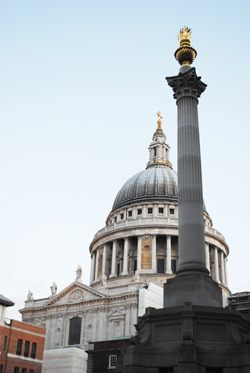
Located just to the north of St Paul’s Cathedral can be found Paternoster Square in the centre of which stands a column.

paternoster-square-columnThe 75 foot (23.3 metre) tall Corinthian column of Portland stone, which was designed by Whitfield Architects and erected in 2003, is topped by a gold leaf covered flaming copper urn which is lit up at night.

While it has been said that the column is “purely decorative”, the developers of Paternoster Square claim on their website that it actually serves several purposes in this case including both commemorative and practical.

Not only is it part of the ventilation system for the carpark underneath, they say its design is apparently a recreation of columns designed by Inigo Jones for the west portico of Old St Paul’s Cathedral.

And then there’s the three metre high urn on top which, not unlike that found on The Monument, they say commemorates the fact the site of the square has twice been destroyed by fire – the first time in the Great Fire of 1666 and the second in the Blitz during World War II.

The area around Paternoster Square was once home to booksellers and publishers’ warehouses.

10 sites commemorating the Great Fire of London – 4. St Paul’s ‘Resurgam’…

Resurgam3
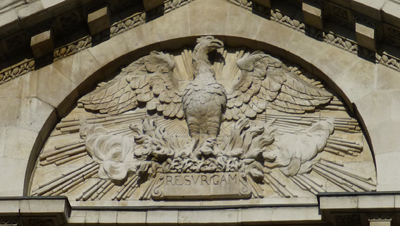
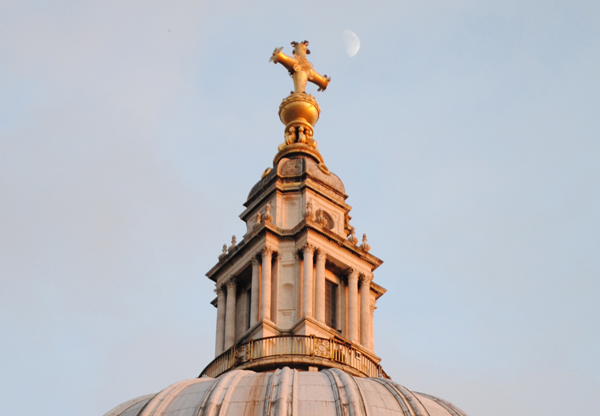
Old St Paul’s Cathedral was certainly the largest and most famous casualty of the Great Fire of London of 1666. And its passing – and rebirth – is recorded on several memorials, one of which can be found on the building itself.

Set on the pediment which, carved by Caius Gabriel Cibber, sits above south portico off Cannon Street, the memorial depicts a phoenix rising from clouds of smoke (ashes), a symbol of Sir Christopher Wren’s new cathedral which rose on the site of the old Cathedral in the wake of the fire. Below the phoenix is the Latin word, ‘Resurgam’, meaning “I Shall Rise Again”.

The story goes that Wren had this carved after, having called for a stone to mark the exact position over which St Paul’s mighty dome would rise, the architect was shown a fragment of one of the church’s tombstones which had been inscribed with the word.

The foundation stone for the new cathedral, largely built of Portland stone, was laid without any fanfare on 21st June, 1675, and it only took some 35 years before it was largely completed. Some of the stonework from the old cathedral was used in the construction of the new.

We should note that the old cathedral was in a state of some disrepair when the fire swept through it – the spire had collapsed in 1561 and despite the addition of a new portico by Inigo Jones, it was generally in poor condition.

Stonework from the Old St Paul’s – everything from a Viking grave marker to 16th century effigies – are now stored in the Triforium, rarely open to the public (tours of the Triforium are being run as part of the programme of events being held at the cathedral to mark the 350th anniversary of the Great Fire – see www.stpauls.co.uk/fire for more).

PICTURE: givingnot@rocketmail.com/CC BY-NC 2.0 (image cropped)

10 sites commemorating the Great Fire of London – 3. The Templar’s column…

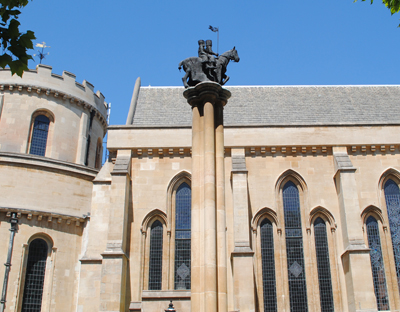
Knights-atop-the-columnStanding outside the Temple Church, in the west of the City of London (between Fleet Street and the River Thames), stands a pillar topped with a pair of Templar knights riding a horse in an obvious commemoration of the military order that once had its preceptory here.

But what many people don’t realise is that the column was also erected, apparently like the Golden Boy of Pye Corner, to commemorate another point where the all-consuming Great Fire of London was finally stopped.

The 10 metre high column was erected in 2000 (another of its purposes was to mark the millennium) in what was once the cloister courtyard of the headquarters of the Templars, which had originally founded to protect pilgrims to the Holy Land in 1119.

The bronze figures of the two men atop a single horse which caps the column was a representation of the image found on the order’s official. It represents the poverty of those who initially joined it – so poor they could only afford one horse for every two men, a situation which was to change dramatically in coming centuries as the order accumulated wealth, a situation which, eventually, in France, led to its downfall.

London Remembers reports that the column was designed in the gothic style, similar to the Purbeck marble columns in the church (which, incidentally, are said to be the oldest surviving free-standing examples of their kind) and deliberately made to contrast with the more florid column of Sir Christopher Wren’s Monument, which marks where the fire started and, also, according to a signboard, “the arrival of the new classical order”.

The column, designed by Ptolemy Dean, and the sculpture, designed by Nicola Hicks, were the gift of Lord Lloyd of Berwick, Treasurer of the Inner Temple in 1999. A Latin inscription around the base of the column reads: “Lest the Temple should be without a memorial of the start of the third millennium the Inner Temple caused this monument to be erected for the greater glory of God.”

For more on Temple and the Temple Church, see our earlier posts here and here and here.

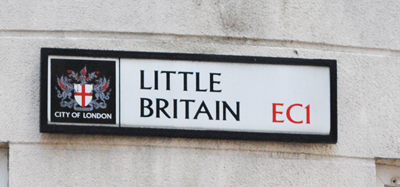
What’s in a name?…Little Britain…

Little-BritainThis central – and rather unassuming – London street owes its name to the French – not British – who apparently once lived in the area which lies just south of Smithfield.

Originally named Little Brittany, it was settlers from Brittany in the east of modern France that inhabited the area where the street can be found after the Norman Conquest. Foremost among them apparently was the Duke of Brittany who apparently had a house here prior to the 1500s.

Between the late 15th century and early 18th century, the street was known as a location for booksellers (it was here that Britain’s first daily newspaper, the early 18th century Daily Courant, was printed in the area after moving from Fleet Street).

Famous residents over the years have included the 17th century poet John Milton (there’s also a much-repeated anecdote that has a Little Britain-based bookseller trying to convince the Earl of Dorset to buy as many copies of the apparently immoveable Paradise Lost as he could carry) , a very young Samuel Johnson (the then three-year-old and his mother lodged with a bookseller when she brought him to be touched by Queen Anne as a cure for his scrofula), and Benjamin Franklin who stayed here in 1724.

Literary references included a mention in Charles Dickens’ Great Expectations – the office of the lawyer Mr Jaggers were placed here.

St Bartholomew’s Hospital now occupies many of the buildings in the street.

This Week in London – A Queen’s garden party; the Great Fire 350 Festival; and, getting behind the scenes at the Museum of London…

Kensington-Palace-garden-partyJoin Queen Caroline, wife of King George II, for a garden party in the grounds of Kensington Palace this weekend. The celebrations include music, military drills and live performances in a bid to bring the era of the Georgians to life. Visitors can listen to court gossip, learn how to play popular music and devise ways to amuse the queen as they pop in and out of a range of tents set up in the gardens, each of which contains a different activity, from uncovering dress secrets to designing a mini-garden fit for a king or queen. There’s even the chance to sample some Georgian ice-cream in the ice-house. The days will be held from today until 21st August. Admission charges apply. For more, see www.hrp.org.uk/kensington-palace/. PICTURE: Via HRP
The Great Fire 350 Festival – marking the 350th anniversary of the Great Fire of London – is underway and there’s a range of events being held in London over this month and next. While we’ll be mentioning some of these a little closer to actual anniversary date, meantime there are bi-weekly walks, a ‘Fire Trail’ treasure hunt and a new Monument app to keep you busy. The latter allows visitors to conduct a self-guided ‘Great Fire journey’ focusing on the fire itself, the commemoration of the blaze and London as we know it now as well as taking users into the minds of Sir Christopher Wren and Robert Hooke – designers of The Monument. Available for download from Android Market and Apple App Store. For more on the events running as part of the anniversary, see www.visitlondon.com/greatfire350/events.

 Take a behind the scenes look at the Museum of London – and see some rarely exhibited objects – in an exhibition which opened late last month. The free display allows visitors to catch a glimpse of some of the work that goes on behind the scenes and see objects usually housed in the museum’s extensive stores including a detailed model of the process engraving department at the Evening Standard newspaper in 1977, an ice-cream maker and moulds from around 1910, and a confectioner’s icing stand from about 1900. The exhibition can be seen until 15th September. For more, see www.museumoflondon.org.uk.

Send all items for inclusion to exploringlondon@gmail.com.

A Moment in London’s History – The rebuilding of London in the aftermath of the Great Fire…

It’s the 350th anniversary of the Great Fire of London ands we thought we’d take a quick look at what happened in the aftermath.

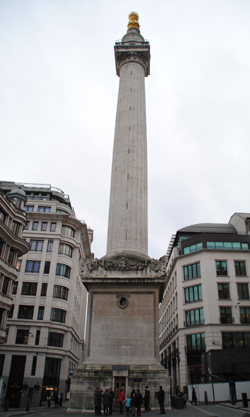
The-MonumentWith much of the city razed in the four day fire of early September, 1666, attention quickly turned to the rebuilding of the City and within just a few days, proposals began coming in for the recreation – and transformation – of London.

Christopher Wren, John Evelyn and Robert Hooke were among those who put forward new designs for the city along with the likes of one Richard Newcourt, whose proposed rigid grid featuring churches set in squares wasn’t adopted for London but was eventually for the streets of Philadelphia in what is now the United States of America.

None of these plans – Wren’s vision had apparently been inspired by the Gardens of Versailles while Evelyn’s was an Italianate city with wide piazzas – were eventually adopted, however, thanks largely to the difficulty in working out who owned which properties in the city (people had more on their mind, such as survival perhaps).

In October, 1666, King Charles II – who had encouraged many of those left homeless to move out of the City out of fears that a rebellion was in the offing – joined with the City authorities in appointing six commissioners to regulate the rebuilding (a key factor in which was the mandatory use of brick in place of wood).

Their actions were supported by a couple of parliamentary acts – drawn up to regulate the rebuilding and allow for the opening and widening of roads, among other things – and the establishment of specially convened Fire Courts to deal with property disputes (owners had to clear roadways of debris and establish their rights of ownership before they could start reconstruction).

Rebuilding was, not surprisingly, to take years – after all, almost 400 acres had been burned within the City walls and 63 acres outside them with more than 80 churches, 44 livery halls and more than 13,000 houses among the casualties. And it was patchy with new buildings standing alongside empty blocks awaiting reconstruction.

Construction of the many grand public buildings destroyed in the fire, such as St Paul’s Cathedral, would also take years (the cathedral, Wren’s Baroque masterpiece, wasn’t completed until 1711).

PICTURE: The Monument, which commemorates the Great Fire of London, is among the works of Sir Christopher Wren (for more on the Monument, see our earlier post here).

Famous Londoners – Scipio Africanus ‘Sam’ Mussabini…

The Olympics kick off in Rio de Janeiro this week, so we thought it a good occasion to recall a Londoner intimately associated with the Olympics, though not as an athlete but as a coach.

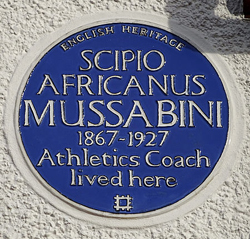
MussabiniBorn in Blackheath, Scipio Africanus – ‘Sam’ – Mussabini was a pioneering athletics coach who, in early 20th century, coached 11 athletes to win medals, including five gold, over five different Olympic Games.

Mussabini, the son of a Syrian-Italian father and French mother, was educated in France and worked, like his father, in journalism, writing for sports magazines and specialising in billiards (which he also played to a high standard).

From the 1890s, he started working, first as a cycling coach and later as an athletics coach in south London, based at Herne Hill Stadium.

His first major success as the latter came when young South African sprinter, Reggie Walker, won gold in the 100 metres at the 1908 London Olympics. In 1913, he was appointed coach of the Polytechnic Harriers at the Herne Hill athletics track.

He would go on to train the likes of Albert Hill – he won gold in the 800 and 1,500 metres at the 1920 Olympics in Antwerp – and his most famous student Harold Abrahams who won gold in the 100 metres and silver in the 4 x 100 metre relay at the 1924 Paris Olympics – a role which is depicted in the 1981 film Chariots of Fire (the coach is played by Ian Holm).

Mussabini is famous for the comprehensive and systematic approach he took to training his athletes, an approach which covered the athletes’ lifestyle and diet as well as a rigorous training regime, and which saw him use techniques such as using a cine-camera t0 film his athletes in action and then analysing the footage. He is also noted for having ensured female athletes, like world record sprinter Vera Palmer-Searle, received high quality coaching.

As a paid coach in an age when most were amateurs, he was ostracised by the establishment and apparently only started to receive the recognition he deserved well after his death, particularly following his depiction in Chariots of Fire.

Mussabini, who suffered from diabetes, died in March, 1927, at the age of 60. He was buried in Hampstead Cemetery. There is an English Heritage blue plaque on the house he lived in at 84 Burbage Road (it backs onto the Herne Hill Stadium) between 1911 and 1916.

Mussabini was inducted into the English Athletics Hall of Fame in 2011 while the Mussabini Medal was awarded every year between 1998 and 2007 by Sports Coach UK to honour outstanding coaches.

PICTURE: Spudgun67/Wikimedia/CC BY-SA 4.0

Lost London – Christ’s Hospital…

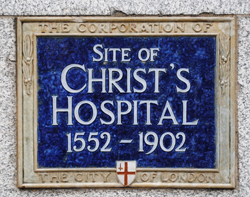
One of the achievements of the short-lived reign of King Edward VI, son of King Henry VIII, was the establishment of this hospital for orphans in 1552 in what were once buildings used by the Greyfriars Monastery (for more on the history of Greyfriars, see our earlier post here).

Christs-HospitalLocated in Newgate Street, the hospital soon had a school attached which became known as the Blue Coat School thanks to the distinctive long blue coats the students wore (and still do, the school is now located near Horsham in West Sussex).

Many of the hospital buildings were destroyed in the Great Fire of London of 1666 but most were later rebuilt under the supervision of Sir Christopher Wren, although the actual work was apparently carried out by others.

Students at the school have included antiquarian William Camden, Romantic poet Samuel Taylor Coleridge and writer Charles Lamb.

New buildings for girls were opened in Hertford in 1704 and the school moved out to Sussex in 1902 with the General Post Office built over the top of the demolished buildings.

This Week in London – Remembering the Great Fire of 1666; rediscovering the Palace of Whitehall; and, the Queen’s dresses go on show…

Fire2• A new “theatrical” exhibition marking the 350th anniversary of the Great Fire of London is opening at the Museum of London on Saturday. Fire! Fire! takes visitors on an interactive journey from before, during and after the great fire, looking at how the fire started and spread and the personal stories of Fire1Londoners present at the time. Visitors will be able to step in Pudding Lane and see what life was like for 17th century Londoners, walk into the bakery where the fire started, and identify objects melted by the flames. Exhibits on show include a restored 17th century fire engine, originally built in London in the last 1670s, other firefighting equipment including a squirt, a leather bucket and fire hook, a pair of bed hangings, a burnt Geneva Bible, and letters written in the fire’s aftermath. Admission charges apply. Can be seen until 17th April next year. A series of events, including walks, tours, lectures, workshop and family activities, accompanies the exhibition. For more, see www.museumoflondon.org.uk/fire-fire.  The museum has also commissioned a Minecraft building group recreate London as it was in 1666 with the first of three interactive maps to be released next week (available for free download from www.museumoflondon.org.uk) and further maps to follow in September and February. For more information on other events surrounding the anniversary, see www.visitlondon.com/greatfire350.

The long lost Palace of Whitehall is the subject of a new visitor experience which kicks off at the last surviving part of the palace – the Banqueting House – today. Handheld devices, binaural 3D sound and haptic technology is being made available to guests as they stroll around the streets of modern Whitehall, allowing them to immerse themselves in the former palace during the time of the Tudors and the Stuarts. The Lost Palace experience, created in a collaboration between Historic Royal Palaces and Chomko & Rosier and Uninvited Guests, includes a chance to see the jousts which so delighted Queen Elizabeth I at Horse Guards Parade, accompany King Charles I as he walks through St James’s Park to his execution at the Banqueting House, meet Guy Fawkes following his arrest in the Gunpowder Plot, take part in a performance of King Lear and eavesdrop on an encounter between King Henry VIII and Anne Boleyn before their doomed love affair began. The Palace of Whitehall was once the largest palace in Europe with 1,500 rooms spread across 23 acres. Tickets can be purchased at the Banqueting House. Runs until 4th September. For more details, see www.hrp.org.uk/thelostpalace.

DressDresses worn by Queen Elizabeth II during two of the most significant events in Her Majesty’s life – her wedding and her coronation – can be seen as part of the Summer Opening of the State Rooms at Buckingham Palace from Saturday. The two dresses will form part of a special exhibition – Fashioning a Reign: 90 Years of Style from The Queen’s Wardrobe, the largest display of the Queen’s dress ever held. Alongside the two feature dresses, both designed by British couturier Sir Norman Hartnell, are around 150 outfits created by designers including Hartnell, Hardy Amies and Ian Thomas. The then Princess Elizabeth’s wedding dress (pictured), made for her marriage to the Duke of Edinburgh on 20th November, 1947, was made in ivory silk, decorated with crystals and 10,000 seed pearls and attached to a 15 foot long train, while the Queen’s Coronation dress – created for the event on 2nd June, 1953, is made of white duchesse satin and encrusted with seed pearls, sequins and crystals (along with an extra four-leaf shamrock on the left side of the skirt, added secretly by Sir Norman, to bring her good luck). The exhibition, open to 2nd October, is being accompanied by special displays at both Windsor Castle and Holyroodhouse in Edinburgh. Admission charges apply. For more, see www.royalcollection.org.uk. PICTURE: Royal Collection Trust/© Her Majesty Queen Elizabeth II 2016. 
The world’s largest collection of London images – more than 250,000, dating from 1450 to now – are being made available on a free-to-access website hosted by the London Metropolitan Archives from today. Collage – The London Picture Archive features more than 8,000 historical photographs of capital’s streets as well as images of the Great Fire of London in 1666 and photographs of the construction of Tower Bridge along with maps, prints, paintings and films, all drawn from the collections at the City of London Corporation’s Guildhall Art Gallery and the Clerkenwell-based London Metropolitan Archives. The collection can be accessed at www.collage.cityoflondon.gov.uk.

It’s hands-on gaming at the Science Museum for two weeks from Friday with more than 160 systems and hundreds of games available to play on. Power UP spans 40 years of gaming with games ranging from classics like Pong and Pac-Man to modern games like Halo and systems from Atari and SEGA to PS4 and Xbox One. Ninety minute sessions are being held four times daily from 11am tomorrow until 7th August. Ticket charges apply. For more , see www.sciencemuseum.org.uk/powerup.

Send all items for inclusion to exploringlondon@gmail.com.

A Moment in London’s History – The “first PM” moves into 10 Downing Street…

With the recent change at 10 Downing Street – David Cameron out/Theresa May in – we thought it a good time to look back at when the man considered Britain’s first PM moved in.

10_Downing_StreetSir Robert Walpole, commonly considered Britain’s first Prime Minister although he was never formally known by that title, was actually First Lord of the Treasury when in early 1730s King George II presented him with the terrace house at 10 Downing Street, off Whitehall, and the large mansion behind it (in fact the title of ‘First Lord of the Treasury’ can still be seen inscribed on the brass letter-box on the property’s front door).

Sir Robert accepted the king’s gift, but only on condition that it be made available to all future First Lords of the Treasury  And he didn’t move in until 22nd September, 1735, having had architect William Kent join the terrace house with the mansion behind it before doing so.

Kent had joined the houses on two levels with the main entrance facing onto Downing Street instead of Horse Guards. The Walpoles would live at the back of the new house where Kent had created a series of grand rooms – suitable for receiving honoured guests – and had built an unusual three sided staircase which remains a star sight of the building today.

Walpole used the ground floor of the new property for business and set-up his study in what is now the Cabinet Room. Lady Walpole used the upstairs room now known as the White Drawing Room as her sitting room and what is now called the Terracotta Room (although the name of this room changes with the colour scheme) as the dining room.

Among those who attended 10 Downing Street during the Walpole’s residency were luminaries such as Queen Caroline (wife of King George II) as well as prominent politicians, writers and military figures.

The Walpoles left in 1742 and it was more than 20 years later before another First Lord of the Treasury moved in.

For more on 10 Downing Street (including its earlier history), check out our previous entries here and here.

PICTURE: Sergeant Tom Robinson RLC/ Contains public sector information licensed under the Open Government Licence v3.0.

London Pub Signs – St Stephen’s Tavern, Westminster…

The origins of the name of this pub apparently lie in something of a mistake (well, sort of).

St-Stephens-TavernLocated at 10 Bridge Street on the corner of Canon Row – just across the road from the clock tower at the north end of the Houses of Parliament, its name apparently lies in mistaken belief that the tower was named St Stephen’s Tower.

It never was, at least not officially. Prior to recently being renamed the Elizabeth Tower – in honour of Queen Elizabeth II’s 60 years on the throne, the tower, which contains the bell known as Big Ben, was simply known as the Clock Tower (another common error has been to call the tower itself Big Ben).

The name St Stephen’s Tower apparently was the fault of Victorian journalists. They had the habit of referring to stories relating to the goings-on in the House of Commons as “news from St Stephen’s” because MPs, prior to the destructive fire of 1834, used to sit in St Stephen’s Hall (the entrance to the hall can be found down the road opposite Westminster Abbey).

Hence we have St Stephen’s Tavern, a favoured watering hole of many politicians – including apparently PMs Stanley Baldwin, Winston Churchill and Harold MacMillan.

The pub has been around since at least Victorian times – it was demolished in 1868 when Westminster tube station being built and rebuilt a few years later. In 1924, the pub was expanded to take over the Queen’s Head next door.

It closed in the late 1980s but was reopened in 2003 with many of the original fittings restored. These include one of only 200 parliamentary division bells, located above the bar, which calls MPs back to parliament when it’s time for them to vote (tourists apparently often think it’s a fire alarm and flee when it goes off).

For more, see www.ststephenstavern.co.uk.

PICTURE: Ewan Munro/Flickr/CC BY-SA 2.0 (image cropped)

10 notable blue plaques of London – 7. A blue plaque for a ship…

As mentioned last week, there are a number of official English Heritage blue plaques in London which commemorate events rather than people.

Alongside the blue plaque commemorating the first V1 flying bomb to hit London (the subject of last week’s entry) is a blue plaque commemorating the site where one of world’s most famous ships – the SS Great Eastern – was built.

THE_GREAT_EASTERN_(_launched_1858_)_largest_steamship_of_the_century_was_built_here_by_I.K._Brunel_and_J.Scott_RussellThe plaque is located at Burrells Wharf, 262 Westferry Road, on the Isle of Dogs in the Docklands, and it was there that the design of Isambard Kingdom Brunel, who had previously designed the SS Great Western and the SS Great Britain, was realised under the direction of naval architect and ship builder John Scott Russell, of J Scott Russell & Co.

The ship, which had a double hull and immense paddle wheels, took some five years to build at a site in Millwall on the Isle of Dogs (if you’re interested in the etymology of the latter, see our earlier post here).

It was supposed to be launched before a crowd of thousands on 3rd November, 1857, (the Great Eastern Ship Company had sold tickets). But the launch was unsuccessful as the equipment supposed to haul the ship to the water failed (and it was during this unsuccessful attempt that the ship was apparently initially christened SS Leviathan;  her name was changed to the SS Great Eastern soon after).

A couple of further unsuccessful attempts were made before, on 31st January, 1858, the 211 metre long ship – aided by an unusually high tide – was finally sent into the Thames (unusually, it was launched sideways).

The outfitting of the ship, which started in January, 1859, took six months and on 6th September, the ship made its maiden voyage from London to Weymouth, a voyage which was marred by the tragic death of a number of stokers in a boiler explosion. Sadly, Brunel himself died soon after the maiden voyage, not in the sort of triumphant circumstances he might have hoped for.

While it was originally designed to sail to India and the Far East, it was in the Atlantic where the ship took up the passenger trade. Her first voyage to North America took place in June the following year and the SS Great Eastern continued to cross the Atlantic over the next few years (including during the American Civil War when she took British troops to Canada) but, blighted by back luck (including, in 1862, running into an uncharted rock in New York harbour) and facing the competition of faster, smaller ships, she was never really a commercial success.

Sold off, the SS Great Eastern was reinvented in the mid 1860s as a cable-laying ship and did so in various parts of the world until, after being laid-up in 1874, sailing to Liverpool where she became something of a tourist attraction and a floating billboard before eventually being scrapped in 1889.

There was legend that two skeletons were found between the two hulls when the ship was broken up – that of a riveter and his ‘bash boy’ (a young lad charged with heating and putting the rivets in the hole) – and it was believed by some that it was their deaths which had brought the ship such bad luck.

The plaque was erected in 1992.

PICTURE: Spudgun67/CC BY-SA 4.0/Wikipedia

Famous Londoners – Sir Joseph Paxton…

Sir Joseph Paxton was one of the pre-eminent landscape gardeners and architects of the Victorian age, although his name is remembered today in great part because of his role in creating one of the most famous buildings of the era – London’s Crystal Palace.

Joseph Paxton ILNThe palace opened 165 years ago this year – it was built for the 1851 Great Exhibition in Hyde Park. But before we get to that, we have to go back a few years to the origins of its designer.

Paxton was born to a large Bedfordshire farming family on 3rd August, 1803 (although the year has been a matter of dispute at times, apparently because, wanting to appear older than he was, early on in his career he claimed that he had been born in 1801).

He attended school locally before venturing into the gardening profession (a number of other family members were already involved in gardening), taking on a number of gardening-related jobs before his first break came in 1823 when he was admitted by the Horticultural Society of London to work as a student gardener in the experimental gardens of Chiswick House in London’s west – then leased by the society from the Duke of Devonshire.

His work was soon noticed and, in 1826, the duke, with whom Paxton would come to have a close friendship, was apparently so enamoured that he appointed him to the position of head gardener at Chatsworth House, his family pile in Derbyshire.

It was something of a dream job for the then still young Paxton, who, over the ensuing years would be responsible for designing gardens as well as fountains (including the Emperor Fountain, named after Emperor Nicholas I of Russia), an arboretum, a model village, a conservatory of unprecedented size – known as the Great Conservatory, and a lily house, the latter featuring a design based on the leaves of the giant Victoria amazonica water lily.

Paxton’s ties to Chatsworth were strengthened further when he married the niece of Chatsworth’s housekeeper, Sarah Bown, in 1827. They would have eight children, six of whom survived.

Chatsworth became the most famous garden in England under Paxton’s watch but for many, it is his instrumental role in the Great Exhibition pavilion which stands out as his greatest achievement.

His involvement was really that of an opportunist – all of the original 245 plans for the main exhibition hall had been rejected when Paxton, on hearing of this while in London on business with regard for his role as a director of the Midland Railway, delivered his own design.

Inspired very much by the lily house he had designed (and which had yet to be completed) at Chatsworth, the design was innovative for a number of reasons, including its modular and prefabricated nature and the copious amounts of glass it used (only possible due to recent technological developments concerning the use of iron and glass).

Following its acceptance (this despite the fact it apparently breached the design competition’s rules), it took some 2,000 men eight months to build the 500 metre long building which, despite some criticism, was such a success at the Great Exhibition that in October of 1851 – some five months after its opening – Paxton was knighted by Queen Victoria. (For more on the Crystal Palace, see our earlier entry here).

Following the Great Exhibition, the building, with Paxton’s aid, was relocated to Sydenham in south London after the exhibition where it remained until it burned down in 1936.

Paxton, meanwhile, returned to his post as head gardener at Chatsworth (a role he fulfilled until 1858), but he is also credited with numerous other projects including the design of public parks in places as far afield as Liverpool and Glasgow, and the design of the London Road Cemetery in Coventry.

He was also involved in the commission charged with improving the Royal Botanic Gardens at Kew and designed numerous residences, the most famous being Mentmore Towers which he designed for Baron Mayer de Rothschild (among his other contributions to the world of design was a plan for an ‘atmospheric railway in London’ which was never built – for more on that, see our previous post here).

Paxton, who also acted as a Liberal MP for Coventry for the last 11 years of his life and was for many years involving in publishing various gardening-related magazines, general newspapers and writing a couple of books, became wealthy by speculating on the growing railway industry.

He died on 8th June, 1865, at his home, Rockhills, in Sydenham and was buried in St Peter’s Churchyard at Edensor on the Chatsworth Estate. His wife Sarah continued to live at Chatsworth until her death in 1871.

PICTURE: Via Wikimedia Commons.

Lost London – Exeter/Essex House…

Located on the south side of the Strand, the then-named Exeter House was built in the 1300s as the London palace of the Bishops of Exeter on land which had previously been occupied by the Knights Templar.

The-DevereuxIt was Bishop Walter Stapledon who had the palace constructed – as well as being Bishop of Exeter, he was Lord High Treasurer to the unpopular King Edward II, a role which eventually led to him being dragged from his horse in the City of London and murdered.

King Henry VIII gave the property to his Secretary of State, William, Lord Paget, and, in the late 16th century, it came into the hands of Robert Dudley, the 1st Earl of Leicester. He rebuilt it and renamed it Leicester House which it remained until, following his death in 1588, it was inherited by his stepson, Robert Devereux, the 2nd Earl of Essex and a favourite of Queen Elizabeth I, and renamed Essex House.

The house was rather large and in 1590 was reported as having as many as 42 bedrooms as well as a picture gallery, a banqueting suite and chapel.

Devereux ended up beheaded for treason on Tower Hill in 1601 but his son, also Robert Devereux, became a distinguished general for the Parliamentarians during the Civil War. He received a delegation from the House of Commons at the property to offer their congratulations after the Battle of Newbury in 1643 and was laid out in state there in 1646 (insatiable diarist Samuel Pepys, then a 13-year-old boy, was among those who saw the body).

After the Civil War, the family’s debts resulted into the property passing into the hands of other families. The main part of the house was eventually demolished in the 1670s and part of the property sold to developer Nicholas Barbon. He built Essex Street, which still stands in the area, was built on the site.

The remaining part of the house, meanwhile, was used to house the Cotton Library before, in 1777, it too was demolished.

The mansion’s chapel, meanwhile, became a dissenters meeting house, known as the Essex Street Chapel, which became the birthplace of Unitarianism in England. The denomination’s headquarters, named Essex Hall, still stands on the site.

The pub The Devereux (pictured above), named for Robert Devereux, is among the buildings which now stand on the site (for more on the pub, see our earlier post here).

10 notable blue plaques of London – 5. Five Londoners with more than one blue plaque…

There’s quite a few whose London residence (or otherwise) is commemorated by more than one blue plaque. So, breaking away from our usual ‘one plaque’ format, here were listing five of those who have made the grade…

William-Wilberforce-blue-plaque1. William Wilberforce (1759-1833). The late 18th century and early 19th century politician and anti-slavery campaigner tops our list with three English Heritage blue plaques. The first is at 111 Brookwood Road in Battersea – the site of Brookwood House where Wilberforce resided during his anti-slavery campaign. The second is on Holy Trinity Church on Clapham Common, the church where Wilberforce and the Clapham Sect with whom he is associated worshipped. And the third is on a property at 44 Cadogan Place in Chelsea where Wilberforce died.

2. Dr Samuel Johnson (1709-1784). Like Wilberforce, the 18th century lexicographer Dr Johnson has three English Heritage blue plaques to his name. The first, on his famous Gough Square property in the City of London we’ve already mentioned (see our earlier post here), while the second is on a property at 8 Russell Street, Covent Garden, then occupied by bookseller Thomas Davies, which was where Dr Johnson famously first met James Boswell in 1763. The third time Dr Johnson’s name appears, more unusually, is on a plaque commemorating Essex Street – Dr Johnson is among a number of names listed on it for his role in establishing an “evening club” at the pub, the Essex Head, in the street in 1783.

3. Samuel Pepys (1633-1703): The 17th century diarist seems to pop-up everywhere in central London so it’s not surprising there are two plaques in the English Heritage blue plaques scheme dedicated to him (although both are located in the same street – one he apparently liked very much). The plaques are located at number 12 and number 14 Buckingham Street in Covent Garden and both mark the site of a Pepys residence.

4. Virginia Woolf (1882-1941): The writer, publisher and literary critic’s name appears on two properties – at 29 Fitzroy Square in Fitzrovia where Woolf lived between 1907-1911 and on Hogarth House at 34 Paradise Road in Richmond where she and Leonard Woolf lived between 1915-1924 (and also where they founded the Hogarth Press in 1917).

5. William Morris (1834-1896): The poet and artist has two English Heritage blue plaques to his credit – the first on 17 Red Lion Square in Holborn where Morris lived in a flat from 1856-1859 with Sir Edward C Burne-Jones, and the second on Red House in Bexleyheath where he and his wife Jane Burden lived from 1860-1865.

PICTURE: Spudgun67/Wikimedia/CC BY-SA 4.0 (image cropped)