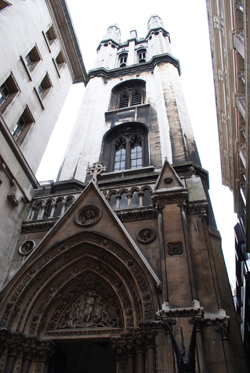
The subject of a current exhibition at the Royal College of Physicians, Dr John Dee – mathematician, courtier, astrologist and ‘magician’ are just some of the tags he is labelled with – is one of the most enigmatic figures of Tudor England.
 Born in London’s Tower ward in 1527, Dee was of Welsh descent and the son of Roland Dee, a mercer and courtier to King Henry VIII, and Johanna Wild. He attended school in Chelmsford and, at the age of 15 entered St John’s College, Cambridge, awarded a Bachelor of Arts in 1545 and a master’s degree in 1548. He was also a founding fellow of Trinity College when it was founded in 1546.
Dee travelled through Europe during the late 1540s and early 1550s, studying and lecturing at places including Louvain, Paris and Brussels. It was during this trip that he met mathematicians and cartographers like Gemma Frisius and Gerardus Mercator.
Back in England, Dee was appointed rector at Upton-upon-Severn (apparently on the recommendation of King Edward VI), and in 1555 was made a member of the Worshipful Company of Mercers. He had, meanwhile, turned down offers of professorships at both the Sorbonne in Paris and the University of Oxford, ostensibly because he had hopes of obtaining an official position at court.
It was perhaps in pursuit of this that he subsequently appeared at England’s Royal Court where he took on the role of teacher of the mathematical sciences while also serving as an astrologer to Queen Mary I and courtiers.
The latter role led to Dee’s arrest and imprisonment in 1555 on charges of being a ‘magus’ (magician) – he would go on to appear for questioning in the infamous Star Chamber – but he was eventually cleared of all charges.
In 1558, Dee became a scientific and medical advisor to Queen Elizabeth I and, by the mid-1560s, had established himself in the village of Mortlake (now in the south-west of Greater London) where he built a laboratory and gathered together what was the largest private library in the country at the time, said to have consisted of more than 4,000 books and manuscripts (and the subject of the current exhibition).
Dee was also associated with several English voyages of exploration for which he provided maps and navigational instruments, most famously Sir Martin Frobisher’s expedition to Canada in 1576-78.
He is also known for his strong views on natural philosophy and astrology and the occult, which included the idea that mathematics had a special, supernatural power to reveal divine mysteries. Some of his occult-related ideas were explored in his 1564 text Monas hieroglyphics – one of numerous works he authored – but his most influential work is said to have been a preface he wrote to an English translation of Euclid’s Elements published in 1570 in which he argued for the central role of mathematics.
Dee is said to have married three times – the first in the mid-1560s and, following the deaths of his previous two wives, the last time in 1578 when he was wedded to Jane Fromond, who was less than half his age and who had been a lady-in-waiting to the Countess of Lincoln. She bore him some eight children (although there are questions over the paternity of at least one) and died in 1604 of the plaque.
By the 1580s, having failed to win the influence he hoped to have at court and wanting to further his explorations into the supernatural (in particular, communication with ‘angels’ through occult practice of crystal-gazing), he travelled to Europe with a convicted counterfeiter and medium Edward Kelley to Europe.
Returning to England, after much lobbying, Queen Elizabeth I appointed him warden of Manchester College in 1596, but despite this, he returned to London in 1605 where his final years were marked by poverty.
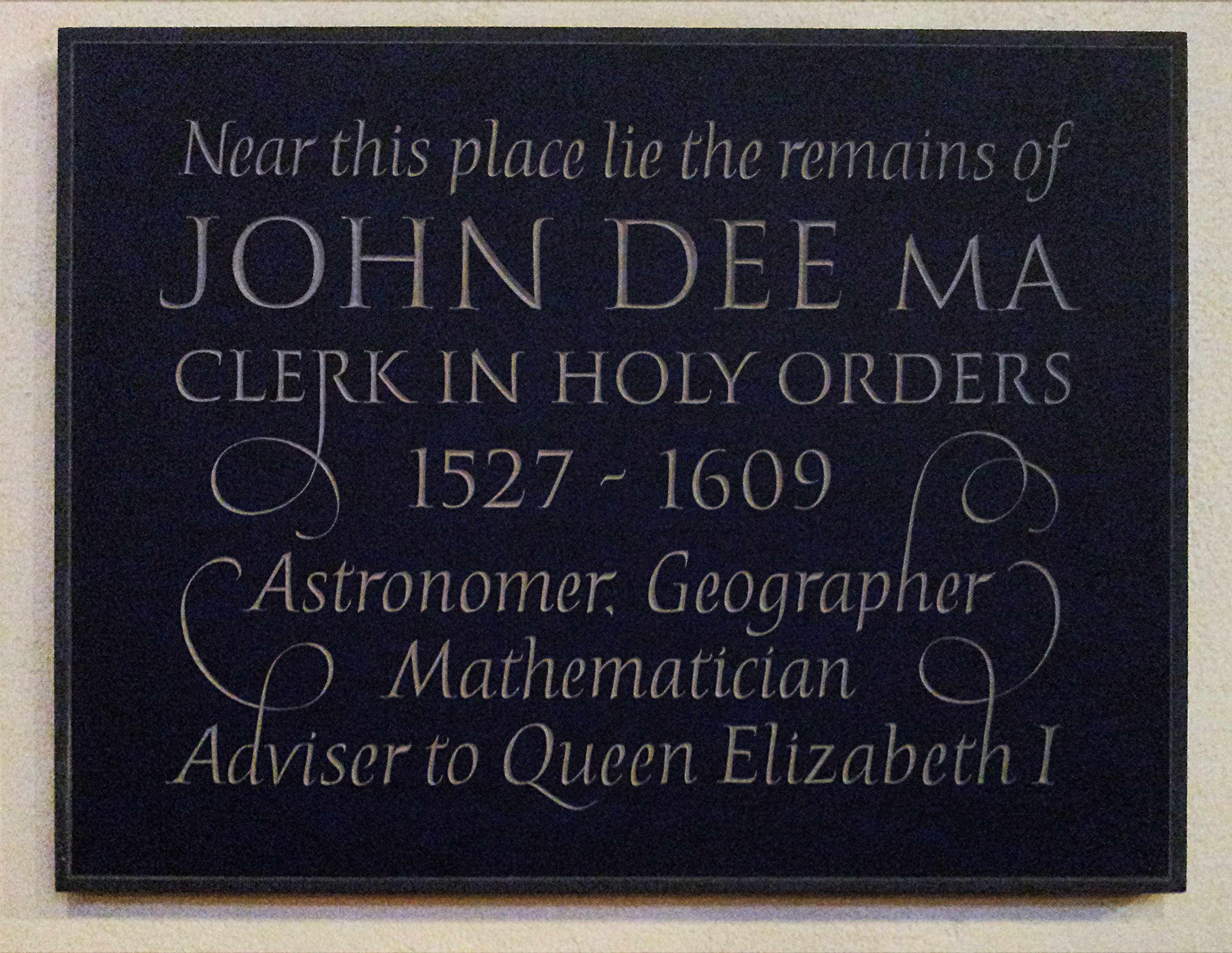
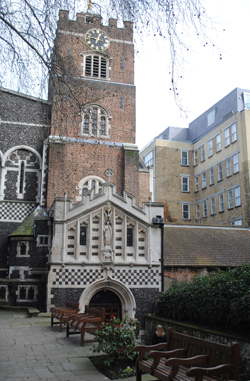
He is believed to have died in March, 1609, at the London home of a friend and was apparently buried in Mortlake (pictured, above, is a memorial plaque at St Mary the Virgin in Mortlake).
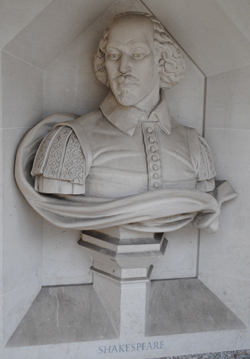
It’s believed that William Shakespeare modelled the figure of Prospero in the 1611 play The Tempest on Dee (it’s also claimed that he was the model for Marlowe’s Doctor Faustus).
Scholar, courtier, magician: the lost library of John Dee runs at the Royal College of Physicians at 11 St Andrews Place, Regent’s Park, until 29th July. Entry is free (check website for opening hours). For more, see www.rcplondon.ac.uk.
PICTURE: Robert Smith/CC BY-SA 3.0/Wikipedia

 .
.