High profile and influential though he was during his lifetime – serving as Chancellor and Archbishop of Canterbury, it was the brutal and shocking nature of Thomas Becket’s death that ensured he would be remembered down through the ages.
Already strained, relations between King Henry II and Becket took a further downturn after the Archbishop excommunicated Roger de Pont L’Évêque, the Archbishop of York, Gilbert Foliot, the Bishop of London, and Josceline de Bohon, the Bishop of Salisbury, thanks to their role in crowning Henry, the Young King, in York, without the Archbishop’s permission.
On hearing the news of the excommunication, King Henry II is said to have uttered those immortal words, “Will no one rid me of this turbulent priest?” (although there is considerable dispute over exactly what he said – contemporary biographer (and Canterbury monk) Edward Grim, for example, has the quote as: “What miserable drones and traitors have I nourished and brought up in my household, who let their lord be treated with such shameful contempt by a low-born cleric?”).
Whatever the exact words, the King’s utterance – made while he was at Bur-le-Roi near Bayeaux in modern France – was interpreted as a command by four knights who were present – Reginald FitzUrse, Hugh de Morville, William de Tracy and Richard le Breton. Leaving the castle, they set out for England to confront the Archbishop.
The knights arrived at Canterbury Cathedral on 29th December, 1170, and informed Becket that he was commanded to go to Winchester to answer for his actions. Becket refused and the knights, retrieving weapons and armour they had stashed outside the cathedral, returned to the cathedral and hunted down Becket (who had apparently ordered the doors to remain open) with swords in their hands.
They found him at a door to the cloister near the stairs leading up to the cathedral quire where monks were chanting vespers. Becket is reported to have said “I am no traitor and I am ready to die” before one of the knights tried to pull him inside. Grabbing a pillar, he refused to go. The knights then struck him with a series of blows on the head which proved fatal.
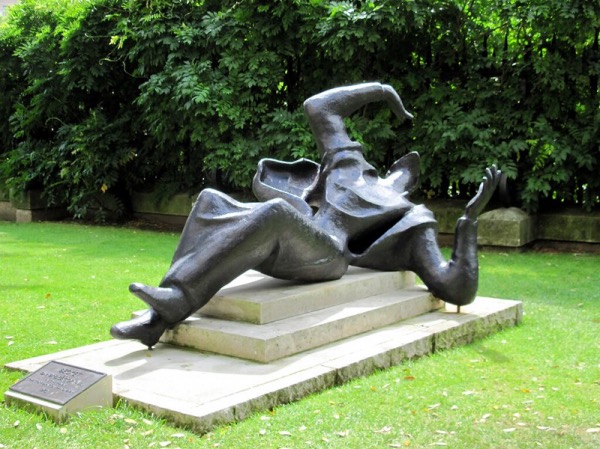
A modern memorial to Becket which features a statue depicting him lying back with his hand raised as though to ward off blows as he is attacked, is located in St Paul’s Churchyard. The statue, which is made from resin coloured to appear as bronze, is the work of Bainbridge Copnall and was created in 1970 as part of commemorations marking 800 years since his death. It was acquired by the City of London Corporation in 1973.
It was damaged by a falling cherry tree in 1987 but was restored by a student of Copnall.
Thomas Becket spent eight years in role of Archbishop of Canterbury, including almost two based at a Cistercian abbey in Pontigny, France, while in exile following his dispute with King Henry II over the Constitutions of Clarendon.
Thomas returned to England in 1170 but his relationship with King Henry remained acrimonious, particularly after the Archbishop excommunicated Roger de Pont L’Évêque, the Archbishop of York, Gilbert Foliot, the Bishop of London, and Josceline de Bohon, the Bishop of Salisbury, who had crowned King Henry’s heir, Henry, the Young King, at York in June of that year without his approval.
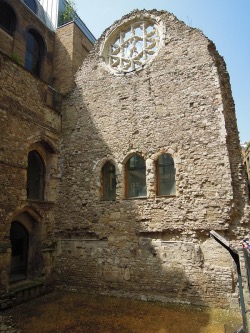
It’s that event that led to Becket’s infamous death at the hands of four knights in late December (more about that next week). But a few weeks before that Becket was in Southwark and there he met representatives of the Priory of St Mary Overie (of which what is now Southwark Cathedral was part) and visited Winchester Palace, London residence of the Bishop of Winchester (which now stands in ruins – see picture).
In what was to be Becket’s last visit to London before his death, he paused overnight at at the palace as he travelled to seek an audience with Henry, the Young King, in Winchester, in a bid to reconcile with the 15-year-old.
It was apparently quite an occasion – crowds estimated by one probable eyewitness to number some 3,000 came out to meet him as did a procession of singing monks from St Mary’s. Becket is said to have distributed alms to the poor and it’s said that a woman named Matilda, who apparently was known for making a spectacle of herself at public occasions, kept telling the Archbishop to “Beware of the knife” (which appears a little too conveniently prescient perhaps to ring true).
While at the palace, messengers arrived to inform Becket that the Young King did not wish to see him and instead ordered him back to Canterbury. Becket didn’t immediately obey – first headed further wet to Croydon and his manor at Harrow before eventually arriving back in Canterbury on about 18th December.
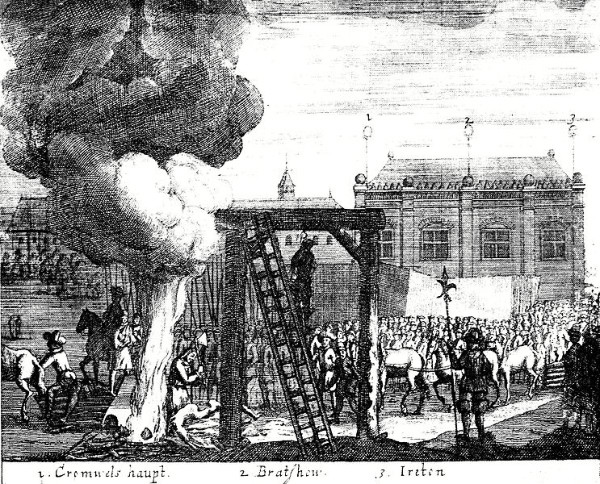
It was 360 years ago late last month that the body of Oliver Cromwell, one time Lord Protector of the Commonwealth, was, having previously been exhumed from his grave in Westminster Abbey, hanged from a gallows at Tyburn before being beheaded.
Cromwell had died two years previously on 3rd September, 1658, at the age of 59. It’s thought he died of septicaemia brought on by a urinary infection (although the death of his favourite daughter Elizabeth a month before is also believed to have been a significant factor in his own demise).
He (and his daughter) were buried in an elaborate funeral ceremony in a newly created vault in King Henry VII’s chapel at Westminster Abbey.
Cromwell’s son Richard had succeeded him as Lord Protector but he was forced to resign in May, 1659, and divisions among the Commonwealth’s leadership soon saw Parliament restored and the monarchy restored under King Charles II in 1660.
In late January, 1661, on Parliament’s order, Cromwell’s body as well as those of John Bradshaw, President of the High Court of Justice for the trial of King Charles I, and Henry Ireton, Cromwell’s son-in-law and a general in the Parliamentary army during the English Civil War, were all exhumed from their graves.
A contemporary engraving of the execution of Cromwell, Ireton and Bradshaw. PICTURE: Via Wikipedia.
The bodies of Cromwell and Ireton were taken to the Red Lion Inn in Holborn where they lay under guard overnight and were joined by that of Bradshaw the following day.
That morning – the 30th January, a date which coincided with the 12th anniversary of the execution of King Charles I in 1649 – the shrouded bodies in various states of decomposition and laying in open coffins were dragged on a sledge to gallows at Tyburn were they were publicly hanged.
The bodies remained on the gallows until sunset when they were removed and beheaded (Cromwell’s beheading apparently took eight blows). The bodies were believed to have been subsequently thrown into a common grave at Tyburn (although there’s all sorts of speculation surrounding the fate of Cromwell’s – indeed some believe his body had already been removed from Westminster Abbey before the exhumation took place and that it was the body of someone else which was hanged and beheaded).
The decapitated heads, however, were kept. They were placed on 20 foot long spikes at Westminster Hall for public display (Samuel Pepys was among those who saw them).
In 1685, however, the spike holding Cromwell’s head broke in a storm. Cromwell’s head is said to have ended up in the possession of a soldier who took it and hid it in his chimney (a reward was offered but searches were unsuccessful). The fate of the head then remains somewhat clouded but in 1710 it was being displayed in the London museum of Swiss-French collector Claudius Du Puy.
It subsequently passed through various hands until it was eventually bought by Dr Josiah Henry Wilkinson in the early 19th century. It remained in the possession of his family until, following tests which concluded it was indeed Cromwell’s head, it was offered to Sydney Sussex College, Cromwell alma mater, where, in 1960, it was buried in a secret location.
Theobold of Bec, the Archbishop of Canterbury, in whose household Becket had previously served before becoming Lord Chancellor, died on 18th April, 1161. King Henry II, apparently hoping to install a friendly face in the post, ensured Becket was nominated to replace him several months later.
In keeping with tradition, the monks of Christ Church, Canterbury, apparently somewhat reluctantly, were persuaded to elect Becket, who was merely an archdeacon, to the post.
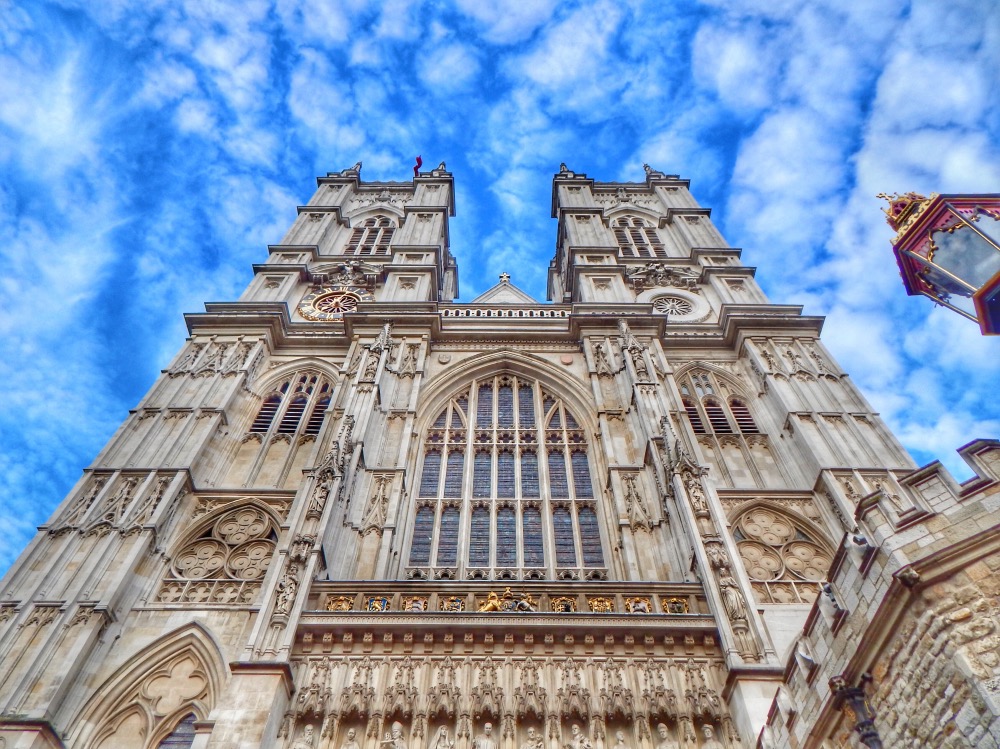
And it was at Westminster Abbey, on 23rd May, 1162, that a council of clergy and noblemen was convened to ratify the decision.
Sitting under the chairmanship of Bishop Henry of Winchester, who had only recently returned from exile, the council was told by the Prior of Christ Church that Thomas had been “unanimously and canonically” elected as Archbishop. The council, despite a lonely objection from Gilbert Foliot, the Bishop of Hereford, had then confirmed the decision and Bishop Henry read out the formal election result in the refectory or monk’s dining hall.
Becket, who was present, was then presented to the seven-year-old Prince Henry (later known as Henry, the Young King), the ill-fated eldest son of King Henry II who had been empowered by his father to give royal consent to the decision.
Becket headed for Canterbury soon after and there was ordained a priest on 2nd June and consecrated as Archbishop the following day. The stage was set for one of English history’s most infamous clashes of church and state.
Westminster Abbey, meanwhile, was also to play a key role in the antipathy that developed between King Henry II and Archbishop Thomas over the coming years. It was here that King Henry II had his aforementioned son Henry crowned as King of England in 1170 – against the wishes of Archbishop Thomas. It was that coronation which brought the simmering tension which had grown between them to a head.
And, in an footnote, in May, 2016, a relic of St Thomas, said to be a bone fragment from his elbow, stayed overnight in the Abbey’s Shrine of St Edward the Confessor. Usually kept at the Basilica of Esztergom in Hungary, the relic’s visit was part of a week-long tour of locations in London and Canterbury – the first time it had visited the UK in more than 800 years.
William Blake’s house in Soho, an illustration by Frederick Adcock, published in ‘Famous houses and literary shrines of London’ (1912) and written by Arthur St John Adcock.
William Blake, one of the UK’s most lauded artists and poets, was born in a property at 28 Broad Street (now Broadwick Street) in Carnaby Market, Soho, on 28th November, 1757.
Blake was the third of seven children (although two died in infancy) born to James and Catherine (he was baptised at nearby St James’s Church, Piccadilly, on 11th December). His father ran a hosiery store and the residence was located above his father’s shop (Blake worked as a delivery boy while a child).
Behind the premises was a workhouse and Blake’s memories of this flavoured some of his later works including Nurse’s Song.
Blake lived in the property until he was 25-years-old, during which time he completed an apprenticeship to engraver James Basire located in Great Queen Street and became a student at the Royal Academy in Old Somerset House in The Strand.
He moved to Green Street with his new wife, Catherine Boucher, in 1782.
His oldest brother James took over his father’s shop following his death in 1784 and, in 1809, the first floor of the premises hosted Blake’s only – and unsuccessful – solo exhibition.
The house survived until the 1960s but despite its famous heritage, the property was razed and a block of flats – William Blake House – was erected in its place. A plaque commemorating Blake’s birth in the former property is all that remains.
Thomas left the employ of Theobold, Archbishop of Canterbury, in 1154 when he took up the role of Chancellor for the newly crowned King Henry II(on Theobold’s recommendation).
The new role meant he wasn’t much in London over the next eight years – King Henry II spent less than two-and-a-half years in England during that period and Becket’s new role meant he was expected to be with the King.
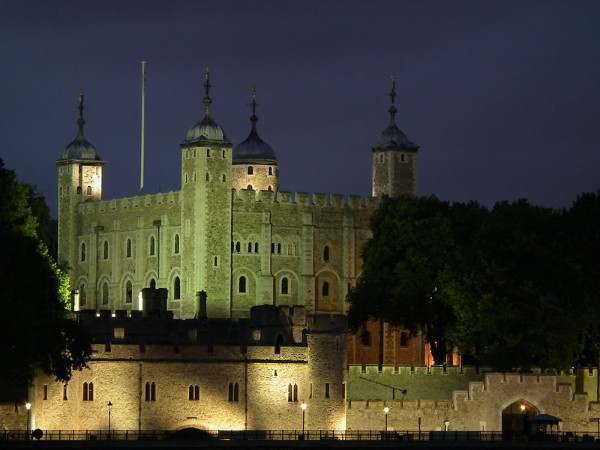
The Tower of London (the expansive St Thomas’s Tower is on the front left). PICTURE: flicksmores (licensed under CC BY-NC-ND 2.0)
One London connection during this period came about, however, when King Henry II awarded him the custody of the Tower of London (the role which is now known as Constable of the Tower and was apparently then referred to as Keeper of the Tower).
Interestingly, Becket is just one of four Archbishops of Canterbury who held the post (although he was Archbishop later) but is the only saint to have done so.
During his time as Constable of the Tower, Becket did carry our substantial repairs on the complex (while Chancellor he also oversaw repairs to other buildings including the Palace of Westminster).
There is a further connection between Becket and the Tower – King Edward I, during his rather dramatic renovations and expansion of the fortress, included a chapel dedicated to the martyred St Thomas in the royal quarters. To this day, the tower which fronts the Thames is known as St Thomas’s Tower (the naming of Traitor’s Gate, formerly known as Water Gate, under it occurred much later and had nothing to do with him).
This month marks 200 years since the death of Romantic poet and London resident John Keats – famous for poems including Ode to a Grecian Urn and Ode to the Nightingale – at the age of just 25.
Born on 31st October, 1795, Keats was the eldest of Thomas Keats and Frances Jennings’ four children. The story goes that he was born in the stable – owned by his mother’s father and managed by his father, located near Finsbury Circus.
John Keats by William Hilton, after Joseph Severn (based on a work of circa 1822) National Portrait Gallery (NPG 194)
At the age of eight, Keats attended the boy’s academy at Enfield (his brothers George and Tom would also attend). He had been at the school for less than a year when, on the night of 15th April, 1804, his father was seriously injured in a horse-riding accident and died the following day.
Within a couple of months, his mother entered an ill-fated marriage and eventually left her family to live with another man. She returned to her family by 1808 but, now ill, she died of tuberculosis in March, 1809. following his mother’s death, his grandmother appointed two London merchants including tea broker Richard Abbey as Keats’ guardians.
Keats, meanwhile, built up a close friendship with headmaster John Clarke and his older son Charles Cowden Clarke at Enfield and through them really began to foster a love of literature (in particular Edmund Spenser‘s Faerie Queene is said to have helped awakened his love of poetry).
But at Abbey’s instruction he left Enfield in 1811 and began to work toward a career as a surgeon, apprenticed to surgeon Thomas Hammond, in nearby Edmonton.
In October, 1815, he left his apprenticeship with Dr Hammond, apparently after a quarrel between them. Moving into London, he registered at Guy’s Hospital for the six-month course of study which was required for him to become a licensed surgeon and apothecary. Lodging with two older students at 28 St Thomas Street, he progressed quickly and was soon promoted to “dresser”, a role which saw him involved dressing wounds daily to prevent or minimize infection, setting bones, and assisting with surgery.
Poetry, however, continued to occupy his mind and his sonnet OSolitude! became his first published poem when it appeared in The Examiner on 5th May, 1816 (editor Leigh Hunt, who was introduced to Keats by Clarke later that year, also went on to publish other works including his sonnet On First Looking into Chapman’s Home).
Keats, who became a certified apothecary in late 1816 (he’d holidayed in Margate with his brother Tom after passing his exams earlier that year), now faced further studies to become a surgeon. But he instead decided to give up medicine and devote himself entirely to his poetry (a move which apparently infuriated his now sole guardian Abbey). About the same time he moved into lodgings at 76 Cheapside with his two brothers, George and Tom (there was also a sister Fanny), having previously lived with that at 8 Dean Street in Southwark.
His circle of artistic acquaintances – which included fellow Romantic poet Percy Bysshe Shelley and painter Benjamin Robert Haydon – now growing, in March, 1817, Keats’ first book of poetry – Poems – was published. It was also around that time that he moved with his brothers to a property at 1 Well Walk in Hampstead, no longer needing to be near the hospitals where he had worked and studied.
In May, 1818, Keats published his 4,000 line allegorical romance, Endymion, but it received a rather scathing reception including by Blackwood’s Magazine which apparently declared the work nonsense and recommended Keats give up writing poetry.
In summer that year, Keats went on a walking tour of Scotland, Ireland and the Lake District with his friend Charles (Armitage) Brown. Following his return to Hampstead, Keats nursed his brother Tom who was ailing from tuberculosis (George having by now left for America) and who died on 1st December.
Following his brother’s death, Keats accepted Brown’s invitation to move into his property at Wentworth Place, located on the edge of Hampstead Heath (now the Keats House museum).
While living at Wentworth Place, Keats developed an intimate relationship with next-door neighbour Frances (Fanny) Brawne and the couple “came to an understanding” but his literary ambitions and failing health – by early 1820 he too had tuberculosis – meant it never came to marriage.
Keats third volume of poetry – containing his famous odes including Ode to a Nightingale and Ode to a Grecian Urn – was published in mid-1820 but now increasingly suffering from tuberculosis, he was advised by his doctors to head to a warmer climate. In September that year he left for Rome with his friend, the painter Joseph Severn (who painted a famous posthumous portrait of Keats), knowing he would probably never see Brawne again.
In Rome – having had to spend 10 days quarantine after the ship arrived in Naples due to a suspected cholera outbreak, he moved into a villa on the Spanish Steps (now home to the Keats-Shelley Memorial House museum) but, despite medical efforts, his health continued to deteriorate.
John Keats died on 23rd February, 1821, and was buried in the city’s Protestant cemetery. His tombstone bears no name or date, just the words “Here lies One whose Name was writ in Water” and an epitaph which speaks of a “young English poet”.
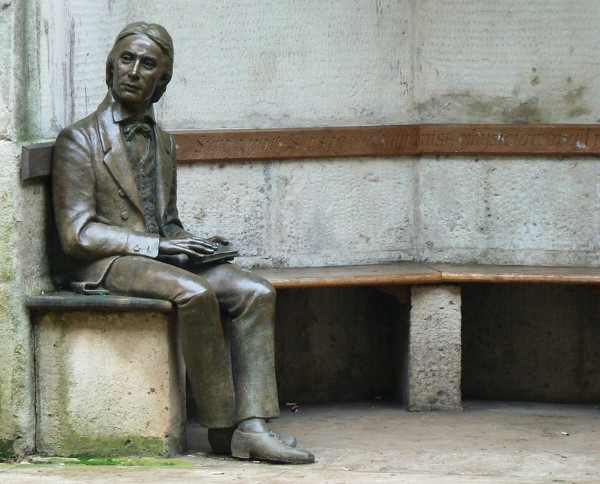
Keats, depicted in a 2007 bronze statue at Guy’s Hospital PICTURE: under_volcano (licensed under CC BY-SA 2.0)
Keats had only been a serious poet for some six years prior to his death and his three volumes of poetry had probably only amounted to some 200 copies. But his reputation continued to grow after his death with support from the likes of Shelley, Tennyson and the pre-Raphaelites, and he is now well-established in the literary canon as one of the greatest English poets.
As well as Keats’ House – which is managed by the City of London and which features an English Heritage Blue Plaque on the facade, Keats is memorialised with several other plaques in London and a famous statue at Guy’s Hospital which features him seated in a former alcove removed from London Bridge – see image above).
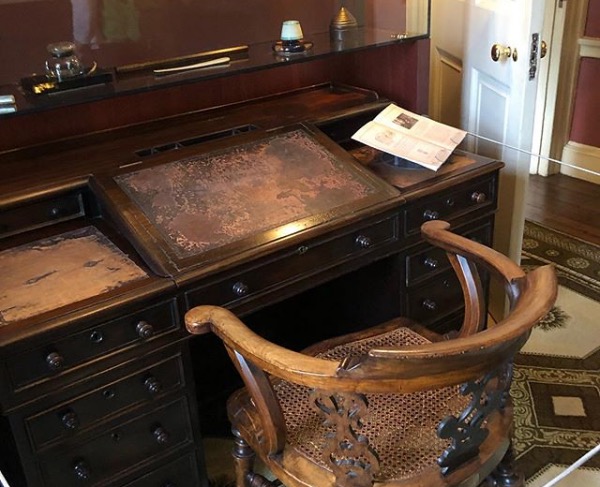
Charles Dickens’ desk and chair at the Charles Dickens Museum. PICTURE: Alyx Dellamonica (Licensed under CC BY-NC 2.0)
Among the treasures to be found at Dickens’ former house (and now the Charles Dickens Museum) in Doughty Street, Bloomsbury, is the desk and accompanying chair where Dickens’ wrote several of his later novels including Great Expectations, Our Mutual Friend and the unfinished The Mystery of Edwin Drood.
Dickens purchased the mahogany pedestal writing desk as well as the walnut and fruitwood smoker’s armchair in 1859. He used them in the study of his final home at Gad’s Hill Place in Kent (Dickens also had an identical chair in his London office which is now in the New York State Library).
After the author’s death in 1870, the desk and chair – which feature in Luke Fildes’ 1870 work The Empty Chair and the RW Buss’ 1875 work Dickens’ Dream – were passed down through the Dickens family until they was auctioned in the 2000s with the funds raised used to benefit the Great Ormond Street Hospital.
While the desk and chair had previously been loaned to the museum for display, in 2015 the establishment was able to purchase the desk and chair and make it part of its permanent collection thanks to a £780,000 grant from the National Heritage Memorial Fund.
While the museum is currently closed due to the coronavirus pandemic, we include these details for when it reopens.
WHERE: 48-49 Doughty Street, Bloomsbury (nearest Tube stations are Russell Square, Chancery Lane or Holborn). WHEN: Currently closed; COST: £9.50 adults/£7.50 concessions/£4.50 children (under six free); WEBSITE: www.dickensmuseum.com.
Around 1145, Thomas Becket left the household of the financier Osbert Huitdeniers and entered the household of Theobold, the Archbishop of Canterbury.
It’s unclear how he made the transition, although it has been speculated it was possibly through family connections, but by the following year, he was well-ensconced as a clerk in the archbishop’s household.
Like many great households, the Archbishop’s moved between various residences including his palace beside Canterbury Cathedral, various manors and the royal court (Lambeth Palace, the current home of the Archbishop of Canterbury in London was constructed after Becket’s death).
Becket rose in the Archbishop’s favour and while serving in his household was given the living of churches including St Mary le Strand in London and Otford in Kent as well as being made a canon of St Paul’s Cathedral (he wasn’t expected to attend the churches to receive the incomes).
The current St Mary le Strand dates from the early 18th century; the church from which Thomas drew an income was an earlier versions and stood a little to the south of the current building.
St Paul’s, meanwhile, was an early version of the pre-Great Fire of London version of the building. During Becket’s time, the grand structure was still under construction (building had been disrupted by a fire in 1135 and the cathedral wasn’t consecrated until 1240, well after Becket’s death).
The present cathedral has a rather spectacular statue of Becket in the churchyard (but we’ll deal with that separately in a later post in this series).
• Statues of two prominent men with links to the trans-Atlantic slave trade will be removed from Guildhall, the City of London has said. The City of London Corporation’s policy and resources committee voted to remove statues of William Beckford and Sir John Cass following a recommendation from the corporation’s Tackling Racism Taskforce. The statue of Beckford, a two-time Lord Mayor of London in the late 1700s who accrued wealth from plantations in Jamaica and held African slaves, will be replaced with a new artwork while the likeness of Sir John Cass, a merchant, MP and philanthropist in the 17th and 18th centuries who also profited from the slave trade, will be returned to its owner, the Sir John Cass Foundation. The corporation will now set up a working group to oversee the removal of the statues and replacement works and will also consider commissioning a new memorial to the slave trade in the City.
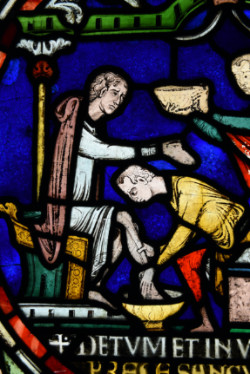
• An 800-year-old stained glass window from Canterbury Cathedral will form the centrepiece of an upcoming exhibition on Thomas Becket. Now scheduled for April after delays due to the coronavirus pandemic, Thomas Becket: murder and the making of a saint will feature more than 100 objects as it tells the story of Becket’s life, death and enduring legacy. The ‘Miracle Window’ – one of seven surviving from an original series of 12 – will be shown in its original arrangement of the first time in more than 350 years. The fifth in the series, it depicts miracles which took place in the three year after Becket’s death including the healing of eyesight and the replacement of lost genitals. The exhibition will represent the first time a complete stained glass window has been lent by the cathedral. Details of tickets will be announced soon. For more, see www.britishmuseum.org/becket.
• The Worshipful Company of Weavers this week announced the donation of £100,000 towards the creation of the new Museum of London in former market buildings at West Smithfield. The donation is one of the largest ever awarded by the livery company which, having a Royal charter dating from 1155, is the oldest surviving. The masterplan for the new museum received planning permission in June last year.
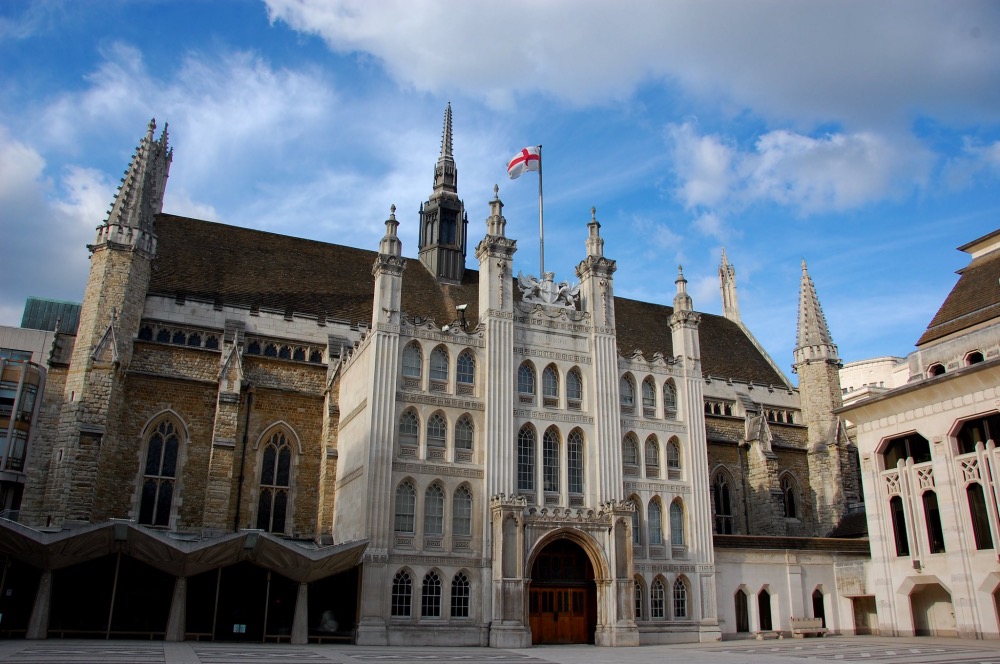
The Guildhall was an important building in Thomas Becket’s London but the earliest parts of the current building date from the early 15th century. PICTURE: stephenarcher (licensed under CC BY-NC 2.0)
This week we look at a location representative of Becket’s brief time working for a former City of London Sheriff and banker, Osbert Huitdeniers (“Eightpence”).
About a year after his return from Paris (possibly around his 22nd birthday in late 1142), Becket – driven apparently by a downturn in the family fortunes – started work as a clerk in the household of Huitdeniers.
A relative of the Becket family, Osbert was a man of some significance – apparently holding a knight’s fee in Kent – and was known at the royal court. He had held the post of sheriff of London from 1139 to 1141 (and may have also been a justiciar at different times).
We’ve been unable to determine where Huitdeniers’ home or business was located, hence why we’ve included Guildhall which certainly would have been known to him as sheriff – and indeed to Becket who grew up nearby, though not in its current form.
Becket’s job would have involved keeping Huitdeniers accounts and during the few years he served the banker, it’s believed he gained some invaluable skills that would prove helpful later in life.
There’s little known about Becket’s education but it’s believed that he attended a school in London as a young boy before, at the age of 10, he was sent to Merton Priory in Surrey (now part of Greater London) as a boarder.
The Augustinian priory had been founded in 1114 by Gilbert, the sheriff of Surrey, Cambridgeshire and Huntingdonshire, and moved to a new site beside the River Wandle in 1117.
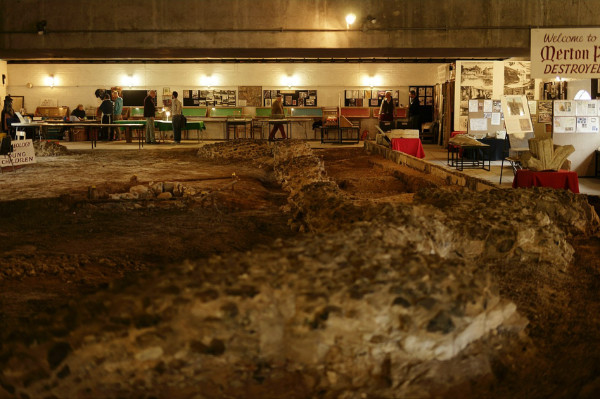
The remains of the Merton Priory chapter house as seen in 2017. PICTURE: Peter Trimming (licensed under CC BY-SA 2.0)
Hence, it was still rather new when he arrived in 1130 and facilities probably rather primitive but there was already a tradition of schooling established there under the first schoolmaster, an Italian named Guy who had apparently died in about 1120.
At some point in his teenage years, Becket was moved to one of the London grammar schools – perhaps one located at St Paul’s Cathedral – to continue his education and then later to Paris where he spent a year before it’s believed he returned home by the age of 21.
Despite his years at various schools, Becket apparently wasn’t much of a scholar, preferring more outdoor pursuits. But his studies, nonetheless, must have covered the trivium, which included Latin grammar, rhetoric and logic, and even some of the more advanced quadrivium, which included arithmetic, geometry, astronomy and music.
Becket’s connections with Merton were to remain strong later in life and included taking one of its canons, Robert, as his chaplain and confessor.
Little of the priory, which was dissolved during the Dissolution, now remains but the ruins of the chapter house can be visited (post-lockdown). Other famous students at the priory included Walter de Merton, the founder of Merton College Oxford.
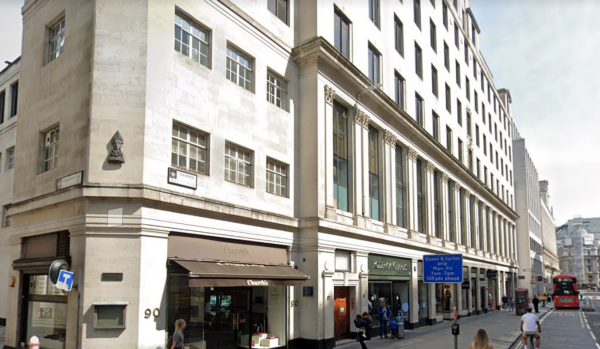
Looking east down Cheapside from the corner of Ironmonger’s Line (with the bust of St Thomas Becket visible in the left). PICTURE: Google Maps.
The 29thDecember, 2020, marked 850 years since the dramatic murder of then Archbishop of Canterbury, Thomas Becket, in Canterbury Cathedral.
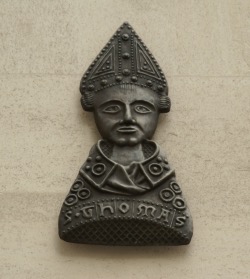
Metallic bust of St Thomas Becket on the wall at 90 Cheapside.PICTURE: Caroline (licensed under CC BY-NC-ND 2.0)
While many of the commemorations have been postponed due to the coronavirus pandemic, we’ve decided to push ahead with our series in commemoration of the martyred saint’s connections with London.
First up, it’s the famous City of London street of Cheapside – one of the main commercial streets in the medieval city – which was where, on 21st December, in what is generally believed to be the year 1120, he was born.
Becket was the son of Norman parents – his father, Gilbert, was a mercer (and served as a City sheriff) and his mother was named Matilda. He is believed to have had at least three sisters.
The location of what was a large residence – and the fact the family owned other property in the area – indicated they were relatively prosperous.
The property was next door to the church of St Mary Colechurch – lost in the Great Fire of London and not rebuilt – which was where St Thomas was baptised, apparently on the evening of his birth suggesting he may have initially been sickly. He was named after the Biblical St Thomas.
The site – which was later occupied by a hospital run by the Order of St Thomas of Acre – is marked with a small metallic bust of St Thomas attached to a wall on 90 Cheapside (on the corner with Ironmongers Lane) as well as a City of London blue plaque.
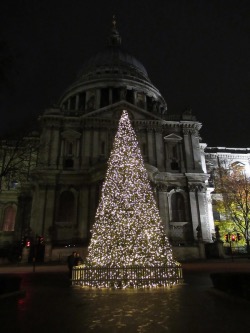
Christmas tree outside St Paul’s Cathedral. PICTURE: Alex Liivet (licensed under CC BY 2.0)
In what has been, and continues to be, such a hard year for so many, we at Exploring London hope you’re still able to celebrate Christmas in some form this year…
Meantime, here’s the next four in our countdown of the 100 most popular posts of all time…
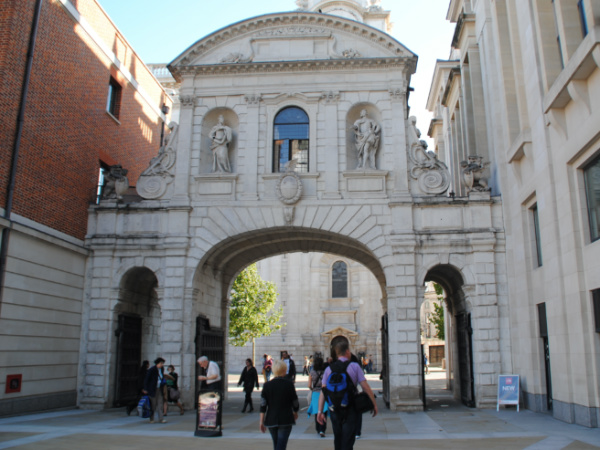
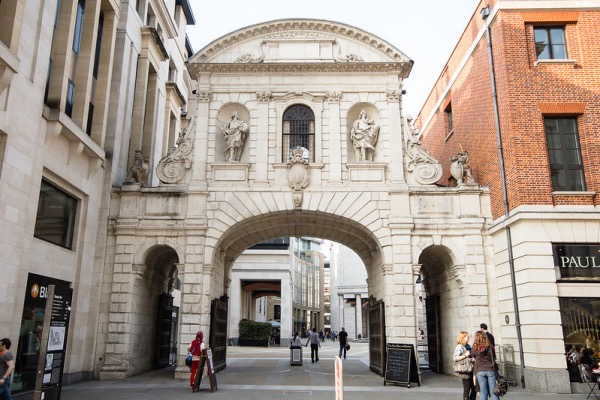
This ornate Baroque archway only stands with walking distance from where it originally stood marking the entrance to the City of London. But it came to this position by a somewhat roundabout route.
Temple Bar – with statues of Queen Anne and King James I (looking towards St Paul’s Cathedral) PICTURE: David Adams.
The gate was originally constructed at the junction where Fleet Street becomes the Strand, it marked the boundary between the City of London and Westminster.
While the first gate on the site dates back to the 14th century (prior to that the boundary was apparently marked with a chain two posts), the gate we see today dates from 1672 when, despite having survived the Great Fire of London, the previous gate – a crumbing wooden structure – was demolished and this upmarket replacement built to the design of none other than Sir Christopher Wren (earlier designs for the gate created by Inigo Jones were never acted upon).
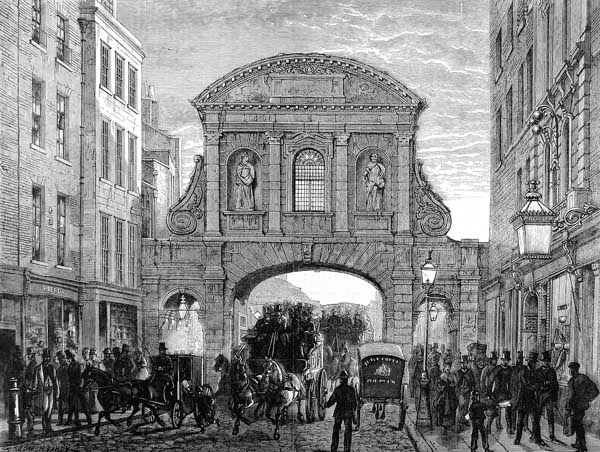
An artist’s impression of the Temple Bar in 1870 from Illustrated London News.
Made of Portland stone, the new structure featured figures of King Charles I and King Charles II on the west side and King James I and Queen Anne of Denmark on the east (it’s said that a third of the total £1,500 cost was spent on the statuary alone).
Shortly after its construction, it became a location for the display of the remains of traitors (usually heads), the first of which were the body parts of Rye House plotter Sir Thomas Armstrong and the last of which was the head of Jacobite Francis Towneley in 1746 (there’s also a story that such was the interest when the heads of the Rye House plotters – who had planned to assassinate King Charles II and crown his brother, the future King James II, in his place – were displayed, telescopes were rented out so people could get a closer look).
Temple Bar with statues of King Charles I and King Charles II (looking into Paternoster Square). PICTURE: Eric Heupel (licensed under CC BY-NC-ND 2.0)
Among the luminaries who passed under the central arch were Anne Boleyn (the day before her coronation) and Queen Elizabeth I. The Queen did so most famously on her way to give thanks in St Paul’s Cathedral for the English victory over the Spanish Armada and since then, whenever a Sovereign has wanted to enter the City past Temple Bar, there’s been a short ceremony in which the Sovereign asks permission of the Lord Mayor of London to enter. Granting this, the Mayor then offers the Sword of State as a demonstration of loyalty and this is subsequently carried before the Sovereign as they proceed through the City as a sign of the Lord Mayor’s protection.
The Temple Bar stood in its original location until 1878 when, to help traffic flow, it was carefully removed brick-by-brick over a period of 11 days (the City of London Corporation well aware of its historical significance) . It was initially intended that the gateway would be rebuilt somewhere else in the city, but time passed and no suitable site was found.
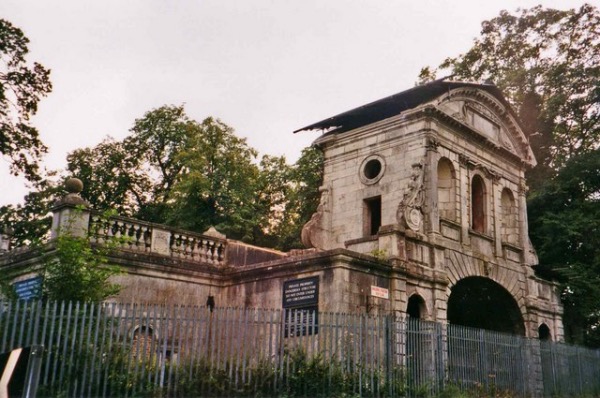
Instead, the gate lay in pieces in a yard in Farringdon Road before, in the mid 1880s, Sir Henry Bruce Meux had all 2,500 stones transported via trolleys pulled by horses to his estate at Theobalds Park in Hertfordshire and re-erected there as a gateway (the Lady Meux apparently used the small upper room for entertaining – among those said to have dined here was King Edward VII and Winston Churchill).
Temple Bar at Theobolds Park. PICTURE: Christine Matthews (licensed under CC BY-SA 2.0)
In 1976, the Temple Bar Trust was formed to have the archway returned to London – they eventually succeeded 30 years later in 2004 when it was re-erected on its current site between St Paul’s and Paternoster Square at a cost of some £3 million.
The original site of the Temple Bar is now marked with a Victorian era memorial – erected in 1888 – which features statues of Queen Victoria and Edward, the Prince of Wales.
Of medieval origins,the Church of St Antholin, which stood on the corner of Sise Lane and Budge Row, had been a fixture in the City of London for hundreds of years before it was destroyed in the Great Fire of 1666.
Rebuilt to the designs of Sir Christopher Wren, it survived until 1874 when it was finally demolished to make way for Queen Victoria Street.
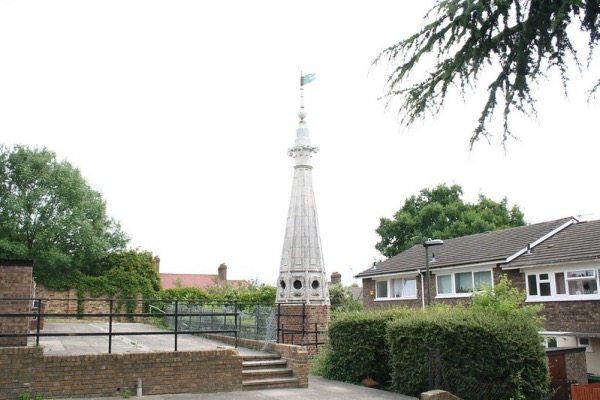
But, while the building itself was destroyed (and we’ll take a more in-depth look at its history in an upcoming article), a section of Wren’s church does still survive – the upper part of his octagonal spire (apparently the only one he had built of stone).
This was replaced at some stage in the 19th century – it has been suggested this took place in 1829 after the spire was damaged by lightning although other dates prior to the church’s demolition have also been named as possibilities.
Whenever its removal took place, the spire was subsequently sold to one of the churchwardens, an innovative printing works proprietor named Robert Harrild, for just £5. He had it re-erected on his property, Round Hill House, in Sydenham.
Now Grade II-listed, the spire, features a distinctive weathervane (variously described as a wolf’s head or a dragon’s head). Mounted on a brick plinth, it still stands at the location, now part of a more modern housing estate, just off Round Hill in Sydenham.
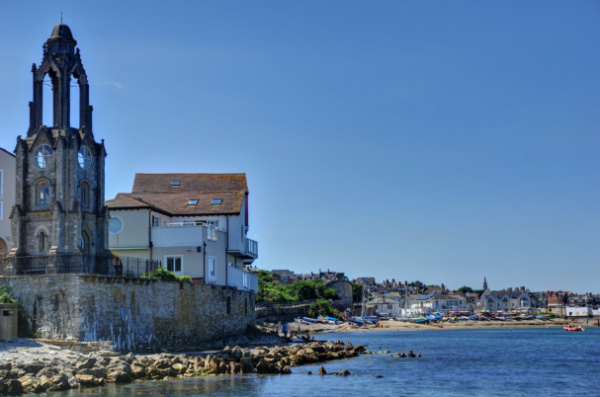
Now situated on the seafront of the town of Swanage in Dorset, the Wellington Clock Tower was originally located at the southern end of London Bridge.
The tower was erected in 1854 as a memorial to the Duke of Wellington, Arthur Wellesley, who had died two years earlier.
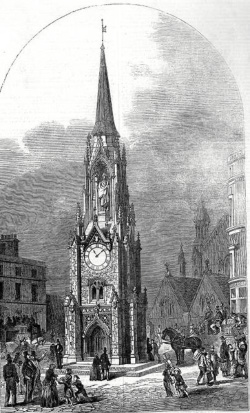
The then proposed Wellington Clock Tower depicted in the London Illustrated News in June, 1854
Its construction was funded through public subscription and contributions of railway companies with the support of the Commissioners for Lighting the West Division of Southwark. It was designed in the Perpendicular Gothic style by Arthur Ashpitel and, after the foundation stone was laid on 17th June, 1854, took six months to build.
The three level structure, which was topped with a tall spire, housed a clock with four faces. The clock was made by Bennett of Blackheath for the 1851 Great Exhibition but the constant rumbling of the carts passing its new location apparently meant the mechanism never kept good time.
There was also small telegraph office in the ground floor room of the tower. A statue of Wellington was intended to be placed within the open top level but funds apparently ran out before it could be commissioned and it never appeared (Wellington’s declining popularity at the time may have also been a factor).
The location of this rather splendid structure meant, however, that it was soon overshadowed by construction of nearby raised railway lines. When the Metropolitan Police condemned the tower as an obstruction to traffic, it was the final straw and having spent little more than a decade in position, the decision was made to demolish the tower.
It was taken down in 1867 but rather than simply being scrapped, Swanage-based contractor George Burt had the building shipped in pieces – they apparently served as ballast during the journey – to his hometown in Dorset where he presented it as a gift to fellow contractor Thomas Docwra. Docwra had the tower reconstructed in a seafront location on the grounds of his property, The Grove, at Peveril Point.
The rebuilt tower lacked the original clock – its faces were replaced with round windows – and in 1904 the spire was also removed and replaced with a small cupola (there’s been various reasons suggested for this, including that the spire was damaged in a storm or because it was felt to be sacrilegious by the religious family which then owned the property).
The tower, which was granted a Grade II heritage listing in 1952, can still be seen on the Swanage waterfront today.



 Exploring London