London Pub Signs – The George and Devonshire…

The-George-and-Devonshire

The last remaining pub in old Chiswick village in west London, The George and Devonshire has a history dating back to the 1650s.

The-George-and-Devonshire2Initially known simply as The George (like so many taverns and pubs, apparently after England’s patron saint), by the 1820s the name had changed to The George and Devonshire – the Duke of Devonshire’s former showpiece property, Chiswick House, can still be found nearby (for more on Chiswick House, see our earlier post here). The coat of arms of the Dukes of Devonshire now hang over the door.

The Grade II-listed building at 8 Burlington Lane, which is conveniently located just metres from a Fullers brewery, dates from the 18th century.

There was apparently once a secret passageway which led from the pub under the nearby St Nicholas’ Church (burial place of artist William Hogarth) to an opening located among a group of small cottages near the Thames – it is said to have been used by rum and spirits smugglers in the 1700s. The remains of the entrance can still apparently be seen in the pub’s cellar.

For more, see www.georgeanddevonshire.co.uk.

London Pub Signs – The Nell of Old Drury…

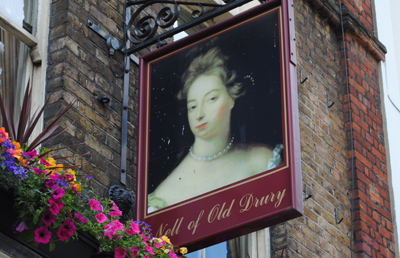
Nell-of-Old-DruryThis Covent Garden pub in London’s West End is named after Nell Gwyn, the 17th century orange seller turned actress who became most famous for being the mistress of King Charles II (for more on Nell, see our earlier post here)

‘The Nell’, as its known, is one of the area’s oldest pubs – a sign says there has apparently been a pub on the site since before 1660 when the Theatre Royal Drury Lane – located opposite – was built.

Nell-of-Old-Drury2There’s supposedly an underground tunnel that connects the theatre and the pub which is said to have been used by the king when he was visiting Nell (we’re not sure if it was Nell or the king who was in the pub). It was also apparently used by other theatre-goers who were warned to return to the theatre when intermission was over by a bell located inside the pub.

Now located at 29 Catherine Street pub (the street was formerly known as Brydges Street – we’ll deal with its renaming in an upcoming post), was apparently originally called The Lamb and then renamed the Sir John Falstaff in the nineteenth century, during which period it hosted exhibitions featuring a tattooed man from the South Seas and a Zulu warrior woman, before assuming its current moniker.

The pub was also apparently a regular for many prominent literary and theatrical figures, not to mention market traders from nearby Covent Garden. The exterior of the pub appears in the Alfred Hitchcock film, Frenzy.

For more on the pub, see www.nellofolddrury.com.


London Pub Signs – The Gladstone Arms…

GladstoneThis Borough pub is, of course, named after the 19th century Prime Minister, William Gladstone, who not only served in the office four times but also lends his name to the ‘Gladstone bag’.

Such was the renown of Gladstone – who served as PM in stints between 1868 to 1894 (he resigned the final time at the ripe old age of 84, dying just over four years later) – that his name also adorns monuments, parks, streets and geographic features around the world as well as his fair share of pubs (including the William Gladstone in the heart of Liverpool).

Gladstone is recalled in the pub’s name but also in a large images of his face adorning the external walls.

The pub is located at 64 Lant Street (the street is famous for being where Charles Dickens lodged while his father was imprisoned in nearby Marshalsea Prison), less than a minutes walk from the Tube station.

Along with food and a pint, ‘The Glad’ these days offers live music several nights a week and boasts a long list of names – some you’ll know, some you won’t – have played there. For more on the pub, check out www.thegladpub.com.

London Pub Signs – The Gipsy Moth…

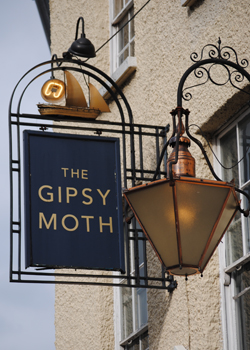
The boat on this iconic Greenwich pub’s sign probably gives the game away here – the Gipsy Moth is named after a yacht of the same name.

The-Gipsy-MothThe Gipsy Moth IV was sailed single-handedly around the globe by Sir Francis Chichester, then aged in his 60s, in 1966-67, who broke numerous records as he did so including the fastest voyage around the world by any small vessel, the longest non-stop passage by a small vessel and what was then the longest single-handed passage.

Following the death of Sir Francis on 26th August, 1972 (he had been knighted by Queen Elizabeth II on the steps of the Old Royal Naval College using the same sword that had knighted Sir Francis Drake in the presence of Queen Elizabeth I in 1581), the boat was put on display in a Greenwich dry dock next to the Cutty Sark. Initially open to the public, it was later closed due to deterioration.

Following a restoration in the early Noughties, in 2006 the Gipsy Moth IV was again sailed around the world (on a trip that wasn’t always smooth sailing) to mark the 40th anniversary of Sir Francis’ journey. It is now owned by a charitable trust based in Cowes on the Isle of Wight.

The renovated pub, located at 60 Greenwich Church Street next to the Cutty Sark, is situated in a building which dates from the late 18th century. It apparently changed its name from the Wheatsheaf in the mid-1970s apparently to mark the arrival of the Gipsy Moth IV.

The pub features a beer garden with views of the Cutty Sark. For more information, see www.thegipsymothgreenwich.co.uk.

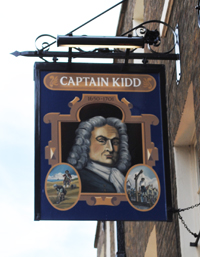
London Pub Signs – The Captain Kidd…

Captain-Kidd2

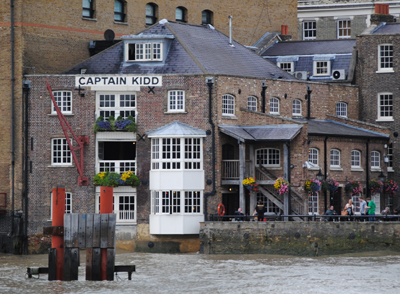
Located on the north bank of the River Thames in Wapping, East London, this pub owes its name to the infamous mariner who met his end at nearby Execution Dock.

Located in what was originally a warehouse, the pub – one of several riverside pubs in Wapping – only apparently dates from the 1980s but the historic location – and the ample views it provides over the river from its garden area – ensures it still has plenty of atmosphere.

Captain-KiddCaptain William Kidd himself was a Scot, born in 1645, who took to the seas in the Caribbean where he operated as a privateer. It was during a voyage in the Indian Ocean – he had set off from London in 1696 – that he undertook actions which led him to being accused of murder and piracy, something he discovered upon his return to the Caribbean soon after.

He traveled to the North American city of Boston to plead his case with the governor but was instead arrested and eventually sent to England where he stood trial for piracy and murder. He was found guilty on all charges and was hanged on 23rd May, 1701, at Execution Dock –  believed to have been located just to the west of the pub – in Wapping.

It was apparently a messy affair – the hangman’s rope broke on the first attempt and he was only successfully hanged on the second. Kidd’s tar-covered body was later displayed in a gibbet hung over the Thames at Tilbury Point as a warning to other pirates for three years.

Kidd’s fame grew after his death, thanks in large part to rumours he’d left buried treasure someone in the US, and his name has become somewhat synonymous with piracy ever since.

The pub, at 108 Wapping High Street, is operated by Samuel Smith’s.

London Pub Signs – The Spaniards Inn…

Stories abound about this historic Hampstead pub – one of London’s oldest, not the least about the origins of its name.

Spaniards-InnTheories about the name include that it was named for a Spanish ambassador attending the court of King James I who sought shelter here during an outbreak of plaque. Others suggest it was named for a Spanish landlord – Francisco Perrero – or for two brothers who once owned it (that is, until one of them died in a duel they fought over a woman).

Whatever the truth, the atmospheric pub, located on the edge of Hampstead Heath, has apparently been around since 1585 and the stories about its connections with the famous (and infamous) number even more than those about its origins.

Highwayman Dick Turpin is associated with the pub (some stories suggest he was born here, although this seems unlikely) and the establishment  is known to have played an important role in sparing nearby Kenwood House, then the home of Lord Mansfield, Lord Chief Justice, during the anti-Catholic Gordon Riots of 1780 – apparently it was the action of the landlord, Giles Thomas, in throwing open the cellars which diverted the attention of would-be rioters from the task at hand to one perhaps more enjoyable.

The pub also features in Charles Dickens’ The Pickwick Papers and in Bram Stoker’s Dracula while among those who frequented it were painter Sir Joshua Reynolds and Lord Byron as well as John Keats who, the story goes, wrote Ode to a Nightingale in the rather extensive garden.

Located in Spaniards Road, this Grade II-listed pub, as well as the main building, features an old toll house on the other side of the road which contains a horse trough (it has been suggested that Turpin stabled Black Bess there but take such claims with a grain of salt!).

Well worth a visit for refreshments after a stroll on the heath. For more, see www.thespaniardshampstead.co.uk.

PICTURE: Philip Halling/Wikipedia 

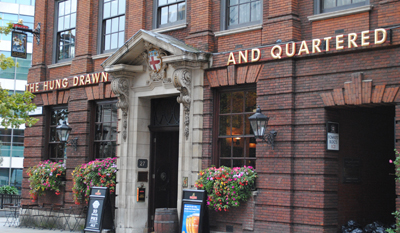
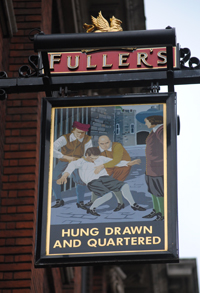
London Pub Signs – The Hung, Drawn and Quartered…

Hung-longThe rather grisly name of this pub (and there’s some debate over whether hanged or hung is grammatically correct) relates to its location close by the former public execution ground of Tower Hill.

While for many Tower Green inside the Tower of London is synonymous with beheadings, only seven people, including Anne Boleyn, were ever actually executed there. Far more people were executed outside the Tower’s walls at nearby Tower Hill, just to the north.

HungSome of the names of those executed here are recorded on a memorial at the site – everyone from Simon Sudbury, the Archbishop of Canterbury who was beheaded here by an angry mob in 1381, through to Sir Thomas More in 1535 (gracious King Henry VIII commuted his sentence from being hung, drawn and quartered to mere beheading), and Simon Fraser, the 11th Lord Lovat, a Jacobite arrested after the Battle of Culloden and the last man to be executed here when his head was lopped off in 1747.

While, as you can see above, many of those executed at Tower Hill were beheaded (and most were of the nobility), there were some executions there which did involve the guilty party being hung, drawn and quartered – a punishment reserved for those being convicted of high treason and also enforced at other sites in London including at Tyburn and Smithfield. Among them was William Collingbourne in 1484 for supporting the cause of Henry Tudor against that of King Richard III.

A plaque on the external wall of the nearby pub quotes a passage from the famous diarist Samuel Pepys after he witnessed an execution in Charing Cross on 13th October, 1660: “I went to see Major General Harrison. Hung drawn and quartered. He was looking as cheerful as any man could in that condition”.

Thomas Harrison fought with Parliament during the Civil War and was among those who signed the death warrant of King Charles I. Found guilty of regicide after the Restoration, he was hung, drawn and quartered (though as Pepys tells us, not here).

The pub, located at 26-27 Great Tower Street, is part of the Fuller’s chain. For more, see www.hung-drawn-and-quartered.co.uk.

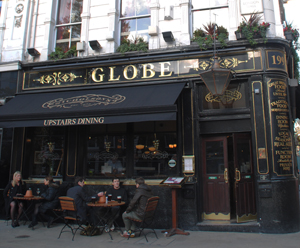
London Pub Signs – The Globe…

GlobeNo, this pub on Moorgate is not related to William Shakespeare. Its name actually comes from the globe which was used as the emblem of Portugal and advertised the fact that fine Portuguese wines were on sale at the premises.

According the pub’s website, there were eight pubs with the sign of the Globe in London during the reign of King Charles I (when this pub was apparently founded). By the middle of the 19th century, the number had risen to more than 30.

There are still a few other Globe pubs in London – as well as this one, others include the Globe in Marylebone Road and The Globe Bow Street (although we’re not sure whether their names were derived in the same way).

The pub, which is located at 83 Moorgate – close to where Moorgate once punctured London’s city wall and gave access to the fens known as Moorfields. In 2008, the pub merged with the neighbouring pub, the John Keats, now commemorated in the name of the bar (that pub was named for the Romantic poet John Keats, who it has been speculated was born in a pub on the site in 1795).

The pub is now part of the Nicholson’s group. For more, check out its website at www.nicholsonspubs.co.uk/theglobemoorgatelondon/.

London Pub Signs – The Minories…

The-MinoriesLocated close to Tower Hill in the eastern part of the City, this pub – and indeed the street in which it sits (at number 64-73) – takes its name from a former nunnery that was once located here.

Known as the Minoresses, the nuns – who belonged to the Order of St Clare (also known as the Poor Clares) – lived in a nunnery here. The institution was founded by in 1293 by Edmund, the brother to King Edward I (reigned 1272-1307), and the earl of Lancaster, Leicester, and Derby, to house nuns who had been brought to England from Spain by the earl’s wife, Blanche of Artois, the widow of King Henry I of Navarre.

As with the case of the Black Friars, the name came to be used to refer to the district in which the now long-gone nunnery once stood (it was dissolved in the Great Dissolution and later used as a residence by the likes of Henry, Duke of Suffolk and father of Lady Jane Grey) and lives on in the name of the street and the pub.

The pub, which has undergone a paint job since our picture was taken, is located under a railway bridge (and may have once been part of the former Minories Railway Station which closed in 1873. For more, see www.minories-london.co.uk.

London Pub Signs – The Viaduct Tavern…

Located on a crossroads opposite the Old Bailey (or Central London Criminal Court as it’s formally known) and the Church of St Sepulchre-without-Newgate, The Viaduct Tavern is a gem of the Victorian era.

The-Viaduct-TavernThe name is relatively easy to explain – built in 1874 (and remodelled around the turn of the 19th century), the tavern lies just east of the Holborn Viaduct – central London’s first flyover – which opened in 1869.

The ornate interior of the Grade II-listed pub at 126 Newgate Street features etched and gilded glass panels, three representative “pre-Raphaelite-style” paintings – including one representing Industry and the Arts which was apparently shot by a soldier, no doubt the worse for wear from drink, celebrating the end of World War I – and a small cashier’s booth, all of which attest to its past as a Victorian gin palace.

Under the pub is a cellar – it’s commonly suggested these were cells were part of Newgate Prison (once located nearby on the site of the Old Bailey) or part of a debtor’s prison associated with Newgate – some believe it to have been the site of the Giltspur Street Compter, but both stories have been disputed by guide Peter Berthould.

Past patrons of the pub – which is reputedly haunted – are said to have included writer Oscar Wilde, who apparently frequented the tavern during his trials over the road in the late 1800s.

The pub is now part of the Fullers chain.

~ http://viaducttavern.co.uk

London Pub Signs – The Barrowboy and Banker…

The-Barrowboy-&-Banker

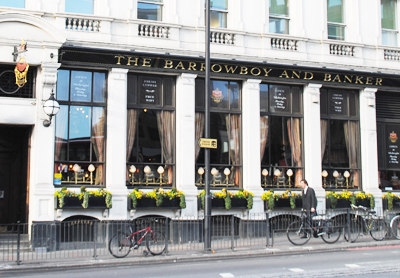
Located just a hop, skip and a jump from the ever-popular Borough Market in Southwark, this oddly monikered pub’s name comes from two separate parts of its history.

The ‘barrowboy’ part refers to the barrow boys or costermongers who used to ply their trade at the nearby market, carting their produce in barrows.

The ‘banker’ part refers to the origins of the building in which the Grade II-listed premises at 6-8 Borough High Street is located. Like one of our previous posts (see The Counting House), it was formerly a bank – in fact, it claims to have been the first ever branch of the National Westminster Bank, which opened in 1970 after the National Provincial Bank and Westminster Bank merged to create what is now known as NatWest.

Some of the 19th century building’s original features – such as the high ceilings and large windows looking out onto the street – are still evident inside but one of the more interesting features – former bank vaults – aren’t open to the public. They lie beneath the bar and are now used for storage.

The pub, now known as an ale and pie house, is part of the Fuller’s chain. For more on the pub, check out http://barrowboy-and-banker.co.uk.

London Pub Signs – The Counting House…

The-Counting-House

This pub, as the names suggests, is located in the City. But more than just being located in a part of London that was traditionally associated with finance, the pub is also actually located in a former bank.

The grand building located at 50 Cornhill was built in 1893 for bankers Prescott, Dimsdale, Cave, Tugwell and Co. (and interestingly, its foundations partly rest on a wall which was once part of the city’s Roman basilica).

The Grade II-listed building, designed by Henry Cowell Boyes and built by William Cubitt, was occupied by several different banks over the years – the last apparently being NatWest – before it was purchased by the Fuller’s Ale and Pie House chain in 1997.

This pub still offers plenty of period atmosphere with a central island bar, large mirrors, old world railing and a magnificent central dome. There’s also a World War I memorial on the wall.

For more on the pub, check out www.the-counting-house.com.

10 fictional character addresses in London – 1. 221b Baker Street…

221b-Baker-Street

Today we kick off our new Wednesday series with a look at some of the most famous addresses in London where fictional characters once lived. Most, if not all, of the addresses we’ll look at are not fictional in themselves – they do actually exist – but the characters said to have lived there owe their lives solely to the imaginations of their creators and the readers and audiences who have loved and admired them.

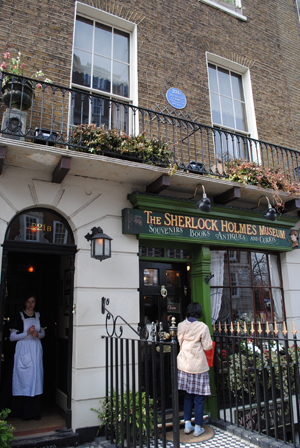
To kick it off, we take a quick look at what is certainly the most visited address of a fictional character in London – 221b Baker Street, the home of Sherlock Holmes and his associate Dr John Watson.

The-Sherlock-Holmes-MuseumWe’ve looked mentioned this Baker Street address in a couple of earlier posts – including a look at the origins of the naming of Baker Street and a piece on Sherlock Holmes himself.

So, to somewhat recap, the writer Sir Arthur Conan Doyle has Holmes and Watson living at this address from 1881 (it becomes their address in the first book featuring them – A Study in Scarlet, published in 1887) to 1904 when Holmes retired (Watson was not a continual presence here, moving in and out a couple of times).

What’s interesting is that the address now belongs to the Sherlock Holmes Museum, although in terms of the other numbers in the street, this is actually located between numbers 237 and 241 (in a street which was, prior to the 1930s, known as Upper Baker Street).

What is now number 221 is a 1930s art deco building formerly known as Abbey House (but this would have been 41 Upper Baker Street in 1887). It was the headquarters of Abbey National which had a long-running dispute with the museum over the right receive mail at the address 221b (since the closure of Abbey House in the early Noughties, the museum has received the mail).

It should be noted that there are also numerous other theories over the ‘real’ location of 221b Baker Street – in particular one which suggests the real address is opposite the former location of Camden House in Baker Street, thanks to a reference in The Empty House.

The museum, which is located in a house built in 1815, is set up as it was in Holmes’ day and contains his first floor study, filled with artefacts relating to the many cases he solved – including his famous pipe as well as his deerstalker hat, magnifying glass, violin, and the wicker chair which was used in Sidney Paget’s famous illustrations.

Other rooms include Dr Watson’s small second floor bedroom and the housekeeper Mrs Hudson’s room.

Worth noting is that there is also reconstruction of Holmes’ study at The Sherlock Holmes pub, located at 10-11 Northumberland Street in Westminster. This had been created for the Festival of Britain in 1951 by the Marylebone Borough Library and Abbey National and was located at Abbey House. For on this, check out the Westminister Libraries & Archives site.

WHERE: The Sherlock Holmes Museum, 221b Baker Street (nearest Tube station is Baker Street);  WHEN: 9.30am to 6pm daily; COST: £8 adults; £5 children (under 16); WEBSITE: www.sherlock-holmes.co.uk.

London Pub Signs – The Sutton Arms…

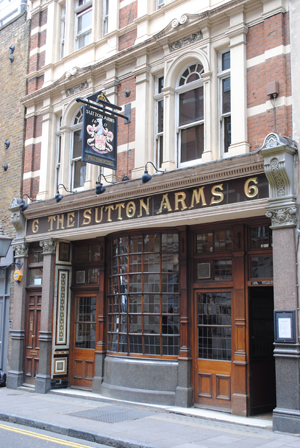
This pub, located just off Charterhouse Square near Barbican, has a distinctive barrel-shaped front window and a name that evokes a sense of the rich history of the area in which it stands.

The-Sutton-ArmsThe name of this pub at 6 Carthusian Street comes directly from Sir Thomas Sutton, a late 16th century/early 17th century businessman and moneylender who owned nearby land on which a Carthusian monastery once stood and who founded the Charterhouse School based at the site.

The monastery, which had been founded in 1371, was dissolved by King Henry VIII in the Dissolution of the Monasteries which took place in the first half of the 16th century – it was a nasty business with some of the monks executed at Tyburn.

The land was subsequently granted to Sir Edward North who built a mansion on the site which was subsequently sold to the fourth Duke of Norfolk. It was his son, Thomas Howard – the first Earl of Suffolk, who, in 1611, sold the property to Sir Thomas (and subsequently built the magnificent Audley End House in Essex with the funds).

Said to have been the “wealthiest commoner in England”, Sutton, who died that same year, used his wealth to endow a charitable foundation to both educate boys and care for elderly men.

The Charterhouse school later moved out to Surrey while elderly “brothers” are still housed at the original location today (for more on the Charterhouse, see our previous posts on King James I’s London and on 10 Historic London Squares).

Some of the glass in the  pub’s great barrel-shaped window was apparently replaced after a bomb knocked some of the original out during the Blitz.

Incidentally, there’s another pub of the same name only a few streets away in Great Sutton Street.

London Pub Signs – Ye Olde Watling…

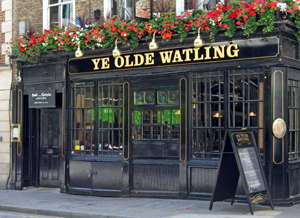
Ye-Olde-WatlingThis pub, located in the City, takes its name from the street upon which it stands – Watling Street.

The street, which is just 180 metres long, bears the same name as a great Roman road which ran all the way from Dover through London to the long gone Roman town of Viroconium (now known as Wroxeter in Shropshire).

The Roman road followed, to some extent, the route of an ancient Celtic pathway. But while the Celtic pathway crossed the Thames at Westminster, the Roman road, once the bridge was constructed, crossed at London Bridge and headed through London, apparently taking in this surviving piece.

The building itself – located on the intersection with Bow Lane – is said to have been constructed from old ship’s timbers by none other than Sir Christopher Wren in 1668. The upstairs rooms were said to have been used as a drawing office during the construction of Wren’s masterpiece, St Paul’s Cathedral. It may have also been used as  pub by the workmen building the cathedral – in fact it’s said to have been the first pub built after the Great Fire of 1666.

The pub is part of the Nicholson group. For more on it, check out www.nicholsonspubs.co.uk/yeoldewatlingwatlingstreetlondon.

PICTURE: Duncan Harris/Wikipedia

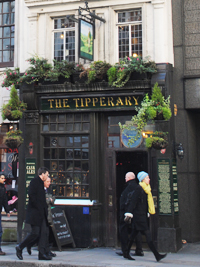
London Pub Signs – The Tipperary…

Built on land which once formed part of ‘White Friars’ (Carmelite) monastery, this Fleet Street institution is the latest incarnation in a string of pubs which have occupied the site since at least the early 17th century.

The-TipperaryA pub was built on the site in about 1605. Made of stone rather than wood (the stones apparently plundered from the monastery), the property – which stands over the top of what’s left of the River Fleet – survived the Great Fire of London in 1666.

While there seem to be a few competing versions of the pub’s history, it was apparently first named the Bolt-in-Tun (the sign of which showed a barrel pierced by a crossbow quarrel or bolt) and became a popular coaching inn (an alley opposite still bears the name Bolt Court). It was apparently later renamed The Boar’s Head.

The pub – located at 66 Fleet Street – was at some stage – the sign outside says in 1700, others suggest it was in the late 1800s – it was bought by Dublin-based brewery SG Mooney & Son (the Mooney name is still on the doorstep). It was after this purchase that it was transformed into what is claims was the first Irish pub outside of Ireland and, perhaps more importantly, the first pub outside Ireland to serve Guinness (first bottled and later draught).

The pub’s name was changed to the Tipperary after World War I when, as one story goes, returning Irish soldiers made it a favourite of theirs and christened it in honour of the song It’s A Long Way To Tipperary.

Bought by Greene King in the 1960s, the pub underwent a restoration which took it back to the style it would have been during Mooney’s days.

The pub apparently once featured a clock by renowned Fleet Street clockmaker Thomas Tompion, known as the “father of English clockmaking”. A replica now sits in the pub thanks to the original being stolen.

London Pub Signs – The White Cross…

The-White-Cross

This pub situated on the bank of the River Thames in Richmond, in London’s west, owes its name to a former monastery which once stood on the site.

A pub has been on the site since at least 1748 when it was known as the Waterman’s Arms. But the current building dates from 1838 and it was renamed the White Cross shortly after.

There’s a couple of competing theories behind its name – one is that the landlord at the time of the name changed was one Samuel Cross. The other is that it was named after the friary which once stood on the site and was dissolved, no surprises here, by King Henry VIII, in 1534. The friary had been established by Observant Franciscans, who took the white cross as their symbol, around 1500.

Apparently some remains of the friary may be incorporated into the cellars of the pub. Other features to note are the lovely open fireplaces including one oddly placed under a window (delightful on colder days), and the sign pointing to the door on the side of the pub which states that this is the entrance in times of high tide (these usually occur during spring and see access to the front entrance blocked by the rising river water).

Located off Water Lane in Richmond. For more on the pub, check out http://thewhitecrossrichmond.com.

London Pub Signs – East India Arms…

East-India-ArmsBuilt in 1829 on a site which has apparently hosted a pub since 1630, this red brick pub in Fenchurch Street in the City is named for the East India Company.

Created by a charter signed by Queen Elizabeth I which gave it a monopoly on all English trade east of the Cape of Good Hope, the East India Company was incorporated in 1600.

It dominated British trade in Asia, in particular in India which it ruled over from 1757 until its final demise in the aftermath of the Indian Mutiny in 1857 after which the British Government took direct control of India.

The company headquarters was located in East India House in nearby Leadenhall Street (the rather grand building was demolished in 1861 and the site is now occupied by the architecturally adventurous Lloyd’s Building).

The small, one-roomed pub, at 67 Fenchurch Street, is now part of the Shepherd Neame chain. For more see www.shepherdneame.co.uk/pubs/london/east-india-arms.

London Pub Signs – The Trafalgar Tavern…

This Greenwich institution, housed in a Grade II-listed building in Park Row, has been noted for its whitebait dinners since it first opened its doors in 1837 (among those said to enjoy them was the author Charles Dickens – indeed the premises features in Our Mutual Friend). 

Trafalgar-TavernThe tavern, which takes its name from the famous 1805 battle of the Napoleonic War which cost Vice-Admiral Lord Horatio Nelson his life, was built by Joseph Kay, a founding member of the Royal Institute of British Architects and the man responsible for the layout of Greenwich town centre.

Built on the site of an earlier tavern named the Old George Inn, the new late Regency pub featured at its heart the Lord Nelson Room which still looks out over the Thames and the, albeit much lessened, shipping that travels upon it. It was a favoured location for gatherings of liberal politicians.

In 1915, the pub transformed into the Royal Alfred Aged Merchant Seamen’s Institute – a role which it continued to fulfil until the 1960s when it reverted to being the Trafalgar Tavern.

For more on the tavern, see www.trafalgartavern.co.uk.

London Pub Signs – The Lord Aberconway…

Located just off Liverpool Street in Old Broad Street in the City, The Lord Aberconway is named after the last chairman of the Metropolitan Railway Company, operator of the world’s first underground railway (keep an eye out for our extended piece on the history of the Underground later this week).

Lord-AberconwayCharles McLaren – Lord Aberconway – (1850-1934) was a landowner, industrialist and MP who was raised to the peerage in 1911, a year after he had left the House of Commons. He served as chairman of ‘The Met’ from 1904 to 1933.

While the current building – the interior of which features booths and an L-shaped bar – dates from the 19th century, there has been a pub on the site, close to Liverpool Street Station, for much longer and its previous names included the King and Keys and the Metropolitan Railway’s ‘Refreshment Room’ and ‘Railway Buffet’.

The pub, which stands not far from the Monument commemorating the Great Fire of London, is reputed to be haunted by victims of the fire (only four people are said to have officially died in the blaze but it’s believed the death toll would have actually been much higher). You’re more likely to see city traders there however.

The pub is now run by the Nicholson’s. For more on the Lord Aberconway, see www.nicholsonspubs.co.uk/thelordaberconwayliverpoolstreetlondon/.