10 London sites to celebrate Charles Dickens – 5. Seven pubs associated with Dickens (including one he never visited)…

There hardly seems to be a pub in London which doesn’t claim some connection with the Victorian author but we thought we’d confine ourselves to five pubs with more well-established credentials…

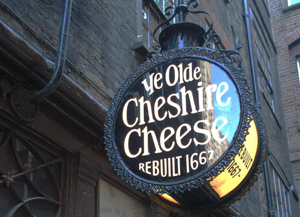
• Ye Olde Cheshire Cheese. This pub is a Fleet Street institution with parts of the current building dating back to 1667 when it was rebuilt following the Great Fire. Dickens was among numerous literary figures who frequented the premises – the pub is perhaps most famously associated with the lexicographer Dr Samuel Johnson (although there is apparently no recorded evidence he ever attended here); other literary figures who came here include Mark Twain and Sir Arthur Conan Doyle – and, according to a plaque in Wine Court, worked out of the pub for a period while producing his journal All The Year Round.

• The One Tun, Saffron Hill. Said to have been established as an ale house on its present site in 1759, the pub was rebuilt in the mid-Victorian era  and was apparently patronised by Dickens between 1833 and 1838. It’s also apparently the inspiration for the pub called The Three Cripples in Oliver Twist (The Three Cripples was actually a lodging house next door to the One Tun and didn’t sell ale). For more, see www.onetun.com

• The George Inn, Southwark. Dating from the 17th century, the George Inn in Borough High Street is the last galleried coaching inn left standing in London and is now cared for by the National Trust (and leased for use by a private company). Dickens is known to have come here when it was running as a coffee house and he mentions it in the book, Little Dorrit. For more, see     www.nationaltrust.org.uk/george-inn/.

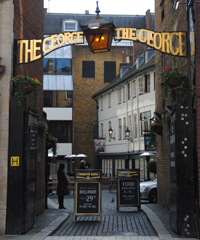
• George & Vulture, Castle Court (near Lombard Street). Established in the 18th century on the site of an older inn, this well-hidden pub was not only frequented by Dickens but is mentioned in The Pickwick Papers more than 20 times.

• The Grapes, Limehouse. Formerly known as The Bunch of Grapes, there has been a pub on the site for almost more than 430 years. Dickens was known to be a patron here (his godfather lived in Limehouse) and mentioned the pub – renamed The Six Jolly Fellowship Porters – appears in his novel Our Mutual Friend. For more, see www.thegrapes.co.uk.

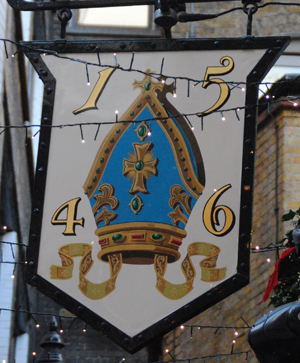
• Ye Olde Mitre, Ely Place. This pub dates from the mid 1500s by Bishop Goodrich of Ely to house his retainers and later rented out to Sir Christopher Hatton (it still houses the remains of a cherry tree which Sir Christopher is said to have danced around during a May Day celebration with none other than the future Queen Elizabeth I). Dickens (and the ubiquitous Dr Johnson) are both said to have drunk here.

• And lastly, The Dickens Inn in St Katharine Docks. It’s worth noting up front that Charles Dickens had nothing to do with this pub – dating back to at least 1800, it was once a warehouse and is thought to have been used to either house tea or play a role in a local brewing operation – but it was his great grandson, Cedric Charles Dickens, who formally opened the pub in 1976, apparently declaring, “My great grandfather would have loved this inn”. For more, see www.dickensinn.co.uk.

This list is by no means comprehensive – we’d love to hear from you if you know of any other pubs Dickens frequented…

LondonLife Special – Long-serving royals…

Today marks 60 years since Queen Elizabeth II ascended to the throne, making her Britain’s second-longest serving monarch. While the celebrations are yet to kick off in earnest (the Diamond Jubilee weekend will be officially held over the 2nd to 5th June), we thought we’d take a quick look at the top 10 longest-serving monarchs who were crowned at Westminster Abbey in London:

1. Queen Victoria – 63 years (20th June, 1837-22nd January, 1901)

2. Queen Elizabeth II – 60 years (6th February, 1952-current)

3. King George III – 59 years (25th October, 1760-29th January, 1820)

4. King James I (VI of Scotland) – 57 years (24th July, 1567-27th March, 1625)

5. King Henry III – 56 years (18th October, 1216-16th November, 1272)

6. King Edward III – 50 years (25th January, 1327-21st June, 1377)

7. Queen Elizabeth I – 44 years (17th November, 1558-24th March, 1603)

8. King Henry VI – 38 years (31st August, 1422-4th March,1461, and, 31st October, 1470-11th April, 1471)

9. King Henry VIII – 37 years (22nd April, 1509-28th January, 1547)

10. King Henry I – 35 years (3rd August, 1100-1st December, 1135)

Around London: A new pleasure garden for London; music hall star Dame Gracie Fields honored; mystery portraits at the NPG; and, celebrating the Olympics (from a Peruvian perspective)…

A new pleasure garden will be built in the city’s east as part of celebrations for next year’s Diamond Jubilee. London Pleasure Gardens, announced back in March, will be built upon a 60,000 square metre site at Pontoon Dock, opposite the ExCeL Exhibition Centre, and consist of an “ever-evolving creative playground for both resident Londoners and tourists alike”. The gardens, which will feature landscaped walkways, a floating cinema, an ‘adult’s playground’ and a range of facilities such as a ‘glass cafe’ – are expected to be open for the Queen’s Jubilee Weekend on 1st June. It’s expected that more than 40,000 people a day will pass through the site during the Olympics. London has had a long association with the concept of pleasure gardens – places where people gathered to listen to music, see art, eat and drink and talk, the most famous of which was the Vauxhall Pleasure Gardens. But the Royal Docks also had its own pleasure gardens in the past – these existed between 1851 and 1884 and were named the Royal Victoria Gardens.  For more, see www.londonpleasuregardens.com.

• Music hall star Dame Gracie Fields has been honored by English Heritage with a blue plaque on the Islington house where she lived for three years in the 1920s. It was while living at 72a Upper Street with her parents and first husband Archie Pitt, that she consolidated her reputation as one of Britain’s most popular performers and it was also during this time that she recorded for the first time (she was to become a regular on the BBC and by 1933 had cut a massive four million discs) and appeared before King George V and Queen Mary at a Royal Variety Performance. Following her success, Fields and Pitt built a mansion in The Bishop’s Avenue, Hampstead, called ‘The Tower’ in honor of the show which had made her a star – Mr Tower of London. She later separated from Pitt and married an Italian born director Monty Banks. They moved to the US in 1940 amid fears her husband would be interned and, after the war, she settled on the Italian island of Capri where, following Banks’ death in 1950, she married again. She made her final appearance on the London stage in 1978 – closing a Royal Variety Performance – and died back in Capri the following year.

• And, briefly…..A new species of dinosaur – Spinops sternbergorum – has reportedly been discovered at the Natural History Museum, identified from bones previously gathering dust on a shelf at the museum.

On Now: Imagined Lives: Portraits of Unknown People. This exhibition at the National Portrait Gallery centres on a group of 14 portraits from the 16th and 17th centuries which depict unknown people. Originally thought to represent famous figures like Queen Elizabeth I, the identity of the sitters is now considered unknown. In response to the pictures, eight internationally renowned authors – from Alexander McCall Smith and Joanna Trollope to Julian Fellowes and Terry Pratchett – have written imaginative short stories about the portraits, bringing them to life. The exhibition was originally shown in Somerset but is now running at the NPG until 22nd July. Admission is free. For more information, see www.npg.org.uk.

On Now: London and the Olympics. The Museum of London is hosting a new display which looks at the 1908 and 1948 Olympic Games held in London but, in twist, looks at not only the experiences of Londoners but those of the 41 man team Peru sent to the 1948 games. Pictures included in the display come from an album made by one of the athletes, Enrique Mendizabal Raig, recording the team’s visit (you can find the images on Flickr here). Entry is free. Runs until September. For more, see www.museumoflondon.org.uk.

Lost London: Gates Special – Ludgate

We’re launching a new ‘Lost London’ special looking at some of the now disappeared gates of London. First up is Ludgate which once stood on the western side of the city.

The gate is believed to have been constructed in Roman times and is known to have been rebuilt a several times – once in 1215 and another time after it was destroyed in the Great Fire – before being demolished in 1760 to allow for the road to be widened.

The origins of the name – which is today commemorated in street names like Ludgate Hill and Ludgate Circus – are sketchy but may have been named after the mythical pre-Roman King Lud, who was, so the legend goes, buried underneath this portal (this myth was popularised by the 12th century writer Geoffrey of Monmouth). Others have suggested ‘lud’ is a corruption of ‘flud’ or ‘flood’ and the gate was so named because it prevented the city being flooded by the River Fleet. Another possibility is that ‘lud’ is simply an old English word for a postern gate, a small secondary gate.

Whatever the origins of its name, it has been suggested it was through Ludgate that William the Conqueror passed when first entering the city. In 1377 it became a prison for petty criminals like debtors and trespassers – serious criminals were sent to Newgate – and this lasted until its final destruction.

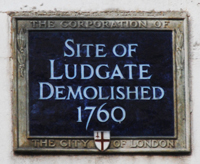
There is a blue plaque on the wall of the church of St Martin-within-Ludgate in Ludgate Hill marking where Ludgate once stood (pictured above). It is believed that some badly corroded statues standing under a porch at the church of St Dunstan-in-the-West on Fleet Street are of Lud and his sons and were taken down from the gate before its demolition. William Kerwin’s statue of Queen Elizabeth I which dates from 1586 sits in a niche on the front of the church is also believed to have been removed from Ludgate.

The Royal Parks – 6. Greenwich Park

The oldest of the royal parks, the 74 hectare (183 acre) Greenwich Park has been associated with royalty since at least the 15th century.

The area covered by the park had been occupied by the Romans (there are some remains of a building, possibly a temple, near Maze Hill Gate) and later the Danes, who raised protective earthworks here in the 11th century. After the Norman Conquest, it became a manor.

Its enclosure only happened in 1433 after the land came into the possession of Humphrey of Lancaster, Duke of Gloucester and brother of King Henry V. At the time regent to the young King Henry VI, Duke Humphrey also built a tower on the heights above the park – where the Royal Observatory now stands.

Following the duke’s death in 1447, the land was seized by Margaret of Anjou – wife of King Henry VI – and subsequently became known as the Manor of Placentia. King Henry VII later rebuilt the manor house, creating what was known as Greenwich Palace or the Palace of Placentia.

Not surprisingly, it was King Henry VIII, who, having been born at Greenwich Palace, introduced deer to the park. Indeed the park was to have strong associations with others in his family – the king married Catherine of Aragorn and Anne of Cleeves at Greenwich Palace, and his daughters, later Queen Mary I and Queen Elizabeth I, were born there while his son, King Edward VI, died there in 1553 at the age of only 15. (There’s a tree in the park known as Queen Elizabeth’s Oak, which is said to be where she played as a child).

In 1613, King James I gave the palace and accompanying park – which he had enclosed with a high wall – to his wife, Queen Anne of Denmark, apparently as an apology after swearing at her in public when she accidentally shot one of his favorite dogs. Queen Anne subsequently commissioned Inigo Jones to design what is now known as the Queen’s House – for more on that, see our earlier post.

Following the Restoration, King Charles II ordered the palace rebuilt and while this work remained unfinished, the king did succeed in having the park remodelled – it is believed that Andre Le Notre, gardener to King Louis XIV of France, had a role in this.

The works included cutting a series of terraces into the slope – these were known as the Great Steps and lined with hawthorn hedges – as well as creating a formal avenue of chestnut trees (now known as Blackheath Avenue), and some woodlands. Work is currently taking place on restoring an orchard which dates from 1666 at the park.

King Charles II also commissioned Sir Christopher Wren to build the Royal Observatory that still stands on the hill overlooking the park – it stands on the site once occupied by the Duke Humphrey Tower (the Royal Observatory is home of the Prime Meridian – see our earlier post on the Royal Observatory for more).

King James II was the last monarch to use the palace and park – his daughter Queen Mary II donated the palace for use as a hospital for veteran sailors and the park was opened to the pensioners in the early 1700s. The hospital later become the Royal Naval College and the National Maritime Museum later moved onto the site (for more on this, see our earlier post).

As an aside, Royal Parks say the truncated shape of some of the trees in the park is apparently due to the fact that when anti-aircraft guns were positioned in the flower garden during World War II, the trees had to be trimmed to ensure a clear field of fire.

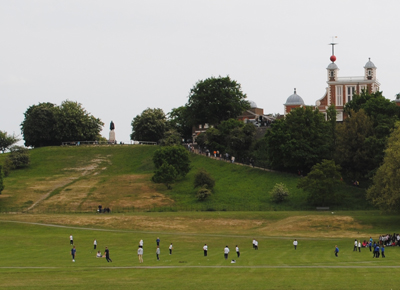
Facilities in the park today include a tea house, a children’s playground, sporting facilities such as tennis courts and, of course, the Wilderness Deer Park where you can see wildlife at large. Statues include that of Greenwich resident General James Wolfe, an instrumental figure in establishing British rule in Canada – it sits on the crest of the hill opposite the Royal Observatory looking down towards the Thames.

The park, which is part of the Greenwich World Heritage Site, is slated as a venue for next year’s Olympics – it will host equestrian events and the shooting and running events of the pentathlon.

WHERE: Greenwich Park (nearest DLR station is Cutty Sark – other nearby stations include Greenwich, Maze Hill and Blackheath); WHEN: 6am to at least 6pm (closing times vary depending on the month); COST: Free entry; WEBSITE: www.royalparks.gov.uk/Greenwich-Park.aspx

The Royal Parks – 1. Hyde Park

This year marks the 160th anniversary of the transfer of the care of the Royal Parks to the government (meaning the public was freely able to enjoy access for the first time). To celebrate, over the next weeks we’ll be taking a look at the history of each of them. First up is the 142 hectare Hyde Park, perhaps the most famous of all eight Royal Parks.

Formerly owned by Westminster Abbey, King Henry VIII seized the land in 1536 for use as a private hunting ground. He had it enclosed with fences and the Westbourne Stream, which ran through the park – it now runs underground – dammed.

It remained the king and queen’s private domain (Queen Elizabeth I is known to have reviewed troops there) until King James I appointed a ranger to look after the park and permitted limited access to certain members of the nobility in the early 17th century.

The park’s landscaping remained largely unaltered until the accession of King Charles I – he created what is known as the ‘ring’ – a circular track where members of the royal court could drive their carriages. In 1637, he also opened the park to the public (less than 30 years later, in 1665, it proved a popular place for campers fleeing the Great Plague in London).

During the ensuring Civil War, the Parliamentarians created forts in the park to help defend the city against the Royalists – some evidence of their work still remains in the raised bank next to Park Lane.

After King William III and Queen Mary II moved their court to Kensington Palace (formerly Nottingham House) in the late 1600s, they had 300 oil lamps installed along what we know as “Rotten Row’ – the first artificially lit road in the country – to enable them and their court to travel safely between the palace and Westminster.

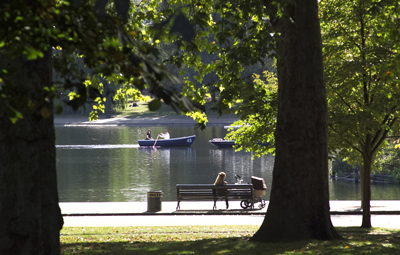
The natural looking Serpentine – the great, 11.34 hectare, lake in the middle of Hyde Park (pictured) – was created in the 1730s on the orders of Queen Caroline, wife of King George II, as part of extensive work she had carried out there. It was Queen Caroline who also divided off what we now know as Kensington Gardens from Hyde Park, separating the two with a ha-ha (a ditch).

The next major changes occurred in the 1820s when King George IV employed architect and garden designer Decimus Burton to create the monumental park entrance at Hyde Park Corner – the screen still remains in its original position while Wellington Arch was moved from a parallel position to where it now stands (see our previous posts for more on that). Burton also designed a new railing fence and several lodges and gates for the park. A bridge across the Serpentine, meanwhile, was built at about the same time along with a new road, West Carriage Drive, formally separating Hyde Park and Kensington Gardens.

While the basic layout of the park has been largely unchanged since, there have been some additions – among them, the establishment in 1872 of Speaker’s Corner as a place to speak your mind in the north-east corner of the park (near Marble Arch), the creation in 1930 of the Lido for bathing in warm weather, and, more recently, the building of the Diana, Princess of Wales’ Memorial Fountain (unveiled in 2004), and the 7 July Memorial (unveiled in July 2009).

Other sculptures in the park include Isis (designed by Simon Gudgeon, located on the south side of the Serpentine), the Boy and Dolphin Fountain (designed by Alexander Munro, it stands in the Rose Garden), and a monumental statue of Achilles, a memorial to the Duke of Wellington designed by Richard Westmacott, near Park Lane. There are also memorials to the Holocaust, Queen Caroline, and the Cavalry as well as a Norwegian War Memorial and a mosaic marking the site of the Reformer’s Tree (the tree was burnt down during the Reform League Riots of 1866).

The park has been integral part of any national celebrations for centuries – in 1814 a fireworks display there marked the end of the Napoleonic Wars, the Great Exhibition – with the vast Crystal Palace – was held there in 1851 and in 1977 a Silver Jubilee Exhibition was held marking Queen Elizabeth II’s 25 year reign. Cannons are fire there on June 2nd to mark the Queen Elizabeth II’s coronation and on 10th June for the Duke of Edinburgh’s birthday.

Facilities these days include rowing and pedal boats, tennis courts, deck chairs, a restaurant and cafe (the latter based in the Lido) and, of course, some Boris bikes. There is a heritage walk through the park which can be downloaded from the Royal Parks website.

WHERE: Hyde Park (nearest tube stations are that of Marble Arch, Hyde Park Corner, Lancaster Gate, Knightsbridge and South Kensington); WHEN: 5am to midnight; COST: Free; WEBSITE: www.royalparks.gov.uk/Hyde-Park.aspx?page=main

PICTURE: Courtesy of Royal Parks. © Indusfoto Ltd 

LondonLife – Open House London, The Middle Temple Hall

Last weekend saw thousands of people make their way to rarely opened properties across London as part of Open House London. Among the properties we visited was the Middle Temple Hall, one the finest example of a 15th century hall in London (if not the UK). The hall was built in the 1560s and early 1570s – by which time the Middle Temple, one of the medieval Inns of Court (more of which we’ll be talking about in an upcoming series), had already existed for about 200 years – and the hall which the Temple currently used, that of the former Templar Knights, was starting to fall apart. The new hall was constructed under the direction of law reporter Edmund Plowden, then Treasurer of the Inn, and funded by members of the Middle Temple. In use by about 1570, Queen Elizabeth I is, according to some stories, said to have dined there many times and it was in the hall that the first performance of Shakespeare’s Twelfth Night took place. While it suffered some damage in World War II bombings, the hall still looks much as it did in the late 1500s. It remains at the centre of the Middle Temple’s collegiate and social life and it is here that members are called to the Bar. Among the notable objects inside are numerous paintings and stained glass memorials of people associated with the Inn (including Sir Walter Raleigh and numerous monarchs – from King Charles I to King Edward VII) as well as the High Table – a table made of three 29 foot long planks from a single oak, it is said to be a gift from Queen Elizabeth I – and the ‘cupboard’, a smaller table which was apparently made from the hatch cover of Sir Francis Drake’s ship, the Golden Hind. Late note: I should add that the Middle Temple Hall is not normally open to the public.

King James I’s London – 10. Westminster Abbey’s Lady Chapel

And so we come to the final instalment in our series on King James I’s London. This week we’re looking at Westminster Abbey’s Lady Chapel where King James I – who was crowned in Westminster Abbey in 1603 – was laid to rest after his death in 1625.

But before we turn to James himself, it’s worth noting that several members of his immediate family are also buried in the abbey’s Lady Chapel (pictured). These include his eldest son, Henry Fredrick, Prince of Wales, who died in 1612 at the age of 18 (and thus opened the way for his younger brother Charles to become King Charles I). He is buried in the south aisle of the magnificent Lady Chapel which had been added at the behest of King Henry VII between 1503 and 1519 and replaced a 13th century chapel.

Three of James’ daughters are also buried in the Lady Chapel – Mary, who died in 1607, aged two, and Sophia, who died in 1606, aged just three days old. Both of them have monuments in the north aisle while their sister Elizabeth, wife of King Fredrick V of Bohemia, who died much later in 1662, is buried near her brother Henry Fitzpatrick.

As we’ve previously mentioned, King James I also outlived his wife, Queen Anne of Denmark, who died of dropsy at Hampton Court Palace on 2nd March, 1619, at the age of 43. She lay in state at Somerset House until her funeral on 13th May and was then buried in the south-eastern area of the Lady Chapel where her gravesite is marked by a modern stone bearing her name. Her wooden funeral effigy is one of a collection which can still be seen in the Abbey’s Museum.

After James himself died on 27th March, 1625, he was laid in the vault beneath King Henry VII’s monument beside Elizabeth of York, Henry’s wife. No monument was erected to mark his passing save for a modern inscription placed nearby (in fact Queen Elizabeth I was the last monarch to be buried with a monument above the site – see below).

It’s also worth noting that in 1612 – nine years into his reign – James arranged for the body of his mother – Mary, Queen of Scots, who was executed in 1587 on the orders of Queen Elizabeth I – to be transferred from its resting place in Peterborough Cathedral to the south aisle of the Lady Chapel where he had an elaborate tomb erected featuring an elegant white marble effigy showing her wearing a coif, ruff and long mantle.

In the north aisle, James had previously erected a marble monument to his predecessor, Queen Elizabeth I and had her body moved from where it had lain in the vault of her grandfather, King Henry VIII, to a place beneath the new monument. Her half-sister, Queen Mary I, is also buried beneath the monument.

That’s the final in our series on King James I’s London – it’s by no means a comprehensive look at significant sites in the early Stuart period and we shall be looking at more from the period down the track, but it’s a good start. Our new special series starts next week. 

WHERE: Westminster Abbey, Westminster (nearest Tube station is Westminster or St James’s Park); WHEN: Open to tourists everyday except Sunday  (times vary so check the website); COST: £16 an adult/£13 concessions/£6 schoolchildren (11-18 years), free for children aged under 11/£38 for a family (two adults, two children); WEBSITE: www.westminster-abbey.org

Where’s London’s oldest…outdoor statue?

It’s generally believed that London’s oldest outdoor statue is that of King Alfred the Great which stands in Trinity Church Square in Southwark but there are a few others worth mentioning for their age.

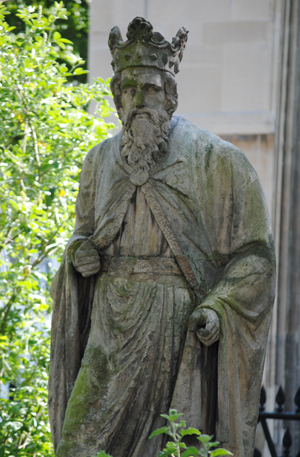
But first, to the statue of Alfred the Great. Located now in Trinity Church Square, it is thought to have been made in the late 14th century (although it’s also suggested it could be much younger) in honor of the man who ruled Wessex in the 9th century and is often credited as being the first “king of the English”.

The statue (right) was apparently located at the Palace of Westminster before it was brought to its present location in 1823 at about the time the square was being laid out.

Others among London’s oldest statues is that of King Charles I sitting astride his horse and looking from Whitehall from its position on the southern side of Trafalgar Square.

Credited as being London’s “oldest equestrian bronze”, this statue is the work of French sculptor Hubert Le Sueur and was cast in 1633 (during King Charles I’s rule) at the behest of Richard Weston, one of the king’s favorites, who that year became the 1st Earl of Portland.

It was removed during the Civil War but later reacquired by the Portland family and, following the Restoration, was reinstalled on its current site – once that of the Charing Cross (see our previous entry for more details) – in 1675 by King Charles II.

Another of London’s oldest statues is that of Queen Elizabeth I which stands on the facade of the church St Dunstan-in-the-West in Fleet Street. This statue, which has been attributed to William Kerwin although other names have also been suggested, dates from 1586 (created during her reign) and decorated the west side of Ludgate until its demolition in 1760, after which it was apparently put into storage until being brought to the church in the 19th century.

Standing nearby in the vestry porch as statues of the legendary pre-Roman British king, Lud, and his sons, Androgeus and Tenvantius, which were also removed from Ludgate and probably date from the same period (about 1586).

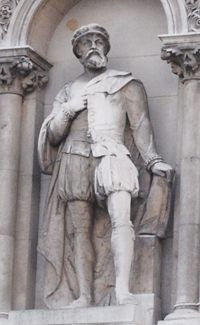
Famous Londoners – Sir Thomas Gresham

Remembered primarily for having founded the Royal Exchange as a centre for commerce in London and Gresham College, Sir Thomas Gresham was one of London’s leading merchants and financiers and an important advisor to successive monarchs during the sixteenth century.

Gresham was born in Milk Lane, London, to merchant Sir Richard Gresham (himself Lord Mayor of London in 1537-38) around 1518-19. He studied at Cambridge before being apprenticed to learn the family trade with his uncle, Sir John Gresham.

In 1543, he was admitted to the Mercers’ Company and subsequently spent time in the Low Countries, residing principally in Antwerp and acting as an agent for King Henry VIII. In 1544 he married Anne Fernley, widow of another London merchant. He also had a house in Lombard Street at this time.

Sir Thomas became an important advisor  to King Edward VI, helping him alleviate financial concerns, a role he continued to play during the successive reigns of Queen Mary I and Queen Elizabeth I (although he spent some time out of favor during Mary’s reign).

Knighted for his services to the crown in 1559, he proposed to built his ‘exchange’ in 1565, offering to pay for it himself if the City of London and Mercers’ Company provided the land. Modelled on the bourse in Antwerp with a trading floor and shops and offices set around a large central courtyard, it was officially awarded the title ‘royal’ by Queen Elizabeth I in 1571.

Sir Thomas died suddenly in 1579, apparently of a heart attack, and left the majority of his wealth to his widow but included clauses in his will stating that after her death rents from the Royal Exchange be used to create a college which would see seven professors offer free lecturers on subjects ranging from astronomy and geometry to rhetoric and divinity.

Known as Gresham College, it became the first institution of higher education in London when it was founded in 1597 and was initially based at Sir Thomas’ mansion in Bishopsgate (it’s now based in Barnard’s Inn Hall and, as it has for the past 400 years, still offers free public lectures).

In 1666, Sir Thomas’ Royal Exchange burnt down along with much of London but it was rebuilt immediately afterward (King Charles II laid the foundation stone of the new building) and rebuilt again following another fire in 1838 (at the time the building was largely occupied by two insurance companies, one of which was Lloyds of London).

It’s this third building, designed by Sir Thomas Tite to resemble the original plan, which stands on the site today. While trading has long since ceased there – it’s now a luxury-end shopping centre – Sir Thomas’s symbol, the gold ‘Gresham Grasshopper’, can still be seen on the weathervane. For more information on the Royal Exchange, see www.theroyalexchange.co.uk.


Treasures of London – The Cheapside Hoard

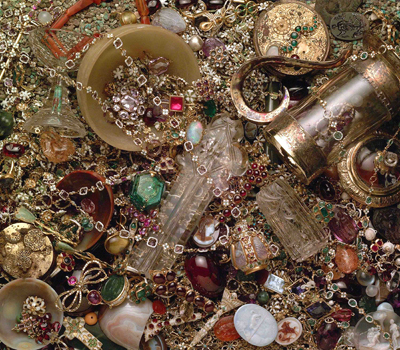
It’s been described as the greatest find of Jacobean and Elizabethan jewellery ever made – an extraordinary cache of some 500 gemstones, jewellery and other related items found buried under the floor during the demolition of a building at 30-32 Cheapside on 18th June, 1912.

Now known as the Cheapside Hoard, it dates from the 16th and 17th centuries and includes neck chains, pendants, hat ornaments, cameos and rings – among the items is a gold watch set into a hinged case made from a Columbian emerald, a tiny bejewelled gold scent bottle, and an onyx cameo of Queen Elizabeth I.

Other items include unfinished ornaments and unmounted gemstones which have origins spanning the world – from Asia and Middle East to South America. While these give support to the idea that the hoard is part of a goldsmith’s reserve stock, mystery still surrounds why it was buried in the building (although Cheapside was known for its goldsmiths during the era which the hoard dates from).

The majority of the hoard is held at the Museum of London where some of the items are on display. Other items are at the British Museum and one, an enamelled gold chain, is at the Victoria & Albert Museum. The Museum of London is planning major exhibition of the hoard starting in late 2013. Stay tuned for more information.

WHERE: Museum of London, 150 London Wall (nearest tube station is Barbican, St Paul’s or Moorgate); WHEN: 10am to 6pm, Monday to Sunday; COST: Free; WEBSITE: www.museumoflondon.org.uk

PICTURE: Museum of London