10 notable blue plaques of London – 6. A blue plaque for a deadly bomb…

V1-flying-bombNot all of the plaques in the English Heritage blue plaques scheme commemorate people, some also commemorate places and events – the saddest of which is no doubt the landing of the first deadly V1 flying bomb on London during World War II.

Located in Bow in the East End is a plaque commemorating the site where the first flying bomb fell on London on 13th June, 1944, a week after D-Day and several months since the last bombs had fallen on London in what was known as the “mini-blitz”.

Carrying some 850 kilograms of high explosive, the unmanned, fast-moving bomb dived to the ground at about 4.25am on the morning of the 13th, badly damaging the railway bridge and track, destroying houses and, sadly, killing six people.

It was to be the start of a new bombing offensive which would eventually see around 2,500 of the V1 flying bombs reach London between June, 1944, and March, 1945.

They were responsible for killing more than 6,000 people and injuring almost 18,000 and were followed by the even more advanced V2 long range rockets – the world’s first ballistic missiles – in September, 1944. These were responsible for another 2,754 deaths in London before the war’s end.

The current plaque on the railway bridge in Grove Road was erected in 1998 by English Heritage and replaced one which was erected by the Greater London Council in 1985 and subsequently stolen.

PICTURE: Spudgun67/CC BY-SA 4.0

10 notable blue plaques of London – 5. Five Londoners with more than one blue plaque…

There’s quite a few whose London residence (or otherwise) is commemorated by more than one blue plaque. So, breaking away from our usual ‘one plaque’ format, here were listing five of those who have made the grade…

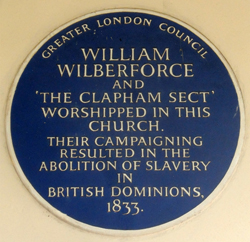
William-Wilberforce-blue-plaque1. William Wilberforce (1759-1833). The late 18th century and early 19th century politician and anti-slavery campaigner tops our list with three English Heritage blue plaques. The first is at 111 Brookwood Road in Battersea – the site of Brookwood House where Wilberforce resided during his anti-slavery campaign. The second is on Holy Trinity Church on Clapham Common, the church where Wilberforce and the Clapham Sect with whom he is associated worshipped. And the third is on a property at 44 Cadogan Place in Chelsea where Wilberforce died.

2. Dr Samuel Johnson (1709-1784). Like Wilberforce, the 18th century lexicographer Dr Johnson has three English Heritage blue plaques to his name. The first, on his famous Gough Square property in the City of London we’ve already mentioned (see our earlier post here), while the second is on a property at 8 Russell Street, Covent Garden, then occupied by bookseller Thomas Davies, which was where Dr Johnson famously first met James Boswell in 1763. The third time Dr Johnson’s name appears, more unusually, is on a plaque commemorating Essex Street – Dr Johnson is among a number of names listed on it for his role in establishing an “evening club” at the pub, the Essex Head, in the street in 1783.

3. Samuel Pepys (1633-1703): The 17th century diarist seems to pop-up everywhere in central London so it’s not surprising there are two plaques in the English Heritage blue plaques scheme dedicated to him (although both are located in the same street – one he apparently liked very much). The plaques are located at number 12 and number 14 Buckingham Street in Covent Garden and both mark the site of a Pepys residence.

4. Virginia Woolf (1882-1941): The writer, publisher and literary critic’s name appears on two properties – at 29 Fitzroy Square in Fitzrovia where Woolf lived between 1907-1911 and on Hogarth House at 34 Paradise Road in Richmond where she and Leonard Woolf lived between 1915-1924 (and also where they founded the Hogarth Press in 1917).

5. William Morris (1834-1896): The poet and artist has two English Heritage blue plaques to his credit – the first on 17 Red Lion Square in Holborn where Morris lived in a flat from 1856-1859 with Sir Edward C Burne-Jones, and the second on Red House in Bexleyheath where he and his wife Jane Burden lived from 1860-1865.

PICTURE: Spudgun67/Wikimedia/CC BY-SA 4.0 (image cropped)

10 notable blue plaques of London – 4. Oldest surviving blue plaque commemorating a woman…

Much has been made about the dearth of women featured on blue plaques in this 150th year of the scheme – according to English Heritage, only 13 per cent of the 900 odd blue plaques in London commemorate a woman.

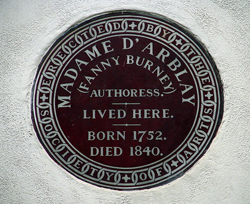
Fanny-Burney-plaqueAmong them are ballet dancer Margot Fonteyn, suffragette Sylvia Pankhurst, socialite Nancy Astor, and, in recent times, cookery writer Elizabeth David.

The oldest surviving blue plaque commemorating a woman, however, is that commemorating what is today a less well-known name, that of Fanny Burney.

Burney (1752-1840), who was known as Madame D’Arblay after she married, was a widely applauded novelist who was also noted for her diaries which record her involvement in the literary circles around Samuel Johnson and the Bluestocking Group.

The blue plaque commemorating her residence at 11 Bolton Street in Mayfair was erected in 1885 by the Society of Arts (which means that like others erected by the society, later the Royal Society of Arts, it’s brown not blue).

Burney, whose most profitable work, Camilla, was published in 1796 after she had spent five years as Second Keeper of the Robs to Queen Charlotte, lived in the house following the death of her husband, the Frenchman Alexandre D’Arblay.

She spent 10 years here – from 1818 until 1828 – and had apparently thought it would be her last residence but she went on to move into three further properties after this one.

PICTURE: Simon Harriyott/CC BY 2.0

10 notable blue plaques of London – 3. The City of London’s only ‘blue plaque’ (and it’s not even blue)…

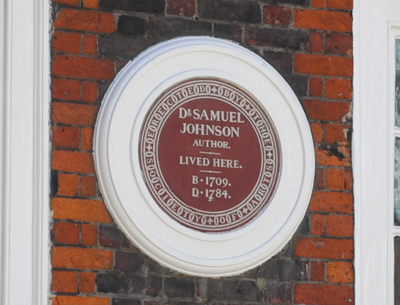
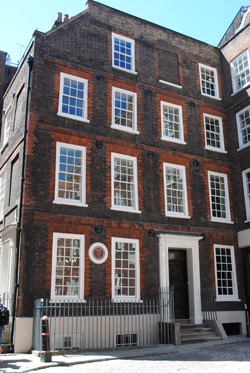
Samuel-Johnson-plaqueThere is only one official blue plaque in the square miles of the City of London – that which marks the property of lexicographer Dr Samuel Johnson in Gough Square (he always did like to stand out from the crowd) – and, like many of the plaques in the scheme, it’s not even blue.

Samuel-Johnson-plaque2The plaque was among the 35 erected in the first 35 years of the scheme – this one in 1876 – and was done so by the Society of Arts which then ran the scheme (later the Royal Society of Arts). In common with most of the first 35 plaques, it is brown in colour.

In 1879, just three years after this plaque was erected, the Society of Arts came to an agreement with the Corporation of the City of London that the corporation – the governing body of the square mile – would commemorate sites of historic significance within its boundaries and the agreement has stood ever since.

The hundreds of “blue plaques” since erected by the City of London Corporation are rectangular in nature and commemorate everything from structures like the long-gone historic gate of Aldgate (88 Aldgate High Street) to homes of the notable such as martyred Archbishop of Canterbury Thomas á Becket (86 Cheapside).

There’s a searchable database of all the City of London plaques which can be found here.

And, of course, Dr Johnson’s house, which he lived in from 1748-59 which compiling his famous A Dictionary of the English Language (the first comprehensive English language dictionary), is now a museum – for details of that, see our earlier post here.

10 notable blue plaques of London – 2. The (now long gone) first Blue Plaque…

The concept of a scheme involving placing commemorative plaques on what was once the homes of notable people was first raised by MP William Ewart in 1863 in Parliament.

Byron-plaqueThree years later, in 1866, the idea was adopted by the then Society of Arts (later the Royal Society of Arts) and in 1867 it erected two blue plaques, the first being one commemorating the birthplace of Lord Byron at 24 Holles Street just south of Cavendish Square in Marylebone and the second being that erected to Emperor Napoleon III in King Street (see last week’s post).

But the Byron plaque had the honour of being the first and it remained on the property until it was demolished in 1889 and the plaque, presumably, lost.

It has, however, been replaced several times on subsequent buildings on the site – the latest incarnation, is a “green plaque” erected by Westminster City Council on what is now a John Lewis store and was unveiled on National Poetry Day in 2012 (it replaced a non-standard, rectangular-shaped plaque – pictured above – which was installed after the building was bombed during World War II).

The current plaque describes Lord Byron as “one of the greatest British poets” and quotes him: “Always laugh when you can. It is a cheap medicine.”

Byron is said to have been born at the property on 22nd January, 1788 and was baptised George Gordon Byron at the nearby St Marylebone Parish Church. Interestingly, English Heritage says that recent research has shown there is no clear evidence for which house in Holles Street Lord Byron actually lived in meaning none of the plaques may have actually marked the correct site.

During the first 35 years of the scheme’s existence it erected on some 35 plaques (there are now some 900 in existence, so the pace has quickened since).

Less than half of them now survive but among those that do are plaques to poet John Keats (erected in 1896 on Keats’ House in Hampstead), novelist William Makepeace Thackeray (erected in 1887 on 2 Palace Green in Kensington) and politician and author Edmund Burke (erected in 1876 on 37 Gerrard Street in Soho.

PICTURE:  Wikimedia

10 notable blue plaques of London – 1. The oldest surviving blue plaque…

English Heritage are celebrating 150 years of the blue plaque scheme this year – the oldest of its kind in the world – and so to celebrate we’re looking at 10 of the most notable among them.

Napoleon-III-blue-plaqueFirst up, it’s the oldest surviving blue plaque. Located in King Street in Mayfair, just off St James’s Square, it commemorates the last French Emperor, Napoleon III, who lived at the property while a prince in 1848.

It was only a brief stay for the then soon-to-be emperor. The nephew and heir of Emperor Napoleon I, he , like other members of his family was exiled from France after the Battle of Waterloo in 1815 and spent the following years in various other countries in Europe as well as, finally, London where he lived firstly at Carlton Gardens and then at the King Street property.

He took the lease on this newly built house in February, 1847, and created what English Heritage has called a “shrine to the Bonapartes” inside, displaying such relics as Napoleon I’s uniforms and a portrait of his famous uncle by the celebrated French artist Paul Delaroche.

The prince was something of a society favourite during his time in London and was invited to join various of St James’s clubs and apparently even enrolled as a special constable during the Chartist riots of 1848.

When the Bourbon monarchy – in the person of King Louis Philippe – was overthrown in France in September that year, the prince abandoned the house to rush back to France (apparently in such a hurry that the story goes that he left his bed unmade and his bath still full of water).

The prince was elected first President of the Second Republic on his return to Paris and in 1852 took his place as Emperor Napoleon III on the restoration of the empire (incidentally, he ended up returning to England in exile following his defeat in the Franco-Prussian War and died in Kent in 1873).

The plaque, installed in 1867, also has the distinction of being the only one installed while the person it commemorates was still alive. The rule now is that those commemorated by a blue plaque need to have been dead for at least 20 years before the honour can be bestowed.

The plaque, which is rather more elaborate than modern versions, was put up by the Society of Arts (they’re mentioned on it) and the design features a French imperial eagle. It was manufactured by Minton Hollins & Co.

For more on Blue Plaques, see www.english-heritage.org.uk/visit/blue-plaques/.

10 iconic London film locations…10. A bridge, a park, and a round church…

OK, we’ve reached the last in our series of London film locations so this week we’re taking a quick look at three more…

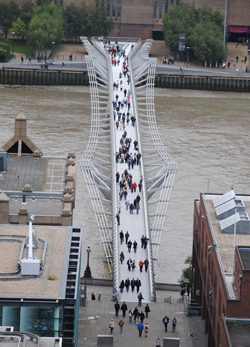
Millennium-FootbridgeThe Millennium Bridge. Initially nicknamed the “wobbly bridge” due to its propensity to move underfoot, this footbridge over the River Thames first opened in June, 2000, for only couple of days before it was closed for almost two years so its movement could be fixed and eventually reopened again in 2002. But despite its young age, the bridge has appeared not just in a Harry Potter film – 2009’s Harry Potter and the Half-Blood Prince – where it gets destroyed but also in the break-out 2014 Marvel film, Guardians of the Galaxy in which it plays the role of a bridge in the city of Xandar (embedded in the rest if the CGI-created city). Among other London locations featured in that film is the modern Lloyd’s Building in Lime Street (again, it makes part of Xandar).

The Regent’s Park. The 2010 film The King’s Speech features numerous London locations – among them is the Avenue Garden in the south-east corner of the park where speech therapist Lionel Logue (played by Geoffrey Rush) takes a stroll with Bertie, the future King George VI (played by Colin Firth), which turns a little uncomfortable. Other locations include 33 Portland Place (which plays the role of the Duke and Duchess’ Piccadilly home as well as that of the interior of Logue’s consulting rooms in the famous Harley Street), and the Draper’s Hall in the City, the interior of which plays the role of St James’s Palace.

The Temple Church. This famous – and beautiful – City of London church made its starring performance in the Tom Hanks movie of 2006, The Da Vinci Code. The church enters the movie when symbology professor Robert Langton (played by Hanks) and cryptologist Sophie Neveu (played by Audrey Tautou) come here in search for a knight’s tomb. Other London locations featured in the film (alongside those in France and Scotland), include Westminster Abbey (although the interiors were actually shot at Lincoln Cathedral). For more on the history of the church, see our earlier post here or on the tomb effigies, see our post here.

Our next special series kicks of next Wednesday.

10 iconic London film locations…9. A chapel of many faces…

There’s an ancient church in London which has taken on the role of various other cathedrals and churches in many recent historic films, most notably in the 1998 film Shakespeare in Love (a fitting reference this week, given the 400th anniversary of the Bard’s death last weekend).

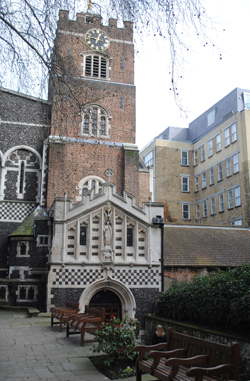
St-BartsBut the church – location of the scene in the film in which Shakespeare’s begs forgiveness after the death of Kit Marlowe – has also been seen in everything from the 1991 Kevin Costner-vehicle, Robin Hood: Prince of Thieves (where it represented the interior of Nottingham Cathedral) to Guy Ritchie’s 2009 film Sherlock Holmes (where it represented St Paul’s Cathedral, location of a ritual sacrifice being conducted by the evil Lord Blackwood).

It has also appeared in the 1996 Victorian-era drama Jude, 2006’s Amazing Grace – the story of William Wilberforce’s effort to combat the slave trade, 2007’s Elizabeth: The Golden Age (where it hosts the execution of Mary, Queen of Scots), 2008’s The Other Boleyn Girl, and the 2012 fantasy epic, Snow White and the Huntsman.

Oh, and the church? The priory church of St Bartholomew The Great (St Bart’s) located in West Smithfield, which has a history dating back 900 years (for more on the history of the church, see our earlier post here).

But the church hasn’t just been seen in films of the historic genre – it’s also played roles in more contemporary movies as well, from 1994’s Four Weddings and Funeral (St Julian’s where a wedding doesn’t take place) to 1999’s The End of the Affair and, more recently, the 2014 film Muppets: Most Wanted.

It’s doubtful there’s a church interior in London that’s been in so many movies in recent times. For more on the church itself, see www.greatstbarts.com.

10 iconic London film locations…8. The Tube and Sliding Doors’ defining moment…

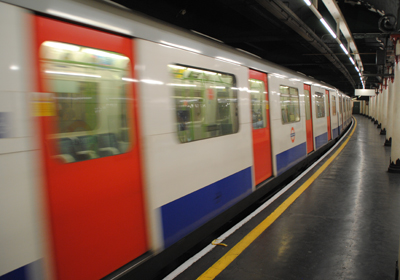
London-TubeThe London Underground appears in many films (more of that in a moment) but there’s only a few where the story really hinges on it, one of which is the Gwyneth Paltrow rom-com, Sliding Doors.

In the movie, PR flack Helen (played by Paltrow) is fired from her job and heads to Embankment Station where her one life suddenly becomes two possibilities.

Without giving too much away (and yes, we know it dates to 1998, but still), in one version she makes her way through the “sliding doors” an catches the train and her life seems to fall into place; in the other she fails to and her life goes somewhat belly-up. It’s a tale of two futures; the life that might have been – and it all hinges on that Tube ride.

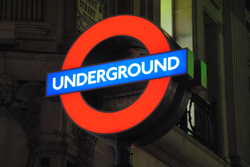
UndergroundFun fact: scenes for the film were actually shot at Waterloo Station on the Waterloo and City Line and at Fulham Broadway Station on the District Line.

As mentioned above, Sliding Doors – which also features numerous other London locations and co-stars John Hannah –  is far from the only film in which the Tube features – in fact, last year it was reported that the London Underground Film Office handles more than 200 requests a month.

While the first film featuring the Tube apparently dates as far back as 1928 (Anthony Asquith’s silent film Underground), other more recent films which have featured the London Underground include everything from Skyfall to The Bourne Ultimatum, and Thor: The Dark World (not forgetting the previously mentioned film V for Vendetta).

They haven’t always been the real thing – the chase scene featuring the Tube in 2012’s Skyfall, for example, was apparently filmed on a set at Pinewood Studios (another Bond film, Die Another Day, even features an imaginary station – Vauxhall Cross – which is used by MI6 as a secret base.)

And when movies are shot featuring the real Underground, the now closed – or ‘ghost’ – station of Aldwych (formerly on a spur branch of the Piccadilly Line) is a popular choice: as well as Atonement and V for Vendetta, it was used in the TV series’ such as Mr Selfridge and Sherlock.

For more on London film locations, see the London Film Location Guide.

10 iconic London film locations…7. The London Eye is saved by the Fantastic Four…

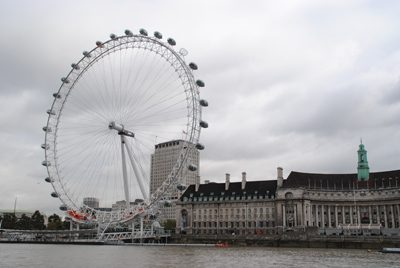
London-Eye

The London Eye features in the background of numerous recent films – everything from 2002’s 28 Days Later to 2004’s Thunderbirds and 2007’s Harry Potter and the Order of the Phoenix.

But the structure, which was built in 1999 and is currently known formally as the Coca-Cola London Eye, has a bigger role in another 2007 film – Fantastic Four: Rise of the Silver Surfer in which the film’s heroes must prevent it toppling into the Thames and a gaping hole that opens up in the river.

Thankfully, in the 2007 film, The Thing (played by Michael Chiklis), Mr Fantastic (Ioan Gruffudd) and the Invisible Woman (Jessica Alba) manage to do so, using their unique powers to save all the people being thrown around inside the Eye’s many pods.

Of course, as an iconic symbol of the city today, the London Eye has also been recreated in several animated films – from Flushed Away to Cars – and is even recreated, tongue-in-cheek, in wood for A Knight’s Tale.

There’s also quite a few films and TV shows which have featured scenes filmed inside the Eye’s pods, including Wimbledon in which one of them plays host to a punch-up.

The area of South Bank around where the Eye is located is a popular spot for films. The OXO Brasserie in the OXO Tower, for example, features in Thor: The Dark World, Millennium Bridge, linking South Bank to St Paul’s Cathedral, can be seen as part of the (imaginary) city on Xander in the film Guardians of the Galaxy and Jubilee Gardens, next to the Eye, was used as a landing pad in Thunderbirds for the T2.

10 iconic London film locations…6. Notting Hill in…Notting Hill…

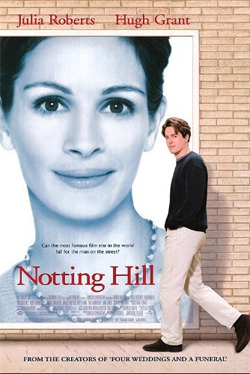
It’s the quintessential London film – the story of a bookshop owner, William Thacker (played by Hugh Grant), whose life takes a romantic turn when a famous American actress Anna Scott (played by Julia Roberts) comes into his shop. And, as the name suggests, it’s set in the west London district known as Notting Hill. 

Notting-Hill-posterThe centrepiece of the 1999 film, which was directed by Richard Curtis, is the Portobello Road Market (pictured above, see more on the history of the market here) but the film also depicts other aspects of the area.

These include the Coronet Cinema, and, of course, the now famous blue door in Westbourne Park Road which represents the entry to Thacker’s flat (it was apparently actually Curtis’ home).

There’s plenty of other London sites in Notting Hill as well – The Ritz hotel in Piccadilly where Anna Scott stays, the Savoy Hotel where a press conference is held and the historic Hampstead Heath home featured (or rather not) in last week’s film Belle, Kenwood House – this time as a film set in a movie Anna is making.

Notting Hill, meanwhile, has long been a popular site for films – everything from The Italian Job (the Michael Caine version) through to another recent Richard Curtis film About Time (2013) has been filmed here.

10 iconic London film locations…5. Belle at Kenwood House (but not as you know it)…

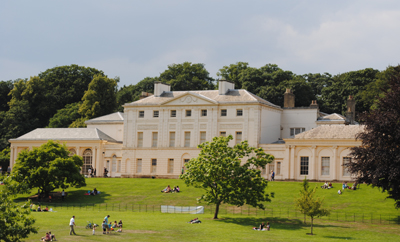
Kenwood-HouseThis is the case of a movie stand-in. While Kenwood House on Hampstead Heath in north London (pictured above) was the real life home of late 18th century figure Dido Elizabeth Belle, the subject of the 2014 Amma Asante-directed film Belle – the movie wasn’t actually shot there.

Thanks to the fact that parts of Kenwood House – in particular the famed Robert Adam interiors – were undergoing restoration at the time, the scenes representing the home’s interiors were instead shot at three other London properties – Chiswick House, Syon Park and Osterley Park, all located in London’s west (West Wycombe Park in Buckinghamshire, meanwhile, was used for the exterior).

While some other scenes were also filmed in London – Bedford Square represented Bloomsbury Square where the London home of Lord Mansfield was located, for example, other locations were also used to represent London – scenes depicting Kentish Town, Vauxhall Gardens and the bank of the River Thames were all actually shot on the Isle of Man, for example.

When the real life Belle – the illegitimate mixed race daughter of an English naval captain who was raised by her great-uncle William Murray, Lord Mansfield (she was played by Gugu Mbatha-Raw in the film; Lord Mansfield by Tom Wilkinson)  – is believed to have lived at Kenwood, it was the weekend retreat of Lord Mansfield, then Lord Chief Justice of England (for more on her life, see our previous post here).

Interestingly, the property was also once home to a 1779 painting (previously attributed to Johann Zoffany but now said to be “unsigned”) which depicts Belle and which was apparently the inspiration for the movie. While a copy of the painting still hands at Kenwood, the original now lives at Scone Palace in Scotland.

For more on Belle’s story, see Paula Byrne’s Belle: The True Story of Dido Belle.

10 iconic London film locations…4. Greenwich’s Old Royal Naval College becomes Lilliput…

Old-Royal-Naval-College

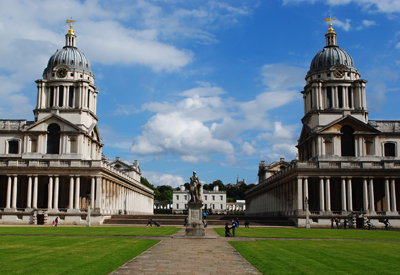
When the makers of the 2010 Jack Black movie Gulliver’s Travels were looking for suitably grand buildings to represent the Lilliputian capital, they turned to the Old Royal Naval College in Greenwich.

Designed by Sir Christopher Wren, the World Heritage-listed site made a grand backdrop for the film in which a supersized Black plays Gulliver, the hero of Jonathan Swift’s book (incidentally Blenheim Palace near Oxford also makes an appearance in the film).

It’s not the first time, of course, that the location has featured in recent films – in fact, such has been its popularity that Empire asked last year whether it was the most popular film location in the world.

Other films in which the Old Royal Naval College appears have included The Dark Knight Rises (where it features in the epilogue), Les Miserables (where the buildings represent a part of a Paris featuring a gigantic wooden elephant which is home to the street urchin Gavroche), and Pirates of the Caribbean: On Stranger Tides (where the spectacular Painted Hall, designed by Wren and Nicholas Hawksmoor, represents the King’s palace).

It has also appeared in both of the recent Sherlock Holmes films as well as a host of others – everything from The Mummy Returns to The Madness of King George and Charlotte Gray.

For more on the history of the Old Royal Naval College, check out our previous post here and here.

10 iconic London film locations…3. The Houses of Parliament explode in V for Vendetta…

DSC_0241

The site of the climatic showdown in V for Vendetta between the silent hoards of masked protestors and the military, Parliament Square is featured in some dramatic aerial shots before, moments after midnight in the early hours of 5th November, the Houses of Parliament explode to the sprightly sounds of Tchaikovsky’s 1812 Overture.

Of course, it’s far from the only London location to feature in the 2006 film which is largely set in the city – among other locations are Trafalgar Square where the protestors gather before marching down Whitehall, and the Old Bailey which explodes in the first scene as well as the former Underground station of Aldwych – located on a former spur line of Piccadilly Line which closed to the public in 1994.

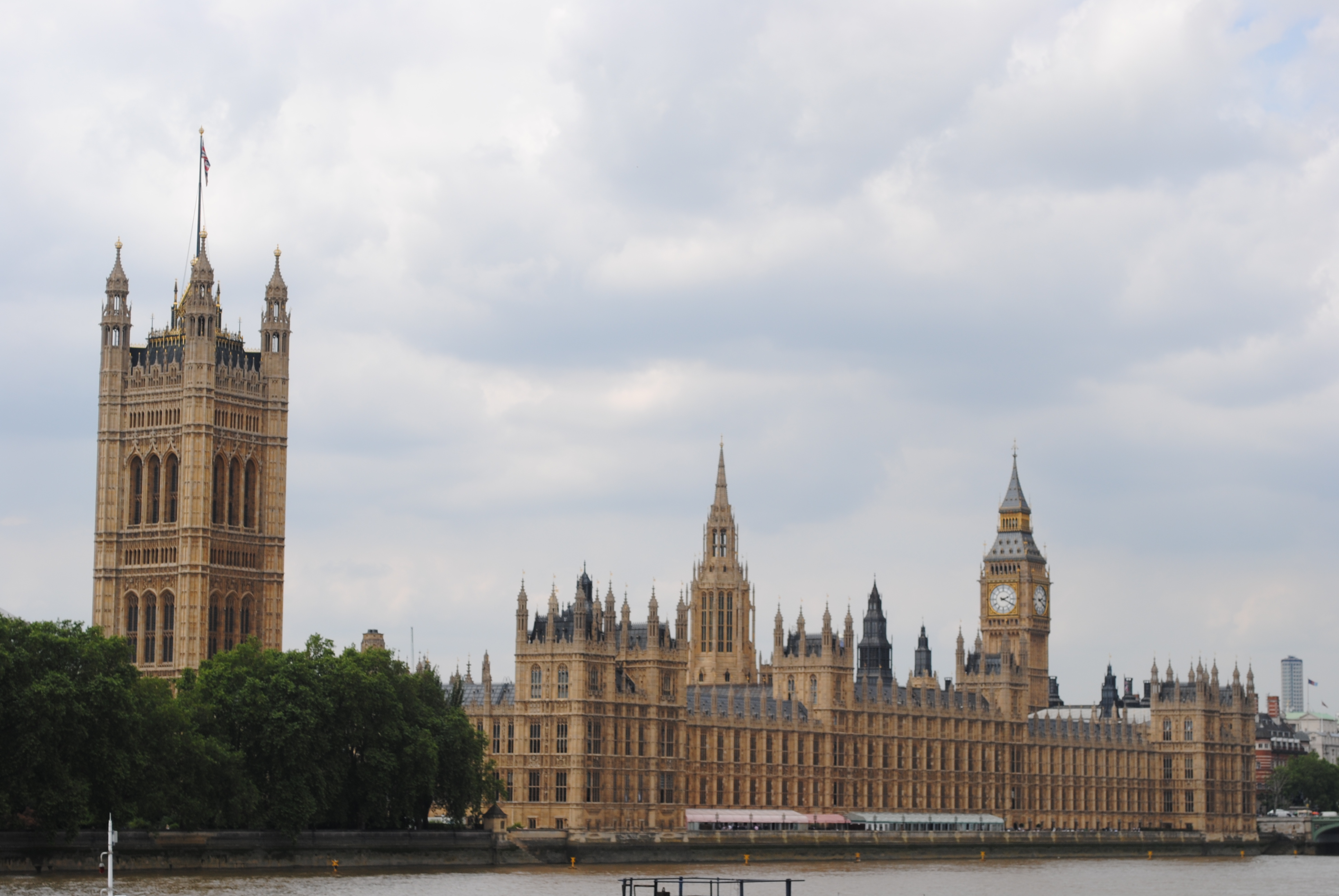
Meanwhile, the Houses of Parliament – also known as the Palace of Westminster (for more on its history, head here) – and the Clock Tower (see our Treasures of London article for more here) have made innumerable appearances on the big screen, including in several Bond films including Thunderbolt (1965), 28 Days Later (2002)and, more recently, in Suffragette (2015).

10 iconic London film locations…2. James Bond’s not-so-secret HQ…

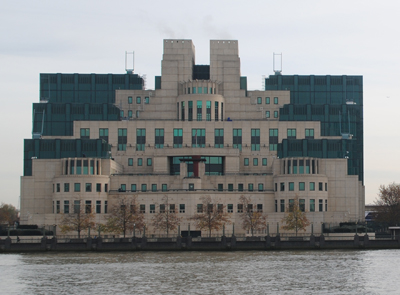
MI6Of course, James Bond has a long-standing relationship with London and there’s a long list of locations that have featured in the many Bond films over the years. But today we’re looking at just one – the Thames-side HQ of spy agency MI6.

The actual London home of the organisation (also known as the Secret Intelligence Service), the not-so-secret building – which is also called the Vauxhall Cross building – is located on Albert Embankment in Vauxhall, sitting alongside Vauxhall Bridge.

It has made numerous appearances in the past few James Bond films – from its first appearance in Golden Eye to its being attacked in The World Is Not Enough, blown up in Skyfall and the featuring of its ruinous remains in the latest film, Spectre.

The subject of some criticism when it was unveiled (and much loved by others), the fortress-like building was designed by architect Terry Farrell. It was built in the early 1990s and officially opened by Queen Elizabeth II in 1994. It suffered – and survived – a real-life rocket attack in 2000.

Other locations to have featured in recent Bond films in London, meanwhile, include Somerset House (passed off as St Petersburg in Golden Eye), the National Gallery (Bond, played by Daniel Craig, first encounters the new Q, played by Ben Wishaw, in Room 34 in Skyfall), and the rooftops of Whitehall (also Skyfall). And that’s just for starters.

10 iconic London film locations…1. Mary Poppins and feeding the birds at St Paul’s Cathedral…

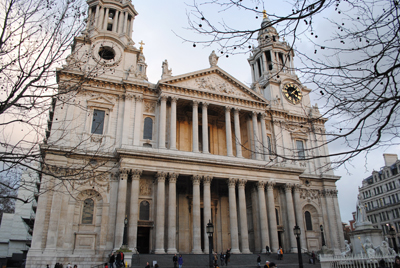
St-Paul's-CathedralThe scene in which Mary Poppins (played by Julie Andrews) sings to the two Banks children about the old woman who feeds the birds outside St Paul’s Cathedral as they go to bed remains one of the most poignant of the iconic Disney film.

Of course, it wasn’t actually filmed at the cathedral – rather it was filmed on a set at Walt Disney’s studios in Burbank, Los Angeles – but the scene remains powerful for its imagery and music nonetheless.

The scene itself shows Mary holding up a snow globe with St Paul’s Cathedral inside as she sings. The audience is taken into the globe where we see the “little old bird woman” (the last role ever played by Oscar winning actress Jane Darwell) feeding the birds on steps outside the cathedral’s west front.

The rather melancholy song, written by brothers Richard and Robert Sherman, talks about how the little old bird woman came to the steps of St Paul’s every day and there called for people to buy her bags of crumbs (priced at tuppence a bag) to feed the pigeons (a practice now frowned upon!).

“All around the cathedral the saints and apostles
Look down as she sells her wares,
Although you can’t see it, you know they are smiling,
Each time someone shows that he cares.”

In the film, the children actually meet the old bird woman the following day but their father discourages them from feeding the birds (although the book recounts things a little differently).

The scene was apparently one of few Mary Poppins author PL Travers – whose first Mary Poppins book was published in 1934 – didn’t object to when making the film (the story of the somewhat acrimonious relationship between Travers and the film-makers is shown in the recent film Saving Mr Banks), which was released on 27th August, 1964. It is also said to have been Walt Disney’s favourite song from the movie.

Of course, St Paul’s is only one of a number of London locations mentioned in the live action/animated film – the Bank of England is another (and to see more about the fictional home of the Banks family, see our earlier post here).

Of course, Mary Poppins is just one of numerous films in which St Paul’s is featured – among the other films which depict the building or its interior include 1962’s Lawrence of Arabia, 1994’s The Madness of King George, 2004’s Harry Potter and the Prisoner of Azkaban and 2009’s Sherlock Holmes.

Special – 10 London ‘battlefields’, a recap…

It seems an age ago that we started this Wednesday series on some of London’s ‘battlefields’ (we’ve used quotes given many of the battlefields we’ve covered haven’t featured what we might think of as having hosted battles in the traditional sense).

But we’ve finally come to an end, so before we launch a new series next week, here’s a recap of what the series entailed and please vote for your favourite below…

10 London ‘battlefields’ – 1. Queen Boudicca takes on the Romans…

10 London ‘battlefields’ – 2. ‘London Bridge is falling down’…

10 London ‘battlefields’ – 3. London sacked in the Peasant’s Revolt…

10 London ‘battlefields’ – 4. Jack Cade’s rebellion…

10 London ‘battlefields’ – 5. Battle of Barnet…

10 London ‘battlefields’ – 6. Battle of Turnham Green…

10 London ‘battlefields’ – 7. Battle of Brentford…

10 London ‘battlefields’ – 8. The Gordon Riots…

10 London ‘battlefields’ – 9. The Battle of Cable Street…

10 London ‘battlefields’ – 10. The Battle of London…

10 London ‘battlefields’ – 10. The Battle of London…

The final in our series looking at London ‘battlefields’, this week we take a look at the so-called Battle of London, the air war fought over London during World War II which, along with the bombing of other British cities, is best known by the phrase The Blitz (it forms part of the greater Battle of Britain).
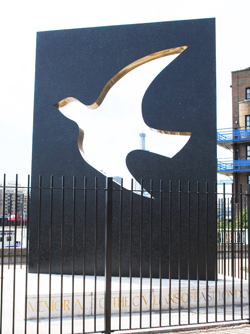
Blitz-memorialTaking place from the afternoon of 7th September, 1940, until May, 1941, the Blitz saw London sustain repeated attacks from the German Luftwaffe, most notably between 7th September and mid November when the city was bombed on every night bar one.

The night of 7th September, the first night of the Blitz (a short form of ‘Blitzkrieg’ – German for ‘lightning war’), was among the worst – with more than 450 killed and 1,300 injured as wave after wave of bombers attacked the city. Another 412 were killed the following night.

One of the most notorious raids took place on 29th December when  incendiary bombs dropped on the City of London starting what has been called the Second Great Fire of London. Around a third of the city was destroyed, including more than 30 guild halls and 19 churches, 16 which had been rebuilt by Sir Christopher Wren in the aftermath of the Great Fire of London in 1666.

The city was only attacked sporadically in the early months of 1941 but the night of the last major raid of the Blitz – that of 10th May, a night subsequently known as The Longest Night – saw the highest casualties of any night with almost 1,500 people reportedly killed.

The Blitz killed almost 30,000 civilian in London, and destroyed more than a million homes with the worst hit districts poorer areas like the East End.

The battle wasn’t one-sided – the RAF fought the Luftwaffe in the skies and did have some wins – on 15th September (a day known as Battle of Britain Day), for example, they shot down some 60 aircraft attacking London for the loss of less than 30 British fighters.

It was this victory which led the Germans to reduce the number of daylight attacks in favour of night-time raids which, until the launch of the RAF’s night-time fighters in 1941, meant they met little effective resistance. This included that of ground defences – throughout December, 1940, it’s said that anti-aircraft fire only brought down 10 enemy planes.

Yet, the Blitz did not lead to a German victory. For the Nazi regime, the purpose of the constant bombing of London (and other cities) was aimed at sapping the morale of its residents to the extent that they would eventually be forced to beg for peace. But the plan failed and Londoners, digging deep, proved their mettle in the face of fear.

Hundreds of thousands of people were involved in  Civil Defence working in a range of jobs – everything from air raid shelter wardens to rescue and demolition teams – and worked alongside firefighters whose numbers were supplemented by an auxiliary service. Naturally all suffered a high level of casualties.

As the weeks passed, the carnage mounted in terms of the loss of and damage to life, destruction of property and psychological toll. And yet the Londoners – sheltering Underground, most famously in the tunnels of the Tube – survived and, as had been the case after the first Great Fire of London, the ruined city was eventually rebuilt.

There are numerous Blitz-related memorials in London, many related to specific bombings. But among the most prominent are the National Firefighters Memorial, located opposite St Paul’s Cathedral, which pays tribute to the firefighters who lost their lives in the war (as well as in peacetime), and a riverside memorial in Wapping honouring civilians of East London killed in the Blitz.
10 London ‘battlefields’ – 9. The Battle of Cable Street…

We hit the 20th century with this London ‘battle’, a confrontation in Stepney between police and a range of anti-fascist and fascist forces in the lead-up to World War II.

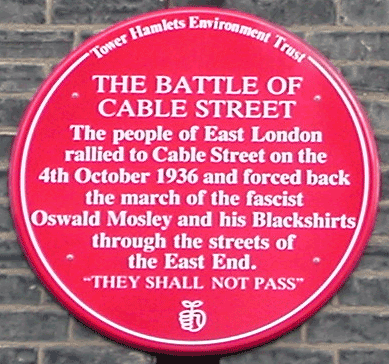
Battle-of-Cable-Street-red-plaqueThe ‘battle’ took place on a Sunday – 4th October, 1936 – following a summer of anti-Semitic violence and was sparked by a decision by the British Union of Fascists, led by Sir Oswald Mosley , to march through the East End, then the heartland of London’s Jewish community.

Incensed at the plans (and faced with government inaction despite calls for the march to be called off), anti-fascist protestors – which included large numbers of Jewish and Irish people as well as trade unionists, communists, socialists, anarchists and local residents – gathered initially at Gardiner’s Corner (named for a department store which once on the site at the junction of Whitechapel High Street and Commercial Road) to prevent the march.

The protestors were chanting and carrying banners which read “No Parasan” (“They shall not pass”, a slogan taken from anti-fascist forces who used it during the Spanish Civil War).

Estimates as to how many people turned out in protest vary widely – from 100,000 people up to as many as 250,000 or even 500,000 – but it’s clear that whatever the actual number, the crowd was huge and vastly outnumbered the up to 3,000 fascists – known as Blackshirts – who turned up to march and the 10,000 Metropolitan Police officers, some of whom were on horseback, sent to prevent the march from being disrupted.

With the path blocked despite police charges into the crowd, Mosley and his Blackshirts were advised by authorities to head south to Cable Street but there they encountered road-blocks made from furniture, paving stones and even apparently overturned lorries which appeared at the street’s west end, around the junction with Christian Street.

Police again attempted to clear the road but were blocked by the makeshift barricades and a wall of protestors while residents in houses lining the streets threw rubbish and even the contents of chamber pots at them. Police responded by sending in squads of men to snatch the ringleaders of the protests; protestors responded by ‘kidnapping’ some police officers.

Faced with continuing violence, Mosley was forced to abandon the march and the BUF were dispersed back through the City of London. The protestors meanwhile were said to have turned the event into a giant street party in celebration of their victory.

More than 100 people were said to have been injured in the violence and some 150 of the demonstrators were arrested. Most of the charges were of a minor nature but some of the ringleaders were given up to three year terms of imprisonment.

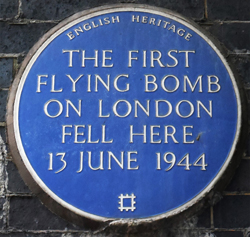
A large mural depicting the battle was painted on the side of St George’s Town Hall in Cable Street in the 1980s and there’s also a red plaque in nearby Dock Street (pictured) commemorating the incident.

Aside from a victory in itself, the battle was the catalyst for the passing of the Public Order Act of 1936 which meant the organisers of marches would henceforth have to seek permission of the police before holding them. It also banned demonstrators from marching in uniform.

PICTURED: A plaque commemorating the ‘battle’ in Dock Street which runs off the west end of Cable Street. Via Richard Allen/Wikipedia

10 London ‘battlefields’ – 8. The Gordon Riots…

Well, not so much a battle as a widespread civil insurrection, the Gordon Riots, often described as the worst riots London has ever seen, resulted in considerable property destruction and numerous deaths.

Houses-of-Parliament10The riots, which took place against a backdrop of high taxation, widespread poverty, and unjust laws, had its origin in the passing of the Catholic Relief Act of 1778 which intended to reduce entrenched discrimination against Roman Catholics in Britain and redress some of anti-Catholic laws which had been introduced 80 years earlier, partly in an attempt to get more Catholics to join the British Army to fight against the United States of America in what’s now known as the War of Independence.

While it initially passed without any real hostility, an attempt to extend the Act’s provisions to Scotland in 1779 provoked such a serious response there that the action was withdrawn. Following the Scottish success in having the provisions withdrawn, the Protestant Association of London was founded with the aim of spear-heading opposition to the act’s provisions. Lord George Gordon was elected president of the newly formed Protestant Association of London in November of that year.

Following failed attempts to have King George III repeal the Act (Lord Gordon had several audiences with the King but failed to convince him of his case and was eventually banned from His Majesty’s presence), on 2nd June, 1780, Gordon and the members of the association marched on the Houses of Parliament (pictured above although the current buildings date from much later than these events) to deliver a petition demanding the Act be repealed.

They crowd, estimated to have been as big as 60,000 strong although a figure in the mid-40,000s is generally accepted, attempted unsuccessfully to force their way into the House of Commons before Lord Gordon, wearing a blue cockade (the symbol of the Protestant Association in his hat) was granted access to deliver the document.

Outside, meanwhile, things went from bad to worse and the crowd erupted into rioting, attacking members of the House of Lords, including bishops, as they attempted to enter and damaging carriages (including that of Lord Chief Justice William Murray, 1st Earl of Mansfield). Soldiers were eventually summoned to quell the riot which they did without violence. Inside, the members of the House of Commons voted down the petition by an overwhelming majority.

That night violence flared up again with the Roman Catholic Sardinian Embassy Chapel in Lincoln’s Inn Fields set alight while the chapel of the Bavarian Embassy in Golden Square, Soho, was destroyed and random violence carried out in streets known to be the residence of wealthy Catholics.

The next day, a crowd gathered in Moorfields – known to be home to many poor Irish Catholic immigrants – and that night attacked many homes.

The violence spread over the following days and among the buildings attacked was Newgate Prison (which was set on fire), the Fleet Prison, and the Clink in Southwark – hundreds of prisoners escaped – as well as Catholic churches, more embassy chapels, homes of known Catholics and politicians who had been associated with the passing of the act (including that of Lord Mansfield and Sir George Savile, who had proposed the Catholic Relief Act) and the Bank of England (the attack on the bank led to the long-standing tradition of soldiers guarding the bank).

Without a standing police force to tackle the mobs, on 7th June the army was called out with orders to fire on groups of four or larger who refused to disperse. In the next few days, well over 200 people (possibly more than 300) were shot dead and hundreds more wounded. Hundreds of the rioters were arrested and, of those, about 25 eventually executed. Gordon himself was arrested and charged with high treason but found not guilty.