What’s in a name?…Old Bailey…

Running from Ludgate Hill to Newgate Street in the western part of the City, there are a couple of explanations behind the thoroughfare known as the Old Bailey.

Old-BaileyOne suggests that the name is derived from Latin word ballium which referred to a wall built for defence and which, in this instance, referred to the old Roman wall which surrounded the City.

Another, according to Antony Badsey-Ellis’ book What’s in a Street Name?, is that the name could be a corrupt form of ‘Bail Hill’ – a place where a bailiff held court.

For centuries the street’s name has also been used for that of a court based there. Now formally known as the Central Criminal Court, the first court – or sessions house – was built here in 1539 on part of the site now occupied by the court.

Built next to the Old Bailey court house – and pre-dating it was Newgate Prison – but when this was demolished in 1902, the Old Bailey (which itself had been rebuilt in the 1670s having been destroyed in the Great Fire of London and then subsequently remodelled) was again rebuilt and, opening in 1907, now covers the site.

For an archive of the court’s proceedings, check out www.oldbaileyonline.orgFor more on the history of The Old Bailey, check out Theresa Murphy’s The Old Bailey: Eight Hundred Years of Crime, Cruelty and Corruption.

What’s in a name?…Shepherd’s Bush…

The derivation of the name of this west London suburb remains something of a mystery with several competing theories vying for attention.

One theory suggests that the area – centred on Shepherd’s Bush Green and largely rural up until at least the middle of the 19th century – was named for the shepherds that once tended their flocks there (perhaps even building a special shelter in a hawthorn bush somewhere on the green, hence the ‘bush’).

A second theory – deemed by Cyril M Harris, author of What’s In A Name? – as “more likely” – suggests it was named after the now long lost Mr Shepherd or Mr Sheppard (or similar spelling).

While the green gets a mention as far back as the early 1600s, the area – noted for its high concentration of Australians and New Zealanders – wasn’t developed in earnest until the late 19th century. It suffered heavy damage in World War II and, later, from road construction.

Shepherd’sBush was historically a base for many BBC offices including the now long closed Lime Grove Studios (The Hour, anyone?), originally the Gaumont Film Company. Other notable buildings in the area include The Bush Theatre, located in the former public library and the Queens Park Rangers Football Club’s home ground in Loftus Road. Just to the north of Shepherd’s Bush is White City where the 1908 Summer Olympics were held (for more on this, see our previous entry here).

What’s in a name?…Sloane Square

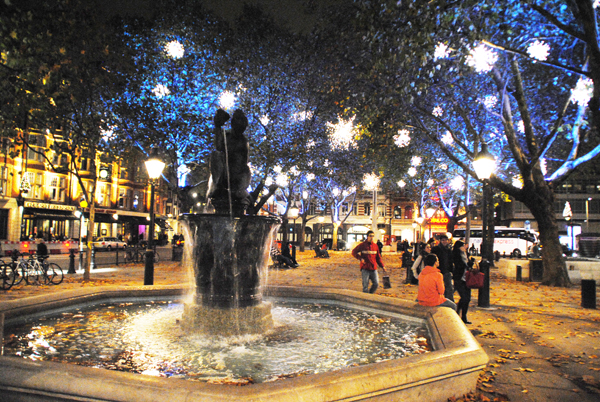
Sloane-SquareThis upmarket square in west London is named in honor of Sir Hans Sloane, the physician come botanist who bought the manor of Chelsea in 1712 and, in doing so, provided grounds for the Chelsea Physic Garden.

Sloane Square was developed by architect Henry Holland Sr and his son Henry Holland Jr in 1771 as part of a residential development they called Hans Town (also named after Sir Hans, it’s still a ward in the Royal Borough of Kensington and Chelsea). For more on Sir Hans Sloane, see our earlier post here.

The square, pictured above as it looks decorated for Christmas, initially consisted of a village green bordered with posts and chains and the surrounding buildings were all residential. Apparently the square initially failed to attract the right sort of residents (it was a little too far from Mayfair) but despite this initial setback, it gradually became the centre of a desirable residential precinct.

Private houses began making way for other buildings in the square in the nineteenth century – in 1810, the New Chelsea Theatre opened, subsequently renamed the Royal Court Theatre (this was later moved to another site still on the square and remains there today), and in 1812, the Chelsea, Brompton and Belgrave Dispensary was established for the relief of the sick and the poor.

The Sloane Square Underground station opened in 1868 and rebuilt after it was damaged by bombs in World War II (it’s interesting to note that the River Westbourne actually runs through some iron conduit over the top of the platforms on its way to the River Thames).

Other notable buildings in the square today include the Peter Jones department store which first arrived in the square in the late nineteenth century.

The square itself was redesigned in the 1930s when the war memorial was put in its current position. The Venus Fountain (pictured above) which now stands there – the work of Gilbert Ledward – was erected in 1953.

What’s in a name?…Canary Wharf

No, Canary Wharf is not so named because it was the centre of London’s lucrative trade in canaries.

Canary-WharfRather it received its name from the fact that it was at a quay here that ships from the Spanish Canary Islands and the Mediterranean landed laden with cargos of fruit.

The wharf, part of the West India Docks on the Isle of Dogs, was built in 1936 by Fruit Lines Limited and a warehouse the following year.

The area where the wharf was once located was redeveloped under a massive regeneration project starting in the late 1980s and is now one of London’s key financial districts, filled with modern, multi-storey office towers and home to the second-tallest tower in the UK, One Canada Square (seen above with the pyramid-shaped roof).

What’s in a name?…Baker Street

Synonymous with Sherlock Holmes, where does the name Baker Street actually come from? Not from a baker located there, as some might expect. Rather, Baker Street was apparently named after a Dorset luminary, Sir Edward Baker.

Baker-StreetSir Edward, created 1st Baronet Baker of Ranston in Dorset in 1802, was a friend and neighbour of the Portman family who developed the area in the late 1700s and early 1800s. Sir Edward (who later changed his name to Sir Edward Baker Baker) had apparently lent the Portmans a helping hand in developing the area.

A fashionable place to live when it was created, Baker Street remains famous for the house at number 221b, which, according to Sir Arthur Conan Doyle, served as the home to literary characters Sherlock Holmes and Dr John Watson between 1881-1904. The Sherlock Holmes Museum, which actually sits between numbers 237 and 241 Baker Street, now claims the address.

Other attractions to have been located in Baker Street include Madame Tussaud’s waxworks which in 1835 set up in premises known as ‘The Baker Street Bazaar’ before moving to its current premises around the corner on Marylebone Road in 1884.

Among the notable buildings still in Baker Street is the London Beatles Store (located at 231/233) where you can purchase all manner of memorabilia related to the group.

Famous residents have included 19th century Prime Minister William Pitt the Younger, actress Sarah Siddons, author and politician Edward Bulwer-Lytton, explorer Sir Richard Burton, and singer Dusty Springfield. The street was almost immortalised in Gerry Rafferty’s 1970s hit, Baker Street.

What’s in a name?…Richmond

It was King Henry VII, father of King Henry VIII, who brought the name Richmond to London.

Richmond-PalaceInheritor of the title of the Earl of Richmond (the title relates to lands in Yorkshire and centres on the castle of Richmond), on being crowned king, Henry VII gained the use of Sheen (or Shene) Palace located on the banks of the Thames, about seven miles south west of Westminster (the history of which we’ll look at in greater detail in an upcoming post).

Sheen Palace was largely destroyed in a fire in 1497 and the king gave orders for it to be rebuilt (Richmond Palace is pictured here – found on a sign at Richmond). It was on its completion in around 1502 that Henry decided to rename the palace after his former earldom – Richmond.

The name Richmond, by the way, comes from a French word for ‘old hill’.

The once separated town of Richmond is now at the centre of the London Borough of Richmond upon Thames (it became a municipal borough in 1890) and a popular residential suburb for London’s wealthy (among those who have lived there are Mick Jagger and Jerry Hall) – sought after for its riverside amenity, quaint village green, and panoramic views from Richmond Hill as well as its fine shopping and dining.

Richmond’s other great drawcard is Richmond Park, one of the city’s eight Royal Parks, and home to more than 600 deer (see our earlier entry on it here).

What’s in a name?…Barbican

Though it’s these days associated with a Brutalist housing estate and performing arts centre based in the north of the City of London, the name Barbican has been associated with the area on which the estate stands for centuries.

BarbicanThe word barbican (from the Latin barbecana) refers to an outer fortification designed to protect the entrance to a city or castle. In this case it apparently referred to watchtower which may have had its origins in Roman or Saxon times (or maybe both). The City of London website suggests it was located “somewhere between the northern side of the Church of St Giles Cripplegate and the YMCA hostel on Fann Street”.

When-ever it was built, the watchtower was apparently demolished on the orders of King Henry III in 1267, possibly as a response to Londoners who had supported England’s barons when they had rebelled against him. One source suggests the tower was rebuilt during the reign of King Edward III but, if so, the date of its subsequent demolition remains unknown.

Later residents of the area – which become known as a place to trade new and used clothes – included John Milton and William Shakespeare.

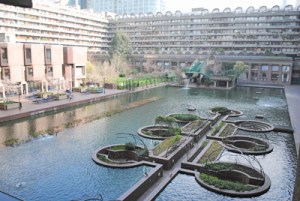
The area known as Barbican was devastated by bombing raids in World War II. Discussions on the future of the site started in 1952 and for more than 10 years plans for redeveloping the area were debated until finally, in the early 1960s, work began on what is now the Barbican Estate including three tall residential towers (part of the residential estate is pictured above). Completed in the mid 1970s, the Brutalist design of the complex, which features buildings named after historical figures associated with the area, means it meets with strong reactions from those who encounter it whether love – or hate.

Construction of the arts centre – known as the Barbican Centre – the largest performing arts centre in Europe and home to the London Symphony Orchestra – was started in the early 1970s. The £156 million centre was eventually opened by Queen Elizabeth II in 1982.

Other buildings within the Grade II listed complex include the Guildhall School of Music and Drama, the City of London School for Girls and a YMCA.

What’s in a name?…Cannon Street

One of the major thoroughfares of the City of London, Cannon Street’s name has nothing at all to do with artillery or religion. In fact, the street, which runs from St Paul’s Churchyard in the west to Eastcheap in the east, owes its name to the industry that once took place there.

Like many other streets in the City connected with the occupations of past residents, Cannon Street is a corruption of a street formerly known as Candelwichstrete (one of many various spellings of which the modern English version is Candlewick Street) which relates to the candlemakers and wax chandlers who lived and conducted their trade along the street in the Middle Ages (the Tallow Chandlers Company, involved in regulating candle-making, has been located in adjoining Dowgate Hill since 1476, although the current building dates from 1672).

The name was gradually corrupted into Cannon Street (apparently the corruption was at least partly due to its pronunciation in the Cockney dialect), which is what it was known as by the late 17th century when the seemingly ever-present Samuel Pepys was writing his diary.

Cannon Street – which was only extended to its current length in the mid-1800s under the supervision of architect JP Bunning, having formerly been a narrow lane which stopped at Dowgate Hill in the east – apparently later become known for the number of drapers based there and was also home to the Steelyard or Stalhof, the trading base of the German Hanseatic League in London in the 13th and 14th centuries (a plaque commemorating this was erected at Cannon Street Station in 2005).

Now lined with office buildings including some former warehouses from the Victorian era, the street is also home to a recently redeveloped above ground train station and Underground station- both of which were opened in the late 1800s (the station, which built was on the site of the Roman governor’s palace, was originally located behind the Cannon Street Hotel, birthplace of the British Communist Party). Cannon Street is also the location of the mysterious London Stone – formerly located at the now long-gone St Swithin’s Church, it can be found behind a grill at number 111 – for more on it, see our earlier post here).

What’s in a name?…Pimlico

Tradition holds that this small triangular area, wedged between Westminster and Chelsea on the north bank of the Thames, takes its name from Ben Pimlico, said to be the 17th century owner of an famous alehouse or tea garden in Hoxton, on the north side of the City, and brewer of a particularly sought-after “nut brown” ale.

The story goes that so popular was his brew that Hoxton Street was then known as the “Pimlico Path”  due to the numbers making their way to his alehouse and that the area of Pimlico somehow adopted this name (although to be fair we should note that it’s also been suggested that the name comes from the Pamlico tribe of American Indians who exported timber to London around the same period).

While references to Pimlico go back to the 17th century, the area was largely uninhabited until the 19th century when it was developed by Victorian planner Thomas Cubitt under contract to the land owner, the Grosvenor family.

Initially in demand among the well-to-do, the fortunes of the area had declined by the end of the nineteenth century before a resurgence of interest took place in the early 20th century.

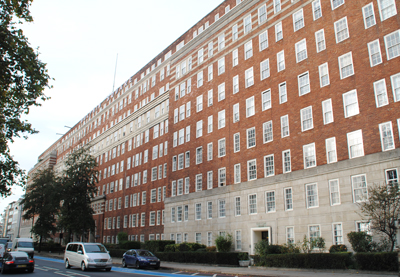
Among the projects constructed at that time was Dolphin Square (pictured) – with more than 1,200 apartments, it was the largest apartment complex in Europe at the time and has since proved particularly popular among politicians keen to be close to the action in Westminster and Whitehall.

Famous residents of Pimlico have included Winston Churchill, who lived briefly at 33 Eccleston Square between 1908-11.

Worth noting is that there is a racecourse in Maryland in the US known as the Pimlico Race Course which is also named for Ben Pimlico’s tavern.

For a photographic essay of Pimlico, check out Brian Girling’s Pimlico Through Time.

What’s in a name?…Victoria Embankment

This Thames-side stretch of land, part of the massive Thames Embankment, was completed in 1870 after several years work and named for the then-reigning monarch, Queen Victoria.

The Victoria Embankment, which runs from Westminster Bridge to Blackfriars Bridge, pushed back the waters of the Thames and reclaimed land which was used for a roadway (built over over the District Tube line) and several public gardens, collectively known as Victoria Embankment Gardens. To see the level of the original river bank, go to the lower entrance of Somerset House on Victoria Embankment and look through the glass floor just outside the doors.

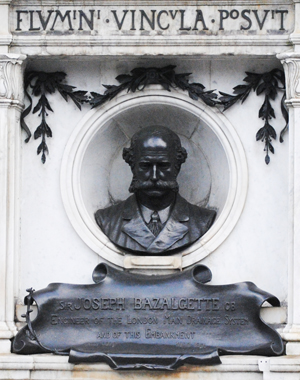
The project was carried out under the direction of engineer of the age, Sir Joseph Bazelgette, as part of his monumental effort to build a modern sewage system for London and to help relieve traffic congestion.

The stretch of roadway and the series of gardens which now occupy part of Victoria Embankment feature numerous statues (including one of Bazelgette himself – pictured) and other landmarks such as the York Watergate (see our previous post), Cleopatra’s Needle (see our previous post) and the RAF Memorial.

There are also several piers positioned along the Victoria Embankment including Embankment, Westminster and Blackfriars Millennium Piers which vessels moored along this section of the riverbank include the HQS Wellington (home of the Honourable Company of Master Mariners) and the HMS President (now a function centre, it is formerly a naval ship named HMS Saxifrage.)

What’s in a name?…Lancaster Gate…

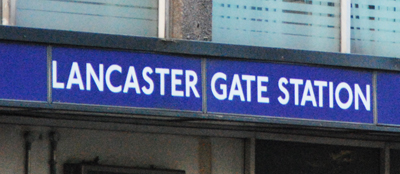
Now perhaps best known as a Tube station and a street and square in Bayswater, just west of the City, the name Lancaster Gate was actually first applied to a gateway located on the northern side of Kensington Gardens, close to where the ornamental water gardens known as the Italian Gardens now stand.

The gate is believed to have been named after Queen Victoria, in her capacity as the head of the Duchy of Lancaster (since the days of King Henry IV, the duchy has been the personal property of the monarch).

The nearby housing development of Lancaster Gate, centred on Christ Church followed in the mid 1800s (designed by Sancton Wood). The church closed in 1977 and was turned into housing in 1983; all that now remains architecturally are the church’s tower and spire.

Among people associated with the street is the Ethiopian Emperor Haile Selassie who resided in a hotel here at the start of World War II.

The Tube station where bears the name Lancaster Gate opened in 1900.

For more on Tube station names, try Cyril M Harris’ What’s in a Name?: Origins of Station Names on the London Underground.

What’s in a name?…Earls Court

A residential district in inner west London, the origins of the name Earls Court apparently go back almost to the time of the Norman Conquest when the area was granted to the de Vere family as part of the Manor of Kensington. 

The de Veres, who held a court at the manor, were named the Earls of Oxford in 1141 and hence, according to Cyril M. Harris, author of What’s in a Name?: Origins of Station Names on the London Underground, came about the name Earl’s Court. The courthouse, which was demolished in the late 1800s, apparently stood on a site by Old Manor Lane now occupied by gardens.

Originally fertile farmland, Earl’s Court’s development took place in the mid to late 1800s after the arrival of the railway line (the station was built in 1869). The area officially became part of London in 1889 when the London County Council was formed and the city’s boundaries extended.

The area became famous for the Earls Court Exhibition Grounds – established by John Robinson Whitley in 1887 –  which featured rides and an arena which hosted Buffalo Bill’s Wild West Show. A giant wheel was added 10 years later.

After the Second World War, the area attracted large numbers of Polish immigrants leading to Earl’s Court Road being named ‘The Danzig Corridor’. The arrival of large numbers of Australian and New Zealander travellers in the late Sixties saw it earning a new nickname – this time ‘Kangaroo Valley’. The area is now undergoing gentrifcation.

Notable buildings include the art deco Earl’s Court Exhibition Centre, former home of the Royal Tournament and site of the volleyball competition during this year’s Olympic Games, while notable residents have included the Egyptian archaeologist Howard Carter, film director Alfred Hitchcock, and Queen frontman Freddie Mercury.

What’s in a name?…St John’s Wood

This well-to-do area in London’s north-west, just outside Regent’s Park, takes its name from the historic ownership of land here by the Order of St John of Jerusalem (also known as the Knights Hospitaller).

The land had previously been part of the Great Forest of Middlesex. The Order of St John of Jerusalem, which since 1140s had its English headquarters in a Clerkenwell priory where St John’s Gate stands (this now houses the Museum of the Order of St John – see our previous entry here), took over ownership of land in the early 1300s after the previous owners, the Knights Templar, fell into disgrace.

Following the Dissolution, it became Crown land and remained so until 1688 after which it passed into the hands of private families, notably the Eyre family who owned much of the area.

It remained relatively undeveloped until the early 19th century when, following the introduction of semi-detached villas on planned estates, it was marketed as a residential alternative for London’s middle classes, away from the smog and congestion of central London.

It became favored by the bohemian set and residents included creative types like artists and authors as well as scientists and traditional craftsmen (apparently in the late 19th century it was also known for its upmarket brothels).

Rebuilt with swanky apartment complexes in the early twentieth century, these days it remains a leafy enclave for the wealthy. Many of the houses which have survived are heritage listed.

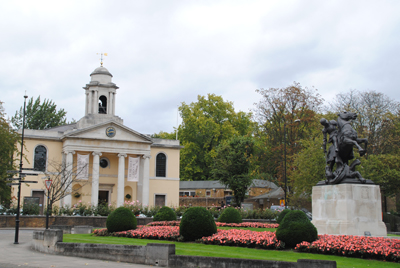
Landmarks include St John’s Church (pictured above, this was consecrated in 1814) and the St John’s Wood Barracks and a Riding School (this was completed in 1825 and is the oldest building still on the site) which is now home to the King’s Troop Royal Horse Artillery which carries out mounted ceremonial artillery duties such as firing royal salutes for the State Opening of Parliament, royal birthdays and state visits.

St John’s Wood is also home to Abbey Road Studios (home of the Beatles and that famous zebra crossing), Lord’s Cricket Ground (officially the home of the Marylebone Cricket Club which was moved here in 1814, the same year the church was consecrated) and the Central London Mosque located on the edge of Regent’s Park.

For more on St John’s Wood, take a look at the website of The St John’s Wood Society.

What’s in a name?…Shoreditch

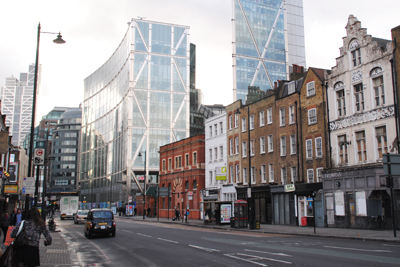
The origins of the name Shoreditch – now a slowly gentrifying area to the north of the City of London within the Borough of Hackney – are lost to time but there are a few interesting theories around.

While the name probably comes to us as a derivation of Soersditch or Sewer Ditch – perhaps in reference to a drain that was once here – a more tragic version has it named after Jane Shore.

A mistress of King Edward IV in the mid to late fifteenth century, she, so the story goes, was buried in a ditch in the area after dying in a state of penury following a dramatic fall from favour during the subsequent reign of King Richard III (the king apparently had Jane arrested and made her perform a public penance for being a harlot).

There was an important priory here – the Augustinian Priory of Holywell – in medieval times and by Elizabethan times, some substantial houses. In 1576, James Burbage built England’s first theatre – known as The Theatre – on its site located near Curtain Road. Some of William Shakespeare’s plays were performed here and at the nearby rival, the Curtain Theatre, before a dispute with the landlord in the late 16th century saw the theatre relocated to Southwark in the dead of night (although the foundations must have remained – these were excavated a few years ago). Both Shakespeare and follow playwright Christopher Marlowe had associations with the area.

The area, which centred on St Leonard’s Church (while the current building dates from around 1740, there is believed to have been a church here  – at the intersection of Shoreditch High Street and Hackney Road – since Saxon times), become known for its textiles in the 17th century and later for its furniture industries.

It was still known as one of London’s premier entertainment districts in the late 19th and early 20th centuries with well known music halls and theatres but by then was also just as well known for its poverty.

Shoreditch suffered heavily during the Blitz and while the area continues to suffer from urban decay there is now some new life being breathed into it with the arrival of projects as the Boxpark Shoreditch which, made from shipping containers, is billed as “the world’s first pop-up mall”. There’s also an annual festival, the Shoreditch Festival, held in summer along Regent’s Canal.

PICTURE: View down Shoreditch High Street to the City – © David Adams.

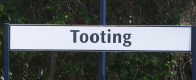
What’s in a name?…Tooting

The name of the south London suburb of Tooting has nothing to do with the railways or trains. In fact, its origins go back to Saxon times.

The area was recorded under the name of Totinge in 675 and in the Domesday Book compiled in the years after the Norman Conquest of 1066. By the late 11th century, the Abbey of St Mary Bec in Normandy was recorded as holding the manors of Tooting Bec and Upper Tooting.

The name apparently derives from the Saxon name Tota and the word ‘ing’, which literally translates as ‘the people who lived at’ – hence the name in its original form means something like “the place where Tota’s people lived” with Tota being a local Anglo-Saxon chieftain.

It’s also been suggested – perhaps less likely given the absence of hills in the area – that the name could be derived from the words ‘to tout’, meaning ‘to look out’, and relate to a watchtower that stood here on the road to London, the word then literally meaning something like “the people of the look-out”. (Interestingly, there was a major Roman road here – running from London to Chichester, Tooting High Street is now built upon it).

The suburb of Tooting largely owes its development to more recent times – it grew rapidly during the Victorian era and then again in the Twenties and Thirties.

PICTURE:  © Roger Whiteway (www.istockphoto.com)

What’s In a Name?…Elephant and Castle

A somewhat neglected area located in the Borough of Southwark, just south-east of Borough, Elephant and Castle takes its rather odd name from a coaching inn which once stood on the site – the Elephant and Castle.

The area is more correctly known as Newington but the name Elephant and Castle was apparently adopted informally in the mid 18th century as the area rose in prominence thanks in part to the opening of Westminster Bridge.

The inn, which stood on the site of a former playhouse, was apparently rebuilt several times but there is now no sign of it – the current, rather ugly, Elephant and Castle pub which is said to stand a short distance from where the tavern once stood, was built in the 1960s.

The origins of the sign of the Elephant and Castle, meanwhile, apparently comes from the mid-15th century when members of the Cutler’s Company adopted the sign of the elephant as their symbol (perhaps representing the ivory they used in their trade). The Worshipful Company of Cutlers still has an elephant carrying a castle on its back in its coat-of-arms.

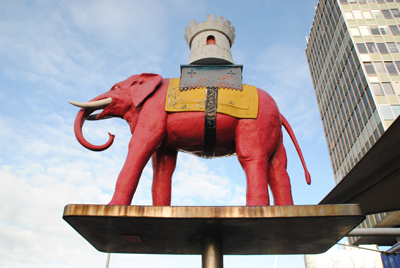
The area of Elephant and Castle, meanwhile, was known for its shopping and theatres before it was heavily bombed in the Blitz. It still features a rather grim shopping mall (pictured is the sign of the elephant and castle out front) which was said to have been the first covered shopping mall in Europe when it opened in the mid-1960s – it is apparently due for demolition as part of a larger regeneration project. The area has already seen some major new developments like the the residential tower known as Strata.

Other prominent buildings include the Metropolitan Tabernacle – standing opposite the shopping centre, this was founded by preacher Charles Hadden Spurgeon in the 19th century and rebuilt after World War II (interestingly, the site of the tabernacle is where three men, known as the Southwark Martyrs, were burnt at the stake for heresy in 1557 during a period of religious persecution in the reign of Queen Mary I).

Famous residents have included Charlie Chaplin – who lived in a workhouse in the area as a child – while other notable features include a large stainless box which stands at the centre of the area’s major road intersection, linking what is now New Kent Road and Kennington Park Road (via Newington Butts) with roads leading to Lambeth, Westminster, Waterloo and London Bridges among others (this is actually a memorial to scientist Michael Faraday, who was born in nearby Newington Butts). The area also boasts its own Tube station, Elephant & Castle.

What’s in a name? Swiss Cottage…

Tucked away near St John’s Wood, to the north-west of the city, is the curiously named enclave of Swiss Cottage.

The origins of the name are fairly self-explanatory – the area is said to have been named for the tavern which, styled as a Swiss chalet, stands at its heart, by the junction of Finchley New Road and Avenue Road.

The first tavern on the site – called The Swiss Tavern and later named Ye Olde Swiss Cottage – is said to date from 1803-04 and stood on land formerly occupied by a toll house. The current building dates from the 1960s, however.

A nearby railway station took the name of Swiss Cottage when the trains first arrived in 1868 – it was later replaced by the Swiss Cottage underground station which now stands opposite.

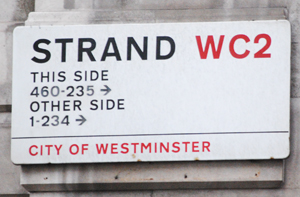
What’s in a name?…Strand

Now one of the major thoroughfares of the West End, the origins of the roadway known as the Strand go back to the Roman times leading west out of the city.

Later part of Saxon Lundenwic which occupied what is now the West End, it ran right along the northern shore of the Thames and so became known as the Strand (the word comes from the Saxon word for the foreshore of a river). During the following centuries the river was pushed back as buildings were constructed between the road and the river, leaving it now, excuse the pun, ‘stranded’ some distance from where the Thames flows.

Sitting on the route between the City of London and Westminster, seat of the government, the street proved a popular with the wealthy and influential and during the Middle Ages, a succession of grand homes or palaces was built along its length, in particular along the southern side.

All are now gone but for Somerset House – originally the home of the Dukes of Somerset, it was built in the 16th century but rebuilt in the 18th century after which it served a variety of roles including housing the Navy Office, before taking on its current role as an arts centre. Others now recalled in the names of streets coming off the Strand include the Savoy Palace, former residence of John of Gaunt which was destroyed in the Peasant’s Revolt, and York House, once home of the Bishops of Norwich and later that of George Villiers, favorite of King James I (see our earlier Lost London entry on York Watergate for more).

After the aristocracy decamped further west during the 17th and 18th centuries, the road and surrounding area fell into decline but was resurrected with a concerted building effort in the early 19th century (this included the creation of the Victoria Embankment which pushed the Thames even further away) which saw it become a favorite of the those who patronised the arts, including the opening of numerous theatres. Among those which still stand on the Strand today are the Adelphi and Savoy Theatres (this was apparently the first in London to be fitted with electric lights and sits on a site once occupied by the Savoy Palace).

Among the other landmarks along the Strand are the churches of St Mary-le-Strand (the present building which sits on what amounts to a traffic island) dates from 1717 and was designed by James Gibbs, and St Clement Danes, designed by Sir Christopher Wren and completed in 1682 (it is now the Central Church of the Royal Air Force). The Strand is also home to the Victorian-era Royal Courts of Justice (it boasts more than 1,000 rooms), Australia House (home of the oldest Australian diplomatic mission), the Strand Palace Hotel (opened in 1907) and Charing Cross Railway Station.

What’s in a name?…Cheapside

One of the major thoroughfares of the City of London, the name is reflective of its role as a marketplace with the medieval English word ‘cheap’ generally been taken to mean market.

Starting from the intersection of Newgate Street and St Martin’s Le Grand through to where it runs into Poultry, the street was apparently originally known as Westcheap – Eastcheap is still located down near the Monument. Cheapside’s surrounding streets – including Poultry, Milk Street, and Bread Street give indication of the sorts of goods that were once sold in the area.

Cheapside was, in medieval times, an important street and was on the processional route royalty would have taken from Westminster to the Tower of London. It is the site of St Mary-le-Bow Church (it’s said that if you’re born within hearing of the Bow bells you’re a true Londoner), and, until the Great Fire of 1666, the eastern end of Cheapside was the site of the end of the Great Conduit where water arrived after being piped in from the Tyburn River in the west.

Key figures associated with Cheapside include slain Archbishop of Canterbury Thomas Becket, born there in 1118, poet John Milton, born on the adjoining Bread Street in 1608, and writer Geoffrey Chaucer. A glimpse into the street’s past was found in 1912 when the Cheapside Hoard was unearthed during the demolition of a building there (you can see our earlier post on that here).

The area was heavily bombed during World War II.

Lined with shops, restaurants and office buildings, Cheapside today remains close to the heart of the city and is currently undergoing significant redevelopment, the recently opened swanky shopping centre at One New Change being an example.