London Pub Signs – The Sutton Arms…

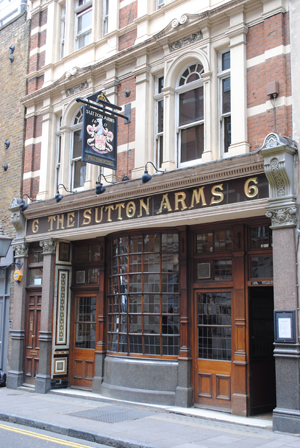
This pub, located just off Charterhouse Square near Barbican, has a distinctive barrel-shaped front window and a name that evokes a sense of the rich history of the area in which it stands.

The-Sutton-ArmsThe name of this pub at 6 Carthusian Street comes directly from Sir Thomas Sutton, a late 16th century/early 17th century businessman and moneylender who owned nearby land on which a Carthusian monastery once stood and who founded the Charterhouse School based at the site.

The monastery, which had been founded in 1371, was dissolved by King Henry VIII in the Dissolution of the Monasteries which took place in the first half of the 16th century – it was a nasty business with some of the monks executed at Tyburn.

The land was subsequently granted to Sir Edward North who built a mansion on the site which was subsequently sold to the fourth Duke of Norfolk. It was his son, Thomas Howard – the first Earl of Suffolk, who, in 1611, sold the property to Sir Thomas (and subsequently built the magnificent Audley End House in Essex with the funds).

Said to have been the “wealthiest commoner in England”, Sutton, who died that same year, used his wealth to endow a charitable foundation to both educate boys and care for elderly men.

The Charterhouse school later moved out to Surrey while elderly “brothers” are still housed at the original location today (for more on the Charterhouse, see our previous posts on King James I’s London and on 10 Historic London Squares).

Some of the glass in the  pub’s great barrel-shaped window was apparently replaced after a bomb knocked some of the original out during the Blitz.

Incidentally, there’s another pub of the same name only a few streets away in Great Sutton Street.

Where is it? #69…

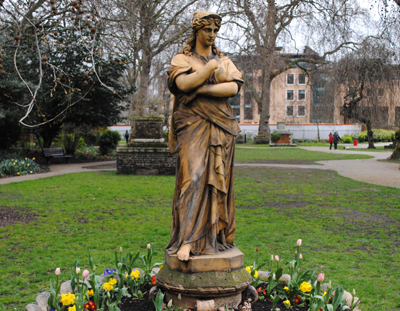
Where-is-it--#69Can you identify where in London this picture was taken and what it’s of? If you think you can, leave a comment below. We’ll reveal the answer early next week. Good luck!

Congrats to Carol Stanley – this statue is located in St George’s Gardens (a formal burial ground located near Coram’s Fields, famous for containing the tomb of Oliver Cromwell’s grand-daughter Anna Gibson). The terracotta figure is of Euterpe, the muse of instrumental music, and, interestingly it (and eight others) once adorned the facade of the Apollo Inn on Tottenham Court Road (the building was demolished in 1961 and the statue subsequently found its way here). For more on these gardens, check out www.friendsofstgeorgesgardens.org.uk.

Lost London – St Paul’s Cross…

Paul's-Cross-Memorial

Located in the north-east corner of the churchyard of St Paul’s Cathedral, St Paul’s Cross – also known simply as Paul’s Cross – was a large free-standing cross which served as an open-air pulpit for at least 500 years.

The history of the Cross goes back to at least the 12th century and it long served as a public gathering place for Londoners to hear sermons or matters of public importance. King Henry III met Londoners here in 1259 so they could swear their allegiance, people like 15th century chaplain Richard Walker appeared here to plead guilty for crimes against the church (in his case to charges of sorcery) and it was here that William Tyndale’s testaments were burnt in the 16th century.

Pauls-Cross2Conversely, it was also from here that the English Reformation was preached (there’s a painting in the Houses of Parliament of King Edward VI listening to a sermon preached from the Cross by reformist Bishop Latimer). It has been said that if all the sermons preached here had been collected, they would effectively make a history of the Church of England.

While it was a simpler structure in its earlier years, in the late 15th century, the then Bishop of London, Thomas Kempe, ordered the construction of a ‘preaching station’ on the site. It was an elevated small wooden structure with a lead roof topped by a cross under which a preacher and a couple of others could stand.

The cross and pulpit were destroyed during the English Civil War in 1643.

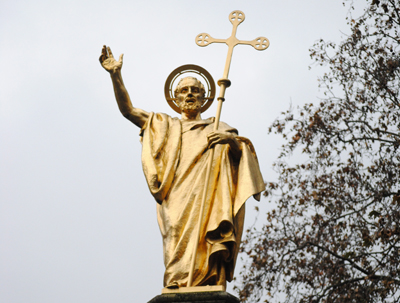
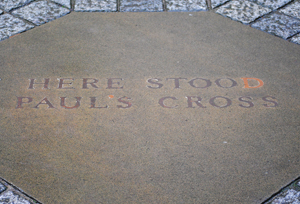
These days there’s a plaque marking the original site of the cross (above). In 1910, the St Paul’s Cross Memorial – a column topped with a gilt statue of St Paul designed by Sir Reginald Blomfield (pictured top), was installed nearby (as ordered by the will of HC Richards, according to a plaque on the site) and remains there today.

The Virtual Pauls Cross website, led by Professor John N Wall of North Carolina State University in the US, reconstructs what the site would have looked like when John Donne gave his Gunpowder Day sermon on 5th November, 1622.

Around London – The Cheapside Hoard revealed; Queen Elizabeth I at the NPG; 3D printing at the Science Museum; and, Viennese portraits…

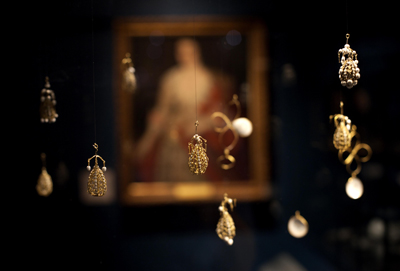
Cheapside-Hoard-1The ‘secrets’ of the Cheapside Hoard – the world’s finest and largest collection of 16th and 17th century jewels – are revealed in a new exhibition opening tomorrow at the Museum of London. The
Cheapside-Hoard-2Cheapside Hoard: London’s Lost Jewels
 publicly displays the hoard of Elizabethan and early Stuart jewellery and gemstones in its entirety for the first time since its discovery more than 100 years ago. The hoard, consisting of as many as 500 pieces including rings, necklaces, cameos, scent bottles and a unique Colombian emerald watch, was discovered buried in a cellar on Cheapside in the City of London in 1912. The exhibition uses new research and state-of-the-art technology to showcase the hoard as it explores the questions of who owned the hoard, when and why was it hidden, and why was it never reclaimed. New information revealed by the research shows that the hoard was buried between 1640 and 1666 (the critical clue was a previously overlooked intaglio – a gemstone engraved with the heraldic badge of William Howard, Viscount Stafford, who lived between 1612-1680). It also reveals Thomas Sympson was the “dodgy” jeweller responsible for two counterfeit rubies contained within the hoard (he apparently had a trade in selling counterfeit gems for as much as £8,000 each). Entry charge applies. Runs until 27th April. For more, see www.museumoflondon.org.uk.  PICTURED: Above: gold and pearl cage pendants from the Cheapside Hoard; and right: a bejewelled scent bottle.

A previously unknown painting of Queen Elizabeth I is on display as part of a new exhibition, Elizabeth I and Her People, opening at the National Portrait Gallery today. The small painting, which has been attributed to miniaturist Isaac Oliver and which is a reworking of the classical story of the Judgement of Paris, was recently acquired by the gallery. It will sit among a selection of other portraits of the “Virgin Queen” in a display which endeavours to show how during her 50 year reign she portrayed the image of a strong monarch. The portraits are just some of the 100 items featured in the exhibition which also includes costumes, coins, jewellery and crafts and examines the rise of new social classes in Elizabethan society. Other portraits in the exhibition feature images of courtiers such as William Cecil and Christopher Hatton along with images of merchants, lawyers, goldsmiths, butchers, calligraphers, playwrights and artists. There is also a little known painting of three Elizabethan children and what may be the first portrait of a guinea pig. The exhibition, supported by the Weiss Gallery, runs until 5th January. Admission charge applies. For more, see www.npg.org.uk.

Printed objects including replacement body organs, aeroplane parts and a music box have gone on display at the Science Museum in South Kensington as part of a new exhibition, 3D: printing the future. The exhibition looks at the rapidly evolving field of 3D printing and its growing impact on society through stories such as the use of 3D printing by engineers to create lighter aeroplane parts and the ways in which the medical industry is researching the use of the technology to create replacement body parts. The display will also include miniature 3D printed figures created from scans of visitors who took part in workshops during the summer holidays. This free exhibition runs in the Antenna gallery for nine months. For more, see www.sciencemuseum.org.uk.

On Now: Facing the Modern: The Portrait in Vienna 1900. On at the National Gallery, the first major UK exhibition devoted to the portrait in Vienna features iconic works by Gustav Klimt, Egon Schiele, Richard Gerstl, Oskar Kokoschka and Arnold Schonberg alongside those of lesser known artists such as Bronica Koller and Isidor Kaufmann. Highlights include Klimt’s Portrait of Hermine Gallia (1904) and Portrait of a Lady in Black (about 1894), Schiele’s The Family (Self Portrait) (1918) and Nude Self Portrait by Gerstl (1908). Runs until 12th January. Admission charge applies. For more, see www.nationalgallery.org.uk.

10 curious London memorials recapped (and vote for the one that most moves you)…

We’re kicking off a new special series next Wednesday but in the meantime we thought we’d recap our latest series – 10 (more) curious London memorials, and the previous series, 10 curious London memorials…

So, first for the 10 (more) curious London memorials list…

10. Memorial to 16th century navigators…

9. The Speke Monument…

8. The SOE Memorial…

7. D’Oyly Carte Memorial…

6. 7 July Memorial…

5. National Police Memorial…

4. ‘People of London’ Memorial…

3. William Wallace Memorial…

2. Animals in War Memorial…

1. Kindertransport memorial…

And, for the first curious London memorials list, which we ran way back in 2011…

10. The Bard or not The Bard?

9. The Golden Boy of Pye Corner

8. Edith Cavell Memorial

7. Tower Hill scaffold memorial

6. The Buxton Memorial Fountain

5. Eros (or the Shaftesbury Memorial Fountain)

4. The Suffragette Memorial

3. Charing Cross

2. The Albert Memorial

1. Watt’s Memorial in Postman’s Park

Hope you’ve enjoyed them. We look forward to bringing you our next series from next Wednesday…

Where is it? #68…

Where-is-it--#68

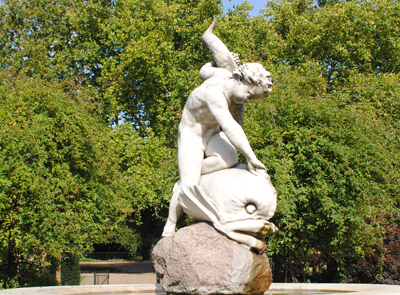
Can you identify where in London this picture was taken and what it’s of? If you think you can, leave a comment below. We’ll reveal the answer early next week. Good luck!

Well done to Renate, John, Diego and José who all correctly named this as the Boy with a Dolphin fountain in Hyde Park’s Rose Garden. The fountain, which is the work of Alexander Munro and dates from 1862, was once the centrepiece of the Victoria-era sunken garden which stood on the site of a former reservoir but was removed to make way for the widening of Park Lane. The fountain was moved to The Regent’s Park in 1960 but returned to Hyde Park in 1995. The Rose Garden, located close to Hyde Park Corner, also contains an older fountain – the Artemis Fountain, which dates from 1822.

Around London – The Bard is back; Foundling Museum displays; and, exhibitions on iconoclasm and explicit Japanese art…

The Bard is back in Leicester Square with the announcement last week that restoration work on the square’s 19th century Grade II listed statue of William Shakespeare – the only full-length statue the playwright in central London – has been completed. The 11 month restoration was carried out as part of £17 million revamp of the square which has seen the installation of a new fountain. The statue, which was the work of James Knowles, has been in the square since it was completed in its current configuration in 1874. Meanwhile, in other sculpture-related news, Sorry, Sorry Sarajevo – a life-size statue of a man holding  a dead or badly injured man in his arms has been placed in St Paul’s Cathedral where it will remain for the rest of the year. The work by Nicola Hicks dates from 1993 – when the Bosnian war was at its height – and has been placed opposite Henry Moore’s 1983 sculpture, Mother and Child: Hood as part of the cathedral’s approach to next year’s World War I centenary.

Two new displays opened at the Foundling Museum in Bloomsbury last month. Hogarth and Copyright, which runs until 5th January, looks at the role the artist William Hogarth played in the passing of the 1735 Engravers’ Copyright Act (also known as Hogarth’s Act – it was the first law to protect artist’s rights over their work) while Handel and Lucretia, presented in conjunction with The Sir Denis Mahon Charitable Trust and running until 26th January, shows Guercino’s painting Lucretia alongside two early manuscripts of Handel’s cantata La Lucretia. Entry is part of admission price. For more, see www.foundlingmuseum.org.uk.

A new exhibition tracing the history of attacks on artworks in Britain from the 16th century to today opened at Tate Britain in Millbank this week. Art under Attack: Histories of British Iconoclasm looks at why and how monuments have been damaged over the past 500 years. The display includes the remarkable pre-Reformation sculpture, the Statue of the Dead Christ (about 1500-1520), which was discovered in 1954 beneath the chapel floor at the Mercer’s Hall. Already damaged – most likely at the hands of Protestant iconoclasts – it may have been buried there to protect it. Also displayed are fragments of monuments destroyed in Ireland last century, paintings including Edward Burne-Jones’ 1898 painting Sibylla Delphica which was attacked by suffragettes in 1913-14, and Allen Jones’ 1969 work Chair – damaged in a feminist attack in 1986. Runs until 5th January. Admission charge applies. For more, see www.tate.org.uk.

A controversial exhibition of sexually explicit Japanese works of art created between 1600-1900 opened at the British Museum this week. Shunga: sex and pleasure in Japanese Art – which carries a warning of “parental guidance for visitors under 16 years – features 170 works including paintings, prints and illustrated books. Drawn from collections in the UK, Japan, Europe and the US, the exhibition of explores the phenomena of what are known as shunga (‘spring pictures’), looking at why it was produced and to whom it was circulated. Admission charge applies. Runs until 5th January. For more, see www.britishmuseum.org.

10 (more) curious London memorials…10. Memorial to 16th century navigators…

16th-century-navigators

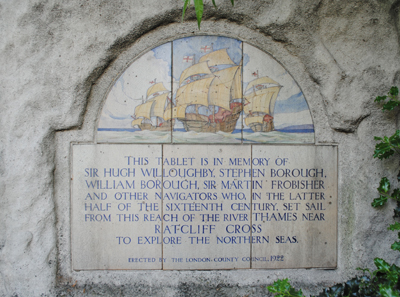
In the final of our series looking at London memorial, we head out to Shadwell in the city’s east where on the bank of the Thames, we find a memorial tablet dedicated to a group of 16th century navigators who set sail from near this point.

Located in Edward VII Memorial Park, the tablet can be found – rather oddly – on the landward side of the Wapping cupola, built to disguise a ventilation shaft and spiral staircase for the Rotherhithe road tunnel which opened in 1908 (the road is the A101). The cupola has a twin on the other side of the river in Rotherhithe.

Erected in 1922, the memorial specifically names arctic explorers Sir Hugh Willoughby, Stephen Borough, William Borough, and Sir Martin Frobisher but then goes on to state that it is also dedicated to the “other navigators who, in the latter half of the sixteenth century, set sail from this reach of the River Thames near Ratcliff Cross to explore the Northern Seas.”

Sir Hugh and his crew died while on an expedition in 1553 after becoming separated from the other ships on the expedition (Stephen Borough, master of one of the other ships, survived that expedition) while Sir Martin Frobisher made several unsuccessful attempts to find the North West passage in the late 1500s.

Ratcliffe Cross was a point on the northern bank of the river located just to the east of the park at the top of Ratcliffe Stairs and was an important navigation point for Thames watermen.

LondonLife – The new Serpentine Sackler Gallery…

Serpentine-Sackler-Gallery


Designed by Pritzker Prize winning architect Zada Hadid, the new Serpentine Sackler Gallery opened to the public in Kensington Gardens on Saturday. Located just a few minutes walk from the Serpentine Gallery on the north side of the Serpentine Bridge, the 900 square metre premises is partly located in a renovated Grade II*-listed building, The Magazine (built in 1805 as a gunpowder store and used by the military until 1963), as well as in a curvaceous modern extension to the north and west. The new gallery, which also features a ‘social space’ and restaurant, is named after Dr Mortimer and Dame Theresa Sackler, whose foundation provided the largest donation for the project – the largest single gift donated to the Serpentine Gallery in its 43-year history. The opening exhibition, Today We Reboot The Planet, features the large scale sculptural work of Argentinian artist Adrián Villar Rojas. The exhibition runs until 10th November. For more, see www.serpentinegallery.orgPICTURES: Serpentine Sackler Gallery, © 2013 Luke Hayes

Serpentine-Sackler-Galllery2

Where’s London’s oldest…tea shop?

Twinings

Opened in the Strand in 1706, Thomas Twining’s tea shop can still be found there today.

Twining, a tea merchant whose family originally hailed from Gloucestershire, started selling tea from what had been a coffee house – Tom’s Coffee House – in an effort to tap into tea’s growing popularity. It had apparently been introduced to England by Catherine of Braganza, the Portuguese wife of King Charles II, soon after the Restoration.

Amid resistance from other coffee house owners and despite high taxes on tea, Twining’s venture succeeded, attracting a wealthy clientele which apparently included Jane Austen, thanks at least in part to its location on the border between the City of Westminster and the City of London.

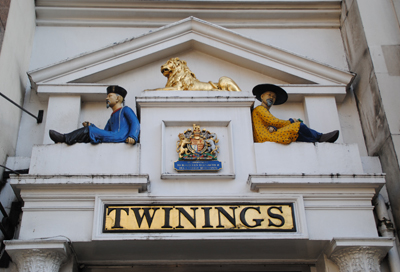
By 1717, Twining had purchased three houses adjacent to his coffee house and converted them into a shop which still stands today at number 216 Strand (the original Tom’s Coffee House was located behind this premises). He was soon selling more dry tea than wet at the sign of the “Golden Lyon”.

Following Thomas’ death in 1741, Twining’s son Daniel took over the business and by the mid-1700s, was exporting to America where he counted the Governor of Boston among his clients (but, apparently it was not Twining’s tea which was tossed into the sea at the Boston Tea Party).

It was Daniel’s son (and Thomas’ grandson), Richard Twining, who was successful in lobbying for the lowering of tea taxes and so paving the way for tea to become the commonly consumed drink it is today. It was also Richard who built the shop’s current entrance portal in 1787 incorporating the golden lion.

The Twinings shop today is the oldest in the City of Westminster while the company’s logo, which dates back to 1787, is the oldest commercial logo in continuous use.

Twinings, which since 1964 had been owned by Associated British Foods, was granted a Royal Warrant in 1837 by Queen Victoria.

For more, see www.twinings.co.uk.

Around London: Historic pearls at the V&A; ‘Big Brother’ house opening; aircraft pioneers honoured; and Jonathan Yeo at the NPG…

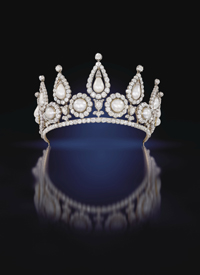
The_Rosebery_Tiara_QMA_Collection._Photo_c_SothebysA pearl-drop earring worn by King Charles I at his execution in 1649, pearl tiaras worn by European nobles and a pearl necklace given to Marilyn Monroe by Joe DiMaggio in 1954 are among the items on display as part of a new exhibition which opened at the V&A last Saturday. The V&A and Qatar Museums Authority exhibition traces the history of pearls from the early Roman Empire to now and features more than 200 pieces of jewellery and works of art. Other items on display include ‘Queen Mary II’ pearls dating from 1662-1664, a miniature portrait of Queen Charlotte wearing pearl jewellery and a set of buttons, finely enamelled and framed with pearls, worn by George III in 1780. There’s also the Dagmar necklace given to Princess Alexandra when she married the future King Edward VII in 1863. The exhibition is part of the Qatar UK 2013 Year of Culture. Admission charge applies. Runs until 19th January. For more, see www.vam.ac.uk. PICTURE: Lady Rosebery’s pearl and diamond tiara (1878) © Christie’s Images.

The Big Brother house – located in Elstree Studios in north London – opens to the public tomorrow and on Saturday as part of a partnership between Initial – an Endemol Company, Channel 5 and the National Trust. Some two million people tuned in to watch the final night of the show this summer leading one TV critic to describe the property as “the most important house in Britain”. The opening is being preceded by an Opening Gala featuring housemates past and present as well as celebrities – but that’s an invitation only event. Sadly, tickets for the opening are already sold out – for returns and your last chance of getting in, follow this link.

The UK’s first aircraft manufacturers – Horace, Eustace and Oswald Short – have been commemorated with an English Heritage blue plaque placed on their former workshop in Battersea. Unveiled this week by Jenny Body – the first female president of the Royal Aeronautical Society, the plaque can be found at the railway arches near Queen’s Circus where the brothers, who lived nearby in the Prince of Wales Mansions, worked on ballooning and first made the transition to aircraft construction. Among their firsts was the construction of the first British powered aircraft to complete a circular mile of flight and the creation of Britain’s first ever purpose-built aircraft factory (it was located on the Isle of Sheppey in Kent). For more, see www.english-heritage.org.uk/discover/blue-plaques/.

On Now: Jonathan Yeo Portraits. New and previously unseen works including a six foot high portrait of controversial artist Damien Hirst and a portrait of Kevin Spacey as King Richard III feature in this exhibition running at the National Portrait Gallery. Other subjects featured in the painted works include media mogul Rupert Murdoch, model Erin O’Connor, artist Grayson Perry and actor Sierra Miller. Runs until 5th January. Admission is free. For more, see www.npg.org.uk.

10 (more) curious London memorials…9. The Speke Monument…

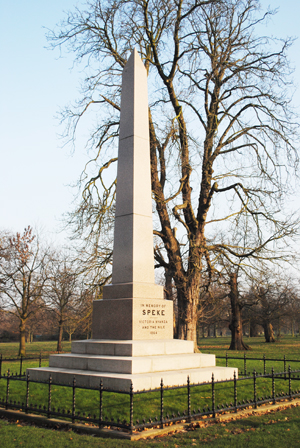
Speke-MonumentWhile thousands walk past this obelisk in Kensington Gardens each day, few probably realise it commemorates the life of John Hanning Speke, a Victorian-era explorer who discovered Lake Victoria in East Africa and named its northern outflow as the source of the Nile.

The red granite monument, designed by Philip Hardwicke and made from stone quarried in Scotland, was paid for by public donations and sponsored by Sir Roderick Murchison, president of the Royal Geographic Society which had paid for two of Speke’s expeditions. It was installed in 1866 and is located near the junction of Lancaster Walk and Budges Walk.

Speke, who had been on several expeditions in Africa, had only died at the age of 37 two years before in relatively controversial circumstances. He was shot by his own gun only the day before he was to participate in a debate with another explorer, Sir Richard Burton, about the source of the River Nile (Speke claimed the source of the Nile was Rippon Falls which flowed out of Lake Victoria; Sir Richard disputed this claim – it was later proven correct). Some have claimed Speke’s death to be suicide; others that it was an accident.

The monument itself was circumspect with regard to Speke’s success – it didn’t directly credit him as being the discoverer of the river’s source. This was rectified in 1995 when a plaque giving credit where it was due was placed on the ground in front of the monument by the Friends of Hyde Park and Kensington Gardens.

LondonLife – Pull up a deckchair…

Deckchair-dreams

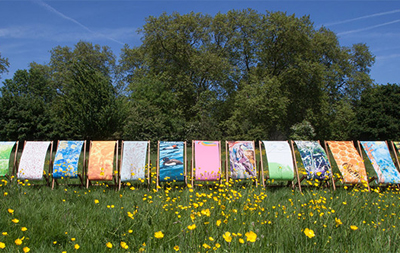
Summer is fading fast but until the end of October, there’s still time to sit back and relax in one of the 550 “designer deckchairs” which have been placed in five central Royal Parks this summer. Designed by the likes of Rolling Stone Ronnie Wood, comedian Harry Enfield and actor Miranda Richardson and artists Michael Craig-Martin, Susan Stockwell and Maggi Hambling under the theme of ‘Nature’s Grand Designs’, the deckchairs can be found in Hyde Park, Green Park, St James’s Park, Kensington Gardens and the Regent’s Park. The chairs join the more than 6,700 deckchairs already in the five Royal Parks which are available for hire (they can also be bought at the Royal Park’s online shop). For more on hiring a deck chair in the Royal Parks, check out http://www.royalparks.org.uk/parks/hyde-park/facilities-in-hyde-park/park-deck-chairs.

Famous Londoners – David Garrick…

Playwright. Actor. Theatre manager. David Garrick stands out as a towering figure of the theatrical world in the 18th century and is remembered, at least in part, for his friendship with the irrepressible lexicographer Samuel Johnson.

Born on 19th February, 1717, in Hereford to an army officer (with French Huguenot roots) as the third of five children, Garrick attended school in Lichfield, north of Birmingham, including, at the short-lived Edial Hall School where Dr Johnson himself taught Latin and Greek. It was during his youth that he first took an interest in the stage, appearing in George Farquhar’s The Recruiting Officer.

When the school closed due to lack of funds, Garrick accompanied Dr Johnson to London (they had become friends) and there he and his younger brother Peter established a wine business (Peter eventually went back to Lichfield to run part of the business from there). While the business wasn’t a great success, Garrick took to acting in amateur theatricals and eventually – according to Peter Thomson, writing in the Oxford Dictionary of National Biography – made his professional debut acting incognito in a pantomime in London in March, 1741, although Garrick apparently said placed his debut in Ipswich that summer when he was acting in Thomas Southerne’s Oroonoko, or the Royal Slave (meanwhile the first performance of one of his dramatic works – Lethe, or Aesop in the Shades – had taken place at Drury Lane the previous year).

His breakthrough role came later that year – in October – when he appeared in London on the stage of the unlicensed Goodman’s Fields Theatre in the title role of Richard III. Soon acclaimed by the likes of Alexander Pope and William Pitt as the greatest actor of his time, further roles followed at Goodman’s Fields and at the famous Drury Lane Theatre as well as in Dublin (where he started an ultimately ill-fated love affair with Irish actress Peg Woffington who returned with him to London where he continued acting at Drury Lane).

Having also performed for a season, at the rival Covent Garden Theatre, in April 1747, Garrick entered into a partnership with James Lacy for the ownership of the Drury Lane Theatre. The first performance was apparently by Garrick himself, reading Ode to Drury Lane Theatre, on dedicating a Building and erecting a Statue, to Shakespeare – a piece written by Dr Johnson.

It was two years later – on 22nd June, 1749 – that he married a German dancer Eva Marie Veigel. They lived at a house at 27 Southampton Street and Garrick’s increasing wealth led him to buy a country property in Hampton, today in south west London, in 1754 which became known as “Garrick’s Villa”. Considerably altered, the Grade I-listed property still stands there today (albeit having suffered extensive damage in a 2008 fire) along with the summerhouse he built to house his collection of Shakespearian memorabilia – known as Garrick’s Temple to Shakespeare, it’s open to the public over from April to October.

Meanwhile, as well as managing the theatre, Garrick continued acting and writing plays. In September, 1769, he staged the Shakespeare Jubilee in Stratford-upon-Avon, celebrating 200 years since the playwright’s birth – even though it was five years too late and was ultimately a bit of a disaster, he took his celebration of Shakespeare back to Drury Lane and there it was a huge success.

Garrick, who moved from Southampton Street into the newly built Adelphi Terrace in 1772, remained manager of Drury Lane until his retirement in 1776 during which time it became widely acknowledged as the country’s leading theatre. He died at home on 20th January, 1779. His wife outlived him by 43 years. The couple had no children. Garrick was subsequently interred in Poet’s Corner, Westminster Abbey – the first actor to receive the honour.

Garrick’s legacy was enormous – not only is he famed for bringing a new ‘realistic’ style to the profession he so loved, he set new standards in the arts of public relations and was also an instrumental figure in having Shakespeare recognised as England’s national icon. Legend goes that he was also the actor responsible for the phrase “Break a leg!” – apparently so engrossed in a performance of Richard III that he overlooked the fact he’d fractured his bone.

Garrick’s name lives on in the Garrick Theatre (still operating in Charing Cross Road) and the Garrick Club, and there’s memorial to him on his former home in Adelphi Terrace.
Lost London – St Dunstan in the East…

St-Dunstan-in-the-East

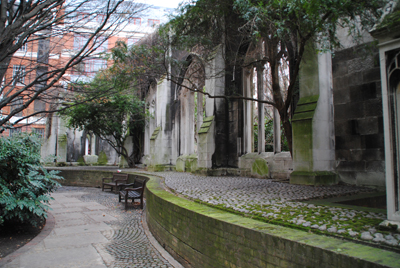
The ruins of this medieval church can still be found in the eastern end of the City of London and now play host to a rather delightful little park.

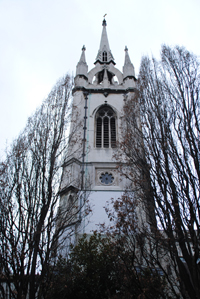
Originally built around 1,100 in the Gothic style, the church – which stands between St Dunstan’s Hill and Idol Lane (off Great Tower Street) was enlarged and repaired in ensuing centuries before suffering severe damage in the Great Fire of London in 1666. Not enough to destroy the church, however, and it was repaired in the late 1660s with a new steeple and tower designed by Sir Christopher Wren to fit with the existing structure, was added in the late 1690s. Inside were carvings by Grinling Gibbons.

St-Dunstan-in-the-East-smallBut by the early 19th century, however, the weight of the roof had pushed the walls dramatically out of line and, after an unsuccessful attempt to repair the church, it was decided to demolish it (with the exception of Wren’s tower) and rebuild.

Built in the Perpendicular style to the designs of David Laing, the new church reopened in 1821.

The church lasted for more than 100 years before it was again severely damaged, this time during the Blitz of 1941. Wren’s spire and tower thankfully remained but other than that it was a shell with only the north and south walls remaining.

The Anglican Church decided not to rebuild – the parish was incorporated into that of All Hallows by the Tower – and the City of London Corporation opted to turn the (now) Grade I-Iisted remains into a public park. It was opened in 1971 by the then Lord Mayor of London, Sir Peter Studd.

It remains there today, with beautiful climbing foliage – including many exotic plants – and a fountain in the nave. The tower, meanwhile, is used by a complementary medical centre.

A great place to pass a lunch hour!

Around London – Open House London; Yinka Shonibare at Greenwich; Bankside transformed; and Michael Peto at the NPG…

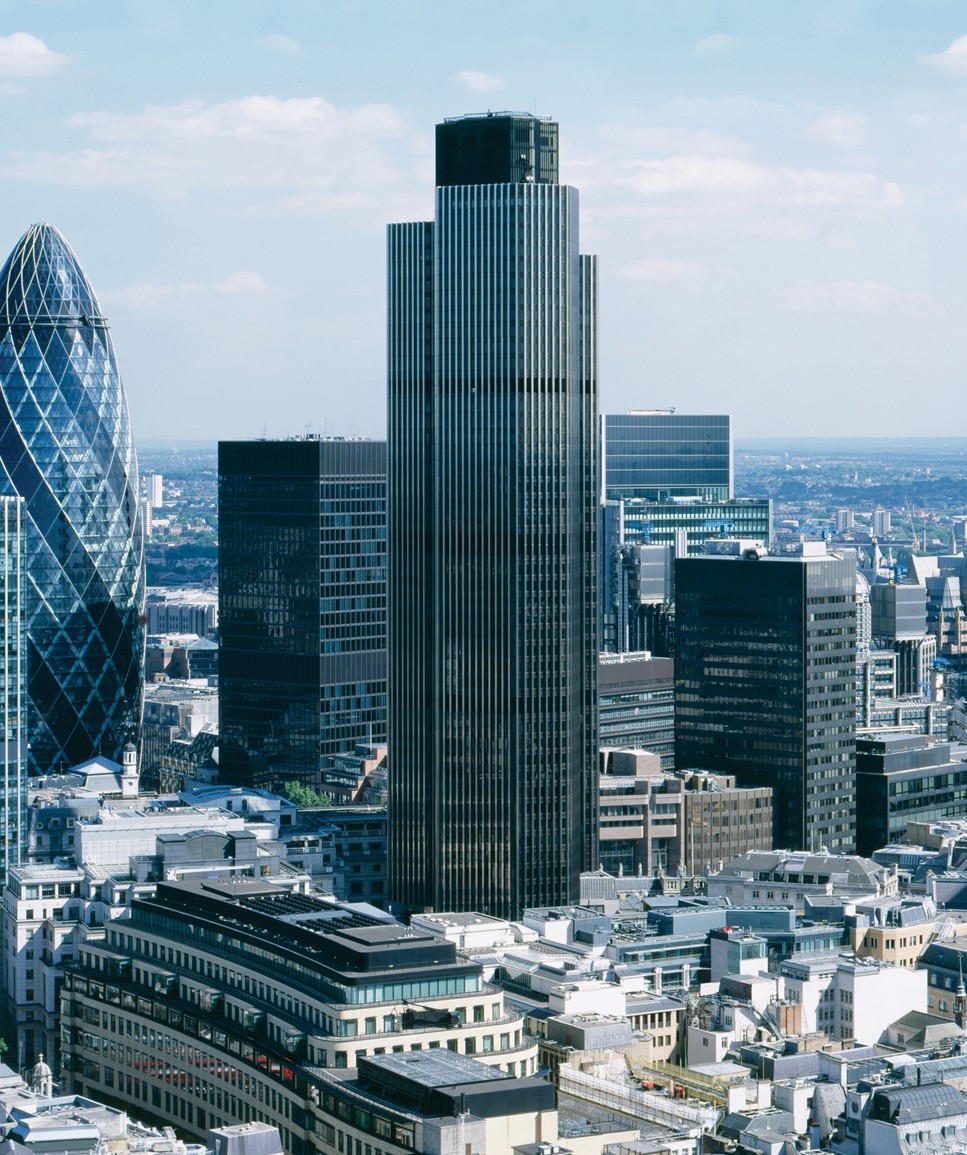
Tower 42_external It’s finally here. Open House London kicks off on Friday and with more than 800 buildings opening their doors, the only difficulty you’ll have this weekend will be choosing what you end up doing! This year’s theme is ‘celebrating architecture, people and place’ and among the highlights will be the opening of landmark structures like Battersea Power Station, Tower 42 (pictured), and the Gherkin (30 St Mary Axe) as well as 100 private homes, architects’ homes and “ground-breaking” housing developments and everything from the Shri Swaminarayan Temple in Brent to Horse Guards in Whitehall (certain buildings, like 10 Downing Street and The View from the Shard, are only open to people who won tickets in an earlier ballot). This year’s festivities also include a moonlit “culture crawl” through London on Friday night. If you haven’t ordered a hardcopy programme, you can check the listings online at www.openhouselondon.org. There’s also an Open House iPhone app available from the appstore.

A series of works by Yinka Shonibare – including some never before seen in the UK – went on display at Greenwich yesterday, thanks to Royal Museums Greenwich. The works, which explore notions of “Britishness, trade and empire, commemoration and national identity”, can be found inside and around buildings including the Queen’s House, National Maritime Museum and Royal Observatory and include Fake Death Pictures – a series of five vision of the death of naval hero Vice-Admiral Lord Nelson, Wind Sculpture – a gravity-defying object located on the Queen’s House lawn, Cheeky Little Astronomer – a specially commissioned sculpture located in the Flamsteed House at the Royal Observatory, and Nelson’s Ship in a Bottle – last seen on Trafalgar Square’s Fourth Plinth. Yinka Shonibare MBE at Greenwich, which is supported by a range of talks, debates and tours, runs until 23rd February. For more, see www.rmg.co.uk.

Bankside will be transformed this weekend as artists will be transforming disused hoardings and derelict buildings with original artworks as part of the Merge Festival. The work’s include Candy Chang’s Before I Die, Alex Chinnick’s Miner on the Moon, and Marcus Lyall and Mark Logue’s House of Pain. Until 20th October. For more on the festival celebrating Bankside, see www.mergefestival.co.uk.

On Now: Michael Peto Photographs: Mandela to McCartney. This new exhibition at the National Portrait Gallery just off Trafalgar Square features a previously unexhibited photo of Elizabeth Taylor and Richard Burton, taken at the beginning of their love affair. It’s one of 10 portraits taken by the late Hungarian-born photographer Michael Peto in London during the 1950s and 1960s – others feature Samuel Beckett, Jennie Lee, Paul McCartney and Ian McKellen. Admission is free. For more, see www.npg.org.uk.

10 (more) curious London memorials…8. The SOE Memorial…

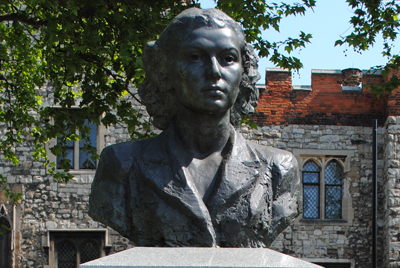
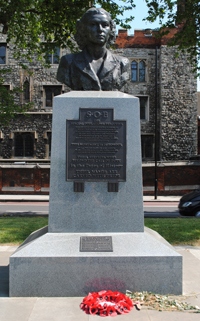
SOE-bigTucked away on Albert Embankment just to the north of Lambeth Bridge, this moving memorial was only unveiled in 2009 and formally honours the under-cover agents who worked for the Allies behind enemy lines during World War II.

The plinth is topped with a larger-than-life bust of Londoner Violette Szabo, sculpted by London artist Karen Newman. Szabo, who here gazes out across the Thames, was tortured and executed after being captured by the Germans while on a mission behind enemy lines following the D-Day landings.

SOEThe daughter of a French mother and English father, Szabo grew up in South London and, when World War II broke out in 1939, volunteered to work as an undercover operative in France as member of the British Special Operations Executive (SOE).

She had successfully completed one mission and had returned to France for a second when she was discovered and sent to a prison camp where she was unsuccessfully tortured for information.

Posthumously awarded the George Cross and the Croix de Guerre, a plaque on the memorial says she was among the 117 SOE agents who did not survive their missions to France. As many as 407 SOE agents were sent on “sabotage missions” to occupied France to fight with the French resistance.

Surprisingly, this SOE Memorial was apparently the first public memorial to honour the work of the unit. Formed on the orders of PM Sir Winston Churchill, it consisted of agents from various countries who were devoted to the Allied cause. Its feats included a raid which destroyed a factory in the Telemark region of Norway where the Germans were trying to produce heavy water which is used in the creation of atomic bombs – an operation which receives a special mention on the memorial.

The memorial was officially unveiled by the Duke of Wellington on 4th October, 2009. One of the plaques on it states that the monument “is in honour of all the courageous S.O.E. Agents: those who did survive and those who did not survive their perilous missions”. “Their services were beyond the call of duty. In the pages of history their names are carved with pride.” Enough said.

For more on the history of women serving in the SOE, see Squadron Leader Beryl E Escott’s book The Heroines of SOE: F Section: Britain’s Secret Women in France.

LondonLife – Steps to nowhere…

Endless-Stair

Inspired by Escher’s staircase, the London Design Festival’s landmark project Endless Stair has taken up residence outside the Tate Modern overlooking the River Thames. Designed by Alex de Rijke of dRMM and Dean of Architecture at the Royal College of Art (in collaboration with AHEC, ARUP, Nüssli, Imola Legno, SEAM and Lumenpulse), the 187 step stairway is constructed from a series of giant interlocking staircases shaped from American tulipwood. The stairway will be in place until 10th October. The London Design Festival, meanwhile, kicked off on Saturday and runs until 22nd September. It features more than 300 events with the V&A once again the festival’s central hub. For more – including a full programme of events –  see www.londondesignfestival.comPICTURE: Cityscape


What’s in a name?…St Mary Axe

There’s several stories behind the rather odd name given to this narrow street which runs between Houndsditch and Leadenhall Street in the City of London – now famous for the gherkin-shaped skyscraper located within it.

St-Mary-AxeIt’s generally agreed that street’s name comes – at least partly – from a former church which it has been suggested once stood where the building known as Fitzwilliam House now stands.

Known as the Church of St Mary Axe (although its full name was apparently the somewhat longer Church of St Mary, St Ursula and her 11,000 Virgins), the medieval building was apparently demolished in the 1560s and the parish united with that of St Andrew Undershaft (this church still sits on the corner of St Mary Axe and Leadenhall Street).

The reasons for the church to be so named remain a matter of speculation. The most interesting version (and the one that would explain the church’s longer name) has it that the name was given due to an axe that was once on display in the church.

The axe had apparently come from Europe where legend says it was one of three axes used by the Huns (some say the three included Atilla himself) to slaughter 11,000 handmaidens who had been travelling in Europe with St Ursula. St Ursula herself was fatally shot with arrows by the Huns’ leader.

How and why the axe came to be on display in this particular church remains something of a mystery but so well did the church become identified with the gruesome relic that it became known as the church of St Mary Axe.

Another version we’ve come across states that the church took on the name because its patrons were the the Skinners’ Company who used such axes. Yet another suggests that the street was named after the church of St Mary and that of a nearby tavern which operated under a sign bearing the image of an axe (but it’s possible the tavern had such a sign because of its proximity to the church in the first place).

These days, as well as being the location of St Andrew Undershaft (now part of the parish of St Helen’s Bishopsgate) and the building known as the Gherkin (it’s official name is 30 St Mary Axe), St Mary Axe is also the place where, on 10th April, 1992, an IRA bomb exploded outside the Baltic Exchange, killing three people.

PICTURE: The Gherkin with St Andrew Undershaft in the foreground.

Around London: Heritage Open Days; Afghanistan supply lines; and Leslie Howard’s Blue Plaque…

It’s a good weekend for a day trip with heritage sites all around the fringes of greater London throwing their doors open this weekend as part of the annual Heritage Open Days event. Among places taking part in this year’s event – which will be followed by Open House London next weekend – are Cleaves Almshouses – established in 1669 and located in Kingston upon Thames, Watford’s oldest building – St Mary’s Church, Lopping Hall in Loughton (so named for the fact it was given to the townspeople in exchange for lopping rights in Epping Forest), and St George’s RAF Chapel of Remembrance at Biggin Hill Airfield in Kent. There are more than 4,500 properties taking part over the weekend, which kicks off today and runs until Sunday, across England. For more information – including full listings of all premises taking part, check out www.heritageopendays.org.uk.

A new display taking at in-depth look at the complexities of supplying soldiers in Afghanistan’s Helmand Province opened at the Imperial War Museum this week. War Story: Supplying Frontline Afghanistan follows the journey from RAF Brize Norton in the UK to Camp Bastion in Afghanistan and then to forward operating bases and patrol bases on the frontline and features photographs, interviews and time lapse footage collected by IWM staff on trips to Afghanistan undertaken last year and this year – the first time IWM teams have visited an active theatre of conflict since World War I. Runs until 27th April. For more, see www.iwm.org.uk.

A blue plaque honouring actor and film director Leslie Howard was unveiled by English Heritage at his former childhood home in Upper Norwood in south London last week. Born in the London suburb of Forest Hill, his family moved to Vienna when was only three-years-old but returned to London five years later and lived at 45 Farquhar Road in Upper Norwood for the next four years before moving to another address nearby. Howard made his West End debut in 1917 – adopting the stage name Leslie Howard in favor of his birth name Leslie Howard Steiner – subsequently appeared on stage and in films including Pygmalion (1938) and Gone with the Wind (1939). He died in 1943 when the plane he was in was shot down by enemy fire over the English Channel. For more, see www.english-heritage.org.uk/discover/blue-plaques/.