10 curiously named churches of London – 9. St Michael Paternoster Royal

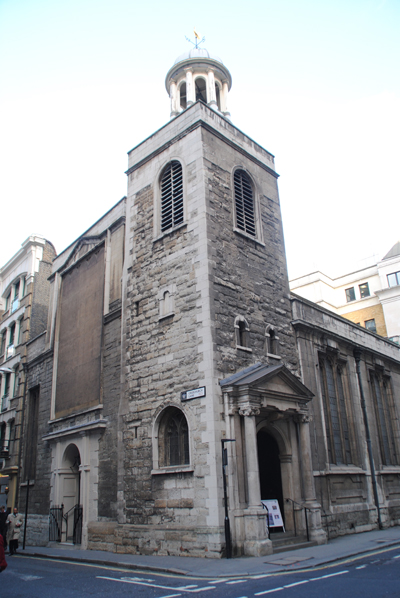
This triple-monikered church was first recorded in the 1200s. Far from unique in its dedication to the Archangel St Michael (there were apparently seven churches which were dedicated to him before the Great Fire), it was distinguished from the others by the name Paternoster Royal.

Surprisingly, the name has nothing to do with royalty or the clergy, at least not directly. The name Paternoster comes from the church’s location on what was Paternoster Lane (it’s now College Hill) – it was named for the number of paternoster or rosary seller that were based there.

The name Royal, meanwhile, is a little bit more obscure. First applied in the 1300s, it apparently comes from the close proximity of another street called Le Ryole which was itself a corruption of the French town of La Reole in the wine districts near Bordeaux. The street is believed to have been given the name thanks to the number of wine merchants who traded there.

Like other London churches, this one has been rebuilt several times – notably after the Great Fire of London (to the designs of Sir Christopher Wren) and again after World War II during which the church was all but destroyed by a V1 flying bomb. Since its reopening in 1968 it has served as the international headquarters of the Christian organisation, the Mission to Seafarers, which supports chaplains working in ports around the world.

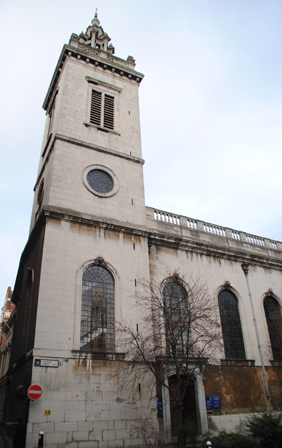
The walls date from Wren’s time and the stone steeple, which wasn’t completed until 1717, is the work of Nicholas Hawksmoor. The interior features carved figures of Moses and Aaron which stand before the reredos – these apparently came from All-Hallows-the-Great (demolished in 1894) as did the chandelier which bears the words ‘Birmingham 1644’).

High profile parishioners over the years have included the four time Lord Mayor of London, Dick Whittington (see our earlier post on him) – he paid for a substantial extension of the church and founded a college of priests there (it’s from this college, which was dissolved in the mid-1500s and then re-established soon after, that College Hill is believed to have derived its name) as well as an almshouse next door.

Whittington and his wife were both buried inside but he was apparently exumed since several times and the location of his body is now unknown. There’s a stained glass window depicting Whittington and his famous cat inside and the gardens just outside also bear his name.

London Pub Signs – The Mayflower

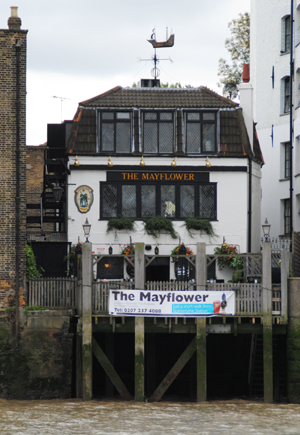
Located on the Thames waterfront in Rotherhithe, The Mayflower’s history is intertwined with that of the more famous ship of the same name.

For it was from a quay near the pub (then named The Shippe) that in July, 1620, Captain Christopher Jones embarked upon the vessel, The Mayflower, and set sail for Southampton to load supplies before boarding the Pilgrim Fathers and making the journey to what is now the United States of America, landing in Plymouth, Massachusetts, on 21st December of that year.

Captain Jones was to return to Rotherhithe the following year and died shortly after. He and the ship’s co-owners are buried in an unmarked grave in the nearby churchyard of St Mary’s where a modern monument to Jones has been erected.

The pub, meanwhile, was rebuilt the following century – in 1780 – and renamed the Spread Eagle and Crown. It took on the name of Mayflower following a restoration in 1957, thanks to its associations with the historic voyage of The Mayflower.

Now part of the Greene King family of pubs, inside the building features oak beams and wooden panelling and boasts fine views of the Thames from an outside deck.

Lost London: Gates Special – Bishopsgate

Another of London’s gates which had its origins in Roman times, it was built as the city exit for Ermine Street which ran all the way to York.

The gate is believed by many to have taken its name from Bishop Erkenwald, a seventh century Anglo-Saxon Bishop of London who is said to have ordered the gate’s reconstruction on the gate’s Roman foundations.

Bishopsgate – the site of which is marked by a bishop’s mitre attached to the facade of a building near the junction of Wormwood Street (pictured) – was rebuilt several times over the centuries (its first known mention was in the 12th century). This included in the 1470s when it is said to have been rebuilt by Hansa merchants who did so apparently in return for exemptions from tolls (or, according to some, other trade privileges).

The gate – which was known for having the heads of traitors displayed on spikes upon its top – took its final form in 1735 before it was finally demolished along with several other London gates in 1760 as part of road widening measures.

The name Bishopsgate is remembered in the street of the same name as well as one of the City of London wards. Among the notable people associated with Bishopsgate are William Kemp, an Elizabethan comic actor who, in a remarkable feat, is said to have performed a Morris dance starting at the gate and finishing in Norwich.

10 curiously named churches of London – 8. St Lawrence Jewry

The reason for the name of this church, founded in 1136, may seem obvious – it was associated with London’s Jewish community, thanks to its location on the edge of the area in which they lived (this area was centred on the street just to the south still known as Old Jewry).

What is perhaps more amazing may be the fact that the name stuck despite the expulsion of all Jews from London in 1291, the name was still used to distinguish it from other churches.

The church – named in honor of St Lawrence, a Roman era martyr who was slow grilled over a fire – was among those consumed in the Great Fire of London and rebuilt by Sir Christopher Wren afterwards. This new church had the honor of being reopened by King Charles II in 1677 – it was badly damaged in the Blitz before being rebuilt by Cecil Brown to Wren’s original design.

Located just off Guildhall Yard – home of the City’s authorities – St Lawrence Jewry is the official church of the Corporation of London and as such hosts a number of special services for the Lord Mayor and Aldermen during the year. Some 11 livery companies have links with the church – among them are those of tallow chandlers, loriners, girders, haberdashers and actuaries.

Worth noting on the inside is the painting of the martyrdom of St Lawrence – this survived the Blitz along with the tower and outer walls – and the many beautiful stained glass windows, painstakingly restored after World War II. There’s also a pond, complete with fish, outside the main entrance.

WHERE: Guildhall Yard (nearest Tube stations are St Paul’s, Bank and, a little further off, Moorgate and Mansion House). WHEN: 8am to 6pm Monday to FridayCOST: Free; WEBSITE: www.stlawrencejewry.org.uk.

Where’s London’s oldest…music hall?

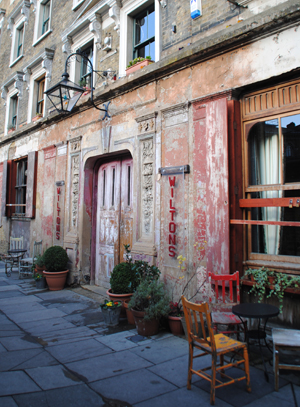
Wilton’s Music Hall  seems to be regularly making news these days so the revelation that it’s London’s oldest (in fact, according to the venue’s website, it’s the oldest surviving grand music hall in the world) probably comes as no surprise.

The hall, located in Graces Alley, Whitechapel, started out life as a pub which stood in the middle of a row of terrace houses. Named the Prince of Denmark, it is said to have had the first mahogany counters in London (hence the ‘Mahogany Bar’ at the front of the music hall today) and incorporated a concert room built at the rear of the ground floor.

The building was taken over by John Wilton in the 1850s. He also bought up the neighbouring terrace homes and subsequently built the grand music hall which still stands today – one of what were then a new generation of large music halls which appeared in London in the mid to latter part of the 19th century but had all but disappeared by 1900.

Wilton’s Music Hall opened on 27th March, 1859, and continued to operate under Wilton’s management for the next couple of decades. In 1877 it was badly damaged in a fire an rebuilt the following year.

Ten years later, however, the Wesleyan Mission took over the building and used it as a hall – dockers were served meals here during their first ever strike in 1889, it was used as a safe house during the so-called Battle of Cable Street of 1936 in which police clashed with protestors opposing a march by the British Union of Facists, and during World War II it was used as shelter for people bombed out of their homes.

The Methodists left in the 1950s and in 1964, the building was scheduled for demolition. Thanks to the intervention of poet John Betjeman, however (he led a campaign to prevent its destruction), the hall was saved. While it’s been undergoing restoration work ever since, more work is still required and the hall is still looking for donations to help fund it.

As well as operating once again as a music venue, it has since appeared in numerous films including Chaplin, The Krays, and the latest Sherlock Holmes film – Sherlock Holmes: A Game of Shadows.

There is a more detailed history of Wilton’s Music Hall at www.arthurlloyd.co.uk/Wiltons.htm, a music hall and theatre site. Wilton’s website can be found here.

Treasures of London – Big Ben…

Often used to describe the clock on the Houses of Parliament (or the tower in which it is located), the name Big Ben was actually first given to the bell that resides within.

Officially known as the Great Bell, it is believed the popular nickname of Big Ben came from Sir Benjamin Hall,  First Commissioner for Works (there is an alternative theory that it was named after Ben Caunt, a popular heavyweight boxer in the 1850s but the parliamentary website describes this as “unlikely”).

The initial bell intended for the clocktower of the Houses of Parliament was cast by Warners of Norton, near Stockton-on-Tees, in August, 1856. Transported to London, it was tested in Palace Yard (where a clock tower had stood in medieval times) but a crack appeared during testing and so the bell had to be recast.

With Warners apparently asking too much for the recasting, George Mears at the Whitechapel Bell Foundry was appointed instead. The new bell was cast on 10th April, 1858.

With a diameter of 2.7 metres, the bell was too big to fit up the clocktower’s shaft vertically so it was turned on its side and the 13.7 tonne bell was winched up to the belfry in October that year. Four quarter bells, which chime on the quarter hour and varying in weight from 1.1 to 4 tonnes, were already in place (interestingly, all of the bells are fixed in position and struck on the outside rather than being allowed to swing and have a hammer strike the inside).

Big Ben debuted on 11th July, 1859 (the clock had been started on 31st May), but in September that year the second bell also cracked. It took four years to find a solution (during that time, the bell was struck on the fourth quarter bell) and it was the Astronomer Royal, Sir George Airy, who found it.

The solution involved turning the bell a quarter turn so the hammer didn’t restrike the crack site and replacing the hammer with a lighter one (the current hammer still weighs 200 kilograms!). A small square was also cut into the bell’s crack to prevent it spreading.

Apart from occasional stoppages, the bell has struck ever since.

For more on Big Ben, visit www.parliament.uk/bigben. Tours are only available to UK residents and can be arranged via local MPs (see here for more) or there are virtual tours for those who either don’t live in the UK or can’t get there (see here for more).

IMAGE: Big Ben with a quarter bell in the fourground. PICTURE: Courtesy of UK Parliament.

10 curiously named churches of London – 7. St Margaret Pattens

It’s not often you’d come across a church named after a type of shoe, but that’s the case with the church of St Margaret Pattens.

Located in Eastcheap, a church dedicated to St Margaret – a saint who was martyred in Antioch in the Middle East – has stood on the current site for at least 900 years. The earliest reference dates from 1067 and the church was rebuilt at least once in the medieval period, with the costs of construction apparently partly funded out of gifts presented to a crucifix or rood which stood in Rood Lane close to the church.

It’s only since the 17th century, however, when the church was rebuilt to the design of Sir Christopher Wren after the Great Fire of London, that it took on the name ‘Pattens’ to distinguish itself from other churches dedicated to St Margaret.

Pattens were wooden undershoes which were trapped beneath normal footwear and raised the wearer above the street, allowing them to walk across muddy roads and still arrive at their destination cleanshod. This footwear was apparently made and sold near which the church was located.

The trade of pattenmaking, incidentially, died out as streets became paved – according to the church’s website, the last pattenmaker died in the 19th century. There’s still a sign in the church asking women to remove their pattens before entering.

It’s worth noting before we move on that there is an alternative theory as to the origins of the name – this is that it commemorates a benefactor, possibly a canon at St Paul’s named Ranulf Patin – but it’s the former interpretation which is more widely accepted.

St Margaret Pattens, which was united with that of St Gabriel Fen after the latter was destroyed in the Great Fire, was damaged by bombing in World War II but was restored in the mid 1950s.

While the church lost many of its valuables during the Reformation (with the exception of a silver gilt communion cup dating from 1545 – on loan to the Victoria & Albert Museum), notable features inside include a memorial to King Charles I (since 1890, the king has been remembered in a special service each year held on the nearest Thursday to the date of his execution – 30th January) and a Royal Stuart Coat-of-Arms believed to be those of King James II.

There’s also a reredos containing a painting by Italian Carlo Maratta (1625-1713), two unusual canopied pews reserved for churchwardens, an hourglass dating from 1750 used to time the sermons, and a bell which dates from before the Great Fire. It’s also possible to view a set of pattens.

Among those who have been associated with the church is famed medieval Lord Mayor of London, Dick Whittington, apparently at one time the church’s patron (you can see our earlier post on him here), as well as livery companies including, as one would expect, the Worshipful Company of Pattenmakers, and the Worshipful Company of Basketmakers.

WHERE: Corner of Eastcheap and Rood Lane (nearest Tube stations are Monument, Bank and Tower Hill). WHEN: Weekdays from 10.30am (check website for services)COST: Free; WEBSITE: www.stmargaretpattens.org.

Famous Londoners – William Hogarth

An artist with a social conscience, William Hogarth’s sketches and paintings summed up much of what was rotten with 18th century England – the society in which he lived – much as Dickens’ writing did in the following century.
Hogarth was a native Londoner – he was the son of Richard Hogarth, a Latin teacher and publisher, in Smithfield in 1697. Despite the ups and downs of his father’s fortunes (during Hogarth’s childhood, Richard Hogarth was confined to the Fleet Prison for debt for five years following an unsuccessful venture running a coffee house), at the age of 16 William was apprenticed to an engraver named Ellis Gamble.

Following his apprenticeship, he set up his own shop in 1720 and it was at this time that he started producing political satires. Hogarth was also painting  and around this time met with artist Sir James Thornhill. He became a regular visitor to Thornhill’s art academy in Covent Garden and their friendship grew, so much so that Hogarth eventually married Thornhill’s daughter Jane in 1729.

In the early 1730s, having established himself as a painter – both of portrait groups and some early satirical painting – Hogarth turned to painting his ‘moral tales’, the first of which, A Harlot’s Progress, was published in 1732 and tells the story decline of a country girl after coming to London. It was followed by A Rake’s Progress in 1733-35 (now at the Sir John Soane’s Museum).

In 1735 Hogarth was also successful in lobbying to have an act passed to protect the copyright of artistic works – it was unofficially known as “Hogarth’s Act”. The same year he also established St Martin’s Lane Academy – a school for young artists and a guild for professionals.

In the late 1730s, Hogarth turned his hand to individual portraits of the rich and famous. Among his most famous works at this time is a magnificent portrait of Captain Thomas Coram (founder of the Foundling Hospital – it can still be seen at what is now the Foundling Museum), and another of actor David Garrick as Richard III for which he was paid the substantial sum of £200, an amount he apparently claimed was more than any other artist had received for a single portrait.

In 1743, Hogarth completed his landmark work Marriage a-la-mode, a series of six paintings which can now be seen at the National Gallery. He was also painting historical scenes – like Moses brought before Pharoah’s Daughter (for the council room of the Foundling Hospital) and Paul before Felix (for Lincoln’s Inn). In 1747, he published a series of 12 engravings, Industry and Idleness, which tells the parallel stories of two apprentices – one successful, the other not – and this was followed by a series of prints such as Beer Street, Gin Lane, and The Four Stages of Cruelty illustrating some of the less savory aspects of everyday life.

Other works completed around this time included The March of the Guards to Finchley – which looks back to the mid-1740s when the Scottish Pretender’s Army was believed to be about to threaten London, The Gate of Calais – which draws on Hogarth’s own experience of being arrested as a spy when he visited France in 1748, and the Election series – four painting which take for their subject the Oxfordshire election of 1754.

There were some clouds on his horizon at this time with unfavourable criticism of his works and beliefs about art but even as he was engaging in a robust debate with critics of his works (largely through a written work he produced called The Analysis of Beauty), Hogarth was appointed in 1757 to the post of Sergeant-Painter to King George II (he commemorated the event in a painting).

Hogarth ran into further trouble in his later years with works deliberately created to provoke – among the more famous was The Times, a work which led to a breach in his friendship with influential MP John Wilkes who then launched a personal and devastating attack on Hogarth in his newspaper The North Briton. Hogarth responded with a non-flattering engraving of Wilkes.

His last work – The Bathos, an apocalyptic piece – seems to capture his gloomy mood at the time, and having suffered a seizure in 1763, Hogarth died at his house in Leicester Fields on the 25th or 26th October, 1764, possibly of an aneurism. Buried in the churchyard of St Nicholas in Chiswick, he was survived by his wife Jane to whom he left his properties – these included his country home in Chiswick, now known as Hogarth’s House. She made her living reprinting his works until her own death five years later.

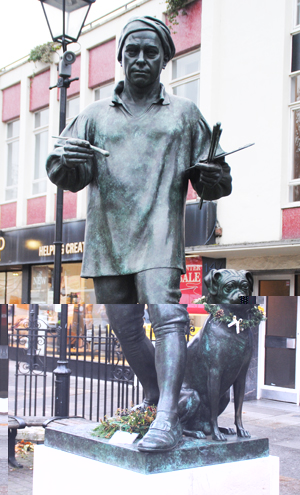
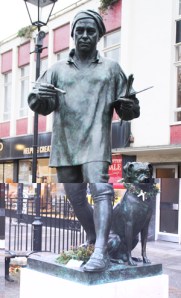
Hogarth’s legacy lies in the impact of his works which not only attacked some of the evils of his day but have since inspired countless artists and been adapted in all manner of artistic endeavours over the ensuring centuries. Hogarth’s works can still be seen at various galleries around town – including that of the Foundling Museum – and there is a fine statue of him and his pug dog, Trump, in Chiswick High Road (pictured) as well as a bust in Leicester Square.
Lost London: Gates Special – Aldgate

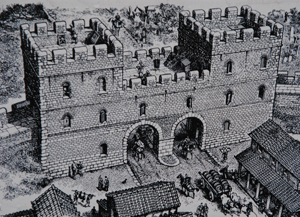
Once the eastern-most gateway into London, Aldgate is another of London’s gates which dates from Roman times.

The gate, which stood over the short street in the City now simply known as Aldgate, was rebuilt several times during the Middle Ages before, thanks again to the need for road widening, it was demolished in 1761.

Some sections of the gate were apparently taken to Bethnel Green, just to the east, where they were rebuilt as an addition to a 17th century mansion known as Aldgate House.

The name Aldgate is generally thought to mean ‘Old Gate’ but alternative theories suggest it derives from ‘Ale Gate’ (a connection with a local alehouse perhaps?) or ‘All Gate’ (that, is, all are free to enter).

The most famous person associated with the gate is the Middle English writer Geoffrey Chaucer – he lived in apartments above it for more than 10 years – from 1374 to 1386 – while working as a customs official.

Aldgate is also one of the wards of the City of London.

PICTURE: An artist’s impression of how Roman Aldgate may have looked as seen on a plaque marking the site of the former gate (part of a series of plaques on the former London Wall Walk).

10 curiously named churches of London – 6. St Katharine Cree

Contrary to what some may, St Katharine Cree is not named after a person of that name (or at least not entirely). St Katherine, certainly, but the addition of ‘Cree’ is simply a medieval corruption of ‘Christ Church’.

The name Christ Church, abbreviated to Cree, was applied to this church because it was the prior of the Augustinian Priory of the Holy Trinity in Aldgate, also known as Christ Church, who founded St Katharine Cree in 1280 for the use of the area’s parishioners (apparently their use of the priory church was causing problems).

The current building dates from 1630 (although the tower dates from 1504), making it the only surviving Jacobean church in London.

It  was consecrated by William Laud, then Bishop of London (and later beheaded for, among other things, his support of King Charles I). He is commemorated in one of the church’s chapels.

Unlike so many other of London’s churches, St Katharine Cree was not destroyed in the Great Fire of London and only suffered minor damage in the Blitz. But structural problems meant it did need substantial restoration in the 1960s.

Inside, is a mid 17th century font and stained glass dating from the same era which depicts a Catherine wheel (St Katherine/Catherine is said to have died strapped to a spiked wheel when martyred during the time of the Roman Empire.).

There is also a rose window which was modelled on that of old St Paul’s Cathedral (before it was destroyed by the Great Fire). Parts of the organ, which was restored in the early Noughties, date from the 17th century and the original was played by none other than George Frideric Handel and Henry Purcell. The six bells were restored in 2009 following an appeal.

Among those buried at St Katharine Cree are Sir Nicholas Throckmorton, a 16th century diplomat (his monument is inside), and the artist Hans Holbein the Younger (his grave is also claimed by St Andrew Undershaft).

The church today has no parish but is the Guild Church to Finance, Commerce and Industry (its rector is that of St Olave Hart Street). Among its annual events is the Lion Sermon given in October, a tradition that dates back to 1643 and owes its origins to the former Lord Mayor of London, Sir John Gayer, who decided to finance the sermon after he survived an encounter with a lion in Syria.

WHERE: Leadenhall Street, London (nearest Tube stations are Aldgate and Tower Hill); WHEN: See website for service timesCOST: Free; WEBSITE: www.sanctuaryinthecity.net/St-Katharine-Cree.html.

LondonLife – New Year’s Day Parade 2012

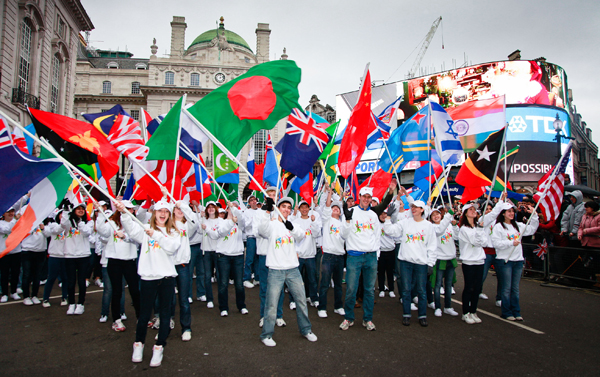
More than 8,500 performers – including those pictured celebrating the launch of London’s Olympic year – took part in this year’s New Year’s Day Parade in London, the wettest in the event’s 26 year history. But the wild weather didn’t put off the more than 500,000 people who turned out to watch the parade as it made its way from the starting point outside the Ritz Hotel in Piccadilly via Trafalgar Square to Parliament Square. As many as 19 London boroughs submitted entries in a competition based on the themes of the Olympics and the Queen’s Diamond Jubilee with Merton (its entry ‘From Horsepower To High Speed Rail’ featured animatronics) and the City of Westminster (its entry ‘Peter Pan’ involved a giant galleon and the The Sylvia Young Theatre School) announced as joint winners. For more on the parade, see www.londonparade.co.uk.

IMAGE: Courtesy of www.londonparade.co.uk

Happy New Year!


Wishing all Exploring London’s readers a very happy start to 2012!

PICTURE: London fireworks, 2011 © Sung Kik Kim (www.istockphoto.com)

Exploring London’s 10 most popular posts for 2011 – Numbers 2 and 1…

And so we come to it – the most popular posts on Exploring London this year – one of which is perhaps surprising, the other of which not!

2. Treasures of London – The Cheapside Hoard: A look at the “greatest find of Jacobean and Elizabethan jewellery ever made”, much of which is now held at the Museum of London;

1. The Royal Wedding – Eight curious facts about Royal Weddings past and present: Perhaps not a surprising winner, given the worldwide interest in 2011’s Royal Wedding, this post looked at some of the stranger facts surrounding royal weddings in Britain in the relatively recent past.

And that brings our countdown to an end. Our usual coverage resumes next week…

Exploring London’s 10 most popular posts for 2011 – Numbers 4 and 3…

We’re getting down to the pointy end of the countdown now. Here’s numbers four and three in Exploring London’s list of our most popular posts for 2011…

4. Curious London Memorials – 4. The Suffragette MemorialOne of our series on curious London memorials, this looked at a memorial in St James, erected in the 1970s to mark the contribution of those who fought for women’s right to vote;

3. The Royal Wedding – London’s royal reception venue: Another of our Royal Wedding themed posts, this looked at the history of Buckingham Palace, location of the reception which took place after the wedding of Prince William and Kate Middleton, now the Duchess of Cambridge.

Exploring London’s 10 most popular posts for 2011 – Numbers 6 and 5…

The countdown of our 10 most popular posts for 2011 continues with numbers six and five…

6. The Royal Wedding – A view from The Mall: Another Royal Wedding entry, this post from April was all about the glamour and excitement of the day itself as we joined the crowds lining The Mall;

5. Treasures of London – The Whispering Gallery, St Paul’s Cathedral: One of London’s star sights, the Whispering Gallery at St Paul’s has long held a fascination for visitors and Londoners alike.

Exploring London’s 10 most popular posts for 2011 – Numbers 8 and 7…

Our countdown continues with numbers 8 and 7…

8. Where’s London’s oldest…outdoor statue? – A somewhat controversial post for some, this talks about London’s oldest full-length statue – that of King Alfred the Great in Trinity Square as well as referencing some of the other oldest statues in the city;

7. The Royal Wedding – London’s Royal Wedding Venues – Part of our coverage of the marriage of Prince William and Kate Middleton (now the Duchess of Cambridge) in April, this looks at where royal weddings have taken place in the past, including Westminster Abbey.

Exploring London’s 10 most popular posts for 2011 – Numbers 10 and 9…

As we approach the end of the year, we’re taking a look back at our 10 most popular posts for 2011. We start the countdown with numbers 10 and 9…

10. LondonLife – The Royal Menageriein which, inspired by what was a new exhibition at the Tower of London, we take at the Royal Menagerie kept there by England’s monarchs for more than 600 years;

9. Treasures of London – Admiral Lord Nelson’s coat: part of a series looking at some of the many, many ‘treasures’ of London, this piece focused on the coat which Admiral Lord Nelson when he was fatally shot aboard the HMS Victory during the Battle of Trafalgar and which can now be seen at the National Maritime Museum in Greenwich (complete with bullet hole).

Stay tuned by numbers 8 and 7 tomorrow. We love to hear from you if there was a particular post that was your favorite. Leave your comment below…

Merry Christmas!

Wishing all Exploring London’s readers a Merry Christmas and Happy New Year!

Keep an eye out next week for our retrospective countdown looking at our 10 most popular posts of 2011!

PICTURE: Detail of Christmas decorations in Regent Street.

Around London – Lloyd’s gets Grade I; 700,000 historic items online in NT database; and, introducing the Silverdale Hoard…

London’s iconic Lloyd’s Building (also known as the ‘inside out’ building thanks to a design in which utility pipes, lifts and stairways are exposed on the outside) has been listed as a Grade I building, becoming the youngest building to be granted such status. John Penrose, Minister for Tourism and Heritage, made the decision following advice from English Heritage. Roger Bowdler, English Heritage’s designation director, said he was “delighted” at the decision. “Its listing at the highest grade is fitting recognition of the sheer splendour of Richard Rogers’s heroic design. Its dramatic scale and visual dazzle, housing a hyper-efficient commercial complex, is universally recognised as one of the key buildings of the modern epoch.” The futuristic-looking building is one of very few post war buildings to be protected with a Grade I listing. Construction of the tower started in 1981 and was largely completed by May 1984. It was occupied two years later. As well as its futuristic exterior, the building also features a nod to the past with the Adam Room, which dates from the 1760s and was moved here intact from which was moved from Bowood House in Wiltshire. The building is also home to the Lutine Bell, which comes from a French frigate captured by the British in 1793, and was rung to herald important announcements (today these are generally only ceremonial). The history of Lloyd’s goes back to 1688 when it’s believed the first Lloyd’s Coffee House opened in Tower Street.

• More than 700,000 objects in the care of the National Trust can be accessed virtually via a new online database. The database, accessed via www.nationaltrustcollections.org.uk contains details of more than 700,000 objects – everything from artworks by Gainsborough to a laudanum bottle containing remnants of poison and the cotton underwear of a grocer – currently housed at more than 200 properties as well as in storage or on loan to other organisations. Highlights include a costume made from beetle wings for the actress Ellen Terry, an early anti-aging ‘machine’, a furnished Victorian dolls house from Uppark House in West Sussex, and a Bible reputed to have been used at the execution of King Charles I from Chastleton House in Gloucestershire. The database has been in development for 15 years and the work to develop it will continue.

A 1,100-year-old collection of Viking Age objects including silver arm-rings and brooch fragments and coins from the Silverdale Hoard – found in Silverdale, Lancashire, in September – has gone on display in room 2 of the British Museum until early in the New Year. Among the 200 objects in the hoard is a type of coin not seen before and bears the inscription Airdeconut which appears to be an early attempt to represent the name Harthacnut. Lancaster City Museum has reportedly expressed an interest in acquiring the hoard. For more, see www.britishmuseum.org.

10 curiously named churches of London – 5. St Magnus the Martyr

St Magnus the Martyr has to be one of the most oddly dedicated churches in London. Indeed, for many years there was confusion over which St Magnus it was dedicated to – candidates including  a second and a third century martyr and a Viking who was slain in the Orkney Isles around 900 years ago.

Revived interest in the latter St Magnus in the early 20th century thanks to the discovery of his remains hidden in a pillar in the Orkney ‘capital’ of Kirkwall , however, led to a confirmation of the church’s dedication in 1924.

There is believed to have been a church on the site since Roman times (a fact which has contributed to the confusion over it’s more recent dedication) but its first known mention as that of St Magnus is shortly after the Norman Conquest.

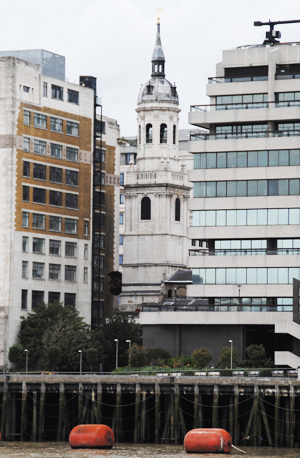
The church’s location, on the approach to London Bridge (see the picture, right, of the church tower overlooking the Thames), meant it occupied an important place in the life of medieval London. Following the Reformation, the patronage of the church was held alternately by the Abbey of Bermondsey and the Abbot and Convent of Westminster – this later passed into the hands of the Bishop of London, Edmund Grindall, and it was he who appointed the church’s most famous rector, Miles Coverdale, best remembered today as a Bible translator (there is a large monument to him in the church).

The church had been repaired in the early 17th century but was destroyed completely in the Great Fire of 1666. It was subsequently rebuilt to the designs of the ubiquitous Sir Christopher Wren.

A fire in 1760 did considerable damage to Wren’s building but it was restored and improvements continued to be made on a sporadic basis until 1831 when Sir John Rennie’s new London Bridge was opened and the old bridge demolished, meaning St Magnus no longer occupied the ‘gateway’ position it had for centuries prior.

The church only received relatively minor damage during World War II when a bomb struck London Bridge but was later restored. Features of the church now include the exterior clock, which dates from 1700, and a piece of wood believed to have one formed part of the Roman wharf which has been placed under the porch.

Among those buried at St Magnus’ during medieval times were Henry Yevele, master mason to King Edward III and King Richard II (his monument was destroyed in 1666). The church still has connections to the Fishmonger’s Company and the Plumber’s Company.

WHERE: Lower Thames Street, London (nearest Tube stations are Monument and London Bridge); WHEN: 10am to 4pm Tuesday to FridayCOST: Free; WEBSITE: www.stmagnusmartyr.org.uk.